Hedges: The Pimps of War

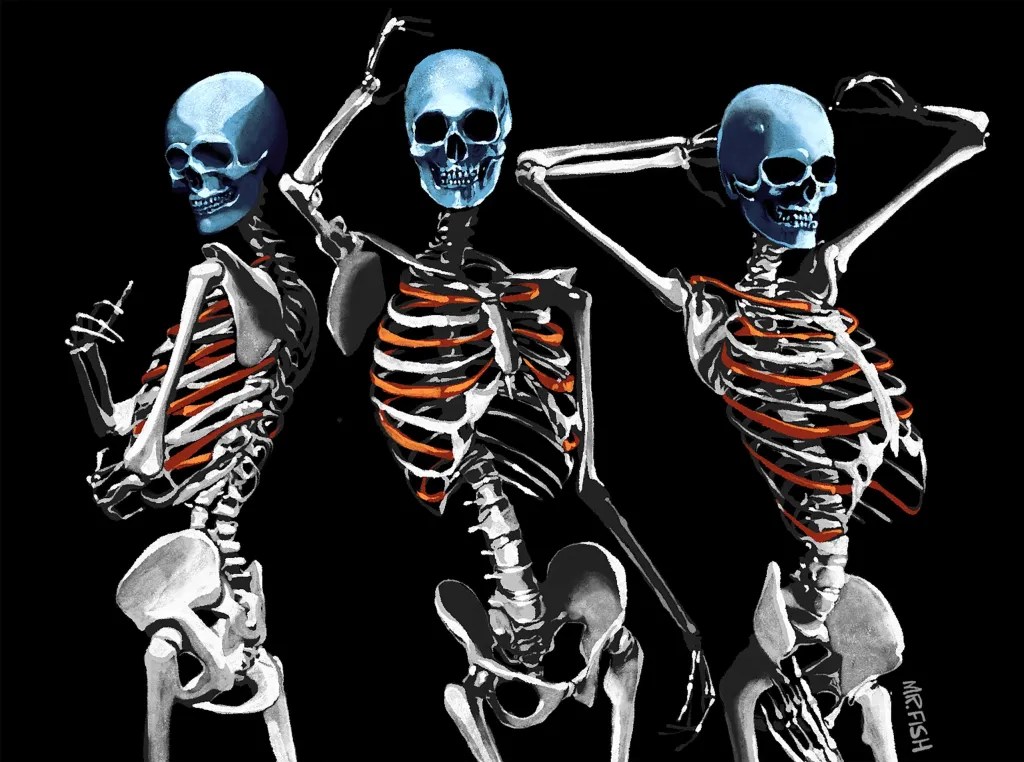
Whores of War, original illustration by Mr. Fish.

The coterie of neocons and liberal interventionists who orchestrated two decades of military fiascos in the Middle East and who have never been held to account are now stoking a suicidal war with Russia.

By Chris Hedges

Source: ScheerPost.com

The same cabal of warmongering pundits, foreign policy specialists and government officials, year after year, debacle after debacle, smugly dodge responsibility for the military fiascos they orchestrate. They are protean, shifting adroitly with the political winds, moving from the Republican Party to the Democratic Party and then back again, mutating from cold warriors to neocons to liberal interventionists. Pseudo intellectuals, they exude a cloying Ivy League snobbery as they sell perpetual fear, perpetual war, and a racist worldview, where the lesser breeds of the earth only understand violence. 

They are pimps of war, puppets of the Pentagon, a state within a state, and the defense contractors who lavishly fund their think tanks — Project for the New American Century, American Enterprise Institute, Foreign Policy Initiative, Institute for the Study of War, Atlantic Council and Brookings Institution. Like some mutant strain of an antibiotic-resistant bacteria, they cannot be vanquished. It does not matter how wrong they are, how absurd their theories, how many times they lie or denigrate other cultures and societies as uncivilized or how many murderous military interventions go bad. They are immovable props, the parasitic mandarins of power that are vomited up in the dying days of any empire, including ours, leaping from one self-defeating catastrophe to the next.

I spent  20 years as a foreign correspondent reporting on the suffering, misery, and murderous rampages these shills for war engineered and funded. My first encounter with them was in Central America. Elliot Abrams — convicted of providing misleading testimony to Congress on the Iran-Contra Affair and later  pardoned by President George H.W. Bush so he could return to government to sell us the Iraq War — and Robert Kagan, director of the State Department’s public diplomacy office for Latin America — were propagandists for the brutal military regimes in El Salvador and Guatemala, as well as the rapists and homicidal thugs that made up the rogue Contra forces fighting the Sandinista government in Nicaragua, which they illegally funded. Their job was to discredit our reporting.

They, and their coterie of fellow war lovers, went on to push for the expansion of NATO in Central and Eastern Europe after the fall of the Berlin Wall, violating an agreement not to extend NATO beyond the borders of a unified Germany and recklessly antagonizing Russia. They were and are cheerleaders for the apartheid state of Israel, justifying its war crimes against Palestinians and myopically conflating Israel’s interests with our own. They advocated for air strikes in Serbia, calling for the US to “take out” Slobodan Milosevic. They were the authors of the policy to invade Afghanistan, Iraq, Syria and Libya. Robert Kagan and William Kristol, with their typical cluelessness, wrote in April 2002 that “the road that leads to real security and peace” is “the road that runs through Baghdad.”

We saw how that worked out. That road led to the dissolution of Iraq, the destruction of its civilian infrastructure, including the obliteration of 18 of 20 electricity-generating plants and nearly all the water-pumping and sanitation systems during a 43-day period when 90,000 tons of bombs were rained down on the country, the rise of radical jihadist groups throughout the region, and failed states. The war in Iraq, along with the humiliating defeat in Afghanistan, shredded the illusion of US military and global hegemony. It also inflicted on Iraqis, who had nothing to do with the attacks of 9/11, the widespread killing of civilians, the torture and sexual humiliation of Iraqi prisoners, and the ascendancy of Iran as the preeminent power in the region. They continue to call for a war with Iran, with Fred Kagan stating that “there is nothing we can do short of attacking to force Iran to give up its nuclear weapons.” They pushed for the overthrow of President Nicholas Maduro, after trying to do the same to Hugo Chavez, in Venezuela. They have targeted Daniel Ortega, their old nemesis in Nicaragua.

They embrace a purblind nationalism that prohibits them from seeing the world from any perspective other than their own. They know nothing about the machinery of war, its consequences, or its inevitable blowback. They know nothing about the peoples and cultures they target for violent regeneration. They believe in their divine right to impose their “values” on others by force. Fiasco after fiasco. Now they are stoking a war with Russia.

“The nationalist is by definition an ignoramus,” Yugoslav writer Danilo Kiš observed. “Nationalism is the line of least resistance, the easy way. The nationalist is untroubled, he knows or thinks he knows what his values are, his, that’s to say national, that’s to say the values of the nation he belongs to, ethical and political; he is not interested in others, they are no concern of his, hell — it’s other people (other nations, another tribe). They don’t even need investigating. The nationalist sees other people in his own images — as nationalists.”

The Biden administration is filled with these ignoramuses, including Joe Biden. Victoria Nuland, the wife of Robert Kagan, serves as Biden’s undersecretary of state for political affairs. Antony Blinken is secretary of state. Jake Sullivan is national security advisor. They come from this cabal of moral and intellectual trolls that includes Kimberly Kagan, the wife of Fred Kagan, who founded The Institute for the Study of War, William Kristol, Max Boot, John Podhoretz, Gary Schmitt, Richard Perle, Douglas Feith, David Frum, and others. Many were once staunch Republicans or, like Nuland, served in Republican and Democratic administrations. Nuland was the principal deputy foreign policy adviser to Vice President Dick Cheney. 

They are united by the demand for larger and larger defense budgets and an ever expanding military. Julian Benda called these courtiers to power “the self-made barbarians of the intelligentsia.”

They once railed against liberal weakness and appeasement. But they swiftly migrated to the Democratic Party rather than support Donald Trump, who showed no desire to start a conflict with Russia and who called the invasion of Iraq a “big, fat mistake.” Besides, as they correctly pointed out, Hillary Clinton was a fellow neocon. And liberals wonder why nearly half the electorate, who revile these arrogant unelected power brokers, as they should, voted for Trump.

These ideologues did not see the corpses of their victims. I did. Including children. Every dead body I stood over in Guatemala, El Salvador, Nicaragua, Gaza, Iraq, Sudan, Yemen or Kosovo, month after month, year after year, exposed their moral bankruptcy, their intellectual dishonesty, and their sick bloodlust.  They did not serve in the military. Their children do not serve in the military. But they eagerly ship young American men and women off to fight and die for their self-delusional dreams of empire and American hegemony. Or, as in Ukraine, they provide hundreds of millions of dollars in weaponry and logistical support to sustain long and bloody proxy wars.

Historical time stopped for them with the end of World War II. The overthrow of democratically elected governments by the US during the Cold War in Indonesia, Guatemala, the Congo, Iran and Chile (where the CIA oversaw the assassination of the commander-in-chief of the army, General René Schneider, and President Salvador Allende), the Bay of Pigs, the atrocities and war crimes that defined the wars in Vietnam, Cambodia, and Laos, even the disasters they manufactured in the Middle East, have disappeared into the black hole of their collective historical amnesia. American global domination, they claim, is benign, a force for good, “benevolent hegemony.” The world, Charles Krauthammer insisted, welcomes “our power.” All enemies, from Saddam Hussein to Vladimir Putin, are the new Hitler. All US interventions are a fight for freedom that make the world a safer place. All refusals to bomb and occupy another country are a 1938 Munich moment, a pathetic retreat from confronting evil by the new Neville Chamberlain. We do have enemies abroad. But our most dangerous enemy is within.

The warmongers build a campaign against a country such as Iraq or Russia and then wait for a crisis — they call it the next Pearl Harbor — to justify the unjustifiable. In 1998, William Kristol and Robert Kagan, along with a dozen other prominent neoconservatives, wrote an open letter to President Bill Clinton denouncing his policy of containment of Iraq as a failure and demanding that he go to war to overthrow Saddam Hussein. To continue the “course of weakness and drift,” they warned, was to “put our interests and our future at risk.” Huge majorities in Congress, Republican and Democrat, rushed to pass the Iraq Liberation Act. Few Democrats or Republicans dared be seen as soft on national security. The act stated that the United States government would work to “remove the regime headed by Saddam Hussein” and authorized $99 million towards that goal, some of it being used to fund Ahmed Chalabi’s Iraqi National Congress that would become instrumental in disseminating the fabrications and lies used to justify the Iraq war during the administration of George W. Bush.

The attacks of 9/11 gave the war party its opening, first with Afghanistan, then Iraq. Krauthammer, who knows nothing about the Muslim world, wrote that “the way to tame the Arab street is not with appeasement and sweet sensitivity but with raw power and victory…The elementary truth that seems to elude the experts again and again…is that power is its own reward. Victory changes everything, psychologically above all. The psychology in the [Middle East] is now one of fear and deep respect for American power. Now is the time to use it.” Removing Saddam Hussein from power, Kristol crowed, would “transform the political landscape of the Middle East.”  

It did, of course, but not in ways that benefited the US.

They lust for apocalyptic global war. Fred Kagan, the brother of Robert, a military historian, wrote in 1999 that “America must be able to fight Iraq and North Korea, and also be able to fight genocide in the Balkans and elsewhere without compromising its ability to fight two major regional conflicts. And it must be able to contemplate war with China or Russia some considerable (but not infinite) time from now [author’s emphasis].”

They believe violence magically solves all disputes, even the Israeli-Palestinian morass. In a bizarre interview immediately after 9/11, Donald Kagan, the Yale classicist and rightwing ideologue who was the father of Robert and Fred, called, along with his son Fred, for the deployment of US troops in Gaza so we could “take the war to these people.” They have long demanded the stationing of NATO troops in Ukraine, with Robert Kagan saying that “we need to not worry that the problem is our encirclement rather than Russian ambitions.”  His wife, Victoria Nuland, was outed in a leaked phone conversation in 2014 with the US Ambassador to Ukraine, Geoffrey Pyatt, disparaging the EU and plotting to remove the lawfully elected President Viktor Yanukovych and install compliant Ukrainian politicians in power, most of whom did eventually take power. They lobbied for US troops to be sent to Syria to assist “moderate” rebels seeking to overthrow Basha al-Assad. Instead, the intervention spawned the Caliphate. The US ended up bombing the very forces they had armed, becoming Assad’s de facto air force.

The Russian invasion of Ukraine, like the attacks of 9/11, is a self-fulfilling prophecy. Putin, like everyone else they target, only understands force. We can, they assure us, militarily bend Russia to our will.

“It is true that acting firmly in 2008 or 2014 would have meant risking conflict,” Robert Kagan wrote in the latest issue of Foreign Affairs of Ukraine, lamenting our refusal to militarily confront Russia earlier. “But Washington is risking conflict now; Russia’s ambitions have created an inherently dangerous situation. It is better for the United States to risk confrontation with belligerent powers when they are in the early stages of ambition and expansion, not after they have already consolidated substantial gains. Russia may possess a fearful nuclear arsenal, but the risk of Moscow using it is not higher now than it would have been in 2008 or 2014, if the West had intervened then. And it has always been extraordinarily small: Putin was never going to obtain his objectives by destroying himself and his country, along with much of the rest of the world.”

In short, don’t worry about going to war with Russia, Putin won’t use the bomb.

I do not know if these people are stupid or cynical or both. They are lavishly funded by the war industry. They are never dropped from the networks for their repeated idiocy. They rotate in and out of power, parked in places like The Council on Foreign Relations or The Brookings Institution, before being called back into government. They are as welcome in the Obama or Biden White House as the Bush White House. The Cold War, for them, never ended. The world remains binary, us and them, good and evil. They are never held accountable. When one military intervention goes up in flames, they are ready to promote the next. These Dr. Strangeloves, if we don’t stop them, will terminate life as we know it on the planet.
The Facebook Team that Tried to Swing Nicaragua’s Election is Full of U.S. Spies

A tacit agreement between the government and Facebook appears to have been made: you can keep the profits, but we control the message. As such, a cynic might wonder what functional difference there is between Facebook and the national security state.

By Alan Macleod

Source: Mint Press News

MANAGUA, NICARAGUA — Less than a week before Nicaragua’s presidential election, social media giant Facebook deleted the accounts of hundreds of the country’s top news outlets, journalists and activists, all of whom supported the ruling left-wing Sandinista government, a top Washington target for regime change.

Facebook claims that these accounts were bots engaged in “inauthentic behavior.” Considering that around half of the country uses the platform for news and entertainment, the decision could barely have been more heavy-handed and intrusive. However, early reports show that if their goal was to swing the result, it has failed badly and the Sandinistas have achieved an overwhelming victory.

“This is appalling interference by Facebook in particular (which is the most popular social media outlet in Nicaragua). They allege that they’ve stopped a government-deployed troll farm but what they have actually done is to close accounts of ordinary Sandinista activists, particularly young people, often with many followers,” John Perry, a journalist living in the city of Masaya, told MintPress.

Worse still, after dozens of Sandinistas took to Twitter to record video messages proving they were real people being censored, their accounts were systematically deleted as well, in what Managua-based journalist Ben Norton described as a Silicon Valley “double-tap strike.”

“These are accounts that average Nicaraguans have come to count on for news and communicating with each other about current events and, in this case, about the election. So it is very troubling that it was obviously targeted against one political group: the Sandinistas,” said Daniel Kovalik, a human-rights lawyer and an observer of this weekend’s elections.

Both Perry and Kovalik were of the opinion that it was no coincidence that Facebook had taken action against precisely the group the U.S. government is trying to overthrow.

Facebook as security-state beard

Perhaps even more worrying from a freedom-of-speech viewpoint is who made the decision at Facebook. The 11-page report detailing the company’s supposed evidence of inauthentic behavior has just two contributors: Luis Fernando Alonso and Ben Nimmo, individuals with deep and long-lasting ties to Western military intelligence. According to his biography on LinkedIn, Alonso was, until last year, working for Booz Allen Hamilton, a shadowy corporation situated in the area around Washington, D.C. colloquially known as “Raytheon Acres.” The national security state farms out much of its most controversial work to the firm, which is technically a private company (and therefore not subject to the same oversight and scrutiny as public agencies). Edward Snowden, for instance, actually worked for Booz Allen Hamilton, not the NSA. Before that, Alonso directly worked for the government at the William J. Perry Center for Hemispheric Defense Studies, a Department of Defense-controlled institution that trains top military and intelligence leaders.

Nimmo’s background is equally spooky. Between 2011 and 2014, he served as NATO’s press officer, moving the next year to the Institute for Statecraft, a U.K. government-funded propaganda operation aimed at spreading misleading information about enemies of the British state. The Institute for Statecraft established a secret network of journalists across Europe who were used to push anti-Russia and pro-establishment talking points, all in coordination.

In 2019, Nimmo played a key role in downplaying the bombshell news that the Conservative government was quietly negotiating to sell off key parts of Great Britain’s National Health Service (NHS) to foreign plutocrats. When the Labour Party publicized this information just days before the election, Nimmo jumped into action, immediately announcing, without evidence, that the documents in question “closely resemble … a known Russian operation.” His supposedly expert conjecture — together with help from allied journalists in the Integrity Initiative — allowed the story to become “Labour’s links to Russia” rather than “Tories privatizing the NHS in secret,” helping the Conservatives make huge electoral gains.

Nimmo also became a senior fellow at the Atlantic Council, NATO’s semi-official think tank.

Facebook — now officially called “Meta” — is extremely secretive about who actually works at their intelligence department. Nowhere can one find a list of names of key figures. However, going back through months of reports and blog posts for names reveals a veritable revolving door between big tech and big government. In short, Facebook is strewn with spies.

For example, a document published in May, entitled “The State of Influence Operations, 2017-2020,” lists five author names in addition to Nimmo’s, at least four of whom have long histories as senior agents in the national security state.

In order, they are:

  • Nathaniel Gleicher, Head of Security Policy: Gleicher spent two and a half years at the White House as the National Security Council’s Director of Cyber Security Policy. Before that he also spent five years at the Department of Justice.
  • David Agranovich, Head of Security Communications: Agranovich worked for more than six years in a senior role at the Department of Defense, before, in 2017, moving on to become the Director for Intelligence for the National Security Council at the White House.
  • Olga Belogolova, Influence Operations Product Policy Manager: The most academic of the authors, Belogolova teaches cybersecurity and influence operations to students at Georgetown University, an institution notorious as America’s spy school. Before that, she worked at the State Department’s Bureau of European and Eurasian Affairs and on Russian, Ukrainian and Eurasian policy at the Office of the Secretary of Defense. She has also served on several working groups at government- and military-funded think tanks like The Center for New American Security, The Center for Strategic and International Studies, and The Atlantic Council.
  • Mike Torrey, Threat Intelligence Analyst: From 2010 until 2018, Torrey was a high-level CIA agent, specializing in cyberwarfare against China. Before that, he worked as a global network intelligence analyst for the NSA.

Of the six authors listed, only one, Margarita Franklin, comes from a non-governmental background.

Looking further into Facebook’s official blog, Mike Dvilyanski is described as the company’s Head of Cyber Espionage Investigations. From 2005 until 2018, Dvilyanski was an FBI agent in Washington and New York City, rising to the rank of Supervisory Special Agent, leading teams investigating cyberwafare.

Another official Facebook report from April was authored by the company’s Technical Threat Investigator, Michael Flossman, who spent nearly six years in the Australian Department of Defense.

In 2018, Facebook announced a partnership with The Atlantic Council, whereby it gave an undisclosed amount of control over users’ news feeds to the group, allowing it to help them decide what posts users saw and which ones were suppressed. Given that the council’s board features a plethora of military generals, former cabinet members, and no fewer than seven former CIA directors, this is tantamount to state censorship on a global level. A tacit agreement between the government and Facebook appears to have been made: you can keep the profits, but we control the message. As such, a cynic might wonder what functional difference there is between Facebook and the national security state.

Silicon Valley: tip of US imperial spear

It might be unfair, however, to single Facebook out. Other large platforms are similarly stocked with government plants. Reddit’s Director of Policy, for instance, was formerly a Deputy Director of The Atlantic Council’s Middle East Task Force. Meanwhile, a senior Twitter executive is also an active duty officer in the British Army’s psychological warfare and online propaganda brigade.

Silicon Valley has not only made their peace with this relationship; they actively court it. “What Lockheed Martin was to the twentieth century, technology and cyber-security companies will be to the twenty-first,” wrote Google executives Eric Schmidt and Larry Cohen in their book, “The New Digital Age,” laying out how they saw Silicon Valley becoming the tip of the American empire’s spear.

Washington has already used social media as a weapon aimed at its enemies. In July, Americans in Miami used Facebook to organize an attempted color revolution in Cuba, while Twitter ignored blatantly obvious bots boosting the anti-government message, even choosing to put it at the top of its “what’s happening” sidebar for 36 hours, meaning every user in the world was alerted to the news. Individuals inside Cuba complained to MintPress that the endless supply of fake news citizens receive from the U.S. via Facebook and WhatsApp is spreading disinformation and rotting Cubans’ brains.

Meanwhile, in 2009, the U.S. government persuaded Twitter to delay scheduled maintenance of its app because of widespread protests it was fomenting in Iran, knowing the platform was being used to coordinate anti-government forces. Last year, Facebook banned all positive references to Iranian general Qassem Soleimani in the wake of his assassination by the Trump administration. “We operate under U.S. sanctions laws, including those related to the U.S. government’s designation of the Iranian Revolutionary Guard Corps and its leadership,” the company said in a statement. Despite the fact that over 80% of the country held positive views towards the general (even before his killing), this meant that even Iranians speaking Farsi with other Iranians online in Iran could not share an overwhelmingly held view. This is but one example of the extraordinary power the U.S. national security state now holds over the means of communication worldwide.

Ineffective interference

The United States has a long history of interfering in Nicaragua, from invasions to propping up the 40-year Somoza family dictatorship. When Sandinista rebels ran them out of town in 1979, Washington began a long campaign of terror against the Sandinistas, including funding, training and arming the infamous Contra death squads. After more than a decade of interference, U.S.-backed candidate Violeta Chamorro won the 1990 election. However, after Daniel Ortega and the Sandinistas returned to power in 2006, the U.S. once again began trying to undermine their rule through sanctions and by supporting a 2018 coup attempt. Washington has also unleashed an army of NGOs into the country, each attempting to foment discontent with the ruling government.

In September, Secretary of State Anthony Blinken met in New York with the foreign ministers of Mexico and every other Central American country in an attempt to organize a united front against Nicaragua. Last week, the U.S. also announced new sanctions on the country. Kovalik told MintPress:

This is clearly punishment for the fact that they’re going to vote [the wrong way]. And meanwhile, of course the U.S. is putting millions into the country in terms of supporting opposition groups and different propaganda sources. So that continues. Again, what passes for alleged foreign interference in the U.S. …. is nothing compared to what the U.S. is doing here.

Western journalists and election observers whose opinions the U.S. government would rather not be shared have also been targeted. British journalist Steve Sweeney was detained in Mexico en route to Nicaragua. “It is no coincidence that it came just weeks after my ban from the U.S. I fully believe my detention is political and an attack on press freedom,” he wrote, after being released. Meanwhile, Canadian observer Dr. Timothy Bood was barred from sharing his experiences on Facebook, the platform blocking him immediately after he made a comment about U.S. interference in the election.

Perry suggested, however, that if Washington thinks that sanctions sanctions or other new measures will dislodge the government and break the people’s will, they are mistaken, and that the plan could backfire:

We had the approval in the U.S. Congress of the RENACER Act a few days ago, which is another threat of U.S. interference during and after the election process. I think opinion polls show that most people reject U.S. interference very strongly. I think in most cases it will strengthen people’s desire to vote and probably to vote for the Sandinista government. So it could have the opposite effect to the one that the U.S. wants to achieve.

Judging by the jubilant Sandinista parades in Managua and other cities today, coupled with the announcement that Ortega won an estimated three-quarters of the vote on a 65% turnout rate, Perry might have been proved right.

The New Normal “Reality” Police

By CJ Hopkins

Source:  Off-Guardian

So, according to Facebook and the Atlantic Council, I am now a “dangerous individual,” you know, like a “terrorist,” or a “serial murderer,” or “human trafficker,” or some other kind of “criminal.” Or I’ve been praising “dangerous individuals,” or disseminating their symbols, or otherwise attempting to “sow dissension” and cause “offline harm.”

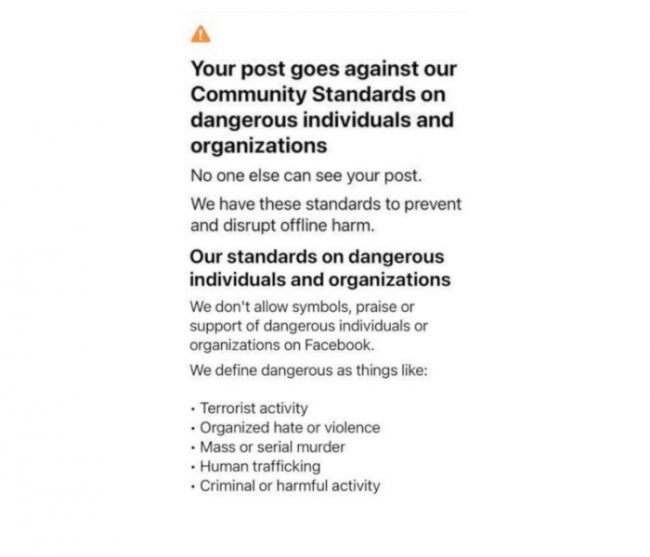
Actually, I’m not really clear what I’m guilty of, but I’m definitely some sort of horrible person you want absolutely nothing to do with, whose columns you do not want to read, whose books you do not want to purchase, and the sharing of whose Facebook posts might get your account immediately suspended. Or, at the very least, you’ll be issued this warning:

Now, hold on, don’t click away just yet. You’re already on whatever website you’re reading this “dangerous,” “terrorist” column on (or you’re reading it in an email, probably on your phone), which means you are already on the official “Readers of Mass-Murdering Content” watch-list. So you might as well take the whole ride at this point.

Also, don’t worry, I’m not going to just whine about how Facebook was mean to me for 2,000 words … well, all right, I’m going to do that a little, but mostly I wanted to demonstrate how “reality” is manufactured and policed by global corporations like Facebook, Twitter, Google, the corporate media, of course, crowdfunding platforms like Patreon and PayPal, and “think tanks” like the Atlantic Council and its Digital Forensic Research Lab (“DFRLab”).

First, though, let me tell you my Facebook story.

What happened was, I made a Facebook post, and a lot of people tried to share it, so Facebook and the DFRLab suspended or disabled their accounts, or just prevented them from sharing it, and sent them the above warning. Facebook didn’t suspend my account, or censor the post on my account, or contact me to let me know that they have officially deemed me a “dangerous individual.”

Instead, they punished anyone who tried to “boost” my “dangerous” post, a tactic anyone who has been through boot camp or in prison (or has watched this classic scene from Full Metal Jacket) will be familiar with.

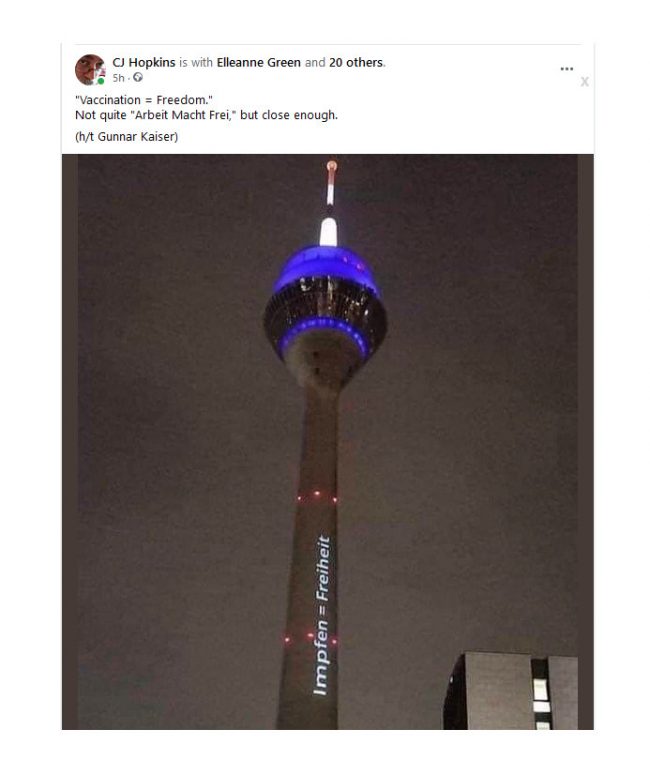
Here’s the “dangerous” post in question. (If you’re particularly sensitive to “terrorist” content, you may want to put on your “anti-terrorism” glasses, or take some other type of prophylactic measures to protect yourself from “offline harm,” before you venture any further.)

The photo, which I stole from Gunnar Kaiser, is of an art exhibit in Düsseldorf, Germany. My commentary is self-explanatory. As you can see, it is extremely “dangerous.” It literally radiates “offline harm.”

OK, before you write to inform me how this was just the work of a dumb Facebook algorithm, think about what I described above. If an algorithm was preventing sharing and suspending people’s accounts based on keyword spotting, it would have censored my original post, and presumably suspended my account.

Or, if Facebook has an algorithm that recognizes certain “dangerous” phrases, and then censors or suspends the accounts of people who share a post including those phrases, but doesn’t censor the original post or suspend the account of the author of the post…well, that’s kind of strange, isn’t it?

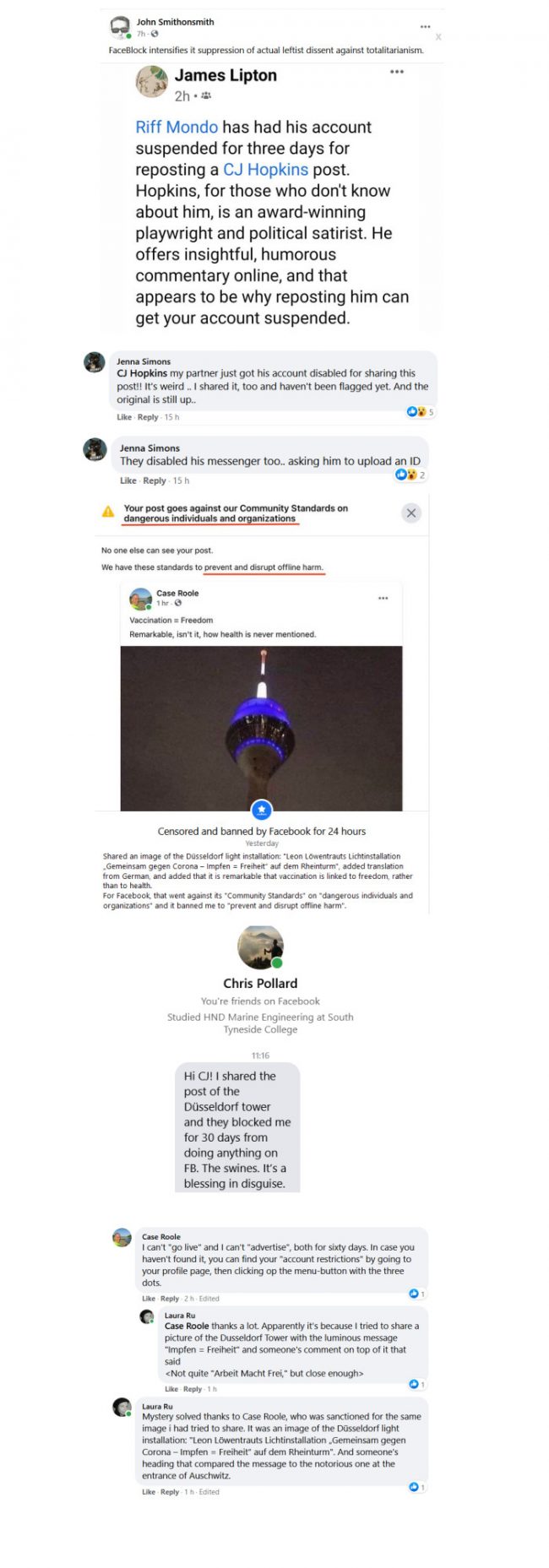
In any event, shortly after I posted it, I started seeing reports like this on Facebook:

Those are just a few examples, but I think you get the general idea.

The point is, apparently, the Corporatocracy feel sufficiently threatened by random people on Facebook that they are conducting these COINTELPRO-type ops. Seriously, think about that for a minute. I am not Stephen King or Margaret Atwood. I’m not even Glenn Greenwald or Matt Taibbi.

I’m a midlist-level author of unusual literature, and a political satirist, and a blogger, basically, and yet Facebook, and their partners at the Atlantic Council, and AstraZeneca, and Pfizer, and Moderna, and who knows which other global corporations and transnational, non-governmental entities like the WEF and WHO, consider someone of my lowly status enough of a threat to their “New Normal” narrative to warrant the attention of the Reality Police.

Now, let me be clear about who I’m talking about when I’m talking about the “Reality Police.” Facebook’s partnership with the Atlantic Council is only one example, but it is a rather good one. Here’s a quick profile of the Atlantic Council…

The Atlantic Council of the United States was founded in 1961 as a think tank and anticommunist public relations organization to prop up support within the US for NATO in the post-World War II era … [its] current, honorary and lifetime directors list reads like a bipartisan rogues gallery of American war-criminals, including Henry Kissinger, George P. Shultz, Frank Carlucci, James A. Baker, R. James Woolsey, Condoleezza Rice, Colin Powell, Robert Gates and Leon Panetta. Among the former Atlantic Council chairman have been Obama administration officials James L. Jones, (national security advisor) and Chuck Hagel (secretary of defense).

The chairman of the council is Brent Scowcroft, the retired US Air Force officer who held national security and intelligence positions in the Nixon, Bush I and Bush II administrations. [It] is funded by substantial government and corporate interests from the financial, defense and petroleum industries.

Its 2017 annual report documents substantial contributions from HSBC, Chevron, The Blackstone Group, Raytheon, Lockheed Martin and Ford Motor Company, among many others. Also listed is Google Inc. in the $100,000 to $250,000 donor category. Among the largest council contributors are the US State Department, The Foreign & Commonwealth Office of the UK, and the United Arab Emirates. Other contributors include Saudi Arabia, Qatar, Boeing, BP, Exxon and the US Army, Navy, Air Force and Marines.

– Kevin Reed, World Socialist Website

These are the folks that are policing “reality” (the “reality” they have manufactured, and are manufacturing moment by moment), deciding what officially happened, and didn’t happen, and what it means, and who qualifies as an “authoritative news source,” and “fact-checking” everything we see on the Internet. It’s not a bunch of pimply-faced IT nerds writing sloppy code in Menlo Park. It’s GloboCap and the Military-Industrial Complex.
If you’re one of my “New Normal” ex-friends and colleagues (or one of my Facebook or Twitter trolls) who, for some unknown reason, is still reading this column, perhaps on your way to get experimentally “vaccinated” or report one of your neighbors for not wearing a mask or being outdoors without a valid reason, this is who has manufactured your “reality” and the so-called “science” you claim I am “denying,” even as reality stares you in the face…

This did not begin with the “New Normal,” of course. Every system of power manufactures its own “reality” (totalitarian systems more fanatically than others). No, I’ve been writing about the manufacturing of “normality,” and the War on Dissent and Populism that GloboCap has been relentlessly waging on anyone and everyone opposing its hegemony or refusing to conform to its ideology, since back when I was still writing heretical columns like this for CounterPunch…before the editors saw which way the wind was blowing and ideologically purged its roster to get back into the good graces of GloboCap (following which ideological purge, Google restored it to the ranks of “real news”).

And that is how reality-policing works. It’s a bullying operation, basically. The entire “cancel culture” phenomenon is. “Cancel culture” is a silly name for it. We are talking about a global empire imposing total ideological conformity (or, in simpler terms, its version of “reality”) on the entire planet through fear and force. The Nazis referred to this process as Gleichschaltung.

Global capitalism has reached the stage where it no longer needs to tolerate dissent (any kind of dissent, from any quarter) to maintain the illusion of “freedom and democracy,” because there is no alternative to global capitalism. It is everywhere. There is nowhere to run or hide. When the Reality Police find you, and threaten to “cancel” you, you have two choices … obey or be vaporized.

If you’re a Palestinian, a Syrian, a Yemeni, the president of an uncooperative African country, or some other type of non-Western person, you might very well be physically vaporized. For Westerners, vaporization is less dramatic and final. You will simply be disappeared from the Internet, fired from your job, socially ostracized, deemed a “dangerous individual,” a “racist,” an “anti-Semite,” a “conspiracy theorist,” a “white supremacist,” a “domestic terrorist,” an “anti-vaxxer,” a “Covid denier.”

If you’re a member of the independent media, or a prominent activist, or a lawyer, or doctor, or just someone with a big social media platform, and have not seen the “New Normal” light, you will be demonized, demonetized, deplatformed, censored, and subjected to the type of creepy COINTELPRO-type tactics I described above.

If you don’t believe me, just ask Robert F. KennedyRainer FuellmichVanessa BeeleyWhitney WebbJames CorbettKen JebsenCory MorningstarThe Last American VagabondGeopolitics & EmpireThe Centre for Research on GlobalizationOffGuardian, and countless other people and outlets that have challenged the official “New Normal” narrative.

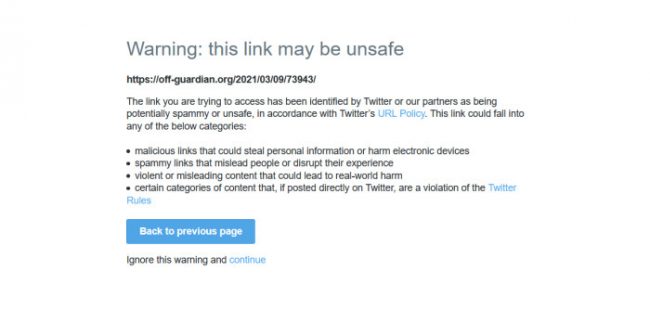
Or have a look at this “warning” you get on Twitter if you attempt to read anything published by OffGuardian …

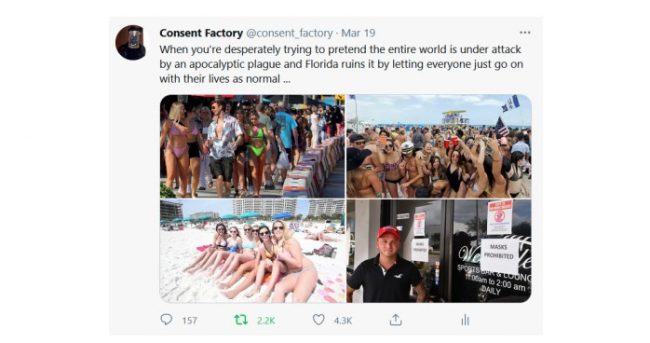
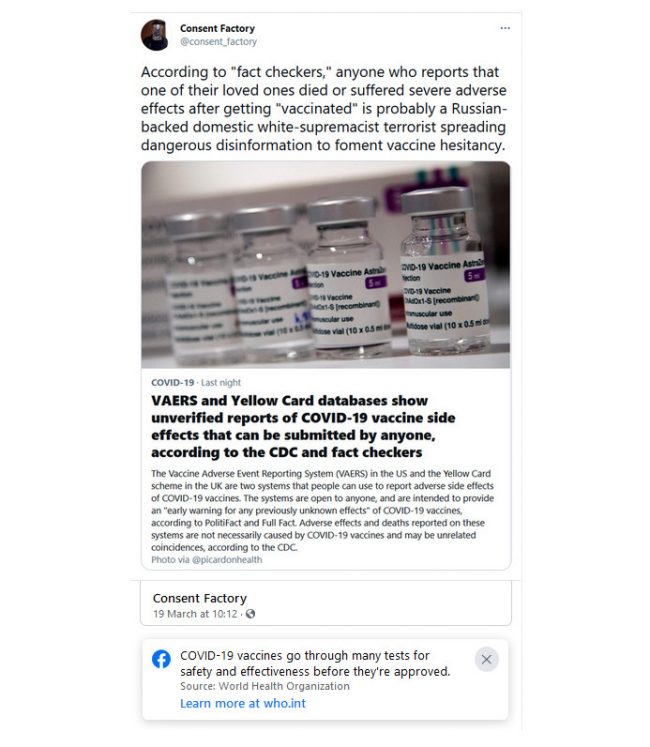
I could go on and on with this, and I’m sure I will in future columns. It’s kind of the only story at the moment, the changeover from simulated democracy to pathologized-totalitarianism as the governing structure of global capitalism. For now, I’ll just leave you with one more image in this already overly pictorial column. Don’t worry, it’s been thoroughly “fact-checked,” so there’s no need to read or question the fine print (even though I have a feeling you will)…

Do watch out for those “unrelated coincidences.” Some of them, I hear, can be rather nasty.

Facebook hires ex-NATO press officer and social media censor Ben Nimmo as intel strategist

By Alan Macleod

Source: The Grayzone

Ben Nimmo, a former NATO press officer and current senior fellow at the Atlantic Council, has announced Facebook has hired him to “lead global threat intelligence strategy against influence operations” and “emerging threats.” Nimmo specifically named Russia, Iran and China as potential dangers to the platform.

His announcement was greeted with joy by several NATO officials but was not met with such enthusiasm by others. “More censorship on the way as the former NATO press officer turned Pentagon-funded ‘researcher’ who labeled real people as Russian bots and peddled disinformation to link Jeremy Corbyn to Russian active measures moves to big tech,” responded investigative journalist Max Blumenthal.

Nimmo’s questionable past certainly raises questions over whether such an official having a substantial say in what 2.8 billion Facebook users worldwide see in their feeds is such a positive step for the free and open exchange of information.

“Disinformation agents”

For example, in 2019, U.K. Labour Party leader Jeremy Corbyn revealed secret Conservative Party documents showing negotiations the Tory government had with the U.S. over the privatization of the National Health Service (NHS). With just days to go before the U.K. general election, the scandal could have toppled the government and brought into power the most radical antiwar, anti-establishment government in the country’s history. Corporate media went into overdrive to spin the news, and Nimmo was a key part of this, immediately announcing, without evidence, that the documents “closely resemble…a known Russian operation.” His supposedly expert conjecture allowed the story to become “Corbyn’s links to Russia” rather than “Tories privatizing the NHS in secret.” Nimmo’s work helped the Conservatives to an election victory and consigned Corbyn to the scrapheap.

This was much to the relief of Nimmo’s Atlantic Council, who had branded Corbyn the “Kremlin’s Trojan Horse” — someone pushing Moscow’s agenda abroad. A British Army general was of a similar opinion, claiming that if Corbyn were to win the election, the military would respond. Secretary of State Mike Pompeo also said that the U.S. government was “doing its best” to prevent a radical leftist from winning power in the U.K.

Nimmo has been extremely liberal with whom he labels Russian disinformation agents. In 2018, his research identified one Twitter user, @Ian56789, as a “Kremlin troll.” In reality, the user, Ian Shilling, was a British pensioner, as Sky News was easily able to confirm, interviewing him on air and asking him the patently absurd question if he was actually a Russian bot or not. Despite clearly being a flesh and blood human, Shilling’s account was later deleted anyway.

In the past, Nimmo has also insisted that Valentina Lisitsa was an influential Russian bot. In reality, she is an internationally known concert pianist, as one Google search would have shown. This sort of behavior does not augur well for those critical of Western foreign policy, who have faced constant harassment, suspension, or outright bans from social media.

https://twitter.com/ValLisitsa/status/978559232508416000

Pro-war putsch

The Atlantic Council began as an offshoot of NATO itself and maintains extremely close connections to the military alliance. It continues to receive major funding from Western governments and weapons contractors, and its board of directors is filled to the brim with former American foreign policy officials such as Colin Powell, Condoleezza Rice, and Henry Kissinger. Also appearing on the board are no fewer than seven former CIA directors and a number of top military generals, such as Jim “Mad Dog” Mattis, Wesley Clark, and David Petraeus.

In recent years, the council’s employees have penetrated deep into big tech and social media organizations. In 2018, it announced it had partnered with Facebook to aid in the curation of Facebook news feeds of users worldwide, giving it considerable power over what sort of views to highlight and which to demote. One year previously, Jessica Ashooh left the position of the council’s Deputy Director of Middle Eastern Strategy to take the position of Director of Policy at Reddit, the eighth-most visited website in the United States. However, as with many intelligence agencies, it is unclear whether one truly “leaves” the Atlantic Council.

It is not just Russia that is in NATO’s crosshairs. Last week, the Atlantic Council published an anonymous, 26,000-word report stating that their goal for China was regime change and advising President Biden to draw a number of “red lines” around it, beyond which the U.S. would respond militarily. Meanwhile, the head of STRATCOM, Admiral Charles A. Richard, wrote that the U.S. must prepare for a potential nuclear war with Beijing.

Greater control

The military escalation has been mirrored by an intensifying online propaganda war, where the U.S. has attempted to isolate China economically and stop advancing Chinese technologies such as Huawei’s 5G network, mobile phone, and semiconductor manufacturer Xiaomi, and video sharing app TikTok. Nimmo has played his part in ramping up suspicions of nefarious Chinese activity online, claiming the existence of a wide-ranging pro-Beijing bot network encouraging Americans to believe that China has handled the COVID-19 pandemic far better than the United States. That Americans might have come to that conclusion on their own appears not to have been considered.

There is an enormous government effort to convince its population of the existence of (foreign) government efforts to manipulate their opinions online. In a massive case of projection, Western governmental organizations point the finger at their enemies, all the while securing greater access and control over the means of communication themselves, to the point where it is now difficult to distinguish where the deep state ends and the fourth estate begins. Nimmo’s move from NATO to NATO-aligned think tank to Facebook is just another example of this phenomenon. Perhaps the reason Nimmo is not looking for any Western influence operations online is that he is part of one.

Reuters, BBC, and Bellingcat participated in covert UK Foreign Office-funded programs to “weaken Russia,” leaked docs reveal

New leaked documents show Reuters’ and the BBC’s involvement in covert UK FCO programs to effect “attitudinal change” and “weaken the Russian state’s influence,” alongside intel contractors and Bellingcat.

By Max Blumenthal

Source: The Grayzone

The UK Foreign and Commonwealth Office (FCO) have sponsored Reuters and the BBC to conduct a series of covert programs aimed at promoting regime change inside Russia and undermining its government across Eastern Europe and Central Asia, according to a series of leaked documents.

The leaked materials show the Thomson Reuters Foundation and BBC Media Action participating in a covert information warfare campaign aimed at countering Russia. Working through a shadowy department within the UK FCO known as the Counter Disinformation & Media Development (CDMD), the media organizations operated alongside a collection of intelligence contractors in a secret entity known simply as “the Consortium.”

Through training programs of Russian journalists overseen by Reuters, the British Foreign Office sought to produce an “attitudinal change in the participants,” promoting a “positive impact” on their “perception of the UK.”

“These revelations show that when MPs were railing about Russia, British agents were using the BBC and Reuters to deploy precisely the same tactics that politicians and media commentators were accusing Russia of using,” Chris Williamson, a former UK Labour MP who attempted to apply public scrutiny to the CDMD’s covert activities and was stonewalled on national security grounds, told The Grayzone.

“The BBC and Reuters portray themselves as an unimpeachable, impartial, and authoritative source of world news,” Williamson continued, “but both are now hugely compromised by these disclosures. Double standards like this just bring establishment politicians and corporate media hacks into further disrepute.”

Thomson Reuters Foundation spokesperson Jenny Vereker implicitly confirmed the authenticity of the leaked documents in an emailed response to questions from The Grayzone. However, she contended, “The inference that the Thomson Reuters Foundation was engaged in ‘secret activities’ is inaccurate and misrepresents our work in the public interest. We have for decades openly supported a free press and have worked to help journalists globally to develop the skills needed to report with independence.”

The tranche of leaked files closely resemble UK FCO-related documented released between 2018 and 2020 by a hacking collective calling itself Anonymous. The same source has claimed credit for obtaining the latest round of documents.

The Grayzone reported in October 2020 on leaked materials released by Anonymous which exposed a massive propaganda campaign funded by the UK FCO to cultivate support for regime change in Syria. Soon after, the Foreign Office claimed its computer systems had been penetrated by hackers, thus confirming their authenticity.

The new leaks illustrate in alarming detail how Reuters and the BBC – two of the largest and most distinguished news organizations in the world – attempted to answer the British foreign ministry’s call for help in improving its “ability to respond and to promote our message across Russia,” and to “counter the Russian government’s narrative.” Among the UK FCO’s stated goals, according to the director of the CDMD, was to “weaken the Russian State’s influence on its near neighbours.”

Reuters and the BBC solicited multimillion-dollar contracts to advance the British state’s interventionist aims, promising to cultivate Russian journalists through FCO-funded tours and training sessions, establish influence networks in and around Russia, and promote pro-NATO narratives in Russian-speaking regions.

In several proposals to the British Foreign Office, Reuters boasted of a global influence network of 15,000 journalists and staff, including 400 inside Russia.

The UK FCO projects were carried out covertly, and in partnership with purportedly independent, high-profile online media outfits including Bellingcat, Meduza, and the Pussy Riot-founded Mediazona. Bellingcat’s participation apparently included a UK FCO intervention in North Macedonia’s 2019 elections on behalf of the pro-NATO candidate.

The intelligence contractors that oversaw that operation, the Zinc Network, boasted of establishing “a network of YouTubers in Russia and Central Asia” while “supporting participants [to] make and receive international payments without being registered as external sources of funding.” The firm also touted its ability to “activate a range of content” to support anti-government protests inside Russia.

The new documents provide critical background on the role of NATO member states like the UK in influencing the color revolution-style protests waged in Belarus in 2020, and raise unsettling questions about the intrigue and unrest surrounding jailed Russian opposition figure Alexei Navalny.

Further, the materials cast serious doubt on the independence of two of the world’s largest and most prestigious media organizations, revealing Reuters and the BBC as apparent intelligence cut-outs feasting at the trough of a British national security state that their news operations are increasingly averse to scrutinizing.

Reuters solicits secret British Foreign Office contract to infiltrate Russian media

A series of official documents declassified in January 2020 revealed that Reuters was secretly funded by the British government throughout the 1960s and 1970s to assist an anti-Soviet propaganda organization run by the MI6 intelligence agency. The UK government used the BBC as a pass-through to conceal payments to the news group.

The revelation prompted a Reuters spokesman to declare that “the arrangement in 1969 [with the MI6] was not in keeping with our Trust Principles and we would not do this today.”

The Trust Principles outline a mission of “preserving [Reuters’] independence, integrity, and freedom from bias in the gathering and dissemination of information and news.”

In its own statement of values, the BBC proclaims, “Trust is the foundation of the BBC. We’re independent, impartial and honest.”

However, the newly leaked documents analyzed by The Grayzone appear to reveal that both Reuters and the BBC are engaged yet again in a non-transparent relationship with the UK’s foreign ministry to counter and undermine Russia.

In 2017, the non-profit arm of the Reuters media empire, the Thomson Reuters Foundation (TRF), delivered a formal tender offering to “enter into a Contract with the Secretary of State for Foreign Affairs, as represented by the British Embassy Moscow, for the provision of a project ‘Capacity Building in Russian Media.’” The letter was signed by Reuters CEO Monique Ville on July 31, 2017.

Reuters’ tender was a response to a call for bids by the FCO, which sought help in implementing “a programme of themed tours to the UK by Russian journalists and online influencers.”

Working through the British Embassy in Moscow, the FCO sought to produce an “attitudinal change in the participants,” promoting a “positive impact” on their “perception of the UK.”

In 2019, the FCO put forward a similar initiative, this time articulating a more aggressive plan to “counter the Russian government’s narrative and domination of the media and information space.” In effect, the British government was seeking to infiltrate Russian media and propagate its own narrative through an influence network of Russian journalists trained in the UK.

Reuters responded to both calls by the FCO with detailed tenders. In its first bid, the media giant boasted of establishing a global network of 15,000 journalists and bloggers through “capacity building interventions.” In Russia, it claimed at least 400 journalists had been cultivated through its training programs.

Reuters claimed to have performed 10 previous training tours for 80 Russian journalists on behalf of the British embassy in Moscow. It proposed eight more, promising to promote “UK cultural and political values” and “create a network of journalists across Russia” bonded together by a shared “interest in British affairs.”

Reuters’ tender highlighted the institutional prejudices and interventionist agenda that underlined its training programs. Detailing a series of UK FCO-funded programs dedicated to “countering Russian state-funded propaganda,” Reuters conflated Russian government narratives with extremism. Ironically, it referred to its own efforts at weakening them as “unbiased journalism.”

At the same time, Reuters appeared to recognize that its covert collaboration with the British Embassy in Moscow was highly provocative and potentially destructive to diplomatic relations. Recounting a UK FCO-funded tour it ran for Russian journalists in the midst of the Sergei Skripal affair, after the British government accused Moscow of poisoning a turncoat Russian intelligence officer who spied for Britain, the tender stated, “[Thomson Reuters Foundation] was in constant communication with the British Embassy in Moscow, to assess levels of risk, including reputational risk to the embassy.”

The mention by Reuters of the Belarusian TV Station Belsat, and its particular relevance “to the UK Government Strategy’s capacity to detect and counter the spread of Russian information” was notable. While describing itself as “the first independent television channel in Belarus,” Belsat is, as the Reuters tender makes clear, a vehicle of NATO influence.

Based in Poland and funded by the Polish Foreign Ministry and other EU governments, Belsat played an influential role in promoting the color revolution-style protests that erupted in May 2020 to demand the ouster of Belarusian President Alexander Lukashenko.

Ultimately, Reuters’ bid appears to have been successful, as it received a July 2019 contract with the FCO’s Conflict, Stability & Security Fund (CSSF). But neither entity seemed to want the public to know about their collaboration on a project designed to counter Russia. The contract was marked “Strictly Confidential.”

“Weaken the Russian state’s influence”

The programs exposed through the latest leak of documents operate under the auspices of a shadowy division of the Foreign and Commonwealth Development Office called Counter Disinformation & Media Development (CDMD). Led by an intelligence operative named Andy Pryce, the program has shrouded in secrecy.

Indeed, the British government has denied freedom of information requests about the division’s budget and stonewalled members of parliament like Chris Williamson who sought data about its budget and agenda, citing national security to block their demands for information.

“When I tried to probe further,” former MP Williamson told The Grayzone, “ministers refused to let me have access to any documents or correspondence relating to this organization’s activities.  I was told that releasing this information could ‘disrupt and undermine the program’s effectiveness.’”

During a meeting convened in London on June 26, 2018, Pryce outlined a new FCO program “to weaken the Russian State’s influence on its near neighbors.” He solicited a consortium of firms to assist the British state in establishing new and seemingly independent media outlets to counter Russian government-backed media in Moscow’s immediate sphere of influence, and to amplify the messaging of NATO-aligned governments.

Justified on the basis of Russia’s supposed intention to “sow disunity and course[sic] disruption to democratic processes,” the campaign Pryce laid out was more aggressive and far-reaching than anything Russia has been caught doing in the West.

Pryce emphasized that secrecy was of the essence, warning that “some grantees will not wish to be linked to the FCO.”

A year later, the FCO’s CDMD division outlined a program to run through 2022 at a cost of $8.3 million to the British taxpayer. It aimed to establish new outlets and support preexisting media operations “to counter Russia’s efforts to sow disunity” and “increase resilience to hostile Kremlin messaging in the Baltic states.”

Thus the British government set out with an array of intelligence contractors to dominate Baltic media with pro-NATO messaging – and perhaps sow some disunity of its own.

As seen below, the BBC placed an apparently successful bid to participate in the covert Baltic program through its non-profit arm, known as BBC Media Action.

The BBC also proposed to participate in a separate UK FCO media propaganda program in Ukraine, Moldova, and Georgia. It named Reuters and a now-defunct intelligence contractor called Aktis Strategy, which participated in previous FCO CDMD programs, as key allies in its consortium.

The BBC identified local partners like Hromadske, a Kiev-based broadcast network born in the midst of the so-called Maidan “Revolution of Dignity” in 2014 that relied on ultra-nationalist muscle to remove an elected president and install a pro-NATO regime. Hromadske materialized almost overnight with seed money and logistical support from the US Agency for International Development (USAID) and billionaire media mogul Pierre Omidyar’s Network Fund.

BBC Media Action proposed working through Aktis to cultivate and grow pro-NATO media in conflict areas like the Donbas region of eastern Ukraine, where a proxy war has raged since 2014 between the Western-backed Ukrainian military and pro-Russian separatists. It was textbook information warfare, weaponizing broadcast media to turn the tide of battle in a protracted, grinding conflict.

The UK FCO propaganda campaign warned that “Kremlin-affiliated structures” could undermine the project if it was exposed. For a media organization that claims to place trust at the heart of its charter of values, the BBC was certainly operating under a high degree of secrecy.

The UK FCO’s meddling in Eastern Europe and the Baltics created a feeding frenzy among contractors seeking to provide “capacity building” and media development assistance on Russia’s periphery. Among the bidders were Reuters and veteran FCO contractors that had participated in an array of information warfare campaigns from Syria to the British home front.

The Consortium

Among the intelligence contractors bidding to participate in the UK FCO-funded Consortium were the Zinc Network and Albany Communications. As journalist Kit Klarenberg noted in a February 18 report on the recent FCO leaks, these firms “boast staff possessed of [security] clearances, individuals who previously served at the highest levels of government, the military and security services. They furthermore have extensive experience in conducting information warfare operations on London’s behalf the world over.”

Previously known as Breakthrough, Zinc has contracted for the UK Home Office to covertly implement media projects propagandizing British Muslims under the auspices of the Prevent de-radicalization initiative. In Australia, Zinc was caught running a clandestine program to promote support for government policies among Muslims.

Ben Norton reported for The Grayzone on Albany’s record of “secur[ing] the participation of an extensive local network of over 55 stringers, reporters and videographers” to influence media narratives and advance Western regime-change goals in Syria, while conducting public relations services on behalf of extremist Syrian militias funded by NATO member states and Gulf monarchies to destabilize the country.

In its bid for the UK FCO media program in the Baltic region, Albany proposed a series of satirical “interactive games” like “Putin Bingo” to encourage opposition to the Russian government and exploit “frustrations experienced by Russians in the EU.”

Albany pitched a Latvia-based outlet called Meduza as “a leading proponent of these games.” A top website among Russian opposition supporters, Meduza has received financial support from the Swedish government and several billionaire-backed pro-NATO foundations.

As a UK FCO contractor, the Zinc Network said it was “delivering audience segmentation and targeting support” not only to Meduza, but also to Mediazona, a supposedly independent media venture founded by two members of the anti-Kremlin performance art group Pussy Riot.

One of Mediazona’s founders, Nadya Tolokonnikova, shared a stage with former US President Bill Clinton at the Clinton Foundation’s 2015 conference. The following year, Tolokonnikova trashed now-imprisoned Wikileaks founder Julian Assange, claiming, “He’s connected with the Russian government, and I feel that he’s proud of it.”

Besides delivering “targeting support” for “independent” outlets pushing the right line against the Kremlin, Zinc proposed leveraging UK FCO funding into a program of direct payments and gaming Google search results in their favor. The intelligence cut-out was explicit about its desire to reduce the search visibility of the Russian government-backed broadcaster RT.com.

The UK covertly funded and managed a network of Russian YouTubers and “activated” anti-government protest content

In a document marked “private and confidential,” Zinc revealed the Consortium’s role in setting up a “YouTuber network” in Russia and Central Asia designed to propagate the message of the UK and its NATO allies.

According to Zinc, the Consortium was “supporting participants mak[ing] and receiv[ing] international payments without being registered as external sources of funding,” presumably to circumvent Russian registration requirements for foreign-funded media outfits.

Zinc also helped the YouTube influencers “develop editorial strategies to deliver key messages” while working “to keep their involvement confidential.” And it carried out its entire program of covert propaganda in the name of “promoting media integrity and democratic values.”

Perhaps the most prominent Russian YouTube influencer is Alexei Navalny, a previously marginal nationalist opposition figure who was nominated for a Nobel Prize after becoming the target of a high-profile poisoning incident that brought relations between Russia and the West to its post-Cold War nadir.

The Russian government’s sentencing of Navalny to a 2.5-year prison term for evading parole has inspired a new wave of anti-government protests. Back in 2018, Navalny personally co-sponsored national demonstrations against the banning of the encrypted messaging app Telegram.

In its bid for a UK FCO contract, Zinc revealed that it played a behind-the-scenes role “to activate a range of content within 12 hours of the recent telegram protests.” Whether those activities involved Navalny or his immediate network was unclear, but the private disclosure by Zinc appeared confirm that British intelligence played a role in amplifying the 2018 protests.

Russian intelligence services have released sting video footage showing Vladimir Ashurkov, the executive director of Navalny’s FBK anti-corruption organization, meeting in 2013 with a suspected British MI6 agent named James William Thomas Ford, who was operating out of the British embassy in Moscow. During the rendezvous, Ashurkov can be heard asking for 10 to 20 million dollars to generate “quite a different picture” of the political landscape.

In 2018, Ashurkov’s name appeared in leaked documents exposing a covert, UK FCO influence network called the Integrity Initiative. As The Grayzone reported, the Integrity Initiative operated behind the cover of a think tank called the Institute for Statecraft, which concealed its own location through a fake office in Scotland.

Run by a group of military intelligence officers, the secret propaganda group worked through clusters of media and political influencers to escalate tensions between the West and Russia. Listed among the London cluster of anti-Russian influencers was Ashurkov.

The Integrity Initiative’s military directors outlined their agenda in stark, unequivocal terms. As the leaked memo below illustrates, they aimed to exploit the media, think tanks and their influence network to stir up as much hysteria about Russia’s supposedly malign influence as possible. Since they embarked on their covert campaign, nearly all their wishes have come true.

Bellingcat joins the Zinc Network, allegedly meddles in Moldova’s elections

After Alexei Navalny’s poisoning, he collaborated with the UK-based “open source” journalism outfit Bellingcat to pin the crime on Russia’s FSB intelligence services. Though it is well established that Bellingcat is funded by the National Endowment for Democracy, a US government entity that supports regime-change operations around the globe, the fact has never appeared in the reams of fawning profiles that corporate media outlets, including Reuters, have published about the organization.

Bellingcat’s role as a partner in the Zinc Network’s UK FCO-funded EXPOSE Consortium may add an additional layer of suspicion about the outlet’s claim to independence.

Indeed, Bellingcat was listed in leaked 2018 documents as a key member of Zinc’s “Network of NGOs.” Among the members in the network was the Institute for Statecraft, the front for the Integrity Initiative.

Bellingcat founder Eliot Higgins has vehemently denied accepting funding from the UK FCO or collaborating with it. But after Zinc documents leaked in early 2019, Higgins disclosed that some version of the Zinc proposal had received the green light from the Foreign Office.

Christian Triebbert, a Bellingcat staff member who was named as a potential trainer by the Zinc documents, and who now heads the New York Times’ video investigations unit, claimed the program consisted of benign workshops on “digital research and verification skills.”

What he and Higgins did not mention, however, was that Bellingcat had apparently been dispatched by the Zinc Network to “respond” to the 2019 parliamentary elections in North Macedonia. Stakes were high as the elections were likely to determine whether the tiny country would enter NATO and join the EU. The pro-NATO candidate triumphed, and not without a little help from the British Foreign Office and its allies.

According to the Zinc proposal, Bellingcat provided training to the Most Network, a Macedonian media outlet. It was joined by DFR Lab, a project of the NATO- and US government-funded Atlantic Council in Washington, DC.
After apparently participating in the covert UK FCO-funded intervention in North Macedonia, Bellingcat published an article ahead of the country’s 2020 parliamentary elections entitled, “Russia’s interference in North Macedonia.”

Several Zinc Network documents list Reuters as a member of the UK FCO-funded Consortium media intervention in the Baltic states.

Asked by The Grayzone how Reuters’ participation in UK FCO-funded programs aimed at countering Russia conformed to the news organization’s Trust Principles, spokesperson Jenny Vereker stated, “This funding supports our independent work to assist journalists and journalism all over the world, as part of our mission to strengthen a free and vibrant global media ecosystem to support a plurality of voices and preserve the flow of accurate and independent information. This is because accurate and balanced news coverage is a crucial pillar of any free, fair and informed society.”

In recent years, the BBC and Reuters have played an increasingly aggressive part in demonizing the governments of countries where London and Washington are seeking regime change. Meanwhile, high-profile online investigative outlets like Bellingcat have sprouted up seemingly overnight to assist these efforts.

With the release of the UK FCO documents, questions must be raised about whether these esteemed news organizations are truly the independent and ethical journalistic entities they claim to be. While they hammer away at “authoritarian” states and malign Russian activities, they have little to say about the machinations of the powerful Western governments in their immediate midst. Perhaps they are reluctant to bite the hand that feeds them.
Biden state media appointee advocated using propaganda against Americans and ‘rethinking’ First Amendment

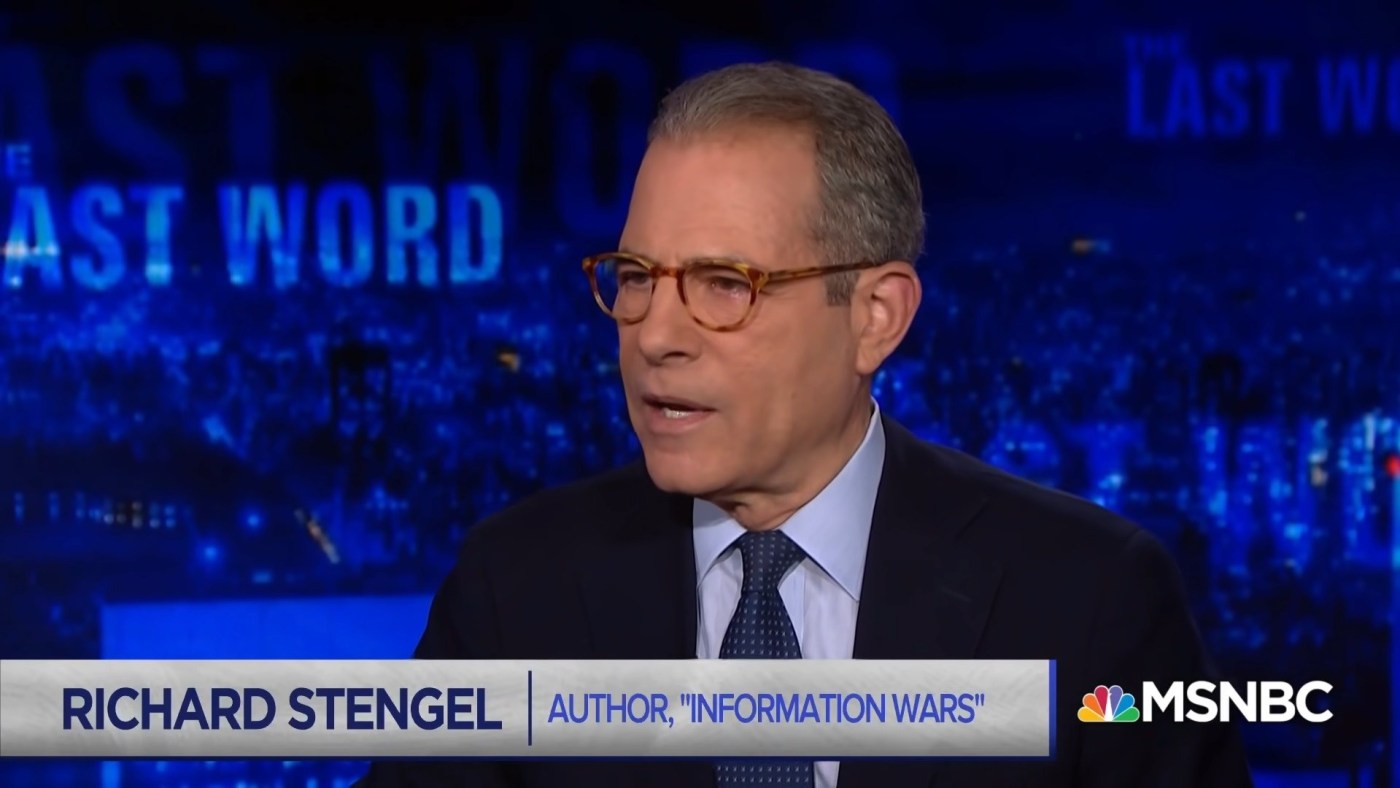
The head of the Joe Biden transition team for the US Agency for Global Media, Richard Stengel, has branded himself the “chief propagandist,” urged the government to use propaganda against its “own population,” and called to “rethink” the First Amendment.

By Ben Norton

Source: The GrayZone

Richard Stengel, the top state media appointee for US President-elect Joe Biden’s transition team, has enthusiastically defended the use of propaganda against Americans.

“My old job at the State Department was what people used to joke as the chief propagandist,” Stengel said in 2018. “I’m not against propaganda. Every country does it, and they have to do it to their own population. And I don’t necessarily think it’s that awful.”

Richard “Rick” Stengel was the longest serving under-secretary of state for public diplomacy and public affairs in US history.

At the State Department under President Barack Obama, Stengel boasted that he “started the only entity in government, non-classified entity, that combated Russian disinformation.” That institution was known as the Global Engagement Center, and it amounted to a massive vehicle for advancing US government propaganda around the world.

A committed crusader in what he openly describes as a global “information war,” Stengel has proudly proclaimed his dedication to the carefully management of the public’s access to information.

Stengel outlined his worldview in a book he published this June, entitled “Information Wars: How We Lost the Global Battle Against Disinformation and What We Can Do About It.”

Stengel has proposed “rethinking” the First Amendment that guarantees the freedom of speech and press. In 2018, he stated, “Having once been almost a First Amendment absolutist, I have really moved my position on it, because I just think for practical reasons in society, we have to kind of rethink some of those things.”

The Biden transition team’s selection of a censorial infowarrior for its top state media position comes as a concerted suppression campaign takes hold on social media. The wave of online censorship has been overseen by US intelligence agencies, the State Department, and Silicon Valley corporations that maintain multibillion-dollar contracts with the US government.

As the state-backed censorship dragnet expands, independent media outlets increasingly find themselves in the crosshairs. In the past year, social media platforms have purged hundreds of accounts of foreign news publications, journalists, activists, and government officials from countries targeted by the United States for regime change.

Stengel’s appointment appears to be the clearest signal of a coming escalation by the Biden administration of the censorship and suppression of online media that is seen to threaten US imperatives abroad.

From Obama admin’s “chief propagandist” to Russiagate-peddling MSNBC pundit

Before being appointed as the US State Department’s “chief propagandist” in 2013, Richard Stengel was a managing editor of TIME Magazine.

In the Obama administration, Stengel not only created the Global Engagement Center propaganda vehicle; he also boasted that he “led the creation of English for All, a government-wide effort to promote the teaching of English around the world.”

After leaving the State Department in 2016, Stengel became a strategic advisor to Snap Inc., the company that runs the social media apps Snapchat and Bitmoji.

Stengel also found time for a fellowship at the Atlantic Council, a think tank closely linked to NATO and the Biden camp which has received funding from the US government, Britain, the European Union, and NATO itself, along with a host of Western weapons manufacturers, fossil fuel corporations, Gulf monarchies, and Big Tech juggernauts.

Stengel worked closely with the Atlantic Council’s Digital Forensic Research Lab, a dubious organization that has fueled efforts to censor independent media outlets in the name of fighting “disinformation.”

But Stengel is perhaps most well known as a regular political analyst on MSNBC in the Donald Trump era. On the network, he fueled Russiagate conspiracy theories, portraying the Republican president as a useful idiot of Russia and claiming Trump had a “one-sided bromance” with Vladimir Putin.

Stengel left MSNBC this November to join Biden’s presidential transition. The campaign announced that he was tapped to lead the Biden-Harris agency review team for the United States Agency for Global Media (USAGM).

USAGM is a state media propaganda organization that has its origins in a Cold War vehicle created by the CIA to spread disinformation against the Soviet Union and communist China. (The agency was previously called the Broadcasting Board of Governors, or BBG, until it rebranded in 2018.)

USAGM states on its website that its most important mission is to “Be consistent with the broad foreign policy objectives of the United States.”

An agency shakeup this year produced revelations that USAGM provided clandestine assistance to separatist activists during the protests that consumed Hong Kong in 2019. The program earmarked secure communications assistance for protesters and $2 million in “rapid response” payouts for anti-China activists.

Richard Stengel’s “obsessive” crusade against Russian “disinformation”

When Richard Stengel referred to himself as the State Department’s “chief propagandist,” advocated the use of propaganda against the American people, and proposed to “rethink” the First Amendment, he was participating in a May 3, 2018 panel discussion at the Council on Foreign Relations (CFR).


During the CFR event, titled “Political Disruptions: Combating Disinformation and Fake News,” Stengel hyped up the threat of supposed “Russian disinformation,” a vague term that is increasingly used as an empty signifier for any narrative that offends the sensibilities of Washington’s foreign policy establishment.

Stengel stated that he was “obsessed with” fighting “disinformation,” and made it clear he has a particular obsession with Moscow, accusing “the Russians” of engaging in “full spectrum” disinformation.

Joining him on stage was political scientist Kelly M. Greenhill, who mourned that alternative media platforms publish “things that seem like they could be true… that’s the sphere where it’s particularly difficult to debunk them… it’s this gray region, this gray zone, where it’s not traditional disinformation, but a combination of misinformation and play on rumors, conspiracy theories, sort of gray propaganda, that’s where I think the nub or the crux of the problem lies.”

Stengel approved, adding, “By the way those terms, the gray zone, are all from Russian active measures, that they’ve been doing for a million years.”

The panelists made no effort to hide their disdain for independent and foreign media outlets. Stengel stated clearly that a “news cartel” of mainstream corporate media outlets had long dominated US society, but he bemoaned that those “cartels don’t have hegemony like they used to.”

Stengel made it clear that his mission is to counter the alternative perspectives given a voice by foreign media platforms that challenge the US-dominated media landscape.

“The bad actors use journalistic objectivity against us. And the Russians in particular are smart about this,” Stengel grumbled.

He singled out Russia’s state-funded media network, RT, lamenting that “Vladimir Putin, when they launched Russia Today, said it was an antidote to the American English hegemony over the world media system. That’s how people saw it.”

Ben Decker, a research fellow at the Misinformation Project at the Harvard Kennedy School of Government, lamented that “RT is invading every weekly finance media space.”

But Decker was cheered by the proliferation of US oligarchs committed to retaking control of the narrative. “In America and across the world,” he stated, “the donor community is very eager to address this problem, and very eager to work with communities of researchers, academics, journalists, etc. to target this problem.”

“I think that there is an appetite to solve this from the top down,” he continued, urging the many academics in the audience “to apply for grant money” in order to fight this Russian “disinformation.”

The CFR panel culminated with an African audience member rising from the crowd and confronting Stengel: “Because what is happening in America is what the United States flipped on the Global South and in the Third World, which we lived with, for many, many years, in terms of a master narrative that was and still is propaganda,” the man declared.

Rather than respond, Stengel rudely ignored the question and made his way hurriedly for the exit: “You know what, I hate last questions. Don’t you? I never, I usually just want to end something before the last question.”

The video of the revealing confrontation caused such a furor that CFR’s YouTube account disabled comments and made the video unlisted. It cannot be found in a search on Google or YouTube; it can only be found with the direct link.

The video of the full discussion is embedded below:

Reporters Claim Facebook is Censoring Information on Julian Assange Case


“90% of my traffic has just been cut off by what seems to be a general algorithm command of some kind to downplay Assange.” “I think it is as simple as that.”

By Alan Macleod

Source: Mint Press News

Craig Murray, the former British ambassador to Uzbekistan and longtime confidant of Julian Assange, has been fastidiously reporting on the Australian publisher’s extradition hearing to the United States. Yet few people have been reading it. This, according to Murray, is because of a deliberate decision by online media giants to downplay or suppress discussion of the case. On his blog, Murray wrote that he usually receives around 50 percent of his readers from Twitter and 40 percent from Facebook links, but that has dropped to 3 percent and 9 percent, respectively during the hearing. While the February hearings sent around 200,000 readers to his site daily, now that figure is only 3,000.

To be plain that is very much less than my normal daily traffic from them just in ordinary times. It is the insidious nature of this censorship that is especially sinister – people believe they have successfully shared my articles on Twitter and Facebook, while those corporations hide from them that in fact it went into nobody’s timeline,” he added.

Asked about the situation by former New York Times reporter Chris Hedges, Murray explained that

Anybody who is at all radical or takes any view of anything that is outwith the official establishment view gets used to occasional shadow banning, but I have never seen anything on this scale before.”

“90% of my traffic has just been cut off by what seems to be a general algorithm command of some kind to downplay Assange,” he added. “I think it is as simple as that.”

There has been considerable public interest in the court proceedings, but very little mainstream attention given to them. To be fair, British authorities have made it inordinately difficult to cover the case, allowing only a small handful of journalists into the Old Bailey court system, where they can watch a live television link up but cannot bring in recording devices. An online stream can only be watched if one registers and signs in between exactly 9:30 and 9:40 a.m., and if they suffer even a momentary lapse in wifi connection, they are shut out of the session. The court system has also blocked human rights groups, including Amnesty International, from monitoring proceedings.

Still, considering the implications for the future of journalism, the lack of coverage might surprise some. The New York Times, the flagship outlet of American print media (and a Wikileaks partner) printed only two articles on the subject and has not mentioned Assange in over two weeks. Its broadcast journalism equivalent CNN, meanwhile, has not touched the issue at all.

Online media creators have, for many years, lived with the threat of algorithmic suppression or demonetization of content on sensitive or controversial issues. YouTube regularly cuts all advertising on videos on the Syrian Civil War, fracking, or other topics on which advertisers might not wish to promote scrutiny. Even airsoft and paintball enthusiasts have learned not to use words like “shoot” and “gun” in their titles, lest the platform demonetizes their content.

Perhaps more alarmingly, however, Silicon Valley tech giants are becoming increasingly closely intertwined with the state department, to the point where it is often difficult to tell where one ends, and another begins. “What Lockheed Martin was to the twentieth century…technology and cyber-security companies [like Google] will be to the twenty-first,” wrote Google executives Eric Schmidt and Jared Cohen in their book, “The New Digital Age: Reshaping the Future of People, Nations and Business.” For example, Facebook is now in a close partnership with the Atlantic Council, who essentially decides for them what content to promote in people’s news feeds and what content is discarded as fake news, misinformation, or low quality. The problem is that the Atlantic Council is a NATO cutout, and a government-funded organization whose board of directors is a who’s who of deep state officials, including virtually every living ex-C.I.A. director, Bush-era cabinet members like Condoleezza Rice and Colin Powell, and military generals like Wesley Clark and David Petraeus. Thus, an organization like this deciding what the world sees on their screens is barely one step removed from total government control of the flow of information.

The U.S. government also frequently directly interferes with content appearing on prominent social media. Earlier this year, Facebook announced that it would remove all comments or posts in praise of recently-slain Iranian General Qassem Soleimani from all its platforms. This was done to comply with the Trump administration’s designation of the Iranian Revolutionary Guard Corps (which Soleimani led) as a terrorist organization. The problem is that Soleimani was Iran’s most popular political figure, with an over 80 percent approval rating, and that Instagram is used by around one-third of the entire Iranian population. Thus, Iranians speaking in their local language were barred from sharing a majority opinion with their country folk because of a decision by Donald Trump.

The Middle East is a particularly contentious area of the world. Yet when news broke that the British Army’s online psychological operations brigade had managed to become a senior Twitter executive, responsible for Middle Eastern content, media largely ignored it, raising even more questions. Algorithm changes have also hammered independent alternative media outlets — often precisely the ones most likely to cover the Assange case — drastically reducing their search engine traffic flow.

Former C.I.A. chief Leon Panetta (an honorary director of the Atlantic Council) recently admitted that Assange is being prosecuted as a warning to journalists. “All you can do is hope that you can ultimately take action against those that were involved in revealing that information so you can send a message to others not to do the same thing,” he told a German documentary crew. While the message is being heard loud and clear by journalists, the public is far less aware that anything is going on, thanks, in part, to online suppression of news about the case. Judge Vanessa Baraitser is scheduled to pronounce judgment on the media “trial of the century” on January 4, after the U.S. presidential election. Murray will doubtless be there. But will anyone read what he has to say?

Social media fact-checking, brought to you by the Deep State

By Daniel Espinoza

Source: Off-Guardian

Almost four years of mainstream media hype about “fake news” and “Russian meddling” propaganda has brought to the world exactly what they were intended to bring: an effective mechanism for internet and social media censorship.

In the center of this move toward global discourse control is an organization called the Poynter Institute, home to the International Fact-Checking Network (IFCN), a body created to coordinate, promote and train dozens of fact-checkers from around the world.

The IFCN and many non-profits working in the same field are funded by the big capitalist “philanthropists” of our era, like George Soros, Pierre Omidyar, Bill Gates, and even the Koch brothers…but also by the US Department of State and a shady “aid” – in reality, political meddling – organization, the National Endowment for Democracy (NED), historically linked to the CIA and regime change operations.

Google and Facebook – itself tied to the warmongering Atlantic Council and its “Digital Forensic Research Lab” – are also associated with Poynter, by funding and partnerships to fight “fake news” (including the development of an “automated” fact-checking program for the upcoming 2020).

The marriage between Poynter’s IFCN, politically inclined billionaires, the State Department – and the whitewashed public face of the Deep State – suggest that the institute is probably working in what Nelson Poynter, its founder, worked on for a key part of his life: propaganda and censorship for the US government.

Although this information is not available in Nelson Poynter’s Wikipedia profile or in poynter.org’s history page, his work for a government propaganda agency is not exactly a secret. A resemblance of his wife, Henrietta, also at the institute’s website, quickly passes over the fact that Poynter did work for the Office of War Information (OWI) during WWII, but his specific role as a government censor and propagandist is never mentioned.

Nevertheless, Hollywood Goes to War, a book written in 1987 by Clayton R. Koppes and Gregory D. Black, is one of the many historical sources that tell the details of Poynter’s job.

FILM CENSORSHIP AND THE BIRTH OF THE VOICE OF AMERICA

Nelson Poynter was recruited by the OWI with his wife Henrietta, who worked as assistant program chief under Elmer Davis, head of the agency. She came up with the name for the “Voice of America”, the famous psychological war operation of the US government.

The radio project was established in February 1942 and soon grew to be the most important US overt propaganda arm of the Cold War.

Unlike his wife’s job, Poynter’s regarded not radio – or his previous line of work, journalism – but movies. In 1942, the OWI’s Bureau of Motion Pictures (BMP) set up office in Hollywood, naming Poynter as its head. His mission was to act as liaison between the agency and the owners of Warner Brothers, Twentieth Century Fox, MGM and the other big studio names.

Elmer Davis, head of the OWI, regarded films as:

The easiest way to inject a propaganda idea into most people’s minds”, in part, because they “do not realize that they are being propagandized”.

Davis was a career journalist who worked for ten years for the New York Times before being recruited by the government. Franklin D. Roosevelt’s White House needed the film industry to incorporate specific themes in their movies, ideas that promoted the notion of WWII as being a “popular” war, fought to defend his Four Freedoms.

But at first, Poynter’s office in Hollywood had little veto power over what the industry could produce – for the entire Western world – limiting itself to suggest cosmetic changes here and there, or the toning down of reactionary and racist imagery and language, an inherent feature in the Hollywood of that era.

The heads of the studios were in fairly good terms with the US Army, historically close to the industry. Its owners were happy to portrait US wars abroad as heroic, in exchange for the lending of military equipment, installations and expert advice.

But in most cases, a disappointed Poynter complained, war ended up only as “a backdrop” for shallow romance, cheap comedies and other proven formulas. Poynter and his boss at the BMP, Lowell Mellett, also hired a former assistant of Harold Lasswell, a famous social researcher who said – back in the 30s – that democracy needed propaganda because people were not the best judges of their own interest.

Eventually, the team devised a way to exert more power over the unruly, reactionary and overly commercial Hollywood studios. They decided to ask the US Office of Censorship to weight in and threat them with banning “offending” films from export, seriously reducing their potential earnings.

According to Koppes and Black’s Hollywood Goes to War, it was a success, prompting MGM, Warner and the other big names to start turning their scripts for review to the Poynter. The BMP knew it was important to intervene right at that stage, before big amounts of money were spent in production.

Poynter was a diligent censor and propagandist, going as far as to suggest dialogues for the movie scripts he was reviewing, breaching “one of the industries taboos” and provoking the powerful tycoons, according to the authors mentioned above.

When the war ended, Poynter went back to journalism. He eventually took over the St. Petersburg Times (renamed Tampa Bay Times in 2012), owned by his father. He also founded the Congressional Quarterly with his wife Henrietta, who died in 1968. As we can read in the Poynter institute’s website:

When Henrietta died suddenly at the age of 66, Nelson mourned deeply. ‘Her passing marked the end of an era for Mr. Poynter,’ said David Shedden, former research librarian at The Poynter Institute. ‘He started looking to the future and thinking about his legacy. He focused on creating a school for journalists, which of course became the Modern Media Institute, and then the Poynter Institute’.”

Nevertheless, historian W.C. Bourne explains that many of the OWI’s top brass – as Elmer Davis and Nelson Poynter, former journalists – returned to the corporate media after the war, but “retained an abiding belief in the things for which OWI stood and the possibilities of accomplishment in the international information picture”.

Many of them also retained the Deep State contacts and a nationalistic “spirit of collaboration”.

A LEGACY OF CENSORSHIP

Nelson Poynter’s work for the government ended many decades ago, and it would be reasonable to suggest that his ties to the US government and its propaganda apparatus probably never involved the journalism institution he founded years after leaving the OWI.

But we have evidence pointing precisely in the opposite direction.

Firstly, the obvious – and open – ties between the institute and today’s version of the foreign meddling machine installed by the US during the Cold War (i.e. the NED). As informed on many occasions by independent journalists, one of the founders of the National Endowment for Democracy once admitted that:

A lot of what we do today was done covertly twenty-five years ago by the CIA.”

Secondly, the intimate ties between the Poynter Institute and the US State Department, which selected it to conduct the “Edward Murrow Program for Journalists”. It brings together “more than 100 emerging international journalists from around the world to examine journalistic practices in the United States”.

In other words, to be indoctrinated in Western corporate journalism and culture and start a relationship with a potential foreign opinion leader.

The State Department’s Murrow program is part of Bureau of Educational and Cultural Affairs (ECA), an agency dedicated to “cultural diplomacy”, intimately tied to intelligence and foreign policy since way before the Cold War. The participants to be trained by Poynter are chosen by US embassies abroad.

2017 report of the historical success of the educational exchange agency stated that:

…565 alumni of the ECA programs are current heads or former heads of state and government, and 31 alumni are heads of international organizations.”

Thirdly, the Poynter Institute, too, redacted an infamous blacklist of “fake news” sites, with the intention of marginalize and, in this case, deny many of them of any kind of advertisement money.

A BLACKLIST TO DEFUND THEM ALL

For this operation, launched on April 30, 2019, Poynter ganged-up with the rest of the fact-checking “cartel”, so to speak.

The institute gathered the blacklists and analysis done in recent years by Snopes, Fact-check.org, Politifact (owned by the Tampa Bay Times and Poynter), OpenSources and the Fake News Codex, and used them to create the mother of all blacklists, naming 515 “unreliable” news websites.

It was retracted shortly after its publication, on May 2, after coming under criticism for “unreliability and poor methodology”. The irony! And this should be understood as an indictment on the whole bunch. As one critic from the George Washington University noted:

Beneath the veneer of its precision, the fact-checking enterprise relies heavily on opinion and interpretation…If a list summarizing fact-checking results and verified by fact checkers is ultimately retracted by those same fact checkers for not being rigorous, it underscores the question of why we should trust anything from the fact-checking community.”

To add insult to injury, Poynter’s dubious list of “unreliable websites” was intended to cause financial harm to those named in it, by guiding advertisers and ad-technology applications to deny them of ads.

After the retraction, Stephen Gutowski, a writer from one of the affected websites, Free Beacon, wrote:

What a disgusting exercise in bad faith from an organization that’s supposed to be about improving and promoting journalism. Instead, they’re creating tabloid-level listicles to smear reporters without offering even a single piece of evidence. Shame on you, @Poynter.”

Philip Klein, from The Washington Examiner – also listed – thought it was:

…worrisome to call for advertisers blacklisting news organizations, especially given the opacity of the process and arbitrariness of many of the judgements [sic].”

THE “CARTEL”

Most of the non-profits behind Poynter’s blacklist share patrons, except for the controversial Snopes, that runs on less grant money than advertisement revenues.

The International Fact-checking Network and its more than a hundred “associated” – subordinated – smaller fact checkers around the globe, are also funded by the same “philanthropists”, like Bill Gates, whose foundation already finances tens of mainstream corporate news outlets with tens of millions of dollars, just like the Columbia Journalism Review recently uncovered.

Regarding Poynter and Gates, specifically:

…Poynter senior vice president Kelly McBride said Gates’s money was passed on to media fact-checking sites, including Africa Check, and noted that she is “absolutely confident” that no bias or blind spots emerged from the work, though she acknowledged that she has not reviewed it herself.”

In a blatant conflict of interests, those same fact-checkers often (try to) debunk information related to the Gates Foundation, just like a private PR agency.

Many lesser players in the global constellation of fact checkers are also funded directly by George Soros and his Open Society Foundation, the Ford Foundation, the US embassy and/or the NED.

When “fact-checking”, the members of this private-public consortium often limit themselves to copy/paste from their “parent” sources, like Poynter’s Politifact and Snopes.

As Emil Marmol and Lee Mager recently wrote for Project Censored, the “fake news” psychological operation was little more than a “Trojan horse for silencing alternative news and reestablishing corporate news dominance”:

The fake news hysteria created by those in government and echoed by the corporate news media is being harnessed and used as a pretext for the suppression of dissent and counterhegemonic viewpoints while re-establishing the corporate press’s preeminence as the sole purveyor and manufacturer of public opinion”.

The Covid-19 pandemic has accelerated the degenerative process under the guise of “protecting us”, prompting democratic governments to take dangerous paths, like arresting citizens for promoting street marches on Facebook.

The internet opened up a world of information to the regular citizen, we must keep it open so more of us can take a look.


Daniel Espinosa lives in Arequipa, second largest city of Peru. He graduated in Communication Sciences in Lima and started researching propaganda and mainstream media. He writes for a Peruvian in-print weekly, Hildebrandt en sus trece, since 2018, and collaborates with many online media. His writings are a critique of the role of mass media in society. You can read his previous work through his MuckRack profile.