Bust the Trust: Now is the Time to Break Up Amazon

By Andy Laties with additional reporting by Sander Hicks

Source: The New York Megaphone

Standing at the cash register at an Upper West Side independent bookstore I used to run, I once noted the frequent passage of cars painted all over with Amazon’s “And You’re Done” logo. These same-day delivery vehicles were Amazon’s way of pushing back against the resurgence of New York City independent bookselling in progress. Soon, the cars were joined by a Columbus Circle location of the Amazon Books chain. That brick-and-mortar store gave lie to Amazon’s long-standing rhetoric that physical bookstores were doomed.

I have competed with Amazon for twenty years. A couple years ago, we indies were finally winning. 2015 was a great year. More independent stores were opening than closing: Books Are Magic, Greenlight, Word Up, Stories, Archestratus Books & Foods, Astoria Bookshop and Quimby’s. New locations for Book Culture, McNally Jackson, WORD and Books of Wonder were in the works. That trend was mirrored nationally. While our numbers had fallen from 4,000 to 1,500, between 1995 and 2005, now we were pushing 2,000 bookstores again.

Why do indy bookstores matter so much? Well, here’s one way to put it, from the writer Ocean Vuong, “The way I see it, whenever someone walks into a bookstore, they are walking into the future of their cultural and intellectual life. A bookseller collaborates with who you are in order to show you a way forward towards more of yourself, a way you might not have known existed for you–but is still entirely your own. Amazon, with its algorithms, can only show you where you’ve been, can only give you the calcified mirror of your past. In a bookstore, you get a human being who is also a mapmaker of possibility.”


A PEOPLE’S HISTORY OF AMAZON

Amazon itself had started as a New York City project. But retailers don’t collect sales tax on out-of-state shipments. So when hedge fund boy wonder Jeff Bezos rounded up his one million in in start-up capital, he left New York City behind. He launched his company in the lightly-populated Washington State. Bezos planned a national mail-order operation that wouldn’t have to collect sales tax in any other state, especially populous New York and California. Thus, most customers would enjoy a six percent or more cost reduction on each sale.

We indie businesses fought together for twenty years to force Amazon to collect sales tax. And we won. I’m proud of what we fierce indies did to force Amazon to pay sales tax. These taxes fund public services like Medicaid and the local fire department. But Amazon had evolved during the battle, and like that strangling kudzu vine you thought you killed last Fall, it grew back even bigger in the Spring. Instead of dying, Amazon turned into that monster plant from Little Shop of Horrors.

After our victories at the state and national levels, there was no longer any reason for Bezos to base his company in Seattle. That’s one reason Amazon is expanding with a big new HQ2 planned for Crystal City, VA. They recently planned to come back to New York City, but chickened out due to the public criticisms about Amazon’s lucrative tax breaks.

Ten years ago, Amazon used to be an innovative book-seller online. Today, They work for CIA, NSA, they help do facial recognition for ICE. They are bidding to create a “new brain” for the Pentagon, in the little-known “JEDI” program. With Jeff Bezos’s ownership of the Washington Post, they are simultaneously powerful DC lobbyists, defense contractors, spies, and a leading DC media vehicle. Amazon is one juggernaut of unbridled corporate and war-making power.

Amazon developed its Amazon Web Services (AWS), the highly profitable, cloud-hosting division, out of the software and hardware infrastructure that runs its online retail operation. Recent headlines tell the tale of how Amazon monetized AWS. Technology Review reported, “Amazon is the Invisible Backbone Behind ICE’s Immigration Crackdown” And Business Insider let us know that “Amazon is Launching a ‘Secret’ Cloud Service for the CIA.” “‘Alexa, Drop a Bomb’: Amazon Wants in on US Warfare” reveals the plans between Amazon and the Pengaton, for the new JEDI program, as reported by Truthout.

The new Amazon wants to become a leading merchant of death, specializing in robotic drones, while moonlighting as web host for ICE and CIA. Its planned “Washington D.C. footprint” is just across the highway from the Pentagon. The failed effort to come into Queens was offering “twenty-five-thousand jobs.” But who can count how many jobs Amazon has killed, and how many retail stores have closed, due to Amazon artificially lowering prices? (A recent article in Yale Law School journal makes the case that Amazon might be on the road to being a monopoly, since it artificially lowers prices to kill competition.) Amazon promises to add jobs in NYC, but recently committed to making those jobs non-union. Workers at Amazon warehouses complain of onerous conditions at low wages, in which bathroom breaks are rare, and workers sometimes have to urinate into plastic bottles.

Amazon is super convenient. It’s true. But Amazon’s retail customers will feel angst and regret once they learn their dollars pay for robotic drone warfare and racial profiling of immigrants.

Recently, the American Booksellers Association reported that Amazon could be a monopoly. They control 75% of all online retail bookselling, the way that Standard Oil controlled the oil industry, before it was broken up as a monopoly, in 1911.

Let’s resist this new version of the Amazon monopoly. Amazon is an arms dealer and corporate spy. Let’s advocate that the Federal Trade Commission dismember the Amazon octopus. Let’s support a movement that is fired up to do “trust-busting.”

For our safety, it’s time to break up Amazon.


Andrew Laties is the author of Rebel Bookseller: Why Indie Businesses Stand for Everything You Want to Fight For, from Free Speech to Buying Local to Building Communities. He currently co-owns Book and Puppet Company, in Easton, Pennsylvania.

Prices, plutocrats, and corporate concentration

Would less corporate concentration – and a weaker corporate capacity to raise prices – mean less inequality?

By Sam Pizzigati

Source: Nation of Change

Andrew Leigh, a member of the Australian parliament, has a side gig. He just happens to be a working economist. Other lawmakers may spend their spare hours making cold calls for campaign cash. Leigh spends his doing research – on why our modern economies are leaving their populations ever more unequal.

Leigh’s latest research is making some global waves. Working with a team of Australian, Canadian, and American analysts, he’s been studying how much the prices corporate monopolies charge impact inequality.

The conventional wisdom has a simple answer: not much. Yes, the reasoning goes, prices do go up when a few large corporations start to dominate an economic sector. But those same higher prices translate into higher returns for corporate shareholders.

Thanks to 401(k)s and the like, the argument continues, the ranks of these corporate shareholders include millions of average families. So we end up with a wash. As consumers, families pay more in prices. As shareholders, they pocket higher dividends.

But this nonchalance about the impact of monopolies, Andrew Leigh and his colleagues counter, obscures “the relative distribution of consumption and corporate equity ownership.” Average families do hold some shares of stock, but not many. In the United States, for instance, the most affluent 20 percent of households own 13 times more stock than the bottom 60 percent.

These bottom 60 percent households, as a result, get precious little return from the few shares of stock they do hold, not nearly enough to offset the higher prices they pay on corporate monopoly products.

“On net, that means it’s nearly impossible for the typical U.S. family to make up for higher prices via the performance of their stock portfolio,” notes a Washington Post analysis of the Leigh team research. “When prices rise, low- and middle-class families pay. Wealthy families profit.”

By how much do these affluents profit? Leigh and his colleagues have done the math. The higher prices – and profits – that corporate concentration has generated have shifted 3 percent of national income out of the pockets of poor and middle-class families into the wallets of the affluent.

The larger our corporations become, in other words, the more unequal our societies become.

Now corporations don’t grow larger in the same way as people grow larger. Corporations have no adolescent growth spurts. They don’t mature. They have no real personhood. Corporations only become larger when the executives who run them make them larger, most typically by wheeling and dealing their way through ever grander mergers and acquisitions.

This wheeling and dealing takes up a huge chunk of modern corporate executive time and energy. Why do execs devote so much of their time and energy to getting bigger? Getting bigger pays – for execs.

Indeed, firm size determines how much executives make more than any other factor, as research has shown repeatedly over the years. Executives don’t have to “perform” – make their enterprises more efficient and effective – to make bigger bucks. They just to need to make their enterprises bigger.

Executives, in short, have a powerful incentive to grow their companies, and that powerful incentive, as the latest research from Andrew Leigh and his colleagues shows, isn’t just making these executives richer. It’s leaving our societies much more unequal.

So what can we do to ease the damage? Tougher antitrust enforcement could certainly slow our rates of corporate concentration. But the legislative activities of Andrew Leigh in Australia suggest another promising approach as well.

Leigh serves as a “shadow” minister for the Australian parliament’s Labor Party opposition. This past fall, he announced that his party, if elected to power, will require all major corporations to publicly disclose the ratio between their CEO and worker pay.

A similar disclosure mandate went into effect in the United States last year. As of January 1, 2019, the UK now has a pay-ratio disclosure mandate in effect as well.

Forcing Australian corporations to reveal their CEO-worker pay ratios, Leigh notes, would encourage these corporations “to think about how they are serving all their workers, and society as a whole.” But a growing number of progressives in the United States and the U.K. believe that pay ratios can do more than just “encourage” corporations to better serve their societies.

These progressives are pushing for consequences on CEO-pay ratios, proposing legislation that would deny government contracts and subsidies to corporations with wide gaps between their CEO and worker pay. They’re also calling for higher tax rates on companies with wider CEO-worker pay ratios, and one American city, Oregon’s Portland, already has such an “inequality tax” in effect.

More moves in this direction could significantly reduce the incentive for the executive wheeling and dealing that’s concentrating corporate power in fewer and fewer corporate hands. That wheeling and dealing – in nations with consequences on pay ratios in effect – would no longer guarantee grand windfalls to our corporate executive class.

Less wheeling and dealing, in turn, would mean less corporate concentration – and a weaker corporate capacity to raise prices. And that would mean, as the new Leigh gang’s research so clearly shows, less inequality.

“It’s Crucial to Break Up Facebook”

By Asher Schechter

Source: ProMarket

Four decades ago, writes Tim Wu in the introduction to his recent book The Curse of Bigness, the United States and other countries entered into a sweeping experiment that radically transformed their economies and politics. The experiment in question consisted of abandoning most checks on anticompetitive conduct, thus allowing concentrated corporate power to grow undisturbed.

The result: an increasingly concentrated global economy marked by historic levels of inequality and extreme concentrations of economic and political power, with disaffected voters being lured by radical far-right nationalists across the West. “We have managed to recreate both the economics and politics of a century ago—the first Gilded Age,” Wu writes.

Now, he warns, liberal democracies risk making yet another grave historical error by ignoring the well-established link between the concentration of economic power and the rise of authoritarianism. That monopolization poses an existential threat to democracy has been widely known throughout history: Louis Brandeis famously referred to this threat as the “curse of bigness”; in Germany, the rise of fascism was partly facilitated by monopolists and industrial cartels.

Yet in recent decades, explained Wu in an interview with ProMarket, much of this history has been forgotten. The legacy of Brandeis, America’s leading defender against bigness, has been “neglected, almost forgotten,” along with the greater antimonopoly tradition that has been an integral part of US politics for over 200 years. Which is why he decided to write The Curse of Bigness, a slim book that is equal parts historical polemic and urgent call to action. 

Wu, the Julius Silver Professor of Law, Science and Technology at Columbia Law School and also the author of The Attention Merchants and The Master Switch, is perhaps best known for coining the term “net neutrality.” In his interview with ProMarket, he discussed the parallels between the monopolies of today and those of the first Gilded Age and explained why breaking up dominant companies is crucial, particularly when it comes to Facebook.

[This conversation has been edited and condensed for length and clarity]

Q: I want to start with Brandeis, who famously coined the phrase “curse of bigness.” In the book, you write that Brandeis “has been done a disservice.”

Yes, I think he has been. I think his economic vision has been forgotten. There are powerful ideas in it, very appealing in our times, very appealing through much of American history. So I wanted to try to do justice to and resurrect the Brandeisian strain of thought when it comes to economic policy.

Q: You point to many parallels between Brandeis’s time and ours, but one that especially haunts the book is the rise of neo-fascist movements around the world and the potential link between large business groups and aspiring authoritarians. Did you feel a certain sense of urgency in writing this book and making this link at this particular moment in time?

There is something alarming about the rise of extremist governments around the world. It has something to do with a sense of discontent as to how the economy functions for people, and that did give the writing of this a sense of a sense of urgency and a sense of a historic moment.

It’s a dangerous moment around the world and in the United States. I don’t think we have a complete understanding of what causes fascist uprisings, but I have a strong instinct, and I think many people do too, that there are economic origins to fascism that are very important and that, among other things, we really need to understand how to prevent people from turning to fascist, neo-nationalist, and extremist answers. I would suggest that has a lot more to do with economic policy than people think.

Q: That is something many of the “big is beautiful”-type arguments about private monopolies seem to ignore: the historical precedents of concentrated economic power contributing to the rise of authoritarian regimes.

I think that’s right. Also, it ignores [the fact] that there’s more to people’s lives than their lives as customers. People are also workers, and it’s one thing to face scale when you’re buying things and another thing to face scale when you’re an employee looking for a job and in a difficult bargaining position.

To take this further: I don’t like excessive pricing or price gouging, but the vision of antitrust over the last 40 years has been that the best of all possible worlds is one where you have relatively mild reductions in prices for consumer goods. Let’s just say there’s more to life than that. It’s not always clear that economics can get at it, but the focus on price in antitrust yields very narrow results.

“I don’t like excessive pricing or price gouging, but the vision of antitrust over the last 40 years has been that the best of all possible worlds is one where you have relatively mild reductions in prices for consumer goods. Let’s just say there’s more to life than that.”

Q: Unlike many people involved in the antitrust debate, even those that support vigorous enforcement, you don’t shy away from what Robert Pitofsky called the “political content of antitrust.” In fact, you seem to embrace it. What would you say is the political role of antitrust?

Ultimately, antitrust is a kind of constitutional check on private power. You can’t understand antitrust law without understanding its relationship with power. This is the centerpiece of the book and the original soul of antitrust law. It wasn’t so concerned with the details with price. It just had a sense that there needed to be some kind of outer limit on private power, much like there’s a limit on public power set by the constitution.

Q: What do you say to criticisms that you’re leading antitrust through uncharted waters, and that reinstilling political values into antitrust risks turning antitrust into a blunt political tool, much like what Trump is threatening to do with tech platforms?

I think this is confusing two meanings of the word “political.” There’s a narrow political sense in which a law can be used to punish your opponents or save your friends—consumer welfare antitrust can be used to do that already. But there’s also the broader sense of the law informed by constitutional values or concerns about power. That is also political, but in a much broader sense. That is the best sense in which the law has been enforced in the best moments of its history—the sense that a firm has become too powerful and too dominant to be tolerated in a land which calls itself free. It’s important not to confuse those two ideas of the term “political.”

Q: You compare the first Gilded Age to our own. Where do you see parallels between the monopolists of the Gilded Age, people like John D. Rockefeller and Andrew Carnegie, and present day dominant firms? Google and Facebook are not shooting workers, after all. 

There’s some traces of the same ideology. Peter Thiel is a prominent example: He calls his [ideology] libertarianism, but it’s not much different than 19th century social Darwinism, which worships the monopoly form and holds the idea that we should see our society as a winner-take-all, survival of the fittest, “The strong shall rule, the weak shall serve them” kind of undertaking. Google and Facebook have much kinder public faces, but—particularly with Facebook—I’m not sure underlying it they think that much differently.

There are other parallels as well, particularly levels of individualized personal wealth that the world has never seen before. In the concentration of wealth is a glorification of wealth, and almost a fetishization with accumulating amounts of money that no person could spend in their lifetime. A lot of projects in Silicon Valley get bent to the need for monstrous payouts and it ends up getting in the way of what would otherwise be good projects or better ways to run companies.

Obviously, as I explore in the book, the economic structure is also similar, where you have an overall economy dominated by fewer entities and greater levels of inequality.

Q: Another parallel seems to be this belief in the goodness of monopolies and the benefits they bring humanity. The ruthless robber barons, who threatened to crush rivals who didn’t submit to their will, genuinely believed they were doing the good, moral thing, for the betterment of humankind.

That’s right. But I think this has less to do with Silicon Valley and more to do with Wall Street today, this very fragmented morality, the idea that somehow the right thing to do is not exactly what we would usually call the ethical thing: It’s right to destroy your rivals, it’s right to lie and cheat so long as you get away with it.

“If you’re looking for the one big signal failure of the last 20 years, it’s got to be merger review. There has been an inexplicable allowance of so many industries to merge down to four or three players, sometimes two, sometimes even a monopoly. Europe is as guilty of this as the United States.”

Q: You write that the priority for neo-Brandeisian antitrust would be reforming the process of merger review. Why is merger review the top priority, and how should it be reformed?

If you’re looking for the one big signal failure of the last 20 years, it’s got to be merger review. There has been an inexplicable allowance of so many industries to merge down to four or three players, sometimes two, sometimes even a monopoly. Europe is as guilty of this as the United States. In many cases, it seems like the question was not how are we going to stop this [merger], but what kind of conditions are [merging companies] going to agree to, which is not the way merger review was intended. Merger review is not intended to be a big set of commitments that companies make, but rather the actual blocking of mergers. There’s been some recovery from that, particularly in the United States near the end of the Obama administration, but merger review has been in a crisis point.

It’s possible Congress could act and reaffirm that it meant what it said when it passed the 1950 Merger Act. It’s possible you could add greater burdens for larger mergers, or mergers that pass some structural threshold. Another way would be to open merger review to more public scrutiny. I understand some of the arguments in favor of secrecy, but I think that in the case of really big blockbuster mergers there’s just too much at stake. Having more public awareness and more groups involved would be good actually, given the important political consequences.

Q: What’s interesting about European antitrust is that although they’ve taken on several big cases in recent years, in terms of mergers European competition authorities don’t put up a lot of a fight. 

I agree. I think that Europe, if anything, has been worse than the United States for the last ten years. The beer merger of Anheuser-Busch InBev and SABMiller was inexplicably approved, creating a monopoly. Telecom mergers across Europe have been allowed, bringing multiple markets down to three [competitors].They allowed the Monsanto-Bayer merger—I’m not sure what they were thinking with that one.

Overall, I think consent decrees appeal to academic economists, but they have a bad track record. One problem with consent decrees is that you have the most talented attorneys and economists negotiating these on the government side, but once they’re done, they’re given to an enforcement bureau which is typically not heavily staffed. And sometimes it can be forgotten, and certainly not enforced with any kind of vigor.

Structural separation is self-executing. The blocking of mergers is self-executing. You don’t have to have the government constantly trying to make sure the thing is working. I think Europe has really gone down the wrong path in that direction.

Q: Another solution you explore in the book is breaking up dominant companies. One company you point to in this regard is Facebook—you call for breaking up Facebook, separating it from Instagram and WhatsApp. Why single out Facebook? And what would breaking up Facebook accomplish, considering its business model is at this point shared by the majority of online platforms?

I think it’s crucial to break up Facebook, particularly from WhatsApp and Instagram. In some ways, I think the burden should be on Facebook to explain why they shouldn’t be broken up.

Will that make a difference? I think it will. I have faith in improved competition. I don’t think there’s strong evidence of great efficiencies that come from having all of the major social networks under one roof. It’s hard to see any real loss of so-called efficiencies, at least ones that matter to consumers.

People are looking for somewhere to switch, but they don’t have anywhere to go. WhatsApp can easily be that platform, and its leadership has different values, or at least had different values before they left.

“I think it’s crucial to break up Facebook, particularly from WhatsApp and Instagram. In some ways, I think the burden should be on Facebook to explain why they shouldn’t be broken up.”

Q: In a recent post in Medium, you laid out ten antitrust cases the government should be investigating. Which ones would you say are the most pressing?

Someone has to stop the T-Mobile/Sprint merger. Maybe it will be the states, but someone has to stop that merger. I already mentioned the Facebook breakup, which I think is big and symbolically important.

I think the Justice Department actually is already working on this, but the Live Nation-Ticketmaster matter has been sitting there for a long time. It’s not the biggest industry, but it’s still a case with a lot of anticompetitive conduct.

And I would like to take a look back at the airline mergers and ask whether we should consider breaking down the triopoly. The state of the airlines is really unacceptable.

Q: It’s been roughly a year since the repeal of net neutrality. You, of course, famously coined the term net neutrality. What would you say is the importance of net neutrality, in terms of competition and the bigness debate?

It’s really a parallel discussion but the same issue, which is: When you have monopolies that don’t seem to be going anywhere, should they be completely unconstrained? Or should there be some rules as to how they conduct themselves? It’s always been a parallel to this question of antitrust, but they’re part of the same discussion. For some reason, we’ve moved in the direction of extreme, radical, laissez faire [responses] for all of these questions. But people are starting to move in different directions now, and the backlash is inevitable.

THE MONOPOLIZATION OF AMERICA: The biggest economic problem you’re hearing almost nothing about

By Robert Reich

Source: Nation of Change

Not long ago I visited some farmers in Missouri whose profits are disappearing. Why? Monsanto alone owns the key genetic traits to more than 90 percent of the soybeans planted by farmers in the United States, and 80 percent of the corn. Which means Monsanto can charge farmers much higher prices.

Farmers are getting squeezed from the other side, too, because the food processors they sell their produce to are also consolidating into mega companies that have so much market power they can cut the prices they pay to farmers.

This doesn’t mean lower food prices to you. It means more profits to the monopolists.

Monopolies all around

America used to have antitrust laws that stopped corporations from monopolizing markets, and often broke up the biggest culprits. No longer. It’s a hidden upward redistribution of money and power from the majority of Americans to corporate executives and wealthy shareholders.

You may think you have lots of choices, but take a closer look:

1. The four largest food companies control 82 percent of beef packing, 85 percent of soybean processing, 63 percent of pork packing, and 53 percent of chicken processing.

2. There are many brands of toothpaste, but 70 percent of all of it comes from just two companies.

3. You may think you have your choice of sunglasses, but they’re almost all from one company: Luxottica – which also owns nearly all the eyeglass retail outlets.

4. Practically every plastic hanger in America is now made by one company, Mainetti.

5. What brand of cat food should you buy? Looks like lots of brands but behind them are basically just two companies.

6. What about your pharmaceuticals? Yes, you can get low-cost generic versions. But drug companies are in effect paying the makers of generic drugs to delay cheaper versions. Such “pay for delay” agreements are illegal in other advanced economies, but antitrust enforcement hasn’t laid a finger on them in America. They cost you and me an estimated $3.5 billion a year.

7. You think your health insurance will cover the costs? Health insurers are consolidating, too. Which is one reason your health insurance premiums, copayments, and deductibles are soaring.

8. You think you have a lot of options for booking discount airline tickets and hotels online? Think again. You have only two. Expedia merged with Orbitz, so that’s one company. And then there’s Priceline.

9. How about your cable and Internet service? Basically just four companies (and two of them just announced they’re going to merge).

Why the monopolization of America is a huge problem

The problem with all this consolidation into a handful of giant firms is they don’t have to compete. Which means they can – and do – jack up your prices.

Such consolidation keeps down wages. Workers with less choice of whom to work for have a harder time getting a raise. When local labor markets are dominated by one major big box retailer, or one grocery chain, for example, those firms essentially set wage rates for the area.

These massive corporations also have a lot of political clout. That’s one reason they’re consolidating: Power.

Antitrust laws were supposed to stop what’s been going on. But today, they’re almost a dead letter. This hurts you.

We’ve forgotten history

The first antitrust law came in 1890 when Senator John Sherman responded to public anger about the economic and political power of the huge railroad, steel, telegraph, and oil cartels – then called “trusts” – that were essentially running America.

A handful of corporate chieftains known as “robber barons” presided over all this – collecting great riches at the expense of workers who toiled long hours often in dangerous conditions for little pay. Corporations gouged consumers and corrupted politics.

Then in 1901, progressive reformer Teddy Roosevelt became president. By this time, the American public was demanding action.

In his first message to Congress in December 1901, only two months after assuming the presidency, Roosevelt warned, “There is a widespread conviction in the minds of the American people that the great corporations known as the trusts are in certain of their features and tendencies hurtful to the general welfare.”

Roosevelt used the Sherman Antitrust Act to go after the Northern Securities Company, a giant railroad trust run by J. P. Morgan, the nation’s most powerful businessman. The U.S. Supreme Court backed Roosevelt and ordered the company dismantled.

In 1911, John D. Rockefeller’s Standard Oil Trust was broken up, too. But in its decision, the Supreme Court effectively altered the Sherman Act, saying that monopolistic restraints of trade were objectionable if they were “unreasonable” – and that determination was to be made by the courts. What was an unreasonable restraint of trade?

In the presidential election of 1912, Roosevelt, running again for president but this time as a third party candidate, said he would allow some concentration of industries where there were economic efficiencies due to large scale. He’d then he’d have experts regulate these large corporations for the public benefit.

Woodrow Wilson, who ended up winning the election, and his adviser Louis Brandeis, took a different view. They didn’t think regulation would work, and thought all monopolies should be broken up.

For the next 65 years, both views dominated. We had strong antitrust enforcement along with regulations that held big corporations in check.

Most big mergers were prohibited. Even large size was thought to be a problem. In 1945, in the case of United States v. Alcoa (1945), the Supreme Court ruled that even though Alcoa hadn’t pursued a monopoly, it had become one by becoming so large that it was guilty of violating the Sherman Act.

What happened to antitrust?

All this changed in the 1980s, after Robert Bork – who, incidentally, I studied antitrust law with at Yale Law School, and then worked for when he became Solicitor General under President Ford – wrote an influential book called The Antitrust Paradox, which argued that the sole purpose of the Sherman Act is consumer welfare.

Bork argued that mergers and large size almost always create efficiencies that bring down prices, and therefore should be legal. Bork’s ideas were consistent with the conservative Chicago School of Economics, and found a ready audience in the Reagan White House.

Bork was wrong. But since then, even under Democratic administrations, antitrust has all but disappeared.

The monopolization of high tech

We’re seeing declining competition even in cutting-edge, high-tech industries.

In the new economy, information and ideas are the most valuable forms of property. This is where the money is.

We haven’t seen concentration on this scale ever before.

Google and Facebook are now the first stops for many Americans seeking news. Meanwhile, Amazon is now the first stop for more than a half of American consumers seeking to buy anything. Talk about power.

Contrary to the conventional view of an American economy bubbling with innovative small companies, the reality is quite different. The rate at which new businesses have formed in the United States has slowed markedly since the late 1970s.

Big Tech’s sweeping patents, standard platforms, fleets of lawyers to litigate against potential rivals, and armies of lobbyists have created formidable barriers to new entrants. Google’s search engine is so dominant, “Google” has become a verb.

The European Union filed formal antitrust charges against Google, accusing it of forcing search engine users into its own shopping platforms. And last June, it fined Google a record $2.7 billion.

But not in America.

It’s time to revive antitrust

Economic and political power cannot be separated because dominant corporations gain political influence over how markets are organized, maintained, and enforced – which enlarges their economic power further.

One of the original goals of the antitrust laws was to prevent this.

Big Tech – along with the drug, insurance, agriculture, and financial giants – is coming to dominate both our economy and our politics.

There’s only one answer: It is time to revive antitrust.

The Bayer-Monsanto Merger Is Bad News for the Planet

By Ellen Brown

Source: Truthdig

Two new studies from Europe show that the number of birds in agricultural areas of France has crashed by a third in just 15 years, with some species being almost eradicated. The collapse in the bird population mirrors the discovery last October that more than three quarters of all flying insects in Germany have vanished in just three decades. Insects are the staple food source of birds, the pollinators of fruits and the aerators of the soil.

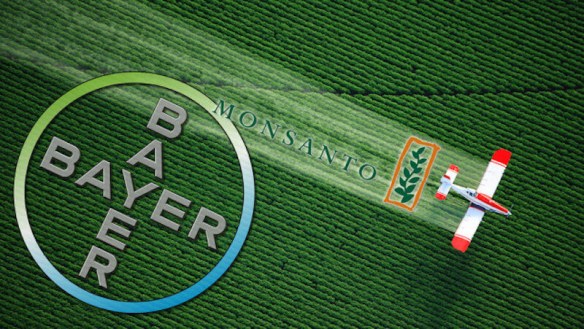
The chief suspect in this mass extinction is the aggressive use of neonicotinoid pesticides, particularly imidacloprid and clothianidin, both made by the Germany-based chemical giant Bayer. These pesticides, along with toxic glyphosate herbicides such as Roundup, have delivered a one-two punch to monarch butterflies, honeybees and birds. But rather than banning these toxic chemicals, on March 21 the EU approved the $66 billion merger of Bayer and Monsanto, the U.S. agribusiness giant that produces Roundup and the genetically modified (GMO) seeds that have reduced seed diversity globally. The merger will make the Bayer-Monsanto conglomerate the largest seed and pesticide company in the world, giving it enormous power to control farm practices, putting private profits over the public interest.

As Massachusetts Sen. Elizabeth Warren noted in a speech in December at the Open Markets Institute, massive companies are merging into market-dominating entities that invest a share of their profits in lobbying and financing political campaigns, shaping the political system to their own ends. She called on the Trump administration to veto the Bayer-Monsanto merger, which is still under antitrust scrutiny and has yet to be approved in the U.S.

A 2016 survey of Trump’s voter base found that more than half disapproved of the Monsanto-Bayer merger, fearing it would result in higher food prices and higher costs for farmers. Before 1990, there were 600 or more small, independent seed businesses globally, many of them family-owned. By 2009, only about 100 survived, and seed prices had more than doubled. But reining in these powerful conglomerates is more than just a question of economics. It may be a question of the survival of life on this planet.

While Bayer’s neonicotinoid pesticides wipe out insects and birds, Monsanto’s glyphosate has been linked to more than 40 human diseases, including cancer. Its seeds have been genetically modified to survive this toxic herbicide, but the plants absorb it into their tissues. In the humans who eat the plants, glyphosate disrupts the endocrine system and the balance of gut bacteria, damages DNA and is a driver of cancerous mutations. Researchers summarizing a 2014 study of glyphosates in the Journal of Organic Systems linked them to the huge increase in chronic diseases in the United States, with the percentage of GMO corn and soy planted in the U.S. showing highly significant correlations with hypertension, stroke, diabetes, obesity, lipoprotein metabolism disorder, Alzheimer’s, Parkinson’s, multiple sclerosis, hepatitis C, end stage renal disease, acute kidney failure, cancers of the thyroid, liver, bladder, pancreas, kidney and myeloid leukaemia. But regulators have turned a blind eye, captured by corporate lobbyists and a political agenda that has more to do with power and control them protecting the health of the people.

The Trump administration has already approved a merger between former rivals Dow and DuPont, and has signed off on the takeover of Swiss pesticide giant Syngenta by ChemChina. If Monsanto-Bayer gets approved as well, just three corporations will dominate the majority of the world’s seed and pesticide markets, giving them enormous power to continue poisoning the planet at the expense of its inhabitants.

The Shady History of Bayer and the Petrochemical Cartel

To understand the magnitude of this threat, it is necessary to delve into some history. This is not the first time Monsanto and Bayer have joined forces. In both world wars, they made explosives and poisonous gases using shared technologies that they sold to both sides. After World War II, they united as MOBAY (MonsantoBayer) and supplied the ingredients for Agent Orange in the Vietnam War.

In fact, corporate mergers and cartels have played a central role in Bayer’s history. In 1904, it joined with German giants BASF and AGFA to form the first chemical cartel. After World War I, Germany’s entire chemical industry merged to become I.G. Farben. By the beginning of World War II, I.G. Farben was the largest industrial corporation in Europe, the largest chemical company in the world, and part of the most gigantic and powerful cartel in all history.

A cartel is a grouping of companies bound by agreements designed to restrict competition and keep prices high. The dark history of the I.G. Farben cartel was detailed in a 1974 book titled “World Without Cancer,” by G. Edward Griffin, who also wrote the best-selling “Creature from Jekyll Island,” on the shady history of the Federal Reserve. Griffin quoted from a book titled “Treason’s Peace,” by Howard Ambruster, an American chemical engineer who had studied the close relations between the German chemical trust and certain American corporations. Ambruster warned:

Farben is no mere industrial enterprise conducted by Germans for the extraction of profits at home and abroad. Rather, it is and must be recognized as a cabalistic organization which, through foreign subsidiaries and secret tie-ups, operates a far-flung and highly efficient espionage machine—the ultimate purpose being world conquest … and a world superstate directed by Farben.

The I.G. Farben cartel arose out of the international oil industry. Coal tar or crude oil is the source material for most commercial chemical products, including those used in drugs and explosives. I.G. Farben established cartel agreements with hundreds of American companies. They had little choice but to capitulate after the Rockefeller empire, represented by Standard Oil of New Jersey, did so, because they could not hope to compete with the Rockefeller-I.G. combination.

The Rockefeller group’s greatest influence was exerted through international finance and investment banking, putting them in control of a wide spectrum of industry. Their influence was particularly heavy in pharmaceuticals. The directors of the American I.G. Chemical Company included Paul Warburg, brother of a director of the parent company in Germany and a chief architect of the Federal Reserve system.

The I.G. Farben cartel was technically disbanded at the Nuremberg trials following World War II, but in fact it merely split into three new companies—Bayer, Hoescht and BASF—which remain pharmaceutical giants today. To conceal its checkered history, Bayer orchestrated a merger with Monsanto in 1954, giving rise to the MOBAY Corp. In 1964, the U.S. Justice Department filed an antitrust lawsuit against MOBAY and insisted that it be broken up, but the companies continued to work together unofficially.

In “Seeds of Destruction: The Hidden Agenda of Genetic Manipulation” (2007), William Engdahl states that global food control and depopulation became U.S. strategic policy under Rockefeller protégé Henry Kissinger, who was secretary of state in the 1970s. Along with oil geopolitics, these policies were to be the new “solution” to the threats to U.S. global power and continued U.S. access to cheap raw materials from the developing world. “Control oil and you control nations,” Kissinger notoriously declared. “Control food and you control the people.”

Global food control has nearly been achieved, by reducing seed diversity and establishing proprietary control with GMO seeds distributed by only a few transnational corporations, led by Monsanto; and by a massive, taxpayer-subsidized propaganda campaign in support of GMO seeds and neurotoxic pesticides. A de facto cartel of giant chemical, drug, oil, banking and insurance companies connected by interlocking directorates reaps the profits at both ends, by waging a very lucrative pharmaceutical assault on the diseases created by their toxic agricultural chemicals.

Going Organic: The Russian Approach

In the end, the Green Revolution engineered by Kissinger to control markets and ensure U.S. economic dominance may be our nemesis. While the U.S. struggles to maintain its hegemony by economic coercion and military force, Russia is winning the battle for the health of the people and the environment. Russian President Vladimir Putin has banned GMOs and has set out to make Russia the world’s leading supplier of organic food.

Russian families are showing what can be done with permaculture methods on simple garden plots. In 2011, 40 percent of Russia’s food was grown on dachas (cottage gardens or allotments), predominantly organically. Dacha gardens produced more than 80 percent of the country’s fruit and berries, more than 66 percent of the vegetables, almost 80 percent of the potatoes and nearly 50 percent of the nation’s milk, much of it consumed raw. Russian author Vladimir Megre comments:

Essentially, what Russian gardeners do is demonstrate that gardeners can feed the world—and you do not need any GMOs, industrial farms, or any other technological gimmicks to guarantee everybody’s got enough food to eat. Bear in mind that Russia only has 110 days of growing season per year—so in the US, for example, gardeners’ output could be substantially greater. Today, however, the area taken up by lawns in the US is two times greater than that of Russia’s gardens—and it produces nothing but a multi-billion-dollar lawn care industry.

In the U.S., only about 0.6 percent of the total agricultural area is devoted to organic farming. Most farmland is soaked in pesticides and herbicides. But the need for these toxic chemicals is a myth. In an October 2017 article in The Guardian, columnist George Monbiot cited studies showing that reducing the use of neonicotinoid pesticides actually increases production, because the pesticides harm or kill the pollinators on which crops depend. Rather than an international trade agreement that would enable giant transnational corporations to dictate to governments, he argues that we need a global treaty to regulate pesticides and require environmental impact assessments for farming. He writes:

Farmers and governments have been comprehensively conned by the global pesticide industry. It has ensured its products should not be properly regulated or even, in real-world conditions, properly assessed. … The profits of these companies depend on ecocide. Do we allow them to hold the world to ransom, or do we acknowledge that the survival of the living world is more important than returns to their shareholders?

President Trump has boasted of winning awards for environmental protection. If he is sincere about championing the environment, he needs to block the merger of Bayer and Monsanto, two agribusiness giants bent on destroying the ecosystem for private profit.


Ellen Brown is an attorney, chairman of the Public Banking Institute, and author of twelve books including “Web of Debt” and “The Public Bank Solution.”