On the Criminal Referral of Comey, Clinton et al: Will the Constitution Hold and the Media Continue to Suppress the Story?

Ray McGovern reports on a major development in the Russia-gate story that has been ignored by corporate media: a criminal referral to the DOJ against Hillary Clinton, James Comey and others, exposing yet again how established media suppresses news it doesn’t like–about as egregious an example of unethical journalism as there is. 

By Ray McGovern

Source: Consortium News

Wednesday’s criminal referral by 11 House Republicans of former Secretary of State Hillary Clinton as well as several former and serving top FBI and Department of Justice (DOJ) officials is a giant step toward a Constitutional crisis.

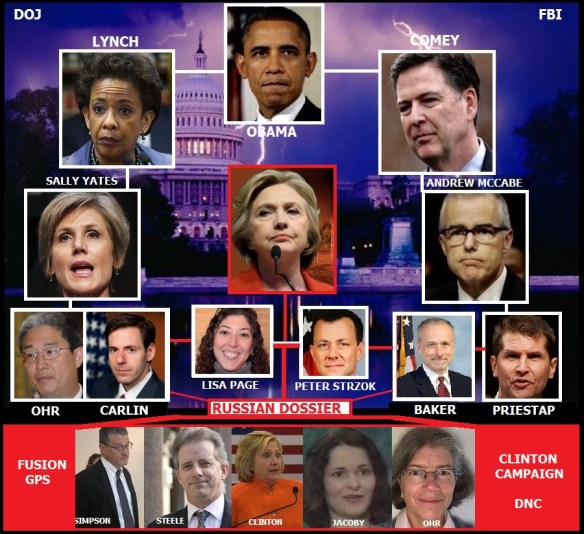
Named in the referral to the DOJ for possible violations of federal law are: Clinton, former FBI Director James Comey; former Attorney General Loretta Lynch; former Acting FBI Director Andrew McCabe; FBI Agent Peter Strzok; FBI Counsel Lisa Page; and those DOJ and FBI personnel “connected to” work on the “Steele Dossier,” including former Acting Attorney General Sally Yates and former Acting Deputy Attorney General Dana Boente.

With no attention from corporate media, the referral was sent to Attorney General Jeff Sessions, FBI Director Christopher Wray, and U.S. Attorney for the District of Utah John Huber.  Sessions appointed Huber months ago to assist DOJ Inspector General (IG) Michael Horowitz.  By most accounts, Horowitz is doing a thoroughly professional job.  As IG, however, Horowitz lacks the authority to prosecute; he needs a U.S. Attorney for that.  And this has to be disturbing to the alleged perps.

This is no law-school case-study exercise, no arcane disputation over the fine points of this or that law. Rather, as we say in the inner-city, “It has now hit the fan.”  Criminal referrals can lead to serious jail time.  Granted, the upper-crust luminaries criminally “referred” enjoy very powerful support.  And that will come especially from the mainstream media, which will find it hard to retool and switch from Russia-gate to the much more delicate and much less welcome “FBI-gate.”

As of this writing, a full day has gone by since the letter/referral was reported, with total silence so far from The New York Times and The Washington Post and other big media as they grapple with how to spin this major development. News of the criminal referral also slipped by Amy Goodman’s non-mainstream DemocracyNow!, as well as many alternative websites.

The 11 House members chose to include the following egalitarian observation in the first paragraph of the letter conveying the criminal referral: “Because we believe that those in positions of high authority should be treated the same as every other American, we want to be sure that the potential violations of law outlined below are vetted appropriately.” If this uncommon attitude is allowed to prevail at DOJ, it would, in effect, revoke the de facto “David Petraeus exemption” for the be-riboned, be-medaled, and well-heeled.

Stonewalling

Meanwhile, the patience of the chairmen of House committees investigating abuses at DOJ and the FBI is wearing thin at the slow-rolling they are encountering in response to requests for key documents from the FBI.  This in-your-face intransigence is all the more odd, since several committee members have already had access to the documents in question, and are hardly likely to forget the content of those they know about.  (Moreover, there seems to be a good chance that a patriotic whistleblower or two will tip them off to key documents being withheld.)

The DOJ IG, whose purview includes the FBI, has been cooperative in responding to committee requests for information, but those requests can hardly include documents of which the committees are unaware.

Putting aside his partisan motivations, House Intelligence Committee Chair Devin Nunes (R-CA) was unusually blunt two months ago in warning of legal consequences for officials who misled the Foreign Intelligence Surveillance Court in order to enable surveillance on Trump and his associates. Nunes’s words are likely to have sent chills down the spine of those with lots to hide: “If they need to be put on trial, we will put them on trial,” he said.”The reason Congress exists is to oversee these agencies that we created.”

Whether the House will succeed in overcoming the resistance of those criminally referred and their many accomplices and will prove able to exercise its Constitutional prerogative of oversight is, of course, another matter — a matter that matters.

And Nothing Matters More Than the Media

The media will be key to whether this Constitutional issue is resolved.  Largely because of Trump’s own well earned reputation for lying, most Americans are susceptible to slanted headlines like this recent one — “Trump escalates attacks on FBI …” — from an article in The Washington Post, commiserating with the treatment accorded fired-before-retired prevaricator McCabe and the FBI he (dis)served.

Nor is the Post above issuing transparently clever warnings — like this one in a lead article on March 17: “Some Trump allies say they worry he is playing with fire by taunting the FBI. ‘This is open, all-out war. And guess what? The FBI’s going to win,’ said one ally, who spoke on the condition of anonymity to be candid. ‘You can’t fight the FBI. They’re going to torch him.’” [sic]

Mind-Boggling Criminal Activity

What motivated the characters now criminally “referred” is clear enough from a wide variety of sources, including the text messages exchange between Strzok and Page.  Many, however, have been unable to understand how these law enforcement officials thought they could get away with taking such major liberties with the law.

None of the leaking, unmasking, surveillance, “opposition research,” or other activities directed against the Trump campaign can be properly understood, if one does not bear in mind that it was considered a sure thing that Secretary Clinton would become President, at which point illegal and extralegal activities undertaken to help her win would garner praise, not prison.  The activities were hardly considered high-risk, because candidate Clinton was sure to win.

But she lost.

Comey himself gives this away in the embarrassingly puerile book he has been hawking, “A Higher Loyalty” — which amounts to a pre-emptive move motivated mostly by loyalty-to-self, in order to obtain a Stay-Out-of-Jail card.  Hat tip to Matt Taibbi of Rolling Stone for a key observation, in his recent article, “James Comey, the Would-Be J. Edgar Hoover,” about what Taibbi deems the book’s most damning passage, where Comey discusses his decision to make public the re-opening of the Hillary Clinton email investigation.

Comey admits, “It is entirely possible that, because I was making decisions in an environment where Hillary Clinton was sure to be the next president, my concern about making her an illegitimate president by concealing the re-started investigation bore greater weight than it would have if the election appeared closer or if Donald Trump were ahead in the polls.”

The key point is not Comey’s tortured reasoning, but rather that Clinton was “sure to be the next president.”  This would, of course, confer automatic immunity on those now criminally referred to the Department of Justice.  Ah, the best laid plans of mice and men — even very tall men.  One wag claimed that the “Higher” in “A Higher Loyalty” refers simply to the very tall body that houses an outsized ego.

I think it can be said that readers of Consortiumnews.com may be unusually well equipped to understand the anatomy of FBI-gate as well as Russia-gate.  Listed below chronologically are several links that might be viewed as a kind of “whiteboard” to refresh memories.  You may wish to refer them to any friends who may still be confused.

2017

Russia-gate’s Mythical ‘Heroes’ June 6, 2017

The Democratic Money Behind Russia-gate Oct. 29, 2017

The Foundering Russia-gate ‘Scandal’ Dec. 13, 2017 

What Did Hillary Clinton Know? Dec. 25, 2017

2018

The FBI Hand Behind Russia-gate Jan. 11, 2018

Will Congress Face Down the Deep State? Jan. 30, 2018

Nunes Memo Reports Crimes at Top of FBI and DOJ Feb. 2, 2018

‘This is Nuts’: Liberals Launch ‘Largest Mobilization in History’ in Defense of Russiagate Probe Feb. 9, 2018

Nunes: FBI and DOJ Perps Could Be Put on Trial Feb. 19, 2018

‘Progressive’ Journalists Jump the Shark on Russia-gate March 7, 2018

Intel Committee Rejects Basic Underpinning of Russiagate March 14, 2018

McCabe: A War on (or in) the FBI? March 18, 2018

Former CIA Chief Brennan Running Scared March 19, 2018
 

If You Come to a Fork in the Road, Take It

By James Howard Kunstler

Source: Kunstler.com

Various readers, fans, blog commenters, Facebook trolls, and auditors twanged on me all last week about my continuing interest in the RussiaRussiaRussia hysteria, though there is no particular consensus of complaint among them — except for a general “shut up, already” motif. For the record, I’m far more interested in the hysteria itself than the Russia-meddled-in the-election case, which I consider to be hardly any case at all beyond 13 Russian Facebook trolls.

The hysteria, on the other hand, ought to be a matter of grave concern, because it appears more and more to have been engineered by America’s own intel community, its handmaidens in the Dept of Justice, and the twilight’s last gleamings of the Obama White House, and now it has shoved this country in the direction of war at a time when civilian authority over the US military looks sketchy at best. This country faces manifold other problems that are certain to reduce the national standard of living and disrupt the operations of an excessively complex and dishonest economy, and the last thing America needs is a national war-dance over trumped-up grievances with Russia.

The RussiaRussiaRussia narrative has unspooled since Christmas and is blowing back badly through the FBI, now with the firing (for cause) of Deputy Director Andrew McCabe hours short of his official retirement (and inches from the golden ring of his pension). He was axed on the recommendation of his own colleagues in the FBI’s Office of Professional Responsibility, and they may have been influenced by the as-yet-unreleased report of the FBI Inspector General, Michael Horowitz, due out shortly.

The record of misbehavior and “collusion” between the highest ranks of the FBI, the Democratic Party, the Clinton campaign, several top political law firms, and a shady cast of international blackmail peddlars is a six-lane Beltway-scale evidence trail compared to the muddy mule track of Trump “collusion” with Russia. It will be amazing if a big wad of criminal cases are not dealt out of it, even as The New York Times sticks its fingers in its ears and goes, “La-la-la-la-la….”

It now appears that Mr. McCabe’s statements post-firing tend to incriminate his former boss, FBI Director James Comey — who is about to embark, embarrassingly perhaps, on a tour for his self-exculpating book, A Higher Loyalty: Truth, Lies, and Leadership.

A great aura of sanctimony surrounds the FBI these days. Even the news pundits seem to have forgotten the long, twisted reign of J. Edgar Hoover (1924 – 1972), a dangerous rogue who excelled at political blackmail. And why, these days, would any sane American take pronouncements from the CIA and NSA at face value? What seems to have gone on in the RussiaRussiaRussia matter is that various parts of the executive branch in the last months under Mr. Obama gave each other tacit permission, wink-wink, to do anything necessary to stuff HRC into the White House and, failing that, to derail her opponent, the Golden Golem of Greatness.

The obvious lesson in all this huggermugger is that the ends don’t justify the means. I suspect there are basically two routes through this mess. One is that the misdeeds of FBI officers, Department of Justice lawyers, and Intel agency executives get adjudicated by normal means, namely, grand juries and courts. That would have the salutary effect of cleansing government agencies and shoring up what’s left of their credibility at a time when faith in institutions hangs in the balance.

The second route would be for the authorities to ignore any formal response to an evermore self-evident trail of crimes, and to allow all that political energy to be funneled into manufactured hysteria and eventually a phony provocation of war with Russia. Personally, I’d rather see the US government clean house than blow up the world over an engineered hallucination.

Biggest Nunes Memo Revelations Have Little To Do With Its Content

By Caitlin Johnstone

Source: Consortium News

It’s fitting that the ever-tightening repetitive loops of America’s increasingly schizophrenic partisan warfare finally hit peak shrillness and skyrocketed into a white noise singularity on Groundhog Day. Right now, we’re right about at the part of the movie where Bill Murray is driving over a cliff in a pickup truck with a large rodent behind the wheel.

If you only just started paying attention to U.S. politics in 2017 what I’m about to tell you will blow your mind, so you might want to sit down for this: believe it or not, there was once a time when both of America’s mainstream political parties weren’t screeching every single day that there was news about to break any minute now which would obliterate the other party forever. No Russiagate, no Nunes memo, no Rachel Maddow red yarn graphs, no Sean Hannity “tick tock,” no nothing. People screaming that the end is nigh and it’s all about to come crashing down were relegated to street corners and the occasional Infowars appearance, not practicing mainstream political punditry for multimillion dollar salaries on MSNBC and Fox News.

I’m not saying it’s a bad thing that Americans are starting to look critically at the power dynamics in their country, but the partisan filters they’ve pulled over their eyes are causing mass confusion and delusion. Now everyone who questions the CIA is a Russian agent and the term “deep state” suddenly means “literally anyone who doesn’t like Donald Trump.” Your take on the contents of the Nunes memo will put you in one of two radically different political dimensions depending on which mainstream cult you’ve subscribed to, and it will cause you to completely miss the point of the entire ordeal.

The part of the memo that has everyone talking today reads as follows: “Furthermore, Deputy Director McCabe testified before the Committee in December 2017 that no surveillance warrant would have been sought from the FISC without the Steele dossier information.”

This refers to a surveillance warrant requested by the FBI’s then-Deputy Director Andrew McCabe from the Foreign Intelligence Surveillance Court seeking permission to spy on the communications of Carter Page, a member of the 2016 Trump campaign. The controversy revolves around the claim that this surveillance warrant would never have even been requested if not for the clearly biased, Clinton-funded, and error-riddled Christopher Steele dossier which is acknowledged even by its former MI6 author to be 10 to 30 percent inaccurate.

Combine that with the fact that this has never been made clear to the public, and baby you’ve got yourself a scandal. The FBI knowingly using extremely tainted evidence from one presidential campaign to get permission to spy on another would indeed be a very big deal.

There are some problems with the “BOOM! Bigger than Watergate!” exclamations that pro-Trump partisans have been parading around about this, however. The first is that the memo is only an internal communication between Republican congressmen; it’s not a sworn testimony or legal transcript or anything legally binding. It’s basically just some Republican ideas about what happened. The assertions made therein are reportedly being hotly contested by Democrats with knowledge of the situation, which is in turn being disputed by Republicans.

Another thing putting a damper on the GOP’s “KABOOM!” parade is the fact that the memo’s contents are not even entirely new; CNN reported way back in April of last year that sources had informed them that the Steele dossier had been used to get a FISA warrant on the Trump campaign. Additionally, even if every single allegation in the memo is true, the revelations are still arguably far less earth shattering than the Edward Snowden revelations of 2013 exposing the NSA’s sprawling domestic espionage network, so the expectation that these less significant new revelations would cause a radical transformation in U.S. politics when the Snowden revelations did not seems highly unrealistic.

Nonetheless, there have been some extremely important revelations as a result of this memo; they just haven’t come from the contents of the memo itself. In the same way that cybersecurity analysts observe the metadata underlying hacked files rather than the contents of the files themselves, political analysts have been pointing out that a lot can be learned about the political establishment by looking at its response to the possibility of the memo’s release.

“Memo is clearly not a blockbuster. We can tell so by reading it. Which makes Dems’ frantic efforts to prevent anyone from reading it seem even more bizarre,” observed TYT’s Michael Tracey. “Veracity of memo’s claims aside, we were told that its release would undermine the rule of law. So, just checking: is the rule of law still in tact?” he added later.

“Now it is clear to all,” WikiLeaks’ Julian Assange tweeted. “The claims about how the ‘Nunes’ memo would destroy ‘national security’ were lies. Classification stickers are used by bureaucrats trying to obtain ‘political security’ for their cronies.”

“One effect of the memo – it’s an example of how extensively we overclassify information,” wrote National Review’s David French. “I’m highly dubious that any information disclosed threatens national security in any way, shape, or form. I’d be willing to bet the Dem response is similarly harmless. Release it.”

Indeed, both the FBI and high-profile Democrats have been claiming that the memo’s unredacted release would pose a national security threat, with California Congressman (and virulent Russiagater) Eric Swalwell going so far to call it “brainwashing.” A CNN panelist wandered completely off the paddock and suggested that yesterday may have been America’s last day as a democracy. Why were they all flipping out so hysterically over a release of information that plainly poses no threat to the American people?

In addition to Assange’s assertion that government secrecy has far less to do with national security than political security (a claim he has made before which seems to be proving correct time and time again), there’s the jarring question posed by Republican Congressman Thomas Massie: “who made the decision to withhold evidence of FISA abuse until after Congress voted to renew FISA program?”

Whoa, Nelly. Hang on. What is he talking about?

It would be understandable if you were unaware of the debate over the reauthorization of FISA surveillance which resulted in unconditional bipartisan approval last month – the mainstream media barely touched it. In point of fact, though, the very surveillance practices alleged to have been abused in this hotly controversial memo are the same which was waved through by both the House and the Senate, and by the very same people promoting the memo in many cases.

The McCabe testimony was in December. FISA was renewed in January. Why is all this just coming out now? If the Republicans truly believed that McCabe said what the memo claims he said, why wasn’t the public informed before their elected representatives renewed the intelligence community’s dangerously intrusive surveillance approval? Was this information simply forgotten about until after those Orwellian powers had been secured?

Of course not. Don’t be an idiot.

This makes the kicking, screaming, wailing and gnashing of teeth by the political establishment make a lot more sense, doesn’t it? Now suddenly we’re looking at a he-said, she-said partisan battle over an issue which can only be resolved with greater and greater transparency of more and more government documents, and we can all see where that’s headed. In their rush to win a partisan battle and shield their president from the ongoing Russiagate conspiracy theory, the Republicans may have exposed too much of the establishment foundation upon which both parties are built.

The term “deep state” does not mean “Democrats and Never-Trumpers” as Republican pundits would have you believe, nor does the term refer to any kind of weird, unverifiable conspiracy theory. The deep state is in fact not a conspiracy theory at all, but simply a concept used in political analysis for discussing the undeniable fact that unelected power structures exist in America, and that they tend to form alliances and work together in some sense.

There is no denying the fact that plutocrats, intelligence agencies, defense agencies and the mass media are both powerful and unelected, and there is no denying the fact that there are many convoluted and often conflicting alliances between them. All that can be debated is the manner and extent to which this is happening.

The deep state is America’s permanent government, the U.S. power structures that Americans don’t elect. These power structures plainly have a vested interest in keeping America’s Orwellian surveillance structures in place, as evidenced by the intelligence community’s menacingly urgent demand for FISA renewal back in December. If there’s any thread to be pulled that really could make waves in the way Official Washington (hat tip to the late Robert Parry) operates, it is in the plot holes between the bipartisan scramble toward unconditional surveillance renewal and the highly partisan battle over exposing the abuse of those very powers.

If we’re going to see a gap in the bars of our cages, that’s a great place to keep our eyes trained, so keep watching. Watch what happens in a partisan war where both parties have a simultaneous interest in revealing as little of the game as possible and exposing the other party. Things could get very interesting.

Release of Nunes memo throws anti-Russia campaign into disarray

By Andre Damon

Source: WSWS.org

The Democratic Party was thrown into disarray Friday after the publication of a classified memo exposing as a factionally-motivated witch-hunt the investigation by leading intelligence agencies into the Trump administration’s alleged collusion with Russia.

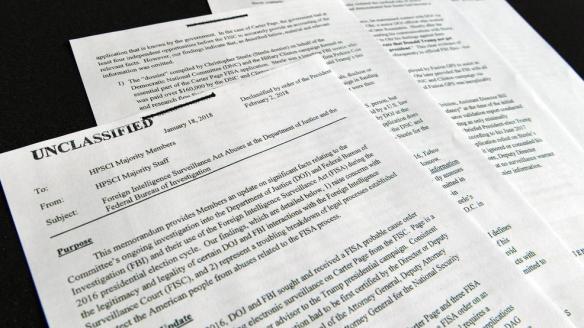
The so-called Nunes memo, which Democratic lawmakers, US intelligence agencies, and major newspapers had been seeking to block for days, alleges that the FBI under the Obama administration used discredited sources and withheld key information to initiate a wiretap of former Trump campaign adviser Cater Page.

The Democrats responded to the prospective release of the Nunes memo with undisguised hysteria, declaring that it threatened National Security and was insufficiently deferential to the US intelligence agencies. Now that the memo has been released, Democrats’ claim that it contains sensitive national security secrets has been exposed as lies.

The memo, written by Republican House Intelligence Committee Chairman Devin Nunes, claims that the FBI obtained a Foreign Intelligence Surveillance (FISA) court authorization to wiretap Page in the fall of 2016 based on a memo compiled by former British intelligence official Christopher Steele.

The so-called Steele dossier, which was released to the public last year, made lurid allegations that Russian government officials had recordings of Trump engaging in “perverted sexual acts” with prostitutes “which have been arranged/monitored by the FSB [Russian intelligence service].” According to the Nunes memo, FBI director James Comey called the Steele Dossier “salacious and unverified” in congressional testimony in June 2017.

In perhaps its most explosive passage, the memo alleges that Andrew McCabe, a deputy FBI director who just stepped down this past week, testified before the House Intelligence Committee in December that “no surveillance warrant would have been sought… without the Steele dossier information.”

In addition, the FISA application “ignored or concealed [Steele’s] anti-Trump financial and ideological motivations,” i.e. the fact that his “research” had been funded by the Clinton campaign.

The Republican memo does not specify what information was collected by the wiretap, or whether it captured any conversations with Trump.

The contents of the memo are another demonstration of the manufactured and partisan character of the anti-Russia campaign and the Democrats’ allegations that Trump “colluded” with Russia. What is playing out is a partisan battle between two criminal and reactionary factions of the state apparatus, centering ultimately around differences over foreign policy.

The release of the memo once again underscores the fact that the US intelligence agencies have massively intervened in US politics. This is true not only with regard to the concocted narrative about “collusion” between Trump and Russia, but equally so with James Comey’s public announcement about re-opening an investigation into Hillary Clinton’s emails just days before the presidential vote, which Clinton claimed may have cost her the election.

The memo has undermined the aura of professional impartiality that the Democrats and their semi-official news outlets, the New York Times and the Washington Post, have sought to cultivate around the so-called “intelligence community.”

The real fear of Democrats is that the exposure of the anti-Russia campaign will undermine the credibility of the FBI. “The selective release and politicization of classified information sets a terrible precedent and will do long-term damage to the intelligence community and our law enforcement agencies,” declared Rep. Adam Schiff of California, the ranking Democrat on the House Intelligence Committee, on Friday.

Schiff added, “If potential intelligence sources know that their identities might be compromised when political winds arise, those sources of vital information will simply dry up, at great cost to our national security.”

But all such arguments about “national security” have been rendered absurd by the release of the document, which contained no sensitive information besides the wrongdoing of the FBI and the Democrats—including Schiff himself.

In an editorial published Friday, ahead of the document’s publication, the New York Times accused congressional Republicans of “undermining the credibility of the law enforcement community,” which they had “once defended so ardently.”

It was left to the satirical news website the Onion to point out the obvious absurdity of such arguments:

Stressing that such an action would be highly reckless, FBI Director Christopher Wray warned Thursday that releasing the “Nunes Memo” could potentially undermine faith in the massive, unaccountable government secret agencies of the United States. “Making this memo public will almost certainly impede our ability to conduct clandestine activities operating outside any legal or judicial system on an international scale,” said Wray, noting that it was essential that mutual trust exist between the American people and the vast, mysterious cabal given free rein to use any tactics necessary to conduct surveillance on U.S. citizens or subvert religious and political groups.

Responding to the Democrats’ allegations that the publication of the document would threaten “national security,” journalist Glen Greenwald tweeted, “What conceivable argument is there that any part of the Nunes Memo could jeopardize national security?”

The Times editorial effectively argues that no documents critical of the actions of the US intelligence apparatus should be published. To make this point, the Times quotes Democratic Senator Ron Wyden, who argued against the release of the memo on the grounds that the public would “see this release as proof that selective classification is used more often to deceive them than to protect them.”

But it is, of course true that “selective classification” is used to deceive the American people. This was demonstrated by the release of the classified Pentagon Papers in 1971, which documented how flagrantly and extensively the Kennedy, Johnson, and Nixon administrations lied to the American people about the Vietnam War.

As The Post, the recently-released film by Stephen Spielberg effectively documents, the New York Times and Washington Post made the decision at the time to defy the Nixon administration and publish the Pentagon Papers, rejecting the spurious argument that their publication would harm “national security.”

The editorial published in the Times Friday reads like a cruder version of the arguments put forward by the Nixon White House to block the release of the Pentagon Papers. If one were to take the editorial at face value, one would conclude that, if the Times had the Nunes memo in its sole possession, it would never have published it.

The Times has become little more than a mouthpiece for the US intelligence agencies, whose aim is to prevent the dissemination of any information that they see as harmful to the interests of the American ruling class and the capitalist state.