2024 Is the New 1984: Big Brother and the Rise of the Security Industrial Complex

By John & Nisha Whitehead

Source: The Rutherford Institute

“Big Brother is Watching You.”―George Orwell, 1984

2024 is the new 1984.

Forty years past the time that George Orwell envisioned the stomping boot of Big Brother, the police state is about to pass off the baton to the surveillance state.

Fueled by a melding of government and corporate power—the rise of the security industrial complex—this watershed moment sounds a death knell for our privacy rights.

An unofficial fourth branch of government, the Surveillance State came into being without any electoral mandate or constitutional referendum, and yet it possesses superpowers, above and beyond those of any other government agency save the military.

It operates beyond the reach of the president, Congress and the courts, and it marches in lockstep with the corporate elite who really call the shots in Washington, DC.

This is the new face of tyranny in America: all-knowing, all-seeing and all-powerful.

Tread cautiously.

Empowered by advances in surveillance technology and emboldened by rapidly expanding public-private partnerships between law enforcement, the Intelligence Community, and the private sector, the Surveillance State is making the fictional world of 1984, Orwell’s dystopian nightmare, our looming reality.

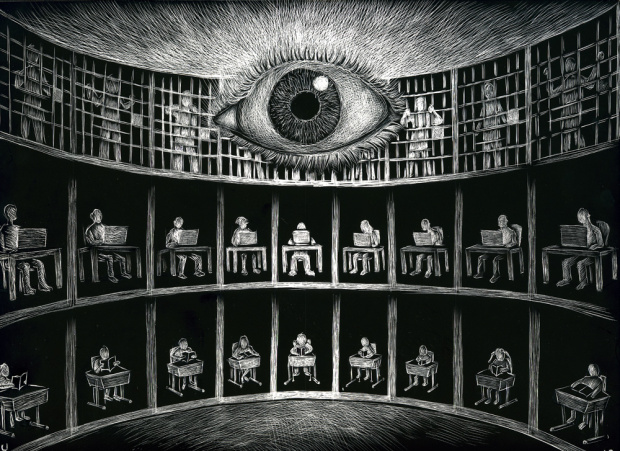
1984 portrays a global society of total control in which people are not allowed to have thoughts that in any way disagree with the corporate state. There is no personal freedom, and advanced technology has become the driving force behind a surveillance-driven society. Snitches and cameras are everywhere. People are subject to the Thought Police, who deal with anyone guilty of thought crimes. The government, or “Party,” is headed by Big Brother who appears on posters everywhere with the words: “Big Brother is watching you.”

Indeed, in our present age of ubiquitous surveillance, there are no private lives.

Everything is increasingly public.

What we are witnessing, in the so-called name of security and efficiency, is the creation of a new class system comprised of the watched (average Americans such as you and me) and the watchers (government bureaucrats, technicians and private corporations).

We now find ourselves in the unenviable position of being monitored, managed and controlled by our technology, which answers not to us but to our government and corporate rulers.

This is the fact-is-stranger-than-fiction lesson that is being pounded into us on a daily basis.

In this way, 1984, which depicted the ominous rise of ubiquitous technology, fascism and totalitarianism, has become an operation manual for the omnipresent, modern-day surveillance state.

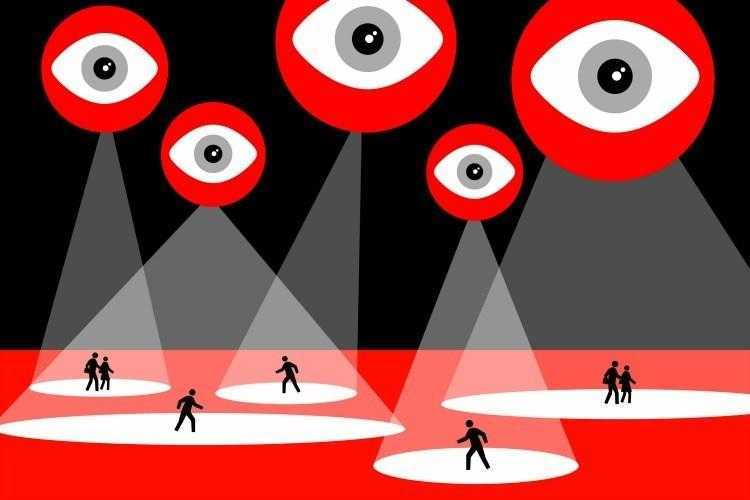
There are roughly one billion surveillance cameras worldwide and that number continues to grow, thanks to their wholehearted adoption by governments (especially law enforcement and military agencies), businesses, and individual consumers.

Surveillance cameras mounted on utility poles, traffic lights, businesses, and homes. Ring doorbells. GPS devices. Dash cameras. Drones. Store security cameras. Geofencing and geotracking. FitBits. Alexa. Internet-connected devices. 

Stingray devices, facial recognition technology, body cameras, automated license plate readers, gunshot detection, predictive policing software, AI-enhanced video analytics, real-time crime centers, fusion centers: all of these technologies and surveillance programs rely on public-private partnerships that together create a sticky spiderweb from which there is no escape.

With every new surveillance device we welcome into our lives, the government gains yet another toehold into our private worlds.

As the cost of these technologies becomes more affordable for the average consumer, an effort underwritten by the tech industry and encouraged by law enforcement agencies and local governing boards, which in turn benefit from access to surveillance they don’t need to include in their budgets, big cities, small towns, urban, suburban and rural communities alike are adding themselves to the surveillance state’s interconnected grid.

What this adds up to for government agencies (that is, FBI, NSA, DHS agents, etc., as well as local police) is a surveillance map that allows them to track someone’s movements over time and space, hopscotching from doorbell camera feeds and business security cameras to public cameras on utility poles, license plate readers, traffic cameras, drones, etc.

It has all but eliminated the notion of privacy enshrined in the  Fourth Amendment and radically re-drawn the line of demarcation between our public and private selves.

The police state has become particularly adept at sidestepping the Fourth Amendment, empowered by advances in surveillance technology and emboldened by rapidly expanding public-private partnerships between law enforcement, the Intelligence Community, and the private sector.

Over the past 50-plus years, surveillance has brought about a series of revolutions in how governments govern and populations are policed to the detriment of us all. Cybersecurity expert Adam Scott Wandt has identified three such revolutions.

The first surveillance revolution came about as a result of government video cameras being installed in public areas. There were a reported 51 million surveillance cameras blanketing the United States in 2022. It’s estimated that Americans are caught on camera an average of 238 times every week (160 times per week while driving; 40 times per week at work; 24 times per week while out running errands and shopping; and 14 times per week through various other channels and activities). That doesn’t even touch on the coverage by surveillance drones, which remain a relatively covert part of police spying operations.

The second revolution occurred when law enforcement agencies started forging public-private partnerships with commercial establishments like banks and drug stores and parking lots in order to gain access to their live surveillance feeds. The use of automatic license plate readers (manufactured and distributed by the likes of Flock Safety), once deployed exclusively by police and now spreading to home owners associations and gated communities, extends the reach of the surveillance state that much further afield. It’s a win-win for police budgets and local legislatures when they can persuade businesses and residential communities to shoulder the costs of the equipment and share the footage, and they can conscript the citizenry to spy on each other through crowdsourced surveillance.

The third revolution was ushered in with the growing popularity of doorbell cameras such as Ring, Amazon’s video surveillance doorbell, and Google’s Nest Cam.

Amazon has been particularly aggressive in its pursuit of a relationship with police, enlisting them in its marketing efforts, and going so far as to hosting parties for police, providing free Ring doorbells and deep discounts, sharing “active camera” maps of Ring owners, allowing access to the Law Enforcement Neighborhood Portal, which enables police to directly contact owners for access to their footage, and coaching police on how to obtain footage without a warrant.

Ring currently partners with upwards of 2,161 law enforcement agencies and 455 fire departments, and that number grows exponentially every year. As Vice reports, “Ring has also heavily pursued city discount programs and private alliances with neighborhood watch groups. When cities provide free or discounted Ring cameras, they sometimes create camera registries, and police sometimes order people to aim Ring cameras at their neighbors, or only give cameras to people surveilled by neighborhood watches.”

In November 2022, San Francisco police gained access to the live footage of privately owned internet cameras as opposed to merely being able to access recorded footage. No longer do police even have to request permission of homeowners for such access: increasingly, corporations have given police access to footage as part of their so-called criminal investigations with or without court orders.

The fourth revolutionary shift may well be the use of facial recognition software and artificial intelligence-powered programs that can track people by their biometrics, clothing, behavior and car, thereby synthesizing the many strands of surveillance video footage into one cohesive narrative, which privacy advocates refer to as 360 degree surveillance.

While the guarantee of safety afforded by these surveillance nerve centers remains dubious, at best, there is no disguising their contribution in effecting a sea change towards outright authoritarianism.

For instance, as an in-depth investigative report by the Associated Press concludes, the very same mass surveillance technologies that were supposedly so necessary to fight the spread of COVID-19 are now being used to stifle dissent, persecute activists, harass marginalized communities, and link people’s health information to other surveillance and law enforcement tools.

As the AP reports, federal officials have also been looking into how to add “‘identifiable patient data,’ such as mental health, substance use and behavioral health information from group homes, shelters, jails, detox facilities and schools,” to its surveillance toolkit.

These cameras—and the public-private eyes peering at us through them—are re-engineering a society structured around the aesthetic of fear and, in the process, empowering “people to not just watch their neighborhood, but to organize as watchers,” creating not just digital neighborhood watches but digital gated communities.

Finally, there is a repressive, suppressive effect to surveillance that not only acts as a potentially small deterrent on crime but serves to monitor and chill lawful First Amendment activity.

As Matthew Feeney warns in the New York Times, “In the past, Communists, civil rights leaders, feminists, Quakers, folk singers, war protesters and others have been on the receiving end of law enforcement surveillance. No one knows who the next target will be.

No one knows, but it’s a pretty good bet that the surveillance state will be keeping a close watch on anyone seen as a threat to the government’s chokehold on power.

After all, as I make clear in my book Battlefield America: The War on the American People and in its fictional counterpart The Erik Blair Diaries, the Surveillance State never sleeps.
360 Degree Surveillance: How Police Use Public-Private Partnerships to Spy on Americans

By John & Nisha Whitehead

Source: The Rutherford Institute

We live in a surveillance state founded on a partnership between government and the technology industry.”— Law Professor Avidan Y. Cover

In this age of ubiquitous surveillance, there are no private lives: everything is public.

Surveillance cameras mounted on utility poles, traffic lights, businesses, and homes. License plate readers. Ring doorbells. GPS devices. Dash cameras. Drones. Store security cameras. Geofencing and geotracking. FitBits. Alexa. Internet-connected devices.  

There are roughly one billion surveillance cameras worldwide and that number continues to grow, thanks to their wholehearted adoption by governments (especially law enforcement and military agencies), businesses, and individual consumers.

With every new surveillance device we welcome into our lives, the government gains yet another toehold into our private worlds.

Indeed, empowered by advances in surveillance technology and emboldened by rapidly expanding public-private partnerships between law enforcement, the Intelligence Community, and the private sector, police have become particularly adept at sidestepping the Fourth Amendment.

As law professor Avidan Y. Cover explains:

A key feature of the surveillance state is the cooperative relationship between the private sector and the government. The private sector’s role is vital to the surveillance both practically and legally. The private sector, of course, provides the infrastructure and tools for the surveillance… The private sector is also critical to the surveillance state’s legality. Under the third-party doctrine, the Fourth Amendment is not implicated when the government acquires information that people provide to corporations, because they voluntarily provide their information to another entity and assume the risk that the entity will disclose the information to the government. Therefore, people do not have a reasonable expectation of privacy in their calling data, or potentially even their emails. As a result, the government does not normally need a warrant to obtain information transmitted electronically. But the Fourth Amendment is not only a source of protection for individual privacy; it also limits government excess and abuse through challenges by the people. The third-party doctrine removes this vital and populist check on government overreach.

Critical to this end run around the Fourth Amendment’s prohibitions against unreasonable searches and seizures by government agents is a pass play that allows police to avoid public transparency requirements (open bids, public meetings, installation protocols) by having private companies and individuals do the upfront heavy lifting, leaving police to harvest the intel on the back end.

Stingray devices, facial recognition technology, body cameras, automated license plate readers, gunshot detection, predictive policing software, AI-enhanced video analytics, real-time crime centers, fusion centers: all of these technologies and surveillance programs rely on public-private partnerships that together create a sticky spiderweb from which there is no escape.

As the cost of these technologies becomes more affordable for the average consumer, an effort underwritten by the tech industry and encouraged by law enforcement agencies and local governing boards, which in turn benefit from access to surveillance they don’t need to include in their budgets, big cities, small towns, urban, suburban and rural communities alike are adding themselves to the surveillance state’s interconnected grid.

What this adds up to for government agencies (that is, FBI, NSA, DHS agents, etc., as well as local police) is a surveillance map that allows them to track someone’s movements over time and space, hopscotching from doorbell camera feeds and business security cameras to public cameras on utility poles, license plate readers, traffic cameras, drones, etc.

It has all but eliminated the notion of privacy and radically re-drawn the line of demarcation between our public and private selves.

Over the past 50 years, surveillance has brought about a series of revolutions in how governments govern and populations are policed to the detriment of us all. Cybersecurity expert Adam Scott Wandt has identified three such revolutions.

The first surveillance revolution came about as a result of government video cameras being installed in public areas. There were a reported 51 million surveillance cameras blanketing the United States in 2022. It’s estimated that Americans are caught on camera an average of 238 times every week (160 times per week while driving; 40 times per week at work; 24 times per week while out running errands and shopping; and 14 times per week through various other channels and activities). That doesn’t even touch on the coverage by surveillance drones, which remain a relatively covert part of police spying operations.

The second revolution occurred when law enforcement agencies started forging public-private partnerships with commercial establishments like banks and drug stores and parking lots in order to gain access to their live surveillance feeds. The use of automatic license plate readers (manufactured and distributed by the likes of Flock Safety), once deployed exclusively by police and now spreading to home owners associations and gated communities, extends the reach of the surveillance state that much further afield. It’s a win-win for police budgets and local legislatures when they can persuade businesses and residential communities to shoulder the costs of the equipment and share the footage, and they can conscript the citizenry to spy on each other through crowdsourced surveillance.

The third revolution was ushered in with the growing popularity of doorbell cameras such as Ring, Amazon’s video surveillance doorbell, and Google’s Nest Cam.

Amazon has been particularly aggressive in its pursuit of a relationship with police, enlisting them in its marketing efforts, and going so far as to hosting parties for police, providing free Ring doorbells and deep discounts, sharing “active camera” maps of Ring owners, allowing access to the Law Enforcement Neighborhood Portal, which enables police to directly contact owners for access to their footage, and coaching police on how to obtain footage without a warrant.

Ring currently partners with upwards of 2,161 law enforcement agencies and 455 fire departments, and that number grows exponentially every year. As Vice reports, “Ring has also heavily pursued city discount programs and private alliances with neighborhood watch groups. When cities provide free or discounted Ring cameras, they sometimes create camera registries, and police sometimes order people to aim Ring cameras at their neighbors, or only give cameras to people surveilled by neighborhood watches.”

In November 2022, San Francisco police gained access to the live footage of privately owned internet cameras as opposed to merely being able to access recorded footage. No longer do police even have to request permission of homeowners for such access: increasingly, corporations have given police access to footage as part of their so-called criminal investigations with or without court orders.

We would suggest a fourth revolutionary shift to be the use of facial recognition software and artificial intelligence-powered programs that can track people by their biometrics, clothing, behavior and car, thereby synthesizing the many strands of surveillance video footage into one cohesive narrative, which privacy advocates refer to as 360 degree surveillance.

Finally, Wandt sees autonomous cars equipped with cameras that record everything around them as yet another revolutionary expansion of surveillance to be tapped by police.

Yet in the present moment, it’s those public-private partnerships that signify a watershed moment in the transition from a police state to a surveillance state and sound a death knoll for our privacy rights. This fusion of government power and private power is also at the heart of the surveillance state’s growing stranglehold on the populace.

As always, these intrusions into our personal lives are justified in the name of national security and fighting crime. Yet while the price to be paid for having the government’s so-called protection is nothing less than our right to privacy, the guarantee of safety remains dubious, at best.

As a study on camera surveillance by researchers at City University of New York concluded, the presence of cameras were somewhat effective as a deterrent for crimes such as car burglaries and property theft, but they had no significant effect on violent crimes.

On the other hand, when you combine overcriminalization with wall-to-wall surveillance monitored by police in pursuit of crimes, the resulting suspect society inevitably gives way to a nation of criminals. In such a society, we are all guilty of some crime or other.

The predatory effect of these surveillance cameras has also yet to be fully addressed, but they are vulnerable to being hacked by third parties and abused by corporate and government employees.

After all, power corrupts. We’ve seen this abuse of power recur time and time again throughout history. For instance, as an in-depth investigative report by the Associated Press concludes, the very same mass surveillance technologies that were supposedly so necessary to fight the spread of COVID-19 are now being used to stifle dissent, persecute activists, harass marginalized communities, and link people’s health information to other surveillance and law enforcement tools. As the AP reports, federal officials have also been looking into how to add “‘identifiable patient data,’ such as mental health, substance use and behavioral health information from group homes, shelters, jails, detox facilities and schools,” to its surveillance toolkit.

These cameras—and the public-private eyes peering at us through them—are re-engineering a society structured around the aesthetic of fear and, in the process, empowering “people to not just watch their neighborhood, but to organize as watchers,” creating not just digital neighborhood watches but digital gated communities.

Finally, there is a repressive, suppressive effect to surveillance that not only acts as a potentially small deterrent on crime but serves to monitor and chill lawful First Amendment activity. As Matthew Feeney warns in the New York Times, “In the past, Communists, civil rights leaders, feminists, Quakers, folk singers, war protesters and others have been on the receiving end of law enforcement surveillance. No one knows who the next target will be.

No one knows, but it’s a pretty good bet that the surveillance state will be keeping a close watch on anyone seen as a threat to the government’s chokehold on power.

It’s George Orwell’s 1984 on a global scale.

As I make clear in my book Battlefield America: The War on the American People and in its fictional counterpart The Erik Blair Diaries, Orwell’s dystopian nightmare has become our looming reality.

The Democrats Are Now the War Party

The Democratic Party has become the party of permanent war, fueling massive military spending which is hollowing out the country from the inside and flirting with nuclear war.

By Chris Hedges

Source: ScheerPost.com

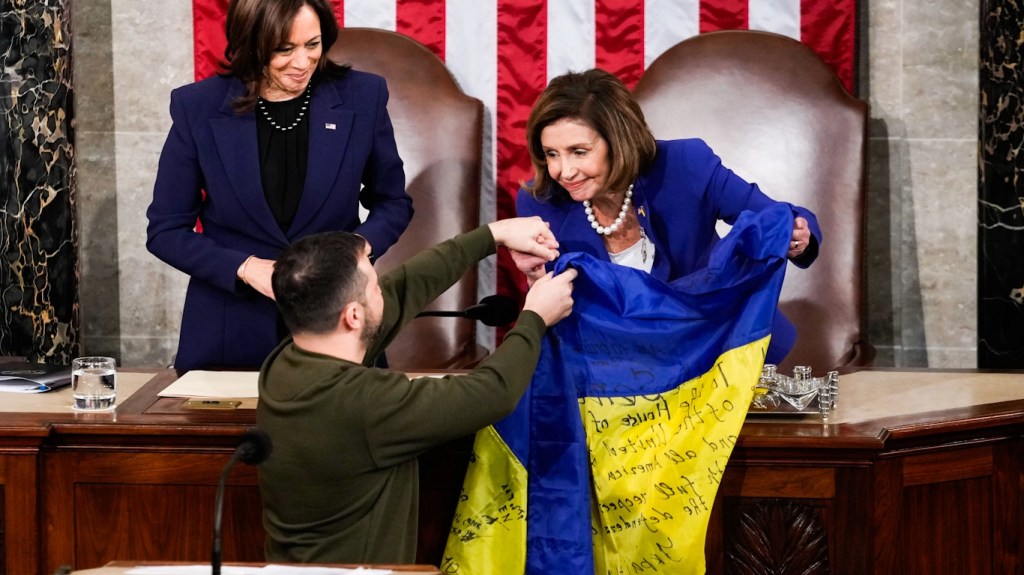
The Democrats position themselves as the party of virtue, cloaking their support for the war industry in moral language stretching back to Korea and Vietnam, when President Ngo Dinh Diem was as lionized as Ukrainian President Volodymyr Zelensky. All the wars they support and fund are “good” wars. All the enemies they fight, the latest being Russia’s Vladimir Putin and China’s Xi Jinping, are incarnations of evil. The photo of a beaming House Speaker Nancy Pelosi and Vice President Kamala Harris holding up a signed Ukrainian battle flag behind Zelensky as he addressed Congress was another example of the Democratic Party’s abject subservience to the war machine.

The Democrats, especially with the presidency of Bill Clinton, became shills not only for corporate America but for the weapons manufacturers and the Pentagon. No weapons system is too costly. No war, no matter how disastrous, goes unfunded. No military budget is too big, including the $858 billion in military spending allocated for the current fiscal year, an increase of $45 billion above what the Biden administration requested. 

The historian Arnold Toynbee cited unchecked militarism as the fatal disease of empires, arguing that they ultimately commit suicide. 

There once was a wing of the Democratic Party that questioned and stood up to the war industry: Senators J. William Fulbright, George McGovern, Gene McCarthy, Mike Gravel, William Proxmire and House member Dennis Kucinich. But that opposition evaporated along with the antiwar movement. When 30 members of the party’s progressive caucus recently issued a call for Biden to negotiate with Putin, they were forced by the party leadership and a warmongering media to back down and rescind their letter. Not that any of them, with the exception of Alexandria Ocasio-Cortez, have voted against the billions of dollars in weaponry sent to Ukraine or the bloated military budget. Rashida Tlaib voted present. 

The opposition to the perpetual funding of the war in Ukraine has come primarily from Republicans, 11 in the Senate and 57 in the House, several, such as Marjorie Taylor Greene, unhinged conspiracy theorists. Only nine Republicans in the House joined the Democrats in supporting the $1.7 trillion spending bill needed to prevent the government from shutting down, which included approval of $847 billion for the military — the total is boosted to $858 billion when factoring in accounts that don’t fall under the Armed Services committees’ jurisdiction. In the Senate, 29 Republicans opposed the spending bill. The Democrats, including nearly all 100 members of the House Congressional Progressive Caucus, lined up dutifully for endless war. 

This lust for war is dangerous, pushing us into a potential war with Russia and, perhaps later, with China — each a nuclear power. It is also economically ruinous. The monopolization of capital by the military has driven U.S. debt to over $30 trillion, $6 trillion more than the U.S. GDP of $24 trillion. Servicing this debt costs $300 billion a year. We spend more on the military than the next nine countries, including China and Russia, combined. Congress is also on track to provide an extra $21.7 billion to the Pentagon — above the already expanded annual budget — to resupply Ukraine.

“But those contracts are just the leading edge of what is shaping up to be a big new defense buildup,” The New York Times reported. “Military spending next year is on track to reach its highest level in inflation-adjusted terms since the peaks in the costs of the Iraq and Afghanistan wars between 2008 and 2011, and the second highest in inflation-adjusted terms since World War II — a level that is more than the budgets for the next 10 largest cabinet agencies combined.”

The Democratic Party, which, under the Clinton administration aggressively courted corporate donors, has surrendered its willingness to challenge, however tepidly, the war industry. 

“As soon as the Democratic Party made a determination, it could have been 35 or 40 years ago, that they were going to take corporate contributions, that wiped out any distinction between the two parties,” Dennis Kucinich said when I interviewed him on my show for The Real News Network. “Because in Washington, he or she who pays the piper plays the tune. That’s what’s happened. There isn’t that much of a difference in terms of the two parties when it comes to war.”

In his 1970 book “The Pentagon Propaganda Machine,” Fulbright describes how the Pentagon and the arms industry pour millions into shaping public opinion through public relations campaigns, Defense Department films, control over Hollywood and domination of the commercial media. Military analysts on cable news are universally former military and intelligence officials who sit on boards or work as consultants to defense industries, a fact they rarely disclose to the public. Barry R. McCaffrey, a retired four-star army general and military analyst for NBC News, was also an employee of Defense Solutions, a military sales and project management firm. He, like most of these shills for war, personally profited from the sales of the weapons systems and expansion of the wars in Iraq and Afghanistan.

On the eve of every congressional vote on the Pentagon budget, lobbyists from businesses tied to the war industry meet with Congress members and their staff to push them to vote for the budget to protect jobs in their district or state. This pressure, coupled with the mantra amplified by the media that opposition to profligate war funding is unpatriotic, keeps elected officials in bondage. These politicians also depend on the lavish donations from the weapons manufacturers to fund their campaigns.

Seymour Melman, in his book “Pentagon Capitalism,” documented the way militarized societies destroy their domestic economies. Billions are spent on the research and development of weapons systems while renewable energy technologies languish. Universities are flooded with military-related grants while they struggle to find money for environmental studies and the humanities. Bridges, roads, levees, rail, ports, electric grids, sewage treatment plants and drinking water infrastructures are structurally deficient and antiquated. Schools are in disrepair and lack sufficient teachers and staff. Unable to stem the COVID-19 pandemic, the for-profit health care industry forces families, including those with insurance, into bankruptcy. Domestic manufacturing, especially with the offshoring of jobs to China, Vietnam, Mexico and other nations, collapses. Families are drowning in personal debt, with 63 percent of Americans living paycheck to paycheck. The poor, the mentally ill, the sick and the unemployed are abandoned. 

Melman, who coined the term “permanent war economy,” noted that since the end of the Second World War, the federal government has spent more than half its discretionary budget on past, current and future military operations. It is the largest single sustaining activity of the government. The military-industrial establishment is nothing more than gilded corporate welfare. Military systems are sold before they are produced. Military industries are permitted to charge the federal government for huge cost overruns. Massive profits are guaranteed. For example, this November, the Army awarded Raytheon Technologies alone more than $2 billion in contracts, on top of over $190 million awarded in August, to deliver missile systems to expand or replenish weapons sent to Ukraine. Despite a depressed market for most other businesses, stock prices of Lockheed and Northrop Grumman have risen by more than 36 and 50 percent this year. 

Tech giants, including Amazon, which supplies surveillance and facial recognition software to the police and FBI, have been absorbed into the permanent war economy. Amazon, Google, Microsoft and Oracle were awarded multibillion-dollar cloud computing contracts for the Joint Warfighting Cloud Capability and are eligible to receive $9 billion in Pentagon contracts to provide the military with “globally available cloud services across all security domains and classification levels, from the strategic level to the tactical edge,” through mid-2028.

Foreign aid is given to countries such as Israel, with more than $150 billion in bilateral assistance since its founding in 1948, or Egypt, which has received over $80 billion since 1978 — aid that requires foreign governments to buy weapons systems from the U.S. The U.S. public funds the research, development and building of weapons systems and purchases them for foreign governments. Such a  circular system mocks the idea of a free-market economy. These weapons soon become obsolete and are replaced by updated and usually more costly weapons systems. It is, in economic terms, a dead end. It sustains nothing but the permanent war economy.

“The truth of the matter is that we’re in a heavily militarized society driven by greed, lust for profit, and wars are being created just to keep fueling that,” Kucinich told me.

In 2014, the U.S. backed a coup in Ukraine that installed a government that included neo-Nazis and was antagonistic to Russia. The coup triggered a civil war when the ethnic Russians in eastern Ukraine, the Donbass, sought to secede from the country, resulting in over 14,000 people dead and nearly 150,000 displaced, before Russia invaded in February. The Russian invasion of Ukraine, according to Jacques Baud, a former NATO security advisor who also worked for Swiss intelligence, was instigated by the escalation of Ukraine’s war on the Donbass. It also followed the Biden administration’s rejection of proposals sent by the Kremlin in late 2021, which might have averted Russia’s invasion the following year. 

This invasion has led to widespread U.S. and E.U. sanctions on Russia, which have boomeranged onto Europe. Inflation ravages Europe with the sharp curtailment of shipments of Russian oil and gas. Industry, especially in Germany, is crippled.  In most of Europe, it is a winter of shortages, spiraling prices and misery. 

“This whole thing is blowing up in the face of the West,” Kucinich warned. “We forced Russia to pivot to Asia, as well as Brazil, India, China, South Africa and Saudi Arabia. There’s a whole new world being formed. The catalyst of it is the misjudgment that occurred about Ukraine and the effort to try to control Ukraine in 2014 that most people aren’t aware of.”

By not opposing a Democratic Party whose primary business is war, liberals become the sterile, defeated dreamers in Fyodor Dostoevsky’s “Notes from the Underground.” 

A former convict, Dostoevsky did not fear evil. He feared a society that no longer had the moral fortitude to confront evil. And war, to steal a line from my latest book, is the greatest evil.

Amazon, “Economic Terrorism” and the Destruction of Competition and Livelihoods

By Colin Todhunter

Source: Off-Guardian

Global corporations are colonising India’s retail space through e-commerce and destroying small-scale physical retail and millions of livelihoods.

Walmart entered into India in 2016 with a US$3.3 billion take-over of the online retail start-up Jet.com. This was followed in 2018 with a US$16 billion take-over of India’s largest online retail platform, Flipkart. Today, Walmart and Amazon control almost two thirds of India’s digital retail sector.

Amazon and Walmart have a record of using predatory pricing, deep discounts and other unfair business practices to attract customers to their online platforms. A couple of years ago, those two companies generated sales of over US$3 billion in just six days during Diwali. India’s small retailers reacted by calling for a boycott of online shopping.

If you want to know the eventual fate of India’s local markets and small retailers, look no further than what US Treasury Secretary Steven Mnuchin said in 2019. He stated that Amazon had “destroyed the retail industry across the United States.”

AMAZON’S CORPORATE PRACTICES

In the US, an investigation by the House Judiciary Committee concluded that Amazon exerts monopoly power over many small- and medium-size businesses. It called for breaking up the company and regulating its online marketplace to ensure that sellers are treated fairly.

Amazon has spied on sellers and appropriated data about their sales, costs and suppliers. It has then used this information to create its own competing versions of their products, often giving its versions superior placement in the search results on its platform.

The Institute for Local Self-Reliance (ILSR) published a revealing document on Amazon in June 2021 that discussed these issues. It also notes that Amazon has been caught using its venture capital fund to invest in start-ups only to steal their ideas and create rival products and services.

Moreover, Amazon’s dominance allows it to function as a gatekeeper: retailers and brands must sell on its site to reach much of the online market and changes to Amazon’s search algorithms or selling terms can cause their sales to evaporate overnight.

Amazon also makes it hard for sellers to reduce their dependence on its platform by making their brand identity almost invisible to shoppers and preventing them from building relationships with their customers. The company strictly limits contact between sellers and customers.

According to the ILSR, Amazon compels sellers to buy its warehousing and shipping services, even though many would get a better deal from other providers, and it blocks independent businesses from offering lower prices on other sites. The company also routinely suspends sellers’ accounts and seizes inventories and cash balances.

The Joint Action Committee against Foreign Retail and E-commerce (JACAFRE) was formed to resist the entry of foreign corporations like Walmart and Amazon into India’s e-commerce market. Its members represent more than 100 national groups, including major trade, workers’ and farmers’ organisations.

JACAFRE issued a statement in 2018 on Walmart’s acquisition of Flipkart, arguing that it undermines India’s economic and digital sovereignty and the livelihoods of millions in India. The committee said the deal would lead to Walmart and Amazon dominating India’s e-retail sector. It would also allow them to own India’s key consumer and other economic data, making them the country’s digital overlords, joining the ranks of Google and Facebook.

In January 2021, JACAFRE published an open letter saying that the three new farm laws, passed by parliament in September 2020, centre on enabling and facilitating the unregulated corporatisation of agriculture value chains. This will effectively make farmers and small traders of agricultural produce become subservient to the interests of a few agrifood and e-commerce giants or will eradicate them completely.

Although there was strong resistance to Walmart entering India with its physical stores, online and offline worlds are now merged: e-commerce companies not only control data about consumption but also control data on production and logistics. Through this control, e-commerce platforms can shape much of the physical economy.

What we are witnessing is the deliberate eradication of markets in favour of monopolistic platforms.

BEZOS NOT WELCOME

Amazon’s move into India encapsulates the unfair fight for space between local and global markets. There is a relative handful of multi-billionaires who own the corporations and platforms. And there are the interests of hundreds of millions of vendors and various small-scale enterprises who are regarded by these rich individuals as mere collateral damage to be displaced in their quest for ever-greater profit.

Thanks to the helping hand of various COVID-related lockdowns, which devastated small businesses, the wealth of the world’s billionaires increased by $3.9tn (trillion) between 18 March and 31 December 2020.

In September 2020, Jeff Bezos, Amazon’s executive chairman, could have paid all 876,000 Amazon employees a $105,000 bonus and still be as wealthy as he was before COVID. Jeff Bezos – his fortune constructed on unprincipled methods that have been well documented in recent years – increased his net wealth by $78.2bn during this period.

Bezos’s plan is clear: the plunder of India and the eradication of millions of small traders and retailers and neighbourhood mom and pop shops.

This is a man with few scruples. After returning from a brief flight to space in July, in a rocket built by his private space company, Bezos said during a news conference:

I also want to thank every Amazon employee and every Amazon customer because you guys paid for all of this.”

In response, US congresswoman Nydia Velazquez wrote on Twitter:

While Jeff Bezos is all over the news for paying to go to space, let’s not forget the reality he has created here on Earth.”

She added the hashtag #WealthTaxNow in reference to Amazon’s tax dodging, revealed in numerous reports, not least the May 2021 study ‘The Amazon Method: How to take advantage of the international state system to avoid paying tax’ by Richard Phillips, Senior Research Fellow, Jenaline Pyle, PhD Candidate, and Ronen Palan, Professor of International Political Economy, all based at the University of London.

Little wonder that when Bezos visited India in January 2020, he was hardly welcomed with open arms.

Bezos praised India on Twitter by posting:

Dynamism. Energy. Democracy. #IndianCentury.”

The ruling party’s top man in the BJP foreign affairs department hit back with:

Please tell this to your employees in Washington DC. Otherwise, your charm offensive is likely to be waste of time and money.”

A fitting response, albeit perplexing given the current administration’s proposed sanctioning of the foreign takeover of the economy, not least by the unscrupulous interests that will benefit from the recent farm legislation.

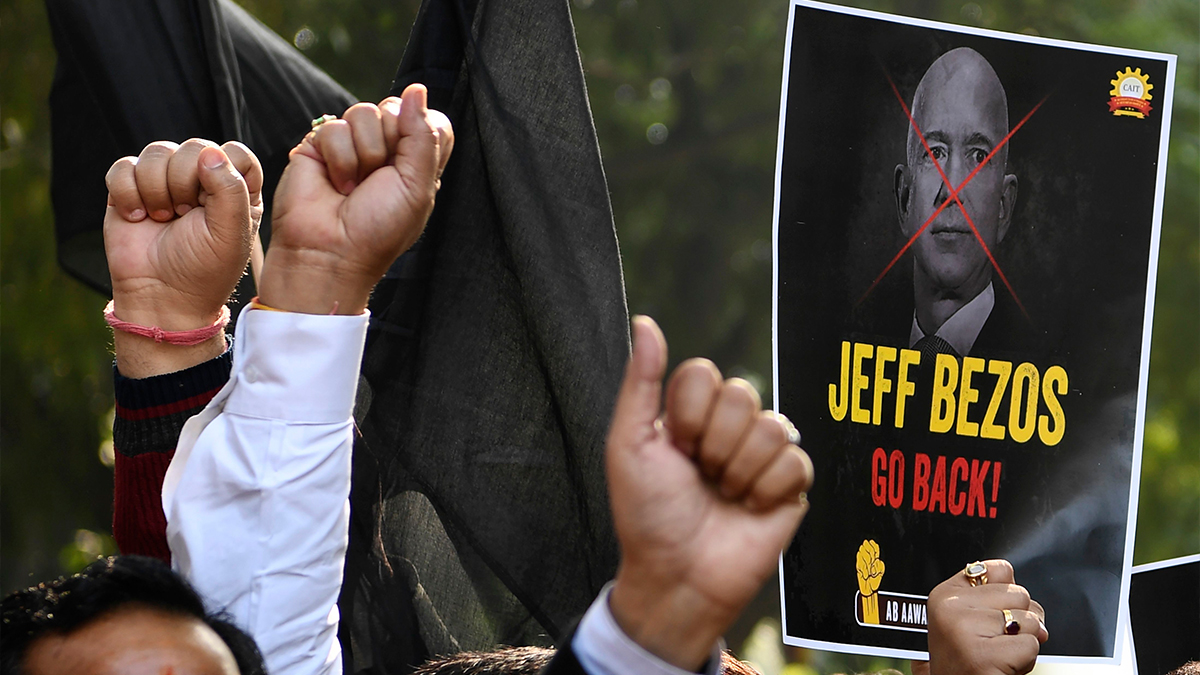
Bezos landed in India on the back of the country’s antitrust regulator initiating a formal investigation of Amazon and with small store owners demonstrating in the streets. The Confederation of All India Traders (CAIT) announced that members of its affiliate bodies across the country would stage sit-ins and public rallies in 300 cities in protest.

In a letter to PM Modi, prior to the visit of Bezos, the secretary of the CAIT, General Praveen Khandelwal, claimed that Amazon, like Walmart-owned Flipkart, was an “economic terrorist” due to its predatory pricing that “compelled the closure of thousands of small traders.”

In 2020, Delhi Vyapar Mahasangh (DVM) filed a complaint against Amazon and Flipkart alleging that they favoured certain sellers over others on their platforms by offering them discounted fees and preferential listing. The DVM lobbies to promote the interests of small traders. It also raised concerns about Amazon and Flipkart entering into tie-ups with mobile phone manufacturers to sell phones exclusively on their platforms.

It was argued by DVM that this was anti-competitive behaviour as smaller traders could not purchase and sell these devices. Concerns were also raised over the flash sales and deep discounts offered by e-commerce companies, which could not be matched by small traders.

The CAIT estimates that in 2019 upwards of 50,000 mobile phone retailers were forced out of business by large e-commerce firms.

Amazon’s internal documents, as revealed by Reuters, indicated that Amazon had an indirect ownership stake in a handful of sellers who made up most of the sales on its Indian platform. This is an issue because in India Amazon and Flipkart are legally allowed to function only as neutral platforms that facilitate transactions between third-party sellers and buyers for a fee.

UNDER INVESTIGATION

The upshot is that India’s Supreme Court recently ruled that Amazon must face investigation by the Competition Commission of India (CCI) for alleged anti-competitive business practices. The CCI said it would probe the deep discounts, preferential listings and exclusionary tactics that Amazon and Flipkart are alleged to have used to destroy competition.

However, there are powerful forces that have been sitting on their hands as these companies have been running amok.

In August 2021, the CAIT attacked the NITI Aayog (the influential policy commission think tank of the Government of India) for interfering in e-commerce rules proposed by the Consumer Affairs Ministry.

The CAIT said that the think tank clearly seems to be under the pressure and influence of the foreign e-commerce giants.

The president of CAIT, BC Bhartia, stated that it is deeply shocking to see such a callous and indifferent attitude of the NITI Aayog whch have remained a silent spectator for so many years when:

…the foreign e-commerce giants have circumvented every rule of the FDI policy and blatantly violated and destroyed the retail and e-commerce landscape of the country but have suddenly decided to open their mouth at a time when the proposed e-commerce rules will potentially end the malpractices of the e-commerce companies.”

Of course, money talks and buys influence. In addition to tens of billions of US dollars invested in India by Walmart and Amazon, Facebook invested US$5.5 billion last year in Mukesh Ambani’s Jio Platforms (e-commerce retail). Google has also invested US$4.5 billion.

Since the early 1990s, when India opened up to neoliberal economics, the country has become increasingly dependent on inflows of foreign capital. Policies are being governed by the drive to attract and retain foreign investment and maintain ‘market confidence’ by ceding to the demands of international capital which ride roughshod over democratic principles and the needs of hundreds of millions of ordinary people. ‘Foreign direct investment’ has thus become the holy grail of the Modi-led administration and the NITI Aayog.

The CAIT has urged the Consumer Affairs Ministry to implement the draft consumer protection e-commerce rules at the earliest as they are in the best interest of the consumers as well as the traders of the country.

Meanwhile, the CCI probably will complete its investigation within two months.

Viral Inequality: From Jeff Bezos to the struggle of Indian Farmers

Billionaires have profited enormously from lockdown, whilst mega corporations are buying out and shutting down independent stores and farms.

By Colin Todhunter

Source: OffGuardian

According to a new report by Oxfam, ‘The Inequality Virus’, the wealth of the world’s billionaires increased by $3.9tn (trillion) between 18 March and 31 December 2020. Their total wealth now stands at $11.95tn.

The world’s 10 richest billionaires have collectively seen their wealth increase by $540bn over this period. In September 2020, Jeff Bezos could have paid all 876,000 Amazon employees a $105,000 bonus and still be as wealthy as he was before COVID.

At the same time, hundreds of millions of people will lose (have lost) their jobs and face destitution and hunger. It is estimated that the total number of people living in poverty could have increased by between 200 million and 500 million in 2020. The number of people living in poverty might not return even to its pre-crisis level for over a decade.

Mukesh Ambani, India’s richest man and head of Reliance Industries, which specialises in petrol, retail and telecommunications, doubled his wealth between March and October 2020. He now has $78.3bn. The average increase in Ambani’s wealth in just over four days represented more than the combined annual wages of all of Reliance Industries’ 195,000 employees.

The Oxfam report states that lockdown in India resulted in the country’s billionaires increasing their wealth by around 35 per cent. At the same time, 84 per cent of households suffered varying degrees of income loss. Some 170,000 people lost their jobs every hour in April 2020 alone.

The authors also noted that income increases for India’s top 100 billionaires since March 2020 was enough to give each of the 138 million poorest people a cheque for 94,045 rupees.

The report went on to state:

…it would take an unskilled worker 10,000 years to make what Ambani made in an hour during the pandemic…and three years to make what Ambani made in a second.”

During lockdown and after, hundreds of thousands of migrant workers in the cities (who had no option but to escape the country’s avoidable but deepening agrarian crisis) were left without jobs, money, food or shelter.

It is clear that COVID has been used as cover for consolidating the power of the unimaginably rich. But plans for boosting their power and wealth will not stop there. One of the most lucrative sectors for these people is agrifood.

More than 60 per cent of India’s almost 1.4 billion population rely (directly or indirectly) on agriculture for their livelihood. Aside from foreign interests, Mukesh Ambani and fellow billionaire Gautam Adani (India’s second richest person with major agribusiness interests) are set to benefit most from the recently passed farm bills that will lead to the wholesale corporatisation of the agrifood sector.

CORPORATE CONSOLIDATION

A recent article on the grain.org website, ‘Digital control: how big tech moves into food and farming (and what it means)’, describes how Amazon, Google, Microsoft, Facebook and others are closing in on the global agrifood sector while the likes of Bayer, Syngenta, Corteva and Cargill are cementing their stranglehold.

The tech giants entry into the sector will increasingly lead to a mutually beneficial integration between the companies that supply products to farmers (pesticides, seeds, fertilisers, tractors, drones, etc) and those that control the flow of data and have access to digital (cloud) infrastructure and food consumers. This system is based on corporate centralisation and concentration (monopolisation).

Grain notes that in India global corporations are also colonising the retail space through e-commerce. Walmart entered into India in 2016 by a US$3.3 billion take-over of the online retail start-up Jet.com which, in 2018, was followed by a US$16 billion take-over of India’s largest online retail platform Flipkart. Today, Walmart and Amazon now control almost two-thirds of India’s digital retail sector.

Amazon and Walmart are using predatory pricing, deep discounts and other unfair business practices to lure customers towards their online platforms. According to Grain, when the two companies generated sales of over US$3 billion in just six days during a Diwali festival sales blitz, India’s small retailers called out in desperation for a boycott of online shopping.

In 2020, Facebook and the US-based private equity concern KKR committed over US$7 billion to Reliance Jio, the digital store of one of India’s biggest retail chains. Customers will soon be able to shop at Reliance Jio through Facebook’s chat application, WhatsApp.

The plan for retail is clear: the eradication of millions of small traders and retailers and neighbourhood mom and pop shops. It is similar in agriculture.

The aim is to buy up rural land, amalgamate it and roll out a system of chemically-drenched farmerless farms owned or controlled by financial speculators, the high-tech giants and traditional agribusiness concerns. The end-game is a system of contract farming that serves the interests of big tech, big agribusiness and big retail. Smallholder peasant agriculture is regarded as an impediment to be replaced by large industrial-scale farms.

This model will be based on driverless tractors, drones, genetically engineered/lab-produced food and all data pertaining to land, water, weather, seeds and soils patented and often pirated from peasant farmers.

Farmers possess centuries of accumulated knowledge that once gone will never be got back. Corporatisation of the sector has already destroyed or undermined functioning agrarian ecosystems that draw on centuries of traditional knowledge and are increasingly recognised as valid approaches to secure food security.

And what of the hundreds of millions to be displaced in order to fill the pockets of the billionaire owners of these corporations? Driven to cities to face a future of joblessness: mere ‘collateral damage’ resulting from a short-sighted system of dispossessive predatory capitalism that destroys the link between humans, ecology and nature to boost the bottom line of the immensely rich.

IMPERIAL INTENT

India’s agrifood sector has been on the radar of global corporations for decades. With deep market penetration and near saturation having been achieved by agribusiness in the US and elsewhere, India represents an opportunity for expansion and maintaining business viability and all-important profit growth. And by teaming up with the high-tech players in Silicon Valley, multi-billion dollar data management markets are being created. From data and knowledge to land, weather and seeds, capitalism is compelled to eventually commodify (patent and own) all aspects of life and nature.

Foreign agricapital is applying enormous pressure on India to scrap its meagre (in comparison to the richer nations) agricultural subsidies. The public distribution system and publicly held buffer stocks constitute an obstacle to the profit-driven requirements of global agribusiness interests.

Such interests require India to become dependent on imports (alleviating the overproduction problem of Western agricapital – the vast stocks of grains that it already dumps on the Global South) and to restructure its own agriculture for growing crops (fruit, vegetables) that consumers in the richer countries demand. Instead of holding physical buffer stocks for its own use, India would hold foreign exchange reserves and purchase food stocks from global traders.

Successive administrations have made the country dependent on volatile flows of foreign capital via foreign direct investment (and loans). The fear of capital flight is ever present. Policies are often governed by the drive to attract and retain these inflows. This financialisation of agriculture serves to undermine the nation’s food security, placing it at the mercy of unforeseen global events (conflict, oil prices, public health crises) international commodity speculators and unstable foreign investment.

Current agricultural ‘reforms’ are part of a broader process of imperialism’s increasing capture of the Indian economy, which has led to its recolonization by foreign corporations as a result of neoliberalisation which began in 1991. By reducing public sector buffer stocks and introducing corporate-dictated contract farming and full-scale neoliberal marketisation for the sale and procurement of produce, India will be sacrificing its farmers and its own food security for the benefit of a handful of unscrupulous billionaires.

As independent cultivators are bankrupted, the aim is that land will eventually be amalgamated to facilitate large-scale industrial cultivation. Indeed, a recent piece on the Research Unit for Political Economy site, ‘The Kisans Are Right: Their Land Is At Stake‘, describes how the Indian government is ascertaining which land is owned by whom with the ultimate aim of making it easier to eventually sell it off (to foreign investors and agribusiness). Other developments are also part of the plan (such as the Karnataka Land Reform Act), which will make it easier for business to purchase agricultural land.

India could eventually see institutional investors with no connection to farming (pension funds, sovereign wealth funds, endowment funds and investments from governments, banks, insurance companies and high net worth individuals) purchasing land. This is an increasing trend globally and, again, India represents a huge potential market. The funds have no connection to farming, have no interest in food security and are involved just to make profit from land.

The recent farm bills – if not repealed – will impose the neoliberal shock therapy of dispossession and dependency, finally clearing the way to restructure the agri-food sector. The massive inequalities and injustices that have resulted from the COVID-related lockdowns are a mere taste of what is to come.

The hundreds of thousands of farmers who have been on the streets protesting against these bills are at the vanguard of the pushback – they cannot afford to fail. There is too much at stake.

Non-MAGA Activists Caught in Social Media War as Twitter Begins Purge

Almost immediately after the Twitter purge began, a number of non-Trump accounts began to face lock outs, suspensions, and even deletions

By Alan Macleod

Source: Mint Press News

Few could have predicted the huge fallout from the Stop the Steal rally in Washington, D.C. that saw the president of the United States banned from virtually every social media platform, including his favorite, Twitter.

In solidarity with Trump, tens of thousands of conservative users appear to be deleting their accounts and moving over to pro-Trump Twitter clone Parler. Celebrities, politicians, and social media figures — particularly conservative ones — have registered losing tens of thousands of followers in a matter of hours. Twitter’s share price plunged by 7% this morning, knocking around $2.5 billion off its market value in one fell swoop.

While the massive publicity generated would normally be positive news for Parler, which brands itself as a “free speech app,” it seems to have suffered a far worse fate than Twitter. The app was deleted by Google and Apple from their app stores over the weekend. But it was Amazon’s decision early this morning that proved a more fatal blow. The company, whose cloud computing business, Amazon Web Services, hosts the app and website, decided to pull it, effective immediately. “We cannot provide services to a customer that is unable to effectively identify and remove content that encourages or incites violence against others,” Amazon said in a statement.

Before it was taken offline, however, activists and researchers had begun a project to download and archive vast quantities of information, totaling over 70 terabytes, including deleted posts, videos, and users’ location data. They intend to use it as evidence to find and prosecute those individuals involved in the storming of the Capitol Building last Wednesday, an action that led to Congress and the Senate being evacuated and five people dying. Those leading the action allegedly used Parler to plan and organize the events and to communicate with each other during the violence.

The president himself encouraged the crowds to go to the building and “fight like hell” to stop what he regards as a “stolen election,” where he was the legitimate winner. “You’ll never take back our country with weakness. You have to show strength, and you have to be strong,” he added.

In response, a host of popular social media platforms, including Twitch, Twitter, Facebook, and Snapchat froze Trump’s accounts on the grounds that he was directly inciting violence. Discord and Reddit also banned popular Trump forums.

While many who opposed the president celebrated, whistleblower and internet freedom advocate Edward Snowden warned that allowing social media companies to set a precedent where they could effectively ban whoever they want from their services set a chilling precedent. “I know a lot of folks in the comments [who] read this are like ‘YAAAAS,’ which, like — I get it. But imagine for a moment a world that exists for more than the next 13 days, and this becomes a milestone that will endure,” he wrote on Twitter.

Almost immediately, a number of non-Trump accounts began to face problems, with pro-Assange journalist Suzie Dawson locked out of her account, educational file sharing website Sci Hub’s account suspended, and the Red Scare podcast’s profile deleted. Other figures began to demand that the accounts associated with the Venezuelan and Chinese government be removed from social media platforms as well.

If Parler can find a way past its massive data hack and a company to host it, it still faces a number of huge problems, including rampant racism and false information predominating its platform. There are also large numbers of fake accounts purporting to represent public figures. The company has also broken its free speech absolutism promise as well, deleting incendiary tweets from Trump-supporting lawyer Lin Wood calling for Mike Pence’s head.

Perhaps more ominous for America, however, is a media reality where different groups of people become completely insulated from one another on the basis of political identification. Already, algorithms have split us off from others who think differently, showing wildly contrasting news and views to us based on our prior actions. However, until now, this was at least happening on the same platform, meaning there was some overlap. If, however, liberals and conservatives are using entirely different social media websites, any chance for inter party debate is lost.

The storming of the Capitol Building on Wednesday was a prime example of what can happen when one group of Americans lives in an entirely alternative reality. Further disintegration of media will only accelerate this trend, making incidents like this more likely in the future.

Edward Snowden On Big Tech Companies, Like Facebook, Censoring & Controlling Information

By Arjun Walia

Source: Collective Evolution

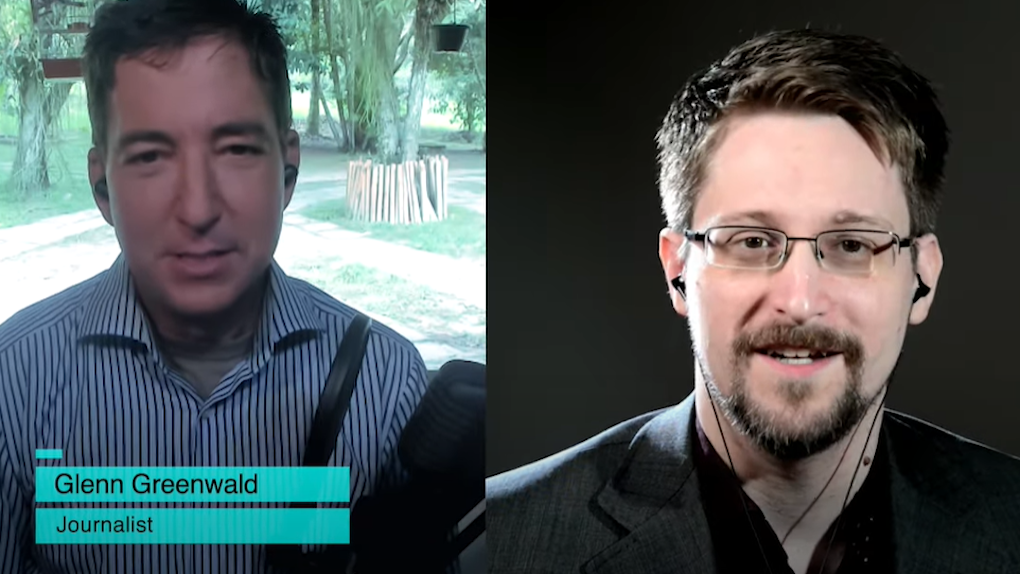
Glenn Greenwald is no stranger to censorship, he’s the journalist who worked with Edward Snowden (NSA mass surveillance whistleblower)  to put together his story and release it to the world while working for the Guardian. He eventually left the Guardian and co-founded his own media company, The Intercept, an organization that would be free from censorship and free to report on government corruption and wrong-doings of powerful people and corporations. He recently resigned from The Intercept as well due to the fact that they’ve now censored him, and is now completely independent. You can find his work here.Glenn Greenwald is no stranger to censorship, he’s the journalist who worked with Edward Snowden (NSA mass surveillance whistleblower)  to put together his story and release it to the world while working for the Guardian. He eventually left the Guardian and co-founded his own media company, The Intercept, an organization that would be free from censorship and free to report on government corruption and wrong-doings of powerful people and corporations. He recently resigned from The Intercept as well due to the fact that they’ve now censored him, and is now completely independent. You can find his work here.Glenn Greenwald is no stranger to censorship, he’s the journalist who worked with Edward Snowden (NSA mass surveillance whistleblower)  to put together his story and release it to the world while working for the Guardian. He eventually left the Guardian and co-founded his own media company, The Intercept, an organization that would be free from censorship and free to report on government corruption and wrong-doings of powerful people and corporations. He recently resigned from The Intercept as well due to the fact that they’ve now censored him, and is now completely independent. You can find his work here.

Anybody who reports on or sheds a bright light onto immoral and unethical actions taken by governments and the powerful corporations they work with has been subjected to extreme censorship. In the case of Edward Snowden, he’s been exiled, and Julian Assange of Wikileaks is currently clinging to his life for exposing war crimes and other unethical actions by multiple governments and corporations. There are many other examples. What does it say about our civilization when we prosecute those who expose harm, corruption, immoral/unethical actions by governments and war crimes?

Greenwald recently interviewed Snowden about internet censorship and the role big tech companies and governments are playing. Greenwald explains that in one of his earliest meetings with Snowden, he (Snowden) explained that he was driven in large part by the vital role the early internet played in his life, “one that was free of corporate and state control, that permitted anonymity and exploration free of monitoring, and, most of all, fostered unrestrained communication and dissemination of information by and among citizens of the world without corporate and state overlords regulating and controlling what they were saying.

This is what he and Snowden go into in the interview posted below. Prior to that I provide a brief summary of Snowden’s key thoughts.

Snowden starts off by mentioning government surveillance programs and the companies they contracted to do this work and compares them to modern day Big Tech giants censoring information on a wide range of topics. We see this today with elections/politics, to medical information dealing with coronavirus and vaccines, for example.

“In secret, these companies had all agreed to work with the U.S. Government far beyond what the law required of them, and that’s what we’re seeing with this new censorship push is really a new direction in the same dynamic. These companies are not obligated by the law to do almost any of what they’re actually doing but they’re going above and beyond, to, in many cases, to increase the depth of their relationship (with the government) and the government’s willingness to avoid trying to regulate them in the context of their desired activities, which is ultimately to dominate the conversation and information space of global society in different ways…They’re trying to make you change your behaviour… – Snowden

So basically, these Big Tech companies have become slaves, if you will, to the governments will, or at least powerful people situated in high places within the government. Snowden brings up the fact that many of these companies are hiring people from the CIA, who come from the Pentagon, who come from the NSA, who have top secret clearances…The government is a customer of all the major cloud service providers. They are also a major regulator of these companies, which gives these companies the incentive to do whatever they want.

This is quite clear if you look at Facebook, Google and Amazon employees. There are many who have come from very high positions within the Department of Defense.

In no case is this more clear than Amazon – Snowden

Amazon appointed Keith Alexander, director of the NSA under Barack Obama.

He was one of the senior architects of the mass surveillance program that courts have repeatedly now declared to be unlawful and unconstitutional….When you have this kind of incentive from a private industry to maintain the warmest possible relationship with the people in government, who not just buy from you but also have the possibility to end your business or change the way you do business…You now see this kind of soft corruption that happens in a constant way. – Snowden

Snowden goes on to explain how people get upset when government, especially the Trump government, tries to set the boundaries of what appropriate speech is by attempting to stop big tech censorship, he then says,

If you’re not comfortable letting the government determine the boundaries of appropriate political speech, why are you begging Mark Zuckerberg to do it?

I think the reality here is…it’s not really about freedom of speech, and it’s not really about protecting people from harm…I think what you see is the internet has become the de facto means of mass communication. That represents influence which represents power, and what we see is we see a whole number of different tribes basically squabbling to try to gain control over this instrument of power.

What we see is an increasing tendency to silence journalists who say things that are in the minority.

You can watch the full conversation between Greenwald and Snowden below, the conversation is about 40 minutes long.

Closing Comments: This kind of information almost begs the question, are we ready as a society to truly create and disseminate journalism that is honest, integral and bi-partisan? Why is it that these types of organizations fail or struggle? How do some media companies fail? Well, they no longer stay true to their mission. They fall to the pressure of politics and fall into ideology. How many other times did ideology change what media outlets reported? Yes, it’s almost impossible to have zero bias, but how close can we get to zero? How can we achieve this when media outlets who do not fit within the accepted framework and disseminate information that challenges the popular opinion are constantly being punished for simply putting out information?

As Snowden mentioned above, these Big Tech companies in collusion with governments are literally attempting to not only censor information, but change the behaviour of people as well, especially journalists. When you take away one’s business or livelihood as a result of non-compliance, you are in a way forcing them to comply and do/say things you they way you want them done/said. We’ve experienced massive amounts of censorship and demonetization here at Collective Evolution, but we haven’t changed as a results of it. We simply created CETV, a platform that helps support our work as a result of censorship.

‘$2.5 TRILLION THEFT’ – STUDY SHOWS RICHEST 1% OF AMERICANS HAVE TAKEN $50 TRILLION FROM BOTTOM 90% IN RECENT DECADES


The median U.S. worker salary would be around twice as high today if wages kept pace with economic output since World War II, new research revealed.

By Brett Wilkins

Source: Common Dreams

New research published Monday found that the top 1% of U.S. income earners have taken $50 trillion from the bottom 90% over the past several decades, and that the median worker salary would be around twice as high today as it was in 1945 if pay had kept pace with economic output over that period.

The study’s authors, Carter C. Price and Kathryn Edwards of the RAND Corporation, examined income distribution and economic growth in the United States from 1945 to the present. The researchers found stark differences between income distribution from 1945 to 1974 and 1975 to 2018.

According to the study—which was funded by the Seattle-based Fair Work Center—the median salary of a full-time U.S. worker is currently about $50,000. Adjusted for inflation using the consumer price index, workers at or below the current median income now earn less than half of what they would have if incomes had kept pace with economic growth. This means that if salaries had kept pace with economic output, the median worker pay would be between $92,000 and $102,000 today, depending on how inflation is calculated.

Had the more equitable distribution of the roughly 30-year postwar period continued apace, the total annual income of the bottom 90% of American workers would have been $2.5 trillion higher in 2018, or an amount equal to about 12% of GDP.  In other words, the upward redistribution of income has enriched the 1% by some $47 trillion—which would now be more than $50 trillion—at the expense of American workers.

David Rolf, a Seattle labor organizer, president of the Fair Work Center, and founder of Service Employees International Union (SEIU) Local 775, is more blunt. He calls this “the $2.5 trillion theft.”

“From the standpoint of people who have worked hard and played by the rules and yet are participating far less in economic growth than Americans did a generation ago, whether you call it ‘reverse distribution’ or ‘theft,’ it demands to be called something,” Rolf, who helped lead the fight for a $15 hourly minimum wage in Seattle and beyond, told Fast Company.

Remarkably, the study found that workers at all income levels would be better off today if income kept pace with output. Full-time, prime-age workers in the 25th percentile, for example, would be earning $61,000 instead of $33,000. Workers in the 75th percentile, who in 2018 earned $81,000, would be making $126,000. Even 90th-percentile workers, who earn $133,000, would be making $168,000 under the more equitable distribution.

On the other hand, had the economic pie been divided more equitably, the income of the top 1% would fall from around $1.2 million to a still-affluent $549,000.

“We were shocked by the numbers,” said Nick Hanauer, a venture capitalist and self-described “zillionaire” who, along with Rolf, came up with the idea for the study. “It explains almost everything,” Hanauer told Fast Company. “It explains why people are so pissed off. It explains why they are so economically precarious.”

Sen. Bernie Sanders (I-Vt.), who made correcting economic inequality a pillar of both of his presidential bids, lamented the “h-u-g-e redistribution of income in America” in a Monday tweet.

The researchers’ findings, which come amid a deadly coronavirus/Covid-19 pandemic, shine light on the injustice of an economy—by far the wealthiest in the history of civilization—in which essential workers struggle mightily, and often in vain, to survive while the richest people grow ever richer at their expense.

According to Americans for Tax Fairness, the total wealth of U.S. billionaires increased by $792 billion, or 27%, during the first five months of the Covid-19 pandemic. During this period, Amazon CEO Jeff Bezos, the world’s wealthiest person, has become the world’s first multi-centibillionaire, with a net worth now surpassing $200 billion. Meanwhile, his employees struggle to make ends meet, and Amazon workers who speak out against poor pay and hazardous working conditions during the pandemic have been fired and derided by company executives.

Compared to other most-developed nations, the U.S. has done a relatively poor job of taking care of its people during the pandemic. In addition to the U.S. being the only developed nation without universal healthcare, its workers have received less in direct payments and government support than people in many comparable countries.

The gap between the richest and poorest U.S. households is now wider than it has ever been in the past 50 years, according to the most recently available data from the U.S. Census Bureau. The pandemic has only exacerbated the situation, as around half of lower-income American households have reported a job or wage loss due to Covid-19.

Internationally, the U.S. ranks 39th out of over 150 nations in income inequality, according to Gini coefficient data compiled by the CIA, placing it roughly on par with nations like Peru and Cameroon. Among Organization for Economic Cooperation and Development (OECD) nations, the U.S. has the seventh-highest level of income inequality.

The U.S. has the highest poverty rate among the world’s most-developed nations, and the fourth-highest poverty rate among OECD nations after South Africa, Costa Rica, and Romania. According to UNICEF, the U.S. also has the second-highest rate of childhood poverty in the developed world behind Romania, with more than one in five U.S. children—and over one in four Latinx children, and nearly one in three Black and Native American children—living in poverty.

This year, more than 54 million Americans, or roughly one in every six people—including 18 million children—may experience food insecurity, according to the nonprofit group Feeding America.