Robert F. Kennedy, Jr.: To Heal the Great Divide

By Edward Curtin

Source: Behind the Curtain

It has been fifty-five years since Senator Robert F. Kennedy stepped onto the presidential nominating stage to try to mend the massive breach that had opened in American society.  The country was torn asunder by the Vietnam War, racism, poverty, the assassination of President Kennedy and the soon-to-be assassination of Rev. Martin Luther King, Jr.  Chaos reigned as Lyndon Johnson lied and Richard Nixon matched him in verbal and actual treachery.  A war between Middle America and the elites running the government was breaking out across the country.  A great divide between whites and blacks, rich and poor, the working class and the upper class was opening wide.  The Tet Offensive had just ripped the face off the official lies about the course of the war in Vietnam and the emperor, Lyndon Jonson, stood naked and would soon announce that he would not run again.

On March 16, 1968, Senator Kennedy declared his candidacy with these words:

I do not run for the presidency merely to oppose any man but to propose new policies. I run because I am convinced that this country is on a perilous course and because I have such strong feelings about what must be done, and I feel that I’m obliged to do all that I can.

I run to seek new policies – policies to end the bloodshed in Vietnam and in our cities, policies to close the gaps that now exist between black and white, between rich and poor, between young and old, in this country and around the rest of the world.

By the end of 1968, a plague year if there ever were one, Richard Nixon, together with his goon squad, prepared to occupy the White House, Vietnam raged on, and everything King and Kennedy stood for seemed lost.  Ignorance, vituperation, and the divide-and-conquer technique long practiced by the power elites set into the body politic like a deadly cancer.  Something died, all hope seemed lost, and the perilous course RFK spoke of was never stopped.  Jackals with polished faces have sat in the White House ever since.

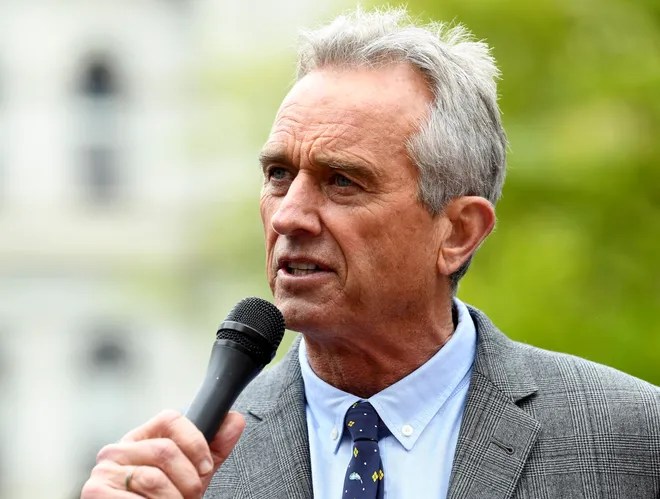
Today hope is resurrected.  Enter Robert F. Kennedy, Jr. center stage who will declare his candidacy for the Democratic nomination for president on Wednesday, April 19, in Boston, Massachusetts.

The wheel of history has turned and 2023 resembles 1968 in many ways while getting worse in others.  The divide in the country remains but has greatly widened.  The CIA and the intelligence agencies totally control the mainstream media now.  The Pentagon’s budget has increased exponentially.  The U.S. wages a savage war against Russia in Ukraine under the blatant lie of defending freedom while supporting Nazis and greatly risking nuclear war.  It provokes war with China.  Permanent war is government policy with military bases and CIA and special forces all over the world, waging semi-clandestine wars, or maybe just wars that people don’t want to know about.  The gap between the rich and the poor has widened while the elites mock working class people as moronic deplorables.  The Department of Defense controls the development, manufacturing, clinical testing, supply, production, and distribution of the mRNA vaccines, while the criminal pharmaceutical companies reap obscene profits.  Lies are piled upon lies in what amounts to an Orwellian nightmare.  And while LBJ and Nixon have been replaced by Joe Biden, the warfare state roll on.

Some things have changed, of course.  In 1968, liberals were turning against the U.S. war against Vietnam and were growing wary of the CIA.  Today they support all the Democratic-led wars and love the CIA.  They trust the obvious media lies and those of a proven liar such as Anthony Fauci.  Nowhere is this sadly truer than with the extended Kennedy family, who in their support for Biden, Fauci, the CIA, etc. have betrayed JFK and RFK.  Their smugness and support for Biden against their brother who is carrying on his uncle’s and father’s legacy is betrayal of the worst kind.

Despite a family actively opposed to his candidacy, despite all the media lies about him, and despite the odds makers giving him little chance, RFK, Jr. is entering the race.  It is an act of supreme moral courage.

Like his father in ’68, he is the only candidate who can heal this nation’s great divide.

That he is opposed by a huge array of people who will lie about him because he is a truthteller does not deter him.  Those lies immediately started up again as soon as word got out that he might run.  It’s an old story.

Trash will be thrown at him.  Every blemish of his nearly seventy years will be dredged up to paint him as a villain, a flawed man, a hypocrite – name all the negative terms you can think of and the real hypocrites, in their self-righteous rage, will use them against him.  They will bounce off him.  He is ready.

When Bobby, Jr. was young, his father handed him a book and said with urgency, “I want you to read this.”  It was Albert Camus’s The Plague.  He read it and it has informed his life ever since.  Just as in 1968, we live in plague times, and the plague is US, it runs through all our institutions and, as in Camus’s books, the rats are running wild, devouring truth and the values that can redeem us.  As he has written in his beautiful and important book, American Values: Lessons I Learned from My Family, Camus’s analysis of Sisyphus and the ancient Greeks has taught him an important lesson:

It is neither our position nor our circumstances that define us, according to the Stoics, but our response to those circumstance; when destiny crushes us, small heroic gestures of courage and service can bring us peace and fulfillment. In applying our shoulder to the stone, we give order to a chaotic universe. Of the many wonderful things my father left me, this philosophical truth was perhaps the most useful. In many ways, it has defined my life, and has allowed me to find serenity and purpose even in the most trying and tragic circumstances. (p.287)

Despite its brilliance, American Values (see this) was completely ignored by the mainstream press.  Why?  Because it revolves around “Chapter 9, Senator Robert F. Kennedy” and the long war between the Kennedys and the CIA that resulted in the deaths of JFK and RFK.  In this chapter, RFK, Jr. brilliantly shows that he fully grasps the CIA’s evil history.  All the other chapters, while very interesting personal and family history, pale in importance.   No member of the Kennedy family since JFK or RFK has dared to say what RFK, Jr. does in this book.  He indicts the CIA.  This is probably not a small part of his extended family’s animosity toward him.  Family taboos must be protected, as if they were state secrets.

But his indictment of the CIA is the fundamental reason why it and the media will at all costs try to prevent him from getting the nomination.  The character assassination will be intense.

Kennedy knows he faces an uphill battle for the presidency, but no matter what forces are aligned against him, political and familial, he will not back down.

He will surprise all the pundits, for his appeal crosses party lines.  He is tough and very smart.  He has been so hated and falsely maligned by the mainstream media for so long that he is skilled at keeping to his message, which I think will be positive and inspirational, something that this country is desperate for after so many years of lies and treachery.

Even Biden’s supporters in the Democratic party know he is a flawed candidate on his last legs, laboring to keep his words straight and his steps solid.  While he may have long served as the establishment’s war puppet, there are many nervous Democrats who want to finally cut their strings with him.  And the Republicans are a party in disarray, internally torn and tired of the Trump saga which will not end.

Two clowns don’t make for a pretty picture running the country and the world into the ground.  Biden and Trump and their predecessors are naked now and not just does one boy see it and shout it only to be ignored.  There is a growing feeling throughout the country that truth and goodness spoken clearly are desperately needed to unite the country through common values. Bob Dylan got it right back a few years:

While preachers preach of evil fates
Teachers teach that knowledge waits
Can lead to hundred-dollar plates
Goodness hides behind its gates
But even the president of the United States
Sometimes must have to stand naked

Every day Americans are bombarded with bad news: the U.S. war against Russia via Ukraine, the lies about the “threats” from Russia and China, the collapsing economy, toxic spills, gun violence, corporate gangsters ripping off the average American and funneling those monies to the politicians who pimp for them, the egregious Covid-19 and “vaccine” lies that are daily being exposed as deadly frauds, the growing threat of nuclear war, etc.

Bad bad news, and with it a growing public sense of hopelessness.  A pall of unacknowledged depression smothers the country.  People are dying for hope, as they were in 1968.  In their inner hearts there is this desperate yearning for one brave soul to stand up and tell Americans the truth about what has happened to their country.  Bobby Kennedy, Jr. is the only one who can move Americans to hope again.

For years he has been telling harsh truths that many who profit from the lies do not want to hear. That our waters are polluted and the chemical companies are criminals; that the pharmaceutical companies are criminal enterprises polluting people’s bodies; that the CIA is organized crime polluting people’s minds and assassinating its anti-war leaders; that the Pentagon is a criminal enterprise not defending but risking American’s lives and their livelihood; that the U.S. government has joined with mega-corporations to run a Mob-like fleecing of the American people; that not one of Sirhan Sirhan’s bullets killed his father, Senator Robert Kennedy, who was shot from behind at close range by a CIA hit man; that the so-called Covid vaccines are very dangerous and have never been appropriately tested and many people are dying and being injured as a result; that Anthony Fauci is a liar and fraud who fronts for Big Pharma (see this) in the Covid-19 crisis that is an intelligence-run operation controlled by spooks working with medical technocrats; and that we are close to losing our country and any semblance of its democratic ideals.

These are not liberal or conservative positions.  They are self-evident conclusions of a patriot, as they should be for everyone.

And because they have become such to more and more Americans who can think without reacting, Kennedy’s voice and his candidacy will grow in strength across the great divide.

The media attacks will be intense and simply full of lies.  They love to call him an “anti-vaxxer,” when he is not opposed to all vaccines.  But no matter how many times he has explained this, the media twist it to serve their masters.

For example, The New York Post recently published a slimy piece that could serve as a template for all the propaganda aimed at Kennedy.  Let me quote:

Robert has said Sirhan did not actually participate in the murder of Sen. Robert F. Kennedy during a Los Angeles presidential campaign stop in 1968.

This of course is a lie.  RFK, Jr. has said that Sirhan fired a pistol but none of his bullets hit the Senator.  He has said a CIA hit man shot his father at close range from behind as the official autopsy clearly showed, while Sirhan was standing in front of the Senator.

Lie number two.  The Post writes:

In it [a speech], he implied that those who oppose vaccines are being persecuted more severely than Anne Frank, the German teen who hid from the Nazis in Amsterdam before being sent to her death at Auschwitz.

He never implied that.  His point was clear: that in the coming digital surveillance state there will be nowhere to hide, not even in an attic, because the surveillance technology will track everyone everywhere, day and night.

These are but a few examples.  Look and you will find them everywhere now and in the coming days.

The hyenas with polished faces will try like hell to dismiss Robert f. Kennedy, Jr. as a flake, a fraud, and a conspiracy nut on an ego-trip.  Too many people can now see through such propaganda.  He is the real thing, our best hope to bridge the great divide that has been created by the elites to divide the American people.

He will not back down, and all people of good will who believe the U.S. can still find its way out of the morass we find ourselves in, should back him up.  He has warned us, he has given us his voice, and his moral courage should be followed by all who hope to hope.

The pundits who dismiss his chances will then be shocked.

The Coronavirus Is Not the Plague: The Plague Is US

By Edward Curtin

Source: Behind the Curtain

“Two categories of propaganda must be distinguished.  The first strives to create a permanent disposition in its objects and constantly needs to be reinforced.  Its goal is to make the masses ‘available,’ by working spells upon them and exercising a kind of fascination.  The second category involves the creation of a sort of temporary impulsiveness in its objects.  It operates by simple pressure and is often contradictory (since contradictory mass movement are sometimes necessary).”  – Jacques Ellul, The Technological Society

The French-Algerian writer Albert Camus’ great 1947 novel, The Plague, is a warning to us today, but a warning in disguise.  When he died sixty years ago at the young age of forty-six, he had already written The Stranger, The Fall, and The Plague, and had won the Nobel Prize for Literature.

The outward story of The Plague revolves around a malignant disease that breaks out in a town that is quarantined when the authorities issue a state of emergency.  After first denying that they have a problem, the people gradually panic and feel painfully isolated.  Death fear runs rampant, much like today with the coronavirus. The authorities declare martial law as they warn that the situation is dire, people must be careful of associating, especially in groups, and they better obey orders or very many will die.  So the town is cordoned off.

Before this happens and the first signs that something is amiss emerge, the citizens of the town of Oran, Algeria remain oblivious, for they “work hard, but solely with the object of getting rich.”  Bored by their habits, heavily drugging themselves with drink, and watching many movies to distract themselves, they failed to grasp the significance of “the squelchy roundness of a still-warm body” of the plague-bearing rats that emerge from their underworld to die in their streets.  “It was as if the earth on which our houses stood were being purged of their secret humors; thrusting up to the surface the abscesses and pus-clots that had been forming in its entrails.”  To them the plague is “unthinkable,” an abstraction, until all their denials are swept aside as the truth emerges from the sewers and their neighbors and families die from the disease.

“Stupidity has a way of getting its way;” the narrator, Dr. Rieux tells us, “as we should see if we were not always so wrapped up in ourselves …. plagues and wars take people equally by surprise.”

The American people are wrapped up in themselves.  Nor do they recognize the true rats.  They are easily surprised; fooled would be a better word.

Camus uses a physical plague to disguise his real subject, which is the way people react when they are physically trapped by human rats who demand they obey orders and stay physically and mentally compliant as their freedom is taken from them.

The Plague is an allegorical depiction of the German occupation of France during World War II.  Camus had lived through that experience as a member of the French Resistance.  He was a writer and editor of the underground Resistance newspaper Combat, and with his artist’s touch he later made The Plague a revelatory read for today, especially for citizens of the United States, the greatest purveyor of the plague of violence in the world.

We are all infected with the soul-destroying evil that our leaders have loosed upon the world, a plague of killing that is now hidden behind the coronavirus fear that is being used to institute tight government controls that many will come to rue in the months ahead, just as happened after the attacks of September 11, 2001.

Coronavirus is a perfect cover-story for the occupation of the public’s mind by a propaganda apparatus that has grown even more devious over the past 19 years.

Ask yourself: Where is the news about U.S. military operations in Syria, Afghanistan, Yemen, Iraq, eastern Europe, Africa, Latin America, Asia, etc.?  There is none in the corporate mainstream media, and little in the alternative media as well.  Have those operations ceased?  Of course not.  It’s just that the news about them, little that it was, has disappeared.

Now it is all about us and the coronavirus panic.  It is about how many of us might die. It is about stocking toilet paper.  For the rich, it is about getting to their second or third houses where they can isolate themselves in splendor. As I write, 150 or so Americans are said to have died of Covid-19, and by the time you will read this the number will have climbed, but the number will be minuscule compared to the number of people in the U.S.A. and those numbers will be full of contradictions that few comprehend unless, rather than reacting in fear, they did some comprehensive research.

But arguments are quite useless in a time of panic when people are consumed with fear and just react.

For we live in plague time, and the plague lives in us. But to most Americans, Covid-19 is the plague, because the government and media have said it is.  Like the inhabitants of Oran, the United States is “peopled with sleep walkers,” pseudo-innocents, who are “chiefly aware of what ruffled the normal tenor of their lives or affected their interests.”  That their own government, no matter what political party is in power (both working for “deep-state,” elite interests led by the organized criminals of the CIA), is the disseminator of a world-wide plague of virulent violence, must be denied and divorced from consensus reality.

That these same forces would use the fear of disease to cow the population should be no surprise for those who have come to realize the truth of the attacks of September 11, 2001 and the anthrax attacks that followed, both of which were used to justify the endless “wars on terror” that have killed so many around the world. It is a shock for so many people who can’t countenance the thought that their own government could possibly be implicated in the death of thousands of U.S. citizens and the release of the deadly anthrax, which we know came from a U.S. lab and was carried out by a group of inside government perpetrators.

When it comes to the plague-stricken deaths visited on millions around the world for decades by the American government, this must be denied by diverting attention to partisan presidential politics, and now the coronavirus that engenders fear, loathing, and a child-like tendency to believe Big Brother.  The true plague, the bedrock of a nation continually waging wars through various means – i.e. bombs and economic and medical sanctions, etc. – against the world, disappears from consciousness.  As U.S. Secretary of State Madeleine Albrecht said to 60 Minutes Lesley Stahl in 1996 when Stahl asked her if the U.S. sanctions on Iraq that had resulted in the death of 500,000 Iraqi children were worth it: “We think the price is worth it.”

For “decent folks must be allowed to sleep at night,” says the character Tarrou sarcastically; he is a man who has lost his ability to “sleep well” since he witnessed a man’s execution where the “bullets make a hole into which you could thrust your fist.”  He awakens to the realization that he “had an indirect hand in the deaths of thousands of people.”  He loses any peace he had and vows to resist the plague in every way he can.  “For many years I’ve been ashamed,” he says, “mortally ashamed, of having been, even with the best intentions, even at many removes, a murderer in my turn.”

The rats are dying in the streets. They are our rats, diseased by us. They have emerged from the underworld of a nation plagued by its denial.  Unconscious evil bubbles up.  We are an infected people. Worry and irritation – “these are not feelings with which to confront plague.” But we don’t seem ashamed of our complicity in our government’s crimes around the world.  For decades we have elected leaders who have killed millions, while business went on as usual. The killing didn’t touch us. As Camus said, “We fornicated and read the papers.”  He knew better. He warned us:

It’s a wearying business being plague-stricken.  But it’s still more wearying to refuse to be it. That’s why everybody in the world looks so tired; everyone is more or less sick of plague. But that is why some of us, those who want to get the plague out of their systems, feel such desperate weariness.

Yet the fight against the plague must go on.  Tarrou puts it thus:

All I maintain is that on this earth there are pestilences and there are victims, and it’s up to us, as far possible, not to join forces with the pestilences. That may sound simple to the point of childishness; I can’t judge if it’s simple, but I know it’s true. You see, I’d heard such quantities of arguments, which very nearly turned my head, and turned other people’s heads enough to make them approve of murder; and I’d come to realize that all our troubles spring from our failure to use plain, clear-cut language.  So I resolved always to speak – and to act – quite clearly, as this was the only way of setting myself on the right track.

These days, I keep thinking of an incident that occurred when I was a young investigator of sexually transmitted diseases, working for the U.S. Department of Health, Education, and Welfare through the Public Health Service as an epidemiologist.  My job was to track down sexually transmitted diseases by finding links of sexual contacts. One day I went to interview and take a blood sample from a poor woman who had been named as a sexual contact.  I knocked on her door on the third or fourth floor of a walkup apartment building.  She looked through the peep hole and asked who it was and I told her my name and what government agency I represented. I could tell she was very wary, but she opened the door. She stood there naked, a very heavy woman of perhaps 300 pounds. She nonchalantly welcomed me in and I followed her as she padded down the hall where she took a housecoat off a hook and put it on.

There is, as you know, an old tale by Hans Christian Anderson called “The Emperor’s New Clothes.” Although the emperor parades around naked, the adults make believe he is clothed.  Only a child sees the obvious. I was 23-years-old naïve young man at the time of this unforgettable incident, but it echoes in my mind as a reminder to myself that perhaps that woman was unconsciously teaching me a lesson in disguise.  The year was 1967, and when I went out to get into my government car with federal license plates, a white man in a white shirt in a white car in a poor black neighborhood, a hail of bricks rained down toward me and the car from the roof opposite.  I quickly jumped in and fled as the ghettos were exploding. Soon the National Guard would be called out to occupy them.

Intuition tells me that although the emperor has no clothes and a vast PSYOPS occupation is now underway, too many are too grown-up to see it.

It’s an old story continually updated.  Like The Plague.

Reviving the Spirit of Existential Rebellion in a World of Propaganda, Lies, and Self Deception

By Edward Curtin

Source: Dissident Voice

Search for nothing anymore, nothing except truth.
Be very still and try to get at the truth.
And the first question to ask yourself is:
How great a liar am I?
— D. H. Lawrence, Search For Truth

Like existential freedom, honesty and truth-seeking demand a perpetually renewed commitment. No one ever fully arrives, and all of us are blown off course on the journey.  Even when we think we have reached our destination, we are often startled by the enigma of arrival, and must set sail again.  We are all in the same boat. The search for truth is a process, an experiment, an essay – a trying without end.

Yet surely it is not an exaggeration to say that most people are liars and self-deceivers.  Honesty, while touted as a virtue, is practiced far less than it is praised.  There is almost nothing that people are less honest about than their attitudes toward honesty.  Few think of themselves as dishonest, and even to hint that someone is so is received as a great insult that usually elicits an angry response.  So most people follow the advice of the character Jean-Baptiste Clamence from Albert Camus’ The Fall: “Promise to tell the truth and then lie as best you can.”  In that way you satisfy your own and others’ secret desires for deception and play-acting, and other people will love you for it.

However, it is widely accepted that political leaders and the mass media lie and dissemble regularly, which, of course, they do. That is their job in an oligarchy.  Today we are subjected to almost total, unrelenting media and government propaganda. Depending on their political leanings, people direct their anger toward politicians of parties they oppose and media they believe slant their coverage to favor the opposition.  Trump is a liar.  No, Obama is a liar.  And Hillary Clinton.  No, Fox News. Ridiculous! – it’s CNN or NBC.  And so on and so forth in this theatre of the absurd that plays out within a megaplex of mainstream media (MSM) propaganda, where there are many shows but one producer, whose overall aim is to engineer the consent of all who enter while setting the different audiences against each other.  It is a very successful charade that evokes name-calling from all quarters.

In other words, for many people their opponents lie, as do other people, but not them. This is as true in personal as well as public life. Here the personal and the political converge, despite protestations to the contrary.

Sartre and Bad Faith

Lying and dissembling are ubiquitous.  Being lied to by the MSM is mirrored in people’s personal lives.  People lie and want to be deceived. They choose to play dumb, to avoid a confrontation with truth.  They want to be nice (Latin, nescire, not to know, to be ignorant) and to be liked.  They want to tuck themselves into a safe social and cultural framework where they imagine they will be safe. They choose to live in what Jean Paul Sartre called bad faith (mauvaise foi).  He put it as follows:

In bad faith it is from myself that I am hiding the truth. But with this “lie” to myself, the one to whom the lie is told and the one who lies are one and the same person, which means  that I must know in my capacity as deceiver the truth which is hidden from me in my capacity as the one deceived.

Such bad faith allows people to fabricate a second act of bad faith: that they are not responsible for their ignorance of the truths behind the government’s and corporate media’s lies and propaganda, even as the shades of the prison house ominously close around us and the world edges toward global death that could arrive in an instant with nuclear war or limp along for years of increasing suffering.

Those of us who write about the U.S.-led demented wars and provocations around the world and the complementary death of democracy at home are constantly flabbergasted and discouraged by the willed ignorance of so many Americans.  For while the mainstream media does the bidding of the power elite, there is ample alternative news and analyses available on the internet from fine journalists and writers committed to truth, not propaganda. There is actually far too much truth available, which poses another problem. But it doesn’t take a genius to learn how to research important issues and to learn how to distinguish between bogus and genuine information.  It takes a bit of effort, and, more importantly, the desire to compare multiple, opposing viewpoints and untangle the webs the Web weaves.  We are awash in information (and disinformation) and both good and bad reporting, but it is still available to the caring inquirer.

The problem is the will to know.  But why, why the refusal to investigate and question; why the indifference? Stupidity?  Okay, there is that.  Ignorance?  That too.  Willful ignorance, ditto.  Laziness, indeed. Careerism and ideology?  For certain.  Upton Sinclair put it mildly when he said, “It is difficult to get a man to understand something, when his salary depends on not understanding it.” Difficult?  No, it’s almost impossible.

But then there are many very intelligent people who have nothing to lose and yet adamantly refuse to entertain alternative possibilities to the reigning orthodoxies that have them in their grip.

As do many others, I know many such people who will yes me to death and then never fully research issues. They will remain in limbo or else wink to themselves that what may be true couldn’t be true.  They close down. This is a great dilemma and frustration faced by those who seek to convince people to take an active part in understanding what is really going on in the world today, especially as the United States wages war across the globe, threatens Russia and China, among others, as it expands and modernizes its nuclear weapons capabilities.

Jacques Ellul on Propaganda

The French sociologist, Jacques Ellul, has argued  convincingly that modern propaganda in a technological mass society is more complicated than the state and media lying and deceiving the population.  He argues that propaganda meets certain needs of modern people and therefore the process of deceit is reciprocal.  The modern person feels lost, powerless, and empty. Ellul says, “He realizes that he depends on decisions over which he has no control, and that realization drives him to despair.”  But he can’t live in despair; desires that life be meaningful; and wants to feel he lives in a world that makes sense.  He wants to participate and have opinions that suggest he grasps the flow of events.  He doesn’t so much want information, but value judgments and preconceived positions that provide him with a framework for living.  Ellul wrote the following in 1965 in his classic book Propaganda:

The majority prefers expressing stupidities to not expressing any opinion: this gives them the feeling of participation.  For they need simple thoughts, elementary explanations, a ‘key’ that will permit them to take a position, and even readymade opinions….The man who keeps himself informed needs a framework….the more complicated the problems are, the more simple the explanations must be; the more fragmented the canvas, the simpler the pattern; the more difficult the question, the more all-embracing the solution; the more menacing the reduction of his own worth, the greater the need for boosting his ego.  All this propaganda – and only propaganda – can give him.

Another way of saying this is that people want to be provided with myths to direct them to the “truth.”  But such so-called truth has been preconceived within the overarching myth provided by propaganda, and while it satisfies people’s emotional need for coherence, it also allows them to think of themselves as free individuals arriving at their own conclusions, which is a basic function of good propaganda.  In today’s mass technological society, it is essential that people be convinced that they are free-thinking individuals acting in good faith. Then they can feel good about themselves as they lie and act in bad faith.

The Spirit of Existential Rebellion 

In the wake of World War II and the complete shattering of any illusion about the human capacity for evil, there arose in Western Europe, particularly in France and Germany a “philosophy” called existentialism. More an attitude towards life rather than a formal philosophy, and with its roots going back at least as far as Kierkegaard and Nietzsche in the 19th century, existentialism emphasized individual freedom, authenticity, personal responsibility, and the need to confront the unimaginable horrors of World War II and the absurd situation in which human beings had created nuclear weapons that could obliterate the planet in a flash, as the United States had used to incinerate Hiroshima and Nagasaki.  How to respond to the birth of global state nuclear terrorism became a task for the existential imagination.

The traditional belief that an all-powerful God could bring the world to an end had now been replaced by the idolatry of nuclear madmen who had hubristically violated the limits that the Greeks had long ago warned us not to exceed by making themselves into gods. Having unleashed the Furies, these false gods have created a world in which the droning sound of nuclear intercontinental missiles haunts the secret nightmares of the world. We have been living with this unspeakable and unspoken truth for more than seventy years.

Opposition to the nuclear standoff and its accompanying proxy wars has waxed and waned over the years. Dissident minorities and sometimes many millions across the globe have mobilized to oppose not only nuclear weapons but the war makers who have waged continuous wars of aggression throughout the world and have created the national-security warfare state, seemingly intent on world destruction.

However, today the sound of silence fills the empty streets, as passivity has overtaken those who oppose the growing nuclear threat and the ongoing U.S.- led wars throughout the world. The spirit of resistance has gone to sleep. The German writer Karl Kraus understood this in the days of Hitler’s rise during the 1930s when he said, “The real end of the world is the destruction of the spirit; the other kind depends on the insignificant attempt to see whether after such destruction the world can go on.”

We need to somehow resurrect the spirit of resistance that will bring together millions of people across the world who oppose the death dealers. I think it is time to recall the power and possibility implicit in the spirit of existential thought.

The existential emphasis on individual responsibility and authentic truth telling in the works of various writers, including Jean Paul Sartre, Simone de Beauvoir, Gabriel Marcel, and Albert Camus (who didn’t consider himself an existentialist but whose work emphasized many of the same themes), inspired large numbers of people in the late’ 50s into the mid-to-late ’60s, including the international anti-nuclear movement and young American anti-war activists. Contrary to popular understanding, existentialism is not about navel gazing and hopelessness, but is about responding freely and authentically to the situations people find themselves in, which today, is the end- time that is a time when the fate of the world lies in the hands of nuclear madmen.

But by the end of the 1960s this existential spirit of rebellion started to dissipate. Academic gibberish replaced this rebellious spirit with the introduction of ideas, such as post structuralism, leading eventually to postmodernist nonsense that not only refuted the need for personal responsibility, but eliminated the person altogether. By 1999 a leading exponent of postmodern rhetoric, Jean Baudrillard, was dismissing everything the existentialists emphasized. He said, “No one needs this kind of ‘existential garb’ any more. Who cares about freedom, bad faith, and authenticity today?”

If such words were just the ranting of an intellectual lost in a fantasy world of abstractions, that would be one thing. But they are a form of propaganda echoed throughout western societies, particularly the United States, through the repeated emphases over the decades that people are not free but are the products of biological brain processes, etc. Deterministic memes have become dominant in cultural mind control. Such postmodern abstractions have denied everything that makes possible the fight against nuclear annihilation and the warfare states’ domination of western Europe and NATO, led by the United States.

The self is an illusion. Freedom is an illusion. Responsibility is an illusion. Guilt is an illusion. Everything is an illusion. A kaleidoscopic mad world in which no on exists and nothing really matters. This deterministic and nihilistic message has become the main current in western cultural propaganda since the late 1960s and has reached a crescendo in the present day. It is responsible for the growth of passivity and denial that dominates contemporary public consciousness. It underlies the refusal of so many otherwise intelligent people to engage themselves in the search for truth that would lead to their joining forces with others to create a mass anti-war movement.

While many people think of existentialism as only an atheistic approach to existence, this is incorrect. There are atheist and agnostic existentialists, yes, but existentialism’s core emphases have deep roots in the various religious traditions, such as Judaism and Christianity, etc. That is because freedom, authenticity, truth telling, and social responsibility, while often buried within the institutional structures of these faiths, lie at their core. So if we are going to resurrect the spirit of rebellion necessary to transform today’s world, we need to renew the virtues that the existentialists emphasize.

The first step in this process is to ask with D.H.Lawrence the question, “How great a liar am I?”

Anti-war activist and author of the indispensable book JFK and the Unspeakable: Why He Died and Why It Matters, James Douglass, made an intriguing suggestion in another book, Lightning East To West, when he said:

The exact opposite of the H bomb’s destructive purpose, but psychic equivalent of its energy, is the Kingdom of Reality which would be the final victory of Truth in history –a force of truth and love powerful enough to fuse billions of individual psyches into a global realization of essential oneness. There is no reason why the same psyche which, when turned outward, was able to create the condition for a self-acting force of over 100 million degrees of heat, thus realizing an inconceivable thermonuclear fusion, cannot someday turn sufficiently inward to create the condition for an equally inconceivable (but nature balancing) fusion in its own psychic or spiritual reality. An end-time can also be a beginning. Gandhi said: ‘When the practice of the law becomes universal, God will reign on the earth as God does in heaven. Earth and heaven are in us. We know the earth, and we are strangers to the heaven within us.

While Gandhi’s words are couched in religious language, their meaning can resonate with secular-minded people as well. These words speak to the power implicit in the human spirit as a whole. That power begins and builds when people of all persuasions are convinced that they must freely pursue the truth at all costs. As the poet Theodore Roethke wrote, “In a dark time, the eye begins to see.”

In these very dark times – these end- times created by nuclear weapons – seeing the truth is dependent on the will to truth, and the will to truth only arises when people believe they are free to alter the circumstances in which they find themselves. This belief in freedom is at the core of all existential thought and is why we need to resurrect it today.

Jesus Was Born in a Police State

By John W. Whitehead

Source: The Rutherford Institute

“Jesus is too much for us. The church’s later treatment of the gospels is one long effort to rescue Jesus from ‘extremism.’”—author Gary Wills, What Jesus Meant

The Christmas narrative of a baby born in a manger is a familiar one.

The Roman Empire, a police state in its own right, had ordered that a census be conducted. Joseph and his pregnant wife Mary traveled to the little town of Bethlehem so that they could be counted. There being no room for the couple at any of the inns, they stayed in a stable, where Mary gave birth to a baby boy, Jesus.

Unfortunately, Jesus was born into a police state not unlike the growing menace of the American police state. When he grew up, he had powerful, profound things to say—things that would change how we view people, alter government policies and change the world. “Blessed are the merciful,” “Blessed are the peacemakers,” and “Love your enemies” are just a few examples of his most profound and revolutionary teachings.

When confronted by those in authority, Jesus did not shy away from speaking truth to power. Indeed, his teachings undermined the political and religious establishment of his day. It cost him his life. He was eventually crucified as a warning to others not to challenge the powers-that-be.

Yet what if Jesus, the revered preacher, teacher, radical and prophet, had been born 2,000 years later? What if, instead of being born into the Roman police state, he had been born and raised in the American police state?

Consider the following if you will.

Had Jesus been born in the era of the America police state, rather than traveling to Bethlehem for a census, Jesus’ parents would have been mailed a 28-page American Community Survey, a mandatory government questionnaire documenting their habits, household inhabitants, work schedule, how many toilets were in their home, etc. The penalty for not responding to this invasive survey can go as high as $5,000.

Instead of being born in a manger, Jesus might have been born at home. Rather than wise men and shepherds bringing gifts, however, the baby’s parents might have been forced to ward off visits from state social workers intent on prosecuting them for the home birth. One couple in Washington had all three of their children removed after social services objected to the two youngest being birthed in an unassisted home delivery.

Had Jesus been born in a hospital, his blood and DNA would have been taken without his parents’ knowledge or consent and entered into a government biobank. While most states require newborn screening, a growing number are holding onto that genetic material long-term for research, analysis and purposes yet to be disclosed.

Then again, had Jesus’ parents been undocumented immigrants, they and the newborn baby might have been shuffled to a profit-driven, private prison for illegals where they would have been turned into cheap, forced laborers for corporations such as Starbucks, Microsoft, Walmart, and Victoria’s Secret. There’s quite a lot of money to be made from imprisoning immigrants, especially when taxpayers are footing the bill.

From the time he was old enough to attend school, Jesus would have been drilled in lessons of compliance and obedience to government authorities, while learning little about his own rights. Had he been daring enough to speak out against injustice while still in school, he might have found himself tasered or beaten by a school resource officer, or at the very least suspended under a school zero tolerance policy that punishes minor infractions as harshly as more serious offenses.

Had Jesus disappeared for a few hours let alone days as a 12-year-old, his parents would have been handcuffed, arrested and jailed for parental negligence. Parents across the country have been arrested for far less “offenses” such as allowing their children to walk to the park unaccompanied and play in their front yard alone.

Rather than disappearing from the history books from his early teenaged years to adulthood, Jesus’ movements and personal data—including his biometrics—would have been documented, tracked, monitored and filed by governmental agencies and corporations such as Google and Microsoft. Incredibly, 95 percent of school districts share their student records with outside companies that are contracted to manage data, which they then use to market products to us.

From the moment Jesus made contact with an “extremist” such as John the Baptist, he would have been flagged for surveillance because of his association with a prominent activist, peaceful or otherwise. Since 9/11, the FBI has actively carried out surveillance and intelligence-gathering operations on a broad range of activist groups, from animal rights groups to poverty relief, anti-war groups and other such “extremist” organizations.

Jesus’ anti-government views would certainly have resulted in him being labeled a domestic extremist. Law enforcement agencies are being trained to recognize signs of anti-government extremism during interactions with potential extremists who share a “belief in the approaching collapse of government and the economy.”

While traveling from community to community, Jesus might have been reported to government officials as “suspicious” under the Department of Homeland Security’s “See Something, Say Something” programs. Many states, including New York, are providing individuals with phone apps that allow them to take photos of suspicious activity and report them to their state Intelligence Center, where they are reviewed and forwarded to law-enforcement agencies.

Rather than being permitted to live as an itinerant preacher, Jesus might have found himself threatened with arrest for daring to live off the grid or sleeping outside. In fact, the number of cities that have resorted to criminalizing homelessness by enacting bans on camping, sleeping in vehicles, loitering and begging in public has doubled.

Viewed by the government as a dissident and a potential threat to its power, Jesus might have had government spies planted among his followers to monitor his activities, report on his movements, and entrap him into breaking the law. Such Judases today—called informants—often receive hefty paychecks from the government for their treachery.

Had Jesus used the internet to spread his radical message of peace and love, he might have found his blog posts infiltrated by government spies attempting to undermine his integrity, discredit him or plant incriminating information online about him. At the very least, he would have had his website hacked and his email monitored.

Had Jesus attempted to feed large crowds of people, he would have been threatened with arrest for violating various ordinances prohibiting the distribution of food without a permit. Florida officials arrested a 90-year-old man for feeding the homeless on a public beach.

Had Jesus spoken publicly about his 40 days in the desert and his conversations with the devil, he might have been labeled mentally ill and detained in a psych ward against his will for a mandatory involuntary psychiatric hold with no access to family or friends. One Virginia man was arrested, strip searched, handcuffed to a table, diagnosed as having “mental health issues,” and locked up for five days in a mental health facility against his will apparently because of his slurred speech and unsteady gait.

Without a doubt, had Jesus attempted to overturn tables in a Jewish temple and rage against the materialism of religious institutions, he would have been charged with a hate crime. Currently, 45 states and the federal government have hate crime laws on the books.

Had anyone reported Jesus to the police as being potentially dangerous, he might have found himself confronted—and killed—by police officers for whom any perceived act of non-compliance (a twitch, a question, a frown) can result in them shooting first and asking questions later. Daniel Shaver, 26 years old, was crawling on the floor, sobbing and begging for his life, and had just reached down to pull up his shorts when a police officer opened fire on him with an AR-15 rifle. “If you move, we’re going to consider that a threat and we are going to deal with it and you may not survive it,” the cop shouted at Shaver before his partner started shooting.

Rather than having armed guards capture Jesus in a public place, government officials would have ordered that a SWAT team carry out a raid on Jesus and his followers, complete with flash-bang grenades and military equipment. There are upwards of 80,000 such SWAT team raids carried out every year, many on unsuspecting Americans who have no defense against such government invaders, even when such raids are done in error.

Instead of being detained by Roman guards, Jesus might have been made to “disappear” into a secret government detention center where he would have been interrogated, tortured and subjected to all manner of abuses. Chicago police “disappeared” more than 7,000 people into a secret, off-the-books interrogation warehouse at Homan Square.

Charged with treason and labeled a domestic terrorist, Jesus might have been sentenced to a life-term in a private prison where he would have been forced to provide slave labor for corporations or put to death by way of the electric chair or a lethal mixture of drugs.

Either way, whether Jesus had been born in our modern age or his own, he still would have died at the hands of a police state.

Indeed, as I show in my book Battlefield America: The War on the American People, what Jesus and other activists suffered in their day is happening to those who choose to speak truth to power today.

For those who celebrate Christmas as a season of miracles, it is indeed a time for joy and thanksgiving. Yet it should also be a time of reckoning, re-awakening and re-commitment to making this world a better place for all humanity.

Remember, what happened on that starry night in Bethlehem is only part of the story. That baby in the manger grew up to be a man who did not turn away from evil but instead spoke out against it, and we must do no less.

Thus, we are faced with a choice: remain silent in the face of evil or speak out against it. As Nobel Prize-winning author Albert Camus proclaimed:

What the world expects of Christians is that Christians should speak out, loud and clear, and that they should voice their condemnation in such a way that never a doubt, never the slightest doubt, could rise in the heart of the simplest man. That they should get away from abstraction and confront the blood-stained face history has taken on today. The grouping we need is a grouping of men resolved to speak out clearly and to pay up personally.

Live Free or Die: The Psychology of Rebellion & Dissent

By Gary ‘Z’ McGee

Source: Waking Times

“I rebel—therefore we exist.” ~Albert Camus, The Rebel

Dissent is a tricky subject. The need to rebel against atrocity is deeply ingrained in the human condition. Even if most of us don’t act on it, the impulse is still there, churning our guts with disgust, getting our hearts pumping, moving us to spit curse words in lathered fury and shout in angry defiance. The problem is that most of us don’t know what to do with this powerful and sometimes overwhelming energy.

Most of us were raised in violent societies that use violence to keep the culture churning in a diabolical conquer-control-consume-repeat cycle. So, most of us tend to use violence to channel our deep and powerful need for dissent, thus perpetuating more violence. When the culture is jamming violence down our throat as a solution to its problems, are we really that surprised when our acts of rebellion turn out to be violent? Something’s got to give if we want to break this cycle of violence deeply imbedded in our culture.

In his book, The Rebel: An Essay on Man in Revolt, Albert Camus wrote about the “true rebel.”The true rebel is in revolt against oppression, violence, slavery and tyranny for the sake of others through constructive and life-affirming action. The true rebel protests out of love, so that others may be free. Intent is everything. True rebellion, Camus argues, is an act motivated but concerned with the common good rather than by self-interest. The rebel in revolt out of selfishness, greed, or need for power, eventually becomes a tyrant. The rebel in revolt for the sake of others, becomes a hero.

Whether you are alt-right or alt-left, republican’t or democan’t, voluntarist or anarchist, if you are seeking power over others for your own selfish and greedy ends, your revolution means fuck-all. You’re just another would-be-tyrant getting churned out of the meat-mill of violence begetting violence. It doesn’t matter how noble or important you think your cause is; if you need to use violence to persuade others to follow it, your cause is fundamentally flawed and immoral. Acting violently in a violent culture only perpetuates violence. Similarly, acting immorally in an immoral society just perpetuates immorality. Unhealthy acts beget unhealthy acts. Like Gandhi said, “An eye for an eye makes the whole world blind.”

Lest we all go blind, we must rebel so that others may freely exist. This requires our dissent to be based in freedom for everyone, even those we don’t agree with. A kind of metamorality arises from this kind of thinking, like Joshua Greene writes about in his book, Moral Tribes. But, and here’s the rub, any freedom which seeks to violate the nonaggression principle must not be tolerated. Violence is where the line must be drawn. As someone once said, “Your freedom to swing your fist ends an inch from my nose” (unknown). In such cases, self-defense is paramount. As Gandhi also advised, “When there is only a choice between cowardice and violence, I would advise violence.”

A true rebel doesn’t seek out rebellion for the sake of rebellion, or just as an excuse to act out violently. No. A true rebel passionately seeks a healthy environment (physically, culturally, and psychologically) and they rebel against anything that stands in the way of that healthy environment. As Camus said, “Rebellion, though apparently negative, since it creates nothing, is profoundly positive in that it reveals the part of man which must always be defended.” And that’s what it comes down to: self-defense, self-preservation, and survival. Not just personal survival, but the survival of the species.

That’s where life-affirming action comes in. When our rebellion is life-affirming, freedom-affirming, and based on nonviolence, it is healthy (heroic). When our rebellion is life-denying, freedom-denying, and based on violence, it is unhealthy (tyrannical). The hero is free, and uses that freedom with the soul intent to free others. The tyrant (or would be tyrant) is also free, but uses that freedom with the soul intent to rule others. We escape tyranny when we seek to free others through our own freedom. Liberty coincides with heroism when we’re able to go from asking, ‘free from what?’ to asking, ‘free for what?’

At the end of the day, the history of our culture of violence is only fruitful through a vigilant rebellion against it. This means a vigilant rebellion against oppression, hate, violence, and slavery of all kinds. Those who dedicate themselves to this culture of violence dedicate themselves to nothing and, in turn, are nothing. But those who dedicate themselves to life, freedom, and health, despite the culture of violence, dedicate themselves to survival and reap from it the harvest that sows its seed in the progressive evolution of our species.

A species hellbent on violence against itself is unhealthy and eventually destroys itself. A species determined to be healthy only ever uses violence as a last resort in self-defense and for the preservation of the species itself. From the former, the defiant tyrant juts his ugly head, declaring himself free at the expense of the freedom of others. From the latter, the defiant hero rises up, denying the tyrant’s violent oppression, and affirming freedom through the freedom of us all. That’s what Camus meant when he wrote: “I rebel –therefore we exist.”