Controlling The Savages: COVID, Lockdowns, Shortages, and The Great Reset

By Brandon Turbeville

Source: Activist Post

Who controls the food supply controls the people. Who controls the energy can control whole continues. Who controls money can control the whole world. – Henry Kissinger

Around 1868, the Indian Wars had briefly paused and the soon to be butchered treaties remained in force. However, the US Federal government and private interests were well aware that the “Indian Question” and “problem of the savages” was still unanswered. In other words, the “problem of the savages” was that the savages still existed. Those “savages” had been beaten back for years by the US regular army but they were not completely vanquished. In fact, despite being outmanned and outgunned and with little to no competition for the advancements in weaponry of the US Army, the Native Americans routinely routed the American military, at times slaughtering whole detachments.

But now that the secessionists had been dealt with, it became apparent that it was now time to remove the gloves from the iron fist of the coming settlements and that the Native Americans had to be annihilated, subjugated, or displaced from their native lands. Railroads, telegraphs, mines, and the like were all being hampered by the very existence of Native Americans.

Enter William Sherman, the general famous for his brutal March to the Sea, the burning of Atlanta, and the destruction of civilian infrastructure in the US Civil War. Say what you want about Sherman, the man knew how to win a war. He knew that breaking the backs of the civilian population and the ability of the society as well as military to sustain itself was a successful method of warfare. He also knew that the Native Americans relied upon buffalo for food and shelter and indeed their very survival. In a letter penned in 1868, he wrote that as long as the buffalo were alive, “Indians will go there. I think it would be wise to invite all the sportsmen of England and America there this fall for a Grand Buffalo hunt, and make one grand sweep of them all.”

And so it became unofficial Federal policy that the buffalo had to be extinguished in order to solve the vexing “Indian problem.” Over the next ten years, the buffalo were hunted by privateers, highly encouraged by the US government, to the point of near extinction. Where buffalo once numbered about 30 million, by the end of the 1800s, that number had been reduced to just a few hundred.

In Andrew C. Isenberg’s book, The Destruction Of The Bison, Isenberg writes of a reporter who asks a railroad worker, “Do the Indians make a living gathering these bones?’ Yes, replied a railroad inspector, ‘but it is a mercy that they can’t eat bones. We were never able to control the savages until their supply of meat was cut off.”

Fast forward to 2022. After nearly three years of COVID hysteria, lockdowns, economic disruptions, and schizophrenic government responses, the United States as a whole, as well as the rest of the world, is facing a food shortage. Claims that once belonged only to “preppers” and “conspiracy theorists” are now mainstream news items, with corporate media outlets reporting that some items may be in short supply or simply not available at all. All that is necessary is a brief internet search to see a myriad of mainstream reports of shortages of meat, vegetables, baby formula and many other staple items. Just a cursory walk around the local grocery store will reveal a fairly obvious shortage of many items though the pain is now mostly at the point of being an inconvenience moreso than a reason for panic. For now.

But talk of a food shortage is more than scattered news reports. Even the United Nations is warning of  one, but not just in the United States. The UN is warning of a global food shortage. As ABC News reports,

The head of the United Nations warned Friday that the world faces “catastrophe” because of the growing shortage of food around the globe.

U.N. Secretary-General Antonio Guterres said the war in Ukraine has added to the disruptions caused by climate change, the coronavirus pandemic and inequality to produce an “unprecedented global hunger crisis” already affecting hundreds of millions of people.

“There is a real risk that multiple famines will be declared in 2022,” he said in a video message to officials from dozens of rich and developing countries gathered in Berlin. “And 2023 could be even worse.”

Guterres noted that harvests across Asia, Africa and the Americas will take a hit as farmers around the world struggle to cope with rising fertilizer and energy prices.

“This year’s food access issues could become next year’s global food shortage,” he said. “No country will be immune to the social and economic repercussions of such a catastrophe.”

Notice that Gueterres also mentions the rising prices of fuel and fertilizer. This is something else that is being experienced worldwide, not just in the United States. Of course, Western media and the ruling party would have the population believe that Vladmir Putin is hoarding all the world’s gas via Ukraine, imposing restrictions and taxes on the vulnerable people of the United States who were on their way to energy independence just three short years. Now, however, they somehow woke up begging other countries for fuel, licking the boots of the Saudis, and blaming Vlad for the doubling of the price at the pump. Clearly, it has nothing to do with intentionally shutting off oil pipelines and punishing businesses and working people on behalf of the climate and faulty notion that man-made CO2 is causing temperatures to rise and the planet to reach a point of irreversible calamity.

Again, however, fuel prices aren’t just rising in the United States. They are rising across the world along with fertilizer and food costs and along with the price of just about any consumer good. Inflation, too – the hidden tax that is making itself well known in the United States – is popping up in the majority of countries across the globe. Who knew printing large amounts of money would cause that money to be worth less and thus cause prices to rise to compensate?

Living standards, too, are dropping all across the world with polio now rearing its head in the UK again for the first time since the 1980s. Polio, of course, is a disease that thrives on the low living standards and poor sanitation of the third world, a world which was partially imported to the UK all the while the standards of living (healthcare, sanitation, nutrition, etc.) have been gradually eroded. It’s not just the UK either. Living standards have been falling in the US for decades but accelerating recently. That is, of course, unless one chooses to believe silly “happiness indexes” repeated out of the UN to promote globalism and Free Trade policies.

Even basic services are falling apart. Labor shortages from pilots to the service industry are causing disruptions in the economy, rising prices, and chaos at airports. All happening globally.

Food shortages are happening globally. Food prices are rising globally. Fuel and fertilizer are rising globally. Living standards are falling globally. Inflation is rising globally. Labor shortages are global. Transportation is falling apart globally. See a pattern yet?

Everything disruption happening nationally is also happening globally. Are we expected to believe that every government across the world simply made the same stupid decisions at the same time? That none of them could figure out the source of the problem? Shouldn’t at least one of them have stumbled on the right path forward and lead the others through the mist? Or should we assume that there are more factors at play here and remember that anytime we see the same thing happening across the world at the same time agendas that are global in nature and have no respect for national boundaries are marching forward? I would argue the latter.

Keep in mind, all of these “global crises” came to be out of the “global pandemic,” itself at best an opportunity that was not allowed to go to waste. At worst, a global hoax designed to usher in the Great Reset. COVID, after all, is still a virus that has yet to be fully identified in a lab, yet the entire world was locked down at the same time, a prison planet brought in to being, upon this dubious evidence and weak justifications. Regardless, COVID’s biggest casualty was freedom.

None of the current crises have arisen on the basis of a chain of befuddled reactionaries acting in ignorant unison across the globe to an emerging “pandemic.” In fact, the only ones ignorant of the pandemic and coming responses were the unsuspecting civilians who willingly gave up their most basic rights over fear of a virus that has never been isolated in a lab and still is not able to be accurately tested for.

Still think COVID just surprised everyone in power as much as it did the unsuspecting citizens? Consider briefly how, in the months before the alleged pandemic arose, a simulation exercise was held at Johns Hopkins Center for Health Security in concert with the World Economic Forum and the Bill and Melinda Gates Foundation regarding the emergence of a global coronavirus pandemic that results in mass disruption of life and culture as we know it, economic chaos, and disruption of basic services.

As Tim Hinchcliffe wrote in his article, “A Timeline Of The Great Reset Agenda: From Foundation To Event 201 And The Pandemic of 2020,

On May 15, 2018, Johns Hopkins Center for Health Security hosted the “Clade X” pandemic exercise in partnership with the WEF.

The Clade X exercise included mock video footage of actors giving scripted news reports about a fake pandemic scenario

. . . . .

The Clade X event also included discussion panels with real policymakers who assessed that governments and industry were not adequately prepared for the fictitious global pandemic.

“In the end, the outcome was tragic: the most catastrophic pandemic in history with hundreds of millions of deaths, economic collapse and societal upheaval,” according to a WEF report on Clade X.

“There are major unmet global vulnerabilities and international system challenges posed by pandemics that will require new robust forms of public-private cooperation to address” — Event 201 pandemic simulation (October, 2019)

Then on October 18, 2019, in partnership with Johns Hopkins and the Bill and Melinda Gates Foundation, the WEF ran Event 201.

During the scenario, the entire global economy was shaken, there were riots on the streets, and high-tech surveillance measures were needed to “stop the spread.”

. . . . .

Two fake pandemics were simulated in the two years leading up to the real coronavirus crisis.

“Governments will need to partner with traditional and social media companies to research and develop nimble approaches to countering misinformation” — Event 201 pandemic simulation (October, 2019)

The Johns Hopkins Center for Health Security issued a public statement on January 24, 2020, explicitly addressing that Event 201 wasn’t meant to predict the future.

“To be clear, the Center for Health Security and partners did not make a prediction during our tabletop exercise. For the scenario, we modeled a fictional coronavirus pandemic, but we explicitly stated that it was not a prediction. Instead, the exercise served to highlight preparedness and response challenges that would likely arise in a very severe pandemic.”

Intentional or not, Event 201 “highlighted” the “fictional” challenges of a pandemic, along with recommendations that go hand-in-hand with the great reset agenda that has set up camp in the nefarious “new normal.”

“The next severe pandemic will not only cause great illness and loss of life but could also trigger major cascading economic and societal consequences that could contribute greatly to global impact and suffering” — Event 201 pandemic simulation (October, 2019)

Together, the Johns Hopkins Center for Health Security, the World Economic Forum, and the Bill and Melinda Gates Foundation submitted seven recommendations for governments, international organizations, and global business to follow in the event of a pandemic.

The Event 201 recommendations call for greater collaboration between the public and private sectors while emphasizing the importance of establishing partnerships with un-elected, global institutions such as the WHO, the World Bank, the International Monetary Fund, and the International Air Transport Organization, to carry out a centralized response.

. . . . .

One of the recommendations calls for governments to partner with social media companies and news organization to censor content and control the flow of information.

“Media companies should commit to ensuring that authoritative messages are prioritized and that false messages are suppressed including though [sic] the use of technology” — Event 201 pandemic simulation (October, 2019)

According to the report, “Governments will need to partner with traditional and social media companies to research and develop nimble approaches to countering misinformation.

“National public health agencies should work in close collaboration with WHO to create the capability to rapidly develop and release consistent health messages.

“For their part, media companies should commit to ensuring that authoritative messages are prioritized and that false messages are suppressed including though [sic] the use of technology.”

Sound familiar?

Throughout 2020, Twitter, Facebook, and YouTube have been censoring, suppressing, and flagging any coronavirus-related information that goes against WHO recommendations as a matter of policy, just as Event 201 had recommended.

Big tech companies have also deployed the same content suppression tactics during the 2020 US presidential election — slapping “disputed” claims on content that question election integrity.

Take a look at the predictions made by Event 201:

  • Governments implementing lockdowns worldwide
  • The collapse of many industries
  • Growing mistrust between governments and citizens
  • A greater adoption of biometric surveillance technologies
  • Social media censorship in the name of combating misinformation
  • The desire to flood communication channels with “authoritative” sources
  • A global lack of personal protective equipment
  • The breakdown of international supply chains
  • Mass unemployment
  • Rioting in the streets (see source)

Only the last two are yet to have checkmarks beside them, though mainstream economists are pointing toward September as a possible date for the mass unemployment. Surely, unless there is some inflationary printing by governments, the riots will then follow.

At the core of the COVID scam as well as the subsequent crises mentioned above is the ushering in of an entirely new society, that depicted by UN Agenda 21 and the Great Reset, itself the beginning of a global society reminiscent of that depicted in the The Hunger Games.

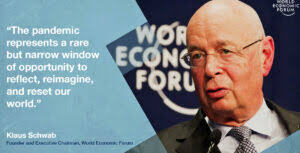
So what is the Great Reset? Essentially, the term comes from both a June 3, 2020 event sponsored by the WEF entitled The Great Reset which featured statements from leaders of the IMF, World Bank, and members of the corporate and banking sectors of the United States and UK as well as book written by Klaus Schwab, founder of the WEF, entitled COVID19: The Great Reset. Both the book and the event echoed the same sentiment, i.e. that the world economy must be shut down and “reset” in order to usher in a new economy based upon the ideals of Agenda 21 and the Green New Deal.

Hinchcliffe again, in a separate article, “’The Great Reset Will Dramatically Expand The Surveillance State Via Real-Time Tracking’: Ron Paul,” writes,

The overall goal of the WEF’s so-called great reset agenda has always been to reshape the global economy and revamp every aspect of society, with or without COVID.

Trust becomes a major concern when you realize that the idea of tracking and tracing every human being on the planet was already championed by the WEF Founder Klaus Schwab years before COVID-19 arrived on the scene.

Another concern is whether to believe that the lockdowns, the limited mobility, the destruction of small businesses, the crashing of the economy, the home evictions, and the largest transfer of wealth in the history of the world are all necessary to stop an “invisible enemy,” along with the subsequent curtailing of freedom that hasn’t been seen in the free world since the beginning of the so-called War on Terror.

“This digital identity determines what products, services and information we can access – or, conversely, what is closed off to us” — WEF report

According to Schwab, the post-COVID fourth industrial revolution will lead to “a fusion of our physical, our digital, and our biological identities.”

In his books, “COVID-19: The Great Reset,” (2020) and “The Fourth Industrial Revolution” (2017), Schwab envisioned a future of tracking and tracing every individual through digital identities connected to the Internet of Bodies (IoB) ecosystem.

For example, in “The Fourth Industrial Revolution,” Schwab noted:

Any package, pallet or container can now be equipped with a sensor, transmitter or radio frequency identification (RFID) tag that allows a company to track where it is as it moves through the supply chain—how it is performing, how it is being used, and so on.

In the near future, similar monitoring systems will also be applied to the movement and tracking of people.

. . . . .

The digital identity agenda picked-up speed throughout 2020, starting with contact tracing and continuing with immunity passports to monitor and control citizen mobility for the greater good.

After attempting to justify mass surveillance in the interest of public health and safety, Schwab wrote in “COVID-19: The Great Reset” that in the post-pandemic era “the genie of tech surveillance will not be put back in the bottle,” and that “dystopian scenarios are not a fatality.”

Below are just a few quotes from “COVID19: The Great Reset:”

Now that information and communication technologies permeate almost every aspect of our lives and forms of social participation, any digital experience that we have can be turned into a “product” destined to monitor and anticipate our behavior.

. . . . .

The pandemic could open an era of active health surveillance made possible by location-detecting smartphones, facial-recognition cameras and other technologies that identify sources of infection and track the spread of a disease in quasi real time.

. . . . .

Dystopian scenarios are not a fatality. It is true that in the post-pandemic era, personal health and wellbeing will become a much greater priority for society, which is why the genie of tech surveillance will not be put back into the bottle.

. . . . .

The combination of AI, the IoT and sensors and wearable technology will produce new insights into personal well-being. They will monitor how we are and feel, and will progressively blur the boundaries between public healthcare systems and personalized health creation systems – a distinction that will eventually break down.

Hinchcliffe also writes:

Between 2014 and 2017, the WEF called to reshape, restart, reboot, and reset the global order every single year, each aimed at solving various “crises.”

2014: WEF publishes meeting agenda entitled “The Reshaping of the World: Consequences for Society, Politics and Business.”

2015: WEF publishes article in collaboration with VOX EU called “We need to press restart on the global economy.”

2016: WEF holds panel called “How to reboot the global economy.”

2017: WEF publishes article saying “Our world needs a reset in how we operate.”

In 2020, the coronavirus was the catalyst needed to enact the great reset plan that had been bubbling under the surface for years, and immunity passports are just another step in the overall plan to track and trace every citizen through their digital identity.

Without digressing too far, I would suggest reading my article, “Social Media, Universal Basic Income, and Cashless Society: How China’s Social Credit System Is Coming To America,” to see just how far characters like Klaus would like to drag the world’s population. It truly is essential reading at this stage of the game.

One of the few statements made by the WEF related to its future goals was a bizarre article published by Forbes entitled, “ Welcome To 2030: I Own Nothing, Have No Privacy And Life Has Never Been Better,” where the WEF contributor describes a futuristic society (eight years away) that resembles a feudalist communist utopia where there is no such thing as privacy or private property and AI runs society. The article is so bizarre because, while it attempts to paint a utopia, even the fictional narrator can’t seem to keep from sounding like a brainwashed cult member. It reads

My biggest concern is all the people who do not live in our city. Those we lost on the way. Those who decided that it became too much, all this technology. Those who felt obsolete and useless when robots and AI took over big parts of our jobs. Those who got upset with the political system and turned against it. They live different kind of lives outside of the city. Some have formed little self-supplying communities. Others just stayed in the empty and abandoned houses in small 19th century villages.

Once in a while I get annoyed about the fact that I have no real privacy. Nowhere I can go and not be registered. I know that, somewhere, everything I do, think and dream of is recorded. I just hope that nobody will use it against me.

All in all, it is a good life. Much better than the path we were on, where it became so clear that we could not continue with the same model of growth. We had all these terrible things happening: lifestyle diseases, climate change, the refugee crisis, environmental degradation, completely congested cities, water pollution, air pollution, social unrest and unemployment. We lost way too many people before we realized that we could do things differently.

Combined with the Social Credit System, UBI, and digital passports, UN Agenda 21, mentioned above, the next step after the world’s economic and cultural systems are “reset,” will be implemented, creating what is essentially a global version of the Soviet Union, gulags and all. For those who are unaware, UN Agenda 21 is an established and published plan developed by the United Nations Department of Economic and Social Affairs, Division for Sustainable Affairs. The plan, according to the UN website, is a “comprehensive plan of action to be taken globally, nationally and locally by organizations of the United Nations system, government, and major groups, in every area in which humans have impact on the environment.”

The plan essentially calls for government control of all land, where human and animal lifestyle and activity is strictly limited and controlled, humans rounded up into “habitat areas,” and individual rights are a thing of the past. Travel will be restricted to essential vehicles only and diet will be mandated by the dictates of the “needs” of the environment.

This is precisely why we are seeing chaos at airports for lack of pilots, why the supply chain is broken and why food is becoming scarce. This is not by accident. In fact, food-processing facilities have been burned,vandalized, and rendered inoperable all across the United States in seemingly random acts. But how random are they? Did a sudden mass psychosis take hold which prodded people into carrying out attacks against food-processing facilities? Or, again, is there an agenda afoot?

Is it any coincidence that the very goals set forth by Agenda 21 and the Great Reset have been met one by one in the last two years?

  • Economic shutdown and “reset” – COVID Lockdowns and furloughs, artificial labor shortages.
  • Food shortages – disruption of supply chain by lockdowns, labor shortage, “random” attacks on    food facilities, destruction of crops, culling of farm animals, rising fuel prices.
  • Restriction of travel – rising fuel prices, fewer cars functional due to trade disruption, harder to find parts, COVID travel restrictions, vaccine passports, digital monitoring of travel, pilot  shortages.
  • Loss of individual rights – slow burn for decades but COVID lockdowns, vaccine passports,   travel restrictions, right to gather all drastically infringed upon under “emergency measures” have eviscerated the concept of individual rights.
  • Unemployment – global economy already struggling before COVID, after the “pandemic,” however, many businesses simply disappeared.

But there is some light in all this. Where many people simply panicked at the outset of the “pandemic” and willingly gave up their rights and their critical thinking skills, the subsequent infringement upon their daily lives for such a sustained amount of time with little to no logical standards for actually preventing disease, many eventually began opening their eyes to the fact that another agenda was being put in place. In fact, more people than ever before have begun to openly question and oppose what their governments are doing in the name of keeping them safe and healthy.

So, after two years of having their most basic rights shredded and destroyed, the savages have become restless. They’ve started to realize that the treaties of the status quo between themselves and the global ruling glass were not being honored and so they began to question the legitimacy of that ruling class. They voted, they protested, they demonstrated, and refused to comply.

And what is the response of the ruling class? “We were never able to fully control the savages until their supply of meat was cut off.” It’s not very inventive but it is effective. So the question dear reader is, if you are a savage and your meat supply is being cut off, what should you do? Well, ask yourself what should the native Americans have done? I’ll leave that up to you but, I think you already know the answer.
The “New Normal” & the Civil Society Deception

A global network of stakeholder capitalist partners are collaborating to usher in what they claim to be a new model of enhanced democratic accountability that includes “civil society”. However, beneath their deceptive use of the term civil society lies an ideology which offers this network an unprecedented degree of political control that threatens to extinguish representative democracy entirely.

By Iian Davis

Source: Unlimited Hangout

Representative democracy is quietly being phased out to be replaced with a “new normal.” This “new normal” is a nascent form of governance being referred to as “civil society.” It is founded upon the principles of communitarianism and it is being offered to us as an illusory replacement for representative democracy.

The Global Public-Private Partnership (G3P), who set the worldwide policy agenda, have long-seen the manipulation of the concept of civil society as a means to achieve their ambitions. This is at odds with how many emergent “civil society” groups understand their allocated roll.

Set against the background of a corporate, global state, in this article, we will explore the exploitation of communitarian civil society and consider the evidence that, despite possibly good intentions, civil society is very far from the system of increased democratic accountability that communitarians had hoped for. In the hands of the G3P, what they refer to as “civil society” is a tyranny.

Shaping the Global Public-Private Partnership

Speaking at the World Economic Forum (WEF) annual Davos meeting in 1998, then United Nations (UN) Secretary General Kofi Annan, described the transformation of the United Nations. He signalled the transition to the G3P model of global governance:

“The United Nations has been transformed since we last met here in Davos. The Organization has undergone a complete overhaul that I have described as a ‘quiet revolution’ […] A fundamental shift has occurred. The United Nations once dealt only with governments. By now we know that peace and prosperity cannot be achieved without partnerships involving governments, international organizations, the business community and civil society […] The business of the United Nations involves the businesses of the world.”

The WEF describes itself as the “International Organization for Public-Private Cooperation.” It represents the interests of more than 1000 global corporations and, in June 2019, it signed a Strategic Partnership Framework agreement with the United Nations. The WEF and the UN agreed to work together to “accelerate implementation of the 2030 Agenda for Sustainable Development.”

Agenda 2030 establishes the initial waypoints along the path to completion of the plan for the 21st century, also known as Agenda 21. The policies required to achieve these goals will be developed by the multi-stakeholder partnership. The UN explain how this is envisaged to operate:

“Cross sectorial and innovative multi-stakeholder partnerships will play a crucial role for getting us to where we need by the year 2030. Partnerships for sustainable development are multi-stakeholder initiatives voluntarily undertaken by Governments, intergovernmental organizations, major groups and others stakeholders, which efforts are contributing to the implementation of inter-governmentally agreed development goals and commitments, as included in Agenda 21.”

For its part, the UN describes itself as the “place where the world’s nations can gather together, discuss common problems and find shared solutions.” Currently 193 sovereign states are signed up to the UN Charter

National governments commit to abide by the principles of the Charter and the ruling arbitration of the International Court of Justice. While UN General Assembly recommendations are non-binding on member states, the UN provides a mechanism by which governments can take collective action.

With the Strategic Partnership in place, the WEF and the corporations they represent are now engaged in “effective collaboration” with the 193 national governments represented at the UN. They are directly partnering with government in the development of global policy agendas.

The partnership will guide the formation of policies and regulations related to international finance and the global financial system; the transition to a new, low carbon global economy; international public health policy, disaster preparedness and global health security; the technological development deemed necessary to bring about the Fourth Industrial Revolution; policies on diversity, inclusion and equality; oversight of the global education systems and more.

In an attempt to add a veneer of democratic accountability to this Strategic Partnership Framework, as the world uniformly moves towards Agenda 2030 Sustainable Development Goals (SDGs), the UN strongly advocates collaboration with “civil society.” Indeed, SDG 17 specifically refers to this arrangement: “Goal 17 further seek to encourage and promote effective public, public-private and civil society partnerships”

Civil society will be engaged by utilising the WEF concept of the “multistakeholder platform.” This is a core element of the WEF’s definition of stakeholder capitalism. 

The communitarian model of civil society is based upon a triumvirate power sharing structure between state (public sector), market (private sector) and community (social or third sector.) However, the WEF’s interpretation of stakeholder capitalism assumes that the public-private partnership stakeholders (state-market) select the civil society communities (social or third sector) they wish to engage with. 

Selection bias is a concern, as it obviously excludes the communities the public-private partnership does not wish to engage with. In part, this contradicts the communitarian view of civil society. 

The WEF’s multistakeholder platform appears to exploit, rather than embrace, communitarian civil society. Understandably, the WEF’s partnership with the UN drew strong criticism from many civil society groups. The Transnational Institute (TNI) encapsulated their concerns as follows: 

“This public-private partnership will permanently associate the UN with transnational corporations […] This is a form of corporate capture […] The provisions of the strategic partnership effectively provide that corporate leaders will become ‘whisper advisors’ to the heads of UN system departments, using their private access to advocate market-based profit-making ‘solutions’ to global problems while undermining real solutions […] The UN’s acceptance of this partnership agreement moves the world toward WEF’s aspirations for multistakeholderism becoming the effective replacement of multilateralism […] The goal was to weaken the role of states in global decision-making and to elevate the role of a new set of ‘stakeholders’, turning our multilateral system into a multistakeholder system, in which companies are part of the governing mechanisms. This would bring transnational corporations, selected civil society representatives, states and other non-state actors together to make global decisions, discarding or ignoring critical concerns around conflicts of interest, accountability and democracy.”

Less than six months after the Strategic Partnership Framework was signed the pseudopandemic allegedly began in Wuhan, China. Resulting world events have somewhat obscured the corporate capture of global governance from public attention, but it remains in place. 

The Civil Society Tradition

Representative democracies have a long tradition of civil society. Between 1835 and 1840 the French aristocrat, Alexis de Tocqueville, wrote and published two volumes of “Democracy in America.” He noted that, for the representative democracy of the “new world,” the voluntary institutions of civil society promoted active engagement in decision making and acted as a bulwark against the excesses of centralised, governmental authority:

“Americans of all ages, all conditions, and all dispositions, constantly form associations. They have not only commercial and manufacturing companies, in which all take part, but associations of a thousand other kinds -religious, moral, serious, futile, extensive, or restricted, enormous or diminutive. The Americans make associations to give entertainments, to found establishments for education, to build inns, to construct churches, to diffuse books […] and in this manner they found hospitals, prisons, and schools […] they form a society.”

While he found that American civil society empowered the citizenry, de Tocqueville also identified some of the apparent risks:

“When several members of an aristocracy agree to combine, they easily succeed in doing so; as each of them brings great strength to the partnership, the number of its members may be very limited; and when the members of an association are limited in number, they may easily become mutually acquainted, understand each other, and establish fixed regulations. The same opportunities do not occur amongst democratic nations, where the associated members must always be very numerous for their association to have any power.”

There is nothing intrinsically wrong with concept of civil society, but even in the 19th century the potential for it to be exploited by powerful interest groups was apparent.

Today, civil society is sold to us as a way to fix what many people see as the “democratic deficit”. First coined in the late 70’s by the Congress of Young European Federalists (JEF), the “deficit” was conceived to explain the observed failings in representative democracy.

The JEF held that the ponderous, centralised bureaucracy of national government was unable to adapt to rapidly changing economic and social conditions. Further, that the interdependent, international nature of modern, technologically advanced industrial societies created conditions that no single nation could address in isolation.

This left the electorate unable to affect the policy changes they needed, as government became unresponsive to social and economic realities. Civil society was suggested as a way to bridge the gap between governance, government and community. Unfortunately, the inherent credulity of the communitarian theory driving it rendered civil society vulnerable to manipulation by more Machiavellian global forces.

Communitarian Civil Society Model

In 1848, Karl Marx and Frederick Engels published the first edition of the Communist Manifesto. In it they criticised their intellectual forebears, Henri de Saint-Simon, Charles Fourier and others, for their utopian naivety. In particular they decried the “utopian socialist” rejection of the class struggle, pointing out that, in their opinion, the proletariat needed an independent political movement in order to overturn the rule of the bourgeoisie.

In 1841, John Goodwyn Barmby coined the term “communitarian.” He was among those who Marx would subsequently label as utopian socialists. Communitarianism elucidated their theory that individual identity was a product of familial, social and community interactions. Communitarianism wasn’t widely referenced until, in 1996, the Canadian philosopher Charles Taylor highlighted that a new form of political communitarianism was building in the US:

“The term has been taken up by a group under the leadership of Amitai Etzioni in the US. This group has a political agenda. One might say that they are concerned social democrats who are worried about the way that various forms of individualism are undermining the welfare state. They see the need for solidarity, and hence for ‘community’ on a number of levels, from the family to the state.”

Amitai Etzioni, an Israeli-American dual citizen, is the director of the Center for Communitarian Policy Studies at George Washington University. A former advisor to the Carter administration, he formed an association of like minded sociologists and other scholars called the Communitarian Network.

In 1991, the Network produced its manifesto in the form of the Responsive Communitarian Platform. Etzioni et al. defined civil society as the moral and political space between community and state. They suggested that global problems could only be tackled with the participation of civil society:

“A communitarian perspective must be brought to bear on the great moral, legal and social issues of our time […] Moral voices achieve their effect mainly through education and persuasion, rather than through coercion […] they exhort, admonish, and appeal to what Lincoln called the better angels of our nature […] this important moral realm, which is neither one of random individual choice nor of government control, has been much neglected […] we see an urgent need for a communitarian social movement to accord these voices their essential place […] civil society is a constant, ongoing enterprise.”

Communitarianism is opposed to authoritarian control. It specifies “community” as representative of the people. Accordingly, in order for government to be genuinely responsive to the changing needs of the electorate, it must engage with communities:

“We seek to find ways to accord citizens more information, and more say, more often. We seek to curb the role of private money, special interests, and corruption in government. Similarly, we ask how ‘private governments,’ whether corporations, labor unions, or voluntary associations, can become more responsive to their members and to the needs of the community.”

Etzioni and other communitarians, like the utopian socialists before them, believe that the community represents the individual. Therefore, the community can speak for the individual. Further, they believe that governments and “private governments” can engage with the people via consultation with the communities. In combination, these communities form civil society.

Communitarian Assumptions

In his 2000 commissioned treatise for the UK-based, privately funded think tank DEMOS, titled The Third Way To A Good Society, Etzioni argued that civil society could remedy public disillusionment in democratic institutions. He noted the dwindling public trust in government and increasing sense of disenfranchisement. The remedy he proposed for this democratic deficit has since proven disastrous:

“We aspire to a society that is not merely civil but is good […] When we bond with family, friends or community members we live up to the basic principle of the good society […] The good society is one that balances three often partially incompatible elements: the state, the market and the community. […] Communities, in my understanding, are based on two foundations […] First, communities provide bonds of affection that turn groups of people into social entities resembling extended families. Second, they transmit a shared moral culture (a set of shared social meanings and values that characterise what the community considers virtuous verses unacceptable behaviour) […] These traits differentiate communities from other social groups […] Contemporary communities evolve among members of one profession working for the same institution […] members of an ethnic or racial group even if dispersed among others; people who share a sexual orientation; or intellectuals of the same political or cultural feather […]Groups that merely share specific interests – to prevent the Internet from being taxed or to reduce the costs of postage – are solely an interest group or lobby. They lack the affective bonds and shared culture that make communities.”

For communitarians shared morality defines the “good society” which manifests in the exercise of power sharing between “the state, the market and the community.” Communities, as defined, stand apart from mere “interest groups” because they have “affective bonds” whereas interest groups don’t, in the communitarian’s view.

Community is, according to the communitarians, held together because people have affection for each other. They suggest that interest groups lack cohesion by comparison.

Community is “good” and therefore the power-sharing triangle is “good” for society. Certainly the vast majority of us want to live in a peaceful society, where families of every shape and size can thrive, where children have the opportunity to reach their full potential and conflict is resolved without resorting to violence. Nonetheless, communitarianism poses some questions.

Absent a shared “specific interest,” it is not easy to define community. Which “communities” will be chosen to form civil society, how is this decision made and who makes it? Who represents the local community? Is it the church, if so which church? Is it a local charity or an environmentalist group? Does the local cyclist community represent the interests of the local road hauliers community? What “good” values do these selected communities promote, who among us agree with them and how many of us share their aims and objectives?

Who is selected from each alleged community to represent the opinions of all of its constituent members? Do the community members share the views of their representatives? Are they happy for these community leaders to speak for them?

In the multistakeholder platform-based model of civil society it appears that these judgments fall to the public-private partnership. How confident can the rest of us be in their rationale? Even the notion of the local community is a nebulous concept. Where are the boundaries of local? Is it our street, our town, city or nation state? Does everyone who lives in whatever is prescribed as the local community agree? Do we all share the same opinions, do we even want to be part of a community?

Communitarians offer few, if any, answers to these questions. It is an implicit assumption of communitarianism that this thing they call community is capable of acting as a voice for the individual. This is not evident.

Communitarian “New Normal” Intolerance

An oft quoted sound-bite during the 2020 iteration of the pseudopandemic was the phrase the “new normal.” Many of us probably believed that the prospect of a new normal referred to little more than the introduction of stringent public health measures following an unprecedented global pandemic. However, this is not what “new normal” means.

While he was far from the first to use it, the “new normal” was a phrase offered by Amitai Etzioni in his 2011 book of the same name. He accompanied his book with an essay, titled The New Normal, also written in 2011. In both the book and the essay, Etzioni explored the communitarian view on the new, post global economic collapse world. The “new normal” was the name Etzioni gave to a society of “diminished economic condition.”

He suggested that people must accept that continual growth was unlikely and should, in any case, eschew consumerism as a measure of success. He welcomed this envisaged change to a society that valued relationships as well as emotional, intellectual and spiritual growth beyond material acquisition. He claimed that a reduction in consumption was required to save the planet. We all needed to reduce our carbon footprints, he asserted.

As people have come to question the often dispiriting pursuit of modern materialism, Etzioni’s perspective was welcome perhaps. However, it is in Etzioni’s exploration of the balance between individual rights and the “common good” where doubts arise. Etzioni, alongside most communitarians, considers that balance to be fluid. Neither individual rights nor the common good take precedent in a sociological concept Etzioni called “libertarian communitarianism.” 

As new situations arise and technologies emerge, what is good for the community today may not be good for the community tomorrow. Therefore, the point at which the common good does override individual rights—as it must—is constantly shifting, according to libertarian communitarianism.

However, one value which communitarianism does not espouse is diversity of opinion. In the communitarian model, the power to define the common good is absolute. The traditional democratic values of freedom of speech and expression are distinctly unwelcome in communitarian philosophy. This is not admitted, but it is implicit to their theory. For communitarians, dissent from the community or disagreement with the stated “common good” is not tolerated.

For example, the Responsive Communitarian Platform states:

“We should not hesitate to speak up and express our moral concerns to others when it comes to issues we care about deeply […] Those who neglect these duties, should be explicitly considered poor members of the community […] A good citizen is involved in a community or communities. We know that enduring responsive communities cannot be created through fiat or coercion, but only through genuine public conviction […] Although it may seem utopian, we believe that in the multiplication of strongly democratic communities around the world lies our best hope for the emergence of a global community that can deal concertedly with matters of general concern to our species as a whole.”

Communitarians are ambitious. They see their civil society as a global project where everyone involved has a “genuine public conviction” to communitarian principles. This ambition is shared by the G3P, but for very different reasons.

What if we are not convinced? What if we believe individual sovereignty is sacrosanct and that freedom of speech and expression, of organic public protest and freedom of choice are more important than a commitment to any prescribed community or the community’s authorised version of the common good?

According to communitarians, like Etzioni, this makes us poor members of the community. We are not “good citizens” and they suggest how we should be dealt with:

“Responsibilities are anchored in community […] communities define what is expected of people; they educate their members to accept these values; and they praise them when they do and frown upon them when they do not […] Whenever individuals or members of a group are harassed, many non-legal measures are appropriate to express disapproval of hateful expressions and to promote tolerance among the members of the polity.”

This is community as a control mechanism, not as an extension of any egalitarian meritocracy where individuals can flourish. The community will define our responsibilities and spell out what is expected of us. The community will instill its values and we must agree with them. If we don’t, we will be “educated” to accept them.

If we strongly express disagreement with community values this could constitute “hate” and “harassment” of community members. Those of us outside of the community, for any reason, will be receive its disapproval and efforts will be made to make us more tolerant of the community’s beliefs. Whatever they may be.

Therefore, uniformity of opinion within these communities is enforced. Debate will be welcome as long as it doesn’t challenge the community’s precepts. These are off limits. Members will probably have to leave independent thought at the door before entering the community and certainly before being accepted by it.

There is a significant risk that groupthink will develop. The roots of communitarianism are in the utopian socialist view that identity is formed by the community. In turn, this also suggests that community identity becomes individual identity.

An individual suffering from groupthink possesses unquestioned certainty, intolerance for any opposing views and an inability to engage in logical discourse. Their critical thinking skills are impaired, because to question the community is to question their own identity. 

Those who do not share the ordained group ethos, or those who question the evidence base underpinning the group’s certainty, are not part of the community. They are “other.”

Etzioni describes anyone who doesn’t embrace vaccine passports as Individual Rights Luddites. Having thought about vaccine passports, he concluded:

“These passports could enable scores of millions of people to leave their depressing quarantines, to go to work, to attend school, and to be socially active again, all of which would help revive the economy and reduce social tensions.”

He accepts that lockdowns and the closure of the global economy was an unavoidable response to a global pandemic and not a policy choice. He believes that school closures make sense and that the economy will be revived once the vaccine passport system is established. He believes that the mRNA and viral vector injections are vaccines and that they work as described by the manufacturers.

In other words Etzioni accepts a whole raft of assumptions. Based upon them, he insists that denying access to society to those who don’t want to be injected is not “discrimination” but rather “differentiation.” Applying his communitarian principles he wrote:

“Differentiation will exert some pressure on those who refuse to be vaccinated, as they will be unable to reap the benefits of the passports unless they reconsider their position.”

Etzioni has defined the common good. Or rather, he accepts the common good as defined for him. Freedom of choice or principles such as bodily autonomy are overridden by the “common good.” 

Etzioni disagrees with the philosopher Giorgio Agamben who pointed out the horrific ramifications of a biosecurity state. This is fine, disagreement and debate are welcome in any free society.

Unfortunately, unlike Agamben, Etzioni doesn’t advocate a free society. He suggests a communitarian civil society based upon the consensus view of what does or does not constitute the common good. As did Hitler’s National Socialists in 1930s Germany, a society from which Etzioni fled as a child to what is now the state of Israel.

Communitarians oppose the abuse of power and it is unfair to describe them as fascists. Nonetheless, it is entirely reasonable to point out the parallels. Both political ideologies accept authoritarian diktat. That is what enforcement of the “common good” is. 

However, this is not the most worrying aspect of the communitarianism. It is communitarians’ naive grasp of the global realpolitik, which renders communitarian civil society the perfect policy vehicle for the G3P. This is what should concern us most. Unlike communitarians, the G3P definitely wants to enforce dictatorial control.

The Political Class Embraces Communitarian Civil Society

In one sense, the global political class’ apparent enthusiasm for communitarian civil society seems surprising. It is unusual for them to seek ways to increase public scrutiny of state and corporate power or public involvement in their policy development. 

While public consultation is nothing new, policy is typically designed via internal party political processes, set at party conferences and so-forth. The parties then produce manifestos that the people are invited to select in elections, once every 4 or 5 years.

Civil society, as envisioned by communitarians, suggests a permanent power sharing structure that affords individual voters “more say, more often” in an effort to “curb the role of private money, special interests, and corruption in government.” It is rare that governments, and the political parties that form them, willingly diminish their own power and authority. 

That this seeming diminution of party political power should be embraced both simultaneously and globally is unprecedented. Yet, that is what we have seen, as Western representative democracies have advocated, what appears to be, increasing political power for civil society groups.

The recent COP26 summit, which established the basis for action for the new global economy, invited representatives from “governments, businesses, NGOs, and civil society groups.” The US State Department brought together “leaders from government, civil society, and the private sector” for their Summit For Democracy to deliberate on US foreign policy.

The German government has appointed a National Civil Society Body to monitor the site selection for potential nuclear waste storage facilities. The UK government has created the Office for Civil Society within the Department for Digital, Culture, Media & Sport. On the surface, it seems democracy is exploding everywhere.

Communitarian Civil Society Is A G3P Project

The Communitarian Network’s ideas certainly enthralled the western political class. During the 1990s, US president Clinton and then UK Prime Minister Tony Blair, with German Chancellor Gerhard Schröder leading the mainland European charge, embraced what they called “the Third Way.”

In New Labour’s Third Way: pragmatism and governance, Dr. Michael Temple outlined how this new form of communitarianism was interpreted in the polity of the 1990s:

“Elements of both stakeholding and communitarianism can be found in the Third Way […] communitarian ideas have undoubtedly influenced New Labour [..] Outputs and not ideology are driving the new agenda of governance under New Labour. This is seen to have its roots in the new ways of working the party has embraced in local governance, where public–private partnerships have become the norm and a new ethos of public service has emerged.”

This transformation in governance was not solely a political shift of the “progressive left.” Following the demise of the UK Labour government, the Conservative-led coalition, under David Cameron, advocated the “Big Society.” Today, under another Conservative government, virtually no UK policy initiative or announcement is complete unless it speaks of engagement with “civil society.”

“Public-private partnerships” became prevalent in UK local government decision-making during the 1980s & 90s. This was an aspect of the forerunner of the Third Way, named by the UK Labour party as the “stakeholder society.”

The idea of the stakeholder society owed much to the reforms introduced by former UK Conservative Prime Minster, Margaret Thatcher. Under her leadership in the 1980s the pursuit of “Reagonomics” led the introduction of compulsory competitive tendering (CCT) for all local authority contracts.

Hitherto, standard local government practice had been to allocate infrastructure projects to private contractors while the regional government provided many local services. With CCT, all contracts were opened up to the private sector. This meant that multinational corporations had access to new taxpayer-funded markets.

Prof. Andrew Gamble and Gavin Kelly, who formed the Resolution Foundation policy think tank, welcomed Tony Blair’s 1996 speech in Singapore. They emphasised the stakeholder society as a crucial element of Blair’s vision of “one nation socialism”:

“The key idea behind one nation socialism is the stakeholder society, a society in which all individuals and interests have a stake through democratic representation, and through the adoption by political parties like the Labour Party of a conception of the public interest.”

However, the stakeholder society redefined who would determine the public interest? Traditionally, this had primarily been an undertaking for elected governments. They could be kicked out of office if the public disagreed with their policies. However, the stakeholder society gave a formal policymaking role to both the third (social) and the private sector. No one voted for them, nor could they be removed through any electoral process.

Nor was the Third Way simply a European project. In the US, the Third Way policy think tank was formed in Washington in 2005. Supposedly a think tank of the “progressive left”, the Third Way was heavily backed by global corporations and lobbied Congress intensively to adopt multinational trade deals, such as the Trans-Pacific Partnership (TPP). 

Initially, it seems difficult to understand why global corporations and governments would be eager to promote an idea like the Third Way or civil society. For global corporations, the ability to focus their lobbying efforts on a handful of elected officials would appear preferable, and easier, than trying to influence the communities forming civil society. Centralised authority benefits them, so why would they seek to to dilute it?

The “key idea” of the stakeholder society did not originate in centre-left think tanks like the Resolution Foundation or the Third Way. It sprang from the heart of the global capitalist network forming the Global Public Private Partnership (G3P).

Stakeholder capitalism is supposedly a new model of so-called responsible capitalism which the founder and current executive chairman of the World Economic Forum (WEF), Klaus Schwab, pioneered in the 1970s. The G3P he represents claims the right to act as trustees of society. In December 2019, Schwab wrote “What Kind of Capitalism Do We Want”, where he outlined the stakeholder capitalism concept:

“Stakeholder capitalism, a model I first proposed a half-century ago, positions private corporations as trustees of society, and is clearly the best response to today’s social and environmental challenges.”

“Trustee” has a specific legal definition:

“The person appointed, or required by law, to execute a trust; one in whom an estate, interest, or power is vested, under an express or implied agreement to administer or exercise it for the benefit or to the use of another.”

The referenced “other” is us, the population. We all apparently agree that private corporations should be invested with the power to administer the global estate. Or at least that is the assumption at the heart of stakeholder capitalism.

Communitarianism and stakeholder capitalism merge to form what is now being referred to as “civil society.” This then is the proposed model of representative democracy that will ostensibly enable us to have a say in the policy formation process. If we examine this claim, however, it is resoundingly hollow.

In the hands of the global stakeholder capitalists, with the connivance of a power hungry “progressive” left, Etzioni’s dream of a communitarian civil society has metastasised into a global control mechanism for the G3P. Civil society, as the term is now being used, is a threat to every democratic principle we value.

The Tyranny of the New Normal Communitarian Civil Society

Etzioni, Michael Sandel, Charles Taylor and other proponents of communitarianism, who advocate local and national governance via civil society, offer a model ripe for exploitation. Governments across the world have enthusiastically seized the opportunity presented by this rendering of civil society, typically in the form of people’s or citizen’s assemblies.

Many assemblies have formed their consultative community through the drawing of lots. So-called sortition is a governance model that invites members of the local community to deliberate on important policy issues. For example, the UK Government commissioned the Climate Assembly to look at policy enabling the UK to achieve “net zero” carbon emissions by 2050.

Selected delegates were able to debate what the net zero policy priorities should be. They considered how fast net zero policies should be implemented and looked at how net zero policies could impact their communities, considering what mitigation measures may be required. What they could not do is question net zero policy nor the underlying assumptions it is based upon.

The World Economic Forum (WEF) succinctly explains how they interpret the communitarian civil society:

“Civil society actors from a wide range of fields come together to collaborate with government and business leaders on finding and advocating solutions to global challenges. They also focus on how to best leverage the transformation brought by the Fourth Industrial Revolution and partner with industry, philanthropy, government and academia to take action and engage in the development, deployment, use and governance of technology. Non-governmental organizations (NGOs), labour and religious leaders, faith-based organizations and other civil society stakeholders are key members of the World Economic Forum’s multistakeholder platform.”

There is no questioning of either government or business. No opportunity is provided for the people, the subjects of the policy agenda under debate, to explore alternatives.

The necessity for the WEF model of the Fourth Industrial Revolution is assumed, as is the partnership with industry to achieve it. The problems are predetermined and the “solutions” have already been decided before civil society has the opportunity to “collaborate with government and business.”

The civil society stakeholders are chosen. Representatives from NGOs, religious communities, unions and philanthropic foundations are the selected stakeholders whose only role is to agree with the policies placed on the table by the public-private partnership. Their consent is deemed to be public consent.

As previously stated, the communitarian civil society creates a power sharing structure between state (public sector), market (private sector) and community (social or third sector.) It assumes that all three sectors are independent of each other and therefore governance, the setting of policy agendas, is achieved through equal compromise of all three parties.

This fatal naivety effectively extinguishes, rather than enhances, democratic accountability. In truth, the public and private sector are not independent of each other. They are working as equals in partnership. 

Between them, they have all the money, all the legal authority, all the resources. Via the public sector (government), they also possess a monopoly on the use of force to compel communities to comply.

On the other side of the civil society equation sits some abstract form of “community” that is invited by the public-private partnership to collaborate. The public-private partnership selects the community or communities they want to rubber stamp their policies. The community has neither power, nor access to resources. Unlike their civil society “partners”, the community can’t force anyone to do anything.

The parameters of the alleged debate are set before the community joins and it will only be allowed to select from whatever “solutions” are put in front of it. All of this fulfills the immediate objectives of the G3P.

At the same time, this allows the G3P to address an issue that has plagued it for years: the democratic deficit or the public’s loss of trust in the institutions of government.

Within the G3P, governments don’t necessarily devise policy. Instead, their primary role is to market the policy and then enforce it. 

Governments also provide the enabling environment for G3P policy agendas. They provide this environment both in terms of investment, via the taxpayer, and perhaps more importantly because the population is more likely to accept the rule of an allegedly democratic government rather than a dictatorship composed of a network of global corporations, NGOs and philanthropic foundations.  

Consequently, a democratic deficit that erodes that trust is a problem. If you want to convert your policy agenda into legislation and regulation that impacts people’s lives, then you need to make them believe they still have some way of holding decision makers to account. Otherwise, they might resist your undemocratic rule. 

The communitarian model of civil society is a gift for the G3P. Not only can they use it to continue maintaining the illusion of democracy, they can exploit claimed engagement with the community and build trust. Building trust is a current, major goal fo the G3P. For example, a “Crucial Year to Rebuild Trust” was the central theme of the 2021 Davos summit, hosted largely virtually by the WEF, and their planned theme for 2022 is “Working Together, Restoring Trust.”

Our continued “trust” in their institutions is vital for the G3P and the stability of their rule. The constant reference to civil society is intended to convince us that we too are stakeholders in the G3P’s multistakeholder platform. In reality, we aren’t. This is a deceit. 

Instead, we are the subjects of the predetermined policy agendas that civil society will be invited to approve on our behalf. If we question the selected representative civil society groups, their communitarian beliefs or their assumed right to speak for us, we will be castigated as “bad citizens.” 

Being in a community of like-minded souls, with whom we feel a bond, is nice but such a community has no chance against against a committed “interest group.” Such groups have a shared goal and often the will and the resources to attain it. Throughout history, communities have been ruthlessly oppressed by such “interest groups.”

Interest groups’ big advantage is that their members don’t have to feel any affection for each other or even agree on anything other than their objective. Its constituent members simply need to settle their purpose and they do so because each recognises how it benefits them. They are committed to the cause, not to each other.

In the case of the G3P, their cause is the creation and control of new markets and, in doing so, the establishment of a new global economic model. Civil society has helped to set this process in motion.

One of the G3P objectives is the global roll-out of Central Bank Digital Currencies (CBDCs). This offers the G3P the ability to individually monitor and control every financial transaction on Earth. We have every reason to fiercely oppose its introduction. It represents nothing less than absolute economic enslavement.  

Yet, the civil society deception is being used to convince us that we are somehow stakeholders in its development. This will undoubtedly be exploited to persuade us to accept its imminent introduction.

The Bank of England (BoE), who claim they have yet to make a decisions on CBDC, has committed its CBDC Taskforce to “engage widely with stakeholders on the benefits, risks and practicalities.”

To this end, they have set up the CBDC Engagement Forum (EF). The BoE states that the EF will:

“Provide a forum to engage senior stakeholders and gather strategic input on all non-technology aspects of CBDC from a diverse cross-section of expertise and perspectives […] The EF will inform the Bank’s further exploration of the challenges and opportunities of potentially implementing CBDC […] Participation in the EF is at the invitation of the Bank and HMT (Her Majesty’s Treasury.) Members will be drawn from the relevant range of CBDC stakeholders: from financial institutions, to civil society groups, to merchants, business users and consumers.”

Given that the introduction of CBDC will radically transform all our lives, it would be good to know who the civil society groups are that will supposedly be representing the public interest. The BoE explains that representatives will be invited to join, following their application, from any of the following organisations:

“Organisation active in retail or the digital economy, a university, a trade or consumer representative body, a think-tank, a registered charity or non-government organisation.”

It is not clear how any of these hand-picked delegates will actually advocate in the public’s interest. However, the BoE assures us that they will:

“On an individual level, the EF will be representative of the gender and ethnic diversity of the UK population, and seek to incorporate members of different backgrounds to support diversity of thought.”

This is what the BoE call engaging widely with stakeholders. In many respects, it is the epitome of communitarian ideology. 

The community (in this case, the British public) will be represented because the EF will reflect the right gender and ethnic balance. This is appropriate, but it is missing one vital aspect of diversity: Class.

Just like the utopian socialists who inspired Etzioni and other communitarian thinkers, the BoE does not think that economic power matters when it comes to defining civil society. As long as they tick the right diversity boxes, class is not an issue. However, when they decide to introduce CBDC, it is the working and middle class who will suffer most as a result.

This may not be the model of civil society that the communitarians intended, but it is the model that the rest of us are going to get. A powerful interest group, the G3P, has seized upon the opportunity of communitarianism to construct a form of fake democratic accountability that consolidates their power and authority.

In one sense, it does fix the democratic deficit. By cutting out the electorate, the “new normal” communitarian civil society effectively ends representative democracy.

We Are at War

By Peter Koenig

Source: Global Research

We are at war. Yes. And I don’t mean the West against the East, against Russia and China, nor the entire world against an invisible corona virus.

No. We, the common people, are at war against an ever more authoritarian and tyrannical elitist Globalist system, reigned by a small group of multi-billionaires, that planned already decades ago to take power over the people, to control them, reduce them to what a minute elite believes is an “adequate number” to inhabit Mother Earth – and to digitize and robotize the rest of the survivors, as a sort of serfs. It’s a combination of George Orwell’s “1984” and Aldous Huxley’s “Brave New World”.

Welcome to the age of the transhumans. If we allow it.

Vaccination

That’s why vaccination is needed in warp speed, to inject us with transgenic substances that may change our DNA, lest we may wake up, or at least a critical mass may become conscious – and change the dynamics. Because dynamics are not predictable, especially not in the long-term.

The war is real and the sooner we all realize it, the sooner those in masks and those in social distancing take cognizance of the worldwide “anti-human” dystopian situations we have allowed our governments to bestow on us, the better our chance to retake our sovereign selves.

Today we are confronted with totally illegal and oppressive rules, all imposed under the pretext of “health protection”.

Non-obedience is punishable by huge fines; military and police enforced rules: Mask wearing, social distancing, keeping within the allowed radius of our “homes”, quarantining, staying away from our friends and families.

Actually, the sooner, We, the People, will take up an old forgotten characteristic of human kind – “solidarity” – and fight this war with our solidarity, with our love for each other, for mankind, with our love for LIFE and our Love for Mother Earth, the sooner we become again independent, self-assured beings, an attribute we have lost gradually over the last decades, at the latest since the beginning of the neoliberal onslaught of the 1980s.

Slice by tiny slice of human rights and civil rights have been cut off under false pretexts and propaganda – “security” – to the point where we, drowned in propagated dangers of all kinds, begged for more security and gladly gave away more of our freedoms and rights. How sad.

Now, the salami has been sliced away.

We suddenly realize, there is nothing left. Its irrecoverable.

We have allowed it to happen before our eyes, for promised comfort and propaganda lies by these small groups of elitists – by the Globalists, in their thirst for endless power and endless greed – and endless enlargements of their riches, of their billions. – Are billions of any monetary union “riches”? – Doubtfully. They have no love. No soul, no heart just a mechanical blood-pump that keeps them alive, if you can call that a “life”.

These people, the Globalists, they have sunk so deep in their moral dysfunction, totally devoid of ethics, that their time has come – either to be judged against international human rights standards, war crimes and crimes against humanity – similar as was done by the Nuremberg Trials after World War II, or to disappear, blinded away by a new epoch of Light.

As the number of awakening people is increasing, the western Powers that Be (PTB) are becoming increasingly nervous and spare no efforts coercing all kinds of people, para-government, administrative staff, medical personnel, even independent medical doctors into defending and promoting the official narrative.

It is so obvious, when you have known these people in “normal” times, their progressive opinions suddenly turning, by 180 degrees, to the official narrative, defending the government lies, the lies of the bought “scientific Task Forces” that “advise” the governments, and thereby provide governments with alibis to “tighten the screws” a bit more (Ms. Merkel’s remarks) around the people, the very people the governments should defend and work for; the lies and deceptive messages coming from “scientists” who may have been promised “eternal, endless ladders of careers”, or of lives in a hidden paradise?

What more may they get in turn for trying to subvert their friends’, peers’, patients’ opinions about the horror disease “covid-19”? – Possibly something that is as good as life itself – and is basically cost free for the avaricious rich. For example, a vax-certificate without having been vaxxed by the toxic injections, maybe by a placebo – opening the world of travel and pleasurable activities to them as “before”.

By the way, has anybody noticed that in this 2020 / 2021 winter flu-season, the flu has all but disappeared? – Why? – It has conveniently been folded into covid, to fatten and exaggerate the covid statistics. It’s a must, dictated by the Globalists, the “invisible” top echelon, whose names may not be pronounced. Governments have to comply with “covid quotas”, in order to survive the hammer of the Globalists.

Other special benefits for those selected and complacent defender of the official narrative, the placebo-vaxxed, may include dispensation from social distancing, mask wearing, quarantining – and who knows, a hefty monetary award. Nothing would be surprising, when you see how this tiny evil cell is growing like a cancer to take over full power of the world – including and especially Russia and China, where the bulk of the world’s natural resources are buried, and where technological and economic advances far outrank the greed-economy of the west. They will not succeed.

What if the peons don’t behave? – Job loss, withdrawal of medical licenses, physical threats to families and loved ones, and more.

The Globalists evil actions and influence-peddling is hitting a wall in the East, where they are confronted with educated and awakened people.

We are at war. Indeed. The 99.999% against the 0.001%.

Their tactics are dividing to conquer, accompanied by this latest brilliant idea – launching an invisible enemy, a virus, a plandemic, and a fear campaign to oppress and tyrannize the entire world, all 193 UN member countries.

The infamous words, spoken already more than half a century ago by Rockefeller protégé, Henry Kissinger, comes to mind:

“Who controls food supply controls the people; who controls the energy can control whole continents; who controls money can control the world.”

Quoted below are some lines and thoughts of a 1 January 2021, RT Op-Ed article by Helen Buyniski entitled “Civil war, medical discrimination, spy satellites and cyborgs! How 2021 could make us yearn for 2020”The article may point us in a direction of what may happen in 2021, that we certainly do not yearn for:

“People everywhere are eager to bid farewell to 2020, a year in which our lives were turned upside down by power-mad elites who seized the Covid-19 pandemic as a chance to go full police state.

But be careful what you wish for…. merely putting up a new calendar does nothing to address [the mounting repression and tyranny], which seem certain to reach a breaking point.

Humanity has been pushed to the limit with arbitrary rules, enforced poverty, and mandated isolation — it will only take a spark or two for things to explode.”

And it continues –

As vaccines are rolled out to the general public, the divide between those obeying the rules and the dissidents will only grow. Those who decline to get the jab will be treated as pariahs, banned from some public spaces and told it’s their fault life hasn’t gone back to normal, just as so-called “anti-maskers” have been.”

And more glorious prospects

“Anyone who isn’t thrilled by the idea of ingesting an experimental compound whose makers have been indemnified from any lawsuits, will be deemed an enemy of the state, even separated from their children or removed from their home as a health risk. Neighbors will gleefully rat each other out for the equivalent of an extra chocolate ration, meaning even the most slavishly obedient individuals could end up in “quarncentration camps” for upsetting the wrong person.”

Yes, we are in the midst of war.

A war that has already ravaged our society, divided it all the way down to families and friends.

If we are not careful, we may not look our children and grandchildren in the eyes, because we knew, we ought to have known what was and is going on, what is being done, by a small dark power elite – the Globalists. We must step out of our comfort zone, and confront the enemy with an awakened mind of consciousness and a heart filled with love – but also with fierce resistance.

If we fail to step up and stand up for our rights, this war goes on to prepare future generations – to abstain from congregating with other people.

They are already indoctrinating our kids into keeping away from friends, school colleagues, peers, and from playing in groups with each other – as the New Normal.

The self-declared cupula – the crème of the crop of civilization – the Globalist evil masters, already compromised and continue to do so, the education systems throughout the globe to instill into kids and young adults that wearing masks is essential for survival, and “social distancing” is the only way forward.

Must see Video

Children of the Great Reset

Breaking the Social Fabric. Towards Totalitarian Rule

They, the Globalists, know damned well that once a civilization has lost its natural cohesion – the social fabric is broken, the very fabric that keeps a civilization together and dynamically advancing, they have won the battle. Maybe not the war, since the war will last as long as there is resistance. The “dynamic advancing” – or simply dynamics itself – is their nightmare, because dynamics is what makes life tick – life, people, societies, entire nations and continents. Without dynamics life on the planet would stand still.

And that’s what they want – a Globalist dictator, controlling a small population of serfs, or robotized slaves, that move only when told, own nothing and are given a digital blockchain controlled universal income, that, depending on their behavior and obedience, they may use to buy food, pleasure and comfort. Once the slaves are dispensable or incorrigible, their electronically controlled brains are simply turned off – RIP.

This may turn out to be the most devastating war mankind has ever fought.

May We, the People, see through this horrendous sham which is already now playing out, in Year One of the UN Agenda 21 /30;

And may We, the People, the commons, win this war against a power-thirsty elite and its bought administrators and “scientists” throughout the world – and restore a sovereign, unmasked, socially coherent society – in solidarity.


Peter Koenig is a geopolitical analyst and a former Senior Economist at the World Bank and the World Health Organization (WHO), where he has worked for over 30 years on water and environment around the world. He lectures at universities in the US, Europe and South America. He writes regularly for online journals and is the author of Implosion – An Economic Thriller about War, Environmental Destruction and Corporate Greed; and  co-author of Cynthia McKinney’s book “When China Sneezes: From the Coronavirus Lockdown to the Global Politico-Economic Crisis” (Clarity Press – November 1, 2020).

Peter Koenig is a Research Associate of the Centre for Research on Globalization.

Masked, Homeless, and Desolate

By Edward Curtin

Source: Off-Guardian

Personality is persona, a mask…The mask is magic…Larva means mask; or ghost…it also means mad, a case of demoniacal possession.”
Norman O. Brown, Love’s Body

Walk the streets in the United States and many countries these days and you will see streaming crowds of people possessed by demons, masked and anonymous, whose eyes look like vacuums, staring into space or out of empty sockets like the dead, afraid of their own ghosts. Fear and obedience oozes from them. Death walks the streets with people on leashes in lockstep.

That they have been the victims of a long-planned propaganda campaign to use an invisible virus to frighten them into submission and shut down the world’s economy for the global elites is beyond their ken. This is so even when the facts are there to prove otherwise.

It is a clear case, as Peter Koenig tells Michel Chossudovsky in this must-see interview, that is not a conspiracy theory but a blatant factual plan spelled out in the 2010 Rockefeller Report, the October 18, 2019 Event 201, and Agenda 21, among other places.

Who can wake the sleepwalkers up in this cowardly new world where culture and politics collude to create and exploit ignorance?

Fifty-five years ago on, July 20, 1965, Bob Dylan released his song “Like a Rolling Stone.” It arrived like a rocking jolt into the placid pop musical culture of the day. It was not about wanting to hold someone’s hand or cry in the chapel. It wasn’t mumbo-jumbo like “Wooly Bully,” the number one hit. It wasn’t like the pop pap that dominates today’s music scene. It wasn’t Woody Guthrie in slow time.

It beat you up. It attacked. It confronted you. Maybe, if you were alive then, you thought Dylan was kidding you. You thought wrong. Bitching about his going electric was a dodge. He was addressing all of us, including himself.

Still is. But who wants to hear his recent “Murder Most Foul” and read Dylan’s scathing lyrics about the assassination of JFK, the killing that started the slow decay that has resulted in such masked madness. “And please, Don’t Let Me Be Misunderstood,” he tells us in capital letters for emphasis. Exactly what all the mainstream media have done, of course, and not by accident.

There are no alibis.

“How does it feel/To be on your own/with no direction home/A complete unknown/Like a rolling stone?”

It was in the mid-1960s when confidence in knowing where home was and how to get there disappeared into thin air. If you left mommy and daddy, could you ever get back from where you were going? Who had the directions?

Absolutes were melting and relativity was widespread. Life was wild and the CIA was planning to make it wilder and more confusing with the introduction of LSD on a vast scale. MKUltra was expanding its scope. Operation Mockingbird was singing so many tunes that heads were spinning, as planned.

The national security state killers were in the saddle, having already murdered President Kennedy and Malcolm X as they sharpened their knives for many more to come. The peace candidate, Lyndon Baines Johnson, had been elected nine months earlier with 61.1% of the popular vote and went immediately to work secretly expanding the war against Vietnam. War as an invisible virus. Who knew?

Who, but a small anti-war contingent, wanted to know?

War takes different forms, and the will to ignorance and historical amnesia endure. War is a disease. Disease is weaponized for war. In 1968 Richard Nixon was elected on a “secret plan” to end the Vietnam War and then ramped it up to monstrous proportions, only to be reelected in 1972 by carrying 49 out of 50 states.

Who wants to know now? The historian Howard Zinn once said correctly that this country’s greatest problem wasn’t disobedience but obedience.

What’s behind the masks? The lockstep?

On the same day that Dylan released “Like a Rolling Stone,” Secretary of Defense Robert McNamara, just back from a “fact-finding” trip to Vietnam, recommended to LBJ that U.S. troop levels in Vietnam be increased to 175,000 and that the U.S. should increase its bombing of North Vietnam dramatically.

This was the same McNamara who, in October 1963, had agreed with JFK when he signed NSAM 263 calling for the withdrawal of 1,000 military personnel from Vietnam by the end of 1963 and the remainder by the end of 1965. One of the moves that got Kennedy’s head blown open.

Poor McNamara, the fog of war must have clouded his conscience, confused the poor boy, just like Secretary of State Colin Powell holding up that vile vial of “anthrax” at the United Nations on February 5, 2003 and lying to the world about weapons of mass destruction in Iraq.

Powell recently said, “I knew I didn’t have any choice. He’s the President.” How “painful,” to use his word, it must have been for the poor guy, lying so that so many Iraqis could be slaughtered. Of course, he had no choice. These war criminals all wear masks. And have no choice.

Masks, or demonic possession, or both. You?

Also in that fateful year 1965, far out of sight and out of mind for most Americans, the CIA planned and assisted in the slaughter of more than a million Indonesians, led by their man, General Suharto. This led to the coup against President Sukarno, who two years earlier had been on good terms with JFK as they worked to solve the interrelated issues of Indonesia and Vietnam. Their meeting planned for early 1964 was cancelled in Dallas on November 22, 1963.

And the politicians and media luminaries came out in their masks and told the public that communists everywhere were out to get them.

It’s tough being on your own. It hurts to think too much. Or think for yourself, at least. To obey an authority higher than your bosses. “I was tricked” is some sort of mantra, is it not?

You never turned around to see the frowns on the jugglers and the clowns
When they all did tricks for you

Dylan was lost and disgusted when he wrote the song. His own music sickened him, which, for an artist, means he sickened himself. He had just returned from a tour of England and was sick of people telling him how much they loved his music when he didn’t. He needed to change.

What else is the point of art but change? If you’re dead, or afraid of getting dead, you aren’t going to change. You’re stuck. Stuck is dead. Why wear a mask if you know who you are?

Knowledge, or more accurately, pseudo-knowledge or mainstream media lies, is a tomb “the mystery tramp” sold to us, a place to hide to avoid pain and guilt.

I have read more books than anyone I know. It sickens me.
I know too much. That sickens me.
I sicken myself. All the news sickens me.
I know so much no one believes me.
As Francesco Serpico once told me: “It’s all lies.”
Of course. Dylan and Serpico are blood brothers.
Only art tells the truth. Real art.

Not bullshit pop art. Some say “Like a Rolling Stone” is about Edie Sedgwick, “the girl of the year” in 1965 and one of Andy Warhol’s superstars. Perhaps to a degree it is, but it’s far more than that. It’s about us.

Poor Edie was poisoned by her wealthy family at a young age and barely had a chance. She was an extreme example of a rather common American story. People poisoned in the cradle. Thinking of her got me thinking of Andy Warhol, the death obsessed hoarder, the guy who called his studio “The Factory” in a conscious or unconscious revelation of his art and persona, his wigs and masks and the hold he has had on American culture all these years. Isn’t he the ultimate celebrity?

Warhol once took my photo on a deserted street. His and my secret but this is the truth. West 47th Street on an early Sunday morning, 1980. I guess he thought he was doing art or collecting images for his museum of dead heads. When I asked him why, he said I had an interesting face.

I told him he did too, rather transparent and creepy, but I didn’t want to capture him. He was a ghost with a camera, a face like a death mask, trying to capture a bit of life. I told him I didn’t give him permission to shoot me, but he turned and walked away into the morning mist. The shooters always just walk away in pseudo-innocence.

I then went down the street to the Gotham Book Mart that was my destination and asked James Joyce why he had written “The Dead,” and Joyce, secretive as ever, quoted himself, “Ed,” he said, “Think you’re escaping and run into yourself. Longest way round is the shortest way home.” Now that was direction.

Only those who know how to play and be guided by intuition are able to escape the living tomb of so-called knowledge; what Dylan called, lifelessness. But that was from “Desolation Row,” released as the closing track of Highway 61 Revisited on August 30, 1965. The only acoustic song on the album. Slow it down to make the point another way. “Like a Rolling Stone” was the opening track.

Do you feel all alone or part of a masked gang roaming the streets incognito? Miss and Mr. Lonely, does that mask help? How do you feel?

Desolation means very lonely. From Latin, de, completely, solare, lonely.

Does that mask help? Do you feel alone together now, one of the crowd?

Do you really want to know about desolation row? It’s here. It was here in 1965, too. Only the true lonely know how it feels to really be all alone.

The Umbrella People, those who some call the deep state or secret government under whose protection all the politicians work, say they want to protect us all from death and disease. They are lying bastards who’ve gotten so many to imitate their masked ways. They can only sing a mockingbird’s song.

Listen to real singers. Dylan has arched the years, as true artists do. Who has paid close attention to what he said this year about the assassination of President Kennedy in his song, “Murder Most Foul”? Or were many caught up in the propaganda surrounding corona virus, and rather than contemplating his indictment of the U.S. government and its media accomplices, were they contemplating their navels to see if a virus had secreted itself in there. Viruses lurk everywhere, they say, and the corporate media made certain to circulate a vaccine about the truth in Dylan’s song. This is normal operating procedure.

We are still on Desolation Row.

“Take Off the Masks.” That was the title of a book by Rev. Malcolm Boyd that I reviewed long ago. He was a gay priest who decided that his mask was a lie. He came out into the light of truth. He had guts.

It is time for everyone to take off the masks. Escape from Desolation Row by seeing what’s going on behind our backs.
Listen to Dylan, long ago – today:

At midnight all the agents
And the superhuman crew
Come out and round up everyone
That knows more than they do
And they bring them to the factory
Where their heart attack machine
Is strapped across their shoulders
And then the kerosene
Is brought down from the castles
By insurance men who go
Check to see that nobody is escaping
To Desolation Row
Praise be to Nero’s Neptune
The Titanic sails at dawn
Everybody’s shouting
“Which side are you on?”