Posterity Will Hate Us: Building a Lasting Legacy of Death

index

By Chris Floyd

Source: Empire Burlesque

What do we aim at? Houses! Who do we kill? Everyone inside the houses! What are their names? We don’t know! What did they do? We don’t know! Are they civilians? We don’t care!

This could be the catechism of the America’s drone death squads that rain death and destruction on defenceless people from the skies of Pakistan, month in, month out, year after year. As the Bureau of Investigative Journalism reports:

Domestic buildings have been hit by drone strikes more than any other type of target in the CIA’s 10-year campaign in the tribal regions of northern Pakistan, new research reveals. … The project examines, for the first time, the types of target attacked in each drone strike – be they houses, vehicles or madrassas (religious schools) – and the time of day the attack took place.

It reveals:

•Over three-fifths (61%) of all drone strikes in Pakistan targeted domestic buildings, with at least 132 houses destroyed, in more than 380 strikes.

•At least 222 civilians are estimated to be among the 1,500 or more people killed in attacks on such buildings. In the past 18 months, reports of civilian casualties in attacks on any targets have almost completely vanished, but historically almost one civilian was killed, on average, in attacks on houses.

•The CIA has consistently attacked houses have throughout the 10-year campaign in Pakistan.

•The time of an attack affects how many people – and how many civilians – are likely to die. Houses are twice as likely to be attacked at night compared with in the afternoon. Strikes that took place in the evening, when families likely to be at home and gathered together, were particularly deadly.

Some of these operations are carried out at the direct order of the president of the United States, who meets with his advisors every Tuesday to draw up death lists of victims to be killed. Others are slaughtered by the innumerable officers and agents upon whom the White House has bestowed a license to kill as they see fit.

But as the Bureau points out, even when the name of the target is known — although of course there is no need for any proof to be offered as to the target’s ostensible death-deserving guilt — they are most often blown to pieces in domestic homes, along with family members, friends and, often, neighbors who live nearby.

— Sometimes when I write paragraphs like the one above — setting out undisputed facts; indeed, facts that are often celebrated in the highest reaches of the political and media elites — I find myself slack-jawed, drop-jawed to the floor with amazement. The bare, banal, widely accepted, shrugged-off realities of life in the American Imperium today would have been regarded, just a few years ago, as the wildest, most unbelievable fantasies of political paranoids. The president sits in the White House and draws up death lists. Robot-controlled missiles blow up people’s houses, killing hundreds of civilians each year. Not an eyelid is batted, scarcely a voice is raised in protest, except on the far-flung disregarded margins. This is the way the world is, and one must acknowledge that — but sometimes, the cognitive dissonance hits you like a two-by-four upside the head.

But this is where we are now. This is what we are now. Future generations will look back on us in horror. They won’t notice or care about the pointless, finely-meshed gradations of minute policy differences between the two parties, or between the two factions called “left” and “right”; they won’t care if Barack Obama was or wasn’t “two percent less evil” than George W. Bush, or any of the pitiful political molehills that entirely preoccupy our chattering classes. No; all they will see in a seamless record of murder, terror, tyranny and corruption inflicted by a militarist state on the world outside and on its own people within. They will look at us just as we look at the people in Nazi Germany or Stalinist Russia and wonder, with revulsion and incomprehension, how such things happened, how whole societies could give themselves over to brutality and hate, how such vicious, vacuous, pathetic elites — and their wretched little followers and sycophants — were allowed to hold such sway for so long.

They will be sickened by us. They will hate us for what we let happen. And they will be right to do so.

Notes Toward a Future of Activism

anonymous_telecomix_2012_5_31

By Micah White

Source: Reconstruction 10.3

<1> Contemporary activism begins from the realization that for the first time in history, a synergy of catastrophes face us. Our physical environment is dying, our financial markets are collapsing and our culture, fed on a diet of junk thought, is atrophying — unable to muster the intellectual courage to face our predicament. While some may caution against immediate action by pointing out that societies often predict perils that never come, what is remarkable about our times is that the apocalypse has already happened.

<2> When we compare the anxiety of our age to that of the Cold War era, we see that what differentiates the two periods is where the threat is temporally located. During the Cold War, the threat of nuclear destruction was always imagined to be in the future. What terrorized the Cold War generation was the thought of life after a nuclear holocaust. Anxiety was therefore centered on what life would be like “the day after” the future event, which was symbolized by the blinding light of a mushroom cloud on the horizon. Thus the post-apocalyptic narrative was deployed in a series of nuclear holocaust science-fiction stories either to mobilize fear in the name of anti-nuke peace — the exemplar of this tactic being the horrifying and scientifically realistic 1984 BBC docudrama Threads in which civilization collapses into barbarism — or, like Pat Frank’s 1959 novel Alas, Babylon, convince a wary public that winning and happily surviving nuclear war is possible, given resourcefulness, discipline and patriotism.

<3> But for those of us alive today, the catastrophic event is not located in the future. There is no “post”-apocalyptic per se because we are already living in the apocalyptic. And although we can anticipate that life is going to get starker, darker and hellish, the essential feature of our times remains that we do not fear the future as much as we fear the present. We can notice this temporal shift in the work of James Lovelock, whose Gaia Hypothesis is gaining traction inside and outside of the scientific community. According to Lovelock’s latest book, The Vanishing Face of Gaia: A Final Warning, even if we were to immediately cease all C02 emissions, sudden and drastic climate change will still occur. In fact, Lovelock argues that a drastic decrease in emissions would trigger climate catastrophe immediately whereas continuing emissions will trigger climate catastrophe eventually and unpredictably. This realization — that the line into a post-climate-change world has already been crossed — fundamentally changes the temporal and spatial assumptions underpinning activist struggles. And the first aspect of activism that must be rethought is our notion of temporality.

<4> The typical activist project is inscribed within the horizon of a modern conception of temporality. The modernist activist acts as if we occupy a present moment that is a discrete point on the linear progression between a mythical, ancient past and an either utopian or dystopian future. But if we accept this model, then the goal of the activist can only be to change the future by preventing the dystopian possibility from being realized. This involves pushing for changes in laws and behaviors in the present that will impact our predictions of how the future will be. But activism based on this temporal model — which as John Foster points out in The Sustainability Mirage: Illusion and Reality in the Coming War on Climate Change underpins “green capitalism” and “sustainable development” — inevitably fails. For one, unable to accurately predict the future, we constantly play the game of basing our actions on rosy predictions while the future grows increasingly gloomier. Another problem with relying on linear temporality is the assumption that time moves in only one direction. Without the freedom to imagine going backwards, we are left the task of steering the runaway train of industrialization without hope of turning around.

<5> Of course, linear time is not the only way to understand temporality and some models can have even worse political consequences. Take for example, the notion that time is cyclical. For the Roman Stoics, time was marked by a series of conflagrations in which the world was razed and a new one formed only to be razed again. In times of adversity when resistance seems impossible, such as the build-up to World War 2, a watered down version of cyclical temporality sometimes enters the cultural consciousness. It infected Nazis who cheered total war and anti-Nazis who used the spurious argument that only by a catastrophic Nazi triumph would a communist state be realized because only then would the people rise up. A similar line of thought was pursued by Martin Heidegger in a letter to Ernst Jünger in which he wondered if the only way to “cross the line” into a new world is to bring the present world to its awful culmination. Unlike the linear conception of time that calls the activist to act in order to realize an alternate future, the cyclical conception is often leveraged to justify inaction or worse, action contrary to one’s ideals.

<6> To escape the problems of linear time and cyclical time, activism must rely on a new temporality. Perhaps the best articulation of this new activist temporality is in the work of Slavoj Žižek. In his most recent book, First as Tragedy, Then as Farce, Žižek blames the failure of contemporary activism on our assumption that time is a one-way line from past to future. He argues that activism is failing to avert the coming catastrophe because it is premised on the same notions of linear time that underpin industrial society. According to Žižek, therefore, a regeneration of activism must begin with a change in temporality. Paraphrasing Jean-Pierre Dupuy, Žižek writes, “if we are to confront adequately the threat of (social or environmental) catastrophe, we need to break out of this ‘historical’ notion of temporality: we have to introduce a new notion of time.” This new notion of time is a shift of perspective from historical progress to that of the timelessness of a revolutionary moment.

<7> The role of the activist should not be to push history in the right direction but instead to disrupt it altogether. Žižek writes, “this is what a proper political act would be today: not so much to unleash a new movement, as to interrupt the present predominant movement. An act of ‘divine violence’ would then mean pulling the emergency cord on the train of Historical Progress.” To accomplish this act of revolutionary violence involves a switch of perspective from the present-looking-forward to the future-looking-backward. Instead of trying to influence the future by acting in the present, Žižek argues that we should start from the assumption that the dread catastrophic event — whether it be sudden climate catastrophe, a “grey goo” nano-crisis or widespread adoption of cyborg technologies — has already happened, and then work backwards to figure out what we should have done. “We have to accept that, at the level of possibilities, our future is doomed, that the catastrophe will take place, that it is our destiny — and then, against the background of this acceptance, mobilize ourselves to perform the act which will change destiny itself and thereby insert a new possibility into the past.” In other words, only by assuming that the feared event has already happened, can we imagine what actions would need to have been taken to prevent its occurrence. These steps would then be actualized by the present day activist. “Paradoxically,” he concludes, “the only way to prevent the disaster is to accept it as inevitable.”

<8> Žižek is right to suggest that activism is at a crossroads; any honest activist will admit that lately our signature moves have failed to arouse more than a tepid response. The fact is that our present is being swallowed by the future we dreaded — the dystopian sci-fi nightmare of enforced consumerism and planet-wide degradation is, day-by-day, our new reality. And thus, activism faces a dilemma: how to walk the line between false hope and pessimistic resignation. It is no longer tenable to hold the nostalgic belief that educating the population, recycling and composting our waste and advocating for “green capitalism” will snatch us from the brink. Likewise, it is difficult to muster the courage to act when the apocalyptic collapse of civilization seems unavoidable, imminent and, in our misanthropic moments, potentially desirable. Žižek’s shift in temporality offers us a way to balance the paralyzing realization that our demise is inevitable with the motivating belief that we can change our destiny. By accepting that as the world is now we are doomed, we free ourselves to break from normalcy and act with the revolutionary fervor needed to achieve the impossible.

<9> The question for would-be activists is therefore not, “how does one engage in meaningful activism when the future is so bleak?” but instead “how does one engage in revolutionary activism when the present is so dark?”

<10> Corresponding to the necessary temporality shift is a spatial change in activism. The future of activism will be the transformation of strictly materialist struggles over the physical environment into cultural struggles over the mental environment. Green environmentalism, red communism and black anarchism will merge into blue mental environmentalism — activism to save our mental environment will eclipse activism to reclaim our physical environment. A key opening to this new form of politics appeared in 1989 with the founding of Adbusters, the internationally distributed anti-consumerism magazine whose subtitle is The Journal of the Mental Environment.

<11> Adbusters is a Situationist inspired offspring of the environmentalism movement. At the time of its formation, there was an active anti-logging movement in British Columbia, Canada. And responding to sagging public support for cutting down old growth trees, the logging industry introduced the “Forests Forever” advertising campaign. As the name suggestions, this campaign argued that the logging industry was not cutting down forests as much as they were protecting forests. It was the kind of disingenuous advertising ploy known as “greenwashing”– a term that, it is worth noting, originated in that same year. Disgusted by what he saw, Kalle Lasn, who was an experimental filmmaker at the time, created a short claymation anti-ad in which an old-growth tree explains to a sapling that a ancient forests are being replaced by tree farms. His intention was to air the anti-ad on the same television stations that the logging industry had used.

<12> When Lasn tried to buy airtime for his anti-ad on the same television station that aired the Forests Forever advertisements, he was refused. That was the founding event of Adbusters: the realization that while corporations can lie to us via the airwaves, we are unable to respond using the same means. But the message of Adbusters goes beyond concerns over the veracity of the information we receive — and here we would do well to follow Jacques Ellul who spoke of the difficulty in distinguishing between information and propaganda. Instead, it is a matter of how the advertisements we see populate our minds with a picture of reality. This picture of reality, our worldview, colors everything we perceive. Thus, the mental environmentalist movement is concerned with the pollution of our minds.

<13> While some may wish to frame this transition in terms of a new development, I think it is just as accurate to view it as an old phenomenon. Hundreds of years ago, for example, “pollution” had an exclusively unscientific, immaterial and spiritual meaning. In the 14th century to pollute meant to desecrate, defile, or contaminate what is sacred such as one’s soul or moral sensibility. Not until the late nineteenth-century did pollution take on the scientific and materialist connotation it has today. The unfortunate consequence is that with the changing meaning of the word pollution, we’ve become increasingly concerned about desecration of our external, natural environment while ignoring the defilement of our internal, mental environment. The future of activism is a return to the early meaning of pollution.

<14> Activism is entering a new era in which environmentalism will cease viewing our mental environment as secondary to our physical environment. No longer neglecting one in favor of the other, we will see a push on both fronts as the only possible way of changing either. This will involve a shift away from a materialist worldview that imagines there to be a one-way avenue between our interior reality and the external reality. Instead, recognition of the permeability of this barrier, an exploration of the mutually sustaining relationship between mindscape and landscape, will open, and reopen, new paths for politics.

<15> This movement toward an activism of the mental environment is based on an ontological argument that can be stated succinctly: our minds influence reality and reality influences our minds. Although simply stated, this proposition has profound implications because it challenges the West’s long standing Cartesian divisions between internal and external reality that serve to ignore the danger of mental toxins. Whereas traditional politics has assumed a static mind that can only be addressed in terms of its rational beliefs, blue activism believes in changing external reality by addressing the health of our internal environment. This comes from an understanding that our mental environment influences which beings manifest, and which possibilities actualize, in our physical reality.

<16> At first it may seem like a strange argument. But the imaginary has been a part of environmentalism since the beginning. Most people trace the lineage of the modern environmentalist movement back to Rachel Carson’s 1961 Silent Spring. Carson’s book argued that the accumulation of toxic chemicals in our environment could work its way up the food chain, causing a widespread die- off. It may not have been the first time the bioaccumulation argument had been made, but it was the first time that it resonated with people. Suddenly, a movement of committed activists and everyday citizens rallied under the environmentalism flag.

<17> Looking back on Carson’s book from the perspective of mental environmentalism, it is significant that it begins, not with hard science as we may expect because Carson was a trained scientist, but with fantasy. The first chapter, entitled “A Fable for Tomorrow,” reads like a fairy tale: “There once was a town in the heart of America where all life seemed to live in harmony with its surroundings.” She then goes on to describe an idyllic, pastoral community known for its abundant agriculture and wild biodiversity. She writes of foxes and deer; laurel, virburnum and alder; wild birds and trout. However, the beauty of the place is not permanent – an evil, invisible malady spreads across the land. Birds die, plants wilt and nature grows silent. The suggestion is that the land has been cursed; if this were a different story perhaps the farmers would have prayed, offered sacrifices to the gods or asked their ancestors for help. Instead, Carson shifts the blame away from transcendental forces and back to the materialist domain of man. “No witchcraft, no enemy action had silenced the rebirth of new life on this stricken world.” Carson concludes, “The people had done it to themselves.”

<18> Some literary critics have argued that the reason “Silent Spring” resonated with the larger public, sparking a movement of everyday people is largely due to this opening fable. They explain that Carson’s story takes Cold War era fears of radioactivity (an invisible, odorless killer) and redirect them into a new fear over environmental pollution that is, likewise, an invisible, odorless killer. This is a compelling interpretation that explains the rhetorical power of Carson’s story but it misses the larger point. Namely, that at its origin, environmentalism was grounded in a mythological story about a cursed land. Faced with a choice over whether to continue in this fantastical, narrative vein or enter the domain of scientific facts, environmentalism tried the latter. Environmentalism has thus become a scientific expedition largely regulated by Western scientists who tell us how many ppb of certain pollutants will be toxic and how many degrees hotter our earth can be before we are doomed. But here we see again the linear temporal model cropping up again which may explain the inability, according to James Lovelock, of the Intergovernmental Panel on Climate Change to predict the rising temperatures we have experienced. In light of the failures of the exclusively scientific approach, it is worth considering another option.

<19> What if Carson had written about how the disappearance of birds was accompanied by the appearance of flickering screens in every home? What if she had drawn a connection between the lack of biodiversity and the dearth of infodiversity? Or the decrease in plant life and the increase in advertised life? To do so would necessitate a new worldview: a blue worldview that acknowledges the interconnection between mental pollution and environmental degradation, spiritual desecration and real-world extinctions.

<20> Keeping one foot within the domain of imagination, environmentalism could speak not only of the disappearance of the wild birds due to physical pollutants but also their disappearance due to mental pollutants. We could wonder at the connection between a culture’s inability to name more than a handful of plants, and the lack of biodiversity in the surrounding nature. And instead of assuming that the lack of biodiversity in external reality caused our poor recognition skills, we would entertain the opposite possibility: that the fewer plants we recognize, the fewer plants will manifest.

<21> Blue activism begins with the realization that internal reality is connected to external reality and then wonders at the relation between pollution of internal reality and the desecration of external reality. The primary pollutant of our mental environment is corporate communication. It is no longer controversial to claim that advertisers stimulate false desires. Any parent knows that after their child watches the Saturday morning cartoons they will suddenly “need” new toys, new treats, new junk. But the effects of advertising go beyond, what the marketers call, “demand generation”. Advertising obliterates autopoesis, self-creation. It is an info-toxin that damages our imagination and our world picture, essential elements of our mental environment. Activists must work on the assumption that there is a connection between the level of pollution in our minds and the prevalence of pollution in our world. At the most basic level, this is because when our minds are polluted, and our imaginations stunted, we are unable to think of a different way of doing things. At a more complex level, it is because our mental environment dictates, to a certain extent, whether certain beings manifest in our physical environment. Naming calls beings into existence and when all the words we know are corporate-speak, the only beings that will manifesto are corporate- owned.

<22> To understand how the pollution of the mental environment can impact the manifestation of beings, consider the story of the Passenger Pigeon. In 1810 one of the great American ornithologists, Alexander Wilson, observed a flock of Passenger Pigeons so plentiful that it blacked out the sun for three days. On another occasion he documented a flock estimated to be two hundred and forty miles long and a mile wide and comprised of over a billion — 1,000,000,000 — birds. A century later, the last passenger pigeon died in the Cincinnati Zoological Garden on September 1, 1914. How do we explain this alarming extinction of the Passenger Pigeon?

<23> If we take a materialist activist position, then we will argue that their sudden demise is due to a combination of forces, all of which are located outside the psyche: overhunting combined with unenforced laws against killing the birds in their nesting places was exacerbated by the telegraph which was used to track the birds over hundreds of miles. The species death of the passenger pigeon is thus interpreted as a tragedy of specific technologies: guns, nets, laws and communication systems. Of course, this account is not wrong; it would be mistaken to argue that these technologies did not play a major factor in their extinction.

<24> But physical environmentalism boils down to conservationism. It is allopathic, only able to treat the symptom, the disappearance of the birds, without considering the root cause. By focusing our attention exclusively on material forces, we are confined to certain activist tactics: a spectrum from reformist gestures of calling for greater enforcement of environmental protection laws, courageous tree sits and militant ELF arsons. And while these actions are commendable, and with open acknowledgment that a diversity of tactics is necessary, the focus on a secular materialist politics is limiting our success. Under this model, Ted Turner is considered a philanthropic hero because he is the nation’s largest landowner and maintains the largest privately owned bison herd. What we do not need is a rich patron of endangered species, but instead a world without endangered species. That requires more than money, it necessitates a paradigm shift.

<25> The unexplainable extinction of the passenger pigeon is a symptom of the state of our mental environment. Species facing extinction can only be saved if we take their disappearance as a symptom and address the root cause of their disappearance. Because of an over-reliance on a secular, materialist conception of politics, scientists dictate the aims of activists. The irony is that our exclusive concern over the physical environment renders us unable to save it.

<26> The curious interplay between our imagination and external reality gives credence to the argument that the struggles over the mental environment are the future of activism. The future of activism begins with the realization that only with a clear mind, a clean mental environment, do we approach the possibility of a clean physical environment.

<27> Dispel immediately the notion that our mental environment is unique to each individual. Just as we share our natural environment, we also share our mental environment, which is crafted through the culture we consume – the television shows we watch, the websites we frequent and the symbols and concepts that comprise our thoughts. Thus, the mental environment is not something entirely within us but is instead something that is outside of our complete control and shared collectively.

<28> Activism of the mental environmentalism is not a politics of solipsism, or an attempt to dodge the imperative of direct action. Instead, developing a politics of anti-consumerism and anti-materialism, places the role of imagination back into the forefront. Denying corporations the right to dominate our mental environment is the most effective long-term strategy of insurrection in the twenty- first century because it directly influences the manifestation of our natural environment. By targeting the mental polluters, vandalizing billboards and blacking out advertisements, we do more than clean up urban blight — we clear a creative space for a revolutionary moment.

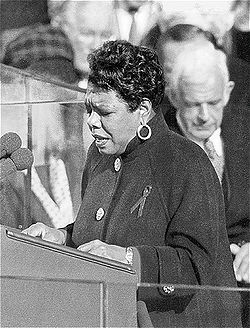
Rest in Peace, Maya Angelou

250px-Angeloupoem

This morning I was rather saddened to learn of the passing of poet and activist Maya Angelou (April 4, 1928 – May 28, 2014). She was well known for her acclaimed series of autobiographical novels and as a colleague of Martin Luther King and Malcolm X in the civil rights movement. According to wikipedia, she has also been a cook, prostitute, night-club dancer and performer, theater cast-member, coordinator for the Southern Christian Leadership Conference, journalist, writer, director (Down in the Delta), producer of plays, movies, and public television programs, and actress (making appearances in Roots and Poetic Justice). One particularly memorable career highlight was her appearance at a ceremony commemorating the 50th anniversary of the United Nations at which she delivered the following poem:

“A Brave and Startling Truth”

We, this people, on a small and lonely planet
Traveling through casual space
Past aloof stars, across the way of indifferent suns
To a destination where all signs tell us
It is possible and imperative that we learn
A brave and startling truth

And when we come to it
To the day of peacemaking
When we release our fingers
From fists of hostility
And allow the pure air to cool our palms

When we come to it
When the curtain falls on the minstrel show of hate
And faces sooted with scorn are scrubbed clean
When battlefields and coliseum
No longer rake our unique and particular sons and daughters
Up with the bruised and bloody grass
To lie in identical plots in foreign soil

When the rapacious storming of the churches
The screaming racket in the temples have ceased
When the pennants are waving gaily
When the banners of the world tremble
Stoutly in the good, clean breeze

When we come to it
When we let the rifles fall from our shoulders
And children dress their dolls in flags of truce
When land mines of death have been removed
And the aged can walk into evenings of peace
When religious ritual is not perfumed
By the incense of burning flesh
And childhood dreams are not kicked awake
By nightmares of abuse

When we come to it
Then we will confess that not the Pyramids
With their stones set in mysterious perfection
Nor the Gardens of Babylon
Hanging as eternal beauty
In our collective memory
Not the Grand Canyon
Kindled into delicious color
By Western sunsets

Nor the Danube, flowing its blue soul into Europe
Not the sacred peak of Mount Fuji
Stretching to the Rising Sun
Neither Father Amazon nor Mother Mississippi who, without favor,
Nurture all creatures in the depths and on the shores
These are not the only wonders of the world

When we come to it
We, this people, on this minuscule and kithless globe
Who reach daily for the bomb, the blade and the dagger
Yet who petition in the dark for tokens of peace
We, this people on this mote of matter
In whose mouths abide cankerous words
Which challenge our very existence
Yet out of those same mouths
Come songs of such exquisite sweetness
That the heart falters in its labor
And the body is quieted into awe

We, this people, on this small and drifting planet
Whose hands can strike with such abandon
That in a twinkling, life is sapped from the living
Yet those same hands can touch with such healing, irresistible tenderness
That the haughty neck is happy to bow
And the proud back is glad to bend
Out of such chaos, of such contradiction
We learn that we are neither devils nor divines

When we come to it
We, this people, on this wayward, floating body
Created on this earth, of this earth
Have the power to fashion for this earth
A climate where every man and every woman
Can live freely without sanctimonious piety
Without crippling fear

When we come to it
We must confess that we are the possible
We are the miraculous, the true wonder of this world
That is when, and only when
We come to it.


Always Low Wages, More Pollution: Why Barack & Michelle Obama Relentlessly Shill For Wal-Mart

walmart-obama-apmichelle_obama_walmart_030311-thumb-640xauto-2467

Democrats in labor unions and figures like former Labor Secretary Robert Reich and others were justly outraged at Barack Obama’s latest wet kiss to Wal-Mart earlier this month. But First Lady Michelle Obama has been in bed with the giant retailer for years. Is this a nasty bug in the Obama presidency, or a corrupt core feature?

By BAR managing editor Bruce A. Dixon

Source: Black Agenda Report

Low Wages, Always: Barack and Michelle Obama Bestow More Wet Kisses on Wal-Mart

“…the willingness of the Obama Administration to do the bidding of Wal-Mart shows just how hollow has become the pretense of elected black Democrats to representing the poor and oppressed…”

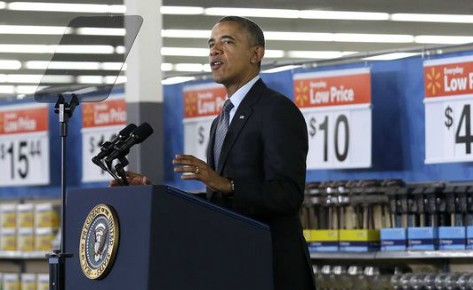
Earlier this month President Obama visited a Bay Area Wal-Mart to praise the world’s largest and most anti-union retailer for its supposed environmental responsibility. The fact is that Wal-Mart’s maintenance of diesel-fueled supply chains between its stores and wherever on the planet wages are lowest and environmental restrictions are totally absent make it a major ongoing contributor to runaway climate change. The president’s appearance therefore, was simply a hypocritical exercise in greenwashing for Wal-Mart.

Though it was an insult to working people and to many of his abject and fervent supporters, it should have been no surprise. It wasn’t President Obama’s first wet kiss to Wal-Mart and with almost three more years in office to go it won’t be his last. Still the willingness of the Obama Administration to do the bidding of Wal-Mart shows just how hollow has become the pretense of elected black Democrats to representing the poor and oppressed.

There was a time when Democrats in the White House did not dare openly shill for the giant retailer. Hillary Clinton served on Wal-Mart’s board of directors through most of the 1980s, while her husband Bill was governor of Arkansas. Even then, Wal-Mart was notorious for overworking and underpaying its workers, violating labor laws to thwart unions, and sopping up prodigious amounts of corporate welfare in the forms of tax breaks and subsidies of all kinds. Being in bed with those crooks wasn’t just an embarrassment, it was a hypocritical affront to Democratic voters, so somewhere on the 1992 road to the White House, Hillary resigned from Wal-Mart’s board. Similarly in 2007 with her husband on the way to the White House, Michelle Obama felt compelled to resign from the board of TreeHouse Foods, a major Wal-Mart vendor. “I won’t shop there,” said presidential candidate Barack Obama when questioned about Wal-Mart at an AFL-CIO labor forum.

Of course labor audiences in 2007 and 2008 were where Obama pledged to renegotiate NAFTA, and immediately raise the minimum wage as soon as he took office. The president never mentioned raising the minimum wage again till about 2012 when Republicans were safely in control of the House of Representatives, and instead of renegotiating NAFTA, President Obama is engaged in secret negotiations to extend it across the Atlantic and Pacific Oceans. Evidently the Obama that promises is a different guy, and far less powerful, than the Obama that acts.

“…The first lady allowed the unscrupulous retailer to leverage her personal image …”

Safely in office, Michelle and Barack Obama have enthusiastically embraced Wal-Mart. The first lady allowed the unscrupulous retailer to leverage her personal image as an advocate of exercise and healthy eating in her “Let’s Move” initiative, and spouting the company line that the best solution to urban “food deserts” is opening more Wal-Mart neighborhood grocery stores. Michelle Obama’s many appearances at and pronouncements around Wal-Mart have done the retailer more good than she and Hillary could ever have done in another decade or two apiece on its board of directors.

Right now Wal-Mart is approaching 30% of the US retail grocery market, with far lower wages, fewer hours, skimpier benefits, and longer and dirtier supply chains than its major competitors. As I said a couple years ago in an article about Michelle Obama’s cynical embrace of Wal-Mart:

Wal-Mart’s business model of corrupting public officials, lying about job creation numbers, rampant sex and race discrimination, relentlessly low wage and benefit levels, and aspirations to monopoly control of local markets across the country make it a bad neighbor, a worse boss, an unfair competitor and sometimes a criminal enterprise.

Wal-Mart has been a leader in the corporate practice of weaponizing its charitable giving, turning it into a lever to open new markets in urban America, to neutralize and isolate opposition, and to curry favor with local political figures. Wal-Mart made it rain on selected charities and ministries in areas like Newark and Chicago when it needed to colonize those new markets. President Obama recognized this “achievement” in the corruption of Democratic party politics in March 2014 by nominating Wal-Mart’s chief of charitable giving to head up his Office of Management and Budget.

Wal-Mart was even allowed, along with McDonalds and other large, low-wage employers, to shape the drafting of regulations governing Obamacare, in ways that exempted the retailer from having to ensure large numbers of its workers for the first several years.

The fiction that elected Democrats represent poor and working people and stand for safeguarding the environment is just that – a fiction. There is a new neoliberal paradigm that allows Democrats to mumble a few words about raising the minimum wage when the other party controls Congress, that claims the moment they took office was the day the oceans stopped rising. If these were curable bugs in the political system, votes and advocacy would wake enough people up to change them. But what if they’re not bugs in the system at all. What if these are its core and immutable features? What then? Isn’t it time to step outside their two-party, capitalist box, to dream and begin to build something else?

Bruce A. Dixon is managing editor at Black Agenda Report and a state committee member of the GA Green Party. He lives and works in Marietta GA and can be reached at bruce.dixon(at)blackagendareport.com.

Memorial Days

By Tom Karlson

they sang and prayed,
naming that day in May,
Decoration day they dis-interred 257 Union men
mass graved, dumped, piled broken bodies twisted,
a Charleston North Carolina Guernica
forgotten men dug up, re-interred
with honor, memory, celebration
by 10,000 in 1866
that first Memorial Day

it is Memorial Day 2010
the Turkish flotilla
bringing aid to Gaza
the attack, nine dead,
Americans, Turks
no aid delivered

Memorial Day 1937,
steelworkers striking Little Steel,
strikers with families march toward the Republic steel mill gate
police-guards open fire
ten dead
thirty shot
one hundred clubbed

today we are at Jones beach
it is Memorial Day
we are fifty souls
remembering our dead, the dead
hundreds of Long Islanders
thousands of North Americans
more than a million Iraqis and Afghanis
families stroll past
some look, others see without vision
all have come to eat, drink
and celebrate that insatiable beast
today the Blue Angles
spin flip dive swoop
begging boys and girls to sign up
the navy, the marines want you
as we call out the named and nameless
let us remember these days
past, present, and future

Tom Karlson is founder of Poets for Peace, Long Island, NY.

A Memorial Day Truth

by Walter Brasch

Source: OpeEdNews.com

It’s the third and final day of the Memorial Day weekend.

Millions of Americans are visiting friends and relatives, perhaps taking a three- or four-day mini-vacation. They may be at pool parties and grilling burgers, hotdogs, veggies, and whatever else appeals to them.

The nation’s politicians are going to Memorial Day rallies. There will be speeches and music. American flags and bunting will drape the stages. The politicians will tell us about the “ultimate sacrifices” American servicemen and women made. They will tell us how wonderful America is, how we are the best country in the world, how we defend freedom and remember those who put their lives on the line to do so. The crowds, whether a few or thousands, will applaud vigorously.

Some will even say that the VA hospitals need a complete overhaul, that Gen. Eric Shinseki–who was wounded and earned three Bronze Stars for bravery, should be fired. These are some of the same politicians who had attacked Shinseki when he was Army chief of staff who warned that it would take hundreds of thousands of Americans, not thousands as the Bush-Cheney cabal had claimed, to successfully invade and control Iraq. For his military knowledge, he was forced into an early retirement. These are the politicians who are outraged that America is treating veterans poorly.

Here’s what the politicians also won’t say. They won’t tell us that 41 Republican senators blocked legislation this past year to provide necessary funding for veterans health. They won’t tell us that during the first years of the Iraq War, the quality of American-based hospitals had deteriorated to the point that it took a major newspaper series to expose what had happened and, finally, with politicians forced to look at despicable conditions, and shamed by their ignorance, there were some measures to improve the care for wounded soldiers after their lives were saved by courageous battlefield medics.

They won’t tell us that members of Congress blocked significant increases in the foodstamp program or that governors and legislatures have not done what they should to care for the homeless. After all, the impoverished and homeless don’t contribute to political campaigns. Of course, the politicians won’t tell us that one-fourth of all adult homeless are veterans.

They won’t tell us about veterans who came home from war, and then lost their jobs or homes during the Great Recession that followed the fraud and greed committed by the bankers and industrial giants who were able to become rich because government did little to protect the people.

With crocodile tears and shallow words, recorded by the news media, the politicians will tell us how much they mourn–but they won’t tell us they are part of the problem, for proudly claiming they voted time after time to block necessary funding and for demanding government not intrude upon the free enterprise system.

The politicians will wave flags and say how much they believe in America and our veterans, and how much they mourn the loss of our soldiers. The crowds will enthusiastically agree–and then go to their barbeques and picnics.

No, they won’t tell us that if we want to reduce these problem–DON’T THUMP YOUR CHESTS, UNFURL YOUR FEATHERS, AND SEND THE YOUTH TO WARS THAT SHOULD NEVER BE FOUGHT.

During the Vietnam War, John Prine recorded “Your Flag Decal Won’t Get You Into Heaven Anymore.” It was true then. It is still true. Please listen.

Somebody Gave Me an Anonymous, Amazing Gift and It Totally Freaked Me Out

green-gift-box-with-ribbon-and-bow-royalty-free-stock-photo-pictures-1203x819

By Josh Indar

Source: PopMatters

I used to think stealing was subversive. Now I know I had it backwards.
It’s just after nine on Saturday morning, a half-hour after my wife discovered the package. I’m at my desk, pawing nervously at my computer mouse, dragging the arrow across a monitor where the image of a mysterious stranger glows colorless in the washed-out light of dawn. I freeze the frame for a better look, not knowing what information I hope to gather. He’s middle-aged, nondescript. He wears light-colored pants and a fleece sweatshirt, and is carrying a small cardboard box, holding it gently, almost tenderly.

I rewind two minutes to 6:02AM. A brown or maroon minivan pulls up and parks. The man gets out, opens the rear lift gate, rummages around. Now he has the box. He’s walking across the driveway. Has he practiced this? Staked out the place? Have we seen him before? Someone we know?
Fourteen strides bring him to our front door, and he bends down to carefully place the box on our doorstep. Like the man, the box is nondescript—small and tan and unmarked. I let the scene play out for the tenth or 20th time, switching between two camera angles. As he leaves, our security light startles him. He brings up his hand to shield his eyes, annoyed, or maybe just surprised, and I see him as some mad bomber, some fugitive from a TV news story, caught on tape as he makes his getaway.
The security light seems to jolt him a little. He quickens his pace, lengthens his stride. Ten paces bring him back to his van, where he jumps in the driver’s seat and glides off down the empty suburban street. I rewind to watch the scene again, glancing guiltily at the little tan box sitting on my desk. I’ve closed it back up to hide its contents, but it’s still there, inanimate yet insistent, pulsing with unanswered questions.
***
Ever wonder what might be the most subversive act you could undertake in modern America? I have. I used to think stealing was subversive, an idea I probably picked up from reading too much Yippie propaganda as a teenager. It was an idea that fit comfortably with my lower-middle class identity and the fact that, like most young people, I wanted a lot of stuff I couldn’t afford. So I stole—not from regular people but from chain stores, because I reasoned they were soft targets of corporate America and deserved to be bled a little bit. Plus it was a cheap thrill that made me feel dangerous and cool.
I finally gave up shoplifting in my 20s, having been caught a couple times and waking up to the fact that I was not actually bringing down Babylon by pilfering stuff I didn’t even need. I still wanted to play out my revolutionary fantasies though, so I set my sights on creating art that might serve as some catalyst to action—a rallying cry, a message from the underworld—anything to minutely deflect the fatal direction this country’s been headed in ever since the vampire lord Reagan locked us on our present course.
To do this, I made music, wrote manifestoes, passed out pamphlets, spray-painted walls. I was grandiose and ridiculous and painfully naïve, but I believed in what I was doing, even if I didn’t know exactly what it was. I was zealous and immature and probably terrible to be around. I fantasized about arson and assassination squads. I thought I was being subversive, but I didn’t understand the meaning of the word.
As I grew older, my life took that time-honored path from caricature to cliché, my ideals sprayed like seafoam against the rocks of everyday life—kids, marriage, college, career. Through it all, I tried my best to stay active and informed, but in the end I found myself like most everyone else, sitting passively and impotently at a computer, cursing the army of dolts and liars and greedheads that have made it their mission in life to ruin my country and diminish the prospects of my children’s happiness and prosperity. I swallowed my powerlessness and gave up on direct subversion, attempting instead to make changes from within.
To this end, I landed a job in education, and from there, I still do what I can to make change, albeit on an individual and painfully gradual basis. I live off the dwindling largesse of the taxpayer, helping foster and homeless youth get their high school diplomas, so that they at least have a chance at a better life. It’s important work and I enjoy it. It pays the bills and eases my conscience, makes me think that even if I’m not boldly reshaping society, at least I’m not adding to its misery. Yet I’ve always felt I was missing something.
***
We all want so much. So many shiny things catch our eyes and divert our attentions. We exist in perpetual envy, sizing each other up, counting and coveting and judging our worth and the worth of our fellow citizens based on whatever status markers are currently in vogue. My 13-year-old son struts around the house singing about stacking paper and making it rain, of guarded mansions and red Bugattis and gold-plated pistols.
On my friend’s Facebook page, I get in a pointless argument with a millionaire who tells me how sick she is of me and my kind stealing from her via the tax system, how she deserves every penny of her riches because she’s worked harder than everyone else and made better choices, completely ignoring the luck and privilege that enabled her to do so.
Walking downtown, I step over a homeless man sitting on the sidewalk, his back against a chain link fence, dirty belongings splayed around him. In a weak and quiet voice, he asks me for change and I instinctively say no, I don’t have any, and as I round the corner I feel in my pocket anyway, coming out with a rumpled five. Will I miss five bucks? Can I give up a cappuccino today so that this dazed human being can survive another few hours? I put it back in my pocket and unlock my car, but as I’m getting in I feel guilt pooling like blood in my stomach, so I decide to go back and give him the money, but as I take a step toward him, I see that a police car has pulled up to the curb.
We have a new law in town that makes it illegal to sit on a public sidewalk, because businesses complained that homeless people were driving away customers. I wrestle with my thoughts for a second. I’m late for a meeting. I don’t want to deal with any cops right now. I don’t even know this guy—what’s his story? What’s his problem? I have bills to pay and kids to raise and lunch to buy.
The door of the cop car swings open and a man in a blue uniform steps out, looking efficient, professional, authoritative. I shove the fiver back in my pocket and get in my car, ashamed. As I drive away, I see in a flash of stark detail all the systems and devices and conditioning that stops me from giving away even a tiny fraction of my hard-earned yet unimpressive bankroll, and I realize that the truest form of subversion in this tainted republic is not shock or violence or humor. It’s generosity.
But let’s go back in time a bit, to the beginning of this story.
***
As my wife is leaving for her morning run, she hollers that there’s an unmarked package on our doorstep. I ignore her, as I’m busy checking my status and reading the news. I’m doing the same thing when she comes back a half hour later, only now she’s holding the box, a worried and expectant look on her face. She places it in my hands, unopened. It’s light, but there is something inside. I turn it a bit, give a gentle shake. I’m mildly afraid.
A couple days before, some anonymous asshole, we assume the neighbor kid, threw an egg through the cracked back window of our family van, making a smelly and disgusting mess inside. We often awake to find trash strewn on our lawn, or our trees and shrubs covered in toilet paper. We’ve both had stuff stolen from our cars, and sometimes at night we get loud phantom knocks on our front door. It’s petty stuff, but it affects us.
We don’t feel welcome in our neighborhood, hence the security cameras. We feel harassed and beleaguered and out of step with the patriotic Americans who populate our street, with their giant trucks and NRA stickers, country music and Super Bowl parties.
“What do you think’s in it?” my wife asks.
“Probably a dog turd.”
“Naw, feels more like a dead rat.”
We laugh as if we’re joking. The box has complicated flaps that keep it tightly closed. I shake it once more and it doesn’t explode, but still, I hold it away from my body, just in case it is a bomb. That way I’ll only lose a few fingers, maybe a hand, but hopefully get to keep my vital organs. I suck in a breath and we brace ourselves for whatever psychological trauma is about to be inflicted on us. The flaps slide out and the box opens, revealing a large stack of white, restaurant-style napkins.
“That’s weird. I wonder…”
The words evaporate as I turn over the napkins, revealing a neat stack of greenish paper. The box falls to the floor. Nestled inside are ten crisp $100 bills and an anonymous note thanking my wife and I for some unidentified “service to our community”.
“What the fuck is that?” we say in unison.
***
I feel awful watching the footage of the delivery, like I’m the most unworthy wretch in the world, treating this beautiful gesture as if it’s some kind of crime. Here I’ve been given this amazing gift, with no strings attached, and yet I feel… what? Violated? Confused? Someone must have made a mistake. All the awful questions that came up when we discovered our car had been vandalized came flooding back. Why me? Who would do such a thing? What did I do to deserve this?

I tell myself to relax and rejoice, but I can’t. I’m too freaked out. My wife says maybe the money is stolen or counterfeit, some kind of diabolical trap. I try to think of anyone we know who could possibly give away a thousand bucks. There’s no one. Whoever did this is way out of our league.
As I stare at the box of cash, I realize that what’s bothering me is not the gift or the giver. It’s not the way it was delivered or the fact that I can’t properly thank the man who left it. What bothers me is my own reaction. I feel sad and fraudulent and incapable of understanding. It’s not that I don’t feel grateful—far from it. I’m intensely aware that this is a kind of secular miracle, a once-in-a-lifetime occurrence.
But how does one repay such a gift? What saintly act is required to make one feel deserving? I decide the proper thing to do is to take out my checkbook and pass the money on, to UNICEF or cancer research or any number of a million worthy causes. But as the day wears on, my weak altruism is pushed aside by the realities of my financial situation.
There’s the $5,0000 we owe to the IRS. The county wants property taxes and our insurance payment is overdue. There’s the kids’ orthodontist bills and their nonexistent college funds, our student loans, the $800 I need to get my car fixed so it’ll pass smog check, the maxed-out credit cards, the mortgage, the broken fence and the old garage door that we have to prop open with a two-by-four.
UNICEF and the starving kids and the cancer victims will all have to wait. I really do need the money. The thing bumming me out the most, I realize, is how small a difference this enormous gift will actually make. It would take a hundred thousand of these miracles just to get me out of debt, let alone help all those who need money. But… wow.
***
I did end up giving some to charity. A pittance really, but it’s something I guess. As of this writing, I’ve yet to tell anyone (besides my mom) about the gift we got that Saturday. I guess I’m still embarrassed about it. I also don’t want anyone to be envious, to have people wonder why it came to me and not to them. I have lots of friends who deserve that money at least as much as I do, and many of them need it more.
I wish it weren’t like this. I wish I were the subversive money bomber, planting little, tan boxes on people’s doorsteps. I wish our society wasn’t so focused on money, so demanding of greed. I wish rappers and pop stars would stop bragging about all their stupid money and start giving it away, so my son could learn why it really is better to give than receive.
I wish I knew how to make enough to pay my bills so that the five dollars I withheld from that homeless guy wouldn’t spark a moral crisis and make me feel like a cowardly shit every time I step over someone who needs my help.
Now I realize that the true gift of my anonymous benefactor wasn’t really the money at all. It was the knowledge that came with it. The most subversive statement you can make is a simple act of generosity.

Josh Indar is a recovering journalist who currently writes novels and short stories. He lives in a little college town in Northern California, where he tutors homeless & foster youth and plays in a band called Severance Package. He holds an MFA in creative nonfiction from Antioch University, Los Angeles. email: jvindar@yahoo.com

Saturday Matinee: Scanners

images

David Cronenberg’s “Scanners” (1981) is infamous for a particular scene occurring less than 15 minutes into the film (and is likely still a shock for audiences today who have never seen it). The film’s notoriety (and comparatively wooden performance of the lead actor) may have caused most viewers to overlook some of the film’s better qualities such as an intelligent proto-cyberpunk storyline involving human drug experimentation, corporate espionage and backlash from a mutant terrorist underground. One particularly compelling plot element features an attack via psychic computer hacking. Scanners is surprisingly polished for its budget in terms of cinematography and special effects and is also notable for standout performances by Patrick McGoohan (creator and star of “The Prisoner” TV series) and Michael Ironside.

Watch Scanners on Kanopy here: https://www.kanopy.com/en/product/113551