The Birth of the Time-Motion Human

QuantimetricSelfSensingPrototypeMannApparatus

By Dale Lately

Source: The Baffler

In a darkened room, a woman lies watched by an infra-red camera as she sleeps. It monitors her breathing, her movements, the flicker of her eyelids. Some hours later it stings her with a painful electric shock. She wakes, tumbles out of bed and into the restroom, whereupon a chip installed in her toothbrush tracks her arm movements. She’s photographed, silently, every thirty seconds. As she sets off in the morning her location is logged and data is streamed on the steps she takes. Her pulse and calorie count are recorded and sent to unseen observers. She has a dog at her side. The dog’s data is logged as well.

Such a tableau would be the envy of any futuristic dictatorship. In fact, the devices outlined above are all available on the consumer market now, for voluntary use. The impetus towards tracking our lives with smartphones, apps and stats represents a massive growth area into which companies like Jawbone, MyFitnessPal, RunKeeper, Runtastic, MapMyRun, Foodzy, GymPact, and Fitocracy are flooding. Alongside the Nike+ Fuelband, there’s the popular Fitbit Flex, a wristband that counts the steps you take by day and the number of times you stir in your sleep. There are smart cups to track what you drink and wristbands programmed to give you electric shocks for not achieving your goals. There’s even a “Fitbit for your vagina” in the form of the KGoal Smart Kegel Trainer—a Kickstarter project designed to track kegels, exercises for women’s pelvic floor muscles to improve childbirth and continence, and for helping them to achieve a better “clench strength” via Bluetooth.

With all this biofeedback now available on our phones, the act of walking, living and breathing can—at least to the “datasexuals” who embrace it—be an ongoing project with limitless potential for improvement. But might such potential also lead to a kind of “Taylorism within”? Applying scientific management to twentieth century business created a workforce optimized for maximum efficiency. Likewise, life-tracking is encouraging us to internalize this dream by optimizing ourselves. Rather than a tool for liberation, we’re using the tech, in other words, to tune our lives for maximum “productivity.”

Perhaps none of this should seem surprising for a consumer society that drives on anxiety. If bad breath had to be invented as a disease mouthwash would help to cure a century ago, now the Quantified Self movement suggests we must live in permanent beta, to aim not just at maintaining ourselves but to become “better than well.” And so, Dave Allen’s Getting Things Done and websites like Lifehacker help to turn our lives into a series of sanctioned tasks and goals, where one must carry a “Surprise Journal” to find areas for self-improvement in one’s life, and sleep comes in the form of “power” naps. There’s the Lumo Back, a gizmo that monitors the tricky process of sitting in a chair, while the Narrative wearable camera snaps your life twice a minute. Time management lessons are now available for kids, while the iPotty seems to give toddlers the message that they shouldn’t take their eyes off a screen even when satisfying the most basic of human needs.

Silicon Valley, naturally, is more than happy to export the mantra of ongoing product optimization to our bodies: life-hacking fanatics talk of “upgrades” and “body hacks,” with often obsessive results. In a Financial Times article that marked a mainstream recognition of the movement, Tim Ferriss–author of The 4-Hour Body–claimed that he could teach people how to lose weight without exercising, work on two hours’ sleep, and have a fifteen-minute orgasm, while bio-hacker Dave Asprey was adamant that he’s made himself twenty years younger and forty IQ points smarter through life-tracking and smart pills (“I’ve rewired my brain,” he said). All of this task management can become a considerable task in itself, leading to the piling up of Catch 22 ironies—like the fact that developers are now working on smartphone apps to solve the problem of people spending too much time on their smartphones.

Luckily, some are questioning the use of intimate monitoring devices in our lives. The information asymmetry provided by the emergent “Internet of Things” may create a class of uninsurable people, while ”digital Taylorism”—the tracking and tagging of workers like cattle—has been roundly criticized as it has begun to emerge at companies like Amazon. What’s disquieting about the popularization of life-tracking is the voluntary desire to become “time-motion humans,” to subject ourselves to a self-imposed surveillance state. “Track everything. Track your entire day—wherever you go,” says the website for the LumoBack. “VESSYL AUTOMATICALLY KNOWS AND TRACKS EVERYTHING YOU DRINK,” the Vessyl “smart mug” warns us in stark capitals. And once we’ve volunteered for this intimate biological scrutiny, we’re keen to publicize the results—using tools like the Withings scale, which threatens to broadcast our weight gains to our Twitter followers as “encouragement.” Self-Improvement Macht Frei.

Since the invention of the forceps we’ve been introducing machinery into our bodies to improve our lives (the aforementioned KGoal is actually based on a biofeedback device from the 1940s by Dr. Arnold Kegel), and undoubtedly many of these trackers are helping to make people healthier. But life tracking also comes from a certain ideological background, one that denigrates macro-interventions in our lives (nationalized health care) in favor of individual micro-solutionism (becoming our own gym instructors and fitness trainers).

We’re living in an entrepreneurial model of humanity, a vision of human beings as start-ups, where unfitness or obesity are viewed as “bugs” to be fixed rather than as products of an economy based on long hours and precarious work. Daily exercise has always been an individual responsibility, but sharing our biofeedback via social media encourages people to compete like businesses, vying for better health scores with the personal data that makes us special. (Flex boasts that it reflects “your stats, not any average Joe’s.”) Here we can all be Superman—“Join over 141,000 other people who want to discover their inner superhero,” urges website Superheroyou—while, back in the complex, unquantifiable real world, we often struggle to maintain control over the most basic facts of our finances and job prospects.

The Quantified Self literature is full of such fantasizing. It all treats the body as a fun challenge, a puzzle to be solved. We see this in the current trend towards adding game-like features to the process of life tracking, which leads to some quite startlingly intimate results (“Spreadsheets,” an app that promises to gamify your sex life, has the user get on the bed and talk dirty to a computer). Even antenatal workouts aren’t immune: the KGoal promises gamification in forthcoming product updates for those who fancy comparing their pelvic thrust scores to those of their peers.

The friendly rivalry that has always been a part of amateur fitness starts to look less inspiring, and more controlling, when it’s built into the architecture of smartphones and social media. It’s more like a crowd-sourced version of what philosopher Michel Foucault termed “Biopower,” the control over our bodies wielded by states and their institutions. But in this version, it’s not the institutions; we control ourselves, and each other.

As more and more aspects of our lives are seen as legitimate targets for intrusion by technology, the gaze inevitably falls on the newly born. Start-ups like Sproutling, Owlet, and Mimo are springing up to replace old-fashioned baby monitors with comprehensive, round-the-clock surveillance (temperature, pulse, breathing, position, room ambience) as well as all the attendant data crunching. These infants may be the first humans to grow up entirely in the lens of machines, with the process of rearing having been refashioned as a high-tech, high-maintenance project, requiring endless inputs from both parent and child alike. They will be the first “time-motion babies”: faster, happier, more productive, in the words of Radiohead’s Ok Computer.

Will they really be happier, versed as they will be, since birth, in the techniques of maximizing their sleep, optimizing their nutrients, and tracking the number of steps they walk? It seems doubtful, but then, it’s impossible to really tell when we talk about happiness—even Silicon Valley hasn’t worked out how to put a number on that.


Dale Lately writes about culture and communications and has contributed to the Guardian, 3:AM Magazine, OpenDemocracy, Litro and Pop Matters. His regular musings can be found at @dalelately and www.dalelately.blogspot.com.

8 Facts About American Inequality

income-inequality-graphic

By Pierce Nahigyan

Source: Nation of Change

…that dream of a land in which life should be better and richer and fuller for everyone, with opportunity for each according to ability or achievement. It is a difficult dream for the European upper classes to interpret adequately, and too many of us ourselves have grown weary and mistrustful of it. It is not a dream of motor cars and high wages merely, but a dream of social order in which each man and each woman shall be able to attain to the fullest stature of which they are innately capable, and be recognized by others for what they are, regardless of the fortuitous circumstances of birth or position.”

– James Truslow Adams, The Epic of America (1931)

The American Dream has been defined many ways by writers of both poetic and prosaic bent, but its essentials tend to involve life, liberty and the pursuit of happiness (or property, depending on your source).

The Declaration of Independence, upon which an entire nation was radically brought into existence, asserts that not only are all men created equal but that this is a “self-evident” truth. The significance of this fact lies not in its semantics, which epistemologists would challenge, but in its utilization as a primary foundational creed. By this “unanimous Declaration of the thirteen united States of America,” a contract was agreed to, that their union would be founded on this principle. Furthermore, life, liberty and the pursuit of happiness are rights that governments are created to uphold. Thus, America was endowed with its dream at the moment of its conception: the freedom to succeed.  

The United States has promoted a self-congratulating exceptionalism for decades, waving its Declaration and Constitution in the faces of other sovereign nations as if the latter had never beheld such concepts. Our capital F “Freedom” sets us apart from the rest of the world, as the political rhetoric has repeated ad nauseam, no matter the freedoms enjoyed by democracies on every continent. And yet our basic freedom, the freedom to succeed, America’s contractual promise, has been shrinking for thirty years.

The freedom to succeed transcends economic systems but it is most potently expressed by capitalist gains. The ability to go “from rags to riches” is ingrained in this nation’s ethos and there is nothing intrinsically immoral about that goal. However, the current state of American inequality reveals a very real and expanding gap between the rich and poor that betrays the foundational endowment of this Union. When the freedom to succeed is denied every citizen, their equality is equally denied. 

The wealth and income inequalities in America do not require socialist reforms to fix, and capitalism is not the problem. The problem is that we have let inequality advance in this country so gradually that its obviousness is masked by its familiarity. Below I outline eight facts about inequality in America that every American should know. 

1) 400 Americans have more wealth than half of all Americans combined. To put that into context, as of 2013 there are an estimated 316,128,839 people living in the United States, according to the U.S. Census Bureau. Just 400 Americans have more money than over 158 million of their fellow citizens. Their net worth is over $2 trillion, which is approximate to the Gross Domestic Product of Russia. This ratio has been verified by Politifact and former Labor Secretary Robert Reich. One explanation for the vast discrepancy in wealth is the definition of “worth,” which includes everything a person or household owns. This means savings and property but also mortgages, bills and debt. Poorer households can owe so much in debt that they possess a negative net worth.

2) America has the second-highest level of income inequality, after Chile. The Organization for Economic Cooperation and Development studies thirty-four developed countries and ranks them both before and after taxes and government transfers take effect (government transfers include Social Security, income tax credit and unemployment insurance). Before taxes and government transfers, America ranks tenth in income inequality. After taxes and transfers, it ranks second. Whereas its developed peers reduce inequality through government programs, the United States’ government exacerbates it. 

3) The current state of inequality can be traced back to 1979. After the Stock Market Crash of 1929, the gap between the rich and the poor began to narrow. For fifty years, wages still differed greatly between the upper- and working-classes, but a robust middle-class took shape, as well as the opportunity for working-class individuals to ascend. In his book, “The Great Divergence,” journalist Timothy Noah traces today’s inequality to the beginning of the 1980s and the widening gap between the middle- and upper-classes. This gap was influenced by the following factors: the failure of American schools to prepare students for new technology; poor immigration policies that favor unskilled workers and drive down the price of already low-income labor; federally-mandated minimum wage that has failed to keep pace with inflation; and the decline of labor unions.

4) Non-union wages are also affected by the decline of unions. The Economic Policy Institute claims that 20% of the growth in the wage gap between high-school educated and college educated men can be attributed to deunionization. Between 1978 and 2011, union representation for blue-collar and high-school educated workers declined by more than half. This has also diminished the “union wage effect,” whereby the existence of unions (more than 40% of blue-collar workers were union members in ’78) was enough to boost wages in non-union jobs – in high school graduates by as much as 8.2%. Not only did unions protect lower- and middle-class workers from unfair wages, they also established norms and practices that were then adopted by non-union employers. Two prime examples are employee pensions and healthcare. Today about 13% of workers belong to unions, which has reduced their bargaining power and influence. 

5) There is less opportunity for intergenerational mobility. In December 2011, President Obama spoke at Osawatomie High School in Kansas. He was very clear about the prospects of the poor in today’s United States:

“[O]ver the last few decades, the rungs on the ladder of opportunity have grown farther and farther apart, and the middle class has shrunk. You know, a few years after World War II, a child who was born into poverty had a slightly better than 50-50 chance of becoming middle class as an adult. By 1980, that chance had fallen to around 40 percent. And if the trend of rising inequality over the last few decades continues, it’s estimated that a child born today will only have a one-in-three chance of making it to the middle class – 33 percent.”

As refreshing as that honesty is, Obama promised no fix beyond $1 trillion in spending cuts and a need to work toward an “innovation economy.” 

In a speech one month later, Obama’s Chairman of Economic Advisers, Alan Krueger, elaborated on the dire state of America’s shrinking middle-class. The contraction, he stated, could partially be attributed to “skill-biased technical change”: work activities that have become automated over time, reducing the need for unskilled labor and favoring those with analytical training. He also highlighted the 50 year decline in tax rates for the top 0.1%, increased competition from overseas workers, and a lack of educational equality for children. Poor children are denied the private tutors, college prep and business network of family and friends available to their wealthier peers, which locks them into the class they are born into.

6) Tax cuts to the wealthiest have not improved the economy or created more jobs. Krueger also revealed that the tax cuts of the 2000s for top earners did not improve the economy any better than they did in the 1990s (meanwhile, income growth was stronger for lower- and middle-class families in the 1990s than in the last forty years). Tax rates for the top income earners in America peaked in 1945 at 66.4 percent. Following decades of gradual reductions, they have since been cut in half. During the same time, the payroll tax has increased since the 1950s and individual income tax has bounced between 40-50% through the present day. Conversely, corporate tax declined from above 30% in the 1950s to under 10% in 2011. All of these tax cuts are made ostensibly to improve the economy and create jobs. However, the National Bureau of Economic Research has concluded that it is young companies, “regardless of their size,” that are the real job creators in America. Tax cuts to the wealthiest do not create jobs

7) Incomes for the top 1% have increased (but the top 0.01% make even more). Between 1979 and 2007, the average incomes of the 1% increased 241%. Compare that to 19% growth for the middle fifth of America and 11% for the bottom fifth. Put another way, in 1980 the average American CEO earned forty-two times as much as his average worker. In 2001, he earned 531 times as much

Average income across the 1% is actually stratified into widely disparate echelons. Compare the $29,840 average income for the bottom 90% to the $161,139 of the top 10%. Compare the $1 million average income of the top 1% to the $2.8 million of the top 0.1%. Yet both still pale beside the $23 million average income of the top 0.01%. 

If those numbers seem a bit overwhelming, Politizane has created a video that illustrates this staggering inequality:

8) The majority of Congress does not feel your pain. Empowered by the Constitution to represent their constituents, United States Congress members are, for the first time in history, mostly millionaires. The 2012 financial disclosure information of the 534 current Congress men and women reveals that over half of them have a net worth of $1 million or more. After the past seven facts it is difficult to read this last one and believe that these 268 legislators have the best interests of the remaining 99% at heart. But if that is too presumptuous a leap, it is not too bold to say that wealthier donors, lobbyists and special interest groups enjoy greater access to these lawmakers than the average American. 

Life, and the Liberty to Go Hungry

Last week Congress failed to extend emergency benefits for unemployment, leaving 1.3 million people without federal aid. Congress is currently on a weeklong recess that will keep them from debating the issue until their return on January 27. The bill was too divisive for Republicans and Democrats to reach an agreement on, though unemployment is still above 7% nationally. 

Thankfully, the unemployed have their Congress working for them. And at $174,000 annual pay, those representatives are sure to return from vacation committed to fresh solutions. 

The pursuit of happiness is an ephemeral affair, but the freedom to succeed is not. It is something one possesses or lacks. It is the difference between enjoying a more prosperous life than one’s parents and believing there is no way out. A “self-evident” truth is one that is meaningful without proof, much akin to faith. If inequality continues to rise in America, the self-evident truths of its founding will be no more than words on an old piece of paper, its American Dream a tattered faith paid lip service by the deceitful and the blind.

A Lie That Serves the Rich — the truth about the American economy

american-economy-tiago-hoisel-wallpaper-wallchan-h-n-ibackgroundz.com

By Paul Craig Roberts, John Titus, and Dave Kranzler

Source: PaulCraigRoberts.org

The labor force participation rate has declined from 66.5% in 2007 prior to the last downturn to 62.7% today. This decline in the participation rate is difficult to reconcile with the alleged economic recovery that began in June 2009 and supposedly continues today. Normally a recovery from recession results in a rise in the labor force participation rate.

The Obama regime, economists, and the financial presstitutes have explained this decline in the participation rate as the result of retirements by the baby boomers, those 55 and older. In this five to six minute video, John Titus shows that in actual fact the government’s own employment data show that baby boomers have been entering the work force at record rates and are responsible for raising the labor force participation rate above where it would otherwise be. http://www.tubechop.com/watch/3544087

It is not retirees who are pushing down the participation rate, but those in the 16-19 age group whose participation rate has fallen by 10.4%, those in the 22-14 age group whose participation rate has fallen by 5.4%, and those in the 24-54 age group whose participation rate is down 2.5%.

The offshoring of US manufacturing and tradable professional service jobs has resulted in an economy that can only create new jobs in lowly paid, increasingly part-time nontradable domestic service jobs, such as waitresses, bartenders, retail clerks, and ambulatory health care workers. These are not jobs that can support an independent existence. However, these jobs can supplement retirement incomes that have been hurt by many years of the Federal Reserve’s policy of zero or negative interest rates. Those who were counting on interest earnings on their savings to supplement their retirement and Social Security incomes have reentered the labor force in order to fill the gaps in their budgets created by the Fed’s policy. Unlike the young who lack savings and retirement incomes, the baby boomers’ economic lives are not totally dependent on the lowly-paid, part-time, no-benefits domestic service jobs.

Lies are told in order to make the system look acceptable so that the status quo can be continued. Offshoring America’s jobs benefits the wealthy. The lower labor costs raise corporate profits, and shareholders’ capital gains and performance bonuses of corporate executives rise with the profits. The wealthy are benefitting from the fact that the US economy no longer can create enough livable jobs to keep up with the growth in the working age population.

The clear hard fact is that the US economy is being run for the sole benefit of a few rich people.

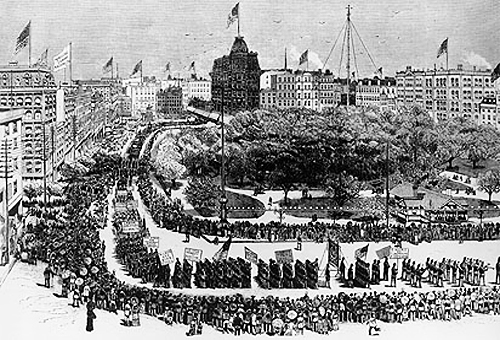
Remember the “Labor” in Labor Day

Labor_Day_New_York_1882

Source: Mickey Z.

With the relentless, ongoing demonization of unions, it’s no surprise that labor history remains obscured and misrepresented and thus, not accessible as a lesson for today’s challenges.

With that in mind, we can choose to view Labor Day as nothing more than the symbolic end of summer and an excuse for more shopping…or we can use it as inspiration to reflect upon some of the brave souls who forged a path of justice and solidarity.

The Lowell Mill Girls

Lowell, Massachusetts was named after the wealthy Lowell family. They owned numerous textile mills, in which the workers were primarily the daughters of New England farmers. These young girls worked in the mills and lived in supervised dormitories. On average, a Lowell Mill Girl worked for three years before leaving to marry. Living and working together often forged a camaraderie that would later find an unexpected outlet.

What had the potential to become a relatively agreeable system for all involved was predictably exploited for mill owners’ gain. The young workers toiled under poor conditions for long hours only to return to dormitories that offered strict dress codes, lousy meals, and were ruled by matrons with an iron fist.

In response, the Lowell mill workers—some as young as eleven—did something revolutionary: the tight-knit group of girls and women organized a union. They marched and demonstrated against a 15 percent cut in their wages and for better conditions…including the institution of a ten-hour workday. They started newspapers. They proclaimed: “Union is power.” They went on strike.

As the movement spread through other Massachusetts mill towns, some 500 workers united to form the Lowell Female Labor Reform Association (LFLRA) in 1844—the first organization of American working women to bargain collectively for better conditions and higher pay.

Sarah Bagley was named the LFLRA’s first president and she promptly led a petition-drive that forced the Massachusetts legislature to investigate conditions in the mills. Bagley not only fought to improve physical conditions, she argued that the female workers “lacked sufficient time to improve their minds,” something she considered “essential for laborers in a republic.”

As with many revolutionary notions, the LFLRA met much opposition in their efforts. Despite their inability to secure the specific changes they demanded, the Lowell Mill Girls laid a foundation for female involvement and leadership in the soon-to-explode American labor movement and must continue to inspire those who stand against injustice today.

Eugene V. Debs

This September 14 marks 96 years since Eugene V. Debs was sentenced to ten years in prison for opposing U.S. entry into World War I. Debs was one of the most prominent labor organizers and political activists of his time. He was also nominated as the Socialist Party’s candidate for president five times. His voting tallies over his first four campaigns effectively illustrate the remarkable growth of the party during that volatile time period:

1900: 94,768

1904: 402,400

1908: 402,820

1912: 897,011

America’s entrance into World War I, however, provoked a tightening of civil liberties, culminating with the passage of the Espionage and Sedition Acts of 1917 and 1918. This totalitarian salvo read in part: “Whoever, when the United States is at war, shall willfully cause or attempt to cause insubordination, disloyalty, mutiny, or refusal of duty in the military or naval forces of the United States, shall be punished by a fine of not more than $10,000 or imprisonment of not more than 20 years, or both.”

Not long after the Espionage and Sedition Acts was voted into law, Debs was in Canton, Ohio for a Socialist Party convention. He was arrested for making a speech deemed “anti-war” by the Canton district attorney. In that speech, Debs declared:

“They have always taught and trained you to believe it to be your patriotic duty to go to war and to have yourselves slaughtered at their command. But in all the history of the world you, the people, have never had a voice in declaring war, and strange as it certainly appears, no war by any nation in any age has ever been declared by the people … Do not worry over the charge of treason to your masters, but be concerned about the treason that involves yourselves. Be true to yourself and you cannot be a traitor to any good cause on earth.”

These words lead to a 10-year prison sentence and the stripping of his US citizenship. While serving his sentence in the federal penitentiary, Debs was nominated for the fifth time, campaigned from his jail cell, and remarkably garnered 917,799 votes.

At his sentencing in 1918, Debs famously told the judge:

“Your honor, years ago, I recognized my kinship with all living beings, and I made up my mind that I was not one bit better than the meanest on earth. I said then, and I say now, that while there is a lower class, I am in it; while there is a criminal element, I am of it; while there is a soul in prison, I am not free.”

To give you an idea of how much work remains for us today, consider that parts of the Espionage Act are still on the books today—just ask Chelsea Manning.

Cesar Chavez

In the late 1960s—thanks to Cesar Chavez and the United Farm Workers (UFW)—deciding whether or not to buy grapes was a political act. Three years after its establishment in 1962, the UFW struck against grape growers around Delano, California…a long, bitter, and frustrating struggle that appeared impossible to resolve until Chavez promoted the idea of a national boycott.

Trusting in the average person’s ability to connect with those in need, Chavez and the UFW brought their plight—and a lesson in social justice—into homes from coast-to-coast and Americans responded. The boycott was an unqualified success as grape growers won signed union contracts and a more livable wage.

Through hunger strikes, imprisonment, abject poverty for himself and his large family, racist and corrupt judges, exposure to dangerous pesticides, and even assassination plots, Chavez remained true to the cause…even if meant, uh…stretching the non-violent methods he espoused.

In 1966, when Teamster goons began to rough up Chavez’s picketers, a bit of labor solidarity solved the problem. William Kircher, the AFL-CIO director of organization, called Paul Hall, president of the International Seafarers Union.

“Within hours,” writes author David Goodwin, “Hall sent a carload of the biggest sailors that had ever put to sea to march with the strikers on the picket lines…There followed afterward no further physical harassment.”

This simple man never owned a house or earned more than $6,000 a year. He left no money for his family when he died yet more than 40,000 people marched behind his casket at his funeral to honor four decades spent improving the lives of farm workers.

The roots of Chavez’ effectiveness lay in his ability to connect on a human level. When asked: “What accounts for all the affection and respect so many farm workers show you in public?” Cesar replied: “The feeling is mutual.”

Today, we face a desperate need to downsize the global culture and economy. It’s never been more important to contemplate the value of small farms and of eating what we grow. Cesar Chavez’ fearless challenges to the industrial status quo and his tireless commitment to the working class stand as inspiration example of the power of solidarity.

I share the above stories as a way of reclaiming our folk tales—the episodes that can inspire us. The conditions and the battles and the urgency have all shifted dramatically, but there is still value in remembering those who stood up to tyranny in the past.

In a society as heavily conditioned as ours, keeping the labor in Labor Day is virtually an act of revolution.

#shifthappens

(Occupy this Book: Mickey Z. on Activism can be ordered here.)

Bukowski on Quitting a Soul-Sucking Job to Become a Full-Time Writer

Charles_Bukowski_smokingTomorrow marks the birthday of working class poet and author Charles Bukowski (he would have been 94). Bukowski’s creativity had been stifled for most of his adult life as a wage slave until at age 49 he seized an opportunity to break free. Bukowski showed his gratitude to his benefactor, Black Sparrow Press, by publishing most of his subsequent major works with them while supporting countless other independent presses across the country with numerous poetry and short story submissions. He also wrote a letter of thanks to John Martin, owner of Black Sparrow Press in 1986, (also containing thoughts on modern life many of us can relate to) featured in the following article:

Bukowski’s Letter of Gratitude to the Man Who Helped Him Quit His Soul-Sucking Job and Become a Full-Time Writer

By Maria Popova

Source: Brain Pickings

“To not have entirely wasted one’s life seems to be a worthy accomplishment, if only for myself.”

“Unless it comes unasked out of your heart and your mind and your mouth and your gut,” Charles Bukowski wrote in his famous poem about what it takes to be a writer, “don’t do it.” But Bukowski himself was a late bloomer in the journey of finding one’s purpose, as his own “it” — that irrepressible impulse to create — took decades to coalesce into a career.

Like many celebrated authors who once had ordinary day jobs, Buk tried a variety of blue-collar occupations before becoming a full-time writer and settling into his notorious writing routine. In his mid-thirties, he took a position as a fill-in mailman for the U.S. Postal Service. But even though he’d later passionately argue that no day job or practical limitation can stand in the way of true creativity, he found himself stifled by working for the man. By his late forties, he was still a postal worker by day, writing a column for LA’s underground magazine Open City in his spare time and collaborating on a short-lived literary magazine with another poet.

In 1969, the year before Bukowski’s fiftieth birthday, he caught the attention of Black Sparrow Press publisher John Martin, who offered Buk a monthly stipend of $100 to quit his day job and dedicate himself fully to writing. (It was by no means a novel idea — the King of Poland had done essentially the same for the great astronomer Johannes Hevelius five centuries earlier.) Bukowski gladly complied. Less than two years later, Black Sparrow Press published his first novel, appropriately titled Post Office.

But our appreciation for those early champions often comes to light with a slow burn. Seventeen years later, in August of 1986, Bukowski sent his first patron a belated but beautiful letter of gratitude. Found in Reach for the Sun: Selected Letters 1978–1994 (public library), the missive emanates Buk’s characteristic blend of playfulness and poignancy, political incorrectness and deep sensitivity, cynicism and self-conscious earnestness.

August 12, 1986

Hello John:

Thanks for the good letter. I don’t think it hurts, sometimes, to remember where you came from. You know the places where I came from. Even the people who try to write about that or make films about it, they don’t get it right. They call it “9 to 5.” It’s never 9 to 5, there’s no free lunch break at those places, in fact, at many of them in order to keep your job you don’t take lunch. Then there’s overtime and the books never seem to get the overtime right and if you complain about that, there’s another sucker to take your place.

You know my old saying, “Slavery was never abolished, it was only extended to include all the colors.”

And what hurts is the steadily diminishing humanity of those fighting to hold jobs they don’t want but fear the alternative worse. People simply empty out. They are bodies with fearful and obedient minds. The color leaves the eye. The voice becomes ugly. And the body. The hair. The fingernails. The shoes. Everything does.

As a young man I could not believe that people could give their lives over to those conditions. As an old man, I still can’t believe it. What do they do it for? Sex? TV? An automobile on monthly payments? Or children? Children who are just going to do the same things that they did?

Early on, when I was quite young and going from job to job I was foolish enough to sometimes speak to my fellow workers: “Hey, the boss can come in here at any moment and lay all of us off, just like that, don’t you realize that?”

They would just look at me. I was posing something that they didn’t want to enter their minds.

Now in industry, there are vast layoffs (steel mills dead, technical changes in other factors of the work place). They are layed off by the hundreds of thousands and their faces are stunned:

“I put in 35 years…”

“It ain’t right…”

“I don’t know what to do…”

They never pay the slaves enough so they can get free, just enough so they can stay alive and come back to work. I could see all this. Why couldn’t they? I figured the park bench was just as good or being a barfly was just as good. Why not get there first before they put me there? Why wait?

I just wrote in disgust against it all, it was a relief to get the shit out of my system. And now that I’m here, a so-called professional writer, after giving the first 50 years away, I’ve found out that there are other disgusts beyond the system.

I remember once, working as a packer in this lighting fixture company, one of the packers suddenly said: “I’ll never be free!”

One of the bosses was walking by (his name was Morrie) and he let out this delicious cackle of a laugh, enjoying the fact that this fellow was trapped for life.

So, the luck I finally had in getting out of those places, no matter how long it took, has given me a kind of joy, the jolly joy of the miracle. I now write from an old mind and an old body, long beyond the time when most men would ever think of continuing such a thing, but since I started so late I owe it to myself to continue, and when the words begin to falter and I must be helped up stairways and I can no longer tell a bluebird from a paperclip, I still feel that something in me is going to remember (no matter how far I’m gone) how I’ve come through the murder and the mess and the moil, to at least a generous way to die.

To not to have entirely wasted one’s life seems to be a worthy accomplishment, if only for myself.

yr boy,

Hank

Complement with Bukowski’s “so you want to be a writer,” then revisit this essential compendium of advice on how to find your purpose and do what you love and the spectacular resignation letter Sherwood Anderson wrote when he decided to quit his soul-sucking corporate job and become a full-time writer.

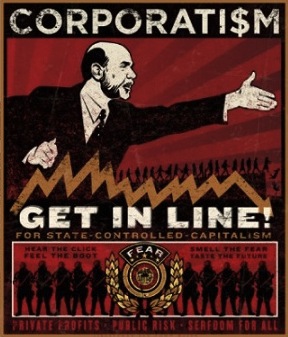
Corporatism Stifles Innovation

Corporatism-630-360

By James Hall

Source: BATR.org

For an economy to grow and create actual wealth, innovation is a bedrock component in the development of enhanced prosperity. Prosperity is an intriguing concept. Simply making and accumulating money falls short of establishing a successful economic model. This recent report illustrates a prime example. Facebook stock soars, as company briefly passes IBM in market value. “By most measures, Facebook is dwarfed by IBM: With about 7,000 employees, ten-year-old Facebook is on track to garner $12 billion in sales this year. The 103-year-old IBM has more than 400,000 workers and sold almost $100 billion of computer hardware and software in 2013.”

Is Facebook a shining star of innovation? Or is it the product of a society, which has given up on working towards a successful economy, whereby a prosperous middle class partakes in the engine of continued and shared affluence? Conversely, is IBM an innovated inventor, or is it a dinosaur of a previous era?

However, you answer such questions, Edmund Phelps in an opinion article, Corporatism not capitalism is to blame for inequality argues that tangible innovation is in decline.

“Innovation tailed off between 1940 and about 1970, while the top decile’s share of wealth and income began rising in the 1970s.

The causation runs the other way: losses of dynamism have tended to sharpen wealth inequality because it hits workers of modest means more than it hurts the wealthy. Developing new products is labour-intensive. So is producing the capital goods needed to make them. These jobs disappear when innovation stalls.”

An explanation of The Rise and Fall of Western Innovation, addresses the plight of economic reality. “It is undeniable that the U.S. economy is not delivering the steadily improving wages and living standards the nation’s residents expect.”

Mass Flourishing is meant to be Edmund Phelps’s chef d’oeuvre, the capstone to a half century of research into the sources of national wealth.

A decline in the pace of innovation threatens prosperity, in the U.S. and everywhere else.

The main cause of this decline, according to Phelps, is corporatism—the inevitable tendency of businesses, workers, and other interests to band together to protect what they have. In modern economies, he says, corporations, unions, and other interests turn government into an agency for forestalling change and preserving the status quo.”

The noted economic expert and academic Robert J. Shiller, in his article, Why Innovation Is Still Capitalism’s Star, provides a critique of “Mass Flourishing: How Grassroots Innovation Created Jobs, Challenge and Change”.

“Professor Phelps discerns a troubling trend in many countries, however, even the United States. He is worried about corporatism, a political philosophy in which economic activity is controlled by large interest groups or the government. Once corporatism takes hold in a society, he says, people don’t adequately appreciate the contributions and the travails of individuals who create and innovate. An economy with a corporatist culture can copy and even outgrow others for a while, he says, but, in the end, it will always be left behind. Only an entrepreneurial culture can lead.”

Jared Bernstein does not agree as stated in a response to Professor Shiller in ‘Does the Government Stifle Innovation? I Don’t See It (To the Contrary…)’. “My points are that a) many important innovations have involved government support somewhere along the way, and b) while one could and should worry about waste in this area, I’ve not seen evidence, nor does Shiller provide any, of stifling. …”.

Well, that viewpoint sure sound like Obama’s infamous endorsement of a government corporatism model, “If you’ve got a business — you didn’t build that. Somebody else made that happen.”

When examining the way corporate transnational businesses operate in the real world, their lack of internal in-house innovation is notorious. These gigantic corporatist carnivores excel at mergers and accusations in the quest of monopolization of markets. In these endeavors, their best friend is government cronyism and favoritism.

The essay, Blaming Capitalism for Corporatism, makes an important point.

“In various ways, corporatism chokes off the dynamism that makes for engaging work, faster economic growth, and greater opportunity and inclusiveness. It maintains lethargic, wasteful, unproductive, and well-connected firms at the expense of dynamic newcomers and outsiders, and favors declared goals such as industrialization, economic development, and national greatness over individuals’ economic freedom and responsibility. Today, airlines, auto manufacturers, agricultural companies, media, investment banks, hedge funds, and much more has at some point been deemed too important to weather the free market on its own, receiving a helping hand from government in the name of the “public good.”

Here within dwells the essential dilemma, defining the genuine “Public Good“. Government often acts according to Mr. Bernstein’s idea of progress, especially in technological terms. Focus on the notion – “economically important” – and the language filter that translates into a benefit for the Corporatocracy matrix.

“While “entrepreneurial culture” will always be essential, many innovations that turned out to be economically important in the US have government fingerprints all over them. From machine tools, to railroads, transistors, radar, lasers, computing, the internet, GPS, fracking, biotech, nanotech—from the days of the Revolutionary War to today—the federal government has supported innovation often well before private capital would risk the investment.”

Corporatism invents methods of greater control and market dominance for select elitist beneficiaries. When government provides seed money to fund research projects, pure science is seldom the objective. As examined in the essay, How Government Did (and Didn’t) Invent the Internet, Harry McCracken writes: (I’m even prepared to believe that if the Internet hadn’t been invented at DARPA, the private sector would have stepped in and done the job. But we’ll never know for sure, since it was invented at DARPA.)

Thus, the paradox most people are unable to see beyond the guise of “so called” progress. Is government involvement or outright development of transhumanist futuristic technology a valid form of innovation or is it the terminal scourge of central planning and a controlled economy? Surely, under such a system, the “Mass Flourishing” of sharing the wealth, will no longer be an issue among the “useless eaters”, designated for extinction.

– See more at: http://www.batr.org/corporatocracy/073014.html#sthash.RFUeioGh.dpuf

The Six-Hour Day

Source: The Hipcrime Vocab

But don’t look for it in Calvinist America anytime soon, where we’re always on the hunt to ferret out “moochers:”

Gothenburg (Sweden) (AFP) – Robert Nilsson, a 25-year-old mechanic in Sweden’s second city Gothenburg, may be the harbinger of a future where people work less and still enjoy a high standard of living. He gets out of bed at the same time as everyone else, but instead of rushing to work, he takes it easy, goes for a jog, enjoys his breakfast, and doesn’t arrive at his Toyota workshop until noon, only to punch out again at 6:00 pm.

“My friends hate me. Most of them think because I work six hours, I shouldn’t be paid for eight,” Nilsson said, talking while fitting part of a rear window onto a Toyota Prius with swift, expert moves.

Sweden often stuns first-time visitors with its laid-back prosperity, making foreigners wonder how it is possible to have both lots of money and lots of leisure.

Part of the answer, according to economists, is a productive and well-educated workforce that adapts to new technologies quicker than most. Exactly how much –- or how little –- Swedes work compared with other nations is a somewhat open question.

“We have a 40-hour work week, but also we have a little more absence than many people and we start work late in life because we study longer,” said Malin Sahlen, an analyst at Timbro, a libertarian Stockholm-based think tank. In 2012, the average Swede worked a total of 1,621 hours, according to the Paris-based Organisation for Economic Co-operation and Development. This is more than the Netherlands with 1,381 hours, but less than Britain with 1,654 hours or the United States with 1,790 hours – and way below Chile’s 2,029 and Mexico’s 2,226 hours.

“We could work more, that’s a fact,” said Sahlen.

But far from looking to increase time spent at work, some in Sweden are out to prove that less is more and that cutting hours can boost productivity.

In an international productivity ranking by the Conference Board, a non-profit business research organisation, Sweden was already placed close to the top, coming 11th out of 61 countries. The United States was third, the Netherlands number five, and Britain number 13, whereas Chile and Mexico were both in the bottom third.

[…]

Left-wing councillor Pilhem says the concept has already proven its merits — at mechanic Nilsson’s workplace, Toyota. Toyota’s Gothenburg branch introduced the six-hour day in 2002 to make its facilities more efficient by having two shifts, one in the morning and one in the afternoon, instead of a single, longer one. Nilsson confirms that in his experience a six-hour day — paid as much as eight — is more efficient because it requires fewer breaks.

“Every time you have a break, it takes 10 to 15 minutes to get back to work, because you have to see where you were when you left off,” he said.

That efficiency is reflected in the salary, as the Toyota workshop pays technicians like Nilsson 29,700 Swedish kronor (3,300 euro, $4,510) a month, well above the 25,100 kronor (2,790 euro, $3,810) national average for workers in the private sector.

“It was a huge success straight away,” said Toyota service centre manager Elisabeth Jonsson. “We saw the results, and everything was working for the staff, for the company, for the customers, so I don’t think we ever had any discussion about putting an end to it.”

Swedes test a future of less work, more play (Yahoo! News)

Clearly, laziness will turn Sweden into an impoverished, hellish dystopia. Oh, wait, that’s the U.S. I’m describing.

Here’s a Reddit page on the article. From that page:

I used to work salary at 30 hrs a week. They told me I needed to go to 40 and get a corresponding pay increase. I did not want to but they made me.

Getting in at 9am and leaving at 3pm left me so much free time that working 30 hours a week felt like a hobby. I had more time outside of work during the day than at work. Now my butt is stuck in a chair 40 hours a week still doing 30 hours a week worth of work.

Though instead of adding just 2 hours to the work day, it added more like 4.

Extra Rush hour driving time 45 mins each way instead of 15- 1 hour extra.

Necessary Lunch Break- 1 hour extra

2 hours extra at the office- 2 hrs

So, even though I got a corresponding 33% increase in pay (from 6 hrs a day to 8 hrs a day), the time it is costing me increased by 61% (from 6.5 hrs to 10.5 hrs).

So technically, by earning more I got a pay cut.

Despite my top line salary going up 33%, my earnings per hour devoted to work dropped by 17%.

Definitely not worth it.

It’s Time to Start Believing Again – Why Basic Income Could and Should be the Next Global Political Movement

Source: Thought Infection

Things change slowly and then all at once. 

If there is one great consistency about change in the 21st century, it is that things seem to change almost imperceptibly right up until they become inevitable. Many good examples of this effect can be found in the world of technology such as the rise of the internetthe fall of film-cameras, or the explosive growth of the green energy industry. In all of these cases the exponential nature of technological advances led many to discount major changes that eventually disrupted entire industries. While this effect is best understood in the world of technology I think this kind of change can also be seen in social and political spheres.

Political movements must by necessity start with only a minority of individuals working very hard for very many years to push forward on an issue. For a very long time it can appear that little or no progress is being made, but below the surface opinions and minds are slowly shifting. This slow progression continues in the background, almost imperceptibly until some sort of tipping point is reached and a sudden shift in the public and political sentiment can occur. A good example of this effect would be the momentous shift away from a deep and vitriolic hatred of gays only a few decades ago towards increasing acceptance today.

In addition to the energy provided by a small group of dedicated individuals, flashpoint social or political change also requires the maneuvering room in order for rapid revolutionary change to happen. The room for new ideas to maneuver can be created by a collapse of incumbent ideology, or in the case of the greatest shifts it often comes from a wider, systemic loss of faith in the system. When people become embittered with things as they are they will inevitably start looking to those offering alternative views.

A person without belief is a power vacuum. 

I think we are currently stand at time when conditions are set for the next global political movement to take hold. We are seeing clear symptoms of a systemic erosion of faith in the political and economic systems as they stand today.

Economic hardship and unemployment has become endemic across large parts of the developed world. Those who do work find themselves squeezed between longer working hours, higher on the job demands, increasing costs of living, and loss of both job security and benefits.

Times feel tough, and people are starting to ask why they are tough. Did we have some sort of disaster? Are our crops failing, or our industries falling apart? What happened that is making institutions like education and health too expensive to support?

Thomas Piketty, in his recent book provides strong evidence that the economic pathology of the current geopolitical situation may simply be the symptoms of a larger economic disease. When capital out-competes labour, it inevitably leads to increasing wealth disparity and the associated economic problems that we see today. People can see that the economic gains that our collective hard-work creates is going disproportionately into the hands of the wealthy. People can see that the game is rigged against them, and they don’t really want to play any more.

At the same time as economic realities are being thrust upon workers around the world, people are also increasingly detached from mainstream politics. Little real change has happened despite perpetual political promises to deliver such. Political detachment combined with economic hardship is a dangerous mix, and is credited with leading to the rise of extreme political groups like the Golden Dawn in Greece and other far-right parties in the UK and France. The rise of more extremist politics is also apparent in the increasingly polarized and broken political landscape of the United States.

The disengagement of the public from the political sphere is particularly strong for those who are also disproportionately affected by the economic slow-down, the youth. It is an unappreciated fact that there are actually more millenials in the United States than there are baby boomers. Whatever politician figures out how to engage the millenial generation politically is going to run the world.

From my perspective, there seems to be a clear build-up of political tension across the globe. While we can argue about specific economic and political maladies that have led us to this point, I think the simple fact is that people are losing faith in the system as a whole. As people lose faith, governments become more detached and fearful of their citizens, leading more people to lose faith in the system, and thus a vicious cycle of political breakdown is perpetuated.

So how do we stop this?

The answer is surprisingly simple – We need to believe again.

People need to believe that the world will be better for their children than it was for them. This is the magic that drives people to get up in the morning and go to school and work, to put in the long hours of hard work, to make discoveries, to invent new technologies, and improve the world. The economy will flourish only as long as people truly believe they can better their own life, and that of their children.

Without faith in the global economic and political system, we have nothing. 

Believe it or not, there just might be one simple medicine which (while it would not solve all of our problems) could go a long way to solving the twin problems of political and economic break down.

Basic income.

There is a long list of reasons that basic income makes for sensible economic policy, which I will not go through here. Suffice it to say that basic income would (1) give workers the leverage to demand more from work, (2) give individuals and innovators the means to do their thing, (3) give corporations more incentive to automate their production, and (4) generally support the consumption economy. (Some worry that such a basic income might lead to less incentive to work, but I say that if you need to use starvation as a threat to get people to work for you, then your business is not profitable enough.)

Perhaps most importantly, basic income would be the solution to restore the faith of the common individual in the current system of global capitalism. By institutionalizing the social contract in the form of a cash dividend for everyone, basic income would finally enshrine the promise that a rich and successful society must first deliver a minimal living standard to everyone.

Serious realistic types might rush to play down the importance of belief in the political system. Who cares whether the rabble believes in what the government and politicians do, as long as it is functional? But these people are completely missing the central truth of the matter here. Belief is the only power in the world that matters. My dollar is only worth what we collectively agree it to be worth, and the same goes for our societies. If we fail to create societies which inspire belief, then we are lost. If we do not find a way fill that vacuum left by eroding belief, then someone else will.

It is time for something that we can believe in, it is time for basic income.