Hillary Clinton Breaks the Irony Meter

By Kevin Carson

Source: Center for a Stateless Society

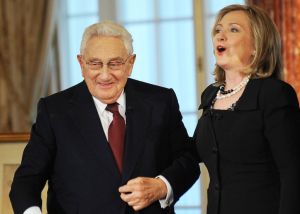
At the March 9 Democratic debate, Hillary Clinton had this to say about competitor Bernie Sanders’s favorable comments on Castro’s Cuba and the Sandinista regime in the ’80s:  “if the values are that you oppress people, you disappear people, imprison people or even kill people for expressing their opinions…, that is not the kind of revolution of values that I ever want to see anywhere.” This, coming from a former Secretary of State who backed a right-wing coup in Honduras and proudly name-drops Henry Kissinger — Henry Kissinger! — as a close friend and mentor, is the kind of thing the Onion can’t compete with.

If Kissinger was known for anything in his years as National Security Adviser and Secretary of State, it was installing dictators who oppressed, disappeared and imprisoned people. He oversaw a wave of coups that swept South America in the late ’60s and ’70s, installing right-wing military regimes that tortured, murdered or disappeared dissidents by the thousands, and where a common fate for labor and peasant activists was to be found in a ditch with their faces hacked off. Under Kissinger the U.S. actively supported Operation Condor — the program by which these South American dictators used torture and murder to suppress opposition — with military aid and technical assistance. He gave the green light to Indonesia’s genocidal invasion of East Timor.

Clinton has a long history of close personal friendship with this monster, and indeed touts herself as something of a protege. According to both Hillary and Bill, Kissinger praised her for running the State Department better than anybody in decades. And well might he praise her, because she’s followed in his footsteps in many ways. As Secretary of State, she oversaw the sale of millions of dollars worth of arms to despotic regimes that oppressed, disappeared and imprisoned people for expressing their opinions — many of which regimes were also large donors to the Clinton Foundation. And while we’re on the subject of people being murdered and disappeared, how about Berta Caceres — an activist murdered by the right-wing Honduran regime whose seizure of power Clinton backed in 2009?

As senator, Clinton voted to authorize George Bush’s criminal war of aggression on Iraq, which has resulted in hundreds of thousands of Iraqi deaths since 2003. She says now it was “a mistake.” It was a mistake all right. She mistakenly believed the vote would make her more viable as a future presidential candidate. She mistakenly predicted the way the political winds would be blowing when she decided to run for president.

And don’t forget Clinton’s support for the Obama administration’s indiscriminate use of drones for extrajudicial killing. Many of the victims were civilians, and hundreds of them were actually children.

If you add it all up, Hillary Clinton still isn’t quite the war criminal her old friend and mentor Henry Kissinger is. Those are some big, bloody shoes to fill. But if she’s elected she’ll grow into them.

The Federal Reserve and the Global Fracture

Octopus 1912

An Interview with Finnish Journalist Antti J. Ronkainen

Michael Hudson

Source: The Unz Review

Antti J. Ronkainen: The Federal Reserve is the most significant central bank in the world. How does it contribute to the domestic policy of the United States?

Michael Hudson: The Federal Reserve supports the status quo. It would not want to create a crisis before the election. Today it is part of the Democratic Party’s re-election campaign, and its job is to serve Hillary Clinton’s campaign contributors on Wall Street. It is trying to spur recovery by resuming its Bubble Economy subsidy for Wall Street, not by supporting the industrial economy. What the economy needs is a debt writedown, not more debt leveraging such as Quantitative Easing has aimed to promote. But the Fed is in a state of denial that the U.S. and European economies are plagued by debt deflation.

The Fed uses only one policy: influencing interest rates by creating bank reserves at low give-away charges. It enables banks too make easy gains simply by borrowing from it and leaving the money on deposit to earn interest (which has been paid since the 2008 crisis to help subsidize the banks, mainly the largest ones). The effect is to fund the asset markets – bonds, stocks and real estate – not the economy at large. Banks also are heavy arbitrage players in foreign exchange markets. But this doesn’t help the economy recover, any more than the ZIRP (Zero Interest-Rate Policy) since 2001 has done for Japan. Financial markets are the liabilities side of the economy’s balance sheet, not the asset side.

The last thing either U.S. party wants is for the election to focus on this policy failure. The Fed, Treasury and Justice Department will be just as pro-Wall Street under Hillary. There would be no prosecutions of bank fraud, there would be another bank-friendly Attorney General, and a willingness to subsidize banks now that the Dodd-Frank bank reform has been diluted from what it originally promised to be.


So let’s go back to beginning. When the Great Financial Crisis escalated in 2008 the Fed’s response was to lower its main interest rate to nearly zero. Why?

The aim of lowering interest rates was to provide banks with cheap credit. The pretense was that banks might lend to help the economy get going again. But the Fed’s idea was simply to re-inflate the Bubble Economy. It aimed at restoring the value of the mortgages that banks had in their loan portfolios. The hope was that easy credit would spur new mortgage lending to bid housing prices back up – as if this would help the economy rather than simply raising the price of home ownership.

But banks weren’t going to make mortgage loans to a housing market that already was over-lent. Instead, homeowners had to start paying down the mortgages they had taken out. Banks also reduced their credit-card exposure by a few hundred billion dollars. So instead of receiving new credit, the economy was saddled with having to repay debts.

Banks did make money, but not by lending into the “real” production and consumption economy. They mainly engaged in arbitrage and speculation, and lending to hedge funds and companies to buy their own stocks yielding higher dividend returns than the low interest rates that were available.


In addition to the near zero interest rates, the Fed bought US Treasury bonds and mortgage backed securities (MBS) with almost $4 trillion during three rounds of Quantitative Easing stimulus. How have these measures affected the real economy and financial markets?

In 2008 the Federal Reserve had a choice: It could save the economy, or it could save the banks. It might have used a fraction of what became the vast QE credit – for example $1 trillion – to pay off the bad mortgages and write them down. That would have helped save the economy from debt deflation. Instead, the Fed simply wanted to re-inflate the bubble, to save banks from having to suffer losses on their junk mortgages and other bad loans.

Keeping these debts on the books, in full, let banks foreclose on defaulting homeowners. This intensified the debt-deflation, pushing the economy into its present post-2008 depression. The debt overhead is keeping it depressed.

One therefore can speak of a financial war waged by Wall Street against the economy. The Fed is a major weapon in this war. Its constituency is Wall Street. Like the Justice and Treasury Departments, it has been captured and taken hostage.

Federal Reserve chairwoman Janet Yellen’s husband, George Akerlof, has written a good article about looting and fraud as ways to make money. But instead of saying that looting and fraud are bad, the Fed has refused to regulate or move against such activities. It evidently recognizes that looting and fraud are what Wall Street is all about – or at least that the financial system would come crashing down if an attempt were made to clean it up!

So neither the Fed nor the Justice Department or other U.S. Government agencies has sanctioned or arrested a single banker for the trillions of dollars of financial fraud. Just the opposite: The big banks where the fraud was concentrated have been made even larger and more dominant. The effect has been to drive out of business the smaller banks not so involved in derivative bets and other speculation.

The bottom line is that banks made much more by getting Alan Greenspan and the Clinton-Bush Treasury officials to deregulate fraud than they could have made by traditional safe lending. But their gains have increased the economy’s overhead.


Do you believe Mike Whitney’s argument that QE was about a tradeoff between the Fed and the government: the Fed pumped the new bubble and saved the banks that the government didn’t need to bail out more banks. The government’s role was to impose austerity so that inflation and employment didn’t rise – which would have forced the Fed to raise interest rates, ending its QE program? source: http://www.counterpunch.org/2016/01/15/the-chart-that-explains-everything/]

That was a great chart that Mike put up from Richard Koo, and you should reproduce it here. It shows that the Fed’s enormous credit creation had zero effect on raising commodity prices or wages. But stock market prices doubled in just six years, 2008-15, and bond prices rose to new peaks. Banks left much of the QE credit on deposit with the Fed, earning an interest giveaway premium.

(Richard Koo: “The struggle between markets and central banks has only just begun,”

http://www.businessinsider.com/richard-koo-struggle-between-markets-and-central-banks-has-only-just-begun-2015-9?r=UK&IR=T

The important point is that the Fed (backed by the Obama Administration) refused to use this $4 trillion to revive the production-and-consumption economy. It claimed that such a policy would be “inflationary,” by which it meant raising employment and wage levels. The Fed thus accepted the neoliberal junk economics proposing austerity as the answer to any problem – austerity for the industrial economy, not the Fed’s own Wall Street constituency.


According to a Fed staff report, QE would lower the exchange rate of dollar to the other currencies causing competitiveness boost for the U.S. firms. Former finance minister of Brazil Guido Mantega, as well as the chairman of Central Bank of India Raghuram Rajan, have described the Fed’s QE as a “currency war.” What’s your take?

The Fed’s aim was simply to provide banks with low-interest credit. Banks lent to hedge funds to buy securities or make financial bets that yielded more than 0.1 percent. They also lent to companies to buy their own stock, and to corporate raiders for debt-financed mergers and acquisitions. But banks didn’t lend to the economy at large, because it already was “loaned up,” and indeed, overburdened with debt.

Lower interest rates did spur the “carry trade,” as they had done in Japan after 1990. Banks and hedge funds bought foreign bonds paying higher rates. The dollar drifted down as bank arbitrageurs could borrow from the Fed at 0.1 percent to lend to Brazil at 9 percent. Buying these foreign bonds pushed up foreign exchange rates against the dollar. That was a side effect of the Fed’s attempt to help Wall Street make financial gains. It simply didn’t give much consideration to how its QE flooding the global economy with surplus dollars would affect U.S. exports – or foreign countries.

Exchange rate shifts don’t affect export trends as much as textbook models claim. U.S. arms exports to the Near East, and many technology exports are non-competitive. However, a looming problem for most countries is what may happen when ending QE increases the dollar’s exchange rate. If U.S. interest rates go back up, the dollar will strengthen. That would increase the cost to foreign countries of paying dollar-denominated debts. Countries that borrowed all dollars at low interest will need to pay more in their own currencies to service these debts. Imagine what would happen if the Federal Reserve let interest rates rise back to a normal level of 4 or 5 percent. The soaring dollar would push debtor economies toward depression on capital account much more than it would help their exports on trade account.


You have said that QE is fracturing the global economy. What do you mean by that?

Part of the flood of dollar credit is used to buy shares of foreign companies yielding 15 to 20 percent, and foreign bonds. These dollars are turned over to foreign central banks for domestic currency. But central banks are only able to use these dollars to buy U.S. Treasury securities, yielding about 1 percent. When the People’s Bank of China buys U.S. Treasury bonds, it’s financing America’s dual budget and balance-of-payment deficits, both of which stem largely from military encirclement of Eurasia – while letting U.S. investors and the U.S. economy get a free ride.

Instead of buying U.S. Treasury securities, China would prefer to buy American companies, just like U.S. investors are buying Chinese industry. But America’s government won’t permit China even to buy gas station companies. The result is a double standard. Americans feel insecure having Chinese ownership in their companies. It is the same attitude that was directed against Japan in the late 1980s.

I wrote about this financial warfare and America’s free lunch via the dollar standard in Super Imperialism (2002) and The Bubble and Beyond (2012), and about how today’s New Cold War is being waged financially in Killing the Host (2015).


The Democrats loudly criticized the Bush administration’s $700 billion TARP-program, but backed the Fed’s QE purchases worth of almost $4 trillion during the Obama administration. How does this relate to the fact that officially, QE purchases were intended to support economic recovery?

I think you’ve got the history wrong. My Killing the Host describes how the Democrats supported TARP, while the Republican Congress opposed it on populist grounds. Republican Treasury Secretary Hank Paulson offered to use some of the money to aid over-indebted homeowners, but President-elect Obama blocked that – and then appointed Tim Geithner as Treasury Secretary. FDIC head Sheila Bair and by SIGTARP head Neil Barofsky have written good books about Geithner’s support for Wall Street (and especially for Citigroup and Goldman Sachs) against the interests of the economy at large.

If you are going to serve Wall Street – your major campaign contributors – you are going to need a cover story pretending that this will help the economy. Politicians start with “Column A”: their agenda to reimburse their campaign contributors – Wall Street and other special interests. Their public relations team and speechwriters then draw up “Column B”: what public voters want. To get votes, a rhetorical cover story is crafted. I describe this in my forthcoming J is for Junk Economics, to be published in March. It’s a dictionary of Orwellian doublethink, political and economic euphemisms to turn the vocabulary around and mean the opposite of what actually is meant.


How do TARP and QE relate to the Federal Reserve’s mandate about price stability?

There are two sets of prices: asset prices and commodity prices and wages. By “price stability” the Fed means keeping wages and commodity prices down. Calling depressed wage levels “price stability” diverts attention from the phenomenon of debt deflation – and also from the asset-price inflation that has increased the advantages of the One Percent over the 99 Percent. From 1980 to the present, the Fed has inflated the largest bond rally in history as a result of driving down interest rates from 20 percent in 1980 to nearly zero today, as you have noted.

Chicago School monetarism ignores asset prices. It pretends that when you increase the money supply, this increases consumer prices, commodity prices and wages proportionally. But that’s not what happens. When banks created credit (money), they don’t lend much to people to buy goods and services or for companies to make capital investments to employ more workers. They lend money mainly to transfer ownership of assets already in place. About 80 percent of bank loans are mortgages, and the rest are largely for stocks and bond purchases, including corporate takeovers and stock buybacks or debt-leveraged purchases. The effect is to bid up asset prices, while loading down the economy with debt in the process. This pushes up the break-even cost of doing business, while imposing debt deflation on the economy at large.

Wall Street isn’t so interested in exploiting wage labour by hiring it to produce goods for sale, as was the case under industrial capitalism in its heyday. It makes its gains by riding the wave of asset inflation. Banks also gain by making labour pay more interest, fees and penalties on mortgages, and for student loans, credit cards and auto loans. That’s the postindustrial financial mode of exploiting labor and the overall economy. The Fed’s QE program increases the price at which stocks, bonds and real estate exchange for labour, and also promotes debt leverage throughout the economy.


Why don’t economists distinguish between asset-price and commodity price inflation?

The economics curriculum has been turned into an exercise for students to pretend that a hypothetical parallel universe exists in which the rentier classes are job creators, necessary to help economies recover. The reality is that financial modes of getting rich by debt leveraging creates a Bubble Economy – a Ponzi scheme leading to austerity and shrinking markets, which always ends in a convulsion of bankruptcy.

The explanation for why this is not central to today’s economic theory is that the discipline has been captured by this neoliberal tunnel vision that overlooks the financial sector’s maneuvering to make quick trading profits in stocks, bonds, mortgages and derivatives, not to take the time and effort to develop long-term markets. Rentiers seek to throw a cloak of invisibility around how they make money. They know that if economists don’t measure their wealth and the public does not see it, voters will be less likely to bring pressure to regulate and tax it.

Today’s central economic problem is that inflating asset prices by debt leveraging extracts more interest and financial charges. When the resulting debt deflation ends up hollowing out the economy, creditors try to blame labour, or government spending (except for bailouts and QE to help Wall Street). It is as if debtors are exploiting their creditors.


If there is a new class war, what is the current growth model?

It’s an austerity model, as you can see from the eurozone and from the neoliberal consensus that cites Latvia as a success story rather than a disaster leading to de-industrialization and emigration. In real democracies, if economies polarize like they are doing today, you would expect the 99 Percent to fight back by electing representatives to enact progressive taxation, regulate finance and monopolies, and make public investment to raise wages and living standards. In the 19th century this drive led parliaments to rewrite the tax rules to fall more on landlords and monopolists.

Industrial capitalism plowed profits back into new means of production to expand the economy. But today’s rentier model is based on austerity and privatization. The main way the financial sector always has obtained wealth has been by privatizing it from the public domain by insider dealing and indebting governments.

The ultimate financial business plan also is to lend with an eye to end up with the debtor’s property, from governments to companies and families. In Greece the European Central Bank, European Commission and IMF demanded that if the nation’s elected representatives did not sell off the nation’s ports, land, islands, roads, schools, sewer systems, water systems, television stations and even museums to reimburse the dreaded austerity troika for its bailout of bondholders and bankers, the country would be isolated from Europe and faced with a crash. That forced Greece to capitulate.

What seems at first glance to be democracy has been hijacked by politicians who accept the financial class war ideology that the way for an economy to get rich is by austerity. That means lowering wages, unemployment, and dismantling government by turning the public domain over to the financial sector.

By supporting the banking sector even in its predatory and outright fraudulent behavior, U.S. and European governments are reversing the trajectory along which 19th-century progressive industrial capitalism and socialism were moving. Today’s rentier class is not concerned with long-term tangible investment to earn profits by hiring workers to produce goods. Under finance capitalism, an emerging financial over-class makes money by stripping income and assets from economies driven deeper into debt. Attacking “big government” when it is democratic, the wealthy are all in favor of government when it is oligarchic and serves their interests by rolling back the past two centuries of democratic reforms.


Does the Fed realize global turbulences what its unconventional policies have caused?

Sure. But the Fed has painted itself in a corner: If it raises interest rates, this will cause the stock and bond markets to go down. That would reverse the debt leveraging that has kept these markets up. Higher interest rates also would bankrupt Third World debtors, which will not be able to pay their dollar debts if dollars become more expensive in their currencies.

But if the Fed keeps interest rates low, pension funds and insurance companies will have difficulty making the paper gains that their plans imagined could continue exponentially ad infinitum. So whatever it does, it will destabilize the global economy.


China’s stock market has crashed, western markets are very volatile, and George Soros has said that the current financial environment reminds him of the 2008 crash. Should we be worried?

News reports make it sound as if debt-ridden capitalist economies will face collapse if the socialist countries don’t rescue them from their shrinking domestic markets. I think Soros means that the current financial environment is fragile and highly debt-leveraged, with heavy losses on bad loans, junk bonds and derivatives about to be recognized. Regulators may permit banks to “extend and pretend” that bad loans will turn good someday. But it is clear that most government reports and central bankers are whistling in the dark. Changes in any direction may pull down derivatives. That will cause a break in the chain of payments when losers can’t pay. The break may spread and this time public opinion is more organized against 2008-type bailouts.

The moral is that debts that can’t be paid, won’t be. The question is, how won’t they be paid? By writing down debts, or by foreclosures and distress sell-offs turning the financial class into a ruling oligarchy? That is the political fight being waged today – and as Warren Buffet has said, his billionaire class is winning it.


That’s all for now. Thank you Michael!

The Age of Authoritarianism: Government of the Politicians, by the Military, for the Corporations

what-corporate-america-wants

By John W. Whitehead

Source: The Rutherford Institute

“I was astonished, bewildered. This was America, a country where, whatever its faults, people could speak, write, assemble, demonstrate without fear. It was in the Constitution, the Bill of Rights. We were a democracy… But I knew it wasn’t a dream; there was a painful lump on the side of my head… The state and its police were not neutral referees in a society of contending interests. They were on the side of the rich and powerful. Free speech? Try it and the police will be there with their horses, their clubs, their guns, to stop you. From that moment on, I was no longer a liberal, a believer in the self-correcting character of American democracy. I was a radical, believing that something fundamental was wrong in this country—not just the existence of poverty amidst great wealth, not just the horrible treatment of black people, but something rotten at the root. The situation required not just a new president or new laws, but an uprooting of the old order, the introduction of a new kind of society—cooperative, peaceful, egalitarian.” ― Historian Howard Zinn

America is at a crossroads.

History may show that from this point forward, we will have left behind any semblance of constitutional government and entered into a militaristic state where all citizens are suspects and security trumps freedom.

Certainly, this is a time when government officials operate off their own inscrutable, self-serving playbook with little in the way of checks and balances, while American citizens are subjected to all manner of indignities and violations with little hope of defending themselves.

As I make clear in my book Battlefield America: The War on the American People, we have moved beyond the era of representative government and entered a new age—the age of authoritarianism. Even with its constantly shifting terrain, this topsy-turvy travesty of law and government has become America’s new normal.

Don’t believe me?

Let me take you on a brief guided tour, but prepare yourself. The landscape is particularly disheartening to anyone who remembers what America used to be.

The Executive Branch: Whether it’s the Obama administration’s war on whistleblowers, the systematic surveillance of journalists and regular citizens, the continued operation of Guantanamo Bay, or the occupation of Afghanistan, Barack Obama has surpassed his predecessors in terms of his abuse of the Constitution and the rule of law. President Obama, like many of his predecessors, has routinely disregarded the Constitution when it has suited his purposes, operating largely above the law and behind a veil of secrecy, executive orders and specious legal justifications. Rest assured that no matter who wins this next presidential election, very little will change. The policies of the American police state will continue.

The Legislative Branch:  It is not overstating matters to say that Congress may well be the most self-serving, semi-corrupt institution in America. Abuses of office run the gamut from elected representatives neglecting their constituencies to engaging in self-serving practices, including the misuse of eminent domain, earmarking hundreds of millions of dollars in federal contracting in return for personal gain and campaign contributions, having inappropriate ties to lobbyist groups and incorrectly or incompletely disclosing financial information. Pork barrel spending, hastily passed legislation, partisan bickering, a skewed work ethic, graft and moral turpitude have all contributed to the public’s increasing dissatisfaction with congressional leadership. No wonder 86 percent of Americans disapprove of the job Congress is doing.

The Judicial Branch: The Supreme Court was intended to be an institution established to intervene and protect the people against the government and its agents when they overstep their bounds. Yet through their deference to police power, preference for security over freedom, and evisceration of our most basic rights for the sake of order and expediency, the justices of the United States Supreme Court have become the guardians of the American police state in which we now live. As a result, sound judgment and justice have largely taken a back seat to legalism, statism and elitism, while preserving the rights of the people has been deprioritized and made to play second fiddle to both governmental and corporate interests.

Shadow Government: America’s next president will inherit more than a bitterly divided nation teetering on the brink of financial catastrophe when he or she assumes office. He or she will also inherit a shadow government, one that is fully operational and staffed by unelected officials who are, in essence, running the country. Referred to as the Deep State, this shadow government is comprised of unelected government bureaucrats, corporations, contractors, paper-pushers, and button-pushers who are actually calling the shots behind the scenes right now.

Law Enforcement: By and large the term “law enforcement” encompasses all agents within a militarized police state, including the military, local police, and the various agencies such as the Secret Service, FBI, CIA, NSA, etc. Having been given the green light to probe, poke, pinch, taser, search, seize, strip and generally manhandle anyone they see fit in almost any circumstance, all with the general blessing of the courts, America’s law enforcement officials, no longer mere servants of the people entrusted with keeping the peace but now extensions of the military, are part of an elite ruling class dependent on keeping the masses corralled, under control, and treated like suspects and enemies rather than citizens. In the latest move to insulate police from charges of misconduct, Virginia lawmakers are considering legislation to keep police officers’ names secret, ostensibly creating secret police forces.

A Suspect Surveillance Society: Every dystopian sci-fi film we’ve ever seen is suddenly converging into this present moment in a dangerous trifecta between science, technology and a government that wants to be all-seeing, all-knowing and all-powerful. By tapping into your phone lines and cell phone communications, the government knows what you say. By uploading all of your emails, opening your mail, and reading your Facebook posts and text messages, the government knows what you write. By monitoring your movements with the use of license plate readers, surveillance cameras and other tracking devices, the government knows where you go. By churning through all of the detritus of your life—what you read, where you go, what you say—the government can predict what you will do. By mapping the synapses in your brain, scientists—and in turn, the government—will soon know what you remember. And by accessing your DNA, the government will soon know everything else about you that they don’t already know: your family chart, your ancestry, what you look like, your health history, your inclination to follow orders or chart your own course, etc. Consequently, in the face of DNA evidence that places us at the scene of a crime, behavior sensing technology that interprets our body temperature and facial tics as suspicious, and government surveillance devices that cross-check our biometricslicense plates and DNA against a growing database of unsolved crimes and potential criminals, we are no longer “innocent until proven guilty.”

Military Empire: America’s endless global wars and burgeoning military empire—funded by taxpayer dollars—have depleted our resources, over-extended our military and increased our similarities to the Roman Empire and its eventual demise. The U.S. now operates approximately 800 military bases in foreign countries around the globe at an annual cost of at least $156 billion. The consequences of financing a global military presence are dire. In fact, David Walker, former comptroller general of the U.S., believes there are “striking similarities” between America’s current situation and the factors that contributed to the fall of Rome, including “declining moral values and political civility at home, an over-confident and over-extended military in foreign lands and fiscal irresponsibility by the central government.”

I haven’t even touched on the corporate state, the military industrial complex, SWAT team raids, invasive surveillance technology, zero tolerance policies in the schools, overcriminalization, or privatized prisons, to name just a few, but what I have touched on should be enough to show that the landscape of our freedoms has already changed dramatically from what it once was and will no doubt continue to deteriorate unless Americans can find a way to wrest back control of their government and reclaim their freedoms.

That brings me to the final and most important factor in bringing about America’s shift into authoritarianism: “we the people.” We are the government. Thus, if the government has become a tyrannical agency, it is because we have allowed it to happen, either through our inaction or our blind trust.

Essentially, there are four camps of thought among the citizenry when it comes to holding the government accountable. Which camp you fall into says a lot about your view of government—or, at least, your view of whichever administration happens to be in power at the time.

In the first camp are those who trust the government to do the right thing, despite the government’s repeated failures in this department. In the second camp are those who not only don’t trust the government but think the government is out to get them. In the third camp are those who see government neither as an angel nor a devil, but merely as an entity that needs to be controlled, or as Thomas Jefferson phrased it, bound “down from mischief with the chains of the Constitution.”

Then there’s the fourth camp, comprised of individuals who pay little to no attention to the workings of government, so much so that they barely vote, let alone know who’s in office. Easily entertained, easily distracted, easily led, these are the ones who make the government’s job far easier than it should be.

It is easy to be diverted, distracted and amused by the antics of the presidential candidates, the pomp and circumstance of awards shows, athletic events, and entertainment news, and the feel-good evangelism that passes for religion today. What is far more difficult to face up to is the reality of life in America, where unemployment, poverty, inequality, injustice and violence by government agents are increasingly norms.

The powers-that-be want us to remain divided, alienated from each other based on our politics, our bank accounts, our religion, our race and our value systems. Yet as George Orwell observed, “The real division is not between conservatives and revolutionaries but between authoritarians and libertarians.”

The only distinction that matters anymore is where you stand in the American police state. In other words, you’re either part of the problem or part of the solution.

War fraud: The great lies behind imperial warfare in the 21st century

By Mark Taliano

Source: Intrepid Report

The “War On Terror” and “The War On Drugs” are both fraudulent, and they are both related. In a classic example of “reverse projection”, ”the War on Terror” is literally a “War for Terror,” and the “War on Drugs” is literally a “War for Drugs.”

Terror, coupled with the illegal trade in narcotics, particularly heroin, is enabling the orchestration, and funding, of illegal warfare which serves the interests of an international oligarch class as it destroys humanity.

The barbarity of the military operations conducted by the West is beyond the imagination of most domestic audiences, even when details are publicized.

Broadly speaking, we can decode the 9/11 terror wars using a simple formula:

  • Problem
  • Reaction
  • Solution

NATO imperialists engineer or exploit problems to create reactions, with a view to creating previously planned solutions. Typically, problems (i.e, 9/11 crimes) serve to engineer public consent (reaction) for illegal invasions (solution).

The “end-game” also contradicts publically stated goals. Evidence demonstrates that the invasions of Afghanistan, Iraq, Libya, and Syria, as well as the war in Ukraine, were launched and prosecuted with a view to destroy each country through invasion, occupation, plunder, and to establish military footholds. The popular notion that the wars are being prosecuted for humanitarian purposes is absolutely ridiculous.

Afghanistan

In Afghanistan, for example, drug-trafficking warlords such as Gulbuddin Hekmatyar were used to create extremist “jihadist” armies (mujahideen) to destroy the Soviet-protected socialist republic. The long-standing CIA-terror group alliance, which pre-dates Afghanistan, continues to be empowered by profits from illegal drug trafficking: According to U.S sources, the production of opium (which is eventually processed into heroin) has increased “40-fold” since the initial invasion of Afghanistan.

So, the invasion destroyed a secular, socialist government and filled the vacuum with extremist drug-trafficking terrorist warlords. But imperialists gained a military foothold in the country.

Iraq

We all know now that the fraudulent “Weapons Of Mass Destruction” pretext was used for the criminal invasion of Iraq. The engineered problem was followed by mixed reactions from a less gullible public, but the invasion (solution), was launched (on the heels of genocidal sanctions) anyway.

Joe Quinn reports that in this invasion, US Death Squads manufactured a civil war to divert attention from the real culprits: the occupiers. A 10,000 strong “Shia militia” under US command is used to terrorize the population and to destroy Iraqi grassroots resistance. Often, the terrorists bomb civilian targets and falsely blame innocent groups—false flag tactics—which in turn create engineered friction and retaliation. Black propaganda operations are a CIA specialty. Consequently, Iraq is now an unstable terrorist quagmire, whereas before the invasion it was a modern, well-developed country free of any identifiable terror groups.

Libya

The NATO invasion of Libya, previously the wealthiest country in Africa, was also a product of repeated Western lies, and now, it too, is a hotbed of terrorism, vice, and drug trafficking. Erin Banco reports in “Drug And Human Trafficking In ‘Lawless’ Libya Is Funding ISIS” that the West’s “lack of foresight has enabled different groups of fighters to traffic a continuous supply of arms, drugs and people across Libya’s borders, helping to bankroll some of the world’s most violent terrorists.”

Syria

The invasion of Syria is following predictable patterns as well. A constellation of extremist, mercenary terror groups, including ISIS—all supported by the West—are trying to destroy Syria. Drug trafficking, stolen oil and artifacts are being used to finance the mass murder, and death squads, often under the cover of the Free Syrian Army (FSA) are being used to create a “civil war,” and to destroy President Assad’s government. The terror and mass murder are primarily orchestrated externally with a view to making Syria safe for Wahhabism, barbarity, and a NATO military presence.

A Wikileaks cable indicates that since 2011, more than 230,000 people have died and a million have been injured. But despite the so-far-successful alliance of Syria, Iran, and Russia in destroying the mercenary terrorists and in saving Syria, the West can take some consolation: the US already has a military foothold in the country. Only time will tell if the West succeeds in creating and sustaining yet another unstable, terrorist-infested vassal state.

Despite what naysayers might think, the NATO-perpetrated holocaust is in many respects a neocon success story: a succession of previously independent countries have been destroyed, and a NATO presence has been installed. In fact, the wars for Terror and Drugs are winning, despite ostensible setbacks.

The whole process of death and destruction is not rational or moral, and the degeneracy is beyond evil. Commentators call it imperialism.


The Wickedness of [US] Foreign Policy

us-imperialism-nepal-south-asia-revolution

By Sheldon Richman

Source: Center for a Stateless Society

If you want to see how inhumane people can be, just watch those who make and execute foreign policy. We could spend all day discussing the cruelties that politicians and bureaucrats commit against people who live inside the United States. Think how many are caged like wild animals because they manufacture, sell, or consume disapproved substances; gamble where government has forbade it; traded sexual services for money; possessed a gun they weren’t “supposed” to possess; etc. ad infinitum. Naturally, America leads the world in locking up people.

But at least the policy of mass imprisonment gets increasing attention. Subject to far less scrutiny is how America’s (mis)leaders, (mis)representatives and public (self-)servants treat foreigners, especially those with dark skins and a still-unfamiliar religion. When we talk about foreign policy, how easy it is to get wrapped up in abstractions like empire,intervention, nonintervention, and kinetic military action. These are important concepts to understand, of course, but foreign-policy conversations often become sterile examinations of “policy,” when what we need is a full awareness of the harm to individual human beings, the destruction of their families, homes, communities, and societies. These persons are the victims of our rulers’ geopolitical stratagems, which seemly outrank all other considerations. Yet each victim has a story embodying unique relationships and aspirations, a story that is permanently changed by an American cluster bomb, drone-launched missile, or special-ops mission.

The best that can be said of the perpetrators of this carnage and social devastation is that they are guilty of gross negligence. Many of their acts, however, cross into the territory of premeditated murder and the infliction of mayhem with malice aforethought.

One need not look hard for the most egregious examples taking place right at this moment. In Yemen the Obama administration gives indispensable material support to Saudi Arabia’s barbaric war — war ought not to require a qualifier like barbaric, but it seems necessary these days — on the poorest population in the region. The U.S.-facilitated starvation blockade and cluster-bombing take an untold number of Yemeni lives while devastating the social order. Policymakers — a euphemism for the architects of devastation — can rationalize this cruelty in geopolitical terms — the Houthis, who incidentally are fighting al-Qaeda-affiliated jihadis, are (falsely) said to be instruments of Iran — but the fact remains that individual persons who did no harm to anyone are being slaughtered and starved with the help of American politicians and military bureaucrats.

Or how about Syria? U.S. conduct carries out a seemingly incoherent policy of simultaneously targeting the regime of President Bashar al-Assad and one of his chief adversaries, the Islamic State, while helping another Islamist group, al-Nusra Front, that has pledged allegiance to Ayman al-Zawahiri, Osama bin Laden’s successor as head of al-Qaeda, perpetrators of the 9/11 attacks. Estimates of the death total in Syria’s civil war reach as high as 340,000, a number that represents the toll at the hands of both government and rebel forces. (The total is sometimes invidiously attributed to Assad’s military alone.) The injured and refugees are probably uncountable.

What must be understood is that most of these deaths, injuries, and dispossessions would probably not have occurred had the Obama administration — most especially Secretary of State Hillary Clinton — not early on intensified the civil war by declaring Assad’s regime “illegitimate,” demanding that he “go” (i.e., die), and overseeing the transfer weapons and jihadi fighters from Benghazi, Libya. While doing all this, the Obama administration was thwarting promising efforts toward a negotiated settlement, which might have stopped or at least reduced the killing of innocent persons. For details see these three articles by the excellent investigate journalist Jonathan Marshall.

And then there’s Libya itself, which Clinton boasts is an example of “smart power at its best.” In 2011 she had egg on her face because she was on the wrong side of the Arab Spring, having defended Egypt’s military dictator, Hosni Mubarak, as a family friend and trusted world leader to the bitter end while throngs of aggrieved Egyptians were in the streets demanding his exit. Needing to clean up her image (perhaps in preparation for her quest for the presidency), she along with administration national-security VIPs Samantha Power and Susan Rice persuaded a reluctant Obama that the residents of Benghazi had to be saved from Col. Muammar Gaddafi’s alleged genocidal designs. The only problem was that Gaddafi had no genocidal designs. (Also see this and this.) And in a classic exhibition of mission-creep, the U.S.-led NATO air campaign went from protecting Benghazi to changing the regime in Tripoli, prompting Clinton to gloated, “We came. We saw. He died.” (Gaddafi was killed extrajudicially, reportedly in a most gruesome manner.)

Since the U.S. intervention, Libya has been wracked by sectarian civil war — even the Islamic State now holds territory there — prompting many Libyans to flee to Europe, which now has to contend with a growing refugee crisis. As noted, the Libyan power vacuum, featuring the unlocking of Gaddafi’s arsenal of heavy weapons, helped to boost the Islamist rebel militias in Syria, to the delight of U.S. allies Turkey (which fears the Kurds) and Saudi Arabia (which fears Iran and the Shi’ites). After the nightmare in Iraq, one has to wonder what Clinton was thinking. The closest thing we have to an answer is from then-Secretary of War Robert Gates, an opponent of the intervention, who said, “We were playing it by ear.” (And let’s not forget: destabilization itself can be an objective.)

Of course we could point to Iraq, George W. Bush’s invasion of which in 2003 set most of the aforementioned mayhem in motion, and Afghanistan, but the story is largely the same: innocent lives are sacrificed to the politicians’ grand agenda. Little people living small lives can’t be allowed to stand in the way.

Does “Creative Destruction” Include the State?


uncle-sam-gun-head

By Charles Hugh Smith

Source: Of Two Minds

When do we get to exercise democracy and fire every factotum, apparatchik, toady and lackey in the state who has abused his/her authority?

Everyone lauds “creative destruction” when it shreds monopolies and disrupts private enterprise “business as usual.” If thousands lose their middle-class livelihoods– hey, that’s the price of progress.

Improvements in productivity and efficiency can’t be stopped, and those employed making buggy whips and collecting horse manure from fetid streets will have to move on to other employment.

This raises an obvious question few dare ask: does this inevitable process of creative destruction include the state? If not, why not? Aren’t the state and the central bank the ultimate monopolies begging to be disrupted for the benefit of all? If government is inefficient and unproductive, shouldn’t it be “creatively destroyed” in the same fashion as private enterprise?

The obvious answer is yes. Why should a monopoly (government) remain untouched by new knowledge and competition as it skims the cream from society to fund its own monopolies and grants one monopoly/cartel privilege after another to its private-sector cronies?

Under the tender care of the state, we now have uncompetitive, inefficient parastic cartels dominating higher education, national defense, healthcare insurance, pharmaceuticals and hospitals– to name but a few of the major industries that are now state-enforced cartels thanks to the heavy hand of the state (i.e. regulatory capture).

Under the tender mercies of the state, prosecutors have a 90% conviction rate thanks to rigged forensic evidence, threats of life imprisonment (better to plea-bargain than risk years in America’s gulag) and other strong-arm tactics that presume guilt, not innocence. We have the best judicial system that money can buy, meaning you’re jail-bait if you can’t put your hands on a couple hundred thousand for legal defense and the all-important media campaign.

No wonder “we’re number one” in false convictions, innocent people rotting away in the drug gulag and overcrowded prisons. The citizenry are fish in a barrel for overzealous prosecutors and “get tough on drugs” politicos.

And for goodness sake, don’t get caught with cash–you must be a drug lord! Only drug lords have more than $200 cash on them at any one time. Once again, the state monopoly on force reckons you’re guilty until proven innocent–and in cases where your cash and car were “legally stolen” (a.k.a. civil forfeiture) by the state, that will cost you months or years and tens of thousands in legal fees to get your property back–unless you’re targeted for further investigation.

As I have described here in detail, the state can empty your bank account on the barest suspicion that you might owe more taxes than you paid. Due process and rule of law have been replaced with legalized looting and harassment by government in America.

Orwell and Kafka Do America: How the Government Steals Your Money–“Legally,” Of Course (March 24, 2015)

Welcome to the Predatory State of California–Even If You Don’t Live There (March 20, 2012)

The Predatory State of California, Part 2 (March 21, 2012)

Criminalizing Poverty For Profit: Local Government’s New Debtors Prisons

Pimping the Empire, Conservative-Style

Pimping the Empire, Progressive-Style

When the Savior State Becomes the Enemy of the People (October 30, 2009)

As for using your rights to uncover whatever illegal spying and dirty tricks the state imposed on you in years past–good luck getting a Freedom of Information claim processed. The state’s organs of security are busy targeting suspected terrorists with drone strikes, and your trivial concerns about constitutional rights don’t count.

In fact, why exactly are you asking? Your inquiry is highly suspicious.

If there is a difference between the U.S. national security state and the Stasi, it is merely technological. We don’t have to depend on snitches; we got high-tech tools, pilgrim.

There are two systems under our state: one for insiders and one for the rest of us. Insiders get a free pass, everyone else gets the state’s boot on their neck. If you’re Hillary Clinton, rules are for the little people who haven’t managed to skim tens of millions in bribes ( a.k.a. speaking fees and campaign contributions). There is no financial crime that can’t be turned into a heroic expression of America’s greatness–if you can afford the bribes.

Here’s how bad it is: let’s say you’re a senior U.S. senator whose husband is the penultimate crony insider worth hundreds of millions of dollars. This is a power couple to be reckoned with, wielding state and private-wealth power.

So what did the national security state say when the senator asked for minimal factual reports on agency activities? Blow chow, honey.

The lady in question is senior U.S. senator Dianne Feinstein, who is married to investment banker/financier Richard Blum. Interestingly, Feinstein had carried the national security state’s water for years in the senate, defending our Stasi/KGB from inquiry or even the dimmest light of media exposure.

Hey, America’s Stasi: you guys really know how to reward your water carriers.

The full story can be found in the new book Lords of Secrecy: The National Security Elite and America’s Stealth Warfare.

Here’s my question: when do we get to exercise democracy and fire every factotum, apparatchik, toady and lackey in the state who has abused his/her authority, trampled on our constitutional rights, participated in civil forfeiture, threatened innocent citizens, looted the system for personal gain and committed malfeasance? It’s called accountability and rule of law, people.

If you can’t fire your Stasi, KGB, corrupt prosecutors, greedy cops and parasitic politicos, then you don’t have a real democracy, you just have a phony facsimile of democracy, an empty shell that’s up held up as propaganda to a skeptical world.

The lottery and social despair in America

1fab0b8ba5546a67810419e62958f0cc

By Andre Damon

Source: WSWS.org

This mania, so generally condemned, has never been properly studied. No one has realized that it is the opium of the poor. Did not the lottery, the mightiest fairy in the world, work up magical hopes? The roll of the roulette wheel that made the gamblers glimpse masses of gold and delights did not last longer than a lightning flash; whereas the lottery spread the magnificent blaze of lightning over five whole days. Where is the social force today that, for forty sous, can make you happy for five days and bestow on you—at least in fancy—all the delights that civilization holds?

Balzac, La Rabouilleuse, 1842

The jackpot in the US Powerball lottery has hit $800 million, since there were no winners in Wednesday’s drawing. In the current round, which began on December 2, over 431 million tickets have been sold, a figure substantially larger than America’s population.

Go into any corner store in America and you will see workers of every age and race waiting in line to buy lottery tickets. With the current round, the lines are longer than ever. Americans spend over $70 billion on lottery tickets each year. In West Virginia, America’s second-poorest state, the average person spent $658.46 on lottery tickets last year.

Powerball players pick six random numbers when they purchase their tickets, with a certain percentage of sales going to the jackpot. If no winning ticket is sold, the jackpot rolls over to the next round.

The totals for the Mega Millions and Powerball national lotteries have been growing every year. This year’s jackpot has eclipsed 2012’s record of $656.5 million, the $390 million payout in 2007 and the $363 million prize in 2000. The jackpots have grown in direct proportion to ticket sales.

State-run gambling programs such as Powerball have been promoted by Democrats and Republicans alike as a solution to state budget shortfalls, even as the politicians slash taxes on corporations and wealthy individuals and gut social programs. From the standpoint of government revenue, lotteries and casinos are nothing more than a back-door regressive tax, soaking up money from the poor in proportion to the growth of social misery.

The boom in lotteries is global. Lottery sales grew 9.9 percent worldwide in 2014, after growing 4.9 percent in 2013.

Psychology Professor Kate Sweeny has noted that lottery sales grow when people feel a lack of control over their lives, particularly over their economic condition. “That feeling of self-control is very important to psychological well-being,” Sweeny says.

There is ample reason for American workers to feel they have no control over their lives. According a recent survey by Bankrate.com, more than half of Americans do not have enough cash to cover an unexpected expense of $500 or more—roughly the price of four name-brand tires.

Some 62 percent of Americans have savings of less than $1,000, and 21 percent do not have any savings at all. Most Americans are one medical emergency or one spell of unemployment from financial ruin.

For all the talk about “economic recovery” by the White House, the real financial state of most American households is far worse than before the 2008 financial crisis and recession. As of 2013, Americans were almost 40 percent poorer than they were in 2007, according to a recent survey by the Pew Research Center. While a large portion of the decline in household wealth is attributable to the collapse of the housing bubble, falling wages and chronic mass unemployment have played major roles.

The yearly income of a typical US household dropped by a massive 12 percent, or $6,400, in the six years between 2007 and 2013, according to the Federal Reserve’s latest survey of consumer finances. A large share of this decline has taken place during the so-called recovery presided over by the Obama administration.

In addition to becoming poorer, America has become much more economically polarized. According to a separate Pew survey, for the first time in more than four decades “middle-income households” no longer constitute the majority of American society. Instead, the majority of households are either low- or high-income. Pew called its findings “a demographic shift that could signal a tipping point” in American society.

“Is the lottery the new American dream?” asked USA Today, commenting on this month’s Powerball jackpot. The observation is truer than the authors intended. For American workers, achieving the “American Dream” of a stable job and one’s own home is becoming increasingly unrealizable.

Following more than 10 million foreclosures during the financial crisis, America’s home ownership rate has hit the lowest level in two decades, and for young households, the rate of home ownership is the lowest it has been since the 1960s.

For the tens of millions of America’s poor, and the more than 100 million on the threshold of poverty, the dream of winning the lottery has replaced the “American Dream” of living a decent life. A lottery ticket is a chance to escape to a fantasy world where money is not a constant, nagging worry, where one is not insulted and bullied at a low-wage job by bosses whose pay is matched only by their incompetence. The lottery is, as Balzac aptly described it, the “opium of the poor.”

Using the same phrase to describe religion, Marx noted that the “illusory happiness of the people” provided by the solace of religion is, in fact, a silent protest and distorted “demand for their real happiness.” It is the intolerable social conditions that compel masses of people to seek consolation in a lottery ticket that will propel them into revolutionary struggles.

The Hate-Filled Origins of the War on Drugs they Don’t Want you to Know

war-on-drugs-poster

By Jay Syrmopoulos

Source: The Free Thought Project

An eye-opening video produced by the folks at ATTN, lays out how cocaine was banned as a means of social engineering, using racism as the main tool in driving this agenda. The desired results were achieved by utilizing stereotypically false racist attributions, perpetuated in the media as a means of turning public opinion against specific substances.Cannabis was attributed to Hispanics, hence the coining of the term “marijuana,” as a means of correlating the drug with Mexicans immigrants. Cocaine was attributed to blacks while opium was linked to the Chinese, with each being associated with racist depictions relating to use of the drug in question.

As hysteria grew, mainly due to the racial demonization of drugs, Congress took action with the passage of the Harrison Act of 1914, which outlawed the production, distribution or importation of opium and cocaine.

These actions were then followed up with the outlawing of marijuana on a federal level with the Marihuana Tax Act of 1937.

The modern “War on Drugs,” which has been waged disproportionately upon urban minorities, has its roots in the Nixon administration.

Nixon dramatically increased the size and presence of federal drug control agencies and pushed through measures such as mandatory sentencing and no-knock warrants.

In the early 1980’s the crack cocaine epidemic hit the inner cities of urban America with a vengeance. It began the devastation of black communities and the disenfranchising of many of the socially conscious organizations, such as the Black Panthers, which were working towards ending institutionalized racism.

Journalist Gary Webb in his groundbreaking investigative series, Dark Alliance, exposed deep connection between the CIA and large scale drug trafficking, which many attribute to the crack cocaine epidemic.

The violence associated with the crack scourge was steadily fed to the living rooms of middle America on the nightly news, which once again manifested as fear in the public. The public then begged the politicians to save them from the media spoon fed menace.

Thus began the approach to “get tough on crime,” which can be seen in the disparate penalties for crack cocaine vs. powder cocaine. Crack, which was primarily used by blacks, was given a penalty 100 times more severe than that of powder cocaine, which was primarily used by whites. This sentencing difference was in spite of the drugs being the same pharmacologically speaking.

In 2010, the Fair Sentencing Act reduced this disparity down to an 18 times more severe penalty for crack vs. powder cocaine, but a massive difference in the way these almost identical substances are treated remains.

It’s quite clear what the impetus for making drugs illegal has historically been, racial fear. The violence perpetrated upon innocent people under the guise of a “War on Drugs” clearly shows that it’s actually a war being waged on all freedom loving Americans.

The manner in which racial prejudice has been used by the state to forward its agenda throughout history is consistent with the divide and conquer approach that continues to be used domestically and abroad, with the mainstream media seemingly ever ready to assist.

Jay Syrmopoulos is an investigative journalist, free thinker, researcher, and ardent opponent of authoritarianism. He is currently a graduate student at University of Denver pursuing a masters in Global Affairs. Jay’s work has previously been published on BenSwann.com and WeAreChange.org. You can follow him on Twitter @sirmetropolis, on Facebook at Sir Metropolis and now on tsu.

Related Video: