Noseblind to Odors in Your Empire?

quigley_us_empire_cartoon

By John Rohn Hall

Source: Axis of Logic

Using metaphor or analogy as a creative aid is especially useful when venturing journalistically into uncomfortable, foreign territory, and Trump’s new version of Amerika is indeed uncomfortable and foreign territory. Gotta admit to a serious case of writer’s block for the last couple weeks since The Donald’s coronation fiasco. Where to begin? All my go-to sources came up cold as January days in Jackson Hole…dried up like puddles after a Mohave Desert rainstorm. The Wizard of Oz, Alice in Wonderland, and The Matrix all seemed irrelevant.  George Carlin, Kurt Vonnegut, or Mark Twain quotes weren’t caustic enough to cut through the slime, nor offer adequate support for a conversation on the subject. But then the Heavens opened up and, through the miracles of Madison Avenue, there was a vehicle available to begin writing anew. A Febreze commercial on HGTV threw a left jab that hit me right between the eyes. Right there on my 46′ Magnavox, a kitchen island in a typical Amerikan home morphed into a back-alley dumpster, complete with roaches, flies, rats, alley cats, garbage, and stench. “Have you gone noseblind to the odors in your home?” the announcer asked. Perhaps, but more importantly, I’d guess that most Amerikans have gone noseblind to odors in their Empire.

And now Donald Trump’s in charge, and he leaves me longing for the pleasant sight of Obama’s smile, that soothing voice, and comforting demeanor. The familiar, believable, lovable, family man. A guy who never lost his cool. When Barack Obama stepped up to the microphone, the sweet, fresh scent of familiarity filled the air. Like the caustic but lively chemical fragrance of Febreze, Obama casually and effortlessly lulled Amerika into dumb insouciance. When Trump takes charge of the same microphone, the resulting clamor smells like a rat-infested dumpster. But then, beauty is in the olfactory receptors of the beholder. In truth, my nose is no more talented than those which decorate the faces of the sea of deplorables, sporting “Make America Great Again!” caps. We’ve all gone noseblind to the stench of Empire. If the truth be told, Amerika stinks under Trump’s watch, it stank during Obama’s eight year reign, it certainly reeked under the orchestration of Bush/Cheney, and the offensive smell lingers in the air just about as far back into the last 500 years of European occupation of The Western Hemisphere as you’d care to go.

Seriously, which odor is more offensive? Trump’s seemingly racist, xenophobic Muslim ban, or Obama’s record of bombing most of the same countries into oblivion? Trump’s signature on a document or Obama’s deadly drone assassination program? All seven Muslim-intensive countries on Trump’s justice-offensive Keep Out List have been subject to invasion or economic sanctions under Obama’s reign. Seems that Obama created the flow of refugees who fear for the lives of their children, and Trump has put out the No Trespassing sign, leaving a sea of desperate people with nowhere to go. The whole thing stinks, and has always stunk. Death and destruction never smell good.

The foul stench emanating from Trump’s Mexican Border Wall Plan is about enough to bring on a case of reverse peristalsis. Taking advantage of Mexico’s weakened condition following three centuries of Spanish occupation, the U.S.A. swooped in and confiscated the entire northern half of that country during The Mexican War. Since then, poor Mexicans have always come in our back door, doing the jobs U.S. Citizens find beneath their dignity, and doing so for slave wages. Obama threw the “illegals” a few bones during his tenure, but managed to deport a record-breaking 2 & 1/2 million of them while he was at it. Trump promises to lock the border and throw away the key. Smells like they’ve both been playing the same nasty game. The stench which filled the air while Obama sat on the throne has neither intensified nor diminished. If you haven’t noticed, you just might be noseblind to the odors of Empire.

We U.S. Citizens shoulder much of the blame for the stinking shenanigans of Empire. We believe the incessant lies of politicians over and over again. Fool us once, shame on you. Fool us 45 times, shame on us. We basked in the foul stench of Obama’s promises to end the wars in the Mideast, only to watch as he authorized the invasions of even more helpless, hapless populations. We cheered when he said he’d shut down Guantanamo. It’s a good thing we didn’t hold our breath. More recently, Trump seemed to be making peace with Russia, announced that the U.S.A. should stop attacking other countries, and seemed to be a good option over Hillary NevermetawarIdidntlike Clinton. In his next breath he beat the war drums, promised even more “defense” spending, and pointed a finger of blame and doom at China and Iran. While he was at it, he reaffirmed that along with maintaining a strong presence at Guantanamo, he’d reopen Black Sites abroad, and ramp up our lagging enhanced interrogation program. Ya gotta love torture. Only time will tell when or where our current loose cannon will fire his next stinking verbal barrage.

As a U.S. Citizen, I know a few things (almost) for sure about the Empire I call home. It is on the march, has been on the march since the penning of The Constitution, and will continue its foul, rancid march until somebody breaks both of its legs, and it can march no more. Empire devours everything in its path, then defecates broken countries and peoples into reeking mounds of destruction and death. The path of Empire’s march does not depend upon who holds its highest office and appears to be making all of the important decisions. While such apparent opposites as Obama and Trump appear to be at odds, they both play the game as they’re instructed. ‘Tis a grand illusion. Voting is an act of complete futility, and American Democracy is a lie. Our leaders are selected and assigned from above. As U.S. Citizens, we are no more than resources to be harvested, then cast aside as our utility diminishes and evaporates, our broken, decaying bodies becoming just another layer in the stench of death permeating the skies over the land of the free and home of the brave.

Tulsi Gabbard vs. ‘Regime Change’ Wars

2

Rep. Tulsi Gabbard is a rare member of Congress willing to take heat for challenging U.S. “regime change” projects, in part, because as an Iraq War vet she saw the damage these schemes do, as retired Col. Ann Wright explains.

By Ann Wright

Source: Consortium News

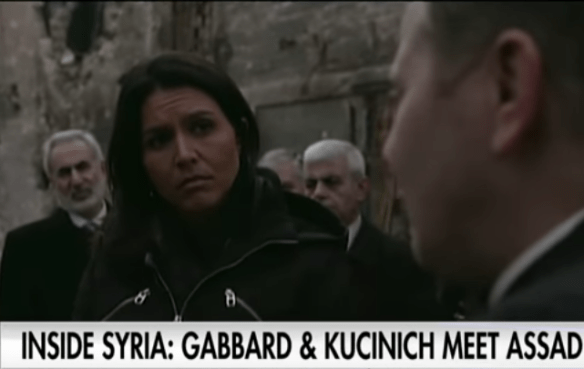
I support Rep. Tulsi Gabbard, D-Hawaii, going to Syria and meeting with President Bashar al-Assad because the congresswoman is a brave person willing to take criticism for challenging U.S. policies that she believes are wrong.

It is important that we have representatives in our government who will go to countries where the United States is either killing citizens directly by U.S. intervention or indirectly by support of militia groups or by sanctions.

We need representatives to sift through what the U.S. government says and what the media reports to find out for themselves the truth, the shades of truth and the untruths.

We need representatives willing to take the heat from both their fellow members of Congress and from the media pundits who will not go to those areas and talk with those directly affected by U.S. actions. We need representatives who will be our eyes and ears to go to places where most citizens cannot go.

Tulsi Gabbard, an Iraq War veteran who has seen first-hand the chaos that can come from misguided “regime change” projects, is not the first international observer to come back with an assessment about the tragic effects of U.S. support for lethal “regime change” in Syria.

Nobel Peace Laureate Mairead Maguire began traveling to Syria three years ago and now having made three trips to Syria. She has come back hearing many of the same comments from Syrians that Rep. Gabbard heard — that U.S. support for “regime change” against the secular government of Syria is contributing to the deaths of hundreds of thousands of Syrians and – if the “regime change” succeeded – might result in the takeover by armed religious-driven fanatics who would slaughter many more Syrians and cause a mass migration of millions fleeing the carnage.

Since 2011, the Obama administration supported various rebel groups fighting for “regime change” in Syria while U.S. allies – Saudi Arabia, Qatar and Turkey – backed jihadist groups including Islamic State and Al Qaeda’s Syrian affiliate, some of the same extremists whom the U.S. military is fighting in Iraq and Afghanistan. If Assad were overthrown, these extremists might take power and create even worse conditions for Syrians.

This possibility of jihadists imposing perverted extremist religious views on the secular state of Syria remains high due to international meddling in the internal affairs of Syria. This “regime change” project also drew in Russia to provide air support for the Syrian military.

Critical of Obama’s ‘Regime Change’

During the Obama administration, Rep. Gabbard spoke critically of the U.S. propensity to attempt “regime change” in countries and thus provoking chaos and loss of civilian life.

On Dec. 8, 2016, she introduced a bill entitled the “Stop Arming Terrorists Act” which would prohibit the U.S. government from using U.S. funds to provide funding, weapons, training, and intelligence support to extremists groups, such as the ones fighting in Syria – or to countries that are providing direct or indirect support to those groups.

In the first days of the Trump administration, Rep. Gabbard traveled to Syria to see the effects of the attempted “regime change” and to offer a solution to reduce the deaths of civilians and the end of the war in Syria. A national organization Veterans For Peace, to which I belong, has endorsed her trip as a step toward resolution to the Syrian conflict.

Not surprisingly, back in Washington, Rep. Gabbard came under attack for the trip and for her meeting with President Assad, similar to criticism that I have faced because of visits that I have made to countries where the U.S. government did not want me to go — to Cuba, Iran, Gaza, Yemen, Pakistan, North Korea, Russia and back to Afghanistan, where I was assigned as a U.S. diplomat.

I served my country for 29 years in the U.S. Army/ Army Reserves and retired as a colonel. I also served 16 years in the U.S. diplomatic corps in U.S. Embassies in Nicaragua, Grenada, Somalia, Uzbekistan, Kyrgyzstan, Sierra Leone, Micronesia, Afghanistan and Mongolia. I resigned from the U.S. government nearly 14 years ago in March 2003 in opposition to President George W. Bush’s “regime change” war on Iraq.

In my travels since my resignation, I didn’t agree with many of the policies of the governments in power in those countries. But I wanted to see the effects of U.S. government policies and, in particular, the effects of attempts at “regime change.”

I wanted to talk with citizens and government officials about the effects of U.S. sanctions and whether the sanctions “worked” to lessen their support for the government that the U.S. was attempting to change or overthrow.

For making those trips, I have been criticized strongly. I have been called an apologist for the governments in power. Critics have said that my trips have given legitimacy to the abuses by those governments. And I have been called a traitor to the United States to dare question or challenge its policy of “regime change.”

But I am not an apologist, nor am I a traitor … nor is Congresswoman Tulsi Gabbard for her recent trip to Syria.


Ann Wright served 29 years in the US Army/Army Reserves and retired as a colonel. She also was a U.S. diplomat for 16 years and served in U.S. Embassies in Nicaragua, Grenada, Somalia, Uzbekistan, Kyrgyzstan, Sierra Leone, Micronesia, Afghanistan and Mongolia. She resigned in March 2003 in opposition to the war in Iraq. She has lived in Honolulu since 2003. [A version of this story originally appeared at

Propaganda Techniques of Empire

index

By James Petras

Source: Axis of Logic

Introduction
Washington’s quest for perpetual world power is underwritten by systematic and perpetual propaganda wars. Every major and minor war has been preceded, accompanied and followed by unremitting government propaganda designed to secure public approval, exploit victims, slander critics, dehumanize targeted adversaries and justify its allies’ collaboration.

In this paper we will discuss the most common recent techniques used to support ongoing imperial wars.

Propaganda Techniques of Empire

Role Reversal
A common technique, practiced by the imperial publicists, is to accuse the victims of the same crimes, which had been committed against them.  The well documented, deliberate and sustained US-EU aerial bombardment of Syrian government soldiers, engaged in operations against ISIS-terrorist, resulted in the deaths and maiming of almost 200 Syrian troops and allowed ISIS-mercenaries to overrun their camp.   In an attempt to deflect the Pentagon’s role in providing air cover for the very terrorists it claims to oppose, the propaganda organs cranked out lurid, but unsubstantiated, stories of an aerial attack on a UN humanitarian aid convoy, first blamed on the Syrian government and then on the Russians.  The evidence that the attack was most likely a ground-based rocket attack by ISIS terrorists did not deter the propaganda mills.  This technique would turn US and European attention away from the documented criminal attack by the imperial bombers and present the victimized Syrian troops and pilots as international human rights criminals.

Hysterical Rants
Faced with world opprobrium for its wanton violation of an international ceasefire agreement in Syria, the imperial public spokespeople frequently resort to irrational outbursts at international meetings in order to intimidate wavering allies into silence and shut down any chance for reasonable debate resolving concrete issues among adversaries.

The current ‘US Ranter-in-Chief’ in the United Nations, is Ambassador Samantha Power, who launched a vitriolic diatribe against the Russians in order to sabotage a proposed General Assembly debate on the US deliberate violation (its criminal attack on Syrian troops) of the recent Syrian ceasefire.  Instead of a reasonable debate among serious diplomats, the rant served to derail the proceedings.

Identity Politics to Neutralize Anti-Imperialist Movements
Empire is commonly identified with the race, gender, religion and ethnicity of its practioners.  Imperial propagandists have frequently resorted to disarming and weakening anti-imperialist movements by co-opting and corrupting black, ethnic minority and women leaders and spokespeople.  The use of such ‘symbolic’ tokens is based on the assumption that these are ‘representatives’ reflecting the true interests of so-called ‘marginalized minorities’ and can therefore presume to ‘speak for  the oppressed peoples of the world’.  The promotion of such compliant and respectable ‘minority members’ to the elite is then propagandized as a ‘revolutionary’, world liberating historical event – witness the ‘election’ of US President Barack Obama.

The rise of Obama to the presidency in 2008 illustrates how the imperial propagandists have used identity politics to undermine class and anti-imperialist struggles.

Under Obama’s historical black presidency, the US pursued seven wars against ‘people of color’ in South Asia, the Middle East and North Africa.  Over a million men and women of sub-Saharan black origin, whether Libyan citizens or contract workers for neighboring countries, were killed, dispossessed and driven into exile by US allies after the US-EU destroyed the Libyan state – in the name of humanitarian intervention.  Hundreds of thousands of Arabs have been bombed in Yemen, Syria and Iraq under President Obama, the so-called ‘historic black’ president.  Obama’s ‘predator drones’ have killed hundreds of Afghan and Pakistani villagers.  Such is the power of ‘identity politics’ that ignominious Obama was awarded the ‘Nobel Peace Prize’.

Meanwhile, in the United States under Obama, racial inequalities between black and white workers (wages, unemployment, access to housing, health and educational services) have widened.  Police violence against blacks intensified with total impunity for ‘killer cops’.  Over two million immigrant Latino workers have been expelled – breaking up hundreds of thousands of families– and accompanied by a marked increase of repression compared to earlier administrations.  Millions of black and white workers’ home mortgages were foreclosed while all of the corrupt banks were bailed out – at a greater rate than had occurred under white presidents.

This blatant, cynical manipulation of identity politics facilitated the continuation and deepening of imperial wars, class exploitation and racial exclusion.  Symbolic representation undermined class struggles for genuine changes.

Past Suffering to Justify Contemporary Exploitation
Imperial propagandists repeatedly evoke the victims and abuses of the past in order to justify their own aggressive imperial interventions and support for the ‘land grabs’ and ethnic cleansing committed by their colonial allies – like Israel, among others. The victims and crimes of the past are presented as a perpetual presence to justify ongoing brutalities against contemporary subject people.

The case of US-Israeli colonization of Palestine clearly illustrates how rabid criminality, pillage, ethnic cleansing and self-enrichment can be justified and glorified through the language of past victimization.  Propagandists in the US and Israel have created ‘the cult of the Holocaust’, worshiping a near century-old Nazi crime against Jews (as well as captive Slavs, Gypsies and other minorities) in Europe, to justify the bloody conquest and theft of Arab lands and sovereignty and engage in systematic military assaults against Lebanon and Syria.  Millions of Muslim and Christian Palestinians have been driven into perpetual exile.  Elite, wealthy, well-organized and influential zionist Jews, with primary fealty to Israel, have successfully sabotaged every contemporary struggle for peace in the Middle East and have created real barriers for social democracy in the US through their promotion of militarism and empire building.  Those claiming to represent victims of the past have become among the most oppressive of contemporary elites.  Using the language of ‘defense’, they promote aggressive forms of expansion and pillage.  They claim their monopoly on historic ‘suffering’ has given them a ‘special dispensation’ from the rules of civilized conduct:  their cult of the Holocaust allows them to inflict immense pain on others while silencing any criticism with the accusation of ‘anti-Semitism’ and relentlessly punishing critics.  Their key role in imperial propaganda warfare is based on their claims of an exclusive franchise on suffering and immunity from the norms of justice.

Entertainment Spectacles on Military Platforms
Entertainment spectacles glorify militarism.  Imperial propagandists link the public to unpopular wars promoted by otherwise discredited leaders.  Sports events present soldiers dressed up as war heroes with deafening, emotional displays of ‘flag worship’ to celebrate the ongoing overseas wars of aggression.  These mind-numbing extravaganzas with crude elements of religiosity demand choreographed expressions of national allegiance from the spectators as a cover for continued war crimes abroad and the destruction of citizens’ economic rights at home.

Much admired, multi-millionaire musicians and entertainers of all races and orientations, present war to the masses with a humanitarian facade. The entertainers smiling faces serve genocide just as powerfully as the President’s benign and friendly  face accompanies his embrace of militarism.  The propagandist message for the spectator is that ‘your favorite team or singer is there just for you… because our noble wars and valiant warriors have made you free and now they want you to be entertained.’

The old style of blatant bellicose appeals to the public is obsolete:  the new propaganda conflates entertainment with militarism, allowing the ruling elite to secure tacit support for its wars without disturbing the spectators’ experience.

Conclusion
Do the Imperial Techniques of Propaganda Work?

How effective are the modern imperial propaganda techniques?  The results seem to be mixed.  In recent months, elite black athletes have begun protesting white racism by challenging the requirement for choreographed displays of flag worship. . . opening public controversy into the larger issues of police brutality and sustained marginalization.  Identity politics, which led to the election of Obama, may be giving way to issues of class struggle, racial justice, anti-militarism and the impact of continued imperial wars.  Hysterical rants may still secure international attention, but repeated performances begin to lose their impact and subject the ‘ranter’ to ridicule.

The cult of victimology has become less a rationale for the multi-billion dollar US-tribute to Israel, than the overwhelming political and economic influence and thuggery of billionaire Zionist fundraisers who demand US politicians’ support for the state of Israel.

Brandishing identify politics may have worked the first few times, but inevitably black, Latino, immigrant and all exploited workers, all underpaid and overworked women and mothers reject the empty symbolic gestures and demand substantive socio-economic changes – and here they find common links with the majority of exploited white workers.

In other words, the existing propaganda techniques are losing their edge – the corporate media news is seen as a sham.  Who follows the actor-soldiers and flag-worshipers once the game has begun?

The propagandists of empire are desperate for a new line to grab public attention and obedience.   Could the recent domestic terror bombings in New York and New Jersey provoke mass hysteria and more militarization? Could they serve as cover for more wars abroad . . .?

A recent survey, published in Military Times, reported that the vast majority of active US soldiers oppose more imperial wars. They are calling for defense at home and social justice.  Soldiers and veterans have even formed groups to support the protesting black athletes who have refused to participate in flag worship while unarmed black men are being killed by police in the streets.   Despite the multi-billion dollar electoral propaganda, over sixty percent of the electorate reject both major party candidates.  The reality principle has finally started to undermine State propaganda!


Nationalist Propaganda has Many Progressives Demonizing ‘The Russians’

79deb5d0f06719de3743bb630d314563

By Robert Barsocchini

Source: Washington’s Blog

Neocon and neoliberal war propaganda, as exhibited in the Washington Post, New York Times, etc., “has turned much of the liberal/progressive community” in the US “into a pro-New Cold War constituency willing to engage in a new breed of McCarthyism”, Robert Parry notes today.  (This author has personally witnessed similar displays.)

Leading Russia expert Stephen Cohen, a professor at Princeton, observes there has been a possibly ‘unprecedented’ ‘propaganda’ ‘tsunami’ occurring in the US targeting Russia and Putin and increasing the already high risk of nuclear war. (The Nation)  This predates the election and the “unproven allegations that Putin had intervened … to put Trump in the White House”, and largely stems from Russia’s intervention at the behest of the Syrian government to prevent the Western-sponsored overthrow of the Syrian state by what US officials privately say is an insurgency dominated by Islamic terrorists being funded by US-backed Saudi dictator Salman bin Abdulaziz’s cadre and similar parties.

Jeff McMahan, a philosopher at Rutgers, notes of the kind of propaganda observed by Cohen that “the powerful sense of collective identity within a nation is often achieved by contrasting an idealized conception of the national character with caricatures of other nations, whose members are regarded as less important or worthy or, in many cases, are dehumanized and despised as inferior or even odious.”  As Parry noted last week, another example of this is the Washington establishment doctrine, partially a holdover from eugenics scholarship and largely a PR tactic serving overtly stated goals of hegemonic expansion, that Russia as a nation is so inferior that any “equivalence” between it and the US is impossible.

However, the world outside the US doctrinal system sees the matter somewhat differently.  In a Western-run global poll taken during the height of the ongoing Ukraine crisis, the international community considered both Russia and the US, along with other countries, for the title of “greatest threat to world peace”.  The US was voted greatest threat by far, receiving twelve times more votes than Russia and three times more votes than the runner-up, Pakistan.

As author David Swanson recently noted in Foreign Policy Journal, in the 95% of the world that is not the US, it is scarcely a secret “that the United States is (as that Putin stooge Martin Luther King Jr. put it) the greatest purveyor of violence on earth. The United States is the top weapons dealer, the top weapons buyer, the biggest military spender, the most widespread imperial presence, the most frequent war maker, the most prolific overthrower of governments, and from 1945 to 2017 the killer of the most people through war.”

McMahan continues: “When nationalist solidarity is maintained” through the type of nationalism described above (which includes keeping much of what Swanson describes secret from or distorting it for the domestic population) “the result is often brutality and atrocity on an enormous scale.”  The Bulletin of Atomic Scientists, which includes respected thinkers and sponsors such as Stephen Hawking, notes the world is at an extremely dangerous moment in terms of the potential for nuclear war, and has set its “doomsday clock” to three minutes to midnight.

Somewhat similar to gang membership, nationalism, McMahan concludes, provides people with “a sense of security and belonging and, by merging their individual identities into the larger national identity, enables them to expand the boundaries of the self, thereby enhancing their self-esteem.

“[W]hile nationalist sentiment may have beneficial effects within the nation, these are greatly outweighed from an impartial point of view by the dreadful effects that it has on relations between nations.”*


Robert J. Barsocchini is an independent researcher and reporter whose interest in propaganda and global force dynamics arose from working as a cross-cultural intermediary for large corporations in the film and Television industry. His work has been cited, published, or followed by numerous professors, economists, lawyers, military and intelligence veterans, and journalists. Updates on Twitter.

*McMahan, Jeff. The Ethics of Killing: Problems at the Margins of Life. 6th ed. New York: Oxford University Press, 2002. Pp 221. Print.

Over Half of Every Tax Dollar You Give to Uncle Sam is Spent on This

us-flag-bombs

By Phillip Schneider

Source: Waking Times

Most people probably don’t think too much about this, but are you aware of just how much of your income is being used to fuel the military industrial complex?

Conveniently omitted from the corporate/state-run media organizations is the fact that some 53 percent of your tax dollars are spent on the military. That’s right, more than half of the money you give to Uncle Sam for the privilege of being American income is spent directly on military.

In 2011 the budget for the US Government was over 3 trillion dollars, while military spending included a $717 billion request from the pentagon, $200 billion towards “overseas contingency funding” for the two major conflicts we are engaged in, and $40 billion in black budget intelligence which includes the CIA, NSA, and other agencies where the amount of money given is never fully disclosed.

In addition, $94 billion was spent on non-DOD military operations, $100 billion on health care and veterans benefits, and $400 billion was spent paying off the interest on debt raised to pay for past wars. This all adds up to over 1.6 trillion dollars spent on so-called defense. That is more than what was spent during the second world war after being adjusted for inflation.

Defense Spending Or Offense Spending?

Now it is true that defense spending is important to American interests. You might be inclined to think about how much worse off we would be without a military. Without a strong defense, if a country decided to engage us in any sort of negative way militarily we wouldn’t be able to resist or hold our ground.

However, what is typically called “defense spending” is by-and-large nothing offense spending designed to support a policy of military interventionism which exploits many nations for their natural resources and establishes Rothschild controlled central banks wherever and whenever they can.

To see this, one needs not look beyond the excuses for going to war in the first place. From the Gulf of Tonkin incident of August 1964, to the supposed WMD’s in Iraq, to Obama’s attempt in the summer of 2013 to begin bombing campaigns in Syria, nearly each and every war is initiated alongside war propaganda intended to serve the special interests who profit from the lucrative military-industrial complex that Eisenhower warned us about in his farewell address of 1961.

Why would they need to continuously lie to get us into war if there was a plausible reason for “defending ourselves” in the first place?

Drone Bombings Are America’s Slap In The Face To The World

When you take the immediate danger of American soldiers out of the equation, and in some cases any human input at all, it creates a situation where the public generally doesn’t see any problem with bombing the living daylights out of another country because it is out of sight, out of mind. For this reason, the drone program has become one of the military’s most insidious operations in history.

To put the drone program into perspective you have to understand its scale and its ability to remain covert. During the Obama presidency alone, the US has bombed a total of eight countries. Syria, Iraq, Libya, Afghanistan, Yemen, Somalia, Uganda, and Pakistan. Also, Obama became the worlds first Nobel Peace Prize winner to bomb another Nobel Peace Prize winner when he authorized a strike on a Afghan hospital run by the 1999 Peace Prize recipient Doctors Without Borders, killing at least 22 people. And somehow, bombs somehow keep on falling in places where Obama boasts that he hast ended two wars.

A recent whistle blower exposed the fact that about 90 percent of those killed in drone strikes are not the intended targets. Yes, you heard that right. For every ten people killed by American drones, nine are innocent bystanders, some of which are merely patients in a hospital suspected of harboring terrorists.

“What is war but mass murder on a scale impossible by private police forces?” – Austrian economist Murray Rothbard

This Money Could Be Spent Fixing Our Country, Or Better Yet Not Stolen From Us

In 2014 one fighter jet ended up costing the US $400 billion dollars. That amount of money could have payed for every homeless person in America to have a house worth $600,000. Imagine what that kind of money could have done if it were spent on humanitarian efforts, or better yet, if left in the hands of hardworking Americans who are supporting the economy through their free market decisions.

At the end of the day, we are all cash-cows for Uncle Sam and his globalist military industrial complex.

This short video puts it all nicely into perspective:

Why Today’s Neoliberal Global Order Is Incompatible With Democracy

global_capitalism01_small_092915-326x493

A new book by Jerry Harris explores the transformation of global capitalism and its implications.

By Bill Fletcher Jr.

Source: In These Times

In the years since the Cold War and the collapse of the USSR, the U.S. Left has sensed that something was morphing within global capitalism. This “something” was described more by its symptoms than by its essence, e.g., deindustrialization. In much of the rest of the world there was a growing awareness, however, that a particular form of capitalism was becoming dominant on a world scale, a form that came to be known as neoliberal capitalism or neoliberal globalization.

Jerry Harris offers his book, Global Capitalism and the Crisis of Democracy, as an instrument to better understand this transformation of global capitalism and its implications. Most of the book is devoted to helping the reader better grasp what Harris argues is the historical transition—underway—from capitalism centered around the nation-state to global capitalism. This work is successful, enlightening and engrossing. In the final two chapters, however, Harris shifts gears, laying the basis for a problem that I’ll discuss below.

The thrust of Harris’s argument is that since World War II, but especially since the late 1960s/1970s, capitalism, which as a system is always in need of expansion, has been evolving in such a manner that it transcends national borders. Contrary to theorists, such as the late Ellen Meiksins Wood, this is not a return to the era of high-level trade that marked the pre-1914 capitalist world (what some theorists have described as an earlier globalization). Rather, it is the emergence of an unprecedented interpenetration of capital on a global stage.

And with this interpenetration we start to see, over the last several decades, the rise of what has come to be termed as a “transnational capitalist class.” This class, as the name implies, is not rooted in one country but has assumed an identity that goes beyond specific nation-states. As Harris make clear, this does not mean that the nation-state no longer holds any importance—which is the thrust of the argument offered by Michael Hardt and Antonio Negri in their famous work, Empire—but that the role has shifted significantly, to a great extent servicing and serving the needs of the transnational capitalist class.

This analysis clashes with more traditional arguments on the Left but it speaks to matters that the traditional analyses have been unable to explain fully. A case in point was the U.S.-led invasion of Iraq. At the time of the 2003 invasion, much of the Left and the progressive anti-war movement argued that this was an effort, in effect, to recolonize Iraq under U.S. domination and seize its oil. In the aftermath of the invasion, however, something odd happened. Occupation forces opened Iraq up for business to global capitalism rather than reserve it for the United States alone.

The transnational capitalist class thesis has been caricaturized by some critics as suggesting that contradictions between nation-states have disappeared into a global class-against-class scenario. Harris takes on this idea directly and with a level of detail that, on those grounds alone, makes his work a must-read book.

Harris lays out his case in describing the development of global capitalism and the transnational capitalist class in the first three chapters. In chapters 4 and 5, he offers a marvelous examination of two concrete situations: Ukraine and China. With regard to Ukraine, Harris digs behind the headlines and looks at the class forces on both sides, the relationship that they have with capitalist class forces in other parts of the world, historic nation-state tensions and the wild card of right-wing populism and neo-fascism that is infecting both Russia and Ukraine. He examines the interrelationship of these forces in a situation—and world—that is undergoing a transition. And therein lies the key to understanding the transnational capitalist class thesis: It speaks to a phenomenon that is emerging and transitioning, rather than a phenomenon that is fully and totally developed.

Harris’ examination of contemporary China is just as illuminating and satisfying. Again, he examines the connections that the Chinese capitalists have developed with others in the transnational capitalist class, including the role of the Chinese State—ironically led by a party that calls itself “Communist”—in the integration of the Chinese economy into the larger global capitalist economy. Harris, along with other theoreticians of this school, argues that many—though not all—of the contradictions we are witnessing between China and the United States are a reflection of the efforts by Chinese capitalists, and their allies, to alter the terms under which global capitalism operates. In other words, the conflict is not a competition between traditional empires but, analogically, disputes within a gang.

Harris offers his book as both an analysis of the growth of neoliberal globalization and a cautionary note on the dangerous road that it has placed before humanity. Perhaps it is for that reason that his final two chapters examine alternatives to neoliberal globalization, including both failed alternatives as well as sources of hope. The problem is that this comes across as two different books. While it was clear that Harris was trying to get the readers to consider how to struggle against global capitalism and its tendency towards authoritarianism and barbarism, there was a missing transition.

Harris might also have been more successful had he integrated into his discussion a deeper analysis of the rise of right-wing populism (including but not limited to neo-fascism) in the context of neoliberal globalization. After all, right-wing populism posits itself as THE alternative strategy of neoliberal globalization. While Harris acknowledges right-wing populism at various points in the book, he tends to merge it a bit too quickly with other segments of the Right, including into what the theoretician Nicos Poulantzas referenced as “authoritarian statism” and what I have described as “neoliberal authoritarianism.” Drawing from Poulantzas, I would distinguish the movement towards authoritarianism by the so-called democratic capitalist state as not identical with the rise of right-wing populism, though the two tendencies can and do overlap.

Despite the abrupt transition, Harris’s discussion of alternatives is useful, though a bit of a distraction. In fact, I would argue that he should further develop his thinking on alternatives in a separate volume. And I would further argue that a deeper examination of right-wing populism in the context of neoliberal globalization deserves to be addressed by adherents to the so-called global capitalism school in order to flesh out their analysis.

Global Capitalism and the Crisis of Democracy is an exceptionally thorough and thought-provoking work. Very rarely, these days, do I use a highlighter when reading a book in order to remind myself of facts, points of interest or points of difference. In this case, the highlighter was with me till the end, with my knowing that I will return to this book as a resource for better understanding, as well as explaining, the development of global capitalism and its implications for the billions of people on this planet ravaged by it.


Bill Fletcher, Jr. is the author of “They’re Bankrupting Us!”: And 20 Other Myths about Unions and co-author of Solidarity Divided: The Crisis in Organized Labor and a New Path toward Social Justice. He is a talk show host, writer and activist. Follow him on Twitter, Facebook and at http://www.billfletcherjr.com.

The War Conspiracy – Oligarchical Collectivism

s_500_wakeup-world_com_0_The-Conspiracy-Of-War-Power-Profit-Propaganda-and-Imperialism

By Ethan Indigo Smith

Source: OpEdNews.com

“Since armies are legal, we feel that war is acceptable; in general, nobody feels that war is criminal or that accepting it is criminal attitude. In fact, we have been brainwashed. War and the large military establishments are the greatest sources of violence in the world. Whether their purpose is defensive or offensive, these vast powerful organizations exist solely to kill human beings. We should all be horrified, but we are too confused.” (source)

Power, Profit, Propaganda and Imperialism

With all the wisdom and knowledge we have access to, I simply cannot believe that the governments of the world are once again positioning our armed forces in a war stance. I cannot believe that individuals are allowing it, and even pushing for it, and volunteering to take part in its violent uselessness. It’s as if there has been a breakout of some terrible disease that wrings out moral essences, removes our impetus for self-preservation and instills a self-destructive hatred of one’s fellow man. There is no sound logic to war, unless there is something more we are not being told”

The fog of war makes obtaining the facts stupendously difficult. Although most prefer to believe government propaganda is a thing of the past, history shows us that it is an inherent part of any wartime society, obscuring facts and motivations in favor of those who initiate — and benefit from — war. Known euphemistically as ‘public relations’, it is the manufacturing of consent to suit a particular agenda, and along with its ‘proper’ use comes the ability to control the thinking of masses (both their focus and beliefs) and mold the collective mind.

However, the more we know about history and the causes and effects of wars in the past, the less we need to know about the wars of the present. Indeed the more we know of the nature of war, the more likely we are to reach accurate conclusions of our current situation, making contextual hypotheses based on what we do know, without having to filter through what we’re (nonsensically) being told.

“Now, according to U.S. foreign policy in Syria, we want to fight ISIS while also fighting Assad in Syria” even though ISIS is fighting against Assad in Syria, and the Russians are helping Syria fight ISIS” so we may have to fight Russia to stop them from fighting with Syria against ISIS. If that sounds insane to you, that’s because it is.” ~ Investigative Journalist Ben Swann

So what’s the rationale?

War is a Racket

US Marine Corps Major General, Smedley Butler, eventually concluded that “war is a racket” in which individuals are used like fodder for institutions. Dear Smedley died the most decorated US Marine in history, and one might merely read his concise 4-chapter book, “War Is A Racket”, to understand the reality of war: it’s an act of institutions against individuals.

“War is a racket. It always has been. It is possibly the oldest, easily the most profitable, surely the most vicious. It is the only one international in scope. It is the only one in which the profits are reckoned in dollars and the losses in lives” It is conducted for the benefit of the very few, at the expense of the very many. Out of war a few people make huge fortunes” In World War 1, a mere handful garnered the profits of the conflict” [and] at least 21,000 new millionaires and billionaires were made.” ~ Smedley D. Butler, War Is a Racket

Written from an insider perspective, it reads like it might have been written five years ago rather than fifty. We are living in a world today that is very much like the world of Smedley Butler, in that not much has changed, not much has been learned, and we’re still doing the same thing — and, inexplicably, expecting a different outcome.

War does not bring peace. As the saying goes, “Fighting for peace is like f**king for virginity. “ War never serves any individual or group, except a powerful elite few — the oligarchs who perpetuate and manipulate tribal, feudal, nationalistic and fascist war-mongering the world over, generating trillion dollar profits from death and destruction, while touting their own patriotism, and encouraging your support.

One of the best ways to gain and maintain power and support for war is to keep the people in constant fear — in fear of wars, of outsiders, and more recently, of “terrorism”. Maintaining a culture of war-minded fear keeps a society in a prolonged stress-response, the kind biologically linked to the threat of death in the wild, enabling those at the top of the oligarchical pile to easily direct the thinking of — and therefore to shape — the society they control. As a result, we consent to a bulk of our taxes being spent on funding the endless military-industrial-complex, instead of creating Nirvana for ourselves. Believing we are under constant threat of the unseen, we have become willing and dedicated contributors to the financial and political objectives of the monstrous war industry, marketed to us under the guise of our own security and protection.

This motive becomes clearer when we consider that the United States Of America is actually a foreign corporation operating out of Washington DC.

The facts are, the United States has been at war for 222 years out of the last 239 years. (That’s 93% of the time!) Since the Declaration of Independence was written in 1776, the U.S. has actually been at peace (albeit planning for further wars) for a total of only 21 years. Not one U.S. president actually qualifies as a solely peacetime president, and the only time the United States lasted five years without going to war was between 1935 and 1940, during the period of the Great Depression — from which economic recovery was led by the war-industry.

More recently, if we look objectively at the history of the Presidents of the United States since the end of the Second World War, we see that each administration — Truman, Kennedy, Eisenhower, Nixon, Reagan, Bush, Clinton, Dubya, and now Obama — created a presidential Doctrine directly pertaining to war, either directly inciting conflict or inviting US involvement in it. Since U.S. involvement in World War II began in 1940, most of the world’s military operations have been initiated by the U.S., and U.S. Military spending today exceeds the rest of the world’s military spending combined, making the US war machine the single most profitable industry in the world. For the period 2010-14, the United States was the world’s biggest exporter of major arms, accounting for 31 percent of global shares, delivering weapons to at least 94 different recipients — many we are told are “hostile to US interests.” [source] In the fiscal year 2015, US military spending is projected to account for 54 percent of all discretionary federal spending — over $598 billion — exceeding the combined budgets for science, environment, housing, health, veterans affairs, education and transportation. [source] The U.S. defense industry employs a staggering 3.5 million Americans — or 1 in every 45 people employed in American [source] — while the private companies supporting the military generate in excess of $300 billion in revenue per year.

The U.S. economy is now so dependent on war, there is no incentive for the U.S. Government to strive for peace — it just isn’t profitable.

s_500_wakeup-world_com_0_War-becomes-perpetual-when-it-is-used-as-a-rationale-for-peace-12

With the U.S. economy and military operations so intrinsically linked, the American people have over time come to accept its war culture as normal, believing the increasingly ludicrous propaganda that tells us the U.S. is subject to threats from far weaker military nations and is nobly “fighting for peace” — an oxymoron of the highest order. As a result, the U.S. government has never been compelled by its People to create peace. The very notion of peace — and I don’t mean winning wars, I mean real peace — is so foreign to the people of the United States because we, as a nation, have never really experienced peace, nor have our leaders (despite their rhetoric) ever envisioned peace, much less planned for it or made it the focus of Presidential Doctrine.

The culture of war we live in today is no accident but the result of implicit cultural design — the very definition of conspiracy.

Conspiracy (noun): a secret plan by a group to do something unlawful or harmful.

Patriotism or Imperialism?

War is built on a narrative of “us” versus “them”, creating the perception of threat and inhumanity in those we are told are our enemies. With governments, corporate military machines and media working together, achieving that perception in any population is the easy part — quelling those who are opposed to war is more difficult.

To achieve this, the very idea of patriotism has been confounded and confused with elitism, imperialism and oligarchical collectivism. By definition, true patriots question information to educate themselves and share it with others, in order that we might progress beyond the status quo. Patriots are forward thinking, they observe and question actuality, and prioritize what is right over personal concerns. They are able to embrace change, including ceasing participation, and are willing to implement beneficial change through their actions. But they do not drive change for its own sake, or their own selfish ends, only when change is necessary to make a right or cancel a wrong. In this way, thetrue patriot poses a distinct threat to the status quo. They do not fear repercussions of their speech; they are unafraid to speak the truth so that others may benefit.

So, within and without their own ranks, institutions seek to isolate and disempower true patriotism by distorting and confusing its meaning, and eliminating the notion altogether by instilling nationalistic ‘you’re either for us or against us’ thinking — which is simply elitism dressed up in patriots clothing. As a result, the true patriot is absent from our mainstream narrative. Government and media institutions have attempted to delete the notion of true patriots and transform our understanding of ‘patriotism’ into flag-waving idiocy, war-minded zealotry, and hyper-nationlistic elitist imperialism. And they have done this so completely, in fact, that people identify materialistic oligarchs like Donald Trump or Hillary Clinton as patriots. In actuality, most politicians around the world are oligarchical collectivists, steering their societies toward imperialist goals — such as war, environmental desecration for corporate benefit and diminished individual freedoms, benefitting only those at the top of the social pyramid, not the society on the whole.

So, before serving your country, first learn who your government is serving.

Oligarchical Collectivism

What is oligarchical collectivism? The term was coined by George Orwell in his seminal book 1984. More precisely, the term is from ‘the book within the book’, entitled “The Theory and Practice to Oligarchical Collectivism”, which is heavily referenced through the narrative of 1984. Some researchers have suggested the only reason Orwell wrote 1984 at all was to enable writing the book within the book.

In it, the fictional world of 1984 is described and it is very much like the actual world of today, where endless war is waged not as a matter of winning, but as a matter of maintaining a steady war economy — a war society through which profits are garnered from the institutions of war and controls over individuals justified. It depicts a world where the states are eternally shifting sides, and eternally at war, and where citizens are constantly under threat of terrorist attack, by nobody knows who, much like we have today with the War On “Terror” — an abstract emotional response against which war can never be won.

Beyond that aspect, the fictional society of 1984 is very much like the reality of today in that everyone is watched and monitored, and pertinent information is restricted, controlled and manipulated to prop up the system.

1984 provides a stark view of a burgeoning culture of totalitarianism that is as important as a work of fiction as it is as a reflection of modern fact. Each aspect of the Five Freedoms of The First Amendment were infringed and removed. Freedom of speech was so restricted that not only was there one source of news — operated by the official governing body — there was also a whole arm of government dedicated to slowly and steadily eliminating and altering language deemed detrimental to the state. Today sharing information on institutional activity that harms individuals is already punishable, whistleblowers are treated as treasonists not patriots, and the sharing of ideas that challenge the status quo is becoming more heavily censored. Japan’s censorship of globally critical information relating to Fukushima, the United States’ constant surveillance of its own people, and the UK’s attempt to prohibit ‘esoteric’ information are all prime examples.

The Conspiracy Of War

The inference of 1984, the underlying lesson in Butler’s War Is A Racket, and the lessons we can learn from reality (both today and in history) is that wars are a matter of instituting control. War is waged on “them” to control “us”. And it is enacted as an unwritten policy, shrouded in secrecy, where the methods and true motives of government are routinely concealed from the People.

“The conscious intelligent manipulation of the organized opinions and habits of the masses is an important element in a democratic society. Those who manipulate this unseen mechanism of society constitute an invisible government which is the true ruling power of our country. We are governed, our minds molded, our tastes formed, our ideas suggested largely by men we have never heard of. In almost every act of our lives, whether in the sphere of politics or business, in our social conduct or our ethical thinking, we are dominated by the relatively small number of persons who understand the mental processes and social patterns of the masses. It is they who pull the wires that control the public mind.” ~ Edward Bernays, considered “the Father of Propaganda”.

Several elements of the war-machine State work in unison. Government priorities change from regulating industry and protecting individuals, to regulating individuals and protecting industry. The release of technology to the public is limited. The society is set up (through economic and other mechanisms) to literally keep people busy securing resources rather than considering the system they are living in, and the impact of that system on the planet, ourselves and each other. The media works to instill and reinforce the ideals, beliefs and official narrative of government. The monetary system is privately owned. The education system prepares children to join the ranks of the working class. Other cultures and ways of thinking are demonized. And the passing on of ancient knowledge and wisdom, history and spirituality, is suppressed.

“One of the saddest lessons of history is this: If we’ve been bamboozled long enough, we tend to reject any evidence of the bamboozle. We’re no longer interested in finding out the truth. The bamboozle has captured us. It’s simply too painful to acknowledge, even to ourselves, that we’ve been taken.” ~ Carl Sagan

What 1984 Can Teach Us About 2015

In the fictional world of 1984, oligarchies war against each other as a matter of routine. It is a world of shifting sides, of terrorism enacted by shadowy entities and populations under mass restriction of information, freedom, movement, natural resources and, importantly, technology — technology that would remove the need to fight over resources. It all sounds very familiar.

Whenever there is a surge of change and awakening in a society, those who profit the most from the status quo institute war and the threat of war, as a tried and tested way to maintain control. And today, the endless (unwinnable) War On Terror and numerous false flag attacks have proven to be effective (albeit transparent) ways to drive both corporate profits and tighter legislative controls, literally taking control of the collective consciousness of humanity.

One of the main ways that those in power control the consciousness of the people, and absorb patriotic opposition to war into the background of public awareness, is to create thought systems that appropriate war. An example offered by George Orwell in 1984 was the use of ‘Big Brother’ by the controlling Inner Party, the human image of “news” presented to the masses via the widely viewed Telescreen. Big Brother does not reflect the patriotic spirit of brotherhood, nor the potential or even the reality of the world, rather it provides an ‘official’ narrative for the actions of the controlling Party which appropriates and misrepresents the concept of brotherhood into a ‘brand name’ of the Telescreen — a psychology of collectivism, not brotherhood, which is a big difference indeed. Today, via the wonder of Television, institutions transfer and confuse words and ideas in the same manner, deliberately confusing themselves, their policies and their products with patriotic ideas, words and ideals. The ‘Patriot Act’ is the perfect example of the modern era.

“If thought corrupts language, language can also corrupt thought.” ~ George Orwell

One of the biggest lessons of 1984, and part of every war that has been — and sometimes the main inducing factor — is the creation of a certain bond within the nation that enables the oligarchical collectivism to continue. The “us” and “them” atmosphere of war creates an nationalistic togetherness within the “us”, bonding a society to its controllers and their goals, and causing that society not only to accept a war as “necessary” but to accept a constant state of hindered development, where resources are diverted to war, and just keeping our nostrils above water takes up most of our energy, time and concentration.

But more than a warning, 1984 and ‘the book within the book’ are an instruction manual for individuals bonded by the oligarchy. It shows us in detail that war is a function of individuals versus institutions, and that no matter what the beginning philosophy — be it capitalism or communism, or most any other structure — war ultimately ends up leading to oligarchical collectivism. War is more than simply influencing political ideas and seeking nationalistic gains, or whatever the stated reason, it is designed to further the goals of elitists, entrenching the corporate-military-industrial complex at the top, where they are, harvesting profit and power off of the rest of us.

“We know that no one ever seizes power with the intention of relinquishing it. Power is not a means; it is an end. One does not establish a dictatorship in order to safeguard a revolution; one makes the revolution in order to establish the dictatorship. The object of persecution is persecution. The object of torture is torture. The object of power is power. Now you begin to understand me.” ~ George Orwell, 1984

Final Thoughts

The war world we are seeing today is the result of text book oligarchical collectivism; the same formulation of authority used by empires and emperors for millennia before us, playing out in a rapidly degrading economic, political and environmental setting. It bears little difference to those societies that have risen and duly fallen before us. The only difference now is that there are “new and improved” modes and destructive war, resources and media/propaganda technologies being used to enforce the rule of the oligarchy. There are new tools and new names, the ‘order’ is packaged in a new sleek design with new bells and whistles, but at its core, it is the same system that sacrifices the lives and livelihoods of individuals to benefit those the system is biased toward.

Those institutions at the top of the pyramid and the “authorities” behind them claim act for the betterment of mankind, and yet, they always seem to get the better of mankind. In a community that is led by the wealthy for the wealthy, this continuation of the status quo comes at the direct cost of individuals and their basic rights to freedom, peace, and unimpeded access to the planet’s natural resources — all of which are treated as commodities. We are led to believe our personal freedoms and livelihood depend on adhering to the status quo, without which the rights and richness of our natural world cannot be accessed. In truth, the opposite is true.

“All the others, even those who resembled ourselves, were cowards and hypocrites. The German Nazis and the Russian Communists came very close to us in their methods, but they never had the courage to recognize their own motives. They pretended, perhaps they even believed, that” just around the corner there lay a paradise where human beings would be free and equal. We are not like that. The Party seeks power entirely for its own sake. We are not interested in the good of others; we are interested solely in power, pure power. What pure power means you will understand presently. We are different from the oligarchies of the past in that we know what we are doing.” ~ 1984

It is true: the war-minded imperialists of today know what they are doing, and arguably do it more effectively than most other empires in history. But in working to break their instilled culture of perpetual war, our strength lies in the lessons of history. Exploitative institutional mechanics can be dismantled and bettered, and individuals can ascend institutional walls. Just as people are capable of creating institutions, people are capable of halting institutions as well. Institutions after all, no matter how powerful or exploitative, are only human structures — a social machinery that relies on our consent and agreement. And as history has proven, when controlling empires push a population too far, they will inevitably fall.

If we educate ourselves and others of the inner workings of our society and, as C.G. Jung put it, “make the darkness conscious”, we can rise above the restraints of misinformation and disinformation, lies, deceit, and propaganda that creates benefit for some, and create a world of mutually agreed peace, which values living breathing beings over life-less institutions. In a world where war is the design of powerful conspirators, peace is the coming revolution.

 

How the Super-Rich Will Destroy Themselves

HangTheBankers

By Paul Buchheit

Source: Nation of Change

Perhaps they believe that their underground survival bunkers with bullet-resistant doors and geothermal power and anti-chemical air filters and infrared surveillance devices and pepper spray detonators will sustain them for two or three generations.

Perhaps they feel immune from the killings in the streets, for they rarely venture into the streets anymore. They don’t care about the great masses of ordinary people, nor do they think they need us.

Or do they? There are a number of ways that the super-rich, because of their greed and lack of empathy for others, may be hastening their own demise, while taking the rest of us with them.

1. Pandemic (Because of Their Disdain for Global Health)

“A year ago the world was in a panic over Ebola. Now it’s Zika at the gate. When will it end?” –Public health expert Dr. Ali Khan.

It could end with a global pandemic that spreads with the speed of the 1918 Spanish Flu, but with a virulence that kills over half of us, rich and poor alike. Vanderbilt University’s Dr. William Schaffner warned us a decade ago, “You’ve got to really invest vast resources right now to protect us from a pandemic.” Added infectious disease specialist Dr. Stephen Baum, “There’s nobody making vaccines anymore because the profitability is low and the liability is high.”

The flu is just one of our worries. It has been estimated that less than 10 percent of the budget for health research is spent on diseases that cause 90 percent of the world’s illnesses. According to a study in The Lancet, of the 336 new drugs developed in the first decade of this century, only four of them were for diseases impacting third-world peoples. World Health Organization director Margaret Chan lamented the long decades of disregard for the African-centered effects of the Ebola virus: “Ebola has historically been confined to poor African nations. The R&D incentive is virtually non-existent. A profit-driven industry does not invest in products for markets that cannot pay.”

The super-rich had better make sure their anti-chemical air filters are also anti-viral.

2. Terrorism (Because of Global Inequality)

In The Spirit Level, Richard Wilkinson and Kate Pickett document some of the most frightening effects of inequality: higher levels of crime and violence, impacting all classes of people.

Inequality is worst at the global level, and the victims of global greed are getting more violent. The World Protests report concluded that the most recent decade represents one of the most agitated periods in modern history — comparable to pre-Civil-War days, World War 1, and the Civil Rights era. According to expert Scott Atran, terrorism primarily appeals to young men who are bored and underemployed; for them, “jihad is an egalitarian, equal-opportunity employer.”

The terrorism of the future could easily take the form of the viral killers mentioned above. As Dr. Khan notes, “A deadly microbe like smallpox — to which we no longer have immunity — can be easily recreated in a rogue laboratory.”

3. Drought (Because of Their Denial of Environmental Destruction)

National Geographic’s 2012 Greendex Survey reveals a remarkable human response to environmental damage: “[Those] demonstrating the least sustainable behavior as consumers, are least likely to feel guilty about the implications of their choices for the environment.” Citizens of Mexico, Brazil, China, and India tend to be most concerned about climate change, pollution, and species loss, while American, French, and British consumers are more concerned about the state of the economy and the cost of energy and fuel.

Even worse than denial is the outright suppression of climate-saving technologies, as, for example, by the American Legislative Exchange Council (ALEC), which wants to charge the “freeriders” who install solar panels on their roofs.

The result of this environmental contempt, according to a Columbia University study, is the prospect of “drought beyond the sub-tropics and into the Northern Hemisphere mid-latitudes, regions of globally important agricultural production.”

The super-rich can while away the hours in their underground bunkers watching videos of the good old days when the earth was cool.

4. Atrophy (Because of the Debt-Induced Collapse of Innovation)

A Small Business Administration study found that only 2% of the Millennial Generation are entrepreneurs (self-employed or business owners), compared to 6.7% of Baby Boomers and 5.4% in Generation X. According to the Kauffman Foundation, 20- to 34-year-olds made up over a third of all new business startups in 1997, but less than a quarter of them today. The super-rich have manipulated the financial system to the point that would-be entrepreneurs, many of them young and deeply in debt, are unable or unwilling to take chances on new startups.

Yet on a global scale youth entrepreneurship is on the rise. America is exceptional in its entrepreneurial decline.

5. Decay (Because of Their Disregard for Our Crumbling Infrastructure)

The corporate elite may face further business collapse if they continue to ignore the breakdown in our nation’s infrastructure. The American Society of Civil Engineers estimates that every American household is losing $3,400 per year in disposable income due to infrastructure deficiencies.

The tens of billions of dollars already being paid for additional transportation and storage costs may not kill the capitalists, but the losses to China and other fast-developing nations will surely deflate their stock prices and their egos.

How the Super-Rich Could Help Themselves

Amidst all the talk of unity and prayer and peace, a solution exists: job opportunities and affordable housing. The super-rich could prolong life for all of us, including themselves, if they recognized the need to support a strong society. If not, they’ll be ensconced in their bunkers with their children at their sides, with nowhere to go and nothing to do.