On The Idiotic Partisan Debate Over Regime Change In Iran Or Syria

By Caitlin Johnstone

Source: CaitlinJohnstone.com

I love my job. Really, I do. But writing about US military agendas for a living often brings one into contact with such staggering stupidity that all you can do is pause and wonder how our species survived past the invention of the pointy stick.

By far the dumbest thing in all of US politics is the fact that Democrats tend to support regime change in Syria, while Republicans tend to support it more in Iran. I am not talking about the elected officials in those parties; I’m talking about the ordinary rank-and-file Joes and Janets who stand absolutely nothing to gain from toppling either Damascus or Tehran, but who have been brainwashed by lifelong media consumption into supporting one or the other anyway.

Whenever I write against the US government’s longstanding agenda to replace the leadership of Tehran with a compliant puppet regime, I know with absolute certainty that I’m going to spend the rest of my time online arguing with Trump supporters and lifelong Republicans. Whenever I write against the US government’s longstanding agenda to do the same in Syria, I know with absolute certainty that I’m going to be arguing predominantly with so-called centrist liberals.

At no time has this ever failed to occur.

I’ve spent the last few days arguing with Trump supporters who are telling me I’m crazy for not celebrating the death of an Iranian general they had no idea existed one week ago, and many of these pro bono State Department propagandists began following my work because they liked what I’ve been saying about Syria.

Conversely, all the fauxgressives and liberal interventionists who spent all last month telling me I’m a monster for writing about leaked OPCW documents showing we were lied to about an alleged 2018 chemical weapons incident have been staying out of my social media notifications completely these past four days.

It is truly bizarre. And it is truly, deeply, profoundly stupid.

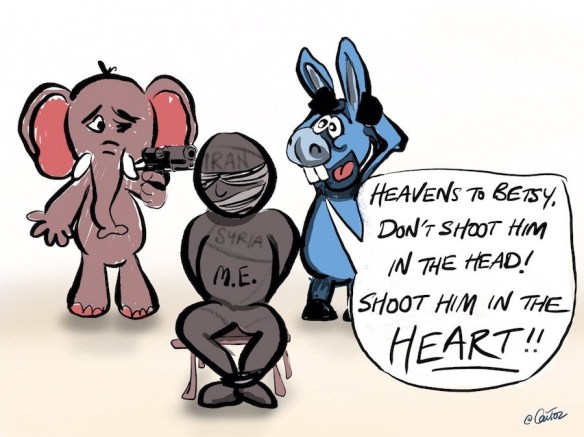
It is truly, deeply and profoundly stupid because the agenda to topple Iran’s government and the agenda to topple Syria’s government are not two separate agendas. They are the same. Supporting one while opposing the other is like wanting to shoot someone in the head but being morally opposed to shooting them in the heart.

Syria and Iran are allies. Eliminating one government necessarily hurts the other. Iran has been helping Syria to win the war against foreign-backed extremist proxy fighters who nearly succeeded in toppling Damascus before its allies stepped in, and should Syria succeed in rebuilding itself (something the Trump administration is actively preventing it from doing) we can be sure it would return the favor when called upon.

The US government’s agenda to “take out” all noncompliant governments in the Middle East is completely removed from any consideration for American party politics. It’s one unified agenda, and the more the imperial blob succeeds in weakening any of the remaining unabsorbed nations, the easier it gets to absorb the others.

Supporting regime change in Iran but not Syria, or vice-versa, is for this reason an inherently absurd position to take. If you opposed Obama’s attempt to topple Damascus via Timber Sycamore-armed proxies, it’s absurd for you to support any maneuvers which could lead to the elimination of Syria’s key ally in that fight. If you oppose Trump’s current warmongering toward Iran, it’s absurd for you to support the elimination of one of Iran’s remaining friends in the region.

If Iran falls you may be sure that Syria will fall next, and vice versa. It’s the same box being ticked; you’re just arguing over whether it should be a left-handed or right-handed check mark.

But such is the strength of propaganda. The perception managers of the US war machine have successfully manipulated the voting public into a debate not about whether regime change interventionism should happen, but which regime change intervention should happen first.

In a sense it’s quite brilliant; we may be quite sure that government agency departments responsible for domestic perception management on US foreign policy have discussed this precise dynamic at length. But in another sense it’s quite mundane: the recent Republican presidents have pursued regime change in Iran, while Obama pursued it in Syria, so Republicans support Republican interventions while Democrats support Democratic ones.

This has nothing to do with any substantial difference in these agendas (again, it’s actually one agenda) and everything to do with what each faction can be more easily propagandized toward. Liberal hearts are easier to grab with horror stories about a monster who gasses babies for no reason and less concerned about refugee crises and the persecution of Syrian Christians, while Republicans are much easier to manipulate into despising a theocracy run by Muslims.

And of course there’s overlap; people who prioritize mass murder above all else like John Bolton and Lindsey Graham will cheer enthusiastically for as much military interventionism as they can get in either country (or any country, really). But by and large, especially among the rank-and-file, people tend to support the interventions their respective presidents propagandized them into supporting. Propaganda is pretty much the only thing the presidential “bully pulpit” is used for.

Because Iraq has poisoned the idea, each mainstream faction may deny actually wanting the US to oust the government of Iran or Syria. Trump supporters who still stand by the anti-interventionist platform he falsely campaigned on may say “I don’t want war with Iran, I just want Iranians to get their freedom and I think it’s awesome they killed Solamumi or however you spell it.” Liberals might say “I don’t want interventionism! I just support the Freedom Fighters™️ in Idlib and want Assad to stop murdering civilians for fun and sexual gratification.” But circulating propaganda narratives about governments targeted for regime change is supporting regime change. You’re participating in it as surely as if you’d deployed the Tomahawk missiles yourself.

Yesterday someone told me that everyone at Qassem Soleimani’s incredibly massive funeral procession was attending because they were forced to. When I asked him if he was claiming that every single one of those millions of people were publicly mourning because they’d been literally forced at gunpoint, he told me no: many were forced in the sense that state propaganda was all they’d ever known, so they were psychologically coerced into grieving Soleimani.

“I don’t accept that your ‘state propaganda their whole lives’ model is any more coercive or fascistic than the kind that causes Americans to turn up to pro- and anti-Trump rallies,” I said. “Americans are no less propagandized than Iranians. If anything it’s worse, since Americans don’t know they’re being propagandized.”

“You’ve got it backwards,” he said. “Iranians don’t know they’re being propagandized because they only have one source of information. The U.S. knows it because we have sides screaming it to other sides all the time and the freedom of information and thought to come to our own conclusions.”

“Nonsense,” I replied. “Nearly all Americans are propagandized to the gills. They’re probably the most aggressively propagandized population on earth, just because so much depends on their swallowing propaganda. It’s just a more scientific sort.”

“And yet here we are, talking about it freely without worrying about swallowing a bullet,” he said.

“Here I am arguing with a man who just so happens to be striving very, very hard to convince me to swallow the exact same narrative that Mike Pompeo is trying to convince me to swallow,” I replied.

The greatest asset of the propagandists is the belief that we haven’t been propagandized.

US assassinates top Iranian general as 4,000 troops readied for Iraq intervention

Revolutionary Guard Gen. Qassem Soleimani, center, attends a meeting in Tehran, Iran. (Office of the Iranian Supreme Leader via AP, File).jpg

By Bill Van Auken

Source: WSWS.org

The targeted assassination of the commander of the Islamic Revolutionary Guard Corps’ (IRGC) Quds Force commander Major General Qasem Soleimani at Baghdad’s international airport early Friday morning has sharply intensified the spiraling conflict between the US and Iran, placing the outbreak of a catastrophic new war in the Middle East on a hair trigger.

The Iraqi and Lebanese media, as well as officials in Iraq’s Shia militia movement, reported that a US missile strike killed Soleimani after he had disembarked from a plane that had brought him to Iraq from either Syria or Lebanon. Also slain in the attack was Abu Mahdi al-Muhandis, the second in command of the Popular Mobilization Forces (PMF), the powerful coalition of Iraqi Shia militias.

The Pentagon issued a statement taking responsibility for the killing: “The U.S. military has taken decisive defensive action to protect U.S. personnel abroad by killing Qasem Soleimani, the head of the Iranian Revolutionary Guard Corps-Quds Force, a U.S.-designated Foreign Terrorist Organization.”

For its part, Iran’s Revolutionary Guards confirmed the killing, telling the Iranian media that “Honored supreme commander of Islam Soleimani was martyred in attack by U.S. helicopters.”

Soleimani has been a major figure within the Iranian military since the Iran-Iraq war of 1980-88. As head of the Quds Force, he played a central role in defeating the US-backed Al Qaeda-linked militias unleashed by Washington and its allies against the government of President Bashar al-Assad in Syria, and subsequently helped lead Iraqi militia forces in routing the Islamic State of Iraq and Syria (ISIS). While mentioned as a possible candidate for the Iranian presidency, he rejected any run for office, insisting that he would serve his country as a soldier.

He was well known to US officials and military commanders who had engaged in back-channel communications with the Iranian general since Tehran’s collaboration with Washington in the 2001 US invasion of Afghanistan.

The assassination came as the Pentagon dispatched another 750 US paratroopers to the Middle East, while 4,000 more have been placed on high alert for deployment to the region.

The deployment follows this week’s storming of the US Embassy in Baghdad by Iraqi demonstrators, an act of popular anger over US militarism that Washington blamed upon Iran.

Defense Secretary Mark Esper claimed on Thursday that there were “indications out there” that Iran is planning “additional attacks” on US forces or interests in the region and that Washington was prepared to “take preemptive action” if it received any “word of attacks or some kind of indication.”

“The game has changed,” Esper said. “Do I think they might do something? Yes, and they will likely regret it.”

Thus, US imperialism has arrogated to itself the “right” to launch not only assassinations, but devastating military attacks on Iran based on the claim that it is acting to “preempt” rumored or invented threats from any entity in the Middle East that Washington deems an Iranian “proxy.” This category stretches from Iraqi Shia militias to the Hezbollah mass political and militia movement in Lebanon to Hamas, the Islamist party that governs the Israeli-occupied territory of Gaza.

On Tuesday, the US Embassy in Baghdad came under siege by thousands of protesters outraged over the December 29 US air strikes against bases in both Iraq and Syria of Kata’ib Hizbullah, an Iraqi Shia militia. The bombings, carried out by US F-15E fighters, killed 25 of the militia’s members and wounded at least 55 others.

The Trump administration claimed that the airstrikes were in retaliation for a missile attack on Iraq’s K-1 military base outside of Kirkuk in which an American civilian contractor was killed. While Washington blamed Kata’ib Hizbullah for the attack, it has presented no evidence of its responsibility.

The protesters, including many militia members and supporters, had marched on the embassy, located in Baghdad’s heavily fortified Green Zone, following funeral services for the slain militia fighters that had brought thousands into the streets of the Iraqi capital.

They scaled the wall surrounding the US Embassy and laid siege to it, hurling Molotov cocktails and rocks. The embassy complex, the largest US diplomatic facility in the world, sprawls over 104 acres on the Tigris River and, at its high point in 2012, housed 16,000 US personnel, an effective continuation of the American occupation that formally ended in 2011.

The protesters managed to storm the main entrance to the complex, setting alight a guard booth and two reception rooms. Photographs released by the Associated Press on Wednesday showed the charred interiors of these areas of the embassy, with smashed furniture and windows and smoke still rising from the ruins.

Walls to the embassy compound were left covered with graffiti, including slogans such as “US embassy closed by order of the people” and “Death to America and Israel.”

US Marines manning the embassy’s interior fired continuous rounds of tear gas, stun grenades and warning shots in an attempt to disperse the protesters. Apache attack helicopters circled overhead firing flares toward the crowds in what was described as a “show of force.”

While the December 29 airstrikes were meant as a demonstration of US power and a blow to the Kata’ib Hizbullah militia, the popular response expressed in the siege of the embassy has exposed the immense crisis of Washington’s policy in Iraq and across the region.

The crowds of protesters were able to reach and enter the embassy only because the elite US-trained Iraqi antiterror troops deployed to protect the Green Zone, which also houses government buildings, other embassies and villas of the Iraqi oligarchy, offered no resistance whatsoever.

The event further exposes the predominant role played in the Iraqi government and its security forces by Shia militias—many of which originated in the fight against American troops following the criminal US invasion of Iraq in 2003—organized under the umbrella of the Popular Mobilization Forces (PMF). This had already become clear in 2014, when the Islamic State of Iraq and Syria (ISIS) was able to overrun roughly a third of Iraq after US-trained security forces collapsed, and the main opposition was mounted by the forces that would be organized into the PMF.

Infuriating the Trump administration, among those present at the embassy protest were Faleh al-Fayyadh, the nominal head of the PMF, who also serves as the country’s national security advisor, Hadi al-Amiri, the former minister of transport and leader of the Badr Brigades, one of the largest militias within the PMF, and other leading members of parliamentary factions tied to the Shia militias.

While the US ambassador had been meeting with these figures in recent months, US Secretary of State Mike Pompeo fired off an angry tweet, including a photograph of four of them, branding them as “terrorists.”

All of Iraq’s key government leaders, including the president, prime minister and head of the parliament, have denounced the US airstrikes as a violation of Iraqi sovereignty. Iraqi Prime Minister Abdul Mahdi, who heads a caretaker government after resigning in the face of mass protests against unemployment, social inequality and government corruption that have swept the country since last October, described the strikes as an “unacceptable vicious assault” against a militia that is considered part of Iraq’s armed forces and warned of its “dangerous consequences.” He described being notified by US Defense Secretary Esper of the impending bombings shortly before they were launched and pleading with him, unsuccessfully, to call them off.

The country’s President Barham Salih, who also condemned the US attack, described a similar conversation with a US diplomatic official.

While Trump fired off a tweet Wednesday thanking Abdul Mahdi and Salih for their “rapid response” to Washington’s demand that they provide security for the embassy, the US-trained Iraqi antiterrorism force charged with protecting the Green Zone, issued a pointed statement to the media denying that it had received an order to protect “any entity.”

The protesters left the Green Zone chanting “Yeah, we burned them!” after being told by militia leaders that they had achieved their purpose, and that legislation would be introduced in the Iraqi parliament demanding the expulsion of all US troops from the country.

While similar proposals have been introduced in the past without success, the present crisis may well have produced the conditions for the approval of such a measure. Leaders of a number of the blocs in the Iraqi legislature have signaled their support for ending the US military presence.

According to the Pentagon’s figures, some 5,000 uniformed US personnel are deployed in Iraq along with an unknown number—undoubtedly greater than that amount—of civilian military contractors. Their presence in the country was justified in the name of the “war on ISIS,” in which the US played a massively destructive role, reducing Mosul, previously Iraq’s second city, along with a number of other urban centers in Anbar province, into rubble and killing tens of thousands.

With ISIS smashed, Trump early last year allowed that having “spent a fortune on building this incredible base” in Iraq, Washington should keep it to “watch” Iran. The remark drew a swift rebuke from the Iraqi president, who stated that Iraq’s constitution “does not allow our territory … to be used against our neighbors” and that Baghdad did not want to be “part of any axis.”

If the Iraqi parliament were to vote for legislation mandating an end to the US military presence in Iraq, it is by no means clear that Washington would withdraw its troops. A continuation of the American occupation, initiated by an unprovoked and criminal invasion, would initiate a new stage in the protracted war that has devastated Iraqi society.

While Washington postures as the victim of missile attacks and an embassy invasion, the conflicts and tensions that continue to roil the Middle East are the product of decades of US military aggression and crippling economic sanctions against Iraq, Iran and Syria that have claimed well over a million lives.

This has culminated in the Trump administration’s abrogation last year of the 2015 nuclear accord between Tehran and the major world powers, followed by the initiation of a “maximum pressure” campaign aimed at reducing Iranian oil exports to zero and starving the Iranian population into accepting regime change and the installation of a US puppet government.

The recklessness and criminality that characterize Washington’s acts against Iran are not a sign of strength, but rather an expression of the deep-going social tensions, economic instability and political crisis gripping American capitalism, which the ruling financial oligarchy seeks to divert outward in an explosion of military violence.

A war against Iran would eclipse the horrific bloodshed of the Iraq war launched in 2003, drawing in the entire region and all of the major powers, including US imperialism’s so-called “great power” rivals Russia and China, bringing humanity face-to-face with the threat of a nuclear Third World War.

The Forgotten Past Will Always be Repeated

By Robert Fantina

Source: CounterPunch

“Those who cannot remember the past are condemned to repeat it.” So said George Santayana.

It is difficult today to look at many, many situations in the world and not see some of the worst events in history being repeated, especially as they relate to racism and genocide. Has the world forgotten Nazi atrocities against Jews, Gypsies, intellectuals and others? Do we not remember the horrific U.S. bombing of two Japanese cities? Are Churchill’s colonial atrocities no longer worth considering?

We will review some of the most egregious events unfolding in front of us today.

Israel: This racist, apartheid state, which, for over 70 years has brutally oppressed the Palestinian people, this year declared itself the nation-state of the Jewish people, and only the Jewish people. Yet 25% of people who live within the borders of the Zionist entity are not Jewish. And despite marginalizing fully one-quarter of its residents, and relegating them to second-class citizen status, government spokespeople have the nerve to proclaim Israel as a democracy.

And what international outrage does this bring? Despite flagrant and constant violations of international law, not to mention common human decency, most of the countries of the world either ignore it all, or issue gentle rebukes, at best. And the world’s media seldom reports on it.

Myanmar: For several years now, the repression and expulsion of the Rohingya people has been ongoing government policy. A United Nations study of August 2018 found evidence of widespread violations of human rights. As of that date, nearly three-quarters of a million Rohingya people have had to flee their homeland due to the brutal persecution they have experienced. The U.N. study stated that military abuses of the Rohingyas “undoubtedly amount to the gravest crimes under international law.” Yet, like Israel’s brutal oppression of the Palestinians, this gets little press in North America.

India: Earlier this year, the government of India revoked Article 370 in the constitution that allowed occupied Kashmir some limited autonomy. Since that time, tens of thousands of Indian troops have stormed into Kashmir, communications with the outside world have been cut, and news media personal are forbidden from entering. The death toll from this recent repression is unknown. Government officials have publicly announced plans to colonize Kashmir using the same model of land confiscation and illegal settlement construction that Israel has used for decades against Palestine. Again, one listens in vain for international opposition to these crimes against humanity.

Additionally, India has now passed a law easing the path for citizenship for many refugees, but making immigration by Muslims more difficult. This has caused widespread protest demonstration throughout India, which are being met with police violence.

Saudi Arabia: That nation’s brutal onslaught against the people of Yemen continues, with the Yemeni death toll in the thousands and constantly rising. A bill passed by the U.S. Congress to prevent the U.S. from selling more weaponry to Saudi Arabia (the largest buyer of weapons from the U.S.) for use in Yemen was vetoed by President Donald Trump, thus enabling the continued slaughter of the Yemenis.

United States: Undergirding all this is the United States. That nation provides huge amounts of financial support to apartheid Israel, as well as protecting it from the legitimate consequences of its action on the international stage. Government spokespeople talk of ‘monitoring’ the situation in Myanmar, and have been mainly silent about India.

But the U.S. remains busy: its decades-long sanctions against Cuba remain. Following some easing of restrictions during the administration of President Barack Obama, Trump has re-issued them all. His sanctions against Iran, in violation of the Joint Comprehensive Plan of Action (JCPOA) and international law are causing great hardship for the people there. The U.S. supports the overthrow of the governments of Venezuela, issuing cruel sanctions against that country, and Syria, going so far as to actually arm, equip and train anti-government terrorist groups in the country, where, due largely to U.S. interference, hundreds of thousands of people have died, and hundreds of thousands more have been injured and left homeless. U.S. brutality toward the Yemenis has been mentioned above. The U.S. was involved in the recent overthrow of the Bolivian government.

Yet as recently as this week, U.S. Secretary of State Mike Pompeo proclaimed that the U.S. supports the right of people everywhere to self-determination. He said this when announcing additional sanctions against Iran, the irony of it certainly being lost on him and Trump. Self-determination is all well and good in the eyes of the U.S. government, as long as certain conditions are met: the form of government the people select must not be socialist; it must be a government that will do the U.S.’s bidding; it must not be a government that thinks its country’s natural resources are its own; it must not question or oppose Israel in any way, and it must not put its people before U.S. corporate profits. It must, in all ways and at all times, be willing to do its part to satisfy the U.S.’s geo-political goals.

As we look at the results of forgetting, or not learning from, history, we should ask an important question: When similar behaviors, perpetrated by German, Italian and English leaders happened before, what was the result? Additional questions arise: Did Germany succeed in annexing its neighbors? Were Italy and England successful in achieving their political goals? No, the result of such behaviors was a war whose devastation exceeded anything that can be imagined. And it brought the United States into its role as a super-power, which has been detrimental for much of the world.

The U.S. has never been interested in human rights or international law. Those in power in that country have only coveted riches, and have been, and are, willing to obtain them in any way possible, regardless of how much blood must flow. And that blood can be of innocent men, women and children in a far-off country, or of its own citizens who it sends to war. It will attempt, however futilely, to order the world to its liking. And as people protest, all possible efforts will be made to crush them.

One thing the U.S. and many other nations have failed to learn is that people will only be able to tolerate the thwarting of their legitimate aspirations for a limited amount of time: they will not allow it to go on forever. Working to genuinely assist them will make more friends and allies, and ultimately be far more beneficial for the world than opposing them and oppressing them ever will.

Until the U.S. and other powerful nations learn this vital lesson, the suffering they cause will be unending.

The Child That Christmas Forgot: How Would Jesus Fare in the American Police State?

By John W. Whitehead

Source: The Rutherford Institute

“Once upon a midnight clear, there was a child’s cry, a blazing star hung over a stable, and wise men came with birthday gifts. We haven’t forgotten that night down the centuries. We celebrate it with stars on Christmas trees, with the sound of bells, and with gifts… We forget nobody, adult or child. All the stockings are filled, all that is, except one. And we have even forgotten to hang it up. The stocking for the child born in a manger. It’s his birthday we’re celebrating. Don’t let us ever forget that. Let us ask ourselves what He would wish for most. And then, let each put in his share, loving kindness, warm hearts, and a stretched out hand of tolerance. All the shining gifts that make peace on earth.”—The Bishop’s Wife (1947)

The Christmas story of a baby born in a manger is a familiar one.

The Roman Empire, a police state in its own right, had ordered that a census be conducted. Joseph and his pregnant wife Mary traveled to the little town of Bethlehem so that they could be counted. There being no room for the couple at any of the inns, they stayed in a stable (a barn), where Mary gave birth to a baby boy, Jesus. Warned that the government planned to kill the baby, Jesus’ family fled with him to Egypt until it was safe to return to their native land.

Yet what if Jesus had been born 2,000 years later?

What if, instead of being born into the Roman police state, Jesus had been born at this moment in time? What kind of reception would Jesus and his family be given? Would we recognize the Christ child’s humanity, let alone his divinity? Would we treat him any differently than he was treated by the Roman Empire? If his family were forced to flee violence in their native country and sought refuge and asylum within our borders, what sanctuary would we offer them?

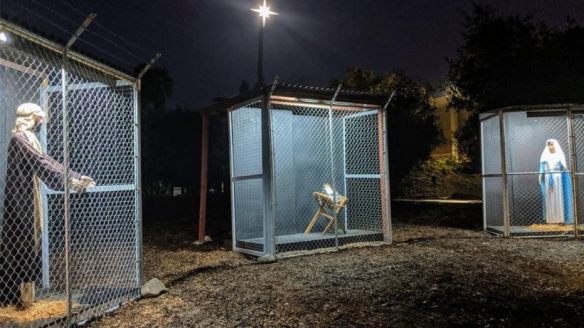
A singular number of churches across the country are asking those very questions, and their conclusions are being depicted with unnerving accuracy by nativity scenes in which Jesus and his family are separated, segregated and caged in individual chain-link pens, topped by barbed wire fencing.

These nativity scenes are a pointed attempt to remind the modern world that the narrative about the birth of Jesus is one that speaks on multiple fronts to a world that has allowed the life, teachings and crucifixion of Jesus to be drowned out by partisan politics, secularism, materialism and war.

The modern-day church has largely shied away from applying Jesus’ teachings to modern problems such as war, poverty, immigration, etc., but thankfully there have been individuals throughout history who ask themselves and the world: what would Jesus do?

What would Jesus—the baby born in Bethlehem who grew into an itinerant preacher and revolutionary activist, who not only died challenging the police state of his day (namely, the Roman Empire) but spent his adult life speaking truth to power, challenging the status quo of his day, and pushing back against the abuses of the Roman Empire—do?

Dietrich Bonhoeffer asked himself what Jesus would have done about the horrors perpetrated by Hitler and his assassins. The answer: Bonhoeffer risked his life to undermine the tyranny at the heart of Nazi Germany.

Aleksandr Solzhenitsyn asked himself what Jesus would have done about the soul-destroying gulags and labor camps of the Soviet Union. The answer: Solzhenitsyn found his voice and used it to speak out about government oppression and brutality.

Martin Luther King Jr. asked himself what Jesus would have done about America’s warmongering. The answer: declaring “my conscience leaves me no other choice,” King risked widespread condemnation when he publicly opposed the Vietnam War on moral and economic grounds.

Even now, despite the popularity of the phrase “What Would Jesus Do?” (WWJD) in Christian circles, there remains a disconnect in the modern church between the teachings of Christ and the suffering of what Jesus in Matthew 25 refers to as the “least of these.”

As the parable states:

“Then the King will say to those on his right, ‘Come, you who are blessed by my Father; take your inheritance, the kingdom prepared for you since the creation of the world. For I was hungry and you gave me something to eat, I was thirsty and you gave me something to drink, I was a stranger and you invited me in, I needed clothes and you clothed me, I was sick and you looked after me, I was in prison and you came to visit me.’ Then the righteous will answer him, ‘Lord, when did we see you hungry and feed you, or thirsty and give you something to drink? When did we see you a stranger and invite you in, or needing clothes and clothe you? When did we see you sick or in prison and go to visit you?’ The King will reply, ‘Truly I tell you, whatever you did for one of the least of these brothers and sisters of mine, you did for me.’ Then he will say to those on his left, ‘Depart from me, you who are cursed, into the eternal fire prepared for the devil and his angels. For I was hungry and you gave me nothing to eat, I was thirsty and you gave me nothing to drink, I was a stranger and you did not invite me in, I needed clothes and you did not clothe me, I was sick and in prison and you did not look after me.’ They also will answer, ‘Lord, when did we see you hungry or thirsty or a stranger or needing clothes or sick or in prison, and did not help you?’ He will reply, ‘Truly I tell you, whatever you did not do for one of the least of these, you did not do for me.’”

This is not a theological gray area: Jesus was unequivocal about his views on many things, not the least of which was charity, compassion, war, tyranny and love.

After all, Jesus—the revered preacher, teacher, radical and prophet—was born into a police state not unlike the growing menace of the American police state. When he grew up, he had powerful, profound things to say, things that would change how we view people, alter government policies and change the world. “Blessed are the merciful,” “Blessed are the peacemakers,” and “Love your enemies” are just a few examples of his most profound and revolutionary teachings.

When confronted by those in authority, Jesus did not shy away from speaking truth to power. Indeed, his teachings undermined the political and religious establishment of his day. It cost him his life. He was eventually crucified as a warning to others not to challenge the powers-that-be.

Can you imagine what Jesus’ life would have been like if, instead of being born into the Roman police state, he had been born and raised in the American police state?

Consider the following if you will.

Had Jesus been born in the era of the America police state, rather than traveling to Bethlehem for a census, Jesus’ parents would have been mailed a 28-page American Community Survey, a mandatory government questionnaire documenting their habits, household inhabitants, work schedule, how many toilets are in your home, etc. The penalty for not responding to this invasive survey can go as high as $5,000.

Instead of being born in a manger, Jesus might have been born at home. Rather than wise men and shepherds bringing gifts, however, the baby’s parents might have been forced to ward off visits from state social workers intent on prosecuting them for the home birth. One couple in Washington had all three of their children removed after social services objected to the two youngest being birthed in an unassisted home delivery.

Had Jesus been born in a hospital, his blood and DNA would have been taken without his parents’ knowledge or consent and entered into a government biobank. While most states require newborn screening, a growing number are holding onto that genetic material long-term for research, analysis and purposes yet to be disclosed.

Then again, had Jesus’ parents been undocumented immigrants, they and the newborn baby might have been shuffled to a profit-driven, private prison for illegals where they first would have been separated from each other, the children detained in make-shift cages, and the parents eventually turned into cheap, forced laborers for corporations such as Starbucks, Microsoft, Walmart, and Victoria’s Secret. There’s quite a lot of money to be made from imprisoning immigrants, especially when taxpayers are footing the bill.

From the time he was old enough to attend school, Jesus would have been drilled in lessons of compliance and obedience to government authorities, while learning little about his own rights. Had he been daring enough to speak out against injustice while still in school, he might have found himself tasered or beaten by a school resource officer, or at the very least suspended under a school zero tolerance policy that punishes minor infractions as harshly as more serious offenses.

Had Jesus disappeared for a few hours let alone days as a 12-year-old, his parents would have been handcuffed, arrested and jailed for parental negligence. Parents across the country have been arrested for far less “offenses” such as allowing their children to walk to the park unaccompanied and play in their front yard alone.

Rather than disappearing from the history books from his early teenaged years to adulthood, Jesus’ movements and personal data—including his biometrics—would have been documented, tracked, monitored and filed by governmental agencies and corporations such as Google and Microsoft. Incredibly, 95 percent of school districts share their student records with outside companies that are contracted to manage data, which they then use to market products to us.

From the moment Jesus made contact with an “extremist” such as John the Baptist, he would have been flagged for surveillance because of his association with a prominent activist, peaceful or otherwise. Since 9/11, the FBI has actively carried out surveillance and intelligence-gathering operations on a broad range of activist groups, from animal rights groups to poverty relief, anti-war groups and other such “extremist” organizations.

Jesus’ anti-government views would certainly have resulted in him being labeled a domestic extremist. Law enforcement agencies are being trained to recognize signs of anti-government extremism during interactions with potential extremists who share a “belief in the approaching collapse of government and the economy.”

While traveling from community to community, Jesus might have been reported to government officials as “suspicious” under the Department of Homeland Security’s “See Something, Say Something” programs. Many states, including New York, are providing individuals with phone apps that allow them to take photos of suspicious activity and report them to their state Intelligence Center, where they are reviewed and forwarded to law-enforcement agencies.

Rather than being permitted to live as an itinerant preacher, Jesus might have found himself threatened with arrest for daring to live off the grid or sleeping outside. In fact, the number of cities that have resorted to criminalizing homelessness by enacting bans on camping, sleeping in vehicles, loitering and begging in public has doubled.

Viewed by the government as a dissident and a potential threat to its power, Jesus might have had government spies planted among his followers to monitor his activities, report on his movements, and entrap him into breaking the law. Such Judases today—called informants—often receive hefty paychecks from the government for their treachery.

Had Jesus used the internet to spread his radical message of peace and love, he might have found his blog posts infiltrated by government spies attempting to undermine his integrity, discredit him or plant incriminating information online about him. At the very least, he would have had his website hacked and his email monitored.

Had Jesus attempted to feed large crowds of people, he would have been threatened with arrest for violating various ordinances prohibiting the distribution of food without a permit. Florida officials arrested a 90-year-old man for feeding the homeless on a public beach.

Had Jesus spoken publicly about his 40 days in the desert and his conversations with the devil, he might have been labeled mentally ill and detained in a psych ward against his will for a mandatory involuntary psychiatric hold with no access to family or friends. One Virginia man was arrested, strip searched, handcuffed to a table, diagnosed as having “mental health issues,” and locked up for five days in a mental health facility against his will apparently because of his slurred speech and unsteady gait.

Without a doubt, had Jesus attempted to overturn tables in a Jewish temple and rage against the materialism of religious institutions, he would have been charged with a hate crime. Currently, 45 states and the federal government have hate crime laws on the books.

Had anyone reported Jesus to the police as being potentially dangerous, he might have found himself confronted—and killed—by police officers for whom any perceived act of non-compliance (a twitch, a question, a frown) can result in them shooting first and asking questions later.

Rather than having armed guards capture Jesus in a public place, government officials would have ordered that a SWAT team carry out a raid on Jesus and his followers, complete with flash-bang grenades and military equipment. There are upwards of 80,000 such SWAT team raids carried out every year, many on unsuspecting Americans who have no defense against such government invaders, even when such raids are done in error.

Instead of being detained by Roman guards, Jesus might have been made to “disappear” into a secret government detention center where he would have been interrogated, tortured and subjected to all manner of abuses. Chicago police have “disappeared” more than 7,000 people into a secret, off-the-books interrogation warehouse at Homan Square.

Charged with treason and labeled a domestic terrorist, Jesus might have been sentenced to a life-term in a private prison where he would have been forced to provide slave labor for corporations or put to death by way of the electric chair or a lethal mixture of drugs.

Indeed, as I show in my book Battlefield America: The War on the American People, given the nature of government then and now, it is painfully evident that whether Jesus had been born in our modern age or his own, he still would have died at the hands of a police state.

Thus, as we draw near to Christmas with its celebrations and gift-giving, we would do well to remember that what happened on that starry night in Bethlehem is only part of the story. That baby in the manger grew up to be a man who did not turn away from evil but instead spoke out against it, and we must do no less.

Guns for Hire: No, the Government Shouldn’t Be Using the Military to Police the Globe

By John W. Whitehead

Source: The Rutherford Institute

“Of all the enemies to public liberty war is, perhaps, the most to be dreaded because it comprises and develops the germ of every other. War is the parent of armies; from these proceed debts and taxes… known instruments for bringing the many under the domination of the few.… No nation could preserve its freedom in the midst of continual warfare.” — James Madison

Eventually, all military empires fall and fail by spreading themselves too thin and spending themselves to death.

It happened in Rome.

It’s happening again.

At the height of its power, even the mighty Roman Empire could not stare down a collapsing economy and a burgeoning military. Prolonged periods of war and false economic prosperity largely led to its demise. As historian Chalmers Johnson predicts:

The fate of previous democratic empires suggests that such a conflict is unsustainable and will be resolved in one of two ways. Rome attempted to keep its empire and lost its democracy. Britain chose to remain democratic and in the process let go its empire. Intentionally or not, the people of the United States already are well embarked upon the course of non-democratic empire.

The American Empire—with its endless wars waged by U.S. military servicepeople who have been reduced to little more than guns for hire: outsourced, stretched too thin, and deployed to far-flung places to police the globe—is approaching a breaking point.

War has become a huge money-making venture, and America, with its vast military empire and its incestuous relationship with a host of international defense contractors, is one of its best buyers and sellers. In fact, as Reuters reports, “[President] Trump has gone further than any of his predecessors to act as a salesman for the U.S. defense industry.”

Under Trump’s leadership, the U.S. military is dropping a bomb every 12 minutes.

This follows on the heels of President Obama, the so-called antiwar candidate and Nobel Peace Prize winner who waged war longer than any American president and whose targeted-drone killings resulted in at least 1.3 million lives lost to the U.S.-led war on terror.

Most recently, the Trump Administration signaled its willingness to put the lives of American troops on the line in order to guard Saudi Arabia’s oil resources. Roughly 200 American troops will join the 500 troops already stationed in Saudi Arabia. That’s in addition to the 60,000 U.S. troops that have been deployed throughout the Middle East for decades.

As The Washington Post points out, “The United States is now the world’s largest producer — and its reliance on Saudi imports has dropped dramatically, including by 50 percent in the past two years alone.”

So if we’re not protecting the oil for ourselves, whose interests are we protecting?

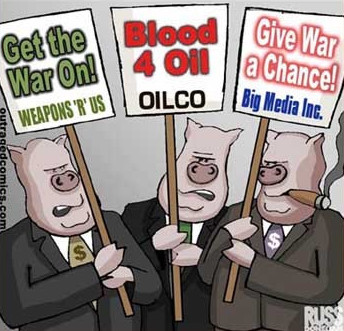
The military industrial complex is calling the shots, of course, and profit is its primary objective.

The military-industrial complex is also the world’s largest employer.

America has long had a penchant for endless wars that empty our national coffers while fattening those of the military industrial complex.

Aided and abetted by the U.S government, the American military-industrial complex has erected an empire unsurpassed in history in its breadth and scope, one dedicated to conducting perpetual warfare throughout the earth.

Although the U.S. constitutes only 5% of the world’s population, America boasts almost 50% of the world’s total military expenditure, spending more on the military than the next 19 biggest spending nations combined. Indeed, the Pentagon spends more on war than all 50 states combined spend on health, education, welfare, and safety.

Unfortunately, this level of war-mongering doesn’t come cheap to the taxpayers who are forced to foot the bill.

Having been co-opted by greedy defense contractors, corrupt politicians and incompetent government officials, America’s expanding military empire is bleeding the country dry at a rate of more than $32 million per hour.

In fact, the U.S. government has spent more money every five seconds in Iraq than the average American earns in a year.

With more than 800 U.S. military bases in 80 countries, the U.S. is now operating in 40 percent of the world’s nations at a cost of $160 to $200 billion annually.

Despite the fact that Congress has only officially declared war eleven times in the nation’s short history, the last time being during World War II, the United States has been at war for all but 21 of the past 243 years.

It’s cost the American taxpayer more than $4.7 trillion since 2001 to fight the government’s so-called “war on terrorism.” That’s in addition to “$127 billion in the last 17 years to train police, military and border patrol agents in many countries and to develop antiterrorism education programs, among other activities.” That does not include the cost of maintaining and staffing the 800-plus U.S. military bases spread around the globe.

The cost of perpetuating those endless wars and military exercises around the globe is expected to push the total bill upwards of $12 trillion by 2053.

The U.S. government is spending money it doesn’t have on a military empire it can’t afford.

As investigative journalist Uri Friedman puts it, for more than 15 years now, the United States has been fighting terrorism with a credit card, “essentially bankrolling the wars with debt, in the form of purchases of U.S. Treasury bonds by U.S.-based entities like pension funds and state and local governments, and by countries like China and Japan.”

War is not cheap, but it becomes outrageously costly when you factor in government incompetence, fraud, and greedy contractors.

For example, a leading accounting firm concluded that one of the Pentagon’s largest agencies “can’t account for hundreds of millions of dollars’ worth of spending.”

Unfortunately, the outlook isn’t much better for the spending that can be tracked.

Consider that the government lost more than $160 billion to waste and fraud by the military and defense contractors. With paid contractors often outnumbering enlisted combat troops, the American war effort dubbed as the “coalition of the willing” has quickly evolved into the “coalition of the billing,” with American taxpayers forced to cough up billions of dollars for cash bribes, luxury bases, a highway to nowhere, faulty equipment, salaries for so-called “ghost soldiers,” and overpriced anything and everything associated with the war effort, including a $640 toilet seat and a $7600 coffee pot.

A government audit found that defense contractor Boeing has been massively overcharging taxpayers for mundane parts, resulting in tens of millions of dollars in overspending. As the report noted, the American taxpayer paid:

$71 for a metal pin that should cost just 4 cents; $644.75 for a small gear smaller than a dime that sells for $12.51: more than a 5,100 percent increase in price. $1,678.61 for another tiny part, also smaller than a dime, that could have been bought within DoD for $7.71: a 21,000 percent increase. $71.01 for a straight, thin metal pin that DoD had on hand, unused by the tens of thousands, for 4 cents: an increase of over 177,000 percent.

That price gouging has become an accepted form of corruption within the American military empire is a sad statement on how little control “we the people” have over our runaway government.

There’s a good reason why “bloated,” “corrupt” and “inefficient” are among the words most commonly applied to the government, especially the Department of Defense and its contractors. Price gouging has become an accepted form of corruption within the American military empire.

It’s not just the American economy that is being gouged, unfortunately.

Driven by a greedy defense sector, the American homeland has been transformed into a battlefield with militarized police and weapons better suited to a war zone. Trump, no different from his predecessors, has continued to expand America’s military empire abroad and domestically, calling on Congress to approve billions more to hire cops, build more prisons and wage more profit-driven war-on-drugs/war-on-terrorism/war-on-crime programs that pander to the powerful money interests (military, corporate and security) that run the Deep State and hold the government in its clutches.

Mind you, this isn’t just corrupt behavior. It’s deadly, downright immoral behavior.

Essentially, in order to fund this burgeoning military empire that polices the globe, the U.S. government is prepared to bankrupt the nation, jeopardize our servicemen and women, increase the chances of terrorism and blowback domestically, and push the nation that much closer to eventual collapse.

Making matters worse, taxpayers are being forced to pay $1.4 million per hour to provide U.S. weapons to countries that can’t afford them. As Mother Jones reports, the Pentagon’s Foreign Military Finance program “opens the way for the US government to pay for weapons for other countries—only to ‘promote world peace,’ of course—using your tax dollars, which are then recycled into the hands of military-industrial-complex corporations.”

Clearly, our national priorities are in desperate need of an overhauling.

As Los Angeles Times reporter Steve Lopez rightly asks:

Why throw money at defense when everything is falling down around us? Do we need to spend more money on our military (about $600 billion this year) than the next seven countries combined? Do we need 1.4 million active military personnel and 850,000 reserves when the enemy at the moment — ISIS — numbers in the low tens of thousands? If so, it seems there’s something radically wrong with our strategy. Should 55% of the federal government’s discretionary spending go to the military and only 3% to transportation when the toll in American lives is far greater from failing infrastructure than from terrorism? Does California need nearly as many active military bases (31, according to militarybases.com) as it has UC and state university campuses (33)? And does the state need more active duty military personnel (168,000, according to Governing magazine) than public elementary school teachers (139,000)?

The illicit merger of the global armaments industry and the Pentagon that President Dwight D. Eisenhower warned us against more than 50 years ago has come to represent perhaps the greatest threat to the nation’s fragile infrastructure today.

The government is destabilizing the economy, destroying the national infrastructure through neglect and a lack of resources, and turning taxpayer dollars into blood money with its endless wars, drone strikes and mounting death tolls.

This is exactly the scenario Eisenhower warned against when he cautioned the citizenry not to let the profit-driven war machine endanger our liberties or democratic processes:

“Every gun that is made, every warship launched, every rocket fired signifies, in the final sense, a theft from those who hunger and are not fed, those who are cold and are not clothed. This world in arms is not spending money alone. It is spending the sweat of its laborers, the genius of its scientists, the hopes of its children. The cost of one modern heavy bomber is this: a modern brick school in more than 30 cities. It is two electric power plants, each serving a town of 60,000 population. It is two fine, fully equipped hospitals. It is some fifty miles of concrete pavement. We pay for a single fighter plane with a half million bushels of wheat. We pay for a single destroyer with new homes that could have housed more than 8,000 people. This is, I repeat, the best way of life to be found on the road the world has been taking. This is not a way of life at all, in any true sense. Under the cloud of threatening war, it is humanity hanging from a cross of iron.”

We failed to heed Eisenhower’s warning.

The illicit merger of the armaments industry and the government that Eisenhower warned against has come to represent perhaps the greatest threat to the nation today.

What we have is a confluence of factors and influences that go beyond mere comparisons to Rome. It is a union of Orwell’s 1984 with its shadowy, totalitarian government—i.e., fascism, the union of government and corporate powers—and a total surveillance state with a military empire extended throughout the world.

This is how tyranny rises and freedom falls.

As I make clear in my book Battlefield America: The War on the American People, the growth of and reliance on militarism as the solution for our problems both domestically and abroad bodes ill for the constitutional principles which form the basis of the American experiment in freedom.

After all, a military empire ruled by martial law does not rely on principles of equality and justice for its authority but on the power of the sword. As author Aldous Huxley warned: “Liberty cannot flourish in a country that is permanently on a war footing, or even a near-war footing. Permanent crisis justifies permanent control of everybody and everything by the agencies of the central government.”


Nuclear War: Just Another Day


By Colin Todhunter

Source: OffGuardian

Catastrophic events that send the world into turmoil happen on ‘just another day’. The atom bomb that exploded over Hiroshima took place while thousands of ordinary folk were just going about their everyday business on ‘just another day’.

A missile attack on a neighbourhood in Gaza or a drone attack on unsuspecting civilians in Afghanistan: death and destruction come like a bolt from the blue as people shop at the local market or take their kids to school on ‘just another day’.

Will it be ‘just another day’ when the next nuclear bomb is exploded in anger, an ordinary day when people are just going about their daily business? By then it might be too late to do anything, too late to act to try to prevent an unfolding global catastrophe on a scale never before witnessed by humans.

Yet so many appear too apathetic and wrapped up in a world of gadgets, technology, shopping malls, millionaire sports players and big-time sports events to think that such a thing could be imminent.

Are they so preoccupied with the machinations of their own lives in cotton-wool cocooned societies to think that what is happening in Syria or Iraq is just too boring to follow or that it doesn’t really concern them or it is ‘not my problem’?

Do they think they are untouchable, that only death, war and violence happens in faraway places?

Could any of us even contemplate that on some not-too-distant day a series of European cities could be laid waste within a matter of minutes? It isn’t worth thinking about. Or is it.

The US (and the West’s) foreign policy is being driven on the basis of fake morality and duplicity. Millions lie dead in Iraq, Afghanistan, Syria and Libya as a result of US-led imperialism, and nuclear-armed Russia is constantly demonised simply because it will not acquiesce to Washington and serve as a vassal state.

And now, as the US continues to stir up tensions with Iran and as China warns neighbouring countries about allowing US nuclear missiles aimed at it on their territories, much of the Western public and media remain oblivious to the dangers of conflict escalation and the biggest immediate threat to all life on Earth: nuclear war.

The threat of mass murder

Some fell to the ground and their stomachs already expanded full, burst and organs fell out. Others had skin falling off them and others still were carrying limbs. And one in particular was carrying their eyeballs in their hand.”

The above extract comes from an account by a Hiroshima survivor talking about the fate of her schoolmates. In 2016, it was read out in the British parliament by Scottish National Party MP Chris Law during a debate about Britain’s nuclear arsenal.

In response to a question from MP George Kereven, the then British PM Theresa May said without hesitation that, if necessary, she would authorise the use of a nuclear weapon that would kill hundreds of thousands of innocent men, women and children. May also implied that those wishing to scrap Britain’s nuclear weapons are siding with the nation’s enemies.

Politicians like May read from a script devised by elite interests. This transnational capitalist class dictates global economic policies and decides on who lives and who dies and which wars are fought and inflicted on which people.

The mainstream narrative tends to depict individuals who belong to this class as ‘wealth creators’. In reality, however, these ‘high flyers’ have stolen ordinary people’s wealth, stashed it away in tax havens, bankrupted economies and have imposed a form of globalisation that results in devastating destruction and war for those who attempt to remain independent or structurally adjusted violence via privatisation and economic neo-liberalism for millions in countries that have acquiesced.

While ordinary folk across the world have been subjected to policies that have resulted in oppression, poverty and conflict, this is all passed off by politicians and the mainstream media as the way things must be.

The agritech sector poisons our food and agriculture. Madelaine Albright says it was worth it to have killed half a million kids in Iraq to secure energy resources for rich corporations and extend the wider geopolitical goals of ‘corporate America’. The welfare state is dismantled and austerity is imposed on millions. The rich increase their already enormous wealth.

Powerful corporations corrupt government machinery and colonise every aspect of life for profit. Environmental destruction and ecological devastation continue apace.

And nuclear weapons hang over humanity like the sword of Damocles.

The public is supposed to back this status quo in support of what? Austerity, powerlessness, imperialism, propping up the US dollar and a moribund system. For whom? Occidental Petroleum, Soros, Murdoch, Rothschild, BP, JP Morgan, Boeing and the rest of the elite and their corporations whose policies are devised in think tanks and handed to politicians to sell to a largely ignorant public: those who swallow the lie about some ‘war on terror’ or Washington as the world’s policeman, protecting life and liberty.

Rejecting hegemonic thought

Many believe nuclear weapons are a necessary evil and fall into line with hegemonic thinking about humanity being inherently conflictual, competitive and war-like.

Such tendencies do of course exist, but they do not exist in a vacuum. They are fuelled by capitalism and imperialism and played upon by politicians, the media and elite interests who seek to scare the population into accepting a ‘necessary’ status quo.

Co-operation and equality are as much a part of any arbitrary aspect of ‘human nature’ as any other defined characteristic. These values are, however, sidelined by a system of capitalism that is inherently conflict-ridden and expansionist.

Much of humanity has been convinced to accept the potential for instant nuclear Armageddon hanging over its collective head as a given, as a ‘deterrent’. However, the reality is that these weapons exist to protect elite, imperialist interests or to pressure others to cave into their demands.

If the 20th century has shown us anything, it is these interests are adept at gathering the masses under notions of flag, god and country to justify their slaughter.

To prevent us all shuddering with the fear of the threat of instant nuclear destruction on a daily basis, it’s a case of don’t worry, be happy, forget about it and watch TV.

It was the late academic Rick Roderick who highlighted that modern society trivialises issues that are of ultimate importance: they eventually become banal or ‘matter of fact’ to the population.

People are spun the notion that nuclear-backed militarism and neoliberalism and its structural violence are necessary for securing peace, defeating terror, creating prosperity or promoting ‘growth’. The ultimate banality is to accept this pack of lies and to believe there is no alternative, to acquiesce or just switch off to it all.

Instead of acquiescing and accepting it as ‘normal’, we should listen to writer and campaigner Robert J Burrowes:

Many people evade responsibility, of course, simply by believing and acting as if someone else, perhaps even ‘the government’, is ‘properly’ responsible. Undoubtedly, however, the most widespread ways of evading responsibility are to deny any responsibility for military violence while paying the taxes to finance it, denying any responsibility for adverse environmental and climate impacts while making no effort to reduce consumption, denying any responsibility for the exploitation of other people while buying the cheap products produced by their exploited (and sometimes slave) labour, denying any responsibility for the exploitation of animals despite eating and/or otherwise consuming a range of animal products, and denying any part in inflicting violence, especially on children, without understanding the many forms this violence can take.”

Burrowes concludes by saying that ultimately, we evade responsibility by ignoring the existence of a problem. The evasion of responsibility, acquiescence and acceptance are, of course, part of the conditioning process.

The ‘problem’ encompasses not only ongoing militarism, but the structural violence of neoliberal capitalism, aided and abetted by the World Bank, IMF and the WTO. It’s a type of violence that is steady, lingering and a daily fact of life under globalised capitalism.

Of course, oppression and conflict have been a feature throughout history and have taken place under various economic and political systems. Indeed, in his various articles, Burrowes goes deep into the psychology and causes of violence.

But there is potentially a different path for humanity.

In 1990, the late British MP Tony Benn gave a speech in parliament (above) that indicated the kind of values that such a route might look like.

Benn spoke about having been on a crowded train, where people had been tapping away on calculators and not interacting or making eye contact with one another. It represented what Britain had apparently become under Thatcherism: excessively individualistic, materialistic, narcissistic and atomised.

The train broke down. As time went by, people began to talk with one another, offer snacks and share stories. Benn said it wasn’t too long before that train had been turned into a socialist train of self-help, communality and comradeship.

Despite the damaging policies and ideology of Thatcherism, these features had survived her tenure, were deeply embedded and never too far from the surface.

For Tony Benn, what had been witnessed aboard that train was an aspect of ‘human nature’ that is too often suppressed, devalued and, when used as a basis for political change, regarded as a threat to ruling interests.

It is an aspect that draws on notions of unity, solidarity, common purpose, self-help and finds its ultimate expression in the vibrancy of community, the collective ownership of productive resources and co-operation.

The type of values far removed from the destructive, divisive ones of imperialism and capitalism which key politicians and the corporate media protect and promote.


Rage Against the War Machine: An Interview with Peace Activist Cindy Sheehan

By Mnar Muhawesh

Source: Mint Press News

Some 2.7 billion dollars per day. That’s how much the U.S. government will spend next year to prop up the military and the more than 800 bases it maintains in over 70 countries. All in the name of national security. And despite that staggering figure, a majority of Americans feel that the wars in Iraq and Afghanistan were not even worth fighting, and they certainly have not made America safer.

That money is more than enough to pay for four years of college for every college student in this country, to fund food stamps and other social safety nets that help our most vulnerable, and to fund programs that would cut fossil-fuel emissions by 40 percent by 2035.

Despite this, there has been an utter failure by both the media and grassroots activists to address the growing waste and greed of the military-industrial complex.

An estimated 4 million people just took part in worldwide climate strikes that put the issue of climate breakdown at the forefront of the media conversation. Missing from this conversation, however, is an analysis of the role militarism and empire plays in driving the chaos. The U.S. military is the world’s largest polluter and emits more carbon dioxide than a hundred countries combined.

You see, America does not have a budget problem, it has a priorities problem; until we demand that our leaders prioritize our needs over those of corporations and those who profit off of war, our politicians will continue to pilfer taxpayer dollars by the trillions to fund forever wars that support building the largest empire history has seen.

Today, Donald Trump is the ugly face of the American Empire, and recently declared the country to be “locked and loaded” and ready to confront the Islamic Republic of Iran. And with conflicts in Iraq, Afghanistan and Syria (to mention only a few) ongoing, it feels like the cycle of war may never end.

The anti-war movement in the U.S., so strong under George W. Bush’s presidency, was effectively disarmed by his successor. Barack Obama put a friendly face on U.S. imperialism and, with the help of Hillary Clinton as his secretary of state, even managed to convince many so-called liberals and progressives to support devastating regime-change operations in Libya, Syria and Ukraine on humanitarian grounds. These interventions unleashed al-Qaeda and ISIS onto the Middle East and neo-Nazi rule on Russia’s borders. Obama expanded America’s wars, dropping over 25,000 bombs targeting seven different countries: Afghanistan, Iraq, Syria, Libya, Yemen, Somalia and Pakistan. He expanded drone wars, earning the nickname “Drone King,” and expanded U.S. bases across Africa under the guise of fighting the War on Terror.

While the Democratic Party and establishment-left mourned Obama’s exit from the White House, warning of a new era of fascism under President Trump, hundreds of thousands of outraged Americans took to the streets in protests against the new Republican president’s racism, misogyny, and xenophobia. This outrage gave birth to the Women’s March. But as these protests swelled, one couldn’t help wondering why there wasn’t any mobilization remotely on this scale in the previous eight years during Obama’s presidency?

This question crossed the mind of Cindy Sheehan, a longtime anti-war activist nicknamed “Peace Mom,” who contacted the organizers of the Women’s March — since one of the movement’s stated goals was to end violence against women — and asked them to make peace a central focus of the march.

But the response of a key organizer of the march showed just how little war and peace was a priority to establishment liberals: “I appreciate that war is your issue Cindy, but the Women’s March will never address the war issue as long as women aren’t free.”

Sheehan rejected the notion that women could be “free” without addressing war and empire. She countered the dismissive comment of the march organizer by stating that divorcing peace activism from women’s issues “ignored the voices of the [millions] of women of the world who are being bombed and oppressed by U.S. military occupation.”

It was clear that the anti-war movement needed to be reborn again, and who better than Sheehan herself could fit the bill?

Cindy grew up in California, where her father worked for the Lockheed corporation. A turning point in her life came in April 2004 after her son Casey was killed while on active service with the U.S. military in Iraq. She gained national attention after she staged an extended protest outside George W. Bush’s ranch in Crawford, Texas, demanding to meet him.

Since then she has tirelessly campaigned against war and violence abroad, being described as the “Rosa Parks of the peace movement.” Throughout her activism, she has taken a nonpartisan stance in speaking truth to power, calling out George W. Bush as the biggest terrorist in the world, but also traveling to Norway to protest Barack Obama’s Nobel Peace Prize. In 2012 she was the vice-presidential nominee of the Peace and Freedom Party.

Today, Cindy is the chief organizer of the upcoming Rage Against the War Machine protests in Washington, scheduled to take place on October 11.


Mnar Muhawesh is founder, CEO and editor in chief of MintPress News, and is also a regular speaker on responsible journalism, sexism, neoconservativism within the media and journalism start-ups.

War Profiteers and the Demise of the US Military-Industrial Complex

By Dmitry Orlov

Source: Club Orlov

Within the vast bureaucratic sprawl of the Pentagon there is a group in charge of monitoring the general state of the military-industrial complex and its continued ability to fulfill the requirements of the national defense strategy. Office for acquisition and sustainment and office for industrial policy spends some $100,000 a year producing an Annual Report to Congress. It is available to the general public. It is even available to the general public in Russia, and Russian experts had a really good time poring over it.

In fact, it filled them with optimism. You see, Russia wants peace but the US seems to want war and keeps making threatening gestures against a longish list of countries that refuse to do its bidding or simply don’t share its “universal values.” But now it turns out that threats (and the increasingly toothless economic sanctions) are pretty much all that the US is still capable of dishing out—this in spite of absolutely astronomical levels of defense spending. Let’s see what the US military-industrial complex looks like through a Russian lens.

It is important to note that the report’s authors were not aiming to force legislators to finance some specific project. This makes it more valuable than numerous other sources, whose authors’ main objective was to belly up to the federal feeding trough, and which therefore tend to be light on facts and heavy on hype. No doubt, politics still played a part in how various details are portrayed, but there seems to be a limit to the number of problems its authors can airbrush out of the picture and still do a reasonable job in analyzing the situation and in formulating their recommendations.

What knocked Russian analysis over with a feather is the fact that these INDPOL experts (who, like the rest of the US DOD, love acronyms) evaluate the US military-industrial complex from a… market-based perspective! You see, the Russian military-industrial complex is fully owned by the Russian government and works exclusively in its interests; anything else would be considered treason. But the US military-industrial complex is evaluated based on its… profitability! According to INDPOL, it must not only produce products for the military but also acquire market share in the global weapons trade and, perhaps most importantly, maximize profitability for private investors. By this standard, it is doing well: for 2017 the gross margin (EBITDA) for US defense contractors ranged from 15 to 17%, and some subcontractors—Transdigm, for example—managed to deliver no less than 42-45%. “Ah!” cry the Russian experts, “We’ve found the problem! The Americans have legalized war profiteering!” (This, by the way, is but one of many instances of something called systemic corruption, which is rife in the US.)

It would be one thing if each defense contractor simply took its cut off the top, but instead there is an entire food chain of defense contractors, all of which are legally required, no less, to maximize profits for their shareholders. More than 28,000 companies are involved, but the actual first-tier defense contractors with which the Pentagon places 2/3 of all defense contracts are just the Big Six: Lockheed Martin, Northrop Grumman, Raytheon, General Dynmics, BAE Systems and Boeing. All the other companies are organized into a pyramid of subcontractors with five levels of hierarchy, and at each level they do their best to milk the tier above them.

The insistence on market-based methods and the requirement of maximizing profitability turns out to be incompatible with defense spending on a very basic level: defense spending is intermittent and cyclical, with long fallow intervals between major orders. This has forced even the Big Six to make cuts to their defense-directed departments in favor of expanding civilian production. Also, in spite of the huge size of the US defense budget, it is of finite size (there being just one planet to blow up), as is the global weapons market. Since, in a market economy, every company faces the choice of grow or get bought out, this has precipitated scores of mergers and acquisitions, resulting in a highly consolidated marketplace with a few major players in each space.

As a result, in most spaces, of which the report’s authors discuss 17, including the Navy, land forces, air force, electronics, nuclear weapons, space technology and so on, at least a third of the time the Pentagon has a choice of exactly one contractor for any given contract, causing quality and timeliness to suffer and driving up prices.

In a number of cases, in spite of its industrial and financial might, the Pentagon has encountered insoluble problems. Specifically, it turns out that the US has only one shipyard left that is capable of building nuclear aircraft carriers (at all, that is; the USS Gerald Ford is not exactly a success). That is Northrop Grumman Newport News Shipbuilding in Newport, Virginia. In theory, it could work on three ships in parallel, but two of the slips are permanently occupied by existing aircraft carriers that require maintenance. This is not a unique case: the number of shipyards capable of building nuclear submarines, destroyers and other types of vessels is also exactly one. Thus, in case of a protracted conflict with a serious adversary in which a significant portion of the US Navy has been sunk, ships will be impossible to replace within any reasonable amount of time.

The situation is somewhat better with regard to aircraft manufacturing. The plants that exist can produce 40 planes a month and could produce 130 a month if pressed. On the other hand, the situation with tanks and artillery is absolutely dismal. According to this report, the US has completely lost the competency for building the new generation of tanks. It is no longer even a question of missing plant and equipment; in the US, a second generation of engineers who have never designed a tank is currently going into retirement. Their replacements have no one to learn from and only know about modern tanks from movies and video games. As far as artillery, there is just one remaining production line in the US that can produce barrels larger than 40mm; it is fully booked up and would be unable to ramp up production in case of war. The contractor is unwilling to expand production without the Pentagon guaranteeing at least 45% utilization, since that would be unprofitable.

The situation is similar for the entire list of areas; it is better for dual-use technologies that can be sourced from civilian companies and significantly worse for highly specialized ones. Unit cost for every type of military equipment goes up year after year while the volumes being acquired continuously trend lower—sometimes all the way to zero. Over the past 15 years the US hasn’t acquired a single new tank. They keep modernizing the old ones, but at a rate that’s no higher than 100 a year.

Because of all these tendencies and trends, the defense industry continues to lose not only qualified personnel but also the very ability to perform the work. INDPOL experts estimate that the deficit in machine tools has reached 27%. Over the past quarter-century the US has stopped manufacturing a wide variety of manufacturing equipment. Only half of these tools can be imported from allies or friendly nations; for the rest, there is just one source: China. They analyzed the supply chains for 600 of the most important types of weapons and found that a third of them have breaks in them while another third have completely broken down. In the Pentagon’s five-tier subcontractor pyramid, component manufacturers are almost always relegated to the bottommost tier, and the notices they issue when they terminate production or shut down completely tend to drown in the Pentagon’s bureaucratic swamp.

The end result of all this is that theoretically the Pentagon is still capable of doing small production runs of weapons to compensate for ongoing losses in localized, low-intensity conflicts during a general time of peace, but even today this is at the extreme end of its capabilities. In case of a serious conflict with any well-armed nation, all it will be able to rely on is the existing stockpile of ordnance and spare parts, which will be quickly depleted.

A similar situation prevails in the area of rare earth elements and other materials for producing electronics. At the moment, the accumulated stockpile of these supplies needed for producing missiles and space technology—most importantly, satellites—is sufficient for five years at the current rate of use.

The report specifically calls out the dire situation in the area of strategic nuclear weapons. Almost all the technology for communications, targeting, trajectory calculations and arming of the ICBM warheads was developed in the 1960s and 70s. To this day, data is loaded from 5-inch floppy diskettes, which were last mass-produced 15 years ago. There are no replacements for them and the people who designed them are busy pushing up daisies. The choice is between buying tiny production runs of all the consumables at an extravagant expense and developing from scratch the entire land-based strategic triad component at the cost of three annual Pentagon budgets.

There are lots of specific problems in each area described in the report, but the main one is loss of competence among technical and engineering staff caused by a low level of orders for replacements or for new product development. The situation is such that promising new theoretical developments coming out of research centers such as DARPA cannot be realized given the present set of technical competencies. For a number of key specializations there are fewer than three dozen trained, experienced specialists.

This situation is expected to continue to deteriorate, with the number of personnel employed in the defense sector declining 11-16% over the next decade, mainly due to a shortage of young candidates qualified to replace those who are retiring. A specific example: development work on the F-35 is nearing completion and there won’t be a need to develop a new jet fighter until 2035-2040; in the meantime, the personnel who were involved in its development will be idled and their level of competence will deteriorate.

Although at the moment the US still leads the world in defense spending ($610 billion of $1.7 trillion in 2017, which is roughly 36% of all the military spending on the planet) the US economy is no longer able to support the entire technology pyramid even in a time of relative peace and prosperity. On paper the US still looks like a leader in military technology, but the foundations of its military supremacy have eroded. Results of this are plainly visible:

• The US threatened North Korea with military action but was then forced to back off because it has no ability to fight a war against it.

• The US threatened Iran with military action but was then forced to back off because it has no ability to fight a war against it.

• The US lost the war in Afghanistan to the Taliban, and once the longest military conflict in US history is finally over the political situation there will return to status quo ante with the Taliban in charge and Islamic terrorist training camps back in operation.

• US proxies (Saudi Arabia, mostly) fighting in Yemen have produced a humanitarian disaster but have been unable to prevail militarily.

• US actions in Syria have led to a consolidation of power and territory by the Syrian government and newly dominant regional position for Russia, Iran and Turkey.

• The second-largest NATO power Turkey has purchased Russian S-400 air defense systems. The US alternative is the Patriot system, which is twice as expensive and doesn’t really work.

All of this points to the fact that the US is no longer much a military power at all. This is good news for at least the following four reasons.

First, the US is by far the most belligerent country on Earth, having invaded scores of nations and continuing to occupy many of them. The fact that it can’t fight any more means that opportunities for peace are bound to increase.

Second, once the news sinks in that the Pentagon is nothing more than a flush toilet for public funds its funding will be cut off and the population of the US might see the money that is currently fattening up war profiteers being spent on some roads and bridges, although it’s looking far more likely that it will all go into paying interest expense on federal debt (while supplies last).

Third, US politicians will lose the ability to keep the populace in a state of permanent anxiety about “national security.” In fact, the US has “natural security”—two oceans—and doesn’t need much national defense at all (provided it keeps to itself and doesn’t try to make trouble for others). The Canadians aren’t going to invade, and while the southern border does need some guarding, that can be taken care of at the state/county level by some good ol’ boys using weapons and ammo they already happen to have on hand. Once this $1.7 trillion “national defense” monkey is off their backs, ordinary American citizens will be able to work less, play more and feel less aggressive, anxious, depressed and paranoid.

Last but not least, it will be wonderful to see the war profiteers reduced to scraping under sofa cushions for loose change. All that the US military has been able to produce for a long time now is misery, the technical term for which is “humanitarian disaster.” Look at the aftermath of US military involvement in Serbia/Kosovo, Afghanistan, Iraq, Libya, Syria and Yemen, and what do you see? You see misery—both for the locals and for US citizens who lost their family members, had their limbs blown off, or are now suffering from PTSD or brain injury. It would be only fair if that misery were to circle back to those who had profited from it.