50 Years After JFK

AMERICAN ROYALTY JFK DALLAS 03

In the half century since JFK’s assassination researchers have yet to determine conclusively who did it, but what can be proven definitively is that the official story is a lie. Despite overwhelming evidence that Lee Harvey Oswald could not possibly have killed JFK in the way claimed by the Warren Commission Report, many in the corporate media still cling to the belief that he was the “lone gunman”. Most who have examined the assassination in-depth suspect the involvement of a cabal of different factions, which JFK himself referenced in his famous address to the American Newspaper Publishers Association in 1961.

Some of the people involved include those most opposed to the truth getting out. Documented evidence reveals the CIA was so threatened by independent researchers looking into JFK’s murder, they coined a new ad hominem attack to discredit them: “Conspiracy Theorists”. Worse than assassinating people’s character is actual assassination, which may have been behind the suspiciously large number witnesses holding important information for investigators who died in mysterious circumstances. Others involved in the “anti-conspiracy conspiracy” might include select heads of corporate news outlets who to this day continue to push the official story and discredit all information which contradicts it. Of course many people within groups involved in the cover-up had no direct role in the planning and execution of the assassination. Some might believe mass distrust of government would be too damaging were the truth to get out, others could be doing favors for powerful allies, were paid off, and/or pressured into cooperating.

As much as the establishment would like us to ridicule and dismiss those who believe anything other than the official story, more people than ever are open to alternative theories because so many have been proven to be true over time, there’s greater awareness that governments and corporations do lie, cheat, steal and kill, and the internet has empowered more people than ever to research on their own or at least cross-check information. Though it’s likely we will never see justice for JFK, because of the work of “conspiracy theorists” we are now more aware of the scope of government/corporate criminality and connections between government, wall street, war-profiteers, and the criminal underworld. Information uncovered related to the JFK assassination provides a glimpse into “deep politics” and an alternative historical narrative. Connections to JFK can be made to Watergate, Iran-Contra, and 9/11 (which is not too surprising because they benefit the same military-industrial geopolitical factions). As new evidence continues to expand our understanding of what took place on 11/22/63, such knowledge could also help us understand government/corporate crimes of the present and future.

On the Smells Like Human Spirit podcast, host Guy Evans interviews author and activist Dr. Michael Parenti and whistleblower/ex-secret service agent Abraham Bolden on the events of 11/22/63:

[audio http://traffic.libsyn.com/smellslikepodcast/SLHS111.mp3 ]

James Corbett on why JFK still matters:

Bill Hick’s irreverent take on the official story:

A short film on the JFK assassination:
Justice System May Be Deaf & Dumb But Not Blind

blind_justice

Compare and contrast the following recent police encounters. In the first, a man who was reportedly behaving in a hostile and erratic manner rams his SUV into a police car before they have a chance to pull him over. He leads a second police car on a chase before ramming into a third police vehicle. He backs up the SUV and rams it a second time before being blocked in by the car behind him. The man continues to fight the police as they attempt to get him out of the SUV and is eventually tasered and arrested.

In the second case, a woman in a minivan with five kids on board as passengers are pulled over for going 71 in a 55 mph zone. She argues with the police over the ticket and drives off but is pulled over again shortly after. A police officer tries to pull the kids out of the van before being rushed by the driver’s 14 year son who is tasered. The officer begins smashing the van’s windows with his baton as backup arrives. The woman attempts to flee again and an officer fires three shots at her van. She leads the police on a chase before surrendering in front of a hotel.

There’s a number of different factors behind the approaches taken by the police in the two cases, but one can’t help but wonder if race and class may have played a part in the way the respective drivers were treated. The first case took place in Oregon and the driver was Dave Dahl, a white man and founder of a local bread company. The police knew who he was because they received a call from someone believing he was off his medication and suffering from a mental breakdown. Whether Oregon police are better trained and/or afraid of getting sued, they demonstrated that police can effectively stop potentially dangerous reckless drivers without resorting to guns.

In the second case the driver was Oriana Ferrell, a black woman from Memphis on vacation with her kids. Though she didn’t deal with the situation in the wisest manner, she was not trying to ram the police and the police officers were also at fault for escalating the situation. Because she was stopped in an isolated area and was no doubt aware of the reality of institutional racism, she may have felt a need to flee for the safety of her family. Such fear appears to have been justified by documented police actions such as shooting at her van full of kids.

Dash-cam footage of the incident:

Poor training and systemic corruption may also have been a factor. Just ten days after Ferrell and her family’s near-death experience, a New Mexico police officer shot and killed a woman after a high speed pursuit.

You can more about the contrasting police encounters here:

http://www.katu.com/news/local/Daves-Killer-Bread-founder-in-custody-after-three-deputies-cars-rammed-232046381.html

http://www.syracuse.com/news/index.ssf/2013/11/police_shoot_at_minivan_full_of_kids_after_traffic_stop_gets_heated.html

European Television’s Double Standards

Press_TV_Double_Standard_2_2_131596177_thumbnail

Lately I’ve been enjoying the program “Double Standards” on the Press TV YouTube channel. It’s a London-based news and satire show hosted by Afshin Rattansi. While it may not be as consistently funny and polished as “The Daily Show” and “The Colbert Report”, it is on occasion more fearless in its choice of targets and strength of its critiques, as shown in this clip from a recent program on bankers and government lackeys:

Their interviews are also usually more politically substantial, such as this clip from last year featuring Patrick Henningsen of 21st Century Wire discussing the European Commission and UK’s Ofcom regulator’s decision to ban Press TV from European satellite and cable broadcasting:

Saturday Matinee: Gridlock’d

627

“Gridlock’d” (1997) is a film most people remember for featuring one of Tupac Shakur’s last starring roles (he was murdered in a shooting just two months after its completion). While Tupac’s performance as Spoon, a level-headed but drug-addicted jazz musician, is impressive and possibly his best, often overlooked are contributions of co-star Tim Roth and actor/writer/first-time director Vondie Curtis Hall. Roth stars as Stretch, Spoon’s impulsive and slightly deranged partner in addiction and music. Both Shakur and Roth inhabit their roles with a sense of authenticity, humanity, and charisma, giving their potentially pathetic characters believable chemistry and a likeable comic edge. The film kicks off when the third member of their jazz combo, Cookie, played by Thandie Newton, has an overdose, compelling the others to go on a quixotic quest seeking treatment for their addiction. Unfortunately for our protagonists the Detroit healthcare system is a bureaucratic maze seemingly designed to thwart their efforts. Odds of their success are decreased further when they’re targeted by cops and gangsters.

Detroit-born Vondie Curtis Hall does an excellent job balancing the script’s gritty realism and dark outlook with comedy and wit. Visually, the film is stylish without looking too glamorous or grim, and he keeps moments of humor and suspense well-paced. Hall is also suitably menacing as gangster D-Reper. Director John Sayles, who previously worked with Hall on the film “Passion Fish”, makes a cameo appearance as one of the cops. Hall hasn’t yet made another film on par with the quality of Gridlock’d, but he continues to do much acting and directing work for television.

As strong as Hall’s directorial debut is, it wouldn’t be as emotionally involving and memorable were it not for Tupac Shakur’s presence. Like his character in Gridlock’d, Tupac was at the time seeking a new beginning; a new creative direction. The fact that his life was tragically cut short can’t help but add a sense of poignancy and dramatic weight to his role and the entire film.

Public Outrage Forces Seattle Officials to Backtrack on DHS Surveillance Grid

index

Last week, Seattle’s alternative weekly paper The Stranger published an exposé on their city’s new wireless mesh network, part of a $2.7 million project purchased by the Department of Homeland Security. The Seattle Police Department refused to answer more than a dozen questions about the network (which was fast-tracked by Seattle City Council with very little process for review and approval) including whether it’s operational, who can access its data, what it might be used for, whether the SPD has used or intends to use it to geo-locate people’s devices via MAC addresses or other identifiers, and how accurately it would be able to track people.

On November 12, Anthony Gucciardi and Mikael Thalen released reports on Infowars and Storyleak featuring leaked documents on the surveillance mesh posted by an anonymous whistleblower earlier this year. Some of the findings are recapped in the video below:

Shortly after the leaks went public (Tuesday evening) Seattle Police Spokesperson Sgt. Sean Whitcomb announced “The wireless mesh network will be deactivated until city council approves a draft policy and until there’s an opportunity for vigorous public debate.” While it’s fortunate they were forced to do this due to public pressure, it contradicted previous statements SPD had made to the local press in the wake of The Stranger article. As reported by RT:

The SPD told The Stranger previously that the system was not being used, but anyone with a smart phone who wandered through the jurisdiction covered by the digital nodes could still notice that their devices were being discovered by the internet-broadcasting boxes, just as a person’s iPhone or Android might attempt to connect to any network within reach. In theory, law enforcement could take the personal information transmitted as the two devices talk to each other and use that intelligence to triangulate the location of a person, even within inches.

When the SPD was approached about the system last week, they insisted that it wasn’t even in operation yet. David Ham of Seattle’s KIRO-7 News asked, however, how come “we could see these network names if it’s not being used?”

“Well, they couldn’t give us an explanation,” Ham said at the time.

“They now own a piece of equipment that has tracking capabilities so we think that they should be going to city council and presenting a protocol for the whole network that says they won’t be using it for surveillance purposes,” Jamela Debelak of the American Civil Liberties Union told the network.

Now just days later, the SPD has admitted to The Stranger that indeed the mesh network was turned on — it just wasn’t supposed to be.

“SPD maintains it has not been actively using the network — it was operational without being operated, having been turned on for DHS grant-mandated testing and then never turned off — so shutting it down won’t hamper any current SPD activities,” The Stranger reported.

Are we supposed to believe the SPD “forgot” to shut the system off or trust that they would leave it operational without anyone operating it in light of the fact that they lied to reporters about the system being on a few days earlier? Both seem unlikely, as does promises that they’ll have enough safeguards in place to prevent misuse of the information they collect.

As RT previously reported, the DHS has been quietly rolling out similar surveillance grids in other cities including Oakland and Las Vegas. At this point, all Americans must remain extra vigilant to stay on top of such Orwellian schemes and do everything within power to shut them down.

UPDATE 11/28: Infowars just released this follow-up report revealing SPD had in fact NOT shut down the surveillance grid after publicly announcing that they would. This is further evidence that government lies and/or is incompetent at doing anything not a high priority for them (like shutting off surveillance grids), as if anyone needed more evidence.

UPDATE 12/9: Seattle police just announced today that the last of the surveillance nodes had finally been shut off last Friday (12/6). According to The Stranger:

Today, an SPD spokesperson said the department had turned off the final nodes in the network on Friday—156 could be disabled remotely, which happened weeks ago (though 19 had to be double-checked in person), but 8 had to be deactivated manually by a technician. Those are now off.

Today, I also received a copy of a letter sent from SPD Chief Jim Pugel to city councilperson Bruce Harrell about the mesh network. The full text is below the jump, but the relevant points are: (a) the department says the technology needs “more vetting with the ACLU and other stakeholders before a public hearing” and (b) Chief Pugel’s assertion that the network does not have the capability to track or record a person’s movements, but that SPD’s draft policies about its use “will cover any non-video technology” anyway.

The department, Pugel says, should be ready for a briefing with the council member earlier next year.

Saturday Matinee: The Plague Dogs

220px-Plaguedogsposter

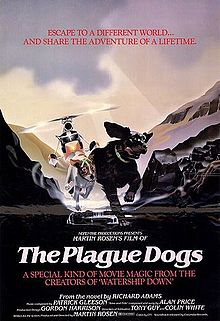
Many of us may have read the Richard Adams book “Watership Down” or have seen the film adaptation, but less known is the film version of his even darker follow-up, “The Plague Dogs” (1982). Like a Disney film, it features anthropomorphized animals and lessons about friendship and courage, but less like Disney, it also has lessons about scientific cruelty, mass media hype, mental illness and mortality. Never in a Disney film would the protagonists be hunted by humans after narrowly escaping vivisection and possibly being exposed to bubonic plague, as happens to Rowf and Snitter, the main characters of The Plague Dogs. It’s an undeniably harrowing and sad story, but it’s also emotionally engaging, intelligent, unsentimental, and an underrated animated masterpiece.

Though The Plague Dogs may be suitable for some kids, it’s also for all film lovers because the artwork is beautiful and the voice acting is subtle yet emotive (especially the voice of John Hurt, who played Winston Smith two years later in a film version of “1984”). It even features a great theme song by Alan Price, former keyboardist for The Animals and best known by cult movie fans as the lead singer of the band featured in Lindsay Anderson’s “O Lucky Man”. Most importantly, The Plague Dog’s message of empathy and arguments for ethical considerations in science are as timely as ever.

If you’re interested in learning more about The Plague Dogs, I recommend this detailed review by the Film Walrus (though it’d be best to read only after watching the film as it reveals spoilers): http://www.filmwalrus.com/2008/08/review-of-plague-dogs.html