
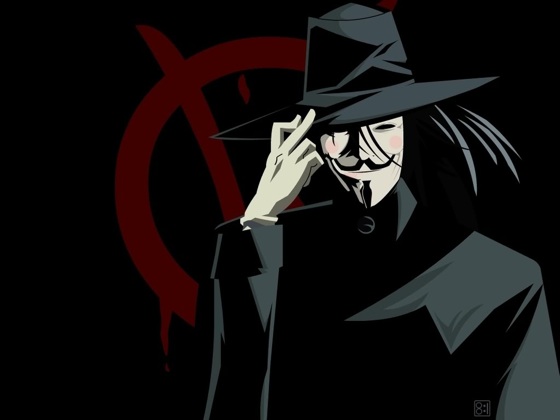
In honor of Guy Fawkes Day I’d like to bring attention to a few intriguing statements from Alan Moore (writer of the graphic novel V for Vendetta) on the connections between his fictions and reality from an interview he did shortly after the start of the Occupy Movement.
Via The Guardian:
I suppose I’ve gotten used to the fact that some of my fictions percolate out into the material world.
…I suppose when I was writing V for Vendetta I would in my secret heart of hearts have thought: wouldn’t it be great if these ideas actually made an impact? So when you start to see that idle fantasy intrude on the regular world… It’s peculiar. It feels like a character I created 30 years ago has somehow escaped the realm of fiction.
…And when you’ve got a sea of V masks, I suppose it makes the protesters appear to be almost a single organism – this “99%” we hear so much about. That in itself is formidable. I can see why the protesters have taken to it. It turns protests into performances.
The mask is very operatic; it creates a sense of romance and drama. I mean, protesting, protest marches, they can be very demanding, very grueling. They can be quite dismal. They’re things that have to be done, but that doesn’t necessarily mean that they’re tremendously enjoyable – whereas actually, they should be.
I think it’s appropriate that this generation of protesters have made their rebellion into something the public at large can engage with more readily than with half-hearted chants, with that traditional, downtrodden sort of British protest. These people look like they’re having a good time. And that sends out a tremendous message.
The reason V’s fictional crusade against the state is ultimately successful is that the state, in V for Vendetta, relies upon a centralised computer network which he has been able to hack. Not an obvious idea in 1981, but it struck me as the sort of thing that might be down the line. This was just something I made up because I thought it would make an interesting adventure story. Thirty years go by and you find yourself living it.
I have no particular connection or claim to what [the protesters] are doing, nor am I suggesting that these people are fans of mine, or of V for Vendetta…So there’s always… Now I didn’t feel responsible, but…at the moment, the demonstrators seem to me to be making clearly moral moves, protesting against the ridiculous state that our banks and corporations and political leaders have brought us to.
…It would probably be better if the authorities accepted this is a new situation, that this is history happening. History is a thing that happens in waves. Generally it is best to go with these waves, not try to make them turn back – the Canute option. I’m hoping that the world’s leaders will realise this.
…Vox populi, Voice of the people. And I think that if the mask stands for anything, in the current context, that is what it stands for. This is the people. That mysterious entity that is evoked so often – this is the people.
Read the full article here: http://www.theguardian.com/books/2011/nov/27/alan-moore-v-vendetta-mask-protest
Last July Moore was interviewed by Salon.com to talk about his new Kickstarter project, Jimmy’s End, but he also shared the following relevant observations about emerging NSA revelations, the surveillance state and technology:
There seems to be something going on, even from the briefest appraisal of the news, with the amount of events transpiring. This is such a connected world, it’s useless to isolate any part of it as a discrete phenomenon. You can’t really talk about the problems in Syria, because its problems are global. The waves of discontent and outrage — whether in the Arab countries, or in Brazil, or in America and Europe over the degrees to which its citizens are being monitored — are not separate phenomena. They are phenomena of an emergent world, and the existence of the Internet is one of its major drivers. We have got no idea how it’s going to turn out, because the nature of our society is such that if anything can be invented, then we will invent it. Sooner or later, if it is possible.
So the Internet is changing everything, but I wouldn’t yet want to say for good or ill. I suspect, as ever, that it will be an admixture of both. But we are all along for the ride, even those people like me who do not have Internet connections, mobile phones or even functioning televisions. I’m slowly disconnecting myself. Basically, it’s a feeling that if we are going to subject our entire culture to what is an unpredictable experiment, then I’d like to try to remain outside the petri dish. [Laughs] It’s only sensible to have somebody as a control.
To me, one of the biggest surprises of these recent surveillance revelations is how surprised people are. The level of surveillance we’ve had over here for the past 20 years now is ridiculous — and useless, I would add. Eerily enough, the security cameras on every street corner of Britain was instigated by the incoming Blair government in 1997, which was when I decided, back in 1982 or so, to set the first episode of “V for Vendetta,” which had cameras on every street corner. So yeah, we’ve had those for awhile; they’ve proliferated and multiplied for decades. More recently, there have been troops of police who have said that all these things are useful for is alienating the public. [Laughs] They are not actually useful in the prevention of crimes, or even actually apprehending their suspects.
Here’s the thing: If you’re monitoring every single thing that goes on in a given culture, if you have all the information that is there to be had, then that is the equivalent of having none of it. [Laughs] How are you going to process that amount of information? That’s when you get all these wonderful emerging paradoxes. Recently over here, there was a case where it was suspected that the people who monitor security screens were taking unnecessary toilet breaks and gossiping when they should be watching us. So it was decided that the only sensible thing to do was to put a security camera in the monitor room. [Laughs] This is answering the question that Juvenal asked so succinctly all those years ago: Who watches the watchmen? The answer is more watchmen! And yet more watchmen watch them, and of course it will eventually occur to them to ask: Can those people who are watching the people doing the watching really be trusted? Much better if they were under surveillance.
That’s the level of absurdity these Orwellian solutions bring to our increasingly complex world. George Orwell’s vision was 1947. Yes, the world was more complex than it had been, but nowhere near as complex as it was going to get. We currently have in Northampton — and I think we might be the first to have it — security cameras in some places that actually talk to you. “Pick that cigarette end up! Yes, you!” [Laughs] Which is so much like Patrick McGoohan’s vision for the Village in “The Prisoner,” all those years ago.
…Technology is always a two-edged sword. It will bring in many benefits, but also many disasters. Because of the complexity of our situation, we cannot predict what things will be until they happen. It’s just part of our responsibility as people in the modern world to do our very, very best to deal with them, and think them through, as they occur. While I’m remote from most technology to the point that I’m kind of Amish, I have played a couple of computer games — until I realized I was being bloodied with adrenalin over something that wasn’t real. At the end of a couple of hours of very addictive play, I may have procured the necessary amount of mushrooms to save a princess, but I also wasted hours of my life that I’ll never be able to get back. This is the reason I am not on the Internet. I am aware of its power as a distraction, and I don’t have the time for that.
Despite the constant clamor for attention from the modern world, I do believe we need to procure a psychological space for ourselves. I apparently know some people who try to achieve this by logging off, or going without their Twitter or Facebook for a limited period. Which I suppose is encouraging, although it doesn’t seem that remarkable from my perspective. I think that people need to establish their own psychological territory in face of the encroaching world.
Read the full interview here: http://www.salon.com/2013/07/07/alan_moore_the_revolution_will_be_crowd_funded/
Despite the fact that Moore said he disowned all Hollywood adaptations of his works, in my opinion the quality of his writing can transcend limitations inherent in such attempts, retaining power and resonance even in “watered down” form. Though I was disappointed by the film version of V for Vendetta overall, many who would not have otherwise been exposed to Moore’s work were able to absorb important aspects of his message through it and viral clips such as this:
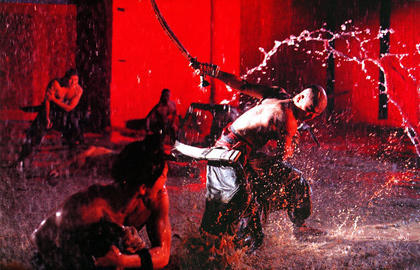
Director Tsui Hark is truly a visionary pioneer of Hong Kong cinema. He was one of the first in the Hong Kong film industry to use Hollywood-style special effects in “Zu Warriors From the Magic Mountain” (1983) and pushed the envelope again with extensive CGI effects for the sequel “The Legend of Zu” (2001). He helped launch Jet Li’s career with his “Once Upon a Time in China” trilogy and was the producer of one of director John Woo’s earliest blockbusters “A Better Tomorrow” (1986). However, for most of the 90s Tsui Hark’s career was in a slump because of a series of failed attempts to break into the U.S. market and an economic downturn of the Hong Kong film industry. One of the films Hark released during this period was “The Blade” (1995). Though it bombed at the box-office, it’s now widely recognized as one of his greatest achievements (so far).
Like many idiosyncratic cult films, The Blade wasn’t palatable to general audiences and was dismissed as a failure upon release. Such films are usually ahead of their time, needing more time to be discovered by fans or for cultural sensibilities to change. The Blade’s unremittingly grim setting and pessimistic tone may have frightened off film-goers who in the mid 90s were drawn more towards lighthearted fare but it’s a quality that makes it stand out today and gives it an oddly contemporary feel. Feudal China has never seemed so brutal and forbidding (yet exotic and multicultural). It’s a fully realized world full of tribalism, hedonism, feral creatures, small pockets of civilization, crude weapons and an unforgiving social and natural environment, not unlike the post-apocalyptic scenario of The Road Warrior.
Other characteristics that contribute to The Blade’s cult status are its archetypal characters, highly stylized art direction, impressionistic photography reminiscent of Wong Kar Wai films, and unforgettable scenes (including one of cinema’s most frenzied and viscerally powerful showdowns). Though its storyline is pretty standard for a wuxia martial arts film, its subtext contains an abundance of philosophical questions about the nature of morality, violence, religion, sex, commerce, disability, pedagogy and memory among other things. The Blade has never had an official DVD release in the U.S. but fortunately this subtitled version was uploaded to YouTube last year:
Though I’m not familiar with Russell Brand’s work as an actor, judging from interview clips he’s a pretty good comedian and social critic in the tradition of Bill Hicks. In this excerpt from the BBC program Newsnight he defends his choice not to vote and voices concern for a number of topics not usually discussed on television.
While I understand the position of not voting, I believe in the U.S. there’s still good reason to vote at least for local elections, initiatives or referendums. Voting may be a form of coersion but in some cases it can block the enaction of policies leading to greater coersion. If one uses absentee ballots voting doesn’t take much time and effort and though vote rigging is a problem, not all elections are rigged and voting can in some cases make it more difficult to do. For now in this country, with education and organization, voting can still lead to positive change or prevent things from getting worse, and of course one’s political activity shouldn’t be limited to voting. However, when it comes to presidential elections, low turnouts are one way to send a message of illegitimacy and disgust. Despite political disagreements I’m glad public figures such as Brand use their fame as a platform for thoughtful and substantive ideas not usually found in the world of corporate media. It seems he’s been on a roll lately because just last month he was banned from the GQ Awards for this speech:
And earlier this year he made a mockery of MSNBC’s “Morning Joe” program:
While Brand may have good reason to be annoyed with the hosts, it’s unfortunate that he resorted to lewd jokes near the end. Stooping to their level undermines the effectiveness of his critique, in my opinion.

A couple days ago Aaron Dykes and Melissa Melton of Truthstream Media released this dissection of a supposedly spontaneous and unusual incident which took place during a recent Obama speech on healthcare:
Even if someone in the audience pointed out to Obama what was happening behind him, it doesn’t explain the utterly unnatural response of the woman next to Karmel who doesn’t even look at her as she’s holding her hand and propping her up. It also doesn’t explain the number of times very similar incidents have occurred in the past. Faintings might be a common occurrence at large public events but to have them play out in almost the exact same way with the same responses makes it more likely to be scripted political theater.
This video was posted on Cryptogon.com and is much like the “TeamWakeEmUp” clip referenced on the Truthstream video:
The latest fainting incident may have been used to hammer in the point about why we need Obamacare and to distract from embarrassing aspects such as the website access problems, but it must have more important uses for it to be used so many times. Corporations and interest groups spend vast amounts of money to get their people into office. High level politicians are too much of an investment risk to allow to act independently so they must work with teams of advisers, speech writers and PR experts. It’s not hard to see what they would gain from the false-fainting ploy. In some situations it could be a distraction but it also adds an element of surprise, fear, reassurance and a little bit of humor which makes the event more dramatic, emotionally resonant and memorable. It also serves to humanize the speaker while simultaneously endowing them with heroic and paternal qualities: attentiveness, assertiveness, cool headed-ness, compassion, and expertise. This strategy would of course work much better in the days before independent media reports and YouTube compilation clips but those could always be dismissed as delusions of “truthers” and conspiracy theorists.

There was once a time when seeking out cult movies was a challenge, involving a combination of dedicated effort and luck to hear about them and to actually be able to see them. Even learning what exactly is a cult film was not so common. Today, with internet communities that thrive on niche interests and novelty, most of us have an idea of what they are. For those who don’t there’s always wikipedia, but it used to be knowledge gained mostly through word of mouth or books discovered in stores or libraries like Midnight Movies by Stuart Samuels and Cult Movies by Danny Peary. To watch such films one had to be lucky enough to live near video stores or independent theaters managed by the right kinds of people (weirdos) or be able to visit such places on trips. Obscure or pirated videotapes could sometimes be ordered by mail through catalogs and magazines or found at comic conventions. Sometimes college campuses would also have small screenings organized by student film societies. Once in a blue moon, some of these films would even air on late night network or cable television.
To do my small part to carry on the cult movie tradition I will feature old and new examples of such films every Saturday that can be viewed in their entirety on YouTube. The first is “The Holy Mountain”, which is appropriate because the director, Alejandro Jodorowsky also created “El Topo”, one of the early acknowledged cult classics.
INDIAN COUNTRY NEWS
"It is the duty of every man, as far as his ability extends, to detect and expose delusion and error"..Thomas Paine
Human in Algorithms
100% Accurate Google Sheets + KDP Book Formatting | 24hr Delivery
From the Roof Top
I See This
blog of the post capitalist transition.. Read or download the novel here + latest relevant posts
अध्ययन-अनुसन्धानको सार

