
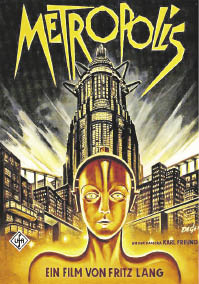
From Open Culture:
Today we bring you one of the most influential films of all time: Fritz Lang’s 1927 fable of good and evil fighting it out in a futuristic urban dystopia, Metropolis.
The melodrama is set in the year 2026. Metropolis is a beautiful high-tech city, but beneath the dazzling surface toil masses of enslaved workers. To keep the machinery running efficiently, the workers have been forced to become virtual machines themselves. The city is ruled by a heartless mastermind named Johann Fredersen, whose idealistic son, Freder, discovers the cruel conditions imposed on the workers and rebels against his father.
Freder falls in love with Maria, a messianic figure preaching love and reconciliation, but his father hatches an evil plot to turn the workers against Maria. He hires the mad scientist Rotwang to make a robotic counterfeit of Maria to wreak havoc among the workers, discrediting her and discouraging rebellion. An epic struggle ensues.
Lang actually detested the story, which was written mostly by his wife Thea Von Harbou. He told Peter Bogdanovich that Metropolis was “silly and stupid.” But from a visual standpoint the film is one of the great works of 20th century art. Lang said he got the idea of making a movie about a futuristic city while visiting New York in 1924. Standing at night on the deck of his ship in New York Harbor, the filmmaker looked up and was amazed:
I saw a street lit as if in full daylight by neon lights and, topping them, oversized luminous advertisements moving, turning, flashing on and off, spiraling…something that was completely new and nearly fairy tale-like for a European in those days….The buildings seemed to be a vertical veil, shimmering, almost weightless, a luxurious cloth hung from the sky to dazzle, distract, and hypnotize. At night the city did not give the impression of being alive; it lived as illusions lived. I knew then that I had to make a film about all of these sensations.
The iconic poster image above is reproduced from an extremely rare program printed for the March 21, 1927 London premiere of Metropolis. You can look through the entire 32-page program at the Web site of bookseller Peter Harrington. The page will open in a new window, so you can look at the program and stay here and watch the film.
There’s also a 2010 restoration of the film, supervised by the F.W. Murnau Foundation, which incorporates footage from an early print discovered in Buenos Aires, bringing the film closer to Lang’s original vision.

Dust is set in a dystopian world where most of humanity lives in walled cities to protect themselves from a chaotic environment where evolution occurs at breakneck speed, creating organisms which can be a deadly plague or miraculous medicine. It’s the job of a tracker to document the changes and, with the help of a black-market merchant, find a cure to save the society which he rejected.

“Zoom” (2015) is a hybrid film on many levels. It’s a Brazilian/Canadian comedy/drama mixing live action and animation directed by Pedro Morelli. The plot is split between three narratives involving comic book artist Emma Boyles (Alison Pill), novelist Michelle (Mariana Ximenes), and film director Edward Deacon (Gael Garcia Bernal). Each exists in parallel realities which become increasingly intertwined as they come together in a metafictional conclusion.
Watch the full film here.

By Charles Hugh Smith
Source: Of Two Minds
We cannot help but feel a hunger for authenticity, honesty, spiritual solace and human connection, but these are precisely what is scarce in our social and economic structure.
There is a tremendous amount of pain in our society. There are many sources of this pain: the emotional desertification of dysfunctional families, the knowledge that we don’t fit in and never will, a widening disconnect between the narratives we’re told are true and our experience, and a social and economic structure that tosses many of us on the trash heap.
The lifestyle we’re told we need to be happy is unattainable to many, and disconcertingly unsatisfactory to the top 10% who reach it.
We cannot help but feel a hunger for authenticity, honesty, spiritual solace and human connection, but these are precisely what is scarce in our social and economic structure.
The process of awakening has many paths. For some, the path starts with the incoherence of official explanations and narratives. For others, it’s the inner search for truth via psychotherapy or spiritual practice.
For some, it’s an investigation into the way our economic and political hierarchy function. For others, art is the starting point: a film, a novel, a comic, a song.
For many of us, it begins with this simple but devastating realization: I don’t fit in. I don’t fit in, have never fit in and never will fit in. I play along because it’s easier on me and everyone I interact with to do so, and I value my independence which means I have to find a way to support myself. That is difficult, as what I like to do has little to no value in our economy.
What interests me is how the epidemic of pain and alienation that characterizes our society is the direct result of how our economy and social order is structured. Incoherence, self-destruction, pain and alienation are the only possible outputs of the system we inhabit.
I have explored this dynamic in my books, starting with Survival+ in 2009 and working forward to my latest book, Why Our Status Quo Failed and Is Beyond Reform. (My other books are: A Radically Beneficial World: Automation, Technology and Creating Jobs for All; Get a Job, Build a Real Career and Defy a Bewildering Economy; The Nearly Free University and the Emerging Economy: The Revolution in Higher Education; Resistance, Revolution, Liberation: A Model for Positive Change; Why Things Are Falling Apart and What We Can Do About It and An Unconventional Guide to Investing in Troubled Times.)
I recently had an amazing free-form 1:50 hour conversation on these topics with New Zealand talk-show host Vinny Eastwood. Any conversation that stretches from the erosion of community to loneliness to Daniel Ellsberg to Marx to Taoism to alienation to Michelangelo Antonioni and on to the process of awakening is amazing in my view.
Here’s Vinny’s page with listening/viewing/downloading options, and the program on Youtube (please ignore my goofy expressions): The magic of bitcoin and cryptocurrencies (1:49:54)
My conclusion may strike many as radical, but to me it is self-evident: the primary source of the rot, insecurity, inequality and alienation of our society is the way we create and distribute money, which is the conduit for creating and distributing political power.
I explain why this is so in my books A Radically Beneficial World: Automation, Technology and Creating Jobs for All and Why Our Status Quo Failed and Is Beyond Reform.
If we don’t change the way money is created and distributed, we change nothing. Money = power. If we don’t devise a form of money that is beyond the reach of central banks and states, all “reform” is just window-dressing, simulacra of “change” that simply solidifies the system’s bogus claim of being reformable.
Cryptocurrencies are in their infancy. There will be many more iterations of Cryptocurrencies beyond bitcoin and Ethereum; recall that bitcoin went public in 2009.
There are security challenges with cryptocurrencies, and the potential for central-state meddling via backdoors in computer operating systems. But once we understand that community and the potential for a less toxic society and economy are crippled by the centralized structure of the state and its money, then there is no way forward but to develop structures of money, work, community, purpose and meaning that are outside the direct control of the state and central bank.
This sort of “crazy talk” is unwelcome. As I noted earlier this week on my chart of the Ministry of Propaganda, in the status quo, skepticism is always a conspiracy or a hoax.
So instead we consider an exploding opiate epidemic, an epidemic of obesity and metabolic illnesses, a discourse of inchoate rage and a Grand Canyon-sized gap between what we’re told is true and what we experience as true “normal.” These things are not normal; they are manifestations of a system that can only generate one output: self-destruction.
INDIAN COUNTRY NEWS
"It is the duty of every man, as far as his ability extends, to detect and expose delusion and error"..Thomas Paine
Human in Algorithms
From the Roof Top
I See This
blog of the post capitalist transition.. Read or download the novel here + latest relevant posts
अध्ययन-अनुसन्धानको सार
 After the Crash