Joni Mitchell on Morgellons Disease

Morgellons fibers embedded in skin. PHOTO: PLOS ONE

Morgellons fibers embedded in skin. PHOTO: PLOS ONE

Influential singer/songwriter Joni Mitchell just turned 70 last Thursday. In a retrospective piece about her career published by U-T San Diego, this particular line caught my attention:

She no longer performs because she has a rare medical condition, Morgellons syndrome, and because decades of chain-smoking have ravaged her once-angelic voice.

It’s a huge tragedy that someone of her talent can no longer sing, but what was truly surprising to me was the revelation that she has Morgellons syndrome. It’s truly courageous for someone as well-known and widely respected as Mitchell to go public about it because people suffering from Morgellons have often been dismissed by the medical establishment as being “delusional”. The issue is clouded by the fact that reported physical symptoms of Morgellons syndrome are indeed similar to delusional parasitosis and in some cases it may also have neurological symptoms (though in most reported cases the symptoms include brain fog, fear, depression, decreased coordination and personality changes rather than delusions).

Joni Mitchell related her personal experience with Morgellons in this excerpt from a 2010 LA Times interview:

LAT: You’ve come out in the media as a sufferer of a controversial condition known as Morgellons. How is your health currently?

JM: I have this weird, incurable disease that seems like it’s from outer space, but my health’s the best it’s been in a while, Two nights ago, I went out for the first time since Dec. 23: I don’t look so bad under incandescent light, but I look scary under daylight. Garbo and Dietrich hid away just because people became so upset watching them age, but this is worse. Fibers in a variety of colors protrude out of my skin like mushrooms after a rainstorm: they cannot be forensically identified as animal, vegetable or mineral. Morgellons is a slow, unpredictable killer — a terrorist disease: it will blow up one of your organs, leaving you in bed for a year. But I have a tremendous will to live: I’ve been through another pandemic — I’m a polio survivor, so I know how conservative the medical body can be. In America, the Morgellons is always diagnosed as “delusion of parasites,” and they send you to a psychiatrist. I’m actually trying to get out of the music business to battle for Morgellons sufferers to receive the credibility that’s owed to them.

As disturbing as symptoms of Morgellons Syndrome are, just as frightening is the fact that we know so little about what it is, what causes it, hows it’s transmitted, and how to cure people who have it. However, in this article recently reposted at GlobalResearch, they uncovered the following information linking Morgellons to GMOs:

In the Sept. 15-21 issue of New Scientist magazine, Daniel Elkan describes a patient he calls “Steve Jackson,” who “for years” has “been finding tiny blue, red and black fibers growing in intensely itchy lesions on his skin.” He quotes Jackson as saying, “The fibers are like pliable plastic and can be several millimeters long. Under the skin, some are folded in a zigzag pattern. These can be as fine as spider silk, yet strong enough to distend the skin when you pull them, as if you were pulling on a hair.”

Doctors say that this type of disease could only be caused by a parasite, but anti-parasitic medications do not help. Psychologists insist that this is a new version of the well-known syndrome known as “delusional parasitosis.” While this is a “real” disease, it is not a physically-caused one.

But now there is physical evidence that Morgellons is NOT just psychological. When pharmacologist Randy Wymore offered to study some of these fibers if people sent them to him, he discovered that “fibers from different people looked remarkably similar to each other and yet seem to match no common environmental fibers.”

When they took them to a police forensic team, they said they were not from clothing, carpets or bedding. They have no idea what they are.

Researcher Ahmed Kilani says he was able to break down two fiber samples and extract their DNA. He found that they belonged to a fungus.

An even more provocative finding is that biochemist Vitaly Citovsky discovered that the fibers contain a substance called “Agrobacterium,” which, according to New Scientist, is “used commercially to produce genetically-modified plants.” Could GM plants be “causing a new human disease?”

To learn more about Morgellons Disease, visit the Charles E. Holman Foundation.

Remember, Remember, the 5th of November

v-for-vendetta-5-11-10-kc

In honor of Guy Fawkes Day I’d like to bring attention to a few intriguing statements from Alan Moore (writer of the graphic novel V for Vendetta) on the connections between his fictions and reality from an interview he did shortly after the start of the Occupy Movement.

Via The Guardian:

I suppose I’ve gotten used to the fact that some of my fictions percolate out into the material world.

…I suppose when I was writing V for Vendetta I would in my secret heart of hearts have thought: wouldn’t it be great if these ideas actually made an impact? So when you start to see that idle fantasy intrude on the regular world… It’s peculiar. It feels like a character I created 30 years ago has somehow escaped the realm of fiction.

…And when you’ve got a sea of V masks, I suppose it makes the protesters appear to be almost a single organism – this “99%” we hear so much about. That in itself is formidable. I can see why the protesters have taken to it. It turns protests into performances.

The mask is very operatic; it creates a sense of romance and drama. I mean, protesting, protest marches, they can be very demanding, very grueling. They can be quite dismal. They’re things that have to be done, but that doesn’t necessarily mean that they’re tremendously enjoyable – whereas actually, they should be.

I think it’s appropriate that this generation of protesters have made their rebellion into something the public at large can engage with more readily than with half-hearted chants, with that traditional, downtrodden sort of British protest. These people look like they’re having a good time. And that sends out a tremendous message.

The reason V’s fictional crusade against the state is ultimately successful is that the state, in V for Vendetta, relies upon a centralised computer network which he has been able to hack. Not an obvious idea in 1981, but it struck me as the sort of thing that might be down the line. This was just something I made up because I thought it would make an interesting adventure story. Thirty years go by and you find yourself living it.

I have no particular connection or claim to what [the protesters] are doing, nor am I suggesting that these people are fans of mine, or of V for Vendetta…So there’s always… Now I didn’t feel responsible, but…at the moment, the demonstrators seem to me to be making clearly moral moves, protesting against the ridiculous state that our banks and corporations and political leaders have brought us to.

…It would probably be better if the authorities accepted this is a new situation, that this is history happening. History is a thing that happens in waves. Generally it is best to go with these waves, not try to make them turn back – the Canute option. I’m hoping that the world’s leaders will realise this.

Vox populi, Voice of the people. And I think that if the mask stands for anything, in the current context, that is what it stands for. This is the people. That mysterious entity that is evoked so often – this is the people.

Read the full article here: http://www.theguardian.com/books/2011/nov/27/alan-moore-v-vendetta-mask-protest

Last July Moore was interviewed by Salon.com to talk about his new Kickstarter project, Jimmy’s End, but he also shared the following relevant observations about emerging NSA revelations, the surveillance state and technology:

There seems to be something going on, even from the briefest appraisal of the news, with the amount of events transpiring. This is such a connected world, it’s useless to isolate any part of it as a discrete phenomenon. You can’t really talk about the problems in Syria, because its problems are global. The waves of discontent and outrage — whether in the Arab countries, or in Brazil, or in America and Europe over the degrees to which its citizens are being monitored — are not separate phenomena. They are phenomena of an emergent world, and the existence of the Internet is one of its major drivers. We have got no idea how it’s going to turn out, because the nature of our society is such that if anything can be invented, then we will invent it. Sooner or later, if it is possible.

So the Internet is changing everything, but I wouldn’t yet want to say for good or ill. I suspect, as ever, that it will be an admixture of both. But we are all along for the ride, even those people like me who do not have Internet connections, mobile phones or even functioning televisions. I’m slowly disconnecting myself. Basically, it’s a feeling that if we are going to subject our entire culture to what is an unpredictable experiment, then I’d like to try to remain outside the petri dish. [Laughs] It’s only sensible to have somebody as a control.

To me, one of the biggest surprises of these recent surveillance revelations is how surprised people are. The level of surveillance we’ve had over here for the past 20 years now is ridiculous — and useless, I would add. Eerily enough, the security cameras on every street corner of Britain was instigated by the incoming Blair government in 1997, which was when I decided, back in 1982 or so, to set the first episode of “V for Vendetta,” which had cameras on every street corner. So yeah, we’ve had those for awhile; they’ve proliferated and multiplied for decades. More recently, there have been troops of police who have said that all these things are useful for is alienating the public. [Laughs] They are not actually useful in the prevention of crimes, or even actually apprehending their suspects.

Here’s the thing: If you’re monitoring every single thing that goes on in a given culture, if you have all the information that is there to be had, then that is the equivalent of having none of it. [Laughs] How are you going to process that amount of information? That’s when you get all these wonderful emerging paradoxes. Recently over here, there was a case where it was suspected that the people who monitor security screens were taking unnecessary toilet breaks and gossiping when they should be watching us. So it was decided that the only sensible thing to do was to put a security camera in the monitor room. [Laughs] This is answering the question that Juvenal asked so succinctly all those years ago: Who watches the watchmen? The answer is more watchmen! And yet more watchmen watch them, and of course it will eventually occur to them to ask: Can those people who are watching the people doing the watching really be trusted? Much better if they were under surveillance.

That’s the level of absurdity these Orwellian solutions bring to our increasingly complex world. George Orwell’s vision was 1947. Yes, the world was more complex than it had been, but nowhere near as complex as it was going to get. We currently have in Northampton — and I think we might be the first to have it — security cameras in some places that actually talk to you. “Pick that cigarette end up! Yes, you!” [Laughs] Which is so much like Patrick McGoohan’s vision for the Village in “The Prisoner,” all those years ago.

…Technology is always a two-edged sword. It will bring in many benefits, but also many disasters. Because of the complexity of our situation, we cannot predict what things will be until they happen. It’s just part of our responsibility as people in the modern world to do our very, very best to deal with them, and think them through, as they occur. While I’m remote from most technology to the point that I’m kind of Amish, I have played a couple of computer games — until I realized I was being bloodied with adrenalin over something that wasn’t real. At the end of a couple of hours of very addictive play, I may have procured the necessary amount of mushrooms to save a princess, but I also wasted hours of my life that I’ll never be able to get back. This is the reason I am not on the Internet. I am aware of its power as a distraction, and I don’t have the time for that.

Despite the constant clamor for attention from the modern world, I do believe we need to procure a psychological space for ourselves. I apparently know some people who try to achieve this by logging off, or going without their Twitter or Facebook for a limited period. Which I suppose is encouraging, although it doesn’t seem that remarkable from my perspective. I think that people need to establish their own psychological territory in face of the encroaching world.

Read the full interview here: http://www.salon.com/2013/07/07/alan_moore_the_revolution_will_be_crowd_funded/

Despite the fact that Moore said he disowned all Hollywood adaptations of his works, in my opinion the quality of his writing can transcend limitations inherent in such attempts, retaining power and resonance even in “watered down” form. Though I was disappointed by the film version of V for Vendetta overall, many who would not have otherwise been exposed to Moore’s work were able to absorb important aspects of his message through it and viral clips such as this:

Inside the Psyche of the 1%

na50_3514938_1_px_470_

Don Fitz, editor of Synthesis/Regeneration, recently wrote an illuminating overview of what current scientific studies can tell us about psychopaths in positions of power. In the following passage he examines why the psychiatric establishment has focused less on “successful psychopathy” than on other anti-social personality disorders:

The concept of “successful psychopath” is not new. An early text described “complex psychopaths” who were very intelligent and included unscrupulous politicians and businessmen. [6] By the 1970s it was more widely recognized that “this category includes some successful businessmen, politicians, administrators.” [7] In other words, the unsuccessful psychopath might go to jail for swindling dozens of people with home improvement scams while successful psychopaths might swindle millions with bank deals, get bailed out by friends in government, and never spend a day in jail.

Perhaps the most fascinating aspect of the medicalization of the disorder is how the psychiatric establishment departed from science in order to grant partial exemption from being characterized as psychopaths to the wealthy. According to the Diagnostic and Statistical Manual of the American Psychiatric Association, in order to receive a diagnosis of “anti-social personality disorder” (i.e., psychopathy) a person must exhibit at least 3 of 7 listed behavior patterns. These include “arrest,” “physical fights or assaults,” and “failure to sustain consistent work behavior.” [8] This means that those who can pay off cops (or never have charges pressed against them due to their social status), or pay someone else to commit violence on their behalf, or own companies instead of having to work for a living are all less likely to receive an official label of “psychopath.”

An increasing number of psychologists are becoming aware that traditional research was limited by the bias of only looking at people in jail. One wrote that subjects in psychopathy research “were usually institutionalized at the time of testing, and consequently our research may not accurately capture the internal structure and dynamics of the successful antisocial or psychopathic individual.” [9]

Support for the concept of successful and unsuccessful psychopaths is provided by the discovery that the “Psychopathic Personality Disorder” syndrome actually has two factors. [10] Statistical analyses have revealed an “emotional detachment” factor, which includes superficial charm and skill at manipulating others, as well as an “anti-social behavior” factor, which includes poor impulse control and the tendency to engage in activities that are illegal.

Multiple studies have confirmed that run-of-the-mill psychopaths (often studied while in jail) score particularly high on anti-social behavior while successful psychopaths score higher on emotional detachment factors. For example, Babiak [11] looked at “industrial psychopaths” and found that they scored higher on “emotional” factors than “deviant life style” factors. Functioning smoothly in the corporate world, they had a “charming façade” that allowed them to easily manipulate others.

In a study of “disordered personalities at work” other researchers [12] were able to give personality tests to business managers and chief executives. They contrasted their personality scores to psychiatric patients and “mentally disordered offenders.” Compared to the mental patients, the corporate executives showed greater “emotional” components of personality disorder and less “acting out” (such as aggressiveness).

There were no clear-cut differences between “psychopaths” and “normals.”
The authors concluded that “participants drawn from the non-clinical population [i.e., business managers] had scores that merged indiscernibly with clinical distributions.” There were no clear-cut differences between “psychopaths” and “normals.” The most likely explanation of psychopathy is that, like any other personality dimension, it has a bell-shaped curve: a few people have almost none of the characteristics, most people have some characteristics of psychopathy, and a few people have a lot. The most visible outlets for people high on psychopathy scales are petty con artists and corporate conniving. Operating in different worlds, their psychopathy expresses itself in different ways.

Now that it is clear that a streak of psychopathy runs through the 1%, it would be worthwhile to go back to those who espouse that “there is no ethic which requires we treat him [the psychopath] as we treat other adults” and ask if that would apply to corporate psychopaths as well. Will editors of scholarly volumes seek out articles heaping abuse on the 1% with the same vigor with which they find articles despising prison inmates? Will academics proclaim that “public health needs” dictate that we suspend civil liberties of corporate executives even if they “have not been convicted of any crime?” Will professors compare the “needed treatment” of the 1% to the “necessary slaughter” of animals?

Since academics know very well where funding for their research comes from, my guess is that they will be a wee bit less harsh on the corporate class than the jailed burglar who provides no grant money. We can be confident that the Tea Party will not be proposing that, if corporate psychopaths who blast the tops off of mountains wreak a thousand times the havoc of petty thieves who steal copper wire from air conditioners, then their punishments should be 1000 times as great.

Yet, it is important not to overstate the evidence and suggest that every capitalist is a psychopath. Not all corporate executives score high on scales of psychopathy. This is likely because many actually believe their ideology of greed makes for a better world.

Fitz also offers plausible explanations for various studies indicating that, on average, test subjects of a higher income have lower levels of empathy while test subjects of a lower income have higher levels of empathy:

Compassion reflects the opposite of psychopathy. When those with wealth and power plan to strangle social security, they never say they intend to hurt people, but rather they want to help them stand on their own. When corporations drive native people from forests, they tell us it is part of their grand scheme to stop climate change. Are we to believe that they are just as compassionate as everyone else…but that they reveal their compassion in their own way? There is now good evidence that there are, in fact, class differences in levels of compassion.

Social class could be linked to compassion more than to any other emotion.
By definition, the rich and powerful have more material resources and spend more of their time telling others what to do. Those with fewer material resources get told what to do. As a result, the rich value independence and autonomy while those with less money think of themselves as more interdependent with others. [13] In other words, the rich prize the image of the “rugged individual” while the rest of us focus on what group we belong to.

How do people explain the extremely unequal distribution of wealth? Those with more money attribute it to “dispositional” causes—they believe that people get rich because their personality leads them to work harder and get what they deserve. Those with less money more often attribute inequality to “external” factors—people’s wealth is due largely to events beyond their control, such as being born into a rich family or having good breaks in life. [14]

People with fewer financial resources live in more threatening environments, whether from potential violence, being unable to pay medical bills, or fearing the possibility of being evicted from their homes. This means that social classes differ in the way that they view the world from an early age. Children from less financially secure homes respond to descriptions of threatening and ambiguous social scenarios with higher blood pressure and heart rate. [15] Adults with lower incomes are also more reactive to emotional situations than are those with more money.

This means that people with fewer financial resources are more attentive to others’ emotions. Since low income people are more sensitive to emotional signals, they might pay more attention to the needs of others and show more altruism in response to suffering.

This was the thinking behind research linking higher income to less compassion. In one study people either watched a neutral video or one depicting a child suffering from cancer. People with lower income had more change in their heart rate and reported feeling more compassion. But they did not rate other emotions as higher. Social class could be linked to compassion more than to any other emotion. [16]

In another study, people reported their emotions toward a partner when the two of them went through a hypothetical job interview. Lower income people perceived more distress in their partners and expressed more compassion toward them. Again, they did not report more intense feelings of other emotions. Nor did participants show more compassion toward people with the same income level as their own. [17]

Like most psychological research, these findings are limited by their use of university students. This makes it hard to conclude that their findings apply to those not in school. Of course, it is quite possible that effects would be even stronger in situations that are far more intense than the somewhat mild experiences that occur in psychological laboratories. A greater problem is interpreting psychological findings as showing absolute differences between groups rather than shades of grey.

It would not be accurate to claim that research proves that the 1% have no compassion while all of the 99% do. But it strongly implies that the 1% feel less compassion, whether watching a videotape of suffering or participating in a live social interaction. Also, lab studies are consistent with findings that people with fewer financial resources give a higher proportion of what they do have to charity. In economic game research, they give more to others. [18]

The greatest reason is the huge jump in happiness as people move out of poverty …
This line of research confirms that (1) people with fewer financial resources identify with a larger “in-group;” (2) “attention to and recognition of suffering is a prerequisite step before compassion can take place;” and (3) “moral emotion is not randomly distributed across social classes…” [19] Compassion toward the suffering of others is less likely among the 1%.

He follows this with a recap of studies indicating how once the accumulation of wealth and material possessions get people above poverty level, it generally doesn’t correlate to increased levels of happiness. There tends to be a “tolerance” effect for happiness derived from wealth while social connection and altruism are more important for sustained happiness for most non-psychopaths. In his conclusion, Fitz argues that for corporate psychopaths, obtaining wealth and power is an addiction with harmful consequences for everyone and the entire planet, and it’s a societal problem requiring nothing less than a cultural transformation to solve:

The 1% could easily find compassion getting in their way as their actions affect an increasing number of lives. Gaining enough wealth to move out of poverty makes a significant difference in the life satisfaction of a person who has little. Gaining the same amount of wealth has no effect on the happiness of the very rich. They must grab the wealth of many impoverished people in order to have a perceptible increase in happiness. As for a drug addict, the rush from an increase in material possessions of those who already have more than enough is merely a temporary fix.

Soon they will have to prevent even more from rising out of poverty if they are to get another short-term happiness rush. Whether the rush is from the actual possessions or the power that they manifest, it still won’t be enough. They must increase the rate of wealth accumulation that they push through their veins. If those with spectacular quantities of obscene wealth are to get their next high, they cannot merely snort enough happiness objects to prevent masses of people from rising out of poverty—they have to manipulate markets to grind an ever-increasing number into poverty.

The petty psychopath and the grand corporate psychopath seek happiness through the act of obtaining material possessions as much as having them. A major difference between them is that the grand psychopath has the ability to cause so much harm. Even more important, the amount of harm that corporate psychopaths cause grows at an exponential rate. Their financial schemes are no longer millions or billions, but now trillions. Not content to drive individual farmers off their land, they design trade deals that force entire countries to plow under the ability to feed their own people and replace it with cash crops to feed animals or produce biofuels.

Finding that the pollution of small communities generates insufficient funds, they blow off the tops of mountain ranges for coal, raze boreal forests for tar sands, attack aquatic ecosystems with deep sea drilling, and contaminate massive natural water systems by mining gold or fracking for gas. While the petty psychopath may become proficient enough to become a godfather, the grand psychopath is driven not merely to planetary destruction but to a frenetic increase in the rate of destruction at precisely the moment when the tipping point of climate change is most haunting. A natural question might seem to follow: Would getting rid of the current batch of corporate psychopaths benefit the world greatly? Actually, no. It would do no good whatsoever because what psychologists call the “reward contingencies” of the corporate world would still exist. The fact that capitalism prizes accumulation of wealth by the few at the expense of the many would mean that, even if the worst corporate criminals disappeared, they would soon be replaced by marketplace clones.

Progressives should avoid using the same “categorical” model so adored by right wing theorists for its utility in hating the poor. A much better explanation for psychopathy among the 1% is that the corporate drive to put profits before all else encourages norms of manipulating people without compassion. The more readily corporate leaders succumb to this mind set, the more likely they will be to climb the ladder. As the corporate mentality dominates society, it reproduces its attitudes and expectations of behavior throughout every organization, institution and individual it touches.

In challenging what the market does to our souls, Alan Nasser said it so well:

A certain kind of society tends to produce a certain kind of person. More precisely, it discourages the development of certain human capacities and fosters the development of others. Aristotle, Rousseau, Marx and Dewey were the philosophers who were most illuminating on this. They argued that the postures required by successful functioning in a market economy tend to insinuate themselves into those areas of social intercourse which take place outside of the realm of the market proper. The result, they claimed, was that the arena for potentially altruistic and sympathetic behavior shrinks over time as society is gradually transformed into a huge marketplace. [35]As mentioned, there are differences in compassion and types of psychopathy between high and low income people. But the differences are not large. Perhaps, even in the corporate board room, many feel the old norms of group loyalty. It is also possible that differences are small, not because of the unwillingness of corporate executives to be ultra-manipulative, but because capitalism pushes everyone toward a “use people” mode.

Thus, building a new society involves going beyond equalizing material wealth. It means changing the core nature of interpersonal relationships. This requires vastly reducing the emphasis on material possessions. Relationships of people to people can never flourish as long as relationships of people to objects reign supreme.

As long as society continues to be deeply divided between those who tell others what to do and those who get told, it will not be possible to establish the emotional sharing that is the basis of widespread altruism. If the 1% are to develop the same level of understanding of others that the 99% has, they will need to walk in their shoes. If they continue to be the ones who live their lives telling others what to do while the rest of us continue being told what to do, they will not develop levels of compassion typical of the 99%.

This means that in office jobs, they should be able to share the joys of typing letters rather than ordering others to type for them. If we decide mining is necessary, those who are now the 1% should get to know that work life. In work at home, they should not be excluded from washing toilets but should participate in the same human activities as the rest of society. Creating a world of universal compassion requires a world of shared experiences.

Read the full article here: http://www.greens.org/s-r/60/60-06.html

Saturday Matinee: The Blade

qt7-blade

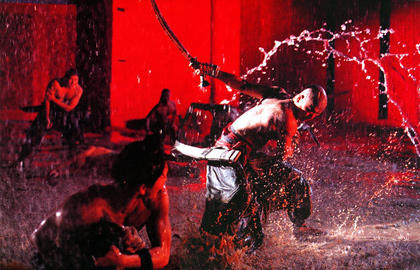
Director Tsui Hark is truly a visionary pioneer of Hong Kong cinema. He was one of the first in the Hong Kong film industry to use Hollywood-style special effects in “Zu Warriors From the Magic Mountain” (1983) and pushed the envelope again with extensive CGI effects for the sequel “The Legend of Zu” (2001). He helped launch Jet Li’s career with his “Once Upon a Time in China” trilogy and was the producer of one of director John Woo’s earliest blockbusters “A Better Tomorrow” (1986). However, for most of the 90s Tsui Hark’s career was in a slump because of a series of failed attempts to break into the U.S. market and an economic downturn of the Hong Kong film industry. One of the films Hark released during this period was “The Blade” (1995). Though it bombed at the box-office, it’s now widely recognized as one of his greatest achievements (so far).

Like many idiosyncratic cult films, The Blade wasn’t palatable to general audiences and was dismissed as a failure upon release. Such films are usually ahead of their time, needing more time to be discovered by fans or for cultural sensibilities to change. The Blade’s unremittingly grim setting and pessimistic tone may have frightened off film-goers who in the mid 90s were drawn more towards lighthearted fare but it’s a quality that makes it stand out today and gives it an oddly contemporary feel. Feudal China has never seemed so brutal and forbidding (yet exotic and multicultural). It’s a fully realized world full of tribalism, hedonism, feral creatures, small pockets of civilization, crude weapons and an unforgiving social and natural environment, not unlike the post-apocalyptic scenario of The Road Warrior.

Other characteristics that contribute to The Blade’s cult status are its archetypal characters, highly stylized art direction, impressionistic photography reminiscent of Wong Kar Wai films, and unforgettable scenes (including one of cinema’s most frenzied and viscerally powerful showdowns). Though its storyline is pretty standard for a wuxia martial arts film, its subtext contains an abundance of philosophical questions about the nature of morality, violence, religion, sex, commerce, disability, pedagogy and memory among other things. The Blade has never had an official DVD release in the U.S. but fortunately this subtitled version was uploaded to YouTube last year:

Podcast Roundup: Halloween Edition

Photo: The Onion

Photo: The Onion

Though I don’t regularly feature podcasts delving into horror/sci-fi aspects of pop culture or the world of metaphysics and the paranormal, today seems an appropriate time to share a few in observance of Halloween, All Hallow’s Eve, Samhain, Day of the Dead, etc.

10/27 Maja D’Aoust and Erik Davis discuss magical and synchronistic aspects of politics and modern culture at Expanding Mind: Show link: http://prn.fm/category/archives/expanding-mind/

10/28 A great discussion on John Carpenter’s 1982 remake of “The Thing” and what makes it a classic horror film at the Debatable Podcast: Show link: http://debatablepodcast.tumblr.com/post/65307821240/episode-56-the-thing-with-sip-eric-sipple-joins

10/29 Guillermo Jimenez and Dr. Paul Cantor have a conversation about the political meaning of apocalyptic “end of the world” narratives in shows like The Walking Dead, X- Files, Fringe, and Falling Skies from a libertarian perspective: Show Link: http://tracesofreality.com/2013/10/29/tor-radio-the-truth-behind-the-walking-dead-liberty-vs-authority-in-pop-culture-with-dr-paul-cantor/

10/30 Tim Binnall and David Acord commemorate the 75th anniversary of Orson Welles’ infamous “War of the Worlds” radio broadcast with an analysis of the program, how it came to be, its importance in the context of emerging technology and the field of media literacy, and how it’s connected to conspiracy and UFOlogy: Show link: http://www.binnallofamerica.com/boaa103013.html

Judging from the last few minutes of this trailer for his film “F For Fake”, Welles himself was involved in perpetuating the mystery and speculation surrounding his War of the Worlds broadcast:

10/30 The always educational “Stuff They Don’t Want You to Know” video podcast covers the origins of Halloween traditions:

Show link: http://www.howstuffworks.com/podcasts/stuff-they-dont-want-you-to-know.rss

The Real Reason U.S. Government Targets Whistleblowers

BHO Prosecutes Whistleblowers_thumb[1]

I’ve mentioned in past posts such as this my thoughts on reasons behind the government’s war on whistleblowers, and it has nothing to do with protecting national security (except in the sense of protecting criminals working within the national security state). Recently, Washington’s Blog supported this view in greater detail with an abundance of documentation and the following commentary:

…Indeed, the worse the acts by officials, the more they say we it must be covered up … for “the good of the country”.

…Obviously, the government wants to stop whistleblowers because they interfere with the government’s ability to act in an unaccountable manner. As Glenn Greenwald writes:

It should not be difficult to understand why the Obama administration is so fixated on intimidating whistleblowers and going far beyond any prior administration – including those of the secrecy-obsessed Richard Nixon and George W Bush – to plug all leaks. It’s because those methods are the only ones preventing the US government from doing whatever it wants in complete secrecy and without any accountability of any kind.

But whistleblowers also interfere with the government’s ability to get away with hypocrisy. As two political science professors from George Washington University (Henry Farrell and Martha Finnemore) show, the government is so hell-bent to punish Manning and Snowden because their leaks are putting an end to the ability of the US to use hypocrisy as a weapon:

The U.S. establishment has often struggled to explain exactly why these leakers [Manning, Snowden, etc.] pose such an enormous threat.

The deeper threat that leakers such as Manning and Snowden pose is more subtle than a direct assault on U.S. national security: they undermine Washington’s ability to act hypocritically and get away with it. Their danger lies not in the new information that they reveal but in the documented confirmation they provide of what the United States is actually doing and why. When these deeds turn out to clash with the government’s public rhetoric, as they so often do, it becomes harder for U.S. allies to overlook Washington’s covert behavior and easier for U.S. adversaries to justify their own.

As the United States finds itself less able to deny the gaps between its actions and its words, it will face increasingly difficult choices — and may ultimately be compelled to start practicing what it preaches. Hypocrisy is central to Washington’s soft power — its ability to get other countries to accept the legitimacy of its actions — yet few Americans appreciate its role.

Manning’s and Snowden’s leaks mark the beginning of a new era in which the U.S. government can no longer count on keeping its secret behavior secret. Hundreds of thousands of Americans today have access to classified documents that would embarrass the country if they were publicly circulated. As the recent revelations show, in the age of the cell-phone camera and the flash drive, even the most draconian laws and reprisals will not prevent this information from leaking out. As a result, Washington faces what can be described as an accelerating hypocrisy collapse — a dramatic narrowing of the country’s room to maneuver between its stated aspirations and its sometimes sordid pursuit of self-interest. The U.S. government, its friends, and its foes can no longer plausibly deny the dark side of U.S. foreign policy and will have to address it head-on.

The era of easy hypocrisy is over.

Professors Farrell and Finnemore note that the government has several options for dealing with ongoing leaks. They conclude that the best would be for the government to actually do what it says.

What a novel idea …

As examples of the hypocrisy Farrell and Finnemore were talking about, Washington’s Blog listed the following:

  • Labeled indiscriminate killing of civilians as terrorism. Yet the American military indiscriminately kills innocent civilians (and see this), calling it “carefully targeted strikes”. For example, when Al Qaeda, Syrians or others target people attending funerals of those killed – or those attempting to rescue people who have been injured by – previous attacks, we rightfully label it terrorism. But the U.S. government does exactly the same thing (more), pretending that it is all okay
  • Scolded tyrants who launch aggressive wars to grab power or plunder resources. But we ourselves have launched a series of wars for oil (and here) and gas

Read the complete article here: http://www.washingtonsblog.com/2013/10/the-real-reason-u-s-targets-whistleblowers.html

Saturday Matinee: The Holy Mountain

images

There was once a time when seeking out cult movies was a challenge, involving a combination of dedicated effort and luck to hear about them and to actually be able to see them. Even learning what exactly is a cult film was not so common. Today, with internet communities that thrive on niche interests and novelty, most of us have an idea of what they are. For those who don’t there’s always wikipedia, but it used to be knowledge gained mostly through word of mouth or books discovered in stores or libraries like Midnight Movies by Stuart Samuels and Cult Movies by Danny Peary. To watch such films one had to be lucky enough to live near video stores or independent theaters managed by the right kinds of people (weirdos) or be able to visit such places on trips. Obscure or pirated videotapes could sometimes be ordered by mail through catalogs and magazines or found at comic conventions. Sometimes college campuses would also have small screenings organized by student film societies. Once in a blue moon, some of these films would even air on late night network or cable television.

To do my small part to carry on the cult movie tradition I will feature old and new examples of such films every Saturday that can be viewed in their entirety on YouTube. The first is “The Holy Mountain”, which is appropriate because the director, Alejandro Jodorowsky also created “El Topo”, one of the early acknowledged cult classics.

Building Bridges: Top 10 Issues That 99% Can Agree On

building_bridges

On a recent episode of PBS Newshour, Jeffrey Brown hosted a roundtable discussion exploring the dangers of polarized politics for American Governance. The guests were Eric Liu, Steven Hayward and Beverly Gage. Most of the discussion was an analysis of the recent government shutdown from a typical left vs. right perspective, but I thought their view of reactions of average citizens was interesting:

JEFFREY BROWN: And so, Eric Liu, let me ask you, because I know you’re very — you’re trying to engage people in the act of citizenship. What do you see the effect of all of this? Are they more engaged? Are they just more disgusted and turned off?

ERIC LIU: Well, I don’t think those are mutually exclusive. There is disgust.

(LAUGHTER)

ERIC LIU: But, because of the disgust, there’s actually more engagement.

And that’s true on both the left and the right. Look, I think the reality is, when Steven was speaking a moment ago about the kind of encroachment of ever-growing and ever-larger government, we can have reasonable debates in this country about what the proper size and scope of government ought to be, but we ought to regard those debates not as “on/off, yes/no, my way or we shut the whole thing down” kind of debates.

…so people from both left and right watching these last two weeks are ready for something different.

They’re ready to actually hear each other and see one another and not the caricatures of one another, and try to figure out, well, where is it that we can manage to agree on the role of government, and where we can’t agree, how can we recognize that to be a citizen isn’t just a single-shot sudden death game. It’s infinite repeat play, and you’re going to win some, and I’m going to win some.

JEFFREY BROWN: All right, let me ask Steven Hayward to respond to this.

Do you see the result of this as people ready to work together or more divisions that ever more polarizes?

STEVEN HAYWARD: Well, I think there’s two things to think about here.

One is, is we have divided government once again. The voters, God bless them, have a lot of cognitive dissonance. Right? In the last week, what you saw is people say, I don’t like Obamacare, but I don’t want the government shut down. I don’t want it to be a matter of a budget fight the way it’s become. And that’s why Republicans lost this proximate battle.

But if you look at some of the poll numbers right now, I think they ought to be very worrying for everybody, but I think more worrying ultimately for liberals, for this reason. You have seen record high numbers of people who now say — I think 65 percent in one poll — that government is a threat to their rights.

You have seen a long-term trend going back really to the 1960s of the number of people saying they have confidence that the federal government will do the right thing down in 15 percent, 20 percent, when it used to be in the ’50s up around 60 to 70 percent. And to the extent that if you’re liberal and that you believe in political solutions to our social problems or government engagement with our problems, you want the public to have confidence in the federal government’s capacities.

And so it seems to me that, as much as this might have been a train wreck for Republicans, the long-term effect of this might not necessarily play out that way.

JEFFREY BROWN: Well, Beverly, when you look back at political — what could be called political crises of the past, what does it — what happens in terms of public response to those?

BEVERLY GAGE: Well, I think to some degree, Steven’s quite right, in that I would kind of like to subscribe to Eric’s view that we’re going to have a much more serious conversation, a much more bipartisan conversation.

But I think it’s equally possible that you’re actually going to see people throw their hands up and say, oh, it’s all such a mess. I don’t really want to make sense of it. I don’t want to deal with it. And, in that way, it sort of serves an anti-government message, and in some ways, even serves sort of the Tea Party message in ways that maybe were intended and maybe weren’t.

But I think there’s also a danger for the Republican Party in all of this, which is to say that these divisions that we’re seeing right now within the Republican Party between moderates and Tea Party conservatives and also between a sort of establishment business class, which is very, very alarmed about what’s happening, and this more right-wing part of the party, that actually may in fact spell destruction for the Republican Party.

Those are divisions that have been there for a long time. They have often been papered over. But when you’re on the brink of financial catastrophe in the way that we were, we may not see them be papered over, and we may in fact see some sort of political realignment coming out of this.

You can read the complete transcript here: http://www.pbs.org/newshour/bb/politics/july-dec13/governing_10-17.html

All three guests made good points, though the views of conservatives and liberals are typically generalized in such discussions and I think issues of most concern to citizens on a grassroots level are often not the ones being debated enough in Washington D.C. There definitely needs to be more political discussion between left and right not just within government but among the general public. Increased communication and education is the best defense against “divide and conquer” tactics but of course this is easier said than done because politics has become a taboo subject for many, mainly due to fear of getting into heated arguments. But perhaps this fear is unwarranted because there’s many issues that the left and right can agree on (though motives and priorities may differ). These are just some of the more topical examples:

  1. End the Wars – As demonstrated by widespread negative reaction to war threats against Syria, people are perhaps becoming more aware of political trickery thus becoming harder to persuade. Also, as living standards drop for more people, the connection between costly foreign policy and the nation’s declining economy and infrastructure has never been more obvious.
  2. Stop the Surveillance State – Privacy is a universal human need. Mass spying on citizens is illegal and unethical whether online or through drones and informants.
  3. End Unjust Trade Agreements – Agreements such as NAFTA and the Trans-Pacific Partnership (TPP) hurt working people and endangers health and safety, the environment, and national sovereignty.
  4. End the Fed – We’ve endured 100 years of a “Federal” Reserve run by private bankers and all we have to show for it is a debt of tens of trillions of dollars. It will never be paid off as long as we continue to use interest-bearing federal reserve notes as currency.
  5. Create Affordable Health Care – It can be argued that Obamacare is an incremental improvement but everyone knows it’s not enough and is far more beneficial for greedy insurance companies than the poor.
  6. End the Drug War – We can all agree the Drug War is a colossal failure (when it comes to the stated purpose of reducing drug addiction). It has only increased incarceration rates while enriching the prison-industrial complex and drug cartels. We need to adopt policies that have proven to be effective such as legalization, decriminalization and harm-reduction.
  7. Stop GMOs – GMOs are unnecessary, physically and economically harmful to farmers, may have potentially catastrophic effects on the ecosystem, and only serves to increase profits for companies like Monsanto.
  8. End Obscene Economic Inequality – Complete economic equality might not be possible, but when economic inequality reaches absurd and unsustainable levels as they have today, obviously something needs to change.
  9. Protect Internet Freedom – Legislation such as the NDAA, SOPA and PIPA indicate that government and corporations are threatened by the internet. Attacks against internet freedom are attacks against freedom of speech, freedom of information and cognitive liberty.
  10. Ignore Corporate News – Another point of agreement between right and left is the corporate news media’s increasing irrelevancy and bias. Today it is not so much a liberal or conservative bias as it is a neoliberal and neoconservative bias.