America, You’ve Been Blacklisted: McCarthyism Refashioned for a New Age

By John W. Whitehead

Source: The Rutherford Institute

“If we confuse dissent with disloyalty—if we deny the right of the individual to be wrong, unpopular, eccentric or unorthodox—if we deny the essence of racial equality then hundreds of millions in Asia and Africa who are shopping about for a new allegiance will conclude that we are concerned to defend a myth and our present privileged status. Every act that denies or limits the freedom of the individual in this country costs us the confidence of men and women who aspire to that freedom and independence of which we speak and for which our ancestors fought.”—Edward R. Murrow

For those old enough to have lived through the McCarthy era, there is a whiff of something in the air that reeks of the heightened paranoia, finger-pointing, fear-mongering, totalitarian tactics that were hallmarks of the 1950s.

Back then, it was the government—spearheaded by Senator Joseph McCarthy and the House Un-American Activities Committee—working in tandem with private corporations and individuals to blacklist Americans suspected of being communist sympathizers.

By the time the witch hunts carried out by federal and state investigative agencies drew to a close, thousands of individuals (the vast majority of them innocent any crime whatsoever) had been accused of communist ties, investigated, subpoenaed and blacklisted. Regarded as bad risks, the accused were blacklisted, and struggled to secure employment. The witch hunt ruined careers, resulting in suicides, and tightened immigration to exclude alleged subversives.

Seventy years later, the vitriol, fear-mongering and knee-jerk intolerance associated with McCarthy’s tactics are once again being deployed in a free-for-all attack by those on both the political Left and Right against anyone who, in daring to think for themselves, subscribes to ideas or beliefs that run counter to the government’s or mainstream thought.

It doesn’t even seem to matter what the issue is anymore (racism, Confederate monuments, Donald Trump, COVID-19, etc.): modern-day activists are busily tearing down monuments, demonizing historic figures, boycotting corporations for perceived political transgressions, and using their bully pulpit to terrorize the rest of the country into kowtowing to their demands.

All the while, the American police state continues to march inexorably forward.

This is how fascism, which silences all dissenting views, prevails.

The silence is becoming deafening.

After years of fighting in and out of the courts to keep their 87-year-old name, the NFL’s Washington Redskins have bowed to public pressure and will change their name and team logo to avoid causing offense. The new name, not yet announced, aims to honor both the military and Native Americans.

Eleanor Holmes Norton, a delegate to the House of Representatives who supports the name change, believes the team’s move “reflects the present climate of intolerance to names, statues, figments of our past that are racist in nature or otherwise imply racism [and] are no longer tolerated.”

Present climate of intolerance, indeed.

Yet it wasn’t a heightened racial conscience that caused the Redskins to change their brand. It was the money. The team caved after its corporate sponsors including FedEx, PepsiCo, Nike and Bank of America threatened to pull their funding.

So much for that U.S. Supreme Court victory preventing the government from censoring trademarked names it considers distasteful or scandalous.

Who needs a government censor when the American people are already doing such a great job at censoring themselves and each other, right?

Now there’s a push underway to boycott Goya Foods after its CEO, Robert Unanue, praised President Trump during a press conference to announce Goya’s donation of a million cans of Goya chickpeas and a million other food products to American food banks as part of the president’s Hispanic Prosperity Initiative.

Mind you, Unanue—whose grandfather emigrated to the U.S. from Spain—also praised the Obamas when they were in office, but that kind of equanimity doesn’t carry much weight in this climate of intolerance.

Not to be outdone, the censors are also taking aim at To Kill a Mockingbird, Harper Lee’s Pulitzer Prize-winning novel about Atticus Finch, a white lawyer in the Jim Crow South who defends a black man falsely accused of rape. Sixty years after its debut, the book remains a powerful testament to moral courage in the face of racial bigotry and systemic injustice, told from the point of view of a child growing up in the South, but that’s not enough for the censors. They want to axe the book—along with The Adventures of Huckleberry Finn—from school reading curriculums because of the presence of racial slurs that could make students feel “humiliated or marginalized.”

Never mind that the N-word makes a regular appearance in hip-hop songs. The prevailing attitude seems to be that it’s okay to use the N-word as long as the person saying the word is not white. Rapper Kendrick Lamar “would like white America to let black people exclusively have the word.”

Talk about a double standard.

This is also the overlooked part of how oppression becomes systemic: it comes about as a result of a combined effort between the populace, the corporations and the government.

McCarthyism worked the same way.

What started with Joseph McCarthy’s headline-grabbing scare tactics in the 1950s about Communist infiltrators of American society snowballed into a devastating witch hunt once corporations and the American people caught the fever.

McCarthyism was a contagion, like the plague, spreading like wildfire among people too fearful or weak or gullible or paranoid or greedy or ambitious to denounce it for what it was: an opportunistic scare tactic engineered to make the government more powerful.

McCarthy, a young Republican senator, grasped the opportunity to make a name for himself by capitalizing on the Cold War paranoia of the time. In a speech in February 1950, McCarthy claimed to have a list of over 200 members of the Communist Party “working and shaping the policy of the U.S. State Department.” The speech was picked up by the Associated Press, without substantiating the facts, and within a few days the hysteria began.

McCarthy specialized in sensational and unsubstantiated accusations about Communist infiltration of the American government, particularly the State Department. He also targeted well-known Hollywood actors and directors, trade unionists and teachers. Many others were brought before the inquisitional House Committee on Un-American Activities for questioning.

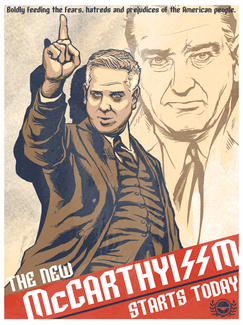
“McCarthyism” eventually smeared all the accused with the same broad brush, whether the evidence was good, bad or nonexistent.

The parallels to the present movement cannot be understated.

Even now, with modern-day McCarthyism sweeping the nation and America’s own history being blacklisted, I have to wonder what this sudden outrage and crisis of conscience is really all about.

Certainly, anyone who believes that the injustices, cruelties and vicious callousness of the U.S. government are unique to the Trump Administration has not been paying attention.

No matter what the team colors might be at any given moment, the playbook remains the same. The leopard has not changed its spots.

Scrape off the surface layers and you will find that the American police state that is continuing to wreak havoc on the rights of the people under the Trump Administration is the same police state that wreaked havoc on the rights of the people under every previous administration.

So please spare me the media hysterics and the outrage and the hypocritical double standards of those whose moral conscience appears to be largely dictated by their political loyalties.

While we squabble over which side is winning this losing battle, a tsunami approaches.

While the populace wages war over past injustices, injustice in the here and now continues to trample innocent lives underfoot. Certainly, little of significance is being done to stem the tide of institutional racism that has resulted in disproportionate numbers of black Americans who continue to be stopped, frisked, shot at, arrested and jailed.

I’ve had enough of the short- and long-term amnesia that allows political sycophants to conveniently forget the duplicity, complicity and mendacity of their own party while casting blame on everyone else.

When you drill right down to the core of things, the policies of a Trump Administration have been no different from an Obama Administration or a Bush Administration, at least not where it really counts.

In other words, Democrats by any other name have been Republicans, and vice versa.

War has continued. Surveillance has continued. Drone killings have continued. Police shootings have continued. Highway robbery meted out by government officials has continued. Corrupt government has continued. Profit-driven prisons have continued. Censorship and persecution of anyone who criticizes the government have continued. The militarization of the police has continued. The devastating SWAT team raids have continued. The government’s efforts to label dissidents as extremists and terrorists has continued.

The more things change, the more they have stayed the same.

We’ve been stuck in this political Groundhog’s Day for so long that minor deviations appear to be major developments while obscuring the fact that we’re stuck on repeat, unable to see the forest for the trees.

This is what is referred to as creeping normality, or a death by a thousand cuts.

It’s a concept invoked by Pulitzer Prize-winning scientist Jared Diamond to describe how major changes, if implemented slowly in small stages over time, can be accepted as normal without the shock and resistance that might greet a sudden upheaval.

Diamond’s concerns related to Easter Island’s now-vanished civilization and the societal decline and environmental degradation that contributed to it, but it’s a powerful analogy for the steady erosion of our freedoms and decline of our country right under our noses.

As Diamond explains, “In just a few centuries, the people of Easter Island wiped out their forest, drove their plants and animals to extinction, and saw their complex society spiral into chaos and cannibalism… Why didn’t they look around, realize what they were doing, and stop before it was too late? What were they thinking when they cut down the last palm tree?”

His answer: “I suspect that the disaster happened not with a bang but with a whimper.”

Much like America’s own colonists, Easter Island’s early colonists discovered a new world—“a pristine paradise”—teeming with life. Yet almost 2000 years after its first settlers arrived, Easter Island was reduced to a barren graveyard by a populace so focused on their immediate needs that they failed to preserve paradise for future generations.

The same could be said of the America today: it, too, is being reduced to a barren graveyard by a populace so focused on their immediate needs that they are failing to preserve freedom for future generations.

In Easter Island’s case, as Diamond speculates:

The forest…vanished slowly, over decades. Perhaps war interrupted the moving teams; perhaps by the time the carvers had finished their work, the last rope snapped. In the meantime, any islander who tried to warn about the dangers of progressive deforestation would have been overridden by vested interests of carvers, bureaucrats, and chiefs, whose jobs depended on continued deforestation… The changes in forest cover from year to year would have been hard to detect… Only older people, recollecting their childhoods decades earlier, could have recognized a difference. Gradually trees became fewer, smaller, and less important. By the time the last fruit-bearing adult palm tree was cut, palms had long since ceased to be of economic significance. That left only smaller and smaller palm saplings to clear each year, along with other bushes and treelets. No one would have noticed the felling of the last small palm.

Sound painfully familiar yet?

We’ve already torn down the rich forest of liberties established by our founders. It has vanished slowly, over the decades. Those who warned against the dangers posed by too many laws, invasive surveillance, militarized police, SWAT team raids and the like have been silenced and ignored. They stopped teaching about freedom in the schools. Few Americans know their history. And even fewer seem to care that their fellow Americans are being jailed, muzzled, shot, tasered, and treated as if they have no rights at all.

The erosion of our freedoms happened so incrementally, no one seemed to notice. Only the older generations, remembering what true freedom was like, recognized the difference. Gradually, the freedoms enjoyed by the citizenry became fewer, smaller and less important. By the time the last freedom falls, no one will know the difference.

This is how tyranny rises and freedom falls: with a thousand cuts, each one justified or ignored or shrugged over as inconsequential enough by itself to bother, but they add up.

Each cut, each attempt to undermine our freedoms, each loss of some critical right—to think freely, to assemble, to speak without fear of being shamed or censored, to raise our children as we see fit, to worship or not worship as our conscience dictates, to eat what we want and love who we want, to live as we want—they add up to an immeasurable failure on the part of each and every one of us to stop the descent down that slippery slope.

We are on that downward slope now.

The contagion of fear that McCarthy helped spread with the help of government agencies, corporations and the power elite is still poisoning the well, whitewashing our history, turning citizen against citizen, and stripping us of our rights.

What we desperately need is the kind of resolve embodied by Edward R. Murrow, the most-respected newsman of his day.

On March 9, 1954, Murrow dared to speak truth to power about the damage McCarthy was inflicting on the American people. His message remains a timely warning for our age.

We will not walk in fear, one of another. We will not be driven by fear into an age of unreason, if we dig deep in our history and our doctrine; and remember that we are not descended from fearful men. Not from men who feared to write, to speak, to associate, and to defend causes that were for the moment unpopular. This is no time for men who oppose Senator McCarthy’s methods to keep silent, or for those who approve. We can deny our heritage and our history, but we cannot escape responsibility for the result. There is no way for a citizen of a republic to abdicate his responsibilities. As a nation we have come into our full inheritance at a tender age. We proclaim ourselves, as indeed we are, the defenders of freedom, wherever it continues to exist in the world, but we cannot defend freedom abroad by deserting it at home. The actions of the junior Senator from Wisconsin have caused alarm and dismay amongst our allies abroad, and given considerable comfort to our enemies. And whose fault is that? Not really his. He didn’t create this situation of fear; he merely exploited it—and rather successfully. Cassius was right. ”The fault, dear Brutus, is not in our stars, but in ourselves.”

America is approaching another reckoning right now, one that will pit our commitment to freedom principles against a level of fear-mongering that is being used to wreak havoc on everything in its path.

The outcome rests, as always, with “we the people.” As Murrow said to his staff before the historic March 9 broadcast: “No one can terrorize a whole nation, unless we are all his accomplices.”

Take heed, America.

As I make clear in my book Battlefield America: The War on the American People, this may be your last warning.
The Maxwell Family Business: Espionage

Ghislaine Maxwell is hardly the only Maxwell sibling to continue their father’s controversial work for intelligence, with other siblings carrying the torch specifically for Robert Maxwell’s sizable role in the PROMIS software scandal and subsequent yet related hi-tech espionage operations.

By Whitney Webb

Source: Unlimited Hangout

Many were surprised to learn earlier this month that the key co-conspirator in Jeffrey Epstein’s intelligence-linked sexual blackmail operation, Ghislaine Maxwell, had been in hiding in New England since Epstein’s arrest and subsequent “suicide” last summer. Her recent arrest, of course, has returned attention to the Epstein scandal and to Ghislaine’s ties to the entire operation, in which she played a central and crucial role, arguably more so than Epstein himself.

Ghislaine was first reported to be living in New England at the mansion of her alleged boyfriend Scott Borgeson on August 14th of last year. Though Maxwell is believed to have stayed there until purchasing the nearby New Hampshire home where she was arrested, attention from her presence on the East Coast was immediately and sensationally re-directed to the West Coast when, a day later on August 15ththe New York Post published a picture allegedly depicting Maxwell reading a book on “CIA operatives” at an In-N-Out Burger in Los Angeles, California. The photo was later revealed to have been photoshopped and a fake, but ultimately served its purpose in distracting from her actual location in New England.

While the media frenziedly covered the fake In-N-Out Burger photo, the appearance of an unexpected visitor nearby Borgeson’s mansion succeeded in largely slipping under the radar. On August 18th, Ghislaine’s sister Christine was spotted “packing up a number of bags” into a SUV just a few miles from Borgeson’s “secluded beachfront” home. Christine, who currently lives and works in Dallas, Texas, declined to comment on why she was visiting the exact area where Ghislaine was allegedly hiding at the time.

Out of the seven Maxwell siblings, Ghislaine Maxwell has undoubtedly received the bulk of media scrutiny both in recent years and arguably ever since the suspected homicide of the family patriarch, Robert Maxwell, in 1991. In the years since his death, Robert Maxwell’s close ties to Israeli intelligence and links to other intelligence agencies have been documented by respected journalists and investigators including Seymour Hersh and Gordon Thomas, among others.

While Ghislaine’s own ties to intelligence have since come to light in relation to her critical role in facilitating the Jeffrey Epstein sexual blackmail operation. Little, if any attention, has been paid to her siblings, particularly Christine and her twin sister Isabel, despite them having held senior roles at the Israeli intelligence front company that facilitated their father’s greatest act of espionage on Israel’s behalf, the sale of the bugged PROMIS software to the U.S. national laboratories at the heart of the country’s nuclear weapons system.

Not only that, but Christine and Isabel later became directly involved with technology-based business ventures that directly involved Ghislaine during the very period she worked with Epstein on behalf of Israeli and U.S. intelligence to ensnare powerful U.S. political and public figures in a sexual blackmail scheme involving minors. At the time, Ghislaine described her profession to a number of newspapers as “an internet operator.” Then, after this venture’s multi-million dollar sale to a competitor, Christine and Isabel became involved with successors to the PROMIS software scandal that were closely tied to U.S. intelligence and Israeli intelligence, respectively.

Ghislaine herself also became involved in these affairs, as did Jeffrey Epstein following his first arrest, as they began courting the biggest names in the U.S. tech scene, from Silicon Valley’s most powerful venture capital firms to its most well-known titans. This also dovetailed with Epstein’s investments in Israeli intelligence-linked tech firms and his claims of having troves of blackmail on prominent tech company CEOs during this same period.

With Ghislaine’s name and her ties to intelligence now inking their way back into the media sphere, detailing the decades-long course of these technology-focused espionage operations and their persistent ties to the Maxwell sisters demands the attention it deserves, as the need to air out the real Maxwell family business – espionage – is now greater than ever before.

Trap doors and Treason

One of the most brazen and successful operations conducted by Israeli intelligence on a global scale is undeniably its sale of a bugged software program to governments, corporations and major financial and scientific institutions around the world. That software program, known as the Prosecutor’s Information Management System or by its acronym PROMIS, was orginally created and marketed by Inslaw Inc., a company created by former NSA official Bill Hamilton and his wife Nancy.

In 1982, Inslaw leased its revolutionary PROMIS software to the U.S. Justice Department, then headed by arch neocon Edwin Meese III, Ronald Reagan’s most trusted advisor and who would later go on to advise Donald Trump following the 2016 election. The success of the software, which allowed integration of separate databases and information analysis on a previously unimaginable scale, eventually caught the attention of Rafi Eitan, the notorious and legendary Israeli spymaster and handler of the “most damaging spy” in American history, Jonathan Pollard. Eitan, at the time, was serving as the then-head of the now defunct Israel intelligence service known as Lekem, which focused specifically on espionage related to scientific and technical information and discoveries.

Eitan had first learned of PROMIS from Earl Brian. Brian was a long-time associate of Ronald Reagan who had previously worked for the CIA in covert operations and had been in charge of Reagan’s healthcare program when Reagan was governor of California. Brian often bragged of the nickname he had acquired in overseeing that health care initiative – “the man who walked over the dead.” In 1982, however, Brian was attempting to build a business empire, in which then-AG Ed Meese’s wife was a major investor, and he had first met Eitan while attempting to sell a healthcare system in Iran.

Brian divulged the efficacy of PROMIS, but – instead of praising its revolutionary approach to data analysis – expressed his frustration that the software enabled U.S. federal investigators to successfully track and target money laundering and other financial crimes. He also expressed frustration that he had been left out of the profits on PROMIS, the development of which he had followed closely for several years.

As their conversation wore on, Eitan and Brian hatched a plan to install a “trapdoor”, today more often referred to as a back door, into the software. They would then market PROMIS throughout the world, providing Israeli intelligence and allied elements of U.S. intelligence with a direct window into the operations of its enemies and allies while also netting Eitan and Brian massive profits for the sale of the software. Brian, of course, would also be able to use PROMIS to circumvent authorities investigating financial crimes.

According to the testimony of ex-Mossad official Ari Ben-Menashe, after a copy of PROMIS was obtained by Israeli military intelligence (via direct collusion with the U.S. Department of Justice), Ben-Menashe contacted an Israeli American programmer living in California on Eitan’s orders. That programmer then planted a “trapdoor” or back door into the software that would allow Lekem covert access to any database connected to a device on which the software was installed.

Once the back door was present, Brian attempted to use his company Hadron Inc to market the bugged PROMIS software around the world, though he first had tried to buy out Inslaw to do so. Unsuccessful, Brian turned to his close friend, then-Attorney General Ed Meese, and the Justice Department then abruptly refused to make the payments to Inslaw that had been stipulated by the contract, essentially using the software for free, which Inslaw claimed to be theft.

Meese’s actions would force Inslaw into bankruptcy and Inslaw subsequently sued the Justice Department, with a US court later finding that the Meese-led department “took, converted, stole” the software through “trickery, fraud and deceit.” With Inslaw out of the way, Brian sold the bugged software to Jordan’s and Iraq’s intelligence services, a major boon for Israel, and to a handful of companies. Despite this, Eitan was unsatisfied with Brian and Hadron and he quickly turned to the person he thought could most effectively market and sell PROMIS to governments of interest all over the world, Robert Maxwell.

First recruited as an asset of Israeli intelligence in the early 1960s, Maxwell’s standing with Israeli intelligence would strengthen considerably beginning in the early 1980s, when he purchased a web of Israeli companies, many of which were official “service providers” for the Mossad. One of these companies, a computer firm called Degem, had been used for years to provide cover to Mossad assassins that conducted kidnappings and murders in Latin America and Africa.

Through Degem and other Maxwell-owned companies based in Israel and elsewhere, Maxwell marketed PROMIS so successfully that Israeli intelligence soon had access to the innermost workings of innumerable governments, corporations, banks and intelligence services around the world. Many of Maxwell’s biggest successes came in selling PROMIS to dictators in Eastern Europe, Africa and Latin America. Following the sale and after Maxwell collected a handsome paycheck, PROMIS’ unparalleled ability to track and surveil anything – from cash flows to human movement – were used by these governments to commit financial crimes with greater finesse and used to hunt down and disappear dissidents. Israeli intelligence, of course, watched it all play out in real time.

In Latin America, for instance, Maxwell sold PROMIS to military dictatorships in Chile and Argentina, which were used to facilitate the mass murder that characterized Operation Condor as the friends and families of dissidents and so-called subversives were easily identified using PROMIS. PROMIS was so effective for this purpose that, just days after Maxwell sold the software to Guatemala, its US-backed dictatorship rounded up 20,000 “subversives” who were never heard from again. Of course, thanks to the back door in PROMIS, Israeli intelligence knew the identities of Guatemala’s disappeared before the victim’s own families. Israel was also intimately involved in the arming and training of many of the same Latin American dictatorships that had been sold the bugged PROMIS software.

Though Israeli intelligence found obvious use for the steady stream of sensitive and classified information, their biggest prize was yet to come – top secret government laboratories in the United States. Eitan tasked Maxwell with selling PROMIS to US labs in the Los Alamos complex, including Sandia National Laboratory, which was and is at the core of the US nuclear weapons system. Notably, the eventual sale of PROMIS to these laboratories by Maxwell occurred during the same period in 1984 when Eitan tasked one of Israel’s top experts in nuclear targeting with supervising Jonathan Pollard’s espionage of U.S. nuclear secrets on Israel’s behalf.

In order to plot how he would accomplish such a feat, Maxwell would meet with none other than Henry Kissinger, who told him that – in order to sell PROMIS to these sensitive laboratories – he needed to enlist the services of then-Senator for Texas John Tower, who was the head of the Senates’ Armed Services Committee at the time. Maxwell quickly struck a deal with Tower and then, using Mossad money, paid Tower $200,000 for his services, which included opening doors – not just to the Los Alamos complex, but also to the Reagan White House. Tower would arrange a trip for Maxwell to travel to Sandia National Laboratory, where he would market PROMIS. Unlike most other PROMIS sales, this one would not be handled by Degem, but a US-based company called Information on Demand.

It is worth noting that, despite Tower’s obvious and treasonous actions with respect to U.S. national security, another long-time “source” of Robert Maxwell, George H.W. Bush, would attempt to nominate Tower to serve as U.S. Secretary of Defense. When the Senate refused to confirm Tower, only then did Bush nominate Dick Cheney, who would then head the Pentagon and oversee the U.S.’ role in the First Gulf War. Not long after his failure to secure the nomination as Pentagon chief, Tower died in a suspicious plane crash soon after the equally suspicious death of Robert Maxwell.

Front Companies and FBI Cover-ups

Robert Maxwell purchased Information on Demand from its founder, Sue Rugge – a former librarian, through the Pergamon Group in 1982 – the very year plans were made by Rafi Eitan and Earl Brian to subvert PROMIS. Its offices were just a few doors down from the home of Isabel Maxwell and her first husband Dale Djerassi, son of the scientist credited with creating the birth control pill.

According to FBI files obtained by Inslaw Inc. via a FOIA request in the 1990s, San Francisco’s FBI opened an investigation into Information on Demand a year later in October 1983 and subsequently interviewed Rugge about the business and its activities. She told the FBI that the company’s sources “include over 250 computer data bases” and that company uses these to “locate single facts as well as provide answers to complex questions dealing with such areas as comprehensive marketing research, custom data summaries, sophisticated literature searching, current awareness service and global information capability.

One of these databases included Lockheed’s Dialog database and “the Defense Technical Center which is connected to the Department of Defense (DOD) which contains classified information. ” She asserted, however, that the company “has no password for access and further no need for access.” Elsewhere in the document, it notes that Information on Demand claimed not have any access to classified information “to the best of their knowledge” and “includes information concerning government and various available means of tapping government information databases.”

The FBI asked Rugge about one client of the company in particular, whose name and identifying information is redacted in its entirety, but notes that this mysterious client had worked with Information on Demand since at least 1973. Subsequent efforts by Inslaw Inc. and others to learn the identity of the redacted client have been unsuccessful since 1994.

Notably, just one month before the FBI opened an investigation into Information on Demand and interviewed Sue Rugge, another related Maxwell-owned firm, Pergamon International Information Corporation, had sent a letter to then-CIA Director Bill Casey, offering to provide the agency with access to patent databases. The only redacted portion of the letter is the identity of PIIC’s Executive Vice President, who had written the letter to Casey.

After Rugge had been interviewed, FBI interest in Information on Demand peaked soon after in June 1984, when a formal investigation was opened. This took place after two employees of Sandia National Laboratory who worked in technology transfer approached the Bureau over Information on Demand’s efforts to sell PROMIS to the laboratory. Those employees were compelled to contact the FBI after obtaining information from employees of the National Security Agency (NSA) regarding “the purchase of Information on Demand Inc. by one Robert Maxwell, the owner of Pergamon International.” The specific information on this purchase from the NSA is included in the report but redacted in its entirety. Two months later, one of the Sandia employees followed up with the Bureau, suggesting that the NSA and FBI jointly investigate Information on Demand, but was essentially stonewalled and told to take it up with FBI headquarters.

The FBI case file is coded as a foreign counter-intelligence investigation specifically, suggesting that the case was opened because the FBI was made aware of the alleged involvement of a foreign intelligence service in some aspect of Information on Demand’s activities that related specifically to the “dissemination, marketing or sale of computer software systems, including but not limited to the PROMIS computer software product.” It also noted that Maxwell himself had previously been the subject of a “security investigation” conducted by the FBI from 1953 until 1961, the year Maxwell was formally recruited as an Israeli intelligence asset.

In early August 1984, FBI headquarters and other higher-ups in the Ed Meese-led Department of Justice, which itself was complicit in the whole sordid PROMIS affair, ordered the New Mexico office to halt its investigation into Information on Demand, Maxwell and PROMIS. The cover-up, oddly enough, continues today, with the FBI still refusing to release documents pertaining to Robert Maxwell and his role in the PROMIS scandal.

Several months following the shuttering of the FBI investigation into Information on Demand, Robert Maxwell again returned to Sandia National Laboratories in February 1985, signing the contract for the sale of PROMIS and listing himself as President and CEO of Information on Demand. A few months later, he passed that role on to his daughter Christine, who served as the company’s president and CEO up until her father’s death in 1991, according to her résumé. Upon the collapse of his business empire shortly after his demise, which also resulted in the closure of Information on Demand, Christine created a company called Research on Demand that offered similar services and specialized “in Internet- and Big Data analytics-related market studies for companies in the Telecoms.”

In addition, Isabel Maxwell, who lived in close proximity to the company’s offices in Berkely, CA, told Haaretz that she had also worked for Information on Demand, which she refers to as “her sister’s company,” following her 1989 divorce from Dale Djerassi.

Recreating their Father’s Legacy

After the death of Robert Maxwell, in what most of his family and many of his biographers regard as a murder conducted by Israeli intelligence, his children began to pick up the pieces and sought to rebuild their father’s empire. Of his seven children, five took on different aspects of their father’s vast portfolio.

Kevin and Ian Maxwell took over much of his businesses (and the associated fall-out) and his murky network of interlocking companies, trusts and foundations spread throughout the world. Ghislaine, having already positioned herself in New York at her father’s behest to anchor his efforts to expand his empire and operations into Manhattan, began a sexual blackmail operation on behalf of Israeli intelligence alongside Jeffrey Epstein. Christine and Isabel, however, would take off where Maxwell’s intelligence-linked work with PROMIS and in technology had left off by cashing in on a new revolutionary technology, the Internet.

“We literally were trying to think about how to restart this whole business” that had collapsed after their father’s death, Christine Maxwell would later say of her decision to found, along with her husband Roger Malina, Isabel and Isabel’s then-husband David Hayden, their internet services company – the McKinley Group – in January 1992. Isabel would remember the decision similarly, telling Wired in 1999, that she and her sister had “wanted to circle the wagons and rebuild,” seeing McKinley as “a chance to recreate a bit of their father’s legacy.” In 2000, Isabel would tell The Guardian that her father would “love it [the internet] if he was still here.” “He was very prescient….He’d be in his element, he’d be having a blast, I’m sure he’d be thrilled to know what I’m doing now,” she told the UK-based publication while “throwing back her head and laughing loudly.” Notably, at that time, Isabel was leading Israeli software company with ties to Israeli military intelligence and powerful Israeli political players, including some who had previously worked directly under her father.

It’s not hard to see why Christine and Isabel saw the internet as their chance to expand upon and rebuild upon Robert Maxwell’s “legacy.” As previously mentioned, Christine, right up until her father’s death, had been president and CEO of the Robert Maxwell-owned Israeli intelligence front company, Information on Demand, where Isabel had also worked. Upon his death, Christine had founded a related company called Research on Demand, which specialized in “internet and big data analytics” for telecommunications firms, and would later overlap with the McKinley Group’s work. McKinley began as a directory with a rating system for websites, later transitioning into the Magellan search engine, all of which Isabel Maxwell told Cnet in 1997 were all Christine’s idea.

McKinley created what became known as the Magellan online directory, remembered as “the first site to publish lengthy reviews and ratings of websites.” Magellan’s “value-added content” approach attracted several large corporations, resulting in “major alliances” with AT&T, Time Warner, IBM, Netcom and the Microsoft Network [MSN] that were negotiated by Isabel Maxwell. Microsoft’s major alliance with McKinley came in late 1995, when Microsoft announced that Magellan would power the search option for the company’s MSN service. Time Warner first chose Magellan for its early web portal called Pathfinder and Magellan was on the homepage of the internet browser Netscape for much of the 1990s.

However, McKinley’s fortunes were troubled as its efforts to be the first search engine to go public fell through, igniting a stand-off between Christine Maxwell and Isabel’s husband that also resulted in the company’s essentially falling behind other market leaders both missing the window for a second IPO attempt and lagging behind in adding ad revenue to their business model. Excite, which was later acquired by AskJeeves, ultimately bought the McKinley Group and Magellan for 1.2 million shares of Excite stock in 1996, which was then valued at $18 million. It was allegedly Isabel Maxwell who made the deal possible, with Excite’s CEO at the time, George Bell, claiming she alone salvaged their purchase of McKinley.

Despite the company’s lackluster end, the Maxwell sisters and other stakeholders in the company, Ghislaine Maxwell among them, not only obtained a multi-million dollar payout from the deal, but also forged close connections with Silicon Valley high-rollers. Upon McKinley/Magellan’s sale, the overt ties of Christine and Isabel Maxwell to intelligence in both the U.S. and Israel would grow considerably.

A Family Affair

While the company is often framed as being a venture between Christine and Isabel Maxwell, McKinley Group and Magellan were much more than just the twin sisters’ business. For instance, a November 2003 article in The Evening Standard notes that Christine and Isabel launched the company with considerable help from their brother, Kevin Maxwell who the article described as being “consumed by an overwhelming desire to be his ‘dad reincorporated’” according to confidants. Another Evening Standard article from March 2001 cited report that “Kevin played a major role” in the company’s affairs.

In addition, at the time, The Sunday Times noted in November 2000 that Ghislaine Maxwell “had a substantial interest in Magellan” and netted a considerable sum following its sale to Excite in 1996. It also noted that Ghislaine, throughout the 1990s, had “been discreetly building up a business empire as opaque as her father’s” and that “she is secretive to the point of paranoia and her business affairs are deeply mysterious.” However, she would nonetheless describe “herself as an ‘internet operator’” even though “her office in Manhattan refuses to confirm even the name or the nature of her business.” A separate article in The Scotsman from 2001 also notes that Ghislaine “is extremely secretive about her affairs and describes herself as an internet operator.”

Exactly how involved Ghislaine Maxwell was involved in the McKinley Group and Magellan is unclear, though her decision to describe herself as an “internet operator” and her documented “substantial interest” in the company suggest that it was more than superficial. What is notable, however, is that Ghislaine’s time as an “internet operator” and her business interests in Magellan overlap directly with her time working alongside Jeffrey Epstein in an Israeli intelligence-linked sexual blackmail operation.

During this period of time, Ghislaine Maxwell and Jeffrey Epstein frequently had considerable overlap in their finances, with press reports from the time often asking whether Ghislaine’s expenses were paid by Epstein or through her access to the “lost Maxwell millions” that had been hidden in a web of murky, untraceable financial entities and allegedly “disappeared” following his 1991 death.

The latter is certainly a possibility as it was Ghislaine who was the first to walk into her late father’s office on the Lady Ghislaine following his death, where she “shredded all incriminating documents onboard,” according to journalist John Jackson who witnessed the scene. This would likely mean that she was quickly able to distinguish which documents were “incriminating” and was intimately aware of his more unsavory business activities. In addition, prior to his death, Robert Maxwell had provided Ghislaine with a “tailor-made” New York corporation called Maxwell Corporate Gifts, of which little is known. The corporation was reportedly intended to aid her in establishing a foothold in New York’s power base for Robert Maxwell’s planned expansion into New York society, a plan first set into motion following his purchase of the New York Daily News.

Notably, an article from The Evening Standard in 2001 makes an odd comment about a major source of income from Epstein during the 1990s, stating that “has made many millions out of his business links with the likes of Bill Gates, Donald Trump and Ohio billionaire Leslie Wexner, whose trust he runs.”  In addition, Epstein victim Maria Farmer noted in an interview that she overheard Ghislaine and Epstein discuss Bill Gates as though they knew him well in 1995. However, these mentions of Bill Gates here defies the official narrative about the Epstein-Gates relationship, which claims they first met in 2011.Given the “major alliance” between McKinley/Magellan and Microsoft that was forged in 1995-1996, it is certainly possible that Epstein’s pre-2001 “business links” with Bill Gates were, in fact, related to Ghislaine’s involvement and stake in Magellan. This is also supported by the fact that, as will be shown in Part 2 of this report, Magellan co-founder Isabel Maxwell had a personal relationship with Bill Gates and that he put her subsequent company, Israel-based CommTouch, “on the map” after a major investment that had been brokered between Gates and Isabel personally. Part 2 will also show how both Isabel and Christine’s overt involvement, with Israeli and U.S. intelligence, respectively, deepened after Magellan was sold to Excite in 1996.

America’s Revolutionary Founders Would Be Anti-Government Extremists Today

By John W. Whitehead

Source: The Rutherford Institute

“It is the duty of the patriot to protect his country from its government.”—Thomas Paine

“When the government violates the people’s rights, insurrection is, for the people and for each portion of the people, the most sacred of the rights and the most indispensable of duties.”—Marquis De Lafayette

Had the Declaration of Independence been written today, it would have rendered its signers extremists or terrorists, resulting in them being placed on a government watch list, targeted for surveillance of their activities and correspondence, and potentially arrested, held indefinitely, stripped of their rights and labeled enemy combatants.

This is no longer the stuff of speculation and warning.

In fact, Attorney General William Barr recently announced plans to target, track and surveil “anti-government extremists” and preemptively nip in the bud any “threats” to  public safety and the rule of law.

It doesn’t matter that the stated purpose of Barr’s anti-government extremist task force is to investigate dissidents on the far right (the “boogaloo” movement) and far left (antifa, a loosely organized anti-fascist group) who have been accused of instigating violence and disrupting peaceful protests.

Boogaloo and Antifa have given the government the perfect excuse for declaring war (with all that entails: surveillance, threat assessments, pre-crime, etc.) against so-called anti-government extremists.

Without a doubt, America’s revolutionary founders would have been at the top of Barr’s list.

After all, the people who fomented the American Revolution spoke out at rallies, distributed critical pamphlets, wrote scathing editorials and took to the streets in protest. They were rebelling against a government they saw as being excessive in its taxation and spending. For their efforts, they were demonized and painted as an angry mob, extremists akin to terrorists, by the ruler of the day, King George III.

Of course, it doesn’t take much to be considered an anti-government extremist (a.k.a. domestic terrorist) today.

If you believe in and exercise your rights under the Constitution (namely, your right to speak freely, worship freely, associate with like-minded individuals who share your political views, criticize the government, own a weapon, demand a warrant before being questioned or searched by the police, or any other activity viewed as potentially anti-government, racist, bigoted, anarchic or sovereign), you’re at the top of the government’s terrorism watch list.

Indeed, under Barr’s new task force, I and every other individual today who dares to speak truth to power could also be targeted for surveillance, because what we’re really dealing with is a government that wants to suppress dangerous words—words about its warring empire, words about its land grabs, words about its militarized police, words about its killing, its poisoning and its corruption—in order to keep its lies going.

This is how the government plans to snuff out any attempts by “we the people” to stand up to its tyranny: under the pretext of rooting out violent extremists, the government’s anti-extremism program will, in many cases, be utilized to render otherwise lawful, nonviolent activities as potentially extremist.

The danger is real.

Keep in mind that the government agencies involved in ferreting out American “extremists” will carry out their objectives—to identify and deter potential extremists—in concert with fusion centers, data collection agencies, behavioral scientists, corporations, social media, and community organizers and by relying on cutting-edge technology for surveillance, facial recognition, predictive policing, biometrics, and behavioral epigenetics (in which life experiences alter one’s genetic makeup).

This is pre-crime on an ideological scale and it’s been a long time coming.

For example, in 2009, the Department of Homeland Security (DHS) released two reports, one on “Rightwing Extremism,” which broadly defines rightwing extremists as individuals and groups “that are mainly antigovernment, rejecting federal authority in favor of state or local authority, or rejecting government authority entirely,” and one on “Leftwing Extremism,” which labeled environmental and animal rights activist groups as extremists

Incredibly, both reports use the words terrorist and extremist interchangeably

That same year, the DHS launched Operation Vigilant Eagle, which calls for surveillance of military veterans returning from Iraq, Afghanistan and other far-flung places, characterizing them as extremists and potential domestic terrorist threats because they may be “disgruntled, disillusioned or suffering from the psychological effects of war.

These reports indicate that for the government, anyone seen as opposing the government—whether they’re Left, Right or somewhere in between—can be labeled an extremist.

Fast forward a few years, and you have the National Defense Authorization Act (NDAA), which Congress has continually re-upped, that allows the military to take you out of your home, lock you up with no access to friends, family or the courts if you’re seen as an extremist.

Now connect the dots, from the 2009 Extremism reports to the NDAA, the National Security Agency’s far-reaching surveillance networks, and fusion centers that collect and share surveillance data between local, state and federal police agencies

Add in tens of thousands of armed, surveillance drones that are beginning to blanket American skies, facial recognition technology that will identify and track you wherever you go and whatever you do. And then to complete the circle, toss in the real-time crime centers being deployed in cities across the country, which will be attempting to “predict” crimes and identify criminals before they happen based on widespread surveillance, complex mathematical algorithms and prognostication programs.

Hopefully you’re getting the picture, which is how easy it is for the government to identify, label and target individuals as “extremist.”

And just like that, we’ve come full circle.

Imagine living in a country where armed soldiers crash through doors to arrest and imprison citizens merely for criticizing government officials. Imagine that in this very same country, you’re watched all the time, and if you look even a little bit suspicious, the police stop and frisk you or pull you over to search you on the off chance you’re doing something illegal.

Keep in mind that if you have a firearm of any kind (or anything that resembled a firearm) while in this country, it may get you arrested and, in some circumstances, shot by police.

If you’re thinking this sounds like America today, you wouldn’t be far wrong.

However, the scenario described above took place more than 200 years ago, when American colonists suffered under Great Britain’s version of an early police state. It was only when the colonists finally got fed up with being silenced, censored, searched, frisked, threatened, and arrested that they finally revolted against the tyrant’s fetters

No document better states their grievances than the Declaration of Independence, drafted by Thomas Jefferson.

A document seething with outrage over a government which had betrayed its citizens, the Declaration of Independence was signed on July 4, 1776, by 56 men who laid everything on the line, pledged it all—“our Lives, our Fortunes, and our sacred Honor”—because they believed in a radical idea: that all people are created to be free.

Labeled traitors, these men were charged with treason, a crime punishable by death. For some, their acts of rebellion would cost them their homes and their fortunes. For others, it would be the ultimate price—their lives.

Yet even knowing the heavy price they might have to pay, these men dared to speak up when silence could not be tolerated.

Read the Declaration of Independence again, and ask yourself if the list of complaints tallied by Jefferson don’t bear a startling resemblance to the abuses “we the people” are suffering at the hands of the American police state.

If you find the purple prose used by the Founders hard to decipher, here’s my translation of what the Declaration of Independence would look and sound like if it were written in the modern vernacular:

There comes a time when a populace must stand united and say “enough is enough” to the government’s abuses, even if it means getting rid of the political parties in power. Believing that “we the people” have a natural and divine right to direct our own lives, here are truths about the power of the people and how we arrived at the decision to sever our ties to the government:

All people are created equal. All people possess certain innate rights that no government or agency or individual can take away from them. Among these are the right to Life, Liberty and the pursuit of Happiness. The government’s job is to protect the people’s innate rights to Life, Liberty and the pursuit of Happiness. The government’s power comes from the will of the people.

Whenever any government abuses its power, it is the right of the people to alter or abolish that government and replace it with a new government that will respect and protect the rights of the people. It is not wise to get rid of a government for minor transgressions. In fact, as history has shown, people resist change and are inclined to suffer all manner of abuses to which they have become accustomed. However, when the people have been subjected to repeated abuses and power grabs, carried out with the purpose of establishing a tyrannical government, people have a right and duty to do away with that tyrannical Government and to replace it with a new government that will protect and preserve their innate rights for their future wellbeing.

This is exactly the state of affairs we are suffering under right now, which is why it is necessary that we change this imperial system of government. The history of the present Imperial Government is a history of repeated abuses and power grabs, carried out with the intention of establishing absolute Tyranny over the country.

To prove this, consider the following:

The government has, through its own negligence and arrogance, refused to adopt urgent and necessary laws for the good of the people. The government has threatened to hold up critical laws unless the people agree to relinquish their right to be fully represented in the Legislature.

In order to expand its power and bring about compliance with its dictates, the government has made it nearly impossible for the people to make their views and needs heard by their representatives. The government has repeatedly suppressed protests arising in response to its actions.

The government has obstructed justice by refusing to appoint judges who respect the Constitution and has instead made the Courts march in lockstep with the government’s dictates.

The government has allowed its agents to harass the people, steal from them, jail them and even execute them. The government has directed militarized government agents—a.k.a., a standing army—to police domestic affairs in peacetime. The government has turned the country into a militarized police state.

The government has conspired to undermine the rule of law and the Constitution in order to expand its own powers.

The government has allowed its militarized police to invade our homes and inflict violence on homeowners. The government has failed to hold its agents accountable for wrongdoing and murder under the guise of “qualified immunity.”

The government has jeopardized our international trade agreements. The government has overtaxed us without our permission.

The government has denied us due process and the right to a fair trial. The government has engaged in extraordinary rendition. The government has continued to expand its military empire in collusion with its corporate partners-in-crime and occupy foreign nations.

The government has eroded fundamental legal protections and destabilized the structure of government. The government has not only declared its federal powers superior to those of the states but has also asserted its sovereign power over the rights of “we the people.”

The government has ceased to protect the people and instead waged domestic war against the people. The government has plundered our seas, ravaged our Coasts, and destroyed the lives of the people.

The government has employed private contractors and mercenaries to carry out acts of death, desolation and tyranny against other nations, totally unworthy of a civilized nation. The government through its political propaganda has pitted its citizens against each other. The government has stirred up civil unrest and laid the groundwork for martial law.

Repeatedly, we have asked the government to cease its abuses. Each time, the government has responded with more abuse.

An Imperial Ruler who acts like a tyrant is not fit to govern a free people.

We have repeatedly sounded the alarm to our fellow citizens about the government’s abuses. We have warned them about the government’s power grabs. We have appealed to their sense of justice. We have reminded them of our common bonds. They have rejected our plea for justice and brotherhood. Thus, our fellow citizens are equally at fault for the injustices being carried out by the government.

Thus, for the reasons mentioned above, we the people of the united States of America declare ourselves free from the chains of an abusive government. Relying on the Creator’s protection, we pledge to stand by this Declaration of Independence with our lives, our fortunes and our honor.

See what I mean? The abuses meted out by an imperial government and endured by the American people have not ended. They have merely evolved.

Two hundred and forty-four years after a group of anti-government extremists declared their independence from tyranny, the American people have once again managed to work their way back under the tyrant’s thumb.

“We the people” are still being robbed blind by a government of thieves. We are still being taken advantage of by a government of scoundrels, idiots and monsters. We are still being locked up by a government of greedy jailers. We are still being spied on by a government of Peeping Toms. We are still being ravaged by a government of ruffians, rapists and killers.

We are still being forced to surrender our freedoms—and those of our children—to a government of extortionists, money launderers and corporate pirates. And we are still being held at gunpoint by a government of soldiers: a standing army in the form of a militarized police.

The bipartisan coup that laid siege to our nation did not happen overnight. It snuck in under our radar, hiding behind the guise of national security, the war on drugs, the war on terror, the war on immigration, political correctness, hate crimes and a host of other official-sounding programs aimed at expanding the government’s power at the expense of individual freedoms.

As I make clear in my book Battlefield America: The War on the American People, the building blocks for the bleak future we’re just now getting a foretaste of—police shootings of unarmed citizens, profit-driven prisons, weapons of compliance, a wall-to-wall surveillance state, pre-crime programs, a suspect society, school-to-prison pipelines, militarized police, overcriminalization, SWAT team raids, endless wars, etc.—were put in place by government officials we trusted to look out for our best interests and by American citizens who failed to heed James Madison’s warning to “take alarm at the first experiment on our liberties.”

For too long now, we have suffered the injustices of a government that has no regard for our rights or our humanity.

We’ve suffered in silence for too long.

Frankly, what this country desperately needs is more anti-government extremists willing to take the government to task for its excesses, abuses and power grabs that fly in the face of every principle for which America’s founders risked their lives.

Having Sucked America Dry, Tech Giants Seek New Markets Beyond Reach of US Antitrust Laws

Sept. 27, 2015 Facebook CEO Mark Zuckerberg hugs Prime Minister of India Narendra Modi at Facebook in Menlo Park, Calif. (AP Photo/Jeff Chiu, File)

An aggressive push to consolidate companies in the tech sector, coupled with the world’s ever-increasing dependence on digital platforms and tools, is quickly leading to a crisis of sovereignty.

By Raul Diego

Source: MintPress News

The American consumer market for big tech gadgets appears to have reached the point of saturation as the novelty of mobile devices and laptops plateau and the persistent lockdown sees savings dwindle and discretionary spending disappear. Apple, which has enjoyed reigning over the smartphone market for more than a decade, has been forced to drop its prices over the last year as a result of a market at full capacity.

Nevertheless, one of the world’s most liquid companies, along with other tech giants like Facebook and Google – whose parent company, Alphabet, Inc. recently overtook Apple as the most cash-rich company in the world – are taking full advantage of their position to gobble up startups in emerging sectors in the Artificial Intelligence (AI) space like Natural Language Processing (NLP), Machine Learning (ML) and Deep Learning (DL), in order to solidify their place in other, mostly untapped markets in developing nations.

Big tech’s insatiable appetite, as manifested in this current sprint to further consolidate their assets, is bound to give them even more control over their already substantial access to our data and other digital activities of the population at large.  Earlier this year, then Presidential candidate Elizabeth Warren led the call to “Break Them Up,” in reference to the big tech companies, declaring that they had “bulldozed competition, used our private information for profit, and tilted the playing field against everyone else. And in the process, they have hurt small businesses and stifled innovation.” Her plan to “level the playing field,” however, seems to have gone away with her fleeting candidacy.

Nonetheless, they are all gearing up to face an election-year challenge to their growing power as a year-long House Judiciary subcommittee investigation is set to conclude and will more than likely provide plenty of fodder for the antitrust battles looming on the horizon. Some analysts have speculated that the U.S. government could impose fines on companies like Google in the tens of billions for past violations. But, whether or not this Congress implements measures with any real teeth remains to be seen.

Captive market shares

American tech giants are turning their focus to south-east Asia as their original markets in the U.S. can no longer support most of their quarterly profit projections. Apple’s recent acquisition of Seattle-based Xnor.ai, which specializes in “low-power, edge-based artificial intelligence tools” that will help them develop low-cost hardware for things like security cameras using artificial visual intelligence.

The Xnor.ai acquisition is just one of several made by Apple this year. Others include an Irish AI platform called Voysis that enables voice interactions with digital retailers; NextVR, a virtual reality headset company that holds over 40 patents in that space and will help Apple carve out a niche in the burgeoning world of streaming music and sporting events.

Google, which already has a virtual monopoly over Internet search capabilities and related tools, is aggressively pursuing startups in the cloud computing space, healthcare, and advertising market. A salient example is the ongoing $2.1 Billion-dollar acquisition of Fitbit, which has reportedly entered its final stages but has raised calls in some quarters for U.S. antitrust regulators to take a closer look.

The bank of Zuckerberg

Meanwhile, Facebook is continuing its incursion into the virtual entertainment arena with the purchase of Sanzaru Games in February as the social media giant solidifies its VR stake by taking over both hardware and software sides of that emerging market. Zuckerberg has also added to his social media empire with plans to acquire animated gif search engine Giphy for $400 Million, extending his consolidation over two of the most popular social media and communication platforms in its portfolio: Instagram and WhatsApp.

Facebook’s recent $5.7 Billion-dollar investment in India’s Jio Platforms also reveals how the tech giant is betting on Asia for its future growth. Facebook claims that Jio has “brought more than 388 million people online” and is poised to leverage its ubiquitous presence in the country through WhatsApp, boasting that the chat/call app has become a “commonly used verb across many Indian languages and dialects.”

The Indian telecom, led by that nation’s richest man, also includes a recently launched e-commerce site called JioMart, that further opens the door for Facebook’s digital payments platform and has the very real potential to put the social media company in a new class as a payment processing giant, shaking up the status quo in a space largely controlled by the banking sector.

Breaking out of the virtual gold cage

Having sucked the American market dry, these colossal corporations continue their unfettered growth and are increasingly beyond the reach of national anti-monopoly laws. Their aggressive push to consolidate across sectors in the technology space, coupled with the world’s ever-increasing dependence on digital platforms and tools is quickly leading us into a crisis of sovereignty.

If three companies own or have a stake in virtually all of the apps, gadgets and software that are ultimately responsible for collecting out data, performing our transactions and providing the content we consume, we will effectively become prisoners of these same corporations.

Even if Google were to re-instate the infamous “don’t be evil” motto in its code of conduct, such a state of affairs would render that promise moot. The slew of acquisitions by the world’s top tech companies in the midst of an economic depression for the rest of us does not bode well for a future of greater self-determination as the wealth and knowledge gaps grow larger.

Efforts to bridge these gaps are being undertaken by people like Dion Devow in Australia, an entrepreneur who is on a mission to close the gap between Indigenous Australians and IT. But, how effective can such efforts really be in the long run if the technological infrastructure continues to accumulate in the hands of so very few?

Deadly Rainbow: Will 5G Precipitate the Extinction of All Life on Earth?

By Robert J. Burrowes

In his recently revised and updated book The Invisible Rainbow: A History of Electricity and Life, scientist Arthur Firstenberg has made both science and history comprehensible by explaining the importance and significance to life on Earth of a vital consideration that has long been ‘invisible’: electricity.

Indeed, as Firstenberg makes clear, if we want to understand life on Earth, we cannot do so without understanding the role that electricity plays in making life possible, healing it and, if abused, threatening us all.

Firstenberg’s book is unusual on at least two counts. Based on decades of scientific research, he carefully explains each point in language accessible to the non-scientist while documenting his case with exceptional clarity and detail complemented by a 138-page bibliography.

If you want to really understand this issue, and what is at stake, you will be doing yourself a favor by reading this book.

The Universe, Electricity and Life: In Brief

As Firstenberg’s subtitle promises, his book includes a history of electricity and its role in the Universe but particularly on Earth.

‘Almost all of the matter in the universe is electrically charged…. The stars we see are made of… charged particles in constant motion. The space between the stars and galaxies, far from being empty, teems with electrically charged subatomic particles, swimming in vast swirling electromagnetic fields, accelerated by those fields to near-light speeds. Plasma is such a good conductor of electricity, far better than any metals, that filaments of plasma – invisible wires billions of light-years long – transport electromagnetic energy in gigantic circuits from one part of the universe to another…. Under the influence of electromagnetic forces, over billions of years, cosmic whirlpools of matter collect along these filaments, like beads on a string, evolving into the galaxies that decorate our night sky.’

The Milky Way, the galaxy in which Earth is located, is a medium-sized spiral galaxy that is 100,000 light-years across; it rotates around its center every 250,000,000 earth years, generating around itself a galactic-size magnetic field. Filaments of plasma, 500 light-years long, generate additional magnetic fields.

Our sun, also made of plasma, sends out an ocean of electrons, protons and helium ions in a steady current called the solar wind. This wind bathes the Earth before diffusing out into the plasma between the stars.

The Earth, with its core of iron, rotates on its axis in the electric fields of the solar system and the galaxy, in turn generating its own magnetic field that traps and deflects the charged particles of the solar wind wrapping the Earth in an envelope of plasma called the magnetosphere. Some of the particles from the solar wind collect in layers we call the Van Allen belts where they circulate 600 to 35,000 miles overhead.

The sun also bombards the Earth with ultraviolet light and X-rays. In addition, atomic nuclei and subatomic particles (known as cosmic rays) shower the Earth from all directions as well. It is these cosmic rays from Space and the radiation emitted by uranium and other radioactive elements in Earth’s crust that provide the small ions that carry the electric currents that surround us in the lower atmosphere.

It is within this electromagnetic environment – a fairly constant vertical field averaging 130 volts per meter – that all life, including Homo Sapiens, evolved on Earth.

In fair weather, the ground beneath us has a negative charge and the ionosphere above us a positive charge. ‘Electricity courses through the sky far above us, explodes downward in thunderstorms, rushes through the ground beneath us, and flows gently back up through the air in fair weather.’ This happens in an endless cycle as about 100 bolts of lightning, each delivering a trillion watts of energy, strike the Earth every second.

Every living thing is part of this circuit. The current enters our heads from the sky, circulates through our meridians, and enters the earth through the soles of our feet. This current provides the energy for growth, healing, and life itself. See ‘Putting the Earth Inside a High-Speed Computer’.

The strength of the atmospheric electrical current is between 1 and 10 picoamperes (trillionths of an ampere) per square meter. Dr. Robert Becker found that 1 picoampere is all the current that is necessary to stimulate healing in frogs…. It is these tiny currents that keep us alive and healthy. See ‘Planetary Emergency’.

The fundamental point about all this is simple: The Earth is incredibly delicately balanced with a great many forces making up this balance and thus making life possible.

One of the many ways in which we have been disrupting this balance is by disturbing the global electrical circuit, that evolved over eons and sustains all life, without paying genuine and sincere attention to what we are doing and what this means for the Earth and all of its inhabitants, including us.

Given the profound implications of generating ‘electric pollution’, some might label this behaviour insane. It is certainly unaware.

Human-Generated Electricity on Earth

It was in 1746 that scientists were finally able to ‘capture’ electricity so that a start could be made on using it directly for human ends. Sure, the wider implications of its use were not considered but it offered opportunities not previously available. And when the damage from its use, on humans and other living organisms, started and then rapidly picked up pace, the association between the spread of electricity (particularly through the telegraph wires in the mid-nineteenth century and electric lighting a few decades later) and the adverse health and environmental impacts were not made, or ignored when they were. And so diseases not previously recorded in the medical literature started to appear: anxiety disorder, influenza, diabetes, heart disease and cancer.

But it wasn’t just us that was impacted; so were the other living organisms of our planet.

And now we are bathed in the 60-cycle current in our house-wiring; the ultrasonic frequencies in our computers, Wi-Fi routers and modems; the radio waves in our televisions; the microwaves in our cell phones and the electromagnetic radiation generated by everything from baby monitors to ‘smart’ devices of all kinds, as well as the vast network of satellites, transmission towers and power lines all endlessly but variably impacting, adversely, virtually every human being on Earth. And if 5G is deployed, there will be nowhere on Earth that is safe for humans, insects, birds, animals and plants.

We will have fundamentally altered the very conditions that made the evolution of life on Earth possible.

An exaggeration?

Here is the briefest sample of the damage existing human-generated electromagnetic radiation is causing life on Earth.

Forests

Apart from being logged mercilessly, burned down to create cattle or soy farms or palm oil plantations, destroyed by the endless proliferation of mining for various mineral resources including coal and oil, damaged by dam construction, wildlife poaching and the extraction of resources like rayon, viscose and modal to make clothing, and adversely impacted in many other ways, forests are being destroyed by electromagnetic radiation inflicted by humans. While acid rain and global warming have been blamed for much of the ‘forest die-off’ that has occurred over the past 40 years, the evidence that electromagnetic radiation has been the real, or at least primary, cause is rather overwhelming once the full circumstances of the damage are seriously investigated. While Firstenberg cites many very compelling examples, the case of the Amazon rainforest makes the point rather starkly.

In 2005, it was noticed that trees were dying without obvious cause. This has been blamed on global warming which caused an unusual drought in that year. However, on 27 July 2002, the US-financed and Raytheon-built System for Vigilance of the Amazon (SIVAM), a $US1.4 billion system of radars and sensors, began its monitoring activities in a two million square mile area of remote wilderness.

Ostensibly to deprive drug traffickers and guerrillas a safe haven, it also ‘required pretending that blasting the rainforest with radiation at levels that were unprecedented in the history of the world was of no consequence to the forest’s precious inhabitants, human or otherwise’. So the system’s ‘25 enormously powerful surveillance radars, 10 Doppler weather radars, 200 floating water-monitoring stations, 900 radio-equipped “listening posts”, 32 radio stations, 8 airborne state-of-the-art surveillance jets equipped with fog-penetrating radar, and 99 “attack/trainer” support aircraft’ can track individual human beings and ‘hear a twig snap’ anywhere in the Amazon.

Again, at the cost of electromagnetically damaging every living organism in the rainforest.

To reiterate though, the Amazon is not the only forest in the world adversely impacted by electromagnetic radiation with many studies examining the issue, wherever they are conducted, consistently revealing forest damage by electromagnetic radiation from civilian and military installations (and even recovery when, as happens occasionally, the local radiation stops).

Insects

In 1901, Marconi sent the world’s first long-distance radio transmission from the Isle of Wight, off the southern coast of England. By 1906 and now host to the greatest density of radio transmissions in the world, the island was almost empty of bees. ‘Thousands, unable to fly, were found crawling and dying on the ground outside their hives’. And healthy bees, imported from the mainland, began dying within a week of arrival. ‘Isle of Wight disease’ was then reported in European countries, South Africa, Australia and North America over following decades with almost everyone assuming it was infectious. Despite various suspected diseases and parasites accused over many decades, each was eventually ‘cleared’ of causing the problem.

But in the second half of the 1990s, the ‘disappearing bee’ problem again accelerated and acquired the name ‘colony collapse disorder’ in 2007 as bee populations were decimated in many parts of the world. And despite the resistance of beekeepers (who are largely convinced that infectious diseases are driving bee losses and that toxic pesticides are necessary to kill mites), some scientists were starting to investigate the impact of electromagnetic radiation on bees. The simplest experiments involved placing a cell phone inside a bee hive: ‘The results of such experiments, considering the complete denial by our society that wireless technology has any environmental effects at all, have been almost unbelievable.’

‘The quickest way to destroy a bee hive, investigators have found, is to place a wireless telephone inside it.’ Landmark research conducted originally in 2009 and then subsequently, which involved placing two cell phones in a hive for 30 minutes at a time every few days, demonstrated that electromagnetic fields interfere with cellular metabolism: bees practically could not metabolize sugars, proteins or fats and, as in humans but far more rapidly, their cells become oxygen starved. Three months, at this modest level of exposure, would destroy a hive.

One particularly nasty development that occurred in the (northern) Winter of 2006-2007 that is considered by some the likely immediate cause of the disastrous colony collapse disorder at the time, is that the US military’s HAARP – High-frequency Active Auroral Research Project – in Alaska reached full power with the installation of the last of its 180 antennas at that time. HAARP is the most powerful radio transmitter on Earth and ‘turned the ionosphere itself – the life-giving layer of sky to which every creature is tuned – into a gigantic radio transmitter’. Why? HAARP was being used for US military communications, particularly with submarines. Even in 1988, when HAARP was still being planned, physicist Richard Williams, a consultant to Princeton University’s David Sarnoff Laboratory, called the project ‘an irresponsible act of global vandalism’ given the power levels that were to be used.

In fact, according to other researchers, the HAARP project has also been used to research and develop electromagnetic weapons, such as directed energy beams. See ‘HAARP: Secret Weapon Used For Weather Modification, Electromagnetic Warfare’.

But whatever its functions, even though now transferred to the University of Alaska Fairbanks, Ulrich Warnke points out that the frequencies of HAARP superimpose unnatural magnetic fields on the natural resonant frequencies of the sky, the daily variations of which have not changed since life appeared on Earth. This is disastrous for bees because they ‘lose an orientation that served them for millions of years as a reliable indicator of the time of day’.

Of course bees are not the only insects adversely impacted by this recent human obsession with electromagnetic radiation. Experiments with other insects, such as ants and fruit flies, again simply using exposure to cell phones rather than any specialized equipment, revealed equally instructive results. A few minutes exposure for a few days, for example, dramatically reduced the reproductive success of the flies. And exposed to phones turned off, in standby mode and then turned on, ants displayed a variety of behaviors including leaving their nest and taking all of their eggs, larvae and nymphs with them.

As an aside, experiments of this nature also revealed ‘intensity windows’ of maximal effect. This means that ‘the greatest damage is not always done by the greatest levels of radiation. Holding your cell phone away from your head may actually worsen the damage.’ And even a cell phone that is turned off but has the battery in it, is ‘clearly and obviously dangerous’.

Birds

The disastrous effects of radio waves on birds were first noted in the 1930s. It was immediately obvious, for example, to diverse groups of people who worked with pigeons – those involved in pigeon racing and those still using pigeons for military communications – when the birds lost their way during the rapid expansion of radio broadcasting. But by the late 1990s, as cell phone towers proliferated and vastly greater numbers of birds were unable to fly home, pigeon-racing plummeted compelling pigeon-fanciers to revisit an issue they had earlier set aside. Unfortunately, it was too late. In 1998, shortly after Motorola’s launch of 66 Iridium satellites had begun providing the first cell phone service from Space, 90% of pigeons being raced in various locations in the United States over a two-week period vanished.

Of course, it is not just pigeon populations that are being decimated. Wherever dramatic bird population declines are being studied and electromagnetic radiation is considered as a possible factor (which is not always the case), the results usually reveal a link even if the damaging impact is variable.

If electromagnetic radiation totally disorients pigeons, how do migratory birds navigate? Often enough, they don’t. For example, in 2004, scientists at the University of Oldenburg in Germany were shocked to discover that migratory songbirds they had been studying were no longer able to orient themselves for their migratory journeys. Conducting a simple experiment – surrounding the aviaries of European robins with grounded aluminium sheeting to remove the influence of electromagnetic radiation – the immediate and positive impact ‘on the birds’ orientation capabilities was profound’, they noted in a study published in 2014.

One series of studies was conducted by wildlife biologist Alfonso Balmori Martínez in Spain for more than a decade from the 1990s, after noting the dramatic increase in leukemias, cancers, headaches, insomnia, memory loss, heart arrhythmias and acute neurological reactions suffered by people near a new installation of antennas adjacent to a local school. His subsequently published research revealed, among many other points, the following: kestrels vanishing from breeding sites after antennas for mobile telecommunications were installed, nest abandonment by storks near the radiation beams from telephone masts, rock doves dead near phone masts, plumage deterioration and locomotive problems in magpies at points highly contaminated with microwave radiation, and a dramatic decline in sparrow populations in irradiated areas, which matched a European-wide trend with, for example, sparrows in the UK declining by 75% between 1994 and 2002. Balmori’s conclusion was simple: ‘This coincides with the rollout of mobile telephony.’

One of the problems peculiar to birds, already identified by Canadian researchers in the 1960s, is that ‘feathers make fine receiving aerials for microwaves’.

By the way, have a ponder what happens when a bird (or animal, reptile, amphibian, fish or even insect, for that matter) is radio tagged so that its behavior can be monitored. It exposes the creatures to immediate radiation, in comparison to that from distant cell phone towers, thus adversely impacting their functioning and altering their behavior! Firstenberg characterized this procedure, politely in my view, as ‘scientific folly’. Other scientists have documented many serious, adverse impacts from radio tagging but the practice is far from over with most wildlife scientists simply assuming that tagging has zero impact.

Amphibians

The ongoing serious decline of frogs, toads, salamanders and other amphibians all over the world has been notable since at least the 1980s. Not something you think about?

Well, amphibians have been falling silent for a range of reasons but, once again, electromagnetic radiation is a key one. Notably, even iconic species, such as the famous and highly protected Golden Toad, named for its brightly colored skin and resident of the Monteverde Cloud Forest Preserve in Costa Rica, have gone extinct without any real fight to save them.

Puzzling to most scientists was the fact that amphibians have been vanishing even in ‘many pristine, remote environments that they thought to be unpolluted’. And they were pristine, except for the ‘invisible pollutant’ that permeated even these environments: electromagnetic radiation.

Needless to say, the usual range of scientific studies has long since proved that exposure of amphibians to electromagnetic radiation is ‘incompatible with [their] survival’.

As Firstenberg notes:

Environmentalists, for the most part, like the rest of modern humanity, have one terrific blindspot: they don’t acknowledge electromagnetic radiation as an environmental factor, and they are comfortable with placing power lines, telephone relay towers, cell towers, and radar stations in the middle of the most remote, pristine mountainous locations, never realizing that they are intensely polluting those environments.

The key question is this: Will humanity, and not just environmentalists, wake up to the threat posed by electromagnetic radiation in time?

Humans

In this brief review, I am not going to discuss the extensive evidence of the damage to human health caused by electromagnetic radiation. But there is not a significant, modern human disease – diabetes, ‘influenza’, cancer, heart disease, strokes, obesity… – and a host of other mental and physical ill-effects (including anxiety, memory loss, impaired motor function, attention-deficit, sleep disturbance, reduced lung capacity, higher white cell counts and headaches as well as a disturbed balance in the boy/girl birth ratio) that can be fully understood without understanding the impact of living in a disturbed electrical environment. Again, Firstenberg spells it out in gruesome detail.

However, to mention two brief examples: Firstenberg explains how electromagnetic radiation damages the mitochondria – thus inhibiting cellular metabolism – with disastrous consequences for those many individuals impacted. However, they are only rarely medically diagnosed as such. And the effects of radio waves on blood sugar are extremely well documented but none of this research has been done in the United States or western Europe.

As an aside, you might be interested to know that a large, rapid, qualitative change in the Earth’s electromagnetic environment has occurred six times in Earth’s history, as noted by Firstenberg: in 1889 power line harmonic radiation began (accompanied by the 1889 pandemic of influenza), in 1918 the radio era began (accompanied by the ‘Spanish’ influenza pandemic), in 1957 the radar era began (accompanied by the Asian flu pandemic), in 1968 the satellite era began (accompanied by the Hong Kong flu pandemic), and twice more coinciding with changes that you can read in the book.

Since a few months before the book was published in February 2020, however, the deployment of 5G technology has been proceeding in earnest, as discussed below. Interesting that during this time people have also been impacted by a ‘virus’ labeled COVID-19, don’t you think?

Anyway, as you probably guessed as well, electromagnetic radiation causes biological damage to fruit trees, crops, farm birds and animals too, with adverse implications for the human food supply (apart from the shocking impact from the mass killing of pollinators such as bees).

What is the State of Play Now?

Despite its enormous health hazards and implications for military violence, as well as its potential for intrusive surveillance, which is also extensively documented – see How Big Wireless Lobbied Governments to Build 5G for Citizen Data Collection and Surveillance – and the vulnerability of satellites to cyber attacks with potentially horrific consequences – see ‘Hackers could shut down satellites – or turn them into weapons’ – the deployment of 5G has begun. From the elite perspective, it is critical to implementation of the so-called fourth industrial revolution. See Techno-Tyranny: How The US National Security State Is Using Coronavirus To Fulfill An Orwellian Vision.

This means that the existing fleet of functional satellites orbiting Earth, which totaled 2,666 on 1 April 2020 – see ‘Satellite Database’ – but has already grown by a couple of hundred since then, will be vastly expanded to tens of thousands in the near future.

For example, the Elon Musk corporation SpaceX has already launched 538 satellites into Space and is planning to launch another 60 every two weeks into the ionosphere. See ‘538 Satellites and Counting’. Again: ‘The ionosphere is a source of high voltage that controls the global electric circuit, which in turn provides the energy for life.’

Moreover, on 26 May 2020 SpaceX filed an application with the Federal Communications Commission (FCC) in the USA for 30,000 ‘next-generation’ (‘Gen2’) satellites. ‘If and when [SpaceX’s] Starlink signs up millions of paying customers, it is possible that nothing will survive – no humans, no animals, and no insects. It is likely that it will be blamed on COVID-19, unless this world wakes up in time.’ See ‘Putting the Earth Inside a High-Speed Computer’.

But SpaceX is not the only satellite corporation although it has a large scheme compared to most of its major competitors, except OneWeb (UK/USA) which submitted a plan to the FCC in the USA on 27 May 2020 for 48,000 satellites.

Some other private corporations or government agencies that have satellite constellations they are planning to expand include Boeing (USA), Spire Global (Luxembourg, Scotland, USA), Iridium (USA), Orbcomm (USA), Globalstar (USA), Telesat (Canada), Eutelsat (Europe), the National Aeronautics and Space Administration’s (NASA) Earth Observing System (USA), the Pentagon’s Space Development Agency (USA) with plans for hundreds or potentially thousands of satellites in seven layers – see ‘National Defense Space Architecture (NDSA), Systems, Technologies, and Emerging Capabilities (STEC)’ – the Russian Satellite Communications Company, GLONASS (Russia) and the BeiDou Navigation Satellite System (China).

Yet other groups, such as Amazon, are planning major constellations – see ‘Amazon to offer broadband access from orbit with 3,236-satellite “Project Kuiper” constellation’ – and Facebook has an experimental satellite license.

In addition, the new corporation Lynk (USA) has been deploying ‘cell-towers-in-space’ satellites and boasts ‘We will connect all 5.2 billion mobile phones on the planet, everywhere.’ How? ‘Subscribers receive coverage from terrestrial towers when they have it and satellite towers when they need it, all from their existing phone.’

As has been noted before this, the slowly-evolving night sky that creatures from Earth have observed for billions of years will be rapidly obliterated in what will presumably be the first instance of astronomical pollution. Stars visible to the naked eye will vanish from view.

On 23 March 2020, the ‘Secure 5G and Beyond Act of 2020’ became law in the United States. See Secure 5G and Beyond Act of 2020. It’s purpose?

To require the President [within 180 days] to develop a strategy to ensure the security of next generation mobile telecommunications systems and infrastructure in the United States and to assist allies and strategic partners in maximizing the security of next generation mobile telecommunications systems, infrastructure, and software, and for other purposes.

So 5G technology is now being rapidly rolled out with elite agents in the telecommunications industry advertising bigger and faster downloads. They just don’t mention that it will kill us.

‘Why not?’ you might ask. ‘Won’t it kill them too?’

Yes, but they are insane which, in this case, means that their minds are incapable of paying attention to, and considering, the ‘big picture’ (including all of the ecological and social variables impacted by their decisions) because their focus is on limited imperatives, such as profit. This is why all of those scientific studies that have consistently exposed the extreme dangers of electromagnetic radiation over recent decades have not only been ignored but great effort, including through the corporate media, has been made to prevent public discussion of the impacts based on the knowledge in this research.

For brief explanations of this insanity, see ‘The Global Elite is Insane Revisited’ and ‘Love Denied: The Psychology of Materialism, Violence and War’ with fuller explanations in ‘Why Violence?’ and Fearless Psychology and Fearful Psychology: Principles and Practice.

This insanity is why the global elite, through its corporate and political agents, is endlessly manipulating us into fighting their wars – even dragging us to the brink of nuclear war – destroying the climate and the environment, driving the collapse of biodiversity, and generating a vast range of political, economic and social crises without ever considering the fundamental outcome – its deleterious impact on all life – of their behaviors. 5G is just the latest manifestation of this insanity.

Of course, all of these crises could be resolved if we were dealing with people who were sane. And if most of us were not readily distracted from paying attention to reality. See ‘The Disintegrated Mind: The Greatest Threat to Human Survival on Earth’.

Resisting the Deployment of 5G

Given the military and surveillance implications of 5G, if you think that governments are particularly concerned to investigate and consider the extensive evidence of the enormous hazards of 5G, you might find it sobering to read the dismissive three paragraphs given to the subject in the European Parliament’s official report on 5G. See 5G Deployment: State of Play in Europe, USA and Asia’.

The reality, as touched on just above, is that elite interests are shaping what happens. You still don’t think so?

In 2002, Gro Harlem Brundtland, the Director-General of the World Health Organization (WHO) and the former Prime Minister of Norway, ordered people entering her office in Geneva to not carry a cell phone. Why? Because cell phones gave her a headache. The following year Brundtland was no longer the Director-General of the WHO. ‘No other public officials have repeated her mistake.’ See The Invisible Rainbow: A History of Electricity and Life.

Nevertheless, the resistance to 5G is rapidly gaining pace with concerned scientists and activists setting the pace. For example, you can see a ‘List of Cities, Towns, Councils and Countries that have Banned 5G’.

And if you wish to join those resisting the deployment of 5G, options include signing the International Appeal: Stop 5G on Earth and in Space, supporting legal challenges such as this one in Denmark – see ‘State of Play and Danish Suing FiveG Network’ – and simply getting rid of your mobile (cell) phone. See ‘End Cellphones Here on Earth (ECHOEarth)’.

Moreover, if you wish, you can campaign strategically to halt the deployment of 5G. You can read a list of strategic goals, as well as how to develop a local strategy to prevent/halt the deployment of 5G, at Nonviolent Campaign Strategy.

Separately from this, if you would like to join the worldwide movement of people working to end all violence, you can do so by signing the online pledge of The Peoples Charter to Create a Nonviolent World.

Conclusion

So what is Arthur Firstenberg’s chilling conclusion?

‘You cannot contaminate the global electrical circuit with millions of pulsed, modulated electronic signals without destroying all of life.’

But, as outlined above, since ‘controlling’ electricity in 1746, humans have been increasingly contaminating the global electrical circuit and it has culminated in what will now be the final electromagnetic assault on Earth.

Which means that unless we can halt the launch of these 5G satellites and the rollout of the technology ‘on the ground’ we will be ‘destroying all of life’. And while some groups advocate measures to protect ourselves as individuals, inadequate though these must be in the unfolding circumstances, no amount of measures to individually protect ourselves from this electromagnetic radiation will protect ‘all of life’ in the wild.

According to Ross Adey, the grandfather of bioelectromagnetics and atmospheric physicist Neil Cherry, we are electrically tuned to the world around us and ‘the safe level of exposure to radio waves is zero’.

There is virtually no time left to understand and act powerfully on that knowledge. What will you do?


Biodata: Robert J. Burrowes has a lifetime commitment to understanding and ending human violence. He has done extensive research since 1966 in an effort to understand why human beings are violent and has been a nonviolent activist since 1981. He is the author of Why Violence? His email address is flametree@riseup.net and his website is here.


America Has Always Been a Dystopia

Too many of us just haven’t been paying attention

By Bryan Merchant

Source: OneZero

“Trump’s American dystopia has reached a new and ominous cliff,” warns a CNN opinion headline. “The last two and a half months in America have felt like the opening montage in a dystopian film about a nation come undone,” writes New York Times columnist Michele Goldberg, in describing the images of militarized police storming U.S. cities to put down protests in the days following George Floyd’s murder, which came on the heels of two months of pandemic, panic, and widespread economic collapse. A very popular post published elsewhere on Medium was titled, bluntly, “America is a Dystopia.”

There is a lot of dystopia talk getting tossed around right now, for reasons that probably seem obvious. Those images we’ve all spent hours staring at on Twitter and cable TV — the military vehicles patrolling suburban streets, the lines of tactical vested officers cordoned around the Lincoln Memorial, the scenes of tear gas blurring flames as masked protesters clash with armed police — match up reasonably well with the aesthetics and broad strokes of a genre that we’ve spent the last 10 years staring at on Netflix and the other channels on cable TV.

But this is not “Trump’s American dystopia.” It is the continued, if inflamed, dystopian state of play as it has laid for centuries. The montage of horrors did not begin only a few months ago or when a cohort of privileged observers suddenly became aghast at the SWAT howitzers and brutal policing tactics when they were seen on suburban streets.

Years of toothless and profitable pop culture dystopias have primed consumers to ignore race, helping to obscure the fact that the real dystopia arrived long ago.

If we wanted to get pithy about it, we might say that the 2010s were the dystopia decade, a period that saw both the rise of dystopia as a reliably profitable and uniform entertainment format in mass culture and what appeared to be the IRL manifestation of the images and tropes the genre broadcast by decade’s end. The Hunger Games rose to dominate box offices and spawned a follow-on flotilla of similarly shaped YA dystopian fare. Black Mirror mainstreamed a visual mode of bleak cynicism about technology, and critical darlings like Ex MachinaHer, and Mad Max: Fury Road made apocalypses brought about by artificial intelligence and climate change palatable for the intelligentsia. Meanwhile, Blade Runner, RoboCop, Starship Troopers, and Children of Men became frequent touchstones. Partly because they are good films that offered prescient cultural and political commentary, and partly because their visuals provide handy fodder for comparative screen-grabbing on social media while we’re watching high-tech police forces brutalize popular uprisings, climate change-fueled wildfires spread across cityscapes, and A.I. take on alarming new dimensions, like being racist.

As a result, comparing America to a dystopia has become something of a national pastime; a recurring op-ed framework, a subgenre of Twitter commentary — especially during crisis points and moments of mass upheaval.

But what are we actually talking about when we talk about “dystopia”? Gesturing towards a vague constellation of injustices set to the color palette of a “gritty” summer blockbuster and declaring it dystopian won’t cut it — for dystopia to be useful as a cautionary tool for avoiding bad futures, we need to understand exactly what the ingredients setting a society on the road to ruin are. As it stands, much of the modern dystopian discourse seems content to position dystopia as something that is bad, with an air of futurity. To quote Daniel Mallory Ortberg’s famous mocking of Black Mirror: “What if phones, but too much.” What if high-tech cops, what if sea level rise, etc.

“The adjective dystopian implies fearful futures where chaos and ruin prevail,” writes Gregory Claeys, a historian and professor at Royal Holloway, University of London, and author of Dystopia: A Natural History. Though in a historical and literary sense, he says, dystopia most commonly describes “a regime defined by extreme coercion, inequality, imprisonment, and slavery.”

Because its most popular touchstones are science fiction, modern dystopia discourse tends to fixate on profit- or warfare-accelerating technologies — digital surveillance, facial recognition, automation software, drones, technologized weapons — and their capacity to serve the wealthy and powerful in a time of ecological collapse, health crises, and/or widening inequality. Our current moment fits the bill. The coronavirus, mass unemployment, and police brutality against a racial justice uprising are unfolding to the backdrop of SpaceX rocket launches and tech billionaires like Amazon’s Jeff Bezos rapidly expanding their wealth.

When I noted on Twitter that the SpaceX launch was sending astronauts on a for-profit trip into space as a surge of protests swept the country, it struck a chord. Many responded by comparing the events to Elysium, the 2013 Neill Blomkamp film about a future where the poor toil and swelter on Earth while the wealthy live in luxury in a space station that orbits above the Terran rabble.

Others pointed to the great Gil Scott Heron song, “Whitey’s On the Moon.” The musician and poet released it in 1970, one year after the NASA moon landing, which was itself one year after Dr. Martin Luther King, Jr.’s assassination provoked a mass nationwide uprising, perhaps the last at a scale comparable to the one we’re seeing today.

Some of the lyrics:

A rat done bit my sister Nell.

(with Whitey on the moon)

Her face and arms began to swell.

(and Whitey’s on the moon)

I can’t pay no doctor bill.

(but Whitey’s on the moon)

Ten years from now I’ll be payin’ still.

(while Whitey’s on the moon)

That song was recorded a half-century ago, yet the plight remains the same. It was the same in 1993, when Octavia Butler, in her own magisterial dystopia, Parable of the Sower, set in a mostly Black community in Southern California in the apocalyptic 2020s, described the news of the death of a Mars explorer as eliciting the following reaction: “People here in the neighborhood are saying she had no business going to Mars, anyway. All that money wasted on another crazy space trip when so many people here on earth can’t afford water, food, or shelter.”

Billionaires can afford to send payloads into orbit, to explore space for science and for profit, but we cannot afford to provide health care to the poor or even basic racial equality. That’s what too many of us are missing when we talk about dystopia.

As comparatively radical as a dystopia like Elysium (or, say, Snowpiercer) is — in terms of summer blockbusters, anyway — its critique is limited to class. It glosses over race. It’s Matt Damon versus Sharlto Copley and Jodi Foster and the other white orbital techno-authoritarians. Take a scan through any of the most popular dystopian cinema products of the last decade or so, and you’ll find the same thing; matters of race are omitted almost entirely from the big screen eschatologies. Not only are the genre’s prime exports — Hunger Games, Divergent, Blade Runner, Elysium, RoboCop, the list goes on — written and directed by white people, the protagonists, actors, and even antagonists are nearly uniformly white. And despite many of these being imagined, written, and made in a nation whose founding arrangement was the most dystopian system conceivable, race is never even a component of the conversation in mainstream dystopian cinema, much less what the uprisings are predicated upon. Even the Handmaid’s Tale, which exploded in the wake of Trump’s misogyny-lined ascendency to the presidency, relegates any matter of racial politics deep into the background.

Angelica Jade Bastién points all this out in “Why Don’t Dystopias Know How to Talk About Race?”, where she explains how this in effect allows white viewers to cosplay as the oppressed, without actually interrogating in any meaningful way what oppression might actually entail or who gets oppressed and why.

“Race is relegated to inspiration, coloring the towering cityscapes of these worlds, while the white characters toil under the hardships that Brown and Black people experience acutely in real life,” Bastién writes. “In this way, dystopias become less fascinating thought experiments or vital warnings than escapades in which white people can take on the constraints of what it means to be the other.”

And in so doing, these popular dystopias appropriate the other’s struggles while conveniently ignoring the actual roots of said struggle. I do still think there’s utility in dystopias and trying to heed their warnings, but only if we recognize what’s being warned against, and only, especially, if we manage to understand that many of the looming “dystopias” perceived by more affluent entertainment consumers have been the realities of plenty of communities who have faced deep inequalities, technologized surveillance, and state oppression for generations already.

There’s a tweet that’s gone viral a number of times over the dystopian decade, each time in slightly different variation. Its most recent iteration came just this January, before the pandemic and the uprising came to dominate dystopia discourse:

https://twitter.com/ElleOnWords/status/1218693768339251200

White dystopia fanboys like me, pundits, columnists, and social media users need to get this through our skulls. To invert a notorious quote attributed to William Gibson, the dystopia has always been here; it just hasn’t been evenly distributed.

The “dystopia” lens too often fixes conditions like those — heavily policed communities, invasive surveillance, state oppression — in the future, and it glosses over the realities of the present and the long histories of oppression of Black communities and bodies, plenty of which was technologically abetted. The writer Anthony Walton noted in a 1999 Atlantic piece, “Technology Versus African Americans,” that from “the caravel to the cotton gin, technological innovation has made things worse for Blacks.” Western technologies, he writes, formed the infrastructure that gave rise to Black slavery:

Arab and African slave traders exchanged their human chattels for textiles, metals, and firearms, all products of Western technological wizardry, and those same slavers used guns, vastly superior to African weapons of the time, in wars of conquest against those tribes whose members they wished to capture… The slave wars and trade were only the first of many encounters with Western technology to prove disastrous for people of African descent. In the United States, as in South America and the Caribbean, the slaves were themselves the technology that allowed Europeans to master the wilderness.

What better fits Claeys description of dystopia — “a regime defined by extreme coercion, inequality, imprisonment, and slavery” — than actual chattel slavery? America was founded as a dystopia.

Yet for white and affluent consumers, the constant generation of novel and fantastic apocalyptic scenarios serves to extend the horizon for the arrival of the hellish conditions contained in dystopia — if oppression is a nebulous but ever-approaching threat, it’s perpetually obscured, lifted away into a sub-fictional ether. It needs not be interrogated, not now, anyway. Which is how power prefers it.

That’s the other thing about dystopia: In many of its guises, it’s a plainly conservative enterprise. The most influential dystopia of the 21st century, I would argue, is not 1984, but Atlas Shrugged, which alone is responsible for a generation of greed-is-good Republican policymaking. The 600,000-page book, which I have (regrettably) read, positions a handful of great white men and women as the only thing keeping society together and inveighs against the millions of working-class “moochers” with a barely veiled racist subtext. (Its author was also openly racist.) Many dystopias are less flagrant but similarly conservative: They highlight the fear that we might all end up like the poor unwashed masses if we are not careful to uphold the social order, not the fear that the poor might never be liberated. And that, in fact, includes the ur-dystopia.

“Visions of the apocalypse are at least as old as 1000 B.C.,” according to the dystopian historian Claeys. “The triumph of chaos over order defined the Egyptian ‘Prophecies of Neferti’ foretold the complete breakdown of society.” In it, the “great no longer rule the land,’ the ‘slaves will be exalted.’” The first dystopia, in other words, was a cautionary tale for the haves against sliding into the world of the have-nots. It’s hard not to shake that vibe from a lot of the Twitter commentariat, pointing at the protests from afar, going “man it’s so dystopian” and moving on to whatever the central animating conflict is in their own personal heroic narratives.

There are still useful deployments of dystopian language — it can certainly be effective shorthand for “this is fucked in a new way, pay attention.” A good example is this series of viral tweets that chronicle a day of peaceful protest where demonstrators were in turn greeted with the creepy electrified visage of Gov. Andrew Cuomo on a towering billboard, beaming down the newly instated curfew. A couple hours later, many protesters would be beaten.

And dystopias can still jolt the politically uninvolved to wake up — this podcaster even pointed to Elysium as an entry point into radical politics. But the surfeit of commentary that amounts to “wow, this is like Blade Runner send tweet” needs an upgrade. White viewers like me need to rethink and reevaluate what it means to watch and read popular dystopian fiction, how those products are shaping our perspectives and critiques of the futures and what they’re missing. And many more Black voices clearly need to be added to the mainstream canon and the broader discussion — there’s tons of great Black dystopian fiction; Dhalgren by Samuel Delany, Who Fears Death by Nnedi Okorafor, Zone One by Colson Whitehead, pretty much anything by Ishmael Reed. Who Fears Death is in development for a TV series, which is a start, but these voices need to be better foregrounded and made central to modern dystopia discourse.

A lack of diversity has been a problem in science fiction since the genre’s inception, and it persists. When I went to the Nebulas, a high-profile sci-fi awards conference last year, attendees were overwhelmingly white. The fact that Octavia Butler’s magisterial Parable of the Sower — a dystopia that actually and skillfully manages to interrogate climate change, total economic collapse, privatization, and racist oppression — is somehow not a film or a limited series yet is as scathing an indictment of Hollywood’s insistence on whitewashing dystopias as anything. The book absolutely rips.

This is not to disparage anyone who feels like they’re living in a certain kind of almost-future hell. The number of people who genuinely experience the world as an impending or current dystopia is almost certainly rising in tandem with trends of still-increasing inequality. A decade of jobless recovery ended in 2019 with the highest levels of income inequality in 50 years, and record numbers of people of all backgrounds, even whites, are sliding into poverty and despair, and our encounters with climate change, technological surveillance, conservatism’s hard drift toward authoritarianism, and all of the above being increasingly mediated through digital devices. Our current socioeconomic system is now ideally structured to be a dystopian protagonist generator. It is rewarding elites with unprecedented wealth and luxury, equipping the agents of the state with increasingly advanced weapons and technology, exacerbating ecological collapse, and positioning us all to experience the devastation alone, blinking into a screen, hoping for tiny units of validation from a pithy comment or two about the state of the morass on social media. It is us versus [gestures wildly] all of that, out there.

Which makes it all the more imperative that white fans, pundits, and observers stop ignoring what it has historically meant to experience actual dystopian conditions. It means acknowledging and working to improve the material conditions for those who are surviving the current iteration, and not glibly waving off dystopia as some always-approaching, faceless Empire without zeroing in on the nation’s institutional prejudices, its targets for violence, its specific hatreds. It means we have to stop LARPing in appropriated fictions. It means understanding that this has always been a dystopia — and that those who have always resisted it are at the center of the story.

Is Data Our New False Religion?

By Charles Hugh Smith

Source: Of Two Minds

Here’s how every modern con starts: let’s look at the data. Every modern con starts with an earnest appeal to look at the data because the con artist has assembled the data to grease the slides of the con.

We have been indoctrinated into a new and false religion, the faith of data. We’ve been relentlessly indoctrinated with the quasi-religious belief that “data doesn’t lie,” when the reality is that data consistently misleads us because that is the intent.

Nobody in the False Religion of Data ever looks at what we don’t measure because that would uncover disruptive truths. My latest book Will You Be Richer or Poorer?: Profit, Power, and AI in a Traumatized World looks at everything consequential that we don’t measure, and since we don’t measure it, we assume it doesn’t exist. That’s the end-game of the False Religion of Datawhat’s actually important isn’t measured and therefore it doesn’t exist, while what is measured is artfully packaged to support a narrative that enriches those behind the screen of “objective data-based science.”

The data-based con can be constructed in any number of ways. A few data points can be cleverly extrapolated to “prove” some self-serving claim, a bit of data can be conjured into a model that just so happens to support the most profitable policy option, inconvenient data points can be covertly deleted via “filtering out the outliers,” statistical trickery can be invoked (with a wave of this magic wand…) to declare semi-random data “statistically significant,” and so on, in an almost endless stream of tricks.

Exhibit #1: the official rate of inflation. Here is the data con elevated to artistry. As I explained in Burrito Index Update: Burrito Cost Triples, Official Inflation Up 43% from 2001 (May 31, 2018), apples-to-apples unmanipulated data shows inflation is dramatically reducing the purchasing power of wages, a dynamic that is unevenly distributed: Inflation Isn’t Evenly Distributed: The Protected Are Fine, the Unprotected Are Impoverished Debt-Serfs (May 25, 2017).

While the official statistics on inflation claim an annual rate of 2.5%, unmanipulated estimates (the Chapwood Index for example) find inflation is north of 10% in major U.S. urban areas.

The official data soothsayers’ bag of tricks include completely bogus, made-up “hedonic adjustments” which magically lower the price of real-world goods and services. Autos are supposedly “cheaper” now because they’re so much safer and reliable. Perhaps, but can we be honest and admit they cost a lot more than they did a generation ago?

No, Autos Are Not “Cheaper Now” (June 28, 2019)

The poor fools giving hundreds of millions of dollars to the con artists of Big Data Marketing apparently don’t understand the flimsiness of the “science.” As Mark, Jesse and I discuss in our latest Salon, Algorithmic Guerrilla Warfare, a few purposefully misleading data points turn the entire Big Data Marketing “science” into the familar “garbage in, garbage out.”

And so here we are in the midst of a pandemic, and the battles over “what the data tells us” sound more like religious wars than science. Everybody’s in such a hurry to conjure up a profitable con or make grandiose claims for their narrative that what we aren’t measuring is ignored.

Here’s the raw data I’d like to see collected:

1. What percentage of people under the age of 50 who do not have chronic health conditions who test positive end up with severe symptoms that incapacitate them for weeks or months?

2. What percentage of these younger, healthier people who exhibit severe symptoms have organ damage that doesn’t heal in a few months?

3. What percentage of people who had antibodies for the virus end up coming down with the illness again a few months later?

Collecting this data is non-trivial, and so it may never be collected–partly because the results might not support the approved narratives: whatever data we don’t collect doesn’t exist and can’t disrupt our models, profit centers, narratives, policies, etc.

In the false religion of data, heresy is asking for data that is not being collected because it might reveal unpalatably unprofitable realities. Much safer to burn heretics at the stake than let them question the cons.

Project Venezuela: Right-wing activists push Wikipedia to blacklist MintPress, other alternative media

A group of right-wing Venezuelans has managed to ban the use of a range of alternative media outlets covering Venezuela, including MintPress News.

Source: Intrepid Report

Still unable to convince a sufficient number of their countryfolk to support them, the Venezuelan opposition has turned their efforts towards convincing an international audience—primarily Americans—to support their cause. Part of that is spending inordinate amounts of time online, arguing in English on social media, creating bot networks, and editing Wikipedia articles. Many Wikipedia articles on Venezuela are particularly biased towards the opposition, containing numerous inaccuracies, falsehoods and non-sequiturs.

Now, according to The Grayzone, a group of right-wing Venezuelans has managed to ban the use of a range of alternative media outlets that do not comport with their views. These include MintPress (already blackballed by Wikipedia), The Grayzone, and the much-lauded independent news site Venezuelanalysis, the most extensive English-language resource on the country available. One user in particular, ZiaLater, a member of a group called “Project Venezuela” who control and moderate content related to the country, was the catalyst for the banning of the sites taking an anti-imperialist stance. Some members of Project Venezuela spend long hours changing Venezuela-related pages so they are more critical of the government and sympathetic to the opposition.

Policing the narrative

Wikipedia suggests using corporate-funded mainstream sources who they feel are “generally reliable.” However, on Venezuela, these same outlets closely resemble and parrot U.S. regime change propaganda. For example, CNN, the BBC, and the Daily Telegraph all reported the blatant falsehood that the Venezuelan government burned aid trucks trying to enter the country last year. In reality, it was the opposition themselves that burned their own trucks, as immediately reported by The GrayzoneMintPress News, and other outlets who were actually there. Multiple well-circulated live streams also showed the event in real-time. However, that was all ignored. The New York Times, a site recommended by Wikipedia for citation, currently employs a journalist covering Venezuela who openly admitted to me on tape that he considers himself a “mercenary” and deliberately plants outrageously exaggerated stories into Western media to push his goals. Other journalists told me that their colleagues consider it their number one mission to overthrow the Maduro government.

In 2017, The Washington Post published an article openly calling for a violent coup in the country, and currently employs a Venezuelan journalist who resigned from The New York Timessaying, “Too much of my lifestyle is bound up with opposition activism” that he “can’t possibly be neutral.” Meanwhile, The Guardian described Oscar Perez, a local ex-soldier who hijacked a helicopter and used it to bomb parliament buildings as a “patriot,” and even pushing the debunked conspiracy theory that Perez was a “government plant.” They have not retracted it, nor apologized. This is just a minor sampling of the opposition propaganda disguised as objective reporting pumped out constantly by corporate media.

“The media coverage of Venezuela is about as terrible as for any country in the world, except possibly for Palestine. It is utterly biased, misleading and distorted,” said Dan Beeton, an economist and Latin America specialist from the Center for Economic Policy Research. “The gap between the image and the reality of Venezuela,” said professor William I. Robinson of the University of California, Santa Barbara, “is so enormous that it is unfathomable.”

In contrast, MintPress has a number of experienced contributors based in Latin America, including Camila Escalante and Ollie Vargas. I myself have published a Ph.D., book, and five peer-reviewed studies in academic journals on the country and find myself in the mainstream of academic thought. Yet the chasm between how specialists see the country and how it is reported in media is so large that we appear ultra-partisan in comparison to the corporate monolith.

A tool to propagate the biases of the ruling elite

While the popular view of Wikipedia is that it is a collective public undertaking that anyone and everyone can add to, in reality, the online encyclopedia has come to mirror the inequalities present in society. The more edits you do, the more power, prestige and influence you accrue, allowing individuals to wield unreasonable power over the world’s 13th most visited website. A class of powerful editors has emerged, who spend hours every day editing and changing content how they see fit. There are strong suspicions that governments and other wealthy organizations are paying people—or teams of people using the same account—to moderate the site full-time, and these power users openly advertise their services to corporations or other groups who want to sanitize or promote their image by changing their pages. Because these users have climbed the Wikipedia hierarchy, their edits become law and are very difficult to overrule.

The CIA has been exposed changing the pages of politically sensitive topics, such as the U.S. invasion of Iraq, Ronald Reagan and Richard Nixon, an FBI computer was spotted editing the entry on Guantanamo Bay, while the NYPD amended Eric Garner’s page and even tried to remove pages focussing on police brutality. Israeli groups are also active on the site, conducting an information war, trying to improve the country’s image. The Guardian revealed they even gave out awards and prizes like free balloon rides for those selected as the “best Zionist editor.”

Thus, the site has effectively been turned into “a tool to propagate the reigning ideology and biases of the ruling elites,” in the words of former New York Times journalist Chris Hedges. As Wikipedia has shown little interest in opposing the site being slowly taken over by organized groups, it is unlikely that the mass blacklisting will be overturned.