Overthrowing other people’s governments: The Master List

Corporate-domination

By William Blum

Originally posted at RINF.com

Instances of the United States overthrowing, or attempting to overthrow, a foreign government since the Second World War. (* indicates successful ouster of a government)

  • China 1949 to early 1960s
  • Albania 1949-53
  • East Germany 1950s
  • Iran 1953 *
  • Guatemala 1954 *
  • Costa Rica mid-1950s
  • Syria 1956-7
  • Egypt 1957
  • Indonesia 1957-8
  • British Guiana 1953-64 *
  • Iraq 1963 *
  • North Vietnam 1945-73
  • Cambodia 1955-70 *
  • Laos 1958 *, 1959 *, 1960 *
  • Ecuador 1960-63 *
  • Congo 1960 *
  • France 1965
  • Brazil 1962-64 *
  • Dominican Republic 1963 *
  • Cuba 1959 to present
  • Bolivia 1964 *
  • Indonesia 1965 *
  • Ghana 1966 *
  • Chile 1964-73 *
  • Greece 1967 *
  • Costa Rica 1970-71
  • Bolivia 1971 *
  • Australia 1973-75 *
  • Angola 1975, 1980s
  • Zaire 1975
  • Portugal 1974-76 *
  • Jamaica 1976-80 *
  • Seychelles 1979-81
  • Chad 1981-82 *
  • Grenada 1983 *
  • South Yemen 1982-84
  • Suriname 1982-84
  • Fiji 1987 *
  • Libya 1980s
  • Nicaragua 1981-90 *
  • Panama 1989 *
  • Bulgaria 1990 *
  • Albania 1991 *
  • Iraq 1991
  • Afghanistan 1980s *
  • Somalia 1993
  • Yugoslavia 1999-2000 *
  • Ecuador 2000 *
  • Afghanistan 2001 *
  • Venezuela 2002 *
  • Iraq 2003 *
  • Haiti 2004 *
  • Somalia 2007 to present
  • Libya 2011*
  • Syria 2012

Q: Why will there never be a coup d’état in Washington?

A: Because there’s no American embassy there.

William Blum is an author, historian, and renowned critic of U.S. foreign policy. He is the author of Killing Hope: U.S. Military and CIA Interventions Since World War II and Rogue State: A Guide to the World’s Only Superpower, among others. Visit his blog.

Arrest of Middle Eastern Mercenary in Venezuela, a Possible Game Changer

By Arturo Rosales, writing from Caracas

Originally posted at Axis of Logic

In the conclusion to the recently published article on Axis of Logic Déjà vu – History tends to repeat itself we ask rhetorically what the next phase of destabilization will be in Venezuela in the US’ quest to secure the largest proven oil reserves in the world.

As of yesterday we may have the first evidence of an answer to this scary and ultimately decisive question. This could be a game changer in the development of the current destabilization effort in Venezuela by paid mercenaries masquerading as “disillusioned students”.

The breakthrough

At 4am on Monday 24th February in a hotel in northern part of the city of Maracay in Aragua state, an individual of Middle Eastern origin and two other people were captured by the Bolivarian Security Forces (SEBIN). Aragua governor, Tareck El Aissami reported the evidence available at that time in several posts on his Twitter account, @TareckPSUV.

El Aissami stated that they had captured a “big fish” in Aragua who was identified as Jayssam Mokded Mokded along with two other people in his company, both of whom have military backgrounds and training.

Jayssam Mokded Mokded


In the raid of the hotel room the security forces found electronic communications equipment – 11 satellite phones for communicating with the US and Colombia – computers and documents linking him with companies in Miami. His vehicle, a Toyota Model FJ was armored with bullet proofing and in it explosives, a keg of gun powder and logistical equipment to set up barricades in the streets were discovered.

It was also established that Mokded Mokded has access to a bank account in Miami with some US$250,000 and had made various transfers of hundreds of thousands of dollars to Miami and other destinations. In Colombia he has another bank account with a balance of some US$10,000. It was also noted that all his dealings with Venezuelan banks were limited to Banesco – a bank that had been involved in laundering finance for the 2002 – 2003 coup attempts but which was said to have changed its ways in recent years.

The purpose

All the evidence points to the fact that Mokded Mokded was fully equipped to carry out terrorist acts in Venezuela and it is known that he had been staying at the hotel in question since February 9th. The Venezuela security forces had been tailing him for several days and he had made visits to several upper and middle class urbanizations. The suspicion is that these visits were reconnaissance missions in order to find the most devastating spot to park car bombs and start sowing terror in Venezuela.

Bombs have been used in the last decade to sow terror in Venezuela and the perpetrators of the 2003 attacks, the Colina brothers, escaped to Florida where a judge refused to extradite them back to Venezuela. This is another example of the US protecting terrorists that carry out black operations against “unfriendly nations”. The last car bomb planted in that terror campaign by the opposition was the one placed under the seat of Danilo Anderson’s Toyota SUV, killing him on November 17th 2004. Anderson was the state prosecutor investigating those who carried out the April, 2002 coup attempt.

Reaction in Florida

Mokded Mokded lives in Doral, a city located in north-central Miami-Dade County in the US state of Florida where he is known as a “businessman”. Florida records show Mokded Mokded is president of CJ International Services, 10580 NW 27th St., in Doral.  He is also the president of Soloblackberry.net.inc with offices in Doral and Porlamar, Venezuela.

On Saturday, thousands met at J.C. Bermudez Park in Doral to express their solidarity with the opposition in Venezuela. Miami’s Doral area is known as “Doralzuela” for its anti-Chavez Venezuelan migrant population which is as radical and as permeated with hatred against chavista Venezuela as is the population of “Little Havana” against fidelista Cuba.

Concerns and Conclusions

The worrying aspects of the arrest of Mokded Mokded is that his possession of explosives, gunpowder and evidence of his reconnaissance for placing car bombs could mean that a new phase of terror is about to be unleashed on Venezuela.

Looking at this development from any angle, it could be a game changer,
escalating violence and hatred, the fuel of these protests throughout the country.

State Governor El Aissami has confirmed that authorities are already on the trail of other mercenaries and will hopefully be able to extract confessions and information from Mokded Mokded and his accomplices about other terror cells waiting to act in Venezuela.

In the hotel raid, a communiqué was found from Mokded Mokded to the Capriles Radonski presidential campaign in Venezuela demonstrating that politically, this “businessman” and apparent terrorist has been in contact with the Venezuela opposition. The opposition is getting nearer to full exposure as collaborators with terrorists “brought here” for the overthrow of the democratically-elected government of Nicolas Maduro.

Actually, none of this is a great surprise but cause for great concern as more innocent lives are now at risk. Massive loss of life due to any terrorist acts will be manipulated by the international media in cahoots with US imperialist lies to blame the Maduro government – as it has been in Syria against President Bashar al Assad.

It is the same script written either by writers in the CIA at Langley or by aides of John Kerry in the State Department – both consorting with the Father of the Paramilitary Death Squads, Colombia’s Alvaro Uribe Vélez.

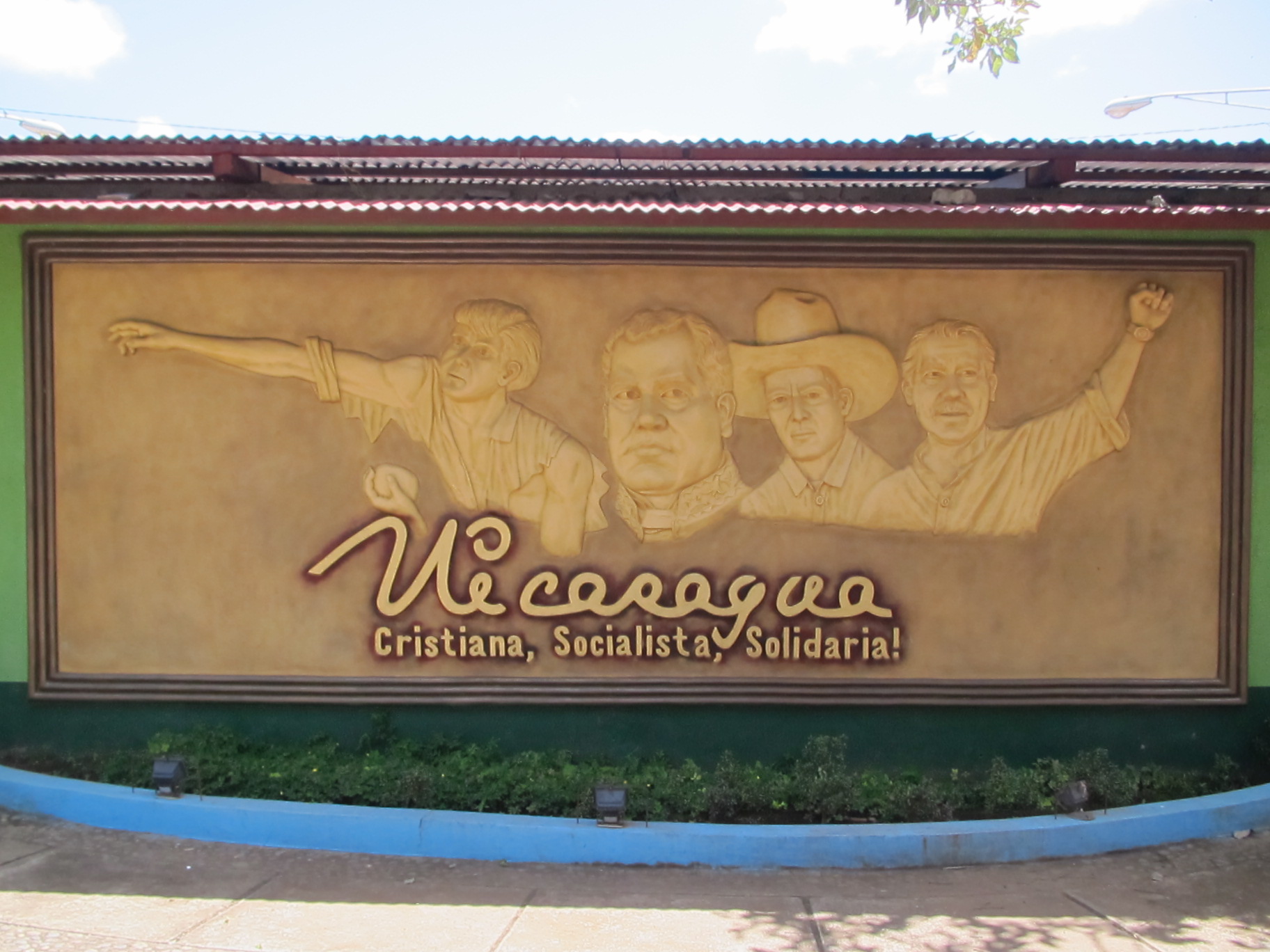
A Brief History of Nicaragua

IMG_4398

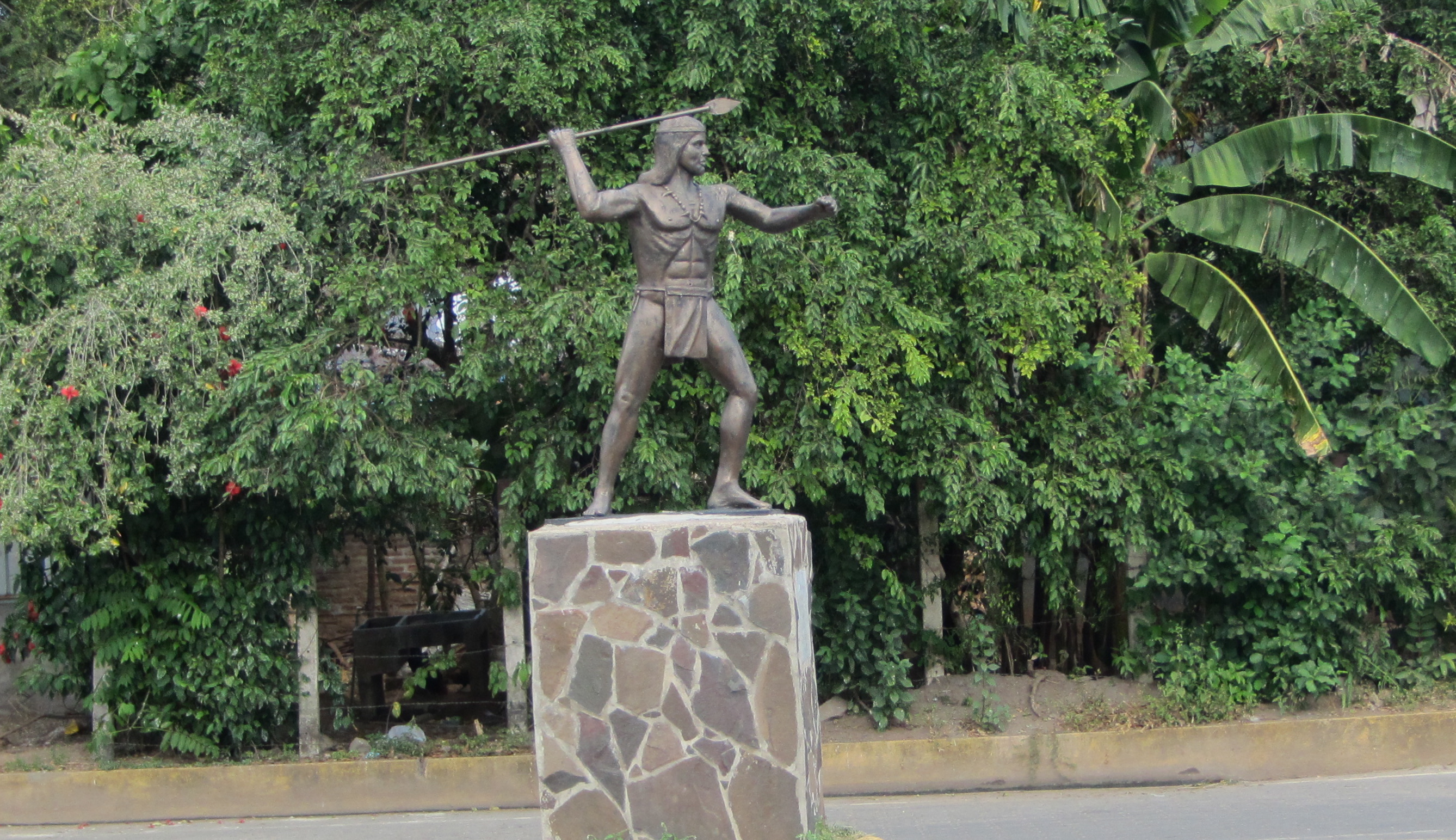
To have even a basic understanding of Nicaraguan culture it’s important to first know a little about the land’s history. In the Pre-Columbian era, the region now called Nicaragua was inhabited by several tribes culturally related to Aztec and Maya civilizations. Not long after Christopher Columbus first reached Nicaragua in 1502, an attempt was made to conquer the region by Gil González Dávila in the 1520s. On April 17, 1523, Dávila first met with Cacique Diriangen, leader of the Dirian peoples. Dávila gave the tribe a three day deadline to become Christians but rather than comply Diriangen led an attack, making him the first known resistance fighter of Nicaragua.

A statue of Diriangen at the entrance to the town of Diria.

A statue of Diriangen at the entrance to the town of Diria.

During over 300 years of colonization, countless indigenous people died of diseases, rival conquistadors waged war on each other, Caribbean pirates raided cities along Lake Nicaragua, British forces fought the Spanish in Nicaragua during a sub-conflict of the the Seven Years’ War, and in 1610 Momotombo volcano erupted, destroying the old capital city of León. In 1838, Nicaragua became an independent republic. Within a few decades, during a power struggle between León and Granada, filibusterer William Walker was hired by the government of León to fight on their side but he exploited the region’s instability and briefly established himself as President of Nicaragua before being forced out of the country a few years later. Three decades of conservative rule followed, during which the U.S. began formulating plans to build a canal across Nicaragua (which may soon become a reality with funding from Chinese corporations). However, when the U.S. shifted their plans to Panama, President Jose Santos Zelaya attempted to negotiate with European partners. Because of the potential threat Zelaya posed to U.S. hegemony and his ambitions to unite the Central American nations, the U.S. government compelled him to resign with the threat of military force and funding of conservative opposition groups, replacing him with a series of puppet regimes. Attempting to prevent insurrection, Nicaragua was occupied by U.S. Marines from 1912 to 1933. From 1927 (the start of Somoza’s rise to power though the National Guard), national hero Augusto César Sandino led a guerrilla war against the conservative government and the U.S. Marines. Shortly after a peace agreement was reached with a newly elected Sacasa administration, the Marines left Nicaragua and the head of the National Guard, Anastasio Somoza García ordered Sandino’s assassination. Sandino was killed by National Guard troops on February 21, 1934. His body was hidden and never found. In 1937 Somoza ousted the Sacasa government in a rigged election.

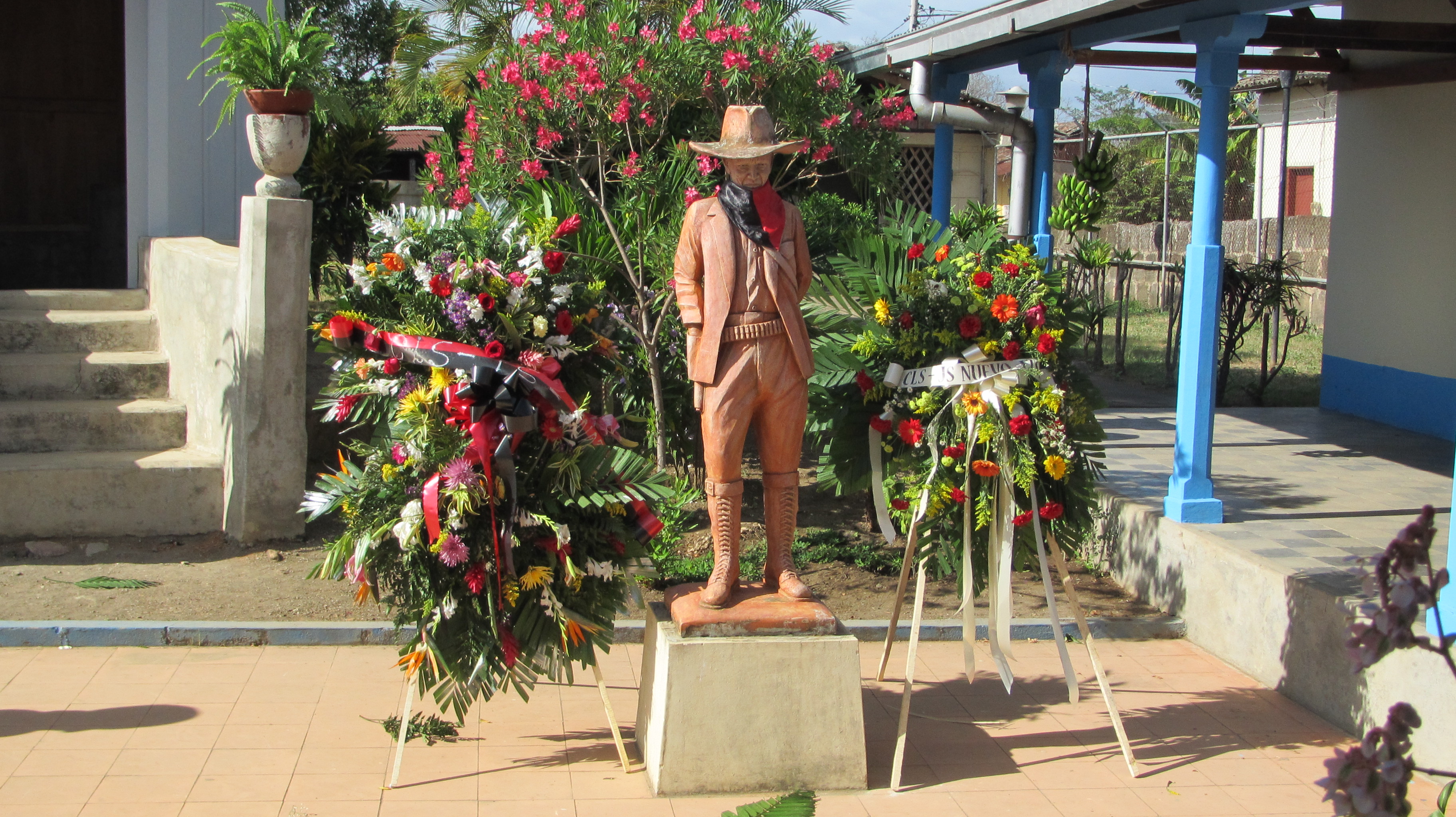
A statue of Sandino at the Augusto C. Sandino Library, a museum located in the house where he grew up in the town of Niquinohomo (Valley of the Warriors).

A statue of Sandino at the Augusto C. Sandino Library, a museum located in the house where he grew up in the town of Niquinohomo (Valley of the Warriors).

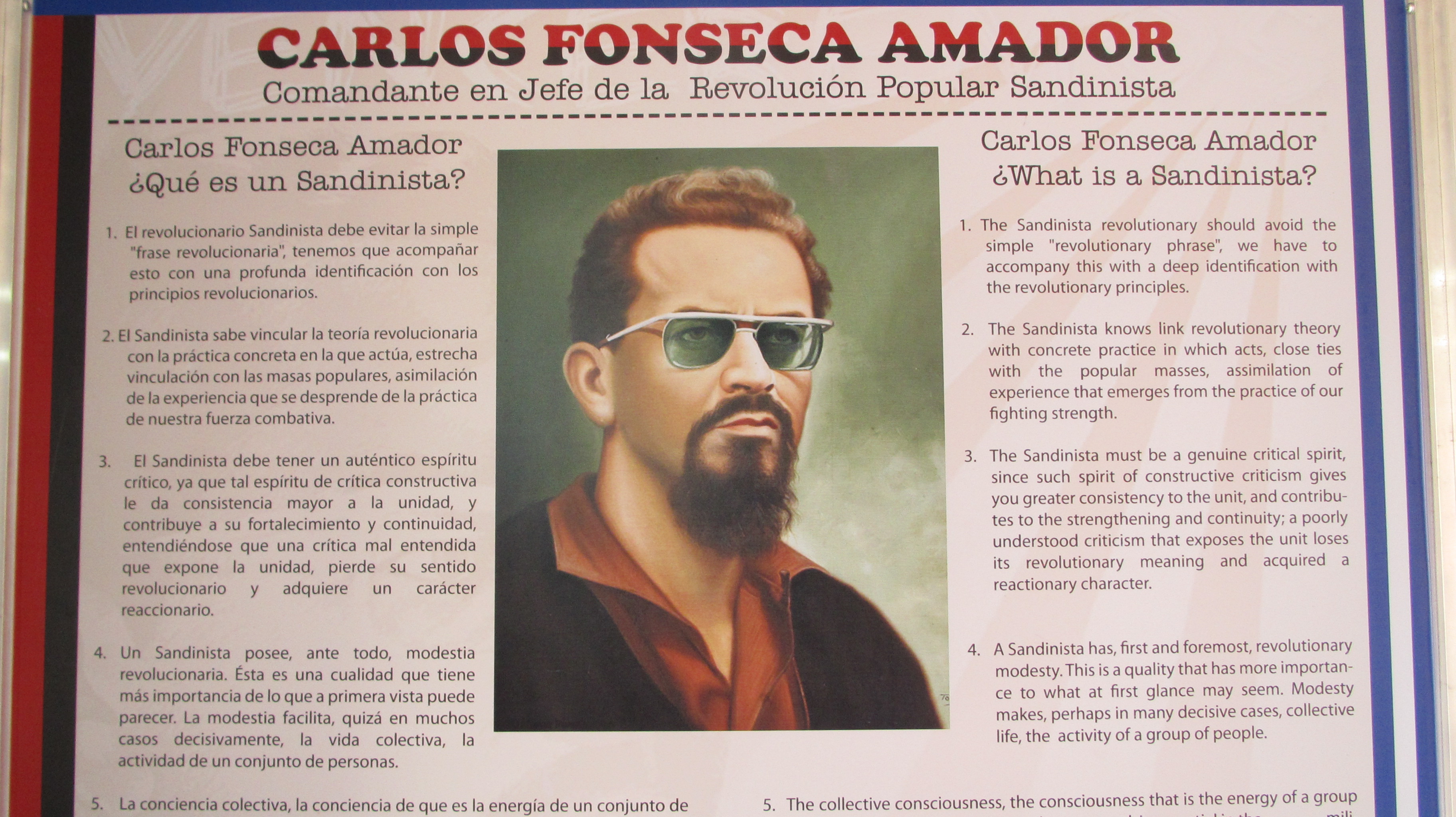
The Somoza regime was Nicaragua’s longest lasting hereditary military dictatorship, having ruled for 43 years. The father of the dynasty, Anastasio Somoza García, was famously called “our son of a bitch” by FDR and was assassinated by 27 year old poet Rigoberto López Pérez in León in 1956. In response to increasingly corrupt and reactionary policies of the Somoza government, Carlos Fonseca, Silvio Mayorga, and Tomás Borge led the formation of the Sandinista National Liberation Front (Frente Sandinista de Liberación Nacional or FSLN, named after and inspired by Augusto Sandino) in 1961. In 1972 a major earthquake hit Managua killing 6000 people, injuring tens of thousands and leaving hundreds of thousands homeless. President Anastasio Somoza Debayle mishandled the situation by failing to distribute essential aid and supplies. When it was later revealed that the government was siphoning relief money for personal gain, popularity and membership of the FSLN greatly increased. Hundreds of Chilean refugees also joined their ranks after a CIA-backed coup assassinated Chilean president Salvador Allende in 1973 and installed the dictator Augusto Pinochet the following year.

A display at the Carlos Fonseca Museum in Matagalpa.

A display at the Carlos Fonseca Museum in Matagalpa.

When Pedro Joaquin Chamorro, editor of the national newspaper and critic of Somoza, was assassinated by the government on January 10, 1978, a mass insurrection was triggered. By the end of Summer, armed youths took over Matagalpa while factions of the FSLN and civilian recruits had the National Guard under siege in Managua, Masaya, León, Chinandega and Estelí. On July 19, 1979, FSLN forces entered the capital and officially assumed power. Just two days before, Anastasio Somoza Debayle resigned and fled to Miami. He was killed a year later by a rocket attack from members of the Argentinian Revolutionary Workers Party while in exile in Paraguay.

Though the Sandinista government inherited a country in ruins and over a billion dollars in debt, they had an ambitious platform which included:

  • nationalization of property owned by the Somozas and their supporters
  • improved rural and urban working conditions
  • free unionization for all workers, both urban and rural
  • price fixing for commodities of basic necessity
  • improved public services, housing conditions, education
  • abolition of torture, political assassination and the death penalty
  • protection of democratic liberties
  • equality for women
  • non-aligned foreign policy

The Sandinistas had early successes with their education and literacy programs but were soon hindered by emerging conflicts with counter-revolutionary Contra forces heavily financed, armed and trained by the CIA. Investigations into the Iran-Contra scandal revealed some of the funding was acquired through arms sales to Iran and drug shipments to U.S. inner cities (read Gary Webb’s Dark Alliance for more about this). Despite strong support for the opposition by the U.S., the FSLN’s Daniel Ortega won the 1984 elections. Less than a year later the Reagan administration implemented a complete embargo on U.S. trade with Nicaragua that would last five years. By the late 80s, the continuing Contra campaign was notorious for human rights violations, corruption and terrorism. In August 1987, Costa Rican president Oscar Arias Sanchez created a peace accord which led to a ceasefire signed by Contra and Sandinista representatives a year later. Disillusioned by conflict and economic strife (made worse by Reagan’s embargo), Nicaraguan voters elected conservative administrations throughout the 1990s and early 2000s but seeing little improvement and much corruption, they reelected FSLN member Daniel Ortega in 2006 and 2011. So far, there has not yet been radical reforms that corporate investors feared and that more radical liberals hoped for, but Ortega has maintained a skepticism towards capitalism while simultaneously maintaining relations with the U.S. and rivals such as Iran, Libya and Venezuela.

As for how the average Nicaraguan feels about their current situation, opinions seem to vary but I plan to share some of the impressions I got in a future post.

Was Bob Marley Murdered by the CIA?

BobMarleyFrasesVariadas

Since today marks the anniversary of Bob Marley’s birthday (February 6, 1945 – May 11, 1981), it seems an appropriate time to revisit that question with a repost of a classic article by Alex Constantine originally published in the February 2002 edition of High Times magazine:

Chanting Down Babylon: The CIA & The Death of Bob Marley

Story By Alex Constantine

Marley knew the drill – in Jamaica, at the height of his success, when music and politics were still one, before the fog of censorship rolled into the island, old wounds were opened by a wave of destabilization politics. Stories appeared in the local, regional and international press downsizing the achievements of the quasi-socialist Jamaican government under Prime Minister Michael Manley. In the late 1970s, the island was flooded with cheap guns, heroin, cocaine, right-wing propaganda, death squad rule and, as Grenada’s Prime Minister Maurice Bishop described it three years later, the CIA’s “pernicious attempts [to] wreck the economy.”

“Destabilization,” Bishop told the emergent New Jewel Party, “is the name given the most recently developed method of controlling and exploiting the lives and resources of a country and its people by a bigger and more powerful country through bullying, intimidation and violence.”

In response to the fascistic machinations of the CIA, Marley wove his lyrics into a revolutionary crucifix to ward off the cloak-and-dagger “vampires” descending upon the island. June 1976: Then-Governor-General Florizel Glasspole placed Jamaica under martial law to stanch the bloody pre-election violence. Prime Minister Manley’s People’s National Party asked the Wailers to play at the Smile Jamaica concert in December. Despite the rising political mayhem, Marley agreed to perform.

In late November, a death squad slipped beneath the gates of Marley’s home on Hope Road in Kingston. As biographer Timothy White tells it, at about 9 PM, “the torpor of the quiet tropical night was interrupted by a queer noise that was not quite like a firecracker.” Marley was in the kitchen at the rear of the house eating a grapefruit when he heard the bursts of automatic gunfire. Don Taylor, Marley’s manager, had been talking to the musician when the bullets ripped through the back of his legs. The men were “peppering the house with a barrage of rifle and pistol fire, shattering windows and splintering plaster and woodwork on the first floor.” Rita Marley, trying to escape with her children and a reporter from the Jamaica Daily News, was shot by one of the men in the front yard. The bullet caught her in the head, lifting her off her feet as it burrowed between scalp and skull.

Meanwhile, a man with an automatic rifle had burst through the back door off the pantry, pushing past a fleeing Seeco Patterson, the Wailers’ percussionist, to aim beyond Don Taylor at Bob Marley. The gunman got off eight shots. One bullet struck a counter, another buried itself in the ceiling, and five tore into Taylor. He fell but remained conscious, with four bullets in his legs and one buried at the base of his spine. The last shot creased Marley’s breast below his heart and drilled deep into his arm.

The survival of the reggae singer and his entire entourage appeared to be the work of Rasta. “The firepower these guys apparently brought with them was immense,” Wailers publicist Jeff Walker recalls. “There were bullet holes everywhere. In the kitchen, the bathroom, the living room, floors, ceilings, doorways and outside.”

There has since been widespread belief that the CIA arranged the hit on Hope Road. Neville Garrick, a Marley insider and former art director of the Jamaican Daily News, had film of “suspicious characters” lurking near the house before the assassination attempt. The day of the shooting he had snapped some photos of Marley standing beside a Volkswagen in a pool of mango-tree shade. The strangers in the background made Marley nervous; he told Garrick that they appeared to be “scouting” the property. In the prints, however, their features were too blurred by shadow to make out. After the concert, Garrick took the photographs and prints to Nassau. Sadly, while the Wailers and crew prepared to board a flight to London, he discovered that the film had been stolen.

Many of the CIA’s files on Bob Marley remain classified to the present day. However, on December 5, 1976, a week after the assault on Hope Road, the Wailers appeared at the Smile Jamaica fest, despite their wounds, to perform one long, defiant anthem of rage directed at the CIA – “War” – suggesting the Wailers’ own attitude toward the “Vampires” from Langley:

Until the ignoble and unhappy regimes
That now hold our brothers
In Angola, in Mozambique,
South Africa
In subhuman bondage
Have been toppled,
Utterly destroyed,
Everywhere is war…

Only a handful of Marley’s most trusted comrades knew of the band’s whereabouts before the festival. Yet a member of the film crew, or so he claimed – reportedly, he didn’t have a camera – managed to talk his way past machete-bearing Rastas to enter the Hope Road encampment: one Carl Colby, son of the late CIA director William Colby.

While the band prepared for the concert, a gift was delivered, according to a witness at the enclave – a pair of boots for Bob Marley. Former Los Angeles cinematographer Lee Lew-Lee [his camera work can be seen in the Oscar-winning documentary The Panama Deception] was close friends with members of the Wailers, and he believes that Marley’s cancer can be traced to the boots: “He put his foot in and said, ‘Ow!’ A friend got in there… he said, ‘let’s [get] in the boot, and he pulled a length of copper wire out – it was embedded in the boot.”

Had the wire been treated chemically with a carcinogenic toxin? The appearance of Colby at Marley’s compound was certainly provocative. [And so was Colby’s subsequent part in the fall of another black cultural icon, O.J. Simpson, nearly 20 years later. At Simpson’s preliminary hearing in 1995, Colby – who resided next door to Nicole Simpson on Gretna Green Way in Brentwood, a mile from her residence on Bundy – and his wife both took the stand to testify for the prosecution that Nicole’s ex-husband had badgered and threatened her. Colby’s testimony was instrumental in the formal charge of murder filed against Simpson and the nationally televised fiasco known as the “Trial of the Century.”]

Seventeen years after the Hope Road assault, Don Taylor published a memoir, Marley and Me, in which he alleges that a “senior CIA agent” had been planted among the crew as part of the plan to “assassinate” Marley. It’s possible that this lapse in security allowed Colby entrance to the compound. It’s clear that the CIA wanted Marley out of the picture. After the assassination attempt, a rumor circulated that the CIA was going to finish Marley off. The source of the rumor was the agency itself. The Wailers had set out on a world tour, and CIA agents informed Marley that should he return to Jamaica before the election, he would be murdered.

Taylor and others close to Marley suspect that it was more than a threat. Lew-Lee recalls: “I didn’t think so at the time, but I’ve always had my suspicions because Marley later broke his toe playing soccer, and when the bone wouldn’t mend the doctors found that the toe had cancer. The cancer metastasized throughout his body, but [Marley] believed he could fight this thing.”

British researcher Michael Conally observes: “They certainly had reasons for wanting to. For one, Marley’s highly charged message music made him an important figure that the rest of the world was beginning to notice. It was an influence that was hard to ignore, least of all because everywhere you went you saw middle- and upper-class white people sprouting dreadlocks, smoking spliffs and adopting the Rastafarian lifestyle. This sort of thing didn’t sit well with traditionalists and authoritarian types.”

The soccer game took place in Paris in 1977, five months after the boot incident, Marley took to the field with one of the leading teams in the country to break the monotony of the Wailers “Exodus” tour. His right toe was injured in a tackle. The toenail came off. At first, it wasn’t considered a serious wound.

But it would not heal. Marley was limping by July and consulted a physician, who was shocked by the toe’s appearance. It was so eaten away that doctors in London advised it be amputated. Marley’s religion forbade it: “Rasta no abide amputation,” he insisted. He told the physician, “De living God, His Imperial Majesty Haile Selassie I, Ras Tafari, Conquering Lion of the Tribe of Judah…He will heal me wit’ de meditations of me ganja chalice.” No scalpel, he said, “will crease me flesh… C’yant kill Rasta. Rastamon live out.”

He flew to Miami and Dr. William Bacon performed a skin graft on the lesion. The disease lingered undiagnosed and spread throughout his body.

Isaac Fergusson, a friend and devotee, observed the slow death of Bob Marley firsthand. In the three years separating soccer injury from cancer diagnosis, Marley remained immersed in music, “ignoring the advice of doctors and close associates that he stop and obtain a thorough medical examination.” He refused to give up recording and touring long enough to consult a doctor. Marley “would have to quit the stage and it would take years to recoup the momentum. This was his time and he seized upon it. Whenever he went into the studio to record, he did enough for two albums. Marley would drink his fish tea, eat his rice-and-peas stew, roll himself about six spliffs and go to work. With incredible energy and determination, he kept strumming his guitar, maybe 12 hours, sometimes till daybreak.” Reggae artist Jimmy Cliff observed after Marley’s death: “What I know now is that Bob finished all he had to do on this earth.” Marley was aware by 1977 that he was dying, and set out to condense a lifetime of music into the few years remaining.

The CIA Rocks Trenchtown

In 1975, US Secretary of State Henry Kissinger, on a diplomatic junket to the island, had assured Prim Minister Manley in a private meeting that there was “no attempt now underway involving covert actions against the Jamaican government.” But in the real world, something of a Caribbean pogrom was underway, overseen, of course, by the CIA. As Kissinger croaked his denials to Manley, the destabilization push was already afoot. The emphasis at this stage was on psychological operations, but in the election year of 1976 a series of covert interventions – employing arson, bombing and assassination as required – completely disrupted Manley’s democratic-socialist rule.

An arsenal of automatic weapons somehow found their way to Jamaica. The CIA’s thugs, directed by a growing coven of pinstriped officers reporting to the US embassy in Kingston, quietly organized secret-police cadres to stoke political violence. Huge consignments of guns and advanced communications gear were smuggled onto the island. One such shipment was intercepted by Manley’s security patrols – a cache of 500 man-eating submachine guns.

The firearms were shipped to the island from Miami by the Jamaican Freedom League, a right-wing paramilitary faction with roots in Langley, financed largely by drugs. Peter Whittington, the group’s second-in-command, was convicted of drug trafficking in Dade County, Florida. The funds were laundered by the League at Miami’s Bank of Perrine, the key American subsidiary of Castle Bank, then the CIA’s financial base in Latin America. The bank was owned and operated by Paul Helliwell, bagman for the Bay of Pigs invasion, accused even by the conservative Wall Street Journal of involvement in the global narcotics trade.

A paramilitary force was mustered to quell the Rastafarian backlash, and the inevitable CIA-trained Cuban exiles beached in Jamaica. Among them was Luis Posada Carriles, once a secret-police official under deposed Cuban dictator Fulgencio Batista, currently a full-fledged agent of the CIA.

The “duppies” [ghosts] policed dissent by incarnating the chemical-warfare tactics of the 1960s. In a year’s time, Marley saw the Rastafarian resistance disintegrate with the rise of a ruthless, highly organized narcotics syndicate, apparently from the Jamaican sand. The sudden abundance of hard narcotics in Jamaica wounded the Rastafarian movement with the burning spear of addiction. Marley and former Wailer Peter Tosh promoted ganja as an alternative to cocaine and heroin, a statement of independence and cohesion against the brutal stratagems of colonial rule.

For the first time in Jamaican politics, public figures roundly criticized the governing elite. Peter Tosh, in particular, split form his peers in the local music scene by serving up impassioned political “livalogues” at his public performances. Tosh pushed on, a cursing, joint-smoking, speechifying black militant, until his murder six years after the passing of Marley.

The suppression of Rastafarian protest escalated in the late 1970s, and grotesque human-rights abuses were commonplace. And the political climate in the Caribbean sweltered with the escalation of American covert operations well into the next decade.

The Nazi Doctor

In September 1980, Bob Marley suffered a stroke while jogging in New York’s Central Park. He was released by a physician the following day and recuperated in his room at the Essex Hotel. Rita Marley choked when she saw him. Her fears rose into uncontrollable sobs, “Wha’ has happened to you?” “Doctor say brain tumor black me out,” Marley told her. Isaac Fergusson had caught the dying rebel’s performance at Madison Square Garden a few days before, and had realized then that something was terribly wrong, even as Marley gripped his guitar “like a machine gun” and “threw his ropelike hair about,” a “whirlwind around his small black face. The crack of a drum exploded into bass, into organ.” Midway into the set, the Wailers stood back and Marley did a solo: “These songs of freedom is all I ever had…” Why, Fergusson wondered, was he singing this alone? Why the past tense?

“Emancipate yourself from mental slavery…”

Fergusson noticed that Marley “was always rubbing his forehead and grimacing while performing.” The following weekend, Fergusson stopped to visit Rita Marley and Judy Mowatt. He asked about Bob’s condition. “We don’t know for sure,” Rita told him. “The doctors say he has a tumor in his brain.” In a silent moment, Fergusson realized that Marley was dying.

He was convinced at last to seek medical treatment. Marley was admitted to the Sloan-Kettering Cancer Center in Manhattan. Tests revealed that the cancer had spread to his brain, lungs and liver. The reggae legend received a few radiation treatments, but checked out when the New York papers let on that he was seriously ill. Marley consulted physicians in Miami, briefly returned to Sloan-Kettering, then to Jamaica, where he met with Dr. Carl “Pee Wee” Fraser, recommended to him by fellow Rastafarians. Dr. Fraser advised that Marley talk to Dr. Josef Issels, a German “holistic comprehensive immunotherapist” then practicing at the Ringberg Clinic in Rottach-Egern, a small Bavarian village located at the southern end of Tegernsee Lake.

Marley traveled to Bavaria and checked into the clinic. Dr. Issels met him, looked him over and allowed, without naming sources: “I hear that you’re one of the most dangerous black men in the world.”

The portrait offered by publicity releases from the Issels Foundation is imposing enough: Dr. Issels, born in 1907, founded the first hospital [financed by the estate of Karl Gischler, a Dutch shipping magnate] in Europe for comprehensive immunotherapy of cancer in 1951. He was the medical director and director of research.

All well and good… until it is considered that by this time, Dr. Issels was 44 years old. Certainly, his medical career did not begin in 1951. Why the unexplained gap in his bona fides? During World War II, it seems, Dr. Issels could be found plying his “research” skills for Hitler’s SS. Lew-Lee claims that Dr. Issels was assigned to the Auschwitz concentration camp, working alongside Dr. Josef Mengele. But author Gordon Thomas, in a long-out-of-print biography of Issels, contends that the doctor served in the SS only briefly. At any rate, he was indeed a member of the Nazi Party and served under Heinrich Himmler. Bob Marley, the “dangerous” black upstart, had placed his life in the hands of a Nazi doctor.

Lew-Lee recalls that Marley rejected conventional cancer treatments, “wanted to do anything but turn to Western medicine. This may have been a mistake.” Evidently so. “Dr. Issels said that he could cur Bob. And they cut Bob’s dreadlocks off. And he was getting all of this crazy, crazy medical treatment in Bavaria. I know this because Devon Evans [a musician then playing with the Wailers] told me that Bob was receiving these medical treatments.” Evans came by “every two or three months – 1979-80 – and told me: ‘Yeah, man, they’re killing Bob. They are KILLING Bob.’ I said, ‘What do you mean ‘they are killing Bob?’ ‘No, no, man,’ he said. ‘Dis Dr. Issels, he’s a Nazi!’”

Dr. Issels was one of the scores of Nazi practitioners to escape the attention of the Nuremberg tribunal. Michael Kater, a professor of history at York University in Canada, informs us that physicians of the Hitler period were steeped in Nazi racial doctrines at medical school, that many of them continued to practice undisturbed by war-crimes tribunals: “It was in a conventional medical culture, infiltrated from one side by a science alienated from humanity and from another by charlatanry, that young physicians in the Third Reich were raised to learn and prepare for practice, with many predestined to practice after 1945.”

Dr. Josef Issels first offered his alternative cancer therapies in a Nazi-fied atmosphere of ruthlessness and quackery. In the 1930s, chronic cancer patients consulted Dr. Issels and received his experimental “combination therapy,” a regimen of diet, homeopathic remedies, vitamins, exercise and detoxification, among other holistic approaches. Today, his clinic offers training in cancer immunization vaccines, UV blood irradiation, oxygen and ozone therapy, “biological dentistry” [tooth extraction], immunity elicitation by mixed bacterial vaccine, blood heating, and so on.

The medical establishment, particularly in the UK, has long rallied against some of Issels’ therapies. A former BBC producer reported in a televised documentary that Dr. Issels was arrested in September 1960. The police warrant alleged, “The accused claims to treat… cancer…. In fact [he] has neither reliable diagnostic methods nor a method to treat cancer successfully. It is contended [that] he is aware of the complete ineffectiveness of this so-called… tumor treatment.” It also called Issels a flight risk, noting that “he had prepared for all contingencies by depositing huge amounts in foreign banks.”

Marley, unaware of his physician’s past, was placed on a regimen of exercise, vaccines [some illegal], ozone injections, vitamins and trace minerals.

In time, Dr. Issels also introduced torture. Long needles were plunged through Marley’s stomach through to the spine. The patient-victim was told that this was part of his “treatment.” The torture continued until Marley foundered on the threshold of death.

Cedella Booker-Marley, his mother, visited him three times in the course of the “treatments.” She found Dr. Issels to be an “arrogant wretch” with the “gruff manners of a bully,” who subjected her dying son to a bloodless brand of “hocus-pocus” medicine. Booker-Marley: “I myself witnessed Issels’ rough treatment of Nesta [Marley]. One time I went with Nesta to the clinic, and we settled down in a treatment room. Issels came in and announced to Nesta, ‘I’m going to give you a needle.’” Dr. Issels “plunged the needle straight into Nesta’s navel right down to the syringe. [Marley] grunted and winced. He could only lie there helplessly, writhing on the table, trying his best to hide his pain. ‘Jesus Christ,’ I heard myself mumbling.” Issels yanked out the needle and strolled casually out of the room. Marley was left groaning with pain. “I went and stood at his side and held is hand.

“With every visit,” she recalls, “I found him smaller, frailer, thinner. As the months of dying dragged on, the suffering was etched all over his face. He would fall into fits of shaking, when he would lose all control and shiver from head to toe like a coconut leaf in the breeze. His eyes would turn in his head, rolling in their sockets until even the white jelly was quivering.”

Marley’s torment was aggravated by starvation. “For a whole week sometimes,” Booker laments, her son “would be allowed no nourishment other than what he got intravenously. Constantly hungry, even starving, he wasted away to a skeleton” – starved to death like an Auschwitz inmate. “To watch my first-born shrivel up to skin and bone ripped at my mother’s heart.” Marley weighed 82 pounds on the day of his death. The starvation diet must have devastated his immune system and rushed his demise, not prolonged his life as Dr. Issels and some biographers have contended. It also caused him intense pain. “It would drag on so, for one long painful month after the other, and every day would be a knife that death stabbed and twisted anew in an already open, bleeding wound.” The agony “wrapped him up like a crushing snake.”

Death finally claimed Marley on May 11, 1981. In Jamaica, May 20 was declared a national day of mourning. Marley’s wake at the National Arena was attended by some 30,000 mourners.

He was survived by his old partner Peter Tosh, who was shot to death in 1987. Marley and Tosh were not the only musicians murdered for political reasons in Jamaica. By the end of the decade, all Jamaican musicians were censored and subject to shell-casing politics.

The island’s Daily Gleaner reported in 1987 that Winston “Yellowman” Foster, stopped at a police roadblock and frisked for drugs, resisted detainment. One of the officers hissed, “You want to go like Tosh?” When Tosh went, there was nothing random about it. Witnesses and friends insist that he was a political hit. Two of the gunmen fled to New York to remain at large. The third was Dennis “Leppo” Lobban, an ex-con sentenced for the murder after an 11-minute trial.

Like Marley, Peter Tosh found the bloodshed and hypocrisy of death squad justice and CIA covert ops in the Third World unbearable. He was so obsessed with hidden evil and the upswell of violence in Jamaica that they visited him in his sleep. He had “visions” of “destruction [and] millions of people inside of [a] pit going down. And I… say, ‘bloodbath, where so much people come from?’ and looking in the pit, mon, it the biggest pit… but the way the people was crying, it was awful.”

The Psychology of Being a “Non-Conspiracy Theorist”

lockstep

by Bernie Suarez

originally posted at Truth and Art TV

There is a brand of people amongst us. They have no name but they exist. They are everywhere, at work, at home, at school, and in the streets, stores, and shopping malls. It is highly unlikely to not know someone who belongs in this category. It’s the so called non-conspiracy theorists. You know, the guy who tries to terminate conversations by alleging that you are nothing more than a “conspiracy theorist” and the information you share is false or not believable. Yes, that guy. Let’s meet face to face with your typical non-conspiracy theorist. We all know them, they often are the ones who hold the “conspiracy” verbal accusation as a valid logically defined argument in and of itself. The logic works like this:

Conspiracy theorist says: “You are claiming that fire alone can cause a building to self-implode, descend at freefall speed into its own footprint? That’s physically impossible, what about Newton’s Laws and laws of thermal dynamics and such? “

Non-conspiracy theorist says: “No, you are wrong because you are a conspiracy theorist.”

And with that, often the non-conspiracy theorist will walk away. What’s happening? They had nothing to elaborate on so the non-conspiracy theorist, whose thinking is engineered and controlled by government, mainstream media and Hollywood entertainment, resorted to a socially engineered answer. For this reason it is fascinating to explore the mindset and psychology of the individuals who take this position in place of a logical stance.

Core defect and twisted meanings

By definition, conspiracy means a group of two or more people secretly plotting (or conspiring) a harmful (or evil) deed against another person(s). This behavior is part of human nature. Humans have been conspiring against each other since the beginning of time. There was a never a time in world history when such an elementary behavior (of conspiring against an enemy) did not exist. Can you find a period in history when a certain human emotional trait or action didn’t exist? Was there a time when the human genome didn’t express jealousy, game playing, free trading, rage, or happiness? As odd or ridiculous as this may sound, non-conspiracists unknowingly subscribe to this logic. If evidence points to a conspired crime, why not treat it as such? Why demonize the very concept of conspiring? This is a core defect in the thought process of non-conspiracy theorists. You can easily identify them by their speech.

What the non-conspiracy theorists doesn’t see is that the battle field is right before them and they have outsourced all critical thought and action to a government thinking service known as mass media. Like being on the playing field in a football field while the ball is in play, without realizing what is happening. You see people waving at you in the stands to get out of the way, but you don’t understand what they are saying so you continue walking on the field with your headsets on. Likewise non-conspiracy theorists perceive all logic and reason arguments and warnings made by the conspiracy theorist as noise. They don’t understand the warning and so they continue living and carrying on with what they are doing. Like the person on the field not understanding the warning being communicated by those in the stands, non-conspiracy theorists cannot receive the basic signals of logic and reason. The headsets adding to the confusion is like the TV and mainstream media news. Since they themselves refuse to look at the evidence, they put their faith in the government and in the mass corporate establishment to safely guide them in their reality. They gain a sense of psychological protection from this overall system. Since the information being believed is almost always artificial they need to hear their own opinions repeated to them by the voices on TV so they can confirm (and re-confirm) their own belief system to themselves to be legitimate. At no point will the non-conspiracy theorist plan a day of research or dedicate a few hours every once in a while to research the topic or put any thought into issues. Information and world problems are but one category in a shelf of categories that make up their lives. The non-conspiracy theorist ignores that government has always implemented social engineering and mass mind control on the general public. In order for the non-conspiracy theorist to confidently walk away from someone who challenges their belief system with scientific facts, they need to have a sustained comfort and assurance that what government and mainstream media is saying is true.

Maintaining the non-conspiracy delusion

The non-conspiracy theorist is thus profoundly psychologically interconnected with today’s mass mind control paradigm. They are a species representing a full byproduct of 21st century social engineering. The doctrine of this type of social engineering, programs its believers to believe that when government and media accuses someone of “conspiracies”, then this accusation is cause for someone being considered diseased. The symptoms being paranoia. But paranoia is based on systematized delusions and delusions are based on false beliefs. A proper exploring of meanings brings us back to proving what is true or false. We come full circle and the spin is over. Non-conspiracy theorists don’t realize they dwell in this circle of misapplied words, never exploring the meanings or doing the work to determine what is true and what is provable.

Non-conspiracy theorists therefore wake up every morning and reach for the mental orientation map known as mainstream media news. Without it they would be disoriented as they would not know what to believe. They actually believe that if anyone was guilty of wrongdoing at the highest level of government someone would speak out every time and everyone would know about it. They ignore that state secrets are the norm and government operations are conducted in secret. They ignore the consequences each individual at the government and military level faces for blowing the whistle. Despite these consequences many individuals at government level still risk it all and do blow the whistle on government. Despite all this the idea of maintaining State secrecy is myth to non-conspiracy theorists. The idea that government would do something immoral, nefarious or criminal is a fiction as well to the non-conspiracy theorist.

The history of war, corruption, tyranny and fascism is incidental, coincidental, insignificant and irrelevant to the non-conspiracy theorist. None of these should be used to gauge the events of our times since history is a thing of the past. Non-conspiracy theorists choose not to connect the historic dots. According to them there is nothing to learn from the history of tyranny and totalitarianism. Anyone attempting to connect the dots is likely a conspiracy theorist. This goes hand in hand with the logic defect we discussed earlier. As the earlier case of the conspiracy theorist having his scientific arguments debunked by virtue of simply being diseased with the accusation of conspiracy theorist. Note, the non-conspiracy theorists use the name as a loaded, proven concept with power to permanently label someone diseased. In this case, attempting to connect the dots automatically tags you as a conspiracy theorist.

As far as non-conspiracy theorists are concerned all critical thought are deferred to the authorities. The scientists do their work and then report the facts to the government and mainstream media who carefully announce to the masses what they should know. Any scientists that speak out and claim to have evidence contradicting government claims must first be endorsed and approved by the mainstream media and government. Without this approval the scientists are marginalized no matter how large their numbers are. Without these ridiculous rules the delusion of being a non-conspiracy theorists cannot be maintained. This is the psychology of tyranny. Tyranny and totalitarianism cannot be implemented without mass mind control. This dangerous group think mentality will ignore all warning signs to help continue advancing the agenda. And so the non-conspiracy theorist is the most important instrument for maintaining control of the masses. Without these non-conspiracy theorist vessels of the global empire, the plan would not be possible.

It is quite possible that years from now the concept of conspiracy will return back to where it belongs right next to other concepts like jealousy, laughter, love, stealing, fighting, friendship, hatred and other human expressions that define who we are. By then perhaps being a friendship theorist, a stealing theorist or a jealousy theorist will be the new propaganda boogie monster term. Or perhaps years from now we will be sick and tired of this vicious cycle of physical and mental slavery. Perhaps people will truly have enough of the control system and will have abolished it by then.

Standing by truth

I am thrilled to be considered a “conspiracy theorist” by those still controlled by the social engineering experiments of the last one hundred or so years. We are proof that humans are able to critically think on their own and prefer to be free. We are the embodiment of the resistance, we never run from challenges and debates, we recreated the media and are responsible for the progressive death of the mainstream media. We choose to give humanity a voice outside of the socially engineered control system. We rely on firsthand accounts, physical evidence consistent with natural laws, factual documents, common sense, high probability, and forensic scientific evidence before jumping to conclusions. We do not rely on name calling to give strength to our position and we stand as a reminder that the human mind will never be completely contained. Unraveling the reality we face became normal for us at some point and the information the non-conspiracy theorists consider scary is common news to those of us name called “conspiracy theorists”.

In order to be considered a conspiracy theorist by the non-conspiracy theorists you must believe that government is corrupt. Believing that others are corrupt does not get you the title automatically. The list of what qualifies someone as a conspiracy theorist has been changing rapidly and today is determined by mainstream media and government in real time. Today, only government and mainstream media gets to decide who qualifies as a conspiracy theorist. The thought process of the non-conspiracy theorist is thus predictable and automated because the agenda being followed by government and mass media is predictable. The mindset is; no research required, if Associated Press, NBC, ABC, CBS, FOX, CNN or NPR doesn’t agree to report it, then all other sources must be false. This shines a light into the thought process of non-conspiracy theorists.

Impact on humanity

How creepy does all this sound? We often take for granted the thought process required to make someone believe how they believe and the (mainstream media believing) non-conspiracy theorist mentality is quietly as culpable for the condition of the world today as the individuals who actually carry out the crimes that have put us where we are. Little to no effort is put by non-conspiracy theorists to learn about their own social mindsets, social engineering, group think, and government propaganda and mind-control history.

The non-conspiracy theorists are thus arguably indirectly ushering many of the religious and cultural prophesies of the end times and the predictions of the dooms-day prophets. They are proving to be key vessels in the events that are to come. They have already carved their mark in history as supporters of the global empire. Everyone who has played a role in supporting the global empire of the U.S. has already left their mark. Let’s all wait and see how this mental defect will play itself out and what role these non-conspiracy theorists will play in ushering in the final pieces of the global government. Will they be rewarded? Will they support the extermination of all critical thinkers? Will it turn out the non-conspiracy theorists were expressing an alternate DNA or is this idea too far out? Will it turn out they were all part of a larger experiment? Will the final waking up process or critical mass be stomped out by this core of non-conspiracy theorist who blindly believe government programmed lies? Or will they be responsible for delaying critical mass by a certain amount of time.

These and many other questions will be answered in the next few years/decades. Let us not forget the layers of defective logic and blind faith in government required to be considered a non-conspiracy theorist. It sounds bizarre but it’s true. It’s been said that in times of mass deceit telling the truth is revolutionary and never has this been more apparent. Want to make an impact on others? Want to be a giant among men? Then tell the truth and watch the sheep run. There is so much deceit in today’s world that if you blindly reverse everything government and mainstream media says, just by default you would be closer to truth than if you believed some of what they say.

Remember the non-conspiracy theorist who says “someone would have spoken out”? We’ve all heard this excuse. Of course, someone always does speak out, only they call those that speak out, no matter how high in government they are, conspiracy theorists, instead of someone who is speaking out or blowing the whistle. It’s time to memorialize the web of non-logic that qualifies a non-conspiracy theorist and not take for granted what these individuals mean to our battle for freedom and what key role they will play in the final lock-down of what was once a beacon for freedom throughout the world. Even as each of us carries on every day it’s difficult to fathom how the average person you come across who is a non-conspiracy theorist is having such a massive impact on millions of people globally and the direction of humanity as a whole including the overall survival of the human race.

If you Enjoyed this article please share!

Who Killed Martin Luther King Jr.?

Photo+of+Martin+Luther+King+Jr.+Orator1

Like many great humanitarians who had the power to inspire and lead large mass movements against the establishment, Martin Luther King Jr. was assassinated. King’s family believe the assassination was the result of a conspiracy involving the US government, and they’re probably right. The following article by Jim Douglas, originally published by Probe Magazine and currently hosted at David Ratcliffe’s Ratical.org site, explores revelations from a 1999 wrongful death lawsuit by the King family against Loyd Jowers and “other unknown co-conspirators”:

The Martin Luther King Conspiracy
Exposed in Memphis

by Jim Douglass
Spring 2000
Probe Magazine

According to a Memphis jury’s verdict on December 8, 1999, in the wrongful death lawsuit of the King family versus Loyd Jowers “and other unknown co-conspirators,” Dr. Martin Luther King Jr. was assassinated by a conspiracy that included agencies of his own government. Almost 32 years after King’s murder at the Lorraine Motel in Memphis on April 4, 1968, a court extended the circle of responsibility for the assassination beyond the late scapegoat James Earl Ray to the United States government.

I can hardly believe the fact that, apart from the courtroom participants, only Memphis TV reporter Wendell Stacy and I attended from beginning to end this historic three-and-one-half week trial. Because of journalistic neglect scarcely anyone else in this land of ours even knows what went on in it. After critical testimony was given in the trial’s second week before an almost empty gallery, Barbara Reis, U.S. correspondent for the Lisbon daily Publico who was there several days, turned to me and said, “Everything in the U.S. is the trial of the century. O.J. Simpson’s trial was the trial of the century. Clinton’s trial was the trial of the century. But this is the trial of the century, and who’s here?”

What I experienced in that courtroom ranged from inspiration at the courage of the Kings, their lawyer-investigator William F. Pepper, and the witnesses, to amazement at the government’s carefully interwoven plot to kill Dr. King. The seriousness with which U.S. intelligence agencies planned the murder of Martin Luther King Jr. speaks eloquently of the threat Kingian nonviolence represented to the powers that be in the spring of 1968.

In the complaint filed by the King family, “King versus Jowers and Other Unknown Co-Conspirators,” the only named defendant, Loyd Jowers, was never their primary concern. As soon became evident in court, the real defendants were the anonymous co-conspirators who stood in the shadows behind Jowers, the former owner of a Memphis bar and grill. The Kings and Pepper were in effect charging U.S. intelligence agencies – particularly the FBI and Army intelligence – with organizing, subcontracting, and covering up the assassination. Such a charge guarantees almost insuperable obstacles to its being argued in a court within the United States. Judicially it is an unwelcome beast.

I can hardly believe the fact that, apart from the courtroom participants, only Memphis TV reporter Wendell Stacy and I attended from beginning to end this historic three-and-one-half week trial. Because of journalistic neglect scarcely anyone else in this land of ours even knows what went on in it. After critical testimony was given in the trial’s second week before an almost empty gallery, Barbara Reis, U.S. correspondent for the Lisbon daily Publico who was there several days, turned to me and said, “Everything in the U.S. is the trial of the century. O.J. Simpson’s trial was the trial of the century. Clinton’s trial was the trial of the century. But this is the trial of the century, and who’s here?”

Many qualifiers have been attached to the verdict in the King case. It came not in criminal court but in civil court, where the standards of evidence are much lower than in criminal court. (For example, the plaintiffs used unsworn testimony made on audiotapes and videotapes.) Furthermore, the King family as plaintiffs and Jowers as defendant agreed ahead of time on much of the evidence.

But these observations are not entirely to the point. Because of the government’s “sovereign immunity,” it is not possible to put a U.S. intelligence agency in the dock of a U.S. criminal court. Such a step would require authorization by the federal government, which is not likely to indict itself. Thanks to the conjunction of a civil court, an independent judge with a sense of history, and a courageous family and lawyer, a spiritual breakthrough to an unspeakable truth occurred in Memphis. It allowed at least a few people (and hopefully many more through them) to see the forces behind King’s martyrdom and to feel the responsibility we all share for it through our government. In the end, twelve jurors, six black and six white, said to everyone willing to hear: guilty as charged.

We can also thank the unlikely figure of Loyd Jowers for providing a way into that truth.

Loyd Jowers: When the frail, 73-year-old Jowers became ill after three days in court, Judge Swearengen excused him. Jowers did not testify and said through his attorney, Lewis Garrison, that he would plead the Fifth Amendment if subpoenaed. His discretion was too late. In 1993 against the advice of Garrison, Jowers had gone public. Prompted by William Pepper’s progress as James Earl Ray’s attorney in uncovering Jowers’s role in the assassination, Jowers told his story to Sam Donaldson on Prime Time Live. He said he had been asked to help in the murder of King and was told there would be a decoy (Ray) in the plot. He was also told that the police “wouldn’t be there that night.”

In that interview, the transcript of which was read to the jury in the Memphis courtroom, Jowers said the man who asked him to help in the murder was a Mafia-connected produce dealer named Frank Liberto. Liberto, now deceased, had a courier deliver $100,000 for Jowers to hold at his restaurant, Jim’s Grill, the back door of which opened onto the dense bushes across from the Lorraine Motel. Jowers said he was visited the day before the murder by a man named Raul, who brought a rifle in a box.

As Mike Vinson reported in the March-April Probe, other witnesses testified to their knowledge of Liberto’s involvement in King’s slaying. Store-owner John McFerren said he arrived around 5:15 pm, April 4, 1968, for a produce pick-up at Frank Liberto’s warehouse in Memphis. (King would be shot at 6:0l pm.) When he approached the warehouse office, McFerren overheard Liberto on the phone inside saying, “Shoot the son-of-a-bitch on the balcony.“

Café-owner Lavada Addison, a friend of Liberto’s in the late 1970’s, testified that Liberto had told her he “had Martin Luther King killed.” Addison’s son, Nathan Whitlock, said when he learned of this conversation he asked Liberto point-blank if he had killed King.

[Liberto] said, ‘I didn’t kill the nigger but I had it done.’ I said, ‘What about that other son-of-a-bitch taking credit for it?’ He says, ‘Ahh, he wasn’t nothing but a troublemaker from Missouri. He was a front man . . . a setup man.’”

The jury also heard a tape recording of a two-hour-long confession Jowers made at a fall 1998 meeting with Martin Luther King’s son Dexter and former UN Ambassador Andrew Young. On the tape Jowers says that meetings to plan the assassination occurred at Jim’s Grill. He said planners included undercover Memphis Police Department officer Marrell McCollough (who now works for the Central Intelligence Agency, and who is referenced in the trial transcript as Merrell McCullough), MPD Lieutentant Earl Clark (who died in 1987), a third police officer, and two men Jowers did not know but thought were federal agents.

Young, who witnessed the assassination, can be heard on the tape identifying McCollough as the man kneeling beside King’s body on the balcony in a famous photograph. According to witness Cobey Vernon Smith, McCollough had infiltrated a Memphis community organizing group, the Invaders, which was working with the Southern Christian Leadership Conference. In his trial testimony Young said the MPD intelligence agent was “the guy who ran up [the balcony stairs] with us to see Martin.”

Jowers says on the tape that right after the shot was fired he received a smoking rifle at the rear door of Jim’s Grill from Clark. He broke the rifle down into two pieces and wrapped it in a tablecloth. Raul picked it up the next day. Jowers said he didn’t actually see who fired the shot that killed King, but thought it was Clark, the MPD’s best marksman.

Young testified that his impression from the 1998 meeting was that the aging, ailing Jowers “wanted to get right with God before he died, wanted to confess it and be free of it.” Jowers denied, however, that he knew the plot’s purpose was to kill King – a claim that seemed implausible to Dexter King and Young. Jowers has continued to fear jail, and he had directed Garrison to defend him on the grounds that he didn’t know the target of the plot was King. But his interview with Donaldson suggests he was not naïve on this point.

Loyd Jowers’s story opened the door to testimony that explored the systemic nature of the murder in seven other basic areas:

  1. background to the assassination;

  2. local conspiracy;

  3. the crime scene;

  4. the rifle;

  5. Raul;

  6. broader conspiracy;

  7. cover-up.

[The seven areas listed below each link to the given subject in Dr. William Pepper’s Closing Statement on 8 December 1999.]

  1. Background to the assassination

    James Lawson, King’s friend and an organizer with SCLC, testified that King’s stands on Vietnam and the Poor People’s Campaign had created enemies in Washington. He said King’s speech at New York’s Riverside Church on April 4, 1967, which condemned the Vietnam War and identified the U.S. government as “the greatest purveyor of violence in the world today,” provoked intense hostility in the White House and FBI.

    Hatred and fear of King deepened, Lawson said, in response to his plan to hold the Poor People’s Campaign in Washington, D.C. King wanted to shut down the nation’s capital in the spring of 1968 through massive civil disobedience until the government agreed to abolish poverty. King saw the Memphis sanitation workers’ strike as the beginning of a nonviolent revolution that would redistribute income.

    “I have no doubt,” Lawson said, “that the government viewed all this seriously enough to plan his assassination.”

    Coretta Scott King testified that her husband had to return to Memphis in early April 1968 because of a violent demonstration there for which he had been blamed. Moments after King arrived in Memphis to join the sanitation workers’ march there on March 28, 1968, the scene turned violent – subverted by government provocateurs, Lawson said. Thus King had to return to Memphis on April 3 and prepare for a truly nonviolent march, Mrs. King said, to prove SCLC could still carry out a nonviolent campaign in Washington.

  2. Local conspiracy

    On the night of April 3, 1968, Floyd E. Newsum, a black firefighter and civil rights activist, heard King’s “I’ve Been to the Mountain Top” speech at the Mason Temple in Memphis. On his return home, Newsum returned a phone call from his lieutenant and was told he had been temporarily transferred, effective April 4, from Fire Station 2, located across the street from the Lorraine Motel, to Fire Station 31. Newsum testified that he was not needed at the new station. However, he was needed at his old station because his departure left it “out of service unless somebody else was detailed to my company in my stead.” After making many queries, Newsum was eventually told he had been transferred by request of the police department.

    The only other black firefighter at Fire Station 2, Norvell E. Wallace, testified that he, too, received orders from his superior officer on the night of April 3 for a temporary transfer to a fire station far removed from the Lorraine Motel. He was later told vaguely that he had been threatened.

    Wallace guessed it was because “I was putting out fires,” he told the jury with a smile. Asked if he ever received a satisfactory explanation for his transfer Wallace answered, “No. Never did. Not to this day.”

    In the March-April Probe, Mike Vinson described the similar removal of Ed Redditt, a black Memphis Police Department detective, from his Fire Station 2 surveillance post two hours before King’s murder.

    To understand the Redditt incident, it is important to note that it was Redditt himself who initiated his watch on Dr. King from the firehouse across the street. Redditt testified that when King’s party and the police accompanying them (including Detective Redditt) arrived from the airport at the Lorraine Motel on April 3, he “noticed something that was unusual.” When Inspector Don Smith, who was in charge of security, told Redditt he could leave, Redditt “noticed there was nobody else there. In the past when we were assigned to Dr. King [when Redditt had been part of a black security team for King], we stayed with him. I saw nobody with him. So I went across the street and asked the Fire Department could we come in and observe from the rear, which we did.” Given Redditt’s concerns for King’s safety, his particular watch on the Lorraine may not have fit into others’ plans.

    Redditt testified that late in the afternoon of April 4, MPD Intelligence Officer Eli Arkin came to Fire Station 2 to take him to Central Headquarters. There Police and Fire Director Frank Holloman (formerly an FBI agent for 25 years, seven of them as supervisor of J. Edgar Hoover’s office) ordered Redditt home, against his wishes and accompanied by Arkin. The reason Holloman gave Redditt for his removal from the King watch Redditt had initiated the day before was that his life had been threatened.

    In an interview after the trial, Redditt told me the story of how his 1978 testimony on this question before the House Select Committee on Assassinations was part of a heavily pressured cover-up. “It was a farce,” he said, “a total farce.”

    Redditt had been subpoenaed by the HSCA to testify, as he came to realize, not so much on his strange removal from Fire Station 2 as the fact that he had spoken about it openly to writers and researchers. The HSCA focused narrowly on the discrepancy between Redditt’s surveiling King (as he was doing) and acting as security (an impression Redditt had given writers interviewing him) in order to discredit the story of his removal. Redditt was first grilled by the committee for eight straight hours in a closed executive session. After a day of hostile questioning, Redditt finally said late in the afternoon, “I came here as a friend of the investigation, not as an enemy of the investigation. You don’t want to deal with the truth.” He told the committee angrily that if the secret purpose behind the King conspiracy was, like the JFK conspiracy, “to protect the country, just tell the American people! They’ll be happy! And quit fooling the folks and trying to pull the wool over their eyes.”

    When the closed hearing was over, Redditt received a warning call from a friend in the White House who said, “Man, your life isn’t worth a wooden nickel.”

    Redditt said his public testimony the next day “was a set-up”: “The bottom line on that one was that Senator Baker decided that I wouldn’t go into this open hearing without an attorney. When the lawyer and I arrived at the hearing, we were ushered right back out across town to the executive director in charge of the investigation. [We] looked through a book, to look at the questions and answers.”

    “So in essence what they were saying was: ‘This is what you’re going to answer to, and this is how you’re going to answer.’ It was all made up – all designed, questions and answers, what to say and what not to say. A total farce.”

    Former MPD Captain Jerry Williams followed Redditt to the witness stand. Williams had been responsible for forming a special security unit of black officers whenever King came to Memphis (the unit Redditt had served on earlier). Williams took pride in providing the best possible protection for Dr. King, which included, he said, advising him never to stay at the Lorraine “because we couldn’t furnish proper security there.” (“It was just an open view,” he explained to me later, “Anybody could . . . There was no protection at all. To me that was a set-up from the very beginning.”)

    Hatred and fear of King deepened, Lawson said, in response to his plan to hold the Poor People’s Campaign in Washington, D.C. King wanted to shut down the nation’s capital in the spring of 1968 through massive civil disobedience until the government agreed to abolish poverty. King saw the Memphis sanitation workers’ strike as the beginning of a nonviolent revolution that would redistribute income. “I have no doubt,” Lawson said, “that the government viewed all this seriously enough to plan his assassination.”

    For King’s April 3, 1968 arrival, however, Williams was for some reason not asked to form the special black bodyguard. He was told years later by his inspector (a man whom Jowers identified as a participant in the planning meetings at Jim’s Grill) that the change occurred because somebody in King’s entourage had asked specifically for no black security officers. Williams told the jury he was bothered by the omission “even to this day.”

    Leon Cohen, a retired New York City police officer, testified that in 1968 he had become friendly with the Lorraine Motel’s owner and manager, Walter Bailey (now deceased). On the morning after King’s murder, Cohen spoke with a visibly upset Bailey outside his office at the Lorraine. Bailey told Cohen about a strange request that had forced him to change King’s room to the location where he was shot.

    Bailey explained that the night before King’s arrival he had received a call “from a member of Dr. King’s group in Atlanta.” The caller (whom Bailey said he knew but referred to only by the pronoun “he”) wanted the motel owner to change King’s room. Bailey said he was adamantly opposed to moving King, as instructed, from an inner court room behind the motel office (which had better security) to an outside balcony room exposed to public view.

    “If they had listened to me,” Bailey said, “this wouldn’t have happened.”

    Philip Melanson, author of The Martin Luther King Assassination (1991), described his investigation into the April 4 pullback of four tactical police units that had been patrolling the immediate vicinity of the Lorraine Motel. Melanson asked MPD Inspector Sam Evans (now deceased), commander of the units, why they were pulled back the morning of April 4, in effect making an assassin’s escape much easier. Evans said he gave the order at the request of a local pastor connected with King’s party, Rev. Samuel Kyles. (Melanson wrote in his book that Kyles emphatically denied making any such request.) Melanson said the idea that MPD security would be determined at such a time by a local pastor’s request made no sense whatsoever.

    Olivia Catling lived a block away from the Lorraine on Mulberry Street. Catling had planned to walk down the street the evening of April 4 in the hope of catching a glimpse of King at the motel. She testified that when she heard the shot a little after six o’clock, she said, “Oh, my God, Dr. King is at that hotel!” She ran with her two children to the corner of Mulberry and Huling streets, just north of the Lorraine. She saw a man in a checkered shirt come running out of the alley beside a building across from the Lorraine. The man jumped into a green 1965 Chevrolet just as a police car drove up behind him. He gunned the Chevrolet around the corner and up Mulberry past Catling’s house moving her to exclaim, “It’s going to take us six months to pay for the rubber he’s burning up!!” The police, she said, ignored the man and blocked off a street, leaving his car free to go the opposite way.

    I visited Catling in her home, and she told me the man she had seen running was not James Earl Ray. “I will go into my grave saying that was not Ray, because the gentleman I saw was heavier than Ray.”

    “The police,” she told me, “asked not one neighbor [around the Lorraine], ‘What did you see?’ Thirty-one years went by. Nobody came and asked one question. I often thought about that. I even had nightmares over that, because they never said anything. How did they let him get away?”

    Catling also testified that from her vantage point on the corner of Mulberry and Huling she could see a fireman standing alone across from the motel when the police drove up. She heard him say to the police, “The shot came from that clump of bushes,” indicating the heavily overgrown brushy area facing the Lorraine and adjacent to Fire Station 2.

  3. The crime scene

    Earl Caldwell was a New York Times reporter in his room at the Lorraine Motel the evening of April 4. In videotaped testimony, Caldwell said he heard what he thought was a bomb blast at 6:00 p.m. When he ran to the door and looked out, he saw a man crouched in the heavy part of the bushes across the street. The man was looking over at the Lorraine’s balcony. Caldwell wrote an article about the figure in the bushes but was never questioned about what he had seen by any authorities.

    In a 1993 affidavit from former SCLC official James Orange that was read into the record, Orange said that on April 4, “James Bevel and I were driven around by Marrell McCollough, a person who at that time we knew to be a member of the Invaders, a local community organizing group, and who we subsequently learned was an undercover agent for the Memphis Police Department and who now works for the Central Intelligence Agency . . . [After the shot, when Orange saw Dr. King’s leg dangling over the balcony], I looked back and saw the smoke. It couldn’t have been more than five to ten seconds. The smoke came out of the brush area on the opposite side of the street from the Lorraine Motel. I saw it rise up from the bushes over there. From that day to this time I have never had any doubt that the fatal shot, the bullet which ended Dr. King’s life, was fired by a sniper concealed in the brush area behind the derelict buildings.

    “I also remember then turning my attention back to the balcony and seeing Marrell McCollough up on the balcony kneeling over Dr. King, looking as though he was checking Dr. King for life signs.

    “I also noticed, quite early the next morning around 8 or 9 o’clock, that all of the bushes and brush on the hill were cut down and cleaned up. It was as though the entire area of the bushes from behind the rooming house had been cleared . . .

    “I will always remember the puff of white smoke and the cut brush and having never been given a satisfactory explanation.

    “When I tried to tell the police at the scene as best I saw they told me to be quiet and to get out of the way.

    “I was never interviewed or asked what I saw by any law enforcement authority in all of the time since 1968.”

    Also read into the record were depositions made by Solomon Jones to the FBI and to the Memphis police. Jones was King’s chauffeur in Memphis. The FBI document, dated April 13, 1968, says that after King was shot, when Jones looked across Mulberry Street into the brushy area, “he got a quick glimpse of a person with his back toward Mulberry Street. . . . This person was moving rather fast, and he recalls that he believed he was wearing some sort of light-colored jacket with some sort of a hood or parka.” In his 11:30 p.m., April 4, 1968 police interview, Jones provides the same basic information concerning a person leaving the brushy area hurriedly.

    Maynard Stiles, who in 1968 was a senior official in the Memphis Sanitation Department, confirmed in his testimony that the bushes near the rooming house were cut down. At about 7:00 a.m. on April 5, Stiles told the jury, he received a call from MPD Inspector Sam Evans “requesting assistance in clearing brush and debris from a vacant lot in the vicinity of the assassination.” Stiles called another superintendent of sanitation, who assembled a crew. “ They went to that site, and under the direction of the police department, whoever was in charge there, proceeded with the clean-up in a slow, methodical, meticulous manner.” Stiles identified the site as an area overgrown with brush and bushes across from the Lorraine Motel.

    Within hours of King’s assassination, the crime scene that witnesses were identifying to the Memphis police as a cover for the shooter had been sanitized by orders of the police.

  4. The rifle

    Probe readers will again recall from Mike Vinson’s article three key witnesses in the Memphis trial who offered evidence counter to James Earl Ray’s rifle being the murder weapon:

    1. Judge Joe Brown;

    2. Judge Arthur Hanes Jr.;

    3. William Hamblin.

      1. Judge Joe Brown, who had presided over two years of hearings on the rifle, testified that “67% of the bullets from my tests did not match the Ray rifle.” He added that the unfired bullets found wrapped with it in a blanket were metallurgically different from the bullet taken from King’s body, and therefore were from a different lot of ammunition. And because the rifle’s scope had not been sited, Brown said, “this weapon literally could not have hit the broadside of a barn.” Holding up the 30.06 Remington 760 Gamemaster rifle, Judge Brown told the jury, “It is my opinion that this is not the murder weapon.”

      1. Circuit Court Judge Arthur Hanes Jr. of Birmingham, Alabama, had been Ray’s attorney in 1968. (On the eve of his trial, Ray replaced Hanes and his father, Arthur Hanes Sr., by Percy Foreman, a decision Ray told the Haneses one week later was the biggest mistake of his life.) Hanes testified that in the summer of 1968 he interviewed Guy Canipe, owner of the Canipe Amusement Company. Canipe was a witness to the dropping in his doorway of a bundle that held a trove of James Earl Ray memorabilia, including the rifle, unfired bullets, and a radio with Ray’s prison identification number on it. This dropped bundle, heaven (or otherwise) sent for the State’s case against Ray, can be accepted as credible evidence through a willing suspension of disbelief. As Judge Hanes summarized the State’s lone-assassin theory (with reference to an exhibit depicting the scene), “James Earl Ray had fired the shot from the bathroom on that second floor, come down that hallway into his room and carefully packed that box, tied it up, then had proceeded across the walkway the length of the building to the back where that stair from that door came up, had come down the stairs out the door, placed the Browning box containing the rifle and the radio there in the Canipe entryway.” Then Ray presumably got in his car seconds before the police’s arrival, driving from downtown Memphis to Atlanta unchallenged in his white Mustang.Concerning his interview with the witness who was the cornerstone of this theory, Judge Hanes told the jury that Guy Canipe (now deceased) provided “terrific evidence”: “He said that the package was dropped in his doorway by a man headed south down Main Street on foot, and that this happened at about ten minutes before the shot was fired [emphasis added].”Hanes thought Canipe’s witnessing the bundle-dropping ten minutes before the shot was very credible for another reason. It so happened (as confirmed by Philip Melanson’s research) that at 6:00 p.m. one of the MPD tactical units that had been withdrawn earlier by Inspector Evans, TACT 10, had returned briefly to the area with its 16 officers for a rest break at Fire Station 2. Thus, as Hanes testified, with the firehouse brimming with police, some already watching King across the street, “when they saw Dr. King go down, the fire house erupted like a beehive . . . In addition to the time involved [in Ray’s presumed odyssey from the bathroom to the car], it was circumstantially almost impossible to believe that somebody had been able to throw that [rifle] down and leaave right in the face of that erupting fire station.”

        When I spoke with Judge Hanes after the trial about the startling evidence he had received from Canipe, he commented, “That’s what I’ve been saying for 30 years.”

    1. William Hamblin testified not about the rifle thrown down in the Canipe doorway but rather the smoking rifle Loyd Jowers said he received at his back door from Earl Clark right after the shooting. Hamblin recounted a story he was told many times by his friend James McCraw, who had died.James McCraw is already well-known to researchers as the taxi driver who arrived at the rooming house to pick up Charlie Stephens shortly before 6:00 p.m. on April 4. In a deposition read earlier to the jury, McCraw said he found Stephens in his room lying on his bed too drunk to get up, so McCraw turned out the light and left without him – minutes before Stephens, according to the State, identified Ray in profile passing down the hall from the bathroom. McCraw also said the bathroom door next to Stephen’s room was standing wide open, and there was no one in the bathroom – where again, according to the State, Ray was then balancing on the tub, about to squeeze the trigger.William Hamblin told the jury that he and fellow cab-driver McCraw were close friends for about 25 years. Hamblin said he probably heard McCraw tell the same rifle story 50 times, but only when McCraw had been drinking and had his defenses down.

      In that story, McCraw said that Loyd Jowers had given him the rifle right after the shooting. According to Hamblin, “Jowers told him to get the [rifle] and get it out of here now. [McCraw] said that he grabbed his beer and snatched it out. He had the rifle rolled up in an oil cloth, and he leapt out the door and did away with it.” McCraw told Hamblin he threw the rifle off a bridge into the Mississippi River.

      Hamblin said McCraw never revealed publicly what he knew of the rifle because, like Jowers, he was afraid of being indicted: “He really wanted to come out with it, but he was involved in it. And he couldn’t really tell the truth.”

      William Pepper accepted Hamblin’s testimony about McCraw’s disposal of the rifle over Jowers’s claim to Dexter King that he gave the rifle to Raul. Pepper said in his closing argument that the actual murder weapon had been lying “at the bottom of the Mississippi River for over thirty-one years.”

    Maynard Stiles, who in 1968 was a senior official in the Memphis Sanitation Department, confirmed in his testimony that the bushes near the rooming house were cut down. At about 7:00 a.m. on April 5, Stiles told the jury, he received a call from MPD Inspector Sam Evans “requesting assistance in clearing brush and debris from a vacant lot in the vicinity of the assassination. . . . They went to that site, and under the direction of the police department, whoever was in charge there, proceeded with the clean-up in a slow, methodical, meticulous manner. . . .“ Within hours of King’s assassination, the crime scene that witnesses were identifying to the Memphis police as a cover for the shooter had been sanitized by orders of the police.

  5. Raul

    One of the most significant developments in the Memphis trial was the emergence of the mysterious Raul through the testimony of a series of witnesses.

    In a 1995 deposition by James Earl Ray that was read to the jury, Ray told of meeting Raul in Montreal in the summer of 1967, three months after Ray had escaped from a Missouri prison. According to Ray, Raul guided Ray’s movements, gave him money for the Mustang car and the rifle, and used both to set him up in Memphis.

    Andrew Young and Dexter King described their meeting with Jowers and Pepper at which Pepper had shown Jowers a spread of photographs, and Jowers picked out one as the person named Raul who brought him the rifle to hold at Jim’s Grill. Pepper displayed the same spread of photos in court, and Young and King pointed out the photo Jowers had identified as Raul. (Private investigator John Billings said in separate testimony that this picture was a passport photograph from 1961, when Raul had immigrated from Portugal to the U.S.)

    The additional witnesses who identified the photo as Raul’s included: British merchant seaman Sidney Carthew, who in a videotaped deposition from England said he had met Raul (who offered to sell him guns) and a man he thinks was Ray (who wanted to be smuggled onto his ship) in Montreal in the summer of 1967; Glenda and Roy Grabow, who recognized Raul as a gunrunner they knew in Houston in the ‘60s and ‘70s and who told Glenda in a rage that he had killed Martin Luther King; Royce Wilburn, Glenda’s brother, who also knew Raul in Houston; and British television producer Jack Saltman, who had obtained the passport photo and showed it to Ray in prison, who identified it as the photo of the person who had guided him.

    Saltman and Pepper, working on independent investigations, located Raul in 1995. He was living quietly with his family in the northeastern U.S. It was there in 1997 that journalist Barbara Reis of the Lisbon Publico, working on a story about Raul, spoke with a member of his family. Reis testified that she had spoken in Portuguese to a woman in Raul’s family who, after first denying any connection to Ray’s Raul, said “they” had visited them. “Who?” Reis asked. “The government,” said the woman. She said government agents had visited them three times over a three-year period. The government, she said, was watching over them and monitoring their phone calls. The woman took comfort and satisfaction in the fact that her family (so she believed) was being protected by the government.

    In his closing argument Pepper said of Raul: “Now, as I understand it, the defense had invited Raul to appear here. He is outside this jurisdiction, so a subpoena would be futile. But he was asked to appear here. In earlier proceedings there were attempts to depose him, and he resisted them. So he has not attempted to come forward at all and tell his side of the story or to defend himself.”

  6. A broader conspiracy

    Carthel Weeden, captain of Fire Station 2 in 1968, testified that he was on duty the morning of April 4 when two U.S. Army officers approached him. The officers said they wanted a lookout for the Lorraine Motel. Weeden said they carried briefcases and indicated they had cameras. Weeden showed the officers to the roof of the fire station. He left them at the edge of its northeast corner behind a parapet wall. From there the Army officers had a bird’s-eye view of Dr. King’s balcony doorway and could also look down on the brushy area adjacent to the fire station.

    The testimony of writer Douglas Valentine filled in the background of the men Carthel Weeden had taken up to the roof of Fire Station 2. While Valentine was researching his book The Phoenix Program (1990), on the CIA’s notorious counterintelligence program against Vietnamese villagers, he talked with veterans in military intelligence who had been re-deployed from the Vietnam War to the sixties antiwar movement. They told him that in 1968 the Army’s 111th Military Intelligence Group kept Martin Luther King under 24-hour-a-day surveillance. Its agents were in Memphis April 4. As Valentine wrote in The Phoenix Program, they “reportedly watched and took photos while King’s assassin moved into position, took aim, fired, and walked away.”

    Testimony which juror David Morphy later described as “awesome” was that of former CIA operative Jack Terrell, a whistle-blower in the Iran-Contra scandal. Terrell, who was dying of liver cancer in Florida, testified by videotape that his close friend J.D. Hill had confessed to him that he had been a member of an Army sniper team in Memphis assigned to shoot “an unknown target” on April 4. After training for a triangular shooting, the snipers were on their way into Memphis to take up positions in a watertower and two buildings when their mission was suddenly cancelled. Hill said he realized, when he learned of King’s assassination the next day, that the team must have been part of a contingency plan to kill King if another shooter failed.

    Terrell said J.D. Hill was shot to death. His wife was charged with shooting Hill (in response to his drinking), but she was not indicted. From the details of Hill’s death, Terrell thought the story about Hill’s wife shooting him was a cover, and that his friend had been assassinated. In an interview, Terrell said the CIA’s heavy censorship of his book Disposable Patriot (1992) included changing the paragraph on J.D. Hill’s death, so that it read as if Terrell thought Hill’s wife was responsible.

  7. Cover-up

    Walter Fauntroy, Dr. King’s colleague and a 20-year member of Congress, chaired the subcommittee of the 1976-78 House Select Committee on Assassinations that investigated King’s assassination. Fauntroy testified in Memphis that in the course of the HSCA investigation “it was apparent that we were dealing with very sophisticated forces.” He discovered electronic bugs on his phone and TV set. When Richard Sprague, HSCA’s first chief investigator, said he would make available all CIA, FBI, and military intelligence records, he became a focus of controversy. Sprague was forced to resign. His successor made no demands on U.S. intelligence agencies. Such pressures contributed to the subcommittee’s ending its investigation, as Fauntroy said, “without having thoroughly investigated all of the evidence that was apparent.” Its formal conclusion was that Ray assassinated King, that he probably had help, and that the government was not involved.

    When I interviewed Fauntroy in a van on his way back to the Memphis Airport, I asked about the implications of his statements in an April 4, 1997 Atlanta Constitution article. The article said Fauntroy now believed “Ray did not fire the shot that killed King and was part of a larger conspiracy that possibly involved federal law enforcement agencies,” and added: “Fauntroy said he kept silent about his suspicions because of fear for himself and his family.”

    Fauntroy told me that when he left Congress in 1991 he had the opportunity to read through his files on the King assassination, including raw materials that he’d never seen before. Among them was information from J. Edgar Hoover’s logs. There he learned that in the three weeks before King’s murder the FBI chief held a series of meetings with “persons involved with the CIA and military intelligence in the Phoenix operation in Southeast Asia.” Why? Fauntroy also discovered there had been Green Berets and military intelligence agents in Memphis when King was killed. “What were they doing there?” he asked.

    When Fauntroy had talked about his decision to write a book about what he’d “uncovered since the assassination committee closed down,” he was promptly investigated and charged by the Justice Department with having violated his financial reports as a member of Congress. His lawyer told him that he could not understand why the Justice Department would bring up a charge on the technicality of one misdated check. Fauntroy said he interpreted the Justice Department’s action to mean: “Look, we’ll get you on something if you continue this way. . . . I just thought: I’ll tell them I won’t go and finish the book, because it’s surely not worth it.”

    At the conclusion of his trial testimony, Fauntroy also spoke about his fear of an FBI attempt to kill James Earl Ray when he escaped from Tennessee’s Brushy Mountain State Penitentiary in June 1977. Congressman Fauntroy had heard reports about an FBI SWAT team having been sent into the area around the prison to shoot Ray and prevent his testifying at the HSCA hearings. Fauntroy asked HSCA chair Louis Stokes to alert Tennesssee Governor Ray Blanton to the danger to the HSCA’s star witness and Blanton’s most famous prisoner. When Stokes did, Blanton called off the FBI SWAT team, Ray was caught safely by local authorities, and in Fauntroy’s words, “we all breathed a sigh of relief.”

    The Memphis jury also learned how a 1993-98 Tennessee State investigation into the King assassination was, if not a cover-up, then an inquiry noteworthy for its lack of witnesses. Lewis Garrison had subpoenaed the head of the investigation, Mark Glankler, in an effort to discover evidence helpful to Jowers’s defense. William Pepper then cross-examined Glankler on the witnesses he had interviewed in his investigation:

    Q. (BY MR. PEPPER) Mr. Glankler, did you interview Mr. Maynard Stiles, whose testifying –

    A. I know the name, Counselor, but I don’t think I took a statement from Maynard Stiles or interviewed him. I don’t think I did.

    Q. Did you ever interview Mr. Floyd Newsum?

    A. Can you help me with what he does?

    Q. Yes. He was a black fireman who was assigned to Station Number 2.

    A. I don’t recall the name, Counsel.

    Q. All right. Ever interview Mr. Norville Wallace?

    A. I don’t recall that name offhand either.

    Q. Ever interview Captain Jerry Williams?

    A. Fireman also?

    Q. Jerry Williams was a policeman. He was a homicide detective.

    A. No, sir, I don’t – I really don’t recall that name.

    Q. Fair enough. Did you ever interview Mr. Charles Hurley, a private citizen?

    A. Does he have a wife named Peggy?

    Q. Yes.

    A. I think we did talk with a Peggy Hurley or attempted to.

    Q. Did you interview a Mr. Leon Cohen?

    A. I just don’t recall without –

    Q. Did you ever interview Mr. James McCraw?

    A. I believe we did. He talks with a device?

    Q. Yes, the voice box..

    A. Yes, okay. I believe we did talk to him, yes, sir.

    Q. How about Mrs. Olivia Catling, who has testified –

    A. I’m sorry, the last name again.

    Q. Catling, C A T L I N G.

    A. No, sir, that name doesn’t –

    Q. Did you ever interview Ambassador Andrew Young?

    A. No, sir.

    Q. You didn’t?

    A. No, sir, not that I recall.

    Q. Did you ever interview Judge Arthur Haynes?

    A. No, sir.

    So it goes – downhill. The above is Glankler’s high-water mark: He got two out of the first ten (if one counts Charles and Peggy Hurley as a yes). Pepper questioned Glankler about 25 key witnesses. The jury was familiar with all of them from prior testimony in the trial. Glankler could recall his office interviewing a total of three. At the twenty-fifth-named witness, Earl Caldwell, Pepper finally let Glankler go:

    Q. Did you ever interview a former New York Times journalist, a New York Daily News correspondent named Earl Caldwell?

    A. Earl Caldwell? Not that I recall.

    Q. You never interviewed him in the course of your investigation?

    A. I just don’t recall that name.

    MR. PEPPER: I have no further comments about this investigation – no further questions for this investigator.

Pepper went a step beyond saying government agencies were responsible for the assassination. To whom in turn were those murderous agencies responsible? Not so much to government officials per se, Pepper asserted, as to the economic powerholders they represented who stood in the even deeper shadows behind the FBI, Army Intelligence, and their affiliates in covert action. By 1968, Pepper told the jury, “And today it is much worse in my view” – “the decision-making processes in the United States were the representatives, the footsoldiers of the very economic interests that were going to suffer as a result of these times of changes [being activated by King].”
To say that U.S. government agencies killed Martin Luther King on the verge of the Poor People’s Campaign is a way into the deeper truth that the economic powers that be (which dictate the policies of those agencies) killed him. In the Memphis prelude to the Washington campaign, King posed a threat to those powers of a non-violent revolutionary force. Just how determined they were to stop him before he reached Washington was revealed in the trial by the size and complexity of the plot to kill him.

The vision behind the trial

In his sprawling, brilliant work that underlies the trial, Orders to Kill (1995), William Pepper introduced readers to most of the 70 witnesses who took the stand in Memphis or were cited by deposition, tape, and other witnesses. To keep this article from reading like either an encyclopedia or a Dostoevsky novel, I have highlighted only a few. (Thanks to the King Center, the full trial transcript is available online at http://www.thekingcenter.com/tkc/trial.html.) [The transcript is no longer available at the King Center. Hypertext, PDF, and text-only representations are available at ratical.org/ratville/JFK/MLKACT/Editor] What Pepper’s work has accomplished in print and in court can be measured by the intensity of the media attacks on him, shades of Jim Garrison. But even Garrison did not gain the support of the Kennedy family (in his case) or achieve a guilty verdict. The Memphis trial has opened wide a door to our assassination politics. Anyone who walks through it is faced by an either/or: to declare naked either the empire or oneself.

The King family has chosen the former. The vision behind the trial is at least as much theirs as it is William Pepper’s, for ultimately it is the vision of Martin Luther King Jr. Coretta King explained to the jury her family’s purpose in pursuing the lawsuit against Jowers: “This is not about money. We’re concerned about the truth, having the truth come out in a court of law so that it can be documented for all.” “I’ve always felt that somehow the truth would be known, and I hoped that I would live to see it. It is important I think for the sake of healing so many people – my family, other people, the nation.”

Dexter King, the plaintiffs’ final witness, said the trial was about why his father had been killed: “From a holistic side, in terms of the people, in terms of the masses, yes, it has to be dealt with because it is not about who killed Martin Luther King Jr., my father. It is not necessarily about all of those details. It is about: Why was he killed? Because if you answer the why, you will understand the same things are still happening. Until we address that, we’re all in trouble. Because if it could happen to him, if it can happen to this family, it can happen to anybody.

“It is so amazing for me that as soon as this issue of potential involvement of the federal government came up, all of a sudden the media just went totally negative against the family. I couldn’t understand that. I kept asking my mother, ‘What is going on?’

“She reminded me. She said, ‘Dexter, your dad and I have lived through this once already. You have to understand that when you take a stand against the establishment, first, you will be attacked. There is an attempt to discredit. Second, [an attempt] to try and character-assassinate. And third, ultimately physical termination or assassination.’

“Now the truth of the matter is if my father had stopped and not spoken out, if he had just somehow compromised, he would probably still be here with us today. But the minute you start talking about redistribution of wealth and stopping a major conflict, which also has economic ramifications . . . ”

In his closing argument, William Pepper identified economic power as the root reason for King’s assassination:

When Martin King opposed the war, when he rallied people to oppose the war, he was threatening the bottom lines of some of the largest defense contractors in this country. This was about money. He was threatening the weapons industry, the hardware, the armaments industries, that would all lose as a result of the end of the war.

“The second aspect of his work that also dealt with money that caused a great deal of consternation in the circles of power in this land had to do with his commitment to take a massive group of people to Washington. . . . Now he began to talk about a redistribution of wealth, in this the wealthiest country in the world.”

Pepper went a step beyond saying government agencies were responsible for the assassination. To whom in turn were those murderous agencies responsible? Not so much to government officials per se, Pepper asserted, as to the economic powerholders they represented who stood in the even deeper shadows behind the FBI, Army Intelligence, and their affiliates in covert action. By 1968, Pepper told the jury, “And today it is much worse in my view” – “the decision-making processes in the United States were the representatives, the footsoldiers of the very economic interests that were going to suffer as a result of these times of changes [being activated by King].”

To say that U.S. government agencies killed Martin Luther King on the verge of the Poor People’s Campaign is a way into the deeper truth that the economic powers that be (which dictate the policies of those agencies) killed him. In the Memphis prelude to the Washington campaign, King posed a threat to those powers of a non-violent revolutionary force. Just how determined they were to stop him before he reached Washington was revealed in the trial by the size and complexity of the plot to kill him.

Dexter King testified to the truth of his father’s death with transforming clarity:

If what you are saying goes against what certain people believe you should be saying, you will be dealt with – maybe not the way you are dealt with in China, which is overtly. But you will be dealt with covertly. The result is the same.

We are talking about a political assassination in modern-day times, a domestic political assassination. Of course, it is ironic, but I was watching a special on the CIA. They say, ‘Yes, we’ve participated in assassinations abroad but, no, we could never do anything like that domestically.’ Well, I don’t know. . . . Whether you call it CIA or some other innocuous acronym or agency, killing is killing.

“The issue becomes: What do we do about this? Do we endorse a policy in this country, in this life, that says if we don’t agree with someone, the only means to deal with it is through elimination and termination? I think my father taught us the opposite, that you can overcome without violence.

We’re not in this to make heads roll. We’re in this to use the teachings that my father taught us in terms of nonviolent reconciliation. It works. . . . We know that it works. . . . So . . . we’re not looking to put people in prison. What we’re looking to do is get the truth out so that this nation can learn and know officially. . . . If the family of the victim, . . . if we’re saying we’re willing to forgive and embark upon a process that allows for reconciliation, why can’t others?

When pressed by Pepper to name a specific amount of damages for the death of his father, Dexter King said, “One hundred dollars.”

The Verdict

The jury returned with a verdict after two and one-half hours. Judge James E. Swearengen of Shelby County Circuit Court, a gentle African-American man in his last few days before retirement, read the verdict aloud. The courtroom was now crowded with spectators, almost all black.

“In answer to the question, ‘Did Loyd Jowers participate in a conspiracy to do harm to Dr. Martin Luther King?’ your answer is ‘Yes.’” The man on my left leaned forward and whispered softly, “Thank you, Jesus.”

The judge continued: “Do you also find that others, including governmental agencies, were parties to this conspiracy as alleged by the defendant?’ Your answer to that one is also ‘Yes.’” An even more heartfelt whisper: “Thank you, Jesus!”

Perhaps the lesson of the King assassination is that our government understands the power of nonviolence better than we do, or better than we want to. In the spring of 1968, when Martin King was marching (and Robert Kennedy was campaigning), King was determined that massive, nonviolent civil disobedience would end the domination of democracy by corporate and military power. The powers that be took Martin Luther King seriously. They dealt with him in Memphis.
Thirty-two years after Memphis, we know that the government that now honors Dr. King with a national holiday also killed him. As will once again become evident when the Justice Department releases the findings of its “limited re-investigation” into King’s death, the government (as a footsoldier of corporate power) is continuing its cover-up – just as it continues to do in the closely related murders of John and Robert Kennedy and Malcolm X.

David Morphy, the only juror to grant an interview, said later: “We can look back on it and say that we did change history. But that’s not why we did it. It was because there was an overwhelming amount of evidence and just too many odd coincidences.

“Everything from the police department being pulled back, to the death threat on Redditt, to the two black firefighters being pulled off, to the military people going up on top of the fire station, even to them going back to that point and cutting down the trees. Who in their right mind would go and destroy a crime scene like that the morning after? It was just very, very odd.”

I drove the few blocks to the house on Mulberry Street, one block north of the Lorraine Motel (now the National Civil Rights Museum). When I rapped loudly on Olivia Catling’s security door, she was several minutes in coming. She said she’d had the flu. I told her the jury’s verdict, and she smiled. “So I can sleep now. For years I could still hear that shot. After 31 years, my mind is at ease. So I can sleep now, knowing that some kind of peace has been brought to the King family. And that’s the best part about it.”

Perhaps the lesson of the King assassination is that our government understands the power of nonviolence better than we do, or better than we want to. In the spring of 1968, when Martin King was marching (and Robert Kennedy was campaigning), King was determined that massive, nonviolent civil disobedience would end the domination of democracy by corporate and military power. The powers that be took Martin Luther King seriously. They dealt with him in Memphis.

Thirty-two years after Memphis, we know that the government that now honors Dr. King with a national holiday also killed him. As will once again become evident when the Justice Department releases the findings of its “limited re-investigation” into King’s death, the government (as a footsoldier of corporate power) is continuing its cover-up – just as it continues to do in the closely related murders of John and Robert Kennedy and Malcolm X.

The faithful in a nonviolent movement that hopes to change the distribution of wealth and power in the U.S.A. – as Dr. King’s vision, if made real, would have done in 1968 – should be willing to receive the same kind of reward that King did in Memphis. As each of our religious traditions has affirmed from the beginning, that recurring story of martyrdom (“witness”) is one of ultimate transformation and cosmic good news.

For more information about the King family’s lawsuit, read “An Act of State” by their lawyer, Dr. William F. Pepper. David Ratcliffe wrote an excellent detailed review of it posted here: http://www.ratical.org/ratville/JFK/MLKactOstate.html

William Pepper was recently on the Progressive Commentary Hour and Guns and Butter. You can listen to both interviews here:

Open Letter to BoA from Anonymous Olympia

258844_104131489680984_104118713015595_32268_721285_o__1_

In the wake of recent revelations of documents confirming Bank of America’s use of social media trolling teams to spy on activist groups, Anonymous Olympia has released an open letter (reposted below) stating that they will hold them accountable. Whether or not they follow through on their promise, they make good arguments for why we should not be giving our money to such banks. There’s plenty of alternatives more deserving of our trust and which make better investments, such as public banks, community banks, credit unions, community currencies, digital currencies (do careful research first) and safe deposit boxes for physical precious metals. Currently, only North Dakota has a state-owned bank, but it’s been such a success, at least 20 other states are considering proposals to create their own.

—————————————————————————-

Dear Bank of America,

Thank you for your interest in Anonymous Olympia. After careful review

of your actions, we have prepared the following open letter:

Your institution is like a large, festering carcass that smothers all

of the life beneath it as it wallows, decaying in its own gluttonous

vastness. Nobody pretends that you’re a decent banking institution

these days except you, and we all know you’re not. You’re swollen,

sallow with your own misdeeds.

It blows our minds how anyone could still bank with you, or why they

would want to. Your commercials smile and lie, but everyone can smell

the bullshit wafting from behind those carefully constructed scenes of

gentle middle-class life that you promote on television and in the

lobbies of your bank branches.

The way you nickel and dime your customers to financial death is

disgusting, and you should be ashamed. A fee to close an account, a

monthly fee to have an account, a thirty five dollar over-draft fee

for as little as a $0.01 over-draft, a fee for bill-pay, the five

dollar debit-usage fee.

You’re a vampire, Bank of America. You’re a parasite, bloated with the

blood that you suck from the financial life of your customers.

Shall we mention your colluding with Visa and MasterCard to keep ATM

fees outrageously high? Or all the times that you illegally and

wrongfully foreclosed on the homes of families that banked with you,

leaving those families homeless, their lives ruined? Or the miniscule

amount of taxes that you’re supposed to pay, but don’t?

What about the six former Bank of America employees who came forward

and revealed your despicable practices, including rewarding employees

who managed to place ten or more mortgage accounts into foreclosure in

one month with a $500.00 bonus?

We suppose a financial institution with your track record of being

evil could justify spying on a group of average citizens who were

attempting to exercise their right to air grievances through public

assembly, but that doesn’t make it right, and it doesn’t make what we

do any of your business, either.

In fact, your actions directly violate our constitutional right to

privacy. The fact that you worked with Washington State Patrol to

share information represents a terrifying fusion of financial and

state interest, one that I hope keeps your employees up at night.

Fascism is defined as a merging of state and corporate interest, so

make of that what you will, Bank of America.

We know that you were asked to comment on your spying, but declined to

do so- this leaves us with little hope that you will hold yourself

accountable for this and other actions, so we’re going to start

holding you accountable, instead, and we’re going to ask all of our

brothers and sisters to join us.

You may have been watching us, Bank of America, but we’ve been

watching you, too, and our memories are long.

We do not forgive, we do not forget.

Regards,
Anonymous Olympia

The Last Gasp of American Democracy

tumblr_lyzbbcoWqZ1qjg60ao1_500

Chris Hedges’ regular columns for Truthdig.com are consistently informative and provocative, but his latest piece offers a particularly critical analysis of the current political moment in the United States. In the following excerpt he ruminates on a number of recent actions of our modern corporate totalitarian state:

Via Truthdig:

The object of efficient totalitarian states, as George Orwell understood, is to create a climate in which people do not think of rebelling, a climate in which government killing and torture are used against only a handful of unmanageable renegades. The totalitarian state achieves this control, Arendt wrote, by systematically crushing human spontaneity, and by extension human freedom. It ceaselessly peddles fear to keep a population traumatized and immobilized. It turns the courts, along with legislative bodies, into mechanisms to legalize the crimes of state.

The corporate state, in our case, has used the law to quietly abolish the Fourth and Fifth amendments of the Constitution, which were established to protect us from unwarranted intrusion by the government into our private lives. The loss of judicial and political representation and protection, part of the corporate coup d’état, means that we have no voice and no legal protection from the abuses of power. The recent ruling supporting the National Security Agency’s spying, handed down by U.S. District Judge William H. Pauley III, is part of a very long and shameful list of judicial decisions that have repeatedly sacrificed our most cherished constitutional rights on the altar of national security since the attacks of 9/11. The courts and legislative bodies of the corporate state now routinely invert our most basic rights to justify corporate pillage and repression. They declare that massive and secret campaign donations—a form of legalized bribery—are protected speech under the First Amendment. They define corporate lobbying—under which corporations lavish funds on elected officials and write our legislation—as the people’s right to petition the government. And we can, according to new laws and legislation, be tortured or assassinated or locked up indefinitely by the military, be denied due process and be spied upon without warrants. Obsequious courtiers posing as journalists dutifully sanctify state power and amplify its falsehoods—MSNBC does this as slavishly as Fox News—while also filling our heads with the inanity of celebrity gossip and trivia. Our culture wars, which allow politicians and pundits to hyperventilate over nonsubstantive issues, mask a political system that has ceased to function. History, art, philosophy, intellectual inquiry, our past social and individual struggles for justice, the very world of ideas and culture, along with an understanding of what it means to live and participate in a functioning democracy, are thrust into black holes of forgetfulness.

The political philosopher Sheldon Wolin, in his essential book “Democracy Incorporated,” calls our system of corporate governance “inverted totalitarianism,” which represents “the political coming of age of corporate power and the political demobilization of the citizenry.” It differs from classical forms of totalitarianism, which revolve around a demagogue or charismatic leader; it finds its expression in the anonymity of the corporate state. The corporate forces behind inverted totalitarianism do not, as classical totalitarian movements do, replace decaying structures with new structures. They instead purport to honor electoral politics, freedom of expression and the press, the right to privacy and the guarantees of law. But they so corrupt and manipulate electoral politics, the courts, the press and the essential levers of power as to make genuine democratic participation by the masses impossible. The U.S. Constitution has not been rewritten, but steadily emasculated through radical judicial and legislative interpretation. We have been left with a fictitious shell of democracy and a totalitarian core. And the anchor of this corporate totalitarianism is the unchecked power of our systems of internal security.

Our corporate totalitarian rulers deceive themselves as often as they deceive the public. Politics, for them, is little more than public relations. Lies are told not to achieve any discernable goal of public policy, but to protect the image of the state and its rulers. These lies have become a grotesque form of patriotism. The state’s ability through comprehensive surveillance to prevent outside inquiry into the exercise of power engenders a terrifying intellectual and moral sclerosis within the ruling elite. Absurd notions such as implanting “democracy” in Baghdad by force in order to spread it across the region or the idea that we can terrorize radical Islam across the Middle East into submission are no longer checked by reality, experience or factually based debate. Data and facts that do not fit into the whimsical theories of our political elites, generals and intelligence chiefs are ignored and hidden from public view. The ability of the citizenry to take self-corrective measures is effectively stymied. And in the end, as in all totalitarian systems, the citizens become the victims of government folly, monstrous lies, rampant corruption and state terror.

Read the full article here: http://www.truthdig.com/report/page2/the_last_gasp_of_american_democracy_20140105