War, Repression and International Gangsterism: U.S. State Policy From Benghazi to Baltimore

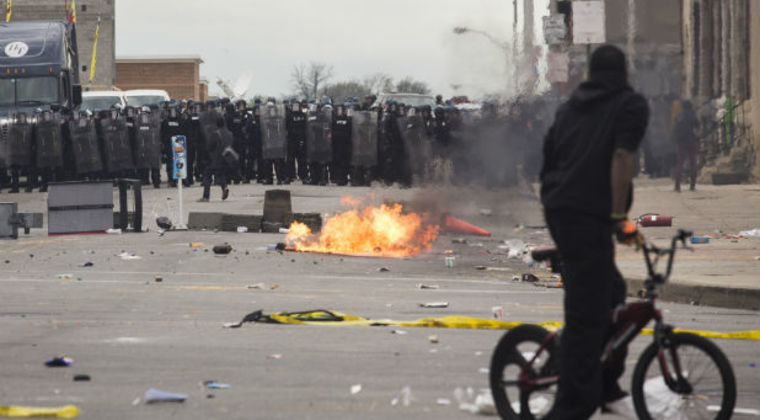
Baltimore-Riots.jpg_23790e32da49a4d09d45db82b7634b69

By Ajamu Baraka

Source: CounterPunch.org

A mere two months after clashes between black youth and police in Baltimore following the murder of Freddie Gray while in police custody, President Obama’s Department of Justice (DOJ) announced the indictment of twenty-four year old Raymon Carter for his alleged involvement in the torching of a CVS pharmacy. The national government’s intervention into the case had an unmistakable message – if you engage in “unauthorized” forms of resistance – in this case, crimes against property – expect to confront the full power of the national government.

U.S. Attorney Rod J. Rosenstein made it even clearer: “Anyone in the future who participates in a ‘riot’ should know that police, prosecutors and citizens will track them down and send them to prison.”

This aggressive and speedy move on the part of the DOJ to criminalize poor, black kids in Baltimore differed sharply from the DOJ approach to high government officials, armed servants of the state at the local level and the big banks and investment firms. For the officials involved in torture under the Bush Administration, the financial gangsters who engineered the 2008 economic crisis, and the killer cops across the country who have yet to experience one indictment from Obama’s DOJ after months of “investigations,” DOJ-granted impunity has been the operative principle in practice.

But Obama’s DOJ has not been the only state institution involved in providing cover and impunity for repression and criminality in the service of the capitalist oligarchy.

Impunity for State Terrorism: the Real Story of Benghazi

What might seem oppositional and important in the game of U.S. politics is usually insignificant and diversionary. Hillary Clinton’s appearance before the House Select Committee, ostensibly established to conduct a bi-partisan investigation into the events that led to the death of Christopher Stevens and three other U.S. citizens on September 11, 2012, was a case in point.

Despite the supposed acrimony between the two ruling class parties in Congress, an ideological consensus exists around the overall strategic commitment to maintain U.S. global dominance. On that ultimate objective both corporate parties share an interest in shifting public attention away from state policies and actions that demonstrate the state’s absolute commitment to the principle of “by any means necessary” for maintaining and advancing the interests of the White supremacist, patriarchal, colonial/capitalist order.

For example, initially the Republican majority’s decision to launch another investigation into the events of 2012 was met with a considerable amount of consternation on the part of some democrats who saw the investigation as just another effort to sabotage Clinton’s run for the Presidency. However, when the republicans settled on the issue of Clinton’s emails the democrats were concerned that Clinton’s use of a private server might cause some embarrassment for her candidacy, but it was also clear that the hearings were going to be rigged and the real questions related to Benghazi would never be raised.

If the House Committee had really been committed to public accountability and surfacing the truth, there were a number of questions that could have been raised such as: 1) what was the role of the facility that was attacked? Was it a U.S. Consulate, a CIA facility or some other entity? 2) Why were those facilities set up so quickly even before a stable government was established in the aftermath of the destruction of the Libyan state? 3 ) Why were there estimated to be more than twenty CIA personnel on the ground in Benghazi just miles from the facility on the night of the attack and what was the mission of those CIA personnel? And 4) Why did the U.S. government contract with an organization to provide security for the facility that had clear ties to Jihadist groups that the U.S. considered as part of the international terrorist networks?

These kinds of questions that would have delved into U.S. involvement in Libya were not raised for two reasons: 1) The Syrian issue – Congress didn’t want the public to focus too much attention on the question of the timeline of U.S. involvement. Although many right-wing republicans were upset that the Obama administration was not more aggressive with more open and direct support for its regime change strategy, everyone in Congress knows that the narrative of reluctant and recent involvement on the part of the Obama administration in the events in Syria is pure fiction. And 2) elements in congress and the Obama administration, with the full collaboration of the corporate press, have suppressed the facts around the mission of the CIA and the role of the State Department in Libya during the period leading to the attack on the two compounds because those activities contravened both U.S. and international law.

Investigative journalist Seymore Hersh revealed that a classified annex to a report prepared by the Senate Intelligence Committee on Benghazi that was not made public, discussed a secret agreement made in early 2012 between the Obama and Erdogan administration in Turkey to run an arms supply line from Libya using arms secured with the overthrow of the Libya state to the so-called rebel forces in Syria. The operation was run by CIA director David Petraeus, and the elements that received support included jihadist groups, including the Al Nusrah Front, al-Qaeda’s official Syrian affiliate.

So even though information on the real role of the U.S. in the war in Syria is getting more coverage, the elites in Congress and the Administration were still not interested in calling too much attention to the fact that the U.S. provided material support to groups that it defined as terrorists which technically under U.S. law should have made that assistance prosecutable.

Vice President Joe Biden even stated publically that governments allied with the U.S. and their nationals were supplying arms to elements that they knew were terrorists and U.S. officials knew it:

“They poured hundreds of millions of dollars and thousands of tons of weapons into anyone who would fight against Assad. Except that the people who were being supplied were al-Nusra and al-Qaeda and the extremist elements of jihadist coming from other parts of the world. “

Yet not one of these individuals or government officials, many who travel on a regular basis to the U.S. and other Western nations have been charged or had sanctions applied to them. In fact, in a pathetic and disingenuous comment, Biden claims that even though it was pointed out to those states by U.S. officials that their support was going to extremist jihadists forces – “We could not convince our colleagues to stop supplying them.”

Obviously for the Obama Administration charging them, freezing their bank accounts, slapping sanctions on the government as was done with the governments and individuals in Iran and Russia was out of the question.

This is why for anyone whose vision is not distorted by the myopia of white supremacist, capitalist ideology, the crude class politics of the DOJ’s decision to prosecute the young resisters in Baltimore is so outrageous.

Benghazi is only a symptom of a pattern of criminal activity on the part of U.S. officials from both parties. From the illegal attacks on Iraq and Libya, subversion in Syria and Venezuela, surveillance, police state repression and mass incarceration domestically, coups in Honduras and Haiti, support for genocide in Yemen, and the continued occupation of Palestine, it is clear that what unites the elites of both parties is their unshakable commitment to maintaining the power of the U.S./EU/NATO axis of domination as the institutional expressions of concentrated white power for as long as possible.

In the meantime, Raymon Carter is facing years in prison because the state claims it has a right to hunt down and prosecute who it defines as criminals.

But the social world is not static and the balance of forces is shifting. One day using that same logic but informed by an alternative ethical framework that centers real justice, the people will be in a position to hunt down and bring to justice the international colonial gangsters who destroy our earth, torture, exploit and bring death to countless millions.

Ajamu Baraka is a human rights activist, organizer and geo-political analyst. Baraka is an Associate Fellow at the Institute for Policy Studies (IPS) in Washington, D.C. and editor and contributing columnist for the Black Agenda Report. He is a contributor to “Killing Trayvons: An Anthology of American Violence” (CounterPunch Books, 2014). He can be reached atwww.AjamuBaraka.com

An Introduction to Technofeudalism Ascending

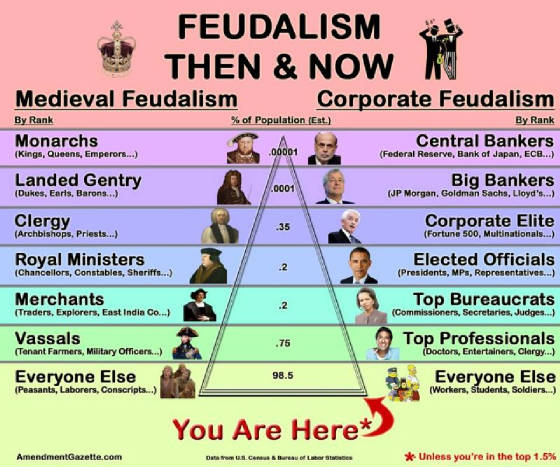
feudalism-then-and-now-hierarchy.jpg.w560h467

By SARTRE

Source: BATR.org

The future of the planetary Reign of Terror has never been clearer. The pattern for global governance has been set into motion and operates under a model that has been used throughout much of history. The modern day version of command and control can be effectively described as Technofeudalism. The purpose of this introduction is to provide an outline of the arguments used by Steven Yates, Ph.D. The link to this significant treatise is provided below. In addition News With Views maintains an extensive archives of Dr. Yates’ work. Invest the time to read the entire essay for a full understanding of the linkage behind Technofeudalis and the course for top down dominance.

Technofeudalism Ascending comprises nine sections. Dr. Yates provides the following preface.

My book Four Cardinal Errors (2011) introduced the idea of technofeudalism. Though a bit of a mouthful, this is the best term for the political economy towards which an intergenerational superelite has been directing as much of the world as possible for at least a century. This existence of this group, I argue, is the foremost political-economic reality of our times.

Their goal, I argued in Four Cardinal Errors, is to institute corporate controlled global governance: de facto world government, managed for private profit and for control over national governments and populations. Technofeudalism is the resulting political economy. While preserving some of the vocabulary and outward features of market capitalism, technofeudalism has almost nothing to do with free markets, or free enterprise, as generally understood. It is about instituting whatever policies, instigating whatever wars, bringing about whatever revolutions, and causing whatever levels of misery are deemed necessary for enforced mass compliance. Its tools include both neoliberal and neoconservative ideology, artificial scarcity, education reduced to job training, and fear induction through constant pontificating about “terrorism” amidst random and often-depraved acts of violence, reducing as many as possible to a status of permanently cash-strapped, mentally paralyzed subjects — living amidst the most advanced technology in human history, but equivalent to serfs (“owned” as de facto property by “their” governments, employers, etc., as in medieval feudal systems of old). Hence, the term technofeudalism.

Introduction:  Why Technofeudalism? (Technofeudalism is the best term for a kind of political economy that has been coming together very gradually for much of the past century, but accelerating in recent decades: it is technologically advanced but populations are controlled by various means and, in effect, made into serfs who are tied to whatever work they can find and to government programs. Technofeudalism is driven by those I call the superelite—a group of globalist-minded extended families whose primary motivation is wealth and power. It illustrates the primary problem of practical political philosophy and strategy: how to contain that minority in our midst that is drawn to power.)

  1. The End of History? (The collapse of the Soviet Union seemed to leave the world at a major turning point; Communism was dead, the combination of market capitalism and liberal democracy seemed to be catching on everywhere, and the U.S. was the sole superpower. It seemed conceivable that it really was, as Francis Fukuyama described, the end of history.)
  1. The Neoliberal Illusion.  (Things began to unravel almost at once, as trade deals such as NAFTA began to put an end to the largest financially independent middle class in history. Neoliberal ideology proved to have a dark side, as wealth began to be redistributed upward and millions of people ended up out of work.)
  1. Precariatization and the Destruction of the American Mind.  (Higher education faced multiple crises: rising radical left “scholarship” in the humanities, a rising corporate or business mindset in expanding administrations, the collapse of the academic job market creating conditions where control was possible, and the impoverishing of faculty via adjunctification, one species of the creation of a precariat — workers in an environment of part-time, temporary, and short term work. Liberal arts learning itself came under assault, as the thinking skills it provides threaten a political economy of power, domination, precarity, and corruption.)
  1. The Empire of Corruption.  (Ensuing decades have seen rising corruption and financial manipulation which eventually caused the 2008 meltdown and have brought about a steadily lowering of the standard of living in the U.S. Supreme Court decisions such as Citizens United ensure a bought-and-paid-for political class, and articles now appear in refereed journals indicating that the U.S. is now a plutocratic oligarchy.)
  1. The Global Corporatist Leviathan.  (If the present political system is plutocratic oligarchy, the correct term for the present economy is corporatism, with technofeudalism its broader political-economic-technocratic instrument. Poor education ensures a systematic confusion between capitalism and corporatism. Under corporatism, corporations are in the driver’s seat behind governments, as we can see from their latest effort to dominate a section of the world’s economy: the Trans-Pacific Partnership.)
  1. The New Serfdom.  (You are living in a feudal system when there is one set of rules for those with power and another set of rules for those without power, with only token representation. Technofeudalism emerges in that its subjects are technologically advanced serfs — surrounded by technology but tied to low-wage work or to a government-based support system.)
  1. “What Can We Do?”  (You can educate yourself on issues ranging from the possibilities of expatriation to that of peoples separating politically from empires, which may become possible as a very severe downturn, worse than the Great Recession — a Greater Depression — is almost certainly inevitable.)
  1. Preparing for the Greater Depression.  (The world is on the verge of having to face the realities of financialization that will bring on the Greater Depression. You can prepare by building proper skills now. It is conceivable that the global superelite is planning on a Greater Depression. You should prepare anyway.)
  1. Grounds for Hope: Real Sustainability and the Cycles of History.  (Technofeudalism will prove unsustainable. It may be put in place, but its structure and the mindset that gave rise to it will cause it to decay and eventually disintegrate. We have come this way before, as empires have risen and fallen before. This provides hope, in that with the collapse of the technofeudalist state, separation and the building of a world of small states will become possible — again if we begin to prepare now.)

This summary outline attempts to persuade the compelling case to review the entire critique. Filling in the connections and relationships to achieve the eternal objective of worldwide ascendancy in an age of technological supremacy, means that the return to a feudal society becomes the undeniable 21th century danger.

Technofeudalism is based upon herding marginal and unneeded humans into ghettos of subsistent serfdom existence. The technocrats who administer the process of dehumanization become the executioners of civilization. Utopia for the select, built on the misery of the masses is a future not worth living. This fact is exactly the objective of the globalist. Destroying resistance through marginalizing survival rules a feudal society. However, building the achievement of a renaissance culture is based upon the liberation of the human spirit and decentralization of authority.

The global elites depend on acquiesce of the masses to accept and adopt the tyrannical systems and indoctrination methods propagated by the technocratic matrix. Liberty is despised by authoritarians. Technofeudalism is the enemy of all human beings. Once armed with the knowledge of this threat, what will be the response of the populace targeted for slavery or extinction?


The Hate-Filled Origins of the War on Drugs they Don’t Want you to Know

war-on-drugs-poster

By Jay Syrmopoulos

Source: The Free Thought Project

An eye-opening video produced by the folks at ATTN, lays out how cocaine was banned as a means of social engineering, using racism as the main tool in driving this agenda. The desired results were achieved by utilizing stereotypically false racist attributions, perpetuated in the media as a means of turning public opinion against specific substances.Cannabis was attributed to Hispanics, hence the coining of the term “marijuana,” as a means of correlating the drug with Mexicans immigrants. Cocaine was attributed to blacks while opium was linked to the Chinese, with each being associated with racist depictions relating to use of the drug in question.

As hysteria grew, mainly due to the racial demonization of drugs, Congress took action with the passage of the Harrison Act of 1914, which outlawed the production, distribution or importation of opium and cocaine.

These actions were then followed up with the outlawing of marijuana on a federal level with the Marihuana Tax Act of 1937.

The modern “War on Drugs,” which has been waged disproportionately upon urban minorities, has its roots in the Nixon administration.

Nixon dramatically increased the size and presence of federal drug control agencies and pushed through measures such as mandatory sentencing and no-knock warrants.

In the early 1980’s the crack cocaine epidemic hit the inner cities of urban America with a vengeance. It began the devastation of black communities and the disenfranchising of many of the socially conscious organizations, such as the Black Panthers, which were working towards ending institutionalized racism.

Journalist Gary Webb in his groundbreaking investigative series, Dark Alliance, exposed deep connection between the CIA and large scale drug trafficking, which many attribute to the crack cocaine epidemic.

The violence associated with the crack scourge was steadily fed to the living rooms of middle America on the nightly news, which once again manifested as fear in the public. The public then begged the politicians to save them from the media spoon fed menace.

Thus began the approach to “get tough on crime,” which can be seen in the disparate penalties for crack cocaine vs. powder cocaine. Crack, which was primarily used by blacks, was given a penalty 100 times more severe than that of powder cocaine, which was primarily used by whites. This sentencing difference was in spite of the drugs being the same pharmacologically speaking.

In 2010, the Fair Sentencing Act reduced this disparity down to an 18 times more severe penalty for crack vs. powder cocaine, but a massive difference in the way these almost identical substances are treated remains.

It’s quite clear what the impetus for making drugs illegal has historically been, racial fear. The violence perpetrated upon innocent people under the guise of a “War on Drugs” clearly shows that it’s actually a war being waged on all freedom loving Americans.

The manner in which racial prejudice has been used by the state to forward its agenda throughout history is consistent with the divide and conquer approach that continues to be used domestically and abroad, with the mainstream media seemingly ever ready to assist.

Jay Syrmopoulos is an investigative journalist, free thinker, researcher, and ardent opponent of authoritarianism. He is currently a graduate student at University of Denver pursuing a masters in Global Affairs. Jay’s work has previously been published on BenSwann.com and WeAreChange.org. You can follow him on Twitter @sirmetropolis, on Facebook at Sir Metropolis and now on tsu.

Related Video:

Grim New Year tidings

father-time-in-space_thumb

By Stephen Lendman

Source: Intrepid Report

The new year traditionally is a time for hope and change, a new beginning, a shift from policies causing so much harm to many millions worldwide—nameless, faceless victims of imperial ruthlessness.

New Year’s day and each successive ones assure more of the same, business as usual—a continued menu of endless imperial wars, neoliberal harshness, government serving elitist interests exclusively, and harsh crackdowns on nonbelievers, America heading toward full-blown tyranny in the name of combating terrorism—the greatest hoax in modern times.

The larger issue is whether humanity can survive the ravages of US-led pure evil—the greatest threat it ever faced in world history, power-crazed lunatics in Washington willing to risk destroying Planet Earth to own it.

Instead of sounding the alarm and urging a call to action, presstitutes masquerading as journalists support what demands condemnation.

Ordinary people are manipulated by bread, circuses, and daily misinformation—mindless of the dangers they face, indifferent to the risk of ending life on Earth, ignorant of the pure evil Washington represents, complicit with its rogue partners.

Each new year begins with the threat of US-launched nuclear war, the unthinkable possibility able to kill us all. Power-crazed lunatics make ruthless choices.

Witness them in one war theater after another—endless mass slaughter and destruction, making the world safe for monied interests.

Madness defines US policies. Its criminal class is bipartisan. Whoever succeeds Obama in January 2017 will exceed the worst of his homeland and geopolitical agenda.

America already is third-worldized, on a fast track toward a ruler-serf society, unfit and unsafe to live in, fundamental freedoms eliminated in plain sight, run by a gangster class serving its own interests exclusively.

It devotes more resources to homeland and foreign militarism, belligerence and confrontational policies than the rest of the world combined.

Expect more of the same in the new year, likely more than ever before, maybe looked back on as the year WW III began—if anyone survives the onslaught, a long shot at best.

Another holiday season brings no joy to the vast majority of people worldwide. Human suffering remains extreme.

US policymakers consider it a small price to pay, nothing too outlandish in serving their interests.

The horrors of their maniacal agenda are airbrushed from official and scoundrel media reports—on New Year’s and every other day.


Stephen Lendman lives in Chicago. He can be reached at lendmanstephen@sbcglobal.net. His new book as editor and contributor is “Flashpoint in Ukraine: US Drive for Hegemony Risks WW III.” Visit his blog at sjlendman.blogspot.com . Listen to cutting-edge discussions with distinguished guests on the Progressive Radio News Hour on the Progressive Radio Network. It airs three times weekly: live on Sundays at 1PM Central time plus two prerecorded archived programs.

15 News Stories from 2015 You Should Have Heard About But Probably Didn’t

Year_end_cropped_1_.560d8b1a89b8b

By Carey Wedler

Source: AntiMedia

In 2015, the iron fist of power clamped down on humanity, from warfare to terrorism (I repeat myself) to surveillance, police brutality, and corporate hegemony. The environment was repeatedly decimated, the health of citizens was constantly put at risk, and the justice system and media alike were perverted to serve the interests of the powers that be.

However, while 2015 was discouraging for more reasons than most of us can count, many of the year’s most underreported stories evidence not only a widespread pattern that explicitly reveals the nature of power, but pushback from human beings worldwide on a path toward a better world.

 1. CISA Pushed Through the Senate, Effectively Clamping Down on Internet Freedom: For years, Congress has attempted to legalize corporate and state control of the internet. First, in 2011, they attempted to pass PIPA and SOPA, companion bills slammed by internet and tech companies and ultimately defeated after overwhelming public outcry. Then they passed  CISPA — which the president had threatened to veto, having caught wind of the public’s opposition to heavy regulation of the internet (earlier this year, Obama reversed his position). However, corporate interests, like Hollywood’s studio monopoly, kept lawmakers’ tenacity afloat.

In October, Congress passed CISA, the Cybersecurity Information Sharing Act, but as the Electronic Freedom Foundation explained: “CISA is fundamentally flawed. The bill’s broad immunity clauses, vague definitions, and aggressive spying powers combine to make the bill a surveillance bill in disguise. Further, the bill does not address problems from the recent highly publicized computer data breaches that were caused by unencrypted files, poor computer architecture, un-updated servers, and employees (or contractors) clicking malware links.” Just before Christmas, Congress went even further, adding an amendment to the annual omnibus budget bill that strips CISA’s minimal privacy provisions even more. That budget bill was approved, though Representative Justin Amash of Michigan has vowed to introduce legislation to repeal the CISA provisions when Congress reconvenes.

But CISA wasn’t the only attack on citizens’ privacy this year. Though lawmakers touted the USA Freedom Act as a repeal of the mass surveillance state, in reality, it simply added a bureaucratic step to the process by which government agencies obtain private information. Further, a hack on Italian security firm, aptly called Hacker Tools, revealed that various agencies — including the DEA, NSA, Army, and FBI — possess software that enables them to, as Anti-Media reported, “view suspects’ photos, emails, listen to and record their conversations, and activate the cameras on their computers…” At the same time, the United Kingdom and France moved to tighten their already comprehensive surveillance States in the wake of multiple terrorist attacks. Though governments claim systematic surveillance is necessary to protect citizens — and Snowden’s leaks endangered that safety — the United States government has been unable to produce sufficient evidence the programs work. Instead, the documents the Department of Defense released this year as proof of the alleged endangerment were entirely redacted.

2. CIA Whistleblower Sent to Prison for Revealing Damning Information to a Journalist: While the government has no problem invading the privacy of its citizens, it offers swift backlash for those who attempt to violate its own clandestine operations. Jeffrey Sterling, a former CIA agent, had his first altercation with the CIA when he sued for racial discrimination in 2001. He was subsequently fired. Years later, the CIA filed espionage charges against him for speaking with New York Times journalist, James Risen. Sterling had revealed a botched CIA scheme, Operation Merlin, to infiltrate Iranian intelligence that ultimately worsened the situation, gave Iran a nuclear blueprint, and was deemed espionage, itself. Rather than acknowledge the woeful misstep, the CIA arrested him, charged him, and ultimately sentenced him to 42 months in prison. The trial was reportedly biased, but nevertheless, was severely underreported by the media. Sterling’s conviction reflects the ongoing war on whistleblowers, which Obama has successfully expanded during his presidency. Sterling joins the ranks of Edward Snowden, Chelsea (formerly Bradley) Manning, and others, including a whistleblower who worked for OSHA’s Whistleblower Protection Program and was fired for exposing dysfunction and incompetence within the ranks.

3. Press Freedom Continued to Deteriorate: An annual report from the World Press Freedom Index saw the United States slip 29 spots from last year, landing 49th out of 180 total. Investigative journalist Barrett Brown was sentenced to five years in prison for exposing the findings of hacker Jeremy Hammond. Brown was charged with obstructing justice, aiding and abetting, and separate charges of allegedly threatening the FBI in a rant. Hammond, who exposed severe violations of privacy on the part of Stratfor, a CIA contractor, was sentenced to ten years in prison. Brown’s experience was not an isolated incident. Journalists around the world, like several journalists who were killed while investigating ISIS in Turkey, faced increased danger. One small-town journalist in India was burned alive after exposing a corrupt politician.

4. Multiple Activists Arrested, Charged with Felonies for Educating Jurors About Their Rights: In an ongoing trend, otherwise peaceful, non-violent individuals were harassed by police and courts — not for exposing clandestine information, but for providing information to potential jurors about their rights in the courtroom. One Denver jury nullification activist, followed by another, was charged with multiple felonies for handing out pamphlets that explain a juror’s right to vote “not guilty” in a verdict, even if the defendant is clearly guilty. This right was established to allow jurors to vote with their conscience and question the morality of laws, from the 19th century’s Fugitive Slave Act to Prohibition, both of alcohol in the 1920s and of marijuana today. The Denver activists are awaiting trial, while more recently, a former pastor was charged with a felony for the same reason.

In other unjust convictions and failings of the “justice” system, an African-American man was sentenced to seven years in prison for barking at a police dog, a Kansas mother faces decades in prison for using marijuana to treat her debilitating Crohn’s disease, and a mentally ill man died in jail after being held for stealing five dollars worth of snacks from a convenience store. He was inexplicably awaiting transfer to a medical facility. Ross Ulbricht, founder of the dark web marketplace, the Silk Road, was sentenced to life in prison in spite of the fact that he committed no violent crimes — though the FBI attempted to paint a false picture that he did, albeit without filing formal charges. The prosecution was rife with corruption and scandal; two FBI agents involved in the case were charged with stealing Bitcoin during the investigation. In July, one admitted to stealing $700,000 worth of the digital currency.

5. Six-year-old Autistic Boy Killed by Police: 2015 established not only that the justice system remains broken, but the the enforcement class — police officers — continues to terrorize citizens. In one underreported case, a six-year-old boy was fatally caught in the crossfire of a police shootout against his father, who was unarmed. In another case, an African-American motorist was shot and killed by University of Cincinnati police over a missing front license plate. While high-profile cases of misconduct, including Freddie Gray and Sandra Bland, rightly dominated the news cycle, many more cases of police brutality received little attention. In fact, in 2015, it was revealed not only that the media-propagated “War on Cops” in America was a myth, but that American police kill exponentially more people in weeks than other countries’ police kill in years. On the bright side, many police officers did face charges — and even prosecution — in 2015, including one repeat rapist who cried upon being convicted of his crimes. The officers involved in the shooting of the six-year-old boy were also charged with murder.

6. Earth Enters Sixth Mass Extinction: 2015, like many years before, was disastrous for the environment. Researchers from Stanford University, University of California, Berkeley, and Princeton determined Earth is entering its sixth mass extinction, citing that species are disappearing at a rate 100 times faster than the normal rate between mass extinctions. Further, thanks, in part, to the widespread use of Monsanto’s glyphosate-based Roundup herbicide, populations of bees and Monarch butterflies dwindled — though, happily, the Monarchs appear to have bounced back. Polar bears also met continued endangerment.

The much-anticipated Paris Climate Conference yielded what many environmental activists deemed weak, if not fraudulent, solutions. Meanwhile, man-made environmental catastrophes endangered humans. In Flint, Michigan, lead levels in the water led to increased rates of contamination in children’s blood, prompting the mayor to declare a state of emergency. A massive methane gas leak in the San Fernando Valley, located just north of Los Angeles, has sickened residents and forced countless families to relocate. Authorities have been unable to stop the leak.

Thankfully, some measures to help the environment were taken, including creative solutions to stop animal poaching, the first flight of a solar-powered plane, the launch of a solar-powered airport in India, and Costa Rica’s successful effort to draw 99% of its energy from renewable sources.

7. Civilian Casualties in Western Wars Continue: Though ISIS and other terrorist groups were rightly condemned for killing civilians in 2015, the West pointed fingers while committing the same crimes. In fact, one U.N. report released in September found U.S. drone strikes have killed more civilians in Yemen than al-Qaeda. Another analysis released this year proved Obama’s drone wars have killed more people than were murdered during the Spanish Inquisition. Though the U.S. military’s bombing of a Doctors Without Borders (MSF) hospital received global attention and outrage, many other incidents went underreported. In May, one U.S. airstrike on Syria killed 52 civilians in one fell swoop. Additionally, U.S.-backed coalitions have bombed civilian populations, like in Yemen, where Saudi Arabia killed at least 500 children, not to mention thousands more adult civilians. In other egregious misdeeds, it was revealed that the U.S. military sanctions pedophilia in Afghanistan.

8. Insurrection at the Pentagon’s Defense Intelligence Agency Over Misleading Reports on ISIS: Over the summer, dissent grew within the ranks of the DIA, the Pentagon’s internal intelligence agency. In September, news broke that 50 intelligence analysts filed a report with the Department of Defense’s Inspector General to expose their superiors’ alleged manipulation of intelligence. The intention of the coverup was to downplay the threat of ISIS and the U.S.’s losing effort to fight it, all to maintain the Obama administration’s narrative the bombing campaigns have been successful.

Similar mishandlings of foreign affairs plagued 2015. It was revealed that the Pentagon had no idea what it did with $8.5 trillion, lost track of $500 million worth of weapons and equipment, and spent $43 million on a single gas station in Afghanistan. A DIA report released in June intimated the military was aware of the rising threat of ISIS, and not only allowed it, but welcomed it. The program to train moderate rebels in the fight cost half a billion dollars but yielded only four or five fighters. Further, multiple generals spoke out this year about the U.S. military’s role in creating ISIS. Additionally, news broke in 2015, that one ISIS recruiter had previously been trained by infamous Iraq War profiteer, Blackwater.

9. Activists Inch a Small Step Closer to Exposing the Actors Behind 9/11: Though few Americans heard about it, in August, a New York judge allowed a trial to move forward that could expose a potential government cover-up in the notorious terrorist attack. The ruling was tepid, allowing a 60 to 90 day window for the case to be dismissed or proceed. A later ruling hindered the effort, citing a reported lack of evidence; but activists have not stopped fighting for the release of 28 redacted pages from the 9/11 commission report that allegedly implicate Saudi Arabia (a majority of the hijackers on 9/11 were of Saudi origin).

Whatever the truth may be, 2015 witnessed growing doubts about the Saudi government, which beheaded more people than ISIS this year. It also sentenced a poet to beheading for writing poetry about his experience as a refugee from Palestine, sentenced a young man, Ali al-Nimr, to crucifixion for participating in anti-government protests, attempted to issue 350 lashings to a British man in possession of wine (though the U.K. intervened on his behalf, and that of al-Nimr; neither will be punished), and initiated a punishment of 1,000 lashings for a pro-democracy blogger, Raif Badawi.

10. The FDA Approved OxyContin for Use in Children: Though the approval of the powerful, addictive painkiller for use in 11-year-olds and younger children was unsurprising, the FDA’s justification was shocking. After lawmakers wrote a letter expressing concern to the FDA, the agency’s spokesperson, Eric Pahon, said the news was, in fact, not that serious because it was already standard practice. It’s important to stress that this approval was not intended to expand or otherwise change the pattern of use of extended-release opioids in pediatric patients,” Pahon said. “Doctors were already prescribing it to children, without the safety and efficacy data in hand with regard to the pediatric population.

However disturbing, the FDA’s decision comported with other events this year: President Obama appointed a pharmaceutical lobbyist Deputy Commissioner of medical and tobacco products, a study found swaths of heroin users graduate from prescription painkillers, and similarly, 75% of high school students who used heroin had previously abused pharmaceuticals.

In other stories regarding the misconduct of agencies tasked with keeping people safe, the FDA continued to allow meat companies to use a pharmaceutical additive banned in 150 countries, while whistleblowers at the USDA revealed several plants were producing pork filled with fingernails, hair, bile, and feces.

11. The Federal Government Finally Admitted Cannabis May Help Fight Brain Cancer: Though the government has long known about the medical benefits of cannabis — it holds patents on several medicinal qualities — the National Institute on Drug Abuse made waves this year when it published a document acknowledging the healing properties of cannabidiol, a non-psychoactive endocannabinoid. In particular, it noted “[e]vidence from one animal study suggests that extracts from whole-plant marijuana can shrink one of the most serious types of brain tumors.” Though more research is needed, the government’s admission was unexpected, albeit welcomed by many cannabis enthusiasts. Other studies this year revealed cannabis may help heal broken bones and is associated with lower rates of obesity.

Though many Americans still faced criminal prosecution for treating themselves and their children with cannabis, 2015 demonstrated the long-term trend of decriminalization and legalization will not be reversed. Nations around the world, from Ireland to Costa Rica to Canada laid groundwork to legalize marijuana to various degrees, while a majority of Americans now support legalization.

12. Nestle Paid $524 to Plunder the Public’s Water Resources: This year, Anti-Media reported on the insidious relationship between Nestle and the Forest Service in California. The investigation found not only that Nestle was using an expired permit to turn exponential profit on 27 million gallons of water, but that a former Forest Service official went on to consult for the company.

While corporate exploitation ran rampant in 2015, many countries around the world fought back. India banned one Nestle product for containing lead, while nations around the world banned Monsanto and GE products. Scotland, Denmark, and Bulgaria, among others, all moved to ban GE crops, while multiple lawsuits highlighted the serious potential health consequences of the widespread use of pesticides. Though corporate power remains all but monolithic, 2015 saw humans across the world rise up to resist it. Most recently (and comically), a proposed initiative in California is about to enter the next phase — signature gathering — to place it on the 2016 ballot. If placed on the ballot and passed, it will force California legislators to wear the logos of their top ten donors while they participate in legislative activities. The effort has drawn widespread praise and enthusiasm.

13. Establishment Caught Manipulating News to Fit Narratives: Following the death of Freddie Gray in Baltimore, contentious protests broke out, eventually resulting in limited rioting and looting. However, while the media attempted to paint protesters as aggressive, it failed to report officers’ systemic prohibition of their physical movement, to say nothing of the riot gear police showed up wearing. After being unable to move, a brick was thrown, but the media failed to reporting the instigation and discrimination law enforcement imposed that ultimately led the students and protesters to grow unruly.

In other manipulations, it was revealed that one Fox News contributor lied about his experience as a CIA agent; he had never been employed at the agency, and only obtained later national security jobs by lying about his CIA experience. Further, CBS edited out comments from Muslims, who discussed U.S. foreign policy as a driver of Islamic extremism during a televised focus group.

A study by fact checker, Politifact, revealed that all the major outlets surveyed — Fox News, CNN, and MSNBC— consistently report half-truths and lies. It is little wonder, then, that another survey found only 7% of Americans still harbor “a great deal of trust” in the mainstream media.

Still, it wasn’t just the media that lied. On multiple occasions, government agencies were caught attempting to distort facts. In March, news emerged that an IP address linked to the NYPD had attempted to edit the Wikipedia page on Eric Garner. Computers inside Britain’s parliament were linked to attempted edits on pages detailing sex scandals, among other transgressions. In a related story, the FBI reported it had foiled yet another terrorist plot, and once again, it was revealed the culprits were provided support from an informant working for the bureau.

14. TPP: In one of the most widely-contested pieces of legislation in recent memory, the Trans-Pacific Partnership moved forward, often in secret. The TPP has been condemned as a corporate power grab that ensures profit for pharmaceutical companies, among many other loathed industries. From clamping down on internet freedom to effectively sanctioning sex trafficking, TPP signals an ominous fate for the future of freedom.

15. Sharp Uptick in Islamophobia: Amid the carnage of the Paris terror attacks, the recent shooting in San Bernardino, and the surge in Syrian refugees seeking asylum in Western nations, attacks against Muslims skyrocketed in 2015. In the United States, Muslims have been attacked for praying in public, wearing traditional head scarves, and for simply being out in public. Sikhs have been caught in the crossfire for the crime of being brown and wearing cloth on their heads — and thus being confused with Muslims — while at least one Christian has been terrorized as a result of the unmitigated hate currently permeating modern society. Many European nations and U.S. states have rejected the influx of refugees from war-torn Syria.

Amid the increased hate against Muslims, however, has come an outpouring of love and tolerance. Muslim groups across the world have condemned terror attacks, raised money to help the families of victims, and promoted programs to discourage extremism. At the same time, citizens across Europe and throughout the United States have welcomed Syrian refugees with open arms.

2015 was a year of chaos, violence, hate, and an ongoing struggle of freedom versus oppression. In many ways, it was like the years, decades, and even centuries and millenia that came before. But amid the conflict and often discouraging headlines, humanity has continued to persevere, offering resistance to seemingly all-powerful forces and paving the way for, if nothing else, potential peace, freedom, and respect for human life.

We Need a Social Economy, Not a Hyper-Financialized Plantation Economy

CI3_9XrWEAASBTL

By Charles Hugh Smith

Source: Of Two Minds

The key to broadly distributing capital and reversing inequality is to nurture the source of social capital: the community economy.

We all know what a hyper-financialized economy looks like–we live in one:central banks create credit/money out of thin air and distribute it to the already-wealthy, who use the nearly free money to buy back corporate shares, enriching themselves while creating zero jobs. Or they use the central-bank money to outbid mere savers to scoop up income-producing assets: farmland, rental properties, cartels, etc.

The only possible output of a hyper-financialized economy is rapidly increasing wealth and income inequality–precisely what we see now.

What we need is a social economy, an economy that recognizes purposes and values beyond maximizing private gains by any means necessary, which is the sole goal of hyper-financialized economies.

Given the dominance of profit-maximizing markets and the state, we naturally assume these are the economy. But there is a third sector, the community economy, which is comprised of everything that isn’t directly controlled by profit-maximizing companies or the state.

What differentiates the community economy from the profit-maximizing market and the state?

1. The community economy allows for priorities and goals other than maximizing profit. Making a profit is necessary to sustain the enterprise, but it is not the sole goal of the enterprise.

2. The community economy is not funded by the state.

3. The community economy is locally owned and operated; it is not controlled by distant corporate hierarchies. The money circulating in the community stays in the community.

4. The community economy is not dominated by moral hazard; the community must live with the consequences of the actions of its residents, organizations and enterprises.

The community economy includes small-scale enterprises, local farmer’s markets, community organizations, social enterprises and faith-based institutions. Its structure is decentralized and self-organizing; it is not a formal hierarchy, though leaders naturally emerge within civic and business groups.

Few Americans have worked on a plantation. I am likely one of the few who has lived and worked in a classic plantation town (Lanai City, circa 1970; I picked pineapples along with my high school classmates as a summer job).

In my analysis, the current financial system is akin to a Plantation Economy:highly centralized and hierarchical, devoted to maximizing profits for distant owners, a finance-fueled machine for extracting wealth from local economies.

I call this the Neocolonial-Financialization Model:

The E.U., Neofeudalism and the Neocolonial-Financialization Model (May 24, 2012)

Wal-Mart and the Plantation Economy (August 24, 2010)

Colonizing the Plantation of the Mind (August 25, 2010)

Greece and the Endgame of the Neocolonial Model of Exploitation (February 19, 2015)

We can differentiate the community economy by comparing it to a hyper-financialized Plantation Economy. In a Plantation Economy, a once-diverse landscape of decentralized, locally owned small enterprises is displaced by corporations that are dependent on the state for their profits via direct subsidies, tax breaks, or a cartel/monopoly enforced by the state. (Think Big Pharma, Big Defense, the Higher Education Cartel, etc.)

The corporate Plantation’s low wages leave many of its workers’ families dependent on state aid to survive, and so it prospers on the backs of taxpayers who subsidize its low wages and the externalization of costs.

The current system rewards those with access to cheap capital and the power of the state. The community economy has neither.

The Plantation Economy institutionalizes poverty, parasitic finance, externalized costs, moral hazard (since the corporate/state overseers do not live in the community being cannibalized) and centralized wealth and political power.These are the only possible outputs of the hyper-financialized Plantation Economy.

Once the Plantation Economy has displaced the community economy, opportunities for work and starting small enterprises shrivel, and residents become dependent on state social welfare for their survival. By eliminating the need to be a productive member of the community, the welfare state destroys positive social roles and the inter-connected layers of the community economy between the state and the individual.

When the individual receives social welfare from the state, that individual has no compelling need to contribute to the community or participate in any way other than as a consumer of corporate goods and services. State social welfare guts the community economy by removing financial incentives to participate or contribute.

Why is the community economy so important? The community economy is first and foremost the engine of social capital, which is the source of opportunity and widely distributed wealth.

Social capital is the sum of all the connections and relationships that enable productive collaboration, commerce, exchange and cooperation. (I cover all eight kinds of capital in my book.)

Corporations offer a limited version of social capital–for example, meeting a manager in another department at a company picnic–but most of this capital vanishes once an individual leaves the company (or is “right-sized” into unemployment). This social capital is only superficially embedded in a place and community, as corporations routinely move operations in pursuit of their core purpose: expanding profits.

Corporations cannot replace communities for the simple reason each organization has different purposes and goals. The sole purpose and goal of a corporation is to expand capital and profits, for if it fails to do so, it falters and expires.

The purpose of a community is to preserve and protect a specific locale by nurturing social solidarity: the sense of sharing a purpose with others, of belonging to a community that is capable of concerted, collective action on the behalf of its members and its locale.

Political scientist Robert Putnam has described this structure as a web of horizontal social networks. Unlike corporations and the state, community economies are horizontal networks, i.e. networks of peers connected by overlapping memberships and interests.

It is not accidental that the current system of hierarchical corporations, banks and the state increases inequality and erodes the community economy: the only possible output of low social capital is rising inequality.

Putnam identified a correlation between the inequalities enforced by oppressive elites (slavery being the most extreme example) fearful of the potential of egalitarian (horizontal) networks to organize resistance to their exploitation.

Areas with low social capital are characterized by limited social mobility and rising economic inequality. In other words, the only way to lessen economic inequality is to nurture the horizontal peer-to-peer community economy that creates social capital.

This makes sense, as communities stripped of social capital offer limited access to the other forms of capital needed to launch local enterprises and construct ladders of social mobility.

A vibrant community economy provides members with an infrastructure of opportunity, i.e. multiple pathways to building capital, gaining knowledge and connecting with others.

The key to broadly distributing capital and reversing inequality is to nurture the source of social capital: the community economy.


It’s a $cam! The American Way of War in the Twenty-First Century

war-is-money

By Tom Engelhardt

Source: TomDispatch.com

Let’s begin with the $12 billion in shrink-wrapped $100 bills, Iraqi oil money held in the U.S.  The Bush administration began flying it into Baghdad on C-130s soon after U.S. troops entered that city in April 2003.  Essentially dumped into the void that had once been the Iraqi state, at least $1.2 to $1.6 billion of it was stolen and ended up years later in a mysterious bunker in Lebanon.  And that’s just what happened as the starting gun went off.

It’s never ended.  In 2011, the final report of the congressionally mandated Commission on Wartime Contracting estimated that somewhere between $31 billion and $60 billion taxpayer dollars had been lost to fraud and waste in the American “reconstruction” of Iraq and Afghanistan.  In Iraq, for instance, there was that $75 million police academy, initially hailed “as crucial to U.S. efforts to prepare Iraqis to take control of the country’s security.”  It was, however, so poorly constructed that it proved a health hazard.  In 2006, “feces and urine rained from the ceilings in [its] student barracks” and that was only the beginning of its problems.

When the bad press started, Parsons Corporation, the private contractor that built it, agreed to fix it for nothing more than the princely sum already paid.  A year later, a New York Timesreporter visited and found that “the ceilings are still stained with excrement, parts of the structures are crumbling, and sections of the buildings are unusable because the toilets are filthy and nonfunctioning.”  This seems to have been par for the course.  Typically enough, the Khan Bani Saad Correctional Facility, a $40 million prison Parsons also contracted to build, was never even finished.

And these were hardly isolated cases or problems specific to Iraq.  Consider, for instance, those police stations in Afghanistan believed to be crucial to “standing up” a new security force in that country.  Despite the money poured into them and endless cost overruns, many were either never completed or never built, leaving new Afghan police recruits camping out.  And the police were hardly alone.  Take the $3.4 million unfinished teacher-training center in Sheberghan, Afghanistan, that an Iraqi company was contracted to build (using, of course, American dollars) and from which it walked away, money in hand.

And why stick to buildings, when there were those Iraqi roads to nowhere paid for by American dollars? At least one of them did at least prove useful to insurgent groups moving their guerrillas around (like the $37 million bridge the U.S. Army Corps of Engineers built between Afghanistan and Tajikistan that helped facilitate the region’s booming drug trade in opium and heroin).  In Afghanistan, Highway 1 between the capital Kabul and the southern city of Kandahar, unofficially dubbed the “highway to nowhere,” was so poorly constructed that it began crumbling in its first Afghan winter.

And don’t think that this was an aberration.  The U.S. Agency for International Development (USAID) hired an American nonprofit, International Relief and Development (IRD), to oversee an ambitious road-building program meant to gain the support of rural villagers.  Almost $300 million later, it could point to “less than 100 miles of gravel road completed.” Each mile of road had, by then, cost U.S. taxpayers $2.8 million, instead of the expected $290,000, while a quarter of the road-building funds reportedly went directly to IRD for administrative and staff costs.  Needless to say, as the road program failed, USAID hired IRD to oversee other non-transportation projects.

In these years, the cost of reconstruction never stopped growing.  In 2011, McClatchy Newsreported that “U.S. government funding for at least 15 large-scale programs and projects grew from just over $1 billion to nearly $3 billion despite the government’s questions about their effectiveness or cost.”

The Gas Station to Nowhere

So much construction and reconstruction — and so many failures.  There was the chicken-processing plant built in Iraq for $2.58 million that, except in a few Potemkin-Village-like moments, never plucked a chicken and sent it to market.  There was the sparkling new, 64,000-square-foot, state-of-the-art, $25 million headquarters for the U.S. military in Helmand Province, Afghanistan, that doubled in cost as it was being built and that three generals tried to stop.  They were overruled because Congress had already allotted the money for it, so why not spend it, even though it would never be used?  And don’t forget the $20 million that went into constructing roads and utilities for the base that was to hold it, or the$8.4 billion that went into Afghan opium-poppy-suppression and anti-drug programs and resulted in… bumper poppy crops and record opium yields, or the aid funds that somehow made their way directly into the hands of the Taliban (reputedly its second-largest funding source after those poppies).

There were the billions of dollars in aid that no one could account for, and a significant percentage of the 465,000 small arms (rifles, machine guns, grenade launchers, and the like) that the U.S. shipped to Afghanistan and simply lost track of.  Most recently, there was the Task Force for Business Stability Operations, an $800-million Pentagon project to help jump-start the Afghan economy.  It was shut down only six months ago and yet, in response to requests from the Special Inspector General for Afghanistan Reconstruction, the Pentagon swears that there are “no Defense Department personnel who can answer questions about” what the task force did with its money.  As ProPublica’s Megan McCloskey writes, “The Pentagon’s claims are particularly surprising since Joseph Catalino, the former acting director of the task force who was with the program for two years, is still employed by the Pentagon as Senior Advisor for Special Operations and Combating Terrorism.”

Still, from that pile of unaccountable taxpayer dollars, one nearly $43 million chunk did prove traceable to a single project: the building of a compressed natural gas station.  (The cost of constructing a similar gas station in neighboring Pakistan: $300,000.)  Located in an area that seems to have had no infrastructure for delivering natural gas and no cars converted for the use of such fuel, it represented the only example on record in those years of a gas station to nowhere.

All of this just scratches the surface when it comes to the piles of money that were poured into an increasingly privatized version of the American way of war and, in the form ofovercharges and abuses of every sort, often simply disappeared into the pockets of the warrior corporations that entered America’s war zones.  In a sense, a surprising amount of the money that the Pentagon and U.S. civilian agencies “invested” in Iraq and Afghanistan never left the United States, since it went directly into the coffers of those companies.

Clearly, Washington had gone to war like a drunk on a bender, while the domestic infrastructure began to fray.  At $109 billion by 2014, the American reconstruction program in Afghanistan was already, in today’s dollars, larger than the Marshall Plan (which helped put all of devastated Western Europe back on its feet after World War II) and still the country was a shambles. In Iraq, a mere $60 billion was squandered on the failed rebuilding of the country.  Keep in mind that none of this takes into account the staggering billions spent by the Pentagon in both countries to build strings of bases, ranging in size from American towns (with all the amenities of home) to tiny outposts.  There would be 505 of them in Iraq and at least 550 in Afghanistan.  Most were, in the end, abandoned, dismantled, or sometimes simply looted.  And don’t forget the vast quantities of fuel imported into Afghanistan to run the U.S. military machine in those years, some of which was siphoned off by American soldiers, to the tune of at least $15 million, and sold to local Afghans on the sly.

In other words, in the post-9/11 years, “reconstruction” and “war” have really been euphemisms for what, in other countries, we would recognize as a massive system of corruption.

And let’s not forget another kind of “reconstruction” then underway. In both countries, the U.S. was creating enormous militaries and police forces essentially from scratch to the tune of at least $25 billion in Iraq and $65 billion in Afghanistan.  What’s striking about both of these security forces, once constructed, is how similar they turned out to be to those police academies, the unfinished schools, and that natural gas station.  It can’t be purely coincidental that both of the forces Americans proudly “stood up” have turned out to be the definition of corrupt: that is, they were filled not just with genuine recruits but with serried ranks of “ghost personnel.”

In June 2014, after whole divisions of the Iraqi army collapsed and fled before modest numbers of Islamic State militants, abandoning much of their weaponry and equipment, it became clear that they had been significantly smaller in reality than on paper.  And no wonder, as that army had enlisted 50,000 “ghost soldiers” (who existed only on paper and whose salaries were lining the pockets of commanders and others).  In Afghanistan, the U.S. is still evidently helping to pay for similarly stunning numbers of phantom personnel, though no specific figures are available.  (In 2009, an estimated more than 25% of the police force consisted of such ghosts.)  As John Sopko, the U.S. inspector general for Afghanistan,warned last June: “We are paying a lot of money for ghosts in Afghanistan… whether they are ghost teachers, ghost doctors or ghost policeman or ghost soldiers.”

And lest you imagine that the U.S. military has learned its lesson, rest assured that it’s still quite capable of producing nonexistent proxy forces.  Take the Pentagon-CIA program to train thousands of carefully vetted “moderate” Syrian rebels, equip them, arm them, and put them in the field to fight the Islamic State.  Congress ponied up $500 million for it, $384 million of which was spent before that project was shut down as an abject failure.  By then, less than 200 American-backed rebels had been trained and even less put into the field in Syria — and they were almost instantly kidnapped or killed, or they simply handed over their equipment to the al-Qaeda-linked al-Nusra Front.  At one point, according to the congressional testimony of the top American commander in the Middle East, only four or five American-produced rebels were left “in the field.”  The cost-per-rebel sent into Syria, by the way, is now estimated at approximately $2 million.

A final footnote: the general who oversaw this program is, according to the New York Times, still a “rising star” in the Pentagon and in line for a promotion.

Profli-gate

You’ve just revisited the privatized, twenty-first-century version of the American way of war, which proved to be a smorgasbord of scandal, mismanagement, and corruption as far as the eye could see.  In the tradition of Watergate, perhaps the whole system could be dubbed Profli-gate, since American war making across the Greater Middle East has represented perhaps the most profligate and least effective use of funds in the history of modern warfare.  In fact, here’s a word not usually associated with the U.S. military: the war system of this era seems to function remarkably like a monumental scam, a swindle, a fraud.

The evidence is in: the U.S. military can win battles, but not a war, not even against minimally armed minority insurgencies; it can “stand up” foreign militaries, but only if they are filled with phantom feet and if the forces themselves are as hollow as tombs; it can pour funds into the reconstruction of countries, a process guaranteed to leave them more prostrate than before; it can bomb, missile, and drone-kill significant numbers of terrorists and other enemies, even as their terror outfits and insurgent movements continue to grow stronger under the shadow of American air power.  Fourteen years and five failed states later in the Greater Middle East, all of that seems irrefutable.

And here’s something else irrefutable: amid the defeats, corruption, and disappointments, there lurks a kind of success.  After all, every disaster in which the U.S. military takes part only brings more bounty to the Pentagon.  Domestically, every failure results in calls for yet more military interventions around the world.  As a result, the military is so much bigger and better funded than it was on September 10, 2001.  The commanders who led our forces into such failures have repeatedly been rewarded and much of the top brass, civilian and military, though they should have retired in shame, have taken ever more golden parachutes into the lucrative worlds of defense contractors, lobbyists, and consultancies.

All of this couldn’t be more obvious, though it’s seldom said.  In short, there turns out to be much good fortune in the disaster business, a fact which gives the whole process the look of a classic swindle in which the patsies lose their shirts but the scam artists make out like bandits.

Add in one more thing: these days, the only part of the state held in great esteem by conservatives and the present batch of Republican presidential candidates is the U.S. military.  All of them, with the exception of Rand Paul, swear that on entering the Oval Office they will let that military loose, sending in more troops, or special ops forces, or air power, and funding the various services even more lavishly; all of this despite overwhelming evidence that the U.S. military is incapable of spending a dollar responsibly or effectively monitoring what it’s done with the taxpayer funds in its possession.  (If you don’t believe me, forget everything in this piece and just check out the finances of the most expensive weapons system in history, the F-35 Lightning II, which should really be redubbed the F-35 Overrun for its madly spiraling costs.)

But no matter. If a system works (particularly for those in it), why change it?  And by the way, in case you’re looking for a genuine steal, I have a fabulous gas station in Afghanistan to sell you…


Tom Engelhardt is a co-founder of the American Empire Project and the author of The United States of Fear as well as a history of the Cold War, The End of Victory Culture. He is a fellow of the Nation Institute and runs TomDispatch.com. His latest book is Shadow Government: Surveillance, Secret Wars, and a Global Security State in a Single-Superpower World.

Time Is Running Out For Pax Americana’s Apologists

aa-American-Empire-statue-of-liberty-and-military

By Rostisla Ischenko

Source: Dissident Voice

The paradox of the current global crisis is that for the last five years, all relatively responsible and independent nations have made tremendous efforts to save the United States from the financial, economic, military, and political disaster that looms ahead. And this is all despite Washington’s equally systematic moves to destabilize the world order, rightly known as the Pax Americana (“American peace”).

Since policy is not a zero-sum game; i.e., one participant’s loss does not necessarily entail a gain for another, this paradox has a logical explanation. A crisis erupts within any system when there is a discrepancy between its internal structure and the sum total of available resources (that is, those resources will eventually prove inadequate for the system to function normally and in the usual way).

There are at least three basic options for addressing this situation:

  1. Through reform, in which the system’s internal structure evolves in such a way as to better correspond to the available resources.
  2. Through the system’s collapse, in which the same result is achieved via revolution.
  3. Through preservation, in which the inputs threatening the system are eliminated by force, and the relationships within the system are carefully preserved on an inequitable relationship basis (whether between classes, social strata, castes, or nations).

The preservation method was attempted by the Ming and Qing dynasties in China, as well as the Tokugawa Shogunate in Japan. It was utilized successfully (in the 19th century) prior to the era of capitalist globalization. But neither of those Eastern civilizations (although fairly robust internally) survived their collision with the technologically more advanced (and hence more militarily and politically powerful) European civilization. Japan found its answer on the path of modernization (reform) back in the second half of the 19th century, China spent a century immersed in the quagmire of semi-colonial dependence and bloody civil wars, until the new leadership of Deng Xiaoping was able to articulate its own vision of modernizing reforms.

This point leads us to the conclusion that a system can be preserved only if it is safeguarded from any unwanted external influences; i.e., if it controls the globalized world.

The contradiction between the concept of escaping the crisis, which has been adopted by the US elite, and the alternative concept – proposed by Russia and backed by China, then by the BRICS nations and now a large part of the world – lay in the fact that the politicians in Washington were working from the premise that they are able to fully control the globalized world and guide its development in the direction they wish. Therefore, faced with dwindling resources to sustain the mechanisms that perpetuate their global hegemony, they tried to resolve the problem by forcefully suppressing potential opponents in order to reallocate global resources in their favor.

If successful, the United States would be able to re-enact the events of the late 1980s – early 1990s, when the collapse of the Soviet Union and the global socialist system under its control allowed the West to escape its crisis. At this new stage, it has become a question of no longer simply reallocating resources in favor of the West as a collective whole, but solely in favor of the United States. This move offered the system a respite that could be used to create a regime for preserving inequitable relationships, during which the American elite’s definitive control over the resources of power, raw materials, finance, and industrial resources safeguarded them from the danger of the system’s internal implosion, while the elimination of alternative power centers shielded the system from external breaches, rendering it eternal (at least for a historically foreseeable period of time).

The alternative approach postulated that the system’s total resources might be depleted before the United States can manage to generate the mechanisms to perpetuate its global hegemony. In turn, this will lead to strain (and overstrain) on the forces that ensure the imperial suppression of those nations existing on the global periphery, all in the interests of the Washington-based center, which will later bring about the inevitable collapse of the system.

Two hundred, or even one hundred years ago, politicians would have acted on the principle of “what is falling, that one should also push” and prepared to divvy up the legacy of yet another crumbling empire. However, the globalization of not only the world’s industry and trade (that was achieved by the end of the 19th century), but also global finance, caused the collapse of the American empire through a policy that was extremely dangerous and costly for the whole world. To put it bluntly, the United States could bury civilization under its own wreckage.

Consequently, the Russian-Chinese approach has made a point of offering Washington a compromise option that endorses the gradual, evolutionary erosion of American hegemony, plus the incremental reform of international financial, economic, military, and political relations on the basis of the existing system of international law.

America’s elite have been offered a “soft landing” that would preserve much of their influence and assets, while gradually adapting the system to better correspond to the present facts of life (bringing it into line with the available reserve of resources), taking into account the interests of humanity, and not only of its “top echelon” as exemplified by the “300 families” who are actually dwindling to no more than thirty.

In the end, it is always better to negotiate than to build a new world upon the ashes of the old. Especially since there has been a global precedent for similar agreements.

Up until 2015, America’s elite (or at least the ones who determine US policy) had been assured that they possessed sufficient financial, economic, military, and political strength to cripple the rest of the world, while still preserving Washington’s hegemony by depriving everyone, including (at the final stage) even the American people of any real political sovereignty or economic rights. European bureaucrats were important allies for that elite; i.e., the cosmopolitan, comprador-bourgeoisie sector of the EU elite, whose welfare hinged on the further integration of transatlantic (i.e., under US control) EU entities (in which the premise of Atlantic solidarity has become geopolitical dogma) and NATO, although this is in conflict with the interests of the EU member states.

However, the crisis in Ukraine, which has dragged on much longer than originally planned, Russia’s impressive surge of military and political energy as it moved to resolve the Syrian crisis (something for which the US did not have an appropriate response) and, most important, the progressive creation of alternative financial and economic entities that call into question the dollar’s position as the de facto world currency, have forced a sector of America’s elite that is amenable to compromise to rouse itself (over the last 15 years that elite has been effectively excluded from participation in any strategic decisions).

The latest statements by Kerry and Obama which seesaw from a willingness to consider a mutually acceptable compromise on all contentious issues (even Kiev was given instructions “to implement Minsk“) to a determination to continue the policy of confrontation – are evidence of the escalating battle being fought within the Washington establishment.

It is impossible to predict the outcome of this struggle – too many high-status politicians and influential families have tied their futures to an agenda that preserves imperial domination for that to be renounced painlessly. In reality, multibillion-dollar positions and entire political dynasties are at stake.

However, we can say with absolute certainty that there is a certain window of opportunity during which any decision can be made. And a window of opportunity is closing that would allow the US to make a soft landing with a few trade-offs. The Washington elite cannot escape the fact that they are up against far more serious problems than those of 10-15 years ago. Right now the big question is about how they are going to land, and although that landing will already be harder than it would have been and will come with costs, the situation is not yet a disaster.

But the US needs to think fast. Their resources are shrinking much faster than the authors of the plan for imperial preservation had expected. To their loss of control over the BRICS countries can be added the incipient, but still fairly rapid loss of control over EU policy as well as the onset of geopolitical maneuvering among the monarchies of the Middle East. The financial and economic entities created and set in motion by the BRICS nations are developing in accordance with their own logic, and Moscow and Beijing are not able to delay their development overlong while waiting for the US to suddenly discover a capacity to negotiate.

The point of no return will pass once and for all sometime in 2016, and America’s elite will no longer be able to choose between the provisions of compromise and collapse. The only thing that they will then be able to do is to slam the door loudly, trying to drag the rest of the world after them into the abyss.

Rostislav Ischenko is the President of Centre for System Analysis and Forecasting (Kiev) currently living in Moscow. Read other articles by Rostisla.