Bayer and Monsanto: A Marriage Made in Hell

146122_600

By Steven MacMillan

Source: New Eastern Outlook

In a world infected with a plethora of immoral multinational corporations, it is hard to think of two corporations who have more nefarious histories than Bayer AG and Monsanto. Considering this, it is a harrowing prospect that the two corporations could potentially strike a deal in the near future.

As Bloomberg reported earlier this month, Bayer AG – the German pharmaceutical and chemical corporation – is reportedly considering a bid for the agrochemical and biotechnology corporation, Monsanto. This comes two months after Monsanto showed some interest in acquiring Bayer Crop Sciences, a branch of Bayer AG.

Founded in 1863, Bayer may be familiar to many readers as the first company to widely sell and trademark Aspirin in the late nineteenth century. But there is a far more sinister history to this company that is often omitted. 

The Inception of Chemical Warfare

April 22nd, 1915 is widely considered to be the first successful large-scale use of poison gas in warfare, when the Germany army deployed chlorine gas against the French lines at the start of the Second Battle of Ypres. In January of that year, German forces had released gas against Russian forces, yet the cold conditions inhibited the main agents in the weapon from having the desired impact.

Even as far back as the First World War, Bayer was playing a major role in the development of Germany’s chemical weapons apparatus. Along with other German chemical giants at the time, Bayer was a key player in producing and supplying the German army with chemical weapons during WWI (it should be noted that other powers were developing and deploying chemical weapons during the Great War, not just Germany). 

Bayer and the Nazi War Machine

Fast-forward a decade or so, and Bayer was playing an integral part in amalgamating numerous chemical companies into one. The merger resulted in the creation of the most infamous chemical company in modern history – I.G. Farben. As the late Anthony C. Sutton – a former Economics Professor at California State University and Research Fellow at Stanford University’s Hoover Institution – wrote in his book, Wall Street and the Rise of Hitler:

“The Farben cartel dated from 1925, when organizing genius Hermann Schmitz (with Wall Street financial assistance) created the super-giant chemical enterprise out of six already giant German chemical companies – Badische Anilin, Bayer, Agfa, Hoechst, Weiler-ter-Meer and Griesheim-Elektron. There companies were merged to become I.G. Farben. Twenty years later the same Hermann Schmitz was put on trial at Nuremburg for war crimes committed by the I.G. cartel. Other I.G. Farben directors were placed on trial but the American affiliates of I.G. Farben and the American directors of I.G. itself were quietly forgotten; the truth was buried in the archives… Without the capital supplied by Wall Street, there would have been no I.G. Farben in the first place and almost certainly no Adolf Hitler and World War II.”

In more modern times, a division of Bayer was accused of ‘knowingly’ selling HIV-contaminated blood products to haemophiliacs, and has paid millions in damages in legal settlements.

Brothers in Death

During the Vietnam War, Monsanto was contracted to produce and supply the US government with a malevolent chemical for military application. Along with other chemical corporations at the time such as Dow Chemical, Monsanto produced the military herbicide Agent Orange which contained high quantities of the deadly chemical Dioxin. Between 1961 and 1971, the US Army sprayed between 50 and 80 million litres of Agent Orange across Vietnamese jungles, forests and strategically advantageous positions.

It was deployed in order to destroy forests and fertile lands which provided cover and food for the opposing troops. The fallout was devastating, with Vietnam estimating that 400,000 people died or were maimed due to Agent Orange, as well as 500,000 children born with birth defects and up to two million people suffered from cancer and other diseases. Millions of US veterans were also exposed and many have developed similar illnesses. The consequences are still felt today, and will continue to be felt for decades to come; with cancer rates, birth defects and other diseases still causing devastation to the victims and their families.

And today, Monsanto is still involved in producing chemical poison. Last year, the World Health Organisations (WHO) cancer agency – the International Agency for Research on Cancer (IARC) – conducted a study on glyphosate, the main ingredient in the most widely used weedkiller in the world, Monsanto’s Roundup – which is heavily sprayed on GMO crops. The IARC study revealed that glyphosate was “classified as probablycarcinogenic to humans”.

Given the history of these corporations and the atrocities they have been complicit in, the last sector they should be involved in is the agricultural industry.

Related Podcast: Radio WhoWhatWhy – Monsanto’s 50 Years of Death From Above and Below Is About to End

The Man Who Bought the Clintons: the Political Business of Terry McAuliffe

1081055032

(Editor’s note: In light of yesterday’s announcement that Hillary Clinton’s former campaign chairman Terry McAuliffe is being investigated by federal prosecutors for illegal foreign campaign donations made directly to him and through the Clinton Foundation, it’s worth revisiting this article from 10/15 to learn more about his shady history.)

By

Source: CounterPunch

In May 1999, the Labor Department brought suit against Jack Moore and John Grau, charging the two men with mismanaging the pension fund for the International Brotherhood of Electrical Workers. Moore was the longtime secretary of the union, while Grau was the vice-president of the National Electrical Contractor’s Association, which was partner in the fund. At issue was a series of sweetheart real estate deals in central Florida, which regulators labeled “imprudent”, and cost the fund money. Moore and Grau eventually settled the case for more than six figures. The union was forced to kick in another $5 million to cover the losses to the pension fund. The person at the center of the scandal, however, made out in the deal very well, indeed. His name: Terry McAuliffe, former head of the DNC, now governor of Virginia.

McAuliffe met Moore in 1988, when both were raising money for the doomed presidential bid of Dick Gephardt. They became close friends, allies in a campaign to redesign the Democratic Party into a more moderate political vessel, along the lines of the pre-Reagan Republicans. Moore controlled the $6 billion IBEW pension fund and had a reputation for investing money in businesses run by friends and political cronies.

So it was that in November 1990, McAuliffe approached Moore and his friend Grau with a proposal for a real estate partnership in central Florida with an investment company called American Capital Management, which McAuliffe owned with his wife Dorothy. The deal involved the purchase of the Woodland Square Shopping Center and five apartment complexes outside Orlando, Florida. It was a lopsided partnership. The pension fund put up $39 million to purchase the property. McAuliffe shelled out $100, yet he and his wife enjoyed 50 percent ownership in the project. He eventually parlayed his $100 investment into a $2.45 million profit.

Fresh from this triumph, McAuliffe approached Moore with a new proposal. He asked Moore to dip into the pension fund one more time for $6 million so that he could purchase a parcel of land south of Orlando called Country Run, which McAuliffe planned to subdivide into 500 single-family homes. Moore obliged and loaned McAuliffe the money. The development soon proved to be a bust. Only half the homes were built and many of them didn’t sell. Years passed, but McAuliffe never bothered to make a single payment to the pension fund on the loan. According to Labor Department records, McAuliffe was in default from December 1992 through October 1997. The managers of the pension fund never demanded payment or called in the loan. The only collateral they had required was the nearly worthless Country Run property itself.

Eventually, McAuliffe found a buyer for the property and repaid the loan. But the aroma of the deals attracted the attention of the Labor Department, which had been looking into the looting of worker pension funds. In May of 1999, the agency brought a suit against Moore and Grau for mismanagement of the fund. Both eventually settled, agreeing to six figure fines, and resigned their positions. The IBEW was compelled to reimburse the pension fund to the tune of five million dollars. The Labor Department didn’t have any authority to go after McAuliffe. That was up to the Clinton Justice Department and they took a pass. He wasn’t sued or otherwise inconvenienced. So a labor fund got looted and Terry McAuliffe got very rich.

This wasn’t the only time McAuliffe steered a labor union toward dangerous legal and financial shoals. In 1996, McAuliffe helped devise a political money-cycling scheme that led to the downfall of several leaders of the Teamster’s Union, including the union’s reform-minded president Ron Carey and his political director William Hamilton. At Hamilton’s trial on corruption charges, Richard Sullivan, the former director of finance for the Democratic National Committee, testified that McAuliffe asked Sullivan and other top DNC fundraisers to approach big Democratic donors who could make a contribution of at least $50,000 to the re-election campaign of Ron Carey, then in a pitched battle with James Hoffa, Jr. Under McAuliffe’s scheme, Sullivan testified, the Teamster’s Union would later recycle that $50,000 back into various Democratic Party accounts. Once again, McAuliffe was never charged with wrongdoing and his lawyer, Richard Ben-Veniste, repeatedly said there’s was nothing illegal in his client’s plan. He lives a charmed life.

* * *

Terry McAuliffe was born in 1957 in Syracuse, New York. His father was a longtime Democratic powerbroker in upper state New York and a top fundraiser for the party. Terry got into politics at a young age. But as anyone can tell there’s not much evidence that he was ever excited about policy issues. The environment, abortion rights, civil rights, peace. These great issues didn’t turn Terry on. Instead, he was entranced by the mechanics of political fundraising, party planning and schmoozing with business elites and Hollywood celebrities.

He made a beeline for the Beltway, attending Catholic University. Through his father’s influence, he got a position as a fundraiser for Jimmy Carter. And then he was off and running, renting his financial services to House and senate races and gubernatorial elections.

In the meantime, McAuliffe managed to earn the obligatory law degree from Georgetown University. Then in 1984, he began to fine-tune his craft under the wing of Tony Coelho, the longtime House whip and master fundraiser from California. At the time, Coelho was heading up the Democratic Congressional Campaign Committee, the main DNC fundraising apparatus for House races.

More than anyone, Coelho laid the foundations for the Democratic Party’s open courting of big business. And Terry McAuliffe, working from the master’s Rolodex, served as Coelho’s chief apprentice, sprinting from one Beltway lobby shop to the next offering prime access to Democratic powerbrokers for political cash, hard and soft money, the new coin of the realm.

The young fundraiser learned an early lesson. No enterprise was off-limits, no matter how tarnished the reputation of the company: weapons-makers, oil companies, chemical manufacturers, banks, sweatshop tycoons. Indeed, McAuliffe made his mark by targeting corporations with festering problems, ranging from liability suits to environmental and worker safety restraints to bothersome federal regulators. The more desperate these enterprises were for political intervention, the more money McAuliffe knew he could seduce into DNC coffers. What about environmental groups? Big labor? The traditional core of the Democratic Party? Not only didn’t their objections (assuming they voiced any) matter, they actually made McAuliffe’s pitch more appealing to the corporadoes. After all, the Republicans didn’t have any sway over these organizations. Triangulation, the backstabbing political playbook of Clintontime, originated as a fundraising gimmick. A very lucrative one.

In the early 90s, really big money began to pour into the DNC. McAuliffe recruited robust donations from Arco and Chevron, Entergy and Enron, Phillip Morris and Monsanto, Boeing and Lockheed, Citibank and Weyerhaeuser. Many of these corporations had all but abandoned the Democrats during the Reagan era. McAuliffe lured them back with promises of favorable treatment by a new generation of anti-regulatory Democrats attuned to the special needs of multinational corporations. This was the mulch bed from which the Clinton presidency took root.

By 1994, Clinton himself had aligned himself to McAuliffe’s magic touch. He tapped him as the chief fundraiser for the 1996 reelection campaign. In this capacity, McAuliffe masterminded some of the more risqué political fundraising operations since the Kennedy era. There were the fundraisers at Buddhist temples in California. There were the notorious coffee klatches, where for a six-figure contribution to the DNC, corporate executives were brought to the White House for some face-time with Bill and Hillary, Al and Tipper, and a retinue of cabinet secretaries, with pen in hand ready to address any nagging problem. McAuliffe also devised the plan to rent out the Lincoln Bedroom to top contributors for slumber parties with the president.

Over the course of the next six years, McAuliffe was personally responsible for raising, largely from corporate sources, more than $300 million for the DNC.

* * *

The scene: the MCI Center in Washington, D.C. The date: May 14, 2000. The Event: “BBQ and Blue Jeans Gala.” It’s Terry McAuliffe’s biggest party yet. A star-studded gathering of DC lobbyists, corporate executives and Hollywood liberals, all in dressed in blue jeans, eating BBQ and listening to the blues and country music. It was also the single biggest fundraiser in history. More than $25 million was raised for the DNC in a single night.

Toward the end of the evening, Al Gore lumbered his way onto the stage and seized the microphone. He directed the spotlight turned on McAuliffe, the real star of the evening. “Terry”, Gore said, “You are the greatest fundraiser in the history of the universe.” The crowd thundered with applause for the man who had just lightened their wallets of several thousands of dollars.

Gore would soon come to rue those fervent words. While most Democrats blamed Katherine Harris or the Supreme Court for the loss of the White House to George W. Bush, McAuliffe pointed the finger at Gore. The fundraiser believed that Gore ran an inept campaign, misspending the precious millions he had worked so diligently to raise. McAuliffe detested the way that Gore distanced himself from the Clintons and refused to allow the president to campaign for him even in key southern states. Even worse from McAuliffe’s perspective, Gore had subtly dissed Clinton on the campaign trail, suggesting that he himself was a man of firmer moral sinew than the embattled president.

When Gore lost, the party fell back into the control of the Clintons and their chief emissary, Terry McAuliffe. The fundraiser swiftly took his revenge out on Gore. In late January, as the moving vans where pulling away from the White House, McAuliffe planned a major send off for the Clintons at Andrews Air Base. All the top Democrats were there; many were invited to give tributes to the first couple in front of the national TV cameras. Al Gore, naturally, expected to give the keynote farewell address. But McAuliffe refused to allow Gore even near a microphone. Gore wasn’t permitted to speak a single word. “McAuliffe didn’t want Gore to speak”, a top aide at the DNC told the Washington Post. “McAuliffe didn’t even want Gore there. The send off was about good memories, success stories. And the VP wasn’t either.”

McAuliffe’s implacable loyalty to Clinton was soon rewarded. Later in 2001, Bill Clinton engineered the ouster of Joe Andrew as head of the DNC and installed McAuliffe, who only months earlier had offered to purchase the Clintons a house in Chappaqua, New York for $1.3 million, as the chief of the party. As the head of the DNC, McAuliffe was now in a position to protect the Clintons’ legacy, reward loyalists, punish party dissidents and select the next presidential nominee.

When Gore began to flirt with the notion of challenging Bush in 2004, McAuliffe went to work to kill off his campaign before it even started. He went straight to Gore’s top political sponsors and advised them to withhold funds from the Gore campaign chest. He was tremendously persuasive, convincing even some of Gore’s most loyal backers, such as financier James Tisch, to deny money to their old friend.

The sabotage of the nascent Gore 2004 campaign was just a run-up for demolition job McAuliffe directed against the unauthorized campaign of Vermont governor Howard Dean. The Dean threat had almost nothing to do with any perceived ideological heresy from the Vermonter. After all Dean was a run-of-the-mill neoliberal who pretty much aped the centrist economic policies of Clinton. The real threat posed by Dean came from his determination to raise millions in campaign contributions outside of the precincts of the DNC. McAuliffe’s control over the party stemmed from his role as the prime dispenser of campaign cash, the elixir necessary to keep political recipients loyal to the party leadership and its policies. Dean showed another way was possible and he had to be put down.

But after the Dean juggernaut was scuttled, McAuliffe reached out a helping hand to the defeated candidate. As usual, the hand proffered money. The Dean campaign was in debt, the legions of Deaniacs seething with rage over the demolition of their hero. McAuliffe offered to help pay off Dean’s debts and set up his new institute, Democracy for America. In return, Dean worked to calm his troops, imploring them not to abandon the party for the independent campaign of Ralph Nader.

* * *

Terry McAuliffe didn’t just use his business contacts to fatten the accounts of the Democratic National Committee; he also deftly exploited them to inflate his own fortune, which now nudges toward nine figures. A similar fruitful intimacy with corporate cronies led to Tony Coelho’s stunning fall from grace, but McAuliffe never looked back. His trajectory has been decidedly prosperous and, to this point, utterly immune to the slumping fortunes of the economy outside the confines of the Beltway. These days McAuliffe says he wants to resurrect the Misery Index, but he’s not acquainted with any of the numbers.

In 1996, McAuliffe met a young corporate tycoon named Gary Winnick, who had once referred to himself as the richest man in Los Angeles. Winnick ran Global Crossing, a fiber-optics company chartered in the tax-friendly haven of Bermuda. At the time McAuliffe met Winnick, Global Crossing was a privately held company, poised to cash in on the deregulation of the telecom industry and the new opportunities in China. In 1997, Winnick offered McAuliffe the opportunity to purchase $100,000 worth of Global Crossing stock.

When Global Crossing shares went public in 1998, the value of the stock soared. Operating with an acute sensitivity to the fluctuations of the market bordering on ESP, McAuliffe sold his shares at the precise moment the stock peaked. McAuliffe told the New York Times he pocketed $18 million in the deal. Within a few months, Global Crossing’s stock collapsed, the company plunged into bankruptcy and more than a third of its workforce were tossed into the ranks of the unemployed.

McAuliffe also served as an on-call DC fixer for Winnick in those optimistic days following the Clinton reelection. In early 1997, McAuliffe set up shop in an office in downtown DC owned by a Winnick company called Pacific Capital Group. According to a boastful McAuliffe, Winnick hired him as a consultant to “help work some deals” with the federal government. “Gary was looking for some political action”, McAuliffe told Worth magazine. “He wanted a stable of people around him with great contacts.”

Few people inside the Beltway enjoyed better contacts than McAuliffe, as Winnick would soon discover. At an appearance in Los Angeles later that year, Bill Clinton lavished on Winnick his personal endorsement. “Gary Winnick has been a friend of mine for some time now and I’m thrilled by the success that Global Crossing has had.”

There’s no evidence that Winnick and Clinton had even met each other before that evening. But the endorsement proved fruitful. It signaled not only Clinton’s faith in the company, but also sent a message to federal agencies that Global Crossing was a firm that they should do business with. It soon paid off. A few months later Global Crossing won a $400 million contract from the Pentagon after repeated prodding from the White House.

After the contract was awarded, McAuliffe arranged for Winnick to play a round of golf with Clinton. Shortly after the afternoon on the links, Winnick donated $1 million to the Clinton presidential library.

Winnick’s joy was short lived, however. In the winter of 2001, the Pentagon rescinded the Global Crossing deal following an investigation by the Inspector General of the Defense Department, which raised questions over how the contract was awarded and Global Crossing’s ability to fulfill its obligations. Later, the company fell into the financial death noted above.

The attack dogs in the Bush White House never really made much of McAuliffe’s ripe ties to Global Crossing. Why? Global Crossing had been almost equally generous to the Bush family.

In 1997, Global Crossing invited former President George H.W. Bush to address company executives in Tokyo, Japan. At the time, Bush’s standard speaking fee was $80,000. The morning after the speech, Bush had breakfast with Winnick. Winnick advised Bush that it would prove much more profitable for the former president to accept payment in Global Crossing stock, then privately held, than cash. Bush agreed. Soon the company went public and the value of Bush’s stock swelled to more than $14 million. Not a bad pay-off for an hour’s speech. To complete the symmetry, one of Winnick’s top executives also serves as a trustee of the G.H.W. Presidential Library Fund.

Winnick tried to cover all of his bases. Yet as with Enron and Tyco, even the most judicious dispensation of money across the political spectrum couldn’t save a company that had been looted from the inside out. Global Crossing went down and so did Winnick. But the politicians who made it all possible remain indemnified from any liability for the carnage, protected by a mutually advantageous non-aggression pact.

Never bite the hands that feed the system.


This essay will appear in “An Orgy of Thieves: Scenes from the Counter-Revolution” coming in 2016 from CounterPunch Books.


Jeffrey St. Clair is editor of CounterPunch. His new book is Killing Trayvons: an Anthology of American Violence (with JoAnn Wypijewski and Kevin Alexander Gray). He can be reached at: sitka@comcast.net.

Clinton Does Best Where Voting Machines Flunk Hacking Tests: Hillary Clinton vs. Bernie Sanders Election Fraud Allegations

1015636467

By Doug Johnson Hatlem

Source: CounterPunch

At the end of the climactic scene (8 minutes) in HBO’s Emmy nominated Hacking Democracy (2006), a Leon County, Florida Election official breaks down in tears. “There are people out there who are giving their lives just to try to make our elections secure,” she says. “And these vendors are lying and saying everything is alright.” Hundreds of jurisdictions throughout the United States are using voting machines or vote tabulators that have flunked security tests. Those jurisdictions by and large are where former Secretary of State Hillary Clinton is substantially outperforming the first full wave of exit polling in her contest against Senator Bernie Sanders.

CounterPunch has interviewed hackers, academics, exit pollsters, and elections officials and workers in multiple states for this series taking election fraud allegations seriously. The tearful breakdown in Hacking Democracy is not surprising. There is a well-beyond remarkable gap between what security experts and academics say about the vulnerability of voting machines and the confidence elections experts and academics, media outlets, and elections officials place in those same machines.

In Leon County, Bev Harris’ Black Box Voting team had just demonstrated a simple hack of an AccuVote tabulator for bubble-marked paper ballots. Ion Sancho, Leon County’s Supervisor of Elections, also fights back tears in the Hacking Democracy clip: “I would have certified this election as a true and accurate result of a vote.” Sancho adds, “The vendors are driving the process of voting technology in the United States.”

In 2010, and this reminder will pain those of you who can remember when Nate Silver’s outfit did real data journalism rather than primarily yay-Clinton boo-Trump punditry, a FiveThirtyEight column argued that hacking was one of two possibilities for statistical anomalies in a Democratic Senate primary in South Carolina: “B. Somebody with access to software and machines engineered a very devious manipulation of the vote returns.”

Joshua Holland’s column in The Nation “debunking” claims of election fraud benefiting Clinton rests its case on a simple proposition: why would Clinton need to cheat when she was winning anyway? Apparently, Mr. Holland has never heard of an obscure American politician named Richard Nixon.

More importantly, entering the South Carolina primary, the pledged delegate count was 52-51. CNN’s poll two weeks out projected an 18 point Clinton win. Ann Selzer, the best pollster in the United States, projected a 22 point Clinton win. RealClearPolitics’ polling average projected a 27.5% win. FiveThirtyEight was much bolder in projecting a 38.3% Clinton win. The early full exit poll said Clinton had won by 36%, pretty close to FiveThirtyEight’s call. Tellingly, white people in that exit poll went for Sanders 58-42. But the final results said Clinton won by 47.5%, an 11.5% exit polling miss. And the exit polls had to adjust their initial figures to a 53-47 Clinton win with white Democrats in South Carolina.

Three days after South Carolina’s primary, Clinton seriously outperformed her exit polling projections again in a bunch of states on Super Tuesday, including Massachusetts where she went from a projected 6.6% loss to a 1.4% win. Super Tuesday set the narrative that Sanders had no chance of beating Clinton in pledged delegates.

Correlating Exit Polling Misses and Bad Machines

Let’s be clear: yes, correlation does not equal causality. What strong correlation does do, however, is set the agenda for reasonable investigation. Mocking fraud claims where there is a strong correlative case and actual evidence of potential vote tampering in places like Arizona, New York, and Chicago is precisely the kind of thing that has seen confidence in media outlets plummet to an all-time low. Just 6% of people in the U.S., about the same number as for Congress, have high confidence that media are unbiased and accurate.

Meanwhile, according to a September 2015 study (.pdf) by the Brennan Center for Justice at New York University’s School of Law, South Carolina uses all machines more than ten years old. In fact, drawing on the source of the Brennan Center report over at Verified Voting, South Carolina uses provably hackable voting machines without a verified paper trail. Virtually all counties in South Carolina use two machines in particular – Electronic Systems and Software’s (ES&S) iVotronic, a touch screen voting machine without a paper trail, and ES&S’s Model 100, used to tabulate absentee and provisional ballots.

Kim Zetter, the best reporter on hacking and computer security at Wired Magazine, delved into the Brennan Center report with an article entitled “The Dismal State of America’s Decade-Old Voting Machines.” Zetter noted that in 2002, after the Bush v. Gore disaster, Congress passed the Help America Vote Act (HAVA) with billions of dollars available for counties throughout the U.S. to upgrade to new voting machines. Zetter then hits the critical point for discussion of election fraud allegations in the Democratic presidential primary:

But many of the machines installed then, which are still in use today, were never properly vetted—the initial voting standards and testing processes turned out to be highly flawed—and ultimately introduced new problems in the form of insecure software code and design.

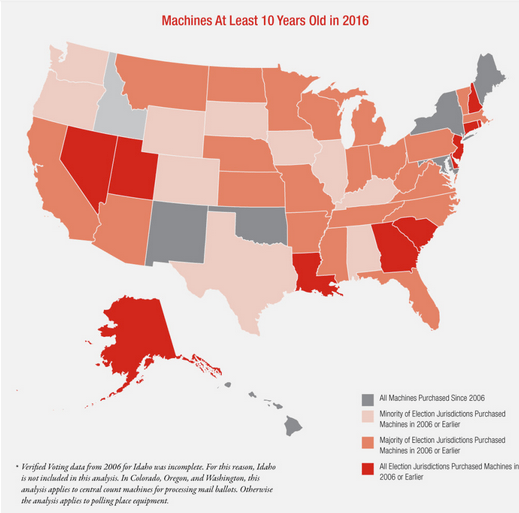
Things are dismal, yes, but they are not evenly so. As this map from the Brennan Center report shows, there are just a few states that are as bad off as South Carolina (all machines ten years old or greater). But there are also just as few states that are relatively well off with all machines newer than ten years old.

state-by-state-10-year-old-voting-machines

Of the nine places where the exit polling has missed by more than 7% (South Carolina, Alabama, Georgia, Massachusetts, Tennessee, Texas, Mississippi, Ohio, New York), two-thirds are states where all or the majority of election jurisdictions are using machines ten years old or greater. For these six states the average initial exit polling miss is a whopping 9.98%. From my column on exit polling misses last week, the average exit polling miss in Clinton’s favor is 5.1%. For the three states (Oklahoma, New York, Maryland) for which there is polling and for which all election jurisdictions use machines less than ten years old (gray in the map), the average is just a 1.67% miss in Clinton’s favor. Now take note, this 1.67% average includes New York with its huge miss in Clinton’s favor. Alabama is also worth looking at, with a minority of jurisdictions having machines more than ten years old, because I have been using an “Alabama Test” to see whether theories for the exit polling misses make sense.

I put figures like this to exit pollster and Executive Vice President of Edison Research Joe Lenski for question 10, which I’d previously left out of the published version of the interview I completed with him. I wanted to know whether the gap in exit polling misses raised any red flags. Here was Lenski’s reply:

The reliability of vote equipment is a true concern but I don’t see any evidence how the concentration of older voting machines in certain states would have affected either candidate more than the other.  There are many examples of vote count errors.  Here is a link reporting a recent vote count error in the Michigan primary that inflated Ted Cruz’s vote by 3000 votes  http://uselectionatlas.org/WEBLOGS/dave/ .  These types of errors are discovered all the time but there is no evidence that these are anything more than mistakes by local election officials – not a systematic attempt to affect a single candidate’s vote totals.  This reminds me of theories after the 2008 New Hampshire Democratic Primary based upon the fact that Hillary Clinton did better in towns with voting machines while Barack Obama did better in towns that voted on paper.  That was simply an artifact of the demographics in New Hampshire of the towns that had voting machines versus those that voted on paper.  Again the states with older voting machines in 2016 may just be the same states with demographics that favored Hillary Clinton over Bernie Sanders.

But again, as I argued last Wednesday, the demographics by state and other proposed reasons for exit polling misses do not actually add up. Big misses have happened in the South, in Massachusetts, and also in Ohio where Sanders otherwise did quite well in the Midwest. Nor do age or early voting patterns predict exit polling misses. Still, what is most remarkable about Lenski’s statement is that he is one of the few non-tech experts we spoke with who recognized that the “reliability of voting equipment is a true concern.”

None of the three elections academics I spoke with for last Wednesday’s piece appeared to be familiar with the Brennan Center report on aging and vulnerable machines, and Antonio Gonzalez, an exit polling expert and Latino voter registration guru who called for parties not to seat Arizona’s delegations in last Thursday’s piece, seemed a bit floored when I presented him with question ten from my interview with Lenski. “Oh,” he said, “I thought Congress was supposed to have taken care of that with HAVA.” HAVA, as noted earlier, offered money from 2002 to 2006 for states to upgrade to the then latest and greatest voting technology.

At this point we should take a look at the proven flaws in four very old and hackable machines in particular. These machines or similar elderly and vulnerable machines are in use in almost all places where Clinton outperforms exit polling most substantially. Because I am taking evidence and counter-evidence seriously, we will also look at the machines used in New York City, which are not quite so old (about six or seven years). While those machines, ES&S’s DS200, have had several problems over the years of the type suggested by Lenski, they also have not verifiably flunked independent security tests, so far as I know.

AccuVote (TS, OS, TSX models)

AccuVote technology is among the worst of the worst. This is the Diebold technology hacked in the Hacking Democracy clip. It is more than ten years old, can be hacked in such a way that even those models (OS, TSX) with a paper trail can be tricked, and it is in use throughout Georgia (12.2% miss) and in more than 300 counties or other election jurisdictions in more than 20 states.

AVC Edge and Edge II  (from my column on Chicago Friday)

The AVC Edge and Edge II (with paper trail) were provably hacked by a “Red Team” from UC Santa Barbara hired by the State of California in 2008. Jim Allen, spokesman for the Chicago Board of Elections, called and emailed to complain after my article last Friday. He dismissed the suggestion that Edge II could be hacked because of the paper trail. Not only is this laughable since his team engaged in a wildly inaccurate audit of the paper trail from the Chicago Democratic primary, but Allen apparently failed to click on the linkregarding the UCSB Red Team test that I included in the article. The first paragraph of that article notes that Edge machines, “even those with a so-called Voter Verified Paper Trail” can be successfully hacked by a single person. AVC Edge machines are in use without a paper trail throughout Louisiana (where there were no exit polls but where Clinton seriously outperformed her pre-election day polling average) and in more than 130 counties in various other states.

Model 100 (from ES&S)

Model 100 also badly flunked (.pdf) the California “Red Team” test in 2008. Like the other machines in this list, it is hackable in a way that spreads virally to other machines in the same network. Hundreds of jurisdictions still use Model 100 to tabulate votes, including especially Wayne County (Detroit), 27 counties in Ohio, 9 counties in Tennessee, 78 counties in Texas, and many more that match very well with where Clinton has outperformed exit polls.

iVotronic (ES&S)

iVotronic machines are touchscreen voting machines, many without a paper trail. iVotronic machines flunked a University of Pennsylvania test in 2007 and are the precise machines in question in the previous suspicious Democratic primary results in South Carolina in 2010. They continue to be used throughout South Carolina (no paper trail) and in hundreds of counties in states where Clinton has suspiciously overperformed exit polling.

DS200

DS200 machines have had a wide variety of malfunctioning problems, particularly in New York City, but those problems can and mostly have been addressed in places like New York City by retraining poll workers to check immediately whether each voters’ vote was counted and then offering a new chance to vote if necessary. As stated, the DS200 has not been provably hacked so far as I know. Newer machines of this sort were put into use just this year in Maryland where the overall exit polling missed in Sanders favor, for once, but by just 0.6 points. Still, the votes in Baltimore County have now been decertifiedbecause, among other things, there were more votes than voters who checked in at the polls. In Maryland, the DS200 machines are all networked to a statewide system for tabulating votes quickly. Networking, however, is not required, and my best information suggests that networking is not how the DS200 is used in New York City. Instead, precinct workers pull the results off the machine at the end of the voting day and relay them to county headquarters, according to my discussions with a poll worker from Brooklyn.

What About the Exceptions to This Correlation?

But we also would have to deal with where there are exceptions to this strong correlation between hackable machines and Clinton beating the exit polling badly. Here’s where my conversation with a particular veteran hacker comes into play. I chatted securely with a long-time member of Anonymous whom I’ll call the King of SciAm (not the handle they use publicly or privately). The King of SciAm has long worked with the Telecommix branch of Anonymous. Telecommix rose to fame when Hosni Mubarak cut off internet access in Egypt during the Arab Spring uprising. Telecommix found work-arounds via dial-up internet to keep information from activists on the ground flowing out of Egypt. As a general rule, Telecommix does not take part in Anonymous leaks or website shutdowns and defacements, but they made an exception to that rule early in this campaign cycle. Telecommix members defaced Donald Trump’s website with a tribute to Jon Stewart upon his retirement. The New Yorker’s Alex Koppleman called it the “classiest website hack ever,” a compliment the King of SciAm relishes.

The King of SciAm emphasized to me that, if hired to hack an election (which they would never do), the first thing they would do would be to figure out the best way to leave no trace: “we’d target the network packets or their headwater.” The key idea being for “a hack to survive the security audit trail after the vote is certified.” Furthermore, “we would likely try to target the thing most likely to get it’s logs wiped first – so – whatever it plugs into to move the data. Are the voting machines in use network connected?”

The King of SciAm told me that targeting old, provably hackable machines is “not an unfair theory,” but “you asked how (if we did these sort of things) we would do them.” The problem, they noted, “is that any change to the voting machine operating system or driver stack will likely be found in the security auditor’s rotation pretty quickly. This is because once the machines are down (end of election day) – they are no longer accessible to revert any source code changes or wipe any logs that said you were there, unless you’ve written STUXnet – in which case you wouldn’t be targeting the booth machines either.”

The King of SciAm was not at all surprised that sloppy hackers may be targeting older machines in places like South Carolina and Chicago, nor that elections officials were cluelessly trusting those machines and not even properly following procedures that could catch a less sophisticated hack.

So if, instead of targeting the DS200 in New York, hackers had targeted further upstream in the voting ecosystem, how would you catch it? The King of SciAm noted that you would have to use some procedure to “match 100% of the data, not 5%,” as in Chicago.

To do this, you would need to use a methodology much more like that used in the FiveThirtyEight article on irregularities in the South Carolina 2010 primary election. There, FiveThirtyEight referred to a Benford’s law test on precinct level results. That test showed an “unusual, non-random pattern in the precinct-level results suggest[ing] tampering, or at least machine malfunction, perhaps at the highest level.”

Intriguingly, after I began this series on election fraud allegations, a reader who would like to remain anonymous, emailed to point out similar irregularities in New York’s Democratic primary this year:

Results for Kings County and Bronx county [show] deviation from perfect 60-40 and 70-30 results was the same 0.035% The increase in votes in Kings (Brooklyn) from 2008 is incredible, almost a perfect 10%. Not only that but that’s where over a 100,000 voters lost their right to vote. Another 20,000 votes in Kings would mean almost a 20% increase which would be amazing compared to other counties that experienced decreases or mild increases. 

Furthermore, the overall results in New York, as announced on election night, deviated from a perfect 58-42 split “by 0.005345%. That’s 97 votes out of over 1.8 million.” Will FiveThirtyEight apply a Benford’s law test to 2016 primary results? Not a chance. They have boosted Clinton throughout and are already quite embarrassed by how badly they missed on the GOP side with Donald Trump.

But what about our test? The “Alabama Test.” What’s good for the goose is good for the gander. Alabama only has a minority of jurisdictions using old, provably hackable machines. Is that a weak correlation for the theory that in most places sloppy hackers targeted old, provably vulnerable machines while apparently more sophisticated hackers would have had to have been involved with targeting New York’s results as well as registration switching operations in a wide variety of states?

Taking a look at Alabama on a county level gives us a fairly strong answer. Most of Alabama’s counties also use hand cast ballots tabulated by the DS200, but a minority use Model 100, one of our flunked election machines. Three of the flunked Model 100 counties, however, are three of the four biggest counties in Alabama (Jefferson, Mobile, and Montgomery) and accounted for around 40% of the vote for Democrats in Alabama. Clinton won by a 64.2% spread in Jefferson, by 66.5% in Mobile, and by a stunning 73.4% in Montgomery. What happened in Madison, the one county of the top four by population that votes using the DS200 model? Clinton won by just a 38.5% spread! In fact, Clinton did not make it to 80% of the vote in any of the top twelve counties by population except for those three counties using Model 100 to tabulate votes.

And controlling for factors like African American voters or wealth does not account for this phenomenon. Take for instance Mobile where the population is 35.3% black versus a 24.6% black population in Madison County. A 10% difference in black population does not account for a 28% difference in the Clinton-Sanders spread. What’s more, if you compare Mobile to a very similar county in North Carolina (where the exit polls did not really miss), you see something similarly telling.

Cumberland County, NC is very comparative to Mobile, Alabama. They have similar populations, similar numbers of black residents (with Cumberland slightly higher at 37.6% African American), very similar per capita income figures, and both counties had about 35,000 Democratic voters. Clinton won Cumberland by 32.8%, very close to the Madison County (DS200 model) results and about half the percentage spread Clinton saw in Mobile (Model 100).

Of the theories we have so far for why exit polling missed in Alabama by a huge 14%, the only theory that provides a reasonable explanation is vote tabulating machine tampering. Now, perhaps someone else will come up with a non-fraudulent exit polling miss theory that passes the Alabama Test and explains other states as well. Such a theory cannot be about early voting (Alabama had none) and over-projecting young voters (there were very few according to exit polls of Alabama).

Until someone comes up with such a workable theory, election fraud benefiting Hillary Clinton to the tune of a 120 to 150 pledged delegate difference, is the best explanation we have. People wanting to prove this theory should be suing for a technologically sophisticated and independent review of results and the voting results’ entire computer ecosystems in places like Ohio, South Carolina, Alabama, Boston, Chicago, New York, and many others.

Part 1: Taking Election Fraud Allegations Seriously
Part 2: Debunking Some Election Fraud Allegations
Part 3: In-depth Report on Exit Polling and Election Fraud Allegations
An Interview With Lead Edison Exit Pollster Joe Lenski
Part 4: Purged, Hacked, Switched
Part 5: Chicago Election Official Admits “Numbers Didn’t Match”

Doug Johnson Hatlem is best known for his work as a street pastor and advocate with Toronto’s homeless population from 2005-2013. He is now a film producer and free-lance writer based in Chicago.

Wake Up Humanity: The Divide Of The Uninformed

1444793074811

By Ryan Cristian

Source: Collective Evolution

As the American people begin to closely examine the shroud that has been pulled over their eyes–seeing the veneer of misinformation that has been cast over the country’s exponential and perpetual profiteering and war-mongering–the people slowly awaken to the prospect that, in its simplest terms, they have been lied to.

The Choice To Follow Their Lead

This country is in the midst of a massive awakening, and the average person is being confronted with a choice: address the looming dark realization that their reality is not what it seems, or double down on the comforting lie and brace for the consequences. With the level of information being thrown at the public in today’s battle for the American mind, it is no wonder many have chosen the latter.

It is a far easier path to stick with what’s familiar, however sinister it might be. As Aldous Huxley predicted, people are being overwhelmed with so many conflicting narratives that most are choosing to stick with what they knew. Despite the pressing feeling that they are being misinformed, at least they can feel good about themselves, or so they are told to believe. It has almost become another form of religion: memorize these talking points, spread the talking points, and have faith that you are on the right side.

What this has produced is an entire class of Americans who have been convinced that they are “informed”; who’s attention, prior to this election cycle, was scarcely directed at much other than the latest reality TV scandal. In essence, that is what this election has been turned into, a crazy reality show. This was wildly ingenious, as those caught by the similarities of the two are slowly being turned on to the new reality show: American Politics. This has awakened a dumb sleeping giant, waiting to be pointed in the right direction. These are the very same individuals screaming at rallies and speaking about how we need to “Make America Great Again,” as if those that have been politically active, prior to the new shiny political show, have been just sitting on their hands waiting for this amazing slogan to come along and give Americans the insight they have been waiting for!

In reality they are simply parroting what they saw on their chosen pulpit and aggressively defending these falsehoods with no real understanding of the surrounding dynamics, or why they have the position they are claiming to hold. When confronted with contrasting information, even while attempting to have a civil discussion, these are the individuals who quickly get agitated and lash out, throwing out terms like “un-American” or a “conspiracy theorist” — the preconditioned responses to any idea that even slightly contradicts their treasured gospel of Truth.

The Divide

The current election cycle, with its supposed “anti-establishment candidates,” has completely changed what was previously a political insider’s game. With the increasing support for candidates such as Trump and Sanders, the country has witnessed a rise of the previously voiceless and currently uninformed. What is being witnessed is not only the sudden arrival of the silent 40%, who chose not to grace the nation with their opinions in previous years (by opting out of the voting process), but the staunch divide between who they have risen in defense of.

Whether these anti-establishment presidential potentials are genuine in their intentions or just more Manchurian candidates with designs to continue business as usual, a clear divide has arisen. This has invigorated a previously nonexistent “middle-class” (if there is still such a thing) to come out in droves to cast their vote for whoever their favorite show told them they were smart for already thinking about picking; nothing more than intentional validation of preexisting, preconceived ideas; no real critical thinking involved. This is by design.

Some feel that the intention is to syphon enough votes away from the other potential candidates, using Trump and Sanders, to allow for the clear establishment hopeful, Hillary Clinton, to easily fall into office as the obvious lesser of two evils. Yet, despite the legitimacy of that claim, no one actually informed can call Clinton the lesser of any evil, let alone the best choice. That can no doubt be argued, but all hinges on whether one feels the scandals surrounding Clinton are political hype, or legitimate crime.

It would seem the laughable idea of literally choosing the lesser of two evils to represent the American people and stand as commander-in-chief of the largest military force on the planet has become this country’s only option. As supposed free individuals, it is hard to address this fact and not come away feeling cheated. So, most ignore it, taking solace in the fact that at least they get to choose between the two; but do they?

Time and time again it has been shown in this country that the electoral college (the system that is used to dole out votes after they have been cast) is anything but democratic. Currently in 24 states, the electoral college does not even have to vote for the candidate who wins the popular vote; they can literally vote for whoever they want, despite what the people have chosen. Take that into account with gerrymandering and super delegates, and it becomes clear that this system is cleverly disguised as a democracy, but quite far from being one.

Some feel that this invigoration and divide of the previously uninvolved was created in order to garner the type of violence and unrest being witnessed in all political arenas at the current stage. The end goal being a push into “an obvious need for more control, more government, more more more,” and ultimatelythe big aversion for most of the uninformed, the New World Order, or a one world government; which has been openly discussed and is a genuine agenda.

Whether one chooses to listen to the obviously biased mainstream media or an independent source, not following up that observance with research of one’s own is equal to not truly being informed. It is just taking another’s word for it. Should one really bank their future and the future of this country on the thoughts and potential ulterior motives of another?

The only way to truly be informed is for one to take it upon themselves to not only research a topic they wish to understand, but to actually understand the topic, and not just repeat what was last heard as one’s personal opinion.

Do not be another manufactured tool of those pulling the strings. Do not allow yourself to be distracted and beguiled by the proverbial bells and whistles of the current political theatre. Take it upon yourself to understand the true inner workings of the US government and know when action must be taken and when it is in the best interest of the American people for that action to be avoided.


SOURCES

http://www.thenation.com/article/figuring-out-why-93-million-people-didnt-vote/

http://www.huffingtonpost.com/howard-steven-friedman/antidemocratic-electoral-college_b_1744138.html

68 Monsanto-Owned Companies To Boycott

9hamburg_germany

(Editor’s Note:  Tomorrow marks the 4th annual international March Against Monsanto. Whether or not you participate, you can take action in solidarity all year round by refusing to buy products from the companies listed below.)

Monsanto Company Inc. is a well-known, American-owned, multinational agrochemical and agricultural biotechnology corporation. It has been a leading force behind the widespread use of genetically modified seeds, the production of GM food products, and the development and application of associated chemicals.

Specifically, Monsanto’s infamous contribution has been Roundup, a glyphosate-based herbicide that is promoted as safe and harmless to humans, but is believed by a multitude of experts to be quite the opposite. While the company’s GMO seeds are advertised as requiring a reduced use of pesticides, this has been exposed as a false claim. The company also previously produced such evils as the insecticide DDT, PCBs, Agent Orange, aspartame and bovine growth hormone.

All of these chemicals are considered by many to be a threat to global ecosystems, water safety and biodiversity. The residues of Roundup, which remain in genetically modified foods, are believed to cause many dangerous effects to human health, including the death of embryonic cells and extreme damage to the intestinal microbiome.

These foods are ubiquitous, with soy, maize, corn, sorghum, canola, alfalfa and cotton being largely contaminated with Roundup. In a world of modern processed foods, a surprising majority of ingredient lists contain at least one of these items. Many forward-thinking companies and restaurants are now excluding GMOs from their product offerings.

Even more upsetting is that the processed foods containing GMOs are often targeted toward children. Check out this link for a video of Daniel Bissonnette, a nine-year-old Canadian boy who asks why children in particular are subjected to the most toxic food by our society.

Tami Monroe Canal, founder of the worldwide March Against Monsanto movement, sums up the issue by saying, “Monsanto’s predatory business and corporate agricultural practices threatens [this] generation’s health, fertility and longevity.”

Here is the list of companies and brands that are either owned by Monsanto, or are known to use genetically modified seeds sold by Monsanto:

  • Aunt Jemima
  • Aurora Foods
  • Banquet
  • Best Foods
  • Betty Crocker
  • Bisquick
  • Cadbury
  • Campbell’s
  • Capri Sun
  • Carnation
  • Chef Boyardee
  • Coca-Cola
  • ConAgra Foods
  • Delicious Brands cookies
  • Duncan Hines
  • Famous Amos
  • Flowers Industries
  • Frito Lay
  • General Mills
  • Green Giant
  • Healthy Choice
  • Heinz
  • Hellmann’s
  • Hershey
  • Holsum
  • Hormel
  • Hungry Jack
  • Hunt’s
  • Interstate Bakeries
  • Jiffy
  • KC Masterpiece
  • Keebler
  • Kellogg’s
  • Kid Cuisine
  • Knorr
  • Kool-Aid
  • Kraft
  • Lean Cuisine
  • Lipton
  • Loma Linda Foods
  • Marie Callender’s
  • Minute Maid
  • MorningStar Farms
  • Mrs. Butterworth’s
  • Nabisco
  • Nature Valley
  • Nestlé
  • Ocean Spray
  • Ore-Ida
  • Orville Redenbacher’s
  • Pepperidge Farm
  • Pepsi
  • Philip Morris
  • Pillsbury
  • Pop Secret
  • Post cereals
  • PowerBar brand
  • Prego
  • Pringles
  • Procter & Gamble
  • Quaker
  • Ragú
  • Rice-A-Roni & Pasta Roni
  • Schweppes
  • Weight Watchers Smart Ones
  • Stouffer’s
  • Tombstone frozen pizza
  • Totino’s
  • Uncle Ben’s
  • Unilever
  • V8

So what is a concerned consumer to do? We recommend getting on the organic train, and staying there. Certified USDA organic products do not contain GMOs and are therefore safe for consumption. However, certain processed organic foods may still be owned by Monsanto. That’s why it’s even more important to buy local, seasonal organic produce and free-range, pastured animal products from small brands that you know and trust. Anything that comes in a box, bag, can or package is better left alone.

If you do choose to buy packaged foods, try using an app such as Buycott, which is able to determine the “family tree” of a company and let you know if it is associated with Monsanto. Then you can pop that product back on the shelf and choose a different one. Boycotting these companies and brands will strengthen the force against the dangerous agricultural practices they are promoting.

We encourage you to join the movement against Monsanto and say “NO!” to everything it represents by boycotting these products. Learn more about anti-GMO efforts here.

Welcome to 1984

1984

By Chris Hedges

Source: truthdig

The artifice of corporate totalitarianism has been exposed. The citizens, disgusted by the lies and manipulation, have turned on the political establishment. But the game is not over. Corporate power has within its arsenal potent forms of control. It will use them. As the pretense of democracy is unmasked, the naked fist of state repression takes its place. America is about—unless we act quickly—to get ugly.

“Our political system is decaying,” said Ralph Nader when I reached him by phone in Washington, D.C. “It’s on the way to gangrene. It’s reaching a critical mass of citizen revolt.”

This moment in American history is what Antonio Gramsci called the “interregnum”—the period when a discredited regime is collapsing but a new one has yet to take its place. There is no guarantee that what comes next will be better. But this space, which will close soon, offers citizens the final chance to embrace a new vision and a new direction.

This vision will only be obtained through mass acts of civic mobilization and civil disobedience across the country. Nader, who sees this period in American history as crucial, perhaps the last opportunity to save us from tyranny, is planning to rally the left for three days, from May 23 to May 26 at Constitution Hall in Washington, D.C., in what he is calling “Breaking Through Power” or “Citizen’s Revolutionary Week.” He is bringing to the capital scores of activists and community leaders to speak, organize and attempt to mobilize to halt our slide into despotism.

“The two parties can implode politically,” Nader said. “They can be divided by different candidates and super PACs. But this doesn’t implode their paymasters.”

“Elections have become off-limits to democracy,” he went on. “They have become off-limits to democracy’s fundamental civil community or civil society. When that happens, the very roots shrivel and dry up. Politics is now a sideshow. Politics does not bother corporate power. Whoever wins, they win. Both parties represent Wall Street over Main Street. Wall Street is embedded in the federal government.”

Donald Trump, like Hillary Clinton, has no plans to disrupt the corporate machinery, although Wall Street has rallied around Clinton because of her predictability and long service to the financial and military elites. What Trump has done, Nader points out, is channel “the racist, right-wing militants” within the electorate, embodied in large part by the white working poor, into the election process, perhaps for one last time.

Much of the left, Nader argues, especially with the Democratic Party’s blatant rigging of the primaries to deny Bernie Sanders the nomination, grasps that change will come only by building mass movements. This gives the left, at least until these protofascist forces also give up on the political process, a window of opportunity. If we do not seize it, he warns, we may be doomed.

He despairs over the collapse of the commercial media, now governed by the primacy of corporate profit.

“Trump’s campaign has enormous appeal to the commercial mass media,” Nader said. “He brought huge ratings during the debates. He taunted the networks. He said, ‘I’m boycotting this debate. It’s going to cost you profit.’ Has this ever happened before in American history? It shows you the decay, the commercialization of public elections.”

The impoverished national discourse, fostered by a commercial mass media that does not see serious political debate as profitable and focuses on the trivial, the salacious and the inane, has empowered showmen and con artists such as Trump.

“Trump speaks in a very plain language, at the third-grade level, according to some linguists,” Nader said. “He speaks like a father figure. He says, ‘I’ll get you jobs. I’ll bring back industry. I’ll bring back manufacturing. I’ll protect you from immigrants.’ The media never challenges him. He is not asked, ‘How are we going do all of this? What is step one? Step two? Is the White House going to ignore the Congress and the courts?’ He astonishes his audience. He amazes them with his bullying, his lying, his insults, like ‘Little Marco,’ the wall Mexico is going to pay for, no more entry in the country by Muslims—a quarter of the human race—until we figure it out. The media never catches up with him. He is always on the offensive. He is always news. The commercial media wants the circus. It gives them high ratings and high profit.”

The focus on info-entertainment has left not only left the public uninformed and easily manipulated but has locked out the voices that advocate genuine reform and change.

“The commercial media does not have time for citizen groups and citizen leaders who are really trying to make America great, whether by advancing health safety or economic well-being,” Nader bemoaned. “These groups are overwhelmed. They’re marginalized. They’re kept from nourishing the contents of national, state and local elections. Look at the Sunday news shows. No one can get on to demonstrate that the majority of the people want full Medicare for all with the free choice of doctors and hospitals, not only more efficient but more life-saving. There was a major press conference a few days ago at the National Press Club. The leading advocates of full Medicare for all, or single-payer, were there, Dr. Steffie Woolhandler and Dr. Sidney Wolfe, the heads of Physicians for a National Health Program. This is a group with about 15,000 physicians on board. Nobody came. There was a stringer for an indie media outlet and the corporate crime reporter. There are all kinds of major demonstrations, 1,300 arrests outside the Congress protesting the corruption of money in politics. Again no coverage, except a little on NPR and on ‘Democracy Now!’ ”

“The system is gamed,” he said. “The only way out of it is to mobilize the civil society.

“We are organizing the greatest gathering of accomplished citizen advocacy groups on the greatest number of redirections and reforms ever brought together in American history under one roof,” he said of his upcoming event. “The first day is called Breaking Through Power, How it Happens. We have 18 groups who have demonstrated it with tiny budgets for over three decades on issues such as road safety, removing hundreds of hazardous or ineffective pharmaceuticals from the market, changing food habits from junk food to nutrition and rescuing people from death row who were falsely convicted of homicides. What if we tripled the budgets and the staffs of these groups? Eighteen of these groups have a total budget that is less than what one of dozens of CEOs make in a year.”

Nader called on Sanders to join in the building of a nationwide civic mobilization. He said that while Clinton may borrow some of his rhetoric, she and the Democratic Party establishment would not incorporate Sander’s populist appeals against Wall Street into the party platform. If Sanders does not join a civic mobilization, Nader warned, there would be “a complete disintegration of his movement.”

Nader also said he was worried that Clinton’s high negativity ratings, along with potential scandals, including the possible release of her highly paid speeches to corporations such as Goldman Sachs, could see Trump win the presidency.

“I have her lecture contract with the Harry Walker lecture agency,” he said. “She had a clause in the contract with these business sponsors, which basically said the doors will be closed. There will be no press. You will pay $1,000 for a stenographer to give me, for my exclusive use, a stenographic record of what I said. You will pay me $5,000 a minute. She has it all. She can’t say, ‘We will look into it or we’ll see if we can find it.’ She has been dissembling. And her latest rant is, ‘I’ll release the transcripts if everyone else does.’ ‘Who is everybody else?’ as Bernie Sanders rebutted. He doesn’t give highly paid speeches behind closed doors to Wall Street firms, business executives or business trade groups. Trump doesn’t give quarter-of-a-million-dollar speeches behind closed doors to business. So by saying ‘I will release all of my transcripts if everyone else does,’ she makes a null and void assertion. This is characteristic of the Clintons’ dissembling and slipperiness. It’s transcripts for Hillary. It’s tax returns for Trump.”

While Nader supports the building of third parties, he cautions that these parties—he singles out the Green Party and the Libertarian Party—will go nowhere without mass mobilization to pressure the centers of power. He called on the left to reach out to the right in a joint campaign to dismantle the corporate state. Sanders could play a large role in this mobilization, Nader said, because “he is in the eye of the mass media. He is building this rumble from the people.”

“What does he have to lose?” Nader asked of Sanders. “He’s 74. He can lead this massive movement. I don’t think he wants to let go. His campaign has exceeded his expectations. He is enormously energized. If he leads the civic mobilization before the election, whom is he going to help? He’s going to help the Democratic Party, without having to go around being a one-line toady expressing his loyalty to Hillary. He is going to be undermining the Republican Party. He is going to be saying to the Democratic Party, ‘You better face up to the majoritarian crowds and their agenda, or you’re going to continue losing in these gerrymandered districts to the Republicans in Congress.’ These gerrymandered districts can be overcome with a shift of 10 percent of the vote. Once the rumble from the people gets underway, nothing can stop it. No one person can, of course, lead this. There has to be a groundswell, although Sanders can provide a focal point”

Nader said that a Clinton presidency would further enflame the right wing and push larger segments of the country toward extremism.

“We will get more quagmires abroad, more blowback, more slaughter around the world and more training of fighters against us who will be more skilled to bring their fight here,” he said of a Clinton presidency. “Budgets will be more screwed against civilian necessities. There will be more Wall Street speculation. She will be a handmaiden of the corporatists and the military industrial complex. There comes a time, in any society, where the rubber band snaps, where society can’t take it anymore.”

The U.S. Military Suffers from Affluenza

f9052cf3c11a568d844c43318fe9d952

Showering the Pentagon with Money and Praise

By William J. Astore

Source: TomDispatch.com

The word “affluenza” is much in vogue. Lately, it’s been linked to a Texas teenager, Ethan Couch, who in 2013 killed four people in a car accident while driving drunk. During the trial, a defense witness argued that Couch should not be held responsible for his destructive acts. His parents had showered him with so much money and praise that he was completely self-centered; he was, in other words, a victim of affluenza, overwhelmed by a sense of entitlement that rendered him incapable of distinguishing right from wrong. Indeed, the judge at his trial sentenced him only to probation, not jail, despite the deaths of those four innocents.

Experts quickly dismissed “affluenza” as a false diagnosis, a form of quackery, and indeed the condition is not recognized by the American Psychiatric Association. Yet the word caught on big time, perhaps because it speaks to something in the human condition, and it got me to thinking. During Ethan Couch’s destructive lifetime, has there been an American institution similarly showered with money and praise that has been responsible for the deaths of innocents and inadequately called to account? Is there one that suffers from the institutional version of affluenza (however fuzzy or imprecise that word may be) so much that it has had immense difficulty shouldering the blame for its failures and wrongdoing?

The answer is hidden in plain sight: the U.S. military. Unlike Couch, however, that military has never faced trial or probation; it hasn’t felt the need to abscond to Mexico or been forcibly returned to the homeland to face the music.

Spoiling the Pentagon

First, a caveat. When I talk about spoiling the Pentagon, I’m not talking about your brother or daughter or best friend who serves honorably. Anyone who’s braving enemy fire while humping mountains in Afghanistan or choking on sand in Iraq is not spoiled.

I’m talking about the U.S. military as an institution. Think of the Pentagon and the top brass; think of Dwight Eisenhower’s military-industrial complex; think of the national security state with all its tentacles of power. Focus on those and maybe you’ll come to agree with my affluenza diagnosis.

Let’s begin with one aspect of that affliction: unbridled praise. In last month’s State of the Union address, President Obama repeated a phrase that’s become standard in American political discourse, as common as asking God to bless America. The U.S. military, he said, is the “finest fighting force in the history of the world.”

Such hyperbole is nothing new. Five years ago, in response to similar presidential statements, I argued that many war-like peoples, including the imperial Roman legions and Genghis Khan’s Mongol horsemen, held far better claims to the “best ever” Warrior Bowl trophy. Nonetheless, the over-the-top claims never cease. Upon being introduced by President Obama as his next nominee for secretary of defense in December 2014, for instance, Ash Carter promptly praised the military he was going to oversee as “the greatest fighting force the world has ever known.” His words echoed those of the president, who had claimed the previous August that it was “the best-led, best-trained, best-equipped military in human history.” Similar hosannas (“the greatest force for human liberation the world has ever known”) had once been sprinkled liberally through George W. Bush’s speeches and comments, as well as those of other politicians since 9/11.

In fact, from the president to all those citizens who feel obliged in a way Americans never have before to “thank” the troops endlessly for their efforts, no other institution has been so universally applauded since 9/11. No one should be shocked then that, in polls, Americans regularly claim to trust the military leadership above any other crew around, including scientists, doctors, ministers, priests, and — no surprise — Congress.

Imagine parents endlessly praising their son as “the smartest, handsomest, most athletically gifted boy since God created Adam.” We’d conclude that they were thoroughly obnoxious, if not a bit unhinged. Yet the military remains just this sort of favored son, the country’s golden child. And to the golden child go the spoils.

Along with unbridled praise, consider the “allowance” the American people regularly offer the Pentagon. If this were an “affluenza” family unit, while mom and dad might be happily driving late-model his and her Audis, the favored son would be driving a spanking new Ferrari. Add up what the federal government spends on “defense,” “homeland security,” “overseas contingency operations” (wars), nuclear weapons, and intelligence and surveillance operations, and the Ferraris that belong to the Pentagon and its national security state pals are vrooming along at more than $750 billion dollars annually, or two-thirds of the government’s discretionary spending. That’s quite an allowance for “our boy”!

To cite a point of comparison, in 2015, federal funding for the departments of education, interior, and transportation maxed out at $95 billion — combined! Not only is the military our favored son by a country mile: it’s our Prodigal Son, and nothing satisfies “him.” He’s still asking for more (and his Republican uncles are clearly ready to turn over to him whatever’s left of the family savings, lock, stock, and barrel).

On the other hand, like any spoiled kid, the Defense Department sees even the most modest suggested cuts in its allowance as a form of betrayal. Witness the whining of both those Pentagon officials and military officerstestifying before Congressional committees and of empathetic committee members themselves. Minimalist cuts to the soaring Pentagon budget are, it seems, defanging the military and recklessly endangering American security vis-a-vis the exaggerated threats of the day: ISIS, China, and Russia. In fact, the real “threat” is clearly that the Pentagon’s congressional “parents” might someday cut down on its privileges and toys, as well as its free rein to do more or less as it pleases.

With respect to those privileges, enormous budgets drive an unimaginably top-heavy bureaucracy at the Pentagon. Since 9/11, Congressional authorizations of three- and four-star generals and admirals have multipliedtwice as fast as their one- and two-star colleagues. Too many generals are chasing too few combat billets, contributing to backstabbing and butt-kissing. Indeed, despite indifferent records in combat, generals wear uniforms bursting with badges and ribbons, resembling the ostentatious displays of former Soviet premiers — or field marshals in the fictional Ruritarian guards.

Meanwhile, the proliferation of brass in turn drives budgets higher. Even with recent modest declines (due to the official end of major combat operations in Iraq and Afghanistan), the U.S. defense budget exceeds the combined military budgets of at least the next seven highest spenders. (President Obama proudly claims that it’s the next eight.) Four of those countries — France, Germany, Great Britain, and Saudi Arabia — are U.S. allies; China and Russia, the only rivals on the list, spend far less than the United States.

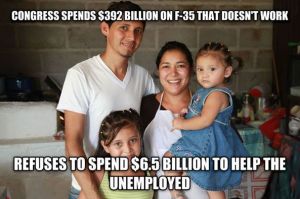
With respect to its toys, the military and its enablers in Congress can never get enough or at a high enough price. The most popular of these, at present, is the under-performing new F-35 jet fighter, projected to cost $1.5 trillion (yes, you read that right) over its lifetime, making it the most expensive weapons system in history. Another trillion dollars is projected over the next 30 years for “modernizing” the U.S. nuclear arsenal (this from a president who, as a candidate, spoke of eliminating nuclear weapons). The projected acquisition cost for a new advanced Air Force bomber is already $100 billion (before the cost overruns even begin).  The list goes on, but you catch the drift.

A Spoiled Pentagon Means Never Having to Say You’re Sorry

To complete our affluenza diagnosis, let’s add one more factor to boundless praise and a bountiful allowance: a total inability to take responsibility for one’s actions. This is, of course, the most repellent part of the Ethan Couch affluenza defense: the idea that he shouldn’t be held responsible precisely because he was so favored.

Think, then, of the Pentagon and the military as Couch writ large. No matter their mistakes, profligate expenditures, even crimes, neither institution is held accountable for anything.

Consider these facts: Iraq, Afghanistan, and Libya are quagmires. The Islamic State is spreading. Foreign armies, trained and equipped at enormous expense by the U.S. military, continue to evaporate. A hospital, clearly identifiable as such, is destroyed “by accident.” Wedding parties are wiped out “by mistake.” Torture (a war crime) is committed in the field. Detainees are abused. And which senior leaders have been held accountable for any of this in any way? With the notable exception of Brigadier General Janis Karpinskiof Abu Ghraib infamy, not a one.

After lengthy investigations, the Pentagon will occasionally hold accountable a few individuals who pulled the triggers or dropped the bombs or abused the prisoners. Meanwhile, the generals and the top civilians in the Pentagon who made it all possible are immunized from either responsibility or penalty of any sort. This is precisely why Lieutenant Colonel Paul Yingling memorably wrote in 2007 that, in the U.S. military, “a private who loses a rifle suffers far greater consequences than a general who loses a war.” In fact, no matter what that military doesn’t accomplish, no matter how lacking its ultimate performance in the field, it keeps getting more money, resources, praise.

When it comes to such subjects, consider the Republican presidential debate in Iowa on January 28th. Jeb Bush led the rhetorical charge by claiming that President Obama was “gutting” the military. Ted Cruz and Marco Rubio eagerly agreed, insisting that a “dramatically degraded” military had to be rebuilt. All the Republican candidates (Rand Paul excepted) piled on, calling for major increases in defense spending as well as looser “rules of engagement” in the field to empower local commanders to take the fight to the enemy. America’s “warfighters,” more than one candidate claimed, are fighting with one arm tied behind their backs, thanks to knots tightened by government lawyers. The final twist that supposedly tied the military up in a giant knot was, so they claim, applied by that lawyer-in-chief, Barack Obama himself.

Interestingly, there has been no talk of our burgeoning national debt, which former chairman of the Joint Chiefs of Staff Admiral Mike Mullen once identified as the biggest threat facing America. When asked during the debate which specific federal programs he would cut to reduce the deficit, Chris Christie came up with only one, Planned Parenthood, which at $500 million a year is the equivalent of two F-35 jet fighters. (The military wants to buy more than 2,000 of them.)

Throwing yet more money at a spoiled military is precisely the worst thing we as “parents” can do. In this, we should resort to the fiscal wisdom of Army Major General Gerald Sajer, the son of a Pennsylvania coal miner killed in the mines, a Korean War veteran and former Adjutant General of Pennsylvania. When his senior commanders pleaded for more money (during the leaner budget years before 9/11) to accomplish the tasks he had assigned them, General Sajer’s retort was simple: “We’re out of money; now we have to think.”

Accountability Is Everything

It’s high time to force the Pentagon to think. Yet when it comes to our relationship with the military, too many of us have acted like Ethan Couch’s mother. Out of a twisted sense of love or loyalty, she sought to shelter her son from his day of reckoning. But we know better. We know her son has to face the music.

Something similar is true of our relationship to the U.S. military. An institutional report card with so many deficits and failures, a record of deportment that has led to death and mayhem, should not be ignored. The military must be called to account.

How? By cutting its allowance. (That should make the brass sit up and take notice, perhaps even think.) By holding senior leaders accountable for mistakes. And by cutting the easy praise. Our military commanders know that they are not leading the finest fighting force since the dawn of history and it’s time our political leaders and the rest of us acknowledged that as well.

William J. Astore, a retired lieutenant colonel (USAF), is a TomDispatchregular. He blogs at Bracing Views.

Govt-Hollywood Complex to Sell “Patriotic” Martial Law Lockdown in New Boston Bombing Films

qefgtrhy

By Berie Suarez

Source: Truth and Art TV

A massive wave of government propaganda is coming and the method of transmission will be Hollywood. Hollywood is one of the most important brainwashing tools to keep the masses ignorant of reality and government corruption. And as we’ve seen in the past, it is designed to reinforce numerous government lies the masses are supposed to believe. Whenever Hollywood releases a film endorsing a government narrative it usually represents the final phase of a false flag, staged event narrative being sold.

Remember what former CIA director William Casey said. Until EVERYTHING that everyone believes is a lie, the control system feels they are not done lying to you yet.

When it comes to propaganda Hollywood operates under a different set of rules as they have the liberty to fictionally represent a story under the guise of “entertainment” without having to be accurate about what really happened. A close look at this issue reveals how powerful and effective the Hollywood-Government complex is at cementing massive government lies in the psyche of the general public.

So it shouldn’t surprise us that it is being reported that Hollywood producers are in race to put out not one but two films about the Boston bombing hoax staged in April of 2013 featuring numerous crisis actors. One film “Patriots Day” will serve to not only reinforce the Boston bombing staged event but to glorify “lockdown” and deceive viewers into worshiping police and psychologically re-accepting that lockdown was necessary to catch the “bad guys”, thus serving to authenticate future lockdowns as necessary as well. Another film being scheduled for release this year “Boston Strong” is also based on the Boston bombing false flag event and the concept of heroism. Both films appear to correlate “strength” with obedience to lockdown as well as “patriotism” and obedience to lockdown, and both are psychological operations on the general public being likely secretly funded by the state.

So without any shame, the storyline behind Patriots Day admits the idea is to sell the manhunt against the Tsarnaev accused patsy brothers itself and the lockdown of Watertown which ensued. The lockdown itself seems to be the focus of the emotion and heroism in these movies more so than the overall false flag narrative which has been debunked and exposed on many levels.

The story of course, is told by lucky Ed Davis, the commissioner that just so happened to get a phone call right at the time of the pressure cooker detonation, and like lucky Larry Silverstein on 9/11 he wasn’t blown up. Davis was just as “lucky” as all those “Craft International” operatives clearly seen all over the place with suspicious backpacks and communicating suspiciously before during and after the explosion.

Commissioner Davis, who was right there are the marathon finish line and walked away to take a phone call moments before the blast occurred, played an integral role working with the FBI, Watertown Police Department, Boston Police Department, Massachusetts State Police and local first responders to track, identify and apprehend the suspected bombers. Their tactics included the use of sophisticated identity technology (they actually discovered the murderers acting differently than the crowd) and giving the historic order to put the city of Boston on lockdown as they rushed to catch the suspects.

The story is envisioned as an intense thriller, spanning the five-day search up to the infamous siege where Dzhokhar Tsarnaev was pulled from a boat in Watertown. Three lost their lives at the Marathon blast site, 264 were injured, and a police officer was killed and several injured in the shootout that ended in the death of Tsarnaev’s older brother, Tamerlan. The younger mass murderer is currently on trial. Victims were eulogized in a touching ceremony at Fenway Park, something that most certainly will be part of each of those feature films, including an unforgettable exhortation of defiance by Red Sox slugger David Ortiz.

This is a clever attempt to appeal to everyone’s emotional and “patriotic” feelings, 9/11 Bush Jr style, while selling them that martial law lockdown is somehow “patriotic” because it helped catch the bad guys.

“There is nothing more compelling than a real story populated by real heroes,” said CBS Films President Terry Press. “The team that we have assembled for this project is determined to give audiences a very personal look at what occurred during the days when the eyes of the world were on the city of Boston and how a group of contemporary patriots faced this crisis.”

Anyone who cares about truth, freedom, and morality should be outraged by this in-your-face propaganda. This also serves as a warning of things to come. Very likely they are rushing these two films because something is coming and they need to condition the masses for a major lockdown.

I’m calling for readers to help take a stand against “lockdown” now before it’s too late. I’m currently in the process of researching how to properly draft a petition that can be used broadly across the U.S. to demand that lockdown is criminalized as illegal, not to mention it’s an ineffective and unproven tactic for catching law breakers. If anyone wants to help and contribute to the process please do or by all means carry out the idea yourself.

This entire effort by the Hollywood-Government complex to expedite the production of these two films which will glorify lockdown should concern everyone. Ask yourself: Why are they moving so fast to glorify lockdown? And why now? I’m sure we’ll soon find out.