Live Free or Die: The Psychology of Rebellion & Dissent

By Gary ‘Z’ McGee

Source: Waking Times

“I rebel—therefore we exist.” ~Albert Camus, The Rebel

Dissent is a tricky subject. The need to rebel against atrocity is deeply ingrained in the human condition. Even if most of us don’t act on it, the impulse is still there, churning our guts with disgust, getting our hearts pumping, moving us to spit curse words in lathered fury and shout in angry defiance. The problem is that most of us don’t know what to do with this powerful and sometimes overwhelming energy.

Most of us were raised in violent societies that use violence to keep the culture churning in a diabolical conquer-control-consume-repeat cycle. So, most of us tend to use violence to channel our deep and powerful need for dissent, thus perpetuating more violence. When the culture is jamming violence down our throat as a solution to its problems, are we really that surprised when our acts of rebellion turn out to be violent? Something’s got to give if we want to break this cycle of violence deeply imbedded in our culture.

In his book, The Rebel: An Essay on Man in Revolt, Albert Camus wrote about the “true rebel.”The true rebel is in revolt against oppression, violence, slavery and tyranny for the sake of others through constructive and life-affirming action. The true rebel protests out of love, so that others may be free. Intent is everything. True rebellion, Camus argues, is an act motivated but concerned with the common good rather than by self-interest. The rebel in revolt out of selfishness, greed, or need for power, eventually becomes a tyrant. The rebel in revolt for the sake of others, becomes a hero.

Whether you are alt-right or alt-left, republican’t or democan’t, voluntarist or anarchist, if you are seeking power over others for your own selfish and greedy ends, your revolution means fuck-all. You’re just another would-be-tyrant getting churned out of the meat-mill of violence begetting violence. It doesn’t matter how noble or important you think your cause is; if you need to use violence to persuade others to follow it, your cause is fundamentally flawed and immoral. Acting violently in a violent culture only perpetuates violence. Similarly, acting immorally in an immoral society just perpetuates immorality. Unhealthy acts beget unhealthy acts. Like Gandhi said, “An eye for an eye makes the whole world blind.”

Lest we all go blind, we must rebel so that others may freely exist. This requires our dissent to be based in freedom for everyone, even those we don’t agree with. A kind of metamorality arises from this kind of thinking, like Joshua Greene writes about in his book, Moral Tribes. But, and here’s the rub, any freedom which seeks to violate the nonaggression principle must not be tolerated. Violence is where the line must be drawn. As someone once said, “Your freedom to swing your fist ends an inch from my nose” (unknown). In such cases, self-defense is paramount. As Gandhi also advised, “When there is only a choice between cowardice and violence, I would advise violence.”

A true rebel doesn’t seek out rebellion for the sake of rebellion, or just as an excuse to act out violently. No. A true rebel passionately seeks a healthy environment (physically, culturally, and psychologically) and they rebel against anything that stands in the way of that healthy environment. As Camus said, “Rebellion, though apparently negative, since it creates nothing, is profoundly positive in that it reveals the part of man which must always be defended.” And that’s what it comes down to: self-defense, self-preservation, and survival. Not just personal survival, but the survival of the species.

That’s where life-affirming action comes in. When our rebellion is life-affirming, freedom-affirming, and based on nonviolence, it is healthy (heroic). When our rebellion is life-denying, freedom-denying, and based on violence, it is unhealthy (tyrannical). The hero is free, and uses that freedom with the soul intent to free others. The tyrant (or would be tyrant) is also free, but uses that freedom with the soul intent to rule others. We escape tyranny when we seek to free others through our own freedom. Liberty coincides with heroism when we’re able to go from asking, ‘free from what?’ to asking, ‘free for what?’

At the end of the day, the history of our culture of violence is only fruitful through a vigilant rebellion against it. This means a vigilant rebellion against oppression, hate, violence, and slavery of all kinds. Those who dedicate themselves to this culture of violence dedicate themselves to nothing and, in turn, are nothing. But those who dedicate themselves to life, freedom, and health, despite the culture of violence, dedicate themselves to survival and reap from it the harvest that sows its seed in the progressive evolution of our species.

A species hellbent on violence against itself is unhealthy and eventually destroys itself. A species determined to be healthy only ever uses violence as a last resort in self-defense and for the preservation of the species itself. From the former, the defiant tyrant juts his ugly head, declaring himself free at the expense of the freedom of others. From the latter, the defiant hero rises up, denying the tyrant’s violent oppression, and affirming freedom through the freedom of us all. That’s what Camus meant when he wrote: “I rebel –therefore we exist.”

Saturday Matinee: In Shadow

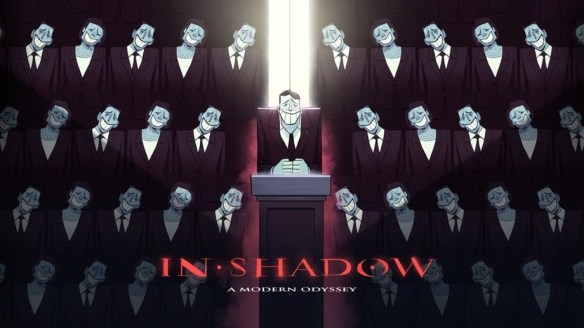
New Animated Short Film “In Shadow” Is A Visionary Journey Behind The Veil

Source: Activist Post

Story artist for film and television, Lubomir Arsov, has just released his most recent creation titled In Shadow. It is a 13-minute animated short that is a powerful and sometimes grim look at the veil that modern society has placed upon nearly every epidemic that plagues the human condition. However, as the story progresses, the seeds are planted in the journey toward awakening and self-empowerment.

Written, Directed & Produced by Lubomir Arsov
Original Soundtrack “Age of Wake” by Starward Projections
Composited by Sheldon Lisoy
Additional Compositing by Hiram Gifford
Art Directed & Edited by Lubomir Arsov

Gallery quality ART PRINTS available here: https://www.inprnt.com/gallery/inshadow/
Film Website: https://www.inshadow.net/

Facebook: https://www.facebook.com/inshadowmovie/
Music Composers: https://www.starwardprojections.com/

Contact: light@inshadow.net

Don’t Just Give Thanks. Pay It Forward One Act of Kindness at a Time

By John W. Whitehead

Source: The Rutherford Institute

“As we express our gratitude, we must never forget that the highest appreciation is not to utter words, but to live by them.”—John F. Kennedy

It’s been a hard, heart-wrenching, stomach-churning kind of year filled with violence and ill will.

It’s been a year of hotheads and blowhards and killing sprees and bloodshed and takedowns.

It’s been a year in which tyranny took a step forward and freedom got knocked down a few notches.

It’s been a year with an abundance of bad news and a shortage of good news.

It’s been a year of too much hate and too little kindness.

Now we find ourselves approaching that time of year when, as George Washington and Abraham Lincoln proclaimed, we’re supposed to give thanks as a nation and as individuals for our safety and our freedoms.

It’s not an easy undertaking.

How do you give thanks for freedoms that are constantly being eroded? How do you express gratitude for one’s safety when the perils posed by the American police state grow more treacherous by the day? How do you come together as a nation in thanksgiving when the powers-that-be continue to polarize and divide us into warring factions?

It’s not going to happen overnight. Or with one turkey dinner. Or with one day of thanksgiving.

Thinking good thoughts, being grateful, counting your blessings and adopting a glass-half-full mindset are fine and good, but don’t stop there.

This world requires doers, men and women (and children) who will put those good thoughts into action.

It says a lot (and nothing good) about the state of our world and the meanness that seems to have taken center stage that we now have a day (World Kindness Day) devoted to making the world more collectively human in thoughts and actions. The idea for the day started after a college president in Japan was mugged in a public place and nobody helped him.

Unfortunately, you hear about these kinds of incidents too often.

A 15-year-old girl was gang raped in a schoolyard during a homecoming dance. As many as 20 people witnessed the assault over the course of two and a half hours. No one intervened to stop it.

A 28-year-old woman was stabbed, raped and murdered outside her apartment early in the morning. Thirty-eight bystanders witnessed the attack and failed to intervene. The woman, Kitty Genovese, died from her wounds at the locked doorway to her apartment building.

A 58-year-old man waded into chest-deep water in the San Francisco Bay in an apparent suicide attempt. For an hour, Raymond Zack stood in the shallow water while 75 onlookers watched. Police and firefighters were called in but failed to intervene, citing budget cuts, a lack of training in water rescue, fear for their safety and a lack of proper equipment. The man eventually passed out and later died of hypothermia. Eventually, an onlooker volunteered to bring the body back to the beach.

A homeless man intervened to save a woman from a knife-wielding attacker. He saved the woman but was stabbed repeatedly in the process. As The Guardian reports, “For more than an hour he lay dying in a pool of his own blood as dozens walked by. Some paused to stare, others leaned in close. One even shook his body and then left, while someone else recorded a video of the entire proceeding.”

This is how evil prevails: when good men and women do nothing.

By doing nothing, the onlookers become as guilty as the perpetrator.

“If I were to remain silent, I’d be guilty of complicity,” declared Albert Einstein.

It works the same whether you’re talking about kids watching bullies torment a fellow student on a playground, bystanders watching someone dying on a sidewalk, or citizens remaining silent in the face of government atrocities.

There’s a term for this phenomenon where people stand by, watch and do nothing—even when there is no risk to their safety—while some horrific act takes place (someone is mugged or raped or bullied or left to die): it’s called the bystander effect.

Psychological researchers John Darley and Bibb Latane mounted a series of experiments to discover why people respond with apathy or indifference instead of intervening.

Their findings speak volumes about the state of our nation and why “we the people” continue to suffer such blatant abuses by the police state.

According to Darley and Latane, there are two critical factors that contribute to this moral lassitude.

First, there’s the problem of pluralistic ignorance in which individuals in a group look to others to determine how to respond. As Melissa Burkley explains in Psychology Today, “Pluralistic ignorance describes a situation where a majority of group members privately believe one thing, but assume (incorrectly) that most others believe the opposite.”

Second, there’s the problem of “diffusion of responsibility,” which is compounded by pluralistic ignorance. Basically, this means that the more people who witness a catastrophic event, the less likely any one person will do anything because each thinks someone else will take responsibility. In other words, no one acts to intervene or help because each person is waiting for someone else to do so.

Now the temptation is to label the bystanders as terrible people, monsters even.

Yet as Mahzarin Banaji, professor of psychology at Harvard University points out, “These are not monsters. These are us. This is all of us. This is not about a few monsters. This is about everybody. It says something very difficult to us. It says that perhaps had we been standing there, we ourselves, if we were not better educated about this particular effect and what it does to us, we may fall prey to it ourselves.”

Historically, this bystander syndrome in which people remain silent and disengaged—mere onlookers—in the face of abject horrors and injustice has resulted in whole populations being conditioned to tolerate unspoken cruelty toward their fellow human beings: the crucifixion and slaughter of innocents by the Romans, the torture of the Inquisition, the atrocities of the Nazis, the butchery of the Fascists, the bloodshed by the Communists, and the cold-blooded war machines run by the military industrial complex.

So what can you do about this bystander effect?

Be a hero, suggests psychologist Philip Zimbardo.

Each of us has an inner hero we can draw upon in an emergency,” Zimbardo concluded. “If you think there is even a possibility that someone needs help, act on it. You may save a life. You are the modern version of the Good Samaritan that makes the world a better place for all of us.”

Zimbardo is the psychologist who carried out the Stanford Prison Experiment which studied the impact of perceived power and authority on middleclass students who were assigned to act as prisoners and prison guards. The experiment revealed that power does indeed corrupt (the appointed guards became increasingly abusive), and those who were relegated to being prisoners acted increasingly “submissive and depersonalized, taking the abuse and saying little in protest.”

What is the antidote to group think and the bystander effect?

Be an individual. Listen to your inner voice. Take responsibility.

“If you find yourself in an ambiguous situation, resist the urge to look to others and go with your gut instinct,” says Burkley. “If you think there is even a possibility that someone is in need, act on it. At worst, you will embarrass yourself for a few minutes, but at best, you will save a life.”

“Even if people recognize that they are witnessing a crime, they may still fail to intervene if they do not take personal responsibility for helping the victim,” writes Burkley. “The problem is that the more bystanders there are, the less responsible each individual feels.”

In other words, recognize injustice. Don’t turn away from suffering.

Refuse to remain silent. Take a stand. Speak up. Speak out.

This is what Zimbardo refers to as “the power of one.” All it takes is one person breaking away from the fold to change the dynamics of a situation. “Once any one helps, then in seconds others will join in because a new social norm emerges: Do Something Helpful.”

“I swore never to be silent whenever and wherever human beings endure suffering and humiliation,” stated Holocaust Elie Wiesel in his Nobel Peace Prize acceptance speech in 1986. “We must always take sides. Neutrality helps the oppressor, never the victim. Silence encourages the tormentor, never the tormented. Sometimes we must interfere. When human lives are endangered, when human dignity is in jeopardy, national borders and sensitivities become irrelevant. Wherever men or women are persecuted because of their race, religion, or political views, that place must – at that moment – become the center of the universe.”

Unfortunately, as I make clear in my book Battlefield America: The War on the American People, too many Americans have opted to remain silent when it really matters while instead taking a stand over politics rather than human suffering.

That needs to change.

I don’t believe we’re inherently monsters. We just need to be more conscientious and engaged and helpful.

The Good Samaritans of this world don’t always get recognized, but they’re doing their part to push back against the darkness.

For instance, earlier this year in Florida, a family of six—four adults and two young boys—were swept out to sea by a powerful rip current in Panama City Beach. There was no lifeguard on duty. The police were standing by, waiting for a rescue boat. And the few people who had tried to help ended up stranded, as well.

Those on shore grouped together and formed a human chain. What started with five volunteers grew to 15, then 80 people, some of whom couldn’t swim.

One by one, they linked hands and stretched as far as their chain would go. The strongest of the volunteers swam out beyond the chain and began passing the stranded victims of the rip current down the chain.

One by one, they rescued those in trouble and pulled each other in.

There’s a moral here for what needs to happen in this country if we only can band together and prevail against the riptides that threaten to overwhelm us.

Here’s what I suggest.

Instead of just giving thanks this holiday season with words that are too soon forgotten, why not put your gratitude into action with deeds that spread a little kindness, lighten someone’s burden, and brighten some dark corner?

I’m not just talking about volunteering at a soup kitchen or making a donation to a charity that does good work, although those are fine things, too.

What I’m suggesting is something that everyone can do no matter how tight our budgets or how crowded our schedules.

Pay your blessings forward.

Engage in acts of kindness. Smile more. Fight less.

Focus on the things that unite instead of that which divides. Be a hero, whether or not anyone ever notices.

Do your part to push back against the meanness of our culture with conscious compassion and humanity. Moods are contagious, the good and the bad. They can be passed from person to person. So can the actions associated with those moods, the good and the bad.

Even holding the door for someone or giving up your seat on a crowded train are acts of benevolence that, magnified by other such acts, can spark a movement.

Imagine a world in which we all lived in peace.

John Lennon tried to imagine such a world in which there was nothing to kill or die for, no greed or hunger. He was a beautiful dreamer whose life ended with an assassin’s bullet on December 8, 1980.

Still, that doesn’t mean the dream has to die, too.

There’s something to be said for working to make that dream a reality. As Lennon reminded his listeners, “War is over, if you want it.”

The choice is ours, if we want it.

What Science Isn’t

The Cult of Lay-Positivism

By Equanimous Rex

Source: Modern Mythology

Science. Does the word bring images of space ships and high-tech equipment doing miraculous things? Wonder drugs and new solutions to old problems? Good, because this article isn’t a declaration that science is evil, or dead. Keep that shining gaze on the things that amaze you, and buckle up.

Never before has it been so easy as in the modern era to find something to fill a person’s God-Hole with. What’s a God-Hole, you ask? Well, put simply its a metaphor for the part of our psyche where religious surety and faithful fanaticism would have been reserved for Yahweh and his earthly cohorts, as was the case with generations and generations of many of our ancestors. These days you can’t walk three steps without crushing some cult or dealing with apologists for yet another embryonic subculture, and one of the most wide-spread and pervasive modern cults is that of the materialistpositivists.

You might not be familiar with the names but you’re definitely familiar with the faces, the words, the general attitudes of the MP’s. They tend to identify themselves by their atheism though their atheism is the least descriptive part of their belief system. Erroneously, MP’s have been in the spotlight for so long that nowadays people assume that if you are an atheist, you must fall in line and along trends of attitudes of this group, despite the fact that an atheist could be a Buddhist, LaVeyan Satanist, religious naturalist, believe in the supernatural, ghosts, psychic powers, or what have you, (since none of these things are theoi, or gods). MP’s on the other hand are intrinsically opposed to the study of or contemplation of seemingly paranormal or preternatural phenomena.

Likewise they have taken hold of the term “skeptic” and have become its face in mainstream discourse. These days all you have to do to be thought of as a skeptic is to, firstly, tell everyone quite loudly that you are one, and secondly, start engaging in specified, surgical doubt of only the belief systems and ideologies you are already antagonistic towards, while neglecting to perform the same upon anything you tacitly presume to be true. Engage in rampant polemics against your opponents and frequently craft apologetics for your own beliefs, use your inquisitiveness and doubt like a blade with which to carve out the proverbial flesh of those whom you despise ideologically. This is far from philosophical skepticism as it was originally intended, but as long as you tell people often enough you are a skeptic, you must be one.

The combination of a certain brand of materialism (philosophical monism, in which they deem all things that exist are material) and positivism (belief that everything that exists can be verified scientifically and anything that can’t be verified scientifically doesn’t exist) forms a unique cocktail, an anti-belief based upon a sense of superiority against all other beliefs. “You have beliefs. We have facts.” It is a potentially useful worldview, which many people use as a metric with which to quantify worthiness, but use is only the same as truth to the strictest of pragmatists.

Most proponents of MP eschew philosophy as navel-gazing aphorisms and platitudes, seeing the field as the decrepit grandfather of science. Given that they are mostly unaware of philosophy — due to their aversion — they don’t usually know that their beliefs fall squarely under philosophy, and they don’t usually seem to know that there are still to this day debates about the validity of their philosophical presuppositions.

Again, being critical of the philosophies of positivism and materialism is not being anti-science, though such a claim is inevitable should you question the sacrosanct nature of anything tangentially related to science or adjacent to science. Karl Popper — the guy who came up with the concept of falsifiability  — was a major opponent to positivism, for example. They’d probably say he was anti-science as well, though that is entirely inaccurate.

This isn’t a condemnation of (most) scientists. I’ve had the pleasure to meet a few over the years and I’ve always found them quite humble in terms of facing the mysterious of the universe. They were the least likely to make outrageous claims or swerve outside of their proverbial lanes. The problem lies mostly with what I’ve come to think of as “positivist laity”.

The “lay-person” is a concept found generally from religion, and refers to someone who is not a part of the clergy, who are not ordained or educated on the ‘inner mysteries’ of the religious order. They are deferential to the priests and clerics and put great faith in them but do not themselves have the same information, education or knowledge.

The materialist-positivist laity seems to consist of people who have no formal or informal education dealing with the scientific method(s) or in the fields of science. They often come from a Post-Christian background (at least in the United States) and are angry that they believed the literalism their parents or geographical region shoved down their throats. They end up seeing a few debunking videos, or those in which someone who is self-identified with atheism points out the inconsistencies of the Christian cosmological mythos. They start to notice that the explanations and descriptions of the world that scientists and science educators give are more functional, and are trusted to be provable, even though the concept of ‘proof’ is mathematical, not scientific.

Either way, for whatever reason, they come to replace Yahweh and his priests for their conception of Science and it’s own educated, inner-circle experts. Once again, not a critique of science nor atheism. Not even really a critique of materialist-positivism. We must focus on the issue at hand. Large swathes of lay-positivists are turning the concept of science into a cargo-cult religion, using it to fill in their empty God-Hole and clutching to their conception of a cohesive and explanatory world-story.

It was the jobs of priests for thousands upon thousands of years to give the simple folk a world-story, without such as story anxieties rise and existential doubt creeps in. The crafting and dissemination of a world-story has since been split up from between priests to spread into other areas and specialists such as philosophers, academics and of course, scientists.

Science isn’t a religion. Science isn’t a good many things. For example, science isn’t technology, which would probably shock quite a few lay-positivists. Humanity used and invented technology since as far back as we can find evidence for humans at all. We created aqueducts, agricultural technology, wartime technology, shipbuilding and navigational technology, calendars and time keeping technology, architectural technology, psychological techniques and so on and so forth, well before science was a twinkle in the eye of natural philosophy. People with no education on science or without any formal training to this day still invent new technology. So, next time someone points to a piece of technology and tries to conflate it with science, keep this in mind. One cannot simply anachronistically and retroactively claim for ‘science’ everything which works or is useful, though this does not prevent some from attempting such a thing.

Science is also not ethics. Nor can science tell you what to do with the information you glean from the universe via science. I’m sure people will disagree, but I’m also sure most of them are not scientists and/or do not have a clear understanding of the scientific method(s). Not every moment of clear-thinking and rationality is science, not every free-thought is evidence of science in the works. By trying to make it appear as though everything which makes sense and works is science, lay-positivists have before-the-fact designated everything that is not science as nonsensical and nonexistent.

Intuition and introspection are cast aside by positivism because they are not scientific, and I agree wholeheartedly that intuition can be flawed, rife with bias and misconceptions. But it’s a ‘don’t throw the baby out with the bathwater’ scenario. Don’t forget that most of us get up every day and manage to navigate this world without using the slightest bit of the scientific method. For instance, we’ve got inductive, deductive and abductive reasoning, none of which are isolated to scientific methods. You’ve got examples of people thought to be great scientists in bygone eras who never used an ounce of empiricism to figure out their great contributions. (Galileo, for example, used rational but non-empirical means to infer a heliocentric model).

Science isn’t a cult, a religion, or anything of the sort. But lay-positivism stands to become just that. People seeking to fill a God-Hole, to give their life a sense of meaning and to provide a cohesive world-story so that they do not feel they exist in a state of uncertainty and chaos. Nietzsche, Freud, Feuerbach, and many others have recognized this fact: the need for Gods is not so easily replaced as the Gods themselves are. If scientific findings are used with an ideological agenda to offer fragile humanity a security blanket against the cold, unpredictable unknown, misrepresented and misunderstood by those who have never even bothered to Google “scientific method” who are merely disenfranchised with their old Church, it very well stands that the word “science” will be appropriated akin to the terms “skepticism” and “atheism” to refer to specified, pigeon-holed belief systems, made sacred and subject to no criticism.

“Meet the old laity, same as the new laity.”

Carl Sagan’s Thoughts On The War on Drugs

cS8BmAg

Since today marks the birthday of the late Carl Sagan, we can remember a lesser-known aspect of his greatness by reading (or re-reading) the following 1969 essay he wrote under the pseudonym “Mr. X” published in 1971 in Lester Grinspoon’s “Marihuana Reconsidered”:

It all began about ten years ago. I had reached a considerably more relaxed period in my life – a time when I had come to feel that there was more to living than science, a time of awakening of my social consciousness and amiability, a time when I was open to new experiences. I had become friendly with a group of people who occasionally smoked cannabis, irregularly, but with evident pleasure. Initially I was unwilling to partake, but the apparent euphoria that cannabis produced and the fact that there was no physiological addiction to the plant eventually persuaded me to try. My initial experiences were entirely disappointing; there was no effect at all, and I began to entertain a variety of hypotheses about cannabis being a placebo which worked by expectation and hyperventilation rather than by chemistry. After about five or six unsuccessful attempts, however, it happened. I was lying on my back in a friend’s living room idly examining the pattern of shadows on the ceiling cast by a potted plant (not cannabis!). I suddenly realized that I was examining an intricately detailed miniature Volkswagen, distinctly outlined by the shadows. I was very skeptical at this perception, and tried to find inconsistencies between Volkswagens and what I viewed on the ceiling. But it was all there, down to hubcaps, license plate, chrome, and even the small handle used for opening the trunk. When I closed my eyes, I was stunned to find that there was a movie going on the inside of my eyelids. Flash . . . a simple country scene with red farmhouse, a blue sky, white clouds, yellow path meandering over green hills to the horizon. . . Flash . . . same scene, orange house, brown sky, red clouds, yellow path, violet fields . . . Flash . . . Flash . . . Flash. The flashes came about once a heartbeat. Each flash brought the same simple scene into view, but each time with a different set of colors . . . exquisitely deep hues, and astonishingly harmonious in their juxtaposition. Since then I have smoked occasionally and enjoyed it thoroughly. It amplifies torpid sensibilities and produces what to me are even more interesting effects, as I will explain shortly.

I can remember another early visual experience with cannabis, in which I viewed a candle flame and discovered in the heart of the flame, standing with magnificent indifference, the black-hatted and -cloaked Spanish gentleman who appears on the label of the Sandeman sherry bottle. Looking at fires when high, by the way, especially through one of those prism kaleidoscopes which image their surroundings, is an extraordinarily moving and beautiful experience.

I want to explain that at no time did I think these things ‘really’ were out there. I knew there was no Volkswagen on the ceiling and there was no Sandeman salamander man in the flame. I don’t feel any contradiction in these experiences. There’s a part of me making, creating the perceptions which in everyday life would be bizarre; there’s another part of me which is a kind of observer. About half of the pleasure comes from the observer-part appreciating the work of the creator-part. I smile, or sometimes even laugh out loud at the pictures on the insides of my eyelids. In this sense, I suppose cannabis is psychotomimetic, but I find none of the panic or terror that accompanies some psychoses. Possibly this is because I know it’s my own trip, and that I can come down rapidly any time I want to.

While my early perceptions were all visual, and curiously lacking in images of human beings, both of these items have changed over the intervening years. I find that today a single joint is enough to get me high. I test whether I’m high by closing my eyes and looking for the flashes. They come long before there are any alterations in my visual or other perceptions. I would guess this is a signal-to-noise problem, the visual noise level being very low with my eyes closed. Another interesting information-theoretical aspects is the prevalence – at least in my flashed images – of cartoons: just the outlines of figures, caricatures, not photographs. I think this is simply a matter of information compression; it would be impossible to grasp the total content of an image with the information content of an ordinary photograph, say 108 bits, in the fraction of a second which a flash occupies. And the flash experience is designed, if I may use that word, for instant appreciation. The artist and viewer are one. This is not to say that the images are not marvelously detailed and complex. I recently had an image in which two people were talking, and the words they were saying would form and disappear in yellow above their heads, at about a sentence per heartbeat. In this way it was possible to follow the conversation. At the same time an occasional word would appear in red letters among the yellows above their heads, perfectly in context with the conversation; but if one remembered these red words, they would enunciate a quite different set of statements, penetratingly critical of the conversation. The entire image set which I’ve outlined here, with I would say at least 100 yellow words and something like 10 red words, occurred in something under a minute.

The cannabis experience has greatly improved my appreciation for art, a subject which I had never much appreciated before. The understanding of the intent of the artist which I can achieve when high sometimes carries over to when I’m down. This is one of many human frontiers which cannabis has helped me traverse. There also have been some art-related insights – I don’t know whether they are true or false, but they were fun to formulate. For example, I have spent some time high looking at the work of the Belgian surrealist Yves Tanguey. Some years later, I emerged from a long swim in the Caribbean and sank exhausted onto a beach formed from the erosion of a nearby coral reef. In idly examining the arcuate pastel-colored coral fragments which made up the beach, I saw before me a vast Tanguey painting. Perhaps Tanguey visited such a beach in his childhood.

A very similar improvement in my appreciation of music has occurred with cannabis. For the first time I have been able to hear the separate parts of a three-part harmony and the richness of the counterpoint. I have since discovered that professional musicians can quite easily keep many separate parts going simultaneously in their heads, but this was the first time for me. Again, the learning experience when high has at least to some extent carried over when I’m down. The enjoyment of food is amplified; tastes and aromas emerge that for some reason we ordinarily seem to be too busy to notice. I am able to give my full attention to the sensation. A potato will have a texture, a body, and taste like that of other potatoes, but much more so. Cannabis also enhances the enjoyment of sex – on the one hand it gives an exquisite sensitivity, but on the other hand it postpones orgasm: in part by distracting me with the profusion of image passing before my eyes. The actual duration of orgasm seems to lengthen greatly, but this may be the usual experience of time expansion which comes with cannabis smoking.

I do not consider myself a religious person in the usual sense, but there is a religious aspect to some highs. The heightened sensitivity in all areas gives me a feeling of communion with my surroundings, both animate and inanimate. Sometimes a kind of existential perception of the absurd comes over me and I see with awful certainty the hypocrisies and posturing of myself and my fellow men. And at other times, there is a different sense of the absurd, a playful and whimsical awareness. Both of these senses of the absurd can be communicated, and some of the most rewarding highs I’ve had have been in sharing talk and perceptions and humor. Cannabis brings us an awareness that we spend a lifetime being trained to overlook and forget and put out of our minds. A sense of what the world is really like can be maddening; cannabis has brought me some feelings for what it is like to be crazy, and how we use that word ‘crazy’ to avoid thinking about things that are too painful for us. In the Soviet Union political dissidents are routinely placed in insane asylums. The same kind of thing, a little more subtle perhaps, occurs here: ‘did you hear what Lenny Bruce said yesterday? He must be crazy.’ When high on cannabis I discovered that there’s somebody inside in those people we call mad.

When I’m high I can penetrate into the past, recall childhood memories, friends, relatives, playthings, streets, smells, sounds, and tastes from a vanished era. I can reconstruct the actual occurrences in childhood events only half understood at the time. Many but not all my cannabis trips have somewhere in them a symbolism significant to me which I won’t attempt to describe here, a kind of mandala embossed on the high. Free-associating to this mandala, both visually and as plays on words, has produced a very rich array of insights.

There is a myth about such highs: the user has an illusion of great insight, but it does not survive scrutiny in the morning. I am convinced that this is an error, and that the devastating insights achieved when high are real insights; the main problem is putting these insights in a form acceptable to the quite different self that we are when we’re down the next day. Some of the hardest work I’ve ever done has been to put such insights down on tape or in writing. The problem is that ten even more interesting ideas or images have to be lost in the effort of recording one. It is easy to understand why someone might think it’s a waste of effort going to all that trouble to set the thought down, a kind of intrusion of the Protestant Ethic. But since I live almost all my life down I’ve made the effort – successfully, I think. Incidentally, I find that reasonably good insights can be remembered the next day, but only if some effort has been made to set them down another way. If I write the insight down or tell it to someone, then I can remember it with no assistance the following morning; but if I merely say to myself that I must make an effort to remember, I never do.

I find that most of the insights I achieve when high are into social issues, an area of creative scholarship very different from the one I am generally known for. I can remember one occasion, taking a shower with my wife while high, in which I had an idea on the origins and invalidities of racism in terms of gaussian distribution curves. It was a point obvious in a way, but rarely talked about. I drew the curves in soap on the shower wall, and went to write the idea down. One idea led to another, and at the end of about an hour of extremely hard work I found I had written eleven short essays on a wide range of social, political, philosophical, and human biological topics. Because of problems of space, I can’t go into the details of these essays, but from all external signs, such as public reactions and expert commentary, they seem to contain valid insights. I have used them in university commencement addresses, public lectures, and in my books.

But let me try to at least give the flavor of such an insight and its accompaniments. One night, high on cannabis, I was delving into my childhood, a little self-analysis, and making what seemed to me to be very good progress. I then paused and thought how extraordinary it was that Sigmund Freud, with no assistance from drugs, had been able to achieve his own remarkable self-analysis. But then it hit me like a thunderclap that this was wrong, that Freud had spent the decade before his self-analysis as an experimenter with and a proselytizer for cocaine; and it seemed to me very apparent that the genuine psychological insights that Freud brought to the world were at least in part derived from his drug experience. I have no idea whether this is in fact true, or whether the historians of Freud would agree with this interpretation, or even if such an idea has been published in the past, but it is an interesting hypothesis and one which passes first scrutiny in the world of the downs.

I can remember the night that I suddenly realized what it was like to be crazy, or nights when my feelings and perceptions were of a religious nature. I had a very accurate sense that these feelings and perceptions, written down casually, would not stand the usual critical scrutiny that is my stock in trade as a scientist. If I find in the morning a message from myself the night before informing me that there is a world around us which we barely sense, or that we can become one with the universe, or even that certain politicians are desperately frightened men, I may tend to disbelieve; but when I’m high I know about this disbelief. And so I have a tape in which I exhort myself to take such remarks seriously. I say ‘Listen closely, you sonofabitch of the morning! This stuff is real!’ I try to show that my mind is working clearly; I recall the name of a high school acquaintance I have not thought of in thirty years; I describe the color, typography, and format of a book in another room and these memories do pass critical scrutiny in the morning. I am convinced that there are genuine and valid levels of perception available with cannabis (and probably with other drugs) which are, through the defects of our society and our educational system, unavailable to us without such drugs. Such a remark applies not only to self-awareness and to intellectual pursuits, but also to perceptions of real people, a vastly enhanced sensitivity to facial expression, intonations, and choice of words which sometimes yields a rapport so close it’s as if two people are reading each other’s minds.

Cannabis enables nonmusicians to know a little about what it is like to be a musician, and nonartists to grasp the joys of art. But I am neither an artist nor a musician. What about my own scientific work? While I find a curious disinclination to think of my professional concerns when high – the attractive intellectual adventures always seem to be in every other area – I have made a conscious effort to think of a few particularly difficult current problems in my field when high. It works, at least to a degree. I find I can bring to bear, for example, a range of relevant experimental facts which appear to be mutually inconsistent. So far, so good. At least the recall works. Then in trying to conceive of a way of reconciling the disparate facts, I was able to come up with a very bizarre possibility, one that I’m sure I would never have thought of down. I’ve written a paper which mentions this idea in passing. I think it’s very unlikely to be true, but it has consequences which are experimentally testable, which is the hallmark of an acceptable theory.

I have mentioned that in the cannabis experience there is a part of your mind that remains a dispassionate observer, who is able to take you down in a hurry if need be. I have on a few occasions been forced to drive in heavy traffic when high. I’ve negotiated it with no difficult at all, though I did have some thoughts about the marvelous cherry-red color of traffic lights. I find that after the drive I’m not high at all. There are no flashes on the insides of my eyelids. If you’re high and your child is calling, you can respond about as capably as you usually do. I don’t advocate driving when high on cannabis, but I can tell you from personal experience that it certainly can be done. My high is always reflective, peaceable, intellectually exciting, and sociable, unlike most alcohol highs, and there is never a hangover. Through the years I find that slightly smaller amounts of cannabis suffice to produce the same degree of high, and in one movie theater recently I found I could get high just by inhaling the cannabis smoke which permeated the theater.

There is a very nice self-titering aspect to cannabis. Each puff is a very small dose; the time lag between inhaling a puff and sensing its effect is small; and there is no desire for more after the high is there. I think the ratio, R, of the time to sense the dose taken to the time required to take an excessive dose is an important quantity. R is very large for LSD (which I’ve never taken) and reasonably short for cannabis. Small values of R should be one measure of the safety of psychedelic drugs. When cannabis is legalized, I hope to see this ratio as one of he parameters printed on the pack. I hope that time isn’t too distant; the illegality of cannabis is outrageous, an impediment to full utilization of a drug which helps produce the serenity and insight, sensitivity and fellowship so desperately needed in this increasingly mad and dangerous world.

Are We Living Haunted Lives?

By Kingsley L. Dennis

Source: Waking Times

‘Fear has many eyes
And can see things underground’
~Cervantes, Don Quixote

The world as we know it has gone from being flat to round; from being the center of the universe to the center of the solar system; from being animistic and supernatural to raw in tooth and claw; from being particle-atomic to wavy-quantum. And now we are disappearing into the digital domains of virtual-augmented spaces and false information, bombarded with the spectacle and the image. And somewhere in the midst of all this is the human soul, still largely wrapped and unopened. If there’s a crime here then it is that we’ve allowed ourselves to become haunted – to live haunted lives that lack significance and meaning.

The ‘objects’ or values that we have attempted to live by, or that we pursue, – such as power, truth, understanding, dreams, work, love, and the rest – have all seemingly vanished into some warped, elusive reality where the presence of these things no longer tangibly exist. However, the doubt, uncertainty, and pain of their absence – or ‘fake presence’ – are indeed real enough to affect us deeply. We seek the already disappeared and stalk their substitutes.

We are now close to the stage where we end up just acting out our fantasies upon the phantasmal theatre of our lives and thinking it is reality. This theatre, or screen, of fantasies and the fantastical is like the cave wall in Plato’s allegory where the flickering shadows that move across are taken to be the real. In an updating of Plato’s famous allegory we no longer have shadows projected upon the cave wall; they are now projected upon the green screens that form the back-drop for computer-generated imagery (CGI) that adorn our movies, television programs, and video games.

Whole societies, notably in the technologically-advanced western world, are arranging for our lives to be enacted amidst a scenery backdrop of events and issues artificially projected for us as CGI onto a fake canvas. Within this encroaching visual world, full of misinformation that influences our worldview, we are made to believe in a different kind of reality. It is a reality that is uncertain and insecure, and that requires for us to hold deep obedience to our state institutions to protect us. And within this projection of reality, meanings are provided for us as ready-made meals. In other words, full of too much salt, saturated fats, and laziness.

These socially manufactured meanings are provided as a substitute for the genuine lack. Of these choices offered we often take our pick, as consumers in a marketplace. It may be career, wealth, fame, achievement, or a combination of these and more. Yet the manufactured consent in our sense of meaning, no matter how thoroughly pursued and potentially obtained, is still not genuine. And like the ready-made meal, it soon leaves us with a continued hunger. The illusion of meaning is a vital illusion, yet it still remains an illusion. We may say then that the world we have come to know is a great spectacle of illusion and play; of movement, distraction, simulation, and excess. Yet rather than critically confronting the illusions and distractions we are cleverly persuaded to indulge in them.

The world we share now is also shared with our collective doubts, fears, anger, and frustrations. And these new emotions upon the global stage are blurring our picture of the world and its future. Whilst there are many of us who are excited and genuinely inspired by this increased complexity and diversity there has been a cultural backlash, in the western nations especially, to cover this up with a sheen of simplicity through generic news, bland reporting, and excruciatingly trivial entertainment. This clash of the complex with the simple is creating an odd reality where things just don’t feel right anymore.

We are participants on a ride through the flippant and the flimsy, the significant and the necessary, as we are expected to find our foothold – our human soul – in a world seemingly on the verge of insanity. In such a world, Disneyland may seem to some as the greatest of sanctuaries; whilst to rest of us it stands as a superficial sign of our times.

Most of us do not have the capacity to verify the truth claims of the mainstream media and yet we are more than willing it accept the veracity of their claims. We suspend our own disbelief by trusting in others, especially when it comes to authority and experts. In other words, we have been conditioned to respect the positions of authority and ‘the expert,’ often without critical thought.

And this is the context which frames the telling of his-story and also our-stories. The singer-songwriter Lou Reed once sang, ‘Don’t believe anything you hear and only half of what you see.’ Documentary film-maker Adam Curtis discusses this phenomenon of how the mainstream media projects a simplified, fake reality in his film HyperNormalization (2016). The term hypernormaliztion was taken from an account of life in the Soviet Union during the twenty years before it collapsed. In this account everyone knew the system was failing but they couldn’t envision any alternative and so everyone is resigned to maintaining the pretence of a functioning society. Over time this delusion is accepted as real, an effect termed as hypernormalization. In other words, when the fake is finally accepted as the real then we are living in a hypernormalized state. Does this sound familiar?

The question is – does Reality ever take place?

Our bodies of authority, our mainstream media channels, and our centers of learning – that is, a majority of our significant institutions – have turned, or are in the process of turning, into advertising gimmicks. They peddle publicity and propaganda as endless programs stuck on a loop. They serve to produce the appearance of reality; yet they fail to represent a sense of reality. And this fundamental difference has produced a feeling of living haunted lives. We wander as ghosts in liminal zones, hungry for meaning.

In this sense of loss we no longer seem to know, or distinguish, between oppositions. Almost all of our value systems are based on relative terms – good, bad, my history, your history, etc. Often, the values we take to be ‘our values’ were inculcated in us depending upon which culture we happened to be born into. It is true there are some values more universally shared – such as thou shalt not kill – but the majority of them are culturally relative. Take for instance, sex before marriage – good or bad? Same-sex partnerships? Freedom of religious speech? Eating pork? Eating rats? Democrats or Republicans? Labour or Conservative? Which is good and which is bad? In the case of political parties it is neither – they are false oppositions. More than that, they are also distractions. When you’re arguing (sorry, debating) over political parties you are not observing the system behind them that created this false lack of choice in the first place. False oppositions plague our haunted hinterland. We don’t see this if we are the aimless ghosts, or the walking dead. It’s not pleasant – it’s eerie. And we are in eerie times.

Modernity in its current form is haunted by a sense of loss; of not knowing where it is heading. There are a great many aspects of our age that are in disruption and dislocation. All forms of stability are in question; old and incumbent patterns and models are in dispute; and too many people are experiencing moods of despair and anguish. It is as if our human civilization has come loose from its moorings and is now adrift upon the waters of uncertainty, insignificance, and the loss of meaning.

And so it seems that our civilization is careering dangerously close to some kind of blind spot where we no longer can tell what is true or false anymore. Truth is replaced by a fake substitute and the false becomes a parody of the truth. They are the haunted spaces where the mist drifts by. It’s like a Zen joke. It’s the same as a voice whispering in the darkness saying there is no such thing as a voice whispering in the darkness. They couldn’t have written a better riddle if they had tried.

So what went wrong? Where did it all go? What is it, in fact?

A profound sense of unease has crept into many of us, and also into our social systems, our cultures, our art, our news, and into the very collective soul of humanity. It is an eeriness; an uncertain disquiet – almost an unsettling foreboding. Something has come loose, and we’re not sure what it is. Further still, most of us are fairly certain that those institutions supposedly ‘looking after our best interests’, or running the show – whether they be governmental bodies, financial elites, or shadowy organizations and cabals – are not really in control or are sure either. It feels as if something is amiss, and we just can’t quite put our finger on it. Welcome to our haunted modernity.

We have disarray over a consensus concerning climate chaos, stock market panics and economic crashes, offshore tax evasions and leaked documents, political scandals, pandemic threats and contested vaccines, state and terrorist violence, congenital anxiety and existential fear – a whole cauldron of terror, dread, disquiet, nervousness, angst, and what-the-hell-is-going-on collective confusion is bubbling both under and over in many of our societies.

We have been infiltrated with a virus and it is infecting not only our bodies but our very minds. It’s a pure mind-bending virus and it’s playing havoc with our insecurities and indulging in our sense of lostness. The Spanish have a phrase for this state – “de perdidos al río” – and it roughly translates as from lost to the river. It may not make complete literal sense in English but that’s just it; you can get the sense of it and its vagueness is exactly where we are – from lost to the river!

In such ‘haunted lives’ we can easily become accustomed to metaphysical anguish as just another pain. It is like a pulled muscle or a sprained ankle; something unpleasant and yet we continue to move around with it. In the end we learn how to direct and project this metaphysical anguish onto other things – we choose intoxicating entertainment, sports, and other cultural pastimes and diversions. Angst just becomes a factor that appears to come as a default setting with our species. There is the danger that we become accepting of the ghostly flimsiness to life, which ends up being hypernormalized so that the sense of absence of something real becomes the new reality. There is the dangerous potential here for a state of indifference to emerge and seep into our cultures, which then becomes an ennui-creep into the world until…oh, well, what does it matter anyway?

During these years of disarray and turbulence it is essential that we create meaning for ourselves, otherwise the ‘distant algorithmic’ universe that runs the life around us will create a deep sense of alienation. In a world of scrambled code and big data, transcendence will seem another chimera not within grasp or even real. Or, at worse, the very notion of transcendence will seem the delirium of unstable minds – for those people not able to ‘get real’ with the world of Now.

In this instance, transcendence will appear as a form of spiritual autism. And yet the notion of going beyond ourselves, of developing our capacities for higher perception, are the saving grace inherent within our human species. We are incomplete, and this haunts us, and yet it should also give us meaning and a higher aim in life in knowing that there is further to go. In knowing that there are tools within us for creating, shaping, and cultivating these finer faculties. In being haunted we are also being reminded of what is lacking and this urge should compel us to find a solution within ourselves. We are in fact being ‘haunted into remembrance.’

However, for many of us a haunted modernity offers us a conditioned life where there is little or no space for transcendence. In such social and cultural hauntings there are no navigable locations. We have stepped into an unsouling from the wilderness. We are compelled to walk on.

The Conception of Nonviolence

By Robert J. Burrowes

Around the world activists who are strategic thinkers face a daunting challenge to effectively tackle the multitude of violent conflicts, including the threat of human extinction, confronting human society in the early 21st century.

I wrote that ‘activists who are strategic thinkers face a daunting challenge’ because there is no point deluding ourselves that the insane global elite – see ‘The Global Elite is Insane’ – with its compliant international organizations (such as the UN) and national governments following orders as directed, is going to respond appropriately and powerfully to the multifaceted crisis that it has been progressively generating since long before the industrial revolution.

For reasons that are readily explained psychologically – see Love Denied: The Psychology of Materialism, Violence and War’ and, for more detail, see Why Violence? and Fearless Psychology and Fearful Psychology: Principles and Practice – this insanity focuses their attention on securing control of the world’s remaining resources while marginalizing the bulk of the human population in ghettos, or just killing them outright with military violence or economic exploitation (or the climate/ecological consequences of their violence and exploitation).

If you doubt what I have written above, then consider the history of any progressive political, social, economic and environmental change in the past few centuries and you will find a long record of activist planning, organizing and action preceding any worthwhile change which was invariably required to overcome enormous elite opposition. In short, if you can identify one progressive outcome that was initiated and supported by the global elite, I would be surprised to hear about it.

Moreover, we are not going to get out of this crisis – which must include ending violence, exploitation and war, halting the destruction of Earth’s biosphere and ongoing violent assaults on indigenous peoples, ending slavery, liberating occupied countries such as Palestine, Tibet and West Papua, removing dictatorships such as those in Cambodia and Saudi Arabia, ending genocidal assaults such as those currently being directed against the people of Yemen and the Rohingya in Myanmar, and defending the rights of a people, such as those in Catalonia, to secede from one state and form another – without both understanding the deep drivers of conflict as well as the local drivers in each case, and then developing and implementing sound and comprehensive strategies, based on this dual-faceted analysis of each conflict.

In addition, if like Mohandas K. Gandhi, many others and me you accept the evidence that violence is inherently counterproductive and has no countervailing desirability in any context – expressed most simply by the Reverend Martin Luther King Jr. when he stated ‘the enemy is violence’ –  then we must be intelligent, courageous and resourceful enough to commit ourselves to planning, developing and implementing strategies that are both exclusively nonviolent and powerfully effective against extraordinarily insane and ruthlessly violent opponents, such as the US government.

Equally importantly, however, it is not just the violence of the global elite that we must address if extinction is to be averted. We must also tackle the violence that each of us inflicts on ourselves, our children, each other and the Earth too. And, sadly, this violence takes an extraordinary variety of forms having originated no later than the Neolithic Revolution 12,000 years ago. See ‘A Critique of Human Society since the Neolithic Revolution’.

Is all of this possible?

When I first became interested in nonviolent strategy in the early 1980s, I read widely. I particularly sought out the literature on nonviolence but, as my interest deepened and I tried to apply what I was reading in the nonviolence literature to the many nonviolent action campaigns in which I was involved, I kept noticing how inadequate these so-called ‘strategies’ in the literature actually were, largely because they did not explain precisely what to do, even though they superficially purported to do so by offering ‘principles’, ‘guidelines’, sets of tactics or even ‘stages of a campaign’.

I found this shortcoming in the literature most instructive and, because I am committed to succeeding when I engage as a nonviolent activist, I started to read the work of Mohandas K. Gandhi and even the literature on military strategy. By the mid-1980s I had decided to research and write a book on nonviolent strategy because, by then, I had become aware that the individual who understood strategy, whether nonviolent or military, was rare.

Moreover, there were many conceptions of military strategy, written over more than 2,000 years, and an increasing number of conceptions of what was presented as ‘nonviolent strategy’, in one form or another, were becoming available as the 1980s progressed. But the flaws in these were increasingly and readily apparent to me as I considered their inadequate theoretical foundations or tried to apply them in nonviolent action campaigns.

The more I struggled with this problem, the more I found myself reading The Collected Works of Mahatma Gandhi in a library basement. After all, Gandhi had led a successful 30 year nonviolent liberation struggle to end the British occupation of India so it made sense that he had considerable insight regarding strategy. Unfortunately, he never wrote it down simply in one place.

A complicating but related problem was that among those military authors who professed to present some version of ‘strategic theory’, in fact, most simply presented an approach to strategic planning (such as using a set of principles or a particular operational pattern) or an incomplete theory of strategy (such as ‘maritime theory’, ‘air theory’ or ‘guerrilla theory’) and (often largely unwittingly) passed these off as ‘strategic theory’, which they are not. And it was only when I read Carl von Clausewitz’s infuriatingly convoluted and tortuously lengthy book On War that I started to fully understand strategic theory. This is because Clausewitz actually presented (not in a simple form, I hasten to admit) a strategic theory and then a military strategy that worked in accordance with his strategic theory. ‘Could this strategic theory work in guiding a nonviolent strategy?’ I wondered.

Remarkably, the more I read Gandhi (and compared him with other activists and scholars in the field), the more it became apparent to me that Gandhi was the only nonviolent strategist who (intuitively) understood strategic theory. Although, to be fair, it was an incredibly rare military strategist who understood strategic theory either with Mao Zedong a standout exception and other Marxist strategists like Vladimir Lenin and Võ Nguyên Giáp understanding far more than western military strategists which is why, for example, the US and its allies were defeated in their war on Vietnam, Laos and Cambodia.

Some years later, after grappling at length with this problem of using strategic theory to guide nonviolent strategy and reading a great deal more of Gandhi, while studying many nonviolent struggles and participating in many nonviolent campaigns myself, I wrote The Strategy of Nonviolent Defense: A Gandhian Approach. I wrote this book by synthesizing the work of Gandhi with some modified insights of Clausewitz and learning of my own drawn from the experience and study just mentioned. I have recently simplified and summarized the presentation of this book on two websites: Nonviolent Campaign Strategy and Nonviolent Defense/Liberation Strategy.

Let me outline, very simply, nonviolent strategy, without touching on strategic theory, as I have developed and presented it in the book and on the websites.

Nonviolent Strategy

You will see on the diagram of the Nonviolent Strategy Wheel that there are four primary components of strategy in the center of the wheel and eight components of strategy that are planned in accordance with these four central components. I will briefly describe the four primary components.

Before doing so, however, it is worth noting that, by using this Nonviolent Strategy Wheel, it is a straightforward task to analyze why so many activist movements and (nonviolent) liberation struggles fail: they simply do not understand the need to plan and implement a comprehensive strategy, entailing all twelve components, if they are to succeed.

So, to choose some examples almost at random, despite substantial (and sometimes widespread) popular support, particularly in some countries, the antiwar movement, the climate justice movement and the Palestinian and Tibetan liberation struggles are each devoid of a comprehensive strategy to deploy their resources for strategic impact and so they languish instead of precipitating the outcomes to which they aspire, which are quite possible.

Having said that a sound and comprehensive strategy must pay attention to all twelve components of strategy it is very occasionally true that campaigns succeed without doing so. This simply demonstrates that nonviolence, in itself, is extraordinarily powerful. But it is unwise to rely on the power of nonviolence alone, without planning and implementing a comprehensive strategy, especially when you are taking on a powerful and entrenched opponent who has much to lose (even if their conception of what they believe they will ‘lose’ is delusional) and may be ruthlessly violent if challenged.

For the purpose of this article, the term strategy refers to a planned series of actions (including campaigns) that are designed to achieve the two strategic aims (see below).

The Political Purpose and the Political Demands

If you are going to conduct a nonviolent struggle, whether to achieve a peace, environmental or social justice outcome, or even a defense or liberation outcome, the best place to start is to define the political purpose of your struggle. The political purpose is a statement of ‘what you want’. For example, this might be one of the following (but there are many possibilities depending on the context):

* To secure a treaty acknowledging indigenous sovereignty between [name of indigenous people] and the settler population in [name of land/country] over the area known as [name of land/country].

* To stop violence against [children and/or women] in [name of the town/city/state/country].

* To end discrimination and violence against the racial/religious minority of [name of group] in [name of the town/city/state/country].

* To end forest destruction in [your specified area/country/region].

* To end climate-destroying activities in [name of the town/city/state/country].

* To halt military production by [name of weapons corporation] in [name of the town/city/state/country].

* To prevent/halt [name of corporation] exploiting the [name of fossil fuel resource].

* To defend [name of the country] against the political/military coup by [identity of coup perpetrators].

* To defend [name of the country] against the foreign military invasion by [name of invading country].

* To defend the [name of targeted group] against the genocidal assault by the [identity of genocidal entity].

* To establish the independent entity/state of [name of proposed entity/state] by removing the foreign occupying state of [name of occupying state].

* To establish a democratic state in [name of country] by removing the dictatorship.
This political purpose ‘anchors’ your campaign: it tells people what you are concerned about so that you can clearly identify allies, opponents and third parties. Your political purpose is a statement of what you will have achieved when you have successfully completed your strategy.

In practice, your political purpose may be publicized in the form of a political program or as a list of demands. You can read the five criteria that should guide the formulation of these political demands on one of the nonviolent strategy websites cited above.

The Political and Strategic Assessment

Strategic planning requires an accurate and thorough political and strategic assessment (although ongoing evaluation will enable refinement of this assessment if new information emerges during the implementation of the strategy).

In essence, this political and strategic assessment requires four things. Notably this includes knowledge of the vital details about the issue (e.g. why has it happened? who benefits from it? how, precisely, do they benefit? who is exploited?) and a structural analysis and understanding of the causes behind it, including an awareness of the deep emotional (especially the fear) and cultural imperatives that exist in the minds of those individuals (and their organizations) who engage in the destructive behavior.

So, for example, if you do not understand, precisely, what each of your various groups of opponents is scared of losing/suffering (whether or not this fear is rational), you cannot design your strategy taking this vital knowledge into account so that you can mitigate their fear effectively and free their mind to thoughtfully consider alternatives. It is poor strategy (and contrary to the essence of Gandhian nonviolence) to reinforce your opponents’ fear and lock them into a defensive reaction.

Strategic Aims and Strategic Goals

Having defined your political purpose, it is easy to identify the two strategic aims of your struggle. This is because every campaign or liberation struggle has two strategic aims and they are always the same:

  1. To increase support for your campaign by developing a network of groups who can assist you.
  2. To alter the will and undermine the power of those groups who support the problem.

Now you just need to define your strategic goals for both mobilizing support for your campaign and for undermining support for the problem. From your political and strategic assessment:

  1. Identify the key social groups that can be mobilized to support and participate in your strategy (and then write these groups into the ‘bubbles’ on the left side of the campaign strategy diagram that can be downloaded from the strategy websites), and
  2. identify the key social groups (corporation/s, police/military, government, workers, consumers etc.) whose support for the problem (e.g. the climate catastrophe, war, the discrimination/violence against a particular group, forest destruction, resource extraction, genocide, occupation) is vital (and then write these groups into the columns on the right side of the campaign strategy diagram).

These key social groups become the primary targets in your campaign. Hence, the derivative set of specific strategic goals, which are unique to your campaign, should then be devised and each written in accordance with the formula explained in the article ‘The Political Objective and Strategic Goal of Nonviolent Actions’. That is: ‘To cause a [specified group of people] to act in the [specified way].’

As the title of this article suggests, it also explains the vital distinction between the political objective and the strategic goal of any nonviolent action. This distinction is rarely understood and applied and explains why most ‘direct actions’ have no strategic impact.

You can read appropriate sets of strategic goals for ending war, ending the climate catastrophe, ending a military occupation, removing a dictatorship and halting a genocide on one or the other of these two sites: Nonviolent Campaign Strategic Aims and Nonviolent Defense/Liberation Strategic Aims.

The Conception of Nonviolence

There are four primary conceptions of nonviolence which have been illustrated on the Matrix of Nonviolence. Because of this, your strategic plan should:

  1. identify the particular conception of nonviolence that your campaign will utilize;
  2. identify the specific ways in which your commitment to nonviolence will be conveyed to all parties so that the benefits of adopting a nonviolent strategy are maximized; and
  3. identify how the level of discipline required to implement your nonviolent strategy will be developed. This includes defining the ‘action agreements’ (code of nonviolent discipline) that will guide activist behaviour.

It is important to make a deliberate strategic choice regarding the conception of nonviolence that will underpin your strategy. If your intention is to utilize the strategic framework outlined here, it is vitally important to recognize that this framework is based on the Gandhian (principled/revolutionary) conception of nonviolence.

This is because Gandhi’s nonviolence is based on certain premises, including the importance of the truth, the sanctity and unity of all life, and the unity of means and end, so his strategy is always conducted within the framework of his desired political, social, economic and ecological vision for society as a whole and not limited to the purpose of any immediate campaign. It is for this reason that Gandhi’s approach to strategy is so important. He is always taking into account the ultimate end of all nonviolent struggle – a just, peaceful and ecologically sustainable society of self-realized human beings – not just the outcome of this campaign. He wants each campaign to contribute to the ultimate aim, not undermine vital elements of the long-term and overarching struggle to create a world without violence.

This does not mean, however, that each person participating in the strategy must share this commitment; they may participate simply because it is expedient for them to do so. This is not a problem as long as they are willing to commit to the ‘code of nonviolent discipline’ while participating in the campaign.

Hopefully, however, their participation on this basis will nurture their own personal journey to embrace the sanctity and unity of all life so that, subsequently, they can more fully participate in the co-creation of a nonviolent world.

Other Components of Strategy

Once you have identified the political purpose, strategic aims and conception of nonviolence that will guide your struggle, and undertaken a thorough political and strategic assessment, you are free to consider the other components of your strategy: organization, leadership, communication, preparations, constructive program, strategic timeframe, tactics and peacekeeping, and evaluation.

For example, a vital component of any constructive program ideally includes each individual traveling their own personal journey to self-realization – see ‘Putting Feelings First’ – considering making ‘My Promise to Children’ to eliminate violence at its source and participating in ‘The Flame Tree Project to Save Life on Earth’ to preserve Earth’s biosphere.

Needless to say, each of these components of strategy must also be carefully planned. They are explained in turn on the nonviolent strategy websites mentioned above.

In addition to these components, the websites also include articles, photos, videos, diagrams and case studies that discuss and illustrate many essential elements of sound nonviolent strategy. These include the value of police/military liaison, issues in relation to tactical selection, the importance of avoiding secrecy and sabotage, how to respond to arrest, how to undertake peacekeeping and the 20 points to consider when planning to minimize the risk of violent police/military repression when this is a possibility.

Conclusion

The global elite and many other people are too insane to ‘walk away’ from the enormous violence they inflict on life.

Consequently, we are not going to end violence in all of its forms – including violence against women, children, indigenous and working peoples, violence against people because of their race or religion, war, slavery, the climate catastrophe, rainforest destruction, military occupations, dictatorships and genocides – and create a world of peace, justice and ecological sustainability for all of us without sound and comprehensive nonviolent strategies that tackle each issue at its core while complementing and reinforcing gains made in parallel struggles.

If you wish to declare your participation in this worldwide effort, you are welcome to sign the online pledge of ‘The People’s Charter to Create a Nonviolent World’.

Given the overwhelming violence that we must tackle, can we succeed? I do not know but I intend to fight, strategically, to the last breath. I hope that you will too.


Biodata: Robert J. Burrowes has a lifetime commitment to understanding and ending human violence. He has done extensive research since 1966 in an effort to understand why human beings are violent and has been a nonviolent activist since 1981. He is the author of Why Violence? His email address is flametree@riseup.net and his website is here.


Robert J. Burrowes
P.O. Box 68
Daylesford
Victoria 3460
Australia
Email: flametree@riseup.net

Websites:
Nonviolence Charter
Flame Tree Project to Save Life on Earth
‘Why Violence?’
Nonviolent Campaign Strategy
Nonviolent Defense/Liberation Strategy
Anita: Songs of Nonviolence
Robert Burrowes
Global Nonviolence Network

Upgrade to the Next Level of Now

By High Vibe Tribe

Source: Waking Times

All things are new. The old systems and paradigms are crumbling before our eyes and minds. Outdated mechanisms of knowledge and understanding have shifted and are passing. For those who are open and ready, it’s an amazing time for letting go.

It can be conceived as timeline or dimensional shifts and bleed-throughs if you like. For those experiencing and tracking these changes you will understand, others may sense something fundamentally different but are having a more difficult time just yet, but all will continue to progress. For those wanting to move with this energetic shift it will come, and more understanding as well as awareness will seep in. It can be subtle, or sometimes one psychic or transdimensional experience can trigger a big leap forward.

While we have so much in common we are all on unique paths. There’s no “one way” but there are commonalities that we all experience.

This energetic shift simply requires letting go into it, because it just is. As sure as we’re alive and Source eternally exists, our progression is assured one way or the other. The move “forward” is always there if we’re willing to move into it, but even if we hang back the overall field is moving anyway. This gets to the crux of our learning experience here, as there are several paradoxical aspects to all of this.

Those who’ve been seeking and learning and growing and working to bring about a better world as well as a more realized self expression have gone through much. While our most profound realizations are incredibly simple, all we’ve gone through to get there has been essential. Each of our paths are distinctly individual, yet we are a form of collective soul at the same time, each yearning for mastery of our being with the best possible outcome for all. This obviously does not apply to all those we share the planet with at this point, but the opportunity is available to all.

While many of us have striven to bring truth and openness to a deliberately darkened world, we’ve gone through many stages in the process. We’ve been the dreaming child, the system slave, the dropout, the student, the philosopher, the hungry researcher, the activist, the warrior, the preacher, the pundit, the angry cynic, the tired observer, the insider, the outcast, etc. The list is long, but these stages, whatever they’ve been, were essential to our development.

We eventually learn we cannot impose receiving the truth on anyone, only offer what we individually have learned, and it’s up to others what they do with it. Increased communication has been one of the driving forces for this recent acceleration of awareness that’s sweeping the planet, in addition to other unseen influences. For those engaged in these activities it’s right at whatever level they’ve chosen, but we must be aware of being drawn back into their vibrational level.  We need to help in whatever effective way possible but we can’t force it or interfere with free will, despite the fact that the matrix operates this way.

It operates on a judgmental frequency. Source does not.

Whatever our outlook, a rising tide lifts all boats.

And the tide is rising.

The Dissolving Past

Not only is the external structure collapsing, albeit somewhat violently, old manners and frameworks of perception are dissipating. How much each old system is sustained depends on how many cling to these often self-projected or believed paradigms, as nothing can override our choice to progress or hold on to the status quo. This is causing a separation of worlds in many respects, as realities split apart, much like worlds or timelines.

This is real.

This is not always obviously manifested externally, certainly not to the satisfaction of the skeptic or naysayer. It is evident, however, in changed lives, raised and lowered vibrations, new discoveries and ideas surfacing, and new social trends taking hold. In fact, it’s quite remarkable once you can perceive them.

A Place Called Now

For the sincere seekers, our search has been for meaning, for the full experience of living, and the Truth that permeates all things. We look for answers to the fundamental questions of life and eventually come to realize we’ve contained them all along in our heart of hearts . We have a knowing about a Source that emanates from within and without and have always been set out to connect with it.

It appears in the timeless state of Now. We get glimpses of it; our feelings draw us towards it, and our hearts long to experience more of it. A certain amount of information helps us along the way, but the reality we seek is beyond it, as what we perceive through this limitation only provides arrows pointing towards the unspeakable which we experience in moments outside of time.

This has long been known, yet even this experience is transcending the old concepts and belief systems. We’ve accumulated many helpful understandings from past teachings, yet in the light of this truly new energetic shift even those are outdated in many respects. Reference points can be anchors if we’re not fully conscious, which is clearly seen in the fullness of a truly fresh Now experience.

The Now is a portal. It’s always there, it’s always here. The Now is the ever present zero point everyone is striving for, yet it is always with us. It exists – over and over, yet timelessly. It’s we who have the difficulty in turning into it fully. Again the paradox, finding no time while inhabiting a world seemingly bound by time.

The Now just is, yet we struggle to find it, to understand it, as it slips through our fingers. Or so we think. In fact we’re flickering in and out of it continuously. Sometimes we can feel its ecstasy, sometimes not. We know we should live in it, yet time sweeps us along like the current of a mighty river, only allowing temporary glimpses of the majestic Now. Our minds then scurry to understand what only the heart can perceive, our ever present conundrum in this denser world of duality.

How do we escape time and explore this amazing realm of Now? It’s not always easy, yet it happens spontaneously with little or no effort. Mind gets in the way to make work of it, or identify when it is happening. Filtration mechanisms working overtime dull our nowness. Concerns and habits shroud our sensibilities. Circumstances and physical conditions blind the senses. Ever new as well as old ephemeral belief systems cloak our awareness.

Yet inspiration opens the door continually. Imagination lights the way. Each of our developmental stages were paving stones that led up to now, and they will continue, albeit in continued transformational manifestations. Yet those too must be let go of in deep energetic and forgiving ways in so many respects so as not to hold us back from previous perceptions.

Everything Is New

The truth is we can all be more in the Now than we are, but the inspiring realization is we’re there a lot more than we think we are. Besides always being in it whether we’re fully conscious of it or not, our lives are filled with breakthrough Now experiences.

Techniques such as meditation and more quiet time and deep experience in nature enhance this, while moments of emotional release, insights and creative imagination and inspiration abound in our lives, often spontaneously, resulting in the same. Making room for more of all of these aspects being a higher priority than ever in our lives soon goes without saying, once we’re really serious about this transition personally as well as for all of humanity and our planetary condition.

Therein lies a commitment to be made.

The Letting Go

We each experience a great falling away of many things in this process. Old unfruitful relationships, locations, living conditions, modes of expression and cherished belief systems. All of these shift or evaporate altogether. Let them pass. The new will manifest almost immediately and in many cases concurrently.

While we may experience times of isolation and solitude, it’s all a wonderful growing opportunity. It can be quite an emotional journey facing ourselves honestly and seeing former close acquaintances or beliefs fade from our lives. The beauty here is that our true friends and family become manifest.

And we are many.

Depending on our rate of acceleration as well as preparation, this shifting process can be a bit disconcerting. While our previous efforts may appear to have been off course or pointless in light of what we learn down the road, they weren’t. Many ideas and concepts and viewpoints will prove to have been quite off course in relation to what we come to learn is true, but they were what helped get us here. It’s seeing that and letting the old go that are at issue.

It’s easy if we’re malleable and trusting. Call it faith in the divine nature of it all, but that is something we can all be securely confident of, despite the seemingly bizarre nature and consequences of many of the choices that have taken place on this evolving planet.

There are no mistakes. There is no condemnation except what we personally ascribe to. Outside of us everything is beautifully neutral. There is no judgement. We invent and comply with that, in accordance with separation. When we realize all is One in different facets and stages and in the process of expansion we don’t judge, we accept, and in love, seeing the wonder of Creation both seen and unseen.

The Paradox of Three Dimensional Life

Yet paradoxically there is the part we are each here to do, most of all to truly awaken and raise in conscious awareness and enduring unconditional love. The ultimate solution. Nothing to wait for. Just be it. The rest will follow as we let go of old triggers toward less fruitful endeavors. It’s very tempting to get into the fray and all things reactive and fight it out in our minds or on the streets or in the staged informational platform at their low density level, but it’s to no avail and only muddies the waters.

Steer clear. Don’t feed the miasma. Be aware of it but don’t even touch it. It’s a tar baby designed to short circuit our connectivity to Source and who we truly, deeply are. That’s what they fear. Not our activism or exposure, although that’s all part of it. It’s us getting the real understanding of our true power as well as what energizes them and keeps them in business, which we then refuse to supply as we rise to a higher vibration with much more effectiveness.

That’s non-compliance.

Get free. Stay free. Help raise the planetary vibration. Share love, speak truth, live in the true joy of real Knowing that transcends these tricks and traps and manifestations of ignorance. Live according to your passion. The world is starving for love, kindness, gentleness, hope and happiness. We’re awash in it if we look around. Don’t let them drag us down to their level.

Let’s rise up and be the living solution. All is well and right in the grand scheme of things, the BIG picture.

Creation keeps expanding and learning, and we are an amazing and integral part of it all!

What a wonder!