
THE WILL TO PURPOSE – ACTIVATING OUR INNER DRIVE & INTENTIONALITY

By Kingsley L. Dennis

Source: Waking Times

‘A sincere reflection on human behavior is enough to convince us that the power of choice plays much less part in the life of man than we think.’ ~J.G. Bennett

We are familiar with the concept that a person has no real choice, and we generally regard this in relation to our commercial choices. That is, what we choose to buy is generally a decision based on a selection of limited choice. This has also been referred to as ‘curated needs.’ What we think or believe we want, or need, is conditioned into us – or ‘curated’ – so that we are merely responding to managed external stimuli to acquire certain goods. Whilst this is valid, and is indeed an operative modality, it remains within the material realm. In the opening citation, the thinker and author J.G. Bennett was referring to a form of choice beyond that of a material one. He was relating to the lack of choice within the inner world of the human being – that is, the presence of human will. Bennett was speaking and writing from the 1940s to the 1970s, yet what he said then is as relevant for today as he was not speaking about things that are relative to historical time or place but to an almost timeless situation – the human condition. The lack of genuine inner will of the human being has been made starker in modern times due to the lens of psychology and similar sciences.

Professor Mattias Desmet has recently popularised the concept of mass formation and false solidarity, which refer to how crowd psychology is established and sustained.[i] In his recent book (The Psychology of Totalitarianism), Desmet points out that what we call totalitarianism has only been with us for the past 120 years, since the beginning of the twentieth century. Two previous examples that he gives are the Stalinist regime that came to power on the back of the Russian Revolution, and the National Socialist (Nazi) regime in Germany. Most recently, he says, the world is experiencing the rise of a global form of totalitarianism under the guise, or ideology, of technocracy. The one thing that totalitarianism has in common is that it is based on ideology rather than brute power. Further, that the populace is persuaded (or programmed) into obeyance through propaganda and social-cultural conditioning, rather than forced through fear (as is the case with dictatorships). The mass formation of willing obedience is a symbol for our times. With the availability of global communications, a largely digitally ‘plugged-in’ world population, the widespread influence of controlled media, and the pervasive presence of mind-influencing technologies, the human species has never been in a more pressing moment in its collective history.

Modern day humanity may not only be suffering from a lack of genuine choice; more importantly, it may be experiencing the dilemma of a lack of connection with internal will power. It is this dominant state of the human psyche – we may even go so far as to call it a widespread psychosis – that lies at the root of much of our present ills with its sense of apathy and pessimism. Some readers will be familiar with German philosopher Friedrich Nietzsche’s concept of the will to power; lesser known is the English philosopher Colin Wilson and his notion of the will to perceive. For Wilson, the question of freedom and choice is not a social problem – it is an internal one for it requires an ‘intensity of will.’[ii] In other words, it is a personal struggle to achieve a form of self-awakening, or triggering, to arouse oneself from the torpidity and apathy of life. The issue is that for most people they don’t consider the fragility of life’s situation. The general masses, at least in the western world, consider themselves to be already free. They exist within the belief structure that they are protected and looked after by their governments and social institutions and that, give or take a few things, they have most essential needs provided for. Such people, I would posit, live on the outside of themselves – they are skin-dwellers. They live through their personalities and are most likely to adhere to mass consensus narratives. They are to be swayed by the rollercoaster ride of external events and react as anticipated by the governing elites who manipulate finances, food supply, energy supply, and more. This mass of people will only recognize the loss of freedom when it is threatened in relation to external events. It is a manufactured sense of freedom for once the threat has vanished – or seemingly made to vanish – then the meaning of freedom dissipates for the danger is no longer perceived. That is, it is an exterior crisis or danger that triggers people into action and as the perceived threat fades, they slip back once again into apathy and mass obedience. There is a lack of internal stimulation.

The stimulation of the human will requires that a person has the will to acquire insight. This they must choose for themselves, for no other agency shall give it to them. On the contrary, many social systems are designed to deteriorate a person’s will by compelling them to give away their dependency and authority onto external systems. Consistency, commitment, and the intention to will, are human aspects severely undermined by the deliberate constraint of material structures and social systems. Such critical observations and the power of intention are also being increasingly undermined by the rise of what I would call ‘lazy spirituality.’ This is the type of Instagram positive thinking or commercial well-beingness that online ‘spiritual celebrities’ are all too eager to promote (and sell). Behind such on-demand spiritual well-being-positive-thinking packages is a passivity or laziness to critically engage in inner work and to gain perceptive cognition to recognize the fallacy inherent within the material domain.

It is one thing to be positively-orientated and having ‘oneness’ for all creation; it is another matter to have the perceptive capacity to recognize that there are forces in play in the world that are active in nullifying metaphysical values and realities in order to replace them with an ever-deepening materialism. It would seem that there is an increasing form of cultural laziness and indecision, especially in this current time when people chiefly wish for things to be made easy for them. Instead of a person having faith and hope that they can change by making real effort, they are usually entertained with illusions that then take away from them the impulse to make any real change within themselves. In today’s world, a person who seeks to develop inner awareness and to raise their perceptive capacity often find themselves at odds with their cultural milieu. Those with ‘spiritual seriousness,’ so to say, are what Colin Wilson referred to as the Outsider.[iii] Such individuals have an intangible need to be more than just a ‘happy, well-fed animal.’ Again, Wilson referred to this state as being that of the robot; he said that we all have a robot within us that is eager to come out and take over all our daily duties for us. The Greek-Armenian mystic G.I. Gurdjieff called this the state of the ‘man machine.’ I have referred to this as the robosapien.[iv]

Within such automated states the individual experiences the world through a narrowed lens of awareness. Wilson, for example, recognized that such limited awareness almost lulled a person into a ‘state of permanent drowsiness, like being half-anesthetized’ so that a broader vision of life is restricted. And this is how what we call ordinary, everyday life affects us. Whether it be through external impacts, stimulants, distractions, information, technological entanglement, energetic haze, and more, the environment of everyday life pacifies us by closing down our perceptual horizons. In response to this, Colin Wilson noted that ‘it is as impossible to exercise freedom in an unreal world as it is to jump while you are falling.’[v] Freedom is not only related to physical mobility and access to human rights; it is also a question of an inner ‘intensity of mind’ that can pull a person out of the collective of mass formation (as Desmet would call it). The modern life can be regarded as a cause of spiritual decay because it seeks to demolish any recognition of a metaphysical reality. And through this, many people are unknowingly suffering a form of ‘reality deficiency.’ There have been people who, over the years, have strived to point this out to us, from wisdom teachers, mystics, and philosophers (like Colin Wilson). This deficiency prevents people from receiving inner nourishment; over time, this acts to deprive human cognition by literally starving it of nutrients (perception). We are in a time right now of great ‘reality deficiency’ as the dominant consensus narratives peddle their lies, manipulations, and programming.

Each age has its own form of reality and/or metaphysical suppression, from the physically overt (Spanish Inquisition) to the covert (technocracy). Within each specific era, there are calculated forces that act to impinge upon the individuals’ own evolutionary drive toward not only self-attainment but, more importantly, a connection with a transcendental impulse (what some may call as Source). The historian Arnold Toynbee believed that civilizations (and its individuals) progress by overcoming struggles; by moving through ‘challenge points,’ so to speak. If the crisis is too great, the civilization succumbs and collapses. If the challenge is not great enough, the civilization overcomes and becomes complacent, slides into greater decadence and eventually collapses. The challenge must be just right – the ‘Goldilocks’ zone, as Gary Lachman calls it. Challenges bring out the best in individuals too, yet they must be able to grow and develop through the crisis – and this is often down to an inner will or drive.  Toynbee believed that a civilization needs to produce a ‘creative minority’ to meet such a challenge of its time. It would seem that we are amidst such a ‘challenge point’ right now; and it is not only a physical crisis but also an existential one. I would go further and suggest that human civilization cannot survive indefinitely without some inborn sense of a transcendental purpose – otherwise it is like a hollow shell that becomes increasingly brittle over time. British philosopher and historian Nicholas Hagger, whose monumental work The Fire and the Stones examines the sacred impulse (the ‘Fire/Light’) within twenty-five civilizations, likewise has shown how civilizations are inspired by the transcendental impulse and decay when such an impulse is forgotten or dismissed.[vi]

What is required is for us, our communities and cultures, to become more conscious of our participation in reality. Further, that what we take to be reality is a merger between the physical and the metaphysical. As such, humanity is a being ‘of spirit’ that is manifesting through the intermediary of a physical body. To take this even further, we need to come to recognize that all existence is consciousness primarily, and that physical phenomena is an energetic state that manifests from a source of consciousness. What is required of humanity to survive beyond this existential crisis and challenge point is to become more conscious. Is this possible? Colin Wilson was not so sure. Wilson believed, and stated as such, that the majority of people cannot accept the burden of becoming more conscious. He felt that the ‘masses’ were both consciously and subconsciously choosing the more comfortable ‘mediocracy of life.’ I would even question what this term means any more – what is the ‘mediocracy of life’ when we can no longer be sure what reality is? Abstractions have now replaced realities to create an enveloping world of pseudo-reality and a ‘theatre of the absurd.’ As I talked about in my book Bardo Times,[vii] life has become a simulation – a simulacra as the French theorist Jean Baudrillard would say – and the notion of what is ‘real’ appears to have dissolved into what is the latest consensus narrative. What is important to acknowledge in these challenging times is that as the chaos whirls around us, humanity stands on the threshold of a higher form of life.

This is the other point that perceptive individuals have been attempting to point out to us (not least of them has been the Indian sage Sri Aurobindo). And this threshold becomes more apparent and urgent whenever a civilization begins either its decline or its necessary transition to a different epoch and modality. This is the challenge that civilization must face – either to raise/adjust its level of consciousness and perceptive capacity or stagnate and then collapse. Human civilization necessarily reflects the state of perception of its inhabitants. As that indwelling perception expands, so too does the physical environment develop in alignment. If perceptive capacity is restricted or even being deliberately reduced, as is the case right now, then entropic or atrophying forces begin to dominate. This is why we must resist, at great effort, to submit to a programming of conformity and perceptive limitation that is likely to come about through increased technocratic forms of social management and control. This is where Colin Wilson’s notion of the will to perceive comes in. Due to the external environment, human consciousness is generally conditioned into a dulled state so that higher insights or perceptions are not ‘allowed’ to get through. We need to seek to ‘widen’ (expand) our consciousness beyond such limiting influences so that greater perceptive insights can be achieved. Most people, however, are reflections of their surroundings and, as such, require external inputs to motivate or trigger them into action. Chaos and crises can function as such triggering impacts. The ‘will to perceive’ also activates a will to purpose. Behind the human developmental impulse there is a push, I would say, to increase our intentionality. Without the ‘will to purpose’ there is a lack of conscious participation. It is the will to purpose that distinguishes the human being from the machine – the ‘robosapien.’ Modern life, with its technocratic pull, is encouraging people not to think but to allow automation to take over duties and responsibilities. On the contrary, we need to be ‘pulling ourselves up by the bootstraps’ and intentionally driving ourselves across the threshold. What could this threshold be?

Humanity is moving towards a stage in its evolutionary path whereby it becomes cognizant of its role as a fusion (a bridge or merger) between spirit/consciousness and physicality/matter. We are, in these times, the forward ground crew sent ahead to prepare the groundwork. Sometime in the future – it could be ten, twenty, thirty years or more – human understanding and the sciences will come to recognize the primary role of consciousness behind all existence. And when this occurs, human life will alter drastically. We shall understand that human existence is a merging of non-physical intelligence with physical forces. The very notion of life and reality will be greatly expanded beyond current conceptions. We shall be propelled beyond the confines of the physical robot – the robosapien – and shall utilize presently unknown organs of perception. But we are not at that threshold yet. And this is partly why we are seeing a contestation of forces in play. There are forces that do not wish for humanity to reach, and pass, this threshold for we shall then no longer be their passive robots to manage and control. The present control hierarchies will be demolished. And there is a small contingency that wish to cut humanity off from this transcendental impulse, to isolate us from receiving such developmental forces, and to push us back into our perceptual prisons of the ‘everyday mundane.’ Such forces aim to increase the programming and technologies of cognitive influence to hypnotize the mass of humanity into accepting an ‘upside-down’ reality that the robosapien seems the most suited to. Our will to purpose now is about having the inner drive and intentionality to move us beyond this current predicament and modern state of alienation, and forward into a state of heightened cognition and expanded perceptual awareness.

It is my view that the ‘teething pains’ that we are presently experiencing represent the birthing, or arrival, of a new form of consciousness coming to manifestation through the human species. That is, a mergence with an expanded field of consciousness. And for this to emerge, the individual is called upon to ‘meet it’ halfway, so to speak. Social forces will attempt to continue to hold back the individual by mental, emotional, and physical/biological interventions. And yet, against these artificial constrictions, I am confident that if enough of us (we don’t need to be a majority) can strive for cognitive freedom, perceptive clarity, and inner awareness, we can become the early wave – the evolutionary outsider – to make the initial steps across the threshold. Just enough of us need to act as the ‘antennae of the race’[viii] to pass the baton onto our descendants. And that, I would say, gives us enough reason to activate our will to purpose.

About the Author

Kingsley L. Dennis is the author of The Phoenix Generation: A New Era of Connection, Compassion, and Consciousnessand The Sacred Revival: Magic, Mind & Meaning in a Technological Age, available at Amazon. Visit him on the web at http://www.kingsleydennis.com/.

[i] See my previous essay: ‘The Establishment of Mass Psychology & False Solidarity’ – https://kingsleydennis.com/the-establishment-of-mass-psychology-false-solidarity/

[ii] For an in-depth study of Wilson’s life and thought, I would recommend the excellent biography by Gary Lachman – Beyond the Robot: The Life and Work of Colin Wilson (2016)

[iii] See Colin Wilson’s book The Outsider (originally published in 1956)

[iv] See my book Hijacking Reality: The Reprogramming and Reorganization of Human Life (2021)

[v] Wilson, Colin (1982) The Outsider. Los Angeles: Jeremy P. Tarcher, p39

[vi] Hagger, Nicholas (1991) The Fire and the Stones. Dorset: Element Books.

[vii] Bardo Times: hyperreality, high-velocity, simulation, automation, mutation – a hoax? (2018)

[viii] A phrase coined by the poet Ezra Pound.

LA VOLUNTAD DE PROPÓSITO: Cruzar el umbral venidero de la humanidad

Punching Down: How the “anti-disinformation” movement worked with Big Tech to protect Big Pharma

By Paul D. Thacker

Source: The Disinformation Chonicle

The COVID-19 pandemic saw the greatest acceleration of online censorship in the short history of the internet. In response, the field dedicated to upholding human rights online—the digital rights movement—remained near silent to this massive government and corporate over-reach. Worse, digital rights activists sometimes even collaborated with censors in the name of protecting the public from “disinformation.”

I’ve spent more than 20 years in digital rights, freedom of expression and open technology communities, and co-founded an organisation dedicated to these ideas: EngageMedia. Over the 17 years I ran Engage Media, we built a team that stretched across 10 countries, from India to Australia—one of the biggest digital rights organisations in the Asia-Pacific, hosting hundreds of workshops and large events, and leading multiple international networks. In short, I’m not a newbie or outsider in this field.

But during the pandemic, I watched the digital rights movement lose its voice as champions of online freedom of expression. Instead, they began to echo the positions of governments and companies with far from stellar records on human rights and corporate integrity. This recasting of governments and corporations as allies, rather than institutions to be held to account, has perverted the mission of digital rights and harmed public health.

The Digital Rights Movement

Digital Rights is an umbrella term that captures multiple concepts from “internet freedom” to “open technology” to “digital public policy.” Over the past several decades, it has become a major force in advocating for online rights and freedoms. Hundreds of universities, institutes, and non-profit organizations work in this arena on every corner of the planet. Whilst I know of no exact calculations, funding for the field is surely in the hundreds of millions of dollars annually—sourced from a mix of liberal foundations, governments, and Big Tech itself.

Core to this fundamentally left-leaning field was anti-censorship and a libertarian ethos. If the movement has a founding document, it is the 1996 Declaration of the Independence of Cyberspace, which begins:

Governments of the Industrial World, you weary giants of flesh and steel, I come from Cyberspace, the new home of Mind. On behalf of the future, I ask you of the past to leave us alone. You are not welcome among us. You have no sovereignty where we gather.

We have no elected government, nor are we likely to have one, so I address you with no greater authority than that with which liberty itself always speaks. I declare the global social space we are building to be naturally independent of the tyrannies you seek to impose on us. You have no moral right to rule us nor do you possess any methods of enforcement we have true reason to fear.

Left-libertarianism and techno-utopianism dominated Internet culture in the 90s and 2000s, yet withered rapidly in the Trump era, as it was unable to move quickly enough to address issues of online discrimination and harassment. In response, a new wing took root that was less hippy, more helicopter parent.

Internet parentalism, with its emphasis on safety over freedom, addressed concerns about the dark side of the Internet, but it did so with top-down regulation and control. And just as the former left-libertarianism created an imperfect system, so has the current left-parentalism. This became quite clear during the pandemic. During COVID, general skepticism of authority was replaced by respect for authority. Once suspect governments and businesses were now to be shielded from critique.

Content moderation is key to the new left-parentalism, and the pandemic radically accelerated and solidified a new digital authoritarianism. It is worth revisiting Hillary Clinton’s seminal 2010 “internet freedom” speech, to see how far thinking has shifted:

Now, all societies recognise that free expression has its limits. We do not tolerate those who incite others to violence… And hate speech that targets individuals on the basis of their race, religion, ethnicity, gender, or sexual orientation is reprehensible… But these challenges must not become an excuse for governments to systematically violate the rights and privacy of those who use the internet for peaceful political purposes.

How different content moderation is today, where comments deemed “offensive” might be censored. In those days liberals even thought about balancing safety and freedom when dealing with terrorists, yet this was not the case with COVID. With Musk now taking over Twitter, the Internet-parentalism wing may be on its back-foot but it has made headway in altering culture, so much so that supporting the left-libertarian approach (or the 2010 Clintonian position) is now considered “right-wing.”

New Zealand Prime minister Jacinda Arden personifies the progressive authoritarian shift. In her recent UN speech she compared “disinformation” to “weapons of war,” expressing a deep frustration with those who stray from the “consensus” and emphasising strong government control for “disinformation.” The Arden approach is now the default setting in the digital rights field where government and corporate censorship have replaced debate and persuasion as the answer to “wrong” ideas. For example, Ardern gave the opening speech at the 2022 RightsCon, the biggest digital rights conference on the calendar (EngageMedia co-hosted the 2015 edition).

That government determines truth to protect citizens is a boom to authoritarians everywhere – from the Philippines, to Ethiopia, to Russia—while also limiting government and corporate accountability. To be clear, both Clinton’s and Ardern’s policy served the needs of power. The difference is that Clinton was largely in step with the previous 200 years of liberal theory, while Arden returns society to levels of government authority and control that people have struggled to overcome for centuries.

Growth and change of “anti-disinformation”

Disinformation was already an established sector prior to the pandemic. But it focused on top level malfeasance: for example, Myanmar military social media accounts promoting violence against the Rohingya or former Philippine President Duterte’s use of bots to attack dissidents. Advocacy took a mostly Clintonian approach to counter such state power—minimising overt censorship, while educating the public and notifying Big Tech of egregious incidents of disinformation (mostly by government).

The Trump election and Cambridge Analytica scandal changed these rules as many blamed social media greed and wilful ignorance for the election loss. Claims of Russian disinformation compounded these problems. Big Tech’s alleged lack of action put it at odds with its core, liberal constituencies. Anger and disillusionment allowed the speech control wing of the digital rights movement to ascend, shifting the movement’s mission from watching the powerful to policing the fringe.

Newer disinformation initiatives also sought to rebuild trust in Big Media, legacy organisations whose legitimacy crumbled for a variety of reasons: from supporting the Iraq war, to failing to predict Trump and Brexit. To recapture authority, elites made themselves the adults who discern the truth, as the rest of society cannot be trusted make competent decisions.

Anti-disinformation amid the pandemic

I went into the pandemic with a wide variety of doubts, but was among the majority in supporting government restrictions, though never on access to information. Banning discussion of a possible lab accident at the pandemic’s beginning triggered me to reevaluate. My own Australian government and the former CDC Director Robert Redfield both considered the lab-leak a plausible reason for how the pandemic started. Meanwhile, leading anti-disinformation organisations labelled it a conspiracy theory, and suggested that journalists not amplify it.

After the lab leak theory became mainstream, I saw no reconsideration of facts among the anti-disinformation and digital rights sectors, as any straying meant being called far-right. Unfortunately, silence only shields the powerful, and civil liberties and human rights groups went AWOL on their duties, or even swapped sides. Witness the ACLU advocating for the violation of bodily autonomy and in favour of widespread vaccine mandates.

The digital rights field seem oblivious to how much information is now controlled. Despite all the changes during COVID, the 2022 iteration of RightsCon had no sessions on the pandemic and disinformation. The digital rights community has also ignored news of the White House directing Twitter to deplatform journalists, and of Harvard and Stanford Professors suing the White House for social media related free speech violations.

Other few key examples of how pandemic censorship protected the powerful:

Questioning of lockdowns was once banned, yet it is now widely acknowledged that lockdowns resulted in serious harm including delays in childhood learning, lack of early treatment for serious illness, a rise in domestic abuse, as well as inflation and a massive transfer of wealth to the rich.

Across the board social media sought to disallow information that is “inconsistent with health authorities’ guidance”. But authorities are not all-knowing and this policy blew away previously held norms around open scientific debate and went against the crowd-sourcing ethos of progressives.


Why the conformity?

Some level of conformity is to be expected; however, it reached uncanny levels during the pandemic. Public relations campaigns hid how information controls have worked, as many aren’t even aware of policies and repeated “fact check” failures. PR campaigns also succeeded in associating those seeking to limit pandemic controls as being right-wing and therefore selfish, or worse, racist and misogynist—even as vaccine hesitancy was highest among communities of colour.

Second, the “anti-disinformation” and digital rights field maintains rigorous class solidarity and is overwhelmingly upper-middle and middle class. The upper and middle classes have a higher trust in institutions because they run those institutions and those institutions have worked for them. The field is also the ultimate laptop class, along with others working in tech. Work from home and other lockdown policies benefited them, even as it harmed others.

Third, digital rights melted into the “follow the science” movement. Populism dented the prestige of the expert and professional managerial class, while COVID energized their authority with “science” and gave them back power. Questioning “the science” and acknowledging mistakes means re-diminishing that power.

Finally, Big Tech has compromised the field with tens of millions of dollars (possibly hundreds) annually, yet this funding bias is rarely discussed. Imagine if Shell, BP, and ExxonMobil were core funders of the climate change movement. Added to this financial influence is a revolving door between Big Tech and those meant to hold it to account

Moving forward

Allegations of “disinformation” have become a tool to delegitimize opposition to orthodoxy and power, and have been weaponised to shield government and Big Pharma from scrutiny. Just as criticism of the automobile industry in the 60s and 70s led to improved car safety, today’s public fora must hold the powerful to account.

By aligning with Big Tech and Big Pharma, the “anti-disinformation” and digital rights sectors have neglected their responsibilities, and have come to serve power rather than people, contributing to a broader chilling effect.

To improve digital rights, we must:

  • Ensure funders, non-profits, journalists, and media organisations more clearly stand up for free speech and invite dissenting views;
  • Remain courageous while suffering the slings and arrows of nasty online criticism. And support those who speak out;
  • Highlight bullying that closes down conversation and benefits institutional interests;
  • Generate greater public awareness of government and corporate manipulation on social media;
  • Refuse Big Tech and Big Pharma funding for work that is meant to keep these same industries accountable;
  • Create more watchers to watch the “anti-disinformation” watchers;
  • Develop alternative media platforms so the conversation can’t be so easily controlled;
  • ·Ensure regulation that protects free speech;
  • Break up Big Tech and Big Media to limit government and corporate control of public discourse and increase diversity of opinion.

Pandemic information controls and restrictions on free speech had real world consequences that contributed to poorer, not better, public health outcomes. By neglecting to address corporate and government pandemic censorship, the digital rights movement failed in its core mission of securing online freedom of expression.

THE EIGHTFOLD PATH OF GOOD CHARACTER

By Gary Z McGee

Source: Waking Times

“Watch your thoughts, they become words. Watch your words, they become actions. Watch your actions, they become habits. Watch your habits, they become character. Watch your character, for it becomes your destiny.” ~Frank Outlaw

A robust character hinges on eight core virtues: courage, curiosity, temperance, humility, liberty, honor, wisdom, and humor. These virtues are vital rungs on the ladder toward achieving wholeness in character.

Courage frees character, curiosity grows character, temperance balances character, humility grounds character, liberty stabilizes character, honor unifies character, wisdom guides character, and humor overcomes character. Let’s break it down.

1.) Courage:

“Without courage you can’t practice any other virtue consistently.” ~Maya Angelou

Courage is the bedrock of human excellence. Before any other virtue can be realized, courage must be self-actualized. There must first come a courageous deviation or there is no “first.” Period. Therefore, it is of the utmost importance that you live a courage-based lifestyle over a comfort-based lifestyle.

Without the initial leap of courage there is no freedom, no excellence. Without courage, one is merely restricted to the conventional, inhibited by the whims of others, imprisoned inside the box of the status quo, and hampered by outdated reasoning. Without courage, the third eye remains calcified, rigid, blind.

With the leap of courage, however, one is emancipated. The world unlocks. The mind unbolts. The soul unfastens. Inhibitions dissolve, and serendipity, adaptability, and improvisation manifest. Boundaries transform into horizons. Comfort zones stretch into adventure. You split the smoke. You shatter the mirrors. And the glory of the path is revealed.

2.) Curiosity:

“If you are not living in awe, you are not paying attention.” ~Rumi

Curiosity is essential. It is the fuel that launches us beyond faith. It is the cure for the disease of certainty.

True curiosity is deep, primal, absorbing, imaginative and ravenous for updated knowledge that has the potential to put outdated knowledge to rest.

Curiosity is the ultimate existential leveling mechanism. It forces our thoughts outside the box, stretches our comfort zone, shatters entrenched mental paradigms, keeps us ahead of the curve, and pushes the envelope of all the things we’ve taken for granted.

Curiosity is on the edge of tomorrow, laughing into the abyss, shirking the tiny-minded perspective of our parochial past, and gaping in astonishment and wild wonder into the mysterium tremendum et fascinans of the Great Mystery.

3.) Temperance:

“The best amount of property to have is that which is enough to keep us from poverty, and which yet is not far removed from it.” ~Seneca

Luckily, health is a benchmark for temperance. It’s the core of universal law. Unluckily, this benchmark is hidden in a ‘language older than words,’ which can sometimes seem impossible to decode. Moderation is Health’s secret decoder ring.

Although some things must be moderated more than others, extremism in anything is the bane of health. We can breathe too much oxygen. We can drink too much water. We can even live too much in the moment. Through moderation we discover health. And through health we are free to practice temperance. We maintain our personal health through moderation so that health in general can manifest. As Gandhi wisely suggested, “Live simply so that others may simply live.”

A good rule of thumb, then, is this: moderation in all things, to include moderation. This way we are proactively injecting balance into the cosmos, while at the same time enjoying life. The key is to accept responsibility for the consequences of both our moderate and immoderate choices. Tricky, but that’s where humility comes into play.

4.) Humility:

“After the ecstasy, the laundry.” ~Jack Kornfield

Research suggests that a healthy dose of humility helps protect against extremism, polarization, and bias. When we are humble, we can admit that we are fallible, imperfect, and uncertain. It gives us the courage to admit when we are wrong.

Without humility we are more likely to fall victim to cognitive dissonance. Without humility we are blinded by faith and stuck in hand-me-down ideologies and outdated traditions. Without humility we are more likely to be clouded by pride. Without humility self-pity outmaneuvers self-empowerment and the Ego reigns supreme as it edges out Soul.

Humility brings us back down to earth. It unravels the roots, uncovers the bones, strikes at the core of the human condition. It reveals the wizard behind the curtain was always us. It forces our head over the edge of the abyss. It exposes our halos as mortal coils. It gets us out of our own way.

That Serbian Proverb said it best, “Be humble for you are made of earth. Be noble for you are made of stars.”

5.) Liberty:

“Seek freedom and become captive of your desires. Seek discipline and find your liberty.” ~Frank Herbert

Freedom is not a given. It must be earned. It must be cultivated, practiced, and acted upon daily. The moment freedom is taken for granted is the moment it is lost.

Freedom is always a rebellion. What it rebels against is anything seeking to fetter the progressive and healthy evolution of the human spirit. In the crashing plane of an unfree world, a free human is someone who puts the oxygen mask on themselves first in order to be there for those who are incapable or who are ignorant of the fact that they are not free.

As Jean Piaget said, “We organize our worlds by first organizing ourselves.” And so self-organization (self-discipline) is the first step toward freedom. Liberty, then, is a culmination of earning freedom through self-discipline, and then holding the world accountable.

6.) Honor:

“Nearly all men can stand adversity, but if you want to test a man’s character, give him power.” ~Abraham Lincoln

The core of honor is self-honesty. We cannot be honorable without self-honesty. Where honesty puts character into perspective, honor unifies character. True honor is being responsible with our power.

Foremost, honor is responsibility. If we are not responsible with our power, then we become a pawn to it. Being a pawn to power is dangerous because power causes us to believe we are always right. When we are responsible with our power, however, we are more likely to admit we could be wrong. And since the fallible and imperfect human condition tends to be wrong about a great many things, it behooves us all to take responsibility with our power so as not to become a pawn to it.

If we lord our power over others, we are being dishonorable. If we use our power to help others flourish, we are being honorable. If we hoard power at the expense of others, we are being dishonorable. If we expiate power to empower others, we are not only being honorable we are being prestigious.

7.) Wisdom:

“We are not provided with wisdom, we must discover it for ourselves, after a journey through the wilderness which no one else can take for us.” ~Marcel Proust

Wisdom cannot be taught. Knowledge can be taught, skills can be taught, but not wisdom. We can discover wisdom, we can live it through experience, we can dip in and out of it in Flow States, we can do wonders with it with our creative powers thereafter, but we cannot teach it.

Wisdom is likewise just as undefinable. It is mystical, numinous, and transcendent. It can even be foolish, eccentric, and outlandish. There’s a childlike element to it that humbles mastery, just as there’s a maturity to it that towers over naivete.

Most of all wisdom is a heightened state of clarity. It’s a crispness of elevated spirit. It’s a three-eyed owl on a high branch. It’s a profound sense of humor that’s undeterred by the knowledge, experience, and tribulations that birthed it. Most of all, Wisdom has the wherewithal to get out of its own way.

As Lao Tzu wisely stated, “To attain knowledge, add things every day. To attain wisdom, remove things every day.”

8.) Humor:

“The individual is more completely revealed in play than in any one other way, and play has a greater shaping power over the character and nature of man than has any one other activity.” ~Luther Gulick

Humor is the only virtue that is transcendent. It sees how character is just that: a character caught within a tragicomedy, strutting itself across an all-too-mortal stage. It sees the character’s feet of clay. But it also sees the character’s wings. It honors both through a laughter born out of levity.

Such levity creates a powerful gravity. The self becomes magnetic. When you are flexible in humor you attract the world to yourself. You’re able to have a soulful laugh at all the ego seriousness. Pettiness falls away from you like water off a duck’s back. You become transcendent, detached, unconquerable.

Having a good sense of humor is the crowning achievement of good character, and the soul is the crown. It’s the golden crown chakra of character, sparking in the eternal night, a beacon of hope in the dark, a beacon of darkness in the blinding light, a symbol of recycled mastery that honors the Great Mystery despite our all too mortal angst.

FTX partnership with Ukraine is latest chapter in shady Western aid saga

By Kit Klarenberg

Source: The Grayzone

The Ukrainian government mysteriously disappeared online records of its fundraising arrangement with the FTX crypto scam just days before the scandal erupted. The initiative claims to have raised $60 million for Ukraine, but where did the money go?

The demise of FTX, the fifth-biggest cryptocurrency exchange by trade volume in 2022, and the second-largest by holdings, has sent a wave of chaos through global financial markets. 

As the turbulence grows, the government of Ukraine is conducting an ongoing cleanup and whitewashing operation to rid any and all references to a high-level cryptocurrency fundraising arrangement it struck with FTX from the web. Eerily, it seems to have commenced just days before the scandal erupted. 

Online records unearthed by The Grayzone claim tens of millions were raised by FTX for the Ukrainian government, and put to a variety of belligerent uses. But with the company now exposed as a Potemkin village lacking underlying assets, and major question marks hanging over whether its operations were from day one fraudulent top to bottom, where does that leave the supposedly successful donation scheme? Were those sums truly raised, and if so, to what purposes were they actually put?

FTX’s destruction resulted from a mass sell-off of the company’s native bitcoin token, FTT, by the rival exchange, Binance. Its value plummeted, prompting a three-day “run” on billions of dollars worth of cryptocurrency, which in turn created – or exposed – a “liquidity crisis” within FTX, as it did not have the available assets required to redeem client withdrawals. FTX filed for bankruptcy on November 11th. 

FTX founder and top Democrat Party donor Sam Bankman-Fried now faces criminal investigations in the Bahamas, where the exchange was headquartered, and calls for official investigations into the largely unregulated cryptocurrency industry are reverberating across the globe.

The sudden death of FTX has been compared to the 2008 disintegration of Lehman Brothers that precipitated the financial crisis.

Massive customer holdings have apparently gone missing thanks to a secret “back door” in the FTX bookkeeping system that allowed Bankman-Fried to make changes to the company’s financial records without any accountability. This connivance may have been used to hide at least $10 billion in client funds Bankman-Fried transferred from exchange to another company he founded, digital asset trader Alameda Research. 

While mainstream media pores over the details of Bankman-Fried’s gargantuan crypto scam, not one single major outlet has investigated or even acknowledged FTX’s relationship with the government of Ukraine. 

Were client holdings unaccountably and illegally funneled into the West’s proxy war? Or did the supposed aid FTX sent to Kiev find its way into the hands of Ukrainian scammers, corrupt warlords and illicit actors? 

The corporate media’s failure to explore these questions appears all the more perverse given Bankman-Fried’s flamboyant promotion of his intimate financial relationship with the government of Ukrainian President Volodymyr Zelensky. 

FTX pledges to “turn bitcoin into bullets, bandages and other war materiel” for Ukraine

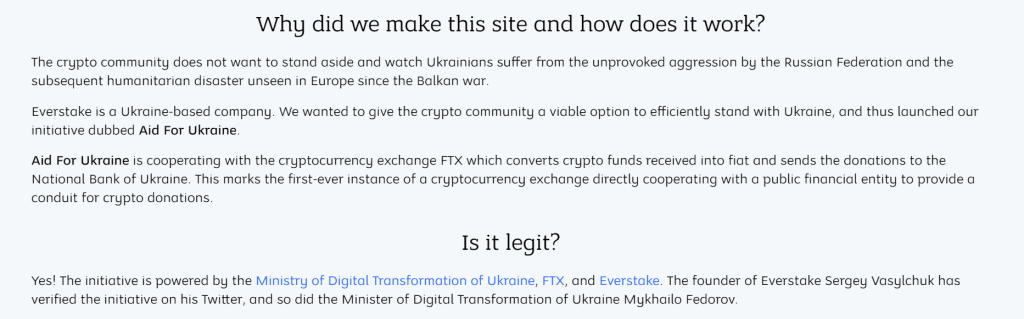
The partnership between FTX and the Ukrainian government was first publicized on March 14th when the leading cryptocurrency website CoinDesk announced Kiev had launched a dedicated webpage for cryptocurrency donations dubbed Aid for Ukraine.

Under its auspices, FTX pledged to “convert crypto contributions to Ukraine’s war effort into fiat for deposit” at the National Bank of Kiev, allowing the embattled government to “turn bitcoin into bullets, bandages and other war materiel.” CoinDesk stated the initiative “deepens an unprecedented tie-up between public and private sector forces in crypto.” 

Oleksandr Bornyakov, an official at Ukraine’s Ministry of Digital Transformation, hinted to CoinDesk about an “upcoming NFT collection” auction to “give the next boost to the crypto fundraising process.”

(Bornyakov’s Ministry of Digital Transformation played a key role in the successful, Zelensky-led campaign to cancel The Grayzone’s Max Blumenthal and Aaron Mate’s appearance at Web Summit, a major international gathering of the tech industry in Lisbon, Portugal). 

In a press release accompanying the announcement of the FTX partnership with Ukraine, Bankman-Fried explained that, “at the onset of the conflict in Ukraine, FTX felt the need to provide assistance in any way it could.” He promised that the arrangement provided “the ability to deliver aid and resources to the people who need it most.”

Kiev disappears Aid for Ukraine site days before FTX scandal goes public

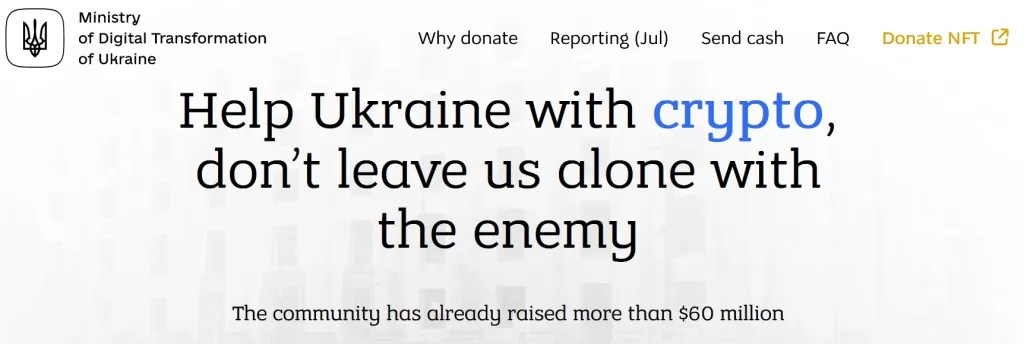
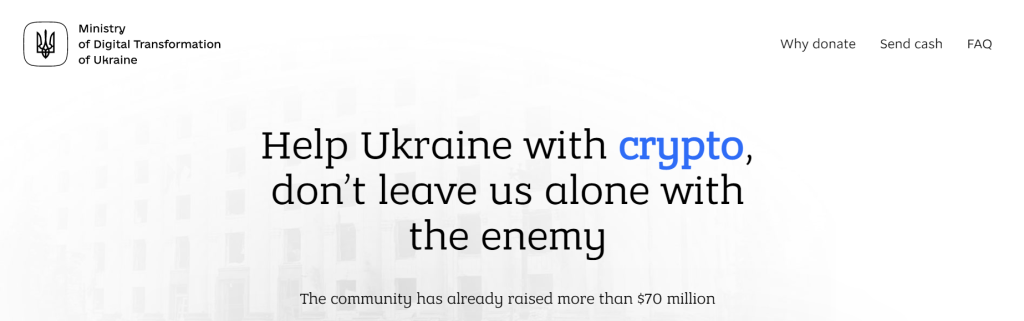
The Aid for Ukraine webpage has now been deleted, but can still be accessed via the Internet Archive. Until very recently, it encouraged visitors to “help Ukraine with crypto” and pleaded, “don’t leave us alone with the enemy.” 

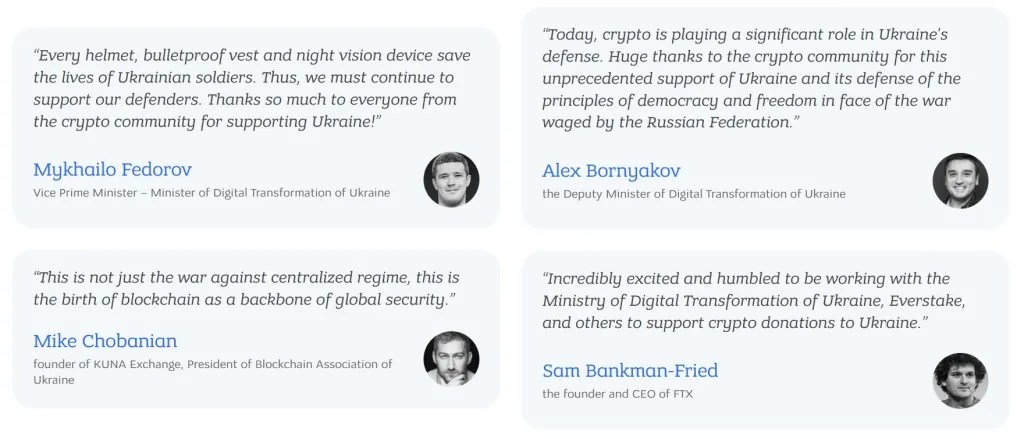
The site featured promotional quotes from an assortment of Ukrainian government officials and bitcoin bros – among them, FTX’s founder.

Mykhailo Fedorov, Ukraine’s deputy Prime Minister, and Minister of Digital Transformation of Ukraine, thanked “the crypto community” for funding the purchase of helmets, bulletproof vests, and night vision devices. For his part, Bankman-Fried declared himself “incredibly excited and humbled” to “support crypto donations to Ukraine.”

The last available Internet Archive capture of Aid for Ukraine” took place on the afternoon of October 26th. Throughout the webpage’s existence, the Internet Archive captured multiple snapshots of it weekly. This clearly indicates the page was purged by Kiev in late October, several days before the FTX crisis initially broke out.

Once it was deleted, the Ukrainian government created a standalone website on November 1st to promote the endeavor. The page was identical, and quotes from Bankman-Fried, and references to FTX’s involvement and its logo, remained in place until the morning of November 15th.

Was the original webpage’s dumping and erasure, and the shift to a totally new interface, at that time merely a spooky coincidence, or were the Ukrainians warned of what was coming? What did Kiev know, and when did it know it?

Bankman-Fried channeled millions to Biden through “stealth” PAC

Though FTX has been accused of serving as a money laundering vehicle for the US Democratic Party, concrete evidence supporting this claim has yet to materialize. But given Bankman-Fried’s background as one of the most prolific donors to the Democrats, and the role he played as a nexus between party power-brokers and the cryptocurrency sphere, the allegations are understandable. 

Bankman-Fried is the son of Stanford law professor Barbara Friedman, founder of a shadowy Super PAC called Mind the Gap which quietly channeled millions to Democratic party candidates, primarily from nameless Silicon Valley investors. 

The organization has no website or social media footprint, and its founders do not advertise their involvement publicly. Chosen through complex data analysis, beneficiaries of the Super PAC often have no idea themselves who or what has donated to their campaigns.

“The raison d’être is stealth,” an individual “with ties to the organization” told Vox back in 2020.

Bankman-Fried establishment of FTX in April 2019 – the same month Joe Biden announced his 2020 Presidential run – has added to the intrigue surrounding the scandal. Once vast sums started flowing into and through the FTX exchange, its founder channeled profits into Biden’s campaign coffers. Oddly, Bankman-Fried had no prior history of political giving.

Throughout the 2020 campaign, Bankman-Fried gifted over $5 million to Biden and groups supporting him. This reportedly helped fuel a potentially decisive “nine-figure, eleventh-hour blitz of TV advertising” targeting swing states, and made the crypto bro the second-largest donor to the president, right behind Michael Bloomberg.

Bankman-Fried claimed this wellspring of generosity was “motivated less by specific issues than by the Biden team’s ‘generic stability and decision-making process.’” Such an apparent lack of enthusiasm for the President stands at odds with the staggering sums he has pumped into Democratic party coffers ever since. 

In 2022 alone, Bankman-Fried lavished almost $40 million on Democratic candidates, campaigns, and PACs. The giving spree made him the second-largest individual donor to Democratic causes, behind liberal venture capitalist George Soros. 

More recently, Bankman-Fried pledged to donate a staggering $1 billion between this year and 2024 to ensure a Democratic victory in the next presidential vote. On October 14th, however, he completely backtracked, branding the investment a “dumb” move. Something scandalous was brewing behind the scenes.

One week later, the Texas State Securities Board announced it was investigating FTX on suspicion of selling unregistered securities. The development went largely unnoticed by the media. To the extent it generated any interest at all, it was framed as just one of several examples of financial authorities scrutinizing crypto players.

What happened to the $60 million raised by Aid for Ukraine?

If FTX was indeed laundering funds for the proxy war in Ukraine, the slightest indication that regulators were investigating its operations would have triggered alarm bells throughout Washington – and by extension, Kiev. This may be why the Ukrainian government switched the Aid for Ukraine webpage with a dedicated website, and scrubbed the original entirely from the internet just days after the announcement.

Also curious are the Internet Archive captures of the Aid for Ukraine website that show records of funds purportedly flowing to Kiev via Bitcoin had not been updated since July. At the time, the webpage reported that over $60 million had been raised by the “community.” This figure is reflected on the updated standalone Aid for Ukraine fundraising site.

A breakdown of spending on the new Aid for Ukraine website states Kiev had spent a total of $54,573,622 in cryptocurrency donations by July 7th on a wide variety of equipment, vehicles, drones, “lethal equipment” and other resources. One of the biggest single expenditures was $5,250,519 on a “worldwide anti-war media campaign,” the details of which would only “be published after our victory” due to “security reasons.”

Ukrainian government officials and private sector actors involved in the operation of Aid for Ukraine have scoffed at suggestions of impropriety regarding its use, but have only raised further questions with their denials.

Oleksandr Bornyakov of Ukraine’s Ministry of Digital Transformation declared that Aid for Ukraine simply used FTX to “convert donations into fiat in March.” The CEO of Everstake, the “validator” company that in theory guaranteed crypto funds donated via Aid for Ukraine reached Kiev’s Ministry of Defense, also thanked “every crypto holder for donating…in those early day [sic], when every cent and every minute was crucial.” 

Taken in tandem, these comments suggest Aid for Ukraine was set up purely to receive donations in the initial stages of the war, and the $60 million figure represents sums received and converted in the weeks immediately following the launch of the initiative. This interpretation is reinforced by an Everstake staffer’s presentation at a cryptocurrency conference at Web Summit on November 1st, on the subject of “raising [over] $60m in crypto for Ukraine.”

But an Internet Archive capture of Aid for Ukraine on April 1st adds to the confusion, showing that two-and-a-half-weeks after the initiative launched, the webpage was updated to claim “over $70 million” had been raised from crypto donors. This was revised down to “over $60 million” five days later. 

More strangely, Aid for Ukraine records show that from the time of the initiative’s launch to April 14th, a total of $45,103,538 was spent. This means just $9,470,084 was spent between April 14 and July 7th, a period in which the war developed into a “bloody war of attrition” according to The Guardian.

This leaves a gap of at least $5.5 million in the money Aid for Ukraine claimed to have raised in its initial weeks, and the funds it says it distributed in Ukraine. 

The disparity was confirmed in a tweet by the official Aid for Ukraine Twitter account, posted on the evening of November 15th, which stated that “out of $60 million received, $54 million have already been spent on Ukraine’s humanitarian and military needs.” 

This implies that no further funds of any size were received after early April, and the total has remained static ever since, despite the resource being open for donations. Which would be highly unusual.

The government of Ukraine, FTX, and Everstake all now have serious questions to answer. Namely, why the funds purportedly raised appear to have decreased in a span of a few days, why no donations have been received since then on the Aid for Ukraine webpage or its new website, how much has been donated since the alleged initial influx, and where did the rest of the money go?

Ukraine: a black hole for Western aid

Stories of potential financial impropriety by Ukrainian officials and the country’s military are invariably ignored or outright buried by the Western media. An August exposé by the Kyiv Independent documented wide-ranging abuses by the leadership of a wing of the International Legion, including sexual harassment, looting, threatening soldiers at gunpoint and sending them unprepared on reckless missions. Though the Kyiv Independent often influences Western media’s coverage of the Ukraine conflict, this story was completely ignored in mainstream quarters.

That same month, CBS broadcast an investigative feature revealing that only 30 percent of Western arm shipments to Ukraine ever reach the frontline. Due to intense backlash from the Pentagon and other powerful sources, CBS temporarily pulled its own documentary and an accompanying promotional trailer and article from the web. The feature has since been “updated” to claim that “the situation has significantly improved” since filming, and “a much larger quantity now gets where it’s supposed to go.”

When it comes to Ukraine, Democrats at the highest levels are also immensely skilled at burying embarrassing stories. In December 2015, Joe Biden coerced Kiev’s then-leader Petro Poroshenko into firing prosecutor general Viktor Shokin as a condition for the US underwriting a $1 billion IMF loan to Ukraine.

“I’m going to be leaving here in six hours. If [Shokin] is not fired, you’re not getting the money,” Biden threatened. 

With Shokin’s firing, the experienced lawyer’s ongoing probe into the energy giant Burisma ended as well. Which meant that Burisma’s most famous board member, Hunter Biden, the son of then-US Vice President’s son, eluded official scrutiny. 

Now, a politically connected crypto-billionaire who used a secret financial “back door” to fleece customers of ungodly sums of money has become the latest character in the saga of shady US aid to Ukraine. And though the collapse of his FTX firm is front page news, mainstream outlets are studiously avoiding the Ukraine angle.

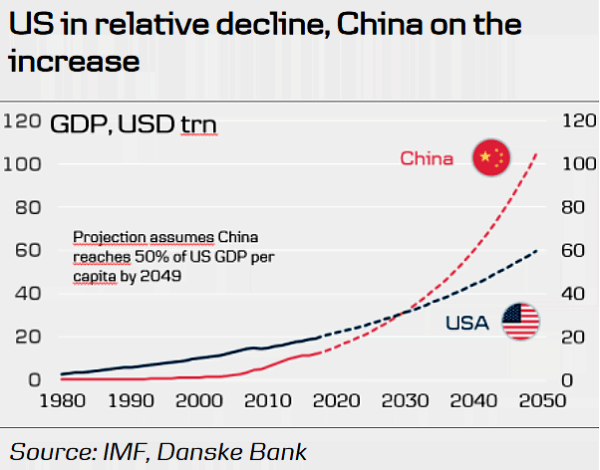
The One Chart That Explains Everything

Look at the chart above. The chart explains everything.

By Mike Whitney

Source: The Unz Review

It explains why Washington is so worried about China’s explosive growth. It explains why the US continues to hector China on the issues of Taiwan and the South China Sea. It explains why Washington sends congressional delegations to Taiwan in defiance of Beijing’s explicit requests. It explains why the Pentagon continues to send US warships through the Taiwan Strait and ship massive amounts of lethal weaponry to Taipei. It explains why Washington is creating anti-China coalitions in Asia that are aimed at encircling and provoking Beijing. It explains why the Biden administration is stepping up its trade war on China, imposing onerous economic sanctions on its businesses, and banning critical high-tech semi-conductors that are “are essential not just… for virtually every aspect of modern society, from electronic products and transport to the design and production of all manner of goods.” It explains why China has been singled-out in the US National Security Strategy (NSS) as “the only competitor with both the intent and, increasingly, the capability to reshape the international order.” It explains why Washington now regards China as its biggest and most formidable strategic adversary that must be isolated, demonized and defeated.

The chart above explains everything, not just the hostile diplomatic jabs that are designed to discredit and humiliate China, but also the openly belligerent policies that are aimed at Russia as well. People need to understand this. They need to see what is really going on so they can put events in their proper geopolitical context.

And what “context” is that?

The context of a Third World War; a war that was thoroughly-planned, instigated and (now) prosecuted by Washington and Washington’s proxies. That’s what’s really going on. The increasingly violent conflagrations we see cropping-up in Ukraine and Asia are not the result of “Russian aggression” or “evil Putin”. No. They are the actualization of a sinister geopolitical strategy to quash China’s meteoric rise and preserve America’s dominant role in the world order. Can there be any doubt about that?

No. None.

This is why we are experiencing the redivision of the world into warring blocs. This is why we are seeing the roll back of 30 years of Globalization and massive suppyline disruption. And this is why Europe has been thrust headlong into frigid darkness and forced deindustrialisation. All of these suicidal policies were concocted for one purpose and one purpose alone, to maintain America’s exalted spot in the global system. That is why all of humanity is presently embroiled in a Third World War; a war that is designed to prevent China from becoming the world’s biggest economy; a war that is designed to preserve US global primacy. Check out this excerpt from an article at the World Socialist Web Site:

An October 19 Financial Times article by Edward Luce, entitled “Containing China is Biden’s explicit goal,” sounded the following alarm: “Imagine that a superpower declared war on a great power and nobody noticed. Joe Biden this month launched a full-blown economic war on China—all but committing the US to stopping its rise—and for the most part, Americans did not react.

“To be sure, there is Russia’s war on Ukraine and inflation at home to preoccupy attention. But history is likely to record Biden’s move as the moment when US-China rivalry came out of the closet.”

Moreover, last week, a top Biden administration official indicated that the US was preparing new bans on China in key hi-tech areas. Speaking at the Center for a New American Security, Alan Estevez, the under-secretary of Commerce for Industry and Security, was asked if the US would ban China from accessing quantum information science, biotechnology, artificial intelligence software or advanced algorithms. Estevez admitted that this was already being actively discussed. “Will we end up doing something in those areas? If I was a betting person, I would put down money on that,” he said….

Luce concluded his Financial Times article cited above by declaring: “Will Biden’s gamble work? I’m not relishing the prospect of finding out. For better or worse, the world has just changed with a whimper not a bang. Let us hope it stays that way.”…(“Biden’s technology war against China”, World Socialist Web Site)

Once again, look at the chart. What does it tell you?

The first thing it tells you is that the hostilities we see in Ukraine (and eventually Taiwan), can be traced back to a fundamental shift in the global economy. China is growing stronger. It’s on a path to overtake the United States economy within the decade. And with growth, come certain benefits. As the world’s biggest economy, China will naturally become Asia’s regional hegemon. And, as Asia’s regional hegemon it will be able “to settle regional disputes in its own favor and to de-legitimize U.S. regional and global leadership.”

Can you see the problem here?

For nearly two decades, the US has oriented its foreign policy around a “rebalancing of forces” strategy called the “pivot to Asia”. In short, the US intends to be the dominant player in the world’s most populous and prosperous region, Asia. Can you see how China’s rise derails Washington’s plan for the future?

The United States is not going to let this happen without a fight. Washington is not going to let China muscle-it-out of the markets that it plans to dominate. That’s not going to happen. And if you think that’s going to happen, you’d better think again. The United States will go to war to avoid a scenario in which the US plays “second fiddle” to China. In fact, the foreign policy establishment has already decided that the US will engage China militarily for that very objective.

So, our thesis is simple; we think WW3 has already begun. That’s all we’re saying. The ructions we see in Ukraine are merely the first salvo in a Third World War that has already triggered an unprecedented energy crisis, massive worldwide food insecurity, a catastrophic break-down in global supply lines, widespread and out-of-control inflation, the steady reemergence of extreme nationalism, and the redivision of the world into warring blocs. What more proof do you need?

And it’s all economic. The origins of this conflict can all be traced back to the seismic changes in the global economy, the rise of China and the unavoidable decline of the United States. It is a case of one empire replacing the other. Naturally, a transition of this magnitude is going to generate tectonic changes in global distribution of power. And along with those changes will come more flashpoints, more devastation, and the looming prospect of nuclear war. And this is precisely how things are playing out.

So, how does the chart explain what is happening in Ukraine?

Washington’s proxy war in Ukraine is actually aimed at China not Russia. Russia is not a peer competitor and Russia does not have the economic wherewithal to displace the United States in the global order. NordStream, however, did pose a significant risk to the US by greatly strengthening Moscow’s economic relations with the EU and particularly with Europe’s industrial powerhouse, Germany. The Moscow-Berlin alliance—which was mutually beneficial and key to German prosperity—had to be sabotaged to prevent further economic integration that would have drawn the continents closer together into the world’s biggest free trade zone. Washington had to stop that in order to preserve its economic stranglehold on Europe and defend the dollar as the world’s reserve currency. Even so, no one expected the US to blow up the pipeline itself in—what appears to be—the greatest act of industrial terrorism in history. That was truly shocking.

In essence, Washington sees Russia as an obstacle to its “pivot” plan to encircle, isolate and weaken China. But Russia is not the greatest threat to US global primacy; not even close. That designation belongs to China.

The Third World War is being waged to contain China not Russia. What the war in Ukraine suggests is that—among foreign policy elites—there is general agreement that, The road to Beijing goes through Moscow. That appears to be the consensus view. In other words, US powerbrokers want to weaken Russia in order to spread US military bases across Asia. Ultimately, the military will be called upon to enforce Washington’s economic rule over its new Asian subjects. If that day ever comes.

We think it is extremely unlikely that Washington’s ambitious plan will succeed, but we have no doubt that it will be implemented all the same. Tens of millions of people are likely to die in a desperate attempt to turn-back the clock to the fleeting ‘unipolar moment’ and the equally short-lived American Century. It is a tragedy beyond comprehension.

IN THE CULTURE OF HUNGRY GHOSTS

By Dylan Charles

Source: Waking Times

“No society can understand itself without looking at its shadow side.” ― Gabor Maté, In the Realm of Hungry Ghosts: Close Encounters with Addiction

Something wicked bubbles just beneath the surface of the collective conscience. Our society is rife with corruption, predation, perversion, over-consumption, violence, addiction and so much more. Somehow enough is never enough, as if the driving force behind human existence is pure want.

This is not true, though, for we know that spiritually well beings are content beings, looking no further than the present moment’s blessings for satisfaction. We don’t have an inherent need for want. Want is a symptom, not the condition. It’s something that enters when the spirit is untended to.

It must then be a spiritual illness which plagues society. Something secretly driving so many of us mad with insatiable desire for sensation and objects. Unforgiving cravings that manifest in any way imaginable, from sex, to money, to food, to power and even in the need to be perfect. It’s a war against the self, waged unconsciously by the self. A below subconscious campaign of self-annihilation.

There are no contemporary metaphors to understand this kind of emptiness. The void just is. And since the void is so rarely acknowledged and so rarely looked at deeply, it sits in the shadows driving us mad, steering with impulse.

In Chinese Buddhist philosophy, though, there is a story that fits. The hungry ghost.

“In Chinese Buddhist teachings, “hungry ghosts are unable to take in or assimilate what they desperately need. The problem lies in their constricted throats — which cannot open for nourishment. They wander aimlessly in search of relief that is not forthcoming.”” [Source]

Interestingly, according to some of its origin myths, the hungry ghost was born out an act of cruelty. In many of the stories, it is a wealthy man’s wife who did some terrible thing to a monk, and when she eventually dies her spirit takes the form of the hungry ghost, forever lurking in purgatory, unable to ever fill its distorted belly and therefore always needing and wanting more.

The hungry ghost, then, is an expression of karma.

Hungry ghosts are the demon-like creatures described in Buddhist, Taoist, Hindu, Sikh, and Jain texts as the remnants of the dead who are afflicted with insatiable desire, hunger or thirst as a result of bad deeds or evil intent carried out in their life times. [Source]

In the realm of hungry ghosts, a deep drama between the ego and the ghost plays out ad infinitum. It’s an interplay that feeds the ego just enough for it to survive, so that in turn the ego can feed the hungry ghost. A dead-end cul-de-sac of sorts. A looping projection of one of our worst human vulnerabilities.

“The work of the ghost does not want to completely destroy its prey. Having fed off the other through dissociative trajectories of turbulence, the ego again becomes more robust. The hungry ghost now has, as companion and source of nurture, a replenished ego on which internal feeding may resume inside the space of erasure until the plenitude of the ghost-within again permeates the intersubjective.” ~  Nick Totton, Psychoanalysis and the Paranormal: Lands of Darkness

Spiritually healthy people understand their cravings for what they, expressions of innumerable forms of pain. Manifestations of the suffering caused by disconnection from the self, and from nature. And the self is nature. There really is no distinction between the two. The illusion is of separateness.

The ghosts are there to remind us that our real work is transmuting our suffering and cruelty into resilience and compassion. It’s not enough to numb the pain, it must be used to our advantage, for our growth, to serve as a catalyst for transformation, and to provide a chrysalis in which the transformation can take place.

“We are social beings. When we feel disconnected or alienated, we experience pain. Addiction, depression, anger, and violence are different ways we react to pain. To heal our society we must heal the emotional wounds.” ~Chris Agnos

Few understand this more clearly than Dr. Gabor Maté, whose work with drug addicts has transformed our understanding of what it means to be stuck in the realm of hungry ghosts.

War Without End

What is wrong with the United States of America?

By Philip Giraldi

Source: The Unz Review

Prussian Major General Carl von Clausewitz famously drew on his own experience in the Napoleonic Wars to examine war as a political phenomenon. In his 1832 book “On War” he provided a frequently quoted pithy summary of war versus peace, writing in terms of politico-military strategy that “War is a mere continuation of politics by other means.” In other words, war-making is a tool provided to statesmen to achieve a nation’s political objectives when all else fails.

One can reject the ultimate amorality of Clausewitz’s thinking about war while also recognizing that some nations have historically speaking exploited war-making as a tool for physical expansion and the appropriation of foreigners’ resources. As far back as the Roman Republic, the country’s elected leaders doubled as heads of its consular armies, which were expected to go out each spring to expand the imperium. More recently, Britain notably engaged in almost constant colonial wars over the course of centuries to establish what was to become history’s largest empire.

America’s dominant neocons characteristically believe they have inherited the mantle of empire and of the war powers that go hand-in-hand with that attribute, but they have avoided other aspects of the transition in turning the United States into a nation made and empowered by war. First of all, what comes out the other end after one has initiated hostilities with another country is unpredictable. Starting with Korea and continuing with Vietnam, Afghanistan, Iraq as well as other minor operations in Latin America, Africa and Asia, American war-making has brought nothing but grief on those on the receiving end with little positive to show for the death, destruction and accumulated debt. Also forgotten in the rush to use force is the raison d’etre to have a federal national government at all, which is to bring tangible benefit to the American people. There has been none of that since 9/11 and even before, while Washington’s hard-line stance on what has become a proxy war against Russia over Ukraine promises more pain – perhaps disastrously so – and no real gain.

If one has any doubt that going to war has become the principal function of both Democrats and Republicans in Washington, it is only necessary to consider several stories that have appeared in the past several weeks. The first comes from the Republican side, and it includes a possibly positive development. House Minority leader Republican Kevin McCarthy warned two weeks ago that the GOP will not necessarily continue to write a “blank check” for Ukraine if they obtain the House majority in next month’s election, reflecting his party’s growing skepticism about unlimited financial support for the corrupt regime in place in Kiev. McCarthy explained “I think people are gonna be sitting in a recession and they’re not going to write a blank check to Ukraine. They just won’t do it. … It’s not a free blank check.”

America’s uncritical support for Ukraine, which has been a contrivance by the White House and media since the fighting started, has led to a growing number of Republicans, particularly some of those aligned with Donald Trump’s “America First” approach, to challenge the need for massive federal spending abroad at a time of record-high inflation at home. Since Russia launched its invasion in February, Congress has approved tens of billions in emergency security and humanitarian assistance for Ukraine, while the Biden administration has shipped billions more worth of weapons and equipment from military inventories, all done with only limited or even no oversight of where the money and weapons are winding up.

But, unfortunately, the GOP is far from unified on its approach to Ukraine-Russia. Congressman Liz Cheney demonstrated that her apple did not fall far from her father’s tree, taking some time off from trying to hang Donald Trump to denounce what she refers to as the “Putin wing of the Republican Party.” She put it this way: “You know, the Republican Party is the party of Reagan, the party that essentially won the Cold War. And you look now at what I think is really a growing Putin wing of the Republican Party.”

Cheney criticized Fox News for “running propaganda” on the issue and in particular called out Fox host Tucker Carlson as “the biggest propagandist for Putin on that network… You really have to ask yourself, whose side is Fox on in this battle? And how could it be that you have a wing of the Republican Party that thinks that America would be standing with Putin as he conducts that brutal invasion of Ukraine?”

Cheney notably did not address the issue of how the war developed in the first place because the US and UK preferred saber rattling to diplomacy with Moscow. Or why the United States feels compelled to tip-toe to the brink of a possible nuclear war over a foreign policy issue that is of no real national interest to the American people. And where did she make her comments? At the McCain Institute in Arizona. Yes, that’s a legacy of Senator John McCain another Republican who never saw a war he couldn’t enthusiastically support.

Both President Joe Biden and Speaker of the House Nancy Pelosi have confirmed that the US is in with Ukraine until “victory” is obtained, whatever that is supposed to mean, while other Administration officials have indicated that the actual purpose of the fighting is to weaken Russia and remove President Putin. White House press secretary Karine Jean-Pierre glibly spouted the party line when asked about McCarthy’s comments. She thanked congressional leaders for bipartisan work to “support Ukraine to defend itself from Russia’s war crimes and atrocities,” adding that “We will continue to work with Congress and continue to monitor those conversations on these efforts and support Ukraine as long as it takes. We are going to keep that promise that we’re making to the brave Ukrainians who are fighting every day, to fight for their freedom and their democracy.”

Perhaps more bizarre than Cheney’s comments is the tale of a letter that was prepared by thirty Democratic Party progressives urging US support for negotiations to end the fighting in Ukraine. The letter was prepared in June but not released until last week before being quickly retracted under pressure on the following day. Pramila Jayapal, who heads the Congressional Progressive Caucus, said it was retracted because it “was being conflated with [the] comments” made by McCarthy over his warning about budget cutting for Ukraine. Jayapal referred to the letter as a “distraction,” but what she really meant was that her group had no desire to make common cause with the Republicans over any issue, including war and peace in an escalating conflict that is manifestly pointless.

A clueless Jayapal also took pains to contradict the message put out by her own group, emphasizing that there has been no opposition to the administration’s Ukraine policy from Democrats in Congress. She said Democrats “have strongly and unanimously supported and voted for every package of military, strategic, and economic assistance to the Ukrainian people.” She doubled down on the White House message, affirming that the war in Ukraine will only end with diplomacy after “a Ukrainian victory.”

So basically, anyone talking sense about Ukraine in Washington is being shut down by forces within the political parties themselves working together with a compliant national media that is mis-representing everything that is taking place on the ground. It is a formula for tragedy as the Biden administration has shown no sign of seeking diplomacy with Russia to end the conflict despite the president’s recent surprising warning that the world is now facing the highest risk of nuclear “Armageddon,” which he, of course, blames on Putin. Given all of that, in my humble opinion a government that is unable or unwilling to take reasonable steps to protect its own citizens while also avoiding a possible nuclear catastrophe that could end up engulfing the entire world is fundamentally evil and has lost all legitimacy. It should recognize that fact before submitting its resignation.

Researchers Find Massive Anti-Russian ‘Bot Army’

By Peter Cronau

Source: Consortium News

A team of researchers at the University of Adelaide have found that as many as 80 percent of tweets about the 2022 Russia-Ukraine invasion in its early weeks were part of a covert propaganda campaign originating from automated fake “bot” accounts.

An anti-Russia propaganda campaign originating from a “bot army” of phony automated Twitter accounts flooded the internet at the start of the war.

The research shows that of the more than 5 million tweets studied, 90.2 percent (both bot and non-bot) came from accounts that were pro-Ukraine, with fewer than 7 percent of the accounts being classed as pro-Russian.

The university researchers also found these automated tweets had been purposely used to drive up fear amongst people targeted by them, boosting a high level of statistically measurable “angst” in the online discourse.

The research team analysed a massively unprecedented 5,203,746 tweets, sent with key hashtags, in the first two weeks of the Russian invasion of Ukraine from Feb. 24. The researchers looked at predominately English-language accounts. A calculated 1.8 million unique Twitter accounts in the dataset posted at least one English-language tweet.

The results were published in August in a research paper, titled “#IStandWithPutin versus #IStandWithUkraine: The interaction of bots and humans in discussion of the Russia/Ukraine war,” by the University of Adelaide’s School of Mathematical Science.

The size of the sample under study, of over 5-million tweets, dwarfs other recent studies of covert propaganda in social media surrounding the Ukraine war. 

The little-reported Stanford University/Graphika research on Western disinformation, analysed by Declassified Australia in September, examined just under 300,000 tweets from 146 Twitter accounts.

The Meta/Facebook research on Russian disinformation reported widely by mainstream media, including by the Australian Broadcasting Corporation (ABC) a fortnight later, looked at only 1,600 Facebook accounts.

Reports on the new research have appeared in only a few independent media sites, and on Russia’s RT.  The ground-breaking study exposing a massive anti-Russia social media disinformation campaign has been effectively ignored by Western establishment media, showing how stories that don’t fit the desired pro-Western narrative are routinely buried. 

Disinformation Blitz Krieg

The Adelaide University researchers unearthed a massive organised pro-Ukraine influence operation underway from the early stages of the conflict. Overall, the study found automated “bot” accounts to be the source of between 60 to 80 percent of all tweets in the dataset. 

The published data shows that in the first week of the Ukraine-Russia war there was a huge mass of pro-Ukrainian hashtag bot activity. Approximately 3.5 million tweets using the hashtag #IStandWithUkraine were sent by bots in that first week. 

In fact, it was like someone had flicked a switch at the start of the war as pro-Ukraine bot activity suddenly burst into life. In that first day of the war the #IStandWithUkraine hashtag was used in as many as 38,000 tweets each hour, rising to 50,000 tweets an hour by day three of the war. 

By comparison, the data shows that in the first week there was an almost total absence of pro-Russian bot activity using the key hashtags. During that first week of the invasion, pro-Russian bots were sending off tweets using the #IStandWithPutin or #IStandWithRussia hashtags at a rate of only several hundred per hour.

Given the apparent long-range planning for the invasion of Ukraine, cyber experts expressed surprise that Russian cyber and internet responses were so laggard. A researcher at the Centre for Security Studies in Switzerland, said: “The [pro-Russian] cyber operations we have seen do not show long preparation, and instead look rather haphazard.”

After being apparently left flatfooted, the #IStandWithPutin hashtag mainly from automated bots, eventually fired up a week after the start of the war. That hashtag started appearing in higher numbers on  March 2, day 7 of the war. It reached 10,000 tweets per hour just twice over the next two days, still way behind the pro-Ukraine tweeting activity. 

The #IStandWithRussia hashtag use was even smaller, reaching only 4,000 tweets per hour. After just two days of operation, the pro-Russian hashtag activity had dropped away almost completely. The study’s researchers noted the automated bot accounts “likely used by Russian authorities,” were “removed likely by pro-Ukrainian authorities.”

The reaction against these pro-Russian accounts had been swift. On March 5, after the #IStandWithPutin hashtag had trended on Twitter, the company announced it had banned over 100 accounts using the hashtag for violating its “platform manipulation and spam policy” and participating in “coordinated inauthentic behaviour.”

Later that month, the Ukraine Security Service (SBU) reportedly raided five “bot farms”’ operating inside the country. The Russia-linked bot operators were reportedly operating through 100,000 fake social media accounts spreading disinformation that was “intended to inspire panic among Ukrainian masses.”

Ukrainian security forces unearthed a pro-Russian automated “bot army” operating out of an apartment in March 2022. The raid found 100 sets of GSM-gateways, left, and 10,000 sim cards, right, operating 100,000 fake bot accounts. (SBU)

Unfiltered Research

The landmark Adelaide University research differs from these earlier revelations in another most unique and spectacular way. 

While the Stanford-Graphika and Meta research was produced by researchers who have long-term deep ties to the U.S. national security state, the Adelaide University researchers are remarkably independent. The academic team is from the university’s School of Mathematical Science.

Using mathematical calculations, they set out to predict and model people’s psychological traits based on their digital footprint.

Unlike the datasets selected and provided for the Stanford/Graphika and the Meta research, the data the Adelaide University team accessed did not come from accounts that had been detected for breaching guidelines and shut down by Meta or Twitter. 

Joshua Watt is one of the lead researchers on the university team, and is a Master of Philosophy candidate in applied mathematics.

He told Declassified Australia that the dataset of 5 million tweets was accessed directly by the team from Twitter accounts on the internet using an academic license giving access to the Twitter API.

The “Application Programming Interface” is a data communication software tool that allows researchers to directly retrieve and analyse Twitter data.

The fake tweets and automated bot accounts had not been detected and removed by Twitter before being analysed by the researchers, although some were possibly removed in Twitter’s March sweep.

Watt told Declassified Australia that in fact many of the bot accounts behind the 5 million tweets studied are likely to be still up and running.

Declassified Australia contacted Twitter to ask what action they may have taken to remove the fake bot accounts identified in the University of Adelaide research. They had not responded by the time of going to press.

Critical Tool in Info War

This new research paper confirms mounting fears that social media has covertly become what the researchers call “a critical tool in information warfare playing a large role in the Russian invasion of Ukraine.”

The Adelaide University researchers tried their best to be noncommittal in describing the activities of the fake Twitter accounts, although they had found the vast majority – over 90 percent – were anti-Russian messages. They stated: “Both sides in the Ukrainian conflict use the online information environment to influence geopolitical dynamics and sway public opinion.”

They found the two main participating sides in the propaganda war have their own particular goals and style. “Russian social media pushes narratives around their motivation, and Ukrainian social media aims to foster and maintain external support from Western countries, as well as promote their military efforts while undermining the perception of the Russian military.”

While the research findings concentrated on automated Twitter bots, there were also findings on the use of hashtags by non-bot tweeters. They found significant information flows from non-bot pro-Russian accounts, but no significant flows from non-bot pro-Ukraine accounts.

As well as being far more active, the pro-Ukraine side was found to be far more advanced in its use of automated bots. The pro-Ukrainian side used more “astroturf bots” than the pro-Russians. Astroturf bots are hyper-active political bots that continuously follow many other accounts to increase followers of that account.

Social Media Role in Boosting Fear

Crucially, the University of Adelaide researchers also investigated the psychological influence the fake automated bot accounts had on the online conversation during those early weeks of the war. 

These conversations in a target audience may develop over time into support or opposition towards governments and policies – but they may also have more instant effects influencing the target audiences’ immediate decisions.

The study found that it was the tweets from the fake “bot” accounts that most drove an increase in conversations surrounding “angst” amongst people targeted by them. They found these automated bot accounts increased “the use of words in the angst category which contains words related to fear and worry, such as ‘shame,’ ‘terrorist,’ ‘threat, ‘panic.’”

By combining the “angst” messaging with messages about “motion” and geographical locations, the researchers found “the bot accounts are influencing more discussion surrounding moving/fleeing/going or staying.” The researchers believe this effect may well have been to influence Ukrainians even away from the conflict zones to flee from their homes.

The research shows that fake automated social media “bot” accounts do manipulate public opinion by shaping the discourse, sometimes in very specific ways. The results provide a chilling indication of the very real malign effects that mass social media disinformation campaigns can have on an innocent civilian population. 

Origins of Twitter Bot Accounts

The researchers report that the overwhelming level of Twitter disinformation that was anti-Russian was from bots “likely [organised] by pro-Ukrainian authorities.”

The researchers asserted no further findings about the origin of the 5 million tweets, but did find that some bots “are pushing campaigns specific to certain countries [unnamed], and hence sharing content aligned with those timezones.” The data does show that the peak time for a selection of pro-Ukrainian bot activity occurred between 6pm and 9pm across U.S. time zones.

Some indication of the origin and the targeting of the messages could be deduced from the specific languages used in the 5 million tweets. Over 3.5 million tweets, or 67 percent, were in the English language, with fewer that 2 percent in Russian and Ukrainian. 

In May 2022, the National Security Agency (NSA) director and U.S. cyber command chief, General Paul Nakasone, revealed that the Cyber Command had been conducting offensive Information Operations in support of Ukraine.

“We’ve conducted a series of operations across the full spectrum: offensive, defensive, [and] information operations,” Nakasone said. 

Nakasone said the U.S. has been conducting operations aimed at dismantling Russian propaganda. He said the operations were lawful, conducted through policy determined by the U.S. Defense Department and with civilian oversight.

Nakasone said the U.S. seeks to tell the truth when conducting an information operation, unlike Russia.

U.S. Cyber Command had deployed to Ukraine a “hunt forward” cyber team in December to help shore up Ukraine’s cyber defences and networks against active threats in anticipation of the invasion.

A newly formed European Union cyber rapid response team consisting of 12 experts joined the Cyber Command team to look for active cyber threats inside Ukrainian networks and to strengthen the country’s cyber defences.

The U.S. has invested $40 million since 2017 in helping Ukraine buttress its information technology sector. According to U.S. Deputy Secretary of State Wendy Sherman, the investments have helped Ukrainians “keep their internet on and information flowing, even in the midst of a brutal Russian invasion.”

Wars & Lies in Our Pockets

With the rise of the internet, war and armed conflict will never be the same. Analysts have noted that the Russian invasion of Ukraine has ushered in a “new digital era of military, political and economic conflict” being manipulated by “laptop generals and bot armies.”

“In all dimensions of this conflict, digital technology plays a key role – as a tool for cyberattacks and digital protest, and as an accelerator for flows of information and disinformation,” wrote analysts at the Heinrich Boll Stiftung in Brussels. “Propaganda has been a part of war since the beginning of history, but never before could it be so widely spread beyond an actual conflict area and targeted to so many different audiences.”

Joshua Watt, one of the lead researchers on the University of Adelaide team that conducted the landmark study, summed it up: “In the past, wars have been primarily fought physically, with armies, air force and navy operations being the primary forms of combat. However, social media has created a new environment where public opinion can be manipulated at a very large scale.”

“CNN brought once-distant wars into our living rooms,” another analyst stated, “but TikTok and YouTube and Twitter have put them in our pockets.”

We are all carrying around with us a powerful source of information and news media – and also, most certainly, disinformation that’s coming relentlessly at us from influence operations run by “bad actors” whose aim is to deceive.