
Why Kim Dotcom Connects The DNC Email Leak To The Murder Of Seth Rich

By: b

Source: Moon of Alabama

Last week we learned a new fact about the DNC email leak in 2016 and of the events that likely led to the killing of Seth Rich.

A quite aggressive Wikipedia page discusses the Murder of Seth Rich:

The murder of Seth Rich occurred on July 10, 2016, at 4:20 a.m. in the Bloomingdale neighborhood of Washington, D.C. Rich died about an hour and a half after being shot twice in the back. The perpetrators were never apprehended; police suspected he had been the victim of an attempted robbery.

The 27-year-old Rich was an employee of the Democratic National Committee (DNC), and his murder spawned several right-wing conspiracy theories, including the false claim, contradicted by the law enforcement branches that investigated the murder, that Rich had been involved with the leaked DNC emails in 2016. It was also contradicted by the July 2018 indictment of 12 Russian military intelligence agents for hacking the e-mail accounts and networks of Democratic Party officials and by the U.S. intelligence community’s conclusion the leaked DNC emails were part of Russian interference in the 2016 United States elections. Fact-checking websites like PolitiFact, Snopes, and FactCheck.org stated that the theories were false and unfounded. The New York Times, the Los Angeles Times and The Washington Post wrote that the promotion of these conspiracy theories was an example of fake news.

Well, that is not what really had happened.

Yes, Seth Rich worked as IT administrator for the Democratic National Committee. He was a fan of Bernie Sanders. During the 2016 primaries DNC functionaries did their best to work against Bernie Sanders and for Hillary Clinton. To make that public Seth Rich collected an archive of all DNC emails, copied it onto an USB stick and looked for someone who would publish them.

UPDATE 20:00 UTC

The former British ambassador Craig Murray said that he was given the USB stick by an intermediary of a disgusted Democratic whistleblower and brought it from Washington DC to Wikileaks which eventually published the emails. The data involved were not only from the DNC but also from Clinton’s campaign chair John Podesta:

WikiLeaks made the DNC messages public in July and the incriminating emails from Podesta were published in October. The messages predominantly showed that DNC officials were bent on sabotaging the presidential campaign of Bernie Sanders in favor of Hillary Clinton. Murray insisted that the information was leaked and not hacked by Russia.

“Neither of the leaks came from the Russians. The source had legal access to the information. The documents came from inside leaks, not hacks…leakers were motivated by disgust at the corruption of the Clinton Foundation and the tilting of the primary election playing field against Bernie Sanders.”

/End Update/

Craig Murray did not mention Seth Rich. Up to last week we did not know if Seth Rich really made contact with Wikileaks.

But we did know that the DNC was never ‘hacked’ by anything Russia. The date/timestamps of the leaked files were consistent with local copying and inconsistent with an internet transfer. The company Crowdstrike which was hired to protect the DNC’s networks and which did an investigation into the case never observed an actual ‘Russian’ hack or any data exfiltration from the DNC network. As ITwire wrote in May 2020:

The controversial American security firm CrowdStrike, which was called in to investigate the alleged Russian hack of DNC servers in 2016, had no proof that any emails from the system had been exfiltrated despite public assertions that this had occurred, according to the transcript of an interview released by the US Government a few days ago.

The transcript was from an interview conducted with CrowdStrike’s president of services and chief security officer Shawn Henry by the US House Permanent Select Committee on Intelligence in December 2017, but only released to the US Special Counsel Robert Mueller who conducted a two-year inquiry into alleged Russian collusion in the 2016 presidential poll.

While the exfiltration of emails from the DNC server has been accepted as a proven fact, Henry’s answers to queries from committee members make it clear that this was definitely not the case.

In one typical exchange, Henry was asked, “What about the emails that everyone is so, you know, knowledgeable of? Were there also indicators that they were prepared but not evidence that they actually were exfiltrated?” To this Henry responded, “There’s not evidence that they were actually exfiltrated. There’s circumstantial evidence – but no evidence that they were actually exfiltrated.”

PolitiFact, Snopes and FactCheck.org are, unsurprisingly, wrong with their assertions.

But how did the emails find their way to Julian Assange at Wikileaks. Assange has never explained that. But Wikileaks set out a $20,000 reward for finding the killer of Seth Rich. That made it obvious that there was a connection between them but no one gave further explanations of it.

It took until last week for the world to learn more about what really happened. On April 21 some rather pungent NAFO activist, Pekka Kallionniemi, launched a Twitter thread with an attack on a person well known in IT circles:

Pekka Kallioniemi @P_Kallioniemi – 10:09 UTC · Apr 21, 2023

In today’s #vatniksoup, I’ll introduce a German-Finnish entrepreneur, conspiracy theorist and propagandist, Kim Dotcom. He’s best-known for his illegal online activities and projects, for his hate towards the US, and for his unwavering support for Putin’s imperialism.
1/18
[…]
In 2017, Dotcom claimed that he worked with Seth Rich, a US citizen and employee on the Democratic National Committee who was murdered during a suspected robbery.His death spawned..
10/18
[…]
..several conspiracy theories stating that he was a whistleblower who had leaked documents damning Hillary Clinton and her campaign manager, John Podesta. The hack-and-leak operation was actually conducted by Russian intelligence service GRU’s hacker group called Fancy Bear.
11/18

Who is Kim Dotcom you might ask:

Kim Dotcom (born Kim Schmitz; 21 January 1974), also known as Kimble and Kim Tim Jim Vestor, is a German-Finnish Internet entrepreneur and political activist who lives in Glenorchy, New Zealand.

Dotcom is the founder and former CEO of the defunct file hosting service Megaupload (2005–2012). In 2012, the United States Department of Justice seized its website and pressed charges against Dotcom, including criminal copyright infringement, money laundering, racketeering and wire fraud. Dotcom was residing in New Zealand at the time; at the request of US authorities, New Zealand police raided his home in 2012 and arrested him. Dotcom posted bail and has been going through legal proceedings ever since to avoid extradition to the United States.

In 2017, Dotcom played a role in spreading conspiracy theories about the murder of Seth Rich.

In May 2017 the Washington Post wrote:

When Seth Rich’s Gmail account received an alert this week from Mega.com, attempting to start a new account on a website created by the New Zealand-based Internet businessman and convicted hacker Kim Dotcom, his family knew that something was off.

Over seven frenzied days, Dotcom had become a leading purveyor of the theory that Rich, a staffer at the Democratic National Committee who was shot dead near his home in Northeast Washington last summer, had supplied DNC documents to WikiLeaks and was killed as a result. Multiple security analysts and an FBI investigation have tied the release to hackers with ties to Russia. D.C. police have said repeatedly that they think Rich was slain in a random robbery attempt.

According to experts and Rich’s family, the emailed invitation from welcome@mega.nz appeared to be an attempt to gain access to Rich’s email. Joel Rich, who monitors his late son’s Gmail account when new emails come in, did not click the link. Dotcom had not worked at Mega itself for years, but he was promising on Twitter to prove that the younger Rich had been in contact with WikiLeaks — and Fox News host Sean Hannity was telling his 2.37 million Twitter followers to be ready for a ­revelation.

Hannity had invited Dotcom to appear on his show for what he said on Twitter would be a “#GameChanger” interview. The implication: that Dotcom would finally offer evidence of his claim that Rich had sent internal DNC documents to WikiLeaks before his death.

All that began to unravel Tuesday afternoon when Fox News retracted a story that had claimed the same Rich-WikiLeaks connection, telling readers that the article was “not initially subjected to the high degree of editorial scrutiny we require for all our reporting.” Fox News did not respond to a request for comment, but Dotcom wrote on his website that he would not speak further about his allegations.

Since then little on the issue was heard from Kim Dotcom. There was no explanation why he was involved in the Seth Rich issue in the first place.

But after Pekka Kallionniemi’s attack was widely retweeted Kim Dotcom contested it:

Kim Dotcom @KimDotcom – 0:41 UTC · Apr 22, 2023

🧵 NAFO bullying exposed

I’m responding to an attempted character assassination by NAFO troll @P_Kallioniemi who prides himself with having attacked over 150 “pro-Russian actors and propagandists.”

His problem is that he picked the wrong guy for his cyber bullying.

Who is Pekka? A research fellow at Tampere University in Finland and a self-proclaimed disinformation expert. Ironic because most of the claims in his attack against me are false. I’m tagging the Dean of Tampere University @SaariJuho to make him aware of Pekka’s NAFO bullying.

First of all I’m in good company because some of the people Pekka has bullied on Twitter are @ggreenwald, @mtaibbi, @rustyrockets & @jimmy_dore. None are “Russian propagandists” or “grifters looking to make some easy money” as Pekka claims. They are truth-tellers, like myself.

False claim 1: Kim was deported from Thailand to Germany.<

Truth: I was never deported from Thailand. I left voluntarily.
[…]
False claim 6: Dotcom claimed that he worked with Seth Rich.

Truth: Seth Rich contacted me and offered information about the DNC. I rejected receiving the data personally and forwarded him to someone close to Wikileaks. That’s how Wikileaks got the DNC and Hillary Clinton leaks.

False claim 7: The (DNC) hack and leak operation was conducted by Russian intelligence.

Truth: A forensic analysis of the leaked DNC data by former US intelligence officials proved that it wasn’t remotely transferred. The meta data shows that the files were transferred locally.

The bold part is significant as it is first time that we learn:

  • That there was a direct connection between Seth Rich and Wikileaks.
  • Why Kim Dotcom had involved himself in the Seth Rich case after Rich had been killed.

You may say that the first claim is not new because many had presumed that. But no one involved had ever actually publicly made the claim. Dotcom’s assertion of this connection through him is new.

After contacting Kim Dotcom Seth Rich was pointed to someone else near to Wikileaks. Eventually Wikileaks asked Craig Murray to fly to DC and to bring the files to Wikileaks. The  Clinton server emails were published by Wikileaks in March 2016. The DNC emails were published in June and July 2016. The Podesta emails were published in October 2016.

I hope that Kim Dotcom will one day write down the complete sequence of events that are related to Seth Rich and the publishing of the Clinton, Podesta and DNC leaks by Wikileaks.

America’s empire is bankrupt

The dollar is finally being dethroned

Credit: JOEL PETT

By John Michael Greer

Source: UnHerd

Let’s start with the basics. Roughly 5% of the human race currently live in the United States of America. That very small fraction of humanity, until quite recently, enjoyed about a third of the world’s energy resources and manufactured products and about a quarter of its raw materials. This didn’t happen because nobody else wanted these things, or because the US manufactured and sold something so enticing that the rest of the world eagerly handed over its wealth in exchange. It happened because, as the dominant nation, the US imposed unbalanced patterns of exchange on the rest of the world, and these funnelled a disproportionate share of the planet’s wealth to itself.

There’s nothing new about this sort of arrangement. In its day, the British Empire controlled an even larger share of the planet’s wealth, and the Spanish Empire played a comparable role further back. Before then, there were other empires, though limits to transport technologies meant that their reach wasn’t as large. Nor, by the way, was any of this an invention of people with light-coloured skin. Mighty empires flourished in Asia and Africa when the peoples of Europe lived in thatched-roofed mud huts. Empires rise whenever a nation becomes powerful enough to dominate other nations and drain them of wealth. They’ve thrived as far back as records go and they’ll doubtless thrive for as long as human civilisations exist.

America’s empire came into being in the wake of the collapse of the British Empire, during the fratricidal European wars of the early 20th century. Throughout those bitter years, the role of global hegemon was up for grabs, and by 1930 or so it was pretty clear that Germany, the Soviet Union or the US would end up taking the prize. In the usual way, two contenders joined forces to squeeze out the third, and then the victors went at each other, carving out competing spheres of influence until one collapsed. When the Soviet Union imploded in 1991, the US emerged as the last empire standing.

Francis Fukuyama insisted in a 1989 essay that having won the top slot, the US was destined to stay there forever. He was, of course, wrong, but then he was a Hegelian and couldn’t help it. (If a follower of Hegel tells you the sky is blue, go look.) The ascendancy of one empire guarantees that other aspirants for the same status will begin sharpening their knives. They’ll get to use them, too, because empires invariably wreck themselves: over time, the economic and social consequences of empire destroy the conditions that make empire possible. That can happen quickly or slowly, depending on the mechanism that each empire uses to extract wealth from its subject nations.

The mechanism the US used for this latter purpose was ingenious but even more short-term than most. In simple terms, the US imposed a series of arrangements on most other nations that guaranteed the lion’s share of international trade would use US dollars as the medium of exchange, and saw to it that an ever-expanding share of world economic activity required international trade. (That’s what all that gabble about “globalisation” meant in practice.) This allowed the US government to manufacture dollars out of thin air by way of gargantuan budget deficits, so that US interests could use those dollars to buy up vast amounts of the world’s wealth. Since the excess dollars got scooped up by overseas central banks and business firms, which needed them for their own foreign trade, inflation stayed under control while the wealthy classes in the US profited mightily.

The problem with this scheme is the same difficulty faced by all Ponzi schemes, which is that, sooner or later, you run out of suckers to draw in. This happened not long after the turn of the millennium, and along with other factors — notably the peaking of global conventional petroleum production — it led to the financial crisis of 2008-2010. Since 2010 the US has been lurching from one crisis to another. This is not accidental. The wealth pump that kept the US at the top of the global pyramid has been sputtering as a growing number of nations have found ways to keep a larger share of their own wealth by expanding their domestic markets and raising the kind of trade barriers the US used before 1945 to build its own economy. The one question left is how soon the pump will start to fail altogether.

When Russia launched its invasion of Ukraine in February 2022, the US and its allies responded not with military force but with punitive economic sanctions, which were expected to cripple the Russian economy and force Russia to its knees. Apparently, nobody in Washington considered the possibility that other nations with an interest in undercutting the US empire might have something to say about that. Of course, that’s what happened. China, which has the largest economy on Earth in purchasing-power terms, extended a middle finger in the direction of Washington and upped its imports of Russian oil, gas, grain and other products. So did India, currently the third-largest economy on Earth in the same terms; as did more than 100 other countries.

Then there’s Iran, which most Americans are impressively stupid about. Iran is the 17th largest nation in the world, more than twice the size of Texas and even more richly stocked with oil and natural gas. It’s also a booming industrial power. It has a thriving automobile industry, for example, and builds and launches its own orbital satellites. It’s been dealing with severe US sanctions since not long after the Shah fell in 1978, so it’s a safe bet that the Iranian government and industrial sector know every imaginable trick for getting around those sanctions.

Right after the start of the Ukraine war, Russia and Iran suddenly started inking trade deals to Iran’s great benefit. Clearly, one part of the quid pro quo was that the Iranians passed on their hard-earned knowledge about how to dodge sanctions to an attentive audience of Russian officials. With a little help from China, India and most of the rest of humanity, the total failure of the sanctions followed in short order. Today, the sanctions are hurting the US and Europe, not Russia, but the US leadership has wedged itself into a position from which it can’t back down. This may go a long way towards explaining why the Russian campaign in Ukraine has been so leisurely. The Russians have no reason to hurry. They know that time is not on the side of the US.

For many decades now, the threat of being cut out of international trade by US sanctions was the big stick Washington used to threaten unruly nations that weren’t small enough for a US invasion or fragile enough for a CIA-backed regime-change operation. Over the last year, that big stick turned out to be made of balsa wood and snapped off in Joe Biden’s hand. As a result, all over the world, nations that thought they had no choice but to use dollars in their foreign trade are switching over to their own currencies, or to the currencies of rising powers. The US dollar’s day as the global medium of exchange is thus ending.

It’s been interesting to watch economic pundits reacting to this. As you might expect, quite a few of them simply deny that it’s happening — after all, economic statistics from previous years don’t show it yet, Some others have pointed out that no other currency is ready to take on the dollar’s role; this is true, but irrelevant. When the British pound lost a similar role in the early years of the Great Depression, no other currency was ready to take on its role either. It wasn’t until 1970 or so that the US dollar finished settling into place as the currency of global trade. In the interval, international trade lurched along awkwardly using whatever currencies or commodity swaps the trading partners could settle on: that is to say, the same situation that’s taking shape around us in the free-for-all of global trade that will define the post-dollar era.

One of the interesting consequences of the shift now under way is a reversion to the mean of global wealth distribution. Until the era of European global empire, the economic heart of the world was in east and south Asia. India and China were the richest countries on the planet, and a glittering necklace of other wealthy states from Iran to Japan filled in the picture. To this day, most of the human population is found in the same part of the world. The great age of European conquest temporarily diverted much of that wealth to Europe, impoverishing Asia in the process. That condition began to break down with the collapse of European colonial empires in the decade following the Second World War, but some of the same arrangements were propped up by the US thereafter. Now those are coming apart, and Asia is rising. By next year, four of the five largest economies on the planet in terms of purchasing power parity will be Asian. The fifth is the US, and it may not be in that list for much longer.

In short, America is bankrupt. Our governments from the federal level down, our big corporations and a very large number of our well-off citizens have run up gargantuan debts, which can only be serviced given direct or indirect access to the flows of unearned wealth the US extracted from the rest of the planet. Those debts cannot be paid off, and many of them can’t even be serviced for much longer. The only options are defaulting on them or inflating them out of existence, and in either case, arrangements based on familiar levels of expenditure will no longer be possible. Since the arrangements in question include most of what counts as an ordinary lifestyle in today’s US, the impact of their dissolution will be severe.

In effect, the 5% of us in this country are going to have to go back to living the way we did before 1945. If we still had the factories, the trained workforce, the abundant natural resources and the thrifty habits we had back then, that would have been a wrenching transition but not a debacle. The difficulty, of course, is that we don’t have those things anymore. The factories were shut down in the offshoring craze of the Seventies and Eighties, when the imperial economy slammed into overdrive, and the trained workforce was handed over to malign neglect.

We’ve still got some of the natural resources, but nothing like what we once had. The thrifty habits? Those went whistling down the wind a long time ago. In the late stages of an empire, exploiting flows of unearned wealth from abroad is far more profitable than trying to produce wealth at home, and most people direct their efforts accordingly. That’s how you end up with the typical late-imperial economy, with a governing class that flaunts fantastic levels of paper wealth, a parasite class of hangers-on that thrive by catering to the very rich or staffing the baroque bureaucratic systems that permeate public and private life, and the vast majority of the population impoverished, sullen, and unwilling to lift a finger to save their soi-disant betters from the consequences of their own actions.

The good news is that there’s a solution to all this. The bad news is that it’s going to take a couple of decades of serious turmoil to get there. The solution is that the US economy will retool itself to produce earned wealth in the form of real goods and non-financial services. That’ll happen inevitably as the flows of unearned wealth falter, foreign goods become unaffordable to most Americans, and it becomes profitable to produce things here in the US again. The difficulty, of course, is that most of a century of economic and political choices meant to support our former imperial project are going to have to be undone.

The most obvious example? The metastatic bloat of government, corporate and non-profit managerial jobs in American life. That’s a sensible move in an age of empire, as it funnels money into the consumer economy, which provides what jobs exist for the impoverished classes. Public and private offices alike teem with legions of office workers whose labour contributes nothing to national prosperity but whose pay cheques prop up the consumer sector. That bubble is already losing air. It’s indicative that Elon Musk, after his takeover of Twitter, fired some 80% of that company’s staff; other huge internet combines are pruning their workforce in the same way, though not yet to the same degree.

The recent hullaballoo about artificial intelligence is helping to amplify the same trend. Behind the chatbots are programs called large language models (LLMs), which are very good at imitating the more predictable uses of human language. A very large number of office jobs these days spend most of their time producing texts that fall into that category: contracts, legal briefs, press releases, media stories and so on. Those jobs are going away. Computer coding is even more amenable to LLM production, so you can kiss a great many software jobs goodbye as well. Any other form of economic activity that involves assembling predictable sequences of symbols is facing the same crunch. A recent paper by Goldman Sachs estimates that something like 300 million jobs across the industrial world will be wholly or partly replaced by LLMs in the years immediately ahead.

Another technology with similar results is CGI image creation. Levi’s announced not long ago that all its future catalogues and advertising will use CGI images instead of highly-paid models and photographers. Expect the same thing to spread generally. Oh, and Hollywood’s next. We’re not too far from the point at which a program can harvest all the footage of Marilyn Monroe from her films, and use that to generate new Marilyn Monroe movies for a tiny fraction of what it costs to hire living actors, camera crews and the rest. The result will be a drastic decrease in high-paying jobs across a broad swathe of the economy.

The outcome of all this? Well, one lot of pundits will insist at the top of their lungs that nothing will change in any way that matters, and another lot will start shrieking that the apocalypse is upon us. Those are the only two options our collective imagination can process these days. Of course, neither of those things will actually happen.

What will happen instead is that the middle and upper-middle classes in the US, and in many other countries, will face the same kind of slow demolition that swept over the working classes of those same countries in the late 20th century. Layoffs, corporate bankruptcies, declining salaries and benefits, and the latest high-tech version of NO HELP WANTED signs will follow one another at irregular intervals. All the businesses that make money catering to these same classes will lose their incomes as well, a piece at a time. Communities will hollow out the way the factory towns of America’s Rust Belt and the English Midlands did half a century ago, but this time it will be the turn of upscale suburbs and fashionable urban neighbourhoods to collapse as the income streams that supported them disappear.

This is not going to be a fast process. The US dollar is losing its place as the universal medium of foreign trade, but it will still be used by some countries for years to come. The unravelling of the arrangements that direct unearned wealth to the US will go a little faster, but that will still take time. The collapse of the cubicle class and the gutting of the suburbs will unfold over decades. That’s the way changes of this kind play out.

As for what people can do in response this late in the game, I refer to a post I made on The Archdruid Report in 2012 titled “Collapse Now and Avoid the Rush”. In that post I pointed out that the unravelling of the American economy, and the broader project of industrial civilisation, was picking up speed around us, and those who wanted to get ready for it needed to start preparing soon by cutting their expenses, getting out of debt, and picking up the skills needed to produce goods and services for people rather than the corporate machine. I’m glad to say that some people did these things, but a great many others rolled their eyes, or made earnest resolutions to do something as soon as things were more convenient, which they never were.

Over the years that followed I repeated that warning and then moved on to other themes, since there really wasn’t much point to harping on about the approaching mess when the time to act had slipped away. Those who made preparations in time will weather the approaching mess as well as anyone can. Those who didn’t? The rush is here. I’m sorry to say that whatever you try, it’s likely that there’ll be plenty of other frantic people trying to do the same thing. You might still get lucky, but it’s going to be a hard row to hoe.

Mind you, I expect some people to take a different tack. In the months before a prediction of mine comes true, I reliably field a flurry of comments insisting that I’m too rigid and dogmatic in my views about the future, that I need to be more open-minded about alternative possibilities, that wonderful futures are still in reach, and so on. I got that in 2008 just before the real estate bubble started to go bust, as I’d predicted, and I also got it in 2010 just before the price of oil peaked and started to slide, as I’d also predicted, taking the peak oil movement with it. I’ve started to field the same sort of criticism once again.

We are dancing on the brink of a long slippery slope into an unwelcome new reality. I’d encourage readers in America and its close allies to brace themselves for a couple of decades of wrenching economic, social, and political turmoil. Those elsewhere will have an easier time of it, but it’s still going to be a wild ride before the rubble stops bouncing, and new social, economic, and political arrangements get patched together out of the wreckage.

Hunger Profiteers, Granny Killers, and Skin-Deep Morality

By Colin Todhunter

Source: Dissident Voice

Today, a fifth (278 million) of the African population are undernourished, and 55 million of that continent’s children under the age of five are stunted due to severe malnutrition.  

In 2021, an Oxfam review of IMF COVID-19 loans showed that 33 African countries were encouraged to pursue austerity policies. Oxfam and Development Finance International also revealed that 43 out of 55 African Union member states face public expenditure cuts totalling $183 billion over the next few years. 

As a result, almost three-quarters of Africa’s governments have reduced their agricultural budgets since 2019, and more than 20 million people have been pushed into severe hunger. In addition, the world’s poorest countries were due to pay $43 billion in debt repayments in 2022, which could otherwise cover the costs of their food imports. 

Last year, Oxfam International Executive Director Gabriela Bucher stated that there was a terrifying prospect that in excess of a quarter of a billion more people would fall into extreme levels of poverty in 2022 alone. That year, food inflation rose by double digits in most African countries.  

By September 2022, some 345 million people across the world were experiencing acute hunger, a number that has more than doubled since 2019. Moreover, one person is dying of hunger every four seconds. From 2019 to 2022, the number of undernourished people grew by 150 million

Billions of dollars’ worth of arms continue to pour into Ukraine from the NATO countries as US neocons pursue their goal of regime change in Russia and balkanisation of that country. 

Yet people in those NATO countries are experiencing increasing levels of hardship. The US has sent almost 80 billion dollars to Ukraine, while 30 million low-income people across the US are on the edge of a ‘hunger cliff’ as a portion of their federal food assistance is taken away. In 2021, it was estimated that one in eight children were going hungry in the US. In England, 100,000 children have been frozen out of free school meals.  

Due to the disruptive supply chain effects of the conflict in Ukraine, speculative trading that drives up food prices, the impact of closing down the global economy under the guise of COVID and the inflationary impacts of pumping trillions of dollars into the financial system between September 2019 and March 2020, people are being driven into poverty and denied access to sufficient food. 

Matters are not helped by issues that have long plagued the global food system: cutbacks in public subsidies to agriculture, WTO rules that facilitate cheap, subsidised imports which undermine or wipe out indigenous agriculture in poorer countries and loan conditionalities, resulting in countries ‘structurally adjusting’ their agri sectors thereby eradicating food security and self-sufficiency – consider that Africa has been transformed from a net food exporter in the 1960s to a net food importer today.  

Great game food geopolitics continue and result in elite interests playing with the lives of hundreds of millions who are regarded as collateral damage. Policies, underpinned by neoliberal dogma masquerading as economic science and necessity, which are designed to create dependency and benefit a handful of multi-billionaires and global agribusiness corporations who, ably assisted by the World Bank, IMF and WTO, now preside over an increasingly centralised food regime. 

Many of these corporations have engaged in rampant profiteering at a time when people across the world are experiencing rising food inflation. For instance, 20 corporations in the grain, fertiliser, meat and dairy sectors delivered $53.5 billion to shareholders in the fiscal years 2020 and 2021. At the same time, the UN estimates that $51.5 billion would be enough to provide food, shelter and lifesaving support for the world’s 230 million most vulnerable people. 

As a paper in the journal Frontiers noted in 2021, these corporations form part of a powerful alliance of multinational corporations, philanthropies and export-oriented countries who are subverting multilateral institutions of food governance. Many who are involved in this alliance are co-opting the narrative of ‘food systems transformation’ as they anticipate new investment opportunities and seek total control of the global food system. 

This type of ‘transformation’ is more of the same wrapped in a climate emergency narrative in an attempt to move food and farming further towards an ecomodernist techno-dystopia controlled by big agribusiness and big tech, as described in the article “The Netherlands: Template for Ecomodernism’s Brave New World.” 

A ‘brave new world’ where a concoction of genetically engineered items, synthetic food and ultra-processed products will do more harm than good – but will certainly boost the bottom line of the pharmaceutical corporations.  

While securing further dominance over the global food system and undermining food security in the process, global agribusiness frames this as ‘feeding the world’. 

The model these corporations promote not only creates food insecurity but also produces death and illness.   

Former Professor of Medicine Dr Paul Marik recently stated

If you believe the narrative, Type 2 diabetes is a progressive metabolic disease that’ll result in cardiac complications. You’re going to lose your legs. You’re going to have kidney disease, and the only treatment is expensive pharma drugs. That is completely false. It’s a lie.

It is projected that by the end of this decade half of the world’s population are going to be obese and over 20% to 25% will have Type 2 diabetes.   

According to Marik, the bottom line is Type 2 diabetes is a metabolic disease due to bad lifestyle and really bad eating habits: 

“We eat all the time. We snack all the time. This is part of the food industry’s goal. Processed food, starch, becomes an addiction. Most of us are glucose addicted and it’s, in fact, more addictive than cocaine. It creates this vicious cycle of insulin resistance.” 

He adds that if you’re insulin resistant, this prevents leptin and the other hormones acting on your brain, so you’re continually hungry: 

“If you are continually hungry, you eat more, which causes more insulin resistance. It causes this vicious cycle of overeating carbohydrates…” 

This is the nature of the modern food system. Cheap processed ingredients, low-nutrient value, highly addictive and maximum profits. A system that is being imposed or has already been imposed on countries whose populations once had healthy, unadulterated diets (see Obesity, malnutrition and the globalisation of bad food – theecologist.org). 

Over the past 60 years in Western nations, there have been fundamental changes in the quality of food. In 2007, nutritional therapist David Thomas in “A Review of the 6th Edition of McCance and Widdowson’s the Mineral Depletion of Foods Available to Us as a Nation” noted a precipitous change towards convenience and pre-prepared foods containing saturated fats, highly processed meats and refined carbohydrates, often devoid of vital micronutrients yet packed with a cocktail of chemical additives including colourings, flavourings and preservatives. 

Aside from the negative impacts of Green Revolution cropping systems and practices, Thomas proposed that these changes are significant contributors to rising levels of diet-induced ill health. He added that ongoing research clearly demonstrates a significant relationship between deficiencies in micronutrients and physical and mental ill health. 

Increasing prevalence of diabetes, childhood leukaemia, childhood obesity, cardiovascular disorders, infertility, osteoporosis and rheumatoid arthritis, mental illnesses and so on have all been shown to have some direct relationship to diet, specifically micronutrient deficiency, and pesticide use

It is clear that we have a deeply unjust and unsustainable food system that causes environmental devastation, illness and malnutrition, among other things. People often ask: So, what’s the solution? The solutions have been made clear time and again and involve a genuine food transition towards agroecology.  

Unlike the co-opted version of ‘food transition’ being promoted, agroecology offers concrete, practical solutions to many of the world’s problems that move beyond (but which are linked to) agriculture. Agroecology challenges the prevailing moribund doctrinaire economics of a neoliberalism that drives a failing system. Well-known academics like Raj Patel and Eric Holtz-Gimenez have written extensively on the potential of agroecology. And its benefits are clear

In finishing, let us consider the skin-deep morality pedalled throughout the COVID period. During COVID, the official narrative was underpinned by emotive slogans like ‘protect lives’ and ‘keep safe’. Those who refused the COVID jab were labelled ‘granny killers’ and ‘irresponsible’. All presided over by government politicians who too often failed to obey their own COVID rules.  

Meanwhile, while having terrorised the public with a health crisis narrative, they continue to collude with powerful agrifood corporations that destroy health courtesy of their practices. They continue to facilitate a system that serves the needs of global agricapital and ruthless investors like BlackRock’s Larry Fink who secure massive profits from a monopolistic food system (Fink also invests in the pharma sector – one of the biggest beneficiaries of a sickening global food regime) that by its very nature creates illness, malnutrition and hunger.    

The COVID narrative was imbued with the notion of moral responsibility. The people who sold it to the masses have no morality. Like the UK’s former health minister and COVID rule breaker Matt Hancock (see Matt Hancock’s Car Crash Interview), they are willing to sell their soul (or influence) to the highest bidder – in Hancock’s case, a £10,000 wage demand for a day’s ‘consultancy’ as a sitting politician or a few hundred thousand to bolster his ego, bank balance and image on a celebrity TV programme.  

In a corrupted and corrupting society, the rewards could be even higher for the likes of Hancock when he leaves office (a health minister who helped traumatise the population while doing nothing to hold the health-damaging agribusiness corporations to account). But with a long line of well-rewarded fraudsters to choose from, we already know that.

Being a Radical Has Led Me to Sometimes Live a Double Life

Is that a good thing?

By Mickey Z.

Source: Dissident Voice

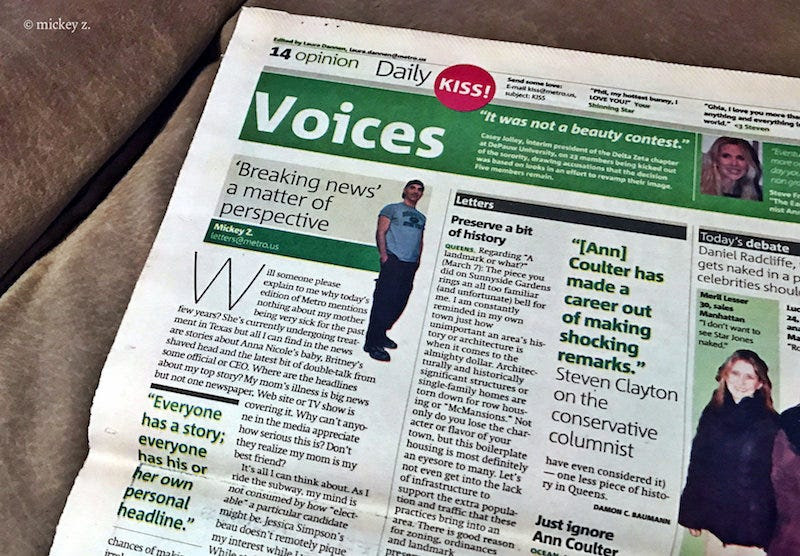
Throughout the 2000s, you’d find me regularly riding NYC’s subways during the very early morning hours — specifically from Queens into Manhattan — to work with personal training clients in gyms. In fact, right up to the plandemic, I was still training a couple of clients in their homes.

On those subway rides, I’d sometimes grab a copy of Metro — one of NYC’s free newspapers delivering a daily dose of corporate media propaganda. However, there was a brief period of time when Metro would allow some subversive voices into the mix. That included yours truly.

From about 2004 to 2007, Metro went through a phase of paying edgy freelancers so I jumped in with both feet. This even included an author photo shoot!

Thus, for a couple of years, my decidedly non-mainstream perspective — and my decidedly non-mainstream photo (wearing a “dumpster diving team” t-shirt, no less) — were on display for millions of New Yorkers to peruse during their morning ride to work or school (see image up top).

As someone who can remember when newspaper columnists held sway in my hometown, let me tell you, it was pretty cool to be jammed into a crowded subway car next to someone reading my latest article.

I’ll never know how many New Yorkers read my Metro columns. To the best of my knowledge, none of my affluent clients saw my column or photo (probably because none of them would ever ride the subway).

Over the years, I did make a select few clients aware of my double life (a couple have even bought my books and attended my talks). But, since many of them were wealthy and mainstream, I typically chose not to divulge anything about my radical writing.

As a result, I sometimes found myself making up elaborate fabrications to account for why I wouldn’t be around for a day or two when, for example, I just so happened to be heading up to MIT to lecture on US foreign policy in 2003.

Yep, this high school grad addressed a huge audience there on the topic of Henry Kissinger and the 1973 Chilean coup on a Monday night… and by Wednesday morning, was back in the gym — working with dumbbells (insert rimshot here).

Looking back now, I ponder my strategy of keeping a big part of myself a secret in the name of maintaining personal trainer income. Why was I so sure that wealthy capitalists would shun me and maybe fire me as their trainer if they encountered my radical mindset?

Perhaps a better question: What did it do to me emotionally to hide something that’s always been very important to me?

I contemplate questions like this now because, well… it’s never too late. I may not have affluent gym clients anymore. But, in Covid-era NYC, I have plenty of others around whom I could start speaking far more openly.

After all, it’s not like I can’t point to cases from the 2000s when my double life was exposed and things went well.

For example, I trained three high-powered lawyers at their high-powered law firm’s gym. This arrangement required me to check in with the doorman — or was he a concierge? (It’s funny to me that I might insult a concierge by calling him a doorman.) Anyway, doormen display one of three basic behavior patterns towards personal trainers.

The first and most common is indifference (we’re used to that). Secondly, they relate to us as fellow blue-collar common people saddled with the same fate: serving the well-heeled. Lastly, in a futile attempt to align themselves with a winner, some doormen openly look down their noses at us.

This was definitely the case at the law firm until a certain concierge saw my handsome face staring back at him from the pages of Metro.

The guy was completely flabbergasted when he read a little something of mine called “Re-Examining Rumsfeld’s Ratio” (which talked about, among other things, the United States unselfconsciously using “Apache” helicopters to quell “ethnic cleansing”).

A political junkie, the concierge now saw me as an “expert” and fell all over himself to shake my hand and introduce himself.

My new best friend could not get enough of me and it became the new norm for him to quiz me about current events before and after my training sessions.

One morning, as I was passing through the lobby, he called me over and pulled out a legal pad. Believe it or not, he had written a page or two of notes to remember all the things he wanted to ask me!

Yeah, just another tricky day in the life of a muscular militant… 

In 2001-2, I worked evenings in a corporate gym (cue the shame and self-loathing) in midtown Manhattan. One night, I was wearing a Yankees t-shirt with the name “Justice” emblazoned on the back (for former Yank David Justice).

A woman named Mary, probably in her late 60s, asked me if I was a Yankee fan. I told her my real reason for wearing the shirt was all about the word “justice.” She smiled and declared that justice was a “noble idea.”

I braced myself for the inevitable “we need to show those towel heads some justice,” (remember, this was early post-9/11 NYC) but instead, Mary told me — albeit in a stage whisper — she was soon going to DC to march against the impending US invasion of Iraq.

After this confession, Mary looked genuinely nervous. Her facial expression seemed to ask: Have I gone too far? In my best French Resistance voice, I reassured her: “Don’t worry, I’m with you.”

After that, we’d talk each and every time she’d come to work out. The corporation eventually phased out its gym facility but just before my last day, I saw Mary and complimented her on how hard she’d been training.

She leaned close to me and whispered: “When the revolution comes, I’ll be ready.”

As for me, my next revolution is to be even more open and transparent about my “controversial” stances. No more hiding.

After all, “a truthful witness saves lives.”

Austerity, War & Dictatorship… the Charade of Western Democracy Is Over. Can We Lose Those Chains?

By Finian Cunningham

Source: Strategic Culture Foundation

Western liberal democracy and its ubiquitous “austerity economics” is a euphemism for fascism. And the charade is finally coming to an end.

Western liberal democracy and its ubiquitous “austerity economics” is a euphemism for fascism. And the charade is finally coming to an end.

Austerity is not some recent policy under neoliberal capitalism. It was born out of the historic crisis in the Western system following the First World War and during the 1930s when fascism became a way to curtail any democratic challenge to the prevailing capitalist system.

That political instrument of repression is wielded today across all Western states. Quite amazingly, for a long time, few people recognized their captive, repressive state as fascism. We generally lived under the illusion that we were free citizens in “liberal democracies”.

In this interview, Clara E Mattei explains how the technocratic-sounding “austerity” is used to hide the brutal reality of dictatorship and repression against the vast majority of citizen workers in Western states.

Clara Mattei is an Assistant Professor in the Economics Department of The New School for Social Research, New York. She is the author of The Capital Order: How Economists Invented Austerity and Paved the Way to Fascism.

Her book investigates the origins of austerity as an economic policy after the crisis of World War One. Crucially, she argues that austerity is not merely about governments balancing financial budgets. Professor Mattei contends that austerity policy implemented by all Western governments is a political instrument of mass repression to prevent any challenge to the prevailing capitalist order.

Austerity forces the vast majority to accept unacceptable conditions that are otherwise shockingly anti-democratic. The precariousness and insecurity of employment, the widespread denial of social services, deprivation and poverty, and the relentless abuse of taxes and resources that are fueling insane militarism and war.

If we really did live in free, democratic societies why are such deformities enforced without any alternative? Austerity is used to crush the political imagination for any reasonable, more humane, more peaceful alternative.

However, as Clara Mattei points out in this interview, the extreme anti-democratic conditions in Western societies are inevitably forcing greater numbers of people to question the injustices and hideous anomalies of the prevailing capitalist order.

People are realizing that Western governments are in reality regimes of repression in service for the enrichment of a minority. That fundamental deformity is why Western societies are collapsing and why the United States and its Western lackeys are driven to increasing conflict against Russia and China.

The charade of “Western democracy” is coming to an end. The rulers and their pantomime political parties are losing the moral authority to hold power over the masses.

As people necessarily seek ways to reinvent societies that are fit for meeting their democratic needs, socialist solutions are beckoning. We have to throw off the mental shackles imposed by our dictators, and realize, as Karl Marx once eloquently said, that we have got nothing to lose except our chains.

Steiner and the Blood Demons

Blood Demons original title artwork by Michael Cox – see his art on Instagram here

By Jason Happenstall

Source: Beyond the Wasteland

Is the human race under spiritual attack? And did the esoteric philosopher and clairvoyant Rudolf Steiner warn about it over a century ago when he said a ‘vaccine’ would be the delivery system for the defeat of humanity?

For many, the overly-authoritarian response by governments worldwide to Covid-19 pointed to some deeper, more sinister, driving force. But it hasn’t just been the governments that seemed to be acting strange. Over the last two years we’ve witnessed people across a broad spectrum of society meekly submit to draconian attacks on their freedoms, many even fiercely defending the assault. In the same way, we’ve seen politicians and parties who once ran on platforms of personal freedom and economic autonomy almost overnight turn into overbearing control freaks, intent on micromanaging every aspect of our lives. How has this happened?

Recently, the term ‘mass formation psychosis’ has been on everybody’s lips. It’s defined as a psychological phenomenon whereby a mass of people voluntarily go through a process of deindividuation and a herd mentality forms. Due to their contagious nature, the thoughtforms affecting these deindividuated people, catalysed by the positive feedback loops of news programmes, social media and peer interaction, spread like wildfire throughout the population. In the past, this used to be called mob psychology, or more plainly, the madness of crowds.

Psychology: from Science to the Occult

Someone for whom the events of the past couple of years would not have been so surprising was the Austrian esoteric philosopher and mystic Rudolf Steiner, who died almost a century ago. Throughout the course of his life Steiner wrote numerous books and delivered thousands of lectures on his theories, contributing greatly to diverse spheres from architecture to education, and agriculture to beekeeping. His highly unique – and sometimes controversial – insights and methods led to the founding of the spiritual movement known as Anthroposophy, which emphasises the existence of a boundless potential for human beings.

Unlike some esoteric thinkers, Steiner saw the great importance of materialistic science, but argued that it was vital to see it as only a single aspect of reality which should ideally be combined with what he called ‘spiritual science’ – gained by mystical experience – in order to present the full picture. After all, breakthroughs often occur when scientists receive insights from beyond the material realm, as in the famous case of James Watson, credited with the discovery of the double helix shape of DNA which came to him in a dream featuring two intertwined serpents. Similarly, Dmitri Mendeleev, created the period table after a dream of “… a table where all the elements fell into place as required.” These cases go to show that not all scientific discoveries are the result of logical deduction and experimentation.

In fact, Steiner, who had been on the receiving end of mystical insights since childhood, honed his clairvoyant skills to such an extent that the information he received from non-conventional sources became more than the occasional flash of insight, His quest became the establishment of methods for obtaining objective extrasensory perception – a task he considered of paramount importance for he believed an epic battle was being fought in the spiritual realm that would have disastrous consequences for humankind unless it was addressed head-on.

Spirits of Darkness

His clearest warnings about the future fate of humanity came in a series of lectures delivered towards the end of his life in Dornach, Switzerland; these lectures are reproduced in the book The Fall of the Spirits of Darkness. Although Steiner’s detractors say his prose can be leaden, his lectures meandering, and his concepts difficult to grasp, he is remarkably clear and straightforward when it comes to the fate that awaits humanity if our obsession with scientific materialism is allowed to reign free without being pulled back into balance by the counterbalancing forces of spirituality.

This is most clearly illustrated in the final two lectures in the series – 13 and 14 – which are respectively titled The Fallen Spirits’ Influence in the World and Into the Future. Steiner posits that an unseen battle took place in the early 19th century which certain ‘spirits of darkness’ lost. These spirits were duly ejected from their heavenly realms and cast down into a more material plane of existence i.e. here. He is remarkably precise about when this occurred: autumn 1879.

These newly arrived spirits joined those who were already here – the ones that have been existing alongside and influencing humanity since the mythological times associated with the Fall. Given that it takes time for these malign spirits to work their way through human societies, it wasn’t until 1914 when their malign influence manifested in human society in the form of the First World War – a disastrous event the cause of which still puzzles secular historians.

Lucifer and Ahriman – the Leaders of the Pack

The spirits Ahriman and Lucifer have been hacking humanity for thousands of years, says Steiner, with Lucifer being the ‘light bringer’ intent on making us more spiritual and granting us more free will, and Ahriman doing the opposite and making us more materialistic and easier to control. In simplistic terms, Lucifer is an ascending influence, which Ahriman is a descending one.

Why should they want to do this? Well, we just don’t know – it’s difficult for our human minds to figure out what makes angels and demons tick. But whenever there’s one of those periodic battles in the spirit world, Steiner said, it tends to result in a new batch of reinforcements being thrown down into the material realm to join forces with those already here.

Steiner told us that Ahriman – a demon first identified by the Zoroastrians in ancient Persia – has the upper hand right now. He had a personal beef with Ahriman and had seen his face in vision – in fact he was still carving a likeness of it out of wood at the time of his death. Ahriman’s main aim seems to be to drag humankind into a purely materialistic state devoid of any form of spirituality, removing even the impulse to connect with our souls. The method of attack would be through science and technology, and by taking possession of the minds of powerful and influential people in order to push through this agenda. These controlled people could be scientists, politicians, religious leaders, or anyone with any influence. Thus, demonic forces would work through these people, and the people themselves, blinded by all-too-human failings such as greed or a lust for power, would lack the basic awareness to recognise what was occurring.

A New Religion for a New Age

The background to this power grab was the rise of atheism and the worship of science and progress. Now, we have a situation in which a purely materialist perspective is presented as the only explanation for all creation. Atheism has, for some, become a de facto religion, while the rich traditions of native spirituality have been side-lined and crushed under its heel. People, animals and in fact all life is regarded in the same cold manner; merely receptacles of proteins and genetic code that can be exploited. The endgame of this play is presented as a bleak, monochrome world expunged of spirit and light, where humans – their minds and spirits broken – are herded together and monitored like lab animals.

We can see how this scenario is being expedited. The CEOs of tech corporations are viewed almost as saints or Bodhisattvas, dangling the carrot of eternal life in the form of uploading the ‘data’ contained within our brains onto microchips. At the same time, politicians, corporate scientists, civil servants and economists are regarded as technocratic engineers tasked with ensuring the smooth functioning of the juggernaut of the material economy. Free will? The implicit assumption is that this will be unnecessary once the AI powered algorithms – which know us better than we do – reach escape velocity. At this stage, human life would have no intrinsic value, and the shells of our former selves would be occupied by the demonic army that Steiner warned us was waiting for its moment.

In the Blood

Some people say that Rudolf Steiner predicted a vaccine would appear which would be the delivery system for the final defeat of humankind. In light of the clandestine efforts made over the last two years to inject almost everybody on the planet with a gene editing treatment, his prescience seems remarkable – but how true is it? Amazingly, Steiner was remarkably clear (by his own standards) about the physical process by which this takeover would occur. He states in his final lecture in The Fall of the Spirits of Darkness that the spiritual world where entities such as angels, demons and archangels dwell is within the human blood. He meant this quite literally, saying:

“Both the Archangels and the Angels had their dwelling place in the blood, as it were. Truly, the blood is not something merely for chemists to analyse; it is also the dwelling place of entities from higher worlds.”

To that end, he speculated that the delivery mechanism will be in the form of a vaccine, injected directly into our bodies.

“Today [in 1917] bodies are vaccinated against one thing and another; in future, children will be vaccinated with a substance which it will certainly be possible to produce, and this will make them immune so that they do not develop foolish inclinations connected with spiritual life – ‘foolish’ here, of course, in the eyes of the materialists.”

This ‘vaccine’, he goes on to say, would block off any communication from the spirit world, meaning no messages or impulses would be able to get through from the ‘spirits of light’ whose aim is always to help humanity progress and fulfil our destiny. Positive impulses which were once transmitted to us would be permanently locked out by the vaccine, and instead the hapless victims would only be able to receive the impulses coming to them from disruptive sources, which we can imagine today might include the media, the education system and even established religion. There would be great confusion, he says, and Ahrimanic forces will turn people’s thoughts upside down and inside out. Everything that once was good and sensible will appear evil and crazy, while everything that was once considered insane and evil will be presented as sensible and good.

Squid Games: From Wetiko to The Matrix

Does this all sound implausible, the ramblings of a long-dead mystic? Many will no doubt say that it does, and that there are more earthly and plausible explanations for the psychic epidemic which has gripped the world. Perhaps Steiner was speaking metaphorically after all, some may reason. Nevertheless, the phenomenon to which Steiner alluded bears striking similarities to the Native American concept of the demonic force they call wetiko. The author Paul Levy has written extensively about this, defining it as “a contagious psychospiritual disease of the soul, a parasite of the mind that is currently being acted out en masse on the world stage via a collective psychosis of titanic proportions.”

Listening to a recent Legalise Freedom podcast entitled Covid-19: War on Humanity, Emma Farrell, a plant healer who uses shamanic techniques to access inner realms, made the observation that she and others in the same field had seen a veritable horde of spiritual parasitic entities attached to people over the last two years – as if a floodgate had been opened and they had poured through it. These entities, she says, come in all shapes and sizes but there are two very common and recognisable ones, one of which is squid-like. These squid-like beings, she says, attach themselves to unprotected people and harvest their spiritual energy by causing division and discord among us.

This struck me as interesting as we’ve seen this squid archetype move into human consciousness over the past few years, not least becoming apparent through popular culture. Many people have reported having dreams of octopus or squid-like creatures, and artists such as Peter Yankowski have painted pictures of these visions. Indeed, the villainous machines that control humans and harvest their energies in the Matrix movies look like robotic squids, while one of the top Netflix series of 2021 was Squid Game, a grim and violent survival thriller that posits human nature as intrinsically barbaric. What’s more, the resurgence in popularity of H.P. Lovecraft’s supernatural tales of horrors from the deep adds another tentacled layer to this rugose cake.

And let’s not forget when Goldman Sachs, one of the world’s largest investment banks, was memorable described by Rolling Stone journalist Matta Taibbi as a “great vampire squid wrapped around the face of humanity, relentlessly jamming its blood funnel into anything that smells like money.” The description is apt, after all, what is the purpose of an investment bank other than to turn every aspect of the sacred world into a monetised asset that can be traded, exploited and leveraged?

The Path Back to Sanity

Could this manifestation of a squid/octopus archetype into human consciousness be what Steiner was warning us about? Are there really spiritual entities within our blood that could account for billionaire technocrats’ obsession with injecting substances into us that are said to contain nanoparticles we know very little about? And how does this sit with the psychospiritual disease of wetiko outlined by Paul Levy, and the concept of ‘mass formation psychosis’ being talked about in the alternative media?

Perhaps the truth lies somewhere in the nexus of these concepts, with the implicit suggestion that we should not rest in our deep enquiry into the manner of the affliction that is currently so prevalent across the world. Only by doing so can we hope to find the necessary tools and weapons to fight back against it.

Or maybe the Ahrimanic demons that Steiner warned us about, the wetiko mind parasites Paul Levy writes of, and the tentacled entities that have squirmed into our collective consciousness via popular culture are all playing on the same team. If so, what does our team look like? And how do we win this game? Perhaps the fight is a necessary one at this juncture in human development, and that by defeating these ‘spirits of darkness’ we can progress to a higher level.

Whatever the case, referring back to the old adage alluded to earlier, people it’s said, might go mad in crowds, but the path back to sanity happens one person at a time.

Don’t Let Them Memory-Hole This 

By Jeffrey A. Tucker

Source: Brownstone Institute

On a video podcast the other day, I made reference to the lockdown orders of March 2020. The host turned off the recording. He said it was fine to talk about this subject but from now on please refer to “the events of March 2020” with no specifics. 

Otherwise, it will be taken down by YouTube and Facebook. He needs those platforms for reach, and reach is necessary for his business model. 

I complied, but I was spooked. Are we really now in the position that talking about what happened to us is verboten on mainstream venues? Sadly, that seems to be where we headed. In big and small ways, and throughout the culture and the whole world, we are bit by bit being trained to forget and hence not learn and thus repeat the whole thing. 

This makes no sense since nearly every public issue in play today traces to those fateful days and the fallout thereof, including censorship, the entrenchment of industry-government oligarchs, the corruption of media and tech, the educational upheaval, the abuse of courts and law, and the developing financial and banking crisis. 

And yet hardly anyone wants to speak about the topic frankly. It is too upsetting. There is too much at stake. We cannot risk being canceled, the single greatest fear of every aspirational professional in today’s world. Plus too many powerful people were in on it and don’t want to admit it. It would appear that the whole subject is being memoryholed in ways of which they all approve. 

For nearly two years, or longer, respectable intellectuals knew not to dissent from the prevailing norms and challenge the whole machinery. This was true of Washington think tanks, which went on their merry way from March 2020 either celebrating the “public health response” or just remaining quiet. The same was true of the leadership of major political parties and third parties. 

Most religious leaders stayed quiet too, even as their doors were padlocked for as long as 2 holiday seasons. Civic organizations played along. If you thought that the job of the ACLU was to defend civil liberties, you were wrong: they one day decided that lockdowns, mandatory masks, and forced shots were essential to their mission. 

So many were compromised over 3 years. These same people now just want the whole subject to go away. We find ourselves in an odd position, having experienced the biggest trauma in our lives and in many generations and yet there is precious little open talk about it. Brownstone was established to fill this void but we’ve become a target as a result. 

The search engines have been gamed for the better part of 3 years to keep the science channeled in only one direction. If web platforms step out of line, it is easy enough for search engines and social-media companies to tag them as problematic and thus throttle their reach. But for Substackers – and they are being targeted now too – it would be hard to find out anything other than what the oligarchs want you to believe. 

This silent treatment is filtering down to every aspect of our lives and becoming entrenched in the political culture too. Here is an example from this week. 

When Donald Trump returned from his theatrical and ridiculous indictment on nothing in New York, he flew immediately back to Mar-a-Lago where he told his story to people gathered in a pastiche-baroque ballroom. He told of the fake news, the attempted impeachments for Russia and Ukraine, the plots and schemes, and onward to the fake ballots and the FBI raid on his home, and now this preposterous new thing. 

It was a solid narrative overall. But his story left out a hugely important detail. He said not one word about Covid lockdowns and Operation Warp Speed that was supposed to be the great fix for the virus but flopped. This was a rather important detail to leave out since it wrecked the economy, the Bill of Rights, education, and led to a massive demographic upheaval in addition to the continuing fallout in terms of culture, economics, and everything else. 

It also caused him to lose the presidency, whether because the shock resulted in mass demoralization (this was certainly not a path to making America great again) or because of the mail-in ballots made possible by Covid restrictions, or probably both. However you look at it, it was the most disastrous decision of his presidency or possibly any presidency in history. 

How in the world are we just supposed to pretend that this did not happen? And yet he is playing along simply because he does not want to admit error. He thinks it makes him appear weak. Nor does he still slam the successor presidency for mask and shot mandates even though hundreds of millions were affected by them. He would rather not bring up the topic at all, lest doing so raises questions about his own judgment in those fateful days of March 2020. 

Meanwhile, the DNC does not want to admit that it celebrated and built on Trump’s biggest disaster while the RNC does not want to discuss that the policies they decry from the DNC actually began under the RNC. And so you have a kind of “mutually assured destruction” pact between them that needs no plot or contract. In silencing all talk about this, each party is only doing what is in its interest. 

We can fully expect that these issues will be locked out of the campaign narratives in 2024 just as they were in 2020 and 2022. Everyone seems to agree: the less said the better. And this is precisely why the announced candidacy of Robert Kennedy, Jr., has triggered the usual and expected gaslighting from the mainstream media. The plan is to flog him into marginalization. And if that doesn’t work, they will flog and flog again. 

We are seeing a real-time example of how history is really written. The narrative is more self-serving than we knew. If all the power centers in society get something tremendously wrong, an informal conspiracy of silence develops around it, with the hope of just wiping it from the history books. 

As Michael Senger has written, “Lockdowns met little resistance in part because they reinforced existing power structures. The rich got richer, the Zoom class got a vacation, workers got stimulus, while some business owners, their employees, and the most vulnerable had to sacrifice everything for this fantasy.” 

And we can add to that: government gained vastly more power. In fact, Covid became the template for the biggest expansion of government power over the population in world history, more effective than ancient myths about god-like rulers, heresy trials and witch burnings of the Middle Ages, sedition purges of the 18th and 19th centuries, red scares of the 20th centuries, the Cold War, or even the wars on terror. Fear of infectious disease was more effective than all of them for ratcheting up despotism. 

When something works this well for the most powerful people in society, why not just keep quiet about it?

The tellers of tales can write stories but they cannot invent their own realities. There will be no restoration of liberty, rights, and truth until we come to terms with what happened, why, and how to prevent it in the future. Playing along with this conspiracy of silence surrounding a policy that effectively blotted out every advance in human rights since the Magna Carta is a disastrous error that could lead to the entrenchment of a new dark age. 

Here’s How We’ll Have Labor Shortages and High Unemployment at the Same Time

By Charles Hugh Smith

Source: Of Two Minds

This is how we’ll end up with severe shortages of truly skilled labor and high unemployment of those who lack the necessary skills.

The labor force and the job market are referred to as if they were monolithic structures. But they’re not monolithic, they are complex aggregates of very different cohorts of age, skills, mobility, education, experience, opportunity, potential and motivation.

As a result, numbers such as the unemployment rate tell us very little about the labor force and the job market in terms of what matters going forward. So what does matter going forward?

1. Demographics–the aging and retirement of key sectors of the work force.

2. Skills and experience that will be increasingly scarce due to mismatched demand for skills that are diminishing as older workers retire.

3. What skills and experience will be demanded by re-industrialization, reshoring and expanding the electrification of the economy.

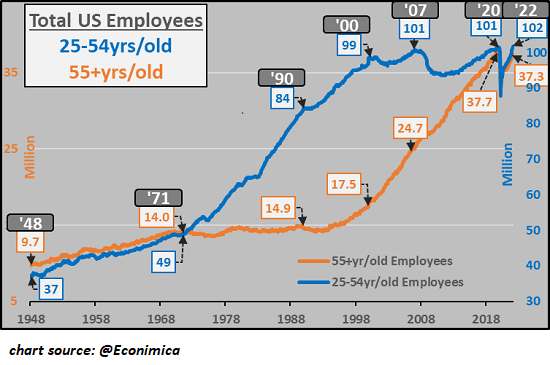
Consider these two charts of the US work force by age. (Courtesy of CH @econimica) In the first chart, Total US Employees, note that the prime working age work force (ages 25-54) has been flatlined for the past 20 years at 101-102 million. In contrast, the 55-and-older cohort of employees soared from 17 million to 37 million. This increase of 20 million accounts for virtually all growth in the employed work force.

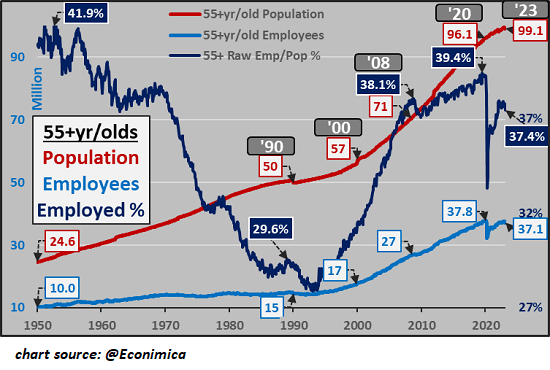
A funny thing happens as workers get old; they retire and leave the work force. Their skills and experience are no longer available to employers or the nation’s economy. The second chart shows the aging of the American populace, as the 55+ cohort increased from 57 million to 99 million since 2000, as the number of older employees skyrocketed from 17 million to 37 million.

While the total US population increased by 18% from 281 million in 2000 to 331 million today, the 55+ cohort increased 74% (from 57 million to 99 million).

The key takeaway here is the number of experienced workers who will retire in the next decade will track the explosive growth in the 55+ cohort. The general consensus is this will not be a problem because there are plenty of younger workers available to fill the vacated slots.

But this overlooks the qualitative and quantitative differences in the millions leaving the work force and those joining the work force. This is especially consequential in real-world jobs, i.e. all those jobs that require engaging real-world materials rather than staring at screens.

Though few analysts and commentators will admit to it, the implicit assumption is that the jobs that matter all involve staring at screens–processing data, finance, entertainment and shaping narrative make the world go round. All the real-world stuff (boring!) will magically get done by tax donkeys who are out of sight, out of mind.

This mindset has it backwards: it’s the real-world work of changing the industrial / energy / energy distribution foundation of the economy that matters going forward, not the staring-at-screens jobs.

What few seem to realize is the work force that’s aging and retiring is the cohort with the real-world skills. It’s a nice idea to remake the entire electrical grid of the nation to transport much larger quantities of electrical power, but who’s going to do all that work? Young people whose career goals are becoming YouTube influencers or day-traders? No. All the ChatAI bots in the world aren’t going to get the real work done, either.

In other words, there is a massive mismatch between the skills available to hire in the young-worker cohort and the skills and experience needed to rebuild the material, real-world foundations of the US economy. It’s well-known but apparently not worth worrying about that the average age of the US farmer is pushing 60 years of age. Nobody left to grow all our food? Hey, isn’t there a ChatAI bot to do all that for us? It can all be automated, right? No? Well, why not? Somebody out there, get it done! Food in super-abundance should be delivered to everyone staring at screens 24/7, it’s our birthright.

The average age of skilled tradespeople is also skewed to the aging work force. There is no easy way to quantify real-world skills gained by on-the-job experience. I suspect it follows a power-law distribution: the newly minted worker just out of school / apprenticeship can handle basic functions, but when tough problems arise, the number of workers with the requisite experience to diagnose and fix the problem diminishes rapidly.

This distribution presents an enormous problem for the economy and employers. Once the super-experienced workers who can solve any problem leave, they cannot be replaced by inexperienced workers. So when the really big problems arise, the systems will break down because those who knew how to deal with the problems are no longer available.

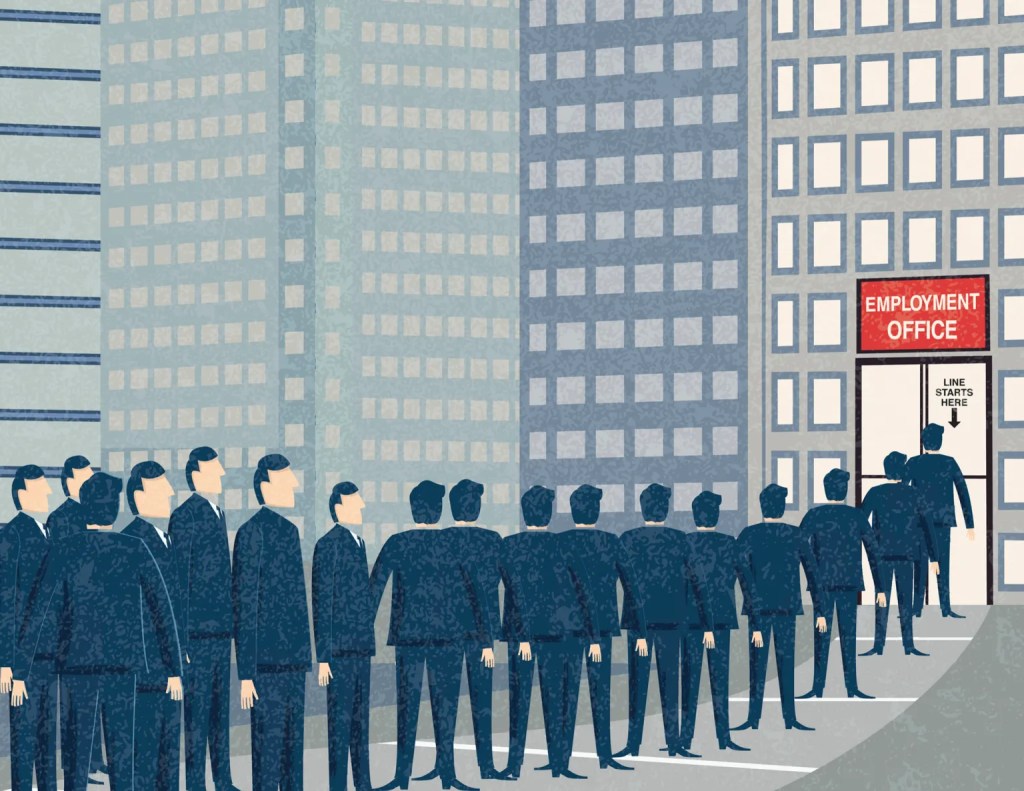
This is how you can have 10 million unemployed workers and 1 million unfilled positions that can’t be filled because few are truly qualified. You want to erect new electrical transmission lines? Nice, but you’re not going to get the job done with green workers accustomed to staring at screens. It takes years of hard labor to acquire even a bare minimum of the skills required. These are not assembly-line jobs that can be filled by unskilled labor, these are jobs in the messy real world, not a distribution center.

As I note in my book on Self-Reliance, individuals with a full spectrum of real-world skills are now extremely rare. Skills that were once common are now performed by specialists. We seem to have all the time in the world to stare at hundreds of cooking programs on TV but how many people actually prepare three meals a day, week in, week out, month in, month out, year in, year out? How many people know how to repair anything, build anything, or maintain a machine?

My direct experience is that many young people don’t know how to put air in the tires of the vehicle Mom and Dad gave them. Young people with graduate-level diplomas don’t know what a green bean plant looks like. (Eeew, gross, it grows in dirt?) The cultural value system that only values wealth, regardless of its source, and minting money from staring at screens has generated a fundamental mismatch between the skills that will be needed going forward and the skills being presented as oh-so-valuable.

Yes, there are many young workers with sharp real-world skills. The question is, are there enough?

This is how we’ll end up with severe shortages of truly skilled labor and high unemployment in the cohort of workers with few real-world skills and a surplus of skills for which there is limited demand. As a real-world experiment, go find a tough old rancher and ask them a series of questions about livestock, machinery, fencing, generators, etc., and then ask the average newly minted college graduate that followed the warped values embedded in our economy the same questions.

Of course the young worker can’t match the experience of the old worker, but do they have any experience at all of a spectrum of essential real-world skills? If not, do they have the requisite physical endurance and commitment needed to acquire real-world skills?

Who’s going to do all the real-world work going forward? A few people talk about it as an abstraction, but it’s not an issue to everyone focused on Federal Reserve policy or GDP. But eventually, the real world will matter more than staring at screens and day-trading, because when the systems break down due to lack of truly qualified employees, we’ll all wake up. But by then it will be too late. We’ll be staring at dead screens begging for somebody somewhere to restore power so we can continue playing with ChatAI to trade zero-day options.