Thoughts About Mind, Consciousness, & Humanity’s Origin

Can understanding the nature of Mind, consciousness and the ET phenomenon lead us to an expanded understanding of our origins?

By Tom Bunzel

Source: The Pulse

As a fan of Eckhart Tolle I’ve always liked his description of Consciousness (or ‘Being’ which seems his preference) as “No Thing.”

This separates “Being” from the world of form, and puts it into the area of what Tesla called “nonmaterial reality.”

I’ve generally thought of this reality as (an) Infinite Mind (again as opposed to “God”) to take out the anthropomorphic bias which seems to permeate organized religion. Political Christianity and some other groups seem to relish an angry and vengeful God to keep the parishioners paying. But when you step away from beliefs that are easily debunked you are still left with a fact.

We seem to be thinking.

Of course, it was Descartes who famously equated thought with Being, which has led to all sorts of issues that Eckhart Tolle describes well in his work.  When we identify with only our thoughts, we have narrowed our focus and reduced reality to labels. 

But the reality of thought persists.  What is it?

Is Thought Electricity in the Brain?

Neuroscientists seem to have identified the presence of thoughts in the brain through various instruments that can pick up electrical signals in parts of the brain and between synapses.

But so far, I don’t believe they can “download” these signals and decode them.

When we observe our thoughts, we can see that they seem to be comprised of “words”.  In fact, I’ve had the experience of thinking in languages other than English (my native language is German) and of course, the thoughts come as words – sometimes in cogent sentences or perhaps just one word. 

So, I was musing, what about ancient humans? Did they need to form a sentence in their brains to warn them that a lion might be in the bushes?

If you’ve ever experienced trauma, you know the answer – our limbic system activates, putting us in “fight or flight” well before any thought ever happens. 

I would suggest that a primal, lower frequency of Mind operates in our limbic system, before thought and language.

So, when did we start thinking in “words”?

According to my AI friend,

“scholars believe it [language] originated at least 100,000 years ago during the Middle Stone Age. The development of language is linked to the increased complexity of human culture and cognition.”

Maybe a tribe of hunter-gatherers developed a sound for “lion” and it became a warning cry.  Then perhaps “big” lion or “many lions”.

We know that our ancients memorialized beasts in petroglyphs of various kinds to communicate but the next big breakthrough was when the words, sentences and thus concepts were able to be preserved.

Writing Was the Big Game Changer

AI tells us that

“Writing systems were invented independently by different civilizations thousands of years ago as a means of recording information. The earliest writing emerged around 3,500-3,000 BCE in Mesopotamia and Egypt. Chinese writing developed around 1,200 BCE.”

So now I will do what they do on Ancient Aliens, which is take a speculative leap based on the foregoing.

It intrigues me that the cultures that seemed to “create” writing all have a version of the Prometheus myth – crediting the “Gods” with giving them the gift of higher knowledge.

To connect this to the beginning of writing seems to make sense, as we have precisely these myths in Mesopotamia (Annunaki) and Egypt. 

And it seems clear that with the onset of the written word (and mathematical notations) great leaps in human progress came almost in quantum intervals.  We got the printing press and eventually our modern technology.

We might speculate that it is likely that Mind has been with us forever, but that thought evolved and expanded dramatically with the beginning of writing – and that writing could easily be seen as a gift that transformed human civilization.   

There May Have Been Consequences for Teaching Humanity

It is also very plausible that any entity that conveyed such a gift to humanity may well have angered other entities that wanted to keep humans in check. 

Cuneiform tablets from the Sumerians describe how one “God” Enki created humans in the image of the Annunaki and gave them knowledge – but most of the humans were wiped out by his rival Enil in the great flood.  We now have evidence in the geological record that such a flood happened about 12,000 years ago.

But just this little thought experiment can vastly expand our sense of our place in the cosmos along with providing a much-needed dose of humility.

What if we did not simply “evolve” with natural selection but received assistance in an area we are now beginning to understand – genetics?  This would indicate a profound connection to the cosmos in a way that is disregarded by our current society.

It is also worth noting, as my AI explains,

“There is evidence that around 250,000-300,000 years ago there were some key genetic changes in early humans that contributed to increased brain size and advanced cognitive abilities compared to other primates.” 

Where these came from or how they came about is still a mystery.

And now that it seems apparent that some visitation by “entities” from the sky is not likely fiction but a reality, it may help to broaden our understanding of Nature and how we got here.

My AI friend makes another statement which I think is exactly backwards:

“Some key developments that enabled writing include the evolution of symbolic thought, the invention of systems of counting, and the emergence of urban civilization needing record-keeping.”

Clearly, it was first language, and then writing and math that led to this evolution of our brains, not the other way around.  Our original brains would have needed to expand to accommodate our first language which took us beyond the limbic system to labeling, and ultimately writing which led us to sharing ideas and thinking “symbolically” – using groups of letters as words and then sentences to convey increasingly complex concepts.

My own experience with neuroplasticity confirms that new uses for the brain expand its capacity, creating new pathways and neural networks. People who keep learning seem less susceptible to dementia.

Opening to the possibility that our evolution was “jump started” by extraterrestrials changes the narrative from chance and natural selection to a more profound connection to the universe in areas that our current science has mostly yet to penetrate. (Nonmaterial reality).

A Clue that Space Is Not Empty

But technology in particular seems to point us in the right direction – it was the offspring of the printing press – the computer – which eventually led us to a huge breakthrough in our awareness of the nonmaterial or seeming empty space as being potentially much much more.

When we developed WiFi suddenly the information encoded in words, thoughts and sentences could travel through space. So who knows what other information or Mind stuff has been around us all along?

Because Mind is everywhere and at the heart of Nature.

Just Seeing Through The Propaganda Isn’t Enough — We’ve Got To Open Our Hearts As Well

Humanity doesn’t just need to escape from the mental prison of imperial indoctrination. It needs to escape from the heart prison as well.

By Caitlin Johnstone

Source: CaitlinJohnstone.com.au

Humanity doesn’t just need to escape from the mental prison of imperial indoctrination. It needs to escape from the heart prison as well.

I’m always talking here about the need to fight empire propaganda to help the public awaken to the fact that everything we’ve been trained to believe about the world is a lie, because that insight taking root in sufficient numbers would be the first step toward the revolutionary changes our world so desperately needs.

But large numbers of people opening their eyes to the reality of mass-scale psychological manipulation by the powerful would by itself be insufficient, because people need not only to see the truth — they also need to care. 

Realizing the depravity and immense human suffering the US-centralized empire is responsible for creates an opportunity to respond to this insight with horror and begin resisting it — but it is only an opportunity. At that juncture it’s still possible for someone to realize that we’re not being told the truth about what’s happening in the world, but decide to play along with the lies anyway, either because the existing world order has made them wealthy, or because they are too indoctrinated with support for western power structures, or because they ideologically support Israel, or because they’re afraid of the changes and upheaval that would come with an overturning of the status quo, or because they are intellectually and morally lazy, or some other selfish reason.

Realizing that you’ve been indoctrinated into accepting a pernicious status quo unlocks an important door within yourself, but just because that door is opened doesn’t mean you have to walk through it. Walking through it requires another kind of awakening — an awakening of the heart.

Really no amount of knowledge or intellectual insight will ever set us free as a species in and of itself. You could upload the sum total of human knowledge into the brain of everyone on earth — including even government secrets that aren’t public knowledge — but unless this is accompanied by a collective opening of the heart, it wouldn’t make any difference. Unless people can find it within themselves to care deeply about the horrific things our rulers have been doing to our fellow human beings, no amount of knowledge about those things will catalyze real change.

And there are plenty of people who know but don’t care. The most powerful government agencies in the world are run by people who know terrible secrets about our ruling power structures that we ordinary members of the public are not allowed to know, but because their loyalty is to the empire and not to humanity, they don’t care about the moral implications of what they know or the human suffering the empire is responsible for.

So the demand of this moment in history is not just to understand, but to care. Not just to know what’s wrong with the world, but to feel it. Not just to awaken on the level of the head, but to awaken on the level of the heart as well. Not just to value our own personal understanding, but to value humanity as a whole.

Knowledge of the truth can lead to a profound compassion for the victims of the globe-spanning power structure which rules over us and a determination to oppose its cruelty — that’s why said power structure pours so much energy into keeping everyone propagandized. But it doesn’t necessarily need to lead to such compassion. The light of truth can stop its expansion at the gates of the heart, unless there’s some willingness from somewhere deep inside us to throw those gates open.

Ultimately humanity just needs to wake up, on every level. We need to liberate ourselves from the shackles of propaganda. We need to liberate ourselves from the shackles on our hearts. We need to liberate ourselves from the shackles of the ego. We need to liberate ourselves from the shackles of the dualistic perspective which obfuscates the oneness of all of reality from our vision. 

That’s what’s being asked of us at this juncture. To wake all the way up and become a conscious species. That’s the only way we’ll ever be able to move about on this planet in a healthy and harmonious way. 

And we’ll either rise to the occasion or we won’t. We’ll either wake up, or we’ll destroy ourselves. I believe we have the freedom as a species to go either way.

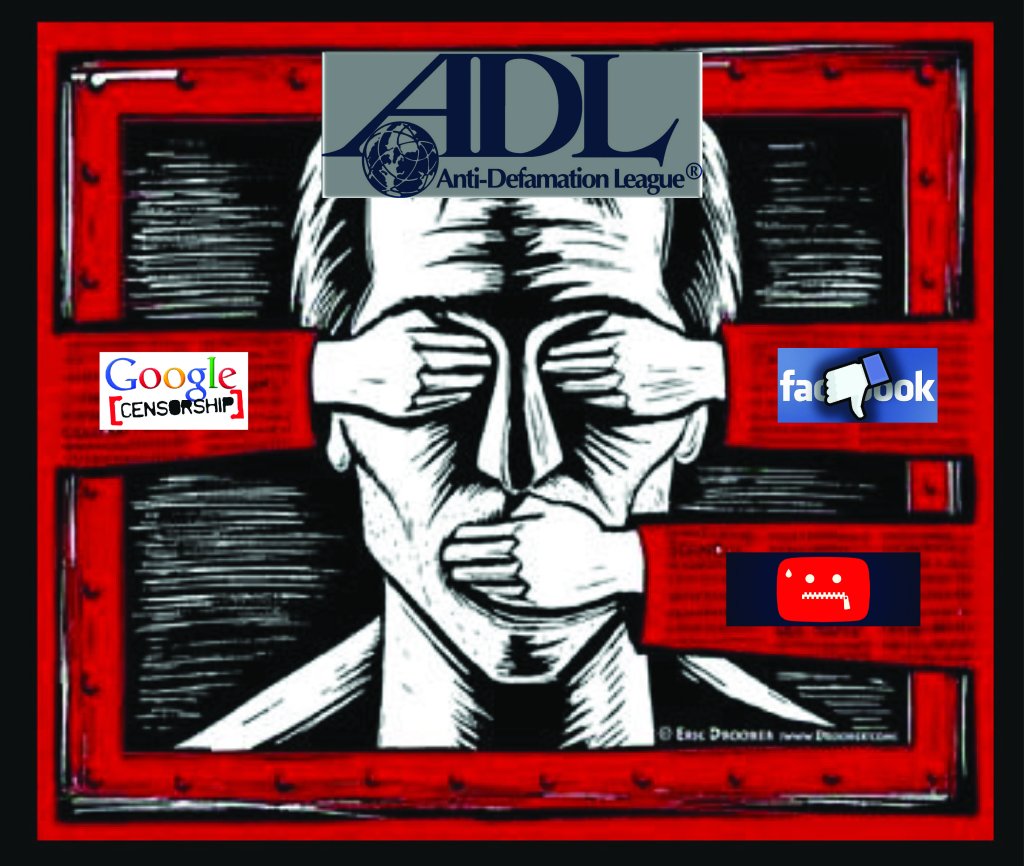
The Language of Force: How the Police State Muzzles Our Right to Speak Truth to Power

By John & Nisha Whitehead

Source: The Rutherford Institute

“If the state could use [criminal] laws not for their intended purposes but to silence those who voice unpopular ideas, little would be left of our First Amendment liberties, and little would separate us from the tyrannies of the past or the malignant fiefdoms of our own age. The freedom to speak without risking arrest is ‘one of the principal characteristics by which we distinguish a free nation.’”—Justice Neil Gorsuch, dissenting, Nieves v. Bartlett (2019)

Tyrants don’t like people who speak truth to power.

Cue the rise of protest laws, which take the government’s intolerance for free speech to a whole new level and send the resounding message that resistance is futile.

In fact, ever since the Capitol protests on Jan. 6, 2021, state legislatures have introduced a broad array of these laws aimed at criminalizing protest activities.

There have been at least 205 proposed laws in 45 states aimed at curtailing the right to peacefully assemble and protest by expanding the definition of rioting, heightening penalties for existing offenses, or creating new crimes associated with assembly.

Weaponized by police, prosecutors, courts and legislatures, these protest laws, along with free speech zones, bubble zones, trespass zones, anti-bullying legislation, zero tolerance policies, hate crime laws, and a host of other legalistic maladies have become a convenient means by which to punish individuals who refuse to be muzzled.

In Florida, for instance, legislators passed a “no-go” zone law making it punishable by up to 60 days in jail to remain within 25 feet of working police and other first responders after a warning.

Yet while the growing numbers of protest laws cropping up across the country are sold to the public as necessary to protect private property, public roads or national security, they are a wolf in sheep’s clothing, a thinly disguised plot to discourage anyone from challenging government authority at the expense of our First Amendment rights.

It doesn’t matter what the source of that discontent might be (police brutality, election outcomes, COVID-19 mandates, the environment, etc.): protest laws, free speech zones, no-go zones, bubble zones, trespass zones, anti-bullying legislation, zero tolerance policies, hate crime laws, etc., aim to muzzle every last one of us.

To be very clear, these legislative attempts to redefine and criminalize speech are a backdoor attempt to rewrite the Constitution and render the First Amendment’s robust safeguards null and void.

No matter how you package these laws, no matter how well-meaning they may sound, no matter how much you may disagree with the protesters or sympathize with the objects of the protest, these proposed laws are aimed at one thing only: discouraging dissent.

This is the painful lesson being imparted with every incident in which someone gets arrested and charged with any of the growing number of contempt charges (ranging from resisting arrest and interference to disorderly conduct, obstruction, and failure to obey a police order) that get trotted out anytime a citizen voices discontent with the government or challenges or even questions the authority of the powers-that-be.

These assaults on free speech are nothing new.

As Human Rights Watch points out, “Various states have long-tried to curtail the right to protest. They do so by legislating wide definitions of what constitutes an ‘unlawful assembly’ or a ‘riot’ as well as increasing punishments. They also allow police to use catch-all public offenses, such as trespassing, obstructing traffic, or disrupting the peace, as a pretext for ordering dispersals, using force, and making arrests. Finally, they make it easier for corporations and others to bring lawsuits against protest organizers.

Journalists have come under particular fire for exercising their right to freedom of the press.

According to U.S. Press Freedom Tracker, the criminalization of routine journalism has become a means by which the government chills lawful First Amendment activity.

Journalists have been arrested or faced dubious charges for “publishing,” asking too many questions of public officials, being “rude” for reporting during a press conference, and being in the vicinity of public protests and demonstrations.

For instance, Steve Baker, a reporter for Blaze News, was charged with four misdemeanors, including trespassing and disorderly conduct charges, related to his sympathetic coverage of the Jan. 6 riots. Dan Heyman, a reporter for the Public News Service, was arrested for “aggressively” questioning Tom Price, then secretary of the Department of Health and Human Services during an encounter in the West Virginia State Capitol.

It’s gotten so bad that merely daring to question, challenge or hesitate when a cop issues an order can get you charged with resisting arrest or disorderly conduct.

For example, Deyshia Hargrave, a language arts teacher in Louisiana, was thrown to the ground, handcuffed and arrested for speaking out during a public comment period at a school board meeting.

Fane Lozman was arrested for alluding to government corruption during open comment time at a City Council meeting in Palm Beach County, Fla.

College professor Ersula Ore was slammed to the ground and arrested after she objected to the “disrespectful manner” shown by a campus cop who stopped her in the middle of the street and demanded that she show her ID.

Philadelphia lawyer Rebecca Musarra was arrested for exercising her right to remain silent and refusing to answer questions posed by a police officer during a routine traffic stop. (Note: she cooperated in every other way by providing license and registration, etc.)

Making matters worse, the U.S. Supreme Court issued a ruling in Nieves v. Bartlett that protects police from lawsuits by persons arrested on bogus “contempt of cop” charges (ranging from resisting arrest and interference to disorderly conduct, obstruction, and failure to obey a police order) that result from lawful First Amendment activities (filming police, asking a question of police, refusing to speak with police).

These incidents reflect a growing awareness about the state of free speech in America: you may have distinct, protected rights on paper, but dare to exercise those rights, and you risk fines, arrests, injuries and even death.

Unfortunately, we have been circling this particular drain hole for some time now.

More than 50 years ago, U.S. Supreme Court Justice William O. Douglas took issue with the idea that merely speaking to a government representative (a right enshrined in the First Amendment) could be perceived as unlawfully inconveniencing and annoying the police.

In a passionate defense of free speech, Douglas declared: 

Since when have we Americans been expected to bow submissively to authority and speak with awe and reverence to those who represent us? The constitutional theory is that we the people are the sovereigns, the state and federal officials only our agents. We who have the final word can speak softly or angrily. We can seek to challenge and annoy, as we need not stay docile and quiet. The situation might have indicated that Colten’s techniques were ill-suited to the mission he was on, that diplomacy would have been more effective. But at the constitutional level speech need not be a sedative; it can be disruptive.

It’s a power-packed paragraph full of important truths that the powers-that-be would prefer we quickly forget: We the people are the sovereigns. We have the final word. We can speak softly or angrily. We can seek to challenge and annoy. We need not stay docile and quiet. Our speech can be disruptive. It can invite dispute. It can be provocative and challenging. We do not have to bow submissively to authority or speak with reverence to government officials.

In theory, Douglas was right: “we the people” do have a constitutional right to talk back to the government.

In practice, however, we live in an age in which “we the people” are at the mercy of militarized, weaponized, immunized cops who have almost absolute discretion to decide who is a threat, what constitutes resistance, and how harshly they can deal with the citizens they were appointed to “serve and protect.”

As such, those who seek to exercise their First Amendment rights during encounters with the police are increasingly finding that there is no such thing as freedom of speech.

Case in point: Tony Rupp, a lawyer in Buffalo, NY, found himself arrested and charged with violating the city’s noise ordinance after cursing at an SUV bearing down on pedestrians on a busy street at night with its lights off. Because that unmarked car was driven by a police officer, that’s all it took for Rupp to find himself subjected to malicious prosecution, First Amendment retaliation and wrongful arrest.

The case, as Jesse McKinley writes in The New York Times, is part of a growing debate over “how citizens can criticize public officials at a time of widespread reevaluation of the lengths and limits of free speech. That debate has raged everywhere from online forums and college campuses to protests over racial bias in law enforcement and the Israel-Hamas war. Book bans and other acts of government censorship have troubled some First Amendment experts. Last week, the Supreme Court heard arguments about a pair of laws — in Florida and Texas — limiting the ability of social media companies such as Facebook to ban certain content from their platforms.”

Bottom line: what the architects of the police state want are submissive, compliant, cooperative, obedient, meek citizens who don’t talk back, don’t challenge government authority, don’t speak out against government misconduct, and don’t resist.

What the First Amendment protects—and a healthy constitutional republic requires—are citizens who routinely exercise their right to speak truth to power.

Yet there can be no free speech for the citizenry when the government speaks in a language of force.

What is this language of force?

Militarized police. Riot squads. Camouflage gear. Black uniforms. Armored vehicles. Mass arrests. Pepper spray. Tear gas. Batons. Strip searches. Surveillance cameras. Kevlar vests. Drones. Lethal weapons. Less-than-lethal weapons unleashed with deadly force. Rubber bullets. Water cannons. Stun grenades. Arrests of journalists. Crowd control tactics. Intimidation tactics. Brutality. Contempt of cop charges.

This is not the language of freedom. This is not even the language of law and order.

Unfortunately, this is how the government at all levels—federal, state and local—now responds to those who choose to exercise their First Amendment right to speak freely.

If we no longer have the right to tell a Census Worker to get off our property, if we no longer have the right to tell a police officer to get a search warrant before they dare to walk through our door, if we no longer have the right to stand in front of the Supreme Court wearing a protest sign or approach an elected representative to share our views, if we no longer have the right to protest unjust laws by voicing our opinions in public or on our clothing or before a legislative body, then we do not have free speech.

What we have instead is regulated, controlled, censored speech, and that’s a whole other ballgame.

Remember, the unspoken freedom enshrined in the First Amendment is the right to challenge government agents, think freely and openly debate issues without being muzzled or treated like a criminal.

Americans are being brainwashed into believing that anyone who wears a government uniform—soldier, police officer, prison guard—must be obeyed without question.

Of course, the Constitution takes a far different position, but does anyone in the government even read, let alone abide by, the Constitution anymore?

The government does not want us to remember that we have rights, let alone attempting to exercise those rights peaceably and lawfully. And it definitely does not want us to engage in First Amendment activities that challenge the government’s power, reveal the government’s corruption, expose the government’s lies, and encourage the citizenry to push back against the government’s many injustices.

Yet by muzzling the citizenry, by removing the constitutional steam valves that allow people to speak their minds, air their grievances and contribute to a larger dialogue that hopefully results in a more just world, the government is creating a climate in which violence becomes inevitable.

When there is no First Amendment steam valve, then frustration builds, anger grows and people become more volatile and desperate to force a conversation.

As John F. Kennedy warned, “Those who make peaceful revolution impossible will make violent revolution inevitable.”

As I point out in my book Battlefield America: The War on the American People and in its fictional counterpart The Erik Blair Diaries, the government is making violent revolution inevitable.

A Low-Trust Society Is an Impoverished Society

By Charles Hugh Smith

Source: Of Two Minds

The sole remaining reservoirs of trust in American life are personal networks, local enterprises and local institutions.

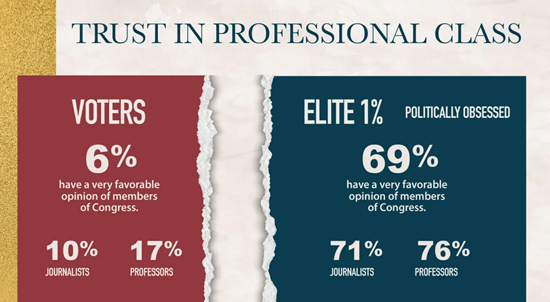
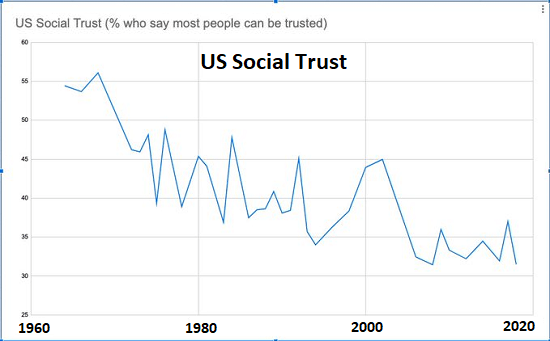
It’s not exactly news that social trust has declined significantly in the United States. Surveys find that public trust in institutions and the professional classes that dominate those institutions has cratered. (see chart below) Social trust–our confidence that other people are trustworthy–has also fallen to multi-decade lows.

This was not the case in decades past. Americans maintained high levels of trust in their institutions, government and fellow citizens. The decline in social trust is across the entire spectrum: our trust in institutions, professional elites and our fellow Americans has declined precipitously.

The causes of this decay of social trust can be debated endlessly, but several factors are obvious:

1. Institutions forfeited the trust of the citizenry by withholding / editing realities to serve the interests of hidden agendas and insiders’ careers. The Vietnam War was pursued on fabrications, as was the second Gulf War to topple Saddam. Watergate eroded trust on multiple levels, as did the Church Committee’s investigation of America’s security agencies’ domestic spying / over-reach.

2. The managerial / professional elites at the top of the nation’s institutions no longer put the citizenry’s interests above their own. The public’s trust has eroded as institutions are primarily viewed as vehicles for self-enrichment and career advancement: healthcare CEOs pay themselves millions, higher education is bloated with layers of non-teaching administration, defense contractors and the Pentagon have greased the revolving door to the benefit of incumbents and insiders, and so on, in an endless parade of self-serving cloaked with smirking PR claims of “serving the public.”

The shift from a high-trust society to a low-trust society is consequential economically, politically and socially. Low-trust societies have stagnant economies, as nobody trusts anyone they don’t know personally or through personally trusted networks, and nobody trust institutions to function effectively or fulfill their stated mission to serve the public good.

Faced with incompetent, unaccountable, corrupt bureaucracies and a culture overflowing with scams, frauds, imposters and get-rich-quick schemes, people give up and drop out. Rather than start a business and accept all the risks just to get dumped on or ripped off, they don’t even try to start a business. Given the financial insecurity that is now the norm, they decide not to get married or have children.

The vast trading networks of the Roman Empire were based on personal trusted networks and trust in Rome’s functionaries / institutions. The owners of trading ships dealt with trusted captains and merchants, who then paid duties to Roman functionaries in Alexandria and other major trading ports.

In other words, tightly bound personal trusted networks work well as long as the state institutions that bind the entire economy are trusted as fair and reliable–not perfect, of course, but efficient and “good enough.”

But when public institutions are viewed as unfair, unreliable, corrupt or incompetent, the entire economy decays. Even personal trusted networks cannot survive in an economy of unfair, unreliable, corrupt or incompetent state bureaucracies and private institutions.

The American economy is now dominated by enormous privately owned and managed monopolies and cartels that are the private-sector equivalent of self-serving state bureaucracies. Big Tech, Big Pharma, Big Healthcare, Big Ag, Big Finance, etc., are even worse than state bureaucracies because there are no legal requirements for transparency or recourse. Try getting a response from a Big Tech corporation when you’ve been shadow-banned or sent to Digital Siberia.

The sole remaining reservoirs of trust in American life are personal networks, local enterprises and local institutions. These are not guaranteed, of course; in many locales, even these reservoirs have been drained. But in other locales, enterprises and institutions such as the county water utility, the local newspaper, the local community college, etc. continue to earn the trust of the public by performing the services they exist to provide effectively and at a reasonable cost.

The larger the institution and the greater its wealth and power, the lower the social trust–for good reasons. The greater the influence of the managerial elites, the greater the disconnect from the everyday experiences of the citizenry and customers, and the more extreme the self-serving PR.

Sure, I trust Big Tech, Big Pharma, Big Healthcare, Big Finance–to rip me off, profiteer, send me obfuscating bills, jack up junk fees, make it impossible to contact them, and send me to Digital Siberia if I complain.

The divide between the elites and the commoners should prompt us to examine the low-trust path we’re sliding down:

In a society in which everything is phony, low quality or fraudulent, you’re taking a chance trusting anyone you don’t know personally–and even that can be risky now that self-aggrandizing flim-flam is the last remaining path to financial security for non-elites.

A low-trust society is an impoverished society, economically stagnant and socially threadbare. That’s where we are now, and the more fragmented, greedy, self-serving, desperate and deranged we become, the lower the odds that we’ll find the means to rebuild trust.

Sadly, we already know that anyone claiming to “rebuild trust” is spouting PR designed to mask self-enrichment. We also know that the vast army of well-paid flacks, factotums, enforcers, happy-story apologists, lackeys, toadies and sell-out minions are declaring “everything’s great!”

Just mumble, “Uh, sure” and continue to Tune in (to degrowth), drop out (of hyper-consumerism and debt-serfdom) and turn on (to self-reliance and relocalizing capital and agency).

The American Explanation for the Moscow Terror Attack Doesn’t Add Up

By Dmitry Trenin

Source: Covert Geopolitics

Russian foreign policy could change significantly, depending on the results of the investigation into the atrocity.

The heinous act of terrorism at the Crocus City Hall concert venue just outside Moscow on Friday night – which is confirmed to have killed more than 130 people at the time of writing – has perhaps shaken Russia more than anything since a similar attack on a theater in the capital in 2002.

This latest atrocity will certainly have a major impact on the Russian people’s consciousness and the nation’s public security. It could also lead to serious changes in Moscow’s foreign policy, depending on the results of the investigation into the source of the attack and its masterminds. Considering the enormously high stakes involved in its findings and conclusions, there is no doubt that the investigation will have to be incredibly thorough.

The US government’s version of an Islamic State connection to the attack has been met with skepticism by Russian officials and commentators. Firstly, they were surprised by how quickly – virtually within minutes – Washington pointed the finger at the group. What also drew the attention of Russian observers was the US reference to an IS-linked news site which had claimed responsibility for the crime.

Normally, all such sources are subjected to thorough checks. But not this time. Figures in Russia have also noted that American spokesmen immediately, and without prompting, declared that Ukraine was in no way linked to the act of terror.

Other criticisms of the American version include the style of the attack (no political statements or demands were made); the admission by one of the captured attackers that he had shot innocent people for money; and the fact that this was not planned as a suicide operation. Many experts have pointed out that IS is far from its prime, and that Russian forces defeated its core elements in Syria years ago. This has allowed speculation to grow about a false flag attack.

Ukraine, true to form, and alone among the nations of the world, has suggested that the Crocus City atrocity was an operation carried out by Russia’s own secret services, launched to facilitate a further tightening of the political regime and a new wave of mobilization. Clearly nonsensical, this interpretation invoked in many Russian minds the old proverb, “liar, liar, pants on fire.”

Russian President Vladimir Putin, in his five-minute address to the nation on Saturday, refrained from rolling out the Kremlin’s own version. His words and his demeanor were calm, but the style of his remarks was stern. Those behind the attack “will be punished whoever they are and wherever they may be,” the president declared.

The direction of Putin’s thinking was revealed by the two facts – not conjectures – he raised: that the terrorists, having fled the scene of the assault, had been apprehended not far (100km or so) from the Ukrainian border, and that “information” had been obtained that they intended to cross the border into Ukraine, where “they had contacts.”

At this point, nothing is firmly established. The results of the Russian investigation will be enormously important. If Moscow concludes that the attack was conceived, planned, and organized by the Ukrainians – say, the military intelligence agency GUR – Putin’s public warning would logically mean that the agency’s leaders will not just be “legitimate” targets, but priority ones for Russia.

Since an attack of such gravity would almost certainly have required the approval of Ukrainian President Vladimir Zelensky, the “guarantee” that Putin informally gave to foreign leaders (including Israel’s then-Prime Minister Naftali Bennett) that Russia would not target Zelensky personally, would presumably be lifted. If so, Moscow would be removing one of its most important self-imposed constraints – not to touch Kiev’s senior leadership.

The Crocus City terrorist attack seemingly fits into a pattern. It has come against the background of Ukraine’s intensification of artillery and drone strikes against the civilian population in Russian regions on the shared border, as well as attempts (all thwarted, thus far) to raid Russian villages.

As a result, scores of Russian civilians have been killed or wounded, and thousands of children evacuated to safety. The conclusion reached by many analysts is that Ukraine, by focusing on “soft” civilian targets, had been seeking to undermine the Russian population’s morale in the run-up to the presidential elections in mid-March, and to strain the country’s internal stability after them.

Regarding the concert hall massacre, there is another aspect at play: the US version of IS complicity and the use of Tajik citizens to carry out the attack may be intended to stoke inter-ethnic tensions within Russia between the Slavic majority and the Muslim minority population, both local and immigrant. 

Taken together, all of this strengthens the argument of those inside Russia who have long insisted that Ukraine – under its present ultranationalist leadership – is a terrorist state, and that Russia simply cannot tolerate such a regime on its borders. They believe that any talk of a ceasefire or negotiations should stop.

Russia must achieve a complete victory – otherwise it will constantly bleed at the hands of the terrorists in power next door, supported and protected by the country’s adversaries in the West. If the results of the investigation confirm that Ukraine was behind the Crocus City massacre, Russia’s war aims will need to be greatly expanded, and the conflict will significantly grow in intensity.

One thing that’s important to note” The war in Ukraine is not considered by Russians to be a war against Ukraine.

Rather, it is seen as a fight against the US-led West, which is using Ukraine as a battering ram to inflict a “strategic defeat” on Russia. It is interesting that Kremlin spokesman Dmitry Peskov just last week publicly admitted for the first time that the “special military operation” was in fact now a war. It became so, he said, as a result of the West’s involvement in the conflict.

Thus, if Ukraine’s complicity in Friday’s terrorist attack is indeed established, it would also suggest, at a minimum, US knowledge and de facto approval of it. In this respect, various people have already highlighted the recent warnings by the GUR chief, Kirill Budanov, and outgoing US Undersecretary of State Victoria Nuland about “unpleasant surprises” awaiting Russia in the near future.    

Thus, Russia’s own warnings about striking airfields in NATO countries if they are used by the Ukrainian Air Force, and about wiping out French (or any other NATO) troop contingents if they are sent into Ukraine, are acquiring more credibility. Escalation of the conflict, which heretofore has mostly been driven by Western actions, each time raising the stakes a notch, and Russia (in)famously “exercising restraint,” will potentially lead to a head-on collision.

Unless, of course, Washington decides at some point that enough is enough, that what’s happening is too dangerous, and that, unlike for Russia, the battle in Ukraine is not existential for the US itself – or even for its dominant position in Europe.  

Net Zero, the Digital Panopticon and the Future of Food 

By Colin Todhunter

Source: Off-Guardian

The food transition, the energy transition, net-zero ideology, programmable central bank digital currencies, the censorship of free speech and clampdowns on protest. What’s it all about? To understand these processes, we need to first locate what is essentially a social and economic reset within the context of a collapsing financial system.

Writer Ted Reece notes that the general rate of profit has trended downwards from an estimated 43% in the 1870s to 17% in the 2000s. By late 2019, many companies could not generate enough profit. Falling turnover, squeezed margins, limited cashflows and highly leveraged balance sheets were prevalent.

Professor Fabio Vighi of Cardiff University has described how closing down the global economy in early 2020 under the guise of fighting a supposedly new and novel pathogen allowed the US Federal Reserve to flood collapsing financial markets (COVID relief) with freshly printed money without causing hyperinflation. Lockdowns curtailed economic activity, thereby removing demand for the newly printed money (credit) in the physical economy and preventing ‘contagion’.

According to investigative journalist Michael Byrant, €1.5 trillion was needed to deal with the crisis in Europe alone. The financial collapse staring European central bankers in the face came to a head in 2019. The appearance of a ‘novel virus’ provided a convenient cover story.

The European Central Bank agreed to a €1.31 trillion bailout of banks followed by the EU agreeing to a €750 billion recovery fund for European states and corporations. This package of long-term, ultra-cheap credit to hundreds of banks was sold to the public as a necessary programme to cushion the impact of the pandemic on businesses and workers.

In response to a collapsing neoliberalism, we are now seeing the rollout of an authoritarian great reset — an agenda that intends to reshape the economy and change how we live.

SHIFT TO AUTHORITARIANISM

The new economy is to be dominated by a handful of tech giants, global conglomerates and e-commerce platforms, and new markets will also be created through the financialisation of nature, which is to be colonised, commodified and traded under the notion of protecting the environment.

In recent years, we have witnessed an overaccumulation of capital, and the creation of such markets will provide fresh investment opportunities (including dodgy carbon offsetting Ponzi schemes)  for the super-rich to park their wealth and prosper.

This great reset envisages a transformation of Western societies, resulting in permanent restrictions on fundamental liberties and mass surveillance. Being rolled out under the benign term of a ‘Fourth Industrial Revolution’, the World Economic Forum (WEF) says the public will eventually ‘rent’ everything they require (remember the WEF video ‘you will own nothing and be happy’?): stripping the right of ownership under the guise of a ‘green economy’ and underpinned by the rhetoric of ‘sustainable consumption’ and ‘climate emergency’.

Climate alarmism and the mantra of sustainability are about promoting money-making schemes. But they also serve another purpose: social control.

Neoliberalism has run its course, resulting in the impoverishment of large sections of the population. But to dampen dissent and lower expectations, the levels of personal freedom we have been used to will not be tolerated. This means that the wider population will be subjected to the discipline of an emerging surveillance state.

To push back against any dissent, ordinary people are being told that they must sacrifice personal liberty in order to protect public health, societal security (those terrible Russians, Islamic extremists or that Sunak-designated bogeyman George Galloway) or the climate. Unlike in the old normal of neoliberalism, an ideological shift is occurring whereby personal freedoms are increasingly depicted as being dangerous because they run counter to the collective good.

The real reason for this ideological shift is to ensure that the masses get used to lower living standards and accept them. Consider, for instance, the Bank of England’s chief economist Huw Pill saying that people should ‘accept’ being poorer. And then there is Rob Kapito of the world’s biggest asset management firm BlackRock, who says that a “very entitled” generation must deal with scarcity for the first time in their lives.

At the same time, to muddy the waters, the message is that lower living standards are the result of the conflict in Ukraine and supply shocks that both the war and ‘the virus’ have caused.

The net-zero carbon emissions agenda will help legitimise lower living standards (reducing your carbon footprint) while reinforcing the notion that our rights must be sacrificed for the greater good. You will own nothing, not because the rich and their neoliberal agenda made you poor but because you will be instructed to stop being irresponsible and must act to protect the planet.

NET-ZERO AGENDA

But what of this shift towards net-zero greenhouse gas emissions and the plan to slash our carbon footprints? Is it even feasible or necessary?

Gordon Hughes, a former World Bank economist and current professor of economics at the University of Edinburgh, says in a new report that current UK and European net-zero policies will likely lead to further economic ruin.

Apparently, the only viable way to raise the cash for sufficient new capital expenditure (on wind and solar infrastructure) would be a two decades-long reduction in private consumption of up to 10 per cent. Such a shock has never occurred in the last century outside war; even then, never for more than a decade.

But this agenda will also cause serious environmental degradation. So says Andrew Nikiforuk in the article The Rising Chorus of Renewable Energy Skeptics, which outlines how the green techno-dream is vastly destructive.

He lists the devastating environmental impacts of an even more mineral-intensive system based on renewables and warns:

“The whole process of replacing a declining system with a more complex mining-based enterprise is now supposed to take place with a fragile banking system, dysfunctional democracies, broken supply chains, critical mineral shortages and hostile geopolitics.”

All of this assumes that global warming is real and anthropogenic. Not everyone agrees. In the article Global warming and the confrontation between the West and the rest of the world, journalist Thierry Meyssan argues that net zero is based on political ideology rather than science. But to state such things has become heresy in the Western countries and shouted down with accusations of ‘climate science denial’.

Regardless of such concerns, the march towards net zero continues, and key to this is the United Nations Agenda 2030 for Sustainable Development Goals.

Today, almost every business or corporate report, website or brochure includes a multitude of references to ‘carbon footprints’, ‘sustainability’, ‘net zero’ or ‘climate neutrality’ and how a company or organisation intends to achieve its sustainability targets. Green profiling, green bonds and green investments go hand in hand with displaying ‘green’ credentials and ambitions wherever and whenever possible.

It seems anyone and everyone in business is planting their corporate flag on the summit of sustainability. Take Sainsbury’s, for instance. It is one of the ‘big six’ food retail supermarkets in the UK and has a vision for the future of food that it published in 2019.

Here’s a quote from it:

“Personalised Optimisation is a trend that could see people chipped and connected like never before. A significant step on from wearable tech used today, the advent of personal microchips and neural laces has the potential to see all of our genetic, health and situational data recorded, stored and analysed by algorithms which could work out exactly what we need to support us at a particular time in our life. Retailers, such as Sainsbury’s could play a critical role to support this, arranging delivery of the needed food within thirty minutes — perhaps by drone.”

Tracked, traced and chipped — for your own benefit. Corporations accessing all of our personal data, right down to our DNA. The report is littered with references to sustainability and the climate or environment, and it is difficult not to get the impression that it is written so as to leave the reader awestruck by the technological possibilities.

However, the promotion of a brave new world of technological innovation that has nothing to say about power — who determines policies that have led to massive inequalities, poverty, malnutrition, food insecurity and hunger and who is responsible for the degradation of the environment in the first place — is nothing new.

The essence of power is conveniently glossed over, not least because those behind the prevailing food regime are also shaping the techno-utopian fairytale where everyone lives happily ever after eating bugs and synthetic food while living in a digital panopticon.

FAKE GREEN

The type of ‘green’ agenda being pushed is a multi-trillion market opportunity for lining the pockets of rich investors and subsidy-sucking green infrastructure firms and also part of a strategy required to secure compliance required for the ‘new normal’.

It is, furthermore, a type of green that plans to cover much of the countryside with wind farms and solar panels with most farmers no longer farming. A recipe for food insecurity.

Those investing in the ‘green’ agenda care first and foremost about profit. The supremely influential BlackRock invests in the current food system that is responsible for polluted waterways, degraded soils, the displacement of smallholder farmers, a spiralling public health crisis, malnutrition and much more.

It also invests in healthcare — an industry that thrives on the illnesses and conditions created by eating the substandard food that the current system produces. Did Larry Fink, the top man at BlackRock, suddenly develop a conscience and become an environmentalist who cares about the planet and ordinary people? Of course not.

Any serious deliberations on the future of food would surely consider issues like food sovereignty, the role of agroecology and the strengthening of family farms — the backbone of current global food production.

The aforementioned article by Andrew Nikiforuk concludes that, if we are really serious about our impacts on the environment, we must scale back our needs and simplify society.

In terms of food, the solution rests on a low-input approach that strengthens rural communities and local markets and prioritises smallholder farms and small independent enterprises and retailers, localised democratic food systems and a concept of food sovereignty based on self-sufficiency, agroecological principles and regenerative agriculture.

It would involve facilitating the right to culturally appropriate food that is nutritionally dense due to diverse cropping patterns and free from toxic chemicals while ensuring local ownership and stewardship of common resources like land, water, soil and seeds.

That’s where genuine environmentalism and the future of food begins.

The US Economy Looks Good On Paper – Here’s Why It’s Actually A Disaster In Progress

By Brandon Smith

Source: Alt-Market.us

One of my favorite false narratives floating around corporate media platforms has been the argument that the American people “just don’t seem to understand how good the economy really is right now.” If only they would look at the stats, they would realize that we are in the middle of a financial renaissance, right? It must be that people have been brainwashed by negative press from conservative sources…

I have to laugh at this claim because it’s a very common one throughout history – It’s an assertion made by almost every single political regime right before a major collapse. These people always say the same things, and when you study economics as long as I have you can’t help but throw up your hands and marvel at their dedication to the propaganda.

One example that comes to mind immediately is the delusional optimism of the “roaring” 1920s and the lead up to the Great Depression. At the time around 60% of the US population was living in poverty conditions (according to the metrics of the decade) earning less than $2000 a year. However, in the years after WWI ravaged Europe, America’s economic power was considered unrivaled.

The 1920s was an era of mass production and rampant consumerism but it was all fueled by easy access to debt, a condition which had not really existed before in America. It was this illusion of prosperity created by the unchecked application of credit that eventually led to the massive stock market bubble and the crash of 1929. This implosion, along with the Federal Reserve’s policy of raising interest rates into economic weakness, created a black hole in the US financial system for over a decade.

There are two primary tools that various failing regimes will always use to distort the true conditions of the economy: Debt and inflation. In the case of America today, we are experiencing BOTH problems simultaneously and this has made certain economic indicators appear healthy when they are, in fact, highly unstable. The average American knows this is the case because they see the effects daily. They see the damage to their wallets, to their buying power, in the jobs market and in their quality of life. This is why public faith in the economy has been stuck in the dregs since 2021.

The establishment can shove out-of-context stats in people’s faces, but they can’t force the populace to see a recovery that simply does not exist. Let’s go through a short list of the most faulty indicators and the real reasons why the fiscal picture is not as rosy as the media would like us to believe…

The “Miracle” Labor Market Recovery

In the case of the US labor market, we have a clear example of distortion through inflation. The $8 trillion+ dropped on the economy in the first 18 months of the pandemic response sent the system over the edge into stagflation land. Helicopter money has a habit of doing two things very well: Blowing up a bubble in stock markets and blowing up a bubble in retail. Hence, the massive rush by Americans to go out and buy, followed by the sudden labor shortage and the race to hire (mostly for low wage part-time jobs).

The problem with this “miracle” is that inflation leads to price explosions, which we have already experienced. The average American is spending around 30% more for goods, services and housing compared to what they were spending in 2020. This is what happens when you have too much fiat money chasing too few goods and limited production.

The jobs market looks great on paper, but the majority of jobs generated in the past few years are jobs that returned after the covid lockdowns ended (the same lockdowns Democrats tried to keep in place perpetually). The rest are jobs created through monetary stimulus, and then there is the issue of “immigrant jobs” and data that is revised to the negative months later.  I suspect we won’t ever hear the real stats unless Trump enters office in 2025.  Then the media discussion will focus intently on how terrible the labor market really is.

Part time low wage service sector jobs are not going to keep the country rolling for very long in a stagflation environment. The question is, what happens now that the stimulus punch bowl has been removed?

Just as we witnessed in the 1920s, Americans have turned to debt to make up for higher prices and stagnant wages by maxing out their credit cards to historic levels. With the central bank keeping interest rates high, the credit safety net will soon falter. This condition also goes for businesses; businesses that will soon jump headlong into mass layoffs when they realize the party is over.  It happened during the Great Depression and it will happen again today.

Stock Market Bonanza

We saw cracks in in the armor of the financial structure in 2023 with the spring banking crisis, and without the abrupt Federal Reserve backstop many more small and medium banks would have dropped dead. The weakness of US banks is offset by the relative strength of the US dollar, which lures in foreign investors hoping to protect their wealth using dollar denominated assets.

But something is amiss. Gold and Bitcoin have rocketed higher along with stocks and the dollar. This is the opposite of what’s supposed to happen. Gold and BC are supposed to be hedges against a weak dollar and weak equities, right? If global faith in the dollar and in stocks is so high, why are investors diving into protective assets like gold?

Again, as noted above, inflation distorts everything. Tens of trillions of extra dollars printed by the Fed are floating around and it’s no surprise that much of that cash is flooding into the stock market which simply pushes higher right along with prices on the shelf. But, gold and BC are telling us a more nuanced story about what’s really happening.

Right now, the US government is adding around $1 Trillion every 100 days to the national debt as the Fed holds rates higher to fight inflation.  Higher interest means exponential debt conditions, and this debt is going to crush America’s financial standing for global investors who will eventually ask HOW the US is going to handle that growing millstone? As I predicted years ago, the Fed has created a perfect Catch-22 scenario in which the US must either return to rampant inflation, or, face a debt breakdown. In either case, US dollar denominated assets will lose their appeal and stock markets will ultimately plummet.

Beyond this reality, stocks are not a leading indicator of anything, let alone the stability of the financial system. Stocks are a trailing indicator; they crash well after all the other warning signals have made it obvious that something is wrong. Average Americans, for good reason, do not care what stock markets have to say.

Healthy GDP Is A Complete Farce

Beyond the stock market, GDP is the most common out-of-context stat used by governments to convince the citizenry that all is well. It is yet another stat that is entirely manipulated by inflation. It is also manipulated by the way in which modern governments define “production and market value.”

GDP is primarily driven by spending. Meaning, the higher inflation goes, the higher prices go, and the higher GDP climbs (to a point). Eventually prices go too high, credit cards tap out and spending ceases. But, for a short time inflation makes GDP (as well as retail) look good.

Another factor that creates a bubble is the reality that government spending is actually included in the calculation of GDP. That’s right, every dollar of your tax money that the government wastes helps the establishment by propping up GDP numbers. This is why government spending increases will never stop – It’s too valuable for them to spend as a way to make the economy appear healthier than it is.

The Real Economy Is Eclipsing The Fake Economy

The bottom line is that Americans used to be able to ignore the warning signs because their bank accounts were not being directly affected. This is over. Now, every person in the country is dealing with a massive decline in buying power and higher prices across the board in all assets. Even the wealthy are seeing a compression to their profits and many are struggling to keep their businesses in the black.

The unfortunate truth is that the elections of 2024 will probably be the turning point at which the whole edifice comes tumbling down. Even if the public votes for change, the system is already broken and cannot be repaired without a complete overhaul. We have consistently avoided taking our medicine and our weaknesses have only accumulated.

People have lost faith in the economy because they have not faced this kind of uncertainty since the 1930s. Even the stagflation crisis of the 1970s will likely pale in comparison to what is about to happen. On the bright side, at least a large number of Americans are aware of the threat, as opposed to the 1920s when the vast majority of people were utterly conned by the government, the banks and the media into thinking all was well. Knowing is the first step to preparing.

Why People Don’t Want To ‘Work’ Anymore

It’s not that people are lazy, there’s something much deeper going on that requires better questions.

By Joe Martino

Source: The Pulse

Last time I wrote about the increasing mental health crisis happening around the world. I didn’t write it to bring about negativity but more so to bring awareness to the reality of our current moment. Awareness is the first step toward any change.

That piece coupled with a video I did the other day on a collectively felt sense of meaninglessness, I believe these two subjects go hand in hand.

Tied in with both of those subjects is the decade-over-decade increase in the difficulty of surviving financially in our modern world.

More and more younger people have been struggling to buy a home and make ends meet due to the high cost of living and stagnating wages. For many, affording necessities in life has become difficult despite working 40-60 hours per week.

This reality recently drove a viral TikTok video that highlights the frustration younger generations feel and the misconceptions associated with their position.

Before you watch it, conversations I have with people about this issue don’t just exist in the Gen Z and Millenial age group. I’ve spoken to people in their 50s and 60s who have also become completely disenfranchised about the state of work.

Also, Quiet Quitting is a trend on the rise. Simply put, people are going to work and doing the bare minimum to stay employed at greater and greater rates. Gallup estimates that in the US 50% of employees have Quiet Quit and that it’s an increasing crisis. In Japan, 94% of employees report being disengaged at work.

Perhaps unsurprisingly, Gallup blames the trend on poor management. This is where humans really have to start waking up and thinking bigger in my opinion, more on this shortly.

Alright, let’s get to the video.

She makes many good points, and if we take her words to heart, clearly she isn’t lazy and trying to ‘not work.’ She is passionate about her work but sees the gap between salary and the reality of living a comfortable life. She also sees the value in work… just not like how it is today.

Not surprisingly, many have agreed with her while many have attacked her. Let’s explore why she might feel this way about life and work. (Note: There is an element that sometimes people can judge, hate, and avoid work so much that it’s a self sabotage situation, I talk about that here.)

  1. She and the generation she represents, even people like her from other generations, are just lazy or may even grow out of this idea.
  2. She’s lying about enjoying her job and if she were to quit and do something she likes she’d find just enough satisfaction to not care about the fact that she can’t afford to do anything beyond eat, have shelter, and enjoy a few things.
  3. Maybe she’s just permanently unhappy and therefore no matter what she does, she will find a way to frame it as negative and bad.
  4. From a position of common sense and orienting to our current environment, this girl realizes the losing game she is part of and is making the observation that this isn’t a reasonable game to play.

As an extension to number 4, the fact that multiple generations of people not only realize how rigged the game is, don’t want to play the game AND are saying something about it provides an evolutionary pressure for society to address it.

The key is, can we listen vs. sitting in judgment?

Oddly, reaction videos are all the craze on YouTube these days. When people make videos like hers or when something happens, creators turn on their cameras and watch the video while simultaneously reacting to it.

Usually, creators reacting to videos like this from Gen Z’ers are well off themselves or conservatives. Their career often stems around having a ‘hot take,’ creating polarity, and leaning into drama so their content can get a lot of views and thus pay their bills.

Sadly, this dynamic in content creation is often missed by the user, not realizing that the host of the video says what they say primarily because they know it will make them money even if it’s not entirely what they think.

Further, we never get to the bottom of what people bring forth because we are skipping the step of coming to the table in good faith and empathizing with each other’s position. Instead, we get a culture stuck in a debating/debunking/warring mindset. Good luck getting good faith conversation to go viral when most out there are focused on hi-jacking your attention.

Sensing Beyond The Surface

Sensing Beyond The Surface

  1. ‘Working’ is Important – Being part of something, contributing to something, living in a community and having a role, all add meaning and purpose to life.

    Being a creative, productive person is a necessity for human well-being, even if only for a few hours a day. No one is saying let’s sit around and do nothing all day. But should we have to work 40 or 50 hours a week to simply survive? No, that is the result of poor system design. We have advanced our technology incredibly to provide the necessities of life yet we work more than we ever have. Doesn’t something seem wrong there?
    Our cultural idea of needing to work 40 hours a week for most of our lives ‘just to be a contributor’ is rather warped. Many cultures have thrived working a few hours a day, yet look at us – working constantly yet experiencing mental illness, poor health, and meaninglessness at massive rates.
    It would benefit us to have a deeper look at WHY our society is currently producing results no one wants all while destroying our environment and people. Too many discussions about this topic think small and are limited to lazy questions from system protectors or political ideologies. This won’t get us to the root of the issue and why people feel the way they do.
  2. Cost of Living is Too High, But Why? – I’m 36, when my parents were my age one worked a mid-level job in corporate and the other a grocery store. They made enough to buy a fairly big house near Toronto, pay off the mortgage by 40 and raise two kids. These days, they’d need to make $100,000+ each just to buy the same house, and forget about paying off the mortgage by 40. Even when interest rates were 22% back then, things were a lot easier.

    Often, when I talk about mortgage rates with older generations, and how it is becoming hard to afford homes, they say “Back in my day rates were 18% – 22%.” The sense that people aren’t listening to what is being said is palatable. We’re not thinking clearly. In 1945 a US citizen dedicated on average 25% of his salary to pay rent/mortgage. In 2019 it was 47%. It’s higher now. And of course in that time interest rates have come down dramatically. Plain and simple, the cost of living has risen incredibly and wages didn’t climb at anywhere near the same rate.

    This is a losing game, and only set to get worse given the path we’re on. That said, this is what anyone should expect in a system driven by fractional reserve banking. When we understand the design of our system, we understand this isn’t about one political view or another, it’s about bad system design. We have to think deeper.
  3. Evolutionary Pressure – As our society declines more and more, younger people who look ahead to their future see something undesirable. The life their parents lived is no longer possible and they see the game is rigged. They aren’t lazy, they are demoralized.
    A left hemisphere reductionist and othering view, who sees humans as cogs in a system might say “Nah, people are lazy. Grow up. Things are fine.” Yet when we take a step back and include a sense of something sacred, our entire perspective changes. Why are we seeing life and merely working to uphold a rigged economy? Is this really all we are capable of? Why are we always trying to protect societal design producing results we don’t like? Do we realize we made all this up and it can be different?
    Sure, there are aspects of younger generations that I think are immature too, we’ve all been through it, but at the same time, younger people are not buying the rigged game and thus are not dying to play it. They are right. They are smart to speak up.
    And to tie things back to meaninglessness and mental health issues, I think we’re seeing now how this all ties into our current moment. People don’t thrive playing a losing game where basic needs are gated behind 100 foot walls.

    Movements toward system redesign have been around for many many decades. It’s not a new idea to discuss how rigged, limiting, and problematic our existing societal design is, but more people are waking up to it now.
    When I spoke about this stuff in 2009 and 2010, most people laughed at me thinking I was nuts. Now, they mostly agree with me. We’re on fertile ground for something new. For a while, we’ll likely live feeling and sensing the possibility of a new society while living in the old. Feeling that we’re not sure we quite belong to a visible society entirely.
    This is the Metacrisis. This is the shift in consciousness as I’ve always called it. It’s an evolutionary pressure that begs us to look deeper than political ideology and hot takes on why someone we don’t agree with is wrong. It begs us to re-taste the sacred. To examine what it means to be human and why we’re here.
    I believe the speed at which it unfolds is intimately connected to the quality of our attention, consciousness and state of being. The more capacity we have to steward a better world, the more it will unfold.
    Change starts within.