Infuriating Video Shows City Official Calling Vietnam Vet “The Enemy” for His Use of Medical Pot

images

By Matt Agorist

Source: The Free Thought Project

Maricopa County, AZ — A video was submitted to the Free Thought Project Sunday, which illustrates the brutal insanity of the state’s War on Drugs.

The video was taken during a heated debate on whether or not to legalize marijuana in Arizona. Maricopa County Attorney, Bill Montgomery, and Attorney Marc Victor went head to head on the topic of prohibition. Victor advocated to end prohibition and Montgomery held the position to continue locking people in cages for a plant.

At the end of the nearly 2 hour long debate, the two debaters took questions from the audience. That is when Vietnam veteran Don Ream stood up to explain to Montgomery how calling people who use marijuana for medicine, “Pot Heads,” was offensive.

Ream explained how he has been a patient for four years, and he is off all of his pharmaceutical medicine. All he uses for his symptoms is his medical marijuana. He then politely invited Mr. Montgomery to come and learn about the benefits of the substance and how safe marijuana actually is.

As Ream began to close his statement, Montgomery took to the podium ready to fire back.

“There is a difference between medical application of marijuana and recreational use of the substance,” said Montgomery, who is an attorney, not a doctor.

Ream then admitted that he uses his marijuana recreationally as well.

“Well, then you’re violating the law, and I have no respect for you,” Montgomery said. “I have no respect for someone who would try to claim that you served this country and took an oath to uphold the Constitution and protect against all enemies foreign and domestic – because you’re an enemy.”

Montgomery was then met with several “Boos” from the audience.

How exactly does ingesting a plant make you an enemy?

The person who wants to ingest a substance for medical or recreational reasons is not the criminal. However, the person that would kidnap, cage, or kill someone because they have a different lifestyle is a villain on many fronts.

The only “enemy” in the interchange below is the person who would deprive someone of their freedom by using government violence to enforce their personal preference. Shame on you Bill Montgomery.

Freedom – A Condition of the Human Heart

Freedom

By Kingsley L. Dennis

Source: Waking Times

Loving freedom, to me, means having the freedom to love yourself deeply, others deeply, and accepting the never-ending truth of change. It means having the freedom to be happy on your own and happy with others as they come in and out of our lives. It means having the freedom to connect wonderfully with those you meet and deal successfully with those who are difficult to relate to well.” – Owen Fitzpatrick

In my previous ‘Reflections’ article (Toward Synthesis), I noted how the humanistic philosopher Erich Fromm viewed the modern world as suffering from the  contradictory struggle between having and being. The human need to find meaning, well-being, and personal growth was in conflict with a different type of world external to us. For Fromm, the resolution of this conflict was to be found in ‘a radical change of the human heart.’ For me, the issue of personal well-being revolves around the perception and experience of freedom. The ability to recognize, and internalize, well-being is fundamentally linked to how a person experiences their freedom.

Freedom is not simply a condition linked to battlefields, nations, and human rights. On an essential level it concerns the freedom within the self, and our battle to maintain this personal freedom within our everyday life. Erich Fromm himself wrote much on our human fear of freedom[i]. Fromm concluded that our in-born fear of pursuing freedom against social conditioning originates in our human birth process. The helplessness of the newly born child and the need for extra long dependency upon protection continues into adulthood in our need for human security. Fromm views our susceptibility to social conditioning as thus based upon a biological predisposition. This can perhaps explain why we often reach out to an outside authority (parent, teacher, partner/lover) as a power or force to recompense us for a sense of personal isolation. Modern society has exploited this tendency by approving and supporting our dependency upon external social systems. In the same way, our cultures often disapprove of those individuals that show high levels of self-reliance and independence. In a world moving toward greater connectedness, collaboration, and shared compassion, the presence of personal freedom is critical. For too long we have been focused upon the play of freedom as it is exhibited outside of us – by external powers – whilst blinded to the inner restraints of personal freedom. For me, freedom is nothing if it is not a freedom of the heart.

We often talk about freedom, or hear other people talk about it, in terms of having. In this way it becomes a value of possession. We either have it or we don’t; other people have it, or manipulate it, or control it, etc. In our modern understanding of freedom we have turned it into a commodity – a material object that we bargain with. In many situations and for many people this has been true. Also, if a person has been kidnapped, or held in prison/confinement, then freedom becomes a very real physical reality. Yet this is just one manifestation of the essence of human freedom. For my purposes I wish to discuss freedom as a state of being.

On an interior level freedom is not about what we have; it is more about where we are and what we do. It is about having the right attitude and perspective. In this context freedom is a process: we need freedom from something or freedom to something. We don’t have or possess freedom – we do freedom. It is important we create a freedom to move into, otherwise where are we going? We can create our freedom from the past – and even the present – if we wish to move toward a different place or state of being. For example, our past should not define how we wish our present to be. We can learn from it, and develop from its experience; yet if it is no longer useful, or even detrimental, then we need to learn how to leave it behind. We all have this choice of where we want To Be.

If we are unable to create this freedom within ourselves then we become, in the words of Doris Lessing, the ‘prisons we choose to live inside.’[ii] Let us not forget also that our interior freedom goes with us wherever we go. If we feel a lack of true freedom within then this will still travel with us whether we are in a meditation retreat in India, or in the Andes of South America. After all, we cannot escape from our very self. It is thus essential that we have the freedom to deal with the events that affect us on a daily basis. We cannot control what events happen to us, yet we do have the freedom of choice to choose how we respond to them. By progressing through our experiences, and by choosing connections and situations that are aligned with our heart, we can become an intentional traveler rather than a random one. The fundamental question to ask ourselves is: how do we want to live?

For me, how we answer this question is part of what I call the ‘living work’ – the work we do inside ourselves to prepare us and make us better for living in the outer world. This is where both aspects of freedom converge – at the intersection where interior and exterior worlds meet. This is where our image of the world and the physical reality of the world also merge. If we can realize that we only experience the world as ‘we are’, then the freedom we find in the world is but a reflection of the freedom we consciously – or unconsciously – perceive within us. In other words, our sense of freedom is as near or as far away as we make it. It may sound contradictory, yet what we need to achieve is the liberation of our own perceptions of freedom. The reason why many of us do not stop to consider this, or perhaps we don’t see it as necessary, is because we do not yet have the freedom to assess the state of our own freedom! As I stated earlier, freedom is not a possession, it is a process – an action – and therefore something to be worked for, to be involved with. Our own freedom is a participatory process.

Perhaps this process involves the freedom to do the small things that are important for our lives; not necessarily the freedom to ‘save the world’ or make a grand gesture. What we need within ourselves is the freedom to make a choice; to act as we feel best; to create moments of joy that can be shared. Or it could be the freedom to begin making a change by changing one thing at a time. Our lives are part of a grand human, living tapestry. By making one small change we can influence change in many other ways through countless visible and invisible connections. Freedom is about having the choice to make these changes, and to take responsibility for our participation in the living tapestry that is life.

Personal freedom is also an expression of intelligence: not intellectual learning but rather social intelligence, spiritual intelligence, emotional intelligence, and instinctive intelligence. All this is the intelligence of personal freedom. I am reminded of Rumi who wrote of the difference between instinctive and acquired intelligence: ‘There are two kinds of intelligence: One acquired/as a child in school memorizes facts and concepts/from books and from what the teacher says, collecting information from the traditional sciences/……There is another kind/…one already completed and preserved inside you./A spring overflowing its spring box. A freshness/in the center of the chest…/This second knowing is a fountainhead/from within you, moving out.’ This second knowing – our instinctual intelligence – is already within each one of us. As a human being we inherently have this knowing. For me, freedom is being able to connect with this internal knowing – and to act from it. In the end, true freedom is a condition of the human heart.

[i] See his book ‘Fear of Freedom’

[ii] See Doris Lessing, Prisons We Choose To Live Inside (1987)

About the Author

Kingsley L. Dennis, author of The Phoenix Generation: A New Era of Connection, Compassion, and Consciousness. Visit him on the web at http://www.kingsleydennis.com/.


Game Over

Political_Studies_3798278

The Jargon of Game Theory

By

Source: Soul of the East

While suffering under the information barrage wrought by mass media, a question arises in one’s mind: exactly how many words are there in the media vocabulary? For, when it comes to treatment of serious subjects like the economy and politics, the words in use are reduced to surprisingly few, so that even purported media analysis or commentary comes to resemble a mantra or nursery rhyme. Furthermore, it is notable that this “linguistic drain” occurs precisely at the moment when “serious” matters come into focus, and in spite of all the loftiness of the talking heads – our designated hierophants and media oracles – we are bombarded with rather frivolous terminology. One can only be perplexed at why, for instance, economic and political agents are called players? Why does the philosophy professor speak about the strategy of Nietzsche’s arguments? What exactly does it mean to have a cultural strategy? On what grounds does the literally critic assume that James Joyce employed a narrative strategy?

Why are all those serious things spoken about as if they were some kind of game?

On the face of it, the answer is surprisingly easy to deduce. Game or game-play jargon originates in global epistemic dominance of thought models derived from mathematical game theory. Its various abstract and complex forms (so called ‘models’ or ‘modules’), as well as their global application to all aspects of life, build the spiritual framework of our time to a significant extent, although they are rarely discussed outside of academia. However, game theory is not merely a mathematician’s plaything. If we bear in mind that the world stage – with all those global players – is also the home to all sorts of people who are well aware that they are being played, but have no idea of true nature of those playing them, then it is clear that the fundamentals of game theory should be subjected to critical scrutiny. The task is all the more urgent – and all the easier – if we bear in mind that the peculiarity of game theory, in contrast to other mathematical models, lies in the fact that it is founded on all-encompassing and simultaneously incredibly simple – one could say simple as in ‘dim witted’ – explanation of man and the world in general.

Game theory is a metaphysical doctrine, i.e. its ambition is to encompass everything, both the nature of man and the nature of universe. And there is a one special rule to every game of metaphysics, namely this: when the abstract and esoteric professional language of science is put aside, the game is potentially understandable to all parties – both those who are playing and those who are being played. It is an unspoken rule, an ancient assumption of all world-view con-games: in order for half-truth to hold sway over everybody, it must be spoken in common language. So let us examine, aided by some elementary concepts, what game theory is exactly and what it means for someone who is not a player, only played.

At its core, though, game theory is an explanatory model of decision making. It defines its subject as rational activity whose purpose is an increase in well-being of the deliberating individual or collective. Any behavior seemingly pursuing different purpose is only a roundabout way to achieve this goal more rationally, or it is simply “irrational.” Tertium non datur. Obviously, we are dealing with, broadly speaking, a “liberal” definition of man, although it is in fact the legacy of Ancient Greek Sophists. Bearing in mind that an individual is always in the midst of other individuals and that in order to achieve its goals it must collaborate or come into conflict with them, society must be rationally modelled in order to minimize conflict. That old bogeyman of political philosophy, Thomas Hobbes, conceived such a thing as possible only through the absolute sovereignty of the State, for was convinced that all those self-centered atoms were more prone to play at some iteration of Total War than that of Sims.

Proponents of game theory try to evade this fairly consistent inference of universal war or use it to prove something else: atomized individuals do not strive toward all-out conflict but towards equilibrium. The term denotes a state of conflict turned latent, in the sense of permanent threat or warning, but having ceased to be destructive; it is, in a word, a rational conflict, a war that grew cold. Namely, rational behavior is primarily strategic, i.e. it endeavors to accomplish its objective despite possible resistance by anticipating the strategies of that resistance. The healthy society is the one in which unavoidable conflicts are being channeled into relative harmony, regulated by the rules of the game, because the players realized that relative equality is more expedient than playing an ‘all or nothing’ game. Hence, game theory has a notably militaristic nature, affirmed by its history: it flourished inside military think tanks during the first years of the Cold war, only to be later unleashed on civil societies throughout the West.

The Prisoner’s Dilemma

At this level, some peculiarities are also notable. The term ‘game’ is made distinct but is not clearly defined, i.e. it is obviously artificially narrowed. For instance: since when does the game have to be competitive? Moreover, it is usually understood as a leisure activity, an escape from labor and conflict. Game by its nature doesn’t require winners and losers. It can be – and it usually is – a completely self-sufficient activity. In that sense, dances, visual and linguistic creative activities, fine or liberal arts, are all forms of playing a game. Those are all activities that, deprived of any calculated purpose outside themselves, remain autonomous and, therefore, free. However, game theory, without further clarification, presumes that games are always forms of competition implying conflict, binary division on winners and losers, elements of chance and power relations, domination and submission. So game theory is concerned with power plays. This is best illustrated in that most famous of game theory modules, the “Prisoner’s Dilemma.”

The Prisoner’s Dilemma is an imagined situation that game theoreticians apply to reality, and it has many variations with according levels of complexity. It can be described, using the so-called static model, in the following way:

Two criminals are brought to a police station for questioning. They committed the crime, but if the police fail to get the confession from one or either of them, they’ll walk. They are put in separate rooms and isolated from one another. A confession is demanded from each one. A situation develops in which the rules of the game provide them with a limited number of possible strategies: each one could or could not confess. If both confess, their pay-off is equally small, but if only one confesses, his pay-off is small, but bigger than the pay-off of his accomplice. If neither confesses, the pay-off is equally big for both of them, yet so is the risk of losing everything. Two key factors are in play: the prisoners are completely isolated from one another – they only know the game’s rules and the pay-offs by which they model their respective strategies, and each one only wants to maximize his own pay-off. The game-theory endeavor to use this module to explain real-life situations and foresee the decisions to be made by opponents (for instance, by Soviets in the Cold-War era) or to offer the best course of deliberation to its users. In the dynamic model of The Prisoner’s Dilemma, the main difference is in access to information, because players are allowed to confer before they are isolated.

A striking feature of such models must be noted. More often than not, the agents of decision-making in game theory modules are described as criminals. Sometimes they are jewel thieves, sometimes it’s a fugitive escaping the posse, and one encyclopedia’s game theory module is illustrated by the act of tossing the incapacitated opponent into precipice. It is interesting that the author uses the pronoun he for the victim while the criminal in the dilemma is denoted as she, in strict obeisance to the rules of political correctness. Bearing in mind that victimhood, imaginary or not, proves to gain a rather abundant pay-off, it seems that even the game theoretician is faced with a Prisoner’s Dilemma.

The Game Myth

This feature leads us to key weak point of game theory, i.e. its flimsy definition of rationality. Namely, the “big players”, of whose moving and shaking the media hierophants inform us unceasingly, are implicitly denounced as criminal organizations, and not by the frustrated and confused public – the notion appears incorporated into the very definition of their enterprises. Every player seeks exclusively his own maximal gain, and that which is considered to be “one’s own,” therefore rationally desirable, seemingly private, comes dangerously close to being privative. Bearing in mind that such exclusive economic players are prone to merge with their playmates in politics – which is, after all, the elementary definition of fascism – one must reach the conclusion that in the foundations of seemingly supra-private bodies, be it corporations or governments, not only private but also privative interests are embedded, and that the very process of democracy can be seen as a means of accomplishing this.

In that sense, it is no wonder that what is now called liberalism is a form of strange metaphysics. Namely, it appeals to ‘human nature’ and ‘natural rights’, but has in fact always been infected with an urge for escapism, clearly visible in so-called “state of nature” and “social contract” theories, mythical stories about a historical event that never happened in a historical age that never was, which man escaped by a decision he never made. Game theory metaphysics transforms this myth and enriches it, but it certainly doesn’t dispel it. The myth is sold, against all reason and the wealth of human imagination, as the veritable image of truth, i.e. a valid world-view, the prism through which the entire contemporary landscape is transmitted before our eyes. However, this picture, no matter how coherent and self-sufficient, is in fact rather fragile.

The persuasive power of the myth is proportional to the verity of its images of truth, while the persuasive power of the lie stems from its appellation to weaknesses of thought – to an inertia delighted with the ease of passing flippant judgment. The mythology of the rational playground falls precisely into this second category, because it assumes the pretense of a necessary and all-applicable system, thereby subverting the transcendental, robbing it of its very possibility while replacing it with a simulacrum. However, in moments of crisis – etymologically equal to moments of judgment – its frailty is all the more obvious, and its ability to maintain the illusion ever more inadequate to the task. The notion of man as a ‘selfish information processor’ is in fact a careless distortion of the classical understanding of elementary human solidarity, founded on love of one’s own transferred to another, best explained in Aristotle’s Book VIII of Nicomachean Ethics, where it is defined as ‘friendship’ (filia) in the broadest sense. The progressive concentration of power in the hands of players, at the expense of those who are played is more likely to push the losing side into the irrational decision of giving up on selfishness, of declaring: “I will not play anymore.”

Ghosts in the Machine 

We face the following eventuality: the choice of irrational decision sheds more light on a crucial system error in the definition of man and game that this pseudo-metaphysics imposes on us. The term ‘irrational’ is never really defined in the framework of game theory. And rationality fared only slightly better, though at least it can serve as a foothold for via negativa deduction of what is not irrationality. For the game theoretician, irrational behavior is not behavior at all; it is a pseudo-behavior deprived of deliberation. Bearing in mind that game theory yields a considerable pay-off in microbiology, where genes are conceived as rational players in the game of survival of the fittest, we can’t even say that irrational players are making monkeys of themselves. So how, using this sophisticated net, does one catch this elusive mutant who won’t play games, strategize, steal, or bow to political religion?

Let’s define him. This “ghost in the machine” could be someone whose moral sentiment forces him to irrationally decline profitable professions or profitable occasions, such as employing his talents in mass propaganda or advertising. Furthermore, in order to achieve his objective, perhaps writing a novel penetrating the depths of human condition, for example, he irrationally decides to always be close to death, because only then he can really reach the heart of his subject, while at the same time he knows that the pay-off will probably come after he is long gone. Is there any conceivable rational agent who can assume that he rationally planned all this? Or are all those “whistleblowers” really rational players; people who rationally decided to confront corruption, and now enjoy the pay-off by being unemployed or jailed, crucified between responsibility towards their conscience and their families?

After all, were the lines you now read calibrated for a payoff? “Irrationality” is what you were seeking the entire time.

Game theory views the irrational as its own confinement; the razor wire lining the playground fence or an unforeseen eventuality breaking the rules of game-play, its strict order. Bearing in mind that we are talking about world order – and world-encircling razor wire – the deprecation of the irrational is absolute inasmuch as the myth of the rational is absolute. Endemic, logically indescribable specimens are reduced to occasional noise in communication channels between players. Yet those endemic specimens are in fact the majority of our respectably populated planet, and so the noise grows to permeate our societies. It even begins to obstruct the tranquility of academic think tanks, and we know that devising complex and abstract logical, not to mention mathematical, models demands focus, a certain withdrawal from the world in the isolation of one’s paneled office – that parody of the monk’s cloister. Could it be that the hum of the irrational is evolving into an unpredictable, unbearable roar of chaos whose source is too powerful for even the valiant forces of campus security to subdue?

Is it only rational to predict that a creature of grand scale is much too big for nets weaved from a flimsy conceptual framework, unfit for catching even butterflies? What happens when the net breaks? Because the enemy is irrational, and therefore unthinkable. It is the great Unknown, something equal to an extraterrestrial invasion. Can the controllers’ sorcery of half-truth, half-philosophy, half-culture, and half-living keep our eyes wide shut for much longer? Among the faceless and unprepossessing shall awaken the beast of the irrational, its inner abyss suspending man between the angelic and the infernal. Game over.

See all of Branko Malic’s writings on philosophy, culture, and deep politics at Kali Tribune.

How Tommy Chong Beat Cancer with Homegrown Cannabis Medicine

tommy

By Alex Pietrowski

Source: Waking Times

As the movement for the liberation of cannabis gains momentum, and attitudes toward this relaxing and healing plant evolve, we are witnessing an explosion in innovation around how cannabis is used, both as a medicine and for recreational purposes. Finally overcoming its reputation as a mind-bending, psychoactive drug that makes you stoned, lazy and useless, cannabis is being celebrated for its healing benefits.

Pioneers in the field of medical marijuana are discovering that much of the medicinal value of cannabis is packed away in its non-psychoactive cannabinoids.

“The Cannabis plant contains over 60 cannabinoids, which are carbon-containing terpenophenolic compounds concentrated in the viscous resin of the glandular trichomes on the cannabis plant bud. There are psychoactive cannabinoids, such as Delta-9-Tetrahydrocannabinol (THC), while others, such as cannabidiol (CBD), have no psychoactive effects while offering profound healing properties.” (Source)

Due to the Schedule I criminal status of the cannabis plant, for many decades it has been difficult for marijuana researchers to understand the relationship between the therapeutic benefits of the cannabis plant and its psychoactive effects. Yet, today, you don’t have to “get high” to benefit from the healing power of cannabis, because, over the last decade many CBD-rich strains are being grown for and by medicinal marijuana users. The CBD compound in cannabis can actually counter the psychoactive effects of THC.

“Knowledge about the therapeutic potential of cannabis products has been greatly improved by a large number of clinical trials in recent years. … There is now clear evidence that cannabinoids are useful for the treatment of various medical conditions.” ~ Investigators from the nova-Institute and the Hannover Medical School in Germany (Source)

Although most medical establishments and professionals would not dare to admit it, many people believe that cannabis, particularly organic CBD oil, can be used to treat, and perhaps even heal, cancer.

Additionally, hundreds of research studies have shown that cannabis-based medications, such medical marijuana, cannabis oil and marijuana edibles, can be used to relieve symptoms of chronic pain, muscle spasms, nausea and vomiting as a result of chemotherapy, loss of appetite in HIV/Aids, Gilles de la Tourette syndrome, multiple sclerosis and neuropathic pain (nerve pain).

“Cannabidiol offers hope of a non-toxic therapy that could treat aggressive forms of cancer without any of the painful side effects of chemotherapy” – Dr. Sean McAllister (source: The Daily Beast)

“CBDs hold the most promise for the use of cannabis in the treatment of serious medical conditions. CBDs have been tested in the treatment of cancer cells and are found to significantly inhibit cancer cell growth. They also assist in the uptake of other cancer drugs, increasing their effectiveness.” (Source)

In a high profile case of the healing power of CBD’s, famous actor, comedian, and marijuana advocate, Tommy Chong shocked his fans in 2011 when he announced that he had been diagnosed with prostate cancer. As a challenge to the world at that time, he stated his determination to cure his cancer with medical cannabis, and began a journey to do just that. By changing his diet and consuming, CBD rich cannabis oil Tommy beat cancer, which he announced in 2013.

In a recent interview in 2014, Tommy talked in greater detail about how he came to the decision to try hemp oil, and how the process worked for him. Remarkably, he mentions that he had his CBD oil made from plants that he legally grew on his own rooftop, bred to have a high CBD count.

While non-psychoactive CBD rich hemp oil is gaining in renown as a natural medicine, Tommy Chong believes that the high potent sedative and calming effects of the oil, the psychoactive component, is also a very beneficial part of the healing process.  He talks about the nature and benefits of cannabis and why so many of the major cancer treatment centers are ignoring the evidence that cannabis is an effective treatment.

While much of this is certainly good news for the public and for those in search of healing from cannabis, the US federal law (as well as law in many countries) continues to categorize cannabis as a Schedule I drug.

Numerous medical research studies and real life examples of the plant’s healing power continue to surface, yet politics have been slow and bureaucratic in responding, likely swayed by heavy lobbing dollars of the pharmaceutical industry, to the quickly evolving landscape of new discoveries when it comes to natural plant medicines.

About the Author

Alex Pietrowski is an artist and writer concerned with preserving good health and the basic freedom to enjoy a healthy lifestyle. He is a staff writer for WakingTimes.com and an avid student of Yoga and life.

Related Podcast: Rick Simpson: The Cannabis Conspiracy, Hemp Oil Healing and Rockefeller Medicine (The Higherside Chats)

http://thehighersidechats.com/wp-content/uploads/2015/04/THC-Rick-Simpson-Free.mp3

G.M.O. Resistance

GMO-Protect-the-land-and-farmers-from-GMOs

By Rebel Fagin

Source: The Daily Censored

We don’t have to do what the corporate death state says. We can choose how we’ll live, what media we’ll consume, and what foods we’ll eat.

Genetically Modified Organisms (GMO) have been added to a dozen crops. GMOs are used in Monsanto’s Roundup Ready seeds – the only seeds that will allegedly survive an attack of the herbicide Roundup. Roundup contains glyphosate, a chemical that disrupts photosynthesis and the immune system. It is a civilian off-shoot of Agent Orange, Monsanto’s notorious herbicide made from 2, 4-D and 2, 4, 5-T.

Here’s how the chemical farmer’s cycle goes. A farmer uses Roundup and other glyphosate based chemicals. Most of the weeds die. Those that survive pass on this survival gene to their offspring and the weeds come back stronger. The farmer then uses more chemicals. Ever wonder where those chemicals go?

You are what you eat. The American Academy of Environmental Medicine (AAEM) states, “Several animal studies indicate serious health risks associated with GM foods.” These include: infertility, immune problems, accelerated aging, faulty insulin regulation, allergic reactions, gastrointestinal disorders, obesity, heart disease, depression, infertility, cancers, and Alzheimer’s disease.

It’s worse for infants. Their immune systems are still developing and they metabolize food at a much higher rate than adults. This makes them more sensitive to chemical toxins. Independent laboratory tests have found genetically engineered soy in four popular infant formulas: Similac Soy (42%), Gerber Good Start Soy (48%), Enfamil Pro Soybee (49%), and Walmart Soy (66%). The Cornucopia Institute Report found GMO contamination in several cereals including: Mother’s Bumpers (28%), Kix Corn Puffs (56%), Nutritious Living Hi-Lo (85%), and Kashi Go Lean (100%)!

GMOs are common in processed foods. They frequently turn up in the forms of sugar, corn starch, corn syrup, cotton seed oil, and canola oil.

GMOs arrive in meat and meat byproducts as rbGH and rbST. These growth hormones have been banned in Canada.

Another dangerous GMO product is aspartame which is found in Nutrisweet and Equal. Aspartame has been linked to disorders ranging from tumors to seizers.
As of March 2015 we know that soy, cotton, canola, sugar beets (not cane sugar), corn, salmon, Hawaiian papaya, alfalfa used for hay, a small amount of yellow and crookneck squash, and recently Arctic Apples can all contain GMOs.

So what can we do? First look at the label. If it says Federal Organic, Non GMO Project Verified, or rbGH and rbST free then it is GMO free. Web sites like http://www.ocsoco.org/gmo, LabelGMOs.org. NonGMOShoppingGuide.com will keep you up to date. However, looking out only for number one is half steppin’. To do the whole dance, couple these labels with Fair Trade or Fair for Life labels and look out for the people who provide you with your food as well.

Shop at your local farmer’s market and get to know your farmers and their practices. Shop at stores that champion organic foods. You can always raise your own food. D.I.Y.
Here’s how to grow a simple organic garden in 10 easy steps.

1) Build beds and put soil in them. Soil is not dirt. Dirt is what happens when you don’t clean. Soil is interactive biological communities. Beds can be made from wood, bricks, chicken wire, etc. You can build them on the ground or at any convenient height. Build them to last several years. Rake out the rocks and level the ground.

2) Add green vegetable cuttings, animal manure, and rock nutrients to your soil. Mix well and level again.

3) You can plant seeds directly in the ground or start them indoors and then transplant them. Space them according to their mature size. This is a good time to put in a flex line drip irrigation system. Drip irrigation is a good way to conserve water. Many people like to include timers.

4) Lay mulch, such as organic hay, between your beds. It will both help retain water and control pests. Till the mulch into the soil at the end of the season.

5) Water and weed regularly. Spend time in your garden and get to know it well. Your garden will serve you for this. Add organic nutrients only as needed. Usually you need more nitrogen in the beginning. Check with your local organic gardener for what works best in your region.

6) For large pests you’ll need a fence tall enough for deer and deep enough so wild pigs don’t dig under it.

7) For smaller pests good soil preparation and a clean garden is your best foundation. Rotate crops for both pest control and to keep soil healthy.

8) Compost discarded organic, non-meat foods in a compost bin. Mix together green (vegetables) and brown (leaves), stir them up, water them, close the lid, and let ‘em cook. Avoid thick skinned foods like bananas and melon rinds as they take longer to break down. Coffee grounds and egg shells add beneficial nutrients to the soil. Stir and wait. After a year or two you’ll retrieve rich black soil from the bottom of your compost to add to your garden. Good compost is warm and alive with worms and other creatures.

9) Check your plants for color, firmness, and smell before you harvest them. You can either harvest the whole plant or take clippings from it and allow it to grow. It depends on the plant and what you want.

10) Take extra food to your local Food Pantry or contact cropmobsters.com and they will help you with distribution.
We are not slaves to the corporate death state. We can choose how we’ll live. Choose life over death and make conscious choices about food today.

Sources: Monsanto A Corporate Profile © 2013 by Food & Water Watch, ResponsibleTechnology.org, LabelGMOs.org, Herbicide forum in Willits, CA 3/8/15

Rebel can be read at the Sonoma County Peace Press & the Daily Censored.

Saturday Matinee: Mini Doc Double Feature

earth-eyes-9447950-400-300

“Our False Reality” and “The Lie We Live”: two recent short videos with a thematic connection. The first was produced by Aaron Dykes and Melissa Melton of TruthstreamMedia.com and explores how those who seek power and control use technology to manipulate and engineer the masses right down to the perception of reality. The second film, produced by Spencer Cathcart, offers a brief but expansive overview of systems of control with a reminder of the positive potential of communications technology.

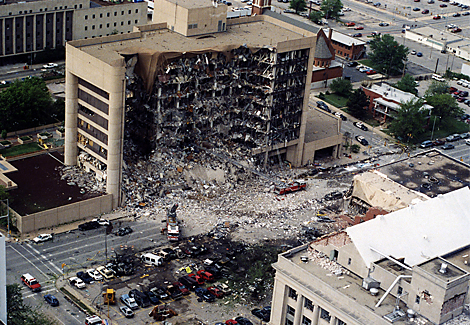
Twenty Years Later: Facts About the OKC Bombing That Go Unreported

mcveigh601

By Kevin Ryan

Source: Washington’s Blog

Next week will mark the 20th anniversary of the terrorist bombing of the Murrah Federal Building in Oklahoma City, which killed 168 people including 19 children. The mainstream media will undoubtedly focus its attention on Timothy McVeigh, who was put to death in June 2001 for his part in the crime. They might also mention Terry Nichols, who was convicted of helping McVeigh plan the bombing and is serving a life sentence without parole.

There will be less discussion about how the FBI spent years hunting for a man who witnesses say accompanied McVeigh on the day of the bombing. They called this accomplice John Doe #2 and theories about his identity range from an Iraqi named Hussain Al-Hussaini, to a German national described below, to a neo-nazi bank robber named Richard Guthrie. The Justice Department finally gave up its search and said it was all a mistake— that there was never any credible evidence of a John Doe #2 being involved.

That reversal demonstrates a pattern of cover-up by authorities and limited media coverage in the years since the crime. This week, accounts will not repeat early reports of secondary devices in the building, or reports of the involvement of unknown middle-eastern characters. There will also be little if any mention of the extensive independent investigation into the crime that was conducted by leading members of the OKC community. Here are seven more facts that will probably not see much coverage on the 20th anniversary.

  1. Attorney Jesse Trentadue began investigating the case after his brother Kenney was killed in prison, apparently having been tortured to death by the FBI in its search for John Doe #2. Trentadue’s investigation led to a federal judge nearly finding the FBI in contempt of court for tampering with a key witness. Trentadue now says, “There’s no doubt in my mind, and it’s proven beyond any doubt, that the FBI knew that the bombing was going to take place months before it happened, and they didn’t stop it.”
  1. Judge Clark Waddoups, who presided over the case brought by Jesse Trentadue, ruled in 2010 that CIA documents associated with the case must be held secret. These documents show that the CIA was involved in the OKC bombing investigation and the prosecution of McVeigh. This means that foreign parties were involved because the CIA is prohibited from interfering in purely domestic investigations.
  1. Andreas Strassmeir, a former German military officer, was suspected of being John Doe #2. Strassmeir became close friends with McVeigh and they were both associated with a neo-nazi organization located in Elohim City, OK. A retired U.S. intelligence official claimed that Strassmeir was “working for the German government and the FBI” while at Elohim City. Mainstream reports about the OKC bombing typically avoid reference to Strassmeir.
  1. Larry Potts was the FBI supervisor who was responsible for the tragedies at Ruby Ridge in 1992, and Waco in 1993. Potts was then given responsibility for investigating the OKC bombing. Terry Nichols claimed that McVeigh—who allegedly had been recruited as an undercover intelligence asset while in the Army—had been working under the supervision of Potts.
  1. Terry Yeakey, an officer of the OKC Police Department, was among the first to reach the scene and he was heralded as a hero for rescuing many victims. Yeakey was also an eyewitness to conversations and physical evidence that convinced him that there was a cover-up of the bombing by federal agents. Yeakey was committed to getting to the truth about what happened but a year after the bombing he was found dead off the side of a rural road. His death was ruled a suicide despite overwhelming evidence that he was murdered. Authorities reported that Yeakey, “slit his wrists and neck… then miraculously climbed over a barbed wire fence… walked over a mile’s distance, through a nearby field, and eventually shot himself in the side of the head at an unusual angle.” No weapon was found, no investigation was conducted, no fingerprints were taken, and no interviews were conducted. His family continues to fight for the truth about his death.
  1. Gene Corley, the engineer who was hired by the government to support its claims about the structural fire at the Branch Davidian complex in Waco, was brought in to investigate the destruction of the Murrah Building. Corley brought along three other engineers: Charles Thornton, Mete Sozen, and Paul Mlakar. Their investigation was conducted from half a block away—where they could not observe any of the damage directly—yet their conclusions supported the pre-existing official account. A few years later, within 72 hours of the 9/11 attacks, these same four men were on site leading the investigations at the Word Trade Center and the Pentagon.
  1. There are many other links between OKC and 9/11. For example, the alleged hijackers visited the OKC area many times and even stayed in the same motel that was frequented by McVeigh and Nichols. After both the OKC bombing and 9/11, building monitoring videos went missing, FBI harassment of witnesses was seen, and officials ignored evidence that did not support the political story. Additionally, numerous oddities link the OKC area to al Qaeda. In 2002, OKC resident Nick Berg was interrogated by the FBI for lending his laptop and internet password to alleged “20th hijacker” Zacarias Moussoui. Two years after this interrogation, Berg became world famous as a victim of beheading in Iraq. Investigators looking for clues about these connections will be particularly interested in two airports in OKC, the president of the University of Oklahoma, and the CIA leader who both monitored the alleged hijackers in Germany and was hired at the university just before 9/11.

On April 19, 2015, at the 20th anniversary of one of the worst terrorist attacks in history, citizens should be reminded that we don’t know what happened that day. We don’t know because officials have covered-up the crime for unknown reasons and most media sources will not challenge that cover-up.

FAA investigating Florida mailman’s landing of gyrocopter on U.S. Capitol lawn

1dfb9_1956

By Ben Montgomery

Source: Tampa Bay Times

Doug Hughes, a 61-year-old mailman from Ruskin, told his friends he was going to do it. He was going to fly a gyrocopter through protected airspace and put it down on the lawn of the U.S. Capitol, then try to deliver 535 letters of protest to 535 members of Congress.

The stunt seemed so outlandish that not even his closest friend thought he would pull it off.

“My biggest fear was he was going to get killed,” said Mike Shanahan, 65, of Apollo Beach, who works with Hughes for the Postal Service.

After 21/2 years of planning, Hughes came hovering low over the buildings of northeast D.C. about 1:20 p.m., like a distant bird. He rounded the Washington Monument a few minutes later, flew straight up the expanse of the National Mall and brought his small craft down right in front of the Capitol, where he was quickly surrounded by police and surrendered without incident.

The flight stunned police, Secret Service and witnesses. Authorities briefly shut down the Capitol as a security measure. The incident brought out dozens of reporters and cameras from national media outlets — exactly what Hughes had hoped for. Hughes, who sees himself as a sort of showman patriot, a mix of Paul Revere and P.T. Barnum, wanted to do something so big and brazen that it would hijack the news cycle and turn America’s attention toward his pet issue: campaign finance reform.

“No sane person would do what I’m doing,” Hughes told the Tampa Bay Times in the weeks before he took flight. He was doing it, he said, because the United States is “heading full-throttle toward a breakdown.”

“There’s no question that we need government, but we don’t have to accept that it’s a corrupt government that sells out to the highest bidder,” Hughes said.

It’s hard to say whether the message got through.

“I don’t think anyone noticed it,” said Sophia Brown, visiting Washington from England. “We noticed it, but nobody made a big deal about it.”

Richard Burns, 27, a worker at a marijuana lobby group in Washington, stood by the Capitol in wonder and solidarity.

“I don’t know whatever it was he was doing, but I support him,” Burns said.

Gil Wheeler, 53, a pilot from Las Vegas, said the biggest problem was how the letter carrier reached restricted airspace in the first place.

“This is just another question for Homeland Security,” Wheeler said. “We still have a lot of questions to ask.”

Late Wednesday, U.S. Capitol Police said Hughes had been arrested, charged under Title 49 of U.S. Code and processed at their headquarters. He was then transferred to the central cellblock in Washington. The FAA was investigating.

News reports said Secret Service agents were investigating at Gettysburg Airport, a small airport in Pennsylvania, where they believe Hughes took off.

Hughes didn’t know whether he would even make it. He imagined being shot down, blown down. Almost every scenario he could imagine involved some type of resistance. Barring that, he said: “They will put the cuffs on me. And they will try to establish who is behind this. . . . The authorities are going to be out to get me.”

His wife could not be reached for comment.

Hughes contacted a Tampa Bay Times reporter last year, saying he wanted to tell someone about his plan and motivation. He said he had no intention of hurting anybody and that he didn’t want to be hurt. By that time, he had already been visited twice by the Secret Service, he said.

The first visit, Hughes told the Times, came one night last spring at about 1 a.m. The agent was accompanied by a Hillsborough County sheriff’s deputy. In a statement issued to media outlets Wednesday, the Secret Service said it interviewed Hughes on Oct. 5, 2013, and that a “complete and thorough investigation was conducted.”

The Secret Service agent asked him questions about his plan, Hughes said, and he said he was honest in his replies, if not totally forthcoming with details. Yes, he did own a gyrocopter. Yes, he kept it in a hangar at the small airport in Wauchula. Yes, he had talked of doing something big to bring attention to the issue of campaign finance reform. No, he was not planning to crash into any buildings or monuments in Washington, D.C.

I’m not a violent person, Hughes remembers saying. All I want to do is draw attention.

Someone inside his circle of secrecy had reported him, telling the Secret Service that Hughes was talking about committing a daring act of civil disobedience that also happened to be a federal crime.

Two days later, Hughes said, the same agent showed up at the post office where Hughes works and asked more questions. One of Hughes’ colleagues told the Tampa Bay Times that he, too, answered questions from the Secret Service.

And then, for months, nothing. That was it, Hughes said. No other questions. No other contact. Hughes put his plan into action.

He bought a burner cell phone and a videocamera and tested a livestream video feed from his gyrocopter. He built a website offline that explained why he was doing this. He bought $250 worth of stamps and stuffed envelopes with his letter:

“I’m demanding reform and declaring a voter’s rebellion in a manner consistent with Jefferson’s description of rights in the Declaration of Independence,” he wrote in his letters. “As a member of Congress, you have three options. 1. You may pretend corruption does not exist. 2. You may pretend to oppose corruption while you sabotage reform. 3. You may actively participate in real reform.”

Late last week, he loaded the gyrocopter onto a trailer and headed for an undisclosed location outside the nation’s capital.

His livestream showed that he took off about 12:10 p.m. Wednesday. He intended to fly about 300 feet high, at 45 mph and wound up landing on the west lawn of the Capitol shortly before 1:30 p.m.

Hughes knew there was a risk he could be shot out of the sky, though he hoped it wouldn’t come to that.

“I don’t believe that the authorities are going to shoot down a 61-year-old mailman in a flying bicycle,” he said. “I don’t have any defense, okay, but I don’t believe that anybody wants to personally take responsibility for the fallout.”

In the end, his flight occurred without incident or escorts. The Times published a story about Hughes’ plans on its website, tampabay.com, shortly after noon when it was clear he had actually taken off and was attempting his flight. His livestream cut in and out but showed his progress. A Times reporter called the Secret Service in Washington, D.C., shortly before 1 p.m. to see if officials were aware of a man in a gyrocopter flying toward the capital. Public information officers there who did not give their names said they had not heard of the protest. They referred a reporter to Capitol Police. A public information officer did not immediately answer.

Sgt. Trina Hamilton in the watch commander’s office said: “He hasn’t notified anybody. We have no information.”

Hughes’ friend, Mike Shanahan, after receiving a call from Hughes early Wednesday, said he contacted a Secret Service agent and left a message but never heard back. Hughes had told his friend he was in Washington, Shanahan recalled. But when Shanahan tried to access the live-streaming website, he could not find it and was unsure if Hughes was really going to take flight.

Before his flight, Hughes said he knew what was at stake. He figured he’ll lose his job of 11 years. And he could lose his tidy little house across from a pond with a fountain. He knew he would lose his freedom. That means losing, at least temporarily, his Russian-born wife and his polite 12-year-old daughter who plays the piano and wins awards at the science fair. He kept them in the dark, he said, for fear they’d be implicated.

Hughes is a slender, soft-spoken, pedantic man, with thinning gray hair and hearing aids. He has no criminal record and it’s rare to hear him curse. But he said he needed the show, the very dramatic public act of civil disobedience, to focus the nation’s attention on campaign finance reform, a topic that in most quarters makes eyes glaze over. Money, he says, has corrupted the democracy.

At the root of Hughes’ disdain is the Supreme Court’s 2010 decision in Citizens United vs. Federal Election Commission, in which the court decided campaign contributions were a form of “political speech” and struck down limits on how much corporations and unions could give to political contenders. The decision changed the game. Campaign spending went through the roof. In Hughes’ mind, there was a parallel spike in favor-dealing and the government is now practically owned by the rich. Hughes likes to point out that nearly half the retiring members of Congress from 1998 to 2004 got jobs as lobbyists earning some 14 times their congressional salaries.

But nobody seems to care.

Hughes thinks the answers are out there, and they’re nonpartisan. He points to reform thinkers like political activist Cenk Uygar and Harvard legal theorist Lawrence Lessig, who launched a political action committee to end political action committees. The motto: “Embrace the irony.”

“I’m not promoting myself,” Hughes said a few weeks ago. “I’m trying to direct millions of people to information, to a menu of organizations that are working together to fix Congress.”

His idea began to blossom 2½ years ago, after his son, John Joseph Hughes, 24, committed suicide by driving his car head-on into another man, killing them both. “Police: Suicidal driver caused deadly crash,” read the headline in the Leesburg newspaper. He was crushed by grief, and disappointed that his son had killed himself — and someone else — to make a stupid, worthless point.

“Something changed in me,” Hughes said. With mourning came a realization. The years Hughes spent thinking about and writing about mundane political issues were for naught if he didn’t have a way to make a point. His political frustrations and grief merged. He doesn’t condone what his son did, but it offered a lesson.

“He paid far too high a price for an unimportant issue,” Hughes said. “But if you’re willing to take a risk, the ultimate risk, to draw attention to something that does have significance, it’s worth doing.”

He has always wanted to fly. Growing up in Santa Cruz, Calif., he used to ride his bike to Sky Park and watch the planes come and go, and read books about the Wright brothers and Kitty Hawk.

At first he thought about using an ultralight fixed-wing plane, but that felt too threatening. He finally found the gyrocopter, which has unpowered helicopter blades on top for lift but gets its thrust from a propeller on the back. The cockpit, if you can call it that, is wide open. “This is as transparent a vehicle that I could come up with,” Hughes said. “You can literally see through it.” He can land the craft in a space the size of half a basketball court.

Hughes told the Times he planned to set up a delayed email blast to alert as many TV and newspaper breaking news desks as he could find, as well as the Secret Service.

The Secret Service statement said it did not receive notification of the flight. Several reporters told the Times they received the email. The Times reported about Hughes’ flight on Twitter and Facebook as it was happening, but most media attention came after his landing at the Capitol. His website went up as scheduled, which broadcast a choppy livestream of his trip.

His biggest fear all along, he said, was losing his nerve.

“I have thought about walking away from this whole thing because it’s crazy,” he said. “But I have also thought about being 80 years old and watching the collapse of this country and thinking that I had an idea once that might have arrested the fall and I didn’t do it.

“And I will tell you completely honestly: I’d rather die in the flight than live to be 80 years old and see this country fall.”

Times staff writers Zachary T. Sampson and Lauren Carroll and researcher Caryn Baird contributed to this report.


This is the text of the letter that Doug Hughes wants to deliver to members of Congress:

Dear ___________,

Consider the following statement by John Kerry in his farewell speech to the Senate —

“The unending chase for money I believe threatens to steal our democracy itself. They know it. They know we know it. And yet, Nothing Happens!” — John Kerry, 2-13

In a July 2012 Gallup poll, 87% tagged corruption in the federal government as extremely important or very important, placing this issue just barely behind job creation. According to Gallup, public faith in Congress is at a 41-year record low, 7%. (June 2014) Kerry is correct. The popular perception outside the DC beltway is that the federal government is corrupt and the US Congress is the major problem. As a voter, I’m a member of the only political body with authority over Congress. I’m demanding reform and declaring a voter’s rebellion in a manner consistent with Jefferson’s description of rights in the Declaration of Independence. As a member of Congress, you have three options.

1. You may pretend corruption does not exist.

2. You may pretend to oppose corruption while you sabotage reform.

3. You may actively participate in real reform.

If you’re considering option 1, you may wonder if voters really know what the ‘chase for money’ is. Your dismal and declining popularity documented by Gallup suggests we know, but allow a few examples, by no means a complete list. That these practices are legal does not make them right! Obviously, it is Congress who writes the laws that make corruption legal.

1. Dozens of major and very profitable corporations pay nothing in taxes. Voters know how this is done. Corporations pay millions to lobbyists for special legislation. Many companies on the list of freeloaders are household names — GE, Boeing, Exxon Mobil, Verizon, Citigroup, Dow …

2. Almost half of the retiring members of Congress from 1998 to 2004 got jobs as lobbyists earning on average fourteen times their Congressional salary. (50% of the Senate, 42% of the House)

3. The new democratic freshmen to the US House in 2012 were ‘advised’ by the party to schedule 4 hours per day on the phones fund raising at party headquarters (because fund raising is illegal from gov’t offices.) It is the donors with deep pockets who get the calls, but seldom do the priorities of the rich donor help the average citizen.

4. The relevant (rich) donors who command the attention of Congress are only .05% of the public (5 people in a thousand) but these aristocrats of both parties are who Congress really works for. As a member of the US Congress, you should work only for The People.

1. Not yourself.

2. Not your political party.

3. Not the richest donors to your campaign.

4. Not the lobbyist company who will hire you after your leave Congress.

There are several credible groups working to reform Congress. Their evaluations of the problem are remarkably in agreement though the leadership (and membership) may lean conservative or liberal. They see the corrupting effect of money — how the current rules empower special interests through lobbyists and PACs — robbing the average American of any representation on any issue where the connected have a stake. This is not democracy even if the ritual of elections is maintained.

The various mechanisms which funnel money to candidates and congress-persons are complex. It happens before they are elected, while they are in office and after they leave Congress. Fortunately, a solution to corruption is not complicated. All the proposals are built around either reform legislation or a Constitutional Amendment. Actually, we need both — a constitutional amendment and legislation.

There will be discussion about the structure and details of reform. As I see it, campaign finance reform is the cornerstone of building an honest Congress. Erect a wall of separation between our elected officials and big money. This you must do — or your replacement will do. A corporation is not ‘people’ and no individual should be allowed to spend hundreds of millions to ‘influence’ an election. That much money is a megaphone which drowns out the voices of ‘We the People.’ Next, a retired member of Congress has a lifelong obligation to avoid the appearance of impropriety. That almost half the retired members of Congress work as lobbyists and make millions of dollars per year smells like bribery, however legal. It must end. Pass real campaign finance reform and prohibit even the appearance of payola after retirement and you will be part of a Congress I can respect.

The states have the power to pass a Constitutional Amendment without Congress — and we will. You in Congress will likely embrace the change just to survive, because liberals and conservatives won’t settle for less than democracy. The leadership and organization to coordinate a voters revolution exist now! New groups will add their voices because the vast majority of Americans believe in the real democracy we once had, which Congress over time has eroded to the corrupt, dysfunctional plutocracy we have.

The question is where YOU individually stand. You have three options and you must choose.

Sincerely,

Douglas M. Hughes

http://www.TheDemocracyClub.org