The Problem With Progressives Defending What Clinton Said In Hacked Audio

DEM_2016_Clinton.JPEG-19e1f_c0-266-3500-2306_s885x516

By Kevin Gosztola

Source: ShadowProof

Early in the Democratic presidential primary, Hillary Clinton’s campaign, including her network of super political action committees, spread dishonest attacks about Bernie Sanders and his supporters routinely. Which is part of what makes the progressive response to the hacked audio of Clinton at a private fundraiser in February remarkable.

The fundraiser, as The Intercept reported, was hosted by “Beatrice Welters, the former U.S. ambassador to Trinidad and Tobago, and her husband Anthony Welters, the executive chairman of an investment consulting firm founded by former Clinton aide Cheryl Mills.” Clinton offered donors her thoughts on what made a “political revolution” appealing to millennials.

“Some are new to politics completely. They’re children of the Great Recession. And they are living in their parents’ basement. They feel they got their education and the jobs that are available to them are not at all what they envisioned for themselves,” Clinton suggested. “And they don’t see much of a future.”

Clinton maintained it was not a good idea to tell idealistic people, particularly young people, that they bought into a “false promise.” So, it was up to politicians like her to say there is another way to make progress that can actually produce achievements because Sanders doesn’t know how to achieve the plans he promoted.

What she said sparked a backlash on social media, particularly from supporters of Sanders who have not forgiven Clinton and the Democratic National Committee for how they conspired to rig the primary process against Sanders. But the campaign’s response to this backlash was swift.

Clinton spokesperson Glen Caplin told The Washington Post, “As Hillary Clinton said in those remarks, she wants young people to be idealistic and set big goals. She is fighting for exactly what the millennial generation cares most about – a fairer more equal, just world. She’s working to create new pathways to jobs and career opportunities, to build more inclusivity and community, and to ensure everyone gets a fair shot.”

“She believes that the most diverse, open-minded generation in history wants their voice heard in this election and that’s why she worked with Senator Sanders on a plan to provide students with debt-free college, and it’s why she’s traveling the country listening to their concerns and talking about not only what’s at stake in this election, but her plan for the generation.”

Sanders admitted he was “bothered” by Clinton’s remarks but stated on CNN, “I agree with her,” and, “There are young people who went deeply into debt, worked very hard to get a good education, and yet they are getting out of school, and they can’t find decent-paying jobs. And that’s a major problem. They are living in their parents’ basements.”

“We’re in the middle of a campaign. And I—trust me. If you go to some of the statements that I made about Hillary Clinton, you can see real differences. So we have differences. There’s nothing to be surprised about. That’s what a campaign is all about.”

Liberal pundit and Vox.com editor-in-chief Ezra Klein praised the comments as an example of the “audacity” of Clinton’s “political realism.”

“Her persistent theme is the danger of overpromising, and the difficult work of persuading voters — particularly young ones — to stick around for the slow, grinding work of change. Her rallying cry is that modest victories can add up, over time, to something much grander,” Klein argued.

One of the more obnoxious efforts to defend Clinton came from Michael Tomasky over at The Daily Beast. He was upset that he had to stop watching golf and football and write about this latest uproar among the “far left.”

“Of all the arrant bullshit I’ve seen on Twitter this election, this is easily the bullshittiest. She insulted no one,” Tomasky proclaimed. “In fact, quite the opposite—for someone speaking behind closed doors to ardent supporters, she was not only restrained, but she openly and directly asked her supporters to be patient with the impatient; that is, to understand the views and motivations of the younger people who wanted more radical change.”

According to Tomasky, people should celebrate Clinton for being “restrained” because the political class usually is less guarded when expressing contempt for the left. Except, it is not like Clinton made this statement because she is some kind of scholar interested in anthropology or social sciences. She wasn’t didactically exploring the finer points of what drives cultures or demographics to protest certain conditions in communities. She was speaking to a room full of rich people, probably from the top 15 percent, who were reasonably terrified at the time that Clinton would not be a strong enough candidate to survive an upswell of left-wing populist anger.

In February, when Clinton made these remarks to her donors, Sanders had raised more money than Clinton and the polls going into the Nevada caucus were close. The media’s major takeaway from that month’s debate was that Clinton painted  Sanders’ plans as unrealistic.

It simply is not true that she was not insulting anyone. If one listens to the recording, it is clear Clinton was working the room. “I mean, I’m still trying to understand the revolution part. Because here’s how I think about it,” she said. Donors giggled and chuckled. She played to them.

Clinton played to her rich donors again when she said:

…[T]here’s just a deep desire to believe that we can have free college, free healthcare, that what we’ve done hasn’t gone far enough, and that we just need to, you know, go as far as, you know, Scandinavia, whatever that means, and half the people don’t know what that means, but it’s something that they deeply feel.

A transcript does not communicate the sarcasm or derisiveness of Clinton’s comment, but when she said “whatever that means,” it was not an example of empathy and understanding. She wholly rejected the idea that the government should move toward social programs like Medicare For All and free public college tuition. She was engaged in a kind of humor that would go over well at the annual Conservative Political Action Conference or CPAC.

The same month Clinton made the recorded comments, her campaign recruited a black congressman, South Carolina Representative Jim Clyburn, to be the face of opposition to Sanders’ college plan and gin up controversy by suggesting it would doom historically black colleges.

Clyburn said, “[If] you start handing out two years of free college at public institutions are you ready for all the black, private HBCUs to close down? That’s what’s going to happen.”

The Democratic presidential nominee only worked with Sanders on a plan for “debt-free college” when her campaign and the Democratic National Committee were terrified Sanders supporters would not fall in line at the national convention in Philadelphia. Clinton’s campaign needed to support a few aspects of the “political revolution” to make it appear it was worthwhile to vote for her (even if she never meaningfully pursues these agenda items as president because she doesn’t really believe in them).

Is it really audacious to stand tall and insist the status quo is unalterable? Or to cast doubt whether Sanders and young people really have all the answers on how to transform the system to work for the 99 percent instead of only the top one percent?

Clinton wants people to be idealistic but not too idealistic. Her message is that older generations, who are part of the political class, need to determine what change is and is not achievable. Set the goals. Then, convince millennials these goals are achievable unlike their idealistic vision for revitalizing the country, which Sanders inspired them to support.

It makes little sense for Sanders or any of his supporters to say they agree with Clinton. Her assessment is not born out of a genuine interest in making the “political revolution” possible. It is born out of an interest in managing anger, co-opting energy, and steering action into policy plans that the Democrats are comfortable advancing for the purposes of pure politics—for touting during campaigns against Republicans.

That does not bode well for the Sanders agenda if she is elected president, but the bigger question is whether the coalition that made up the backbone of the “political revolution” will show enough solidarity and have the courage to make clear demands of Clinton as president.

It is one thing to encourage others to hold their nose and vote for Hillary Clinton because she is the lesser of two evils and Donald Trump is one massive evil that this country must not elect. It is quite another thing to downplay, misrepresent, justify, and ignore the truth of what Clinton stood for or pretend the fact Sanders and her are “collaborating” means she’s had some change of heart.

Clinton is still the same politician, who will not support a ban on fracking and who hawkishly supported bombing Libya. She is the same politician, who fervently opposed Medicare For All and still does not support a $15 federal minimum wage. Yet, it seems no matter how often corporate Democrats undermine progressive action or populist reforms, there are always enough progressives willing to excuse this action and even praise the calculated way in which Democrats play politics and punch down at the left.

Stop Trump! Stop Clinton! Stop the Madness (and Let Me Off)!

869b45d356923d7150751daa3504016c

Source: Stop Imerialism

“That’s the real issue this time,” he said. “Beating Nixon.  It’s hard to even guess how much damage those bastards will do if they get in for another four years.”

The argument was familiar, I had even made it myself, here and there, but I was beginning to sense something very depressing about it.  How many more of these goddamn elections are we going to have to write off as lame, but “regrettably necessary” holding actions?  And how many more of these stinking double-downer sideshows will we have to go through before we can get ourselves straight enough to put together some kind of national election that will give me and the at least 20 million people I tend to agree with a chance to vote for something, instead of always being faced with that old familiar choice between the lesser of two evils?

Now with another one of these big bogus showdowns looming down on us, I can already pick up the stench of another bummer.  I understand, along with a lot of other people, that the big thing this year is Beating Nixon.  But that was also the big thing, as I recall, twelve years ago in 1960 – and as far as I can tell, we’ve gone from bad to worse to rotten since then, and the outlook is for more of the same.

—Hunter S. Thompson, Fear and Loathing: On the Campaign Trail ’72


Another bummer indeed. It’s been nearly four and a half decades since His Majesty, Dr. Gonzo, wrote those words…and my oh my has the rot turned putrid, the stench overwhelming.

Were it only the fact that a corporate imperialist sociopath and a raving pseudo-fascist gasbag are competing to become the Murderer-in-Chief, one could simply retreat to the friendly confines of the Hobson’s Choice Inn.  There, among the carpets and curtains carrying the stains of elections past, one would watch the political circus in peace while doing the work of organizing against both Tweedle Bum and Tweedle Bummer.

But this time, there’s something even more sinister afoot, something far worse than mere cardboard cutouts in formal dress. No, this time it’s the pompous arrogance and vacuous prattling of “leftists,” “anti-imperialists,” and other assorted mental contortionists doing their damnedest to browbeat everyone within earshot (eyeshot?) that THIS TIME it’s important!

“How can you sit aside so smug and allow the fascist Trump to win? You’re being irresponsible,” they chirp.

“How can you attack Trump and let the Warmongering Witch of the West become President? You know what she’ll do,” they drone.

And the response to the denizens of both camps remains the same: If you’re not opposing both Janus faces of Dillary Crump while working to guillotine the many-headed hydra of the ruling class, then what the hell are you really doing?  Oh, right, I forgot – this is all “strategic,” it’s about avoiding a calamity by accepting a disaster.  I’m sure the children of Libya or Muslim-American and Mexican-American immigrants will understand as they are crushed under the bus beneath which they were thrown by a “progressive left” so quick to speak for them.

But perhaps it might be useful for the Left, of which I consider myself a part, to reflect on just what the sort of ‘sophisticated’ and ‘pragmatic’ politics of lesser evilism hath wrought: the continued evisceration of the working class by both the red team and blue team of the single ruling party, perpetual war for profit and Empire, an immutable rightward drift that makes Richard Nixon look like Eugene Debs, and a parasitical ruling class of finance capital whose greatest trick has been convincing the people that it doesn’t rule them.

And where are the victories?  What can we point to as the great breakthrough justifying the tactical vote?  [crickets]…[a single tumbleweed rolls along an empty desert landscape]

Have we seen anything but an acceleration of the worst aspects of imperialism and capitalism?  The climate is in crisis and we’re told by leftist royalty like the great Noam Chomsky that we should vote for Clinton because she at least recognizes the peril of climate change while Trump wants to put a lump of coal in Pachamama’s stockings.  But the obvious question then becomes: so what?

So what Clinton pays lip service to the global threat? She was an ardent supporter of the “All of the above” energy policy of Obama while promoting fracking around the world, taking massive campaign donations from energy industry lobbyists, and tacitly supporting the construction and expansion of the Keystone XL pipeline until it became politically untenable (thanks in no small part to the Bernie Sanders campaign).  And, of course, who could forget the votes she cast in support for expanded offshore oil drilling in the Gulf of Mexico, a shameful vote which directly contributed to the Deepwater Horizon spill in 2010.

I suppose the question should be asked of Chomsky: Is a begrudging vote for Hillary to be cast solely on the grounds of her having appropriately progressive and focus-grouped talking points?  It seems that’s just about the size of it. So then the inevitable follow-up question would be: Why f*cking bother rewarding her for knowing the importance of lying well?

And how about that pesky little World War III problem?  I can almost hear the “Oh, don’t exaggerate…Hillary doesn’t want to start a war with nuclear-armed Russia” cries from the tastemakers of the liberal unintelligentsia.  Well, let’s allow the Queen of Chaos to speak for herself.  In a raving, Strangelovian speech given before the mouth-breathing jingos of the American Legion, Clinton explained:

We need to respond to evolving threats, from states like Russia, China, Iran and North Korea…We need a military that is ready and agile so that it can meet the full range of threats — and operate on short notice across every domain — not just land, sea, air, and space, but also cyber space…You’ve seen reports — Russia has hacked into a lot of things, China has hacked into a lot of things — Russia even hacked into the Democratic National Committee! Maybe even some state election systems, so we’ve gotta step up our game…Make sure we are well defended and able to take the fight to those who go after us. As president I will make it clear that we will treat cyberattacks just like any other attack…We will be ready with serious political, economic, and military responses.

Did anyone else feel a shiver run down their spine, as I did?  Clinton literally advocates for war with Russia, arguing that a cyberattack which may, or may not, have originated in Russia be treated as an act of war.  Nuclear-armed Russia should expect a military response from the United States over allegations of hacking?  It’s sort of a pot calling the kettle black and trying to smash it with a goddamn sledgehammer kind of situation.

Now, of course, there are plenty of good people on the Left – Adolph Reed, Noam Chomsky, Arun Gupta, and many others – arguing that Clinton is a necessary evil to block Trump from bringing to fruition a full-fledged fascist movement that would have dire ramifications for social justice movements.  And there is undeniably an element of truth in that.

However, the wisdom of the logic relies on a false premise: Trump represents an existential threat while Hillary does not.  This basic assumption is undeniably flawed as global war with countries like Russia and China is indeed one of the great threats to humanity; this is precisely what Clinton’s belligerent foreign policy leads toward.  And there was a time when anti-war still was synonymous with Left activism.  What happened that we are now told that the pro-war position is necessary in order to stop, er, um, fascism?  How far we’ve fallen.

Trump: The Fascist “Anti-Imperialist”

In the unending search for the most imbecilic political logic, one comes across that rare breed of obtuse ignoramus who suggests that Trump is the anti-imperialist’s choice.  If that word has any meaning left today – something that is very much open for debate given recent developments – its application to Donald Trump is about as appropriate as referring to Clinton as the anti-fascist’s choice.

Trump doesn’t mean no more imperial wars; he simply means no more pretending our wars aren’t imperial.  He’s not for ending the wars, but rather fighting them with the nakedly neo-colonial intentions made overt that Clinton would only secretly share over candlelit dinners with Huma Abedin, Madeleine Albright, and Mephistopheles.  With people like Walid Phares, Michael Flynn, and Keith Kellogg as advisers, Trump will retain a pro-Israel imperial policy in the Middle East while advocating for NATO’s expanded mission of counter-terrorism.  Oh, excuse me, Trump wants Denmark to pay “it’s fair share” of NATO costs – pardon me while I release to the heavens a flight of doves in his honor.

What anti-imperialist isn’t enamored with a candidate who calls for a full military invasion of Syria and Iraq? And, of course, there’s no connection whatever between imperialism, colonialism and white supremacy, right?  Trump can spout the most virulently racist filth heard in US politics since George Wallace and Barry Goldwater went on a Tinder date to the Old Ebbitt Grill, and yet these anti-imperial mannequins swear up and down that Trump is an enemy of the Empire.  Even his complimentary reach-around to Bibi Netanyahu isn’t enough to shake the cobwebs from the faux anti-imperial noodleheads of the commentariat. Sigh.

And so, where does this leave us on the Left?  Everyone wants to bludgeon leftists into supporting Clinton to stop Trump using the familiar cudgel of “necessary evil”, while offering little to no additional direction other than “once the election is over we will…”  Yeaaaaaah, that’s worked out well for us thus far.

Others secretly root for Trump to upset the apple cart and open a space for the Left, conveniently forgetting that the Left remains a fractured and disunited bloc while the fascist right grows in strength and organization every day.  And commentators of the Left rush to tell their readers and fellow travelers that THIS or THAT is what they should do.

I’ve got an idea. How about we take a breath, drink/smoke/snort something nice and strong, close our eyes and listen close to hear the echoes of Dr. Gonzo reverberating off the walls of the Left echo chamber:

Life has become immeasurably better since I have been forced to stop taking it seriously.

Or, if that’s just too droll:

In a world of thieves, the only final sin is stupidity.

Killing Democracy by a Thousand Cuts

illusionofvote

By Jim Heddle and Mary Beth Brangan

Source: FreePress.org

How are our votes being stolen? Let us count the ways…

Electoral Proctology

As the fateful June 7 primary election day approached in 6 states, including California, a stellar group of election protection luminaries gathered on Memorial Day weekend in a private home in Santa Monica with about 100 of their closest friends.  Their purpose, as that great American philosopher W.C. Fields once advised, was ‘to seize the bull by the tail and stare the situation squarely in the face.’

[ See videos of the meeting: Don’t Let Them Steal Your Vote –  Part 1https://youtu.be/Pax4z8AuGTU

Part 2  https://youtu.be/jF0Eab9wKQc  ]

Not a Pretty Picture

Chaired by movie star and long-time political activist Mimi Kennedy, a panel including Harvey Wasserman, Bob Fitrakis, Greg Palast, Bev Harris and John Blakey compared notes on the myriad methods their investigations have uncovered that are destroying the validity of U.S. elections. Facing these facts is the first step in the daunting task of restoring election integrity in America’s very broken electoral system.

In this year’s primary season alone we have seen:

·         Massive disenfranchisement caused by arbitrarily changing voters’ assigned precincts and then giving incorrect information on the changes.

·         Chaos caused in predominately minority districts by reducing the number of precincts  – and the number of machines per precinct – causing long lines and hours-long waits which turned away many voters with jobs or other time commitments.

·         Arcane regulations which instructed poll workers to give unprecedented numbers of voters ‘provisional ballots,’ which are rarely counted.

·         For example, in California, voters who registered ‘NPP’ for No Party Preference and were mailed a ballot, were not permitted to vote in the Democratic primary unless they took both the ballot and its envelope to a polling place and said the magic words, “I surrender this ballot and request a cross-over ballot.” Without those exact words, poll workers were instructed not to supply a ‘cross-over’ ballot AND not to inform the voter of the rule.

·         Media outlets prematurely calling elections before all ballots are counted – or, in some cases, even cast.

·         As of this writing, 2.6 million ballots yet to be counted for the California primary

But it gets worse.

Strip & Flip

The theme of the Santa Monica panel was set by a hot-off-the-press book just published by Fitrakis and Wasserman titled ‘The Strip & Flip Selection of 2016: The Five Jim Crows & Electronic Election Theft.’  [ Get it here: http://freepress.org/store.php ] This is the latest in a string of books the team has written in the last decade.  They have had a ringside seat to both observe – and also fight against – the increasing corruption of the U.S. electoral system, based, as they are in Columbus, Ohio, capitol of a key swing state.  In 2012, Fitrakis’s threatened lawsuit in Ohio state court prevented the planned electronic theft of the election and saved Obama’s election victory.

[See “Swing State: How the Fix Was Nixed in Ohio 2012”   https://www.youtube.com/watch?v=10qwtBlHeTY ]

Election Theft, as American as Apple Pie

Intentional disenfranchisement of potential voters in order to favor selected demographic sectors is simple in concept, if complex in means. It has been a part of the American electoral landscape from the git-go.  Eliminating legitimate voters from the voter rolls by various tactics – that’s the ‘strip’ part.  Skewing the ballot count in order to produce desired outcome percentages – that’s the ‘flip’ part – also achieved by multiple mechanisms, as we shall see.

“Not every conspiracy is a theory.”

The ad slogan for the current thriller ‘Money Monsters’ actually gets it right. Though poo-pooed as ‘conspiracy theory’ by pundits and vote fraud denialists across the political spectrum, Bob & Harvey’s work – in combination with the work of many other investigator/activists including co-panel members Bev Harris, Greg Palast,, Mimi Kennedy and John Blakey – has incontrovertibly revealed the plethora of means by which America’s electoral system has now been stripped of the last vestiges of whatever trustworthiness it may have ever actually possessed.

A short run down follows – to be expanded upon below – of issues discussed by the panel.

But, keep in mind that, for brevity, the list does not include additional key related issues, such as: unlimited campaign spending by anonymous persons and non-voting corporate entities and their surrogates – even from foreign states or agents; mainstream media’s biased reporting; manipulations by party officials; ‘super delegate’ and ‘contested convention’ schemes; the counter-democracy Electoral College; or the ‘gerrymandering-on-steroids’ REDMAP redistricting process carried out by Republicans following the 2010 election, which left them in control of the House of Representatives and many key state legislatures until at least 2020, when the next census-based re-districting is scheduled.  The latter major ploy is well documented in David Daley’s recent book “Rat F**ked: The True Story Behind the Secret Plan to Steal America’s Democracy.”)

Here’s the short list from the Santa Monica panel presentations:

·         Massive electronic purging of legitimate voters from voter rolls across the country

·         Massive vote suppression and disenfranchisement by myriad means on a national scale

·         Virtually decisive control of voter rolls without detection; vote counting and reporting by privately owned, secret, electronic devices and computer programs specifically designed to steal elections through cyber chicanery.

The Five Jim Crows

It all started with the constitution, Wasserman explained, a document drafted in secret, behind closed doors by a tiny elite of propertied white men, and rammed through to ratification by the states through electoral manipulation.   It denied voting rights to women and to males without property, but contained the “3/5ths clause” that gave slave owners congressional representation for their slaves despite the fact that the slaves themselves couldn’t vote.

The so-called Three-Fifths Compromise is in Article 1, Section 2, Paragraph 3 of the United States Constitution:

Representatives and direct Taxes shall be apportioned among the several States which may be included within this Union, according to their respective Numbers, which shall be determined by adding to the whole Number of free Persons, including those bound to Service for a Term of Years, and excluding Indians not taxed, three fifths of all other Persons.

The effect, according to Wikipedia, “was to give the southern states a third more seats in Congress and a third more electoral votes than if slaves had been ignored, but fewer than if slaves and free persons had been counted equally, allowing the slaveholder interests to largely dominate the government of the United States until 1861.”  https://en.wikipedia.org/wiki/Three-Fifths_Compromise

It was also a divide-and-conquer strategy to make sure black and white laborers would never again unite in revolting as they did in Virginia in 1675 in what’s called Bacon’s Rebellion.

Fitrakis and Wasserman call that ‘the First Jim Crow.’  After the Civil War and emancipation, they explain, Supreme Court rulings, KuKluxKlan terror, black lynchings, literacy tests and other apartheid strategies established the ‘Second Jim Crow,’ that “again guaranteed that blacks in the South (and parts of the North) would not be allowed to vote, and that they would be carefully divided from whites by caste as well as class.”

The Third Jim Crow was/is the ‘War on Drugs’ initiated by Richard Nixon to combat the liberalization of the southern Democratic Party, the anti-war movement and the rise of the Black Power movement.  As Nixon administration official John Erlichman recently explained to Harper’s interviewer Dan Blum,

“The Nixon campaign in 1968, and the Nixon White House after that, had two enemies: the antiwar left and black people. You understand what I’m saying? We knew we couldn’t make it illegal to be either against the war or black, but by getting the public to associate the hippies with marijuana and blacks with heroin, and then criminalizing both heavily, we could disrupt those communities. We could arrest their leaders, raid their homes, break up their meetings, and vilify them night after night on the evening news. Did we know we were lying about the drugs? Of course we did.”  https://harpers.org/archive/2016/04/legalize-it-all/

Young, left-leaning Latinos were also caught up in the Drug War dragnet.  Now, 45 years later, 41 million (mostly people of color) have been jailed for pot and other controlled substances, making private corporate prisons a growth industry, and giving the U.S. the highest prison population in the world.  Though having no significant impact on drug use, the Drug War has disenfranchised millions of potential voters, and continues to do so today.  Michelle Alexander’s recent book The New Jim Crow: Mass Incarceration in the Age of Colorblindnessshows how one system of race-based disenfranchisement has been replaced by another.  http://newjimcrow.com/

The Fourth Jim Crow, explain the authors, was born of America’s push to establish what they call “a race-based global empire” with a long series of foreign interventions – also continuing today – which “involved the white-ruled US interfering with the political systems of non-white nations.”

The impact of these interventions on our own political system, say Wasserman and Fitrakis, has been catastrophic. “They’ve established the US as a corporate-ruled race-based empire, fueling the growth of a military whose intrinsic power overshadows our entire electoral process…and set the stage for…the Fifth Jim Crow – the electronic flipping of our elections.”

Engineering Vote Fraud Abroad Comes Home to Roost

Manipulation of election outcomes in other countries has been developed into a high art by such US agencies as the CIA, USAID and other so-called ‘democracy promotion’ projects fielded abroad by both the Republican and Democratic parties.

Note the authors, “Overseas, the CIA began to apply advanced electronics to the art and science of election theft.  By the 1970’s, in front of the Church Committee, the Agency admitted to already having manipulated countless Third World elections to protect America’s corporate and ‘national security’ interests.”  They trace the subsequent development of electronic voting technology techniques, corporations and institutions up to the present day, when up to 80% of US votes in the coming presidential election will be electronically mediated.  In line with the adage that ‘what goes around, comes around,’ American expertise in foreign nations’ electronic vote rigging has now come home to compromise the integrity and validity of our own system, big time.

The New Jim Crow – “Interstate Crosscheck”

Panel member investigative journalist Greg Palast has been researching and reporting on this process for going on two decades for such outlets abroad as the BBC and the Guardian news paper.  Still, like the proverbial ‘prophet without honor in his own country,’ Palast states with deep frustration that he still has a hell of a time getting American so-called ‘mainstream’ media to pay any attention to his explosive exposes. http://www.gregpalast.com/

Now reporting for Rolling Stone, he is also using crowd funding to produce a forth-coming documentary titled, The Best Democracy Money Can Buy: A Tale of Billionaires and Ballot Bandits https://www.youtube.com/watch?v=kg2gCgFMBOg

In his presentation in Santa Monica Palast debunked claims by Donald Trump and others that ‘millions of people’ are committing ‘voter fraud’ by ‘voting more than once.’  Describing what he calls ‘the next, or Sixth Jim Crow,’  he reported that 29 state election officials across the country have announced the creation of what they call ‘The Interstate Crosscheck.’  Touted as a defense against mythical individual ‘voter fraud’ the system purports to identify people who are voting more than once, sometimes in multiple states, and purge them from polling lists.

In actuality, in violation of the Voting Rights Act, says Palast, the program uses census data to identify African American voters – tagged ‘BLA’ for black– with similar common names and fraudulently remove them from voter lists.

In the history of the South, when slaves were finally freed, they were often registered by their masters’ surnames.  As a result, to this day, many black persons carry the same or similar names, thus facilitating the “Interstate Crosscheck” scam.

Based on his findings, Palast says, “We expect 1 million voters – almost all of them voters of color – to lose their right to vote in 29 Republican-controlled states before the November election.”

But, he is quick to point out, it isn’t just Republicans who regularly mess with elections.  As questionable outcomes in this primary suggest, “the Democrats are dirty,” Palast says, pointing out that Democrats invented Jim Crow, which Nixon just adopted for his so-called ‘southern strategy.’

Palast admits to being tired of being a ‘reporter in exile,’ and hopes that, now that he is reporting for Rolling Stone, he can finally come home and report his investigative findings to his own countrymen “who need to know this stuff!”

“Fraction Magic” – A Digital Thumb on the Scale: Fractionalization & Decimalization of Votes

Harking back to the infamous “3/5ths clause” described above, what if you were hired to write a vote-counting program that could assign various arbitrary decimal or fractional values to each and all of the votes counted and come up with desired percentages for every candidate and contest?

To use a simple-minded butcher’s scale analogy: What if your program assigned a vote for Hillary the arbitrary ‘weight’ of 2 pounds, and assigned a Bernie vote just a weight of 1 pound?

Then, in a given race, Bernie got 200 votes and Hillary got 150 votes.

If you just added up the total votes for each candidate, you would call the election for Bernie with a 50-vote lead.

But, if your private, proprietary, secret counting program totaled their votes by the artificial ‘weights’ it arbitrarily assigned to them, you would announce Hillary the winner with a 300 to 200-vote lead.

That, ladies and gentlemen, is the intentionally programed ‘glitch’ that BlackBoxVoting.org founder Bev Harris and her colleague, IT expert Bennie Smith have discovered in a significant number of America’s vote counting systems. It is achieved via ‘fractionalization’ or ‘decimalization.’

They explain that it works like this: “Instead of “1” the vote is allowed to be 1/2,  or 1+7/8, or any other value that is not a whole number.”

That allows ‘weighting’ of selected electoral contests. “Weighting a race removes the principle of ‘one person-one vote’ to allow some votes to be counted as less than one or more than one. Regardless of what the real votes are, candidates can receive a set percentage of votes. Results can be controlled. For example, Candidate A can be assigned 44% of the votes, Candidate B 51%, and Candidate C the rest.”

On her excellent webite BlackBoxVoting.org, Harris and Smith report,

…the results of our review of the GEMS election management system, which counts approximately 25 percent of all votes in the United States. The results of this study demonstrate that a fractional vote feature is embedded in each GEMS application which can be used to invisibly, yet radically, alter election outcomes by pre-setting desired vote percentages to redistribute votes. This tampering is not visible to election observers, even if they are standing in the room and watching the computer. Use of the decimalized vote feature is unlikely to be detected by auditing or canvass procedures, and can be applied across large jurisdictions in less than 60 seconds.  http://blackboxvoting.org/

“GEMS vote-counting systems are and have been operated under five trade names: Global Election Systems, Diebold Election Systems, Premier Election Systems, Dominion Voting Systems, and Election Systems & Software, in addition to a number of private regional subcontractors. At the time of this writing, this system is used statewide in Alaska, Connecticut, Georgia, Mississippi, New Hampshire, Utah and Vermont, and for counties in Arizona, California, Colorado, Florida, Illinois, Indiana, Iowa, Kansas, Kentucky, Massachusetts, Michigan, Missouri, Ohio, Pennsylvania, Tennessee, Texas, Virginia, Washington, Wisconsin and Wyoming. It is also used in Canada.”

Read more: http://blackboxvoting.org/fraction-magic-1/

Adjusted Exit Polls

Around the world, so-called exit polls – which ask a sampling of exiting voters how they voted – are viewed as the Gold Standard for checking the accuracy of the ballot count.  In most countries, if the ballot count and the exit poll numbers don’t match, there is either a recount or the election is declared ‘not free and fair.’

Not so in America.  Here, as Jonathan Simon documents in his book Code Red: Computerized Election Theft and The New American Century, the exit poll numbers are instead adjusted to match the official vote count.

In the US, the exit pollster of record has been Edison/Mitofsky http://www.edisonresearch.com/election-polling/ working for a consortium of news organizations that comprise the National Election Pool (NEP): ABC, CBS, CNN, Fox, NBC and the Associated Press.  As Wasserman relates, when election researcher and statistician Dr. Steve Freeman called the late Warren Mitofsky personally to request the raw data from the 2004 exit polls, the response was “Go f**k  yourself.”

[ See also: Analysis of the 2004 Presidential Election Exit Poll Discrepancies

http://www.verifiedvoting.org/wp-content/uploads/downloads/Exit_Polls_2004_Edison-Mitofsky.pdf

Maybe that’s why respected international election observer Former President Jimmy Carter can say the USA “is not a functioning democracy.”  Maybe that’s why, as Fitrakis and Wasserman point out:

In March 2015, the Harvard Electoral Integrity Project reported that over fourteen hundred international election experts gathered data the year before and pronounced the United States was 45th in election integrity among the world’s long-standing democracies. The Project reported that on a 100-point scale, the U.S. received an integrity rating of 69.3% – one notch ahead of the narco-drug state Columbia….

What this means in practice is revealed in a recent study of three decades of data by liberal mainstream political scientists Martin Gilens of Princeton, and Benjamin Page of Northwestern. Their analysis confirmed that the U.S. political system has become “an oligarchy” – as Carter himself has said – where wealthy elites and their corporations “rule,” regardless of which party is in Congress and the White House.

“The central point that emerges from our research,” Gilens and Page wrote, “is that economic elites and organized groups representing business interests have substantial independent impacts on U.S. government policy, while mass-based interest groups and average citizens have little or no independent influence.”

As Gilens explained in an interview, “ordinary citizens have virtually no influence over what their government does in the United States.”

Citizen Exit Polls

Edison Research was scheduled to do exit polling for the NEP media consortium in the California primary.  But when Ohio election protection attorney Cliff Arnebeck gave notice that he intended to sue for the raw data, the California exit poll was canceled.

Into the breach jumped California activist/funder Lori Grace and her Institute for American Democracy and Election Integrity (www.trustvote.org), engaging professional pollsters to sample selected districts in Northern and Southern California.  The results will be forthcoming at TrustVote.org. http://trustvote.org/

Already the site reports:

In other eleven states besides California, there has been noted a significant difference between the Edison Research exit polls and the electronic vote totals presented on the morning after the primaries. These totals do not include anything from California. These differences show votes appear to be shifted from Bernie Sanders to Hillary Clinton. The chances of this kind of shift happening are considered to be statistically impossible between Tuesday night and Wednesday morning in these eleven states….

…In addition, some people may have concerns that [private election system or voting machine] companies like Scytl/SOE and ES&S which managed the votes in Kentucky, New York and Arizona, have directors who are also on the boards of other companies involved in wire-tapping, the defense industry and military interrogations.

A System Designed for Cheating

Corroborating the findings of the other Santa Monica presenters with his own recent experience, John Blakey of Audit Arizona reported that, in this very primary, in Maricopa County, domain of infamous Sherrif Joe Arpaio, 150,000 voters appear to have been ‘suppressed.’  Possibly that’s because 85% of Arizona voters use vote-by-mail ballots, which, extensive evidence shows, rarely get counted.

Blakey is suing the State of Arizona for access to records. “We have the right language for it now,” Blakey says, thanks to the work of the other panel members. “It’s not ‘voter fraud,’ it’s vote fraud.  It is a system designed for cheating.”

STD – Software Transmitted Disease

Well-known actor Mimi Kennedy is a fierce, long-term election protection activist in private life.  In this election she received poll worker training that has taken her into the heart of California’s election system.  She says her friend Bev Harris’ ‘fraction magic’ findings show how deeply what she calls “STD, Software Transmitted Disease” has infected our electoral system.  She explains, “There are seven thousand small voting jurisdictions all over America.  State law controls elections.  Seven thousand jurisdictions within and among those states can have some say in process, procedure, choice of private contractors, common servicer software and hardware.  Outside IT ‘experts’ are hired who may or may not be honest or bright. That means that fraud capacity is there.  People ask me ‘Who are the ‘them’ that may be stealing our votes?’  I tell them, ‘someone in any of those jurisdictions who can.’”

The Ohio Plan, ‘How to Nix the Fix’

Wasserman and Fitrakis admit that, “as we approach the 2016 election, the prospects for a truly democratic outcome are grim.”

However, lest we despair in the face of all these discouraging revelations, they insist that the fixes in our badly compromised electoral system CAN be nixed.

“The only cure,” they conclude, “is a bottom-up revolution in human consciousness and action.”  They hope their work “will help inform and motivate an energized grassroots uprising” based on what they call The Ohio Plan.

The Ohio Plan:

1.      Universal, automatic, same-day voter registration.

2.      A four-day national voting holiday.

3.      Votes counted by students & elders, paid the minimum wage.

4.      Universal use of hand-counted paper ballots.

5.      A universal automatic recount.

May it be so.

============

Mary Beth Brangan and James Heddle co-direct EON, The Ecological Options Network.  Since 2004, they have produced many video reports in cooperation with FreePress.org and the Columbus Institute for Contemporary Journalism which can be viewed on the EON’s YouTube channel Election Protection & Deep Democracy playlist  https://www.youtube.com/playlist?list=PLF06C90E53E4D6919  They are currently at work on a new documentary SHUTDOWN: The California-Fukushima Connection.  http://www.shutdowndoc.tv/   

The Desire to Fit In is the Root of Almost All Wrongdoing

226816_20150205_092434_mddtpdg

By Christopher Freiman

Source: aeon

Imagine that one morning you discover a ring that grants you magic powers. With this ring on your finger, you can seize the presidency, rob Fort Knox and instantly become the most famous person on the planet. So, would you do it?

Readers of Plato’s Republic will find this thought experiment familiar. For Plato, one of the central problems of ethics is explaining why we should prioritise moral virtue over power or money. If the price of exploiting the mythical ‘Ring of Gyges’ – acting wrongly – isn’t worth the material rewards, then morality is vindicated.

Notice that Plato assumes that we stray from the moral path through being tempted by personal gain – that’s why he tries to show that virtue is more valuable than the gold we can get through vice. He isn’t alone in making this assumption. In Leviathan (1651), Thomas Hobbes worries about justifying morality to the ‘fool’ who says that ‘there is no such thing as justice’ and breaks his word when it works to his advantage. And when thinking about our reasons to prefer virtue to vice, in his Enquiry Concerning the Principles of Morals (1751) David Hume confronts the ‘sensible knave’, a person tempted to do wrong when he imagines ‘that an act of iniquity or infidelity will make a considerable addition to his fortune’.

Some of history’s greatest philosophers, then, agree that wrongdoing tends to be motivated by self-interest. Alas, I’m not one of history’s greatest philosophers. Although most assume that an immoral person is one who’s ready to defy law and convention to get what they want, I think the inverse is often true. Immorality is frequently motivated by a readiness to conform to law and convention in opposition to our own values. In these cases, it’s not that we care too little about others; it’s that we care too much. More specifically, we care too much about how we stack up in the eyes of others.

Doing the wrong thing is, for most of us, pretty mundane. It’s not usurping political power or stealing millions of dollars. It’s nervously joining in the chorus of laughs for your co-worker’s bigoted joke or lying about your politics to appease your family at Thanksgiving dinner. We ‘go along to get along’ in defiance of what we really value or believe because we don’t want any trouble. Immanuel Kant calls this sort of excessively deferential attitude servility. Rather than downgrading the values and commitments of others, servility involves downgrading your own values and commitments relative to those of others. The servile person is thus the mirror image of the conventional, self-interested immoralist found in Plato, Hobbes and Hume. Instead of stepping on whomever is in his way to get what he wants, the servile person is, in Kant’s words, someone who ‘makes himself a worm’ and thus ‘cannot complain afterwards if people step on him’.

Kant thinks that your basic moral obligation is to not treat humanity as a mere means. When you make a lying promise that you’ll pay back a loan or threaten someone unless he hands over his wallet, you’re treating your victim as a mere means. You’re using him like a tool that exists only to serve your purposes, not respecting him as a person who has value in himself.

But Kant also says that you shouldn’t treat yourself as a mere means. This part of his categorical imperative gets less publicity than his injunction against mistreating others, but it’s no less important. Thomas Hill, a philosopher at the University of North Carolina, Chapel Hill, notes in Autonomy and Self-Respect (1991) that servility involves a mistaken assessment of your moral status. Crucially, the servile person is guilty of the same root error as the person who deceives or threatens others – namely, denying the basic moral equality of all persons. It’s just that the person you’re degrading is you. But servile behaviour neglects the fact that you’re entitled to the same respect as anyone else.

Now, maybe you’re thinking that lying about your opinion of Donald Drumpf [or Shillary Clinton] to placate your parents so you can eat your cranberry sauce in peace is no big deal. Fair enough. But servility can cause much graver moral transgressions.

Take the most famous psychological study of the 20th century: Stanley Milgram’s obedience experiments. Milgram discovered that most of his subjects would deliver excruciating – and sometimes apparently debilitating or lethal – electric shocks to innocent victims when an experimenter told them to do so. In ‘The Perils of Obedience’ (1973), Milgram explained that one reason why the typical subject goes along with malevolent authority is because he ‘fears that he will appear arrogant, untoward, and rude if he breaks off’. The subjects’ commitment to politeness overwhelmed their commitment to basic moral decency. And a lot of us are more like Milgram’s subjects than we’d care to admit: we don’t want to appear arrogant, untoward or rude at the dinner table, the classroom, the business meeting. So we swallow our objections and allow ourselves – and others – to be stepped on.

The pernicious consequences of servility aren’t confined to the lab, either. Indeed, Milgram’s experiment was motivated partly by his desire to understand how so many ordinary-seeming people could have participated in the moral horrors of the Holocaust. More recently, the military violence at Abu Ghraib has been explained in part by the soldiers’ socialisation into conformity. These examples and reflections on our own lives reveal an underappreciated moral lesson. It’s not always, or even usually, the case that we do wrong because we lack respect for others. Often it’s because we lack respect for ourselves.

Thinking Dangerously in the Age of Normalized Ignorance

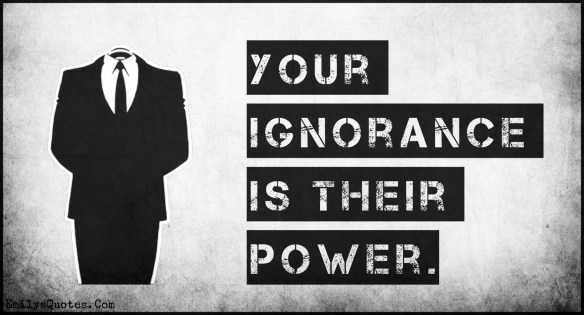
your-ignorance-is-their-power

By Henry Giroux

Source: CounterPunch

What happens to a society when thinking is eviscerated and is disdained in favor of raw emotion? [1] What happens when political discourse functions as a bunker rather than a bridge? What happens when the spheres of morality and spirituality give way to the naked instrumentalism of a savage market rationality? What happens when time becomes a burden for most people and surviving becomes more crucial than trying to lead a life with dignity? What happens when domestic terrorism, disposability, and social death become the new signposts and defining features of a society? What happens to a social order ruled by an “economics of contempt” that blames the poor for their condition and wallows in a culture of shaming?[2] What happens when loneliness and isolation become the preferred modes of sociality? What happens to a polity when it retreats into private silos and is no longer able to connect personal suffering with larger social issues? What happens to thinking when a society is addicted to speed and over-stimulation? What happens to a country when the presiding principles of a society are violence and ignorance? What happens is that democracy withers not just as an ideal but also as a reality, and individual and social agency become weaponized as part of the larger spectacle and matrix of violence?[3]

The forces normalizing and contributing to such violence are too expansive to cite, but surely they would include: the absurdity of celebrity culture; the blight of rampant consumerism; state-legitimated pedagogies of repression that kill the imagination of students; a culture of immediacy in which accelerated time leaves no room for reflection; the reduction of education to training; the transformation of mainstream media into a mix of advertisements, propaganda, and entertainment; the emergence of an economic system which argues that only the market can provide remedies for the endless problems it produces, extending from massive poverty and unemployment to decaying schools and a war on poor minority youth; the expanding use of state secrecy and the fear-producing surveillance state; and a Hollywood fluff machine that rarely relies on anything but an endless spectacle of mind-numbing violence. Historical memory has been reduced to the likes of a Disney theme park and a culture of instant gratification has a lock on producing new levels of social amnesia.

As we learned in the recent debate between Donald Trump and Hilary Clinton (a billionaire and millionaire), ignorance is the DNA of authoritarianism, serving to subvert the truth and obscure the workings of power. Willful ignorance has become a normalized political tool and form of public pedagogy that both provides the foundation for what Noam Chomsky labels as the rise of the “stupid party” and which works incessantly to create a “stupid nation.”[4]Trump, of course, proves that stupidity is in fashion and deeply entrenched within the larger culture while Hilary capitalizes on her penchant for disingenuousness by claiming support for policies she really disdains, i.e., stating she will raise taxes on her buddies from Goldman Sachs and other members of the financial elite. Hardly believable from a woman who “has earned millions of dollars from speeches to Wall Street banks and investment firms (and) was paid $675,000 for a series of speeches to Goldman Sachs.”[5] No hints of the radical imagination here, or the truth for that matter. Only the politics of stupidity and evasion and a media spectacle supporting the celebration of corrupted and limited and pathologized political horizons.

Manufactured ignorance also makes invisible the corruption of the financial elite, allowing them to plunder resources and define the accumulation of capital as a divine blessing. It gets worse. Manufactured ignorance aided by the voracious seductions of commodified corporate-driven disimagination machine that promotes a culture of empty pleasures through and endless regime of consuming and discarding. American society is now dominated by a pervasive commodified landscape of disimagination machines that extends from Hollywood movies and video games to mainstream television, magazines, news, and the social media. These mind-numbing desiring machines which thrive on speed and sensation function mostly as workstations of ignorance to create a fog of distractions that promote forms of social amnesia that erase from memory and public discourse the structural, systemic and social forces that reinforce what can be called organized powerlessness and massive human suffering. This is the stuff of a politics of disappearance that erases the presence of the poor, unemployed, the “approximately 11 million Americans cycle[d] through jails and prisons each year,” black youth, immigrants, ecological disasters, class warfare, acts of state sponsored terrorism, the rise of the police state, and the rise of the warfare state.[6] As the machinery of social death accelerates, America’s most precious investment, youth, also disappear. As neoliberal disimagination machines such as Fox News make clear youth as a social investment no longer count in a society that disdains long term investments and their messy calls for being included in the script of democracy. As such, the current war on youth is about erasing the future, at least any alternative future and any notion of imagination that might summon one into view.

When coupled with an age of precarity and endless uncertainty in which young people have few decent jobs, are strangulated by debt, face a future of career-less jobs, and isolation, young people have little room for politics because they are more concerned with trying to survive rather than engaging in political struggles, or imagining a different future. At the same time, armies of the unemployed or underemployed are caught in a spiral of receding wages, diminished social provisions, and increasingly find themselves paralyzed by anxiety and free-floating anger. In such situations, thinking and informed action become more difficult while a politics wedded to economic and social justice is eviscerated. Moreover, politics becomes toxic when dominated by unapologetic discourses of racism and hatred and is on full display in the Trump campaign. Tapping into such anger and redirecting away from the real problems that produce it has become the central script in the rise of the new authoritarians. This poisonous discourse gains momentum and accelerates as it moves between white supremacist incantations of Trump and his zealots and the deceptive vocabulary of Hillary Clinton and her financial elite backers who embrace a savage neoliberalism with its false claims to freedom, choice, and the virtues of militarization. Civic death is on full display as the ideals of democracy disappear in an election in which authoritarianism in its various forms rules without apology. As thinking dangerously and acting with civic courage wanes, state violence, disposability and voicelessness become the dominant registers of an authoritarian politics that has intensified in American life producing neo-fascist movements in American society that have moved from the fringes to the center of political life.

Tragedy looms large in American society as the forces that promote powerlessness and voicelessness intensify among those elements of the population struggling just to survive the symbolic violence of a culture of cruelty and the material violence of a punishing state. The issue of losing one’s voice either to the forces of imposed silencing or state repression weaken dissent and open the door to the seductions of a dogmatism that speaks in the language of decline, making America great again, while touting the coded vocabulary of white nationalism and racial purity. How else to explain Trump’s call for imposing racial profiling as a way to boost the notion of law and order.

Thinking undangerously is the first step in the triumph of formalism over substance, theater over politics, and the transformation of politics into a form of celebrity culture. The refusal to think works in the service of a form of voicelessness, which is another marker of what it means to be powerless. Within this moral and political vacuum, the codes, rhetoric, and language of white supremacy is on the rise wrapped in the spectacle of fear-mongering and implied threats of state repression. In this instance, emotion become more important than reason, ideas lose their grip on reality, and fashion becomes a rationale for discarding historical memory, informed arguments, and critical thought. Reflection no longer challenges the demands of commonsense. In the mainstream media, the endless and unapologetic proliferation of lies become fodder for higher ratings, informed by suffocating pastiche of talking heads, all of whom surrender to “the incontestable demands of quiet acceptance.”[7]Within such an environment, the truth of an event is not open to public discussion or informed judgment at least in the official media apparatuses producing, distributing and circulating ideas that parade as commonsense. As a result, all that remains is the fog of ignorance and the haze of political and moral indifference.

Americans occupy a historical moment in which it is crucial to think dangerously, particularly since such thinking has the power to shift the questions, provide the tools for offering historical and relational contexts, and “push at the frontiers…of the human imagination.”[8]Stuart Hall is right in insisting that thinking dangerously is crucial “to change the scale of magnification. … to break into the confusing fabric that ‘the real’ apparently presents, and find another way in. So it’s like a microscope and until you look at the evidence through the microscope, you can’t see the hidden relations.”[9] In this instance, the critical capacity for thinking becomes dangerous when it can intervene in the “continuity of commonsense, unsettle strategies of domination,” and work to promote strategies of transformation.[10]

As Adorno observes, such thinking “speaks for what is not narrow-minded—and commonsense most certainly is.”[11] As such, dangerous thinking is not only analytical in its search for understanding and truth, it is also critical and subversive, always employing modes of self and social critique necessary to examine its own grounds and those poisonous fundamentalisms in the larger society haunting the body politic. As Michael Payne observes, thinking dangerously (or critical theory in this instance) should be cast in the language of hints, dialogue, and an openness to other positions, rather than be “cast in the language of orders.”[12] Of course, this is not to suggest that thinking dangerously guarantees action, but at the same time, any action that distances itself from such thinking is bound to fail.

In an age when shouting, rage, and unchecked emotions shape public discourse, self-reflection becomes a liability and suppresses the axiom that critical thought should function to “lift…human beings above the evidence of our senses and sets appearances apart from the truth.”[13]   Salmon Rushdie is right in viewing thinking dangerously as a type of political necessity whose purpose is to “push boundaries and take risks and so, at times, to change the way we see the world.”[14] As Hannah Arendt noted, thoughtfulness, the ability to think reflectively and critically is fundamental to radical change and a necessity in a functioning democracy. Put differently, formative cultures that make such thinking possible along with the spaces in which dialogue, debate, and dissent can flourish are essential to producing critically literate and actively engaged citizens.

Unfortunately, thinking undangerously cuts across ideological and political divides. For instance, there is a new kind of historical and social amnesia overtaking some elements of resistance in the United States. Many progressives have forgotten the lessons of earlier movements for real change extending from the anti-Vietnam War and Black Freedom movements to the radical feminist and gay rights movements of the sixties. History as a repository of learning with vast resources to enable people to build on historical legacies, develop mass movements, and take seriously the pedagogical task of consciousness raising, is in decline. Too much of contemporary politics has become more personal, often reducing agency to the discourses and highly charged emotions of trauma. These historical legacies of resistance did not limit their politics to a call recognition and security within the confines of isolated political issues. Instead, they called for a radical transformation of capitalist and other authoritarian societies. Moroever, they understood that the truth of domination lie in understanding the totality of a society and how various issues were connected to each other. George Monbiot exemplifies this issue in arguing against responding to the varied crisis associated with neoliberalism as if they emerged in isolation—a response that contributes to neoliberalism’s anonymity. He writes:

Its anonymity is both a symptom and cause of its power. It has played a major role in a remarkable variety of crises: the financial meltdown of 2007?8, the offshoring of wealth and power, of which the Panama Papers offer us merely a glimpse, the slow collapse of public health and education, resurgent child poverty, the epidemic of loneliness, the collapse of ecosystems, the rise of Donald Trump. But we respond to these crises as if they emerge in isolation, apparently unaware that they have all been either catalyzed or exacerbated by the same coherent philosophy; a philosophy that has – or had – a name. What greater power can there be than to operate namelessly?[15]

This politics of the disconnect is exacerbated by the fact that mass social movements run the risk of undermining by a politics that has collapsed into the personal. For example, for too many progressives personal pain represents a retreat into an interiority that focuses on trauma. Robin Kelley provides a caveat here in pointing out that all too often “managing trauma does not require dismantling structural racism” and the larger issues of “oppression, repression, and subjugation” get replaced with “words such as PTSD, micro-aggressions, and triggers.” [16] Kelley is not suggesting that the pain of personal suffering be ignored. Instead, he warns “against … the consequences of framing all grievances in the ‘language of personaltrauma.’”[17]

Personal trauma in this case can begin with legitimate calls for spaces free of racism, sexual harassment, and various other forms of hidden but morally and politically unacceptable assaults. And at its best, such a politics functions as an entry into political activism; but when it becomes less a justifiable starting point than an endpoint it begins to sabotage any viable notion of radical politics. Kelley is right in insisting that “trauma can easily slip into thinking of ourselves as victims and objects rather than agents.”[18] Moreover, the language of safe spaces, personal trauma, and triggers can easily become a topsy-turvy discursive universe of trick mirrors and trapdoors that end up reproducing a politics of intimidation and conformity, while forgetting that pedagogical practices and a corresponding politics in the service of dramatic transformation are always unsettling and discomforting.

Progressives must avoid at all cost is the rebirth of a politics in which how we think and act is guaranteed by the discourses of origins, personal experience, and biology. When individuals become trapped within their own experiences, the political imagination weakens, and a politics emerges that runs the risk of inhabiting a culture of exclusion and hardness that shuts down dialogue, undermines compassion, kills empathy, makes it more difficult to listen to and learn from others. A politics that puts an emphasis on personal pain can become blind to its own limitations and can offer falsely a guaranteed access to the truth and a comforting embrace of a discourse of political certainty.

In such cases, the walls go up again as the discourses of biology and exclusion merge to guard the frontiers of moral righteousness and political absolutism. Put differently, the registers of militarization are on full display in such alleged sites of resistance such as higher education where a growing culture of political purity marks out a space in which the personal becomes the only politics there is housed within a discourse of “weaponized sensitivity” and “armed ignorance.”[19] The first causality of armed ignorance is a kind of thoughtfulness that embraces empathy for the other, a willingness to enter into public discussion, and dialogue with those who exist outside of the bunkers of imagined communities of exclusion. Leon Wieseltier is right in arguing that “grievance is sometimes the author of blindness, or worse.”[20]

Under such conditions, empathy wanes and only extends as far as recognizing those who mirror the self, one that endlessly narrates itself on the high ground of an unassailable moralism and stultifying orbits of self-interests. In addition, politics collapses into the privatized orbits of a crude essentialism that disdains forms of public discourse in which boundaries break down and the exercise of public deliberation is viewed as fundamental to a substantive democracy. Of course, there is more at work here than what might be called the atrophy of critical thought, self-reflection, and theory, there is also the degeneration of agency itself.

What does thinking look like when it is transformed into a pedagogical parasite on the body of democracy? At one level, it becomes toxic, blinding the ideological warriors to their own militant ignorance and anti-democratic rhetoric. At the same time, it shuts down any attempt to develop public spheres that connect rather than separate advocates of a politics walled in by suffocating notions of essentialism dressed up in the appeal to orthodoxy parading as revolutionary zeal. What must be remembered is that thinking undangerously mimics a pedagogy of repression that falsely assumes a revolutionary stance when in fact everything about it is counter-revolutionary. In the end this suggests a kind of theoretical helplessness, a replacing of the courage to think dangerously with the discourse of denunciation and a language overflowing with the comforting binary of good and evil.

There is more at risk here than legitimating the worse forms of thoughtlessness, there is also the intolerable potential for both the moral collapse of politics and the undermining of any vestige of democracy. Thinking dangerously as a critical enterprise is about both a search for the truth and a commitment to the recognition that no society is ever just enough and hence is fundamental to the always unfinished struggle, making the impossible all the more possible. Not one or the other but both. Such thinking should be used to both understand and engage the major upheavals people face and to connect such problems to larger political, structural, and economic issues.

Thinking dangerously can make the pedagogical more political by mapping the full range of how power is used and how it can be made accountable in all of its uses. Thinking dangerously is about more than doing a critical reading of screen culture and other texts, it is also about how knowledge, desire, and values become invaluable tools in the service of economic and political justice, how language provides the framework for dealing with power and what it means to develop a sense of compassion for others and the planet. Dangerous thinking is more than a mode of resistance, it is the basis for a formative and pedagogical culture of questioning and politics that takes seriously how the imagination can become central to the practice of freedom, justice, and democratic change.

Notes.

[1] This essay draws upon a number of ideas in Henry A. Giroux,Dangerous Thinking in the Age of the New Authoritarianism (New York: Routledge, 2015).

[2] I have borrowed this term from Jeffrey St. Clair, “The Economics of Contempt,” Counterpunch (May 23, 2014).

[3] Brad Evans and I have taken up the issue of violence in its various valences in Brad Evans and Henry A. Giroux, Disposable Futures: The Seduction of Violence in the Age of the Spectacle (San Francisco: City Lights Books, 2015). Also, see Henry A. Giroux, America’s Addiction to Terrorism (New York: Monthly Review Press, 2016).

[4] Noam Chomsky, “Corporations and the Richest Americans Viscerally Oppose the Common good,” Alternet (Sep9tember 29, 2014). Online: http://www.alternet.org/visions/chomsky-corporations-and-richest-americans-viscerally-oppose-common-good

[5] Chris Cillizza , “The New York Times just perfectly explained Hillary Clinton’s Goldman Sachs speech problem,” The WashingtonPost (February 26, 2016). Online:https://www.washingtonpost.com/news/the-fix/wp/2016/02/26/the-new-york-times-just-perfectly-explained-why-hillary-clintons-answers-on-her-paid-speeches-dont-work/

[6] Rebecca Gordon, “There Oughta Be a Law…Should Prison Really Be the American Way?,” TomDispatch.com (September 25, 2016). Online: http://www.tomdispatch.com/blog/176190/tomgram%3A_rebecca_gordon%2C_arresting_our_way_to_%22justice%22/

[7] Brad Evans and Julien Reid, “The Promise of Violence in the Age of Catastrophe,” Truthout (January 5, 2014. Online: http://truth-out.org/opinion/item/20977-the-promise-of-violence-in-the-age-of-catastrophe

[8] Arundhati Roy, Power Politics (Cambridge, Ma: South End Press, 2001), P. 1

[9] Stuart Hall and Les Back, “In Conversation: At Home and Not at Home”, Cultural Studies, Vol. 23, No. 4, (July 2009), pp. 664-665.

[10] I have taken this phrases from an interview with Homi Bhaba in Gary Olson and Lynn Worsham, “Staging the Politics of Difference: Homi Bhabha’s Critical Literacy JAC ((1999), p. 9.

[11] Zygmunt Bauman, Liquid Life (London: Polity Press, 2005), p.139.

[12] Michael Payne, “What Difference Has Theory Mad? From Freud to Adam Phillips,” College Literature 32:2 (Spring 2005), p. 7.

[13] Ibid., Bauman, Liquid Life, 151.

[14] Salman Rushdie, “Whither Moral Courage?” The New York Times, (April 28, 2013)

[15] George Monbiot, “Neoliberalism – the ideology at the root of all our problems,” The Guardian, (April 15, 2016) Online: http://www.theguardian.com/books/2016/apr/15/neoliberalism-ideology-problem-george-monbiot

[16] Robin D.G. Kelley, “Black Study, Black Struggle – final response,”Boston Review, (March 7, 2016). Online: http://bostonreview.net/forum/black-study-black-struggle/robin-d-g-kelley-robin-d-g-kelleys-final-response

[17] Ibid., Robin D.G. Kelley, “Black Study, Black Struggle – final response.” Boston Review.,

[18] Robin D.G. Kelley, “Black Study, Black Struggle,” Boston Review,(March 7, 2016) Online: https://bostonreview.net/forum/robin-d-g-kelley-black-study-black-struggle

[19] The notion of weaponized sensitivity is from Lionel Shriver, “Will the Left Survive the Millennials?” New York Times (September 23, 2016). Online. http://www.nytimes.com/2016/09/23/opinion/will-the-left-survive-the-millennials.html. Armed ignorance was coined by my colleague Brad Evans in a personal correspondence.

[20] Leon Wieseltier, “How voters’ personal suffering overtook reason – and brought us Donald Trump,” Washington Post, (June 22, 2016). Online: https://www.washingtonpost.com/posteverything/wp/2016/06/22/how-voters-personal-suffering-overtook-reason-and-brought-us-donald-trump/


Henry A. Giroux currently holds the McMaster University Chair for Scholarship in the Public Interest in the English and Cultural Studies Department and a Distinguished Visiting Professorship at Ryerson University. His most recent books are America’s Education Deficit and the War on Youth (Monthly Review Press, 2013) and Neoliberalism’s War on Higher Education (Haymarket Press, 2014). His web site is www.henryagiroux.com.

Electoral Politics and the Illusion of Control

what-corporate-america-wants

By William Hawes

Source: Dissident Voice

We have all been told a lie. The lie that says democracy can be maintained only through voting, through purely representative, parliamentarian means. When the founding fathers set up the Constitution and Bill of Rights, they were wary of any truly popular, working and middle class control of the United States. Our government was to be run as a republic, designed by elites, for the elites. Our three branches of government were not simply invented for checks and balances: another reason was to stymie any massively popular mandates that would go against the interests of the oligarchy.

Today, the checks and balances used ostensibly to prevent tyranny are being used against us: even though a high majority (65%) is against government surveillance which violates privacy, and 78% want Citizens United overturned, we are stuck with a broken system and statesmen bought off by corporations. Even though 80% of eligible citizens didn’t vote in the 2014 elections, this year our out-of-touch pundits and mass media puppets prattle on unceasingly about our democracy, still misguidedly believing these candidates represent the will of the people.

Just sixteen years ago, our very own electoral system, in the form of a gilded cage, shut down the popular will of the people, as Al Gore won about 500,000 more votes than George W. Bush, yet still lost. Although the decision was made over 200 years ago, we have decided that the antiquated Electoral College system should still be used today.

More broadly, our never-ending election cycle serves as a palliative for ordinary Americans, but does nothing to cure the underlying disease and rot within our political system. Progressive liberals can take pleasure in Sanders’ statements supporting a raise in the minimum wage, debt relief for students, fighting income inequality, etc. Yet Sanders has no broad coalition in Congress to advance his agenda and to fight his “revolution”. Isolationist, non-interventionist conservatives can take pride in Trump’s support of Russia’s fight against ISIS in Syria, and his token rhetoric towards re-working unfair free trade agreements and bringing back jobs. Yet Trump’s pandering towards racists and xenophobes will only accelerate the descent towards fascism that the US has been slipping into for decades.

The second lie we’ve been told, or assumed implicitly, is that we are in control of our national destiny. Through the vote, we can supposedly make a clean slate every four years, to make up for the misdeeds of our past political leaders. The truth is much murkier. Our national security state and intelligence services have been built up to Leviathan levels, and presidential candidates are instantly discredited and marginalized for suggesting even small decreases in military spending. Corporate lobbyists and the conglomerate multinationals control the political landscape, determining the limits of discourse and shutting down anyone who exceeds the boundaries. Absurdly, third party candidates, some of the only ones with fresh ideas to invigorate our democracy, are demonized. Mainstream media coverage reinforces these imaginary limits of discussion, and Independents, Greens, Socialists, and Libertarians are relegated to the sidelines.

As the neoliberal order reinforces and deepens material poverty and intellectual ignorance, public discourse narrows without totalitarian overt manipulation. This makes issues seem as if they are progressing naturally, when public debate and consent is in actuality homogenized and conformist. This is analogous to the concept known to scientists as “shifting baselines”: here it applies to a public that accepts deeper cuts to social services, increases in privatizations, and increased militarization and policing of the public sphere, because the momentum seems inexorable and immutable. The establishment uses rhetorical threats and excuses to further corporate agendas and destroy civil society, all in the name of maintaining “economic growth” and upholding “law and order”.

The truth is that only by staring into the abyss can we collectively begin to dig ourselves out of our self-dug graves. The US has been in an unofficial recession since 2008. Millions of Americans live paycheck to paycheck, with minimal society safety nets, leading to insecurity, uncertainty and cynicism towards the future, and crippling anxiety. Politicians routinely show they do not care about the working class and the poor when they speak to the “middle class”, whatever that means anymore. Our leaders are handpicked by Wall Street billionaires, and/or defense and fossil fuel industrialists. Abroad, covert war is ongoing in a dozen or more countries in Asia and North Africa.

With so many minds confined to the hypnotic and myopic gaze focused on high technology, mass media, and our official “leaders”, 21st century man falls further into enslavement every day. As Fromm would say, we Escape from Freedom into self-indulgence and apathy, leaving hard decisions to technocrats and oligarchs. Control over our food, medicine, intellectual property, and basic social and environmental rights are consolidated into a handful of multinational corporations who inundate us with false needs through advertising and propaganda. Computer algorithms tell us what to buy, and social media manipulates our emotions, fulfilling the preaching of techno-dystopian prophets who warn of non-human intelligence guiding humanity towards dark futures.

Revolutionary fervor lurks under the surface, yet whether a popular progressive movement can blossom remains to be seen. Conversely, a missed revolution could easily result in an authoritarian and fascist takeover by the reactionary far-right. One thing we know for certain is that continuing under this two-party charade will only lead us to our doom.

Average citizens have never had any control of the republic since its founding. A complete constitutional overhaul is needed, and forms of direct, consensus, and deliberative democracy must be woven into a hybrid system. Elections should be funded by the public, with no corporate money allowed, shorter election cycles, and no discrimination towards third parties, unlike the current Commission on Presidential Debates. State governments should gain power, and federal programs reigned in and redefined towards streamlined regulation and oversight. Tax subsidies should be stripped from the fossil fuel industries entirely and redirected towards the best scientists and engineers in the field of renewable energy.

What is desperately needed is a shift in worldview to promote government that sees its job as not simply to tax and legislate, but to also support healthy life-world systems. Also, promoting humble and dedicated leaders who are stewards of community and the Earth, who do not insist on blatant exploitation of distant nations and pillaging resources, would go a long way. This cannot be done within the confines of the Democratic and Republican parties, who thrive on domination, coercion, control, and manipulation of public interests.

To break the cycle, we must collectively embrace our frailties and limitations. The deadly, patriarchal energy technologies such as the petrochemical industries and nuclear energy must be shut down. We must learn from the man-made tragedies of Bhopal, Katrina, Chernobyl, and Fukushima, and dismantle dangerous plants and factories, and begin to move humanity away from areas susceptible to natural disasters and coastal flooding. The US, Russia, and the nuclear nations must formally apologize for the atmospheric nuclear testing in the fifties and sixties which will kill millions from cancer, and ban nuclear weapons for good.

Learning to relinquish control and learning to keep one’s ego in check are two of the ultimate tests our leaders must accept. As the Tao Te Ching says:

Therefore the sages:
Manage the work of detached actions
Conduct the teaching of no words
They work with myriad things but do not control
They create but do not possess
They act but do not presume
They succeed but do not dwell on success
It is because they do not dwell on success
That it never goes away.1

  1. Tao Te Ching: Annotated and Explained. Derek Lin. SkyLight Paths. 2006.  Translation by Derek Lin. [↩]


William Hawesis a writer specializing in politics and the environment. You can find his e-book of collected essays here. His articles have appeared online at Global Research, Countercurrents, Dissident Voice, and Counterpunch. You can email him at wilhawes@gmail.com Read other articles by William.

Living In A Van Down By The River – Time To Face The True State Of The Middle Class In America

maggie_smith_lives_on_alan_bennett_s_driveway_in_the_lady_in_the_van_trailer

By Michael Snyder

Source: InvestmentWatch

Do you remember the old Saturday Night Live sketches in which comedian Chris Farley portrayed a motivational speaker that lived in a van down by the river?  Unfortunately, this is becoming a reality for way too many Americans.  As the middle class has shrunk and the cost of living has increased, a lot of people have decided to quite literally “live on the road”.  Whether it is a car, a truck, a van, a bus or an RV, an increasing number of Americans are using their vehicles as their homes.  Just recently, someone that I know took a trip down the west coast of the United States and stayed at a number of campgrounds along the way.  What she discovered was that a lot of people were actually living at these campgrounds.  Of course there are some that actually prefer that lifestyle, but many others are doing it out of necessity.

Earlier this week, Circa.com posted a story about “the van life”.  One of the individuals that they featured was a recent graduate of the University of Southern California named Stephen Hutchins.  Without much of an income at the moment, he decided that the best way to cut expenses was to live in his van

“The main expenses are insurance for the van, which is like $60 a month,” said Hutchins. “Then, I have a storage unit for like $60.”

That puts his monthly rent at $120. The van cost him just $125 at an auction.

Living in a van is certainly not the most comfortable way to go, and many of you are probably wondering how he performs basic tasks such as cooking and bathing.  Well, it turns out that he makes extensive use of public facilities

He showers at the gym, cooks on a portable stove on a sidewalk (he stores his butane at his friends’ place nearby) and uses wifi at nearby coffeeshops.

For a while such a lifestyle may seem like “an adventure”, but after a while it will start to get really old.  And not a lot of women are going to be excited about dating a man that lives in a van, and you certainly wouldn’t want to raise a family in a vehicle.

Sadly, just like during the last economic crisis many Americans are getting to the point where staying in their homes may not be an option.  Just check out the following excerpt from a recent New York Post article entitled “The terrifying signs of a looming housing crisis“…

The number of New Yorkers applying for emergency grants to stay in their homes is skyrocketing — as the number of people staying in homeless shelters reached an all-time high last weekend, records show.

There were 82,306 applications for one-time emergency grants to prevent evictions in fiscal 2016, up 26 percent from 65,138 requests the previous year, according to the Mayor’s Management Report.

I put a couple of phrases in that quote in bold because I really wanted you to notice a couple of things.

First of all, it is very alarming to hear that the number of New Yorkers staying in homeless shelters “reached an all-time high” last weekend.  I thought that we were supposed to be in an “economic recovery”, but apparently things in New York are rapidly getting worse.

Secondly, the fact that applications for emergency grants are up 26 percent compared to last year is another indication of how rough things are right now for average families in New York.  We all remember what happened when millions of families lost their homes to foreclosure across the nation during the last financial crisis, and nobody should want to see a repeat of that any time soon.

During this election season, Barack Obama and Hillary Clinton would like all of us to believe that the economy is doing just fine, but that is not true at all.  Even using the doctored numbers that the government gives us, Barack Obama is solidly on track to be the only president in all of U.S. history to never have a single year of 3 percent GDP growth, and he has had two terms to try to do that.

Gallup CEO Jim Clifton is also quite skeptical of this “economic recovery”, and he recently authored an article on this subject that is receiving a tremendous amount of attention.  The following is how that article begins

I’ve been reading a lot about a “recovering” economy. It was even trumpeted on Page 1 ofThe New York Times and Financial Timeslast week.

I don’t think it’s true.

The percentage of Americans who say they are in the middle or upper-middle class has fallen 10 percentage points, from a 61% average between 2000 and 2008 to 51% today.

Other surveys have found that it is even worse than that.

For example, a Pew Research Center study from the end of last year discovered that the middle class in America has now actually become a minority in this country.

Here are some other numbers that Clifton included in his article

  1. According to the U.S. Bureau of Labor Statistics, the percentage of the total U.S. adult population that has afull-time job has been hovering around 48% since 2010this is the lowest full-time employment level since 1983.
  2. The number of publicly listed companies trading on U.S. exchanges has been cut almost in half in the past 20 years — from about 7,300 to 3,700. Because firms can’t grow organically — that is, build more business from new and existing customers — they give up and pay high prices to acquire their competitors, thus drastically shrinking the number of U.S. public companies. This seriously contributes to the massive loss of U.S. middle-class jobs.
  3. New business startups are at historical lows. Americans have stopped starting businesses. And the businesses that do start are growing at historically slow rates.

Once upon a time, America was the land of opportunity.

We were the place where anything was possible and where entrepreneurship was greatly encouraged.

But today we strangle small businesses to death with rules, regulations, red tape and taxes.

If we want a stronger middle class, we need to create a much better environment for the creation of small businesses.  Small business ownership often lifts individuals into the middle class, and small businesses have traditionally been the primary engine for the growth of good jobs in this country.

If the middle class continues to shrink, poverty will continue to rise.  Previously I have written about how the number of homeless children in the United States has shot up by 60 percent since the last economic crisis, and Poverty USA claims that a staggering 1.6 million children slept either in a homeless shelter or in some other form of emergency housing during 2015.

If you will be sleeping in a warm bed in a comfortable home tonight, you should be thankful.  An increasing number of Americans are sleeping in tent cities, in their vehicles or on the streets.  These hurting people deserve our love, our compassion and our prayers.


An Open Letter to the People of the United States: Election or Revolution?

votefornobody

(Editor’s note: While we do believe positive change is possible on a local level through grass-roots campaigns and voter initiatives, until major systemic changes are forced into existence we have no reason to expect anything from presidential politics other than what we’ve been subjected to for the past few decades.)

By Robert J. Burrowes

As citizens of the USA with a presidential election approaching you have a wonderful opportunity to ponder whether to participate in this election or to participate in the ongoing American Revolution.

Your first revolution might have overthrown the authority of the British monarchy and aristocracy but the one in progress must remove the US elite which has executed a political coup against your government. And you cannot remove elite coupmakers in a fraudulently conducted election in which the ‘choice’ is essentially between two violently insane individuals, each of whom represents the violently insane US elite. See ‘The Global Elite is Insane‘ and ‘Why Violence?

The real value of this second revolution, which moves along steadily with routine outbreaks over a multitude of peace, environmental and social justice issues and occasional ‘uprisings’, such as the Occupy Movement in 2011 which spawned a range of new and visionary initiatives, is that it could give citizens of your country the chance to finally reclaim the Republic for those people who genuinely care about ‘life, liberty and the pursuit of happiness’. And, just as importantly, have sufficient vision to regard these aspirations as something to be shared with the entire US population, starting with Native Americans, and even those of us in the rest of the world including those countries that are currently victims of US elite violence, whether it be wars, drone strikes, coups, economic exploitation or ecological destruction.

Such a revolution might rewrite your constitution and replace the second amendment ‘right of the people to keep and bear arms’ with the right to live free of the fear of gun violence. It might result in a form of social organization that distributes wealth equitably (perhaps by actually taxing the wealthy and outlawing the use of offshore tax havens) while reallocating the annual military (killing) budget to life-enhancing projects such as poverty alleviation, affordable housing, free education, free healthcare, clean water, renewable energy technologies, and a substantial budget for compensation to those countries that the US elite has systematically exploited or simply destroyed during the past 200 years. This would allow the 50 million US citizens who live in poverty, and another billion people around the world who also live in poverty, the chance to live a decent life.

Now, you might ask, ‘How are we, the ordinary citizens of the United States, even with our handguns, rifles and assault weapons, going to take on the US military and police to remove elite control of our government?’ Well, the answer is that you do not need even one weapon for this ongoing revolution and, in fact, you are vastly better off without them. Weapons have only one use – to kill people – and any revolution worth the name has a more profoundly ambitious aim than this.

What you need is intelligence, commitment, courage and a sound nonviolent strategy. The US elite controls your government and has crippled your republic because, over successive generations, you have let them. Every time you cooperate with the elite, because you are scared, by paying your taxes (more than 50% of which finances US wars and other military violence), putting your money into their corporate banks, shopping at their corporate shopping malls, buying and consuming the ‘news’ presented by their corporate media, rationalizing their policies as reasonable, participating in their unjust and violent legal system, fighting (as an enlisted person or as a mercenary) in their military forces, working in their prison system, accepting exploited employment of any kind, eating their poisoned and genetically mutilated foods (GMOs), going along with their endless attempts to divide you along racial, class, religious and other lines, you simply consent to their control. Why?

You have a simple alternative. Consciously and systematically participate in the ongoing nonviolent revolution that is already taking place and give it added life by your presence. Remake the US republic as you want it by withdrawing your cooperation with elite structures and processes while creating alternatives that meet your needs and the needs of those around you.

Join those US visionaries who are creating cooperatives where people are both managers and valued workers, take your money out of elite banks and put it into financial organizations that exist or which you create to serve the interests of their members (or, if you prefer, use LETSystems), refuse to participate in or pay for (with your taxes) US imperialism (and win friends all over the world), grow or buy healthy locally-grown organic/biodynamic (and, if you are concerned about the climate catastrophe as well, vegetarian) food, read progressive news outlets so that you know what is really going on in the USA and the world, read literature that deepens your understanding and concern for humanity and doesn’t just offer you a distraction from the horror in which you live, and support or even become one of those many fine nonviolent activists in your country who take personal risks in the struggle to create a better world.

If you want more of what you have, then you should vote and/or buy a gun. They have an equivalent outcome: they both legitimize elite violence and exploitation directed at you and those you love.

If you want to participate in this second and ongoing American revolution, then spend your time participating in the wholesome activities that many grassroots organizations already offer and in creating its next manifestations in your own neighborhood. It is the powerful conscience-based choices that you make as an individual that define your Self. And it is these choices that will have most impact on your family, neighborhood, community organization, trade union, religious organization and elsewhere and that will help decide the future of the USA and its role in the world.

Now you might say, I do some or even all of the sorts of things you mentioned above, so why not vote too? My answer is simply this: Voting is an act of disempowerment. It’s essential message is ‘I appoint you to govern for me’. I prefer to govern myself (both meanings intended). And you?

So what of those who present the ‘lesser evil’ argument: one candidate is so bad that it is better to have the other. This ‘argument’ is not worthy of scrutiny. If you are deceived by this argument, you will vote forever in the delusional hope that you will one day get a choice to vote for someone genuinely decent. In 2008, Barack Obama was supposed to be the candidate of hope and change. Did you get that hope and change? Are you going to get it with Clinton or Trump? Of course not. Elites simply ensure that change via the electoral system cannot happen; its function is to absorb and dissipate our dissent.

If you vote you are saying that you endorse this system of electoral exploitation. The tragedy is that even third-party candidates, who may be people of genuine principle, have no chance. Even worse, they add a veneer of legitimacy to your corrupt electoral system.

In essence, if you vote for the ‘lesser evil’ you are still voting for an ‘evil’ and, more importantly, you have participated in and endorsed an ‘evil’ system: one which denies you a genuine ‘free and fair’ choice to vote for a candidate who actually represents your interests and views and has a reasonable chance of winning. And, having won, is then able to actually implement their policies (rather than be stymied by a power structure that has no intention of letting this happen). Given your circumstances, ‘the only winning move is not to play’ their corrupt game and to put your energy into a genuinely winning move: working for the regeneration of American society.

Look at it this way. If there are two rotten eggs, would you choose the one that is less rotten and eat it? Presumably you would seek another option and only after you have identified and fixed what is causing the problem in the first place. The point is this: Unless you spend your time deeply contemplating the nature of the society in which you want to live and then devoting your time and energy into creating that society, you will never have it. And you have betrayed yourself.

The reality is that either Clinton or Trump is going to be president of the USA for the next four years and a lot of people (both in the US but particularly in foreign countries) are going to die because of it (through US military violence and corporate exploitation). What we can do is to invest our political energy into creating a United States in which, at some point in the future, the likes of Clinton and Trump, and those they represent, no longer drive outcomes in our world.

To reiterate: I am not saying ‘Don’t vote and do nothing’ (as so many people do already). I am suggesting that you ponder the dysfunctionality of your society, do some research into the secretive ‘deep state’ (or military-industrial complex or power elite or the 1% or however you wish to describe it) that controls your ‘republic’ with its electoral system designed to delude you into believing that you have a say in governing your nation, and then consider how you want to engage politically and act in accord with your conscience in doing so. It is only by doing this that we will have any chance of getting the society and the world that we want, even if it is beyond our lifetimes (and assuming we can avert extinction at our own hand in the meantime).

In summary, profound change only occurs from the ‘bottom up’ when enough ordinary people take the initiative to remake their own society. And if you are really interested in doing this, one important place to start is by reviewing the way in which you nurture children. See ‘My Promise to Children‘.

Other straightforward options, in addition to those mentioned above, include participation in ‘The Flame Tree Project to Save Life on Earth‘ and signing the online pledge of ‘The People’s Charter to Create a Nonviolent World‘.

But for those of you who are serious strategic thinkers, I have outlined a strategy for removing coupmakers on the website Nonviolent Defense/Liberation Strategy which is a straightforward presentation of the more detailed explanation offered in the book
The Strategy of Nonviolent Defense: A Gandhian Approach‘.

Is our destiny in our own hands? Only if we have enough people of courage to accept responsibility for it. Are you one of them?


Biodata: Robert J. Burrowes has a lifetime commitment to understanding
and ending human violence. He has done extensive research since 1966 in
an effort to understand why human beings are violent and has been a
nonviolent activist since 1981. He is the author of ‘Why Violence?
His email address is flametree@riseup.net
and his website is at http://robertjburrowes.wordpress.com


Robert J. Burrowes
P.O. Box 68
Daylesford
Victoria 3460
Australia
Email: flametree@riseup.net

Websites:
Nonviolence Charter
Flame Tree Project to Save Life on Earth
‘Why Violence?’
Nonviolent Campaign Strategy
Nonviolent Defense/Liberation Strategy
Anita: Songs of Nonviolence
Robert Burrowes
Global Nonviolence Network