
America as Dangerous Flailing Beast

the-beast-from-the-earth

Despite pretty talk about “democracy” and “human rights,” U.S. leaders have become the world’s chief purveyors of chaos and death – from Vietnam through Iraq, Libya, Syria, Ukraine and many other unfortunate nations, a dangerous dilemma addressed by John Chuckman.

By John Chuckman

Source: Counterpunch

When I think of America’s place in the world today, the image that comes to mind is of a very large animal, perhaps a huge bull elephant or even prehistoric mammoth, which long roamed as the unchallenged king of its domain but has become trapped by its own missteps, as caught in a tar pit or some quicksand, and it is violently flailing about, making a terrifying noises in its effort to free itself and re-establish its authority.

Any observer immediately knows the animal ultimately cannot succeed but certainly is frightened by the noise and crashing that it can sustain for a considerable time.

I think that is the pretty accurate metaphor for the situation of the United States today, still a terribly large and powerful society but one finding itself trapped after a long series of its own blunders and errors, a society certain ultimately to become diminished in its prestige and relative power with all the difficulties which that will entail for an arrogant people having a blind faith in their own rightness.

America simply cannot accept its mistakes or that it was ever wrong, for Americanism much resembles a fundamentalist religion whose members are incapable of recognizing or admitting they ever followed anything but the divine plan.

America has made a costly series of errors over the last half century, demonstrating to others that the America they may have been in awe of in, say, 1950, and may have considered almost godlike and incapable of mistakes, has now proved itself indisputably, in field after field, as often not even capable of governing itself. The irony of a people who are seen as often unable to govern themselves advising others how to govern themselves brings a distinct note of absurdity to American foreign policy.

America’s establishment, feeling its old easy superiority in the world beginning to slip away in a hundred different ways, seems determined to show everyone it still has what it takes, determined to make others feel its strength, determined to weaken others abroad who do not accept its natural superiority, determined to seize by brute force and dirty tricks advantages which no longer come to it by simply superior performance.

Rather than learn from its errors and adjust its delusional assumptions, America is determined to push and bend people all over the world to its will and acceptance of its leadership. But you cannot reclaim genuine leadership once you have been exposed enough times in your bad judgment, and it is clear you are on the decline, just as you cannot once others realize that they can do many things as well or better than you.

In the end, policies which do not recognize scientific facts are doomed. Policies based on wishes and ideology do not succeed over the long run, unless, of course, you are willing to suppress everyone who disagrees with you and demand their compliance under threat. The requirement for an imperial state in such a situation is international behavior which resembles the internal behavior of an autocratic leader such as Stalin, and right now that is precisely where the United States is headed.

Stalin’s personality had a fair degree of paranoia and no patience for the views of others. He felt constantly threatened by potential competitors and he used systematic terror to keep everyone intimidated and unified under him.

Stalin’s sincere belief in a faulty economic system that was doomed from its birth put him in a position similar to that of America’s oligarchs today. They have a world imperial system that is coming under increasing strain and challenge because others are growing and have their own needs and America simply does not have the flexibility to accommodate them.

America’s oligarchs are not used to listening to the views of others. Stalin’s belief in a system that was more an ideology than a coherent economic model is paralleled by the quasi-religious tenets of Americanism, a set of beliefs which holds that America is especially blessed by the Creator and all things good and great are simply its due.

Dominion over the Earth?

Americanism blurrily assumes that God’s promise in the Old Testament that man should have dominion over the earth’s creatures applies now uniquely to Americans. Such thinking arose during many years of easy superiority, a superiority that was less owing to intrinsic merits of American society than to a set of fortuitous circumstances, many of which are now gone.

In Vietnam, America squandered countless resources chasing after a chimera its ideologues insisted was deadly important, never once acknowledging the fatal weaknesses built right into communism from its birth. Communism was certain eventually to fail because of economic falsehoods which were part of its conception, much as a child born with certain genetic flaws is destined for eventual death.

America’s mad rush to fight communism on all fronts was in keeping with the zealotry of America’s Civic Religion, but it was a huge and foolish practical judgment which wasted colossal resources.

In Vietnam, America ended in something close to total shame – literally defeated on the battlefield by what seemed an inconsequential opponent, having also cast aside traditional ethical values in murdering great masses of people who never threatened the United States, murder on a scale (3 million) comparable to the Holocaust.

The United States used weapons and techniques of a savage character: napalm, cluster bombs, and secret mass terror programs. The savagery ripped into the fabric of America’s own society, dividing the nation almost as badly as its Civil War once had. America ended reduced and depleted in many respects and paid its huge bills with devalued currency.

Following Vietnam, it has just been one calamity after another revealing the same destructive inability to govern, the same thought governed by zealotry, right down to the 2008 financial collapse which was caused by ignoring sound financial management and basically instituting a system of unlimited greed. The entire world was jolted and hurt by this stupidity whose full consequences are not nearly played out.

The wars in Afghanistan and Iraq were completely unnecessary, cost vast sums, caused immense misery, and achieved nothing worth achieving. We now know what was kept hidden, that more than one million Iraqis died in an invasion based entirely on lies. These wars also set in motion changes whose long-term effects have yet to be felt. Iraq, for example, has just about had its Kurdish, oil-producing region hived off as a separate state.

Mishandling Russia

America’s primitive approach to the Soviet Union’s collapse, its sheer triumphalism and failure to regard Russia as important enough to help or with which to cooperate, ignored America’s own long-term interests. After all, the Russians are a great people with many gifts, and it was inevitable that they would come back from a post-collapse depression to claim their place in the world.

So how do the people running the United States now deal with a prosperous and growing Russia, a Russia which reaches out in the soundest traditional economic fashion for cooperation and partnership in trade and projects? Russia has embraced free trade, a concept Americans trumpeted for years whenever it was to their advantage, but now for Russia is treated as dark and sinister.

Here America fights the inevitable power of economic forces, something akin to fighting the tide or the wind, and only for the sake of its continued dominance of another continent. Americans desperately try to stop what can only be called natural economic arrangements between Russia and Europe, natural because both sides have many services, goods, and commodities to trade for the benefit of all. America’s establishment wants to cut off healthy new growth and permanently to establish its primacy in Europe even though it has nothing new to offer.

America’s deliberately dishonest interpretation of Russia’s measured response to an induced coup in Ukraine is used to generate an artificial sense of crisis, but despite the pressures that America is capable of exerting on Europe, we sense Europe only goes along to avoid a public squabble and only for so long as the costs are not too high.

The most intelligent leaders in Europe recognize what the United States is doing but do not want to clash openly, although the creation of the Minsk Agreement came pretty close to a polite rejection of America’s demand for hardline tactics.

The coup in Ukraine was intended to put a hostile government in control of a long stretch of Russian border, a government which might cooperate in American military matters and which would serve as an irritant to Russia. But you don’t get good results with malicious policy.

So far the coup has served only to hurt Ukraine’s economy, security and long-term interests. It has a government which is seen widely as incompetent, a government which fomented unnecessary civil war, a government which may have shot down a civilian airliner, and a government in which no one, including in the West, has much faith.

Its finances are in turmoil, many important former economic connections are severed, and there is no great willingness by Europe, especially an economically-troubled Europe, to assist it. It is not an advanced or stable enough place to join the EU because that would just mean gigantic subsidies being directed to it from an already troubled Europe.

And the idea of its joining NATO is absolutely a non-starter both because it can’t carry its own weight in such an organization and because that act would cross a dangerous red line for Russia.

Kiev is having immense problems even holding the country together as it fights autonomous right-wing outfits like the Azov Battalion in the southeast who threaten the Minsk Agreement, as the regime tries to implement military recruiting in western Ukraine with more people running away than joining up, as it finds it must protect its own President with a Praetorian Guard of Americans from some serious threats by right-wing militias unhappy with Kiev’s failures, as it must reckon with the de facto secession of Donetsk and the permanent loss of Crimea – all this as it struggles with huge debts and an economy in a nosedive.

America is in no position to give serious assistance to Ukraine, just plenty of shop-worn slogans about freedom and democracy. These events provide a perfect example of the damage America inflicts on a people with malicious policy intended only to use them to hurt others.

There is such a record of this kind of thing by America that I am always surprised when there are any takers out there for the newest scheme. One remembers Secretary of State Henry Kissinger in 1975 encouraging the Iraqi Kurds to revolt against Saddam Hussein and then leaving them in the lurch when the dictator launched a merciless suppression.

I also think of the scenes at the end of the Vietnam War as American helicopters took off in cowardly fashion from the roof of the embassy leaving their Vietnamese co-workers, tears streaming down their faces, vainly grasping for the undercarriages of helicopters, a fitting and shameful end to a truly brainless crusade.

Messing up Ukraine  

I don’t know but I very much doubt that the present government of Ukraine can endure, and it is always possible that it will slip into an even more serious civil war with factions fighting on all sides, something resembling the murderous mess America created in Libya. Of course, such a war on Russia’s borders would come with tremendous risks.

The American aristocracy doesn’t become concerned about disasters into which they themselves are not thrust, but a war in Ukraine could easily do just that. In ironic fashion, heightened conflict could mark the beginning of the end of the era of European subservience to America. Chaos in Ukraine could provide exactly the shock Europe needs to stop supporting American schemes before the entire continent or even the world is threatened.

I remind readers that while Russia’s economy is not as large as America’s, it is a country with a strong history in engineering and science, and no one on the planet shares its terrifying experiences with foreign invasion. So it has developed and maintains a number of weapons systems that are second to none. Each one of its new class of ballistic missile submarines, and Russia is building a number of them, is capable of hitting 96 separate targets with thermo-nuclear warheads, and that capability is apart from rail-mounted ICBMs, hard-site ICBMs,  truck-mounted missiles, air-launched cruise missiles, sea-launched cruise missiles, and a variety of other fearsome weapons.

Modern Russia does not make threats with this awesome power, and you might say Putin follows the advice of Theodore Roosevelt as he walks softly but carries a big stick, but I do think it wise for all of us to keep these things in mind as America taunts Russia and literally play a game of chicken with Armageddon.

I don’t believe America has a legitimate mandate from anyone to behave in this dangerous way. Europe’s smartest leaders, having lived at the very center of the Cold War and survived two world wars, do understand this and are trying very carefully not to allow things to go too far, but America has some highly irresponsible and dangerous people working hard on the Ukraine file, and accidents do happen when you push things too hard.

The Israel Obsession

In another sphere of now constant engagement, instead of sponsoring and promoting fair arrangements in the Middle East, America has carried on a bizarre relationship with Israel, a relationship which is certainly against the America’s own long term interests, although individual American politicians benefit with streams of special interests payments – America’s self-imposed, utterly corrupt campaign financing system being ultimately responsible – in exchange for blindly insisting Israel is always right, which it most certainly is not.

An important segment of Israel’s population is American, and they just carried over to Israel the same short-sightedness, arrogance and belligerence which characterize America, so much so, Israel may legitimately be viewed as an American colony in the Middle East rather than a genuinely independent state.

Its lack of genuine independence is reflected also in its constant dependence on huge subsidies, on its need for heavily-biased American diplomacy to protect it in many forums including the United Nations, and on its dependence upon American arm-twisting and bribes in any number of places, Egypt’s generous annual American pension requiring certain behaviors being one of the largest examples.

Here, too, inevitability has been foolishly ignored. The Palestinians are not going anywhere, and they have demonstrated the most remarkable endurance, yet almost every act of Israel since its inception, each supported by America, has been an effort to make them go away through extreme hardship and abuse and violence, looking towards the creation of Greater Israel, a dangerous fantasy idea which cannot succeed but it will fail only after it has taken an immense toll.

Despite America’s constant diplomatic and financial pressure on other states to support its one-sided policy here, there are finally a number of signs that views are turning away from the preposterous notion that Israel is always right and that it can continue indefinitely with its savage behavior.

Recently, we have had a great last effort by America and covert partners to secure Israel’s absolute pre-eminence in the Middle East through a whole series of destructive intrusions in the region – the “Arab Spring,” the reverse-revolution in Egypt, the smashing and now dismemberment of Iraq, the smashing and effective dismemberment of Libya, and the horrible, artificially-induced civil war in Syria which employs some of the most violent and lunatic people on earth from outside and gives them weapons, money and refuge in an effort to destroy a stable and relatively peaceful state.

I could go on, but I think the picture is clear: in almost every sphere of American governance, internally and abroad, America’s poor political institutions have yielded the poorest decisions. America has over-extended itself on every front, has served myths rather than facts, has let greed run its governing of almost everything, and has squandered resources on achieving nothing of worth.

I view America’s present posture in the world – supporting dirty wars and coups in many places at the same time and treating others as game pieces to be moved rather than partners – as a desperate attempt to shake the world to gain advantages it couldn’t secure through accepted means of governance and policy.

America is that great beast, bellowing and shaking the ground, and for that reason, it is extremely dangerous.



The Prison Industry in the United States: Big Business or a New Form of Slavery?

national-occupy-day-in-support-of-prisoners-022012-by-kevin-rashid-johnson-web

By Vicky Pelaez

Source: Global Research

Human rights organizations, as well as political and social ones, are condemning what they are calling a new form of inhumane exploitation in the United States, where they say a prison population of up to 2 million – mostly Black and Hispanic – are working for various industries for a pittance. For the tycoons who have invested in the prison industry, it has been like finding a pot of gold. They don’t have to worry about strikes or paying unemployment insurance, vacations or comp time. All of their workers are full-time, and never arrive late or are absent because of family problems; moreover, if they don’t like the pay of 25 cents an hour and refuse to work, they are locked up in isolation cells.

There are approximately 2 million inmates in state, federal and private prisons throughout the country. According to California Prison Focus, “no other society in human history has imprisoned so many of its own citizens.” The figures show that the United States has locked up more people than any other country: a half million more than China, which has a population five times greater than the U.S. Statistics reveal that the United States holds 25% of the world’s prison population, but only 5% of the world’s people. From less than 300,000 inmates in 1972, the jail population grew to 2 million by the year 2000. In 1990 it was one million. Ten years ago there were only five private prisons in the country, with a population of 2,000 inmates; now, there are 100, with 62,000 inmates. It is expected that by the coming decade, the number will hit 360,000, according to reports.

What has happened over the last 10 years? Why are there so many prisoners?

“The private contracting of prisoners for work fosters incentives to lock people up. Prisons depend on this income. Corporate stockholders who make money off prisoners’ work lobby for longer sentences, in order to expand their workforce. The system feeds itself,” says a study by the Progressive Labor Party, which accuses the prison industry of being “an imitation of Nazi Germany with respect to forced slave labor and concentration camps.”

The prison industry complex is one of the fastest-growing industries in the United States and its investors are on Wall Street. “This multimillion-dollar industry has its own trade exhibitions, conventions, websites, and mail-order/Internet catalogs. It also has direct advertising campaigns, architecture companies, construction companies, investment houses on Wall Street, plumbing supply companies, food supply companies, armed security, and padded cells in a large variety of colors.”

According to the Left Business Observer, the federal prison industry produces 100% of all military helmets, ammunition belts, bullet-proof vests, ID tags, shirts, pants, tents, bags, and canteens. Along with war supplies, prison workers supply 98% of the entire market for equipment assembly services; 93% of paints and paintbrushes; 92% of stove assembly; 46% of body armor; 36% of home appliances; 30% of headphones/microphones/speakers; and 21% of office furniture. Airplane parts, medical supplies, and much more: prisoners are even raising seeing-eye dogs for blind people.

CRIME GOES DOWN, JAIL POPULATION GOES UP

According to reports by human rights organizations, these are the factors that increase the profit potential for those who invest in the prison industry complex:

. Jailing persons convicted of non-violent crimes, and long prison sentences for possession of microscopic quantities of illegal drugs. Federal law stipulates five years’ imprisonment without possibility of parole for possession of 5 grams of crack or 3.5 ounces of heroin, and 10 years for possession of less than 2 ounces of rock-cocaine or crack. A sentence of 5 years for cocaine powder requires possession of 500 grams – 100 times more than the quantity of rock cocaine for the same sentence. Most of those who use cocaine powder are white, middle-class or rich people, while mostly Blacks and Latinos use rock cocaine. In Texas, a person may be sentenced for up to two years’ imprisonment for possessing 4 ounces of marijuana. Here in New York, the 1973 Nelson Rockefeller anti-drug law provides for a mandatory prison sentence of 15 years to life for possession of 4 ounces of any illegal drug.

.The passage in 13 states of the “three strikes” laws (life in prison after being convicted of three felonies), made it necessary to build 20 new federal prisons. One of the most disturbing cases resulting from this measure was that of a prisoner who for stealing a car and two bicycles received three 25-year sentences.

. Longer sentences.

. The passage of laws that require minimum sentencing, without regard for circumstances.

. A large expansion of work by prisoners creating profits that motivate the incarceration of more people for longer periods of time.

. More punishment of prisoners, so as to lengthen their sentences.

HISTORY OF PRISON LABOR IN THE UNITED STATES

Prison labor has its roots in slavery. After the 1861-1865 Civil War, a system of “hiring out prisoners” was introduced in order to continue the slavery tradition. Freed slaves were charged with not carrying out their sharecropping commitments (cultivating someone else’s land in exchange for part of the harvest) or petty thievery – which were almost never proven – and were then “hired out” for cotton picking, working in mines and building railroads. From 1870 until 1910 in the state of Georgia, 88% of hired-out convicts were Black. In Alabama, 93% of “hired-out” miners were Black. In Mississippi, a huge prison farm similar to the old slave plantations replaced the system of hiring out convicts. The notorious Parchman plantation existed until 1972.

During the post-Civil War period, Jim Crow racial segregation laws were imposed on every state, with legal segregation in schools, housing, marriages and many other aspects of daily life. “Today, a new set of markedly racist laws is imposing slave labor and sweatshops on the criminal justice system, now known as the prison industry complex,” comments the Left Business Observer.

Who is investing? At least 37 states have legalized the contracting of prison labor by private corporations that mount their operations inside state prisons. The list of such companies contains the cream of U.S. corporate society: IBM, Boeing, Motorola, Microsoft, AT&T, Wireless, Texas Instrument, Dell, Compaq, Honeywell, Hewlett-Packard, Nortel, Lucent Technologies, 3Com, Intel, Northern Telecom, TWA, Nordstrom’s, Revlon, Macy’s, Pierre Cardin, Target Stores, and many more. All of these businesses are excited about the economic boom generation by prison labor. Just between 1980 and 1994, profits went up from $392 million to $1.31 billion. Inmates in state penitentiaries generally receive the minimum wage for their work, but not all; in Colorado, they get about $2 per hour, well under the minimum. And in privately-run prisons, they receive as little as 17 cents per hour for a maximum of six hours a day, the equivalent of $20 per month. The highest-paying private prison is CCA in Tennessee, where prisoners receive 50 cents per hour for what they call “highly skilled positions.” At those rates, it is no surprise that inmates find the pay in federal prisons to be very generous. There, they can earn $1.25 an hour and work eight hours a day, and sometimes overtime. They can send home $200-$300 per month.

Thanks to prison labor, the United States is once again an attractive location for investment in work that was designed for Third World labor markets. A company that operated a maquiladora (assembly plant in Mexico near the border) closed down its operations there and relocated to San Quentin State Prison in California. In Texas, a factory fired its 150 workers and contracted the services of prisoner-workers from the private Lockhart Texas prison, where circuit boards are assembled for companies like IBM and Compaq.

[Former] Oregon State Representative Kevin Mannix recently urged Nike to cut its production in Indonesia and bring it to his state, telling the shoe manufacturer that “there won’t be any transportation costs; we’re offering you competitive prison labor (here).”

PRIVATE PRISONS

The prison privatization boom began in the 1980s, under the governments of Ronald Reagan and Bush Sr., but reached its height in 1990 under William Clinton, when Wall Street stocks were selling like hotcakes. Clinton’s program for cutting the federal workforce resulted in the Justice Departments contracting of private prison corporations for the incarceration of undocumented workers and high-security inmates.

Private prisons are the biggest business in the prison industry complex. About 18 corporations guard 10,000 prisoners in 27 states. The two largest are Correctional Corporation of America (CCA) and Wackenhut, which together control 75%. Private prisons receive a guaranteed amount of money for each prisoner, independent of what it costs to maintain each one. According to Russell Boraas, a private prison administrator in Virginia, “the secret to low operating costs is having a minimal number of guards for the maximum number of prisoners.” The CCA has an ultra-modern prison in Lawrenceville, Virginia, where five guards on dayshift and two at night watch over 750 prisoners. In these prisons, inmates may get their sentences reduced for “good behavior,” but for any infraction, they get 30 days added – which means more profits for CCA. According to a study of New Mexico prisons, it was found that CCA inmates lost “good behavior time” at a rate eight times higher than those in state prisons.

IMPORTING AND EXPORTING INMATES

Profits are so good that now there is a new business: importing inmates with long sentences, meaning the worst criminals. When a federal judge ruled that overcrowding in Texas prisons was cruel and unusual punishment, the CCA signed contracts with sheriffs in poor counties to build and run new jails and share the profits. According to a December 1998 Atlantic Monthly magazine article, this program was backed by investors from Merrill-Lynch, Shearson-Lehman, American Express and Allstate, and the operation was scattered all over rural Texas. That state’s governor, Ann Richards, followed the example of Mario Cuomo in New York and built so many state prisons that the market became flooded, cutting into private prison profits.

After a law signed by Clinton in 1996 – ending court supervision and decisions – caused overcrowding and violent, unsafe conditions in federal prisons, private prison corporations in Texas began to contact other states whose prisons were overcrowded, offering “rent-a-cell” services in the CCA prisons located in small towns in Texas. The commission for a rent-a-cell salesman is $2.50 to $5.50 per day per bed. The county gets $1.50 for each prisoner.

STATISTICS

Ninety-seven percent of 125,000 federal inmates have been convicted of non-violent crimes. It is believed that more than half of the 623,000 inmates in municipal or county jails are innocent of the crimes they are accused of. Of these, the majority are awaiting trial. Two-thirds of the one million state prisoners have committed non-violent offenses. Sixteen percent of the country’s 2 million prisoners suffer from mental illness.

The Never-Ending ISIS Fraud

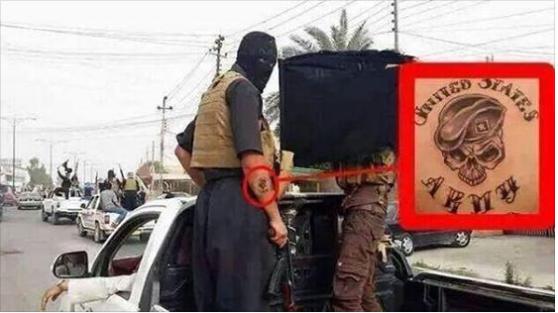
ISIS-guy-has-us-army-tattoo-photo

By Daniel Spaulding

Source: The Soul of the East

In the midst of Saudi Arabia’s merciless, unprovoked bombing campaign against the people of Yemen comes news that a faction of ISIS-aligned militants has established a beachhead in the south of the Arabian Peninsula for their proclaimed Caliphate. Already media reports have been circulating that the local al-Qaeda affiliate has taken advantage of Riyadh’s bombing campaign to seize control of territory in the southeast of Yemen, with no noticeable Saudi opposition to these acts. The Saudis have not made quelling groups like al-Qaeda and ISIS any sort of priority in their assault; rather it is exclusively the Houthi militias that are in the sights of the Wahhabist kingdom.

This state of affairs apparently suits jihadist factions just fine. They have expressed no noticeable opposition to the Saudi bombing campaign and the mass killing of Yemeni civilians. Rather, ISIS has issued a declaration of war against the Houthis, threatening the mass slaughter of Yemen’s Shiite sect. The aims of Saudi Arabia, and its main backer, the United States, and jihadist factions like ISIS and al-Qaeda converge when it comes to fighting and suppressing the Houthis (cynically presented as Iranian proxies). Or rather, once again, jihadists are deliberately unleashed and encouraged to wage war against the enemies and rivals of Washington and Riyadh, just as they have been previously employed in Libya and Syria.

Despite all the fearmongering rhetoric and disinformation trumpeted by elements of the American media about secret ISIS training camps in Mexico, there have been precisely zero ISIS cells uncovered in the United States. More specifically, no cells not manufactured and managed by America’s own domestic intelligence agencies have been found. On the other hand, ISIS is very active in savagely attacking states, like that of Bashar Assad’s Syria, and other groups, like the Houthis in Yemen, that are in the target sights of Washington and Riyadh. To put it bluntly, ISIS and al-Qaeda are the shock troops of America’s Brave New War.

It is a common and entirely cynical meme among certain factions of the alternative media to place all the blame on Barack Obama for US support of the jihad international, insinuating that he’s a secret Islamist sympathizer and fellow traveler. On the contrary, the joint American-Saudi sponsorship of mujahedin brigades is hardly anything new or unique to the Obama administration. It reaches back to Jimmy Carter and Zbigniew Brzezinski, who armed the mujahedin in Afghanistan against the Russians. Indeed, the entire sordid love affair goes back even earlier to British imperial policy to divide and rule the Middle East, as enacted by Lawrence of Arabia. Oddly enough, the Iranian government, now opposed by America and Israel, was built up by both countries throughout the 1980’s.

More recently, during the presidency of George W. Bush, the Washington-Riyadh axis funded and facilitated jihadist militants in Iran and Lebanon in a concerted effort to destabilize those countries. The specific aim of this endeavor, according the investigative journalist Seymour Hersh, who broke the story, was to use the Sunni jihadists to undermine and degrade the influence of Shiite powers in the region, especially Iran, Syria, and Hezbollah in Lebanon.[1]

Thus the current positions and activities employed by the Obama administration toward this end are merely a continuation of previous Bush-era policies. Collaborating with the Saudis to unleash radical Sunni jihadists in Syria, Iraq, and Yemen against the Shiites of those nations is an attempt to break Iran’s perceived hegemony in the Middle East.

Israel’s role in this criminal enterprise, meanwhile, should not be passed over in silence. Israel has repeatedly bombed the Syrian military, while allowing Syrian jihadists to remain unmolested in the Golan, and even providing various forms of aid to the Syrian jihadists. Tel Aviv officials are quite open about the fact that they are far more comfortable with murderous ISIS and other Sunni radicals in power next door than with Iran and the Shiites.

Between the globalists based in Washington and the Saudi Wahhabists, one hand washes the other. (Lest we dare to mention the cover up of Saudi Arabia’s involvement with 9-11 terror attacks by Washington.)

We would never have any understanding of the monstrous fraud perpetrated against the peoples of the Middle East, as well as ordinary Americans, from ingesting the poison-pill weaponized memes of the mass media. When not chasing their tails with ridiculous celebrity gossip, phony social outrage, or even more trivial and banal items, the press in the Western world, especially the United States, are a non-stop source of disinformation, fake news sets, State Department talking points, and general mind-blowing stupidity.

“We live in a world where there is more and more information,” observed the French philosopher Jean Baudrillard, “and less and less meaning.”

The average cable news viewer or social media consumer is saturated with all sorts of images, narratives, and factoids, but they are deprived of any coherent meaning to the items they absorb. Many assume, Baudrillard observed, that “information produces meaning,” but they are wrong, and in fact, “the opposite occurs.”

Instead of finding meaning or even connecting the dots in the ISIS scam, and unaware of elite dialectical manipulations, the average American is left to wallow in his ignorance, blind to what his rulers do in his name. He is easily cowed into fear and terror of the very same jihadist groups that his government has sponsored and promoted for decades, surrendering his freedom and identity while cheering on his own dehumanization in the Brave New War. Murder, mayhem, and a kaleidoscopic spectacle of lies: such are the fruits of the fraud we celebrate.


[1] Russia is the other perpetual target of the American-Saudi sponsored jihadist networks. Russian president Vladimir Putin recently revealed in an interview that he confronted former president Bush about the CIA’s backing of Muslim radicals in the North Caucasus. And in 2013 then head of Saudi intelligence Prince Bandar in a meeting with Putin offered to reign in Chechen militant groups, which he acknowledged where directed by Saudi intelligence, if Russia agreed to end its support for the Assad government in Syria.

Kick Open the Doorway to Liberty: What Are We Waiting For?

0823e935c920bdf2c31447b67612bfc6

By John W. Whitehead

Source: The Rutherford Institute

“The greatness of America lies in the right to protest for right.”—Martin Luther King Jr.

Everything this nation once stood for is being turned on its head.

Free speech, religious expression, privacy, due process, bodily integrity, the sanctity of human life, the sovereignty of the family, individuality, the right to self-defense, protection against police abuses, representative government, private property, human rights—the very ideals that once made this nation great—have become casualties of a politically correct, misguided, materialistic, amoral, militaristic culture.

Indeed, I’m having a hard time reconciling the America I know and love with the America being depicted in the daily news headlines, where corruption, cronyism and abuse have taken precedence over the rights of the citizenry and the rule of law.

What kind of country do we live in where it’s acceptable for police to shoot unarmed citizens, for homeowners to be jailed for having overgrown lawns (a Texas homeowner was actually sentenced to 17 days in jail and fined $1700 for having an overgrown lawn), for kids to be tasered and pepper sprayed for acting like kids at school (many are left with health problems ranging from comas and asthma to cardiac arrest), and for local governments to rake in hefty profits under the guise of traffic safety (NPR reports that police departments across the country continue to require quotas for arrests and tickets, a practice that is illegal but in effect)?

Why should we Americans have to put up with the government listening in on our phone calls, spying on our emails, subjecting us to roadside strip searches, and generally holding our freedoms hostage in exchange for some phantom promises of security?

As I document in my new book Battlefield America: The War on the American People, it doesn’t matter where you live—big city or small town—it’s the same scenario being played out over and over again in which government agents ride roughshod over the rights of the citizenry.

In such an environment, it’s not just our Fourth Amendment rights—which protect us against police abuses—that are being trampled. It’s also our First Amendment rights to even voice concern over these practices that are being muzzled. Just consider some of the First Amendment battles that have taken place in recent years, and you too will find yourself wondering what country you’re living in:

  • Harold Hodge was arrested for standing silently in front of the U.S. Supreme Court building, holding a sign in protest of police tactics.
  • Marine Brandon Raub was arrested for criticizing the government on Facebook.
  • Pastor Michael Salman was arrested for holding Bible studies in his home.
  • Steven Howards was arrested for being too close to a government official when he voiced his disapproval of the war in Iraq.
  • Kenneth Webber was fired from his job as a schoolbus driver for displaying a Confederate flag on the truck he uses to drive from home to school and back.
  • Fred Marlow was arrested for filming a SWAT team raid that took place across from his apartment.

And then there were the three California high school public school students who were ordered to turn their American flag t-shirts inside out on May 5 (Cinco de Mayo) because school officials were afraid it might cause a disruption and/or offend Hispanic students. Incredibly, the U.S. Supreme Court actually sided with the school and the Ninth Circuit Court of Appeals, affirming that it might be disruptive for American students to wear the American flag to an American public school.

While there are all kinds of labels being put on so-called “unacceptable” speech today, from calling it politically incorrect and hate speech to offensive and dangerous speech, the real message being conveyed is that Americans don’t have a right to express themselves if what they are saying is unpopular, controversial or at odds with what the government determines to be acceptable.

Whether it’s through the use of so-called “free speech zones,” the requirement of speech permits, the policing of online forums, or a litany of laws and policies that criminalize expressive activities, what we’re seeing is the caging of free speech and the asphyxiation of the First Amendment.

Long before the menace of the police state, with its roadside strip searches, surveillance drones, and SWAT team raids, it was our First Amendment rights that were being battered by political correctness, hate crime legislation, the war on terror and every other thinly veiled rationale used to justify censoring our free speech rights.

By suppressing free speech, the government is contributing to a growing underclass of Americans who are being told that they can’t take part in American public life unless they “fit in.” Mind you, it won’t be long before anyone who believes in holding the government accountable to respecting our rights and abiding by the rule of law is labeled an “extremist” and is relegated to an underclass that doesn’t fit in and must be watched all the time.

It doesn’t matter how much money you make, what politics you subscribe to, or what God you worship: we are all potential suspects, terrorists and lawbreakers in the eyes of the government.

In other words, if and when this nation falls to tyranny, we will all suffer the same fate: we will fall together. However, if it is possible to avert such an outcome, it will rest in us remembering that we are also all descendants of those early American revolutionaries who pushed back against the abuses of the British government. These people were neither career politicians nor government bureaucrats. Instead, they were mechanics, merchants, artisans and the like—ordinary people groaning under the weight of Britain’s oppressive rule—who, having reached a breaking point, had decided that enough was enough.

The colonists’ treatment at the hands of the British was not much different from the abuses meted out to the American people today: they too were taxed on everything from food to labor without any real say in the matter, in addition to which they had their homes invaded by armed government agents, their property seized and searched, their families terrorized, their communications, associations and activities monitored, and their attempts to defend themselves and challenge the government’s abuses dismissed as belligerence, treachery, and sedition.

Unlike most Americans today, who remain ignorant of the government’s abuses, cheerfully distracted by the entertainment spectacles trotted out before them by a complicit media, readily persuaded that the government has their best interests at heart, and easily cowed by the slightest show of force, the colonists responded to the government’s abuses with outrage, activism and rebellion. They staged boycotts of British goods and organized public protests, mass meetings, parades, bonfires and other demonstrations, culminating with their most famous act of resistance, the Boston Tea Party.

On the night of December 16, 1773, a group of men dressed as Indians boarded three ships that were carrying tea. Cheered on by a crowd along the shore, they threw 342 chests of tea overboard in protest of a tax on the tea. Many American merchants were aghast at the wanton destruction of property. A town meeting in Bristol, Massachusetts, condemned the action. Ben Franklin even called on his native city to pay for the tea and apologize. But as historian Pauline Maier notes, the Boston Tea Party was a last resort for a group of people who had stated their peaceful demands but were rebuffed by the British: “The tea resistance constituted a model of justified forceful resistance upon traditional criteria.”

The rest, as they say, is history. Yet it’s a history we cannot afford to forget or allow to be rewritten.

The colonists suffered under the weight of countless tyrannies before they finally were emboldened to stand their ground. They attempted to reason with the British crown, to plea their cause, even to negotiate. It was only when these means proved futile that they resorted to outright resistance, civil disobedience and eventually rebellion.

More than 200 years later, we are once again suffering under a long train of abuses and usurpations. What Americans today must decide is how committed they are to the cause of freedom and how far they’re willing to go to restore what has been lost.

Nat Hentoff, one of my dearest friends and a formidable champion of the Constitution, has long advocated for the resurgence of grassroots activism. As Nat noted:

This resistance to arrant tyranny first became part of our heritage when Samuel Adams and the Sons of Liberty formed the original Committees of Correspondence, a unifying source of news of British tyranny throughout the colonies that became a precipitating cause of the American Revolution. Where are the Sons of Liberty, the Committees of Correspondence and the insistently courageous city councils now, when they are crucially needed to bring back the Bill of Rights that protect every American against government tyranny worse than King George III’s? Where are the citizens demanding that these doorways to liberty be opened … What are we waiting for?

What are we waiting for, indeed?

Feds Panic on Mass Common Core Test Refusals, Threaten Reprisals

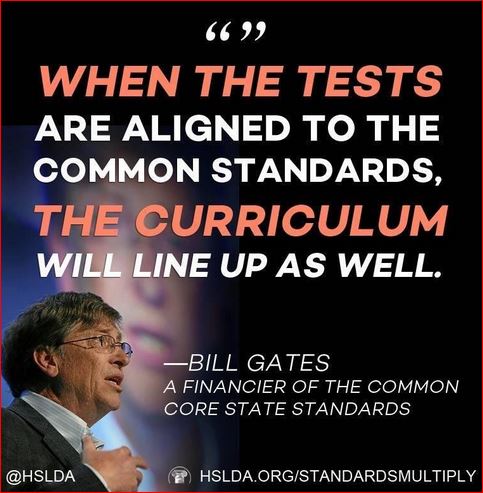
Gates-HSLDA-Curriculum-aligned

By Alex Newman

Source: The New American

Public resistance to Common Core is exploding across America, and officials are not happy about it. The Obama administration’s Department of Education, along with pro-Common Core government officials across the country under pressure from the feds, appear to be in panic mode. Facing a growing nationwide “opt out” movement to refuse participation in the unconstitutional federally funded testing regime aligned with the Obama-backed national school standards, senior bureaucrats, including Education Secretary Arne Duncan, have actually started resorting to lawless threats against parents, teachers, students, and entire state governments. Some parents were threatened by officials with jail time. Even small children are being punished by the state for “opting out” of the deeply controversial tests, with one California mother telling The New American that her daughter was publicly denied ice cream in retaliation.

But so far, the threats are only emboldening the opposition.

Perhaps the most outrageous threat so far came from Obama’s education chief, Duncan, who boasted in recent years of using government schools to create “green citizens” with UNESCO (United Nations Educational, Scientific, and Cultural Organization) as a “global partner.” Late last month, Duncan, who was greeted by protesters urging him to “stop test bullying,” threatened federal intervention to force Americans to take the Common Core tests if states would not do the job. “We think most states will do that,” Duncan proclaimed at an Education Writers Association conference in Chicago. “If states don’t do that, then we [the federal government] have an obligation to step in.” In reality, of course, the federal government has an obligation under the U.S. Constitution to butt out. But despite swearing an oath to uphold and defend the Constitution, including the 10th Amendment, Duncan has led the charge in recent years to finish federalizing the government school system — and to use it as what he called a “weapon” to “change to world.”

Sounding oblivious to America’s federalist system of constitutional government, Duncan proclaimed that he expected state governments to hold “districts’ and schools’ feet to the fire on this,” as if state governments were mere administrative units to enforce decrees from the all-powerful federal executive branch. Hundreds of thousands of students in New York recently opted out. Almost nobody took the tests in some districts amid a full-scale uprising by teachers, students, and parents. In Chicago, where even the teachers’ union has blasted the federal takeover, school officials were threatened with the loss of more than $1 billion in state and federal “education aid” if not enough students were successfully coerced into taking the Common Core-aligned tests. Still, few details were provided on what it might look like to have the Obama administration “step in” and force students to take the controversial tests — an outrageous threat he also made in a discussion with Motoko Rich of the New York Times.

Critics, however, ridiculed the threat, daring the administration to try it. “Assuming that Duncan is not planning to call in the National Guard to haul off opt-outing 8 year olds, the only possible ‘sanction’ would be withholding funds,” observed Carol Burris, an award-winning New York principal who recently stepped down to fight back against what she sees as problems with the public education system. “That would surely lead to court challenges forcing the Education Department to justify penalizing schools when parents exercise their legitimate right to refuse the test — an impossible position to defend.” Noting that students of all races and backgrounds were opting out of the testing scheme, Burris pointed out that the rates “defy the stereotype that the movement is a rebellion of petulant ‘white suburban moms.’”

In a recent statement published by the Washington Post, the New York “2013 High School Principal of the Year” also highlighted a number of troubling government abuses targeting parents. Among other concerns, she said, citing activists and teachers, that administrators in some districts took advantage of non-English speaking parents by lying to them about the tests, saying they were mandatory or that children would be held back for refusal to take them. One critic called it “blatant discrimination at best.” Burris also lambasted the Common Core tests and noted that Duncan’s own children go to a non-Common Core school — as do the children of Common Core financier Bill Gates, and Common Core strongman Obama. She concluded the scathing commentary by noting that the movement to refuse the tests puts the entire “education reform” agenda in serious trouble.

Beyond targeting states and schools, education officials in some areas, responding to federal pressure, have strayed into the realm of potential criminal activity in seeking to boost participation in the tests. In one especially extreme case from Georgia, school officials, citing supposed “federal and state mandates” on the tests, said parents could not refuse to allow their children to take the tests. A meeting was scheduled for the parents to meet with the principal. However, when they arrived, they were met by a police officer, who reportedly warned them that they may be “trespassing” on school property due to their opposition to the testing regime. In the end, it was apparently sorted out without arrest, but the incident was deeply troubling to parents.

In South Carolina, education bureaucrats went even further. The officials reportedly warned parents that they could be imprisoned for 30 days for refusing to allow their children to participate in the national testing regime, which was mandated under the unconstitutional Bush-era No Child Left Behind scheme. According to news reports citing the group South Carolina Parents Involved in Education, South Carolina Education Department Chief Operating Officer Elizabeth Carpentier also threatened groups or organizations that encourage testing refusals with potential criminal charges of “aiding and abetting a crime.” School officials cited in media reports downplayed the threats, saying that parents and groups were merely threatened with existing statutes on “truancy” for not sending children to school for the testing.

In California, mother Amy Watson and her husband decided that their 10-year-old daughter would not be taking the unconstitutional federally funded Smarter Balanced Assessment Consortium (SBAC) test. She was placed in an alternate classroom each testing day with other “opt out” students. In response to the refusal, though, on the day after testing was finished, “the three girls who opted out again were identified, ‘called out,’ and given instructions to go to the same classrooms as during SBAC testing,” Watson told The New American. “The girls were sent out so the ‘test takers’ could have an ice cream party. My daughter returned to her classroom with the trashcan full of empty ice cream containers. There were three ‘left over’ containers. The three opt-out students were not permitted to have them. These three containers were given to teachers instead.” The same thing happened to opt-out students in other grades, she added, calling it an “egregious act.”

Now, Watson has filed a privacy law-violation complaint with the U.S. Department of Education after her daughter and other opt-out students were “intentionally targeted.” The 10-year old is now fearful of additional retaliation from school officials, and Watson is seeking counseling for her daughter due to the emotional and psychological impact the targeting had on her. “I described the situation to the representative at the federal Department of Education,” Watson said. “He verified that ‘yes, this is a violation of FERPA [federal privacy law to protect students].’” The outraged mother is also in contact with attorneys and vowed to continue pursuing the case. Since the scandal, school officials have tried to downplay the incident as a “misunderstanding,” Watson said. But she is not buying it.

As the rebellion against the unconstitutional Common Core testing regime continues to sweep across America like wildfire, the Obama administration is certain to continue doing everything possible to stop it — including lawlessly threatening the American people. But despite those threats, as awareness of Common Core spreads, opposition will keep spreading as well. The testing regime is crucial for enforcing Common Core, and for gathering vast amounts of private data on students for the federal government. Without it, the widely criticized standards regime foisted on America by taxpayer-funded bribes from the Obama administration may well crumble.

The education establishment is now in a serious bind. On one hand, it can rip off the mask and resort to more outright lawlessness and tyranny in an effort to enforce compliance with its deeply unpopular machinations. Such a reaction would almost certainly backfire and produce even more public outrage and resistance. Alternatively, the Obama administration and its backers can risk having the entire Common Core scheme come crashing down around them by ignoring the mushrooming national movement to refuse the tests. Either way, the American people can still win the battle for education in the long run, if the pressure stays on.

Overcoming the American Dream

george-carlin-american-dream

By Frank Castro

Source: The Hampton Institute

“Anyone who has ever struggled with poverty knows how extremely expensive it is to be poor.” – James Baldwin
My house sat tucked a mile deep, wrapped in 500 acres of sprawling oaks and towering pines. Dense thickets crisscrossed the land like formidable barricades protecting masses of forests from the intrusions of bored, yet curious children. They would leave you picking daggers from your sides and forearms if you journeyed too far. I grew up in a remote place called Farmhaven, the midway point between Canton and Carthage, Mississippi. Driving through you would never know you were somewhere with a name. Farmhaven is one of those places marked by only an intersection and a road that always goes somewhere else. It is here though, with my father and my brother, in the heart of the South, that I learned the most important lesson life could teach me.

When I was very young the world was a place of limitless potential. Like a naïve summer breeze still clinging to the fantasy that winter will never come, I was no different than most children who believe the world is theirs. You do not have to be rich to dream such dreams. A swift run and leap off the South end of our porch, where the ground was soft and the magnolia leaves puddled, was all it took. With my arms stretched wide I pretended to be a fighter pilot leaving the deck of an aircraft carrier. I never really knew or cared what fighter pilots do; I just wanted to see the world through a bird’s eyes. It was my own American Dream. And the further from the porch I landed, the more I believed I would someday soar.

It’s probably not an unfamiliar story. After all, in children imagination abounds. About this time we start being told to follow our dreams, as if the world were built in such a way that the realization of all our dreams is possible. Certainly that’s what I believed, that people just out to make the imagined real. Life is not without a cruel sense of irony though, and elders rarely mention to adolescents the kind of world in which we live. They shield us from it, understandably not wanting to damage the authenticity and fragility of our youthful ambition. But reality will come knocking. It always does. It will come to tell us that the world has been built in such a way that our dreams will be withheld from us, that the joys of making them real cannot be ours, but rather, with and atop our backs, they must be forfeited to erect someone else’s.

This is the price of poverty.
Knock, Knock

“Capitalism is cruel and heartless and tears people apart, mentally, physically and socially.” - Susan Rosenthal

My father taught me the value of work. For all his faults, I could never question how hard he labored to provide for my brother and me, or how determined he was to instill in us a love for building with our own hands. He tried to teach us how to work the land. We plowed and planted. We built homes for our chickens, turkeys, and ducks. We constructed wooden and wire fences for rotating our goats and horses from one field to another. During the winter months when our grazing fields turned to tundra, I hoisted buckets of feed to the troughs I had built. My brother and I became so proficient with our hands that often my father would drop us off in the woods with supplies and expect a job to be done when he returned with lunch.

But neither our farm nor all the work we put into it was ever what kept a roof over our heads. Even after the fruits of our labor yielded plates for our table, we still needed money. I knew this all too well, even as a seven year old. My room was in the middle of our house. You could not get from the kitchen to the living room without first walking through it. Often a door was left cracked open, not intentionally, but because door frames shift with age and require a firm snug to be pulled completely shut. Through the years while I had a step-mother I heard my father and her argue about bills when the doors where ajar. Always more bills. They both worked in addition to our farm. She worked at a cigarette store. His job always changed. And still it was never enough. Sometimes they got loud. Her voice screeched. His slurred. And mine would make lists in my head of everything I was going to do the next day to make it all better.

I began doing my own laundry about that time because I wanted my step-mother to stay. My child’s mind thought it would make a difference. She left after a few more years though, and when it happened I really could not blame her. My father had begun turning to his bottles more often than he turned to her. When he got drunk enough one night to put a shotgun to my brother’s head, she lost all composure. Refrigerator doors flung open. Voices thundered. Walls shook. Glass bottles clanked and flew further off the porch than I ever had, exploding all over the lawn - just like my family, exploding. My screams were equal only to my tears. Every little list I had made in my head was useless. The gun landed in the yard too after my step-mother snatched it. My brother and I spent that night in the shadow of two people we loved parting ways forever. Soon we lost the farm… and our father too.

I never soared into those magnolia leaves again. In the years to come dreams of a family and a home where I belonged replaced all desire to fly.

Not till much later did I realize that nothing I did then would have made a significant difference. Neither my brother nor I held fault for our poverty and, despite his drinking, it was not entirely my father’s fault either. Addiction, I learned, is most often endemic of a society that generates addicts. Something bigger loomed, something far more pervasive and far-reaching than the lives of a few backwoods Mississippians. Reflecting on how expensive poverty had been for my family, asking why I was poor and why were we ripped apart, I found myself on an inescapable trajectory to discover the origins of inequality.
Their Gluttony Is Our Starvation

“The class which has the power to rob upon a large scale has also the power to control the government and legalize their robbery.” - Eugene V. Debs

My family’s farm was bought by a group of wealthy men who wanted a hunting resort. For the majority of the year our old home sits empty and rotting. It is a reminder that in the halls of country clubs and on the decks of overpriced yachts, poverty is, in the most acute sense of the word, the abundant currency of the rich. Their very existence is predicated on the existence of the poor.

This is not a fact we like to grapple with in America. Here everybody believes they can get rich. We believe the realization of ALL of our dreams is possible. We call this belief the American Dream, and it has been incredibly successful at stifling plausible attempts at equality outside the capitalist framework. To paraphrase John Steinbeck, socialism never took root in America because the poor see themselves not as an exploited proletariat but as temporarily embarrassed millionaires. It is the worst sort of fabrication because it makes us believe the preposterous - my family could have our house, our farm, a decent living with ample food, and an environment where addiction would stymy, while simultaneously rich folks could use it all to shoot animals for sport.

If it sounds ridiculous, it’s because it is.

Under capitalism one party was always going to lose, and generally the party which loses is the one with significantly less money. Our socioeconomic realities are structured this way. “Losers” are a necessity for capitalism’s survival. My family’s misfortune was a microcosm of structured events that play out against billions of poor people in orchestrated symphony every day. They (we) find ourselves in battles with people, organizations, and nations who have enormous financial capabilities, and therefore power, and because our global political system was built around empowering the moneyed class, before the battle ever starts our circumstances are engineered for defeat. Scaled up or down, this predisposition between those with power and those without is consistent. It is why my family lacked the financial agency over our lives to survive. But it is also why entire poor communities are displaced and gentrified by wealthy developers, or entire swaths of the planet are exploited by wealthy nations and their corporations. Where ever we are, our struggles are connected.

The American Dream then has at least two primary functions. Its first is to generate a mythology around itself which can effectively negate the reality that within capitalism not everybody can realize their dreams, that there must be an oppressed class. Such a mythology atomizes people from collective struggle. It induces a form of hyper individualism often seen in the “Boot-Strap Myth,” or the idea that anybody of little means, with hard work and determination, can lift themselves to the highest rungs of bourgeoisie society (the richest of the rich). By focusing on individual stories of capitalist success, the Bill Gates and Sam Waltons of the world, the vast poverty and suffering required for the emergence of massive fortunes is left out of the picture. One can point to Gates and believe their own ascendance is possible without understanding its possibility is predicated on the systematic exploitation of tens of thousands of workers in mines and factories across the globe. And more importantly, focus on the few success stories of the super-rich invisibilizes the structure which keeps wealth within their hands at the direct expense of the poor and makes it beyond examination or reproach.

A second primary function of the American Dream is to facilitate an overpowering sense of entitlement through exploitive competition. It cleaves us from cooperative modes of thinking and existing by constantly pitting us against each other. Through competing with fellow human beings for the necessities of life - work, housing, education, affection, nourishment, social belonging, etc. - an individual is conditioned to accept that competition is the natural state of human existence, and therefore competition necessitates winners and losers. Here, belief of capitalist mythology graduates into acceptance of capitalist power structures, and then finally into the endorsement and full-fledged participation in them. The latter is crucial, for in order to amass a huge fortune a person has to endorse a sort self-maximizing choice which, in their minds, justifies widespread exploitation. At this point it is believed that “losers” (the exploited) are inevitable, thus the more losers, or the greater number of exploited, the richer (and fewer) the winners. If you play the game ruthlessly enough to win, or even thrive, the logic follows that you are entitled to all the rewards and privileges expropriated from the oppressed.

With little doubt, I imagine the men who bought our farm thought nothing of it. In their minds having the money for it was the only requisite needed, and since they had played by the rules of capitalism well enough to be rewarded with the money needed to purchase it, they were “entitled” to it. But it was never their home. They had never toiled in the fields for crops. They had never spent a birthday or Christmas Eve in the house. They had never fished the ponds. They had never run around the yard filling the trees with laughter, or fed the hummingbirds from the clotheslines. They had never made peace with the bees that burrowed into the oak joists beneath the porch. They had never labored with an axe to stock firewood or climbed beneath the house and wrapped the pipes for winter. They knew nothing of the land or the house but its acreage and price. And that was enough, because the memories of children don’t fetch power when money talks.
Poverty Is a Weapon of Mass Destruction

“You cannot call a society which has 3.5 million homeless and 18.5 million vacant homes civil. That’s violent and morally bankrupt.” - Frank Castro

Poverty is a weapon of mass destruction. We just do not see it that way because we have a very limited understanding of what violence looks like. Statistics paint a broad picture, like the fact that 7.7 million people die of hunger every year (21,000 a day), or the fact that 3.5 Americans remain homeless despite 18.5 million vacant homes; but unless we know those individuals’ stories, and they resonate with us in some way, a culture of competition and entitlement keeps us preoccupied with trying to realize our own ambitions - or resolve our own problems. Whatever the reason, often we are concerned more with ourselves than our collective struggle.

Myths like the American Dream condition us to accept that an elite minority profiting off widespread misery is the way of the world. But remember, the hungry don’t choose to starve, and few houseless people choose homelessness. They are starved and put on the streets by a system which structurally denies them access to food and shelter. If we are to get a realistic picture of how destructive global capitalism is, it requires a broader and deeper understanding of violence.

In 2013, Peter Joseph tried reframing the parameters of violence:

“If I put a gun to someone’s head, say, a 30-year-old healthy male, pull the trigger, and kill him, assuming an average life expectancy of, say, 84, you can argue that possibly 54 years of life [were] stolen from that person in a direct act of violence.
However, if a person is born into poverty in the midst of an abundant society where it is statistically proven that it would hurt no one to facilitate meeting the basic needs of that person and yet they die at the age of 30 due to heart disease, which has been found to statistically relate to those who endure the stress and effects of low socioeconomic status, is that death, the removal of those 54 years once again, an act of violence? And the answer is “Yes, it is.” You see, our legal system has conditioned us to think that violence is a direct behavioral act. The truth is that violence is a process, not an act, and it can take many forms. You cannot separate any outcome from the system by which it is oriented.”

***Distributed equally, the grains produced throughout the world would provide each person 3,600 calories per day . The average person requires 2,000 calories a day to maintain a healthy diet.

If we can understand the scenario Peter explains as a process of violence multiplied by millions of starving and homeless people, then little more evidence is needed to indict and convict capitalism as the sadistic, murderous, and megalomaniacal system it is. Contrary to what the Boot Straps Myth and the American Dream tell us, poverty sits infinitely more on the shoulders of structures we are born into than it does personal choice, ambition, or determination. If more understood this, perhaps then finally the lie that billions like me were born into poverty because our parents were lazy, untalented, or lack the ambition to succeed, could die.
Dream Differently

“You have to act as if it were possible to radically transform the world. And you have to do it all the time.” - Angela Davis

When poverty consumed my family it destroyed any understanding of unity I had. To this day my dream remains to rediscover what family means for me, what it will look and feel like; but through the pain and the loss this much has become clear: There is no room left for “America” in my dreams. I imagine a world where families are no longer faced with the looming pistol of starvation and homelessness. No borders, rules, or regulations will rip our homes from us. No person or institution will dangle over us the future we strive toward like a tree that grows inches with every stretch for fruit. Instead we will live in cooperation with each other, a cooperation which builds beyond blood and yields families the breadth of communities. I have survived this long by doing what most people with dreams do - by continuing to live every day to make them reality. And while I struggle every day to keep mine alive, I am inspired by the building happening all around me, and by the friends who have been my family.

My story is only one of billions across the globe though - one among a sea of poverty’s victims. Ensuring billions more are not to follow suit requires shedding America’s myths. When we tell children to follow their dreams without empowering them to envision a world beyond global capitalism, and beyond America, we limit them to the possibilities afforded through oppression. We preclude the possibility of starting our lives with visions of a world that centers liberation, cooperation, love, and justice.

As Wolfi Landstreicher once said, “If one loves life, if one wants to expand and flourish, it is absolutely necessary to free desire from the channels to constrain it, to let it flood our minds and hearts with passion that sparks the wildest dreams. Then one must grasp these dreams and from them hone a weapon with which to attack this reality, a passionate rebellious reason capable of formulating projects aimed at the destruction of that which exists and the realization of our most marvelous desires. For those of us who want to make our lives our own, anything less would be unrealistic.”

To us then has fallen the challenge of taking back the power of imagination, of dreaming beyond ourselves and beyond America.

When Drug Users Aren’t People

d90d9d221dc48be6739092bcee48b1c9

By Ryan Calhoun

Source: Center for a Stateless Society

Judge Katherine Forrest’s decision to lock up Ross Ulbricht for the rest of his life is a momentous tragedy. There were other tragic circumstances on display during Ulbricht’s trial, however. Submitted as evidence against the integrity of the Silk Road were stories of drug overdoses that were allegedly tied to products bought on the darknet drug market. The loss of life in these cases is something we should never look at as unimportant, but their use in condemning Ulbricht’s market are seriously problematic.

“I have no doubt in my mind, that if Preston had not taken that drug which one of his friends had purchased off the internet Silk Road, he would still be alive today,” wrote one grieving mother from Australia. Her son had jumped to his death after purchasing what he may have thought was LSD, but was actually a synthetic known as NBOMe. First please let us take note of where such synthetics come from, a need to produce new designer chemicals which are often more unstable, untested, and easily passed off as what we know to be much safer psychoactive chemicals. The parents and siblings grieving in these cases misplace their ire. What truly led to many people ingesting dangerous chemicals was in fact the laws that are now being used to send Ross Ulbricht to prison. Also worth recognizing is that at the time of ingestion, there was no federal ban on these substances and, at least in America, they could be found or sold discreetly in wholly legal forms of exchange.

Notice also the subtle dehumanization of drug users masquerading as compassion. When someone overdoses people do not recognize the choice of the individual. They do not talk about these people as individual agents, but as symptoms of the individual. In the Silk Road case, parents condemn what Ulbricht’s venue provided for their children — a safe and discreet way to obtain psychoactive chemicals. They would have never sought out these drugs had it not been for Silk Road. This is doubly dehumanizing. They characterize their son’s purchase as somehow inevitable, that he was too weak to help himself and too ignorant to know the dangers inherent in hard drug use. But what compounds the dehumanization of drug consumers in this treatment is that they declare that drug markets OUGHT to be unsafe, ought to be insecure. Their son is a mere exception to the scummy and disposable drug world, he was corrupted by looking through a window to a drug trade which didn’t pose enormous risk to his safety. Drug users, drug distributors, they don’t deserve safety to these people.

Many who are involved in drug subcultures aim to make consumption safer for those who choose freely to consume these substances. Along with being able to read customer reviews that keep merchants within these bazaars held accountable by reputation, there is frequent encouragement to buy test kits for these chemicals. Across the internet you will find no shortage of FAQs on how to prudently go into an experience with drugs, especially for psychedelic experiences which are often delicate and require a good deal of coaching to ensure the best set and setting. At raves across the country people are encouraged by their peers to consume judiciously, to stay hydrated, and most of all to enjoy their experience — which is a frame of mind directly hindered by drug laws and cultural taboos.

These are all voluntary, spontaneous modes of behavior, many born out of a genuine concern for one’s fellow drug users. They are treated as individuals, not addicts. They are met with care, compassion, and resources both physical and mental. What drove these markets underground, what made them more dangerous than they ever needed to be is the intention behind these laws and tragically behind the condemnation of Ulbricht and others as “psychopaths” from people who lost those they loved. It is this legislation, this judicial process, and these cultural norms that must change. We must recognize drug users not as inherently sick and lascivious, but as people who come from the same world as we do, who sought these chemicals not out of an alien urge that overtook them, but because drugs come with a great deal of reward to the user. We can’t let that reward go unchecked from the dangers that are there for those who choose willingly to accept it. We must abolish not only the laws, but the puritanical attitudes which make us see our neighbors and our loved ones as fraught with illness for wanting to get high. It’s time. We must step out of the shadows, break the back of the system that has kept us there, and bring this enormous wealth of human experience into its proper social context. Free Ross Ulbricht, free all drug criminals, and end this dehumanization campaign once and for all.

Assassination as Policy in Washington and How It Failed: 1990-2015

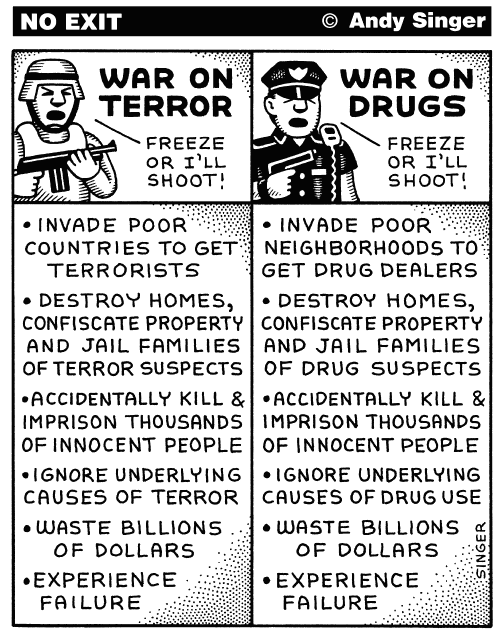
War on Drugs

By Andrew Cockburn

Source: Counterpunch

As the war on terror nears its 14th anniversary — a war we seem to be losing, given jihadist advances in Iraq, Syria, and Yemen — the U.S. sticks stolidly to its strategy of “high-value targeting,” our preferred euphemism for assassination.  Secretary of State John Kerry has proudly cited the elimination of “fifty percent” of the Islamic State’s “top commanders” as a recent indication of progress. Abu Bakr al-Baghdadi himself, “Caliph” of the Islamic State, was reportedly seriously wounded in a March airstrike and thereby removed from day-to-day control of the organization. In January, as the White House belatedly admitted, a strike targeting al-Qaeda leadership in Pakistan also managed to kill an American, Warren Weinstein, and his fellow hostage, Giovanni Lo Porto.

More recently in Yemen, even as al-Qaeda in the Arabian Peninsula took control of a key airport, an American drone strike killed Ibrahim Suleiman al-Rubaish, allegedly an important figure in the group’s hierarchy.  Meanwhile, the Saudi news channel al-Arabiya has featured a deck of cards bearing pictures of that country’s principal enemies in Yemen in emulation of the infamous cards issued by the U.S. military prior to the 2003 invasion of Iraq as an aid to targeting its leaders.  (Saddam Hussein was the ace of spades.)

Whatever the euphemism — the Israelis prefer to call it “focused prevention” — assassination has clearly been Washington’s favored strategy in the twenty-first century.   Methods of implementation, including drones, cruise missiles, and Special Operations forces hunter-killer teams, may vary, but the core notion that the path to success lies in directly attacking and taking out your enemy’s leadership has become deeply embedded.  As then-Secretary of State Hillary Clinton put it in 2010, “We believe that the use of intelligence-driven, precision-targeted operations against high-value insurgents and their networks is a key component” of U.S. strategy.

Analyses of this policy often refer, correctly, to the blood-drenched precedent of the CIA’s Vietnam-era Phoenix Program — at least 20,000 “neutralized.” But there was a more recent and far more direct, if less noted, source of inspiration for the contemporary American program of murder in the Greater Middle East and Africa, the “kingpin strategy” of Washington’s drug wars of the 1990s. As a former senior White House counterterrorism official confirmed to me in a 2013 interview, “The idea had its origins in the drug war.  So that precedent was already in the system as a shaper of our thinking.  We had a high degree of confidence in the utility of targeted killing. There was a strong sense that this was a tool to be used.”

Had that official known a little more about just how this feature of the drug wars actually played out, he might have had less confidence in the utility of his chosen instrument.  In fact, the strangest part of the story is that a strategy that failed utterly back then, achieving the very opposite of its intended goal, would later be applied full scale to the war on terror — with exactly the same results.

The Kingpin Strategy Arrives

At the beginning of the 1990s, the Drug Enforcement Administration (DEA) was the poor stepsister of federal law enforcement agencies.  Called into being by President Richard Nixon two decades earlier, it had languished in the shadow of more powerful siblings, notably the FBI.  But the future offered hope.  President George H.W. Bush had only recently re-launched the war on drugs first proclaimed by Nixon, and there were rich budgetary pickings in prospect.  Furthermore, in contrast to the shadowy drug trafficking groups of Nixon’s day, it was now possible to put a face, or faces, on the enemy.  The Colombian cocaine cartels were already infamous, their power and ruthless efficiency well covered in the media.

For Robert Bonner, a former prosecutor and federal judge appointed to head the DEA in 1990, the opportunity couldn’t have been clearer.  Although Nixon had nurtured fantasies of deploying his fledgling anti-drug force to assassinate traffickers, even soliciting anti-Castro Cuban leaders to provide the necessary killers, Bonner had something more systematic in mind.  He called it a “kingpin strategy,” whose aim would be the elimination either by death or capture of the “kingpins” dominating those cartels.

Implicit in the concept was the assumption that the United States faced a hierarchically structured threat that could be defeated by removing key leadership components.  In this, Bonner echoed a traditional U.S. Air Force doctrine: that any enemy system must contain “critical nodes,” the destruction of which would lead to the enemy’s collapse.

In a revealing address to a 2012 meeting of DEA veterans held to commemorate the 20th anniversary of the kingpin strategy’s inauguration, Bonner spoke of the corporate enemy they had confronted.  Major drug trafficking outfits, he said, “by any measure are large organizations. They operate by definition transnationally. They are vertically integrated in terms of production and distribution. They usually have, by the way, fairly smart albeit quite ruthless people at the top and they have a command and control structure. And they also have people with expertise that run certain essential functions of the organization such as logistics, sales and distribution, finances, and enforcement.”  It followed therefore that the removal of those smart people at the top, not to mention the experts in logistics, would render the cartel ineffective and so cut off the flow of narcotics to the United States.

Pursuit of the kingpins promised rich institutional rewards.  Aside from the overbearing presence of the FBI, Bonner had to contend with another carnivore in the Washington bureaucratic jungle eager to encroach on his agency’s territory. “DEA and CIA were butting heads,” recalled the former DEA chief in a 2013 interview. “There was real tension.” Artfully, he managed to negotiate peace with the powerful intelligence agency, “so now we had a very important ally. CIA could use DEA and vice versa.”

By this he meant that the senior agency could use the DEA’s legal powers for domestic operations to good advantage.  This burgeoning relationship brought additional potent allies. Not only was his agency now closer to the CIA, Bonner told me, but “through them, the NSA.” A new Special Operations Division created to work with these senior agencies was to oversee the assault on the kingpins, relying heavily on electronic intelligence.

This new direction would swiftly gain credibility after the successful elimination of the most famous cartel leader of all.  Pablo Escobar, the dominant figure of the Medellín cartel, was an object of obsessive interest to American law enforcement.  He had long evaded U.S.-assisted manhunts before negotiating an agreement with the Colombian government in 1991 under which he took up residence in a “prison” he himself had built in the hills above his home city. A year later, fearing that the government was going to welsh on its deal and turn him over to the Americans, Escobar walked out of that prison and went into hiding.

The subsequent search for the fugitive drug lord marked a turning point. The Cold War was over; Saddam Hussein was defeated in the first Gulf War in 1991; credible threats to the U.S. were scarce; and the danger of budget cuts was in the air. Now, however, the U.S. deployed the full panoply of surveillance technology originally developed to confront the Soviet foe against a single human target. The Air Force sent in an assortment of reconnaissance planes, including SR-71s, which were capable of flying at three times the speed of sound. The Navy sent its own spy planes; the CIA dispatched a helicopter drone.

At one point there were 17 of these surveillance aircraft simultaneously in the air over Medellín although, as it turned out, none of them were any help in tracking down Escobar.  Nor did the DEA make any crucial contribution. Instead, his deadly rivals from Cali, Colombia’s other major trafficking group, played the decisive role in the destruction of that drug lord’s power and support systems, combining well-funded intelligence with bloodthirsty ruthlessness.

His once all-powerful network of informers and bodyguards destroyed, Escobar was eventually located by homing in on his radio and gunned down as he fled across a rooftop on December 2, 1993.  Though the matter is open to debate, a former senior U.S. drug enforcement official assured me unequivocally that a sniper from the U.S. Army’s Special Operations Delta Force had fired the killing shot.

Following this triumph, the DEA turned its attention to the Cali cartel, pursuing it with every resource available: “We really developed the use of wiretaps,” Bonner told me.  Patience and the provision of enormous resources eventually yielded results. In June and July 1995, six of the seven heads of the Cali cartel were arrested, including the brothers Gilberto and Miguel Rodríguez-Orijuela, and the cartel’s cofounder, José “Chepe” Santacruz Londoño.  Although Londoño subsequently escaped from jail, he would in the end be hunted down and killed.  Continued U.S. pressure for the rest of the decade and beyond resulted in a steady flow of cartel bosses into prisons with life sentences or into coffins.

Cartel Heads Go Down and Drugs Go Up

The strategy, it appeared, had been an unqualified success.  “When Pablo Escobar was on the run, for all practical purposes, his organization started going down… ultimately it was destroyed.  And that’s the strategy we have called the kingpin strategy,” crowed Lee Brown, Bill Clinton’s “drug czar,” in 1994.

In public at least, no officials bothered to point out that if that strategy’s aim was to counter drug use among Americans, it had achieved precisely the opposite of its intended goal.  The giveaway to this failure lay in the on-the-street cost of cocaine in this country.  In those years, the DEA put enormous effort into monitoring its price, using undercover agents to make buys and then laboriously compiling and cross-referencing the amounts paid.

The drugs obtained by these surreptitious means, however, were of wildly varying purity, the cocaine itself often having been adulterated with some worthless substitute. That meant that the price of a gram of pure cocaine varied enormously, since a few bad deals of very low purity could cause wide swings in the average. Dealers tended to compensate for higher prices by reducing the purity of their product rather than charging more per gram. As a result, the agency’s price charts showed little movement and so gave no indication of what events were affecting the price and therefore the supply.

In 1994, however, a numbers-cruncher with the Institute for Defense Analysis, the Pentagon’s in-house think tank, began subjecting the data to more searching scrutiny. The analyst, a former Air Force fighter pilot named Rex Rivolo, had been tasked to take an independent look at the drug war at the request of Brian Sheridan, the hardheaded director of the Defense Department’s Office of Drug Control Policy who had developed a healthy disrespect for the DEA and its operations.

Having tartly informed DEA officials that their statistics were worthless, mere “random noise,” Rivolo set to work developing a statistical tool that would eliminate the effect of the swings in purity of the samples collected by the undercover agents. Once he had succeeded, some interesting conclusions began to emerge: the pursuit of the kingpins was most certainly having an effect on prices, and by extension supply, but not in the way advertised by the DEA. Far from impeding the flow of cocaine onto the street and up the nostrils of America, it was accelerating it. Eliminating kingpins actually increased supply.

It was a momentous revelation, running entirely counter to law enforcement cultural attitudes that reached back to the days of Eliot Ness’s war against bootleggers in the 1920s and that would become the basis for Washington’s twenty-first-century counterinsurgency wars. Such a verdict might have been reached intuitively, especially once the kingpin strategy in its most lethal form came to be applied to terrorists and insurgents, but on this rare occasion the conclusion was based on hard, undeniable data.

In the last month of 1993, for example, Pablo Escobar’s once massive cocaine smuggling organization was already in tatters and he was being hunted through the streets of Medellín. If the premise of the DEA strategy — that eliminating kingpins would cut drug supplies — had been correct, supply to the U.S. should by then have been disrupted.

In fact, the opposite occurred: in that period, the U.S. street price dropped from roughly $80 to $60 a gram because of a flood of new supplies coming into the U.S. market, and it would continue to drop after his death.  Similarly, when the top tier of the Cali cartel was swept up in mid-1995, cocaine prices, which had been rising sharply earlier that year, went into a precipitous decline that continued into 1996.

Confident that the price drop and the kingpin eliminations were linked, Rivolo went looking for an explanation and found it in an arcane economic theory he called monopolistic competition. “It hadn’t been heard of for years,” he explained. “It essentially says if you have two producers of something, there’s a certain price. If you double the number of producers, the price gets cut in half, because they share the market.

“So the question was,” he continued, “how many monopolies are there? We had three or four major monopolies, but if you split them into twenty and you believe in this monopolistic competition, you know the price is going to drop. And sure enough, through the nineties the price of cocaine was plummeting because competition was coming in and we were driving the competition. The best thing would have been to keep one cartel over which we had some control. If your goal is to lower consumption on the street, then that’s the mechanism. But if you’re a cop, then that’s not your goal. So we were constantly fighting the cop mentality in these provincial organizations like DEA.”

The Kingpin Strategy Joins the War on Terror

Deep in the jungles of southern Colombia, coca farmers didn’t need obscure economic theories to understand the consequences of the kingpin strategy. When the news arrived that Gilberto Rodríguez-Orijuela had been arrested, small traders in the remote settlement of Calamar erupted in cheers. “Thank the blessed virgin!” exclaimed one grandmother to a visiting American reporter.

“Wait till the United States figures out what it really means,” added another local resident. “Hell, maybe they’ll approve, since it’s really a victory for free enterprise. No more monopoly controlling the market and dictating what growers get paid. It’s just like when they shot Pablo Escobar: now money will flow to everybody.”

This assessment proved entirely correct. As the big cartels disappeared, the business reverted to smaller and even more ruthless groups that managed to maintain production and distribution quite satisfactorily, especially as they were closely linked either to Colombia’s Marxist FARC guerrillas or to the fascist anti-guerrilla paramilitary groups allied with the government and tacitly supported by the United States.

Much of Rivolo’s work on the subject remains classified. This is hardly surprising, given that it not only undercuts the official rationale for the kingpin strategy in the drug wars of the 1990s, but strikes a body blow at the doctrine of high-value targeting that so obsesses the Obama administration in its drone assassination campaigns across the Greater Middle East and parts of Africa today.

Rivolo was, in fact, able to monitor the application of the kingpin strategy in the following decade.  In 2007, he was assigned to a small but high-powered intelligence cell attached to the Baghdad headquarters of General Ray Odierno, who was, at the time, the operational U.S. commander in Iraq.  While there he made it his business to inquire into the ongoing targeting of “high-value individuals,” or HVIs.  Accordingly, he put together a list of 200 HVIs — local insurgent leaders — killed or captured between June and October 2007.  Then he looked to see what happened in their localities following their elimination.

The results, he discovered when he graphed them out, offered a simple, unequivocal message: the strategy was indeed making a difference, just not the one intended. It was, however, the very same message that the kingpin strategy had offered in the drug wars of the 1990s.  Hitting HVIs did not reduce attacks and save American lives; it increased them. Each killing quickly prompted mayhem. Within three kilometers of the target’s base of operation, attacks over the following 30 days shot up by 40%. Within a radius of five kilometers, a typical area of operations for an insurgent cell, they were still up 20%. Summarizing his findings for Odierno, Rivolo added an emphatic punch line: “Conclusion: HVI Strategy, our principal strategy in Iraq, is counter-productive and needs to be re-evaluated.”

As with the kingpin strategy, the causes of this apparently counter-intuitive result became obvious upon reflection.  Dead commanders were immediately replaced, and the newcomers were almost always younger and more aggressive than their predecessors, eager to “make their bones” and prove their worth.

Rivolo’s research and conclusions, though briefed at the highest levels, made no difference.  The kingpin strategy might have failed on the streets of American cities, but it had been a roaring success when it came to the prosperity of the DEA.  The agency budget, always the surest sign of an institution’s standing, soared by 240% during the 1990s, rising from $654 million in 1990 to over $1.5 billion a decade later.  In the same way, albeit on a vaster scale, high-value targeting failed in its stated goals in the Greater Middle East, where terror recruits grew and terror groups only multiplied under the shadow of the drone.  (The removal of al-Baghdadi from day-to-day control of the Islamic State, for instance, has apparently done nothing to retard its operations.)  The strategy has, however, been of inestimable benefit to a host of interested parties, ranging from drone manufacturers to the CIA counterterrorism officials who so signally failed to ward off 9/11 only to adopt assassination as their raison d’être.

No wonder the Saudis want to follow in our footsteps in Yemen. It’s a big world. Who’s next?

Andrew Cockburn is the Washington editor of Harper’s Magazine.  An Irishman, he has covered national security topics in this country for many years.  In addition to publishing numerous books, he co-produced the 1997 feature film The Peacemaker and the 2009 documentary on the financial crisis American Casino.  His latest book is Kill Chain: The Rise of the High-Tech Assassins (Henry Holt).