Hang onto your wallets: Negative interest, the war on cash, and the $10 trillion bail-in

global-economic-crisis

By Ellen Brown

Source: Intrepid Report

Remember those old ads showing a senior couple lounging on a warm beach, captioned “Let your money work for you”? Or the scene in Mary Poppins where young Michael is being advised to put his tuppence in the bank, so that it can compound into “all manner of private enterprise,” including “bonds, chattels, dividends, shares, shipyards, amalgamations . . .”?

That may still work if you’re a Wall Street banker, but if you’re an ordinary saver with your money in the bank, you may soon be paying the bank to hold your funds rather than the reverse.

Four European central banks—the European Central Bank, the Swiss National Bank, Sweden’s Riksbank, and Denmark’s Nationalbank—have now imposed negative interest rates on the reserves they hold for commercial banks; and discussion has turned to whether it’s time to pass those costs on to consumers. The Bank of Japan and the Federal Reserve are still at ZIRP (Zero Interest Rate Policy), but several Fed officials have also begun calling for NIRP (negative rates) [update: Bank of Japan implemented a negative interest rate 1/29/16].

The stated justification for this move is to stimulate “demand” by forcing consumers to withdraw their money and go shopping with it. When an economy is struggling, it is standard practice for a central bank to cut interest rates, making saving less attractive. This is supposed to boost spending and kick-start an economic recovery.

That is the theory, but central banks have already pushed the prime rate to zero, and still their economies are languishing. To the uninitiated observer, that means the theory is wrong and needs to be scrapped. But not to our intrepid central bankers, who are now experimenting with pushing rates below zero.

Locking the door to bank runs: The cashless society

The problem with imposing negative interest on savers, as explained in the UK Telegraph, is that “there’s a limit, what economists called the ‘zero lower bound.’ Cut rates too deeply, and savers would end up facing negative returns. In that case, this could encourage people to take their savings out of the bank and hoard them in cash. This could slow, rather than boost, the economy.”

Again, to the ordinary observer, this would seem to signal that negative interest rates won’t work and the approach needs to be abandoned. But not to our undaunted central bankers, who have chosen instead to plug this hole in their leaky theory by moving to eliminate cash as an option. If your only choice is to keep your money in a digital account in a bank and spend it with a bank card or credit card or checks, negative interest can be imposed with impunity. This is already happening in Sweden, and other countries are close behind. As reported on Wolfstreet.com:

The War on Cash is advancing on all fronts. One region that has hogged the headlines with its war against physical currency is Scandinavia. Sweden became the first country to enlist its own citizens as largely willing guinea pigs in a dystopian economic experiment: negative interest rates in a cashless society. As Credit Suisse reports, no matter where you go or what you want to purchase, you will find a small ubiquitous sign saying “Vi hanterar ej kontanter” (“We don’t accept cash”) . . .

The lesson of Gesell’s decaying currency

Whether negative interests will actually stimulate an economic recovery, however, remains in doubt. Proponents of the theory cite Silvio Gesell and the Wörgl experiment of the 1930s. As explained by Charles Eisenstein in Sacred Economics:

The pioneering theoretician of negative-interest money was the German-Argentinean businessman Silvio Gesell, who called it “free-money” (Freigeld). . . . The system he proposed in his 1906 masterwork, The Natural Economic Order, was to use paper currency to which a stamp costing a small fraction of the note’s value had to be affixed periodically. This effectively attached a maintenance cost to monetary wealth.

. . . [In 1932], the depressed town of Wörgl, Austria, issued its own stamp scrip inspired by Gesell. . . . The Wörgl currency was by all accounts a huge success. Roads were paved, bridges built, and back taxes were paid. The unemployment rate plummeted and the economy thrived, attracting the attention of nearby towns. Mayors and officials from all over the world began to visit Wörgl until, as in Germany, the central government abolished the Wörgl currency and the town slipped back into depression.

. . . [T]he Wörgl currency bore a demurrage rate [a maintenance charge for carrying money] of 1 percent per month. Contemporary accounts attributed to this the very rapid velocity of the currencies’ circulation. Instead of generating interest and growing, accumulation of wealth became a burden, much like possessions are a burden to the nomadic hunter-gatherer. As theorized by Gesell, money afflicted with loss-inducing properties ceased to be preferred over any other commodity as a store of value.

There is a critical difference, however, between the Wörgl currency and the modern-day central bankers’ negative interest scheme. The Wörgl government first issued its new “free money,” getting it into the local economy and increasing purchasing power, before taxing a portion of it back. And the proceeds of the stamp tax went to the city, to be used for the benefit of the taxpayers. As Eisenstein observes:

It is impossible to prove . . . that the rejuvenating effects of these currencies came from demurrage and not from the increase in the money supply. . . .

Today’s central bankers are proposing to tax existing money, diminishing spending power without first building it up. And the interest will go to private bankers, not to the local government.

Consumers today already have very little discretionary money. Imposing negative interest without first adding new money into the economy means they will have even less money to spend. This would be more likely to prompt them to save their scarce funds than to go on a shopping spree.

People are not keeping their money in the bank today for the interest (which is already nearly non-existent). It is for the convenience of writing checks, issuing bank cards, and storing their money in a “safe” place. They would no doubt be willing to pay a modest negative interest for that convenience; but if the fee got too high, they might pull their money out and save it elsewhere. The fee itself, however, would not drive them to buy things they did not otherwise need.

Is there a bigger threat than a sluggish economy?

The scheme to impose negative interest and eliminate cash seems so unlikely to stimulate the economy that one wonders if that is the real motive. Stopping tax evaders and terrorists (real or presumed) are other proposed justifications for going cashless. Economist Martin Armstrong goes further and suggests that the goal is to gain totalitarian control over our money. In a cashless society, our savings can be taxed away by the banks; the threat of bank runs by worried savers can be eliminated; and the too-big-to-fail banks can be assured that ample deposits will be there when they need to confiscate them through bail-ins to stay afloat.

And that may be the real threat on the horizon: a major derivatives default that hits the largest banks, those that do the vast majority of derivatives trading. On November 10, 2015, the Wall Street Journal reported the results of a study requested by Senator Elizabeth Warren and Rep. Elijah Cummings, involving the cost to taxpayers of the rollback of the Dodd-Frank Act in the “cromnibus” spending bill last December. As Jessica Desvarieux put it on the Real News Network, “the rule reversal allows banks to keep $10 trillion in swaps trades on their books, which taxpayers could be on the hook for if the banks need another bailout.”

The promise of Dodd-Frank, however, was that there would be “no more taxpayer bailouts.” Instead, insolvent systemically-risky banks were supposed to “bail in” (confiscate) the money of their creditors, including their depositors (the largest class of creditor of any bank). That could explain the push to go cashless. By quietly eliminating the possibility of cash withdrawals, the central bank can make sure the deposits are there to be grabbed when disaster strikes.

If central bankers are seriously trying to stimulate the economy with negative interest rates, they need to repeat the Wörgl experiment in full. They need to first get some new money into the economy, money that goes directly to the consumers and local businessmen who will spend it. This could be achieved in a number of ways: with a national dividend; or by using quantitative easing for infrastructure or low-interest loans to states; or by funding free tuition for higher education. Consumers will hit the malls when they have some new discretionary income to spend.

Ellen Brown is an attorney, founder of the Public Banking Institute, and author of twelve books including the best-selling Web of Debt. Her latest book, The Public Bank Solution, explores successful public banking models historically and globally. Her 300+ blog articles are at EllenBrown.com. Listen to “It’s Our Money with Ellen Brown” on PRN.FM.

The West Is Reduced To Looting Itself

wPGF1

By Paul Craig Roberts

Source: PaulCraigRoberts.org

I, Michael Hudson, John Perkins, and a few others have reported the multi-pronged looting of peoples by Western economic institutions, principally the big New York Banks with the aid of the International Monetary Fund (IMF).

Third World countries were and are looted by being inticed into development plans for electrification or some such purpose. The gullible and trusting governments are told that they can make their countries rich by taking out foreign loans to implement a Western-presented development plan, with the result being sufficient tax revenues from economic development to service the foreign loan.

Seldom, if ever, does this happen. What happens is that the plan results in the country becoming indebted to the limit and beyond of its foreign currency earnings. When the country is unable to service the development loan, the creditors send the IMF to tell the indebted government that the IMF will protect the government’s credit rating by lending it the money to pay its bank creditors. However, the conditions are that the government take necessary austerity measures so that the government can repay the IMF. These measures are to curtail public services and the government sector, reduce public pensions, and sell national resources to foreigners. The money saved by reduced social benefits and raised by selling off the country’s assets to foreigners serves to repay the IMF.

This is the way the West has historically looted Third World countries. If a country’s president is reluctant to enter into such a deal, he is simply paid bribes, as the Greek governments were, to go along with the looting of the country the president pretends to represent.

When this method of looting became exhausted, the West bought up agricultural lands and pushed a policy on Third World countries of abandoning food self-sufficiency and producing one or two crops for export earnings. This policy makes Third World populations dependent on food imports from the West. Typically the export earnings are drained off by corrupt governments or by foreign purchasers who pay little while the foreigners selling food charge much. Thus, self-sufficiency is transformed into indebtedness.

With the entire Third World now exploited to the limits possible, the West has turned to looting its own. Ireland has been looted, and the looting of Greece and Portugal is so severe that it has forced large numbers of young women into prostitution. But this doesn’t bother the Western conscience.

Previously, when a sovereign country found itself with more debt than could be serviced, creditors had to write down the debt to an amount that the country could service. In the 21st century, as I relate in my book, The Failure of Laissez Faire Capitalism, this traditional rule was abandoned.

The new rule is that the people of a country, even a country whose top offiials accepted bribes in order to indebt the country to foreigners, must have their pensions, employment, and social services slashed and valuable national resources such as municipal water systems, ports, the national lottery, and protected national lands, such as the protected Greek islands, sold to foreigners, who have the freedom to raise water prices, deny the Greek government the revenues from the national lottery, and sell the protected national heritage of Greece to real estate developers.

What has happened to Greece and Portugal is underway in Spain and Italy. The peoples are powerless because their governments do not represent them. Not only are their governments receiving bribes, the members of the governments are brainwashed that their countries must be in the European Union. Otherwise, they are bypassed by history. The oppressed and suffering peoples themselves are brainwashed in the same way. For example, in Greece the government elected to prevent the looting of Greece was powerless, because the Greek people are brainwashed that no matter the cost to them, they must be in the EU.

The combination of propaganda, financial power, stupidity and bribes means that there is no hope for European peoples.

The same is true in the United States, Canada, Australia, and the UK. In the US tens of millions of US citizens have quietly accepted the absence of any interest income on their savings for seven years. Instead of raising questions and protesting, Americans have accepted without thought the propaganda that their existence depends upon the success of a handful of artificially created mega-banks that are “too big to fail.” Millions of Americans are convinced that it is better for them to draw down their savings than for a corrupt bank to fail.

To keep Western peoples confused about the real threat that they face, the people are told that there are terrorists behind every tree, every passport, under every bed, and that all will be killed unless the government’s overarching power is unquestioned. So far this has worked perfectly, with one false flag after another reinforcing the faked terror attacks that serve to prevent any awareness that this a hoax for accumulating all income and wealth in a few hands.

Not content with their supremacy over “democratic peoples,” the One Percent has come forward with the Trans-Atlanta and Trans-Pacific partnerships. Allegedly these are “free trade deals” that will benefit everyone. In truth, these are carefully hidden, secret, deals that give private businesses control over the laws of sovereign governments.

For example, it has come to light that under the Trans-Atlantic partnership the National Health Service in the UK could be ruled in the private tribunals set up under the partnership as an impediment to private medical insurance and sued for damages by private firms and even forced into abolishment.

The corrupt UK government under Washington’s vassal David Cameron has blocked access to legal documents that show the impact of the Trans-Atlantic partnership on Britain’s National Health Service. http://www.globalresearch.ca/cameron-desperate-to-stop-scandal-as-secret-plans-to-sell-the-national-health-service-are-discovered/5504306

For any citizen of any Western country who is so stupid or brainwashed as not to have caught on, the entire thrust of “their” government’s policy is to turn every aspect of their lives over to grasping private interests.

In the UK the postal service was sold at a nominal price to politically connected private interests. In the US the Republicans, and perhaps the Democrats, intend to privatize Medicare and Social Security, just as they have privatized many aspects of the military and the prison system. Public functions are targets for private profit-making.

One of the reasons for the escalation in the cost of the US military budget is its privatization. The privatization of the US prison system has resulted in huge numbers of innocent people being sent to prison, where they are forced to work for Apple Computer, IT services, clothing companies that manufacture for the US military, and a large number of other private businesses. The prison laborers are paid as low as 69 cents per hour, below the Chinese wage.

This is America today. Corrupt police. Corrupt prosecutors. Corrupt judges. But maximum profits for US Capitalism from prison labor. Free market economists glorified private prisons, alleging that they would be more efficient. And indeed they are efficient in providing the profits of slave labor for capitalists.

Here is a news report on UK Prime Minister Cameron denying information about the effect of the Trans-Atlantic partnership on Britains’ National Health.
http://www.theguardian.com/business/2016/jan/26/anger-government-blocks-ttip-legal-documents-nhs-health-service

The UK Guardian, which often has to prostitute itself in order to maintain a bit of independence, describes the anger that the British people feel toward the government’s secrecy about an issue so fundamental to the well being of the British people. Yet, the British continue to vote for political parties that have betrayed the British people.

All over Europe, the corrupt Washington-contolled governments have distracted people from their sellout by “their” governments by focusing their attention on immigrants, whose presence is a consequence of the European governments representing Washington’s interests and not the interest of their own peoples.

Somthing dire has happened to the intelligence and awareness of Western peoples who seem no longer capable of comprehending the machinations of “their” governments.

Accountable government in the West is history. Nothing but failure and collapse awaits Western civilization.

Global House Price Crash Led by Major Cities And Rapid Exit Of Investors

property-market-crash-investwithalex

By Graham Vanbergen

Source: TruePublica

The global house price crash is being led by the most important cities in the world and where they are not falling yet, they soon will be.

The fault lies directly in the lap of central banks as quantitative easing caused an enormous injection of cash into economies, forcing interest rates to fall the their lowest levels in history. This knee-jerk over-reaction effectively halted price corrections that should have fully unfolded but didn’t and put rocket boosters under house price inflation the world over.

With banks and their financial services operations now seen by the public as nothing more than criminal gangs operating with impunity, both legally saved money and laundered cash needed a safe haven. Normal people know nothing about derivatives, day-trading and the like. Property is something most people know something about. Criminals just want to harbour ill gotten gains.

With institutional investors, individuals looking to boost pension incomes, criminals with global reach and an aspirational general public all combined, mountains of cash found their way into property. The international property bubble inflated as the market uncoupled from both the economy and reality.

In Britain, a blinkered Chancellor, unable to see the obvious, supported naive first time buyers in various ways all at the expense of the taxpayer in the hope of winning votes in his 2020 bid. By then the housing market in Britain will have crashed and all his first time buyer voters will be in negative equity for another decade.

It now takes an average skilled worker 14 years to buy a 600q ft one bed apartment in London, the equivalent of renting it for 30 years. What could go wrong?

Sales in London have now dropped by a quarter, prices are already deflating with some commentators blaming new stamp duty/taxation rules imposed for April this year. This is just another reason for the impending decline soon to engulf London and then ripple out to the rest of the country. The average price of a property in Britain is 300 per cent higher today than 20 years ago and that includes the biggest financial crash since the Great Depression.

Hong Kong is experiencing property price falls with most commentators expecting declines of 20 per cent, some at 30 per cent and a few at 40 per cent. The government backed builders to construct rented property to ease the ridiculous prices required to buy an apartment. It took ten years and now rental prices have fallen back just as property investment has taken a nosedive.

In Sydney there’s been a total collapse of business investment and corresponding increase in property investment as Australians got on the ‘get-rich-quick’ bandwagon. Prices are now falling at around 1.5 per cent a month. Not much you might think but by mid 2016, prices could easily be off 12 per cent with no indication of the bottom.

So over-stretched are they in Vancouver it is estimated that a normal price correction of 20 per cent would completely wipe out ten per cent of homeowners. Not surprising as house prices there are by some estimates now 30 per cent overvalued.

America’s most important housing market, San Fransico is about the feel the big house price chill after its epic over-heating. It managed an eye-watering 103 per cent increase in some plush areas in just four years. Affordability has tanked and only the top 10 per cent of earners in the city can now afford to own a home there. If prices fall back to 2008 levels, the 60 to 70 per cent average increase in prices since then could dive with catastrophic consequences.

In The Netherlands just 7 per cent of properties sell for more than the asking price – about the norm for the country. In Amsterdam that figure is about 60 per cent. Housing stock has vaporised and prices today have shot past the 2008 peak. These are the ominous signs of a price correction. Amsterdam may continue to rise for a short while but soon the party will be over.

In Geneva, Switzerland 90 per cent of all household debt is mortgaged. Since 2008, property prices have increased what some might say is a modest 24.3 per cent. Price falls are expected for several reasons; the imposition of a countercyclical capital buffer (CCB) to prevent the real estate market from further overheating, other stricter (mortgage) lending controls and a squeeze on immigration which was causing house price inflation. Switzerland’s mortgage market is 140 per cent of GDP. Expectations are that prices will deflate more slowly, but deflate they will.

The French property market had the dubious distinction of being the most overvalued in Europe in 2011. Even the OECD gave a stern warning that Paris was about to implode – it probably knew best as that is where it’s office are located. Property prices in Paris rose 278 per cent in eleven years to 2011 with two well known French economists predicting steady house price falls for the next ten years totalling 35 per cent to 2025 and a best case scenario of falls until 2020.

What all this says now is obvious. The financial crash in 2008 was caused by reckless banks deliberately overextending mortgage lending that led to the public speculating in the property market. Central banks then pumped trillions of dollars, euros and pounds into the market in order to save the banks. It saved them in part by deliberately inflating property prices.

Investors are now getting out of the game. They know the QE scam is over. As ZeroHedge reportsHow Billionaires Are Investing In 2016: “The Only Winning Move Is Not To Play The Game“. Here they report that the rich and powerful have ended their investment strategies; the only way now is to hold cash, duck and see what happens as the global markets in all asset classes unravel. It confirms what is being said here; that all this ‘funny money’ has created growing distortions in nearly all asset prices—from stocks to bonds to real estate.

The UBS global real estate bubble index for 2016 makes for sobering reading, predicting falls in 10 major cities this year. Fortune reports that the “world is headed for disaster, and will take the prices of equities down with it. How much? Edwards predicts the U.S. stock market could plunge as much as 75%. That would be worse than during the financial crisis, in which stocks from their peak to trough dropped a brutal 62%.”

Even the Oracle of Omaha, Warren Buffet has got this all wrong as his stock is heading south and about to enter ‘bear’ territory.

Bloomberg agrees: “Fed Up Investors Yank Cash From Almost Everything Just Like 2008“.

And what they mean by everything is not just stocks and bonds. The FTGlobal property bubble fears mount as prices and yields spike”. Here the FT reports that returns for rental income (globally) has collapsed when a crash in massively overleveraged property triggered the 2008 international banking crash. Time to get out.

Everyone got into property because prices were expected to beat bond prices, and they did.

When the worlds biggest, wealthiest and most powerful start losing their shirts they rapidly divest to save the proverbial bacon. Result? Asset prices fall and house prices with it. The global house price crash is on and coming to a town near you.

Gandhi the Anarchist

5e0fc8e70e7f794d27662ed00910928f

Editor’s note: Tomorrow marks the 67th anniversary of the assassination of Mohandas Gandhi. Society often celebrates such influential rebels while forgetting what made them great. Articles such as this help us avoid that trap.

By Jason Farrell

Source: Center for a Stateless Society

A complex man with a controversial legacy, Mohandas Gandhi remains one of the pioneers of civil disobedience as a political weapon and a giant in 20th century anti-colonialism. An individualist anarchist who motivated millions to fight to liberate themselves from British rule, his success showed a potentially powerful application of libertarian ideas during a major political crisis and the ability of those values to inspire positive, peaceful outcomes.

Gandhi’s principles of radical liberation existed within a moral framework that abhorred violence but empowered ordinary people, intellectually and spiritually, to prevail against oppressors and shatter a miserable status quo. According to the research of Erica Chenoweth, Gandhi’s template of non-violent resistance has been immensely successful for later generations around the world in creating lasting improvements in civil rights.

Modern activists and political thinkers shouldn’t discount the essential libertarian qualities of Gandhi’s philosophy, as they were among its most powerful and effective attributes. A commitment to natural law, self-determination, individualism and an abhorrence of government were core to his thinking and largely responsible for his success as an activist.

Gandhi’s Philosophy

Satyagraha, Gandhi’s philosophy of non-violence, which translates to “truth force” or “love force” carries with it some distinctly libertarian ideas. It incorporates elements of both the “knowledge problem” (applied in a moral sense) and the non-aggression axiom, although taken a step further into moral obligation to others — which is more than libertarianism demands. According to Gandhi:

In the application of Satyagraha, I discovered in the earliest stages that pursuit of truth did not admit of violence being inflicted on one’s opponent but that he must be weaned from error by patience and compassion. For what appears to be truth to the one may appear to be error to the other. And patience means self-suffering. So the doctrine came to mean vindication of truth, not by infliction of suffering on the opponent, but on oneself.

Gandhi noted the purpose of Satyagraha was to “convert, not to coerce, the wrong-doer.” Success is thus defined as cooperation towards a just end, rather than a political “win.” He also spoke of means and ends as inseparable, rejecting the use of violence or the “victory, by any means necessary,” mentality of some who have practiced passive resistance in the West. Gandhi knew using violent means would embed injustice in whatever ends are attained, exacerbating the cycle of violence that plagues so many societies. In this way, the practitioner’s authority is rooted in moral force instead of violence, and has the potential to reduce antagonisms within a society without harming the antagonists.

Gandhi developed a set of very particular rules and mores for Satyagrahis to follow, including mandatory spinning, chastity and abstinence from alcohol. With these we are unconcerned, since different disobedience movements employed different particulars in their belief systems. What is interesting and relevant is the commonality among them, and the parallels to libertarian beliefs: The notion of the moral abhorrence of coercion, and the acknowledgement of coercion’s role in perpetuating injustice; the belief in natural rights that oblige disobedience to unjust laws; finally, and most pertinently, the almost mystical ability of this approach to inspire entire populations to mass action is an historical fact.

Foundations of Indian Liberty: Satyagraha in Action

The Jallianwala Bagh massacre of April 13, 1919 (also known as the Amritsar massacre) has been characterized as the turning point in the history of British India, the event that lost Britain her ‘jewel in the crown’ and eventually her empire. The event, condemned by Winston Churchill, nevertheless produced an escalation of tension and insults against Indian subjects and shattered the notion that Indians were British subjects with the same rights as the British themselves, much in the way the Easter Rising created that same clarity for the Irish.

The Tribune of India described the massacre as a

[M]ilestone in the struggle for freedom which brought Mahatma Gandhi on the scene in his capacity as a leader of the masses whose presence inspired millions of people for three decades.

In the annals of our freedom struggle the Jallianwala Bagh massacre occupies an unforgettable place. Overnight, men and women resolved to defy the British might. For Gandhiji, the incident was a turning point. He became a ‘rebel’ and realised the futility of achieving freedom through British cooperation. The seeds of his ‘do or die’ movement were thus sown then and there.

Noted the Tribune:

History bears ample testimony to the fact that the ill-conceived and unwarranted 1919 military operation proved to be a catalyst for bringing the doom of the British Raj as it created an unbridgeable gulf between the British Government and the Indian people, leaving the British with no other option but to transfer power to the Indians.

Gandhi capitalized on the anger against British rule with the first concerted civil disobedience campaigns, the non-cooperation movement that began in the 1920’s. The Salt March of 1930 was among his most famous successes. The march began with a mere 78 people, swelling to throngs of 30,000-50,000 as they marched through four provinces to protest the salt tax. Gandhi went to sea to make illegal salt, a highly symbolic and dangerous act that challenged British authority. The result was widespread support and media attention, and the building of a broad-based movement. That movement contributed to Indian independence from the British in 1947.

Gandhi’s Libertarian Ideology

Though Gandhi the monolithic figure is widely revered, his actual political philosophy is seldom discussed, perhaps because he was an anarchist who believed in a cooperative agrarian economic model that prevented stratification of classes and political power.

It is well known that Gandhi was motivated by a desire to see India gain independence from the British Empire. Beyond that, his experience with governments seemed to have led him to a deep abhorrence of the institution, and an embracing of individualism, self-reliance and spontaneous order, part of a moral system he called the Swaraj, which translates literally to “self-rule.”

According to Swaraj.org:

The call for Swaraj represents a genuine attempt to regain control of the ‘self’ — our self-respect, self-responsibility, and capacities for self-realization — from institutions of dehumanization. As Gandhi states, “It is Swaraj when we learn to rule ourselves.” The real goal of the freedom struggle was not only to secure political azadi (independence) from Britain, but rather to gain true Swaraj (liberation and self-rule).

Gandhi scorned the representative democracy due to its conflict with his deeply held reverence for the rights of the individual, noting “Swaraj will be an absurdity if individuals have to surrender their judgment to a majority.”

Gandhi recognized inequalities would persist. He was, however, deeply skeptical of government as a tool of social improvement:

I look upon an increase of the power of the State with the greatest fear, because although while apparently doing good by minimizing exploitation, it does the greatest harm to mankind by destroying individuality, which lies at the root of all progress. We know of so many cases where men have adopted trusteeship, but none where the State has really lived for the poor.

It is my firm conviction that if the State suppressed capitalism by violence, it will be caught in the coils of violence itself, and will fail to develop non-violence at any time. The State represents violence in a concentrated and organized form. The individual has a soul, but as the State is a soulless machine, it can never be weaned from violence to which it owes its very existence.

Gandhi was a believer in spontaneous order as well: “We find the general work of mankind is being carried on from day to day be the mass of people acting as if by instinct.”

Influenced by Western traditions in part due to the time he spent in Britain in his youth, Gandhi was also a believer in individualism, and the use of reason to underwrite a person’s morality. According to Professor T.N. Madan, Honorary Professor of Sociology at New Delhi University:

One of Gandhi’s outstanding contributions to social and political thought, I suggest, was the conception of altruistic individualism within a cultural setting that was generally considered group-centred … In regarding reason and moral sense as the primary sources of good conduct, Gandhi asserted the right of the individual to arrive at judgments and, if necessary, to defend them against collective opinion, whether traditional or contemporary. His excoriation of the practice of untouchability was not merely an assertion of his own individual right to make moral judgments — indeed he considered this an obligation  but more importantly the assertion of the moral worth of every single human being, irrespective of his or her ascribed social status. Such moral worth is the basic premise of good society; whether it is enhanced or eroded depends on the dialectic of social pressures and individual agency.

Gandhi not only believed in asserting individual rights against the coercion of the state, he evidently believed market processes and private property would best meet man’s needs and scorned the use of parliamentary systems in attempting to achieve social ends. He was hostile to centralized authority of any kind and believed strongly in individualism and self-rule. “If we become free,” he said, “India becomes free and in this thought you have a definition of Swaraj. It is Swaraj when we learn to rule ourselves.”

It is worthwhile to note the relevance of natural law in radical liberation. Like with most governments, the British claim that their colonies enjoyed rights as British subjects was farcical. Whenever conflict arose, those rights seemed to dissolve quickly into coercion and bloodshed as the British fought to maintain unquestioned supremacy. Gandhi, like the Sinn Fein and the American founders before him, used the notion of a higher “natural” law and an emphasis on self-rule to motivate the oppressed to seize their own freedom.

Gandhi angered some by extending his notion of power and Swaraj to the history of colonization. While acknowledging the British Empire’s cynical intentions in India, he placesthe responsibility for the disaster of colonization on the Indian people. “It is truer to say that we gave India to the English than that India was lost … to blame them for this is to perpetuate their power.” Because power resides in the people and they can only lose it by relinquishing it (often through coercion by others), petitions to the government get a new meaning with Gandhi. “A petition of an equal is a sign of courtesy; a petition from a slave is a symbol of his slavery.”

Here again is a similarity with Sinn Fein’s embrace of natural rights — rights don’t come from government, but from within. Therefore, rights continue to exist when they cannot be openly expressed due to coercion. This is a crucial intersection for libertarians. Radical ideologies succeed in part by inculcating oppressed and apathetic populations with a sense of self-worth. The concept of natural rights was important during the colonial period, when colonized people believed rights were rare morsels tossed to them on the whim of their superiors. Gandhi’s philosophy sought to rob Britain of their power to determine the law as a sort of demystification of white rule.

Anarchic India of course, was not to be. Gandhi, not being able to realize his “oceanic villages” system with Indian liberation in 1947, settled on minarchism:

Gandhi recognized that there would be a national government, and his anarchic, oceanic circle would not yet be possible. Nevertheless, he used the terms of nationalism to move towards the ideal of Anarchy. He advocated for a minimal level of State organization to fund some education programs and to promote his economic concept of trusteeship. Hence, Gandhi was a compromising Anarchist.

Gandhi had to compromise his principles in some cases. But of greater import is the fact that his individualist principles caught fire and exploded in popularity in the face of severe oppression. Indian independence was a complicated endeavor, but in the end, Gandhi proved to be on the right side of history. The radical anarchist who had been repeatedly imprisoned, classified as a terrorist by the British parliament and derided as a threat to law and order, was described by former U.S. Secretary of Defense George C. Marshall as “a spokesman for the conscience of all mankind.” With the positive impact non-violent resistance movements have had in the last seven decades, he might also be considered a true political visionary.

Poisoning Black Cities

CYcJy0hWwAAswen

They drowned New Orleans. Now they have poisoned Flint, Michigan. The corporate campaign to ethnically cleanse U.S. cities knows no bounds. Michigan’s emergency financial manager law is “part of Wall Street’s tool kit to starve, bulldoze, redline, over-price, oppressively police, and even poison Black people out of the urban centers.”

By Glen Ford

Source: Black Agenda Report

“Michigan’s emergency financial manager system is the lead-tipped point of the spear that is gutting urban Black America.”

It has taken the poisoning of an entire city of 100,000 people – 52 percent of them Black – to draw national attention to the human effects of systematic corporatization of the public sphere under neoliberal U.S. capitalism. Republican Governor Rick Synder promises to “fix” the ruined water infrastructure of Flint, Michigan, now hopelessly corroded and saturated with lead – a repair that could cost as much as $1.5 billion. But, even if Snyder is forced to resign, as demonstrators demand, or is jailed, as filmmaker Michael Moore would prefer, it won’t fix the irreparably damaged brains of the city’s children or prevent a cascade of Flint-like catastrophes from unfolding across the country.

We are experiencing another Katrina moment, a dreadful epiphany in which the nature of the beast that is preying upon us becomes horrifically clear. Michigan’s emergency financial manager system – a weapon of corporate dictatorship imposed selectively on heavily Black and brown cities and school systems – is the lead-tipped point of the spear that is gutting urban Black America. It is not a unique instrument – and certainly not a Republican invention – but part of Wall Street’s tool kit to starve, bulldoze, redline, over-price, oppressively police, and even poison Black people out of the urban centers.

“A Katrina moment.”

Katrina should have been the wake-up call, a decade ago, but the hegemonic influence of the bankster-infested Democratic Party in Black America muted the warning, that the Lords of Capital were determined to eject Blacks from valuable real estate by any means necessary. After their success in expelling 100,000 Black people from New Orleans under cover of a hurricane, the corporate designers of the New American City stepped up the pace of gentrification, deploying every soft and hard tool available to them. The Black-removal machine was revved up to maximum, erasing Black urban majorities and pluralities with dizzying speed.

Having met little organized resistance, the corporate ethnic cleansers grew bolder. Republicans like Rick Synder get elected by trashing Black people; they hardly need an economic motivation for race-baiting. Corporate Democrats are more subtle. Rick Snyder wasn’t the first governor to disenfranchise Black urbanites in Michigan; his Democratic predecessor, Jennifer Granholm, a reputed “liberal,” appointed emergency managers to lord it over mostly Black Benton Harbor, Highland Park, Pontiac, and the Detroit Public Schools (where teachers have been on a sick-out to protest the ghastly conditions wrought by that bipartisan legacy of plantation-like governance).

“The Black-removal machine is erasing Black urban majorities and pluralities with dizzying speed.”

The Obama administration was a full partner in the deal that finalized the bankrupting of Detroit, providing federal funds to protect prime city assets necessary for future “revitalization” (to benefit anticipated new residents) but uttering not a word in protest of the disenfranchisement of the current, 83 percent Black population. The U.S. Justice Department failed to file a brief in support of the local NAACP’s appeal to the federal courts, that Michigan’s emergency financial manager law is racially selective, sparing financially troubled “municipalities with majority-white populations” from financial oversight while negating the votes of more than half of the state’s Black citizenry. “You do not throw out the right to vote on the basis of economic distress,” said Detroit NAACP president Rev. Dr. Wendell Anthony.

On the contrary, that’s exactly what corporations do when they set an economic or political goal that cannot be achieved at the local ballot box: they disenfranchise the uncooperative voters. In the United States, Black votes are the easiest to nullify, because huge numbers of whites don’t think Blacks are worthy of full citizenship. They take pleasure in bringing Detroit low, and in the enforced shrinking of Black New Orleans, never considering that the weakening of democratic norms will ultimately expose whites to the whims of Capital, as well. It is the oldest story in the United States.

“Corporate tentacles encroach upon the traditional powers of ‘too-Black’ cities until there is little left for the local government to tax or administer.”

White racism thus shapes the corporate model for direct rule by moneyed interests. Typically, the urban disenfranchisement process begins with the public schools, which become overwhelmingly Black and brown ahead of the general population. Locally elected inner city school boards are swept away in favor of state or direct mayoral control, while suburbanites retain the old, hands-on democratic model. (The Michigan legislature took over Detroit’s schools in 1999.) Corporate tentacles encroach upon the traditional powers of “too-Black” cities in ways not visible to ordinary citizens – through regional agencies, special industrial and development zones, targeted tax abatements, etc. – until there is little left for the local Black government to tax or administer except its largely impoverished constituents. Black governance is discredited – even though, in the last stages of urban distress, there are few resources with which to govern. The city writhes in protracted pain until “rescued” by the state for the purpose of corporate makeover (“renaissance”) and repopulation.

The corporate rulers and their minions must be held responsible for all of the pain that is inflicted on the people of intentionally distressed cities, whose residents are stripped of the means to defend themselves against the tortures, humiliations and various poisons of the state.

When Collapse Is Cheaper and More Effective Than Reform

a-falling-house-of-cards

By Charles Hugh Smith

Source: Of Two Minds

Collapse begins when real reform becomes impossible.

We all know why reforms fail: everyone whose share of the power and money is being crimped by reforms fights back with everything they’ve got.

Reforms that can’t be stopped by the outright purchase of politicos are watered down in committee, and loopholes wide enough for jumbo-jets of cash to fly through are inserted.

The reform quickly becomes “reform”–a simulacrum that maintains the facade of fixing what’s broken while maintaining the Status Quo. Another layer of costly bureaucracy is added, along with hundreds or thousands of pages of additional regulations, all of which add cost and friction without actually solving what was broken.

The added friction increases the system’s operating costs at multiple levels. Practitioners must stop doing actual work to fill out forms that are filed and forgotten; lobbyists milk the system to eradicate any tiny reductions in the flow of swag; attorneys probe the new regulations for weaknesses with lawsuits, and the enforcing agencies add staff to issue fines.

None of this actually fixes what was broken; all these fake-reforms add costs and reduce whatever efficiencies kept the system afloat. Recent examples include the banking regulations passed in the wake of the 2008 meltdown and the ObamaCare Affordable Care Act (ACA).

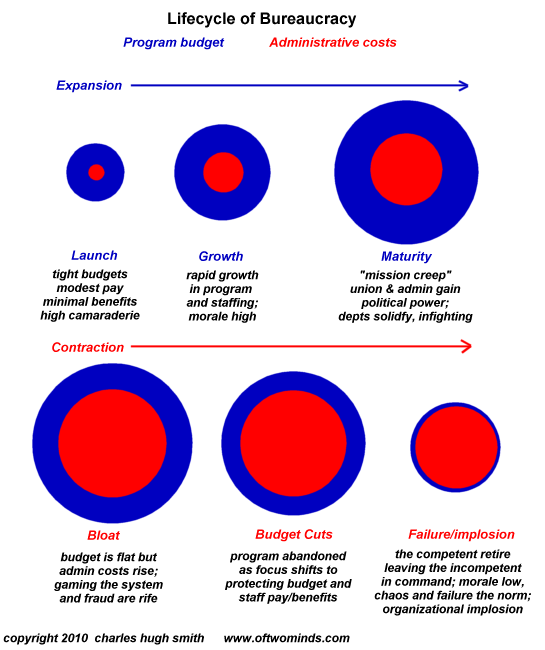
Back in 2010 I prepared this chart of The Lifecycle of Bureaucracy: as bureaucracies expand, they inevitably become less accountable, less efficient, more bloated with legacy staffing and requirements that no longer make sense, etc.

As costs soar, the bureaucracy’s budget is attacked, and the agency circles the wagons and focuses on lobbying politicos and the public to leave the budget untouched.

Since accountability has been dissipated, management becomes increasingly incompetent and larded with people who can’t be fired so they were kicked upstairs. Staff morale plummets as the competent quit/transfer out in disgust, leaving the least productive and those clinging on in order to retire with generous government benefits.

In this state of terminal decline, the agency’s original function is no longer performed adequately and the system implodes from the dead weight of its high costs, lack of accountability, gross incompetence, inability to adapt and staggering inefficiency.

lifecycle-bureaucracy

I’ve covered this dynamic a number of times:

Our Legacy Systems: Dysfunctional, Unreformable (July 1, 2013)

The Way Forward (April 25, 2013)

When Escape from a Previously Successful Model Is Impossible (November 29, 2012)

Complexity: Bureaucratic (Death Spiral) and Self-Organizing (Sustainable) (February 17, 2011)

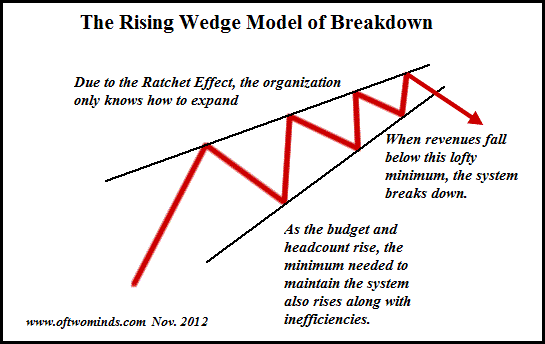
This generates a ratchet effect, where costs increase even as the bureaucracy’s output declines. The ratchet effect can also be visualized as a rising wedge, in which costs and inefficiencies continue rising until any slight decrease in funding collapses the organization.

Dislocations Ahead: The Ratchet Effect, Stick-Slip and QE3 (February 14, 2011)

The Ratchet Effect: Fiefdom Bloat and Resistance to Declining Incomes (August 23, 2010)

rising-wedge

The net result of the Ratchet Effect and the impossibility of reform is this: it’s cheaper and more effective to let the system collapse than squander time and treasure attempting reforms that are bound to fail as vested interests will fight to the death to retain every shred of power and swag.

Since the constituent parts refuse to accept any real reforms, the entire system implodes. We can look at healthcare, higher education and the National Security State as trillion-dollar examples of systems that become increasingly costly even as their performance declines or falls off the cliff.

This is the lesson of history, as described in the seminal book The Upside of Down: Catastrophe, Creativity, and the Renewal of Civilization.

Collapse does not need to be complete or sudden. Collapse tends to be a process, not an event.

Collapse begins when you can’t find any doctors willing to accept Medicaid payments, when the potholes don’t get filled even when voters approve millions of dollars in new taxes, and when kids aren’t learning anything remotely useful or practical despite the school board raising tens of millions of dollars in additional property taxes.

Collapse begins when real reform becomes impossible.

2016 The Year Ahead

winter-solstice-gallery

By Neil Kramer

Source: NeilKramer.com

2016 will rigorously test people’s readiness to embody their truth. Can we live the wisdom and transformation we’ve been cultivating over years of study, journeying, and contemplation? Can we summon the strength to have our outside accurately reflect our inside? Are we ready to run our own world yet?

In many schools of mystical study, polarity is a key principle. The student is taught that everything in life is dual. All phenomena have pairs of opposites, as observed in the primal forces of birth and death, day and night, order and chaos, joy and sorrow. Over time, through experientially mapping and understanding the interplay of each set of polarities in our own lives, we may gradually determine a point of equilibrium that reveals the hidden teachings of these mysterious fluctuations. What we must be careful to avoid, is clinging to just one end of life’s naturally divergent polarizations. And herein lie the trials set forth in the world’s current crises.

At every turn, the synthetic culture of Empire implores us to throw our hearts and minds into unconscious polarization. It wants us to radicalize ourselves to either patriot or terrorist, believer or atheist, white or black, liberal or conservative, strong or weak, and then embark on an endless crusade to reform, condemn, or destroy the other side. This one-way polarization renders all participants impotent, regardless of which side they pick. This subtle but devastating trick deactivates our will and we automatically forfeit our capacity to rule ourselves. Lost in unconscious polarization, we serve Empire.

Nevertheless, whilst Empire’s constant telegraphing of fear can be unsettling, its power to deceive is unquestionably failing to influence legions of honorable humans who refuse to hand over their discernment to the corrupt and compliant media. The sock puppet terror cells and fabricated economic cataclysms are fraying at the edges and their artificial nature is pitifully evident. The official narrative betrays only those who choose to hide from reality. For them we can do nothing, until they do something for themselves.

It is my heartfelt observation that a critical threshold of spiritually alive humans have grown so excellently in confidence and wisdom, that the old hierarchies must resort to ever more vulgar contrivances to preserve their reins of power. Understand then, that the daybreak of a new higher consciousness will be heralded not by gentle awakenings and well-mannered transitions, but by bewildering fragmentation. Just as these patterns of collapse were experienced in many people’s personal lives throughout 2015, so now they are shaking the very foundations of Empire. Towering ramparts that once seemed so impossibly daunting and everlasting, will soon be little more than forlorn ruins.

We are upon the eve of the grand winter solstice of Empire, and the longest darkest night will seem interminably protracted and bone-chillingly cold. But like all things, this too shall pass. And the daylight will lengthen and the new growth that we have envisioned for so long will blossom – if we let it. We made Empire and we must unmake it. As a thing is bound, so it is unbound. Deeds not words. Learn the art of depolarization and nothing can stop you.

The U.S. Is At The Center Of The Global Economic Meltdown

maxresdefault

By Brandon Smith

Source: Alt-Market.com

While the economic implosion progresses this year, there will be considerable misdirection and disinformation as to the true nature of what is taking place. As I have outlined in the past, the masses were so ill informed by the mainstream media during the Great Depression that most people had no idea they were actually in the midst of an “official” depression until years after it began. The chorus of economic journalists of the day made sure to argue consistently that recovery was “right around the corner.” Our current depression has been no different, but something is about to change.

Unlike the Great Depression, social crisis will eventually eclipse economic crisis in the U.S. That is to say, our society today is so unequipped to deal with a financial collapse that the event will inevitably trigger cultural upheaval and violent internal conflict. In the 1930s, nearly 50% of the American population was rural. Farmers made up 21% of the labor force. Today, only 20% of the population is rural. Less than 2% work in farming and agriculture. That’s a rather dramatic shift from a more independent and knowledgeable land-utilizing society to a far more helpless and hapless consumer-based system.

What’s the bottom line? About 80% of the current population in the U.S. is more than likely inexperienced in any meaningful form of food production and self-reliance.

The rationale for lying to the public is certainly there. Economic and political officials could argue that to reveal the truth of our fiscal situation would result in utter panic and immediate social breakdown. When 80% of the citizenry is completely unprepared for a decline in the mainstream grid, a loss of savings through falling equities and a loss of buying power through currency destruction, their first response to such dangers would be predictably uncivilized.

Of course, the powers-that-be are not really interested in protecting the American people from themselves. They are interested only in positioning their own finances and resources in the most advantageous investments while using our loss and fear to extract more centralization, more control and more consent. Thus, the hiding of economic decline is enacted because the decline itself is useful to the elites.

And just to be clear for those who buy into the propaganda, the U.S. is indeed in a speedy decline.

In ‘Lies You Will Hear As The Economic Collapse Progresses’, published in summer of last year, I predicted that “Chinese contagion” would be used as the scapegoat for the downturn in order to hide the true source: American wealth destruction. Today, as the Dow and other markets plummet and oil markets tank due to falling demand and glut inventories, all we seem to hear from the mainstream talking heads and the people who parrot them in various forums is that the U.S. is the “only stable economy by comparison” and the rest of the world (mainly China) is a poison to our otherwise exemplary financial health. This is delusional fiction.

The U.S. is the No. 1 consumer market in the world with a 29% overall share and a 21% share in energy usage, despite having only 5 percent of the world’s total population. If there is a global slowdown in consumption, manufacturing, exports and imports, then the first place to look should be America.

Trucking freight in the U.S. is in steep decline, with freight companies pointing to a “glut in inventories” and a fall in demand as the culprit.

Morgan Stanley’s freight transportation update indicates a collapse in freight demand worse than that seen during 2009.

The Baltic Dry Index, a measure of global freight rates and thus a measure of global demand for shipping of raw materials, has collapsed to even more dismal historic lows. Hucksters in the mainstream continue to push the lie that the fall in the BDI is due to an “overabundance of new ships.” However, the CEO of A.P. Moeller-Maersk, the world’s largest shipping line, put that nonsense to rest when he admitted in November that “global growth is slowing down” and “[t]rade is currently significantly weaker than it normally would be under the growth forecasts we see.”

Maersk ties the decline in global shipping to a FALL IN DEMAND, not an increase in shipping fleets.

This point is driven home when one examines the real-time MarineTraffic map, which tracks all cargo ships around the world. For the past few weeks, the map has remained almost completely inactive with the vast majority of the world’s cargo ships sitting idle in port, not traveling across oceans to deliver goods. The reality is, global demand has fallen down a black hole, and the U.S. is at the top of the list in terms of crashing consumer markets.

To drive the point home even further, the U.S. is by far the world’s largest petroleum consumer. Therefore, any sizable collapse in global oil demand would have to be predicated in large part on a fall in American consumption. Oil inventories are now overflowing, indicating an unheard-of crash in energy use and purchasing.

U.S. petroleum consumption was actually lower in 2014 than it was in 1997 and 25% lower than earlier projections predicted. A large part of this reduction in gas use has been attributed to fewer vehicle miles traveled. Though oil markets have seen massive price cuts, the lack of demand continued through 2015.

This collapse in consumption is reflected partially in newly adjusted 4th quarter GDP forecasts by the Federal Reserve, which are now slashed down to 0.7%.  And remember, Fed and government calculate GDP stats by counting government spending of taxpayer money as “production” or “commerce”.  They also count parasitic programs like Obamacare towards GDP as well.  If one were to remove government spending of taxpayer funds from the equation, real GDP would be far in the negative.  That is to say, if the fake numbers are this bad, then the real numbers must be horrendous.

And finally, let’s talk about Wal-Mart. There is a good reason why mainstream pundits are attempting to marginalize Wal-Mart’s sudden announcement of 269 store closures, 154 of them within the U.S. with at least 10,000 employees being laid off. Admitting weakness in Wal-Mart means admitting weakness in the U.S. economy, and they don’t want to do that.

Wal-Mart is America’s largest retailer and largest employer. In 2014, Wal-Mart announced a sweeping plan to essentially crush neighborhood grocery markets with its Wal-Mart Express stores, building hundreds within months. Today, those Wal-Mart Express stores are being shut down in droves, along with some supercenters. Their top business model lasted around a year before it was abandoned.

Some in the mainstream argue that this is not necessarily a sign of economic decline because Wal-Mart claims it will be building 200 to 240 new stores worldwide by 2017. This is interesting to me because Wal-Mart just suffered its steepest stock drop in 27 years on reports that projected sales will fall by 6% to 12% for the next two years.

It would seem to me highly unlikely that Wal-Mart would close 154 stores in the U.S. (269 stores worldwide) and then open 240 other stores during a projected steep crash in sales that caused the worst stock trend in the company’s history. I think it far more likely that Wal-Mart executives are attempting to appease shareholders with expansion promises they do not plan to keep.

I am going to call it here and now and predict that most of these store sites will never see construction and that Wal-Mart will continue to make cuts, either with store closings, employee layoffs or both.

As the above data indicates, global demand is disintegrating; and the U.S. is a core driver.

The best way to sweep all these negative indicators under the rug is to fabricate some grand idea of outside threats and fiscal dominoes. It is much easier for Americans to believe our country is being battered from without rather than destroyed from within.

Does China have considerable fiscal issues including debt bubble issues? Absolutely. Is this a catalyst for global collapse? No. China’s problems are many but if there is a first “domino” in the chain, then the U.S. economy claims that distinction.

China is the largest exporter in the world, not the largest consumer. If anything, a crash in China’s economy is only a REFLECTION of an underlying collapse in U.S. demand for Chinese goods (among others). That is to say, the mainstream dullards have it backward; a crash in China is a herald of a larger collapse in U.S. markets. A crash in China is a symptom of the greater fiscal disease in America. The U.S. is the primary cause; it is not the victim of Chinese contagion. And the crisis in the U.S. will ultimately be far worse by comparison.

I wrote in ‘What Fresh Horror Awaits The Economy After Fed Rate Hike?’, published before Christmas:

“Market turmoil is a guarantee given the fact that banks and corporations have been utterly reliant on near-zero interest rates and free overnight lending from the Fed. They have been using these no-cost and low-cost loans primarily for stock buybacks, purchasing back their own stocks and reducing the number of shares on the market, thereby artificially elevating the value of the remaining shares and driving up the market as a whole. Now that near-zero lending is over, these banks and corporations will not be able to afford constant overnight borrowing, and the buybacks will cease. Thus, stock markets will crash in the near term.

This process has already begun with increased volatility leading up to and after the Fed rate hike. Watch for far more erratic stock movements (300 to 500 points or more) up and down taking place more frequently, with the overall trend leading down into the 15,000-point range for the Dow in the first two quarters of 2016. Extraordinary but short lived positive increases in the markets will occur at times (Christmas and New Year’s tend to result in positive rallies), but shock rallies are just as much a sign of volatility and instability as shock crashes.”

Markets moved immediately into crash territory after the new year began. This was an easy prediction to make and one that I have been reiterating for months — just as the timing of the Fed rate hike was an easy prediction to make, based on the Fed’s history of deliberately increasing instability through bad policy as the economy moves into deflationary spirals. The Fed did it during the Great Depression and is doing it again today.

It is no coincidence that global markets began to tank after the first Fed rate hike; no-cost overnight lending to banks and corporations was the key to maintaining equities in a relatively static position.  As the U.S. loses momentum, the world loses momentum.  As the Fed ends outright stimulation and manipulation, the house of cards falls.

I have said it many times and I’ll say it yet again: If you think the Fed’s motivation is to prolong or protect the U.S. economy and currency, then you will never understand why it takes the policy actions it does. If you understand and accept the fact that the Fed is a saboteur working carefully and incrementally toward the destruction of the U.S. to make way for a new globally centralized system, everything falls into place.

To summarize, the U.S. economy as we know it is not slated to survive the next few years. Read my article ‘The Economic Endgame Explained’ for more in-depth information on why a collapse is being engineered and what the openly admitted goal is, including the referenced 1988 article from The Economist titled “Get Ready A World Currency In 2018,” which outlines the plan for a reduction of the dollar and the U.S. system in order to make way for a global basket reserve currency (Special Drawing Rights).

It is astonishingly foolish to assume that even though the U.S. has held the title of king of global consumption share for decades, that our economy is somehow not a primary faulty part in the sputtering global economic engine.  Economies are falling because demand is falling.   Demand is falling because Americans are not buying.  Americans are not buying because Americans are broke. Americans are broke because central bank policy has created an environment of wealth destruction. This wealth destruction in the U.S. has been ongoing, but only now is it becoming truly visible.  The volatility we see in developing nations is paltry compared to the financial chaos we now face.  Anyone who attempts to dismiss the dangers of a U.S. breakdown or the threat to the unprepared public is either an idiot, or they are trying to divert and distract you from reality. The coming months will undoubtedly verify this.