“if…” (1968) is one of the all-time classic student rebellion films directed by notorious anarchist Lindsay Anderson. In his first screen role, Malcolm McDowell stars as the oppressed non-conformist Mick Travis who with a few cohorts, stage an armed revolution in their school. According to the film’s Wikipedia entry, shortly before Lindsay Anderson’s death in 1994 he had completed the script for a yet unmade official sequel to “if…” (not to be confused with the other films in the Mick Travis trilogy, “O Lucky Man” and Britannia Hospital”) described as follows:
The sequel takes place during a Founders’ Day Celebration where many of the characters reunite. Mick Travis is now an Oscar-nominated movie star, eschewing England for Hollywood. Wallace is a military major who has lost his arm. Johnny is a clergyman. Rowntree is the Minister of War. In the script Rowntree is kidnapped by a group of anti-war students and saved by Mick and his gang, though not before Mick crucifies Rowntree with a large nail through his palm.
“Vital” (2004) is a film by Shinya Tsukamoto about a med school student who loses his memory after surviving a car crash which kills his girlfriend. Shortly after resuming studies he realizes a cadaver assigned to him to dissect is the body of his girlfriend. Against the advice of everyone around him, he becomes obsessed with his work in an effort to recover his memories and former sense of self. Like other films by Shinya Tsukamoto, Vital has much psychological conflict, Cronenbergian body horror and surreal imagery, but is more subdued and life-affirming than any other feature film he’s made to date. Vital also features a masterful performance from lead actor Tadanobu Asano.
“Tokyo Fist” (1995) can be seen as director Shinya Tsukamoto’s surreal precursor to “Fight Club”, but it also features an unsettling mood and body horror reminiscent of the films of David Lynch and David Cronenberg respectively. Added to the mix is Tsukamoto’s unique brand of visceral and hyper-kinetic filmmaking, making Tokyo Fist an unforgettable experience for fans of global cult cinema (though it’s not for the squeamish).
(Click the “CC” button at the bottom right corner of video window while playing to activate English subtitles.)
With the underground film “Tetsuo: The Iron Man” (1989), writer/director/actor Shinya Tsukamoto broke out into the global cult cinema scene. Made on a shoestring budget and drawing influences from cyberpunk sci-fi and anime such as “Akira”, Tetsuo depicts a man’s transformation into a machine as his psychological state rapidly deteriorates. Two later “sequels”, “Tetsuo II: Body Hammer” (1992) and “Tetsuo: The Bullet Man” (2009) are variations of the same plot with progressively larger budgets and artistic ambition.
Robert Downey Sr.‘s Putney Swope is an unusual film that splits audiences into two camps without breaking a sweat: those who absolutely love it and think it’s an unheralded masterpiece, and those who utterly loathe it (Check out Amazon reviews!) A third and far larger category would be comprised of everyone who’s never even heard of this odd little gem in the first place. Back in the early 80s, when super rare cheap to license cult films would often appear on some schlocky video label long before some mainstream films became available Putney Swope would often show up in the “Midnight Movies” or cult films section of video rental shops. After that it more or less disappeared until it came out on DVD. Every once in a while it’s on TV, too, but it’s still, sadly, Putney Swope is not a widely known film.
The Coen Brothers, Chris Rock, Dave Chapelle and Paul Thomas Anderson are all known to be big fans of the film. Jane Fonda declared it a masterpiece to Johnny Carson on The Tonight Show in 1969 and the Beastie Boys have sampled from it and rapped about it. Anderson even lifted a scene from it for Boogie Nights.
The first three times I saw Putney Swope I thought it was an incredible masterpiece. I was stunned by it. I laughed out loud. I sobbed. It was amazing. It was profound and symbolic of everything! Then again, the first three times I saw the film I was ridiculously high on LSD and I watched it over and over again, by myself, three times in the same night!
When the acid wore off I still thought it was a great and profound film, perhaps just not as great. That didn’t stop me from being an evangelist for this weird little movie, which satirized race, how race was portrayed in advertising, race in the workplace, black militants, white privilege and corporate corruption (there’s even a hint of Orwell’s Animal Farm in it), to all of my friends. Man did I force this film on a lot of (grateful!) people. I’ve easily seen it 30 times.
The plot goes something like this: Arnold Johnson (who later played “Hutch” on Sanford and Son) is Putney Swope, a middled-aged black man who works at a Madison Avenue advertising agency with a bunch of corrupt corporate buffoons. When the founder of the agency dies mid-speech, the board holds a vote to find his successor while his body goes cold on the table. Everyone writes down a name on a piece of paper. They are informed that they cannot vote for themselves and so each man tears up his ballot. They cut deals with each other and then all vote for the one guy who they think no one else will vote for either, Putney Swope, the only black guy.
So Swope becomes the new CEO with a landslide. His motto is “Rockin’ the boat’s a drag. You gotta sink the boat!” He promptly fires all of the white executives (save for one), renames the agency “Truth & Soul” and hires a young, idealistic and politically militant black staff who want to tell the actual truth in advertising. “Truth & Soul” refuse to take accounts from cigarette manufacturers, liquor companies or the war machine. They become so successful that the government becomes alarmed. Eventually everyone becomes corrupted, even Putney himself, who takes to dressing like Fidel Castro.
That’s about it, plot-wise, but a lot of stuff happens in Putney Swope that would be difficult to try to describe here. The film is mainly in black and white, but the commercial parodies are in color. Antonio Fargas Jr. (“Huggy Bear” on Starsky & Hutch) has a memorable role as “The Arab,” Putney’s Muslim advisor and prankster Alan Abel is also seen in a cameo role. Putney Swope has great lines like “Anything that I have to say would just be redundant”; “A job? Who wants a JOB?”; and “Are you for surreal?!” that have been quoted over and over again (at least in my house). The US president and his wife are played by midgets who engage in a threesome with a photographer. There is a Mark David Chapman-type weirdo hovering around. It’s hard to describe, you really just have to see it. I think Putney Swope is one of the great, great, great American counterculture films of the 1960s. One day. I predict confidently, it will be seen as the equal to Easy Rider or Five Easy Pieces. I’m surprised that French cinemaphiles haven’t discovered it yet… but they will. They will.
This probably isn’t the best way to watch the film (grab the Putney Swope DVD on Amazon) but DO watch the first scene up to the point where Putney takes over the advertising agency. If that doesn’t make you want to watch the rest, I can’t do much for you…
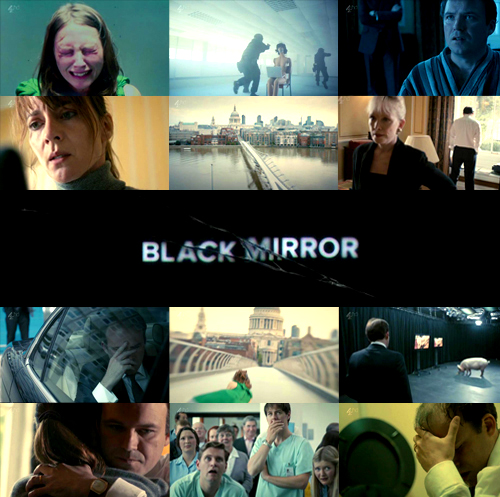
“Black Mirror” (2011 – ) is a British anthology series created by satirist Charlie Brooker exploring potential unintended social/psychological effects of technology. It’s sort of an updated and darker version of The Twilight Zone offering (often pessimistic) commentary on society, government, culture and relationships.
Because tomorrow marks the birthday of Jack Nance, I’d like to bring attention to “I Don’t Know Jack” (2002), a documentary on cult actor Jack Nance exploring the uniqueness of his character, his unconventional career, and the strange circumstances surrounding the death of his wife in 1991 and himself five years later. The film features interviews with family and friends including Catherine Coulson, Brad Dourif, Dennis Hopper, David Lynch and Charlotte Stewart.
“I Am Cuba” (1964) is a Soviet-Cuban co-production directed by Mikhail Kalatozov which ties together several stories depicting different aspects of the Cuban experience during the pre-Castro era. Upon release (and long after), the film was largely ignored, being too Communist for western audiences and not revolutionary enough for audiences in the Soviet Union. Fortunately, in the 1990s the film was re-discovered and championed by prominent directors such as Martin Scorsese and Francis Ford Coppola who with Milestone Films re-released the film at New York’s Film Forum in 1995. I Am Cuba is notable for inspiring and emotionally powerful scenes as well as technical achievements such as complex tracking shots and striking cinematography utilizing wide angle lenses and infrared film stock.

 “if…” (1968) is one of the all-time classic student rebellion films directed by notorious anarchist Lindsay Anderson. In his first screen role, Malcolm McDowell stars as the oppressed non-conformist Mick Travis who with a few cohorts, stage an armed revolution in their school. According to the film’s Wikipedia entry, shortly before Lindsay Anderson’s death in 1994 he had completed the script for a yet unmade official sequel to “if…” (not to be confused with the other films in the Mick Travis trilogy, “O Lucky Man” and Britannia Hospital”) described as follows:


 is an unusual film that splits audiences into two camps without breaking a sweat: those who absolutely love it and think it’s an unheralded masterpiece, and those who utterly loathe it (Check out
  !) A third and far larger category would be comprised of everyone who’s never even heard of this odd little gem in the first place. Back in the early 80s, when super rare cheap to license cult films would often appear on some schlocky video label long before some mainstream films became available