Set to the tune of Massive Attack’s “Angel,” Serena Bramble’s 2009 remix project “The Endless Night: A Valentine to Film Noir” is a “video love letter that distills film noir movies into their atmospheric essence.”
Bramble, an editor and writer, had this to say about her work:
“After many long hours, this is my tribute to my favorite genre, to the dark shadows and the profound despair of the soul. I tried to include as many as I could get my hands on, though there are obviously some that I overlooked, some accidently (the absence of The Sweet Smell of Success and White Heat are the most obvious and shameful), some purposefully (save Sam Fuller’s 1964 pulp masterpiece The Naked Kiss, I decided to stay strictly within the 18-year period between 1940 and 1958, so absolutely no neo-noirs like Chinatown, and even more importantly, absolutely no colors).
“If this should be deleted for copyright infringement (this is for recreational use only, not for profit; all film clips and the music by Massive Attack belong to their respective copyright holders), I’ve had a hell of a time doing it. And just in case I glorified violence and smoking a bit too much, as a semi-pacifist, nonsmoking woman, I can only quote Samuel Fuller: “I hate violence. That has never prevented me from using it in my films.”
The films, dangerous ladies and toxic dudes seen during Bramble’s epic supercut are:
The Letter (1940, William Wyler. Bette Davis) The Maltese Falcon (1941, John Huston. Humphrey Bogart, Mary Astor) Shadow Of A Doubt (1943, Alfred Hitchcock. Joseph Cotten) Double Indemnity (1944, Billy Wilder. Barbara Stanwyck, Fred MacMurray) Murder, My Sweet (1944, Edward Dmytryk. Dick Powell) Scarlet Street (1945, Fritz Lang. Edward G. Robinson, Joan Bennett) Laura (1945, Otto Preminger. Gene Tierney) Detour (1945, Edgar G. Ulhmer. Ann Savage) Notorious (1946, Alfred Hitchcock. Cary Grant, Ingrid Bergman) Gilda (1946, Charles Vidor. Rita Hayworth) The Killers (1946, Robert Siodmak. Ava Gardner, Burt Lancaster) The Big Sleep (1946, Howard Hawks. Humphrey Bogart) The Postman Always Rings Twice (1946, Tay Garnett. John Garfield, Lana Turner) The Lady From Shanghai (1947, Orson Welles. Rita Hayworth, Welles) Out Of The Past (1947, Jacques Tourneur. Jane Greer, Robert Mitchum) Brute Force (1947, Jules Dassin. Burt Lancaster) Force Of Evil (1948, Abraham Polonsky. John Garfield, Marie Windsor) The Set-Up (1949, Robert Wise. Robert Ryan) The Third Man (1949, Carol Reed. Orson Welles) Criss Cross (1949, Siodmak. Burt Lancaster, Yvonne De Carlo) Gun Crazy (1950, Joseph H. Lewis. John Dall, Peggy Cummins) In A Lonely Place (1950, Nicholas Ray. Humphrey Bogart, Gloria Grahame) The Asphalt Jungle (1950, Huston. Sterling Hayden) Night And The City (1950, Jules Dassin. Richard Widmark, Gene Tierney) Sunset Blvd. (1950, Billy Wilder. Gloria Swanson, William Holden) Ace In The Hole (1951, Billy Wilder. Kirk Douglas, Jan Sterling) Angel Face (1952, Otto Preminger. Jean Simmons) Pickup On South Street (1953, Samuel Fuller. Richard Widmark) The Big Heat (1953, Fritz Lang. Gloria Grahame, Lee Marvin) Kiss Me Deadly (1955, Robert Aldrich. Gaby Rodgers) Night Of The Hunter (1955, Charles Laughton. Robert Mitchum, Lillian Gish) The Killing (1956, Stanley Kubrick. Sterling Hayden) Elevator To The Gallows (1958, Louis Malle. Jeanne Moreau, Maurice Ronet) Touch Of Evil (1958, Orson Welles) The Naked Kiss (1964, Samuel Fuller. Constance Towers)
“The Lathe of Heaven” (1980) PBS television adaptation of the 1971 science fiction novel The Lathe of Heaven by Ursula K. Le Guin. It’s directed by David Loxton and Fred Barzyk (Between Time and Timbuktu) and stars Bruce Davison as protagonist George Orr, Kevin Conway as Dr. William Haber, and Margaret Avery as lawyer Heather LeLache. In Portland sometime in the near future, George Orr is charged as a drug offender for taking medications which he needs to prevent dreaming since he fears that his dreams affect reality. Under the care of William Haber, it’s discovered that Orr is not delusional and attempts to make use of the dreams to solve an array of social problems with results that are provocatively pessimistic.
A film about screen culture and its implications. While the world burns, where are we?
Introduction
We live in a world of screens. The average adult spends the majority of their waking hours in front of some sort of screen or device. We’re enthralled, we’re addicted to these machines. How did we get here? Who benefits? What are the cumulative impacts on people, society and the environment? What may come next if this culture is left unchecked, to its end trajectory, and is that what we want?
Stare Into The Lights My Pretties investigates these questions with an urge to return to the real physical world, to form a critical view of technological escalation driven by rapacious and pervasive corporate interest. Covering themes of addiction, privacy, surveillance, information manipulation, behaviour modification and social control, the film lays the foundations as to why we may feel like we’re sleeprunning into some dystopian nightmare with the machines at the helm. Because we are, if we don’t seriously avert our eyes to stop this culture from destroying what is left of the real world.
Purpose
This independent film was made with no budget (adding to its authenticity) with no affiliations, is not-for-profit, and is released to the world for free for the purposes of critical discourse, education, and for cultivating radical social and political change.
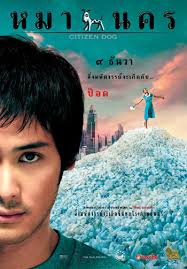
“Citizen Dog” (2004) is a surreal Thai romantic comedy directed by Wisit Sasanatieng (Tears of the Black Tiger) and based on a story by his wife, Siriphan Techajindawong. It’s a magical realist tale set in contemporary Bangkok about an aimless slacker named Pod who must overcome numerous obstacles to be with a fellow dreamer named Jin.
Watch the full film here. (Pop-up ads may appear when video is started.)
David Lynch inspired short film “Lucid” is now online!
By Kim S�nderholm
Source: Screen Anarchy
David Lynch inspired short film “Lucid”, directed by Henrik Bjerregaard Clausen, written by Mads Zaar Riisberg, produced by Stoyan Yankov and starring Kim Sønderholm is now publicly available online!
This short nightmare, clocking in just under five minutes, is a “Twin Peaks”-esque short film from Denmark (no worries, spoken language is English) has toured festivals worldwide for a good while, gotten screened on over 75 festivals and won a lot of awards. Ending its festival run it is now public available for streaming for everyone to see. Take five minutes and enjoy!
A man wakes up from a dream and attempts to change the course of his life, but is he truly in control of his own destiny? What is in the dark forest? How can you tell if you are still dreaming?
In the waning days of World War II, American bombers drop napalm canisters on Japanese cities, creating fire storms. These bombs, longer than a tin can but about as big around, fall to earth trailing cloth tails that flutter behind them; they are almost a beautiful sight. After they hit, there is a moment’s silence, and then they detonate, spraying their surroundings with flames. In a Japanese residential neighborhood, made of flimsy wood and paper houses, there is no way to fight the fires.
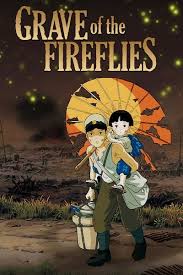
“Grave of the Fireflies” (1988) is an animated film telling the story of two children from the port city of Kobe, made homeless by the bombs. Seita is a young teenager, and his sister Setsuko is about 5. Their father is serving in the Japanese navy, and their mother is a bomb victim; Seita kneels beside her body, covered with burns, in an emergency hospital. Their home, neighbors, schools are all gone. For a time an aunt takes them in, but she’s cruel about the need to feed them, and eventually Seita finds a hillside cave where they can live. He does what he can to find food, and to answer Setsuko’s questions about their parents. The first shot of the film shows Seita dead in a subway station, and so we can guess Setsuko’s fate; we are accompanied through flashbacks by the boy’s spirit.
“Grave of the Fireflies” is an emotional experience so powerful that it forces a rethinking of animation. Since the earliest days, most animated films have been “cartoons” for children and families. Recent animated features such as “The Lion King,” “Princess Mononoke” and “The Iron Giant” have touched on more serious themes, and the “Toy Story” movies and classics like “Bambi” have had moments that moved some audience members to tears. But these films exist within safe confines; they inspire tears, but not grief. “Grave of the Fireflies” is a powerful dramatic film that happens to be animated, and I know what the critic Ernest Rister means when he compares it to “Schindler’s List” and says, “It is the most profoundly human animated film I’ve ever seen.”
It tells a simple story of survival. The boy and his sister must find a place to stay, and food to eat. In wartime their relatives are not kind or generous, and after their aunt sells their mother’s kimonos for rice, she keeps a lot of the rice for herself. Eventually, Seita realizes it is time to leave. He has some money and can buy food–but soon there is no food to buy. His sister grows weaker. Their story is told not as melodrama, but simply, directly, in the neorealist tradition. And there is time for silence in it. One of the film’s greatest gifts is its patience; shots are held so we can think about them, characters are glimpsed in private moments, atmosphere and nature are given time to establish themselves.
Japanese poets use “pillow words” that are halfway between pauses and punctuation, and the great director Yasujiro Ozu uses “pillow shots”–a detail from nature, say, to separate two scenes. “Grave of the Fireflies” uses them, too. Its visuals create a kind of poetry. There are moments of quick action, as when the bombs rain down and terrified people fill the streets, but this film doesn’t exploit action; it meditates on its consequences.
The film was directed by Isao Takahata, who is associated with the famous Ghibli Studio, source of the greatest Japanese animation. His colleague there is Hayao Miyazaki (“Princess Mononoke,” “Kiki’s Delivery Service,” “My Neighbor Totoro”). His films are not usually this serious, but “Grave of the Fireflies” is in a category by itself. It’s based on a semi-autobiographical novel by Nosaka Akiyuki–who was a boy at the time of the firebombs, whose sister did die of hunger and whose life has been shadowed by guilt.
The book is well-known in Japan, and might easily have inspired a live-action film. It isn’t the typical material of animation. But for “Grave of the Fireflies,” I think animation was the right choice. Live action would have been burdened by the weight of special effects, violence and action. Animation allows Takahata to concentrate on the essence of the story, and the lack of visual realism in his animated characters allows our imagination more play; freed from the literal fact of real actors, we can more easily merge the characters with our own associations.
Hollywood animation has been pursuing the ideal of “realistic animation” for decades, even though that’s an oxymoron. People who are drawn do not look like people who are photographed. They’re more stylized, more obviously symbolic, and (as Disney discovered in painstaking experiments) their movements can be exaggerated to communicate mood through body language. “Grave of the Fireflies” doesn’t attempt even the realism of “The Lion King” or “Princess Mononoke,” but paradoxically it is the most realistic animated film I’ve ever seen–in feeling.
The locations and backgrounds are drawn in a style owing something to the 18th century Japanese artist Hiroshige and his modern disciple Herge (the creator of Tin Tin). There is great beauty in them–not cartoon beauty, but evocative landscape drawing, put through the filter of animated style. The characters are typical of much modern Japanese animation, with their enormous eyes, childlike bodies and features of great plasticity (mouths are tiny when closed, but enormous when opened in a child’s cry–we even see Setsuko’s tonsils). This film proves, if it needs proving, that animation produces emotional effects not by reproducing reality, but by heightening and simplifying it, so that many of the sequences are about ideas, not experiences.
There are individual moments of great beauty. One involves a night when the children catch fireflies and use them to illuminate their cave. The next day, Seita finds his little sister carefully burying the dead insects–as she imagines her mother was buried. There is another sequence in which the girl prepares “dinner” for her brother by using mud to make “rice balls” and other imaginary delicacies. And note the timing and the use of silence in a sequence where they find a dead body on the beach, and then more bombers appear far away in the sky.
Rister singles out another shot: “There’s a moment where the boy Seita traps an air bubble with a wash rag, submerges it, and then releases it into his sister Setsuko’s delighted face–and that’s when I knew I was watching something special.”
There are ancient Japanese cultural currents flowing beneath the surface of “Grave of the Fireflies,” and they’re explained by critic Dennis H. Fukushima Jr., who finds the story’s origins in the tradition of double-suicide plays. It is not that Seita and Setsuko commit suicide overtly, but that life wears away their will to live. He also draws a parallel between their sheltering cave and hillside tombs.
Fukushima cites an interview with the author, Akiyuki: “Having been the sole survivor, he felt guilty for the death of his sister. While scrounging for food, he had often fed himself first, and his sister second. Her undeniable cause of death was hunger, and it was a sad fact that would haunt Nosaka for years. It prompted him to write about the experience, in hopes of purging the demons tormenting him.”
Because it is animated and from Japan, “Grave of the Fireflies” has been little seen. When anime fans say how good the film is, nobody takes them seriously. Now that it’s available on DVD with a choice of subtitles or English dubbing, maybe it will find the attention it deserves. Yes, it’s a cartoon, and the kids have eyes like saucers, but it belongs on any list of the greatest war films ever made.
Note: To activate English subtitles, click on the “CC” button on the bottom-left corner of the video window.
Object Name: There Will Come Soft Rains Maker and Year: Nazim Tulyahodzhaev (Director), UzbekFilm, 1984 Object Type: Film Description: (Steve Toyoshima)
There Will Come Soft Rains (Будет ласковый дождь) is an animated film produced in the former Soviet Union, based on the Ray Bradbury short story of the same name. Though obscure in the rest of the world during the Cold War, it has gained a cult following in recent years. A VHS-quality copy of the film has been uploaded to YouTube, and appears to be the only version available at this time.
Originally printed in 1950, Bradbury’s story follows the last day of an automated house in the wake of a nuclear apocalypse. The title is from a poem by Sarah Teasdale, written after she witnessed the horrors of the First World War. It described a world that nature reclaims after humanity has ceased to be. Bradbury adopts this poem’s tone and features it in his story.
Written just a few years after the bombings of Hiroshima and Nagasaki, and a few months before the start of the Korean War, There Will Come Soft Rains and the UzbekFilm adaptationreflect the fears of their respective eras. During the years between the original story and the 1984 version, the Cold War had broadened, touching off violence around the world as the two superpowers supported smaller proxy conflicts. In 1983, Soviet jets shot down a Korean airliner that they believed was on an espionage mission, provoking condemnation from the United States. The militant stance of new American President Ronald Reagan, his announcement of a US Strategic Defense Initiative (SDI, nicknamed “Star Wars” by the media), and plans to install missiles in Europe set nuclear tensions at an all-time high. In fact, much of the world felt that a nuclear war was inevitable. The invasion of Grenada and NATO war games exercises that simulated pre-nuclear attack communications put Soviet leadership at high alert for a first strike by their Western foes; the Kremlin wanted to avoid making the same mistake that Stalin had in 1941—ignoring Hitler’s aggression until it was nearly too late.
It was in this tense political environment that UzbekFilm‘s There Will Come Soft Rains was released. A studio in current day Uzbekistan that was originally founded in the 1920s, UzbekFilm expanded from art cinema to producing children’s fantasy films and animated features in the 1980s. There is a marionette show-like sense of playfulness and movement to the cartoons they produced, with a heavy emphasis on colors and textures. There Will Come Soft Rains was directed by Nazim Tulyahodzhaev, a prolific director and actor who had graduated from the Moscow State Institute of the Theatrical Arts in the 1970s and is still working today.
Tulyahodzhaev adapted Bradbury’s story for the 1980s, creating the character of the robot caretaker of the house, which didn’t exist in Bradbury’s original story. (The unsettling design of Robot was based onLou Cameron’s Classics Illustrated cover for H.G. Wells’ War of the Worlds.) Where the automated house in the original story gradually fell apart after its owners were vaporized while playing outside, it’s the paranoia of Robot that leads to the destruction of the home in Tulyahodzhaev’s version.
When the film opens, it’s December 31st, 2026, in Allendale, California. It’s not entirely clear how long ago the nuclear war happened, or how long the McClellan family lived in a post-apocalyptic world. The McClellan home has been fortified for a nuclear war, with radiation suits hiding behind sliding cabinet doors for daily use by the family. Everything in the home is automated. The preparation of food, movement through the house, even religion is administered by the omnipresent Robot. During the time of prayer, a small crucifix slides out of a small door on the wall of the elder Mrs. McClellan’s room as a somber organ tune plays.
The McClellans themselves can no longer benefit from any of these conveniences, as we find out they were vaporized sometime before the events of the film. Somehow, the nuclear attack was able to breach the windows of the bunker, and the family has been reduced to ash. In a horrifying scene, Robot attempts to wake his charges by swiveling their beds upwards, spilling the remains of the family to the floor. Likely this is meant to invoke the neutron bomb, an atomic weapon designed to maximize radiation damage to humans caught within the radius and minimize damage to nearby structures. Its development became a focal point of the anti-nuke movement in the United States, with President Jimmy Carter only finding out about the program in the newspaper. Though Carter shelved the project, Reagan would become its champion. As he said in the late 1970s:
Very simply, it is the dreamed of death ray weapon of science fiction. It kills enemy soldiers but doesn’t blow up the surrounding countryside or destroy villages, towns and cities…..Here is a deterrent weapon available to us at much lower cost than trying to match the enemy gun for gun, tank for tank, plane for plane.
The fate of the McClellans is a visceral reminder of what it would mean to use such a weapon. Though they have been destroyed, their possessions are intact, with even small toys in the children’s room still walking around on battery power.
In the end, it is the intrusion of a curious bird through one of the broken windows of the home that sends Robot into a frenzy. The robotic arm sprouts sharp steel talons and attempts to smash the bird, which it sees as an intruder and danger to the family. The furniture, Mrs. McClellan’s wheelchair, and the crucifix are demolished during the rampage. Blinded after colliding with a wall, the final target of Robot is its own power source. It destroys itself and the house in a final blow.
The machine created to protect humans was engineered too well, a fear that has only become closer to reality in our modern age of militarized robotic drones. Though intended for peaceful purposes, Robot loses control after its owners are gone and only bits are left behind. The film closes with the poignant moment of the bird, unharmed, trying to fly into a peaceful scene on a video screen while one of Mrs. McClellan’s songs plays on the phonograph. Over the ending, Sarah Teasdale’s haunting poem is read.
This somber short and several more, including the light-hearted Contact (directed by Vladimir Tarasov), represent a wealth of animated films from the former Soviet Union that show the world through a lens that many of us who grew up in the West haven’t yet seen, but whose universal appeal carries the message past the boundaries of culture and language.
“Natural City” (2003) is a dystopian science fiction film from South Korean director Min Byeong-cheon. The plot focuses on two cops, R and Noma, who (not unlike Blade Runners) must hunt down renegade cyborgs. The rogue cyborgs are designed for roles ranging from military commandos to companion “dolls” and have a limited 3 year lifespan, though black market technology enables the transfer of a cyborg’s mind into the brain of a human host. This breakthrough compels R into finding Cyon, an orphaned prostitute who could potentially host the mind of Ria, a doll he’s fallen deeply in love with and who has only a few days left before expiration. Eventually, R must make a difficult decision testing his split personal and professional loyalties.






 After the Crash