Saturday Matinee: Horns and Halos

Review by Underground Film Journal

Horns and Halos, which opened the 9th New York Underground Film Festival, is a documentary by married filmmakers Suki Hawley and Michael Galinsky about the intrigue surrounding the publication of the controversial book Fortunate Son, a biography of George W. Bush. The book was originally published by St. Martin’s Press in 1999, subsequently pulled off the bookstore shelves by them after controversy arose over a passage accusing Bush of being a convicted drug user and then re-published by a little artsy boutique outfit in New York City called Soft Skull Press.

What makes Horns and Halos a successful documentary is that the filmmakers did an excellent job of remaining amazingly unbiased towards the subject matter. While watching the movie, I got the impression that Bush supporters would dismiss everyone involved in the book’s publication as a complete wacko and reject any criticisms made against the president in the film; and that anti-Bush activists would find the issues brought up by the book to be damning evidence against him. Personally, I think the truth lies, as the saying goes, somewhere in-between.

The author of Fortunate Son is Arkansas author J.H. Hatfield who, despite appearing slightly off-kilter, seems like an intensely earnest man who just wanted to be taken as a serious author. Previous to his infamous work, Hatfield was the writer of unauthorized biographies of Ewan McGregor and Patrick Stewart, as well as guides to TV shows like Star Trek, Lost in Space and The X-Files.

The main focus of the film, however, is Sander Hicks, the garrulous and determined CEO of Soft Skull Press and re-publisher of “Fortunate Son.” It makes sense that Horns and Halos would spotlight Sander over Hatfield, though, since the movie seems like a very low-budget affair and Hawley, Galinsky and Hicks are all NYC residents while Hatfield lived all the way in Arkansas.

But what’s interesting about all four participants — the filmmakers and their subjects — is that they all seem to be people who have stumbled onto a subject that’s bigger than themselves. There’s a lot of information presented in and lurking around the fringes of Horns and Halos that I really think would have been better served by someone with a bigger budget, for example Michael Moore who can afford a team of researchers; travel freely around the country and also possibly have the balls to charge the White House and demand interviews with Bush and Karl Rove, whose name figures prominently in Hatfield’s research but whom the filmmakers don’t go into much detail on.

But that doesn’t mean that this film shouldn’t be seen and that Galinsky and Hawley’s approach isn’t entirely successful. The real winner of the movie, even though he isn’t in the film as much as I would have liked, is Hatfield. I think the film, at the very least, redeems his character, which got so maligned in the public forum that it eventually led him to commit suicide in 2001.

It is true that Hatfield was an ex-felon. He served five years in prison after being convicted of conspiracy to murder in 1988. But he also may have been a victim of a greedy publisher who forced him to include in his book the unsubstantiated rumor that Bush was convicted of cocaine possession in 1972.

The drug charge story is a complicated one and rather than me recount it here, a good overview of it is included in a new preface by Sander Hicks in Fortunate Son, which is also available to read on Soft Skull Press’s website. While the preface is interesting, it does make one or two slips, especially in not footnoting key passages, e.g. the statement, “[Bush] blurted out at a press conference that he hadn’t done drugs since 1974.” Little details like that can bug me and prevent me from agreeing with a story 100%. (Alas, since the writing of this review, Hicks’ preface is no longer available, but there is a new forward by Mark Crispin Miller.)

The same goes for all of Horns and Halos. I do think having a little bit more of Hatfield in the flick would have made things a lot more clearer, especially considering the scope of the subject. After the NYUFF screening of the film, Hicks and Galinsky did a brief Q&A session together (Hawley was absent as she had just given birth to a daughter) and I thought it really sad that Hatfield couldn’t be there to see the finished film and accept the applause from the audience that would have greeted him. I think he would have been the hit of the festival.

Most library system members can watch the full film on Kanopy.

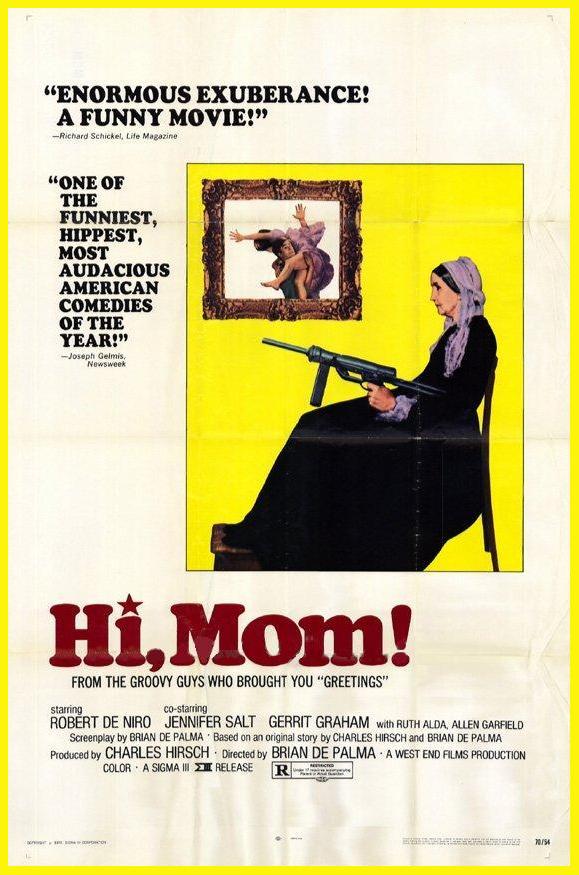
Saturday Matinee: Hi, Mom!

“Hi, Mom!” (1970) is a dark comedy directed by Brian De Palma and stars Robert De Niro. It’s a sequel to Greetings (1968) in which De Nero reprises his role of John Rubin who is now a voyeuristic filmmaker. John later falls in with a group of militant black activists leading to the film’s most memorable scene in which he participates in an experimental theater performance. The show is called “Be Black, Baby” and requires its white audience to don blackface and be subjected to an escalating series of abuses by black actors in whiteface until John arrives as a seemingly real NYPD officer and proceeds to put the white audience members under arrest. De Palma and De Niro’s next collaboration would be 17 years later for The Untouchables.

Saturday Matinee: Gregoire Moulin vs. Humanity

“Gregoire Moulin vs. Humanity” (2001) is a French romantic comedy starring and directed by the late Artus de Penguern. The film is a spoof of Amélie, which was released the same year and also featured Artus (who played the character Hipolito). While the world of Amélie was charming and magical, the world of Gregoire Moulin is cruel and twisted (though filmed in a similar visually striking manner). The films also play on the conventional romantic comedy plot structure in which two quirky characters find eachother against seemingly insurmountable odds.

To activate English subtitles, click the “CC” button in the lower left corner of the video window. Next, click the “Settings” icon next to it, choose “Subtitles/CC”, choose “Auto-Translate”, and then “English”.

Saturday Matinee: The Murder of Fred Hampton

Fred Hampton, founder of the Illinois chapter of the Black Panther Party for Self-Defense, was assassinated by a special unit of the Chicago Police Department on December 4th, 1969 as he lay face down in bed. He was 21 years old when he was murdered. The police fired 99 unanswered shots into his apartment, wounding Fred as he slept. Apparently drugged by an informant, Hampton was unable to awaken. After the raid the police put two more shots into Hampton’s head and said “Now he’s good and dead.”

This film follows the last year or so of Fred’s life and the investigation immediately following his murder.

The first part of the film shows Fred speaking and organizing and provides a brief glimpse into the Panther community programs such as free breakfasts for school children, as well as a fairly good portrayal of Hampton’s dynamic speaking abilities, vast depth of knowledge for someone so young, and his passion for the revolutionary struggle of all oppressed people worldwide regardless of race.

The remainder of the film focuses on Fred’s murder including footage of the crime scene. The attacking police unit was so secret that the local precinct was not notified to clean things up after the bodies were removed. As a result the Panthers and their attorneys filmed and collected a vast amount of evidence which proved the police and states’ attorneys were lying. The police and government arguments are given, interspersed with contradictory proof by the Panthers and their attorneys proving that this was not a raid gone sour, but rather a carefully planned assassination. The photo of the police smiling joyously as they carry Hampton’s body out of the apartment is ominous.

This film was made right after Fred Hampton was murdered, and before the Panthers were aware that one of their own – William O’Neal – was actually an FBI informant who provided the police with the map of Fred Hampton’s apartment. It was also filmed years before the information about the FBI’s COINTELPRO campaign was made public. It is a great piece of history which gives a rare fair treatment to the Black Panther Party.

Watch the full film here.


Saturday Matinee: Soaked in Bleach

You Decide: “Soaked in Bleach” expounds on the events leading up to Kurt Cobain’s death in 1994

By Bryan Thomas

Source: Night Flight

In 2015, Benjamin Statler produced, wrote and directed Soaked in Bleach, a docu-drama that expounds on the events leading up to the death of Nirvana‘s Kurt Cobain as seen through the eyes of a private investigator, Tom Grant.

The former Los Angeles County Sheriff’s Dept. detective turned private investigator — who had an exemplary resume and a spotless reputation — had initially been hired by Courtney Love on Easter Sunday 1994 to track down Cobain, who had gone missing after checking himself out of a drug rehab facility.

Soaked in Bleach focuses mainly on Grant’s investigation between April 1st and April 8th, with a particular focus on what may have happened on April 5, 1994.

At the time, the official Seattle Police Department incident report stated that “Kurt Cobain was found with a shotgun across his body, had a visible head wound and there was a suicide note discovered nearby.”

The coroner’s report later estimated that Nirvana’s 27-year-old musician and lead singer’s body had been lying in the “greenhouse,” a mussy little room over the garage at Cobain and Love’s Seattle home, for three days.

It was later determined by local Seattle police detectives that Cobain had committed suicide by a reported self-inflicted gunshot wound, but right from the beginning there were major doubts as to whether this ruling was correct.

This was due in no small part to Grant, who carried on his own investigation, eventually coming to the conclusion that Cobain had been murdered, and his death had been made to look like a suicide.

Grant — who never met Cobain when he was alive — came to realize that Cobain wasn’t the hopeless basketcase his wife had made him out to be, and he could find no one, no family member nor any of Cobain’s close friends, who believed he was suicidal.

In 2014, the Seattle Police Department released a number of photographs from the crime scene, and in 2016 previously-undeveloped film was also shared with the public for the first time.

The docu-drama unfolds like a narrative crime thriller, interwoven with cinematic re-enactments, interviews with key experts and witnesses — including Norm Stamper, ex-chief of the Seattle Police Department; Cyril Wecht, forensic pathologist and former president of the American Academy of Forensic Science; and, Ryan Ainger, Nirvana’s first manager — and the examination of official artifacts from the case, which are analyzed in the minutest details, including crime scene photos, autopsy reports and someone’s “cheat sheet,” which showed they were trying to mimic Cobain’s actual handwriting for the fraudulent suicide note.

Soaked in Bleach‘s dramatic re-enactments feature actor Daniel Roebuck as Grant.

Night Flight fans may recognize Roebuck from his role of “Samson,” the teenage killer in River’s Edge, or from his stint as “Dr. Arzt” from TV’s LOST,” or from his literally dozens of other roles on episodic TV show and feature films, including lots of horror films.

Tyler Bryan plays Kurt Cobain, and Sarah Scott is the chainsmoking Courtney Love, who can be seen wearing a babydoll nightie and knee-high stockings, rolling around on her bed while answering Grant’s questions.

Grant’s visible unease around Love — who married Kurt Cobain in 1992 — is palpable.

The June 2015 release of Soaked in Bleach was apparently timed to counter a competing documentary, Brett Morgen‘s Kurt Cobain: Montage of Heck, a film — released theatrically at the beginning of the same year — that many considered to be crass and exploitative.

Statler’s docudrama was considered so controversial, though, that Courtney Love’s legal team tried to stop the film’s release by issuing a cease-and-desist warning letters to movie theaters all over the country who were advertising their forthcoming screenings of Soaked In Bleach, under the pretense that his film was “defamatory.”

One of the more chilling and memorable moments in the docu-drama itself comes during an interview with Stamper, who says:

“We should have, in fact, taken steps to study patterns involved in the behavior of key individuals who had a motive to see Kurt Cobain dead. If, in fact, Kurt Cobain was murdered, as opposed to having committed suicide, and it was possible to learn that, shame on us for not doing that. That was, in fact, our responsibility. It’s about right and wrong. It’s about honor. It’s about ethics. If we didn’t get it right the first time, we damn better get it right the second time, and I would tell you now, if I were the Chief of Police, I would re-open this investigation.”

The film’s title comes from lyrics to Nirvana’s “Come As You Are,” a track from their Nevermind album, released as a single:

That line “Come dowsed in mud, soaked in bleach” was reportedly taken from a campaign in Seattle that encouraged heroin users to soak their needles in bleach after injecting to reduce the risk of spreading HIV (the actual phrase used was “If dowsed in mud, soak in bleach”).

“Soaked in bleach” — in the context of criminal acts — also refers to the destruction of DNA evidence by using bleach.

Watch the full film here.

Saturday Matinee: High Rise

“High Rise” (2015) is a British dystopian film directed by Ben Wheatley and based on a novel of the same name by J.G. Ballard. The film is set in luxury tower in a 1970s version of the future. The building houses all the conveniences of modern life, giving inhabitants the delusion of self-sufficiency as they become increasingly insular and detached from the outside world. Unfortunately the building is faulty and as the the infrastructure gradually collapses, social pressures among residents approach a breaking point. Truly a metaphor for our times.

Watch the full film here.

Saturday Matinee: Happiness

“Happiness” (1998) is a bleakly dark comedy written and directed by Todd Solondz. It follows the lives of three sisters and their respective problematic relationships. Joy (Jane Adams), is the youngest sister and is viewed by her family as the least successful by conventional standards. Helen (Lara Flynn Boyle) is the middle sister who is a famous writer but remains unfulfilled. The oldest sister is Trish (Cynthia Stevens), an upper middle-class housewife whose family seems perfect on the surface. The film was best described by Roger Ebert who wrote in his review: “…the depraved are only seeking what we all seek, but with a lack of ordinary moral vision… In a film that looks into the abyss of human despair, there is the horrifying suggestion that these characters may not be grotesque exceptions, but may in fact be part of the mainstream of humanity…. It is not a film for most people. It is certainly for adults only. But it shows Todd Solondz as a filmmaker who deserves attention, who hears the unhappiness in the air and seeks its sources.”

Watch the full film here.

Saturday Matinee: Testament

Cover Your Eyes: Lynne Littman’s ‘Testament’, 1983

By Richard McKenna

Source: We Are the Mutants

Testament
Directed by Lynne Littman
Paramount Pictures, 1983

1983 was a pretty fertile year for fictional nuclear apocalypses in Western popular culture. 2019: After the Fall of New York, Endgame, Exterminators of the Year 3000, Stryker, and Le Dernier Combat were released in cinemas, while ABC’s The Day After and Britain’s BBC2 adaptation of 1961 dystopian novel The Old Men at the Zoo, updated to feature a nuclear attack on London, appeared on television. Publishers released a slew of books with atomic mushrooms on their covers, including The Aftermath: The Human and Ecological Consequences of Nuclear War (edited by Jeannie Peterson), Luke Rhinehart’s Long Voyage Back, William Prochnau’s Trinity’s Child, and Dean Ing’s Pulling Through, as well as The Web, that year’s installment in Jerry Ahern’s Survivalist series. All of them attempted, seriously or otherwise—and it was generally otherwise—to examine the effects of a seemingly imminent nuclear war. The Doomsday Clock stood at four minutes to midnight (the closest it had been since 1960, though it was about to move even closer) and two events that year—the NATO military exercise Able Archer 83 and a nuclear attack false alarm in the Soviet Union—almost prompted a catastrophic escalation from fiction to reality.

The BBC’s optimism-annihilating Threads was still a year away, but the cultural momentum was building up to a psychological discharge whose blast radius would, for some, obliterate their ability to think about or plan for the future: what was the point, when they would be spending it eking out a life in the radioactive ruins of our civilization (or, if the Italians were right, driving customized cars and dressing like members of Krokus). That momentum surged dramatically with the release of Testament, the high water mark of the class of ’83. British sci-fi and horror magazine Starburst published a short yet positive review of it alongside a single publicity still showing a mother huddled up in bed with her children, fearfully pointing a torch into the darkness—an image that summarized perfectly the fear that it would be in our own homes that we would be killed, if not by the bomb itself then by the stone-age appetites and economics its detonation unleashed.

Despite containing no mushroom clouds, no heroics, no fallout shelters, no special effects, no geiger counters, and no enormous doors slamming in the depths of hellTestament is absolutely devastating: nothing except average people gradually realizing that the rest of their already abbreviated lives is destined to be a grim slog through even more illness, death, and loss than they’ve already experienced.

The film, produced by PBS and directed by National Education Television documentarian Lynne Littman, deals with the effects of a nuclear attack on a family who live in an idyllic small town (so idyllic that a young Kevin Costner and Rebecca De Mornay have settled there) somewhere within driving distance of San Francisco, and the first ten minutes is an artfully contrived little précis of their privileged lives: we see mom Carol (the great Jane Alexander) unenthusiastically acting out the instructions on her workout tape from bed while husband Tom (the also great William Devane) blithely takes their reluctant older son Brad cycling, leaving mom to get teenage daughter Mary (Roxana Zal) and little son Scotty (Lukas Haas) ready for school.

This initial section of the film highlights the reassuring frivolities and ephemera of Western life—toys, games, sports, exercise, E.T. t-shirts, He-Man figures and Sesame Street, and, in a way, Testament plays peculiarly like some kind of anti-E.T., or at least some nightmarish re-edit of its homely, chaotic, childish motifs, the intruder into the suburban calm not a kindly alien botanist but something native and altogether less friendly.

There is almost no buildup to the nuclear attack—no news reports about the mobilization of the armed forces, no preparations for shelter. The only indication that an attack is coming at all is that the nature of the film indicates that it must be, and the lack of narrative preparation makes the viewer’s stomach sink even more violently when the cartoon the family children are watching in their sunny lounge is suddenly replaced by static, which is then replaced by an emergency warning transmission. When the attack itself comes, it’s not even a noise, just a silent flash of blinding light. There are none of the typical signifiers: no models are destroyed, there is no colorized stock footage of shacks being blown away by 1,000 mph winds, no flesh drooping from bones, no radiation sickness makeup—only confusion, then coffins, and then funeral pyres. As the broadcasters who exchange news with the town’s chipper old radio ham start to vanish one by one, awareness grows that this might really be it—there might really be no hope.

The locals pull together and, unable to believe that the wider world won’t rally, seem determined to struggle through, organizing mutual assistance and continuing with their little world of school plays and piano lessons. But it gradually becomes more and more obvious that there is going to be no struggling through this one. Things are not going to return to normal—they are just going to keep getting worse, and there won’t be any school plays when all the children have died and all the adults are busy building bonfires to burn their corpses on.

The delicacy of touch with which the proceedings are handled—director Littman got the rights to the source material, a 1981 short story by Carol Amen, after reading it with her son—means that Testament makes its point all the more forcefully. Yes, very occasionally the tone does get slightly preachy, but considering the point the film wants to make—the stupidity of slowly and agonizingly killing half of the population of the planet—it’s a forgivable blip. In any event, Testament never feels smug or self-righteous: there are a few things that jar, and others that produce the odd smirk (a display of priestly affection very unlike that in Thorn Birds, a TV miniseries that caused a scandal the same year that Testament was released), but, most of the time, the viewer is simply staring at the screen in dread.

With its calm tonal palette and inoffensive James Horner score, suggestive of TV movies about domestic tragedy on the scale of divorce or alcoholism, one can imagine a grandparent of any political persuasion sitting down to watch it. In terms of production values, Testament sits somewhere between that well-made TV movie and a feature film proper, and its artlessness and lack of pretension, make it, if anything, even more upsetting and disorientating when things start to get really awful. Handled with a little less sensitivity and compassion, it could easily have been mawkish; but it isn’t, and Testament refuses to underline any particular aspect of the situation. There is simply the grind of life getting worse and worse until it is intolerably awful and you cannot survive. The economy with which the characters are sketched lends them a blank credibility, and the absence of any of the iconography of nuclear war (not even a single radioactive symbol) only adds to the film’s power.

Throughout the film, motifs of recording and repetition recur: family super-8 movies, nursery rhymes, the exercise cassette that mom is playing at the beginning, the answering machine, the pre-recorded warning message, the journal that Carol starts writing at the beginning of the film, even the roles of priest, mom, and policeman. It is when the graves turn to funeral pyres that the gravity of the situation becomes obvious, and perhaps the point is that the repetition and formalization of daily life is life. Deprived of the batteries and security and hope that allow us make those repetitions, the life we know ends as the recordings wind down. One very touching moment, when mom and son dance together to a (not very good) cover of the Beatles’ “All My Loving” played on a battery powered recorder, underlines perfectly the finite nature of the technologies we use to remember who we are.

The film is dotted with such lovely little scenes, like the one where Brad takes his late dad’s bike from the garage after his own has been stolen, and another when Mary asks Carol what it’s like to make love. Nobody is blamed for the war, and there’s no mention of politics, or enemy countries, or presidents. By definition it is probably a left-wing film (Amen’s original story appeared in feminist magazine Ms.), at least in as much as it aims to affect the opinion of the viewer as regards the effectiveness of a nuclear deterrent, and it is conceivable that to some particularly ideologically-driven idiots at the time it may have looked like liberal hand-wringing.

Testament isn’t perfect, but it is a powerful and economic piece of drama about personal loss and mass death that eschews all spectacle and seems to have no particular axe to grind other than to ask: What is the conceivable purpose of all this misery? It’s a point that bears repeating.

Watch the full film here.