How America Became an Oligarchy

OLIGARCHY

By Ellen Brown

Source: Counterpunch

“The politicians are put there to give you the idea that you have freedom of choice. You don’t. . . . You have owners.”

— George Carlin, The American Dream

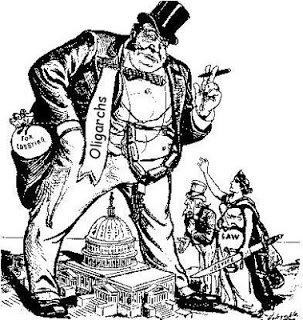
According to a new study from Princeton University, American democracy no longer exists. Using data from over 1,800 policy initiatives from 1981 to 2002, researchers Martin Gilens and Benjamin Page concluded that rich, well-connected individuals on the political scene now steer the direction of the country, regardless of – or even against – the will of the majority of voters. America’s political system has transformed from a democracy into an oligarchy, where power is wielded by wealthy elites.

“Making the world safe for democracy” was President Woodrow Wilson’s rationale for World War I, and it has been used to justify American military intervention ever since. Can we justify sending troops into other countries to spread a political system we cannot maintain at home?

The Magna Carta, considered the first Bill of Rights in the Western world, established the rights of nobles as against the king. But the doctrine that “all men are created equal” – that all people have “certain inalienable rights,” including “life, liberty and the pursuit of happiness” – is an American original. And those rights, supposedly insured by the Bill of Rights, have the right to vote at their core. We have the right to vote but the voters’ collective will no longer prevails.

In Greece, the left-wing populist Syriza Party came out of nowhere to take the presidential election by storm; and in Spain, the populist Podemos Party appears poised to do the same. But for over a century, no third-party candidate has had any chance of winning a US presidential election. We have a two-party winner-take-all system, in which our choice is between two candidates, both of whom necessarily cater to big money. It takes big money just to put on the mass media campaigns required to win an election involving 240 million people of voting age.

In state and local elections, third party candidates have sometimes won. In a modest-sized city, candidates can actually influence the vote by going door to door, passing out flyers and bumper stickers, giving local presentations, and getting on local radio and TV. But in a national election, those efforts are easily trumped by the mass media. And local governments too are beholden to big money.

When governments of any size need to borrow money, the megabanks in a position to supply it can generally dictate the terms. Even in Greece, where the populist Syriza Party managed to prevail in January, the anti-austerity platform of the new government is being throttled by the moneylenders who have the government in a chokehold.

How did we lose our democracy? Were the Founding Fathers remiss in leaving something out of the Constitution? Or have we simply gotten too big to be governed by majority vote?

Democracy’s Rise and Fall

The stages of the capture of democracy by big money are traced in a paper called “The Collapse of Democratic Nation States” by theologian and environmentalist Dr. John Cobb. Going back several centuries, he points to the rise of private banking, which usurped the power to create money from governments:

The influence of money was greatly enhanced by the emergence of private banking. The banks are able to create money and so to lend amounts far in excess of their actual wealth. This control of money-creation . . . has given banks overwhelming control over human affairs. In the United States, Wall Street makes most of the truly important decisions that are directly attributed to Washington.

Today the vast majority of the money supply in Western countries is created by private bankers. That tradition goes back to the 17th century, when the privately-owned Bank of England, the mother of all central banks, negotiated the right to print England’s money after Parliament stripped that power from the Crown. When King William needed money to fight a war, he had to borrow. The government as borrower then became servant of the lender.

In America, however, the colonists defied the Bank of England and issued their own paper scrip; and they thrived. When King George forbade that practice, the colonists rebelled.

They won the Revolution but lost the power to create their own money supply, when they opted for gold rather than paper money as their official means of exchange. Gold was in limited supply and was controlled by the bankers, who surreptitiously expanded the money supply by issuing multiple banknotes against a limited supply of gold.

This was the system euphemistically called “fractional reserve” banking, meaning only a fraction of the gold necessary to back the banks’ privately-issued notes was actually held in their vaults. These notes were lent at interest, putting citizens and the government in debt to bankers who created the notes with a printing press. It was something the government could have done itself debt-free, and the American colonies had done with great success until England went to war to stop them.

President Abraham Lincoln revived the colonists’ paper money system when he issued the Treasury notes called “Greenbacks” that helped the Union win the Civil War. But Lincoln was assassinated, and the Greenback issues were discontinued.

In every presidential election between 1872 and 1896, there was a third national party running on a platform of financial reform. Typically organized under the auspices of labor or farmer organizations, these were parties of the people rather than the banks. They included the Populist Party, the Greenback and Greenback Labor Parties, the Labor Reform Party, the Antimonopolist Party, and the Union Labor Party. They advocated expanding the national currency to meet the needs of trade, reform of the banking system, and democratic control of the financial system.

The Populist movement of the 1890s represented the last serious challenge to the bankers’ monopoly over the right to create the nation’s money. According to monetary historian Murray Rothbard, politics after the turn of the century became a struggle between two competing banking giants, the Morgans and the Rockefellers. The parties sometimes changed hands, but the puppeteers pulling the strings were always one of these two big-money players.

In All the Presidents’ Bankers, Nomi Prins names six banking giants and associated banking families that have dominated politics for over a century. No popular third party candidates have a real chance of prevailing, because they have to compete with two entrenched parties funded by these massively powerful Wall Street banks.

Democracy Succumbs to Globalization

In an earlier era, notes Dr. Cobb, wealthy landowners were able to control democracies by restricting government participation to the propertied class. When those restrictions were removed, big money controlled elections by other means:

First, running for office became expensive, so that those who seek office require wealthy sponsors to whom they are then beholden. Second, the great majority of voters have little independent knowledge of those for whom they vote or of the issues to be dealt with. Their judgments are, accordingly, dependent on what they learn from the mass media. These media, in turn, are controlled by moneyed interests.

Control of the media and financial leverage over elected officials then enabled those other curbs on democracy we know today, including high barriers to ballot placement for third parties and their elimination from presidential debates, vote suppression, registration restrictions, identification laws, voter roll purges, gerrymandering, computer voting, and secrecy in government.

The final blow to democracy, says Dr. Cobb, was “globalization” – an expanding global market that overrides national interests:

[T]oday’s global economy is fully transnational. The money power is not much interested in boundaries between states and generally works to reduce their influence on markets and investments. . . . Thus transnational corporations inherently work to undermine nation states, whether they are democratic or not.

The most glaring example today is the secret twelve-country trade agreement called the Trans-Pacific Partnership. If it goes through, the TPP will dramatically expand the power of multinational corporations to use closed-door tribunals to challenge and supersede domestic laws, including environmental, labor, health and other protections.

Looking at Alternatives

Some critics ask whether our system of making decisions by a mass popular vote easily manipulated by the paid-for media is the most effective way of governing on behalf of the people. In an interesting Ted Talk, political scientist Eric Li makes a compelling case for the system of “meritocracy” that has been quite successful in China.

In America Beyond Capitalism, Prof. Gar Alperovitz argues that the US is simply too big to operate as a democracy at the national level. Excluding Canada and Australia, which have large empty landmasses, the United States is larger geographically than all the other advanced industrial countries of the OECD (Organization for Economic Cooperation and Development) combined. He proposes what he calls “The Pluralist Commonwealth”: a system anchored in the reconstruction of communities and the democratization of wealth. It involves plural forms of cooperative and common ownership beginning with decentralization and moving to higher levels of regional and national coordination when necessary.

Dr. Alperovitz is co-founder of an initiative called The Next System Project, aimed at defining the issues in a national political debate as a first step to realizing the possible. He quotes Prof. Donald Livingston, who asked in 2002:

What value is there in continuing to prop up a union of this monstrous size? . . . [T]here are ample resources in the American federal tradition to justify states’ and local communities’ recalling, out of their own sovereignty, powers they have allowed the central government to usurp.

Taking Back Our Power

If governments are recalling their sovereign powers, they might start with the power to create money, which was usurped by private interests while the people were asleep at the wheel. State and local governments are not allowed to print their own currencies; but they can own banks, and all depository banks create money when they make loans, as the Bank of England recently acknowledged.

The federal government could take back the power to create the national money supply by issuing its own Treasury notes as Abraham Lincoln did. Alternatively, it could issue some very large denomination coins as authorized in the Constitution; or it could nationalize the central bank and use quantitative easing to fund infrastructure, education, job creation, and social services, responding to the needs of the people rather than the banks.

The freedom to vote carries little weight without economic freedom – the freedom to work and to have food, shelter, education, medical care and a decent retirement. President Franklin Roosevelt maintained that we need an Economic Bill of Rights. If our elected representatives were not beholden to the moneylenders, they might be able both to pass such a bill and to come up with the money to fund it.

Ellen Brown is an attorney, founder of the Public Banking Institute, and author of twelve books including the best-selling Web of Debt. Her latest book, The Public Bank Solution, explores successful public banking models historically and globally. Her 300+ blog articles are at EllenBrown.com. Listen to “It’s Our Money with Ellen Brown” on PRN.fm.


Life in the Algorithm

images

By Douglas Haddow

Source: Adbusters

The searches we make, the news we read, the dates we go on, the advertisements we see, the products we buy and the music we listen to. The stock market. The surveillance society. The police state, and the drones. All guided by a force we never see and few understand.

A series of calculation procedures that come together to constitute capitalism’s secret ingredient — the all holy algorithm, that which binds and optimizes. Those strange numerical gods who decide whether or not you’re a terrorist and what kids’ toy is going to set the market on fire this Christmas. But what are they, where did they come from and how did they get so powerful?

Algorithms are not new. You can trace their origin all the way back to a 9th century Persian mathematician by the name of Muhammad ibn Musa al–Khwarizmi (Algoritmi in Latin) from whom the word derives its name. Then there was Abu Yusaf Ya’qub ibn Ishaq al–Kindi, a contemporary of al–Khwarizmi’s at Baghdad’s House of Wisdom. He discovered and developed the science of frequency analysis, or code–breaking, providing a basis for code breaker Alan Turing to develop his Turing Machine, the theoretical prototype for the 9 billion devices currently sending and receiving signals through the Internet.

When we talk about algorithms, when they come up in conversation, often tied to latent and emerging fears, we’re not talking about the mathematical models behind them, we’re talking about the models that the models were modeled on. Most people have never heard of a polytope, Boolean Logic or the Hirsch Conjecture. But everyone has a credit score, whether they like it or not.

If we want to interrogate the true nature of these numbers, the wizard behind the ghost in the machine, we need to look no further than Adam Smith, that dour Scot who lived with his mum and accidentally created the modern world.

Smith was neither a modernist nor a cosmopolitan. He was an absent’minded hermit who never married, had few friends, suffered from alternating fits of depression and hypochondria, travelled outside Britain on just one occasion and demanded that all his personal writing be burned upon his death. He was the supreme king of unintended consequences, a humble and misunderstood moral philosopher who became the patron saint of greed.

Most famously, and most tragically, Smith was an ambitious writer who got a bit flowery with his language on occasion, and, as a result, his entire legacy was reduced to two words: invisible and hand. As in, the Invisible Hand — that mysterious market force that secretly and surreptitiously guides all our actions and decisions. Or so we’ve been told.

In The Wealth of Nations, the blueprint for what became known as capitalism, Smith drops the phrase but once. It’s situated in a rather dry discussion on trade policy and is used as a metaphor in a straightforward critique of mercantilism’s excessive restrictions.

And that’s it. Just a cursory metaphor used for poetic flourish in an otherwise obscure and forgettable passage. And for the 150 years that followed the book’s publication, that’s exactly what it was — obscure and forgotten. Smith didn’t mention it, his contemporaries didn’t mention it, nor did his critics. Nary a soul on Earth repeated those two words or paid them any heed.

That is, until 1948, when everything changes.

If you look at a Google NGRAM chart of “invisible hand,” you’ll see that there was little to no interest in the phrase up until the 1930s and ’40s, at which point it begins to bubble up a bit, gaining traction in a few peripheral spheres here and there. Then in ’48, Chicago School economist Paul Samuelson writes a book called Economics: An Introductory Analysis, which would go on to become the best–selling economics book of all time.

In his book, Samuelson grabs hold of Smith’s wordplay and freebases meaning from it until a mere metaphor mutates into the economic doctrine that would define the shape and form of global finance for the remainder of the century, and beyond.

“Every individual, in pursuing only his own selfish good, was led, as if by an invisible hand, to achieve the best good for all, so that any interference with free competition by government was almost certain to be injurious,” writes Samuelson. And with that, not only is it justifiable to be callous in the pursuit of wealth, your callousness will somehow, vis–à–vis the invisible hand, uplift those you trample on your way to the top.

Picture Gordon Gekko, hair trickling with high–end product, walking with the gait of limitless sprezzatura, saying, “Greed is right, greed works. Greed clarifies, cuts through and captures the essence of the evolutionary spirit. Greed, in all of its forms; greed for life, for money, for love, knowledge has marked the upward surge of mankind.”

Samuelson would later go on to regret the liberties he took with Smith’s words, but the meme had already been injected into the passive hive mind of economics. What followed was a long and tangled game of economic telephone wherein Smith’s fatalistic conceit gradually took on mythical qualities. From turn of phrase to doctrine, from doctrine to dogma, from dogma to metaphysical law. The invisible hand became the celestial justification of the free market and the economic rationalist’s negation of anything that stood in its way.

Austrian economist Friedrich Hayek even went so far as to develop an entire theory of human interaction based on the myth. It was called Catallactics, and proposed that we did not live within an economy, but rather, a Catallaxy — a complex and self–organizing system in which every individual sent out a constant stream of complex signals that mixed to create overall market behavior.

Knowledge, Hayek argued, was distributed on an individual level, each person containing their own fraction of the whole.

The vast repository of human knowledge was inherently decentralized. Because of this, no central body or government agency could ever hope to contain enough of it to know what was really going on. But if allowed to move freely without meddling, these messages would come together to create order and equilibrium in the market.

This, he argued, is why the government should never meddle in the market. And why order could never be “planned,” and was instead “brought about by the mutual adjustment of many individual economies in a market.” As long as the signals, our private info–snowflakes, could float freely, the market would reach equilibrium.

Through Hayek, dogma became revelation — the invisible hand was not merely a magical presence promising equilibrium, it was also pointing us toward a not–too–distant utopia. And if we didn’t follow the hand? Oppression and despair would follow mankind into a dark hole of tyranny.

Hayek’s ideas spread swiftly through a series of think tanks connected to his economic clique, The Mont Pelerin Society, which counted Karl Popper, Ludwig von Mises and, of course, who else but Milton Friedman among its members. Together they successfully launched what we now call “neoliberalism” into the political consciousness.

Neoliberalism found its champions in Margaret Thatcher and Ronald Reagan. Thatcher regularly corresponded with Hayek and used the slogan There Is No Alternative (TINA) to explain her affection for its concepts. Reagan hired Friedman to be his economic advisor. And together they carried out an economic revolution that smashed trade unions and deregulated and privatized anything and everything that could be guillotined. From this axis of Anglos, it spread to other parts of the Commonwealth, then to Europe, Asia, South America and beyond.

But no matter how much they stripped away government meddling, somehow the “abstract signals” still weren’t getting through. The hand remained clenched and crises endemic. Asia, Argentina, the Eurozone, the 2008 meltdown, the flash crash. The market continually failing to magically self–correct and achieve equilibrium.

The faithful kept their faith and stuck to the program. The crisis, both economic and existential, were met with a recommitment to the faith in the form of austerity and technology and the dream persisted.

The problem was obvious to anyone outside the neoliberal thought–bubble: the invisible hand wasn’t real and it didn’t exist. It never had existed. It wasn’t just invisible, but immaterial, made from the twisted fantasies of economists obsessed with achieving an impossible “equilibrium.” You couldn’t touch it, and it couldn’t touch you.
Until now.

In 2010, when the Dow Jones Industrial dropped 1000 points in under a minute, the biggest one–day point decline in history, it received far less attention then it deserved, because everything returned to normal a few seconds later. Now, miniature flash crashes occur constantly throughout the day. But this crash was a turning point, demonstrating that something had changed. That something was that the neoliberals had achieved what communists, socialists and Christians never could: they made their god real, and in doing so, achieved their utopia. They just didn’t let the rest of us in on it.

The critical flaw in Hayek’s vision of the hand was that a “central body” could never gather enough information. We know this to be untrue, and with big data and the analysis and manipulation of that data through algorithmic equation, the missing link between money and the machine was discovered.

The searches we make, the news we read, the dates we go on, the advertisements we see, the products we buy and the music we listen to. The stock market … All informed by this marriage between mathematics and capital, all working together in perfect harmony to achieve a singular goal — equilibrium. But it’s a curious sort of equilibrium. Less to do with the relationship between supply and demand, and more about the man and the market.

All these algorithms we encounter throughout the day, they’re working toward a greater goal: solving problems and learning how to think. Like the advent and rise of high–frequency trading, they’re part of an optimization trend that leads to a strange brand of perfection: automated profit.

And their current day use, no matter how impressive the specs, is still rooted in 7th century code–breaking. Only now it’s about breaking our individual codes. Throughout the day we send out thousands of our own individual abstract signals and the algorithms figure out how best to streamline our existence into the market’s needs. We’re all just cyphers waiting to get cracked.

This is not the stuff of Orwell and Huxley, but Amazon and the NSA.

There is an overwhelming feeling of inevitability surrounding all of this. With computational capacity still threatening to double every two years, the algorithmic estate will continue to expand and become more sophisticated. All of this development, testing and research is leading to a predictable outcome. Given that they are leading investment and research in the sector, Wall Street financiers will develop the world’s first fully functioning Artificial Intelligence.

If any of this feels inevitable, it’s because it was designed to make us feel that way. If the algorithms that organize the world of money were turned on their head and used to analyze the defects in their guiding philosophy, they would shred it all on one razor sharp fact: the world beyond the market is still a real one. And no matter how sophisticated the math, how brilliant the AI, we will always be living in it.

Outside of The Wealth of Nations, Smith employed the Invisible Hand concept on only two other occasions. Once in his Theory of Moral Sentiments, where he slags off the rich, and the other in the History of Astronomy, where he says:

For it may be observed, that in all Polytheistic religions, among savages, as well as in the early ages of Heathen antiquity, it is the irregular events of nature only that are ascribed to the agency and power of their gods. Fire burns, and water refreshes; heavy bodies descend, and lighter substances fly upwards, by the necessity of their own nature; the invisible hand of Jupiter was never apprehended to be employed in those matters.

These days, the “savages” kick back, polish their yachts and let the machines do their thinking for them. Their god is a primitive and cruel one. Worse yet, it lacks imagination. The future it sees is just an optimized version of the present. Everything that falls within its gaze is predictable, because mathematical sequences are predictable. What remains to be seen is whether or not human beings are as predictable as the machines think we are.

Zombie Apocalypse and the Politics of Artificial Scarcity

By Colin Jenkins

Source: The Hampton Institute

cdc_zombie_attacksDystopian narratives have long been an alluring and thought-provoking form of entertainment, especially for those who take an interest in studying social and political structures. From classics like Nineteen Eighty-Four and Brave New World to the current hit, The Hunger Games, these stories play on our fears while simultaneously serving as warning signs for the future.

Their attractiveness within American society is not surprising. Our lives are driven by fear. Fear leads us to spend and consume; fear leads us to withdraw from our communities; and fear leads us to apathy regarding our own social and political processes. This fear is conditioned as much as it is natural. The ruling-class handbook, Machiavelli’s The Prince, made it clear: “Since love and fear can hardly exist together, if we must choose between them, it is far safer to be feared than loved.”

The idea of apocalypse is a central tenet of human society. We’ve been taught about Armageddon, Kali Yuga, Judgement Day, Yawm ad-Dīn, nuclear holocaust, the end times, the four horsemen, and the Sermon of the Seven Suns. Hierarchical societal arrangements leave us feeling powerless. Exploitative systems like capitalism leave us feeling hopeless. And the widespread deployment of fear ultimately keeps us in our place, and out of the business of those who own our worlds.

The last half-century has brought us the zombie apocalypse – a fictional world where the human race has largely been transformed into a brainless, subhuman hoard of flesh-eaters, with only a few random survivors left to carve out any semblance of life they can find in a barren landscape. The emergence and immense popularity of the TV show The Walking Dead is the latest, and perhaps most influential, piece in a long line of narratives centered within themes of survival, human interaction, and scarcity.
Human Nature and Interaction

Behind all political battles, social critiques, and theoretical inquiries lies the most fundamental question: when left to our own accord, how will we interact with one another? How one answers this question usually goes a long way to how one perceives the world, and how issues are viewed and opinions are formed. To our dismay, potential answers are typically presented in dualities. Are we good or evil? Competitive or cooperative? Generous or greedy? Violent or peaceful?

A common theme among religion has been that human beings are “born into sin” and heavily influenced by “evil forces” to do harmful things. One who embraces this theme will tend to have less faith in humanity than one who does not. For, if we really are engaging in a daily struggle to resist the powers of evil, it is reasonable to assume that evil will take hold of many. How can we trust anyone who, at a moment’s notice, could potentially lose the ability to act on their own conscience? The common theme of our dominant economic system – capitalism – is that human beings are inherently competitive and self-centered. When combined, it is easy to see how such ideologies may create intensely authoritative and hierarchical systems. After all, people who are influenced by strong and evil metaphysical forces while also being drawn toward callous, self-interest certainly cannot be trusted with free will.

This lesson is drilled deep into our psyches with each episode of The Walking Dead, where the potential threat of flesh-eating zombie hoards become an afterthought to the clear and present danger of “evil” humans who are out to get one another. Whether it’s a sadistic governor charming an entire town with violent gladiator events, an outlaw gang with the obligatory pedophile, or a pack of hipster cannibals salivating at the thought of eating their next visitor, the intended theme is clear – human beings are not capable of co-existing, even in a world where they rarely interact.

But is this idea accurate? Are we really drawn toward conflict? Must we compete with one another to survive? Is it appropriate to apply Darwin’s evolutionary theories in a social sense where the “fit” are meant to gain wealth and power over the “weak”? Or are we, as Peter Kropotkin theorized in his classic Mutual Aid, more inclined to mimic most other species on Earth, which have been observed over the course of centuries to exhibit “Mutual Aid and Mutual Support carried on to an extent which made me suspect in it a feature of the greatest importance for the maintenance of life, the preservation of each species, and its further evolution?”

There is ample evidence that we are drawn to cooperation. “Caring about others is part of our mammalian heritage, and humans take this ability to a high level,” explains neuroscientist Sandra Aamodt. “Helping other people seems to be our default approach, in the sense that we’re more likely to do it when we don’t have time to think a situation through before acting. After a conflict, we and other primates-including our famously aggressive relatives, the chimpanzees-have many ways to reconcile and repair relationships.” Studies have shown that in the first year of life, infants exhibit empathy toward others in distress. Evolutionary Anthropologist Michael Tomasello has put “the concept of cooperation as an evolutionary imperative to the test with very young children, to see if it holds for our nature and not just our nurture. Drop something in front of a two-year-old, he finds, and she is likely to pick it up for you. This is not just learned behavior, he argues. Young children are naturally cooperative.”

So, if we are truly inclined to cooperate with one another, why is there so much division and turmoil in the world? The answer to this question may be found by assessing not only the mechanisms of capitalism, but more importantly in the creation of artificial scarcity as a means to maintain hierarchies.
Capitalism and Artificial Scarcity

It is no secret that capitalism thrives off exploitation. It needs a large majority of people to be completely reliant on their labor power. It needs private property to be accessible to only a few, so that they may utilize it as a social relationship where the rented majority can labor and create value. It needs capital to be accessible to only a few, so that they may regenerate and reinvest said capital in a perpetual manner. And it needs a considerable population of the impoverished and unemployed – “a reserve army of labor,” as Marx put it – in order to create a “demand” for labor and thus make such exploitative positions “competitive” to those who need to partake in them to merely survive. It needs these things in order to stay intact – something that is desirable to the 85 richest people in the world who own more than half of the world’s entire population (3.6 billion people).

But wealth accumulation through alienation and exploitation is not enough in itself. The system also needs to create scarcity where it does not already exist. Even Marx admitted that capitalism has given us the productive capacity to provide all that is needed for the global population. In other words, capitalism has proven that scarcity does not exist. And, over the years, technology has confirmed this. But, in order for capitalism to survive, scarcity must exist, even if through artificial means. This is a necessary component on multiple fronts, including the pricing of commodities, the enhancement of wealth, and the need to inject a high degree of competition among people (who are naturally inclined to cooperation).

Since capitalism is based in the buying and selling of commodities, its lifeblood is production. And since production in a capitalist system is not based on need, but rather on demand, it has the tendency to produce more than it can sell. This is called overproduction. Michael Roberts explains:

Overproduction is when capitalists produce too much compared to the demand for things or services. Suddenly capitalists build up stocks of things they cannot sell, they have factories with too much capacity compared to demand and they have too many workers than they need. So they close down plant, slash the workforce and even just liquidate the whole business. That is a capitalist crisis.

When overproduction occurs, it must be addressed. There are multiple ways to do this. Marx addressed three options: “On the one hand by enforced destruction of a mass of productive forces; on the other, by the conquest of new markets, and by the more thorough exploitation of the old ones.” Another is through the destruction of excess capital and commodities. Whichever measure is taken, it is paramount that the economy must emerge from a starting point that is different from the ending point where the crisis began. This is accomplished through creating scarcity, whether in regards to labor, production capacity, or commodities and basic needs.

Maintaining scarcity is also necessary for wealth enhancement. It is not enough that accumulation flows to a very small section of the population, but more so that a considerable portion of the population is faced with the inherent struggles related to inaccessibility. For example, if millions of people are unable to access basic needs such as food, clothing, shelter, and healthcare, the commodification of those needs becomes all the more effective. On the flip side, the mere presence of accessibility – or wealth – which is enjoyed by the elite becomes all the more valuable because it is highly sought after.

In this sense, it is not the accumulation of personal wealth that creates advantageous positions on the socioeconomic ladder; it’s the impoverishment of the majority. Allowing human beings access to basic necessities would essentially destroy the allure (and thus, power) of wealth and the coercive nature of forced participation. This effect is maintained through artificial scarcity – the coordinated withholding of basic needs from the majority. These measures also seek to create a predatory landscape – something akin to a post-apocalyptic, zombie-filled world where manufactured scarcity pits poor against poor and worker against worker, all the while pulling attention away from the zombie threat.
Control through Commodification

A crucial part of this process is commodification – the “transformation of goods and services, as well as ideas or other entities that normally may not be considered goods, into commodities” that can be bought, sold, used and discarded. The most important transformation is that of the working-class majority who, without the means to sustain on their own, are left with a choice between (1) laboring to create wealth for a small minority and accepting whatever “wages” are provided, or (2) starving.

In The Socioeconomic Guardians of Scarcity, Philip Richlin tells us that:

“When society deprives any community or individual of the necessities of life, there is a form of violence happening. When society commodifies the bare necessities of life, they are commodifying human beings, whose labor can be bought and sold. Underneath the pseudo-philosophical rationalizations for capitalism is a defense of wage slavery. For, if your labor is for sale, then you are for sale.”

We are for sale, and we sell ourselves everyday – in the hopes of acquiring a wage that allows us to eat, sleep, and feed our families. In the United States, the 46 million people living in poverty haven’t been so lucky. The 2.5 million who have defaulted on their student loans have been discarded. The 49 million who suffer from food insecurity have lost hope. The 3.5 million homeless are mocked by 18.6 million vacant homes. And the 22 million who are unemployed or underemployed have been deemed “unfit commodities” and relegated to the reserve army of labor.

The control aspect of the commodification of labor comes in its dehumanizing effect – an effect that was commonly recognized among 18th and 19th century thinkers. One of those thinkers, Wilhelm Von Humboldt, when referring to the role of a wage laborer, explained “as whatever does not spring from a man’s free choice, or is only the result of instruction and guidance, does not enter into his very nature; he does not perform it with truly human energies, but merely with mechanical exactness, suggesting that “we may admire what he (the laborer) does, but we despise what he is,” because he is essentially not human.

The worker, in her or his role in the capital-labor relationship, exists in a position of constant degeneration. This is especially true with the onset of mass production lines and the division of labor – both of which are inevitable elements within this system. “As the division of labor increases, labor is simplified,” Marx tells us. “The special skill of the worker becomes worthless. He becomes transformed into a simple, monotonous productive force that does not have to use intense bodily or intellectual faculties. His labor becomes a labor that anyone can perform.” As automation and technology progress, such specialized task-mastering even seeps into what was once considered “skilled” labor, thus broadening its reach.

In this role, workers are firmly placed into positions of control within a highly authoritative and hierarchical system.
A World beyond Profit

Dystopian narratives are no longer fiction. From birth, we are corralled into a system that scoffs at free will, stymies our creative and productive capacities, and leaves us little room to carve our own paths. The constructs directed from above are designed to strip us of our inclination to care and cooperate, and make us accept the need to step over one another to get ahead. This is not our nature. Whether we’re talking about Kropotkin’s studies in “the wild” or Tomasello’s experience with children, observable evidence tells us we’ve been duped.

Another world is not just possible; it is inevitable if we are to exist in the long-term. In Post-Scarcity Anarchism, Murray Bookchin offers a glimpse into this world not constructed on labor, profit, and artificial scarcity:

“It is easy to foresee a time, by no means remote, when a rationally organized economy could automatically manufacture small “packaged” factories without human labor; parts could be produced with so little effort that most maintenance tasks would be reduced to the simple act of removing a defective unit from a machine and replacing it by another-a job no more difficult than pulling out and putting in a tray. Machines would make and repair most of the machines required to maintain such a highly industrialized economy. Such a technology, oriented entirely toward human needs and freed from all consideration of profit and loss, would eliminate the pain of want and toil-the penalty, inflicted in the form of denial, suffering and inhumanity, exacted by a society based on scarcity and labor.”

The barren landscape for which we’ve been placed has a future beyond Hershel’s overrun farm, the confines of a prison, the Governor’s creepy town of Woodbury, and the trap known as Terminus. It has a future beyond the artificial constructs of capitalism and hierarchy. Human nature is talking to us… and we’re starting to listen.

The Dire State of Our Nation (What You Won’t Hear from the Politicians)

Unknown-18

By John W. Whitehead

Source: The Rutherford Institute

No matter what the politicians might say about how great America is, the fact is that the nation seems to be imploding. Consider the following facts:

Our government is massively in debt. Currently, the national debt is somewhere in the vicinity of $18 trillion. More than a third of our debt is owned by foreign countries, namely China and Japan.

Our education system is abysmal. Despite the fact that we spend more than most of the world on education ($115,000 per student), we rank 36th in the world when it comes to math, reading and science, far below most of our Asian counterparts. Even so, we continue to insist on standardized programs such as Common Core, which teach students to be test-takers rather than thinkers.

Our homes provide little protection against government intrusions. Police agencies, already empowered to crash through your door if they suspect you’re up to no good, now have radars that allow them to “see” through the walls of your home.

Our prisons, housing the largest number of inmates in the world and still growing, have become money-making enterprises for private corporations that rely on the inmates for cheap labor.

We are no longer a representative republic. The U.S. has become a corporate oligarchy. As a recent survey indicates, our elected officials, especially those in the nation’s capital, represent the interests of the rich and powerful rather than the average citizen.

We’ve got the most expensive, least effective health care system in the world compared to other western, industrialized nations.

The air pollution levels are dangerously high for almost half of the U.S. population, putting Americans at greater risk of premature death, aggravated asthma, difficulty breathing and future cardiovascular problems.

Despite outlandish amounts of money being spent on the nation’s “infrastructure,” there are more than 63,000 bridges—one out of every 10 bridges in the country—in urgent need of repair. Some of these bridges are used 250 million times a day by trucks, school buses, passenger cars and other vehicles.

Americans know little to nothing about their rights or how the government is supposed to operate. This includes educators and politicians. For example, 27 percent of elected officials cannot name even one right or freedom guaranteed by the First Amendment, while 54 percent do not know the Constitution gives Congress the power to declare war.

Nearly one out of every three American children live in poverty, ranking us among the worst in the developed world.

Patrolled by police, our schools have become little more than quasi-prisons in which kids as young as age 4 are being handcuffed for “acting up,” subjected to body searches and lockdowns, and suspended for childish behavior.

We’re no longer innocent until proven guilty.  In our present surveillance state, that burden of proof has now been shifted so that we are all suspects to be spied on, searched, scanned, frisked, monitored, tracked and treated as if we’re potentially guilty of some wrongdoing or other.

Parents, no longer viewed as having an inherent right to raise their children as they see fit, are increasingly being arrested for letting their kids walk to the playground alone, or play outside alone. Similarly, parents who challenge a doctor’s finding or request a second opinion regarding their children’s health care needs are being charged with medical child abuse and, in a growing number of cases, losing custody of their children to the government.

Private property means little at a time when SWAT teams and other government agents can invade your home, break down your doors, kill your dog, wound or kill you, damage your furnishings and terrorize your family.

Court rulings undermining the Fourth Amendment and justifying invasive strip searches have left us powerless against police empowered to forcefully draw our blood, forcibly take our DNA, strip search us, and probe us intimately.

Americans have no protection against police abuse. It is no longer unusual to hear about incidents in which police shoot unarmed individuals first and ask questions later.

If there is any absolute maxim by which the federal government seems to operate, it is that the American taxpayer always gets ripped off. This is true, whether you’re talking about taxpayers being forced to fund high-priced weaponry that will be used against us, endless wars that do little for our safety or our freedoms, or bloated government agencies such as the National Security Agency with its secret budgets, covert agendas and clandestine activities.

Americans are powerless in the face of militarized police. As police forces across the country continue to be transformed into extensions of the military, Americans are finding their once-peaceful communities transformed into military outposts, complete with tanks, weaponry, and other equipment designed for the battlefield.

Now these are not problems that you can just throw money at. As I point out in my book A Government of Wolves: The Emerging American Police State, these are problems that will continue to plague our nation unless and until Americans wake up to the fact that we’re the only ones who can change things.

For starters, we’ll need to actually pay attention to what’s going on around us, and I don’t mean by turning on the TV news, which is little more than government propaganda. Pay attention to what your local city councils are enacting. Pay attention to what your school officials are teaching and not teaching. Pay attention to whom your elected officials are allowing to wine and dine them.

Most of all, stop acting like it really matters whether you vote for a Republican or Democrat, because it doesn’t, and start acting like citizens who expect the government to work for them, rather than the other way around.

While that bloated beast called the federal government may not listen to you, you can have a great impact on your local governing bodies if you’ll just take a stand. This will mean gathering together with your friends and neighbors and, for example, forcing your local city council to start opposing state and federal programs that are ripping you off. And if need be, your local city council can refuse to abide by the dictates that continue to flow from Washington, DC.

All of the signs point to something nasty up ahead. The time to act is now.

11 Predictions Of Economic Disaster In 2015 From Top Experts All Over The Globe

economic-collapse

By Michael Snyder

Source: Economic Collapse Blog

Will 2015 be a year of financial crashes, economic chaos and the start of the next great worldwide depression?  Over the past couple of years, we have all watched as global financial bubbles have gotten larger and larger.  Despite predictions that they could burst at any time, they have just continued to expand.  But just like we witnessed in 2001 and 2008, all financial bubbles come to an end at some point, and when they do implode the pain can be extreme.  Personally, I am entirely convinced that the financial markets are more primed for a financial collapse now than they have been at any other time since the last crisis happened nearly seven years ago.  And I am certainly not alone.  At this point, the warning cries have become a deafening roar as a whole host of prominent voices have stepped forward to sound the alarm.  The following are 11 predictions of economic disaster in 2015 from top experts all over the globe…

#1 Bill Fleckenstein: “They are trying to make the stock market go up and drag the economy along with it. It’s not going to work. There’s going to be a big accident. When people realize that it’s all a charade, the dollar will tank, the stock market will tank, and hopefully bond markets will tank. Gold will rally in that period of time because it’s done what it’s done because people have assumed complete infallibility on the part of the central bankers.”

#2 John Ficenec: “In the US, Professor Robert Shiller’s cyclically adjusted price earnings ratio – or Shiller CAPE – for the S&P 500 is currently at 27.2, some 64pc above the historic average of 16.6. On only three occasions since 1882 has it been higher – in 1929, 2000 and 2007.”

#3 Ambrose Evans-Pritchard, one of the most respected economic journalists on the entire planet: “The eurozone will be in deflation by February, forlornly trying to ignite its damp wood by rubbing stones. Real interest rates will ratchet higher. The debt load will continue to rise at a faster pace than nominal GDP across Club Med. The region will sink deeper into a compound interest trap.”

#4 The Jerome Levy Forecasting Center, which correctly predicted the bursting of the subprime mortgage bubble in 2007: “Clearly the direction of most of the recent global economic news suggests movement toward a 2015 downturn.”

#5 Paul Craig Roberts: “At any time the Western house of cards could collapse. It (the financial system) is a house of cards. There are no economic fundamentals that support stock prices — the Dow Jones. There are no economic fundamentals that support the strong dollar…”

#6 David Tice: “I have the same kind of feel in ’98 and ’99; also ’05 and ’06.  This is going to end badly. I have every confidence in the world.”

#7 Liz Capo McCormick and Susanne Walker: “Get ready for a disastrous year for U.S. government bonds. That’s the message forecasters on Wall Street are sending.”

#8 Phoenix Capital Research: “Just about everything will be hit as well. Most of the ‘recovery’ of the last five years has been fueled by cheap borrowed Dollars. Now that the US Dollar has broken out of a multi-year range, you’re going to see more and more ‘risk assets’ (read: projects or investments fueled by borrowed Dollars) blow up. Oil is just the beginning, not a standalone story.

If things really pick up steam, there’s over $9 TRILLION worth of potential explosions waiting in the wings. Imagine if the entire economies of both Germany and Japan exploded and you’ve got a decent idea of the size of the potential impact on the financial system.”

#9 Rob Kirby: “What this breakdown in the crude oil price is going to spawn another financial crisis.  It will be tied to the junk debt that has been issued to finance the shale oil plays in North America.  It is reported to be in the area of half a trillion dollars worth of junk debt that is held largely on the books of large financial institutions in the western world.  When these bonds start to fail, they will jeopardize the future of these financial institutions.  I do believe that will be the signal for the Fed to come riding to the rescue with QE4.  I also think QE4 is likely going to be accompanied by bank bail-ins because we all know all western world countries have adopted bail-in legislation in their most recent budgets.  The financial elites are engineering the excuse for their next round of money printing . . .  and they will be confiscating money out of savings accounts and pension accounts.  That’s what I think is coming in the very near future.”

#10 John Ing: “The 2008 collapse was just a dress rehearsal compared to what the world is going to face this time around. This time we have governments which are even more highly leveraged than the private sector was.

So this time the collapse will be on a scale that is many magnitudes greater than what the world witnessed in 2008.”

#11 Gerald Celente: “What does the word confidence mean? Break it down. In this case confidence = con men and con game. That’s all it is. So people will lose confidence in the con men because they have already shown their cards. It’s a Ponzi scheme. So the con game is running out and they don’t have any more cards to play.

What are they going to do? They can’t raise interest rates. We saw what happened in the beginning of December when the equity markets started to unravel. So it will be a loss of confidence in the con game and the con game is soon coming to an end. That is when you are going to see panic on Wall Street and around the world.”

If you have been following my website, you know that I have been pointing to 2015 for quite some time now.

For example, in my article entitled “The Seven Year Cycle Of Economic Crashes That Everyone Is Talking About“, I discussed the pattern of financial crashes that we have witnessed every seven years that goes all the way back to the Great Depression.  The last two major stock market crashes began in 2001 and 2008, and now here we are seven years later.

Will the same pattern hold up once again?

In addition, there are many other economic cycles that seem to indicate that we are due for a major economic downturn.  I discussed quite a few of these theories in my article entitled “If Economic Cycle Theorists Are Correct, 2015 To 2020 Will Be Pure Hell For The United States“.

But just like in 2000 and 2007, there are a whole host of doubters that are fully convinced that the party can continue indefinitely.  Even though our economic fundamentals continue to get worse, our debt levels continue to grow and every objective measurement shows that Wall Street is more reckless and more vulnerable to collapse than ever before, they mock the idea that a financial collapse is imminent.

So let’s see what happens in 2015.

I have a feeling that it is going to be an extremely “interesting” year.

The Calling: How Cronyism Worsens Income Inequality (and Freed Markets Reduce It)

cronyism-out-of-control

By Steven Horwitz

Source: Future of Freedom Foundation

I recently gave an introductory Public Choice talk sponsored by Students for Liberty at the University of Ottawa. The next speaker was my friend Anne Rathbone Bradley, who was Skyping in from Washington. Anne gave a terrific talk about cronyism and rent-seeking that nicely complemented many of the points I’d made. But one of the side issues she raised really stuck with me, and I want to expand on it.

Anne connected cronyism (I hesitate to call it “crony capitalism”), rent-seeking, and income inequality in a way I hadn’t quite thought about before. The key to the connection is to realize some important truths about the political process.

The first truth is that cronyism is no accident. It is no accident that the U.S. economy has increasingly become one in which your connections to political power matter more for your ability to increase your wealth than does producing a product or service that consumers wish to buy. We are becoming what Ayn Rand deftly termed an “aristocracy of pull.”

The ability of some to get wealthier through political connections does trouble many on the political left, but they often argue that with better elected officials, or more ethical businesspeople, or limits on campaign contributions, we could dramatically reduce this sort of cronyism. What their argument misses is that as long as government gives out goodies, private-sector actors will find ways to get their hands on them. If you really want to take the money out of politics, you need to make it harder for politicians to hand out money.

For libertarians, the state is always little more than a dispenser of privileges to special interests. This is not an accident of who is elected or who is wealthy. Government privileges provide an easy path to profit for those who can capture them — and with none of the hard work of actually competing in the market. This is why many people, including those in the private sector, like the state.

The second important truth is that these political privileges are much more likely to be captured by those who already have financial and political power. Despite the fantasy believed by so many that government regulation and other interventions are all about constraining the rich and powerful in the name of the masses, in fact a great deal of government regulation is driven by the desires of those same rich and powerful to become more so. The more power we give to government, the more power we are giving to those with the money and connections to access political power. In other words, expanding the state gives more power and privilege to the powerful and privileged.

The last truth is that when private-sector actors seek to use political privileges to enhance their profits, they often do so by blocking smaller competitors’ access to the market, or by raising their costs of competing. When Walmart supports a higher minimum wage, it thereby favors raising the costs for their small mom-and-pop rivals. When taxicab companies defend their monopoly privileges, they intend to shut firms like Uber and Lyft out of the market altogether. When entrenched hairdressers demand that hair braiders be licensed, the established practitioners mean to raise their competitors’ costs or shut them out altogether.

When we put all three of these truths together, we get a story about the way in which those who already have wealth and power can and do make use of the state to block the upward mobility of their poorer, less-powerful potential competitors. Small-business owners, Uber and Lyft drivers, and African-American women who want to open hair-braiding businesses are trying to grab on to the bottom rungs of the income ladder and work their way up. These are the very people — start-up entrepreneurs and the working poor — that those critical of the market claim to care about.

In a world where government has all of these powers to intervene in markets, rent-seeking and cronyism are inevitable. Regulation will ensure that those who know the right people can tilt the regulatory playing field in their favor. The result will be a worsening of the income inequality that concerns so many. The rich will get richer through rent-seeking and cronyism, and they will do so at the expense of the poor and relatively powerless. If rent-seeking and cronyism worsen income inequality, and the source of rent-seeking and cronyism is the state’s ability to intervene, then a pretty good case can be made that freed markets will give us a world with less income inequality than the status quo.

Libertarians are right to point out that inequalities of income are not inherently bad. If the existing pattern of incomes were the result of a truly freed market (like in the famous, if simplified, Wilt Chamberlain example in Robert Nozick’s Anarchy, State, and Utopia), there would be no reason for worry. This is especially true because in a freed market, dynamic change would ensure that the same people do not occupy the same rungs on the ladder from year to year.

However, if inequalities are instead the result of a mixed economy in which those who already have wealth and power can enhance it at the expense of those with less — not to mention the consumers who lose out on the benefits of greater competition and lower prices, then libertarians are right to object and look for solutions. Of course, asking for more state action to combat state-driven inequalities is unlikely to work and very likely to make matters worse.

Thus, we can ground our arguments against government intervention in the market in our desire to reduce inequalities that are not the result of voluntary exchanges that benefit both parties.

Finally, this whole argument gives libertarians another reason to love the sharing economy of Uber, Lyft, AirBnB, and the rest. Not only are such companies providing important competition for established firms and thereby lowering prices and bringing better services and more options to consumers, they are also part of the fight against the unearned privileges of the rich and powerful and the fight against politically driven, and therefore unjustified, increases in income inequality.

Classical liberalism needs to reassert its long-standing commitment to progressive goals, even as it rejects the means preferred by most so-called progressives today. We have an opportunity to bring new allies to our cause by recognizing the interrelationships among rent-seeking, cronyism, the sharing economy, small businesspeople, and income inequality. Let’s not overlook it.

Cynicism, Recession, and the Resurgence of Cyberpunk

books

By Marshall Sandoval

Source: PopMatters

Human nature might be augmented and highly channeled by technology, but human nature stays the same. And that tech might actually amplify all the worst things about us too.

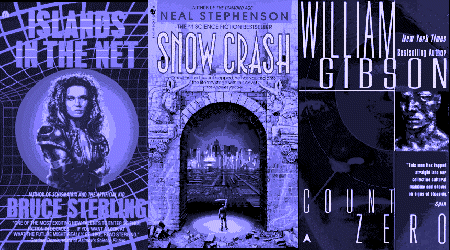
Cyberpunk has seen a recent resurgence in video games. Seemingly every game developer working today has a William Gibson book tucked under their arm or follows @swiftonsecurity (a satirical Twitter account that imagines a Taylor Swift consumed with cyber security). Cyberpunk video games are pervasive, including cyberpunk game jam projects on itch.io, Twine games, indie titles, and major AAA releases. All of these projects embrace cyberpunk themes and aesthetics. Observers credit the current trend to a number of cyclical and cultural factors. After talking to the indie developers behind a number of exciting cyberpunk titles at the center of this resurgence, I believe that the creators of these games are overwhelmingly inspired by the headlines in today’s newspapers.

It seems like no coincidence that these games have all appeared in a short time period following the economic recession. On the most basic level of analysis, it seems that these games may be providing a sense of escape from recent economic events. Last Life developer Sam Farmer notes, “I’m gonna go back to my film school class on Sci-Fi and Fantasy and say that it’s escapism. Horror, in general, and escapism, in particular, is often more popular in times of economic downturn, when you want to be somewhere else.”

Garrett Cooper’s Black Ice is an action game which casts the player as a hacker taking down corporate servers. Promoting the game, he’s found that cyberpunk narratives may be popular for reflecting reality as much as for providing an escape. He says, “I’ve talked to people about my game. I say, ‘All the corporations are evil.’ So they’re like, ‘Oh. So you’re talking about real life?’ I’m like, ‘No. Not exactly.’ That’s what people feel. The fantasy of being the one guy that can take something technological and turn it against the corporation.”

Games writer Austin Walker is an academic and cyberpunk superfan who sees the same throughline in these games and the literary roots of the genre. Walker says, “A key to traditional cyberpunk again and again is that there is economic inequality. We are positioning ourselves somewhere on that scale of how we feel about this stuff. Cyberpunk stories do that too. Usually they position the hero at the bottom of that; they’re usually in or near poverty.” In a time of extreme real-world inequality, cyberpunk stories locate players in a fantasy of rising up to subvert the system and taking down greedy corporations.

David Pittman’s indie project Neon Struct deals with a fictional near-future surveillance state. The game was heavily influenced by the recent leaks about actual domestic surveillance in the present day in the United States. Pittman says, “Edward Snowden’s release of NSA documents in 2013 was an essential part of the inception of Neon Struct (formerly Die Augen der Welt, or ‘The Eyes of the World’). I have strong feelings about the abuse of surveillance by the U.S. government, and I’ve known for close to a year that I wanted to make a game about it.” He’s quick to add, “Despite my own interest and leaning in the real world debate over mass surveillance, I am developing a way to introduce the story, which does not require the player character to actually leak any classified information. I don’t want to assume that the player shares my biases.” Nonetheless, it’s clear that the forthcoming project was informed by recent events.

Other examples of indie games providing commentary on and gaining inspiration from world events abound. Brigador is an isometric cyberpunk shooter with an extremely stylish trailer, and developer Jack Monahan lists a surprising influence. Monahan says, “While I’m not sure if the author would agree with the genre classification {of cyberpunk}, my brother and I both read and enjoyed (and were worried by) a book called Cities Under Siege: The New Military Urbanism by Stephen Graham. Like William Gibson said, the future caught up to all of his writing, more or less. We basically are living in a dystopic future”. Notably, Monahan made these statements before the recent military-style urban clashes in Ferguson, Missouri. The aforementioned Last Life is shaped by real world advances in medicine and philosophical debates about transhumanism. Matt Conn is seeking to expand LGBT representation in the games space with the cyberpunk RPG R.O.M. He says, “Because I did GaymerX and prior to that I did a startup that was very successful and then crashed. Seeing how all that happened, I feel like I have an interesting perspective of the tech scene and the LGBT rights scene.” These varied examples show the differing events influencing today’s cyberpunk boom.

As strongly as these games are influenced by the socio-political climate, it is reductionist to say this is the only thing bringing cyberpunk back into prominence. Again, Austin Walker says, “It’s tempting to just say, ‘Oh that’s happening again. We’re getting concerned again about things like privatization and inequality.’ I think that’s part of it. I don’t know if I’d be comfortable saying, ‘This is the one reason why’”. Many developers also noted the power of nostalgia as a reason for the influx of cyberpunk games. Alex Preston a developer behind Hyper Light Drifter says, “I think my generation is coming into its own, creatively, and we have a fondness for these themes and ideas. A lot of us grew up with books, films, and games that touched on these themes, and it bleeds through in our creative work. I think nostalgia is a powerful force.”

Likewise, Brendan Chung, creator of ‘90s-influenced hacker game Quadrilateral Cowboy has noticed the cyclical nature of cyberpunk themes. He says, “My guess is that the people who grew up fiddling with old PC tech are now at an age where they now have the skillset and financial means to make their own games. Now that we can make games, we’re making things that harken back to one of the things that got us interested in games in the first place.” Nostalgia for ‘80s and ‘90s cyberpunk is another likely force bringing these kinds of games back to the games market.

Additionally, I kept hearing indie developers suggest their own outlook about the state of the world today is extremely bleak. Conn says, “On a more philosophical note, this is a way of writing about the future we kind of want to see. Even if it’s dystopian or dark. I think that for a lot of us, it’s very scary going into the future.” A similarly grim outlook is shared by Monahan. He says, “I think the dystopic elements of cyberpunk point to a certain cynicism that things aren’t going to get any better. Human nature might be augmented and highly channeled by technology, but human nature stays the same. And that tech might actually amplify all the worst things about us too.” Monahan also sees this cynicism in the nostalgia that drives the cyberpunk resurgence. He adds, “So much great work from the ‘80s was in a similar vein. I think of Snake Plissken’s deadpan response to news that the president’s plane has gone down: ‘President of what?’. There’s a disillusionment from the classic era of cyberpunk that makes a revival now seem fairly natural, I think.” Natural or not, the revival is in full force, and it’s becoming a strong and subversive undercurrent in the indie games space.

Money Woes and the Trials of Job

6

By Mark Anthony Rockeymoore

Source: Sacred Space in Time

Being broke seems to be endemic. Money woes, bills pilling up, creditors calling for blood and first born children. Money flowing in is gone before it is received and there seems to be no end in sight.

How can we focus on higher spiritual ideals when the daily grind calls for all our attention?

We can’t, as long as the two are separated.

By two, I mean, material concerns and spiritual concerns. Simply put, Divinity is not separate from the world. How we deal with our worldly concerns is directly related to how we deal with our spiritual concerns. If we diligently apply ourselves to becoming more accountable and responsible in our daily lives, carefully attending to the details of a normative life, then this concentration will similarly affect our pursuit of the higher goals. And vice versa, if balance is sought.

Money is energy. It greases the wheels of the mechanism of life, providing impetus to support our lifestyles. Money flows where energy goes. And our work, produces that energy. Labors of love produce value that result in success in life. If you do not care for what you do then your efforts are in vain and doomed to failure.

How hard are you working toward your goals? Or are you a debt slave, working toward someone else’s goals? Do you love what you do? If so, could you – in any conceivable way – get paid for it?

Whatever you are thinking about right this moment – that art, that writing, that building, that repairing, that knitting, that video game, that party you put together, the food you make – whatever it may be, if your passion is there then your joy is there as well. If you can get paid by doing what you love to do, then your success is guaranteed.

Money woes – being broke – are a transitory state, as money comes and goes. The idea of wealth itself is subjective and not necessarily even related to money. Health, family, friends are a form of wealth that are worth more than gold. Ask Job, of bible fame, who lost all – money, family, friends – but never disbelieved in the oneness of spirituality, thereafter receiving what he had lost and more as a result of his faith. For Job, there was no separation between his life and his relationship to his god. He saw all he experienced as expressive of his own failures, although the test of his faith through physical illness also challenged his understanding of the Greater Plan for his life. His humility in the face of total ruin is an exemplar of true faith, which is certain knowledge of the efficacy and necessity of each and every lesson we go through that we perceive as negative in nature. The appearance of God in the storm was all that was necessary for his faith to be restored, despite his continuing ignorance in the face of the Adversary’s enmity. It is funny, how, in life, so many things that appear bad, turn out good at some point.

As life shifts, perspectives shift. Life shifts as the mind and spirit undergo transformation. What occurs within, affects that which occurs without.

The trials of Job occurred because he was the best, not the worst. A faithful servant to his god. His faith and devotion were cast upon the flames of tribulation, resulting in the loss of his wealth, his health and his family. And yet, throughout his torment, Job’s confusion, misery and even anger reveal his pain and desperation and also his utter reliance upon his god as the ultimate salvation from his problems. Throughout his trials, his knowledge of the interwoven strands of body and soul remained intact. For him, there was no separation and, in the end, this knowing was his saving grace.

Hard times can be instructional if the lesson is internalized. As we undergo one or more of the trials of Job, realizing that, in the end, even though the workings of creation can be inscrutable and beyond our ability to understand, there is a reason for every iota of pain, suffering and heartache we experience. That the experience, no matter its intensity, is designed to lift us up, to make us stronger, and to bring us closer to the God that holds us in his arms, that loves, that is Love itself.

Building upon strong foundations can only lead to a solid structure. Living, then, within this structure – this house of many mansions – can be the realization of one’s highest dreams and aspirations, if the dream, the joy and the energy coincide.