Why War? Building on the legacy of Einstein, Freud and Gandhi

By Robert J. Burrowes

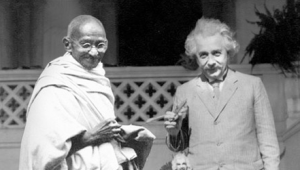
In 1932, Sigmund Freud and Albert Einstein conducted a correspondence subsequently published under the title ‘Why War?’ See ‘Why War: Einstein and Freud’s Little-Known Correspondence on Violence, Peace, and Human Nature’. In many ways, this dialogue between two giants of the 20th century is symbolic of the effort made by many humans to understand that perplexing and incredibly damaging feature of human experience: the institution of war.

In a recent article, the founder of peace research, Professor Johan Galtung, reminded us of the legacy of Freud and Einstein in this regard and reflected on their dialogue, noting some shortcomings including their failure to ‘unpack conflict’. See ‘Freud-Einstein on Peace’.

Of course, Freud and Einstein weren’t the first to consider the question ‘Why War?’ and their dialogue was preceded by a long sequence of individuals and even some organizations, such as the Women’s International League for Peace and Freedom and War Resisters’ International, who sought to understand, prevent and/or halt particular wars, or even to understand and end the institution itself, as exemplified by the Kellogg-Briand Pact in 1928 outlawing war. Moreover, given the failure of earlier initiatives, many individuals and organizations since Freud and Einstein have set out to understand, prevent and/or halt wars and these efforts have taken divergent forms.

Notable among these, Mohandas K. Gandhi was concerned to develop a mode of action to deal with many manifestations of violence and he dramatically developed, and shared, an understanding of how to apply nonviolence, which he labeled satyagraha (holding firmly to the truth), in overcoming large-scale violence and exploitation. He successfully applied his strategic understanding of nonviolence to the Indian independence struggle against British colonial rule. But while Gandhi was happy to acknowledge his debt to those who had gone before, he was not shy in proclaiming the importance of finding new ways forward: ‘If we are to make progress, we must not repeat history but make new history. We must add to the inheritance left by our ancestors.’

My own journey to understand human violence was caused by the death of my two uncles, Bob and Tom, in World War II, ten years before I was born. My childhood in the 1950s and 1960s is dotted with memories of my uncles, stimulated through such events as attending memorial services at the Shrine of Remembrance where their war service was outlined. See ‘My Brothers’ on my father’s website.

But by the early 1960s, courtesy of newspaper articles and photos, I had become aware of exploitation and starvation in Africa and elsewhere, and as a young university student in the early 1970s I was reading literature about environmental destruction. It wasn’t just war that was problematic; violence took many other forms too.

‘Why are human beings violent?’ I kept asking. Because I thought that this question must have been answered somewhere, I kept reading, including the work of Freud and Karl Marx as an undergraduate, but also the thoughts of many other scholars, such as Frantz Fanon, as well as anarchists, feminists and those writing from other perspectives which offered explanations of violence, whether direct, structural or otherwise.

By the early 1980s I had started to read Gandhi and I had begun to understand nonviolence, as Gandhi practised and explained it, with a depth that seemed to elude the activists I knew and even the scholars in the field that I read.

Separately from this, I was starting to gain a sense that the human mind was not something that could be understood well by viewing it primarily as an organ of thinking and that much of the literature and certainly most of the practitioners in the field of psychology and related fields, especially psychiatry, had failed to understand the emotional depth and complexity of the human mind and the implications of this for dealing with conflict and violence. In this sense, it was clear to me, few had understood, let alone been able to develop, Freud’s legacy. This is because the fundamental problem is about feeling (and, in relation to violence, particularly suppressed fear and anger). Let me explain why.

Violence is something that is usually identified as physical: it involves actions like hitting, punching and using weapons such as a gun. This is one of the types of violence, and probably the one now most often lamented, that is inflicted on indigenous peoples, women and people of colour, among others.

Separately from this, Gandhi also identified exploitation as violence and Galtung elaborated this concept with his notion of ‘structural violence’. Other forms of violence have been identified and they take many forms such as financial violence, cultural violence and ecological violence. But violence can be more subtle than any of these and, hence, much less visible. I have given two of these forms of violence the labels ‘invisible violence’ and ‘utterly invisible violence’. Tragically, ‘invisible violence’ and ‘utterly invisible violence’ are inflicted on us mercilessly from the day we are born. And, as a result, we are all terrorized.

So what are ‘invisible’ and ‘utterly invisible’ violence?

In essence, ‘invisible’ violence is the ‘little things’ we do every day, partly because we are just ‘too busy’. For example, when we do not allow time to listen to, and value, a child’s thoughts and feelings, the child learns to not listen to themSelf thus destroying their internal communication system.

When we do not let a child say what they want (or ignore them when they do), the child develops communication and behavioural dysfunctionalities as they keep trying to meet their own needs (which, as a basic survival strategy, they are genetically programmed to do). When we blame, condemn, insult, mock, embarrass, shame, humiliate, taunt, goad, guilt-trip, deceive, lie to, bribe, blackmail, moralize with and/or judge a child, we both undermine their sense of Self-worth and teach them to blame, condemn, insult, mock, embarrass, shame, humiliate, taunt, goad, guilt-trip, deceive, lie, bribe, blackmail, moralize and/or judge.

The fundamental outcome of being bombarded throughout their childhood by this ‘invisible’ violence is that the child is utterly overwhelmed by feelings of fear, pain, anger and sadness (among many others). However, parents, teachers and other adults also actively interfere with the expression of these feelings and the behavioural responses that are naturally generated by them and it is this ‘utterly invisible’ violence that explains why the dysfunctional behavioural outcomes actually occur.

For example, by ignoring a child when they express their feelings, by comforting, reassuring or distracting a child when they express their feelings, by laughing at or ridiculing their feelings, by terrorizing a child into not expressing their feelings (e.g. by screaming at them when they cry or get angry), and/or by violently controlling a behaviour that is generated by their feelings (e.g. by hitting them, restraining them or locking them into a room), the child has no choice but to unconsciously suppress their awareness of these feelings.

However, once a child has been terrorized into suppressing their awareness of their feelings (rather than being allowed to have their feelings and to act on them) the child has also unconsciously suppressed their awareness of the reality that caused these feelings. This has many outcomes that are disastrous for the individual, for society and for nature because the individual will now easily suppress their awareness of the feelings that would tell them how to act most functionally in any given circumstance and they will progressively acquire a phenomenal variety of dysfunctional behaviours, including many that are violent towards themselves, others and/or the Earth.

Moreover, this emotional (or psychological) damage will lead to a unique combination of violent behaviours in each case. And some of these individuals will gravitate to working in one of the social roles that specifically requires, or justifies, the use of ‘legitimized violence’, such as the violence carried out by police, prosecuting lawyers, magistrates and judges, as well as that inflicted by the military. Others, of course, will operate outside the realm of legitimized violence and be labelled as ‘criminals’.

But, you might be wondering, what is the link between what happens in childhood and war?

The answer is simply that perpetrators of violence, and those who collaborate with them, are created during childhood. And these perpetrators and collaborators are all terrified, self-hating and powerless – for much greater detail of the precise psychological characteristics of perpetrators of violence and their collaborators, see ‘Why Violence?’  and ‘Fearless Psychology and Fearful Psychology: Principles and Practice’ – and they go on to perform all of the key roles in creating, maintaining, equipping, staffing and legitimizing the institutions of war and in conducting it.

If it weren’t for the violence to which we are all mercilessly subjected throughout childhood, there would be no interest in violence or war of any kind. If we were raised without violence, we would be naturally peaceful and cooperative, content to spend our time seeking to achieve our own unique evolutionary potential and to nurture the journey of others as well as life itself, rather than just become another cog in someone else’s military (or other bureaucratic or corporate) machine.

If any of the above resonates with you, then I invite you to make ‘My Promise to Children’.

In addition, if further reducing the violence in our world appeals to you, then you are also welcome to consider participating in ‘The Flame Tree Project to Save Life on Earth’,  signing the online pledge of ‘The People’s Charter to Create a Nonviolent World’ and/or considering using the strategic framework on one or the other of these two websites for your campaign to end violence or war in one context or another: Nonviolent Campaign Strategy and Nonviolent Defense/Liberation Strategy.

A child is not born to make war. But if you inflict enough violence on a child, and destroy their capacity to become their own unique and powerful self, they will be terrorised into perceiving violence and war as their society wants them to be perceived. And violence and war, and the institutions that maintain them, will flourish.

If we want to end war, we must halt the adult war against children as a priority.


Biodata: Robert J. Burrowes has a lifetime commitment to understanding
and ending human violence. He has done extensive research since 1966 in
an effort to understand why human beings are violent and has been a
nonviolent activist since 1981. He is the author of ‘Why Violence?
His email address is flametree@riseup.net
and his website is at http://robertjburrowes.wordpress.com


Robert J. Burrowes
P.O. Box 68
Daylesford
Victoria 3460
Australia
Email: flametree@riseup.net

Websites:
Nonviolence Charter
Flame Tree Project to Save Life on Earth
‘Why Violence?’
Nonviolent Campaign Strategy
Nonviolent Defense/Liberation Strategy
Anita: Songs of Nonviolence
Robert Burrowes
Global Nonviolence Network

Do Psychopaths Run the World?

what-people-think-psychopaths-are-streetdemocracy

By Nick Parkins

Source: Waking Times

“Our society is run by insane people for insane objectives. I think we’re being run by maniacs for maniacal ends and I think I’m liable to be put away as insane for expressing that. That’s what’s insane about it.” ~John Lennon (1940-1980), English singer and songwriter

Lennon and others externalise the apparent paranoia that wells up inside us. “The world has gone mad!” More often than not we partition this voice off, content to view the world as others prescribe it. But who are these others, and what do they want?

The term psychopath is often criminally misjudged, thanks largely to unhelpful portrayals of sick, twisted and violent psycho-character types in the popular media. This has led, by way of public ignorance, to the common belief that the psychopath has no function, role or place in open society. A swift offload that allows us, the apparent sane majority, to circumvent our worst fears.

Any notion that the psychopath is incapable of functioning in open society is, according to M.E. Thomas1 – a self-confessed sociopath – flawed. The question is not the capacity to function, but rather what capacity or form that function takes. As Thomas says, psychopaths and sociopaths share an intertwined clinical history; both can function, they just do so differently. And though we are left to muse on what mask that function may take, in many social situations they excel.

Competition Wins Out

Jean-Baptiste de Lamarck was a French biologist who advocated a theory of evolution widely rebuked in establishment circles. Lamarck’s major work was published in the same year Charles Darwin was born – who would go on to supplant Lamarck’s theory 50 years later. In Lamarck’s world cooperation prevailed over Darwinian competition as the driving mechanism of evolution.

According to authors G. Greenberg and M.M. Haraway,2 it was Darwin’s view that served to reflect and sustain a Victorian society tied to free market, capitalist and imperial values. His model supported a dog-eat-dog, life is hard, code of practice; the scientific valediction of the natural world as played out on a brutal, cold and insensitive landscape. Arguably the perfect environment for the aspiring modern day psychopath, and a prevailing view that the poet Tennyson described as nature, red in tooth and claw.

Snakes & Ladders

Although diagnosing definitive psychopathy in individuals remains somewhat of a grey area, attempts have been made to categorise psychological traits that set psychopathic personalities apart. Most prominent is the diagnostic check-list devised by renowned Canadian psychologist Robert Hare that is used to determine a categorical diagnosis of clinical psychopathy, or at best a category score.

According to Hare’s list, psychopaths display superficial charm, unbridled ego, and pathological lying and cold, calculated cunning to entrance their prey. They are often impulsive and irresponsible, and exhibit an absence of empathy and remorseless lack of guilt. These and other attributes, such as criminal versatility and a marked capacity to manipulate, deceive and control, mark them out as dangerous. These are traits that enable psychopaths to move into high-ranking positions of power and influence.

“We know much less about corporate psychopathy and its implications,” explains New York psychologist Paul Babiak, “in large part because of the difficulty in obtaining the active cooperation of business organisations for our research.”3 A dilemma that Hare disclosed to Jon Ronson, author of The Psychopath Test. “Prisoners are easy,” states Hare. “They like meeting researchers. It breaks up the monotony of their day. But CEOs, politicians…”4 According to Hare, these sharks are a different kettle of fish.

A rare study on psychopathy in the workplace conducted by Babiak, Neumann and Hare5 suggests that 1 in 25, or 4 per cent, of corporate executives display significant personality traits typical of psychopathy – an incidence four times that estimated in the general population. The study supports the claim that psychopaths can and in fact do achieve high ranking corporate status. We are left to speculate, but Hare concedes Wall Street may harbour 1 in 10 attracted to lucrative watering holes that are poorly regulated.6Factor this in and it’s not hard to see how the very lifeblood and identity of corporations and financial institutions can often run cold.

Arguably most startling, the study indicates that despite being classed as substandard managers, team players and attracting poor performance appraisals, executives that met the clinical threshold of psychopath were valued by their immediate superiors as creative and innovative, as good communicators and strategic thinkers.

In short, they may not always fly under the radar. Despite the blips, it is clear to American psychiatrist Hervey Cleckley7 that psychopaths possess the communication, persuasion and interpersonal skills to override any negative impacts on their career. A finding supported by the Babiak study: “some companies viewed psychopathic executives as having leadership potential, despite negative performance reviews and low ratings on leadership and management by subordinates.”8 According to the authors, this shows a proficiency to manipulate decision makers, a point made by psychologist Dennis Doren who observed in institutions the psychopath’s unerring ability to seek out and foster relationships with those of highest authority and demonstrate tremendous skill at influencing them.9

In many instances the chameleon-like ability of the psychopath to mimic its surroundings by reading and influencing colleagues through the art of deception, be it through self promotion or subtle persuasion, allows the snake charmer to hide his true skin and pass unchecked through social customs. Studies suggest psychopathy, in body or by proxy, can entrench itself at the top, but is this phenomenon relatively isolated, or has this scenario over the course of human history always prevailed?

As Above, So Below

As vice president and director of Governance Studies at the Brookings Institution, Darrell West analyses business and law school curricula, specifically, according to West “because business and law schools train the leaders of tomorrow.”10 In the course of his research West reviews course syllabi and conducts interviews with faculty members. He has also surveyed data on business and law school student perceptions. What he found was troubling.

“The social responsibility of business is to increase its profits,” states West, taking his lead from the title of a 1970 New York Times magazine article written by the highly-influential American economist and statistician, Milton Friedman. The article was unequivocal: according to Friedman, maximising shareholder value was a company’s sole responsibility.11

“Many schools do not require stand alone courses that provide broad conceptions on the purpose of the corporation in society,” says West. Of those that do, “many focus on the purpose of the corporation, with emphasis on how to maximise shareholder value, especially in law schools.”12 Instruction therefore is key, notes West, and will colour a student’s view of the world. In fact, West concludes, “business school surveys show that after completing school, students are more likely to see shareholder value as the most important goal of the corporation.”13

It was not that Friedman was a prophet. In hindsight, according to West, he helped shape the outlook of numerous business leaders, academics, and thought-leaders that ultimately served to affect America’s modern sense of purpose of the corporation. An inherent identity that helps shape the way business and law school students view their, often times, lack of responsibility to society even today.

In the real world, inevitable coldly-calculated equations play out on the one side to maximise profit and on the other to minimise loss. And like most mathematical equations they make little or no sense to the layman.

“Can you buy what you already own?” This was the equation facing all concerned when Canadian-based Nautilus Minerals Inc. purchased the licence in 2011 from the “Independent State of Papua New Guinea” (PNG) to mine deep-sea vent fields in sovereign waters off the country’s coastline. The answer, morally, of course, is no.

According to Sir Julias Chan, current Governor of New Ireland province in PNG, ethics are an intangible commodity, and unlike cold hard currency rarely stack up. “First, the state cedes exploration and production rights to foreign companies for next to nothing,” says Chan. In the case of PNG 10,000 kina, equivalent to US$4,000. “For this pittance, the foreign developer gets full control of all the wealth that can be taken from the ground.”14

“The next step is for the state to seek equity in the project, usually 30 percent in a mining project and 22.5 per cent in an oil or gas project,” explains Chan. “The state has ‘given away’ the entire resource to a foreign company, and now returns to buy what was already legally its own property, for a 30 percent interest in the project.” To PNG this meant 300 million kina, or US$118 million. “And, to do so, the state usually takes out a commercial loan rate that puts the country further into debt at high interest.”15 Today a common event whereby the state acts to castrate itself and its people to high finance.

Joel Bakan is a professor of law at the University of British Columbia, Canada. While those that run corporations are for the most part, good, moral people, says Bakan, the duty of the corporate executive is to the corporation’s business interests first and foremost. “The money they manage is not theirs,” explains Bakan. “They can no sooner use it to heal the sick… or buy a villa in Tuscany.” In the corporate world, good people are encouraged to behave badly. In fact, the sum of corporate parts are “singularly self interested and unable to feel genuine concern for others in any context. The corporation, like the psychopathic personality it resembles, is programmed to exploit others for profit.”16

Under such terms it is not difficult to envisage how a system can soon come to value and mimic its most deviant parts. Equally, how the parts over time can come to be shaped by the whole.

It’s Behind You

According to philosopher and author Aaron James, while the psychopath feigns moral action as a tool to manipulate others, the arsehole could well be a butt of equal contention. Unlike the prototypical psychopath, says James, the arsehole “traffics in and is moved by moral justification,” which leads to an “entrenched sense of special entitlement.”17

The perfect example, according to James, is Apple founder Steve Jobs who saw his sole obligation to society as implicitly tied to producing the products his consumers desired. James notes what Jobs’s best friend, Jony Ive, once told Business Insider: “when he’s frustrated… his way to achieve catharsis is to hurt somebody. And I think he feels he has a liberty and license to do that,” said Ive. “The normal rules of social engagement, he feels, don’t apply to him.”18

Worryingly, James says, “the arsehole’s reasoning is shaped by the moral justification his surrounding culture makes available to him.”19 For instance, according to Hare, many white-collar criminals are psychopaths. “They flourish because the characteristics that define the disorder are actually valued,” asserts Hare. “When they get caught, what happens? A slap on the wrist, a six-month ban from trading, [oh] and don’t give us the $100 million back.”20

Accordingly, not only does corporate culture control net arsehole production, but the quality of butt-heads produced. And, depending on the culture, says James, “an arsehole can be better or worse behaved than a psychopath.”21 A consoling thought.

Arguably it is no more comforting to know that the psychopath you had fingered all along is really an arsehole nurtured by a system that is, by way of inherent nature, socially deviant. If the reasoning of a typical arsehole is moved by moral justification, taken from his surrounding environment, then the ability of a psychopathic culture and/or system to shape its own governing class is implied.

They Gave Us Their Mind

The enduring strength of psychopathy lies in its ability to manipulate how others perceive it. But the innate ability of the psychopath or the system to shape our perceptions is not, in itself, entirely the reserve of the clinical psychopath.

We all play our part in the masquerade. Many of us partake in cosmetic enhancements and props that support our ego’s waltz through this porcelain world. Whatever the score, the Hare check-list has a number picked out for us all. In its pursuit of ultimate control, this is the greatest achievement of psychopathy; after all, what better way to predict by response a person or group, than to give them your mind?

The competitor’s urge to win at all cost is certainly pervasive. So, too, the trend of irresponsibility, most evident in the compensation culture that has crept into the social mindset, thanks to laws that restrict a person’s capacity to develop by way of ethics and moral concepts of right and wrong. How can you take responsibility for thoughts and concepts that are not your own? In the broad, rules and regulations teach us to hand over our power, a transaction that re-enforces itself in society according to Thomas. She says that given the choice between having power and giving it up to a ‘trusted’ entity, people often choose to give it up rather than take the responsibility that comes with it.22

In its apparent, endless quest to reinvent society in its own image, psychopathy perhaps has more than one expression. Recent research into social media habits throws up disturbing correlations between heavy Facebook use and socially aggressive narcissism. In one study users that scored highly on a Narcissistic Personality Inventory questionnaire, reports Damien Pearse, “had more friends on Facebook, tagged themselves more often and updated their news-feeds more regularly.” The research, the report states, “comes amid mounting evidence that young people are becoming increasingly narcissistic, and obsessed with self-image and shallow friendships.”23

In the same breath the media have ‘jokingly’ jumped on those abstaining from Facebook as highly suspicious and suspect – they could have something to hide. Facebook use is, of course, prevalent and ‘normal’.

An infinite number of media streams exist that entice us to see our reflection, drawing us into powerful undercurrents, and buffeting us from one bank to the next. We surface only to take breath, disorientated and confused, disconnected from our natural cues. But perhaps that’s the idea. Certainly it is the innate need to control and the power to wield it, at whatever cost, and without care, that fractures the pathological mind from the rest of us.

The God Complex

“Those who rise to power in the corporatocracy, are control freaks, addicted to the buzz of power over other human beings.” ~Bruce Levine, social critic & psychologist

In a competitive world there will always be those who actively seek out, justify or embrace traits of psychopathy as a route to success. For a surgeon, a cold detachment and cool head has its place. But glorifying the psychopath is a perilous path to tread. According to psychologist Linda Mealey, competition only serves to increase the use of antisocial and Machiavellian strategies and counteracts any increase in pro-social behaviour after success.

Spiralling societal separation, and re-enforcing detachment, sets a dangerous precedent, what James refers to as a sense of “entitlement born of cosmic grandiosity.”24 He cites oil baron John D. Rockefeller who viewed his wealth not in some Wild West American capitalist context that gave him free rein, but unapologetically, by divine right: “God gave me my money,”25 said Rockefeller.

This sense of divine entitlement, being chosen, as apart from society, has deeply disturbing parallels to contemporary wealth.

Jeff Greene is a multi-billionaire property investor and entrepreneur, and owns reportedly America’s most expensive home. Greene, who made his fortune betting on sub-prime mortgages, says Americans need to have “less things”: “America’s lifestyle expectations are far too high and need to be adjusted, so we have less things and a smaller, better existence,” lectured the 60-year old, who lets out the $195 million palatial estate in Beverly Hills to royal families and international dignitaries for hundreds of thousands of dollars a month.26

At its heart, assuming it had one, departments within the system, be they political, corporate or financial, select by lineage this mind; one willing to create, support and maintain it. “Figures such as J.P. Morgan, Randolph Hearst, and Mayer Rothschild,” argues author Stefan Verstappen, “are professional psychopaths that reach the pinnacle of the financial stage where they cause no less misery and destruction as their political counterparts.”27

As a result, examples of psychopathic conduct in high office are commonplace. Robert Kirkconnell is a decorated US Air Force combat veteran of 27 years, and an outspoken critic of the US government MK-ULTRA program that conducted a battery of callous psychological or ‘mind control’ tests on its own citizens. In American Heart of Darkness, Kirkconnell charges the presidential Rockefeller Commission, set up to investigate the CIA’s activities, which he says funded the program. Kirkconnell no longer sees his home as a constitutional republic, but as a pathocracy run by psychopaths.

Contagious Psychopathic Worldviews?

“I had to win at all costs, sometimes allowing the costs to flow unchecked, just to see the volume of my power.” ~M.E. Thomas

“Power is all I have ever really cared about in my life,” states Thomas. “Physical power, the power of being desired or admired, destructive power, knowledge, invisible influence. I like people enough that I want to touch them, mould them, ruin them,” says Thomas. “I want to exercise my power.”28 It’s nothing personal. It’s dietary. The idea of ruining people, she says, is simply delicious.

Thomas is not unique. The psychopath invariably plays with its food. In the process actively seeking to visit misfortune or suffering on others. Thomas regards herself as a white tiger – a beautiful and exotic pet but inherently dangerous. And whilst in her own words she considers herself tamed, inside she continues to grapple with a primal urge to destroy.

This mindset is not lost on society. In fact, it is a worldview captured succinctly in Michael Ellner’s personal state of the world address: “Just look at us,” he asks. “Everything is backwards, everything is upside down. Doctors destroy health, lawyers destroy justice, psychiatrists destroy minds, scientists destroy truth, major media destroys information, religions destroy spirituality and governments destroy freedom.” You can see his point. But to what extent does this world talked of by Ellner stem solely from blind pursuit of power and profit?

Is there a hidden systemic malevolence that creates fear and uncertainty; the chaos to warrant this chase? Is the malevolent mist, that evil intent we ascribe to heinous acts and misdeeds, illusory, an epiphenomena, a by-product of the psychopath brain? Or is it real, autonomous, and guiding the program? And does this distinction matter? Does it help us interpret, say, the rise in chronic illness, its origins and how the healing profession has become, as critics claim, a public relations buzz-term; managing symptoms for profit?

The world of Kirkconnell swings into focus. Are we all victims of systemic programming; of disorientation; an imbalance the predator incites in us to maintain and enforce its position and status?

Like a god, so much of what psychopathy is and does hides in plain sight. The psychopath appeals to its prey’s sense of empathy and faith in humanity. He is the blank slate onto which people project their hopes and ideals.

This realisation must dawn if we are to expose systemic psychopathy and confront wildly sinister possibilities, not least the darker identities and underlying motives upon which it is based.

Darwin Dorr is the director of research into psychopathology at Wichita State University, Kansas. “The majority of paedophiles are psychopathic,” says Dorr, “or at least manifest to a significant degree the psychological characteristics of psychopathy.”29

Such ties that bind power to its perversions are historic, endemic and persist to this day. Investigations surrounding an elite Sydney paedophile ring are only the tip of a cold and callous iceberg that threatens to sink a titanic raft of untruths. In the UK, the reputation of once respected DJ, television presenter, and establishment confidante, Jimmy Savile, sank when his penchant for children, dead bodies, and satanic rituals and foreplay was disclosed to a shocked population.

Questions are now being asked outside UK Home Office circles and its curious taste for celebrity trash cans. All of a sudden the term psychopath seems no longer sufficient. Are such people, the system they represent, and the entities they mimic and worship, beyond a check-list? Certainly UK and wider establishment attempts to stymie the truth only serve to disclose further the covert means and amoral control by which psychopathy operates as an integral part of the system.


Nick Parkins has a master’s degree in philosophy of the mind and likes to live outside the box. To read his work, or if you have a strange or unexplained experience you would like him to cover visit www.nickparkins.co.uk.

The above article appeared in New Dawn 152 (Sept-Oct 2015).

If you appreciate this article, please consider a digital subscription to New Dawn.

Footnotes

  1. M.E. Thomas, Confessions of a Sociopath: A Life Spent Hiding In Plain Sight, Crown Publishing Group, 2013
  2. G. Greenberg, M.M. Haraway, Comparative Psychology: A Handbook, Garland Reference Library of Social Science, Routledge, 1998
  3. P. Babiak, C.S. Neumann, R.D. Hare, “Corporate psychopathy: Talking the walk,” Behavioural Sciences and the Law, at http://web.natur.cuni.cz/~houdek3/papers/Babiak et al 2010.pdf
  4. J. Ronson, The Psychopath Test: A Journey Through the Madness Industry, Picador, 2011
  5. P. Babiak, C.S. Neumann, R.D. Hare, op. cit.
  6. R. Hare, www.hare.org/comments/comment2.html
  7. H.M. Cleckley, The Mask of Sanity: An Attempt to Clarify Some Issues About the So Called Psychopathic Personality, Mosby, 1976
  8. P. Babiak, C.S. Neumann, R.D. Hare, op. cit.
  9. B.J. Board, K. Fritzon, “Disordered personalities at work,” Psychology, Crime and Law, Vol. 11(1), 17-32, with reference to D. Doren, Understanding and Treating the Psychopath, Wile, 1987
  10. D. West, “The purpose of the corporation in business and law school curricula,” Governance Studies at Brookings, www.brookings.edu/~/media/research/files/papers/2011/7/19 corporation west/0719_corporation_west.pdf
  11. M. Friedman, “The Social Responsibility of Business is to Increase its Profits,” New York Times Magazine, 13 September 1970
  12. D. West, op. cit.
  13. D. West, op. cit.
  14. “PNG Leadership has been poor steward of resources,” The National, 20 April 2011, www.roland-seib.de/05/Seib-Pressespiegel-1.5.11.pdf
  15. Ibid.
  16. J. Bakan, The Corporation: The Pathological Pursuit of Profit and Power, Free Press, 2004
  17. A. James, “Ass-holes: a theory,” Nicholas Brealey Publishing, 2013
  18. D. Love, “16 Examples of Steve Jobs being a jerk,” Business Insider, 25 October 2011, www.businessinsider.com/steve-jobs-jerk-2011-10
  19. A. James, op. cit.
  20. R. Hercz, “Psychopaths among us,” www.hare.org/links/saturday.html
  21. A. James, op. cit.
  22. M.E. Thomas, op. cit.
  23. D. Pearse, “Facebook’s dark side: study finds link to socially aggressive narcissism,” The Guardian, 17 March 2012, www.theguardian.com/technology/2012/mar/17/facebook-dark-side-study-aggressive-narcissism
  24. A. James, op. cit.
  25. www.bartleby.com/73/1207.html
  26. J. Christie, “Multi-billionaire who gave a lecture about American’s ‘needing to have less things and live a smaller existence’ owns a staggering FIVE mansions…”, Daily Mail, 24 January 2015
  27. S. Verstappen, Defense Against the Psychopath: A Brief Introduction to Human Predators, Woodbridge Press, 2011
  28. M.E. Thomas, op. cit.
  29. D. Dorr, “The pedophile as psychopath,” 1998, in T. Millon, E. Simonsen, & M. Birket-Smith (Eds.), Psychopathy: Antisocial, Violent, and Criminal Behavior, 304-320, Guilford Press
  30. P. Gilbert, “An introduction to the theory and practice of compassion-focused therapy and compassionate mind training for shame based difficulties,” The Compassionate Mind Foundation, www.compassionatemind.co.uk/downloads/training_materials/1.Workbook_2010.pdf
  31. P. Gilbert, op. cit.

Are We (Collectively) Depressed?

By Charles Hugh Smith

Source: Of Two Minds

We need to encourage honesty above optimism. Once we can speak honestly, there is a foundation for optimism.

Psychoanalysis teaches that one cause of depression is repressed anger.

The rising tide of collective anger is visible in many places: road rage, violent street clashes between groups seething for a fight, the destruction of friendships for holding the “incorrect” ideological views, and so on. I Think We Can Safely Say The American Culture War Has Been Taken As Far As It Can Go.

A coarsening of the entire social order is increasingly visible: The Age of Rudeness.

This raises a larger question: are we as a society becoming depressed as we repress our righteous anger and our sense of powerlessness as economic and social inequality rises?

Depression is a complex phenomenon, but it typically includes a loss of hope and vitality, absence of goals, the reinforcement of negative internal dialogs, and anhedonia, the loss of the joy of living (joie de vivre).

Depressive thoughts (and the emotions they generate) tend to be self-reinforcing, and this is why it’s so difficult to break out of depression once in its grip.

One part of the healing process is to expose the sources of anger that we are repressing. As psychiatrist Karen Horney explained in her 1950 masterwork, Neurosis and Human Growth: The Struggle Towards Self-Realization, anger at ourselves sometimes arises from our failure to live up to the many “shoulds” we’ve internalized, and the idealized track we’ve laid out for ourselves and our lives.

The recent article, The American Dream Is Killing Us does a good job of explaining how our failure to obtain the expected rewards of “doing all the right things” (getting a college degree, working hard, etc.) breeds resentment and despair.

Since we did the “right things,” the system “should” deliver the financial rewards and security we expected. This systemic failure to deliver the promised rewards is eroding social mobility and the social contract while generating frustration, anger, etc.

We are increasingly angry at the system, but we reserve some anger for ourselves, because the mass-media trumpets how well the economy is doing and how some people are doing extremely well. Naturally, we wonder, why them and not us? The failure is thus internalized.

One response to this sense that the system no longer works as advertised is to seek the relative comfort of echo chambers–places we can go to hear confirmation that this systemic stagnation is the opposing political party’s fault.

We don’t just self-sort ourselves into political “tribes” online–we congregate in increasingly segregated communities and states: The Simple Reason Why A Second American Civil War May Be Inevitable.

Americans are moving to communities that align more with their politics. Liberals are moving to liberal areas, and conservatives are moving to conservative communities. It’s been going on for decades. When Jimmy Carter was elected in 1976, 26.8% of Americans lived in landslide counties; that is counties where the president won or lost by 20% of the vote.

By 2004, 48.3% of the population lived in these counties. This trend continues to worsen. As Americans move to their preferred geographic bubbles, they face less exposure to opposing viewpoints, and their own opinions become more extreme. This trend is at the heart of why politics have become so polarizing in America.

We’re self-sorting at every level. Because of this, Americans are only going to grow more extreme in their beliefs, and see people on the other side of the political spectrum as more alien.”

Part of the American Exceptionalism we hear so much about is a can-do optimism: set your mind to it and everything is possible.

The failure to prosper as anticipated is generating a range of negative emotions that are “un-American”: complaining that you didn’t get a high-paying secure job despite having a college degree (or advanced degree) sounds like sour-grapes: the message is you didn’t work hard enough, you didn’t get the right diploma, etc.

It can’t be the system that’s failed, right? I discuss this in my book Why Our Status Quo Failed and Is Beyond Reform: the top 10% who are benefiting mightily dominate politics and the media, and their assumption is: the system is working great for me, so it must be working for everyone. That’s the implicit narrative parroted by status quo mouthpieces.

The inability to express our despair and anger generates depression. Some people will redouble their efforts, others will seek to lay the blame on “the other” (some external group) and others will give up. What few people will do is look at the sources of systemic injustice.

Perhaps we need a national dialog about declining expectations, rising inequality and the failure of the status quo that avoids the blame-game and the internalization trap (i.e. it’s your own fault you’re not well-off).

We need ways to express our resentment, anger, despair, etc. that are directed at the source, the complex system we inhabit, not “the other.” We need to encourage honesty above optimism. Once we can speak honestly, there is a foundation for optimism.


A Nonviolent Strategy to Defeat Genocide

Rohingya protesters gather in front of a United Nations regional office building to call for an end to the ongoing unrest and violence in Myanmar’s Rakhine State in Bangkok on June 11, 2012. AFP PHOTO/ Nicolas ASFOURI


By Robert J. Burrowes

It is a tragic measure of the depravity of human existence that genocide is a continuing and prevalent manifestation of violence in the international system, despite the effort following World War II to abolish it through negotiation, and then adoption and ratification of the 1948 ‘Genocide Convention‘.

According to the Genocide Convention, genocide is any act committed with the intent to destroy, in whole or in part, a national, ethnic, racial or religious group by killing members of the group, causing serious bodily or mental harm to members of the group, deliberately inflicting on the group conditions of life calculated to bring about its physical destruction in whole or in part, imposing measures intended to prevent births within the group and/or forcibly transferring children of the group to another group.

While this definition is contested because, for example, it excludes killing of political groups, and words such as ‘democide’ (the murder or intentionally reckless and depraved disregard for the life of any person or people by their government,) and ‘politicide’ (the murder of any person or people because of their political or ideological beliefs) have been suggested as complementary terms, in fact atrocities that have been characterized as ‘genocide’ by various authors include mass killings, mass deportations, politicides, democides, withholding of food and/or other necessities of life, death by deliberate exposure to invasive infectious disease agents or combinations of these. See ‘Genocides in history‘.

While genocide and attempts at genocide were prevalent enough both before World War II (just ask the world’s indigenous peoples) and then during World War II itself, which is why the issue attracted serious international attention in the war’s aftermath, it cannot be claimed that the outlawing of genocide did much to end the practice, as the record clearly demonstrates.

Moreover, given that the United Nations and national governments, out of supposed ‘deference’ to ‘state sovereignty’, have been notoriously unwilling and slow to meaningfully respond to genocides, as was the case in Rwanda in 1994 and has been the case with the Rohingya in Myanmar (Burma) for four decades – as carefully documented in ‘The Slow-Burning Genocide of Myanmar’s Rohingya‘ – there is little evidence to suggest that major actors in the international system have any significant commitment to ending the practice, either in individual cases or in general. For example, as official bodies of the world watch, solicit reports and debate whether or not the Rohingya are actually victims of genocide, this minority Muslim population clearly suffers from what many organizations and any decent human being have long labeled as such. For a sample of the vast literature on this subject, see ‘The 8 Stages of Genocide Against Burma’s Rohingya‘ and ‘Countdown to Annihilation: Genocide in Myanmar‘.

Of course, it is not difficult to understand institutional inaction. Despite its fine rhetoric and even legal provisions, the United Nations, acting in response to the political and corporate elites that control it, routinely fails to act to prevent or halt wars (despite a UN Charter and treaties, such as the Kellogg-Briand Pact, that empower and require it to do so), routinely fails to defend refugees, routinely fails to act decisively on issues (such as nuclear weapons and the climate catastrophe) that constitute global imperatives for human survival, and turns the other way when peoples under military occupation (such as those of Tibet, West Papua, Western Sahara and Palestine) seek their support.

Why then should those under genocidal assault expect supportive action from the UN or international community in general? The factors which drive these manifestations of violence serve a diverse range of geopolitical interests in each case, and are usually highly profitable into the bargain. What hope justice or even decency in such circumstances?

Moreover, the deep psychological imperatives that drive the phenomenal violence in the international system are readily nominated: in essence, phenomenal fear, self-hatred and powerlessness. These psychological characteristics, together with the others that drive the behaviour of perpetrators of violence, have been identified and explained – see ‘Why Violence?‘ and ‘Fearless Psychology and Fearful Psychology: Principles and Practice‘ – but it is the way these (unconsciously and deeply-suppressed) emotions are projected that is critical to understanding the violent (and insane) behavioural outcomes in our world. For brief explanations see, for example, ‘Understanding Self-Hatred in World Affairs‘ and ‘The Global Elite is Insane‘.

Given the deep psychological imperatives that drive the violence of global geopolitics and corporate exploitation (as well as national, subnational and individual acts of violence), we cannot expect a compassionate and effective institutional response to genocide in the prevailing institutional order, as the record demonstrates. So, is there anything a targeted population can do to resist a genocidal assault?

Fortunately, there is a great deal that a targeted population can do. The most effective response is to develop and implement a comprehensive nonviolent strategy to either prevent a genocidal assault in the first place or to halt it once it has begun. This is done most effectively by using a sound strategic framework that guides the comprehensive planning of the strategy. Obviously, there is no point designing a strategy that is incomplete or cannot be successful.

A sound strategic framework enables us to think and plan strategically so that once our strategy has been elaborated, it can be widely shared and clearly understood by everyone involved. It also means that nonviolent actions can then be implemented because they are known to have strategic utility and that precise utility is understood in advance.

There is little point taking action at random, especially if our opponent is powerful and committed (even if that ‘commitment’ is insane which, as briefly noted above, is invariably the case). There is a simple diagram presenting a 12-point strategic framework illustrated here in the form of the ‘Nonviolent Strategy Wheel‘.

In order to think strategically about nonviolently defending against a genocidal assault, a clearly defined political purpose is needed; that is, a simple summary statement of ‘what you want’. In general terms, this might be stated thus: To defend the [nominated group] against the genocidal assault and establish the conditions for the group to live in peace, free of violence and exploitation.

Once the political purpose has been defined, the two strategic aims (‘how you get what you want’) of the strategy acquire their meaning. These two strategic aims (which are always the same whatever the political purpose) are as follows: 1. To increase support for the struggle to defeat the genocidal assault by developing a network of groups who can assist you. 2. To alter the will and undermine the power of those groups inciting, facilitating, organizing and conducting the genocide.

While the two strategic aims are always the same, they are achieved via a series of intermediate strategic goals which are always specific to each struggle. I have identified a generalized set of 48 strategic goals that would be appropriate in the context of ending any genocide here. These strategic goals can be readily modified to the circumstances of each particular instance of genocide.

Many of these strategic goals would usually be tackled by action groups working in solidarity with the affected population campaigning in third-party countries. Of course, individual activist groups would usually accept responsibility for focusing their work on achieving just one or a few of the strategic goals (which is why any single campaign within the overall strategy is readily manageable).

As I hope is apparent, the two strategic aims are achieved via a series of intermediate strategic goals.

Not all of the strategic goals will need to be achieved for the strategy to be successful but each goal is focused in such a way that its achievement will functionally undermine the power of those conducting the genocide.

It is the responsibility of the struggle’s strategic leadership to ensure that each of the strategic goals, which should be identified and prioritized according to their precise understanding of the circumstances in the country where the genocide is occurring, is being addressed (or to prioritize if resource limitations require this).

I wish to emphasize that I have only briefly discussed two aspects of a comprehensive strategy for ending a genocide: its political purpose and its two strategic aims (with its many subsidiary strategic goals). For the strategy to be effective, all twelve components of the strategy should be planned (and then implemented). See Nonviolent Defense/Liberation Strategy.

This will require, for example, that tactics that will achieve the strategic goals must be carefully chosen and implemented bearing in mind the vital distinction between the political objective and strategic goal of any such tactic. See ‘The Political Objective and Strategic Goal of Nonviolent Actions‘.

It is not difficult to nonviolently defend a targeted population against genocide. Vitally, however, it requires a leadership that can develop a sound strategy so that people are mobilized and deployed effectively.


Biodata: Robert J. Burrowes has a lifetime commitment to understanding
and ending human violence. He has done extensive research since 1966 in
an effort to understand why human beings are violent and has been a
nonviolent activist since 1981. He is the author of ‘Why Violence?
His email address is flametree@riseup.net
and his website is at http://robertjburrowes.wordpress.com


Robert J. Burrowes
P.O. Box 68
Daylesford
Victoria 3460
Australia
Email: flametree@riseup.net

Websites:
Nonviolence Charter
Flame Tree Project to Save Life on Earth
‘Why Violence?’
Nonviolent Campaign Strategy
Nonviolent Defense/Liberation Strategy
Anita: Songs of Nonviolence
Robert Burrowes
Global Nonviolence Network

If a Fool Speaks the Truth, Does it Become Untrue? How to Not Be Divided

By Cassius Methyl

Source: The Mind Unleashed

When a fool speaks the truth, does it become untrue?

Of course not. The truth is the truth regardless of who says it, or how they sound. The truth remains what it is no matter who opposes it, advocates for it, or any other form of influence.

Most people unconsciously believe the opposite. It really boils down to people being unwilling to spend time or effort on forming a detailed opinion on a topic.

They take shortcuts in their reasoning and convince themselves that they can make a vague, brief assessment of the subject at hand, often by observing the behavior of those advocating for or opposing the subject. Based on how a figurehead of an idea or ideology looks or speaks, average people will form opinions and skip reasoning through what the person is saying.

People in power know this, and many suspect that people are placed as figureheads for ideas and movements, paid to look foolish and crazy to give the ideas they represent a bad name. It’s a common sense divide and conquer strategy against activists and thinkers.

Take Alex Jones for example. People seeking a better understanding of the world got into Infowars’ content several years ago, before they took a 180 degree turn toward supporting government. Now, the mainstream media uses Alex Jones as a tool to convince people who don’t care to look into things that deeply, that many true things are crazy nonsense.

One can observe the effectiveness of this strategy and conclude that it will be used as a tool many more times in the future, to make the truth look stupid and the hegemony’s plans look brilliant.

Create a culture that prioritizes appealing to authority over reasoning and critical thought, and create foolish, outlandish figureheads for the ideas that would destroy the system and restore people’s power: that’s how they win.

To not be divided and not develop false opinions, we have to not take shortcuts in our reasoning. We have to not develop any opinions about how the world works too quickly: we have to not just take anyone’s word for anything, but take a hard look at reality and really research before thinking we know something.

How can we actually foster a culture where people do that? That’s an impossible sounding task with the way things look now, but person by person, we can foster that culture for at least a small group of people who think this way. At least the people who care can create their own culture.

It will take a relaxed yet strong and persistent, humble attitude and a sharp sense of discernment to get us through the rest of this decade safely.

If you’d like more perspective on the history of activists being divided, lets take a look at some history with the Black Panthers as targets of the FBI’s COINTELPRO program in the 1960’s. Reading from Assata Shakur.com:

“By July 1969, the Black Panthers had become the primary focus of the program, and was ultimately the target of 233 of the total authorized “Black Nationalist” COINTELPRO actions.

Although the claimed purpose of the Bureau’s COINTELPRO tactics was to prevent violence, some of the FBI’s tactics against the BPP were clearly intended to foster violence, and many others could reasonably have been expected to cause violence. For example, the FBI’s efforts to “intensify the degree of animosity” between the BPP and the Blackstone Rangers, a Chicago street gang, included sending an anonymous letter to the gang’s leader falsely informing him that the the Chicago Panthers had “a hit out” on him.  The stated intent of the letter was to induce the Ranger leader to “take reprisals against” the Panther leadership.

Similarly, in Southern California, the FBI launched a covert effort to “create further dissension in the ranks of the BPP.”  This effort included mailing anonymous letters and caricatures to BPP members ridiculing the local and national BPP leadership for the express purpose of exacerbating an existing “gang war” between the BPP and an organization called the United Slaves (US). This “gang war” resulted in the killing of four BPP members by members of US and in numerous beatings and shootings.””

An Open Letter to People with ‘Mental Health’ Issues

Robert J. Burrowes

As ‘mental health’ issues gain more attention, sympathetic and
otherwise, in a wide variety of contexts and countries around the world,
the opportunity for inaccurate perceptions of what causes these issues,
and how to treat them, are likewise expanded.

So if you or someone you know is supposed to have a ‘mental illness’
such as anxiety, depression, schizophrenia, obsessive-compulsive
disorder (OCD), bipolar disorder, anorexia nervosa or post-traumatic
stress disorder (PTSD), I would like to give you the opportunity to
consider an explanation and a way forward that you are unlikely to have
come across.

My first suggestion is that you ignore any label that you have been
given. These labels are an inaccurate and unhelpful way of labeling the
appropriate, diverse and complex emotional responses that a normal human
being will have to emotionally disturbing events. It is inaccurate
because words such as these imply a ‘disorder’ that a normal individual
should not have in response to emotionally challenging events in their
life and it is unhelpful because the term suggests that many different
individuals are having the same (dysfunctional) response.

Human beings have a brilliantly diverse and complex array of emotions
and hence potential emotional responses as a result of the evolutionary
pressures that shaped the emergence of hominids over millions of years.
An extraordinary emotional capacity is one of the defining features of
our humanity and, I would argue, far more important than any other
feature such as our intellectual capacity.

Our emotions or, more simply, our feelings play the central role in
determining our behaviour in any given circumstance. Whatever we do, we
are responding to our feelings. If we are doing what we want to do, we
are doing what we feel like doing. If we are not doing what we feel like
doing, it is because our fear has been triggered sufficiently to
override feelings that would otherwise have us doing something more
functional and enjoyable. Regrettably, human ‘socialization’ (that is,
terrorization) plays heavily on our fear during childhood in order to
turn us into obedient slaves in the forms of student, worker/soldier and
citizen. And this happens irrespective of our level of intelligence. For
a full explanation, see ‘Why Violence?

Unfortunately, once our fear has been utilized to suppress our awareness
of how we genuinely feel and what we want to do – which is sometimes
euphemistically referred to as ’emotional regulation’ – we are no longer
able to access these feelings readily and we live our lives
unconsciously and powerlessly submitting to the will of those we fear
and the institutions they control. But the price for doing so is that
our lives are no longer our own.

As a unique individual who has experienced the ongoing violent trauma
virtually all of us experience during childhood you have found yourself
experiencing a level of emotional response that is very appropriate
given your experience but which is both exacerbated and complicated by
the sudden release of feelings that you had been suppressing since
childhood (and which you are probably being told are inappropriate now).

The fear you feel (probably labeled ‘anxiety’, ‘nervousness’ or
something else) in particular (and perhaps virtually all) contexts is
also triggering the monumental fear (of your parents, teachers,
religious figures and other adults) that you were scared into
suppressing as a child.

The anger you feel about how you were treated and/or what happened to
others (perhaps siblings) you know is merely the peak of the volcano of
anger that you have been keeping the lid on since childhood.

The sadness you feel about what has happened to you and perhaps others
you know is only the tip of the iceberg of sadness you have been
suppressing all of your life.

The guilt, shame, embarrassment… you feel, perhaps about those you let
down or for some other reason, is only the latest addition to the guilt
and other feelings you have been suppressing since childhood.

Do you think I am wrong? Then consider this. Were you ever allowed to
show your fear as a child (and to act on it)? Were you allowed to cry
freely and openly? Were you allowed to get angry (at being ‘done over’
or in defense of yourself)? As often as you needed? Or were you
endlessly admonished and, one way or another, terrorized into behaving
blandly (with ‘acceptable’ feelings like love and happiness tolerated in
particular doses and circumstances).

So if you want to deal powerfully with all of the emotional responses
that are causing your so-called ‘mental illness’, here is my suggestion.
Focus on feeling each and all of your feelings. If you wake from a
nightmare, deliberately and consciously focus on the imagery in the
nightmare while you feel just how terrified you are. Focus on this
feeling for as long as you can. It will be horrendous and will take
enormous courage. But, after a time, it will start to fade and you will
feel some relief. When your fear arises again, in any context, pay
conscious attention to it. You have been suppressing it all of your
life; it just wants to be heard and felt so that you can let it go
forever.

If you feel angry, instead of trying to suppress it, harming yourself or
harming someone else (perhaps, even, someone you love), express your
anger fully and completely but in a safe way. How? Here are some
suggestions but you will need to decide what will work best for you. Get
an axe and chop wood (thinking about utterly destroying who/what is
making you angry: parents, teachers, religious figures, politicians,
military officers…) until your anger has been vented. Or smash a bat or
racquet into a mattress or cushion. Or scream (into a pillow if noise is
an issue). Or punch a punching bag. If you feel angry you need to exert
enormous physical effort to adequately express it. This might require
several hours for any one session and you might need to do a great many
sessions. Remember, you need to work off a lifetime of anger! If you can
set up a safe space for your regular anger sessions, do so. Whatever you
do, however, don’t waste your time saying or writing ‘I feel angry…’.
And don’t waste a moment of your life in an ‘anger management’ course.
Anger, like all emotions, needs to be expressed, not ‘managed’ (that is,
suppressed).

Another reason why it is important that you express your anger as I have
just suggested is because you will often discover afterwards that you
are projecting your anger. Projection is another of the creative ways
that your mind can use to give you a lead back to some of your
suppressed feelings. Projection occurs, for example, when it feels like
you are angry with your spouse for something she/he has done but, once
you fully express the feelings, you realize that, in fact, while your
spouse did something that unintentionally triggered your anger, most of
the anger is actually about someone or something from your childhood.
You cannot discover the source of the projection without fully
expressing the feelings first. Many people who routinely abuse their
spouse and/or children are trapped in a projection which is why their
anger cannot lead to greater self-awareness. People often project their
fear and sadness too: phobias are the result of projected fear, for
example, while sad films enable some people to access their suppressed
sadness.

If you feel sad or anxious or ashamed or guilty or in pain or despairing
or obsessive or depressed or hopeless or compulsive or self-hating or
humiliated or anything else, just let yourself feel it, deeply. And let
it manifest in its own way: cry (if that is what happens when you feel
sad), shake (if that is what happens when you feel scared), feel guilty
or hopeless, feel horrible or …. Deliberately. Consciously. For as long
as it lasts or for as long as you are able to do at the time.

If you feel a sensation in your body, such as muscle tension or a pain
or a sense of contamination, focus on where you feel it and how it
feels. Eventually, after feeling the feelings from this sensation (which
might take very many sessions), you will discover why the sensation
originated and learn what it is trying to teach you.

If you feel suicidal it will often be because you are unconsciously
suppressing another shocking feeling that feels beyond your courage to
feel consciously, such as the feeling of self-hatred for something
shameful you have done, and suicide will seem the best way out. The
suicidal feeling might also arise out a sense of hopelessness or a
desire for release from enormous emotional and/or physical pain. Suicide
is an option that no-one should ever take from you, and I would never do
so, but I gently encourage you to focus on any suicidal feeling in the
belief that the underlying feeling – self-hatred, pain or something else
– will eventually be relieved and the urge to destroy yourself will pass
allowing you to keep traveling the journey of healing.

At this point, I should add that consciously focusing on feeling
physical pain (as a result of injuries or otherwise) is an important
element of any comprehensive healing strategy too.

As you have realized by now, this process of feeling isn’t necessarily
fun and my suggestion runs directly counter to our ‘feel good’ culture
which emphasizes ‘positive’ feelings while teaching you to suppress
‘negative’ ones. However, feeling your suppressed feelings will be,
ultimately, liberating and will progressively restore you to a life of
authenticity: a superior version of the life of dignity, honour and
courage that you once had (or should have had).

If new symptoms arise as you travel your healing journey and even if
these involve difficult feelings, it will usually be a sign that you are
making solid progress in uncovering the original sources of your
emotional ‘ill-health’. These symptoms, if any, simply provide another
opportunity for you to focus on how you feel. Take advantage of them
until they fade so that you learn what they are teaching you.

Another suggestion I have is to alter your diet to the consumption of
organically-grown, vegetarian whole (unprocessed) food so that your
brain gets the nutrition it needs to heal and function well. This also
means that you should discontinue using any drugs that are supposed to
suppress your awareness of your anxiety, depression, OCD, PTSD…
particularly given that psychiatric drugs might generate new symptoms,
worsen your existing symptoms and/or even cause brain damage. If you are
addicted (whether to psychiatric drugs, alcohol or illicit drugs), you
might consider consulting a natural health practitioner (such as a
homeopath or naturopath) who is familiar with assisting people to
withdraw from drugs and to detoxify their bodies, or consider buying the
Charlotte Gerson book ‘Healing the Gerson Way: Defeating Cancer and
other Chronic Diseases’ so that you can undertake Gerson Therapy at home to eliminate all of your physical drug addictions. Alternatively, you might consult the ‘Mad in America‘ website for other methods on how to safely and easily break your addictions.

In addition, I strongly encourage you to discontinue seeing all of those
psychiatrists, psychologists, psychotherapists, counsellors and doctors
(unless they qualify as specified below) who are more terrified of the
natural expression of your feelings than are you (and probably only
offer time-limited sessions). See ‘Defeating the Violence of
Psychiatry‘. You need to feel all of your feelings which have been an appropriate emotional
response to the terror of your childhood. It is feeling our feelings
that allows us to move on from violence and trauma to lead a meaningful
life. Evolution is not stupid even if many of its human products have,
indeed, been stupefied.

If you are lucky enough to know someone (relative, friend or
professional) who feels capable of listening to you while you talk about
violent/traumatic experiences (and thus enable your feelings to surface
more readily) and you trust them to do so, I encourage you to take
advantage of the listening. Ideally, this should happen on a daily basis
with each session lasting for as long as you need it.

Talk about your experiences (or don’t talk if you find this difficult)
but spend time focusing on how you feel about these experiences. Choose
an unpleasant memory from your past and focus on the feelings – sadness,
fear, anger, shame, guilt… – that arise as you talk and then think about
that memory. Keep replaying the memory as often as it feels productive
to do so, until the feelings attached to that memory have all been
felt/expressed and the memory is no longer difficult to contemplate. If
the feelings attached to a particular memory feel too horrible for you
to feel now, choose a memory with feelings that feel manageable and
tackle them first. The more horrible memories will wait until you feel
capable of feeling them because the courage you need to feel your worst
fears will gradually accumulate.

The listener should listen in silence (even if you are not speaking)
and, if capable of doing so, occasionally reflect any of your feelings
they can hear ‘beneath’ the words you are speaking; for example, ‘You
sound scared of your mother/father’ or ‘You sound angry that your
teacher forced you to do something against your will’. If the reflection
is accurate, keep focusing on how you feel by imagining what is bringing
up the feeling. If you feel like crying, then cry. If you need to get
angry, do so in the way that works for you (as mentioned above). And so
on. You are the only one who can interpret your feelings, nightmares,
dreams and other emotional experiences and you should ask any listener
to let you do so. Discourage any listener from reassuring or advising
you; deal with the reality of how you feel, finally, and discover your
own way forward. For more detail, see ‘Nisteling: The Art of Deep
Listening‘.

If you don’t know anyone who can listen without being triggered into
feelings of their own (because they are scared by what happened to
you/them) then you are better off listening to yourself. That means
having regular sessions, preferably on a daily basis, in a safe space
you have created when you allow yourself to deliberately focus on
traumatic experiences and to feel each and all of the feelings,
sometimes in combination, that arise when you do. It will sometimes mean
that you need to abandon what you are doing because something triggers a
sudden rush of feelings that demand your attention immediately. Not very
convenient I know, but neither were your traumatic experiences as a
child.

If you want more information about the process I have described above,
see Anita McKone ‘Fearless Psychology and Fearful Psychology: Principles
and Practice‘.

How long will it take? For many of you it will take a very long time,
perhaps several years of regular sessions. I would like to tell you
otherwise but you have been lied to far too often already – there are no
quick fixes to the emotional trauma you are suffering – and I won’t
insult you by doing so again. Having said ‘it will take a very long
time’, I will add that every individual has a unique healing journey
and, whatever the difficult feelings involved, each session of feeling
is a session of healing – which might reveal an important insight about
your life – and will take you one step closer to gaining a life free of
mental ill-health and full of emotional power.

In essence, it is vastly superior strategy to provide yourself with a
safe space in which your feelings can arise naturally so that you can
feel and express them, safely and completely, rather than endlessly try
to suppress them (but have them manifest ‘out of control’ anyway).

If you have a spouse or child who has been traumatized by your
behaviour, the information in this article is equally valid for them
too. In fact, it is useful information for any person because,
tragically, we were all terrorized during childhood.

Obviously, I haven’t dealt with every issue – like ‘How do I recover
from my emotional devastation when I need to work?’ or ‘How do I recover
emotionally if I have difficult physical injuries too?’ – so I am going
to have to trust you to work out answers to any unanswered questions. I
am just explaining how you can emotionally restore yourself.

Finally, if your life experience generally leaves you inclined to
believe that humans can do better than inflict mass violence on each
other in attempts to ‘resolve’ their conflicts, then you might consider
signing online ‘The People’s Charter to Create a Nonviolent World‘.

In conclusion, I want to summarize your options, which are the options
open to any human. You stand at the fork of two paths. The first path is
the one that takes you further along the journey that you are traveling,
offering you more of what you have now.

The second path, outlined above, offers you a long journey of difficult,
frightening and painful emotional healing – with regular periods of
relief and rewarding insights about your life – which will, if traveled,
lead you to a vastly superior version of your old life.

The third path, which will only open to you once you have traveled the
second path for a considerable time, will provide an encounter with ever
deeper layers of suppressed fear, sadness, pain, anger, shame, guilt,
anxiety, dread, humiliation, self-hatred … terror, fury … until its end
many years later (although your capacity to cope with such horror will
be steadily growing all of the time). At the end of this third path,
should you choose to travel it and once your final layer of suppressed
terror has been felt, you will become the person that evolution intended
you to be on the day you were born.


Biodata: Robert J. Burrowes has a lifetime commitment to understanding
and ending human violence. He has done extensive research since 1966 in
an effort to understand why human beings are violent and has been a
nonviolent activist since 1981. He is the author of ‘Why Violence?
His email address is flametree@riseup.net
and his website is at http://robertjburrowes.wordpress.com


Robert J. Burrowes
P.O. Box 68
Daylesford
Victoria 3460
Australia
Email: flametree@riseup.net

Websites:
Nonviolence Charter
Flame Tree Project to Save Life on Earth
‘Why Violence?’
Nonviolent Campaign Strategy
Nonviolent Defense/Liberation Strategy
Anita: Songs of Nonviolence
Robert Burrowes
Global Nonviolence Network

Gaslighting: State Mind Control and Abusive Narcissism

By Vanessa Beeley

Source: 21st Century Wire

Exceptionalism: the condition of being different from the norm; also:  a theory expounding the exceptionalism especially of a nation or region.

There are many theories surrounding the origin of American exceptionalism. The most popular in US folklore, being that it describes America’s unique character as a “free” nation founded on democratic ideals and civil liberties. The Declaration of Independence from British colonial rule is the foundation of this theory and has persevered throughout the often violent history of the US since its birth as a free nation.

Over time, exceptionalism has come to represent superiority in the minds and hearts of Americans. Belief in their economic, military and ideological supremacy is what has motivated successive US governments to invest in shaping the world in their superior image with little or no regard for the destruction left in the wake of their exceptional hegemony.

In considering itself, exceptional, the US has extricated itself from any legal obligation to adhere to either International law or even the common moral laws that should govern Humanity.  The US has become exceptionally lawless and authoritarian particularly in its intolerant neo-colonialist foreign policy.  The colonized have become the colonialists, concealing their brutal savagery behind a veneer of missionary zeal that they are converting the world to their form of exceptionalist Utopia.

Such is the media & marketing apparatus that supports this superiority complex, the majority of US congress exist within its echo chamber and are willing victims of its indoctrination. The power of the propaganda vortex pulls them in and then radiates outwards, infecting all in its path.  Self-extraction from this oligarchical perspective is perceived as a revolutionary act that challenges the core of US security so exceptionalism becomes the modus vivendi.

Just as Israel considers itself ‘the chosen people’ from a religious perspective, the US considers itself the chosen nation to impose its version of Democratic reform and capitalist hegemony the world over. One can see why Israel and the US make such symbiotic bedfellows.

“The fatal war for humanity is the war with Russia and China toward which Washington is driving the US and Washington’s NATO and Asian puppet states.  The bigotry of the US power elite is rooted in its self-righteous doctrine that stipulates America as the “indispensable country” ~ Paul Craig Roberts: Washington Drives the World Towards War.

So why do the American people accept US criminal hegemony, domestic and foreign brutal tyranny & neo-colonialist blood-letting with scant protest? Why do the European vassal states not rise up against this authoritarian regime that flaunts international law and drags its NATO allies down the path to complete lawlessness and diplomatic ignominy?

What is Gaslighting?

The psychological term “Gaslighting” comes from a 1944 Hollywood classic movie called Gaslight.  Gaslighting describes the abuse employed by a narcissist to instil in their victim’s mind, an extreme anxiety and confusion to the extent where they no longer have faith in their own powers of logic, reason and judgement. These gaslighting techniques were adopted by central intelligence agencies in the US and Europe as part of their psychological warfare methods, used primarily during torture or interrogation.

Gaslighting as an abuser’s modus operandi, involves, specifically, the withholding of factual information and its replacement with false or fictional information designed to confuse and disorientate. This subtle and Machiavellian process eventually undermines the mental stability of its victims reducing them to such a depth of insecurity and identity crisis that they become entirely dependent upon their abuser for their sense of reality and even identity.

Gaslighting involves a step by step psychological process to manipulate and destabilize its victim.  It is built up over time and consists of repetitive information feeds that enter the victim’s subconscious over a period of time, until it is fully registered on the subconscious “hard disk” and cannot be overridden by the conscious floppy disk.  Put more simply, it is brainwashing.

Overall, the main reason for gaslighting is to create a dynamic where the abuser has complete control over their victim so that they are so weak that they are very easy to manipulate.” ~ Alex Myles

Three Stages of Gaslighting: Stage One

The first stage depends upon trust in the integrity and unimpeachable intentions of the abuser, a state of reliance that has been engendered by the abuser’s artful self-promotion and ingratiating propaganda.  Once this trust is gained, the abuser will begin to subtly undermine it, creating situations and environments where the victim will begin to doubt their own judgement.  Eventually the victim will rely entirely upon the abuser to alleviate their uncertainty and to restore their sense of reality which is in fact that of the abuser.

Stage Two

The second stage, defence, is a process by which the abuser isolates the victim, not only from their own sense of identity but from the validation of their peers.  They are made to feel that their opinion is worthless, discredited, down-right weird.  In political circles they would be labelled a conspiracy theorist, a dissident, a terror apologist.  As a consequence, the victim will withdraw from society and cease to express themselves for fear of ridicule, judgement or punishment.

This stage can also be compared to Stockholm Syndrome where a hostage or captive is reduced,by psychological mind games, back to infantile dependency upon their captor.  Narcissistic abuse bonds the victim to the aggressor via trauma.  Stockholm Syndrome bonds the victim to the aggressor via regression to an infantile state where the abuser/aggressor becomes the “parent” who will rescue the victim from imminent annihilation.  Both methods tap into the victim’s survival mechanisms to gain and maintain control.

Stage Three

The final stage is depression.  A life under the tyrannical rule of a narcissist drives the victim into a state of extreme confusion.  They are stripped of dignity & self-reliance.  They, ultimately exist in an information vacuum which is only filled by that which the abuser deems suitable or relevant.  This can eventually invoke symptoms of PTSD [Post Traumatic Stress Disorder]. Flashbacks, constant apprehension, hyper vigilance, mind paralysis, rage and even violence.  The process is complete and the victim has been reduced to a willing accomplice in the abusers creation of a very distorted reality.

Exceptionalism or Narcissism?

We are currently seeing the transformation of US exceptionalism into an abusive Narcissism.

The gargantuan apparatus of mind bending and controlling is being put into hyper drive by the ruling elite.  We are inundated with propaganda that challenges our sense of reality but only after being “tenderized” by the fear factor.  Fear of “terror”, fear of war, fear of financial insecurity, fear of gun violence, fear of our own shadow.  Once we are suitably quaking in our boots, in comes the rendition of reality that relieves our anxiety.  If we challenge this version of events we are labelled a conspiracy theorist, a threat to security. We are hounded, discredited, slandered and ridiculed.  We are isolated and threatened.

Wars are started in the same way.  Despite the hindsight that should enable us to see it coming, the process swings into motion with resounding success. The ubiquitous dictator, the oligarch who threatens to destroy all that the US and her allies represent which of course is, freedom, equality & civil liberty all wrapped up in the Democracy shiny paper and tied with the exceptionalist ribbon.

Next the false flag to engender fear, terror and to foment sectarian strife. The support of a “legitimate” organic, indigenous “revolution” conveniently emerging in tandem with US ambitions for imposing their model of governance upon a target nation. The arming of “freedom fighters”, the securing of mercenary additions to these manufactured proxy forces.  All this is sold in the name of freedom and democracy to a public that is already in a state of anxiety and insecurity, lacking in judgement or insight into any other reality but that of their “abuser”.

The NGO Complex Deployment

Finally, the Humanitarians are deployed.  The forces for “good”, the vanguard of integrity and ethical intervention.  The power that offers all lost souls a stake-holding in the salvation of sovereign nations that have lost their way and need rescuing.  A balm for a damaged soul, to know they can leave their doubts and fears in such trustworthy hands as HRW, Amnesty International, they can assuage their deep sense of guilt at the suffering being endured by the people of far flung nations because they can depend upon the NGOs to provide absolution with minimal effort on their part.  They don’t realise that NGOs are an integral part of their abuser’s apparatus, operating on the leash of neo-colonialist financing and influence.  NGOs provide the optic through which the abuser will allow the victim to perceive their world and once absorbed into this flawed prism the victim’s own cognitive dissonance will ensure they do not attempt a jail break.

In this state of oppressed consciousness the victim accepts what they are told.  They accept that the US can sell cluster bombs to Saudi Arabia that obliterate human beings and lay waste to essential civilian infrastructure in Yemen.  They accept that the US financially, ideologically & militarily supports the illegal state of Israel and provides the arsenal of experimental weapons that maim and mutilate children and civilians on a scale that is unimaginable.  They accept that a crippling blockade of the already impoverished and starving nation of Yemen is “necessary” to resolve the issues of sectarian divisions that only exist in the minds of their Congressional abusers.

The majority of Americans accept mass murder under the pretext of the right to protect, because their ability to form rational and reasoned opinions has been engineered out of them.  This is now the definition of US exceptionalism.  It is their ability to manipulate the world into accepting their lawlessness and global hegemony agenda.  In seeking to impose its own image upon our world the US has drifted so far from its founding principles, one wonders how they will ever return to them.  They have employed a recognised form of torture to ensure capitulation to their mission of world domination which entails the mental, physical and spiritual torture of target civilian populations.

In conclusion, the US has indeed achieved exceptionalism.  The US has become an exceptional global executioner and persecutor of Humanity.  Imperialism is a euphemism for the depths of abuse the US is inflicting upon the people of this world.

Our only hope is to break the cycle of abuse with empathy for the victim and with appreciation for the years of brainwashing that precedes their agonizing passive-aggressive apathy towards crimes being committed in “their name”.

This was an email I received recently from one courageous young American girl whose epiphany is testament to the resilience and survival instinct of the human spirit.

My name is Caroline and I am a 22 year old US citizen. I only fairly recently discovered the truth about Empire/NATO’s activities in Syria and Libya and so many other countries (thanks to writers like Andre Vltchek, Cory Morningstar, Forrest Palmer). I am sickened when I remember that I signed some of those Avaaz petitions and I feel horrified at knowing that I have Syrian and Libyan blood on my hands. I want to believe that I’m not “really” guilty because I really thought (as I had been told) that I was not doing something bad at the time, but still, what I did contributed to the suffering of those people and I want to do something to atone in at least some small way, even though I probably can’t “make up” for what I did or erase my crime.

If it’s not too much trouble, could you please tell me what you think I should do, if there is anything?” 

She deserves an answer…


***

Author Vanessa Beeley is a contributor to 21WIRE, and since 2011, she has spent most of her time in the Middle East reporting on events there – as a independent researcher, writer, photographer and peace activist. She is also a member of the Steering Committee of the Syria Solidarity Movement, and a volunteer with the Global Campaign to Return to Palestine. See more of her work at her blog The Wall Will Fall.


Related Podcast:

Life-Hacks of the Poor and Aimless

horrible-life-hacks-19

On negotiating the false idols of neoliberal self-care

By Laurie Penny

Source: The Baffler

Late capitalism is like your love life: it looks a lot less bleak through an Instagram filter. The slow collapse of the social contract is the backdrop for a modern mania for clean eating, healthy living, personal productivity, and “radical self-love”—the insistence that, in spite of all evidence to the contrary, we can achieve a meaningful existence by maintaining a positive outlook, following our bliss, and doing a few hamstring stretches as the planet burns. The more frightening the economic outlook and the more floodwaters rise, the more the public conversation is turning toward individual fulfillment as if in a desperate attempt to make us feel like we still have some control over our lives.

Coca-Cola encourages us to “choose happiness.” Politicians take time out from building careers in the debris of democracy to remind us of the importance of regular exercise. Lifestyle bloggers insist to hundreds of thousands of followers that freedom looks like a white woman practicing yoga alone on a beach. One such image (on the @selflovemantras Instagram) informs us that “the deeper the self love, the richer you are.” That’s a charming sentiment, but landlords are not currently collecting rent in self-love.

Can all this positive thinking be actively harmful? Carl Cederström and André Spicer, authors of The Wellness Syndrome, certainly think so, arguing that obsessive ritualization of self-care comes at the expense of collective engagement, collapsing every social problem into a personal quest for the good life. “Wellness,” they declare, “has become an ideology.”

There is an obvious political dimension to the claim that wellbeing, with the right attitude, can be produced spontaneously. Months after being elected leader of the most right-wing government in recent British history, yogurt-featured erstwhile PR man David Cameron launched an ill-fated “happiness agenda.” The scheme may have been better received if the former prime minister were not simultaneously engaged in decimating health care, welfare, and higher education—the very social structures that make life manageable for ordinary British people. As part of Cameron’s changes to the welfare system, unemployment was rebranded as a psychological disorder. According to a study in the Medical Humanities journal, in the teeth of the longest and deepest recession in living memory, the jobless were encouraged to treat their “psychological resistance” to work by way of obligatory courses that encouraged them to adopt a jollier attitude toward their own immiseration. They were harangued with motivational text messages telling them to “smile at life” and that “success is the only option.”

This mode of coercion has been adopted by employers, too, as Cederström and Spicer note. Zero-hour-contract laborers in an Amazon warehouse, “although they are in a precarious situation . . . are required to hide these feelings and project a confident, upbeat, employable self.” All of which begs the question: Who exactly are we being well for?

The well-being ideology is a symptom of a broader political disease. The rigors of both work and worklessness, the colonization of every public space by private money, the precarity of daily living, and the growing impossibility of building any sort of community maroon each of us in our lonely struggle to survive. We are supposed to believe that we can only work to improve our lives on that same individual level. Chris Maisano concludes that while “the appeal of individualistic and therapeutic approaches to the problems of our time is not difficult to apprehend . . . it is only through the creation of solidarities that rebuild confidence in our collective capacity to change the world that their grip can be broken.”

The isolating ideology of wellness works against this sort of social change in two important ways. First, it persuades all us that if we are sick, sad, and exhausted, the problem isn’t one of economics. There is no structural imbalance, according to this view—there is only individual maladaption, requiring an individual response. The lexis of abuse and gas-lighting is appropriate here: if you are miserable or angry because your life is a constant struggle against privation or prejudice, the problem is always and only with you. Society is not mad, or messed up: you are.

Secondly, it prevents us from even considering a broader, more collective reaction to the crises of work, poverty, and injustice. That’s the logic exposed by personal productivity gurus like Mark Fritz, who tells us, in The Truth About Getting Things Done, that:

The biggest barrier to achieving the success you have defined for your life is never anyone else or the circumstances you encounter. Your biggest barrier is almost always you. . . . Dr Maxwell Maltz, author of Psycho-Cybernetics [ETA: sounds legit to me!], put it best when he said, “Within you right now is the power to do things you never dreamed possible. This power becomes available to you as soon as you can change your beliefs.

This, of course, is a cyclopean lie—but it’s a seductive one nonetheless. It would be nice to believe that all it takes to change your life is to repeat some affirmations and buy a planner, just as it was once comforting for many of us to trust that the hardships of this plane of existence would be rewarded by an eternity of bliss in heaven. There is a reason that the rituals of well-being and self-care are followed with the precision of a cult (do this and you will be saved; do this and you will be safe): It is a practice of faith. It’s worth remembering that Marx’s description of religion as the opiate of the masses is often misinterpreted—opium, at the time when Marx was writing, was not just known as an addictive drug, but as a painkiller, a solace when the work of survival became unbearable.

With the language of self-care and well-being almost entirely colonized by the political right, it is not surprising that progressives, liberals, and left-wing groups have begun to fetishize a species of abject hopelessness. Positive thinking has become deeply unfashionable. The American punk kids I know describe it, disparagingly, as “posi.” The British ones, of course, describe it as “American.” Whatever you call it, it feels a lot like giving in.

In a scintillating essay at Open Democracy, activist Chloe King writes that

changing your attitude is not going to change or help to dismantle structural injustice and a failed and unsustainable economic model which serves only the elite rich of this world, and exploits the rest of us, particularly the working class and those living in poverty. As far as I am concerned positive thinking will fucking ruin your life. “Just think positive” is a precursor to “it gets better,” and the hard reality is it is only going to get much, much worse for our most vulnerable.

There is truth here. What is also true, however, is that the young people I know who are, in general, the very worst at taking basic care of themselves as individuals—the people whose problem is not that they don’t drink enough asparagus water, but that they don’t drink enough of anything that isn’t day-old wine from a foil bag—are those who went through the student and Occupy uprisings of 2010–2012 and experienced, briefly, what it meant to live a different sort of life. What it meant to be part of a community with common goals of which mutual aid and support were not the least. What it meant to experience that sudden, brief respite from individual striving and build a prefigurative society together. The lonely work of taking basic care of yourself as you wait for the world to change is a poor substitute. When you’re washed up and burned out from putting your body on the line to fight the state, it’s especially galling to be told to share a smile and eat more whole grains.

When modernity teaches us to loathe ourselves and then sells us quick fixes for despair, we can be forgiven for balking at the cash register. Anxious millennials now seem to have a choice between desperate narcissism and crushing misery. Which is better? The question is not rhetorical. On the one hand, Instagram happiness gurus make me want to drown myself in a kale smoothie. On the other, I’m sick and tired of seeing the most brilliant people I know, the fighters and artists and mad radical thinkers whose lives’ work might actually improve the world, treat themselves and each other in ludicrously awful ways with the excuse, implicit or explicit, that any other approach to life is counterrevolutionary.

Some of the left critique of self-care as a neoliberal conspiracy has to do with dismissing the work that women and queer people do to survive. “I have heard feminism be dismissed as a form of self-indulgence,” writes Professor Sara Ahmed of Goldsmiths, University of London. So have I. I’ve heard men on the left write off anti-sexist, anti-racist politics as hopelessly individualistic, whilst also refusing to do the basic work of self-care and mutual care that keeps hope alive and health possible, because that work is women’s work, undignified in comparison to watching your life fall apart while you wait for the revolution or for some girl to pick up the pieces, whichever comes first.

The left has a special talent for counterproductive, theory-enabled wallowing. “Neoliberalism sweeps up too much when all forms of self-care become symptoms of neo-liberalism,” writes Ahmed. “When feminist, queer, and anti-racist work that involves sharing our feelings, our hurt and grief, recognizing that power gets right to the bone, is called neo-liberalism, we have to hear what is not being heard. . . . A world against you can be experienced as your body turning against you. You might be worn down, worn out, by what you are required to take in.”

It is at this point that I confess to you that I’ve been doing yoga for two years and it’s changed my life to an extent that I almost resent. I have trained myself, through dedicated practice on and off the mat, to find enough inner strength not to burst out laughing when the instructor ends the class by declaring “let the light in me honor the light in you.” The instructor is a very nice person who smiles all the time like a drunk kindergarten teacher and could probably kill me with her abs alone, so I have refrained from informing her that the light in me is sometimes a government building on fire.

Downward-facing dog is not a radical position. Nonetheless, that particular asana is among a few small concessions I make to self-care while I wait for the end of patriarchy and the destruction of the money system. Overpriced charcoal health drinks aren’t good for liberating anything except your wallet and your colon in short succession, but walks in the park are free, so I occasionally go out in the sunshine and try to soak up a bit of Vitamin D without worrying about skin cancer, melting ice-caps, and millions of people drowning in Bangladesh. I no longer subsist entirely on chicken nuggets, cigarettes, and spite. I sometimes take a day off, because it became apparent that the revolution was not being driven any faster by my being sick and sad all the time. Late Capitalism is as good an excuse of any for not getting out of bed, but huddling under the covers worrying about Donald Trump is a very inefficient way of sticking it to the man.

The problem with self-love as we currently understand it is in our view of love itself, defined, too simply and too often, as an extraordinary feeling that we respond to with hearts and flowers and fantasy, ritual consumption and affectless passion. Modernity would have us mooning after ourselves like heartsick, slightly creepy teenagers, taking selfies and telling ourselves how special and perfect we are. This is not real self-love, no more than a catcaller loves the woman whose backside he’s loudly admiring in the street.

The harder, duller work of self-care is about the everyday, impossible effort of getting up and getting through your life in a world that would prefer you cowed and compliant. A world whose abusive logic wants you to see no structural problems, but only problems with yourself, or with those more marginalized and vulnerable than you are. Real love, the kind that soothes and lasts, is not a feeling, but a verb, an action. It’s about what you do for another person over the course of days and weeks and years, the work put in to care and cathexis. That’s the kind of love we’re terribly bad at giving ourselves, especially on the left.

The broader left could learn a great deal from the queer community, which has long taken the attitude that caring for oneself and one’s friends in a world of prejudice is not an optional part of the struggle—in many ways, it is the struggle. Writer and trans icon Kate Bornstein’s rule number one is “Do whatever it takes to make your life more worth living. Just don’t be mean.” It’s more than likely that one of the reasons that the trans and queer communities continue to make such gains in culture, despite a violent backlash, is the broad recognition that self-care, mutual aid, and gentle support can be tools of resistance, too. After the Orlando massacre, LGBTQ people across the world started posting selfies under the hashtag #queerselflove. In the midst of the horror, the public mourning, and the fear, queer people of all ages and backgrounds across the world engaged in some light-hearted celebration of ourselves, of one another.

The ideology of wellbeing may be exploitative, and the tendency of the left to fetishize despair is understandable, but it is not acceptable—and if we waste energy hating ourselves, nothing’s ever going to change. If hope is too hard to manage, the least we can do is take basic care of ourselves. On my greyest days, I remind myself of the words of the poet and activist Audre Lorde, who knew a thing or two about survival in an inhuman world, and wrote that self care “is not self-indulgence—it is self-preservation, and that is an act of political warfare.”