FBI Tracked Chattanooga Shooter’s Family for Years

150716130834-bullet-holes-photo-chattanooga-shooting-lv-00000000-large-169

By Tony Cartalucci

Source: Land Destroyer

Once again, another convenient shooting has helped supercharge anger, hatred, fear, and division across the Western World after an alleged “Islamist extremist” opened fire on and killed 4 US Marines at a recruiting station in Chattanooga, Tennessee.

Without any knowledge of how the US has in fact created Al Qaeda and its many global affiliates, including vicious terrorist groups plaguing Southeast Asia, and the most notorious to date, the so-called “Islamic State” (ISIS), the American public will predictably react in a manner that will simply further justify America’s meddling across the globe amid its self-created and perpetuated “War on Terror.” It will also help in efforts to further tighten control over the American public itself, with increased justifications for expanding police state measures and future pushes to disarm the American people.

Yahoo News would report in their article, “Shootings at Chattanooga military facilities leave 4 Marines, gunman dead; act called ‘domestic terrorism‘,” that:

A U.S. official told the Associated Press that Abdulazeez had not been on the radar of federal law enforcement before Thursday’s shooting. 

But also added:

His father had been investigated several years ago for “possible ties to a foreign terrorist organization” and added to the U.S. terrorist watch list, according to a report in the New York Times, but that probe did not surface information about Abdulazeez, the paper said.

This means that yet another case of “domestic terror” has involved someone either investigated by the FBI, entrapped by an active FBI operation where FBI investigators posed as terrorist leaders and walked a patsy through every step of a terrorist attack before arresting them and thus “foiling” the attack, or linked directly to someone the FBI was investigating.

Ironically, the immense omnipresent police state the West has erected to combat the so-called “terrorist” threat, including the total surveillance of all communications online and across all telecommunication networks, at home and abroad under the National Security Agency (NSA) will only expand, despite it once again apparently failing, and despite attempts by special interests on Wall Street and in Washington to claim this latest attack “again” somehow circumvented these already sweeping measures.

Meanwhile, The US Continues Supporting Extremists Abroad

And while this latest attack is passed off as a “domestic terrorist attack” and the result of “Islamic extremists,” rather than a false flag event, the US continues to openly support the very “terrorists” it claims threatens its homeland and has inspired these sort of attacks.

Just recently, the Washington Post literally allowed a spokesman of Al Qaeda to defend his faction’s role in the fighting in Syria, and his condemnation of the United States for not rendering more aid for the cause of overrunning and destroying the Syrian nation – a goal the US itself is likewise pursuing.

Labib Al Nahhas, “head of foreign political relations” for terrorist organization Ahrar al-Sham, wrote in his Washington Post op-ed titled, “The deadly consequences of mislabeling Syria’s revolutionaries,” that:

Stuck inside their own bubble, White House policymakers have allocated millions of U.S. taxpayer dollars to support failed CIA efforts to support so-called “moderate” forces in Syria. But these “moderate” groups have proved to be a disappointment on nearly every count, not least of all in confronting the Islamic State.

He also states:

That question should prompt Washington to admit that the Islamic State’s extremist ideology can be defeated only through a homegrown Sunni alternative — with the term “moderate” defined not by CIA handlers but by Syrians themselves.

Essentially, the Washington Post afforded a terrorist organization space to make an appeal to the American public for military support. Ahrar al-Sham regularly coordinates with and fights within operations led by Al Qaeda’s Al Nusra Front, a US State Department designated terrorist organization from which ISIS itself sprung.

Al Nusra and Ahrar al-Sham are described as the “closest” of allies by Western think-tanks and media reports. It is also revealed that Ahrar al-Sham worked along side ISIS itself.

A Stanford University report under “Mapping Militant Organizations” explained (emphasis added):

Ahrar al-Sham quickly became one of the largest military organizations operating in Syria, and it has been active in efforts to unite the Islamist opposition under a single banner. It rejects the idea of Western intervention but sometimes works alongside Free Syrian Army brigades. It routinely cooperates with al-Nusra and, until relations soured in 2013, also worked with ISIS. In February 2014, the U.S. Director of National Intelligence called Ahrar al-Sham one of the three most effective rebel groups in Syria.

The Washington Post isn’t the only voice in the Western media promoting Al Qaeda. Foreign Policy in 2012 abhorrently proclaimed, “Two Cheers for Syrian Islamists: So the rebels aren’t secular Jeffersonians. As far as America is concerned, it doesn’t much matter.” As much as an admission that the US is backing what is essentially terrorism in Syria, the Foreign Policy article attempted even then to promote the alleged “pragmatism” of supporting Al Qaeda to eliminate America’s foreign enemies.

And while Foreign Policy and terrorists writing in the pages of the Washington Post demand more weapons and support from the West, it is already a documented fact that immense and constantly flowing supply convoys are streaming out of both NATO-member Turkey and US-ally Jordan’s territory, into Syria and Iraq, for the purpose of resupplying ISIS. This explains ISIS’ otherwise inexplicable ability to not only maintain its impressive fighting capacity as it simultaneously wages war against both the Syrian and Iraqi armies, but to expand its fighting to all fronts opposed to US regional hegemony.

This includes Yemen, Libya, and even Egypt where ISIS most recently managed to hit an Egyptian naval vessel with a missile. Foreign Policy would again weigh in. Their article, “Islamic State Sinai Affiliate Claims to Have Hit Egyptian Ship With Missile,” states:

The use of a guided missile to strike an Egyptian ship represents a higher level of technological sophistication than what has been previously observed in Sinai attacks. It is unclear, however, exactly what kind of missile was used in the attack, beyond the militant group’s claim that it was a guided munition.

Militant groups in the region have in the past used guided missiles to attack government ships in the Mediterranean. During the 2006 war between Israel and Hezbollah, an Iranian anti-ship missile fired by the militant group struck the Israeli warship Hanit, badly damaging the vessel and killing four crew members.

Of course, Foreign Policy and others across the Western media will be quick to point out that Hezbollah is a state-sponsored militant organization which receives its weapons from Syria and Iran. The question then becomes how ISIS replicated this level of “technological sophistication,” and which state-sponsors put the missiles into their hands.

The US supporting Al Qaeda is not really news. Al Qaeda was initially a joint US-Saudi venture to create a mercenary army to fight the Soviets in Afghanistan during the 1980’s. This mercenary army would again fight Russian interests in Serbia and Chechnya before eventually being used as the pretext for US invasions and occupations of both Afghanistan and Iraq from 2001 onward. In 2007, it was revealed that the US, Saudi Arabia, and Israel sought to use the terrorist organization to raise a proxy military front to overthrow Syria and Iran. The resulting bloodbath in Syria beginning in 2011 is the operational execution of this documented conspiracy.

Al Qaeda and its various affiliates serve both as a proxy mercenary front to strike where Western forces cannot, and a pretext to invade abroad. It also serves as a constant justification for increased tyranny at home. With the most recent shooting carried out by yet another target of the FBI’s “investigations,” and the predictable divisive backlash that will follow, it is assured that the American public will be further blinded to the fact that this so-called “Islamic extremism” was born in Washington and on Wall Street, in Riyadh and Tel Aviv, not in a mosque or springing forth from the pages of the Qu’ran.

In fact, the vast majority of the world’s Islamic people are locked in mortal combat with the West’s mercenary terrorist forces, with tens of thousands of them having shed their blood fighting Al Qaeda everywhere from Libya to Egypt, to Iraq and Syria. While the US attempts to pose as the leading power in the fight against extremism, its token airstrikes deep within Syrian territory are quickly undone by the torrent of supplies it itself oversees flooding into Syrian territory. For every fighter killed by a US airstrike, 10 more are being trafficked in through US and NATO-run networks stretching as far afield as Xinjiang, China.

The US presence in Iraq and Syria serves simply as one of several planned stepping stones to eventually and directly intervene militarily in toppling either or both governments, before moving on to Tehran.

The “War on Terror” is a fraud, and each “terrorist attack” a carefully orchestrated means of further perpetuating that fraud.

It’s A War Of Words

d90d9d221dc48be6739092bcee48b1c9

By Pia Massie

Source: Adbusters

It’s the end of the Nation State. It’s the beginning of a whole new chapter in human history: a hinge point, a paradigm shift in consciousness and an astonishing moment to be alive.

We are more connected, deeper in crisis, more adept, faster, more empathic, more afraid and simultaneously more aware than any species has ever been. It’s terrifying or thrilling or mysteriously both depending on your POV and your GPS location.

The fast and furious empire of the US is already in free fall; the signs and signifiers are blaring everywhere. The loot has already been moved offshore. The prison system is booming. Monsanto has patented life and death, mixing them up and street hustling the world in a fatal con of three card Monte. We’ve poisoned our soldiers with depleted uranium and our mothers with toxic plastics. South America is rejecting the yoke of the North. Europe is blocking GMO food, questioning the sanity of its producers and consumers. Asia is steadily gaining ground. And yet American movies tell us that “against all odds,” “what doesn’t kill you makes you stronger,” “the hero never dies.”

In crises people diverge, we either become our best selfless selves: providing food, water, clothing, shelter, comfort, humanity, kindness —rushing in to the quake or paddling in to the flood zone atop a refrigerator or jumping into the burning building— fueled by a fierce love, a deep aha about our interconnectivity, courageous in our vulnerability… OR… we are swallowed up by fear and anxiety shrinking smaller and shirking our responsibilities or still worse biting and clawing over others and killing the planet in the mad wake spewing from the acting out of our deep multi-generational distress.

As multiple systems collapse, escapism becomes harder. The war of words becomes more deadly: traitor, warrior, patriot, egomaniac, spy, dropout, terrorist, freedom fighter, son, partner, friend – each word defines a relationship between people, connecting the framing POV and again the coordinates of where we stand on the map.

It is a real crossroads we are standing at here in this exact moment of our lives. So fuel yourself with love; arm yourself with truth and tenderness; don’t forget to water the garden. Find the courage to tell your own story. Carpe Diem. It is never too late.

— Pia Massie, Vancouver, Canada

Jade Helm, Terrorist Attacks, Surveillance and Other Fairy Tales for a Gullible Nation

TerrorAlert

By John W. Whitehead

Source: The Rutherford Institute

“Strange how paranoia can link up with reality now and then.” ― Philip K. Dick, A Scanner Darkly

Once upon a time, there was a nation of people who believed everything they were told by their government.

When terrorists attacked the country, and government officials claimed to have been caught by surprise, the people believed them. And when the government passed massive laws aimed at locking down the nation and opening the door to total government surveillance, the people believed it was done merely to keep them safe. The few who disagreed were labeled traitors.

When the government waged costly preemptive wars on foreign countries, insisting it was necessary to protect the nation, the citizens believed it. And when the government brought the weapons and tactics of war home to use against the populace, claiming it was just a way to recycle old equipment, the people believed that too. The few who disagreed were labeled unpatriotic.

When the government spied on its own citizens, claiming they were looking for terrorists hiding among them, the people believed it. And when the government began tracking the citizenry’s movements, monitoring their spending, snooping on their social media, and surveying their habits—supposedly in an effort to make their lives more efficient—the people believed that, too. The few who disagreed were labeled paranoid.

When the government let private companies take over the prison industry and agreed to keep the jails full, justifying it as a cost-saving measure, the people believed them. And when the government started arresting and jailing people for minor infractions, claiming the only way to keep communities safe was to be tough on crime, the people believed that too. The few who disagreed were labeled soft on crime.

When the government hired crisis actors to take part in disaster drills, never alerting the public to which “disasters” were staged, the people genuinely believed they were under attack. And when the government insisted it needed greater powers to prevent such attacks from happening again, the people believed that too. The few who disagreed were told to shut up or leave the country.

Finally, the government started carrying out covert military drills around the country, insisting they were necessary to train the troops for foreign combat, and most of the people believed them. The few who disagreed, warning that perhaps all was not what it seemed, were dismissed as conspiracy theorists and quacks.

By the time the government locked down the nation, using local police and the military to impose martial law, there was no one left in doubt of the government’s true motives—total control and domination—but there was also no one left to fight back.

Now every fable has a moral, and the moral of this story is to beware of anyone who urges you to ignore your better instincts and trust the government.

In other words, if it looks like trouble and it smells like trouble, you can bet there’s trouble afoot.

For instance, while there is certainly no shortage of foul-smelling government activities taking place right now, the one giving off the greatest stench is Jade Helm 15. This covert, multi-agency, multi-state, eight-week military training exercise is set to take place from July 15 through Sept. 15 in states across the American Southwest.

According to official government sources, “Jade Helm: Mastering the Human Domain” is a planned military exercise that will test and practice unconventional warfare including, but not limited to, guerrilla warfare, subversion, sabotage, intelligence activities, and unconventional assisted recovery. The training exercise will take place in seven different southwestern states: California, New Mexico, Colorado, Arizona, Texas, Utah and Nevada.

U.S. Army Special Operations Command will primarily lead this interagency training program but the Navy Seals, Air Force Special Operations, Marine Special Operations Command, Marine Expeditionary Units, 82nd Airborne Division, and other interagency partners will also be involved. Approximately 1,200 troops are expected to participate in these exercises.

The training is known as Realistic Military Training because it will be conducted outside of federal property. The exercises are going to be carried out on both public and private land, with the military reportedly asking permission of local authorities and landowners prior to land usage. The military map listing the locations that will host the exercise shows Texas, Utah, and the southern part of California as “hostile territory.” According to U.S. officials, these three areas are marked as hostile to simulate environments where American troops are viewed as the enemy. The other areas on the map are marked as permissive, uncertain (leaning friendly), or uncertain (leaning hostile).

Military officials claim that the southwestern states were chosen because this exercise requires large areas of undeveloped land as well as access to towns and population hubs. These states purportedly also provide a climate and terrain that is similar to that of potential areas of combat for the United States, particularly Iraq, Iran and Syria.

Now the mainstream media has happily regurgitated the government’s official explanation about Jade Helm. However, there is a growing concern among those who are not overly worried about being labeled conspiratorialists or paranoid that the government is using Jade Helm as a cover to institute martial law, bring about total population control, or carry out greater surveillance on the citizenry.

In the first camp are those who fear that Jade Helm will usher in martial law. These individuals believe that by designating the two traditionally conservative and Republican-dominated states, Utah and Texas, as hostile territory, while more Democratic states like Colorado and California are marked as friendly, the military plans to infiltrate the states with large numbers of gun owners and attempt to disarm them.

Adding fuel to the fire is the mysterious and sudden temporary closures of five Walmart stores in Texas, California, Oklahoma and Florida, two of which are located near Jade Helm training sites. Those in this camp contend that the military is planning to use the Walmart stores as processing facilities for Americans once martial law is enacted.

Pointing to the mission’s official title, “Jade Helm: Mastering the Human Domain,” there is a second camp that fears that the military exercises are merely a means to an end—namely total population control—by allowing the military to discern between friendly civilians and hostiles. This concern is reinforced by military documents stating that a major portion of Jade Helm training will be about blending in with civilians, understanding how to work with civilians, using these civilians to find enemy combatants, and then neutralizing the target.

In this way, the United States military is effectively using psychological warfare to learn how people function and how to control them.

As a study written by military personnel states, mastering the human domain, also known as identity processes, means “use of enhanced capabilities to identify and classify the human domain; to determine whether they are adversarial, friendly, neutral, or unknown.” The study later states that identity processes can be used to “manage local populations during major combat, stability, and humanitarian assistance and/or disaster relief operations.”

While the military has promised that the work they are doing is aimed for use overseas, we have seen first-hand how quickly the military’s weapons and tactics used overseas are brought home to be used against the populace. In fact, some of the nation’s evolutionary psychologists, demographers, sociologists, historians and anthropologists have been working with the Department of Defense’s Minerva Initiative to master the human domain. This security research includes “Understanding the Origin, Characteristics, and Implications of Mass Political Movements” at the University of Washington and “Who Does Not Become a Terrorist and Why?” at the Naval Academy Post Graduate School. Both studies focus on Americans and the different movements and patterns that the government can track to ensure “safety and security.”

The Department of Homeland Security (DHS) is also working to infiltrate churches across the country to establish a Christian Emergency Network, carry out emergency training exercises to prevent and prepare for disasters (active shooter drills and natural disaster preparedness), and foster two-way information sharing, while at the same time instituting a media blackout of their activities. As the DHS continues to establish itself within churches, a growing number of churches are adopting facial recognition systems to survey their congregations, identify and track who attends their events, and target individuals for financial contributions or further monitoring. As the partnership between churches and the DHS grows, their facial recognition databases may be shared with the federal government, if that is not already happening.

Finally, there is the third camp which fears that Jade Helm is merely the first of many exercises to be incorporated into regular American life so that the government can watch, study, and better understand how to control the masses. Certainly, psychological control techniques could be used in the future to halt protests and ensure that the nation runs “smoothly.”

It remains to be seen whether Jade Helm 15 proves to be a thinly veiled military plot to take over the country (one lifted straight out of director John Frankenheimer’s 1964 political thriller Seven Days in May), turn the population into automatons and psychological experiments, or is merely a “routine” exercise for troops, albeit a blatantly intimidating flexing of the military’s muscles.

However, as I point out in my book Battlefield America: The War on the American People, the problem arises when you add Jade Helm to the list of other troubling developments that have taken place over the past 30 years or more: the expansion of the military industrial complex and its influence in Washington DC, the rampant surveillance, the corporate-funded elections and revolving door between lobbyists and elected officials, the militarized police, the loss of our freedoms, the injustice of the courts, the privatized prisons, the school lockdowns, the roadside strip searches, the military drills on domestic soil, the fusion centers and the simultaneous fusing of every branch of law enforcement (federal, state and local), the stockpiling of ammunition by various government agencies, the active shooter drills that are indistinguishable from actual crises, the economy flirting with near collapse, the growing social unrest, the socio-psychological experiments being carried out by government agencies, etc.

Suddenly, the overall picture seems that much more sinister. Clearly, there’s a larger agenda at work here, and it’s one the American people had better clue into before it’s too late to do anything about it.

Call me paranoid, but I think we’d better take James Madison’s advice and “take alarm at the first experiment on our liberties.”


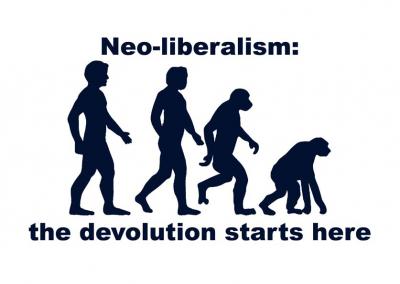
Neoliberalism Is Changing Our World Without Our Even Noticing

neo_liberalism_devolution_via_permanentculturenow.com_

Wendy Brown charts the ‘stealth revolution’ that’s transforming every aspect of society — and now has democracy in its sights.

By Hans Rollmann

Source: PopMatters

‘Neoliberalism’ is a much confused and maligned term these days. Progressive activists deploy it derisively as a general sort of derogatory label; learned professors write articles on the topic without really saying anything more penetrating. It’s as over-used an idiom as globalization (or as capitalism and socialism were 70 years ago). Even Anti-Flag take up the subject in their 2012 track “The Neoliberal Anthem”: “Strap in and watch the world decay!” they proclaim. Blunt, but not inaccurate.

Yet for all its confounded usages, what exactly does it signify?

In a 2013 review essay in the Los Angeles Review of Books that is more useful – if less straightforward – than Anti-Flag, Michael W. Clune described neoliberalism as “an economic doctrine that favors privatization, deregulation, and unfettered free markets over public institutions and government.” (”What Was Neoliberalism?”, 26 February 2013)

But it’s much more than that. Now, in Undoing the Demos: Neoliberalism’s Stealth Revolution, political theorist Wendy Brown contributes a truly useful text on an over-wrought topic, and one which focuses not only on the economic manifestations of neoliberalism, but on its broader effects on our political and social thinking. “Neoliberalism is a distinctive mode of reason, of the production of subjects, a ‘conduct of conduct,’ and a ‘scheme of valuation,’” she writes. It’s a mode of thinking, and the manner in which it emerges can be infinitely varied. We must be alert to neoliberalism’s “inconstancy and plasticity”, she warns, and its ability to reconfigure itself in new guises. Neoliberalism “takes diverse shapes and spawns diverse content and normative details, even different idioms. It is globally ubiquitous, yet disunified and nonidentical with itself in space and over time.” It’s a slippery beast, in other words – hard to define and even harder to see when it’s happening.

Brown’s work is an important and vital contribution at this time insofar as it takes aim at the beating heart of neoliberalism: its insinuation in the very institutions and identities which were hitherto used to limit its spread; institutions which, it was once hoped, would sustain deeper and more profound values implicit to democratic society and human sociality.

Brown is less interested than other scholars in the grim economics of neoliberalism: what she focuses on is its implicit threat to democracy. She opens her book by charting the emergence and contestation between ‘homo politicus’ and ‘homo oeconomicus’; between the human who uses politics to shape their world, and the human who is driven by self-interest and sees the world as always already shaped by economics. French philosopher Michel Foucault discussed this dichotomy in his 1978-79 College de France lectures on the Birth of Biopolitics, and Brown analyzes what Foucault saw – and failed to see – about this early emergence of neoliberal rationality.

In a superb if lamentably short section on gender she also discusses the question: “Does homo economicus have a gender? Does human capital? Is there a femina domestica invisibly striating or supplementing these figures…?” Her point is that “liberalism’s old gender problem is intensified by neoliberalism”, or that neoliberalism impacts women with particular vehemence.

Having discussed Foucault’s early charting of neoliberal political rationality, and expanded on his ideas in light of neoliberalism’s trajectory in the past 30 years, Brown analyzes some modern examples of neoliberalism’s diverse expressions. She looks at how it has insinuated itself in governance – in the notion of building consensus, rather than appreciating contestation; in the depoliticization of government; in the valorization of benchmarking and best practices. All of these deliver destructive blows against democratic political will, against the notion that humans can determine their own destiny and ought to shape their own reality. Instead of making their own decisions, governments appoint ‘external consultants’ to tell them what they should be doing; instead of inventing new ideas and ways of doing things, governments survey ‘best practices’ and see what everyone else is doing. It represents, in many ways, the triumph of mediocrity.

Neoliberal rationality infects law and legal reason, as well. Brown offers an in-depth analysis of the Citizens United case, which protected the right of corporations and the wealthy to dominate democratic elections in the US with their overwhelming power of capital. She also offers one of the best and most thorough analyses of how neoliberal rationality is destroying higher education: the post-WWII dream of an educated and equal society has been twisted into an economistic view, which holds that universities exist only to enhance capital; and that the purpose of an education is not to become better able to contribute to the broader political community, but rather to enhance one’s own ability to generate further capital.

Brown’s book is theoretical yet accessible; it’s an important and vital interjection which reveals and casts bare the neoliberal rationality that increasingly governs our world.

Dismantling Neoliberal Rationality

There’s an implicit warning in Brown’s text, which she addresses briefly but is worth some additional reflection. Audre Lorde famously cautioned against using the master’s tools to dismantle the master’s house, and increasingly this is precisely the direction in which efforts to limit the ravages of neoliberal thinking have turned, using economistic arguments in an effort to preserve institutions and principles that are premised on other-than-economistic values. Some examples serve to illustrate this.

In the ‘80s and ‘90s, public-private partnerships (P3’s) emerged as a neoliberal strategy transferring control and responsibility for public infrastructure – roads, bridges, hospitals, schools – into private hands. The basic argument held that the private sector, not beholden to political interests but rather to principles of efficiency and maximization of cost and utility, would prove more efficient custodians of public infrastructure. This neoliberal argument piggybacked nicely onto the drive to lower taxes. In an environment where lower taxes resulted in reduced state budgets, maximizing cost and efficiency would ensure public dollars stretched as far as possible.

This argument was received sympathetically by a public which had been worked up (by conservative pundits and politicians) into a collective sense of outrage over personal tax obligations and a sense of diminishing consumer power. It struck an affective chord, even though it was not based on any solid research. Yet P3’s became a dominant and accepted approach to building and maintaining public infrastructure and services.

In the past decade, efforts to fight back against public-private partnerships have achieved some limited success and have taken as their point of departure the fact that these partnerships are in fact not very efficient or effective. The private sector, it turns out, is often even more inefficient and ineffective than the public sector, given that it is driven by values such as greed and profit as opposed to public accountability. Analyses of several P3 projects have revealed massive cost over-runs, invariably subsidized by taxpayers to a cost far in excess of what it would have cost the state to produce the infrastructure on its own. (”The Problem with Public-Private Partnerships”, by Toby Sanger and Corina Crawley, CCPA, 1 April 2009) Contractual stipulations often guarantee corporate profits at public expense, requiring the state to assume all the risk, using public funds to rescue projects when private partners fail or walk away, and in some cases even using public funds to top-up corporate profits that fail to meet agreed-upon projections. (”Ontario Auditor breaks new ground with review of public private partnerships methodology”, by Keith Reynolds, Policy Note, 5 January 2015)

All this is true, and revealing the truly ineffective and inefficient nature of P3s has been critical to turning them back in many cases. However, there’s a problem with this. These campaigns against P3s adopt the same economistic principles as were used to promote the notion of P3s in the first place: namely, that efficiency, cost maximization and capital enhancement ought to be the driving principles of the demos, or public state. The implicit argument is that P3s are wrong not because they transfer public ownership into private hands, but because they do so inefficiently and at the expense of the taxpayer. Granted, there is often a reference to P3s being ‘unaccountable’ to the public, but this is rarely interrogated or explored as deeply as it should be. In fact, it ought to lie at the core of public resistance to P3s. Public-private partnerships are wrong simply because the state ought never to allow public goods to fall under private control, even if it might save more money. Economization ought never to hold sway over the values, principles and political power of the public.

Similarly, neoliberal logic has infected other efforts to fight back against neoliberal initiatives. Labour unions – a common target of neoliberalism—are increasingly defended on the basis that they benefit the economy (through ensuring consistent and safe workplace practices as well as strong wages to bolster consumer spending in the community), rather than on the simpler basis that workers deserve the right to control their working conditions. Efforts to reduce tuition fees for out-of-province/state or international students are often predicated on the notion that their economic contribution to the local economy exceeds the value of their fiscal contribution to the university through tuition fees. Nowhere – or rarely – is the argument presented that post-secondary ought to be a public good and universal right in and of itself.

The danger, in other words, is that efforts to resist neoliberalism are increasingly being expressed in such a way that they serve to entrench and legitimize neoliberal values – economization, efficiency, capital enhancement—rather than questioning or challenging the desirability and social and political consequences of those values in the first place.

Brown acknowledges the urgency of the problem. It’s quite possible, she observes, for neoliberal economic policy to be paused or reversed but for “the deleterious effects of neoliberal reason on democracy” to survive, undermining the potential for substantive, entrenched change. Without tackling neoliberal reason, neoliberal economics and governance will inevitably emerge again. It is the ongoing sense of surrender to the inevitability of economics; of the bottom line; of finance as key determiner of what is politically possible, that dooms the political potential of democracy. Although only emerging at the end of the book, this is one of the key lessons it offers: that efforts to resist or reverse the ravages of neoliberal economics are fatally flawed when “NGOs, nonprofits, schools, neighborhood organizations, and even social movements that understand themselves as opposing neoliberal economic policies may nonetheless be organized by neoliberal rationality.”

Fascism’s Forbidden Face

Brown comes close to a forbidden truth in closing. She notes, with great delicacy and hesitation, the similarities between neoliberal rationality and fascism. “This is not to say that neoliberalism is fascism or that we live in fascist times,” comes the inevitable caveat. But what if it is an emerging form of fascism?

One of the troubling trends that’s emerged in recent decades and needs to be challenged more forcefully is the notion that it’s intellectually taboo, inaccurate or excessive to call something ‘fascist’, or to draw analogies to fascist states like Nazi Germany. An example of this taboo is ‘Godwin’s Law’ – the notion that referring to Hitler (or by extension, fascism broadly) destroys the credibility of your argument. It’s a trendy term, but intellectually dangerous. The fact is, fascism was – and is – very real, and the notion that no one should talk about fascism as seriously emerging in the present day is very much a product of our neoliberal era.

In fact we do need to talk about it. The skepticism with which the term ‘fascism’ is treated; the dismissal of arguments which make reference to Nazis, all collaborate in erasing and masking the very real resemblances that exist between historical fascism and contemporary forms of governance like neoliberalism. In its demand for self-sacrifice to the heartless whole – a demand iterated, for instance, in the sacrifice of millions of homeowners and mortgage defaulters in order to save the banks during the subprime mortgage crisis – neoliberal rationality resembles the demand for citizen self-sacrifice that characterized fascism.

George Orwell (in his remarkable book review of Adolf Hitler’s Mein Kampf) warned against underrating the emotional appeal of fascism. While socialism and even capitalism offered a vision of the good life – fewer working-hours, health and education, leisure and pleasure – people appear inevitably lured by the attraction of struggle and self-sacrifice. “Whereas Socialism, and even capitalism in a more grudging way, have said to people ‘I offer you a good time,’ Hitler has said to them ‘I offer you struggle, danger and death,’ and as a result a whole nation flings itself at his feet,” he wrote. The same could easily be said of neoliberalism: people have a remarkable knack of voting for economic tough-guys who promise to make life harder on individuals and communities in order to ‘save the economy’, whatever that’s supposed to mean.

Brown’s book is essential reading not only for academics but for anyone concerned with our collective political future, and with the defense of democratic politics. Her book ends on a grim note: “Despair” is the title of its final section. Brown has eloquently elucidated the problem, and made a profound contribution to understanding the complex nature of neoliberal rationality and its threat to democracy.

So what is the solution? Brown doesn’t have one, but notes there is no alternative but to keep struggling to find an alternative. We have reached a state of “civilizational despair”, she writes; modernism is dead and with it the hope and belief that we can create a better world. How do we counter this despair, and re-inject hope and alternatives into the world? Such a task “is incalculably difficult, bears no immediate reward, and carries no guarantee of success. Yet what, apart from this work, could afford the slightest hope for a just, sustainable, and habitable future?”


Hans Rollmann is a writer and editor based in Eastern Canada. He’s a columnist, writer and opinions editor with the online news magazine TheIndependent.ca as well as editor of Landwash, a journal of literary and creative arts published out of Newfoundland and Labrador. His work has appeared in a range of other publications both print and online, from Briarpatch Magazine to Feral Feminisms. In addition to a background in radio-broadcasting, union organizing and archaeology, he’s currently completing a PhD in Gender, Feminist & Women’s Studies in Toronto. He can be reached by email at hansnf@gmail.com or @hansnf on Twitter.


Zero for 40 at Predicting Attacks: Why Do Media Still Take FBI Terror Warnings Seriously?

By Adam Johnson

Source: FAIR

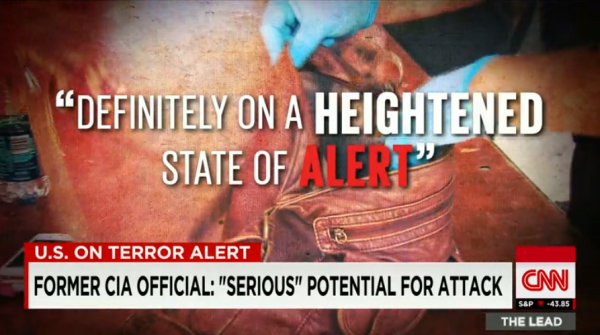
On Monday, several mainstream media outlets repeated the latest press release by the FBI that country was under a new “heightened terror alert” from “ISIL-inspired attacks” “leading up to the July 4th weekend.” One of the more sensational outlets, CNN, led with the breathless warning on several of its cable programs, complete with a special report by The Lead’s Jim Sciutto in primetime:

TerrorAlert

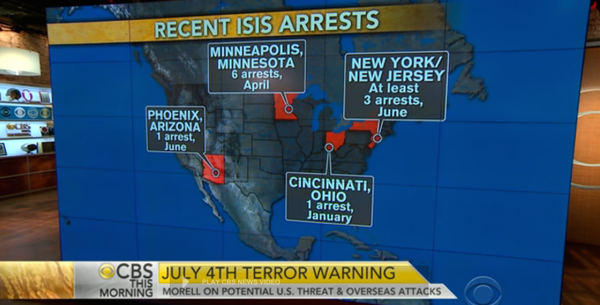
The threat was given extra credence when former CIA director—and consultant at DC PR firm Beacon Global Strategies—Michael Morell went on CBS This Morning (6/29/15) and scared the ever-living bejesus out of everyone by saying he “wouldn’t be surprised if we were sitting [in the studio] next week discussing an attack on the US.” The first piece of evidence Morell used to justify his apocalyptic posture, the “50 ISIS arrests,” was accompanied by a scary map on the CBS jumbotron showing “ISIS arrests” all throughout the US:

RecentISISArrests

But one key detail is missing from this  graphic: None of these “ISIS arrests” involved any actual members of ISIS, only members of the FBI—and their network of informants—posing as such. (The one exception being the man arrested in Arizona, who, while having no contact with ISIS, was also not prompted by the FBI.) So even if one thinks the threat of “lone wolf” attacks is a serious one, it cannot be said these are really “ISIS arrests.”  Perhaps on some meta-level, it shows an increase of “radicalization,” but it’s impossible to distinguish between this and simply more aggressive sting operations by the FBI.

In any event, this nuance gets left out entirely. As I’ve previously shown, in the media’s rush to hype the threat, the fact of FBI-manufactured—or at least “assisted”—terror plots is left out as a complicating factor altogether, and the viewer is left thinking the FBI arrested 50 actual ISIS sleeper cells.

Nevertheless, the ominous FBI (or Department of Homeland Security) “terror warning” has become such a staple of the on-going, seemingly endless “war on terror” (d/b/a war on ISIS), we hardly even notice it anymore. Marked by a feedback loop of extremist propaganda, unverifiable claims about “online chatter” and fuzzy pronouncements issued by a neverending string of faceless Muslim bad guys, and given PR cover by FBI-contrived “terror plots,” the specter of the impending “attack” is part of a broader white noise of fear that never went away after 9/11. Indeed, the verbiage employed by the FBI in this latest warning —“we’re asking people to remain vigilant”—implies no actual change of the status quo, just an hysterical nudge to not let down our collective guard.

There’s only one problem: These warnings never actually come to fruition. Not rarely, or almost never, but—by all accounts—never. No attacks, no arrests, no suspects at large.

Here’s a selection of previous FBI and DHS “terror warnings” over the past 14 years, not a single one of which actually predicted or foiled a terror attack:

October 2001: “Potential use of chemical/biological and/or radiological/nuclear weapons

November 2001: California bridges

February 2002: “Hollywood studios”

May 2002: Statue of Liberty

June 2002: “Around the Fourth of July holiday”

July 2002: Stadiums

August 2002: “Landmarks”

October 2002: “AQ to attack Amtrak

November 2002:Spectacular Al Qaeda attacks

February 2003: “Apartments, hotels, sports arenas and amusement parks

May 2003: “Possibility of multiple attacks”

May 2004: “Attempt to affect the outcome” of presidential election

July 2004: “Military facilities and large gatherings” on July 4th

August 2004: VA hospitals

January 2005: Dirty bomb

March 2005: US/Mexican border

October 2005: NYC & Baltimore subways

March 2006: “Sporting events”

June 2007: Colleges

December 2007:Shopping malls in Chicago and LA”

November 2008: “Al Qaeda to attack transit during Thanksgiving

November 2010: Mass transit in New York City

October 2011: “Americans in Europe” facing “commando-style AQ attack”

February 2011: “Financial institutions”

May 2011: “Threats of retaliation”

June 2011: Al Qaeda “hit list”

July 2011: “Private jets of executives” involved in drone manufacturing

September 2011: “Small planes”

September 2011: “New York City or Washington around…10th anniversary of 9/11

September 2011: Airports

March 2012: “Terrorist hacking”

August 2012: Anarchists blowing up bridge during Tampa RNC

September 2012: “Islamic violence over movie

August 2013: “San Fransisco on high alert

November 2013: “cyber attacks”

April 2014: “College students abroad”

December 2014: ISIS targeting Mississippi River bridge

December 2014: ISIS “sabotaging US military personnel” over social media

April 2015: ISIS targeting “parts of California

May 2015: ISIS targeting “military bases

A casual search reveals the FBI and DHS are a pitiful 0 for 40 warning of terror attacks—some of which were specifically about 4th of July threats, none of which materialized in any way. This should not be considered a comprehensive list of all threat warnings transmitted by media; I tried to narrow the scope to warnings that were at least in some way specific.

The actual terror attacks carried out on US soil—the Times Square bomber, “Underwear bomber,” Boston bombing and Garland attacks—were accompanied by no such warnings. (Nor were the often deadlier terrorist attacks by right-wing white terrorists–but terrorism in this category is rarely if ever the subject of FBI warnings.)

So why, a rational person may ask, does the media keeps repeating them if they’re wrong 100 percent of the time?

The problem is three fold:

  1. The FBI has all the incentive in the world to issue warnings and no incentive whatsoever to not issue warnings. Issuing warnings has no downside, while not doing so is all downside.
  2. The FBI, like all agencies of the government, does not operate in a political vacuum. Emphasizing the “ISIS threat” at home necessarily helps prop up the broader war effort the FBI’s boss, the president of the United States, must sell to a war-weary public. The incentive is to therefore highlight the smallest threats. This was a feature that did not go unnoticed during the Bush years, but has since fallen out of fashion.
  3. It has no actual utility. What does it mean to be “more vigilant”? It’s a vague call to alertness that officials, aside from “beefing up security” by local police, never quite explain what it means. If the FBI wanted to tell local police departments to up their security of the 4th of July weekend, surely they could do so quietly, without the chair of the House Committee on Homeland Security having to go on all major networks talking over b-roll of ISIS in apocalyptic terms.

When I brought up these objections up to CNN’s Sciutto, his response was less than satisfying:

fair question, the point is about the wider threat, FBI encourages people to attend events but be vigilant.

Yes, I would prefer warnings only when attacks were imminent. Which, of course, they never are. Because if they were, the government would actually attempt to stop them, rather than running a three-day PR tour. CNN‘s Jake Tapper, to his credit, would raise my concerns to Michael Chertoff later that day:

View image on Twitter

Ex-DHS head pushes back against terror warning skeptics http://cnn.it/1LyERVV 


While the attempt to introduce some skepticism is very much appreciated, Tapper missed the fundamental problem altogether. Next time he has on a Chertoff or a McCaul discussing a vague government terror warning, I’d like him to ask this simple question: “Has the FBI ever successfully warned, or foreshadowed in anyway, a terror attack in the United States? Because so far the count is 0 for 40+, and I’m curious what makes this time different.”

Put the burden of proof on those who are attempting to scare us, march our men and women off to war, and line their private security firm’s pockets. Don’t demand “FBI warning skeptics” disprove those in power; make those in power justify their own consistently discredited “warnings.”

If journalists still insist on disseminating these vague “threats,” I ask this question: How many false positives would be required for you to eventually stop doing so? Seventy? Two hundred?

Because 14 years on, I’m curious when, if ever, this media trope will ever end.

h/t Kevin Gosztola, who caught a 4th of July warning from 2004 I missed.\


Adam Johnson is an associate editor at AlterNet and writes frequently for FAIR.org. You can follow him on Twitter at @adamjohnsonnyc.

No ‘Je Suis Charleston’?

Obama-sings-Amazing-Grace-poolvideo

The De-politicization of Black Oppression

By Ajamu Baraka

Source: Counterpunch

Where are the international marches of solidarity with African Americans? The statements from world leaders condemning the terrorist attack and calling on U.S. Authorities to crack down on the white nationalist terror networks developing in the U.S.? Where are the marches in white communities condemning racism and standing with black people? Why no ‘Je Suis Charleston’?

The fact that these questions are not being raised by most people speaks to the adroit way in which the propagandists of the U.S. state, with the corporate media in lockstep, successfully domesticated and depoliticized the murderous attack in Charleston, South Carolina.

First, President Obama, as the government’s chief propagandist, defined Dylann Roof, the white nationalist assailant, as a pathological, hateful loner who had easy access to guns. The words “terrorist” never crossed his lips or the lips of any other officials of the national government.

Then, the state and corporate media followed-up this framing with a fascinating slight-of-hand stunt: instead of focusing on the domestic security threat posed by violent, racist right-wing extremists groups in the country, the old trope of gun control – along with a new twist, removing the Confederate flag – became the new focus! The implication was that by removing the Confederate battle flag – a symbol of white supremacy and the defense of slavery – from public buildings (no one bothered to explain why, if this was the rationale for removing the Confederate flag, there would not be a discussion around the need to reject the national flag also), that would somehow move the country towards racial reconciliation, much like electing a black president was supposed to do.

The effectiveness of this propaganda effort paid off just a few days after the attack. The domestic and international press gave full coverage to the spate of “terrorist” attacks that took place in three different counties but missing from that coverage was any connection and mention of the terror attack in Charleston.

However, it was at the funeral of Rev Pinckney, the pastor of the Emanuel African Methodist Episcopal Church murdered by Dylann Roof, where the concluding act of the governments’ obscene efforts to co-opt and deflect the pain of the attack played to a world-wide audience. President Obama turned in one of his best performances of a life-time of performances for white supremacy. His eulogy was a masterful example of his special talent to embody an instrumentalist “blackness” while delivering up that blackness to the white supremacist, U.S. settler project. In his eulogy, he couched his narrative of “American exceptionalism” in the language of Christian religiosity that was indistinguishable from the proclamations of the religious right that sees the U.S. as a state bestowed with the grace of their God.

Obama sang ‘Amazing Grace’ and lulled into a stupefying silence black voices that should have demanded answers as to why the Charleston attack was not considered a terrorist attack, even though it fit the definition of domestic terrorism, or why the Obama Administration collaborated with suppressing the 2009 report from the Department of Homeland Security (DHS), which identified violent white supremacist groups as a threat to national security more lethal than the threat from Islamic ‘fundamentalists’.

Because of this threat and the depraved indifference to black life by the U.S. government, international attention and solidarity is critical for African Americans. Yet, by quickly deploying the Obama weapon – aligning the government with the victims of the attack but defining the attack as a domestic criminal act – the political space for international solidarity with the plight of African Americans was significantly reduced, at least in relationship to the Charleston attack.

There is another element of this story that compelled the Administration to get out in front of this issue. Obama needed to draw attention away from the fact that his Administration caved under the pressure from the “respectable” racist right-wingers in Congress who criticized the DHS report in 2009.

John Boehner, the leader of the House of Representatives, characterized the report as “Offensive and unacceptable.” According to Boehner, the Obama Administration should not be condemning “American citizens who disagree with the direction Washington Democrats are taking our nation.”

Instead of defending Secretary Napolitano and the report issued by her Department, or taking the opportunity provided by the report to educate the public on this internal threat, Obama threw Napolitano under the bus and the DHS pulled the report from its website. The unit responsible for monitoring white supremacist organizations and movements was dismantled, and the threat of white supremacist violence becoming the victim of Washington politics.

This is the mindset and the politics of this Administration and the political culture in the U.S., where the differential value placed on black life allows black life to be reduced to an instrumental calculation when considering issues of international public relations and domestic politics.

The result?

For all intents and purposes, the tragedy in Charleston is over, closed out on a song written by a captain on a slave ship in 1779 and sung over 200 years later by a black man still in the service of white supremacy.

Ajamu Baraka is interviewed in Episode 3 of CounterPunch Radio, available for free here.

Ajamu Baraka is a human rights activist, organizer and geo-political analyst. Baraka is an Associate Fellow at the Institute for Policy Studies (IPS) in Washington, D.C. and editor and contributing columnist for the Black Agenda Report. He is a contributor to “Killing Trayvons: An Anthology of American Violence” (Counterpunch Books, 2014). He can be reached at www.AjamuBaraka.com


America’s Mania for Positive Thinking and Denial of Reality Will Be Our Downfall

tomorrowland-trailer-poster-2015-movie-george-clooney

The ridiculous positivism, the belief that we are headed toward some glorious future, defies reality.

By Chris Hedges

Source: Alternet

The naive belief that history is linear, that moral progress accompanies technical progress, is a form of collective self-delusion. It cripples our capacity for radical action and lulls us into a false sense of security. Those who cling to the myth of human progress, who believe that the world inevitably moves toward a higher material and moral state, are held captive by power. Only those who accept the very real possibility of dystopia, of the rise of a ruthless corporate totalitarianism, buttressed by the most terrifying security and surveillance apparatus in human history, are likely to carry out the self-sacrifice necessary for revolt.

The yearning for positivism that pervades our corporate culture ignores human nature and human history. But to challenge it, to state the obvious fact that things are getting worse, and may soon get much worse, is to be tossed out of the circle of magical thinking that defines American and much of Western culture. The left is as infected with this mania for hope as the right. It is a mania that obscures reality even as global capitalism disintegrates and the ecosystem unravels, potentially dooming us all.

The 19th century theorist Louis-Auguste Blanqui, unlike nearly all of his contemporaries, dismissed the belief, central to Karl Marx, that human history is a linear progression toward equality and greater morality. He warned that this absurd positivism is the lie perpetrated by oppressors: “All atrocities of the victor, the long series of his attacks are coldly transformed into constant, inevitable evolution, like that of nature. … But the sequence of human things is not inevitable like that of the universe. It can be changed at any moment.” He foresaw that scientific and technological advancement, rather than being a harbinger of progress, could be “a terrible weapon in the hands of Capital against Work and Thought.” And in a day when few others did so, he decried the despoiling of the natural world. “The axe fells, nobody replants. There is no concern for the future’s ill health.”

“Humanity,” Blanqui wrote, “is never stationary. It advances or goes backwards. Its progressive march leads it to equality. Its regressive march goes back through every stage of privilege to human slavery, the final word of the right to property.” Further, he wrote, “I am not amongst those who claim that progress can be taken for granted, that humanity cannot go backwards.”

Blanqui understood that history has long periods of cultural barrenness and brutal repression. The fall of the Roman Empire, for example, led to misery throughout Europe during the Dark Ages, roughly from the sixth through the 13th centuries. There was a loss of technical knowledge (one prominent example being how to build and maintain aqueducts), and a cultural and intellectual impoverishment led to a vast historical amnesia that blotted out the greatest thinkers and artists of the classical world. None of this loss was regained until the 14th century when Europe saw the beginning of the Renaissance, a development made possible largely by the cultural flourishing of Islam, which through translating Aristotle into Arabic and other intellectual accomplishments kept alive the knowledge and wisdom of the past. The Dark Ages were marked by arbitrary rule, incessant wars, insecurity, anarchy and terror. And I see nothing to prevent the rise of a new Dark Age if we do not abolish the corporate state. Indeed, the longer the corporate state holds power the more likely a new Dark Age becomes. To trust in some mythical force called progress to save us is to become passive before corporate power. The people alone can defy these forces. And fate and history do not ensure our victory.

Blanqui tasted history’s tragic reverses. He took part in a series of French revolts, including an attempted armed insurrection in May 1839, the 1848 uprising and the Paris Commune—a socialist uprising that controlled France’s capital from March 18 until May 28 in 1871. Workers in cities such as Marseilles and Lyon attempted but failed to organize similar communes before the Paris Commune was militarily crushed.

The blundering history of the human race is always given coherence by power elites and their courtiers in the press and academia who endow it with a meaning and coherence it lacks. They need to manufacture national myths to hide the greed, violence and stupidity that characterize the march of most human societies. For the United States, refusal to confront the crisis of climate change and our endless and costly wars in the Middle East are but two examples of the follies that propel us toward catastrophe.

Wisdom is not knowledge. Knowledge deals with the particular and the actual. Knowledge is the domain of science and technology. Wisdom is about transcendence. Wisdom allows us to see and accept reality, no matter how bleak that reality may be. It is only through wisdom that we are able to cope with the messiness and absurdity of life. Wisdom is about detachment. Once wisdom is achieved, the idea of moral progress is obliterated. Wisdom throughout the ages is a constant. Did Shakespeare supersede Sophocles? Is Homer inferior to Dante? Does the Book of Ecclesiastes not have the same deep powers of observation about life that Samuel Beckett offers? Systems of power fear and seek to silence those who achieve wisdom, which is what the war by corporate forces against the humanities and art is about. Wisdom, because it sees through the facade, is a threat to power. It exposes the lies and ideologies that power uses to maintain its privilege and its warped ideology of progress.

Knowledge does not lead to wisdom. Knowledge is more often a tool for repression. Knowledge, through the careful selection and manipulation of facts, gives a false unity to reality. It creates a fictitious collective memory and narrative. It manufactures abstract concepts of honor, glory, heroism, duty and destiny that buttress the power of the state, feed the disease of nationalism and call for blind obedience in the name of patriotism. It allows human beings to explain the advances and reverses in human achievement and morality, as well as the process of birth and decay in the natural world, as parts of a vast movement forward in time. The collective enthusiasm for manufactured national and personal narratives, which is a form of self-exaltation, blots out reality. The myths we create that foster a fictitious hope and false sense of superiority are celebrations of ourselves. They mock wisdom. And they keep us passive.

Wisdom connects us with forces that cannot be measured empirically and that are outside the confines of the rational world. To be wise is to pay homage to beauty, truth, grief, the brevity of life, our own mortality, love and the absurdity and mystery of existence. It is, in short, to honor the sacred. Those who remain trapped in the dogmas perpetuated by technology and knowledge, who believe in the inevitability of human progress, are idiot savants.

“Self-awareness is as much a disability as a power,” the philosopher John Gray writes. “The most accomplished pianist is not the one who is most aware of her movements when she plays. The best craftsman may not know how he works. Very often we are at our most skillful when we are least self-aware. That may be why many cultures have sought to disrupt or diminish self-conscious awareness. In Japan, archers are taught that they will hit the target only when they no longer think of it—or themselves.”

Artists and philosophers, who expose the mercurial undercurrents of the subconscious, allow us to face an unvarnished truth. Works of art and philosophy informed by the intuitive, unarticulated meanderings of the human psyche transcend those constructed by the plodding conscious mind. The freeing potency of visceral memories does not arrive through the intellect. These memories are impervious to rational control. And they alone lead to wisdom.

Those with power have always manipulated reality and created ideologies defined as progress to justify systems of exploitation. Monarchs and religious authorities did this in the Middle Ages. Today this is done by the high priests of modernity—the technocrats, scholars, scientists, politicians, journalists and economists. They deform reality. They foster the myth of preordained inevitability and pure rationality. But such knowledge—which dominates our universities—is anti-thought. It precludes all alternatives. It is used to end discussion. It is designed to give to the forces of science or the free market or globalization a veneer of rational discourse, to persuade us to place our faith in these forces and trust our fate to them. These forces, the experts assure us, are as unalterable as nature. They will lead us forward. To question them is heresy.

The Austrian writer Stefan Zweig, in his 1942 novella “Chess Story,” chronicles the arcane specializations that have created technocrats unable to question the systems they serve, as well as a society that foolishly reveres them. Mirko Czentovic, the world chess champion, represents the technocrat. His mental energy is invested solely in the 64 squares of the chessboard. Apart from the game, he is a dolt, a monomaniac like all monomaniacs, who “burrow like termites into their own particular material to construct, in miniature, a strange and utterly individual image of the world.” When Czentovic “senses an educated person he crawls into his shell. That way no one will ever be able to boast of having heard him say something stupid or of having plumbed the depths of his seemingly boundless ignorance.”

An Austrian lawyer known as Dr. B, whom the Gestapo had held for many months in solitary confinement, challenges Czentovic to a game of chess. During his confinement, the lawyer’s only reading material was a chess manual, which he memorized. He reconstructed games in his head. Forced by his captivity to replicate the single-minded obsession of the technocrat Czentovic, Dr. B too became trapped inside a specialized world, and, unlike Czentovic, he became insane temporarily as he focused on a tiny, specialized piece of human activity. When he challenges the chess champion, his insanity returns.

Zweig, who mourned for the broad liberal culture of educated Europe swallowed up by fascism and modern bureaucracy, warns of the absurdity and danger of a planet run by technocrats. For him, the rise of the Industrial Age and the industrial man and woman is a terrifying metamorphosis in the relationship of human beings to the world. As specialists and bureaucrats, human beings become tools, able to make systems of exploitation and even terror function efficiently without the slightest sense of personal responsibility or understanding. They retreat into the arcane language of all specialists, to mask what they are doing and give to their work a sanitized, clinical veneer.

This is Hannah Arendt’s central point in “Eichmann in Jerusalem.” Technocratic human beings are spiritually dead. They are capable of anything, no matter how heinous, because they do not reflect upon or question the ultimate goal. “The longer one listened to him,” Arendt writes of the Nazi Adolf Eichmann on trial, “the more obvious it became that his inability to speak was closely connected with an inability to think, namely, to think from the standpoint of somebody else. No communication was possible with him, not because he lied but because he was surrounded by the most reliable of all safeguards against the words and presence of others, and hence against reality as such.”

Zweig, horrified by a world run by technocrats, committed suicide with his wife in 1942. He knew that from then on, the Czentovics would be exalted in the service of state and corporate monstrosities.

Resistance, as Alexander Berkman points out, is first about learning to speak differently and abandoning the vocabulary of the “rational” technocrats who rule. Once we discover new words and ideas through which to perceive and explain reality, we free ourselves from neoliberal capitalism, which functions, as Walter Benjamin knew, like a state religion. Resistance will take place outside the boundaries of popular culture and academia, where the deadening weight of the dominant ideology curtails creativity and independent thought.

As global capitalism disintegrates, the heresy our corporate masters fear is gaining currency. But that heresy will not be effective until it is divorced from the mania for hope that is an essential part of corporate indoctrination. The ridiculous positivism, the belief that we are headed toward some glorious future, defies reality. Hope, in this sense, is a form of disempowerment.

There is nothing inevitable about human existence except birth and death. There are no forces, whether divine or technical, that will guarantee us a better future. When we give up false hopes, when we see human nature and history for what they are, when we accept that progress is not preordained, then we can act with an urgency and passion that comprehends the grim possibilities ahead.

Chris Hedges, a Pulitzer Prize-winning reporter, writes a regular column for Truthdig every Monday. Hedges’ most recent book is “Empire of Illusion: The End of Literacy and the Triumph of Spectacle.”

Freedom Rider: U.S. Pushes Russia Towards War

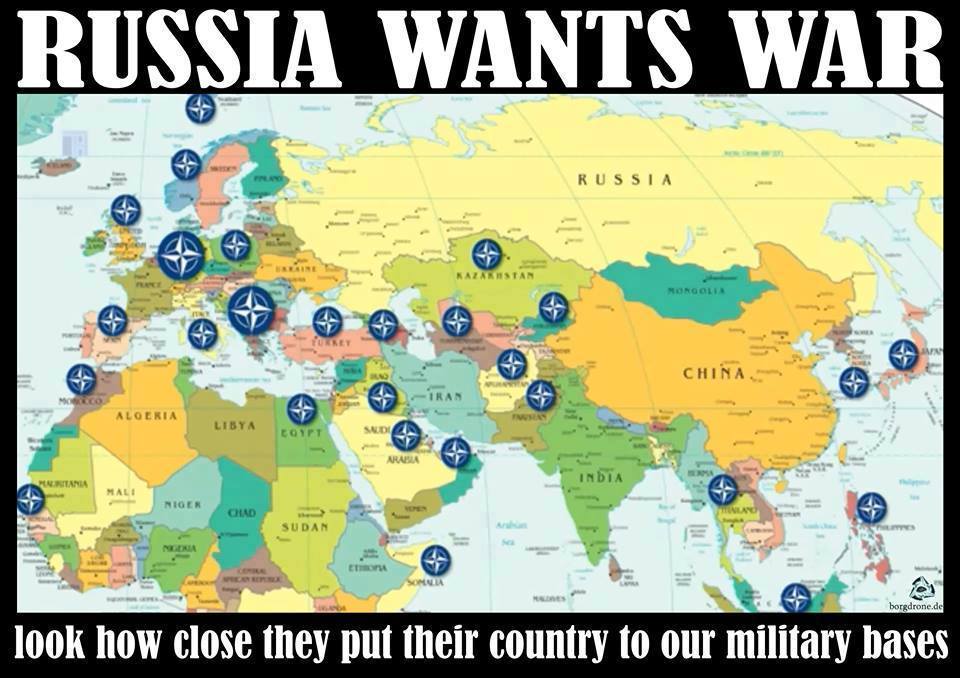
russia_wants_war_look_how_closely_they_put_country_to_our_military_bases

By Margaret Kimberly

Source: Black Agenda Report

The United States has intervened in too many countries without paying a high enough price.”

This columnist recently said that “Russia Wins” in its handling of America’s attempt to eviscerate its influence and its economy. At the time those words were written Secretary of State John Kerry met with Vladimir Putin in Sochi, Russia. The meeting appeared to be an admission that the imperial power grab was not working out as Washington hoped. Among other things, Kerry was concerned that the Ukrainian tail was starting to wag the American dog.

In a public statement he warned Ukrainian president Poroshenko, who threatened to retake Crimea and the Donbass. “We would strongly urge him to think twice not to engage in that kind of activity, that that would put Minsk [accords] in serious jeopardy. And we would be very, very concerned about what the consequences of that kind of action at this time may be.” Barack Obama promptly tossed Kerry under the bus upon his return home.

Kerry’s subordinate Victoria Nuland and the United Nations ambassador Samantha Power repeated the very words that Kerry warned against and contradicted everything he said. Power went to Kiev to sing the praises of the Ukrainians in person. She didn’t have to mention Kerry by name, her presence alone said that he and any talk of diplomacy were on the outs. Of course the meeting between Kerry and Putin had to have been approved by president Obama, but just one month later it appears to have been a figment of the world’s imagination.

Russia has every right to arm its own territory.”

In the battle to stay on top of the world and remain in control of it, Washington inevitably lurches back and forth in its policy decision making. Now they and their scribes in corporate media have settled back into comfortable territory, simultaneously vilifying the Russian government and endlessly repeating anti-Russian propaganda.

A recent New York Times editorial with the grandiose title, “The Fantasy Mr. Putin is Selling,” claimed that president Putin has a “willingness to brandish nuclear weapons.” There was no mention of America’s unilateral withdrawal from the Anti-Ballistic Missile treaty in 2002. Not content to tell one lie the Times then criticized Putin for “aggressive behavior, including pouring troops and weapons into Kaliningrad, a Russian city located between NATO members Lithuania and Poland.” Of course, Russia has every right to arm its own territory. The Times also neglected to mention that the American military are positioning weapons and holding training exercises in Ukraine, Poland, Romania and the Baltic states that border Russia. It seems that those provocations are not deemed worthy of mention.

The New York Times and its counterparts always play this role. They cozy up to president Obama as they have with all his predecessors and support any and all of their mischief. Far from being a voice of information for the public, they do the bidding of the powerful and are accessories to their crimes.

Antagonizing Russia is riskier than paying jihadists to take over Libya.”

The Obama administration is in the process of killing the Minsk accords which were shepherded by France and Germany. This is the only process which can defang the beast, and that is why it is being sabotaged. The United States has intervened in too many countries without paying a high enough price. It is like a serial criminal who remains at large and thus thinks of himself as invincible. This county is responsible for carnage in Afghanistan, Iraq, Haiti, Somalia, Yemen, and Syria and that is the list of victims only since 2001.

One has to ask where and when the straw will break the camel’s back. American military power has allowed it to run rough shod over humanity, but antagonizing Russia is riskier than paying jihadists to take over Libya.

Not only does the United States have the most and the biggest guns but it has the corporate media at its disposal, parroting every word as if they were gospel truth. Americans who think of themselves as well informed will be in for a shock if Moldova turns out to be the flash point for open warfare that was instigated by their government.

Russia will never be beholden to America.”

Everyone knows that an assassination in Sarajevo in 1914 pushed the world into war. In 2015 the signs are ominous that something terrible may happen because of an incident in Transnistria or Donetsk or some other locale Americans know nothing about.

The process of marginalizing Russia began as soon as the Soviet Union collapsed. While the Warsaw Pact disbanded, NATO grew at Russia’s expense. But Russia will never be beholden to America. There is no puppet they can place in the Kremlin. These fantasies have put the world on the brink.

Obama and his friends in NATO may not want to start a war but they may get one all the same. Of course the president is concerned about his legacy. He ought to be. If he continues as he has done since 2009, his legacy may be that he was head inmate in the asylum when the last war began.


Margaret Kimberley’s Freedom Rider column appears weekly in BAR, and is widely reprinted elsewhere. She maintains a frequently updated blog as well as at http://freedomrider.blogspot.com. Ms. Kimberley lives in New York City, and can be reached via e-Mail at Margaret.Kimberley(at)BlackAgendaReport.com.