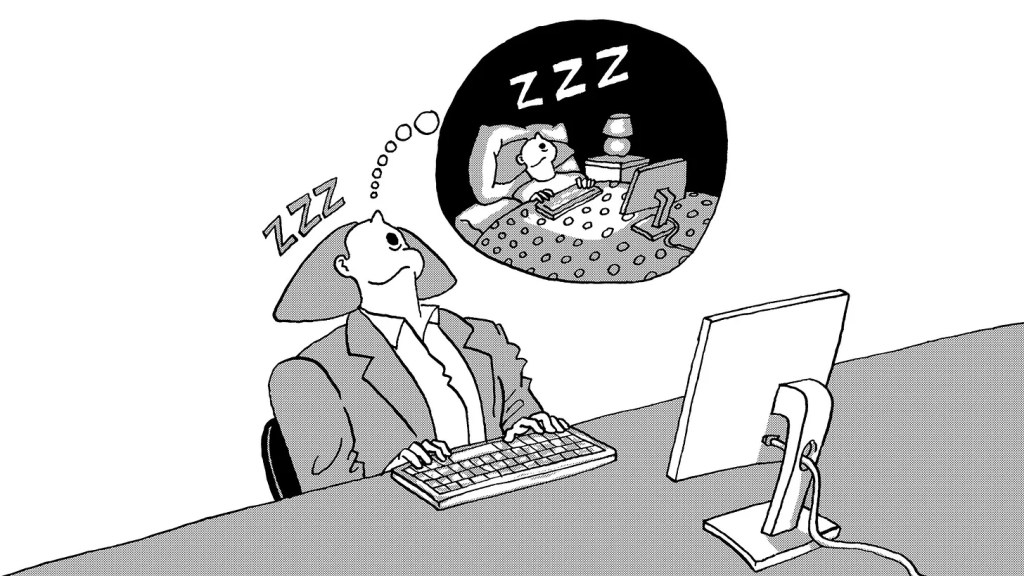
Half-Awake In the Dream

After losing consciousness during transport, my memories became increasingly fragmented and “impressionistic”, most likely a side effect of strong medication. This roughly coincided with my stay in the Harborview Trauma ICU which was about a week after being admitted to ER, though subjectively it felt more like a month.

Since talking to my wife about my hospitalization, I realize there were times when I was conscious enough to answer questions, yet had no recollection despite remembering things earlier in the chronology. Odder still, some of what I did recall was in a liminal state between dream and waking life.

As if my mind was attempting to reset to the morning of the crash, it placed me in an “alternate reality” version in which I arrived at work like usual and promptly started the daily routine at my workspace. Suddenly I was back on the gurney and being wheeled out of the work area and through a sub-basement corridor I had never seen before. Through dream logic architecture I ended up at the UW Medical Center ER. I recognized one of the nurses as a former co-worker and realized even within the dream that it made no sense since she was a senior lab tech at the UWMC clinical lab. I speculated that one of the “actual” nurses had a voice similar to my co-worker’s, causing my mind to actually see her as that person.

I was next transported to the Harborview Trauma ICU (partly via light rail!), which I must have realized was where I “actually” was either consciously or subconsciously. At that point my experience took a paranoid turn as I began to suspect nurses and assistants were skimming my medications for personal use. Within the dream state I passed out and reawakened in a fantastical ICU bathed in a hazy white glow. I somehow got the notion this was at a sprawling new hospital connecting the Northgate light rail station to the nearby library.

It was at this imaginary location where I realized I was being visited by my wife as well as parents and brother from Hawaii. Somehow I knew this aspect of the pseudo-dream was “real” and not in the spirit realm and was glad they were alive and well, though I could tell they were shaken to see the state I was in. It seemed I wasn’t conscious for long, and had several other interactions with family before waking in a more lucid state at Harborview’s Neuro ICU.

Earliest Post-Crash Memories

I have no idea how long I was unconscious (or if I still was), but I  seemingly reawakened from a black void to an infinite expanse of space. If it was a dream, it was an unusually memorable and lucid one, but unlike in a typical lucid dream I wasn’t able to alter my environment. Though initially confused, for I had no idea how or why I was there, I felt deep serenity and contentment. I also sensed a benevolent presence but could see no one around nor could I detect a physical body of my own for that matter. Not long after that realization, the stillness and darkness morphed into motion and light detected through the vibrations of the surface I was on and lights bright enough to sense through my eyelids. It was a struggle to open my eyes and could do so only briefly, but it allowed me to confirm that I was indeed on a gurney moving under ceiling lights and surrounded by a group of doctors and/or nurses.

As my hearing returned at the same time, I caught them mid-conversation. I couldn’t make out the words exchanged over the noise of the gurney and medical equipment and also because my hearing seemed impaired, giving sounds a muffled and distant quality. However, the speed and tone of the voices gave the impression they were deeply concerned. This unsettled me to put it mildly and I wondered what had happened and if my wife Danielle was alive and well. I realized I had no recollection of whatever caused me to be here or even of the past few days. I remember wanting to show the doctors and nurses I was conscious by attempting to move but after much effort gave up. I assumed my immobility was due to being strapped to the gurney and blacked out soon after.

A New Beginning

On April 5 2024 I was in a bicycle crash while commuting to work. I sustained catastrophic injuries causing paralysis below my shoulders. I was only able to survive due to spinal cord surgery. Given the sudden and extreme disruption to every facet of my life, there have been times when I wished the surgery never happened. However, over time I’ve accepted my fate and have become more driven to survive by those I love.

After months of healing and rehabilitation (and with the help of adaptive technology) I feel ready to blog again. My intention is to use this platform to process my thoughts on the trauma I’ve lived through and still-unreal situation I continue to experience. Though my personal struggles are of little significance compared to geopolitical developments such as the Gaza genocide, Ukraine proxy war, multiple nations on the verge of economic collapse, and the most demoralizing and dysfunctional US presidential campaign season (so far), there are connections which I plan to elaborate on in future posts. In the meantime, you can read more details about what I went through on my fundraising site here: https://helphopelive.org/campaign/24110/

Thoughts About Mind, Consciousness, & Humanity’s Origin

Can understanding the nature of Mind, consciousness and the ET phenomenon lead us to an expanded understanding of our origins?

By Tom Bunzel

Source: The Pulse

As a fan of Eckhart Tolle I’ve always liked his description of Consciousness (or ‘Being’ which seems his preference) as “No Thing.”

This separates “Being” from the world of form, and puts it into the area of what Tesla called “nonmaterial reality.”

I’ve generally thought of this reality as (an) Infinite Mind (again as opposed to “God”) to take out the anthropomorphic bias which seems to permeate organized religion. Political Christianity and some other groups seem to relish an angry and vengeful God to keep the parishioners paying. But when you step away from beliefs that are easily debunked you are still left with a fact.

We seem to be thinking.

Of course, it was Descartes who famously equated thought with Being, which has led to all sorts of issues that Eckhart Tolle describes well in his work.  When we identify with only our thoughts, we have narrowed our focus and reduced reality to labels. 

But the reality of thought persists.  What is it?

Is Thought Electricity in the Brain?

Neuroscientists seem to have identified the presence of thoughts in the brain through various instruments that can pick up electrical signals in parts of the brain and between synapses.

But so far, I don’t believe they can “download” these signals and decode them.

When we observe our thoughts, we can see that they seem to be comprised of “words”.  In fact, I’ve had the experience of thinking in languages other than English (my native language is German) and of course, the thoughts come as words – sometimes in cogent sentences or perhaps just one word. 

So, I was musing, what about ancient humans? Did they need to form a sentence in their brains to warn them that a lion might be in the bushes?

If you’ve ever experienced trauma, you know the answer – our limbic system activates, putting us in “fight or flight” well before any thought ever happens. 

I would suggest that a primal, lower frequency of Mind operates in our limbic system, before thought and language.

So, when did we start thinking in “words”?

According to my AI friend,

“scholars believe it [language] originated at least 100,000 years ago during the Middle Stone Age. The development of language is linked to the increased complexity of human culture and cognition.”

Maybe a tribe of hunter-gatherers developed a sound for “lion” and it became a warning cry.  Then perhaps “big” lion or “many lions”.

We know that our ancients memorialized beasts in petroglyphs of various kinds to communicate but the next big breakthrough was when the words, sentences and thus concepts were able to be preserved.

Writing Was the Big Game Changer

AI tells us that

“Writing systems were invented independently by different civilizations thousands of years ago as a means of recording information. The earliest writing emerged around 3,500-3,000 BCE in Mesopotamia and Egypt. Chinese writing developed around 1,200 BCE.”

So now I will do what they do on Ancient Aliens, which is take a speculative leap based on the foregoing.

It intrigues me that the cultures that seemed to “create” writing all have a version of the Prometheus myth – crediting the “Gods” with giving them the gift of higher knowledge.

To connect this to the beginning of writing seems to make sense, as we have precisely these myths in Mesopotamia (Annunaki) and Egypt. 

And it seems clear that with the onset of the written word (and mathematical notations) great leaps in human progress came almost in quantum intervals.  We got the printing press and eventually our modern technology.

We might speculate that it is likely that Mind has been with us forever, but that thought evolved and expanded dramatically with the beginning of writing – and that writing could easily be seen as a gift that transformed human civilization.   

There May Have Been Consequences for Teaching Humanity

It is also very plausible that any entity that conveyed such a gift to humanity may well have angered other entities that wanted to keep humans in check. 

Cuneiform tablets from the Sumerians describe how one “God” Enki created humans in the image of the Annunaki and gave them knowledge – but most of the humans were wiped out by his rival Enil in the great flood.  We now have evidence in the geological record that such a flood happened about 12,000 years ago.

But just this little thought experiment can vastly expand our sense of our place in the cosmos along with providing a much-needed dose of humility.

What if we did not simply “evolve” with natural selection but received assistance in an area we are now beginning to understand – genetics?  This would indicate a profound connection to the cosmos in a way that is disregarded by our current society.

It is also worth noting, as my AI explains,

“There is evidence that around 250,000-300,000 years ago there were some key genetic changes in early humans that contributed to increased brain size and advanced cognitive abilities compared to other primates.” 

Where these came from or how they came about is still a mystery.

And now that it seems apparent that some visitation by “entities” from the sky is not likely fiction but a reality, it may help to broaden our understanding of Nature and how we got here.

My AI friend makes another statement which I think is exactly backwards:

“Some key developments that enabled writing include the evolution of symbolic thought, the invention of systems of counting, and the emergence of urban civilization needing record-keeping.”

Clearly, it was first language, and then writing and math that led to this evolution of our brains, not the other way around.  Our original brains would have needed to expand to accommodate our first language which took us beyond the limbic system to labeling, and ultimately writing which led us to sharing ideas and thinking “symbolically” – using groups of letters as words and then sentences to convey increasingly complex concepts.

My own experience with neuroplasticity confirms that new uses for the brain expand its capacity, creating new pathways and neural networks. People who keep learning seem less susceptible to dementia.

Opening to the possibility that our evolution was “jump started” by extraterrestrials changes the narrative from chance and natural selection to a more profound connection to the universe in areas that our current science has mostly yet to penetrate. (Nonmaterial reality).

A Clue that Space Is Not Empty

But technology in particular seems to point us in the right direction – it was the offspring of the printing press – the computer – which eventually led us to a huge breakthrough in our awareness of the nonmaterial or seeming empty space as being potentially much much more.

When we developed WiFi suddenly the information encoded in words, thoughts and sentences could travel through space. So who knows what other information or Mind stuff has been around us all along?

Because Mind is everywhere and at the heart of Nature.

Just Seeing Through The Propaganda Isn’t Enough — We’ve Got To Open Our Hearts As Well

Humanity doesn’t just need to escape from the mental prison of imperial indoctrination. It needs to escape from the heart prison as well.

By Caitlin Johnstone

Source: CaitlinJohnstone.com.au

Humanity doesn’t just need to escape from the mental prison of imperial indoctrination. It needs to escape from the heart prison as well.

I’m always talking here about the need to fight empire propaganda to help the public awaken to the fact that everything we’ve been trained to believe about the world is a lie, because that insight taking root in sufficient numbers would be the first step toward the revolutionary changes our world so desperately needs.

But large numbers of people opening their eyes to the reality of mass-scale psychological manipulation by the powerful would by itself be insufficient, because people need not only to see the truth — they also need to care. 

Realizing the depravity and immense human suffering the US-centralized empire is responsible for creates an opportunity to respond to this insight with horror and begin resisting it — but it is only an opportunity. At that juncture it’s still possible for someone to realize that we’re not being told the truth about what’s happening in the world, but decide to play along with the lies anyway, either because the existing world order has made them wealthy, or because they are too indoctrinated with support for western power structures, or because they ideologically support Israel, or because they’re afraid of the changes and upheaval that would come with an overturning of the status quo, or because they are intellectually and morally lazy, or some other selfish reason.

Realizing that you’ve been indoctrinated into accepting a pernicious status quo unlocks an important door within yourself, but just because that door is opened doesn’t mean you have to walk through it. Walking through it requires another kind of awakening — an awakening of the heart.

Really no amount of knowledge or intellectual insight will ever set us free as a species in and of itself. You could upload the sum total of human knowledge into the brain of everyone on earth — including even government secrets that aren’t public knowledge — but unless this is accompanied by a collective opening of the heart, it wouldn’t make any difference. Unless people can find it within themselves to care deeply about the horrific things our rulers have been doing to our fellow human beings, no amount of knowledge about those things will catalyze real change.

And there are plenty of people who know but don’t care. The most powerful government agencies in the world are run by people who know terrible secrets about our ruling power structures that we ordinary members of the public are not allowed to know, but because their loyalty is to the empire and not to humanity, they don’t care about the moral implications of what they know or the human suffering the empire is responsible for.

So the demand of this moment in history is not just to understand, but to care. Not just to know what’s wrong with the world, but to feel it. Not just to awaken on the level of the head, but to awaken on the level of the heart as well. Not just to value our own personal understanding, but to value humanity as a whole.

Knowledge of the truth can lead to a profound compassion for the victims of the globe-spanning power structure which rules over us and a determination to oppose its cruelty — that’s why said power structure pours so much energy into keeping everyone propagandized. But it doesn’t necessarily need to lead to such compassion. The light of truth can stop its expansion at the gates of the heart, unless there’s some willingness from somewhere deep inside us to throw those gates open.

Ultimately humanity just needs to wake up, on every level. We need to liberate ourselves from the shackles of propaganda. We need to liberate ourselves from the shackles on our hearts. We need to liberate ourselves from the shackles of the ego. We need to liberate ourselves from the shackles of the dualistic perspective which obfuscates the oneness of all of reality from our vision. 

That’s what’s being asked of us at this juncture. To wake all the way up and become a conscious species. That’s the only way we’ll ever be able to move about on this planet in a healthy and harmonious way. 

And we’ll either rise to the occasion or we won’t. We’ll either wake up, or we’ll destroy ourselves. I believe we have the freedom as a species to go either way.

Why People Don’t Want To ‘Work’ Anymore

It’s not that people are lazy, there’s something much deeper going on that requires better questions.

By Joe Martino

Source: The Pulse

Last time I wrote about the increasing mental health crisis happening around the world. I didn’t write it to bring about negativity but more so to bring awareness to the reality of our current moment. Awareness is the first step toward any change.

That piece coupled with a video I did the other day on a collectively felt sense of meaninglessness, I believe these two subjects go hand in hand.

Tied in with both of those subjects is the decade-over-decade increase in the difficulty of surviving financially in our modern world.

More and more younger people have been struggling to buy a home and make ends meet due to the high cost of living and stagnating wages. For many, affording necessities in life has become difficult despite working 40-60 hours per week.

This reality recently drove a viral TikTok video that highlights the frustration younger generations feel and the misconceptions associated with their position.

Before you watch it, conversations I have with people about this issue don’t just exist in the Gen Z and Millenial age group. I’ve spoken to people in their 50s and 60s who have also become completely disenfranchised about the state of work.

Also, Quiet Quitting is a trend on the rise. Simply put, people are going to work and doing the bare minimum to stay employed at greater and greater rates. Gallup estimates that in the US 50% of employees have Quiet Quit and that it’s an increasing crisis. In Japan, 94% of employees report being disengaged at work.

Perhaps unsurprisingly, Gallup blames the trend on poor management. This is where humans really have to start waking up and thinking bigger in my opinion, more on this shortly.

Alright, let’s get to the video.

She makes many good points, and if we take her words to heart, clearly she isn’t lazy and trying to ‘not work.’ She is passionate about her work but sees the gap between salary and the reality of living a comfortable life. She also sees the value in work… just not like how it is today.

Not surprisingly, many have agreed with her while many have attacked her. Let’s explore why she might feel this way about life and work. (Note: There is an element that sometimes people can judge, hate, and avoid work so much that it’s a self sabotage situation, I talk about that here.)

  1. She and the generation she represents, even people like her from other generations, are just lazy or may even grow out of this idea.
  2. She’s lying about enjoying her job and if she were to quit and do something she likes she’d find just enough satisfaction to not care about the fact that she can’t afford to do anything beyond eat, have shelter, and enjoy a few things.
  3. Maybe she’s just permanently unhappy and therefore no matter what she does, she will find a way to frame it as negative and bad.
  4. From a position of common sense and orienting to our current environment, this girl realizes the losing game she is part of and is making the observation that this isn’t a reasonable game to play.

As an extension to number 4, the fact that multiple generations of people not only realize how rigged the game is, don’t want to play the game AND are saying something about it provides an evolutionary pressure for society to address it.

The key is, can we listen vs. sitting in judgment?

Oddly, reaction videos are all the craze on YouTube these days. When people make videos like hers or when something happens, creators turn on their cameras and watch the video while simultaneously reacting to it.

Usually, creators reacting to videos like this from Gen Z’ers are well off themselves or conservatives. Their career often stems around having a ‘hot take,’ creating polarity, and leaning into drama so their content can get a lot of views and thus pay their bills.

Sadly, this dynamic in content creation is often missed by the user, not realizing that the host of the video says what they say primarily because they know it will make them money even if it’s not entirely what they think.

Further, we never get to the bottom of what people bring forth because we are skipping the step of coming to the table in good faith and empathizing with each other’s position. Instead, we get a culture stuck in a debating/debunking/warring mindset. Good luck getting good faith conversation to go viral when most out there are focused on hi-jacking your attention.

Sensing Beyond The Surface

Sensing Beyond The Surface

  1. ‘Working’ is Important – Being part of something, contributing to something, living in a community and having a role, all add meaning and purpose to life.

    Being a creative, productive person is a necessity for human well-being, even if only for a few hours a day. No one is saying let’s sit around and do nothing all day. But should we have to work 40 or 50 hours a week to simply survive? No, that is the result of poor system design. We have advanced our technology incredibly to provide the necessities of life yet we work more than we ever have. Doesn’t something seem wrong there?
    Our cultural idea of needing to work 40 hours a week for most of our lives ‘just to be a contributor’ is rather warped. Many cultures have thrived working a few hours a day, yet look at us – working constantly yet experiencing mental illness, poor health, and meaninglessness at massive rates.
    It would benefit us to have a deeper look at WHY our society is currently producing results no one wants all while destroying our environment and people. Too many discussions about this topic think small and are limited to lazy questions from system protectors or political ideologies. This won’t get us to the root of the issue and why people feel the way they do.
  2. Cost of Living is Too High, But Why? – I’m 36, when my parents were my age one worked a mid-level job in corporate and the other a grocery store. They made enough to buy a fairly big house near Toronto, pay off the mortgage by 40 and raise two kids. These days, they’d need to make $100,000+ each just to buy the same house, and forget about paying off the mortgage by 40. Even when interest rates were 22% back then, things were a lot easier.

    Often, when I talk about mortgage rates with older generations, and how it is becoming hard to afford homes, they say “Back in my day rates were 18% – 22%.” The sense that people aren’t listening to what is being said is palatable. We’re not thinking clearly. In 1945 a US citizen dedicated on average 25% of his salary to pay rent/mortgage. In 2019 it was 47%. It’s higher now. And of course in that time interest rates have come down dramatically. Plain and simple, the cost of living has risen incredibly and wages didn’t climb at anywhere near the same rate.

    This is a losing game, and only set to get worse given the path we’re on. That said, this is what anyone should expect in a system driven by fractional reserve banking. When we understand the design of our system, we understand this isn’t about one political view or another, it’s about bad system design. We have to think deeper.
  3. Evolutionary Pressure – As our society declines more and more, younger people who look ahead to their future see something undesirable. The life their parents lived is no longer possible and they see the game is rigged. They aren’t lazy, they are demoralized.
    A left hemisphere reductionist and othering view, who sees humans as cogs in a system might say “Nah, people are lazy. Grow up. Things are fine.” Yet when we take a step back and include a sense of something sacred, our entire perspective changes. Why are we seeing life and merely working to uphold a rigged economy? Is this really all we are capable of? Why are we always trying to protect societal design producing results we don’t like? Do we realize we made all this up and it can be different?
    Sure, there are aspects of younger generations that I think are immature too, we’ve all been through it, but at the same time, younger people are not buying the rigged game and thus are not dying to play it. They are right. They are smart to speak up.
    And to tie things back to meaninglessness and mental health issues, I think we’re seeing now how this all ties into our current moment. People don’t thrive playing a losing game where basic needs are gated behind 100 foot walls.

    Movements toward system redesign have been around for many many decades. It’s not a new idea to discuss how rigged, limiting, and problematic our existing societal design is, but more people are waking up to it now.
    When I spoke about this stuff in 2009 and 2010, most people laughed at me thinking I was nuts. Now, they mostly agree with me. We’re on fertile ground for something new. For a while, we’ll likely live feeling and sensing the possibility of a new society while living in the old. Feeling that we’re not sure we quite belong to a visible society entirely.
    This is the Metacrisis. This is the shift in consciousness as I’ve always called it. It’s an evolutionary pressure that begs us to look deeper than political ideology and hot takes on why someone we don’t agree with is wrong. It begs us to re-taste the sacred. To examine what it means to be human and why we’re here.
    I believe the speed at which it unfolds is intimately connected to the quality of our attention, consciousness and state of being. The more capacity we have to steward a better world, the more it will unfold.
    Change starts within.

Just Keep Bringing Awareness To The Depravity Of The Empire In As Many Ways As Possible

You never know what could be the one thing that snaps somebody’s eyes open.

By Caitlin Johnstone

Source: CaitlinJohnstone.com.au

At this point in history the most effective way for westerners to fight the empire and build support for revolutionary change is to undermine public support for western status quo systems and institutions. One does this by using every means at their disposal to help people see that the power structures which rule over us don’t serve our interests, and that they are in fact profoundly evil and destructive.

It takes a flash of insight for a westerner to be able to really see the perniciousness of the US-centralized empire in all its blood-soaked glory. This is because westerners spend their entire lives marinating in empire propaganda from childhood, which has normalized and manufactured their consent for the murderous, exploitative and oppressive power structure we live under. The current status quo is all they’ve ever known, and the idea that something better might be possible is alien to them.

Teachers of spiritual enlightenment point students to the truth of their being in as many ways as possible in an effort to facilitate a flash of insight into reality. The reason they do that rather than saying the same words over and over again from day to day is because everyone’s mind is unique and ever-changing, and what knocks things home for one student one day will just be useless noise to another student who will later pop open at something completely different. The receptivity to insight varies from person to person.

Similarly, a westerner who’s been swimming in empire propaganda their whole life won’t have their moment of insight into the depraved nature of the empire until something lands for them that they are personally receptive to. Someone who isn’t receptive to words about the exploitative and ecocidal nature of global capitalism may be receptive to the threat of rapidly expanding censorship, surveillance, police militarization and other authoritarian measures. Someone who is unbothered by the empire’s nuclear brinkmanship with Russia and looming war with China may have their heart broken and their worldview changed when shown what is happening in Gaza.

What triggers the opening of one pair of eyes may not be what triggers another. A kickboxer doesn’t throw only overhand rights because that happened to be what scored a knockout in his last bout, he throws a diverse array of strikes in varied combinations at all levels to overwhelm the defenses of his opponent and land a fight-ending blow. When fighting the empire, one needs to bring the same approach.

Look for fresh opportunities to show westerners that the mass media are deceiving and propagandizing them to get them questioning their assumptions about what they’ve been told about the world. Look for fresh opportunities to show them evidence that the US war machine is the most murderous and destructive force on this planet. Look for fresh opportunities to show them how status quo systems create a far less beneficial society and a far less healthy world than what we could have under different systems. You never know what could be the one thing that snaps somebody’s eyes open.

Nothing you do on this front is wasted effort. All positive changes in human behavior at any level are always preceded by an expansion of awareness, so anything you can do to help bring awareness to the reality of our situation is energy well spent. Any effort you make to shove human consciousness toward the light of truth in even the tiniest way has a beneficial effect on our species.

So use whatever tools you can to make that happen. Have conversations, attend demonstrations, put up signs and stickers, write, tweet, make podcasts, make videos — whatever you find effective for you. Just make sure you’re coming at this thing from as many angles as possible, because diversifying your attacks on the mind control machine is the best way to get through its defenses.

Quantum Physics And Buddhism – Carlo Rovelli Encounters Nāgārjuna

By David Edwards

Source: Media Lens

Carlo Rovelli is a renowned Italian theoretical physicist and writer who has made important contributions to the physics of space and time. He is currently a Distinguished Visiting Research Chair at the Perimeter Institute, and a core member of Canada’s Rotman Institute of Philosophy of Western University, working mainly in the field of quantum gravity. His short book, Seven Brief Lessons on Physics (2014), has been translated into 41 languages and has sold over one million copies worldwide.

In his 2021 book, Helgoland – The Strange and Beautiful Story of Quantum Physics, Rovelli describes a surprising epiphany in his efforts to understand the mysteries of quantum physics:

‘In my own attempts to make sense of quanta for myself, I have wandered among the texts of philosophers in search of a conceptual basis for understanding the strange picture of the world provided by this incredible theory. In doing so, I have found many fine suggestions and acute criticisms, but nothing wholly convincing.

‘Until one day I came across a work that left me amazed.’ (Rovelli, Penguin, e-book version, 2021, p.72)

Remarkably, the book in question is a key 3rd century text of Buddhist metaphysics, The Fundamental Verses of the Middle Way, by the enlightened mystic Nāgārjuna. Rovelli writes:

‘The central thesis of Nāgārjuna’s book is simply that there is nothing that exists in itself, independently from something else. The resonance with quantum physics is immediate. Obviously, Nāgārjuna knew nothing, and could not have imagined anything, about quanta – that is not the point. The point is that philosophers offer original ways of rethinking the world…’. (p.73)

Rovelli is wrong to describe Nāgārjuna as a ‘philosopher’; he was a mystic. Philosophers seek solutions through thought; mystics seek solutions by transcending thought. If Nāgārjuna was engaged in ‘rethinking the world’, it was in the cause of a truth that can be experienced only when thinking is paused. Rovelli writes:

‘The illusoriness of the world, its samsara, is a general theme of Buddhism; to recognise this is to reach nirvana, liberation and beatitude.’

Here Rovelli is placing the cart before the horse: ‘liberation and beatitude’ are not reached by recognising ‘the illusoriness of the world’; rather, the illusoriness of the way we see the world is recognised as the endpoint of a process of liberation and beatitude.

This process is meditation. The fact that Rovelli does not mention the words ‘meditation’, ‘meditator’, or ‘meditate’ in his book, indicates he is currently limited to an intellectual understanding of nirvana and of the path (which is no-path) by which it is attained. In Buddhism, the ‘wisdom’ aspect of ‘the path’ – intellectually exploring the illusoriness of phenomena – is supported by the ‘method’ aspect of meditation. Together, these are the two ‘wings’ on which the bird of enlightenment takes flight.

In fact, the Buddha did not say the world is an ‘illusion’; he said that the world does not exist in the way it appears to exist to us; that our deep-seated belief that the world is made up of independently existing objects is an illusion. There are many Zen and other stories in which masters tweak students’ noses, or hit them over the head, asking: ‘Is that an illusion?’

Rovelli does a good job of explaining how apparently concrete objects vanish on close inspection. We naturally imagine that a chair, for example, exists as a single object, a unit. In fact, what we call ‘a chair’ is made up of a seat, legs, a back rest and so on. None of the legs is ‘a chair’; nor is the seat; nor is the back rest. None of the parts that make up a chair is ‘the chair’. It turns out that the unitary chair, which seemed so solid, is a mere label applied to a set of parts.

But to say the chair is made of parts is also misleading, because it suggests that the parts, at least, are solid, unitary objects. Alas, the parts also disappear on close inspection. Thus, the seat might be made up of a wooden frame with a cushion in the middle – neither of these are ‘a seat’. And, of course, all such objects are made of atoms. An ‘atom’ is also a collection: of neutrons, protons, electrons and sub-atomic particles. None of these is ‘an atom’. An ‘atom’ is also a mere label applied to a collection. Everywhere we reach out for solid ‘things’ that disappear into thin air that is also just a label.

Why should any of this concern me as an obviously solid, unitary self? If someone shouts abuse at me – it’s happened once or twice on twitter.com – I feel as if I’ve been impacted by an insulting barb. Apparently a solid entity, ‘me’, has been hit. Otherwise, why would I feel pain?  

But when I search for a dart board-like entity that has been struck, I find that none of my body parts, none of my thoughts and none of my emotions are a unitary self called ‘me’. This presumed unit is also a mere label. But how can an insulting barb wound a label, a mere idea? Shouldn’t it pass right through? The answer is that it hurts because we believe deeply in a solid self that doesn’t actually exist. We are therefore co-authors of the insult, the pain.

So, is everything really just a collection of mental labels? Is nothing real? Consider dreams: on one level, they are clearly illusions. But they are real as illusions. To be more precise, the awareness that perceives an illusion or dream is real – awareness is required for the dream to be experienced.

Indeed, even if the whole world is a dream, the awareness that perceives the dream is real. And, as discussed, nirvana is not reached merely by intellectually recognising ‘the illusoriness of the world’; it is discovered when the true nature of this awareness, of being, is experienced. But how might that happen?

Nothingness’ Is Not Empty

Just as physical objects – chairs, planets, stars – appear in external space, sense perceptions, thoughts and emotions appear in the internal space of awareness. The thoughts, ideas and memories that make up our idea of ‘me’ are all ‘objects’ in this inner space. We think we’re ‘the voice in our head’, but we’re actually the ‘space’, the witness of ‘the voice’.

What is the fundamental nature of this awareness? We know from experience that when angry thoughts and emotions appear in awareness, we suffer. Likewise, when fearful, anxious and jealous thoughts appear. Many of us imagine that awareness without any thoughts, like external space, would be a blank, empty nothingness.

According to the Upanishads, the ancient scriptures of Hinduism dating back to 800 years BC, this is not the case at all. The Upanishads argue that both the internal space of awareness and external space are manifestations of Brahman, the formless, changeless source of all material forms:

‘We should consider that in the inner world Brahman is consciousness; and we should consider that in the outer world Brahman is space.’ (Juan Mascaró trans., The Upanishads, Penguin, 1965, p.115)

This is significant and, in fact, testable, because Brahman is said to be in the nature of awareness and bliss. In other words, consciousness – even the consciousness waiting at a rainy bus stop on a chilly winter’s morning – is in the nature of bliss. But if that’s true, why are we conscious beings so miserable at the bus stop and in so many other situations? The answer is that man and woman were born free but are everywhere in chains of thought.

What we in the West mis-label ‘meditation’ (which actually suggests its exact opposite, thinking) is the art of uncovering the fundamental nature of awareness by reducing and eventually dropping the thought by which it is obscured.

Anyone can relax in a comfortable chair for an hour paying attention to whatever feelings are present in the heart area and lower belly. Naturally, thoughts will blaze away. This is exactly as it should be and is not in any way wrong. Instead of following these chains of thought as usual: ‘He was so patronising… and she didn’t defend me at all… What I should have said is…’ Instead of riding this train of thought, we try to notice the thoughts and return to feeling.

This goes on and on: we’re managing to focus attention on feeling, we suddenly start riding thought, suddenly realise what we’re doing and return to feeling. If we do this consistently, on a daily basis, one day, after about 40-45 minutes, the mind grows weary of generating thoughts that aren’t being properly appreciated and starts to lose momentum.

Less thoughts are now appearing, and we may have a subtle sense that we are sailing in calmer waters. Following this, actual gaps can start to appear in the thought stream allowing us to focus with clarity on feelings in the heart and lower belly. These gaps – moments of awareness unclouded by thought – are experienced as tiny, golden sparks of love, bliss and peace. This is a revolutionary moment – it is quite astonishing that, having been half-asleep and chaotically distracted, we are suddenly happier sitting doing nothing than we have been in years and decades.

The arising of these sparks is often heralded by unusually generous thoughts; we suddenly have an impulse to be kind to someone in some way, even to an enemy. This is a sure sign that something odd is happening. These sparks then deepen and intensify and may endure for hours or days. Initially, though, they are vulnerable to intense mental activity – a post-meditation Twitterspat will rapidly extinguish them. Enlightened mystics, by contrast, live in a state of permanent ecstasy and love. Lao Tzu, author of the Tao Te Ching, said:

‘The Tao [love and bliss] doesn’t come and go.

It is always present everywhere,

just like the sky.

If your mind is clouded,

you won’t see it,

but that doesn’t mean

it isn’t there.

All misery is created

by the activity of the mind.

Can you let go of words and ideas,

attitudes, and expectations?

If so, then the Tao will loom into view.

Can you be still and look inside?

If so, then you will see that the truth

is always available, always responsive.’ (Lao Tzu, Brian Browne Walker trans., Hua Hu Ching – The Unknown Teachings of Lao Tzu, e-book, St Martin’s Press, 2012, p.39)

Be still and look inside – it is as simple as that. But it is advice that has been ignored by most people for millennia.

Rovelli concludes:

‘But Nāgārjuna’s emptiness also nourishes an ethical stance that clears the sky of the endless disquietude: to understand that we do not exist as autonomous entities helps us free ourselves from attachments and suffering. Precisely because of its impermanence, because of the absence of any absolute, the now has meaning and is precious.’

Yes, intellectually reflecting on our lack of solidity and impermanence can help dissolve the perceived importance of our attachments. But what reduces our attachments and self-importance to nothing, if only temporarily at first, is the dazzling love and bliss that arise in meditation. The ‘now’ isn’t just precious because it is impermanent; it is precious because the experience of the ‘now’ unobscured by thought is overflowing with ecstasy and love that make all worldly attachments seem trivial. The Indian mystic Osho said:

‘When ego [thought] is not, love comes as a perfume – as a flowering of your heart… With this attitude, when the mind is completely unmoving, something of the divine will lure you; you will have glimpses.

‘Once you know the bliss of such glimpses, you will know the nonsense, the absurdity, and the absolutely unnecessary misery of ambition. Then the mind stops by itself. It becomes completely still, silent, nonachieving.’

The American mystic Robert Adams said:

‘I felt a love, a compassion, a humility, all at the same time. That was truly indescribable. It wasn’t a love that you’re aware of. Think of something that you really love, or someone that you really love with all your heart. Multiply this by a jillion million trillion, and you’ll understand what I’m talking about.’ (Adams, Silence of the Heart – Dialogues With Robert Adams, Acropolis Books, 1999, pp.9-10)

Rovelli continues:

‘For me as a human being, Nāgārjuna teaches the serenity, the lightness and the shining beauty of the world: we are nothing but images of reality. Reality, including ourselves, is nothing but a thin and fragile veil, beyond which… there is nothing.’ (p.75)

One can sense the anxiety in these words. Rovelli perceives ‘the shining beauty of the world’, but it is a cold, austere beauty because it appears to him to be a ‘thin and fragile veil’, beyond which lies ‘nothing’. But we have already agreed that ‘there is nothing that exists in itself, independently from something else everything is interdependent’. Indeed so, we are there as the witness of ‘nothing’. (p.73). Osho explained:

‘In English there is no word to translate the Buddhist word shunyata. In that “nothingness” … it is not empty, it is full of your witness, full of your witnessing, full of the light of your witness.’

We are not brains in jars or ivory towers. This paradoxically full ‘nothing’ is not a mere concept for Rovelli to ponder intellectually; it is an existential challenge for him to face and feel. Jiddu Krishnamurti put it well:

‘We have all had the experience of tremendous loneliness, where books, religion, everything is gone and we are tremendously, inwardly, lonely, empty. Most of us can’t face that emptiness, that loneliness, and we run away from it. Dependence is one of the things we run to, depend on, because we can’t stand being alone with ourselves. We must have the radio or books or talking, incessant chatter about this and that, about art and culture. So we come to that point when we know there is this extraordinary sense of self-isolation.

‘We may have a very good job, work furiously, write books, but inwardly there is this tremendous vacuum. We want to fill that and dependence is one of the ways. We use dependence, amusement, church work, religions, drink, women [or men], a dozen things to fill it up, cover it up. If we see that it is absolutely futile to try to cover it up, completely futile, not verbally, not with conviction and therefore agreement and determination, but if we see the total absurdity of it, then we are faced with a fact…. Why don’t I face the fact and see what happens?

‘The problem now arises of the observer and the observed. The observer says, “I am empty; I don’t like it” and runs away from it. The observer says, “I am different from the emptiness.” But the observer is the emptiness; it is not emptiness seen by an observer. The observer is the observed. There is a tremendous revolution in thinking, in feeling, when that takes place.’ (Krishnamurti, The Book of Life, HarperSanFrancisco, 1995, p.84)

The crucial point about this ‘nothingness’, then, is that we are standing here as witnesses; it is a witnessed nothing. The witness is not a thing – it is no-thing – but it is existent, real. And it is anything but ‘thin and fragile’. It turns out that the observer is the observed: it is the fundamental nature of the universe and it is in the nature of consciousness, love and bliss.

How remarkable: the next step for quantum physics, for Rovelli himself, is to recognise the ‘nothingness’ within; to see how we stuff it with knowledge; and to experiment in dropping that knowledge, in dropping all thought, in the cause of facing that abyss.

Such a confrontation could herald a revolution in human consciousness: a union of physics and mysticism, of science and love.