‘Give War a Chance’ – A ‘War That Even Pacifists Can Get Behind’

By Alastair Crooke

Source: Strategic Culture Foundation

The West is now waking up to the reality of the emerging, polycentric and fluid global order, Alastair Crooke writes.

More than a year into Russia’s Special Operation, the initial burst of European excitement at western push-back on Russia has dissipated. The mood instead has turned to “existential dread, a nagging suspicion that [western] civilisation may destroy itself”, Professor Helen Thompson writes.

For an instant, a euphoria had coalesced around the putative projection of the EU as a world power; as a key actor, about to compete on a world scale. Initially, events seemed to play to Europe’s conviction of its market powers: Europe was going to bring down a major power – Russia – by financial coup d’état alone. The EU felt ‘six feet tall’.

It seemed at the time a galvanising moment: “The war re-forged a long-dormant Manichaean framing of existential conflict between Russia and the West, assuming ontological, apocalyptic dimensions. In the spiritual fires of the war, the myth of the ‘West’ was rebaptised”, Arta Moeini suggests.

After the initial disappointment at the lack of a ‘quick kill’, the hope persisted – that if only the sanctions were given more time, and made more all-embracing, then Russia surely would ultimately collapse. That hope has turned to dust. And the reality of what Europe has done to itself has begun to dawn – hence Professor Thomson’s dire warning:

“Those who assume that the political world can be reconstructed by the efforts of human Will, have never before had to bet so heavily on technology over [fossil] energy – as the driver of our material advancement”.

For the Euro-Atlanticists however, what Ukraine seemed to offer – finally – was validation for their yearning to centralise power in the EU, sufficiently, to merit a place at the ‘top table’ with the U.S., as partners in playing the Great Game.

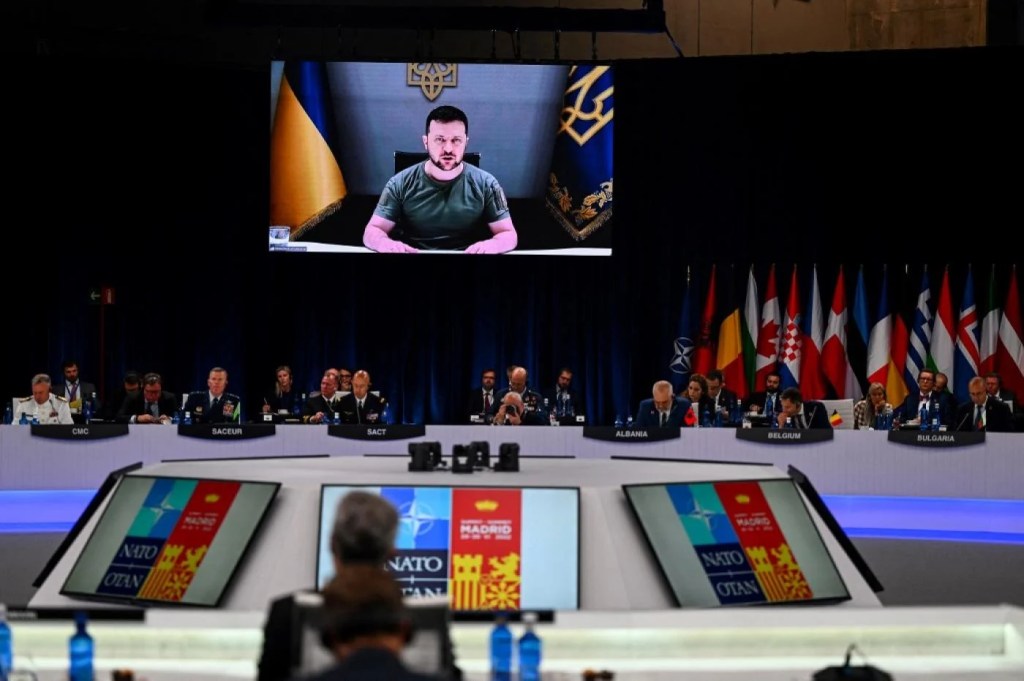
Ukraine, for better or worse, underlined Europe’s profound military dependence on Washington – and on NATO.

More particularly, the Ukraine conflict seemed to open the prospect for consolidating the strange metamorphosis of NATO from military alliance to an enlightened, Progressive, peace alliance! As Timothy Garton Ash effused in the Guardian in 2002, “NATO has become a European peace movement” where one could watch “John Lennon meet George Bush”.

The Ukraine war is portrayed, in this vein, as the “war­ that even former pacifists can get behind. All its proponents seemed to be singing is “Give War a Chance””.

Lily Lynch, a Belgrade-based writer, argues that,

“…especially in the past 12 months, telegenic female leaders such as the Finnish Prime Minister, Sanna Marin, German Foreign Minister, Annalena Baerbock, and Estonian Prime Minister, Kaja Kallas, have increasingly served as the spokespersons of enlightened militarism in Europe … ”

“No political party in Europe better exemplifies the shift from militant pacifism to ardent pro-war Atlanticism than the German Greens. Most of the original Greens had been radicals during the student protests of 1968 … But as the founding members entered middle age, fissures began to appear in the party – that would one day tear it apart”.

“Kosovo then changed everything: The 78-day NATO bombing of what remained of Yugoslavia in 1999, ostensibly to halt war crimes committed by Serbian security forces in Kosovo, would forever transform the German Greens. NATO for the Greens became an active military compact concerned with spreading and defending values such as human rights, democracy, peace, and freedom – well beyond the borders of its member states”.

A few years later, in 2002, an EU functionary (Robert Cooper) could envisage Europe as a new ‘liberal imperialism’. The ‘new’ was that Europe eschewed hard military power, in favour of weaponising both a controlled ‘narrative’ and controlled participation in its market. He advocated for ‘a new age of empire’, in which Western powers no longer would have to follow international law in their dealings with ‘old fashioned’ states; they could use military force independently of the United Nations; and could impose protectorates to replace regimes which ‘misgovern’.

The German Greens’ Foreign Minister, Annalena Baerbock, has continued with this metamorphosis, scolding countries with traditions of military neutrality, and imploring them to join NATO. She has invoked Archbishop Desmond Tutu’s line: “If you are neutral in situations of injustice, you have chosen the side of the oppressor”. And the European Left has been utterly captivated. Major parties have abandoned military neutrality and opposition to war – and now champion NATO. It is a stunning reversal.

All this may have been music to the ears of the Euro-élites anxious for the EU to rise to Great Power status, but this soft-power European Leviathan was wholly underpinned by the unstated (but essential) assumption that NATO ‘had Europe’s back’. This naturally implied that the EU had to tie itself ever closer to NATO – and therefore to the U.S. which controls NATO.

But the flip-side to this Atlanticist aspiration – as President Emmanuel Macron noted – is its inexorable logic that Europeans simply end by becoming American vassals. Macron was trying rather, to rally Europe towards the coming ‘age of empires’,hoping to position Europe as a ‘third pole’ in a concert of empires.

The Atlanticists were duly enraged by Macron’s remarks (which nonetheless drew support of other EU states). It could even seem (to furious Atlanticists) that Macron actually was channelling General de Gaulle who had called NATO a “false pretence” designed to “disguise America’s chokehold over Europe”.

There are however, two related schisms that flowed out from this ‘re-imagined’ NATO: Firstly, it exposed the reality of internal European rivalries and divergent interests, precisely because the NATO lead in the Ukraine conflict sets the interests of the Central East European hawks wanting ‘more America, and more war on Russia’ up and against that of the original EU western axis which wants wanting strategic autonomy (i.e. less ‘America’, and a quick end to the conflict).

Secondly, it would be predominantly the western economies that would have to bankroll the costs and divert their manufacturing capacity towards military logistic chains. The economic price, non-military de-industrialisation and high inflation, potentially, could be enough to break Europe – economically.

The prospect of a pan-European cohesive identity might be both ontologically appealing – and be seen to be an ‘appropriate accessory’ to an aspiring ‘world actor’ – yet such identity becomes caricature when mosaic Europe is transformed into an abstract de-territorialised identity that reduces people to their most abstract.

Paradoxically, the Ukraine war – far from consolidating the EU ‘identity’, as first imagined – has fractured it under the stresses of the concerted effort to weaken and collapse Russia.

Secondly, as Arta Moeini, the director of the Institute for Peace and Diplomacy, has observed:

“The American push for NATO expansion since 1991 has enlarged the alliance by adding a host of faultline states from Central and Eastern Europe. The strategy, which began with the Clinton administration but was fully championed by the George W. Bush administration, was to create a decidedly pro-American pillar on the continent, centred on Warsaw – which would force an eastward shift in the alliance’s centre of gravity away from the traditional Franco-German axis”.

“By using NATO enlargement to weaken the old power centres in Europe that might have occasionally stood up to [Washington] such as in the run-up to the invasion of Iraq, Washington ensured a more compliant Europe in the short-term. The upshot, however, was the formation of a 31-member behemoth with deep asymmetries of power and low compatibility of interests” – that is much weaker and more vulnerable – than it believes itself to be”.

Here is the key: “the EU is much weaker than it believes it to be”. The outset of the conflict was defined by a cast of mind entranced by the notion of Europe as a ‘mover and shaker’ in world affairs, and mesmerised by Europe’s post-war prosperity.

EU leaders convinced themselves that this prosperity had bequeathed it the clout and the economic depth to contemplate war – and to weather its reversals – with panglossian sanguinity. It has produced rather, the converse: It has put its project in jeopardy.

In John Raply and Peter Heather’s The Imperial Life Cycle, the authors explain the cycle:

“Empires grow rich and powerful and attain supremacy through the economic exploitation of their colonial periphery. But in the process, they inadvertently spur the economic development of that same periphery, until it can roll back and ultimately displace its overlord”.

Europe’s prosperity in this post-war era, thus was not so much one of its own making, but drew benefit from the tail-end of accumulations hewn from an earlier cycle – now reversed.

“The fastest-growing economies in the world are now all in the old periphery; the worst-performing economies are disproportionately in the West. These are the economic trends that have created our present landscape of superpower conflict — most saliently between America and China”.

America may think of itself as exempt from the European colonial mould, yet fundamentally, its model is

“an updated cultural-political glue that we might call “neoliberalism, NATO and denim”, which follows in the timeless imperial mould: The great wave of decolonisation that followed WW2 was meant to end that. But the Bretton Woods system, which created a trading regime that favoured industrial over primary producers and enshrined the dollar as the global reserve currency – ensured that the net flow of financial resources continued to move from developing countries to developed ones. Even when the economies of the newly-independent states grew, those of the G7 economies and their partners grew more”.

A once-mighty empire is now challenged and feels embattled. Taken aback by the refusal of so many developing countries to join with isolating Russia, the West is now waking up to the reality of the emerging, polycentric and fluid global order. These trends are set to continue. The danger is that economically weakened and in crisis, western countries attempt to re-appropriate western triumphalism, yet lack the economic strength and depth, so to do:

“In the Roman Empire, peripheral states developed the political and military capacity to end Roman domination by force… The Roman Empire might have survived – had it not weakened itself with wars of choice – on its ascendant Persian rival”.

The final ‘transgressive’ thought goes to Tom Luongo: “Allowing the West to keep thinking they can win – is the ultimate form of grinding out a superior opponent”.

Interesting!
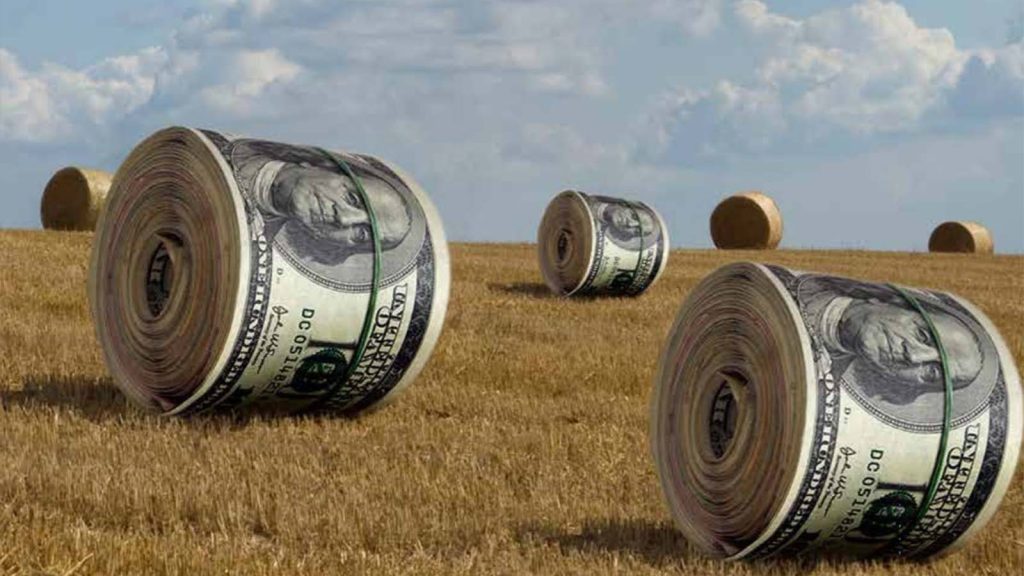
Toxic Contagion – Funds, Food and Pharma

By Colin Todhunter

Source: Off-Guardian

In 2014, the organisation GRAIN revealed that small farms produce most of the world’s food in its report Hungry for land: small farmers feed the world with less than a quarter of all farmland.

The report Small-scale Farmers and Peasants Still Feed the World (ETC Group, 2022) confirmed this.

Small farmers produce up to 80% of the food in the non-industrialised countries. However, they are currently squeezed onto less than a quarter of the world’s farmland. The period 1974-2014 saw 140 million hectares – more than all the farmland in China – being taken over for soybean, oil palm, rapeseed and sugar cane plantations.

GRAIN noted that the concentration of fertile agricultural land in fewer and fewer hands is directly related to the increasing number of people going hungry every day. While industrial farms have enormous power, influence and resources, GRAIN’s data showed that small farms almost everywhere outperform big farms in terms of productivity.

In the same year, policy think tank the Oakland Institute released a report stating that the first years of the 21 century will be remembered for a global land rush of nearly unprecedented scale. An estimated 500 million acres, an area eight times the size of Britain, were reported bought or leased across the developing world between 2000 and 2011, often at the expense of local food security and land rights.

Institutional investors, including hedge funds, private equity, pension funds and university endowments, were eager to capitalise on global farmland as a new and highly desirable asset class.

This trend was not confined to buying up agricultural land in low-income countries. Oakland Institute’s Anuradha Mittal argued that there was a new rush for US farmland. One industry leader estimated that $10 billion in institutional capital was looking for access to this land in the US.

Although investors believed that there is roughly $1.8 trillion worth of farmland across the US, of this between $300 billion and $500 billion (2014 figures) is considered to be of “institutional quality” – a combination of factors relating to size, water access, soil quality and location that determine the investment appeal of a property.

In 2014, Mittal said that if action is not taken, then a perfect storm of global and national trends could converge to permanently shift farm ownership from family businesses to institutional investors and other consolidated corporate operations.

WHY THIS MATTERS

Peasant/smallholder agriculture prioritises food production for local and national markets as well as for farmers’ own families, whereas corporations take over fertile land and prioritise commodities or export crops for profit and markets far away that tend to cater for the needs of more affluent sections of the global population.

In 2013, a UN report stated that farming in rich and poor nations alike should shift from monocultures towards greater varieties of crops, reduced use of fertilisers and other inputs, increased support for small-scale farmers and more locally focused production and consumption of food. The report stated that monoculture and industrial farming methods were not providing sufficient affordable food where it is needed.

In September 2020, however, GRAIN showed an acceleration of the trend that it had warned of six years earlier: institutional investments via private equity funds being used to lease or buy up farms on the cheap and aggregate them into industrial-scale concerns. One of the firms spearheading this is the investment asset management firm BlackRock, which exists to put its funds to work to make money for its clients.

BlackRock holds shares in a number of the world’s largest food companies, including Nestlé, Coca-Cola, PepsiCo, Walmart, Danone and Kraft Heinz and also has significant shares in most of the top publicly traded food and agriculture firms: those which focus on providing inputs (seeds, chemicals, fertilisers) and farm equipment as well as agricultural trading companies, such as Deere, Bunge, ADM and Tyson (based on BlackRock’s own data from 2018).

Together, the world’s top five asset managers – BlackRock, Vanguard, State Street, Fidelity and Capital Group – own around 10–30% of the shares of the top firms in the agrifood sector.

The article Who is Driving the Destructive Industrial Agriculture Model? (2022) by Frederic Mousseau of the Oakland Institute showed that BlackRock and Vanguard are by far the biggest shareholders in eight of the largest pesticides and fertiliser companies: Yara, CF Industries Holdings K+S Aktiengesellschaft, Nutrien, The Mosaic Company, Corteva and Bayer.

These companies’ profits were projected to double, from US$19 billion in 2021 to $38 billion in 2022, and will continue to grow as long as the industrial agriculture production model on which they rely keeps expanding. Other major shareholders include investment firms, banks and pension funds from Europe and North America.

Through their capital injections, BlackRock et al fuel and make huge profits from a globalised food system that has been responsible for eradicating indigenous systems of production, expropriating seeds, land and knowledge, impoverishing, displacing or proletarianizing farmers and destroying rural communities and cultures. This has resulted in poor-quality food and illness, human rights abuses and ecological destruction.

SYSTEMIC COMPULSION

Post-1945, the Rockefeller Chase Manhattan bank with the World Bank helped roll out what has become the prevailing modern-day agrifood system under the guise of a supposedly ‘miraculous’ corporate-controlled, chemical-intensive Green Revolution (its much-heralded but seldom challenged ‘miracles’ of increased food production are nothing of the sort; for instance, see the What the Green Revolution Did for India and New Histories of the Green Revolution).

Ever since, the IMF, the World Bank and the WTO have helped consolidate an export-oriented industrial agriculture based on Green Revolution thinking and practices. A model that uses loan conditionalities to compel nations to ‘structurally adjust’ their economies and sacrifice food self-sufficiency.

Countries are placed on commodity crop production treadmills to earn foreign currency (US dollars) to buy oil and food on the global market (benefitting global commodity traders like Cargill, which helped write the WTO trade regime – the Agreement on Agriculture), entrenching the need to increase cash crop cultivation for exports.

Today, investment financing is helping to drive and further embed this system of corporate dependency worldwide. BlackRock is ideally positioned to create the political and legislative framework to maintain this system and increase the returns from its investments in the agrifood sector.

The firm has around $10 trillion in assets under its management and has, according to William Engdahl, positioned itself to effectively control the US Federal Reserve, many Wall Street mega-banks and the Biden administration: a number of former top people at BlackRock are in key government positions, shaping economic policy.

So, it is no surprise that we are seeing an intensification of the lop-sided battle being waged against local markets, local communities and indigenous systems of production for the benefit of global private equity and big agribusiness.

For example, while ordinary Ukrainians are currently defending their land, financial institutions are supporting the consolidation of farmland by rich individuals and Western financial interests. It is similar in India (see the article The Kisans Are Right: Their Land Is at Stake) where a land market is being prepared and global investors are no doubt poised to swoop.

In both countries, debt and loan conditionalities on the back of economic crises are helping to push such policies through. For instance, there has been a 30+ year plan to restructure India’s economy and agriculture. This stems from the country’s 1991 foreign exchange crisis, which was used to impose IMF-World Bank debt-related ‘structural adjustment’ conditionalities. The Mumbai-based Research Unit for Political Economy locates agricultural ‘reforms’ within a broader process of Western imperialism’s increasing capture of the Indian economy.

Yet ‘imperialism’ is a dirty word never to be used in ‘polite’ circles. Such a notion is to be brushed aside as ideological by the corporations that benefit from it. Instead, what we constantly hear from these conglomerates is that countries are choosing to embrace their entry and proprietary inputs into the domestic market as well as ‘neoliberal reforms’ because these are essential if we are to feed a growing global population. The reality is that these firms and their investors are attempting to deliver a knockout blow to smallholder farmers and local enterprises in places like India.

But the claim that these corporations, their inputs and their model of agriculture is vital for ensuring global food security is a proven falsehood. However, in an age of censorship and doublespeak, truth has become the lie and the lie is truth. Dispossession is growth, dependency is market integration, population displacement is land mobility, serving the needs of agrifood corporations is modern agriculture and the availability of adulterated, toxic food as part of a monoculture diet is feeding the world.

And when a ‘pandemic’ was announced and those who appeared to be dying in greater numbers were the elderly and people with obesity, diabetes and cardio-vascular disease, few were willing to point the finger at the food system and its powerful corporations,   practices and products that are responsible for the increasing prevalence of these conditions (see campaigner Rosemary Mason’s numerous papers documenting this on Academia.edu). Because this is the real public health crisis that has been building for decades.

But who cares? BlackRock, Vanguard and other institutional investors? Highly debatable because if we turn to the pharmaceuticals industry, we see similar patterns of ownership involving the same players.

A December 2020 paper on ownership of the major pharmaceuticals companies, by researchers Albert Banal-Estanol, Melissa Newham and Jo Seldeslachts, found the following (reported on the website of TRT World, a Turkish news media outlet):

Public companies are increasingly owned by a handful of large institutional investors, so we expected to see many ownership links between companies — what was more surprising was the magnitude of common ownership… We frequently find that more than 50 per cent of a company is owned by ‘common’ shareholders who also own stakes in rival pharma companies.”

The three largest shareholders of Pfizer, J&J and Merck are Vanguard, SSGA and BlackRock.

In 2019, the Centre for Research on Multinational Corporations reported that payouts to shareholders had increased by almost 400 per cent — from $30 billion in 2000 to $146 billion in 2018. Shareholders made $1.54 trillion in profits over that 18-year period.

So, for institutional investors, the link between poor food and bad health is good for profit. While investing in the food system rakes in enormous returns, you can perhaps double your gains if you invest in pharma too.

These findings predate the 2021 documentary Monopoly: An Overview of the Great Reset, which also shows that the stock of the world’s largest corporations are owned by the same institutional investors. ‘Competing’ brands, like Coke and Pepsi, are not really competitors, since their stock is owned by the same investment companies, investment funds, insurance companies and banks.

Smaller investors are owned by larger investors. Those are owned by even bigger investors. The visible top of this pyramid shows only Vanguard and Black Rock.

A 2017 Bloomberg report states that both these companies in the year 2028 together will have investments amounting to $20 trillion.

While individual corporations – like Pfizer and Monsanto/Bayer, for instance – should be (and at times have been) held to account for some of their many wrongdoings, their actions are symptomatic of a system that increasingly leads back to the boardrooms of the likes of BlackRock and Vanguard.

Prof Fabio Vighi of Cardiff University says:

Today, capitalist power can be summed up with the names of the three biggest investment funds in the world: BlackRock, Vanguard and State Street Global Advisor. These giants, sitting at the centre of a huge galaxy of financial entities, manage a mass of value close to half the global GDP, and are major shareholders in around 90% of listed companies.”

These firms help shape and fuel the dynamics of the economic system and the globalised food regime, ably assisted by the World Bank, the IMF, the WTO and other supranational institutions. A system that leverages debt, uses coercion and employs militarism to secure continued expansion.

America’s Social Contract Is Broken

Design by Robomega

By Charles Hugh Smith

Source: Of Two Minds

I do not claim any expertise in social contract theory, but in broad brush we can delineate two implicit contracts: one between the citizenry and the state (government) and another between citizens.

We can distinguish between the two by considering a rural county fair. Most of the labor to stage the fair is volunteered by the citizenry for the good of their community and fellow citizens; they are not coerced to do so by the government, nor does the government levy taxes to pay its employees or contractors to stage the fair.

The social contract between citizens implicitly binds people to obeying traffic laws as a public good all benefit from, not because a police officer is on every street corner enforcing the letter of the law.

The social contract between the citizens and the state binds the government to maintaining civil liberties, equal enforcement of the rule of law, defending the nation, and in the 20th century, providing social welfare for the disadvantaged, disabled and low-income elderly.

Critiques of “trickle down economics” focus on income inequality as a key metric of the Social Contract: rising income inequality is de facto evidence that the Social Contract is broken.

I think this misses the key distinction in the Social Contract between citizens and the state, which is the legitimacy of the process of wealth creation and the fairness of the playing field and the referees, i.e. that no one is above the law.

Few people begrudge legitimately earned wealth, for example, the top athlete, the pop star, the tech innovator, the canny entrepreneur, the best-selling author, etc. The source of these individual’s wealth is transparent, and any citizen can decline to support this wealth creation by not paying money to see the athlete, not buying the author’s books, not shopping at the entrepreneur’s stores, etc.

The Social Contract is broken not just by wealth inequality per se but by the illegitimate process of wealth acquisition, i.e. the state has tipped the scales in favor of the few behind closed doors and routinely ignores or bypasses the intent of the law even as the state claims to be following the narrower letter of the law.

By this definition, the Social Contract in America has been completely smashed. One sector after another is dominated by cartel-state partnerships that are forged and enforced in obscure legislation written by lobbyists. Once the laws have been riddled with loopholes and the regulators have been corrupted, “no one is above the law” has lost all meaning.

Those who violate the intent of the law while managing to conjure an apparent compliance with the letter of the law are shysters, scammers and thieves who exploit the intricate loopholes of the system, all the while parading their compliance as evidence the system is fair and just. In this way, the judicial system becomes part of the illegitimate process of wealth accumulation.

In America, political and financial Elites are above the intent of the law. Is bribery of politicos illegal? Supposedly it is, but in practice it is entirely and openly legal.

This is the norm in banana republics, whose ledgers are loaded with thousands of codes and regulations that are routinely ignored by those in power. In the Banana Republic of America, financial crimes go uninvestigated, unindicted and unpunished: banks and their management are essentially immune to prosecution because the crimes are complex (tsk, tsk, it’s really too much trouble to investigate) and they’re “too big to prosecute.”

The rot has seeped from the financial-political Aristocracy to the lower reaches of the social order. The fury of those still working legitimate jobs and paying their taxes is grounded in a simple, obvious truth: America is now dominated by scammers, cheaters, grifters and those gaming the system, large and small, to increase their share of the swag.

The honest taxpayer is a chump, a mark who foolishly ponies up the swag that’s looted by the smart operators. Everyone knows that the vast majority of wealth accumulation in America flows not from transparent effort on a level playing field, but from persuading the Central State (the Federal government and the Federal Reserve) to enforce cartels and grant monopolistic favors such as tax shelters designed for a handful of firms and unlimited credit to private banks.

When scammers large and small live better than those creating value in the real economy, the Social Contract has ceased to exist. When the illegitimate process of wealth acquisition–a rigged playing field, a bought-off referee, and an Elite that’s above the law by every practical measure–dominates the economy and the political structure, the Social Contract has been shattered, regardless of how much welfare largesse is distributed to buy the complicity of state dependents.

Once the chumps and marks realize there is no way they can ever escape their exploited banana-republic status as neofeudal debt-serfs, the scammers, cheats and grifters large and small will be at risk of losing their perquisites. The fantasy in America is that legitimate wealth creation is still possible despite the visible dominance of a corrupt, venal, self-absorbed, parasitic, predatory Aristocracy. Once that fantasy dies, so will the marks’ support of the Aristocracy.

As Voltaire observed, “No snowflake in an avalanche ever feels responsible”: every claim, every game of the system, every political favor purchased is “fair and legal,” of course. This is precisely how empires collapse.

In broad brush, we can trace the transition from feudalism to capitalism to the present financialized, globalized cartel-state neofeudalism and next, to a synthesis built on the opposite of neofeudalism, which is decentralization, transparency, accountability, legitimacy and the adaptive churn of competing ideas and proposals.

America’s empire is bankrupt

The dollar is finally being dethroned

Credit: JOEL PETT

By John Michael Greer

Source: UnHerd

Let’s start with the basics. Roughly 5% of the human race currently live in the United States of America. That very small fraction of humanity, until quite recently, enjoyed about a third of the world’s energy resources and manufactured products and about a quarter of its raw materials. This didn’t happen because nobody else wanted these things, or because the US manufactured and sold something so enticing that the rest of the world eagerly handed over its wealth in exchange. It happened because, as the dominant nation, the US imposed unbalanced patterns of exchange on the rest of the world, and these funnelled a disproportionate share of the planet’s wealth to itself.

There’s nothing new about this sort of arrangement. In its day, the British Empire controlled an even larger share of the planet’s wealth, and the Spanish Empire played a comparable role further back. Before then, there were other empires, though limits to transport technologies meant that their reach wasn’t as large. Nor, by the way, was any of this an invention of people with light-coloured skin. Mighty empires flourished in Asia and Africa when the peoples of Europe lived in thatched-roofed mud huts. Empires rise whenever a nation becomes powerful enough to dominate other nations and drain them of wealth. They’ve thrived as far back as records go and they’ll doubtless thrive for as long as human civilisations exist.

America’s empire came into being in the wake of the collapse of the British Empire, during the fratricidal European wars of the early 20th century. Throughout those bitter years, the role of global hegemon was up for grabs, and by 1930 or so it was pretty clear that Germany, the Soviet Union or the US would end up taking the prize. In the usual way, two contenders joined forces to squeeze out the third, and then the victors went at each other, carving out competing spheres of influence until one collapsed. When the Soviet Union imploded in 1991, the US emerged as the last empire standing.

Francis Fukuyama insisted in a 1989 essay that having won the top slot, the US was destined to stay there forever. He was, of course, wrong, but then he was a Hegelian and couldn’t help it. (If a follower of Hegel tells you the sky is blue, go look.) The ascendancy of one empire guarantees that other aspirants for the same status will begin sharpening their knives. They’ll get to use them, too, because empires invariably wreck themselves: over time, the economic and social consequences of empire destroy the conditions that make empire possible. That can happen quickly or slowly, depending on the mechanism that each empire uses to extract wealth from its subject nations.

The mechanism the US used for this latter purpose was ingenious but even more short-term than most. In simple terms, the US imposed a series of arrangements on most other nations that guaranteed the lion’s share of international trade would use US dollars as the medium of exchange, and saw to it that an ever-expanding share of world economic activity required international trade. (That’s what all that gabble about “globalisation” meant in practice.) This allowed the US government to manufacture dollars out of thin air by way of gargantuan budget deficits, so that US interests could use those dollars to buy up vast amounts of the world’s wealth. Since the excess dollars got scooped up by overseas central banks and business firms, which needed them for their own foreign trade, inflation stayed under control while the wealthy classes in the US profited mightily.

The problem with this scheme is the same difficulty faced by all Ponzi schemes, which is that, sooner or later, you run out of suckers to draw in. This happened not long after the turn of the millennium, and along with other factors — notably the peaking of global conventional petroleum production — it led to the financial crisis of 2008-2010. Since 2010 the US has been lurching from one crisis to another. This is not accidental. The wealth pump that kept the US at the top of the global pyramid has been sputtering as a growing number of nations have found ways to keep a larger share of their own wealth by expanding their domestic markets and raising the kind of trade barriers the US used before 1945 to build its own economy. The one question left is how soon the pump will start to fail altogether.

When Russia launched its invasion of Ukraine in February 2022, the US and its allies responded not with military force but with punitive economic sanctions, which were expected to cripple the Russian economy and force Russia to its knees. Apparently, nobody in Washington considered the possibility that other nations with an interest in undercutting the US empire might have something to say about that. Of course, that’s what happened. China, which has the largest economy on Earth in purchasing-power terms, extended a middle finger in the direction of Washington and upped its imports of Russian oil, gas, grain and other products. So did India, currently the third-largest economy on Earth in the same terms; as did more than 100 other countries.

Then there’s Iran, which most Americans are impressively stupid about. Iran is the 17th largest nation in the world, more than twice the size of Texas and even more richly stocked with oil and natural gas. It’s also a booming industrial power. It has a thriving automobile industry, for example, and builds and launches its own orbital satellites. It’s been dealing with severe US sanctions since not long after the Shah fell in 1978, so it’s a safe bet that the Iranian government and industrial sector know every imaginable trick for getting around those sanctions.

Right after the start of the Ukraine war, Russia and Iran suddenly started inking trade deals to Iran’s great benefit. Clearly, one part of the quid pro quo was that the Iranians passed on their hard-earned knowledge about how to dodge sanctions to an attentive audience of Russian officials. With a little help from China, India and most of the rest of humanity, the total failure of the sanctions followed in short order. Today, the sanctions are hurting the US and Europe, not Russia, but the US leadership has wedged itself into a position from which it can’t back down. This may go a long way towards explaining why the Russian campaign in Ukraine has been so leisurely. The Russians have no reason to hurry. They know that time is not on the side of the US.

For many decades now, the threat of being cut out of international trade by US sanctions was the big stick Washington used to threaten unruly nations that weren’t small enough for a US invasion or fragile enough for a CIA-backed regime-change operation. Over the last year, that big stick turned out to be made of balsa wood and snapped off in Joe Biden’s hand. As a result, all over the world, nations that thought they had no choice but to use dollars in their foreign trade are switching over to their own currencies, or to the currencies of rising powers. The US dollar’s day as the global medium of exchange is thus ending.

It’s been interesting to watch economic pundits reacting to this. As you might expect, quite a few of them simply deny that it’s happening — after all, economic statistics from previous years don’t show it yet, Some others have pointed out that no other currency is ready to take on the dollar’s role; this is true, but irrelevant. When the British pound lost a similar role in the early years of the Great Depression, no other currency was ready to take on its role either. It wasn’t until 1970 or so that the US dollar finished settling into place as the currency of global trade. In the interval, international trade lurched along awkwardly using whatever currencies or commodity swaps the trading partners could settle on: that is to say, the same situation that’s taking shape around us in the free-for-all of global trade that will define the post-dollar era.

One of the interesting consequences of the shift now under way is a reversion to the mean of global wealth distribution. Until the era of European global empire, the economic heart of the world was in east and south Asia. India and China were the richest countries on the planet, and a glittering necklace of other wealthy states from Iran to Japan filled in the picture. To this day, most of the human population is found in the same part of the world. The great age of European conquest temporarily diverted much of that wealth to Europe, impoverishing Asia in the process. That condition began to break down with the collapse of European colonial empires in the decade following the Second World War, but some of the same arrangements were propped up by the US thereafter. Now those are coming apart, and Asia is rising. By next year, four of the five largest economies on the planet in terms of purchasing power parity will be Asian. The fifth is the US, and it may not be in that list for much longer.

In short, America is bankrupt. Our governments from the federal level down, our big corporations and a very large number of our well-off citizens have run up gargantuan debts, which can only be serviced given direct or indirect access to the flows of unearned wealth the US extracted from the rest of the planet. Those debts cannot be paid off, and many of them can’t even be serviced for much longer. The only options are defaulting on them or inflating them out of existence, and in either case, arrangements based on familiar levels of expenditure will no longer be possible. Since the arrangements in question include most of what counts as an ordinary lifestyle in today’s US, the impact of their dissolution will be severe.

In effect, the 5% of us in this country are going to have to go back to living the way we did before 1945. If we still had the factories, the trained workforce, the abundant natural resources and the thrifty habits we had back then, that would have been a wrenching transition but not a debacle. The difficulty, of course, is that we don’t have those things anymore. The factories were shut down in the offshoring craze of the Seventies and Eighties, when the imperial economy slammed into overdrive, and the trained workforce was handed over to malign neglect.

We’ve still got some of the natural resources, but nothing like what we once had. The thrifty habits? Those went whistling down the wind a long time ago. In the late stages of an empire, exploiting flows of unearned wealth from abroad is far more profitable than trying to produce wealth at home, and most people direct their efforts accordingly. That’s how you end up with the typical late-imperial economy, with a governing class that flaunts fantastic levels of paper wealth, a parasite class of hangers-on that thrive by catering to the very rich or staffing the baroque bureaucratic systems that permeate public and private life, and the vast majority of the population impoverished, sullen, and unwilling to lift a finger to save their soi-disant betters from the consequences of their own actions.

The good news is that there’s a solution to all this. The bad news is that it’s going to take a couple of decades of serious turmoil to get there. The solution is that the US economy will retool itself to produce earned wealth in the form of real goods and non-financial services. That’ll happen inevitably as the flows of unearned wealth falter, foreign goods become unaffordable to most Americans, and it becomes profitable to produce things here in the US again. The difficulty, of course, is that most of a century of economic and political choices meant to support our former imperial project are going to have to be undone.

The most obvious example? The metastatic bloat of government, corporate and non-profit managerial jobs in American life. That’s a sensible move in an age of empire, as it funnels money into the consumer economy, which provides what jobs exist for the impoverished classes. Public and private offices alike teem with legions of office workers whose labour contributes nothing to national prosperity but whose pay cheques prop up the consumer sector. That bubble is already losing air. It’s indicative that Elon Musk, after his takeover of Twitter, fired some 80% of that company’s staff; other huge internet combines are pruning their workforce in the same way, though not yet to the same degree.

The recent hullaballoo about artificial intelligence is helping to amplify the same trend. Behind the chatbots are programs called large language models (LLMs), which are very good at imitating the more predictable uses of human language. A very large number of office jobs these days spend most of their time producing texts that fall into that category: contracts, legal briefs, press releases, media stories and so on. Those jobs are going away. Computer coding is even more amenable to LLM production, so you can kiss a great many software jobs goodbye as well. Any other form of economic activity that involves assembling predictable sequences of symbols is facing the same crunch. A recent paper by Goldman Sachs estimates that something like 300 million jobs across the industrial world will be wholly or partly replaced by LLMs in the years immediately ahead.

Another technology with similar results is CGI image creation. Levi’s announced not long ago that all its future catalogues and advertising will use CGI images instead of highly-paid models and photographers. Expect the same thing to spread generally. Oh, and Hollywood’s next. We’re not too far from the point at which a program can harvest all the footage of Marilyn Monroe from her films, and use that to generate new Marilyn Monroe movies for a tiny fraction of what it costs to hire living actors, camera crews and the rest. The result will be a drastic decrease in high-paying jobs across a broad swathe of the economy.

The outcome of all this? Well, one lot of pundits will insist at the top of their lungs that nothing will change in any way that matters, and another lot will start shrieking that the apocalypse is upon us. Those are the only two options our collective imagination can process these days. Of course, neither of those things will actually happen.

What will happen instead is that the middle and upper-middle classes in the US, and in many other countries, will face the same kind of slow demolition that swept over the working classes of those same countries in the late 20th century. Layoffs, corporate bankruptcies, declining salaries and benefits, and the latest high-tech version of NO HELP WANTED signs will follow one another at irregular intervals. All the businesses that make money catering to these same classes will lose their incomes as well, a piece at a time. Communities will hollow out the way the factory towns of America’s Rust Belt and the English Midlands did half a century ago, but this time it will be the turn of upscale suburbs and fashionable urban neighbourhoods to collapse as the income streams that supported them disappear.

This is not going to be a fast process. The US dollar is losing its place as the universal medium of foreign trade, but it will still be used by some countries for years to come. The unravelling of the arrangements that direct unearned wealth to the US will go a little faster, but that will still take time. The collapse of the cubicle class and the gutting of the suburbs will unfold over decades. That’s the way changes of this kind play out.

As for what people can do in response this late in the game, I refer to a post I made on The Archdruid Report in 2012 titled “Collapse Now and Avoid the Rush”. In that post I pointed out that the unravelling of the American economy, and the broader project of industrial civilisation, was picking up speed around us, and those who wanted to get ready for it needed to start preparing soon by cutting their expenses, getting out of debt, and picking up the skills needed to produce goods and services for people rather than the corporate machine. I’m glad to say that some people did these things, but a great many others rolled their eyes, or made earnest resolutions to do something as soon as things were more convenient, which they never were.

Over the years that followed I repeated that warning and then moved on to other themes, since there really wasn’t much point to harping on about the approaching mess when the time to act had slipped away. Those who made preparations in time will weather the approaching mess as well as anyone can. Those who didn’t? The rush is here. I’m sorry to say that whatever you try, it’s likely that there’ll be plenty of other frantic people trying to do the same thing. You might still get lucky, but it’s going to be a hard row to hoe.

Mind you, I expect some people to take a different tack. In the months before a prediction of mine comes true, I reliably field a flurry of comments insisting that I’m too rigid and dogmatic in my views about the future, that I need to be more open-minded about alternative possibilities, that wonderful futures are still in reach, and so on. I got that in 2008 just before the real estate bubble started to go bust, as I’d predicted, and I also got it in 2010 just before the price of oil peaked and started to slide, as I’d also predicted, taking the peak oil movement with it. I’ve started to field the same sort of criticism once again.

We are dancing on the brink of a long slippery slope into an unwelcome new reality. I’d encourage readers in America and its close allies to brace themselves for a couple of decades of wrenching economic, social, and political turmoil. Those elsewhere will have an easier time of it, but it’s still going to be a wild ride before the rubble stops bouncing, and new social, economic, and political arrangements get patched together out of the wreckage.

Hunger Profiteers, Granny Killers, and Skin-Deep Morality

By Colin Todhunter

Source: Dissident Voice

Today, a fifth (278 million) of the African population are undernourished, and 55 million of that continent’s children under the age of five are stunted due to severe malnutrition.  

In 2021, an Oxfam review of IMF COVID-19 loans showed that 33 African countries were encouraged to pursue austerity policies. Oxfam and Development Finance International also revealed that 43 out of 55 African Union member states face public expenditure cuts totalling $183 billion over the next few years. 

As a result, almost three-quarters of Africa’s governments have reduced their agricultural budgets since 2019, and more than 20 million people have been pushed into severe hunger. In addition, the world’s poorest countries were due to pay $43 billion in debt repayments in 2022, which could otherwise cover the costs of their food imports. 

Last year, Oxfam International Executive Director Gabriela Bucher stated that there was a terrifying prospect that in excess of a quarter of a billion more people would fall into extreme levels of poverty in 2022 alone. That year, food inflation rose by double digits in most African countries.  

By September 2022, some 345 million people across the world were experiencing acute hunger, a number that has more than doubled since 2019. Moreover, one person is dying of hunger every four seconds. From 2019 to 2022, the number of undernourished people grew by 150 million

Billions of dollars’ worth of arms continue to pour into Ukraine from the NATO countries as US neocons pursue their goal of regime change in Russia and balkanisation of that country. 

Yet people in those NATO countries are experiencing increasing levels of hardship. The US has sent almost 80 billion dollars to Ukraine, while 30 million low-income people across the US are on the edge of a ‘hunger cliff’ as a portion of their federal food assistance is taken away. In 2021, it was estimated that one in eight children were going hungry in the US. In England, 100,000 children have been frozen out of free school meals.  

Due to the disruptive supply chain effects of the conflict in Ukraine, speculative trading that drives up food prices, the impact of closing down the global economy under the guise of COVID and the inflationary impacts of pumping trillions of dollars into the financial system between September 2019 and March 2020, people are being driven into poverty and denied access to sufficient food. 

Matters are not helped by issues that have long plagued the global food system: cutbacks in public subsidies to agriculture, WTO rules that facilitate cheap, subsidised imports which undermine or wipe out indigenous agriculture in poorer countries and loan conditionalities, resulting in countries ‘structurally adjusting’ their agri sectors thereby eradicating food security and self-sufficiency – consider that Africa has been transformed from a net food exporter in the 1960s to a net food importer today.  

Great game food geopolitics continue and result in elite interests playing with the lives of hundreds of millions who are regarded as collateral damage. Policies, underpinned by neoliberal dogma masquerading as economic science and necessity, which are designed to create dependency and benefit a handful of multi-billionaires and global agribusiness corporations who, ably assisted by the World Bank, IMF and WTO, now preside over an increasingly centralised food regime. 

Many of these corporations have engaged in rampant profiteering at a time when people across the world are experiencing rising food inflation. For instance, 20 corporations in the grain, fertiliser, meat and dairy sectors delivered $53.5 billion to shareholders in the fiscal years 2020 and 2021. At the same time, the UN estimates that $51.5 billion would be enough to provide food, shelter and lifesaving support for the world’s 230 million most vulnerable people. 

As a paper in the journal Frontiers noted in 2021, these corporations form part of a powerful alliance of multinational corporations, philanthropies and export-oriented countries who are subverting multilateral institutions of food governance. Many who are involved in this alliance are co-opting the narrative of ‘food systems transformation’ as they anticipate new investment opportunities and seek total control of the global food system. 

This type of ‘transformation’ is more of the same wrapped in a climate emergency narrative in an attempt to move food and farming further towards an ecomodernist techno-dystopia controlled by big agribusiness and big tech, as described in the article “The Netherlands: Template for Ecomodernism’s Brave New World.” 

A ‘brave new world’ where a concoction of genetically engineered items, synthetic food and ultra-processed products will do more harm than good – but will certainly boost the bottom line of the pharmaceutical corporations.  

While securing further dominance over the global food system and undermining food security in the process, global agribusiness frames this as ‘feeding the world’. 

The model these corporations promote not only creates food insecurity but also produces death and illness.   

Former Professor of Medicine Dr Paul Marik recently stated

If you believe the narrative, Type 2 diabetes is a progressive metabolic disease that’ll result in cardiac complications. You’re going to lose your legs. You’re going to have kidney disease, and the only treatment is expensive pharma drugs. That is completely false. It’s a lie.

It is projected that by the end of this decade half of the world’s population are going to be obese and over 20% to 25% will have Type 2 diabetes.   

According to Marik, the bottom line is Type 2 diabetes is a metabolic disease due to bad lifestyle and really bad eating habits: 

“We eat all the time. We snack all the time. This is part of the food industry’s goal. Processed food, starch, becomes an addiction. Most of us are glucose addicted and it’s, in fact, more addictive than cocaine. It creates this vicious cycle of insulin resistance.” 

He adds that if you’re insulin resistant, this prevents leptin and the other hormones acting on your brain, so you’re continually hungry: 

“If you are continually hungry, you eat more, which causes more insulin resistance. It causes this vicious cycle of overeating carbohydrates…” 

This is the nature of the modern food system. Cheap processed ingredients, low-nutrient value, highly addictive and maximum profits. A system that is being imposed or has already been imposed on countries whose populations once had healthy, unadulterated diets (see Obesity, malnutrition and the globalisation of bad food – theecologist.org). 

Over the past 60 years in Western nations, there have been fundamental changes in the quality of food. In 2007, nutritional therapist David Thomas in “A Review of the 6th Edition of McCance and Widdowson’s the Mineral Depletion of Foods Available to Us as a Nation” noted a precipitous change towards convenience and pre-prepared foods containing saturated fats, highly processed meats and refined carbohydrates, often devoid of vital micronutrients yet packed with a cocktail of chemical additives including colourings, flavourings and preservatives. 

Aside from the negative impacts of Green Revolution cropping systems and practices, Thomas proposed that these changes are significant contributors to rising levels of diet-induced ill health. He added that ongoing research clearly demonstrates a significant relationship between deficiencies in micronutrients and physical and mental ill health. 

Increasing prevalence of diabetes, childhood leukaemia, childhood obesity, cardiovascular disorders, infertility, osteoporosis and rheumatoid arthritis, mental illnesses and so on have all been shown to have some direct relationship to diet, specifically micronutrient deficiency, and pesticide use

It is clear that we have a deeply unjust and unsustainable food system that causes environmental devastation, illness and malnutrition, among other things. People often ask: So, what’s the solution? The solutions have been made clear time and again and involve a genuine food transition towards agroecology.  

Unlike the co-opted version of ‘food transition’ being promoted, agroecology offers concrete, practical solutions to many of the world’s problems that move beyond (but which are linked to) agriculture. Agroecology challenges the prevailing moribund doctrinaire economics of a neoliberalism that drives a failing system. Well-known academics like Raj Patel and Eric Holtz-Gimenez have written extensively on the potential of agroecology. And its benefits are clear

In finishing, let us consider the skin-deep morality pedalled throughout the COVID period. During COVID, the official narrative was underpinned by emotive slogans like ‘protect lives’ and ‘keep safe’. Those who refused the COVID jab were labelled ‘granny killers’ and ‘irresponsible’. All presided over by government politicians who too often failed to obey their own COVID rules.  

Meanwhile, while having terrorised the public with a health crisis narrative, they continue to collude with powerful agrifood corporations that destroy health courtesy of their practices. They continue to facilitate a system that serves the needs of global agricapital and ruthless investors like BlackRock’s Larry Fink who secure massive profits from a monopolistic food system (Fink also invests in the pharma sector – one of the biggest beneficiaries of a sickening global food regime) that by its very nature creates illness, malnutrition and hunger.    

The COVID narrative was imbued with the notion of moral responsibility. The people who sold it to the masses have no morality. Like the UK’s former health minister and COVID rule breaker Matt Hancock (see Matt Hancock’s Car Crash Interview), they are willing to sell their soul (or influence) to the highest bidder – in Hancock’s case, a £10,000 wage demand for a day’s ‘consultancy’ as a sitting politician or a few hundred thousand to bolster his ego, bank balance and image on a celebrity TV programme.  

In a corrupted and corrupting society, the rewards could be even higher for the likes of Hancock when he leaves office (a health minister who helped traumatise the population while doing nothing to hold the health-damaging agribusiness corporations to account). But with a long line of well-rewarded fraudsters to choose from, we already know that.

Austerity, War & Dictatorship… the Charade of Western Democracy Is Over. Can We Lose Those Chains?

By Finian Cunningham

Source: Strategic Culture Foundation

Western liberal democracy and its ubiquitous “austerity economics” is a euphemism for fascism. And the charade is finally coming to an end.

Western liberal democracy and its ubiquitous “austerity economics” is a euphemism for fascism. And the charade is finally coming to an end.

Austerity is not some recent policy under neoliberal capitalism. It was born out of the historic crisis in the Western system following the First World War and during the 1930s when fascism became a way to curtail any democratic challenge to the prevailing capitalist system.

That political instrument of repression is wielded today across all Western states. Quite amazingly, for a long time, few people recognized their captive, repressive state as fascism. We generally lived under the illusion that we were free citizens in “liberal democracies”.

In this interview, Clara E Mattei explains how the technocratic-sounding “austerity” is used to hide the brutal reality of dictatorship and repression against the vast majority of citizen workers in Western states.

Clara Mattei is an Assistant Professor in the Economics Department of The New School for Social Research, New York. She is the author of The Capital Order: How Economists Invented Austerity and Paved the Way to Fascism.

Her book investigates the origins of austerity as an economic policy after the crisis of World War One. Crucially, she argues that austerity is not merely about governments balancing financial budgets. Professor Mattei contends that austerity policy implemented by all Western governments is a political instrument of mass repression to prevent any challenge to the prevailing capitalist order.

Austerity forces the vast majority to accept unacceptable conditions that are otherwise shockingly anti-democratic. The precariousness and insecurity of employment, the widespread denial of social services, deprivation and poverty, and the relentless abuse of taxes and resources that are fueling insane militarism and war.

If we really did live in free, democratic societies why are such deformities enforced without any alternative? Austerity is used to crush the political imagination for any reasonable, more humane, more peaceful alternative.

However, as Clara Mattei points out in this interview, the extreme anti-democratic conditions in Western societies are inevitably forcing greater numbers of people to question the injustices and hideous anomalies of the prevailing capitalist order.

People are realizing that Western governments are in reality regimes of repression in service for the enrichment of a minority. That fundamental deformity is why Western societies are collapsing and why the United States and its Western lackeys are driven to increasing conflict against Russia and China.

The charade of “Western democracy” is coming to an end. The rulers and their pantomime political parties are losing the moral authority to hold power over the masses.

As people necessarily seek ways to reinvent societies that are fit for meeting their democratic needs, socialist solutions are beckoning. We have to throw off the mental shackles imposed by our dictators, and realize, as Karl Marx once eloquently said, that we have got nothing to lose except our chains.

Technology and a Tyranny Worse than Prison 

By Bert Olivier

Source: Brownstone Institute

In an outstanding piece of political-theoretical writing, titled ‘The Threat of Big Other’ (with its play on George Orwell’s ‘Big Brother’) Shoshana Zuboff, succinctly addresses the main issues of her book, The Age of Surveillance Capitalism – The Fight for a Human Future at the New Frontier of Power (New York: Public Affairs, Hachette, 2019), explicitly linking it to Orwell’s 1984

Significantly, at the time she reminded readers that Orwell’s goal with 1984 was to alert British and American societies that democracy is not immune to totalitarianism, and that “Totalitarianism, if not fought against, could triumph anywhere” (Orwell, quoted by Zuboff, p. 16). In other words, people are utterly wrong in their belief that totalitarian control of their actions through mass surveillance (as depicted in 1984, captured in the slogan, “Big Brother is watching you”) could only issue from the state, and she does not hesitate to name the source of this threat today (p. 16):

For 19 years, private companies practicing an unprecedented economic logic that I call surveillance capitalism have hijacked the Internet and its digital technologies. Invented at Google in 2000, this new economics covertly claims private human experience as free raw material for translation into behavioural data. Some data are used to improve services, but the rest are turned into computational products that predict your behaviour. These predictions are traded in a new futures market, where surveillance capitalists sell certainty to businesses determined to know what we will do next. 

By now we know that such mass surveillance does not merely have the purpose – if it ever did – of tracking and predicting consumer behaviour with the aim of maximising profits; far from it. It is generally known among those who prefer to remain informed about global developments, and who do not only rely on the legacy media for this, that in China such mass surveillance has reached the point where citizens are tracked through a myriad of cameras in public places, as well as through smartphones, to the point where their behaviour is virtually completely monitored and controlled. 

Small wonder that Klaus Schwab of the World Economic Forum (WEF) does not let an opportunity pass to praise China as the model to be emulated by other countries in this respect. It should therefore come as no surprise that investigative reporter, Whitney Webb, also alluding to Orwell’s prescience, draws attention to the striking similarities between mass surveillance that was developed in the United States (US) in 2020 and Orwell’s depiction of a dystopian society in 1984, first published in 1949. 

In an article titled “Techno-tyranny: How the US national security state is using coronavirus to fulfil an Orwellian vision,” she wrote:

Last year, a government commission called for the US to adopt an AI-driven mass surveillance system far beyond that used in any other country in order to ensure American hegemony in artificial intelligence. Now, many of the ‘obstacles’ they had cited as preventing its implementation are rapidly being removed under the guise of combating the coronavirus crisis.

Webb proceeds to discuss an American government body that focused on researching ways in which artificial intelligence (AI) could promote national security and defence needs, and which provided details concerning the “structural changes” which American society and economy would have to undertake to be able to maintain a technological advantage in relation to China. According to Webb the relevant governmental body recommended that the US follow China’s example in order to surpass the latter, specifically regarding some aspects of AI-driven technology as it pertains to mass surveillance. 

As she also points out, this stance on the desired development of surveillance technology conflicts with (incongruous) public statements by prominent American politicians and government officials, that Chinese AI-technological surveillance systems instantiate a significant threat for Americans’ way of life), which did not, however, prevent the implementation of several stages of such a surveillance operation in the US in 2020. As one knows in retrospect, such implementation was undertaken and justified as part of the American response to Covid-19. 

None of this is new, of course – by now it is well-known that Covid was the excuse to establish and implement Draconian measures of control, and that AI has been an integral part of it. The point I want to make, however, is that one should not be fooled into thinking that strategies of control will end there, nor that the Covid pseudo-vaccines were the last, or worst, of what the would-be rulers of the world can inflict upon us to exercise the total control they wish to achieve – a level of control that would be the envy of the fictional Big Brother society of Orwell’s 1984

For example, several critically thinking people have alerted one to the alarming fact that the widely touted Central Bank Digital Currencies (CBDCs) are Trojan horses, with which the neo-fascists driving the current attempt at a ‘great reset’ of society and the world economy aim to gain complete control over people’s lives. 

At first blush the proposed switch from a fractional reserve monetary system to a digital currency system may seem reasonable, particularly in so far as it promises the (dehumanising) ‘convenience’ of a cashless society. As Naomi Wolf has pointed out, however, far more than this is at stake. In the course of a discussion of the threat of ‘vaccine passports’ to democracy, she writes (The Bodies of Others, All Seasons Press, 2022, p. 194):

There is now also a global push toward government-managed digital currencies. With a digital currency, if you’re not a ‘good citizen,’ if you pay to see a movie you shouldn’t see, if you go to a play you shouldn’t go to, which the vaccine passport will know because you have to scan it everywhere you go, then your revenue stream can be shut off or your taxes can be boosted or your bank account won’t function. There is no coming back from this.

I was asked by a reporter, ‘What if Americans don’t adopt this?’

And I said, ‘You’re already talking from a world that’s gone if this succeeds in being rolled out.’ Because if we don’t reject the vaccine passports, there won’t be any choice. There will be no such thing as refusing to adopt it. There won’t be capitalism. There won’t be free assembly. There won’t be privacy. There won’t be choice in anything that you want to do in your life.

And there will be no escape.

 In short, this was something from which there was no returning. If indeed there was a ‘hill to die on,’ this was it. 

This kind of digital currency is already in use in China, and it is being rapidly developed in countries like Britain and Australia, to mention only some.

Wolf is not the only one to warn against the decisive implications that accepting digital currencies would have for democracy. 

Financial gurus such as Catherine Austin Fitts and Melissa Cuimmei have both signalled that it is imperative not to yield to the lies, exhortations, threats and whatever other rhetorical strategies the neo-fascists might employ to force one into this digital financial prison. In an interview where she deftly summarises the current situation of being “at war” with the globalists, Cuimmei has warned that the drive towards digital passports explains the attempt to get young children ‘vaccinated’ en masse: unless they can do so on a large scale, they could not draw children into the digital control system, and the latter would therefore not work. She has also stressed that the refusal to comply is the only way to stop this digital prison from becoming a reality. We have to learn to say “No!”

Why a digital prison, and one far more effective that Orwell’s dystopian society of Oceania? The excerpt from Wolf’s book, above, already indicates that the digital ‘currencies’ that would be shown in your Central World Bank account, would not be money, which you could spend as you saw fit; in effect, they would have the status of programmable vouchers that would dictate what you can and cannot do with them. 

They constitute a prison worse than debt, paralysing as the latter may be; if you don’t play the game of spending them on what is permissible, you could literally be forced to live without food or shelter, that is, eventually to die. Simultaneously, the digital passports of which these currencies would be a part, represent a surveillance system that would record everything you do and wherever you go. Which means that a social credit system of the kind that functions in China, and has been explored in the dystopian television series, Black Mirror, would be built into it, which could make or break you.  

In her The Solari Report, Austin Fitts, for her part, elaborates on what one can do to “stop CBDCs,” which includes the use of cash, as far as possible, limiting one’s dependence on digital transaction options in favour of analog, and using good local banks instead of the banking behemoths, in the process decentralising financial power, which is further strengthened by supporting small local businesses instead of large corporations. 

One should be under no illusion that this will prove to be easy, however. As history has taught us, when dictatorial powers attempt to gain power over people’s lives, resistance on the part of the latter is usually met with force, or ways of neutralising resistance.

As Lena Petrova reports, this was recently demonstrated in Nigeria, which was one of the first countries in the world (Ukraine being another), to introduce CBDCs, and where there was initially a very tepid response from the population, where most people prefer using cash (partly because many cannot afford smartphones). 

Not to be outdone, the Nigerian government resorted to dubious shenanigans, such as printing less money and asking people to hand in their ‘old’ banknotes for ‘new’ ones, which have not materialised. The result? People are starving because they lack cash to buy food, and they do not have, or do not want, CBDCs, partly because they lack smartphones and partly because they resist these digital currencies. 

It is difficult to tell whether Nigerians’ doubts about CBDCs is rooted in their awareness that, once embraced, the digital passport of which these currencies will comprise a part, would allow the government complete surveillance and control of the populace. Time will tell whether Nigerians will accept this Orwellian nightmare lying down.

Which brings me to the significant philosophical point underpinning any argument about resisting the drive for dictatorial power through mass surveillance. As every enlightened person should know, there are different kinds of power. One such variety of power is encapsulated in Immanuel Kant’s famous motto for enlightenment, formulated in his famous 18th-century essay, “What is Enlightenment?” The motto reads: “Sapere aude!” and translates as “Have the courage to think for yourself,” or “Dare to think!” 

This motto may be said to correspond with what contributors to the activities of Brownstone Institute engage in. Hence, the emphasis on critical intellectual engagement is indispensable. But is it sufficient? I would argue that, while speech act theory has demonstrated, accurately – emphasising the pragmatic aspect of language – that speaking (and one could add writing) is already ‘doing something,’ there is another sense of ‘doing.’ 

This is its meaning of acting in the sense one encounters in discourse theory – which demonstrates the interwovenness of speaking (or writing) and acting through the imbrication of language with power relations. What this implies is that language use is intertwined with actions that find their correlate(s) in speaking and writing. This is compatible with Hannah Arendt’s conviction, that of labour, work and action (the components of the vita activa), action – the verbal engagement with others, broadly for political purposes, is the highest embodiment of human activity.

Philosophers Michael Hardt and Antonio Negri have shed important light on the question of the connection between Kant’s “Sapere aude!” and action. In the third volume of their magisterial trilogy, Commonwealth (Cambridge, Mass., Harvard University Press, 2009; the other two volumes being Empire and Multitude), they argue that although Kant’s “major voice” shows that he was indeed an Enlightenment philosopher of the transcendental method, who uncovered the conditions of possibility of certain knowledge of the law-governed phenomenal world, but by implication also of a practical life of dutiful social and political responsibility, there is also a seldom-noticed “minor voice” in Kant’s work. 

This points, according to them, towards an alternative to the modern power complex that Kant’s “major voice” affirms, and it is encountered precisely in his motto, articulated in the short essay on enlightenment referred to above. They claim further that the German thinker developed his motto in an ambiguous manner – on the one hand “Dare to think” does not undermine his encouragement, that citizens carry out their various tasks obediently and pay their taxes to the sovereign. Needless to stress, such an approach amounts to the strengthening of the social and political status quo. But on the other hand, they argue that Kant himself creates the aperture for reading this enlightenment exhortation (p. 17): 

[…] against the grain: ‘dare to know’ really means at the same time also ‘know how to dare’. This simple inversion indicates the audacity and courage required, along with the risks involved, in thinking, speaking, and acting autonomously. This is the minor Kant, the bold, daring Kant, which is often hidden, subterranean, buried in his texts, but from time to time breaks out with a ferocious, volcanic, disruptive power. Here reason is no longer the foundation of duty that supports established social authority but rather a disobedient, rebellious force that breaks through the fixity of the present and discovers the new. Why, after all, should we dare to think and speak for ourselves if these capacities are only to be silenced immediately by a muzzle of obedience? 

One cannot fault Hardt and Negri here; notice, above, that they include ‘acting’ among those things for which one requires the courage to ‘dare.’ As I have previously pointed out in a discussion of critical theory and their interpretation of Kant on the issue of acting, towards the conclusion of his essay, Kant uncovers the radical implications of his argument: if the ruler does not submit himself (or herself) to the very same rational rules that govern the citizens’ actions, there is no obligation on the part of the latter to obey such a monarch any longer. 

In other words, rebellion is justified when authorities themselves do not act reasonably (which includes the tenets of ethical rationality), but, by implication, unjustifiably, if not aggressively, towards citizens. 

There is a lesson in this as far as the ineluctable need for action is concerned when rational argument with would-be oppressors gets one nowhere. This is especially the case when it becomes obvious that these oppressors are not remotely interested in a reasonable exchange of ideas, but summarily resort to the current unreasonable incarnation of technical rationality, namely AI-controlled mass surveillance, with the purpose of subjugating entire populations. 

Such action might take the form of refusing ‘vaccinations’ and rejecting CBDCs, but it is becoming increasingly apparent that one will have to combine critical thinking with action in the face of merciless strategies of subjugation on the part of the unscrupulous globalists.

The Everything Bubble and Global Bankruptcy

By Charles Hugh Smith

Source: Of Two Minds

The resulting erosion of collateral will collapse the global credit bubble, a repricing/reset that will bankrupt the global economy and financial system.

Scrape away the complexity and every economic crisis and crash boils down to the precarious asymmetry between collateral and the debt secured by that collateral collapsing. It’s really that simple.

In eras of easy credit, both creditworthy and marginal borrowers are suddenly able to borrow more. This flood of new cash seeking a return fuels red-hot demand for conventional assets considered “safe investments” (real estate, blue-chip stocks and bonds), demand which given the limited supply of “safe” assets, pushes valuations of these assets to the moon.

In the euphoric atmosphere generated by easy credit and a soaring asset valuations, some of the easy credit sloshes into marginal investments (farmland that is only briefly productive if it rains enough, for example), high-risk speculative ventures based on sizzle rather than actual steak and outright frauds passed off as legitimate “sure-fire opportunities.”

The price people are willing to pay for all these assets soars as the demand created by easy credit increases. And why does credit continue increasing? The assets rising in value create more collateral which then supports more credit.

This self-reinforcing feedback appears highly virtuous in the expansion phase: the grazing land bought to put under the plow just doubled in value, so the owners can borrow more and use the cash to expand their purchase of more grazing land. The same mechanism is at work in every asset: homes, commercial real estate, stocks and bonds: the more the asset gains in value, the more collateral becomes available to support more credit.

Since there’s plenty of collateral to back up the new loans, both borrowers and lenders see the profitable expansion of credit as “safe.”

This safety is illusory, as it’s resting on an unstable pile of sand: bubble valuations driven by easy credit. We all know that price is set by what somebody will pay for the asset. What attracts less attention is price is also set by how much somebody can borrow to buy the asset.

Once the borrower has maxed out their ability to borrow (their income and assets-owned cannot support more debt) or credit conditions tighten, then those who might have paid even higher prices for assets had they been able to borrow more money can no longer borrow enough to bid the asset higher.

Since price is set on the margin (i.e. by the last sales), the normal churn of selling is enough to push valuations down. At first the euphoria is undented by the decline, but as credit tightens (interest rates rise and lending standards tighten, cutting off marginal buyers and ventures) then buyers become scarce and skittish sellers proliferate.

Questions about fundamental valuations arise, and sky-high valuations are found wanting as tightening credit reduces sales, revenues and profits. Once the “endless growth” story weakens, the claims that bubble prices are “fair value” evaporate.

As defaults rise, lenders are forced to tighten credit further. The first tumbling rocks are ignored but eventually the defaults trigger a landslide, and the credit-inflated bubble in asset valuations collapses.

As valuations plummet, so too does the collateral backing all the new debt. Debt that appeared “safe” is soon exposed as a potential push into insolvency. When the bungalow doubled in value from $500,000 to $1 million, the trajectory of valuation gains looked predictably rosy: every decade housing prices went up 30% or more. So originating a mortgage for $800,000 on a house that looked to be worth $1.3 million in a few years looked rock-solid safe.

But the $1 million was a bubble based solely on easy, abundant, low-cost credit. When credit tightens, the home is slowly but surely repriced at its pre-bubble valuation ($500,000) or perhaps much lower, if that value was merely an artifact of a previous unpopped bubble.

Now the collateral is $300,000 less than the mortgage. The owner who made a down payment of $200,000 will be wiped out by a forced sale at $500,000, and the lender (or owner of the mortgage) will take a $300,000 loss.

Given the banking system is set up to absorb only modest, incremental losses, losses of this magnitude render the lender insolvent. The lender’s capital base is drained to zero by the losses and then pushed into negative net-worth by continued losses.

The collateral collapses when bubbles pop, but the debt loaned against the now-phantom collateral remains.

This is the story of the Great Depression, a story that’s unloved because it calls into question the current series of credit-inflated bubbles and resulting financial crises. So the story is reworked into something more palatable such as “the Federal Reserve made a policy error.”

This encourages the fantasy that if central banks choose the right policies, credit bubbles and valuations detached from reality can both keep expanding forever. The reality is credit bubbles always pop, as the expansion of borrowing eventually exceeds the income and collateral of marginal borrowers, and this tsunami of cash eventually pours into marginal high-risk speculative vebtures that go bust.

There is no way to thread the needle so credit-asset bubbles never pop. Yet here we are, watching the global Everything Bubble finally start collapsing, guaranteeing the collapse of collateral and all the debt issued on that collateral, and the rabble is arguing about what policy tweaks are needed to reinflate the bubble and save the global economy from bankruptcy.

Sorry, but global bankruptcy is already baked in. Too much debt has been piled on phantom-collateral and income streams derived from bubble assets rising (for example, capital gains, development taxes, etc.). The asymmetry is now so extreme that even a modest decline in asset valuations/collateral due to a garden-variety business-cycle recession of tightening financial conditions will trigger the collapse of The Everything Bubble and the mountain of global debt resting on the wind-blown sands of phantom collateral.

There are persuasive reasons to suspect global debt far exceeds the official level around $300 trillion, most saliently, the largely opaque shadow banking system. When assets roughly double in a few years, bubble symmetry suggests that valuations will decline back to the starting point of the bubble in roughly the same time span.

The resulting erosion of collateral will collapse the global credit bubble, a repricing/reset that will bankrupt the global economy and financial system.