“Max Headroom: 20 Minutes Into the Future” (1985) was a television movie originally broadcast on Britain’s Channel 4 and served as a pilot for a series co-produced with ABC in 1987. It’s widely considered the earliest science fiction TV movie and series of the cyberpunk subgenre. Part of the reason for its enduring cult status is the sharp social satire of its vision of the future which remains topical to this day.
The film takes place in a corporate dystopia controlled by an oligarchy of media conglomerates. Like in Orwell’s 1984, television is used as a tool for propaganda as well as mass surveillance. Similar to Winston Smith, the protagonist of 1984, reporter Edison Carter works within the system while questioning the ethics of his employer, but unlike Smith, Carter has enough clout and connections to challenge the system and whistleblow while retaining relative autonomy. He is helped by his producer Theora Jones, computer hacker Bryce Lynch, pirate broadcaster Blank Reg, and rogue artificial intelligence personality Max Headroom.
In Max Headroom: 20 Minutes Into the Future, Edison uncovers a conspiracy involving a new commercial technology called blip-verts: subliminal advertising that can cram greater amounts of data into minds of viewers but with devastating side-effects. During the struggle to bring the investigative report to the airwaves, Max Headroom is accidentally unleashed.
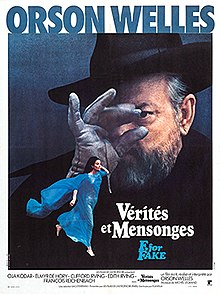
If you’ve seen Orson Welles’ late period quasi-documentary F for Fake, then you know about the mysterious art forger Elmyr De Hory. In his freewheeling cinematic essay, Welles explored the funhouse mirror life of de Hory, who found that he had an uncanny knack for being able to paint counterfeits of Picasso, Matisse, Modigliani and Renoir’s work. After some of his fakes were sold to museums and wealthy collectors, suspicions were raised and his legal troubles—and a life spent moving from place to place to avoid the long arm of the law—began.
At the time Welles met up with Elmyr in the early 70s, he was living in Ibiza and had been the subject of Fake! The Story of Elmyr de Hory the Greatest Art Forger of Our Time written by notorious “biographer” Clifford Irving, who himself figures prominently in the film. During the course of filming F for Fake, Irving (who was later portrayed by Richard Gere in The Hoax), was serendipitously revealed to have forged his own “autobiography” of Howard Hughes (not to mention Hughes’ signature). The resulting film, an essay on the authorship of “truth” in art, is a dazzling, intellectuality challenging masterpiece that can never quite decide if it’s a fake documentary about a fake painter of fake masterpieces who himself was the subject of a fake biographer… or what it is. (It’s no wonder that Robert Anton Wilson was such a fan of F for Fake, which figures prominently in his book, Cosmic Trigger II).
F or Fake also calls into question the nature of “genius”: If Elmyr’s forgeries were good enough to pass off as Picasso or Modigliani’s work, or even to hang in museums under the assumption that they were the work of these masters, wouldn’t Elmyr’s genius be of equal or even nearly equal value to theirs? (Worth noting that it was ego that got in the way of Elmyr’s scam at several points in his life: He was often left apoplectic at hearing how much crooked art dealers were making from his paintings!)
De Hory’s former bodyguard and driver, Mark Forgy, has kept Elmyr’s archive since his suicide in December 1976. In recent years Mr. Forgy has been trying to make more sense of Elmyr’s odd life. From the New York Times:
“I’m so far down the rabbit hole,” Ms. Marvin said in a recent phone interview, “I’m just not going to rest until I find out who this man is.”
A few weeks ago, she and Mr. Forgy traveled to western France and unrolled a dozen de Hory paintings that had been discovered in a farmhouse’s attic. In Budapest, they found birth records, dated 1906, for Elemer Albert Hoffmann, son of Adolf and Iren. No one knows when Elemer upgraded his name, or how he financed art studies in Munich and Paris before moving to New York in 1947.
He claimed that his father was a Roman Catholic and a diplomat, but the Budapest ledgers list Adolf as a Jewish merchant. The Nazis killed his entire family, Mr. de Hory said. But a cousin named Istvan Hont visited the artist’s villa on Ibiza, where Mr. Forgy was working at various times as a chauffeur, secretary and gardener. Mr. Hont, it turns out, was the forger’s brother.
Mr. Forgy knew that his boss copied masterpieces but did not much question their life on Ibiza, in which they kept company with celebrities like Marlene Dietrich and Ursula Andress. “I accepted the amazing with a nonchalance,” Mr. Forgy said in a recent phone interview. Mr. de Hory was the focus of Orson Welles’s 1974 documentary “F for Fake,” and Clifford Irving breathlessly titled his book “Fake! The Story of Elmyr de Hory the Greatest Art Forger of Our Time.”
After Mr. de Hory’s suicide, Mr. Forgy returned to Minnesota. “I went into deep seclusion” working as a night watchman and house restorer, he said. He held onto the papers and paintings. “I have schlepped them around endlessly,” he said. “The walls here in the house look like the Pitti Palace in Florence.”
His wife, Alice Doll, encouraged him in recent years to examine the stacks of false passports, Hungarian correspondence and Swiss arrest reports. Ms. Marvin contacted him last year. She had helped organize a show about faked and stolen art at the National Museum of Crime & Punishment in Washington, including a portrait of a pensive brunette by Mr. de Hory imitating Modigliani.
The researchers are now raising money for the documentary, developing an exhibition for the Budapest Art Fair in November and preparing to interview a nonagenarian de Hory cousin in Germany. They also plan to send paintings for lab analysis. “We’re trying to create a forensics footprint of his work,” Ms. Marvin said.
They already know that Mr. de Hory tore blank pages out of old books for sketching paper and bought paintings at flea markets to scrape and recycle the canvases. His fakes have become collectibles. Last fall, at a Bonhams auction in England, a buyer paid more than $700 for a seascape of crowded sailboats, with a forged Raoul Dufy signature on the front and “Elmyr” on the back.
Daily Kos recently did a post on the background of one of my favorite Christmas songs, “Christmas in the Trenches“, while a Fanpop.com article from last year delivered a devastating take-down of one of my least favorite Christmas songs, “Do They Know It’s Christmas?“.
Consolidation of media ownership + corporate propaganda = (rather unsettling) comedy gold:
The Onion looks back at It’s a Wonderful Life:
A hilarious but deeply cynical Rankin/Bass-style musical number (NSFW):
Last week Nick Margerrison posted a follow-up to his inspiring essay, The Global Awakening published last year on Disinfo.com. In Improve Yourself First, he reminds us of the importance of inner development as a means to avoid violent revolutions which replace one form of tyranny with another. He also makes the connection between today’s internet-based self-improvement movement and how printed culture facilitated the age of enlightenment. In his words: “the most important revolutionary aspect of the printed page: it allowed people to learn how to improve themselves and change the way they thought. This is the driving force behind any meaningful long term social change ever experienced in any society“. For these reasons, authoritarians love censorship, controlling what people think and controlling how to think.
Based on trends he has observed, he writes “the entire notion of a hierarchical dictatorship is coming apart” in part because “leaders lead by controlling information and the communications revolution makes this impossible.” Furthermore, “victory in the oncoming ‘war on information’ is beyond their power, no matter how hard they try, just like the ‘war on drugs’. The Western World’s massive financial difficulties limit their ambitions for now but make no mistake, the internet is causing them to lose their grip on reality.”
As an antidote, he encourages the practice of questioning ideas requiring others to follow orders and suggestions (even his own). In other words, thinking critically and independently, which an uncensored internet facilitates. The true path for a revolution in Margerrison’s view begins with self improvement and learning “not what to think but how to think…The biggest most important changes that you can make to your world are the ones you can make right now to yourself and the way you think.” In his long-term view, the more people who take up the challenge of self improvement, the less unlikely the wider changes needed in society will be. By making such personal efforts in myriad ways, “we might well all move in different directions but the definition of the word “revolution” will move away from something which involves violence and brings long term suffering.”
In “La Antena” (2007), a surreal Argentine parable written and directed by Esteban Sapir, the population of an unknown city is kept under the complete control of Mr. TV through his monopolization of the broadcast system and food supply. Everyone in the city except for a singer, La Voz, has lost their voice (yet are still able to communicate through visual words). With the help of his scientist henchman Dr. Y, Mr. TV kidnaps La Voz in a scheme to take away the last remaining means of communication from the the citizens. A TV repairman gets word of the plan and attempts to foil it using an abandoned antenna in the mountains.
The film is shot in a silent film style reminiscent of the works of Fritz Lang and F.W. Murnau, but also seems to incorporate influences from modern fantasy films such as Dark City and Pan’s Labyrinth. Unfortunately, the only complete version of the film I could find was without subtitles, but those who don’t know Spanish can still enjoy it because the story is conveyed mostly through (beautifully evocative) imagery and doesn’t rely heavily on dialogue.
As the nation approaches the first anniversary of the Sandy Hook Elementary School massacre, mainstream media are predictably excluding from their tragedy porn any substantive analysis of the idiosyncratic, misleading, and in some cases flagrantly propagandistic reportage of the event that might call the official story into question.
As with a majority of scandals and coverups over the past several decades where powerful interests are implicated, American journalism has become more and more complicit if not actively involved in delivering dubious information that establishes a dominant narrative, while thereafter failing to vigorously interrogate and amend faulty coverage that leads to vast public misconceptions.
The assassination of JFK, the falsely-reported Tonkin Gulf incident that sparked the costly Vietnam War, and the similarly questionable events of 9/11 that have together brought the US to the present national and geopolitical impasse all come to mind. One is left to ponder how the behavior of a wholly government-controlled media system would differ from our corporate-run consciousness industry that routinely and shamelessly showboats its First Amendment protections.
The consequences of such a communication breakdown are vast, with countless lives and entire nations having been undermined and destroyed. Moreover, the “first drafts of history” become plagued by myth and distortion that eventually cohere as collective memory, thus robbing a people of their self-determination, nullifying their humanity, and ensuring that the cycle repeats interminably.
Those rationally dissenting from the official record and who occupy positions to alter public opinion are usually written off by establishment-controlled media outlets as “conspiracy theorists,” “wackos,” and so on. If such individuals cannot be neutralized through defamation or blackmail, and if they possess information or occupy positions where they are capable of posing a serious and immediate threat to official fictions and thus the power structure itself, they are prone to becoming oddly “suicidal,” (see, for example, here, here, here, here, here, here, and here), or are simply killed outright (e.g. here, here, here, here, here, here, and here and here).
What else won’t we see in the corporate media’s series of heart-tugging memorials devoted to the anniversary of Sandy Hook? The two most recent and obvious indications that the event itself is at the very least a coverup include, first, the wholly unreported story of the Obama administration’s $2.5 million payout (read: bribe) to state and local law enforcement agencies directly involved in responding to the incident, and second, what is by almost any measure the entirely illegal destruction of pertinent evidence in the demolition of the crime scene itself.
Empowered by the internet as their primary means of communication, a broad array of independent researchers have conduced an impromptu “truth commission” that together calls the Sandy Hook narrative presented by corporate news media into serious question. For those with eyes to see and the ability to think critically they have also shamed the mainstream journalists directly involved in (mis)representing the event to the American public.
Yet without a genuinely independent investigation of the incident apart from the oversight and influence of the [Governor Dannel] Malloy and Obama administrations, the broader public will likely never know what actually took place on December 14, 2012 in Newtown Connecticut. As has too often been the case throughout the last half century, the prospects are high that yet another “big lie” has again taken root in the ever-malleable and somnambulent public mind.
Whenever there’s a cheerful jobs report propagated by corporate news, many of us know they’re lying (because it just doesn’t correspond to reality) though we might not know exactly how the numbers they use decieve us. At Counterpunch.org, Paul Craig Roberts dissects some of the figures cited by the Bureau of Labor Statistics as support for claims of an economic recovery. For example, their payroll jobs report says that the US economy created 203,000 jobs in November. Since it takes about 130,000 new jobs each month to keep up with population growth, the remaining 70,000 of the jobs would have only slightly reduced the unemployment rate yet it supposedly fell from 7.3 to 7.0 which is too much. It turns out the payroll survey counts a person holding two jobs as if it were two employed persons, while the unemployment rate is calculated from the household survey, which counts a person holding two or more jobs as one job. Though the two figures are often reported together, they actually have no connection.
Payroll numbers can be skewed by seasonal hiring and because the birth-death model used to estimate the numbers of unreported business shutdowns and startups often underestimate the former and overestimate the latter. The unemployment rate figures are innacurate because it leaves out people who have given up on looking for work. The greater the number of discouraged workers there are, the lower the rate of unemployment, according to the BLS.
So exactly where and what are the 203,000 new payroll jobs created in November? Paul Craig Roberts breaks down the figures as reported by the BLS and discovered that the majority are lowly-paid, part-time, nontradable (non exportable) domestic service jobs including:
…retail trade with 22,300 jobs, transportation and warehousing with 30,500 jobs, temporary help services with 16,400 jobs, ambulatory health care services with 26,300 jobs, home health care services with 11,800 jobs, and the old reliable waitresses and bartenders with 17,900 jobs.
This is the jobs profile of the American super economy. It is the profile of India 30 or 40 years ago.
PCR continues his analysis by citing the work of statistician John Williams (shadowstats.com), who found more misstated jobs that could be attributed to the government shutdown and reopening, the birth-death model, and concurrent-seasonal-adjustment errors. According to Williams, whose figures include long-term discouraged workers who cannot find a job, the US unemployment rate is actually 23.2%.
Of course there’s no recovery with a 23.2% unemployment rate, but to keep stocks and bonds at all-time record high levels, the Federal Reserve is printing $1,000 billion new dollars annually, potentially creating an economic bubble. Despite these issues, the BLS estimated a third quarter GDP growth of 3.6%. Paul Craig Roberts challenges this claim with the following figures:
US real per capita income has declined from $29,554 in 2007 to $27,319 in 2012, a drop of $2,235 or 7.5%.
According to the Bureau of Labor Statistics, there are 1,277,000 fewer seasonally adjusted payroll jobs in November 2013 than in December 2007.
He concludes by asking:
How it is possible for the economy to have been in recovery since June 2009 (according to the National Bureau of Economic Research) and there are 1,277,000 fewer jobs today than existed six years ago prior to the recession?
How has real Gross Domestic Product recovered when jobs and real consumer incomes have not?

 , then you know about the mysterious art forger