Mass Incarceration in the US Viral Video

imgpress

Though many of us may be aware of the widespread societal harm caused by the prison-industrial complex, as is the case with many complex issues, it’s helpful to compile and organize the multitude of relevant data through infographics or short videos to drive the message home for others who may be less familiar with the issues. This is exactly what the Vlogbrothers did in collaboration with Visual.y, Kurzgesagt and The Prison Policy Initiative with this recently released video:

Notes from the vlogbrothers YouTube channel:

Thanks to Visually (http://Visual.ly) for facilitating the creation of this video, to http://youtube.com/kurzgesagt for the animation, and to The Prison Policy Initiative for research help and fact checking. (http://www.prisonpolicy.org).

It wasn’t easy to pick this topic, but I believe that America’s 40-year policy of mass incarceration is deeply unethical, not very effective, and promotes the security of the few at the expense of the many.

It’s hard for me, as a person who was born into privilege, to imagine the challenges convicted criminals face, often for crimes that are utterly non-violent.

If you’re feeling like you want to do something about this, I’m mostly just making this video as an informational resource and to encourage people to think of felons not as bad, scary people but just as people.

The people at The Prison Policy Initiative were very helpful in the creation of this video and if you want to learn more about their work and how to get involved go to http://www.prisonpolicy.org


A lot of people have been asking why I didn’t cover race in this video. It is absolutely true that our justice system has serious racial bias at every step: arrest, prosecution, conviction, and sentencing. But as I researched this video (I started this project three months ago) it was very clear that I wouldn’t be doing anyone any favors if I tried to make this a comprehensive study of the US criminal justice system.

Racism, the war on drugs, sentencing laws, class bias…I found that as soon as I started hitting those topics there was no way to do it justice without a lot more time. It’s not a simple discussion (though many would have you believe that it is). So I decided to make this video a top-down introduction for people who know very little about our incarceration policy (the vast majority of people.) I wanted to discuss how this policy is bad for /everyone/ whether you’re black or white, privileged or not.

Do I feel bad about not talking about race? Absolutely…but I had a goal and I determined what I thought was the best path for accomplishing it.


It’s Official: U.S. Political, Economic and Legal Systems are (even more) FUBAR

JusticeScalesCorruption_mega

Some might argue they’ve been FUBAR for some time now. Most of the world knows that power corrupts and the rich (as well as the national security state which protects their interests) are above the law. By paying off the right law makers and law enforcers they figuratively and sometimes literally get away with murder. Now, thanks to two recent court rulings, the wealthy in the U.S. are free to lavish unlimited bribes on politicians and can get away with not just murder but child rape. These are the types of stories that corporate media shills don’t want you to know, but with the internet more people than ever are becoming aware (and justifiably outraged).


DuPont Heir Avoids Jail Time for Raping His Children

Judge ruled he “will not fare well” in prison

By John Vibes

Source: Intellihub.com

Weeks ago, we published a report about a member of the DuPont family with a prolonged history of sexually abusing children.  The man in question, 47-year-old Robert H. Richards IV, confessed to molesting both of his children and managed to avoid jail time because the judge said that he would not hold up well in prison.

At the time that we reported this story, it was ridiculed as “conspiracy theory” or “sensationalism”, by people who did not want to believe that this type of blatant systematic corruption exists.

However, now that the mainstream media has finally begun to pick this story up, it has gone viral and sparked outrage world wide.

Richards is a member of both the DuPont family, who built the worldwide chemical empire, and the Richards family, who co-founded the prestigious corporate law firm Richards Layton & Finger.

Richards was able avoid any jail time, thanks to his overpriced lawyers and the prestige of his families.  In 2008, Richards confessed to the fourth-degree rape of his daughter, and only received probation.  Then years later in 2010, he confessed to sexually abusing his son when he was just a toddler.  Now this information is finally coming to light as the result of a civil lawsuit that was recently filed by his ex-wife.

Kendall Marlowe, executive director of the National Association for Counsel for Children, told The News Journal that sex offenders are jailed for the safety of the children they threaten.

“Child protection laws are there to safeguard children, and adults who knowingly harm children should be punished,” she said. “Our prisons should be more rehabilitative environments, but the prison system’s inadequacies are not a justification for letting a child molester off the hook.”

It is actually shocking that the mainstream media has picked up this story at all.  There is a deep history of crime, corruption and pedophilia among aristocratic families.  Luckily, stories like this are actually beginning to get mainstream recognition, but it is unfortunate that most people out there won’t believe that a story is credible until it is seen in one of the state regulated, corporately owned news sources.

John Vibes is an investigative journalist, staff writer and editor for Intellihub News where this article originally appeared. He is also the author of an 65 chapter Book entitled “Alchemy of the Timeless Renaissance” and is an artist with an established record label.


Ignorance is Strength, Freedom is Slavery, Money is Speech

By Kathy Malloy

Source: MikeMalloy.com

It was bad enough when the Supremes declared corporations were people in the infamous Citizens United decision. Now they have decided that money is free speech. In other words, money is to be given the same constitutional protection as free speech. The Washington Post explains it this way:

A split Supreme Court Wednesday struck down limits on the total amount of money an individual may spend on political candidates as a violation of free speech rights, a decision sure to increase the role of money in political campaigns.

The 5 to 4 decision sparked a sharp dissent from liberal justices, who said the decision reflects a wrong-headed hostility to campaign finance laws that the court’s conservatives showed in Citizens United v. FEC , which allowed corporate spending on elections.

“If Citizens United opened a door,” Justice Stephen G. Breyer said in reading his dissent from the bench, “today’s decision we fear will open a floodgate.”

So there it is, the final nail in the coffin to free and fair elections. Bye-bye campaign finance rules. “We the people” is now “we the wealthy.” The First Amendment protection of free speech was designed by the framers of our Constitution to protect our right to express our political opinions and exchange information and ideas without fear of governmental reprisal. By definition, it gives this right equally to every American citizen. Now the Roberts Court has decided, a la Orwell, that some people are more equal than others. If James Madison wanted to equate money with free speech, he would’ve drafted it into the Bill of Rights back in 1787. He must be flipping in his grave. His protection of all citizens has become a guarantee that the vast majority of us will no longer have any say in our electoral process.

This decision must make billionaires like Sheldon Adelson laugh so hard they spit gold coins out their noses. Now Adelson can select from a bevy of eager Neocons up on his auction block. And the brothers Koch can purchase any candidate they think will best do their bidding on Capitol (Capital?) Hill. And the 99% of the rest of us? Well, we will march lemming-like to the polls and pull the lever for whichever corporate candidate the 1% has purchased and placed on the ballot. Our elections will now be about as free and fair as those in N. Korea.

What was that Thomas Jefferson wrote in the Declaration of Independence? Something about what must happen whenever a government becomes destructive of our unalienable rights . . . .

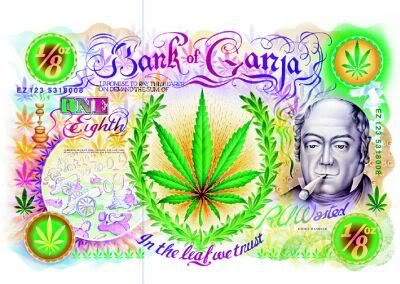
Legal Pot: The Gateway Drug to State-Run Banking?

cannabis-bank-of-ganja-4900451

Karen Weise of Bloomberg Business Week recently reported on proposed legislation from Washington State Senator Bob Hasegawa which would create a state-run bank for Washington’s legal marijuana industry. Cannabis businesses are currently forced to rely heavily on cash. Some still go through traditional banks using separate management companies though there still may be risk of asset forfeiture from the feds. As the article below mentions, state-run banks are an effective solution with proven results.

From Bloomberg:

If ever a hippie dream existed, it would probably look something like what’s being proposed in Washington by Democratic State Senator Bob Hasegawa. He wants to open a state-run bank specifically to serve Washington’s newly legal marijuana industry. The proposal would solve two real problems: Pot businesses would no longer be trapped in an all-cash economy thanks to federal laws that prohibit banks from handling drug money, and the state would send less money to Wall Street.

There’s just one state-run bank in the country: the Bank of North Dakota. It uses the revenue collected through taxes and other government income to provide capital for low-interest loans to state residents, including students, homeowners, and farmers. The bank’s operations return millions to the state’s coffers. (It’s worth noting that the bank has nothing to do with pot.)

As the financial crisis caused a credit crunch for borrowers, some citizens and states themselves started looking to North Dakota as a model of how to keep lending afloat. “After the banking crisis in 2008, some farmers came to me from eastern Washington, literally in tears, saying their credit was being cut off,” Hasegawa says.

Heather Morton, who tracks financial regulation at the National Conference of State Legislatures, found bills in six state legislatures in 2010 related to the creation of state-run banks. Interest swelled as the economy continued to struggle and the Occupy Wall Street movement took up the idea of state banks as an alternative to Wall Street. By 2011 the number of states with bills contemplating the creation of their own banks hit 15, according to Morton’s research, before legislation eventually tapered off last year as the economy improved.

In Washington, one of eight states in which legislation was put forward in 2013, the state-banking push predates the advent of a legal marijuana retail sector. Hasegawa’s bill, which he has sponsored for several years, gained support from 44 out of 98 lawmakers in 2012 but was killed in the banking committee. Each year, Hasegawa tinkers with the legislation in response to opponents, who include the state’s banking community, bond brokers, and the state treasurer. The critics argue that the effort is too risky and would diminish competition, among other things. (After lengthy study, a formal commission in Massachusetts recommended against creating a bank there, saying the effort would be more capital-intensive than it’s worth.)

After voters approved legalizing recreational marijuana in Washington last year, however, Hasegawa saw a new opening. Marijuana businesses have had to resort to largely operating in cash and have been agitating for federal authorities to give banks permission to handle pot accounts. Because pot isn’t legal at the national level, federal money-laundering laws prevent financial institutions from handing marijuana-related money.

Hasegawa has submitted a new bill for the 2014 legislative session that would create a state-run bank as the sole depository for the state’s marijuana businesses. Passage of the bill, which Hasegawa knows is a long shot, would provide “a foot in the door” to a broader state-run bank. But even if it fails, the state senator still sees an upside: “It has drawn the debate away from the detractors of the other arguments.” Washington’s legislative session opens on Jan. 13, and recreational sales in the state are expected to start this spring.

Opposition has now “focused on the illegality of marijuana itself,” Hasegawa says, “which makes me think a lot of their other arguments are really just smoke screens.”

How Colorado Disrupted the Drug War

barack-obama-colorado-marijuana-majority

David Sirota reports on the successful political strategy used by activist Mason Tvert to help decriminalize recreational marijuana use in Colorado. It demonstrates how a slight shift in the public discourse can lead to large and rapid changes in attitudes towards an issue, and hopefully this strategy will be used in other states and countries currently prohibiting recreational cannabis use. Excerpts from Pando Daily:

“Marijuana has been illegal because of the perception of harm surrounding it — that’s how they made it illegal, that’s how it is illegal currently,” Tvert tells me in the shop’s bustling lobby. “Our opponents’ goal has been to maintain a perception of harm. So our idea has been to get people to understand that marijuana is not as harmful as they’ve been led to believe, and not as harmful as a product like alcohol that is already legal.”

Despite increasingly absurd attempts by the government’s drug-war apparatus to obscure the obvious truth, decades of medical and social science research on everything from physiological toxicity, to domestic violence to addiction has proven Tvert’s point that cannabis is less harmful than alcohol. But it was only a few years ago that Tvert’s colleague and future mentor at MPP, Steve Fox, happened upon a key political revelation in the reams of survey data about drug policy.

“He was looking at the polling and discovered that of those who think marijuana is safer than alcohol, 75 percent think it should be legal,” Tvert recounts as we wait behind a customer who is interrogating one of the shop’s staff members about THC and CBD content. “In other words, the number one indicator of whether or not you support marijuana being legal is whether you recognize it is safer than alcohol.”

From that revelation came the creation of the group headed by Tvert that was entirely focused on drawing the alcohol-marijuana comparison. Aptly named Safer Alternative For Enjoyable Recreation (aka SAFER), it was predicated on a two-step strategy.

“Rather than trying to increase the percentage of people who think marijuana should be legal, we simply tried to increase the percentage of people who understand marijuana is less harmful than alcohol, which would naturally produce an increase in the percentage of people who support legalization,” he says.

…In their view, this script-flipping tactic has worked better than any other strategy before it. Not only has it resulted in Colorado legalized weed, but national polls seem to support the larger theory. Indeed, as surveys show more Americans are now viewing marijuana as less harmful than alcohol, they are simultaneously showing a majority now support legalization across the country.

…But even beyond lessons about cannabis is an even larger lesson about how assumptions and frames of reference so often determine the difference between status quo and disruption.

In drug policy, the assumption had long been that prohibition is pro-safety and that legalization is a dangerous experiment. So instead of only amplifying old messages about legalization (it will raise tax revenue, it will end criminal justice iniquities, etc.) Tvert, SAFER and MPP creatively changed the fulcrum of the entire conversation. Rather than portray their fight as one for a brand new, wholly unknown and therefore frightening reality, they used alcohol – a product that most are already comfortable with – to recast their push as one designed to create a new version of current reality. And not just a new version, but a safer reality that doesn’t statutorily encourage people who want to use a mind-altering substance to only use one that is more harmful than cannabis.

…With the rise of social media and the slow-motion fall of a monopoly media that once had complete control over the public policy conversation, there is clearly more opportunity than ever to change the terms of the debate, even on issues that seem utterly intractable.

Read the full article here: http://pando.com/2014/01/07/how-colorado-disrupted-the-drug-war/

A must-see take down of cannabis legalization opponents/media pundits David Brooks and Ruth Marcus from The Colbert Report:

http://www.colbertnation.com/the-colbert-report-videos/431861/january-06-2014/recreational-pot-sales-in-colorado

People’s Lawyer Lynne Stewart Released From Prison

lynne_stewart_0

While most of us were celebrating New Year’s Eve last Tuesday, former activist lawyer Lynne Stewart and her family were celebrating her freedom. On December 31, she was granted a compassionate release from a prison in Fort Worth, Texas by a federal judge and the following day she was back home in Brooklyn.

In 2005 Lynne Stewart was found guilty of helping Sheikh Omar Abdel Rahman (the client she was defending at the time) communicate with supporters. She was sentenced to 28 months in prison and later resentenced for 10 years. Prior to her conviction Stewart was an attorney who represented many economically disadvantaged and anti-establishment defendants such as members of the Weather Underground and Black Panthers.

In 2005, Stewart was also diagnosed with breast cancer and due to her sentencing, crucial and potentially life-saving surgery was delayed for 18 months. By the time she received treatment, her cancer reached Stage Four and had metastasized to the point that her operating physician commented that her condition was the worst he had seen. By December 2013 she was also diagnosed with anemia, high blood pressure, asthma and diabetes, and was likely to have only 18 months left to live according to her doctor.

Despite the fact that Lynne Stewart never should have served such a sentence for trumped up charges designed to hype the pointless “War on Terror” in the first place, it’s fortunate that such a courageous person deserving of respect won’t die alone in prison. Her release is a victory for her family, friends, and countless supporters who fought tirelessly for her cause, including Justice for Lynne Stewart, the Center for Constitutional Rights, the National Lawyers Guild, independent news outlets including Building Bridges Radio, Law and Disorder Radio, and Black Agenda Report, and public figures such as Desmond Tutu, William Pepper, Mark Lane, and Dick Gregory. In support of Stewart’s release, Gregory had this to say:

“The reason for the prosecution and persecution of Lynne Stewart is evident to us all. It was designed to intimidate the entire legal community so that few would dare to defend political clients whom the State demonizes and none would provide a vigorous defense. It also was designed to narrow the meaning of our cherished first amendment right to free speech, which the people of this country struggled to have added to the Constitution as the Bill of Rights.”

TPP: NAFTA on Steroids

TPP-protest-sign-from-Petrovich-lawn1-e1384352291139

by Stephen Lendman

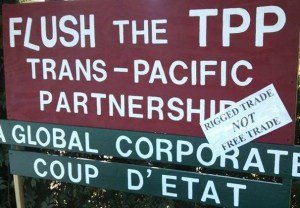
The Trans-Pacific Partnership (TPP) is a trade deal from hell. It’s a stealth corporate coup d’etat.

It’s a giveaway to banksters. It’s a global neoliberal ripoff. It’s a business empowering Trojan horse. It’s a freedom and ecosystem destroying nightmare.

The Electronic Frontier Foundation (EFF) calls it “a secretive, multi-national trade agreement that threatens to extend restrictive intellectual property (IP) laws across the globe and rewrite international rules on its enforcement.”

More on TPP below. New York Times editors support it. Two decades ago, they endorsed NAFTA.


On January 1, 1994, its destructive life began. It’s anti-labor, anti-environment, anti-consumer and anti-democratic.

Corporate giants love it. Why not? They wrote it. Hundreds of pages of one-size-fits-all rules benefit them.

They override domestic laws. A race to the bottom followed. NAFTA was a disastrous experiment. In November 1993, New York editors headlined “The ‘Great Debate’ Over NAFTA,” saying:

“The laboriously constructed agreement to phase out trade barriers among the US, Mexico and Canada, which this page has strongly supported, is likely to have a positive, though small, impact on US living standards and provide a modest boost to the Mexican economy.”

“Some American jobs would be lost to cheaper Mexican labor, other jobs would be gained because American exports would increase as Mexico’s high tariffs gradually disappeared.”

“Economics aside, Nafta’s defeat would suggest that the US had abandoned its historical commitment to free trade and would thus discourage other Latin and South American countries thathave moved toward more market-oriented economies in the expectation of freer world trade.”So-called “free trade” is one-sided. It isn’t fair. NAFTA proponents promised tens of thousands of newly created US jobs.

Ordinary famers would export their way to wealth. Mexican living standards would rise. Economic opportunities would reduce regional immigration to America.

NAFTA’s promises never materialized. Reality proved polar opposite hype. A decade later, about a million US jobs were lost.

America’s Mexican trade deficit alone cost around 700,000 jobs by 2010.

Official government data show nearly five million US manufacturing disappeared since 1994.

NAFTA alone wasn’t responsible. It reflected broken promises, lost futures, and other trade deals from hell to follow. TPP stands out. It’s NAFTA on steroids.

Since 2008, multiple negotiating rounds were held. They continue secretly. Twelve nations are involved.

They include America, Australia, Brunei, Canada, Chile, Japan, Malaysia, Mexico, New Zealand, Peru, Singapore, and Vietnam. Others are invited to join.

At issue is agreeing on unrestricted trade in goods, services, rules of origin, trade remedies, sanitary and phytosanitary measures, technical barriers, government procurement and competition policies, and intellectual property (IP).

It’s about eliminating fundamental freedoms. It’s circumventing sovereign independent rights. Corporate power brokers want unchallenged control.

They want global rules and standards rewritten. They want supranational powers. They want them overriding national sovereignty. They want investor rights prioritized over public ones.

They already rule the world. Imagine giving them more power. Imagine no way to stop them.

Imagine a duplicitous president. Obama’s in lockstep with their wish list. He intends giving them everything they want.

Public Citizen is independent. It’s our voice. Its work entails “ensur(ing) that all citizens are represented in the halls of power.”

Its Global Trade Watch (GTW) monitors TPP developments. It calls it “a stealthy policy being pressed by corporate America. (It’s) a dream of the 1%.” It’ll:

• “offshore millions of American jobs,

• free the banksters from oversight,

• ban Buy America policies needed to create green (and many other) jobs (as well as) rebuild out economy,

• decrease access to medicine,

• flood the US with unsafe food and products,

• and empower corporations to attack our environment and health safeguards.”

Hyped benefits are fake. Reality is polar opposite what corporate shysters claim. Everything accruing from TPP benefits them. It does so by undermining what matters most to ordinary people.

Lori Wallach heads GTW. Ben Beachy is research director. Last June, they headlined their New York Times op-ed “Obama’s Covert Trade Deal.”

He’s committed to open government, he claims. His policies reflect otherwise. He’s negotiating TPP secretly.

It’s “the most significant international commercial agreement since the” World Trade Organization’s 1995 creation, said Wallach and Beachy.

Congress has exclusive “terms of trade” authority. Obama systematically refuses repeated congressional requests to release the entire draft agreement being negotiated.

He “denied requests from members to attend (sessions) as observers.” He “revers(ed) past practice” snubbing them.

He “rejected demands by outside groups” to release the draft text. George Bush never went that far.

Obama’s “wall of secrecy” had one exception. About “600 trade ‘advisors,’ dominated by representatives of big business,” got access to what Congress was denied.

TPP overrides American laws. It requires changing them. Otherwise trade sanctions on US exports can be imposed.

Wall Street loves TPP. It prohibits banning risky financial products. It lets banksters operate any way they want without oversight.

Congress has final say. Both houses will vote on TPP. Ahead of doing so, they’ll have access to its full text.

Why later? Why not now? Why not earlier? Why not without enough time for discussion and public debate?

Members won’t get enough time to examine TPP carefully. Maintaining secrecy as long as possible prevents public debate.

Obama wants TPP fast-tracked. He wants it approved by yearend. Until March, Ron Kirk was Obama’s trade representative.

He was remarkably candid. He said revealing TPP’s text would raise enormous opposition. Doing so might make adopting it impossible.

According to Wallach and Beachy:

“Whatever one thinks about ‘free trade,’ (TPP secrecy) represents a huge assault on the principles and practice of democratic governance.”

“That is untenable in the age of transparency, especially coming from an administration that is otherwise so quick to trumpet its commitment to open government.”

On October 30, a newly formed Friends of TPP caucus was formed. Four House co-chairman head it. They include Reps. David Reichert (R. WA), Charles Boustany (R. LA), Ron Kind (D. WI) and Gregory Meeks (D. NY).

They sound like earlier NAFTA supporters. They claim TPP is important for US jobs, exports and economic growth. They lied saying so.

Wallach commented separately. TPP is hugely hugely destructive, she said. It’s more than about trade. It’s a “corporate Trojan horse.” It has 29 chapters. Only five relate to trade.

The others “either handcuff our domestic governments, limit food safety, environmental standards, financial regulation, energy and climate policy, or establish new powers for corporations.”

They promote offshoring jobs to low-wage countries. They ban Buy America. Corporations can do whatever they please. Instead of investing domestically, they can use “our tax dollars” to operate abroad.

They can exploit national resources freely. They’ll have “rights for min(ed) (commodities), oil, gas” and others “without approval.”

TPP includes all sorts of “worrisome issues relating to Internet freedom.”

It provides a back door to earlier failed legislation. It resurrects SOPA, PIPA, ACTA and CISPA provisions. It tramples on fundamental freedoms and national sovereignty.

“Think about all the things that would be really hard to get into effect as a corporation in public, a lot of them rejected here and in the other 11 countries, and that is what’s bundled in to the TPP,” said Wallach.

“And every country would be required to change its laws domestically to meet these rules.”

“The binding provision is each country shall ensure the conformity of domestic laws, regulations and procedures.”

Negotiations are secret. Nothing is discussed publicly. Details leaked out. TPP includes hugely unpopular policies. It forces them on member countries.

It overrides domestic laws protecting people and ecosystems. It’s predatory capitalism at its worst writ large. Obama fully supports it. Lawmakers hadn’t seen it until last year.

They got access to a single chapter. Examining it is severely restricted. Their office is denied a copy. They alone can read it. Their staff is denied permission.

They can’t take detailed notes. They can’t publicly discuss what’s in it. Technical language makes it hard to understand what they read.

Congressional approval is likely. Lobby pressure is intense. “Everything is bought and sold,” said Wallach. “Honor is no exception.”

The reason there’s no deal so far “is because a lot of other countries are standing up to the worst of US corporate demands,” Wallach explained.

For how long remains to be seen. If TPP is adopted, public interest no longer will matter. The worst of all possible worlds will replace it. Corporate rights will supersede human ones. A global race to the bottom will intensify.

Signatory countries will be legally bound to support loss of personal freedoms. Sovereign laws won’t protect against poisoned food, water and air.

Ecosystems will be destroyed. Millions more jobs will shift from developed to under or less developed nations.

Corporate power will grow more exponentially. Fundamental human and civil rights may erode altogether. Not according to Times editors.

On November 5, they headlined “A Pacific Trade Deal.”

A dozen nations want a deal by yearend, they said. They want it to “help all of our economies and strengthen relations between the United States and several important Asian allies.”

It bears repeating. TPP is a trade deal from hell. It’s a stealth corporate coup d’etat. It’s a freedom and ecosystem destroying nightmare. Times editors didn’t explain.

They lied to readers. They betrayed them. They repeated their 1993 duplicity. Millions affected understand best.

An October 8 White House press release lied. It called TPP “a comprehensive, next-generation model for addressing both new and traditional trade and investment issues, supporting the creation and retention of jobs and promoting economic development in our countries.”

“The deepest and broadest possible liberalization of trade and investment will ensure the greatest benefits for countries’ large and small manufacturers, service providers, farmers, and ranchers, as well as workers, innovators, investors, and consumers.”

Times editors endorsed what they haven’t read. TPP provisions remain secret. Leaked information alone is known.

Times editors willingly accept Obama misinformation as fact. Twenty years ago, they got NAFTA wrong. Here they go again.

They’re mindless about secret negotiations. Public concerns don’t matter. Corporate interests alone count.

Subverting national sovereignty is OK. So is empowering transnational giants without oversight. They’ll be able sue countries for potentially undermining future profits.

Times editors support the worst of corporate excess. Doing so shows which side they’re on.

Fundamental freedoms aren’t important. Corporate rights drive The Times’ agenda. Its editors explained nothing about fast-track authority.

Max Baucus (D. MT) chairs the Senate Finance Committee. He supports fast-tracking. Doing so hands congressional authority to Obama.

Proper hearings are restricted. Debate is limited. Amendments can’t be introduced. The Senate can’t filibuster. Congress can only vote up or down.

It can happen virtually out of sight and mind. It can happen with scant media coverage. It can happen with none at all. It can become law with practically no public awareness.

Imagine corporate America getting coup d’etat authority with hardly anyone knowing what happened. Imagine the consequences if it does. Imagine today’s America becoming worse than ever.

Times editors stressed how Obama wants TPP to be “an example for the rest of the world to follow.”

Imagine one more than ever unfit to live in. Imagine a president promising change to believe in promoting it.

Imagine Times editors endorsing what demands condemnation. Imagine not explaining what readers most need to know.

Imagine substituting misinformation for truth and full disclosure. Imagine all the news they call fit to print not fit to read.

A Final Comment

On November 13, Public Citizen headlined “Leaked Documents Reveal Obama Administration Push for Internet Freedom Limits, Terms That Raise Drug Prices in Closed-Door Trade Talks.”

“US Demands in Trans-Pacific Partnership Agreement Text, Published Today by WikiLeaks, Contradict Obama Policy and Public Opinion at Home and Abroad.”

TPP’s leaked text reveals Obama demands limiting Internet freedom. He wants restricted access to lifesaving medicines.

He wants all TPP signatory countries bound the the same deplorable rules.

He lied claiming TPP reduces health care costs. It has nothing to do with advancing online freedom as he promised. It’s polar opposite on both counts.

According to Public Citizen:

“It is clear from the text obtained by WikiLeaks that the US government is isolated and has lost this debate.”

“Our partners don’t want to trade away their people’s health. Americans don’t want these measures either.”

Obama’s in the pocket of Big Pharma. He’s a Wall Street tool. He represents other corporate interests. He spurns popular ones. He lies claiming otherwise. He repeatedly avoids truth and full disclosure.

He lied about Obamacare. It’s an abomination. It’s a scam. It’s a scheme to enrich insurers and other healthcare giants.

TPP is a global scam. It’s an assault on fundamental freedoms.

Reports indicate around half the House members strongly oppose it. Others lean that way. According to Lori Wallach:

“This could be the end of TPP.”

“All these other countries are like, ‘Wait, you have no trade authority and nothing you’ve promised us means anything. Why would we give you our best deal?’ Why would you be making concessions to the emperor who has no clothes?”

It bears repeating. TPP is a trade bill from hell. It’s a stealth corporate coup d’ etat. Killing it is essential.

The alternative is losing fundamental freedoms. It’s destroying national sovereignty. It’s making healthcare less affordable. It’s undermining what ordinary people value most.

Stephen Lendman lives in Chicago.

He can be reached at lendmanstephen@sbcglobal.net.

His new book is titled “Banker Occupation: Waging Financial War on Humanity.”

http://www.claritypress.com/LendmanII.html

Visit his blog site at sjlendman.blogspot.com.

Listen to cutting-edge discussions with distinguished guests on the Progressive Radio News Hour on the Progressive Radio Network.

It airs Fridays at 10AM US Central time and Saturdays and Sundays at noon. All programs are archived for easy listening.

http://www.progressiveradionetwork.com/the-progressive-news-hour

 

Why ‘I Have Nothing to Hide’ Is the Wrong Way to Think About Surveillance

verizon-we-can-hear-you-now

A common defense of mass surveillance used by apologists is “if you have nothing to hide, why worry?” Nevermind that there’s many things that are perfectly legal that we might not “hide” but choose not to reveal indiscriminately (ie. credit card numbers, medical records, nakedness, etc.), we may in fact have something to hide but not even know it. As noted by Moxie Marlinspike of Wired.com:

If the federal government can’t even count how many laws there are, what chance does an individual have of being certain that they are not acting in violation of one of them?

For instance, did you know that it is a federal crime to be in possession of a lobster under a certain size? It doesn’t matter if you bought it at a grocery store, if someone else gave it to you, if it’s dead or alive, if you found it after it died of natural causes, or even if you killed it while acting in self defense. You can go to jail because of a lobster.

If the federal government had access to every email you’ve ever written and every phone call you’ve ever made, it’s almost certain that they could find something you’ve done which violates a provision in the 27,000 pages of federal statues or 10,000 administrative regulations. You probably do have something to hide, you just don’t know it yet.

He also makes a compelling argument for why we should have something to hide:

Over the past year, there have been a number of headline-grabbing legal changes in the U.S., such as the legalization of marijuana in Colorado and Washington, as well as the legalization of same-sex marriage in a growing number of U.S. states.

As a majority of people in these states apparently favor these changes, advocates for the U.S. democratic process cite these legal victories as examples of how the system can provide real freedoms to those who engage with it through lawful means. And it’s true, the bills did pass.

What’s often overlooked, however, is that these legal victories would probably not have been possible without the ability to break the law.

The state of Minnesota, for instance, legalized same-sex marriage this year, but sodomy laws had effectively made homosexuality itself completely illegal in that state until 2001. Likewise, before the recent changes making marijuana legal for personal use in Washington and Colorado, it was obviously not legal for personal use.

Imagine if there were an alternate dystopian reality where law enforcement was 100% effective, such that any potential law offenders knew they would be immediately identified, apprehended, and jailed. If perfect law enforcement had been a reality in Minnesota, Colorado, and Washington since their founding in the 1850s, it seems quite unlikely that these recent changes would have ever come to pass. How could people have decided that marijuana should be legal, if nobody had ever used it? How could states decide that same sex marriage should be permitted, if nobody had ever seen or participated in a same sex relationship?

…We can only desire based on what we know. It is our present experience of what we are and are not able to do that largely determines our sense for what is possible. This is why same sex relationships, in violation of sodomy laws, were a necessary precondition for the legalization of same sex marriage. This is also why those maintaining positions of power will always encourage the freedom to talk about ideas, but never to act.

Read the full article here: http://www.wired.com/opinion/2013/06/why-i-have-nothing-to-hide-is-the-wrong-way-to-think-about-surveillance/

The East German STASI regime also put their citizens under mass surveillance allegedly for their own good. The information collected was used as leverage by authorities to force informants to betray friends, neighbors and family members.  Trust throughout the society crumbled and eventually the government itself crumbled.