The Commencement Controversy and the Real Mumia

n00000875-b

By Kevin Price

Source: TruthThroughStruggle

Three weeks ago I visited imprisoned journalist, Mumia Abu-Jamal, at SCI-Mahanoy in Pennsylvania. I’ve been visiting with Mumia, sometimes regularly, for the last decade. Despite the polarizing rhetoric from those who’ve fought for three decades for Mumia’s state sanctioned murder, the man I met is one of the kindest, funniest, and most intelligent people I’ve had the pleasure to know. The first time I visited with Mumia, on death row at SCI-Greene in 2004, the conversation was so engaging that the visit was halfway over before I realized his hands had been shackled the whole time. After years of organizing around his case I knew he was a brilliant thinker, but I was pleasantly surprised by his sense of humor and silliness.

I learned of Mumia’s case as a teenager in 1997, when my world was rocked by reading his gripping book documenting death row life, “Live From Death Row.” The same week I purchased his newly released collection of musings, essays, and poems, “Death Blossoms.” I stayed up all night reading it, inspired by the empathy and insight coming through the pages. At that point I was a freshmen in high school and had begun to get politicized by an active punk scene in Norfolk, VA. Mumia’s writing opened my eyes to worlds I had never even considered. I started organizing heavily for a new trial for Mumia as well as working on many other causes and movements. After over 15 years studying this case I know that his trial was a travesty of justice (as does Amnesty International and many international governing bodies) and I believe that he is innocent.

In person and in his writings Mumia rarely focuses on his own case, instead focusing on broad international struggles for justice. On our most recent visit we talked about books we’re reading, world events, and mutual friends. For a few years he’s been studying musical composition and when I told him that I didn’t know how to read music he spent an hour passionately explaining the basics to me. I learned a lot. These visits have been some of the most educational hours of my life. It’s easy, absorbed in conversation, to forget that we are in a prison. It’s hard to comprehend that this man was nearly put to death on two separate occasions and that the mere mention of his name will send many into a fit of rage. If they actually met Mumia they wouldn’t recognize him next to the violent cop-killer straw man the media built in his image. Mumia has been characterized by much of the mainstream media as an unrepentant murderer. When word got out that an audio recording by Mumia would be the commencement address at Goddard College this Sunday, Fox News and other media pundits manufactured a media controversy.

Over the years I’ve seen a lot of backlash by the Fraternal Order of Police and others who want Mumia dead. When Rage Against the Machine and the Beastie Boys organized a massive benefit show in his defense there was media uproar and pressure to shut down the show. When Mumia was made the first honorary citizen of Paris, France since Pablo Picasso, and Saint-Denis, France named a street after him, the US House of Representatives passed HR 1082 condemning Mumia and Saint-Denis, France. The hysteria over having Mumia as the commencement speaker at Goddard is just the most recent in a long series of similar media spectacles. This one hits a bit closer to home for me because I graduated from Goddard College in 2012 and have friends who will be graduating this Sunday. I love Goddard and am very protective of it. Conversations with Mumia were part of the catalyst for my enrolling in Goddard. He attended Goddard in the 70s and finished his degree there in 1995, knowing he might be executed before graduation.

It’s difficult to watch a person that you love and respect routinely slandered in the media. Goddard College and their graduating students have been condemned for their decision and attacked as well. I’m impressed with the way the school and the graduating students are defending their decision. There are a number of symbolic reasons it’s valuable to have Mumia speak at commencement. The United States is the largest jailer in the world history, with over 2,000,000 people in the prison system. Racism plays a key role in deciding who will be convicted and the sentence they will receive, and as a result black men are incarcerated at vastly disproportionate numbers. The lack of educational opportunities and diminishing job options are a huge factor in our sky rocketing rates of imprisonment. If we seek to change these conditions I can think of no better speaker than Mumia Abu-Jamal, an accomplished academic, and brilliant black man who is wrongfully convicted. With the rampant police murders of black people, notably Eric Garner and Mike Brown, it’s important to publicly assert that black lives matter and that the victims of police brutality and judicial misconduct must be defended.

These are wonderful symbolic reasons to celebrate the choice of Mumia as a commencement speaker. However, Mumia is not a symbol. He is a man who was wrongfully held in solitary confinement on death row for nearly 30 years and is now being wrongfully held in general population with no legal possibility for parole. He has children who have had children in the years he’s been away. He is a man with a brilliant mind and an unstoppable pen. Those who oppose him have been fighting for decades to silence his voice. Yet every week, often twice a week, Mumia continues work as a journalist, writing and recording audio commentaries over the prison phone calls. With so much at stake it only seems right that we listen.

_______________________________________________________________________________________________
To hear Mumia’s commentaries go to http://www.prisonradio.org

For more information on who Mumia is, his case and his writings go to http://www.freemumia.com

The Wretched Tenure of Attorney General Eric Holder

Eric Holder

Going…going…almost gone, but let’s not forget him

By Dave Lindorff

Source: This Can’t Be Happening!

Good riddance!

Eric Holder has announced that he is leaving his post of Attorney General, which he has sullied and degraded for six years.

A corporate lawyer with the A-list Washington and Wall Street law firm Covington & Burling, Holder will be remembered for his timid defense of civil rights, his overseeing. and even encouragement of the massive militarization of the nation’s police forces, his anti-First Amendment efforts to pursue not just whistleblowers but the journalists who use them, threatening both with jail and in fact jailing a number of them (particularly in the case of whistleblower extraordinaire Edward Snowden, and Wikileaks journalist Julian Assange, both of whom reportedly face US treason charges), and his weak enforcement of environmental protection laws.

But Holder, who came into his position as the nation’s top law enforcement officer in early 2009 at the start of the Obama administration and at the height of the financial crisis, will be best remembered for his overt announcement that there would be no attempt to prosecute the criminals at the top of the nation’s biggest so-called “too-big-to-fail” banks, whose brazen crimes of theft, deceit, fraud and perjury during the Bush/Cheney years and beyond sank not just the US but the global economy into a crisis which is still with us.

Holder not only did not make any effort to put Wall Street’s banking titans behind bars for their epic crimes; he did not even make them step down from their exalted and absurdly highly compensated executive positions when his office reached negotiated settlements with the banks in civil cases involving those crimes — civil cases that in almost all cases allowed the banks to settle without even having to admit their guilt. (His ludicrous excuse: punishing these criminal executive might jeopardize the banks’ stocks and hurt “innocent” shareholders!) Nor was this legal benevalence limited to purely financial crimes. Banks like Citicorp and HSBC, which were found to have knowingly laundered millions — even billions — of dollars in drug money for drug cartels, were also allowed by Holder to escape with petty fines, and no prosecution of a single bank executive.

As the US Public Interest Research Group (PIRG) notes in its response to word that Holder is leaving as AG [1], his Justice Department generally even allowed the Banks that were fined to deduct those fines from their taxes as a business expense — something that ordinary citizens are not allowed to do by the IRS, and which Holder could have barred the banks from doing.

No surprise there. Among the clients of Holder’s old law firm are both Bank of America and Morgan Stanley. The firm also has since 2010 had a lobbying services contract with Xe Services, the murderous mercenary firm formerly known as Blackwater Worldwide whose bloody abuses in Iraq were so monstrous the company had to change its name (but not its methods) in order to keep obtaining mercenary services contracts from the US government.

It is being suggested that Holder may opt to go back to his old post as a partner at Covington & Burling, which would be the final, though hardly surprising, insult to the American people, providing a particularly galling example of Washington’s revolving door between government regulators and enforcers and the industries that they were supposed to be regulating or keeping honest.

God, how far we have fallen from the days when Ramsey Clark was attorney general, and left to become a leading critic of Washington’s imperial government at home and abroad!

At this point the Obama Administration is little more than a place holder until the next presidential election in 2016. President Obama, who campaigned as a fire-breathing liberal who would restore constitutional government, end the Bush/Cheney wars, re-open the government so that transparency instead of secrecy would be the default position, and take decisive action against climate change, has abandoned all those false promises.

The illegal and unconstitutional wars continue in Iraq and Afghanistan, and are now being expanded into Africa and Syria and, at least by proxy, but most dangerously, to Ukraine. Civil liberties are under attack at least as severely as they were back in the McCarthy period, with whistleblowers being jailed, with the president asserting the unfettered right to order the killing without trial of American citizens, and with a spying system in place run by the National Security Agency that is monitoring and storing, by its own admission, virtually all electronic communications of the American people. The government is also as closed and secret in its operation as it has been since 1974, when it was broadened following the Watergate and Cointelpro scandals, and is certainly less transparent and open than it was even under Bush/Cheney. The Obama administration has also done little to nothing about tackling carbon emissions despite the president’s lies to the contrary in his address to the UN.

In all of this extraordinary list of treachery and cowardice, Holder has played his sycophantic role as a defender of corporate America, of white privilege, and of Washington power. He has been both the John Ashcroft and the Alberto Gonzalez of the Obama administration. (Actually, that comparison is unfair to John Ashcroft, who at least was a man of conviction — repellent as some of those convictions may have been. In Holder’s case, we have a man not of principle, but who is simply a corporate lawyer, ready to do his clients’ bidding, however sordid and corrupt.)

Given the depths of unpopularity to which President Obama has sunk after six years of selling out his own electoral base and catering to the interests of the rich and powerful, the military establishment and neo-con right-wing of the Washington policy elite, it is safe to say that Holder’s replacement, still unknown, will be no better, though given Holder’s tenure it’s also hard to imagine his successor being much worse either.

So good riddance to Holder. But it will be worth while, and indeed important, to watch carefully this departing Obama official’s behavior back in the private sector, from under which rock he emerged to be attorney general six years ago.

“Shock and Awe” Comes to America

Ferguson_Day_6,_Picture_44

By Wayne Madsen

Source: Strategic Culture Foundation

The United States has employed «shock and awe» techniques – described by Pentagon policy documents as the use of «spectacular displays of force» to intimidate an opponent – against the civilian population of the St. Louis, Missouri suburb of Ferguson, just a stone’s throw from Lambert-St. Louis International Airport. The police use of shock and awe tactics followed street protests after the police shooting death of an 18-year old black teen, Michael Brown. According to a private autopsy, Brown, an African-American, was shot six times, including twice in the head, by white Ferguson police officer Darren Wilson. The St. Louis County coroner concluded that the number of shots that hit Brown could have been as high as eight.

Ferguson and St. Louis County police immediately dispatched military vehicles and equipment to quell the initially non-violent protests in Ferguson that erupted after the shooting. Two reporters covering the protests, one from The Washington Post and the other from the Huffington Post, were arrested by the police. An Al Jazeera television crew was subjected to a tear gas attack by police who then proceeded to shut off the news crew’s lights and disable their cameras.

After the local Ferguson and St. Louis County police were criticized for their «shock and awe» tactics, which also saw innocent protesters and members of the clergy shot at point blank range with rubber bullets and tear gassed, Missouri Governor Jay Nixon, who was slow to respond to the racially-inflamed incident, ordered Ferguson and St. Louis County police to stand down. Nixon replaced the local police with Missouri state police troopers who did not initially use military-clad law enforcement or vehicles.

However, after it was revealed that Brown was shot multiple times, rioters were reported to have looted local businesses. Nixon ordered the Missouri National Guard on to the streets and imposed a strict night time curfew. Police on the scene also issued a «keep moving» order to Ferguson citizens, an attempt to prevent any public protest organization efforts by pedestrians.

There were also numerous reports of neo-Nazi, Ku Klux Klan, and other far-right extremists arriving in Ferguson, with police «wink and a nod» foreknowledge in some cases, to stoke violence and engage in «false flag» attacks on people and property. In many respects, Ferguson discovered what occurs when government authorities, officially or unofficially, team up with right-wing racists and xenophobes to menace an entire civilian population. The authorities in Kiev have made similar deals with neo-Nazis, who have links to American white supremacist groups, to attack civilians in eastern and southern Ukraine.

Police allegedly reported that Molotov cocktails were thrown at police by unknown parties after violence increased. The violence was stirred after Ferguson police released a videotape from a convenience store that allegedly showed Brown in a physical altercation with the store’s clerk after Brown was said to have stolen a pack of miniature cigars. The store owner later said that the videotaped individual in what the police released to the media was not Brown and the Ferguson Police Chief later admitted that Officer Wilson did not stop Brown based on any suspicion that it was he who had stolen the cigars.

Eyewitnesses said that police reports that Molotov cocktails were thrown at police vehicles were false. And as further proof that police were permitting agitators to stir up violence, there were a number of social media reports that among those stoking violence in Ferguson was a white man sporting a swastika tattoo.

Governor Nixon later stated that the release of the store’s video by police needlessly incited an already tense situation in Ferguson.

American police using heavy-handed tactics against peaceful protesters is not limited to Ferguson and neither are police arrests of journalists covering protests. Neither was Ferguson the first time police arrested or threatened to arrest national television and radio reporters, as St. Louis area police threatened to do with a reporter for MS-NBC after another night of street violence in Ferguson.

In 2008, national reporters were arrested by police who used unjustified force at a protest at the Republican National Convention in St. Paul, Minnesota. The scenes from Ferguson were also reminiscent of strong-armed police tactics sued against Occupy Wall Street protesters around the country, as well as anti-globalization demonstrations in Seattle; Washington, DC; Pittsburgh, and other cities.

The presence of police-sanctioned provocateurs who engaged in violent acts in order to provoke a «shock and awe» response from military-armed police is endemic to protests around the United States, especially after 9/11, the date viewed by many Americans as the watershed date between pre- and post-Constitutional America.

Someone in the St. Louis County Coroner’s Office also leaked information on Brown’s blood test, saying that it showed past use of marijuana. The leak appeared timed to hurt a number of referenda around the United States on the legalization of marijuana. Many police departments are campaigning against the referenda and it would appear that the St. Louis authorities leaked the information as some sort of proof, albeit bogus, that marijuana legalization will lead to an increase in «violence.»

Many media commentators also drew comparisons between the scenes of the heavy paramilitary presence on the streets of Ferguson to scenes of Israeli soldiers in Gaza and on the West Bank. There are valid reasons for the comparisons.

In 2011, St. Louis County Police Chief Timothy Fitch received training from Israeli Defense Force (IDF) and Israeli National Police officials during a trip to Israel sponsored by the right-wing Anti-Defamation League (ADL). That same year, Oakland, California police who received similar training from former members of the IDF, shot Iraqi war U.S. Army veteran Scott Olsen in the head. Olsen suffered a severe brain injury from the assault.

Companies associated with Israel’s military-law enforcement infrastructure, including those specializing in Israeli Krav Maga martial arts techniques and other Israel crowd control tactics, have not only trained state and metropolitan police forces in the United States, but also state National Guard units. Police departments receiving such training include the St. Louis County Police, as well as the police departments of New York, Philadelphia, Houston, Dallas, Louisville, Richmond, Charlotte, Nashville, Albuquerque, Tulsa, and Atlantic City.

American police departments have a seemingly unlimited supply of military gear, weapons, and vehicles at their disposal. Under the Pentagon’s 1033 program, the Defense Department has made available, often free-of-charge, surplus military equipment to police departments from St. Louis County and Ferguson to Lewiston, Maine and Ohio State University.

Among the excess military equipment distributed to local, metropolitan, county, and state police by the Defense Logistics Agency are highly-mobile multi-wheeled vehicles (Humvees), militarized water craft, mine-resistant ambush protection (MRAP) vehicles, long-range acoustic device (LRAD) sound cannons, assault rifles, night scopes, flash bang grenades, and helicopters.

In addition to receiving population control training from Israelis, American police departments have also been trained by the constantly name-changing firm once known as Blackwater. Formerly known as Xe Security and Academi, the CIA-linked private military company, now merged with Triple Canopy under the Constellis Holdings, Inc., trained a number of U.S. police departments at its military base-like facility in Moyock, North Carolina. One of the police patches on the firm’s training alumni board in Moyock is that of the St. Louis County Police.

In addition to the St. Louis County Police, other U.S. law enforcement agencies trained by Blackwater include the Maricopa County, Arizona Sheriff’s Department; Atlanta Police; Chillicothe, Ohio Police; Charleston, South Carolina Police; Metropolitan Washington, DC Police; Metropolitan Washington Airports Authority Police (Dulles and Reagan National Airports); Prince George’s County, Maryland Police; the FBI SWAT Team; New York Police Department; Fairfax County, Virginia Police; Tampa Police; U.S. Drug Enforcement Administration (DEA); DeKalb County, Georgia Police; Arlington County, Virginia Police; Baltimore Police; U.S. Coast Guard; University of Texas Police; Norfolk, Virginia Police; Chicago Police Department; Oregon State Police; Los Angeles Police Department; Harvey Cedars, New Jersey Police; City of Fairfax, Virginia Police; Alexandria, Virginia Police Special Operations; Illinois State Police; and Dallas Police.

Based on the actions of the St. Louis County police and their cache of Pentagon weapons, as well as their Israeli and Blackwater training, the next dead U.S. citizen – African American, Caucasian, Hispanic, or otherwise – could be found lying in a pool of his or her own blood, drawn by a militarized police officer, from the Jersey shore to the streets of Los Angeles.

Local Police and Much Else Will Be Militarized As Long As Federal Government Is

Outrage In Missouri Town After Police Shooting Of 18-Yr-Old Man

By David Swanson

Source: OpEdNews.com

Groups on the ground in St. Louis are calling for nationwide solidarity actions in support of Justice for Mike Brown and the end of police and extrajudicial killings everywhere.”

As they should. And we should all join in.

But “nationwide” and “everywhere” are odd terms to equate when discussing police militarization. Are we against extrajudicial killings (otherwise known as murder) by U.S. government employees and U.S. weapons in Pakistan? Yemen? Iraq? Gaza? And literally everywhere they occur? The militarization of local police in the United States is related to the militarization of U.S. foreign policy, which has now reached the point that bombing and “doing nothing” are generally conceived as the only two choices available. Local police are being militarized as a result of these factors:

  • A culture glorifying militarization and justifying it as global policing.
  • A federal government that directs roughly $1 trillion every year into the U.S. military, depriving virtually everything else of needed resources.
  • A federal government that still manages to find resources to offer free military weapons to local police in the U.S. and elsewhere.
  • Weapons profiteers that eat up local subsidies as well as federal contracts while funding election campaigns, threatening job elimination in Congressional districts, and pushing for the unloading of weapons by the U.S. military on local police as one means of creating the demand for more.
  • The use of permanent wartime fears to justify the removal of citizens’ rights, gradually allowing local police to begin viewing the people they were supposed to protect as low-level threats, potential terrorists, and enemies of law and order in particular when they exercise their former rights to speech and assembly. Police “excesses” like war “excesses” are not apologized for, as one does not apologize to an enemy.
  • The further funding of abusive policing through asset forfeitures and SWAT raids.
  • The further conflation of military and police through the militarization of borders, especially the Mexican border, the combined efforts of federal and local forces in fusion centers, the military’s engagement in “exercises” in the U.S., and the growth of the drone industry with the military, among others, flying drones in U.S. skies and piloting drones abroad from U.S. land.
  • The growth of the profit-driven prison industry and mass incarceration, which dehumanize people in the minds of participants just as boot camp and the nightly news do to war targets.
  • Economically driven disproportionate participation in, and therefore identification with, the military by the very communities most suffering from its destruction of resources, rights, and lives.

But policing is not the only thing militarized by what President Eisenhower called the “total influence — economic, political, even spiritual” of the military industrial complex. Our morality is militarized, our entertainment is militarized, our natural world is militarized, and our education system is militarized. “Unwarranted influence, whether sought or unsought, by the military industrial complex” is not easily opposed while maintaining the military industrial complex. When Congress Members lend their support to a new war in Iraq while proposing that the U.S. Post Office and a dozen other decent things not be defunded, they are speaking out of both sides of their mouths. The United States cannot live like other wealthy nations while dumping $1 trillion a year into a killing machine.

The way out of this cycle of madness in which we spend more just on recruiting someone into the military or on locking them up behind bars than we spend on educating them is to confront in a unified and coherent manner what Martin Luther King Jr. called the evils of racism, extreme materialism, and militarism. Not racism, extreme materialism, and what the military does to the local police. Not racism, extreme materialism, and what the military does to weapons testing sites. Not racism, extreme materialism, and what the military does to the people of Honduras causing them to flee to a land that then welcomes them with an attitude of militarism. Not any of these partial steps alone, but the whole package of interlocking evils of attitude and mindset.

There is a no-fly-zone over Ferguson, Missouri, because people in the U.S. government view the people of the United States increasingly as they view the people of other countries: as best controlled from the air. Notes the War Resisters League,

“Vigils and protests in Ferguson — a community facing persistent racist profiling and police brutality — have been attacked by tear gas, rubber bullets, police in fully-armored SWAT gear, and tank-like personnel carriers. This underscores not only the dangers of being young, Black, and male in the US, but also the fear of mobilization and rebellion from within racialized communities facing the violence of austerity and criminalization.

“The parallels between the Israeli Defense Forces in Palestine, the Military Police of Rio de Janeiro, the Indian police in Kashmir, the array of oppressive armed forces in Iraq, and the LAPD in Skid Row could not be any clearer. . . .

“This is not happening by accident. What is growing the capacity of local police agencies to exercise this force are police militarization programs explicitly designed to do so. As St. Louis writer Jamala Rogers wrote in an article on the militarization of St. Louis Police this past April, ‘It became clear that SWAT was designed as a response to the social unrest of the 1960s, particularly the anti-war and black liberation movements.’ Federal programs such as DoD 1033 and 1122, and the Urban Areas Security Initiative (UASI), in which St. Louis Police are active participants, provide weapons and training to police departments across the country, directly from the Pentagon. Commenting on the ominous growth of the phenomenon, Rogers continues: ‘and now, Police Chief [of St. Louis Police] Sam Dotson wants to add drones to his arsenal.’

“The events in Ferguson over these last few days demonstrate that the violence of policing and militarism are inextricably bound. To realize justice and freedom as a condition for peace, we must work together to end police militarization and violence.”

The War Resisters League is organizing against Urban Shield, an expo of military weapons for police and training event planned for Oakland, Calif., this September 4-8. The Week of Education and Action will take place in Oakland from August 30-September 5. Read all about it here.

David Swanson is a member of the National Committee of the War Resisters League and wants you to declare peace at http://WorldBeyondWar.org His new book is War No More: The Case for Abolition. He blogs at http://davidswanson.org and http://warisacrime.org and works for http://rootsaction.org. He hosts Talk Nation Radio. Follow him on Twitter: @davidcnswanson and FaceBook.uson

Saturday Matinee: Drug War Double Feature

American_Drug_War_-_The_Last_White_HopeIMG_5412

Source: AmericanDrugWar.com

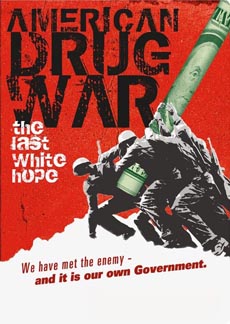
The War on Drugs has become the longest and most costly war in American history, the question has become, how much more can the country endure? Inspired by the death of four family members from “legal drugs” Texas filmmaker Kevin Booth sets out to discover why the Drug War has become such a big failure. Three and a half years in the making the film follows gang members, former DEA agents, CIA officers, narcotics officers, judges, politicians, prisoners and celebrities. Most notably the film befriends Freeway Ricky Ross; the man many accuse for starting the Crack epidemic, who after being arrested discovered that his cocaine source had been working for the CIA.

AMERICAN DRUG WAR shows how money, power and greed have corrupted not just dope fiends but an entire government. More importantly, it shows what can be done about it. This is not some ‘pro-drug’ stoner film, but a collection of expert testimonials from the ground troops on the front lines of the drug war, the ones who are fighting it and the ones who are living it.

Source: AKATommyChong.com

At the height of popularity of the Bush administration — the federal government entrapped and subsequently imprisoned Tommy Chong.  Josh Gilbert began documenting the federal case against his long time friend, for the terrible crime of selling bongs.

This film examines the personal effects on Tommy, the motivations and tactics of the politicized Justice Department under George Bush, set against the back drop of the War on Drugs and the legal issues involved. The film premiered at the Toronto Film Festival to huge press and critical acclaim, and appeared at many other film festivals. It premiered theatrically at Film Forum in New York City and went on to a successful arthouse theatrical release throughout North America. It was recently broadcast on Showtime and the CBC in Canada.

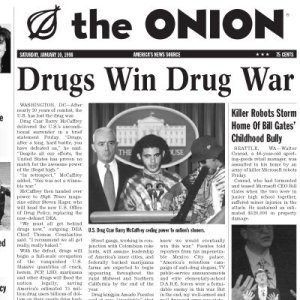
Why We Can’t Wage War on Drugs

drugs-win-war-on-drugs

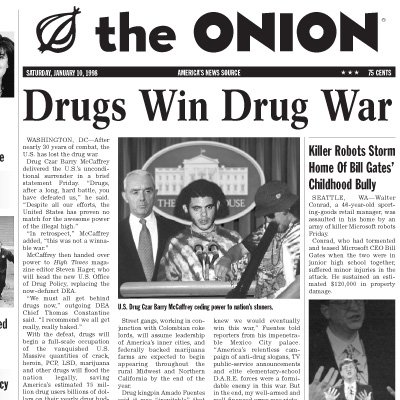
The war on drugs was always a war against an idea. But ideas have a shelf-life, too, and this one has lost its potency

By Mike Jay

Source: Aeon Magazine

When the US President Richard Nixon announced his ‘war on drugs’ in 1971, there was no need to define the enemy. He meant, as everybody knew, the type of stuff you couldn’t buy in a drugstore. Drugs were trafficked exclusively on ‘the street’, within a subculture that was immediately identifiable (and never going to vote for Nixon anyway). His declaration of war was for the benefit of the majority of voters who saw these drugs, and the people who used them, as a threat to their way of life. If any further clarification was needed, the drugs Nixon had in his sights were the kind that were illegal.

Today, such certainties seem quaint and distant. This May, the UN office on drugs and crime announced that at least 348 ‘legal highs’ are being traded on the global market, a number that dwarfs the total of illegal drugs. This loosely defined cohort of substances is no longer being passed surreptitiously among an underground network of ‘drug users’ but sold to anybody on the internet, at street markets and petrol stations. It is hardly a surprise these days when someone from any stratum of society – police chiefs, corporate executives, royalty – turns out to be a drug user. The war on drugs has conspicuously failed on its own terms: it has not reduced the prevalence of drugs in society, or the harms they cause, or the criminal economy they feed. But it has also, at a deeper level, become incoherent. What is a drug these days?

Consider, for example, the category of stimulants, into which the majority of ‘legal highs’ are bundled. In Nixon’s day there was, on the popular radar at least, only ‘speed’: amphetamine, manufactured by biker gangs for hippies and junkies. This unambiguously criminal trade still thrives, mostly in the more potent form of methamphetamine: the world knows its face from the US TV series Breaking Bad, though it is at least as prevalent these days in Prague, Bangkok or Cape Town. But there are now many stimulants whose provenance is far more ambiguous.

Pharmaceuticals such as modafinil and Adderall have become the stay-awake drugs of choice for students, shiftworkers and the jet-lagged: they can be bought without prescription via the internet, host to a vast and vigorously expanding grey zone between medical and illicit supply. Traditional stimulant plants such as khat or coca leaf remain legal and socially normalised in their places of origin, though they are banned as ‘drugs’ elsewhere. La hoja de coca no es droga! (the coca leaf is not a drug) has become the slogan behind which Andean coca-growers rally, as the UN attempts to eradicate their crops in an effort to block the global supply of cocaine. Meanwhile, caffeine has become the indispensable stimulant of modern life, freely available in concentrated forms such as double espressos and energy shots, and indeed sold legally at 100 per cent purity on the internet, with deadly consequences. ‘Legal’ and ‘illegal’ are no longer adequate terms for making sense of this hyperactive global market.

The unfortunate term ‘legal highs’ reflects this confusion. It has become a cliché to note its imprecision: most of the substances it designates are not strictly legal to sell, while at the same time it never seems to include the obvious candidates – alcohol, caffeine and nicotine. The phrase hasn’t quite outgrown its apologetic inverted commas, yet viable alternatives are thin on the ground: ‘novel psychoactive substance’ (NPS), the clunky circumlocution that is preferred in drug-policy circles, is unlikely to enter common parlance. ‘Legal highs’, for all its inaccuracies, points to a zone beyond the linguistic reach of the war on drugs, that fervid state of mind in which any separation between ‘drugs’ and ‘illegal’ seems like a contradiction in terms. Then again, if that conceptual link breaks down, what does become of the old idea of drugs? When the whiff of criminality finally disperses, what are we left with?

I said ‘old idea’, but the word ‘drug’, at least in the sense that has been familiar throughout our lifetimes, turns out to be a recent coinage, peculiar to the 20th century. The word itself is, of course, centuries old: as a general term for any medication or chemical remedy, it dates back to the 14th century. But its more specific sense – as in ‘drug addict’, ‘drug control’ or ‘drug culture’ – can be dated quite precisely to the years around 1900. And on examination, it proves to be a curious hybrid, bridging two quite separate meanings.

The first is psychoactivity. A ‘drug’ is a substance that acts on the mind, changing the way we think or feel. But this descriptive meaning also carries a strong suggestion of judgment, less easily defined but unmistakably negative. ‘Drug’, in this sense, is a label to be avoided. Thus, according to the industries that produce and promote them, alcohol and tobacco are not drugs; cannabis advocates insist it is not a drug but a herb; and LSD enthusiasts say that it is not a drug but a sacrament. Indigenous users of coca, betel nut or ayahuasca are appalled at the suggestion these substances might be drugs. A cup of tea is psychoactive, but we would only call it a drug if we wished to make a point. An indeterminate white powder bought off the internet, on the other hand, might be legal, but it is undoubtedly still a drug.

Before the 20th century, it would have been difficult to express this idea. Many of today’s ‘drugs’, such as cannabis, cocaine and morphine, were sold in any high-street pharmacy. ‘Heroin’, for instance, emerged in 1898 as Bayer Pharmaceuticals’ new brand of over-the-counter cough medicine. Did the authorities simply turn a blind eye to the dangers that these substances posed? They did not: opium was classified as a poison because of its overdose risk, and cannabis was known to cause mental disturbance in some users. Yet these properties did not confer any exceptional status. And why should they? Even today, there are still plenty of prescription medicines that are toxic, habit-forming or that have deliriant side-effects. What made the drug-drugs special? In the 20th century, they came to be defined by their illegality, but of course they could not have been created by it. Only once certain hostile perceptions about drugs were in place could it make sense to ban them. What caused the perceptions?

We might start with the temperance movement. In the 19th century, alcohol was being recognised as a causal factor in all sorts of social ills, and so temperance campaigns promoted sobriety as the path to personal health, moral virtue and social respectability. Progressive social reformers joined forces with doctors and religious authorities to condemn the habitual intoxication of previous generations. Other intoxicating drugs might not have presented such a widespread problem, but they all got swept up in the same mixture of medical, moral and social opprobrium.

By the late 19th century, consumer groups were campaigning against the heavy doses of opiates and cocaine concealed in patent medicines

Global trade, meanwhile, made imported drugs such as opium and cocaine cheap and abundant; industry refined them into newly potent forms, which an energetic and largely unregulated business sector advertised and distributed to a booming consumer market. At the same time, the hypodermic syringe was transforming medical practice. It allowed doctors – and, increasingly, the general public – to inject large quantities of pure and potentially dangerous opiates such as morphine. This brought a breakthrough in pain relief, but also new risks such as abscesses and blood poisoning and, for some patients, compulsive and self-destructive overuse.

By the late 19th century, consumer groups were campaigning against the heavy doses of opiates and cocaine concealed in patent medicines, and doctors were diagnosing addiction as a medical pathology with serious social consequences. The first uses of ‘drug’ in its modern sense date from this era: in its earliest occurrences, it stood as an abbreviation of phrases such as ‘addictive drug’ or ‘dangerous drug’. Doctors advised governments and the public that injections of powerful narcotics should be confined to professionals. Use without medical supervision was classified as ‘abuse’.

Largely couched in medical terms as it was, the whole notion of ‘drugs’ carried moral and cultural implications from the start. Within the temperance debate, intoxication was an evil in itself and abstinence a corresponding virtue. Also, a good many of the substances that caused concern in the West were associated with immigrant communities: opium in the Chinese districts of San Francisco or London’s docklands, cocaine among the black communities of the southern US. In the racially charged debates of the day, these substances were presented as the ‘degenerate habits’ of ‘inferior races’, a ‘plague’ or ‘contagion’ that might infect the wider population. Such ideas might no longer be explicit, but the drug concept certainly carries a murky sense of the foreign and alien even now. That’s why it rarely applies to the psychoactive substances that we see as part of normal life, whether caffeine in the west, coca in the Andes, or ayahuasca in the Amazon.

During the first years of the 20th century, opium, morphine and cocaine became less socially acceptable, rather as tobacco has in our era. Their use was now viewed through the prism of medical harm, and their users correspondingly started to seem feckless or morally weak. The drugs themselves became, in a sense, ‘legal highs’: not technically prohibited but retreating into the shadows, available only under the counter or from those in the know. And then, once their sale was formally banned in the years around the Great War, ‘drugs’ became a term with legal weight: a specified list of substances that were not merely medically dangerous or culturally foreign, but confined to the criminal classes.

The banning of drugs occasioned strikingly little public debate, certainly compared with the prohibition of alcohol in the US. Then again, the ‘drug problem’ was pretty marginal at that point, and confined to subcultures (ethnic, bohemian, criminal) without a public voice. The only organised resistance to this new language of condemnation came from the pharmaceutical industry, concerned that its legitimate trade was being tarnished by unfortunate associations. What’s now the American Pharmacists Association, pressured by its major corporate sponsors such as Johnson & Johnson, complained about the casual use of terms such as ‘drug evil’, ‘drug fiend’ and ‘drug habit’, and lobbied newspapers to specify the drugs in question as ‘narcotics’ or ‘opiates’.

But ‘drugs’ was too vague and too useful to replace with more precise terms. It conveyed not simply particular chemicals, but a moral position on the use of them by certain people and for certain purposes. This position was eventually enshrined in the legal frameworks that emerged to prohibit them. The 1961 UN Single Convention on Narcotic Drugs, the founding document of the international drug laws, is unique among UN conventions in using the word ‘evil’ to describe the problem it seeks to address.

Legislators celebrated the 1961 Convention as the culmination of a 50-year battle to prohibit drugs, a battle that had begun at the Hague Opium Conference of 1911. Yet with hindsight, 1961 was the moment at which the consensus around the evils of drugs began to fracture. An adventurous postwar generation, the first to be raised as truly global consumers, was awakening to the realisation that alcohol was not the world’s only intoxicant. An international underground was beginning to spread news of hashish-smoking in Morocco and LSD synthesised in Swiss laboratories, as well as Benzedrine pills that propelled truck drivers through the night, and hallucinogenic mushrooms in Mexican mountain villages. For many, the resounding denunciations of drugs as dangerous, foreign and criminal no longer rang quite true. Within a booming youth culture, controlled substances were becoming the talismans of a new morality, an entire view of life that valorised pleasure, experiment and self-discovery.

In a sense, Nixon’s war on drugs was lost before it was even announced. It could have succeeded only by uniting an already polarised society in the belief that drugs were a genuine threat to civilisation, and that there was a genuine possibility of returning to a world without them. These propositions grew ever harder to sell over the intervening decades, as drug use became increasingly normal, while the vast sums of money spent trying to control it not only failed to reduce it, but actually created a global criminal market on a scale that Nixon could never have imagined.

psychiatric diagnoses such as low self-esteem and social anxiety open the door to new ‘feel-good’ drugs designed to enhance confidence and happiness

The problem is not just one of unintended consequences. As the war on drugs has dragged on, the medical, moral and cultural certainties that interlocked so tightly to create the very concept of ‘drugs’ have been drifting out of focus. In medical terms, the category rested on a clear distinction between sanctioned ‘use’ and criminal ‘abuse’. Yet today’s consumers are in practice free to make this distinction themselves. The arrival of online pharmacies means we can all take our chances with the prescription drugs of our choice: generic, pirated, off-label, out of date or semi-legitimately dispensed by doctors and pharmacists on the other side of the world. As a result, the line between pharmaceutical and illicit drugs is blurring. Recent studies in the US have found opiate users moving from prescription drugs such as OxyContin and Vicodin to street heroin and back again, depending on price and availability. As new ‘legal highs’ with opiate-like effects come on-stream, any such line may eventually become impossible to draw.

Within the pharmaceutical industry as a whole, other pressures and trends are conspiring to soften the distinction between recreation and medicine, ‘feeling good’ and ‘feeling better’. Smart drugs and nootropics promise to make us feel ‘better than well’; the broadening of psychiatric diagnoses to encompass conditions such as low self-esteem and social anxiety opens the door to new ‘feel-good’ drugs designed to enhance confidence and happiness. Pop-science catchphrases such as ‘serotonin-booster’ might apply equally to antidepressants or to MDMA. At the cutting edge of brain research, neural network studies are pointing the way towards implants for deep-brain stimulation or brain-embedded fibre-optic cables: a brave new world in which moods and perceptions might be controlled electronically and drugs, good or bad, would be redundant.

At the same time, the cultural landscape in which ‘drugs’ were defined is receding from view. Nixon launched his war on drugs in a country where even cannabis was a profoundly alien substance to almost everybody over the age of 30; today, most Westerners below retirement age recognise drugs, for better or worse, as part of the culture in which they grew up. We have long been comfortable global consumers, seeking out the novel and exotic in everything from food to travel, music to spirituality; our appetite for intoxicants participates in this pursuit of novel sensations, and is explicitly linked to it by corporate advertising that uses the visual lexicon of mind-expanding drugs to sell us everything from energy drinks to smartphones. ‘Drugs’, in its original sense, drew on a reflexive distaste for the culturally alien. This distaste has itself become alien to the inhabitants of the 21st century.

As drugs have swirled into this kaleidoscope of lifestyle and consumer choices, the identity of the ‘drug user’ has slipped out of view. A unitary class of ‘drugs’ depended for its coherence on an identifiable class of users, clearly recognised as deviant. But drug use has long ceased to function as a reliable indicator of class, ethnicity, age, political views or any criminality beyond itself. Plenty of drug users self-identify with confidence these days and, if conspicuous drug ‘scenes’ are easily located, the majority of drug use nevertheless takes place outside them. Buying and selling, the point of greatest visibility and risk for the user, has been rendered virtual: the shady street deals of the past can now be conducted online via PayPal or bitcoin, the incriminating package delivered through the letterbox in an innocuous Jiffy bag.

Though its medical and cultural underpinnings might be shifting, the category of drugs is still firmly defined by the law. At their margins, the drug laws could be starting to reflect the reality of what we might call a post-drug world, but it seems unlikely that they will drive the process. When the drug laws were first passed a century ago, they reflected a cultural shift that had already taken place; we can expect them to be dismantled only after the landscape of a post-drug world is plain for all to see. But even now, it is not hard to discern in outline. Alcohol prohibition, when it eventually collapsed, was superseded by a patchwork of regulatory controls – licensing, insurance, tax – that either existed already or were devised on the basis of pragmatic policy goals.

We can envisage a similar patchwork for a day – however close or distant – when drugs are removed from the ambit of criminal law. In so far as any drug presents medical risks, it requires regulation to minimise them, and a well-established spectrum, from labelling to licensing to prescription, already exists for this purpose. In so far as they constitute a luxury market, we might expect them to be taxed. As with alcohol, in some jurisdictions they might remain illegal by broad popular consent. The prohibition of drugs, including alcohol, was an emergency measure that overrode the logic of pragmatism. The alternative is not another leap in the dark, but a return to the routine regulatory calculus.

But what lies beyond the idea of ‘drugs’ itself? The simple answer is that there is nothing to replace. Behind the term lies a disparate group of chemicals whose varied effects – stimulant, narcotic, psychedelic, euphoriant – offer a more accurate language of description. Value-laden terms, both positive and negative, would doubtless emerge to complement them. A post-drug world would require not a new language but the recovery of an older one. The category of ‘drugs’ was an attempt, characteristic of its historical moment, to separate out good chemicals from bad ones. But as we have known since antiquity, good and evil, virtue and vice are not inherent in a plant or a molecule. Pedanius Dioscorides, the great classical authority on medicine, maintained that no substance is intrinsically good: it all depends on the dose at which it is administered, the use to which it is put, and the intentions behind that use. The Greek term pharmakon could mean both a medicine and a poison: there was no such thing as a harmless remedy, since anything with the power to heal also had the power to harm. All drugs, psychoactive or otherwise, are a technology, a prosthetic that extends our physical and mental reach. Like so many of the other technologies that are transforming our world, their benefits and dangers must ultimately be understood as extensions of ourselves.

The Stealing of America by the Cops, the Courts, the Corporations and Congress

edward_r_murrow_a_nation_of_sheep_will_soon_have_a_government_of_wolves__2013-06-24

By John W. Whitehead

Source: The Rutherford Institute

“What the government is good at is collecting taxes, taking away your freedoms and killing people. It’s not good at much else.” —Author Tom Clancy

Call it what you will—taxes, penalties, fees, fines, regulations, tariffs, tickets, permits, surcharges, tolls, asset forfeitures, foreclosures, etc.—but the only word that truly describes the constant bilking of the American taxpayer by the government and its corporate partners is theft.

We’re operating in a topsy-turvy Sherwood Forest where instead of Robin Hood and his merry band of thieves stealing from the rich to feed the poor, you’ve got the government and its merry band of corporate thieves stealing from the poor to fatten the wallets of the rich. In this way, the poor get poorer and the rich get richer. All the while, the American Dream of peace, prosperity, and liberty has turned into a nightmare of endless wars, debilitating debt, and outright tyranny.

What Americans don’t seem to comprehend is that if the government can arbitrarily take away your property, without your having much say about it, you have no true rights. You’re nothing more than a serf or a slave.

In this way, the police state with all of its trappings—from surveillance cameras, militarized police, SWAT team raids, truancy and zero tolerance policies, asset forfeiture laws, privatized prisons and red light cameras to Sting Ray guns, fusion centers, drones, black boxes, hollow-point bullets, detention centers, speed traps and abundance of laws criminalizing otherwise legitimate conduct—is little more than a front for a high-dollar covert operation aimed at laundering as much money as possible through government agencies and into the bank accounts of corporations.

The rationalizations for the American police state are many. There’s the so-called threat of terrorism, the ongoing Drug War, the influx of illegal immigrants, the threat of civil unrest in the face of economic collapse, etc. However, these rationalizations are merely excuses for the growth of a government behemoth, one which works hand in hand with corporations to profit from a society kept under lockdown and in fear at all times.

Indeed, as I point out in my book A Government of Wolves: The Emerging American Police State, the real motivating factor behind erecting a police state is not to protect the people, but to further enrich the powerful. Consider the following costly line items, all part of the government’s so-called quest to keep us safe and fight terrorism while entrenching the police state, enriching the elite, and further shredding our constitutional rights:

$4.2 billion for militarized police. Almost 13,000 agencies in all 50 states and four U.S. territories participate in a military “recycling” program which allows the Defense Department to transfer surplus military hardware to local and state police. In 2012 alone, $546 million worth of military equipment was distributed to law enforcement agencies throughout the country.

$34 billion for police departments to add to their arsenals of weapons and equipment. Since President Obama took office, police departments across the country “have received tens of thousands of machine guns; nearly 200,000 ammunition magazines; thousands of pieces of camouflage and night-vision equipment; and hundreds of silencers, armored cars and aircraft.” While police departments like to frame the acquisition of military surplus as a money-saving method, in a twisted sort of double jeopardy, the taxpayer ends up footing a bigger bill. First, taxpayers are forced to pay millions of dollars for equipment which the Defense Department purchases from megacorporations only to abandon after a few years. Then taxpayers find themselves footing the bill to maintain the costly equipment once it has been acquired by the local police.

$6 billion in assets seized by the federal government in one year alone. Relying on the topsy-turvy legal theory that one’s property can not only be guilty of a crime but is also guilty until proven innocent, government agencies have eagerly cashed in on the civil asset forfeiture revenue scheme, which allows police to seize private property they “suspect” may be connected to criminal activity. Then whether or not any crime is actually proven to have taken place, the cops keeps the citizen’s property. Eighty percent of these asset forfeiture cases result in no charge against the property owner. Some states are actually considering expanding the use of asset forfeiture laws to include petty misdemeanors. This would mean that property could be seized in cases of minor crimes such as harassment, possession of small amounts of marijuana, and trespassing in a public park after dark.

$11,000 per hour for a SWAT team raid on a government dissident. The raid was carried out against Terry Porter, a Maryland resident who runs a welding business, is married with three kids, is outspoken about his views of the government, and has been labeled a prepper because he has an underground bunker and food supplies in case things turn apocalyptic. The raiding team included “150 Maryland State Police, FBI, State Fire Marshal’s bomb squad and County SWAT teams, complete with two police helicopters, two Bearcat ‘special response’ vehicles, mobile command posts, snipers, police dogs, bomb disposal truck, bomb sniffing robots and a huge excavator. They even brought in food trucks.”

$3.8 billion requested by the Obama administration to send more immigration judges to the southern border, build additional detention camps and add border patrol agents. Border Patrol agents are already allowed to search people’s homes, intimately probe their bodies, and rifle through their belongings, all without a warrant. As one journalist put it, “The surveillance apparatus is in your face. The high-powered cameras are pointed at you; the drones are above you; you’re stopped regularly at checkpoints and interrogated.” For example, an American citizen entering the U.S. from Mexico was subjected to a full-body cavity search in which she was subjected to a variety of invasive procedures, including an observed bowel movement and a CT scan, all because a drug dog jumped on her when she was going through border security. Physicians found no drugs hidden in her body.

$61 billion for the Department of Homeland Security, one of the most notoriously bloated government agencies ever created. The third largest federal agency behind the Departments of Veterans Affairs and Defense, the DHS—with its 240,000 full-time workers and sub-agencies—has been aptly dubbed a “runaway train.”

$80 billion spent on incarceration by the states and the federal government in 2010. While providing security, housing, food, medical care, etc., for six million Americans is a hardship for cash-strapped states, it’s a gold mine to profit-hungry corporations such as Corrections Corp of America and GEO Group, the leaders in the partnership corrections industry. Thus, with an eye toward increasing its bottom line, CCA has floated a proposal to prison officials in 48 states offering to buy and manage public prisons at a substantial cost savings to the states. In exchange, the prisons would have to contain at least 1,000 beds and states would have to maintain a 90% occupancy rate for at least 20 years. This has led to the phenomenon of overcriminalization of everyday activities, in which mundane activities such as growing vegetables in your yard or collecting rainwater on your property are criminalized, resulting in jail sentences for individuals who might otherwise have never seen the inside of a jail cell.

$6.4 billion a year for the Bureau of Prisons and $30,000 a year to house an inmate. There are over 3,000 people in America serving life sentences for non-violent crimes. These include theft of a jacket, siphoning gasoline from a truck, stealing tools, and attempting to cash a stolen check. Most of the non-violent offenses which triggered life sentences were drug crimes involving trace amounts of heroin and cocaine. One person imprisoned for life was merely a go-between for an undercover officer buying ten dollars’ worth of marijuana. California has more money devoted to its prison system than its system of education. State spending on incarceration is the fastest growing budget item besides Medicaid.

93 cents an hour for forced, prison labor in service to for-profit corporations such as Starbucks, Microsoft, Walmart, and Victoria’s Secret. What this forced labor scheme has created, indirectly or not, is a financial incentive for both the corporations and government agencies to keep the prisons full to capacity. A good portion of the 2 million prisoners in public facilities are forced to work for corporations, making products on the cheap, undermining free laborers, and increasing the bottom line for many of America’s most popular brands. “Prison labor reportedly produces 100 percent of military helmets, shirts, pants, tents, bags, canteens, and a variety of other equipment. Prison labor makes circuit boards for IBM, Texas Instruments, and Dell. Many McDonald’s uniforms are sewn by inmates. Other corporations—Microsoft, Victoria’s Secret, Boeing, Motorola, Compaq, Revlon, and Kmart—also benefit from prison labor.”

$2.6 million pocketed by Pennsylvania judges who were paid to jail youths and send them to private prison facilities. The judges, paid off by the Mid Atlantic Youth Service Corporation, which specializes in private prisons for juvenile offenders, had more than 5,000 kids come through their courtrooms and sent many of them to prison for petty crimes such as stealing DVDs from Wal-Mart and trespassing in vacant buildings.

$1.4 billion per year reportedly lost to truancy by California school districts, which receive government funding based on student attendance. The so-called “solution” to student absences from school has proven to be a financial windfall for cash-strapped schools, enabling them to rake in millions, fine parents up to $500 for each unexcused absence, with the potential for jail time, and has given rise to a whole new track in the criminal justice system devoted to creating new revenue streams for communities. For example, Eileen DiNino, a woman serving a two-day jail sentence for her children’s truancy violations, died while in custody. She is one of hundreds of people jailed in Pennsylvania over their inability to pay fines related to truancy, which include a variety of arbitrary fees meant to rack up money for the courts. For example, “[DiNino’s] bill included a laundry list of routine fees: $8 for a “judicial computer project”; $60 for Berks constables; $40 for “summary costs” for several court offices; and $10 for postage.” So even if one is charged with a $20 fine, they may end up finding themselves on the hook for $150 in court fees.

$84.9 million collected in one year by the District of Columbia as a result of tickets issued by speeding and traffic light cameras stationed around the city. Multiply that income hundreds of times over to account for the growing number of localities latching onto these revenue-generating, photo-enforced camera schemes, and you’ll understand why community governments and police agencies are lining up in droves to install them, despite reports of wide scale corruption by the companies operating the cameras. Although nine states have banned the cameras, they’re in 24 states already and rising.

$1.4 billion for fusion centers. These fusion centers, which represent the combined surveillance and intelligence efforts of federal, state and local law enforcement, have proven to be exercises in incompetence, often producing irrelevant, useless or inappropriate intelligence, while spending millions of dollars on “flat-screen televisions, sport utility vehicles, hidden cameras and other gadgets.”

In sum, the American police state is a multi-billion dollar boondoggle, meant to keep the property and the resources of the American people flowing into corrupt government agencies and their corporate partners. For those with any accounting ability, it’s clear that the total sum of the expenses being charged to the American taxpayer’s account by the government add up to only one thing: the loss of our freedoms. It’s time to seriously consider a plan to begin de-funding this beast and keeping our resources where they belong: in our communities, working for us.

Why It’s Worth Paying More for Legal Pot

By Dominic Holden

Source: The Stranger

I bought a bag of marijuana today at Cannabis City, Seattle’s first legal retail pot store, just after they opened at noon. (Surprisingly for a pot store, they opened on time.) It was a different experience from every other time I’ve bought pot—and I’ve bought a lot of pot before—not just because there were dozens of TV crews swarming outside. What legalization provides, prohibition never could: explicit certainty about what I purchased, what it contains, what it doesn’t contain, where it came from, where the money goes, and the promise that every time I purchase this product it will be essentially the same.

Here’s the excellent pot, the bag, a receipt, and a very detailed label:

thumb-1404869035-pot_and_receipt

$40 gets you two grams of pot and more information about your stash than you’ve ever had before.

Consumers will decide whether all that certainty is worth the price; the two-gram bag was $40, including $10 in tax, which is generally higher than street prices.

Some people already say it’s not worth it. Standing beyond the media frenzy was John Stuart, 24, who was wearing a pair of pot-leaf-print shorts and a Marilyn Manson t-shirt. His friend had a white pit bull on a rope. Were they waiting to buy pot inside? “No, because I got a medical-marijuana card and it’s way too expensive at Cannabis City,” said Stuart. “You could go to Westlake Park and get it for $10 a gram. That’s a lot cheaper than going to the store.”

But the pot Stuart can buy in a dispensary or in a park will never be like this. The glut of information on that label represents something between government overreach and a pot-lover’s dream come true.

The largest typeface on the label details the precise composition of the drug. This strain is called OG’s Pearl, which contains exactly 21.5 percent THC (the predominant set of psychoactive chemicals in cannabis). The label then lists the CBD, a more narcotic chemical found in marijuana, and the nonpsychoactive CBG. The label goes on: These buds are 80 percent indica-type cannabis (as opposed to the more stimulating sativa, which presumably makes up the other 20 percent). It lists the moisture content (6.25 percent), the day it was harvested (June 2), the day it was tested (June 23), where it was grown (Kitsap County), how it was grown (indoors), and who grew it (Nine Point Growth Industries).

If I like this product, I can buy it again and it will reliably be the same thing. If the product changes—how or where it’s grown, whether there are shifts in chemical composition at the next harvest—it will be right there on the label.

This chunk of vegetation, like all the pot legally sold in Washington, was tracked from the time it was a baby clone to a full-grown plant, then tracked from harvest and into this package. And because it’s so closely tracked, consumers have unprecedented certainty that it’s not tainted with contaminants (other drugs, sketchy fertilizers, tobacco juice, mold, soap, etc.).

It’s also a guaranteed weight—you’re not going to get shorted on your deal—and you know your money is paying for legit, in-state jobs, not funding some murderous interstate cartel.

But if Mr. Stuart buys pot in the park, it’s all but certain he’ll have no idea what he’s really getting (or where his money goes). Even dispensaries will lie through their teeth about what they’re selling—I know because it was once my job to tell that lie.

In my 20s, I worked briefly as an assistant manager in a marijuana dispensary in California. Each morning, growers would deliver massive sacks of weed to the back door, and we’d haul them to an upstairs office for inventory purposes. It turns out, one of my jobs there was to name the strains. People talk a lot about pot strains like they’re of hallowed pedigree, and some of them are legit examples of growers developing a unique variety (classics like White Widow or Blueberry, or newer strains like Jack Herer). But a lot of strain names? They’re totally fabricated. There’s always pothead lore about how one strain is stronger, how it makes you happy, how it’s got a “really mellow vibe,” or it’s “good for sleep.” But most of that is bullcrap. At the dispensary I worked for, part of my job was to fabricate names as a marketing ploy. I’d just make ’em up. I called them Einstein, Alligator, Beethoven, Plato—any name I’d think could sell. And if the name was marketable and we’d run out of that type of pot? We’d find another type of pot and call it the same name. Long story short: Under prohibition, the name’s meaningless. The place you bought it didn’t guarantee its provenance. You never knew what you were getting from one bag to the next.

With the standards we have in Washington, we don’t have punk-ass kids (like me) making up stuff about your weed and you don’t have to guess what you’re smoking. The question is: Do we have enough legal pot to keep this system running?

1404863612-holcomb_and_pot

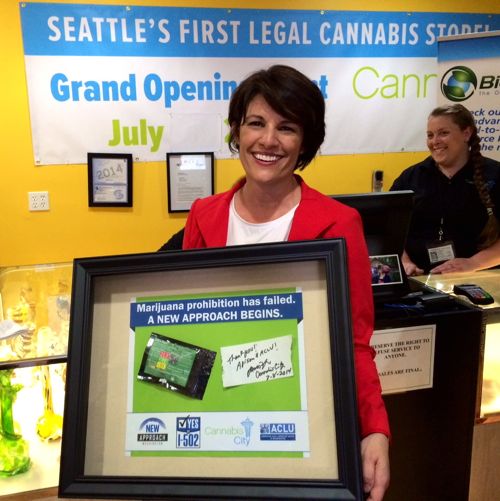
ALISON HOLCOMB: Beaming for bud.

Alison Holcomb, who sponsored the initiative that legalized marijuana, bought a bag of pot herself today. She acknowledged the shortages of ready-to-use marijuana, as we wrote about over here, and said the first day was not as critical as the state being able to license enough growers to maintain a supply chain: “It is critical that we can sustain stores, instead of seeing them going under due to lack of product to sell to customers.”

But she added that the stores we have are better than what she expected. “When we drafted the initiative [in 2011], we were thinking of the state-run liquor stores,” said Holcomb. But unlike the austere state booze outlets, which were nixed by voters, the Cannabis City showroom has hardwood floors, wooden paneling, and illuminated display cases. “This is warmer and more inviting than what we envisioned,” said Holcomb. (It’s also a helluva lot nicer than buying pot in an alley or at some chatty dealer’s apartment.)

Cannabis City owner James Lathrop was beside himself with self-satisfaction. “I declare this war over,” he told the crowd. (Good for him, but tell that to people in the other 48 states.)

However, Lathrop, Holcomb, and others also provided something with legal pot you’ll never see from a street dealer: a level-headed warning in writing.

Every customer was handed an informational “consumer’s guide” pamphlet with “what you should know” about pot use in a Washington State. It warns about the potency of edibles (which aren’t in stores yet), the law about driving stoned (don’t do it), and the rules about where you can consume it (in private places, but not in hotels that ban smoking).

That pamphlet—free of fear-mongering—represents a tiny but critical revolution in drug education: It’s produced by the Washington State Liquor Control Board, a state agency, but it’s sponsored by and features the logos of the ACLU, the National Organization for the Reform of Marijuana Laws, and the Marijuana Business Association. This pamphlet is evidence of government critics co-opting government.

This is the end of “Just Say No” in our state. That was an era of the government lying about the harms of pot and promising you that one toke led to a lifetime of addiction, while pro-pot forces generally exaggerated the benefits and downplayed the risks. More and more, both sides are settling on the facts and providing all the information—sometimes more than you know what to do with, right on the label—for users make up their own minds. You know you’re buying local.

So if it costs a few bucks more per gram, it’s worth it.

Editor’s note: while I agree with much of the author’s arguments, there is something to be said for supporting blackmarket pot as well. In cases where you and the dealer develop friendship and trust you can get comparable consistency of quality. Though it may not always be the exact same strain, it can be a pleasant surprise to try something new. You may also have an opportunity to experience other illegal substances if you choose (but always do the research first). If/when cannabis becomes as commercialized as foods and tobacco, you may not be able to trust the labels on the package anyway. And why not show loyalty towards those who have provided quality service through the dark days of prohibition at the risk of their freedom and security?