Darren Wilson Wasn’t the First: A Short History of Killer Cops Let Off the Hook

michael-brown-darren-wilson

The U.S. has a long history of allowing police to walk free after vicious racist violence.

By Flint Taylor

Source: In These Times

The Ferguson grand jury’s decision not to indict Ferguson police officer Darren Wilson for the killing of African-American teenager Michael Brown is heartless but unsurprising. But it is important to place the case in context with the history of police violence investigations and prosecutions in high profile cases—and the systemic and racist police brutality that continues to plague the nation. In doing so, there are lessons for the movement for justice in the Michael Brown case, as well as for those who are engaged in the broader struggle against law enforcement violence.

What follows, then, is a brief history of similar high profile cases where public outrage compelled the justice system to confront acts of racially motivated police violence—with, to say the least, less than satisfactory results.

Chicago

Over the past 45 years, Chicago has been a prime example of official indifference and cover-up when it comes to prosecuting the police for wanton brutality and torture.

On December 4, 1969, Black Panther leaders Fred Hampton and Mark Clark were slain in a police raid that implicated the Cook County State’s Attorney and the FBI’s Cointelpro program. A public outcry led to a Federal Civil Rights investigation. Despite finding that the raiding police fired more than 90 shots to one by the Panthers, the Grand Jury in 1970 did not indict, but rather issued a report that equally blamed the police perpetrators and the Panther victims.

Outrage at this decision led to the appointment of a Special Prosecutor who, in the face of extreme official resistance, obtained an indictment against the police and the State’s Attorneys who planned and executed the raid—not for murder and attempted murder, but rather for obstruction of justice.

The case came to trial in front of a politically connected judge who dismissed the case without even requiring that the charged officials put on a defense. Again, the outrage, particularly in the African-American community was so extreme that the chief prosecutor, Edward V. Hanrahan, was voted out of office a week after the verdict was rendered in 1972.

The Jon Burge police torture scandal provides another stark example. Evidence that had been unearthed over the years demonstrated that a crew of predominately white Chicago police detectives, led by Jon Burge, tortured at least 120 African-American men from 1972 to 1991.

Cook County State’s Attorney Richard M. Daley was tendered powerful evidence of this torture as early as 1982, but did not investigate or prosecute Burge and his men. Daley’s office continued to use confessions tortured from the victims to send scores of them to prison—10 of whom went to death row, though they were later saved by a death penalty moratorium in 2000 and by a grant of clemency in 2003 by then-Governor George Ryan—during the next seven years.

In 1989, the local U.S. Attorneys’ office declined to prosecute, as did the Department of Justice in 1996 and Cook County State’s Attorney Richard Devine for the five years directly thereafter. In 2001, due to continuing public pressure, a politically connected Special Prosecutor was appointed to investigate the torture. But after a four year, $7 million investigation, he too refused to indict, instead issuing what is widely considered to be a whitewash report that absolved Daley, Devine, and numerous high Chicago police officials.
Finally, in 2008 the U.S. Attorney indicted Burge for perjury and obstruction of justice, and he was convicted in 2010, and sentenced to 4 ½ years in prison. However, the U.S. Attorney has subsequently declined to prosecute Burge’s confederates for similar offenses.

New Orleans

Chicago is by no means an isolated example of how difficult it is to obtain justice for wanton police violence through the judicial system. In New Orleans, a crew of white detectives responded to the killing of a white police officer in 1980 by terrorizing the black community of Algiers, killing four innocent people and torturing numerous others by “booking and bagging” them: beating suspects with telephone books and suffocating them with bags over their heads.

Seven officers were indicted by the Department of Justice for civil rights violations arising from the torture of one of the victims and three were convicted.  No officers were charged for the four killings or for the other acts of torture.

In 2005, in the wake of Hurricane Katrina, an NOPD officer fatally shot an unarmed black man named Henry Glover, then several of his fellow officers burned his body to cover-up their crime. NOPD officers also shot and killed two unarmed black men on the Danziger Bridge.

After state authorities botched their investigation, the Civil Rights Division of the Justice Department indicted the officers involved in the two cases and obtained convictions of some of the main police actors. However, the Court of Appeals for the Fifth Circuit overturned the verdict in the Glover case, and the trial judge, citing government misconduct, took the extraordinary step of granting the convicted officers a new trial in the Danziger case. 

New York

In 1997, an NYPD officer sexually assaulted a Haitian-American man named Abner Louima in a precinct station bathroom by shoving a broken broomstick up his rectum. Louima’s attacker was subsequently charged with federal civil rights violations, while three of his police accomplices were charged with covering up the crimes.

After Louima’s attacker pleaded guilty, his accomplices were convicted, but the Second Circuit Court of Appeals overturned their convictions on the grounds that the lawyers who represented the officers had a conflict of interest. After they were convicted a second time, the Appeals Court again overturned their convictions—this time on the basis that there was insufficient evidence of intent.

In 1999, four officers from the NYPD’s Street Crimes Unit fired 41 shots at Amadou Diallo, a Guinean immigrant who was reaching for his wallet, hitting him 19 times. The officers were indicted for second degree murder and the case was moved to upstate New York, where a jury acquitted the officers. 

In July of this year, NYPD officers arrested an African-American man named Eric Garner, allegedly for selling untaxed cigarettes. They put a prohibited chokehold on him, forced him to the ground face first with his hands behind his back, and shoved his face into the pavement, where he died a few minutes later of a heart attack. The deadly assault, which was captured on videotape, is now under investigation by a Special Grand Jury empaneled by the District Attorney’s Office.

Los Angeles

Among the most notorious cases was the brutal 1991 beating of Rodney King by five LAPD officers. A videotape captured most of the brutality and also showed several other officers standing by and doing nothing to stop the pummeling of a defenseless black man.

Four officers were charged at the state level with assault with a deadly weapon and use of excessive force. The trial was moved to a predominantly white suburban county, and three of the officers were acquitted of all charges, while the fourth was acquitted of assault with a deadly weapon and other lesser charges. But the jury failed to reach a verdict on his use of excessive force.

After an angry uprising in the Africa- American community of Los Angeles that left 53 dead and around 2,000 injured, the U.S. Justice Department indicted the four officers, and a federal jury convicted two of them, while acquitting the other two.

This past August, LAPD officers fatally shot an unarmed mentally ill African-American man named Ezell Ford, who witnesses said was shot in the back while lying on the ground. Despite massive protests, there has been no grand jury investigation to date, the autopsy report is yet to be released, and the LAPD has not completed its investigation.

Oakland

In Oakland, California in the late 1990s, a unit of police officers dubbed the “Rough Riders” systematically beat, framed and planted narcotics on African Americans whom they claimed were dealing drugs. Four of the “Riders” were indicted by the District Attorney’s Office, and the trial was moved to a suburban county. The ringleader fled the country, and was tried in absentia.

After a year-long trial before a bitterly divided jury on which there were no blacks, the officers were acquitted of eight charges, and the jury was hung on the remaining 27 counts. At the urging of then-Mayor Jerry Brown, the officers were not re-tried.

Also in Oakland, in the early morning hours of New Years Day, 2009, a BART officer shot and killed a young black man named Oscar Grant, who was lying face down, unarmed,  in a busy transit station. The shooting was videotaped, and led to militant protests in Oakland.

Another jury with no black members rejected the charge of murder and instead found the officer guilty of involuntary manslaughter. As a result, Oscar Grant’s killer spent less than a year behind bars. The Department of Justice subsequently opened a civil rights investigation, but no charges were brought.

Milwaukee

From 2007-2012 in Milwaukee, a unit of white police officers, spurred on by the Department’s CompStat program of aggressive policing, stopped and illegally body cavity searched more than 70 African-American men whom they claimed to be investigating for drug dealing. In conducting these searches, most commonly performed on the street, the searching officer reached inside the men’s underwear, and probed their anuses and genitals.

After this highly illegal practice came to light, the unit’s ringleader, Michael Vagnini, was indicted by the Milwaukee County District Attorney on numerous counts of sexual assault, illegal searches, and official misconduct, while three of the other unit officers were also charged for participating in two of the searches. The unit’s sergeant and several other members of the unit, all of whom were present for many of the searches, were not charged.

The charged officers were permitted to plead guilty to the lesser included offenses of official misconduct and illegal strip searches, with Vagnini receiving a 36-month sentence while the other three received sentences that totaled, collectively, less than a month in jail. By pleading guilty, they also received promises that they would not be charged with federal civil rights violations.

Pattern and Practice Investigations

These high profile cases represent only the tip of the iceberg when it comes to cases where racist police violence has not been subjected to equal justice under the law.

Recently, the Justice Department declined to prosecute Little Rock, Arkansas, officers who shot and killed Eugene Ellison, an elderly African American man who was walking out of his home with a cane in his hand, while there have been documented reports of unarmed black men recently being shot down by the police in Chicago; Houston; San Antonio; Beaver Creek, Ohio; and Sarasota, Florida.

In 1994, the United States Congress, recognizing that police misconduct and violence was systemic in many parts of the country, passed 42 U.S. Code Section 14141, which empowered the Justice Department to file suit against police departments alleging patterns and practices of unconstitutional conduct, and to obtain wide ranging court orders, consent decrees, and independent monitors in order to implement reforms to those practices.

Although understaffed, the Pattern and Practice Unit of the Justice Department has attacked systemic and discriminatory deficiencies in police hiring, supervision, and monitoring in numerous police departments over the past 20 years.  A particularly egregious act or series of acts of police violence often prompts the Unit to initiate an investigation, and its lawyers have obtained consent decrees or court orders in Cincinnati, Pittsburgh, Steubenville, Ohio, New Orleans, Puerto Rico, Oakland, and Miami.

Last month, lawyers handling the Little Rock cases requested that the DOJ do a pattern and investigation of the LRPD, and the Unit is reportedly now investigating the practices of the Ferguson Police Department. While these investigations are not a panacea, they offer a mechanism for exposing and reforming blatantly unconstitutional police practices, and have also demonstrated how pervasive the problem systemic police violence continues to be.

In light of this history, the pre-ordained failure of a biased local prosecutor to obtain an indictment against Darren Wilson should not surprise us. But the movement for justice for Michael Brown has brought widespread attention to the nationwide problem of systemic and racist police violence and highlighted the movement that has come together to battle against it.

Just two weeks ago, the Brown case, along with the Burge torture cases, was presented to the United Nations Committee Against Torture in Geneva. The movement should now turn its attention to the Department of Justice, demanding a federal civil rights indictment against Wilson a full scale pattern and practice investigation of the Ferguson Police Department, and, more broadly, an end to systemic and racist police violence.

As the history of the battle against racist police violence so pointedly teaches, the public outcry and agitation must continue not only in Ferguson but across the nation. Because as Frederick Douglas rightly stated many years ago, power concedes nothing without a demand.
Flint Taylor is one of the lawyers for the families of slain Black Panther leaders Fred Hampton and Mark Clark and together with his law partner Jeffrey Haas was trial counsel in the marathon 1976 civil trial. For more information on the Hampton/Clark case, the history of Black Panther Party, and the FBI’s Program to destroy it, visit peopleslawoffice.com.


Don’t Forget Why Marijuana Legalization Is Winning

index

By Maia Szalavitz

Source: Substance.com

When I first started writing about drugs in the mid-’80s—before I got into recovery in 1988—it was almost impossible to imagine an America where four states and DC have legalized recreational marijuana use, 58% of Florida midterm voters just cast their ballots in favor of legalizing medical use (the measure needed 60% to pass), and California passed a ballot initiative to lower drug and other nonviolent crime sentences. (Nineteen other states have legalized medical marijuana.)

The magnitude of the change is hard to understand without knowing a bit of recent history—and if we are going to continue to move toward rational drug policy, knowing where we’ve been and how it has changed is critical. I offer this perspective through the lens of my own experience covering the drug war for nearly 30 years.

My first national column was called, embarrassingly enough, “Piss Patrol.” I was assigned by High Times to write about corporate urine testing policies, starting around 1987, presumably as a service to stoned readers who were considering their employment options.

Over the next few years, the media would spill so much ink and airtime demonizing crack cocaine that by 1989, 64% of people polled by CBS News said that drugs were the country’s biggest problem—and Republicans and Democrats began tripping over one another to race to pass the harshest possible drug sentencing laws.

High Times itself was targeted by the DEA with frequent demands for its list of subscribers and raids on all of its biggest advertisers of growing supplies, nearly forcing the magazine to close.

Testifying before Congress, LAPD chief Daryl Gates said that casual drug users “ought to be taken out and shot,” and the DARE drug prevention program he founded saw nothing ominous in encouraging kids to turn their parents in to the police if they used drugs. Supreme Court Justice Thurgood Marshall warned in a prescient 1989 dissent in a urine testing case that “there is no drug exception to the Constitution,” although Congress and the rest of the legal establishment apparently begged to differ.

Even today, police can confiscate cash and property they suspect to be involved in drug crimes, without convicting the owners and with virtual impunity. The surveillance revelations about the NSA’s spying on American citizens include cases where that agency has shared information with the DEA that was gathered from phones and computers without a warrant. In fact, the DEA has an official policy of basically lying to defense attorneys—and sometimes even prosecutors and judges—about the source of this data.

Yet even before the rage to pass tough drug laws took off in the 1980s, law enforcement efforts like mandatory minimum sentences were known to be ineffective. The federal government had quietly overturned one set of mandatory drug sentences in the late ‘60s—since they had clearly failed to prevent the late ‘60s.

And New York City would never have been one of the capitals of crack if the 15-to-life “Rockefeller law” mandatory sentences for selling even powder cocaine, which had been in place here since the mid-‘70s, actually suppressed drug use.

As is clear from this brief summary, for most of my adult life, the idea of a rational drug policy seemed literally to be a pipe dream (a term, by the way, from opium dens). So how did we go, in just a few years, from seeing drug users as demon enemies in a war who must be locked up to having the drug czar drop the military language and even speak at last month’s National Harm Reduction Conference in Baltimore?

Many factors are clearly playing a role. Two of the most obvious are the sheer economic burden of having become the world’s most prolific jailer and the drop in violent crime that hasn’t been paralleled by a fall in addiction rates or a reduction in the availability of drugs like marijuana, heroin and cocaine. Some of the crime decrease may, of course, be linked to the 500% rise in the number of prisoners since 1980—but research shows that violent crime fell more in states that have lowered incarceration rates.

Other influences have also been important. One has been the increasing recognition—driven especially by Michelle Alexander’s 2011 bestseller The New Jim Crow—of the racist nature of the drug war. When you know this history of the drug laws it is very hard to justify supporting them.

Another factor is the rise of the Internet. Early adopters of the net tended to be hippies and libertarians: Steve Jobs famously said that his use of LSD was one of the most important experience of his life, for example, and pro-legalization views dominated online before the mainstream media began to realize the web was the future of its business.

This gave legalizers a loud voice—one that had been previously drowned out by a media that had so bought into the drug war that networks and newsmagazines thought nothing of taking government payments to place stories with the “correct” anti-drug slant in lieu of running paid anti-drug ads.

The Internet has also allowed critics—including me—to directly attack inaccurate coverage as it appeared, exposing readers to truthful information about drugs and drug users that was previously hard to find. It is much harder to start a panic when debunkers immediately offer alternative perspectives.

Three other important forces should also be mentioned. First, the Drug Policy Alliance—helped by large donations from billionaire George Soros—spurred activism and funded ballot initiative measures that brought marijuana policy reform out of the fringes and into the mainstream.

Second, the harm reduction movement spurred by the AIDS epidemic quietly racked up successes. As it became clear that needle exchange hadn’t resulted in a massive increase in IV drug use—but had helped halt the spread of HIV—resistance to measures like naloxone to reverse overdose was pre-empted.

In contrast to the fight over needle exchange, when conservative politicians, drug treatment providers and religious leaders actively opposed expansion and claimed, without data, that it would encourage drug use, it’s actually hard now to find anyone who will argue that drug users and their families should not have access to the OD antidote for fear that preventing the deaths of users “sends the wrong message.”

Third, recovery activists have played a role. While there are still reactionary forces like Patrick Kennedy, many people who have come out about their own recovery have made clear that the criminal justice approach has failed. By putting a real face on drug users—not a stereotyped image of a criminal—recovering people have begun to help fight against, rather than support, their own oppression.

Of course, historically, fights for drug law reform have often resulted in backlash—marijuana was almost legalized, for example, under President Jimmy Carter, but instead we got Ronald Reagan’s war on drugs. But the strength and variety of the forces working against that possibility—particularly the rapid access to accurate information—give me hope that we may finally be starting to get drug policy right.

Maia Szalavitz is one of the nation’s leading neuroscience and addiction journalists, and a columnist at Substance.com. She has contributed to Timethe New York TimesScientific American Mindthe Washington Post and many other publications. She has also published five books, including Help at Any Cost: How the Troubled-Teen Industry Cons Parents and Hurts Kids (Riverhead, 2006), and is currently finishing her sixth, Unbroken Brain, which examines why seeing addiction as a developmental or learning disorder can help us better understand, prevent and treat it. Her last column for Substance.com was about why it is time to reclaim the concept of “recovery” from the abstinence-only establishment.

Zombies are us: The walking dead in the American police state

zombies2_300x250

By John W. Whitehead

Source: Intrepid Report

Fear is a primitive impulse, brainless as hunger, and because the aim of horror fiction is the production of the deepest kinds of fears, the genre tends to reinforce some remarkably uncivilized ideas about self-protection. In the current crop of zombie stories, the prevailing value for the beleaguered survivors is a sort of siege mentality, a vigilance so constant and unremitting that it’s indistinguishable from the purest paranoia.—Terrence Rafferty, New York Times

Fear and paranoia have become hallmarks of the modern American experience, impacting how we as a nation view the world around us, how we as citizens view each other, and most of all how our government views us.

Nowhere is this epidemic of fear and paranoia more aptly mirrored than in the culture’s fascination with zombies, exacerbated by the hit television series The Walking Dead, in which a small group of Americans attempt to survive in a zombie-ridden, post-apocalyptic world where they’re not only fighting off flesh-eating ghouls but cannibalistic humans.

Zombies have experienced such a surge in popularity in recent years that you don’t have to look very far anymore to find them lurking around every corner: wreaking havoc in movie blockbusters such as World War Z, running for their lives in 5K charity races, battling corsets in Pride and Prejudice and Zombies, and even putting government agents through their paces in mock military drills arranged by the Dept. of Defense (DOD) and the Center for Disease Control (CDC).

We’ve been so hounded in recent years with dire warnings about terrorist attacks, Ebola pandemics, economic collapse, environmental disasters, and militarized police, it’s no wonder millions of Americans have turned to zombie fiction as a means of escapism and a way to “envision how we and our own would thrive if everything went to hell and we lost all our societal supports.” As Time magazine reporter James Poniewozik phrases it, the “apocalyptic drama lets us face the end of the world once a week and live.”

Writing for the New York Times, Terrence Rafferty notes:

In the case of zombie fiction, you have to wonder whether our 21st-century fascination with these hungry hordes has something to do with a general anxiety, particularly in the West, about the planet’s dwindling resources: a sense that there are too many people out there, with too many urgent needs, and that eventually these encroaching masses, dimly understood but somehow ominous in their collective appetites, will simply consume us. At this awful, pinched moment of history we look into the future and see a tsunami of want bearing down on us, darkening the sky. The zombie is clearly the right monster for this glum mood, but it’s a little disturbing to think that these nonhuman creatures, with their slack, gaping maws, might be serving as metaphors for actual people—undocumented immigrants, say, or the entire populations of developing nations—whose only offense, in most cases, is that their mouths and bellies demand to be filled.

Here’s the curious thing: while zombies may be the personification of our darkest fears, they embody the government’s paranoia about the citizenry as potential threats that need to be monitored, tracked, surveilled, sequestered, deterred, vanquished and rendered impotent. Why else would the government feel the need to monitor our communications, track our movements, criminalize our every action, treat us like suspects, and strip us of any means of defense while equipping its own personnel with an amazing arsenal of weapons?

For years now, the government has been carrying out military training drills with zombies as the enemy. In 2011, the DOD created a 31-page instruction manual for how to protect America from a terrorist attack carried out by zombie forces. In 2012, the CDC released a guide for surviving a zombie plague. That was followed by training drills for members of the military, police officers and first responders. As journalist Andrea Peyser reports:

Coinciding with Halloween 2012, a five-day national conference was put on by the HALO Corp. in San Diego for more than 1,000 first responders, military personnel and law enforcement types. It included workshops produced by a Hollywood-affiliated firm in . . . overcoming a zombie invasion. Actors were made up to look like flesh-chomping monsters. The Department of Homeland Security even paid the $1,000 entry fees for an unknown number of participants . . .

“Zombie disaster” drills were held in October 2012 and ’13 at California’s Sutter Roseville Medical Center. The exercises allowed medical center staff “to test response to a deadly infectious disease, a mass-casualty event, terrorism event and security procedures” . . .

[In October 2014], REI outdoor-gear stores in Soho and around the country are to hold free classes in zombie preparedness, which the stores have been providing for about three years.

The zombie exercises appear to be kitschy and fun—government agents running around trying to put down a zombie rebellion—but what if the zombies in the exercises are us, the citizenry, viewed by those in power as mindless, voracious, zombie hordes?

Consider this: the government started playing around with the idea of using zombies as stand-ins for enemy combatants in its training drills right around the time the Army War College issued its 2008 report, warning that an economic crisis in the U.S. could lead to massive civil unrest that would require the military to intervene and restore order.

That same year, it was revealed that the government had amassed more than 8 million names of Americans considered a threat to national security, to be used “by the military in the event of a national catastrophe, a suspension of the Constitution or the imposition of martial law.” The program’s name, Main Core, refers to the fact that it contains “copies of the ‘main core’ or essence of each item of intelligence information on Americans produced by the FBI and the other agencies of the U.S. intelligence community.”

Also in 2008, the Pentagon launched the Minerva Initiative, a $75 million military-driven research project focused on studying social behavior in order to determine how best to cope with mass civil disobedience or uprisings. The Minerva Initiative has funded projects such as “Who Does Not Become a Terrorist, and Why?” which “conflates peaceful activists with ‘supporters of political violence’ who are different from terrorists only in that they do not embark on ‘armed militancy’ themselves.”

In 2009, the Dept. of Homeland Security issued its reports on Right-wing and Left-wing Extremism, in which the terms “extremist” and “terrorist” were used interchangeably to describe citizens who were disgruntled or anti-government. Meanwhile, a government campaign was underway to spy on Americans’ mail, email and cell phone communications. Recent reports indicate that the U.S. Postal Service has handled more than 150,000 requests by federal and state law enforcement agencies to monitor Americans’ mail, in addition to photographing every piece of mail sent through the postal system.

Noticing a pattern yet? “We the people” or, more appropriately, “we the zombies” are the enemy.

So when presented with the Defense Department’s battle plan for defeating an army of the walking dead, you might find yourself giggling over the fact that a taxpayer-funded government bureaucrat actually took the time to research and write about vegetarian zombies, evil magic zombies, chicken zombies, space zombies, bio-engineered weaponized zombies, radiation zombies, symbiant-induced zombies, and pathogenic zombies.

However, I would suggest that you take at face value the DOD’s strategy, outlined in “CONOP 8888,” recognizing that, in an age of extreme government paranoia, what you’re really perusing is a training manual for the government in how to put down a citizen uprising or at least an uprising of individuals “infected” with dangerous ideas about freedom. Military strategists seized upon the zombie ruse as a way to avoid upsetting the public should the “fictional training scenario” be mistaken for a real plan. Of course, the tactics and difficulties involved are all too real, beginning with martial law.

As the DOD training manual states: “zombies [read: “activists”] are horribly dangerous to all human life and zombie infections have the potential to seriously undermine national security and economic activities that sustain our way of life. Therefore having a population that is not composed of zombies or at risk from their malign influence is vital to U.S. and Allied national interests.”

So how does the military plan to put down a zombie (a.k.a. disgruntled citizen) uprising?

The strategy manual outlines five phases necessary for a counter-offensive: shape, deter, seize initiative, dominate, stabilize and restore civil authority. Here are a few details:

Phase 0 (Shape): Conduct general zombie awareness training. Monitor increased threats (i.e., surveillance). Carry out military drills. Synchronize contingency plans between federal and state agencies. Anticipate and prepare for a breakdown in law and order.

Phase 1 (Deter): Recognize that zombies cannot be deterred or reasoned with. Carry out training drills to discourage other countries from developing or deploying attack zombies and publicly reinforce the government’s ability to combat a zombie threat. Initiate intelligence sharing between federal and state agencies. Assist the Dept. of Homeland Security in identifying or discouraging immigrants from areas where zombie-related diseases originate.

Phase 2 (Seize initiative): Recall all military personal to their duty stations. Fortify all military outposts. Deploy air and ground forces for at least 35 days. Carry out confidence-building measures with nuclear-armed peers such as Russia and China to ensure they do not misinterpret the government’s zombie countermeasures as preparations for war. Establish quarantine zones. Distribute explosion-resistant protective equipment. Place the military on red alert. Begin limited scale military operations to combat zombie threats. Carry out combat operations against zombie populations within the United States that were “previously” U.S. citizens.

Phase 3 (Dominate): Lock down all military bases for 30 days. Shelter all essential government personnel for at least 40 days. Equip all government agents with military protective gear. Issue orders for military to kill all non-human life on sight. Initiate bomber and missile strikes against targeted sources of zombie infection, including the infrastructure. Burn all zombie corpses. Deploy military to lock down the beaches and waterways.

Phase 4 (Stabilize): Send out recon teams to check for remaining threats and survey the status of basic services (water, power, sewage infrastructure, air, and lines of communication). Execute a counter-zombie ISR plan to ID holdout pockets of zombie resistance. Use all military resources to target any remaining regions of zombie holdouts and influence. Continue all actions from the Dominate phase.

Phase 5 (Restore civil authority): Deploy military personnel to assist any surviving civil authorities in disaster zones. Reconstitute combat capabilities at various military bases. Prepare to redeploy military forces to attack surviving zombie holdouts. Restore basic services in disaster areas.

Notice the similarities? Surveillance. Military drills. Awareness training. Militarized police forces. Martial law. What’s amazing is that the government is not being covert about any of this. As I point out in my book, A Government of Wolves: The Emerging American Police State, it’s all out in the open, for all to see, read and learn from.

If there is any lesson to be learned, it is simply this: whether the threat to national security comes in the form of actual terrorists, imaginary zombies or disgruntled American citizens infected with dangerous ideas about freedom, the government’s response to such threats remains the same: detect, deter and annihilate.

It’s time to wake up, America, before you end up with a bullet to the head—the only proven means of killing a zombie.

Constitutional attorney and author John W. Whitehead is founder and president of The Rutherford Institute. His new book “The Freedom Wars” (TRI Press) is available online at www.amazon.com. Whitehead can be contacted at johnw@rutherford.org. Information about The Rutherford Institute is available at www.rutherford.org.

The Web Revolution That’s Changing How the World Gets High

ibdt-carousel

By Mike Power

Source: Disinfo.com

It is mainly the young who are suffering the consequences of society’s inability to update our drug laws effectively for the modern age. Almost one third of young people are searching for ways of getting legally high, according to the latest survey commissioned by the Angelus Foundation, a campaign group founded in 2009 by Maryon Stewart, whose twenty-one-year-old daughter Hester, a gifted medical student and keen athlete, died after taking GBL in 2009. (Gamma-butyrolactone, a paint stripper and industrial cleaner, can be used as an intoxicant and is poplar on the club scene. It is active at 1 ml, and causes euphoria and disinhibition, but overdoses, where users fall into a coma-like state, are commonplace since it is so potent. It was legal until late 2009.)

Two-thirds of the 1,011 sixteen-to-twenty-four-year-olds surveyed by the Angelus Foundation in October 2012 admitted they were not well-informed about the risks associated with the new drugs on the market.

Festivals since Woodstock have been linked with drug use, whatever message their PR machines might seed in the press, so events there can tell us much about current trends of use and the attendant problems. Dip your head under the canvas at a festival medical tent and you arrive at the intersection of the net, new drugs and young people. Monty Flinsch, who runs Shanti Camp, a non-profit aid organization providing drug crisis intervention at American festivals, says that in recent years instead of dealing with the psychological issues caused by LSD, psilocybin and MDMA, they have seen seizures, delirium, violence and deaths. ‘Even discounting the hyperbolic news coverage of face-eating zombies, the real situation is substantially worse with legal research chemicals than it ever was before. It is now easier for an American teenager to obtain a powerful psychedelic than it is to obtain alcohol. Today’s scene is much more complex with the influx of large numbers of research chemicals ranging from the more common bath salts (MDPV, methylone) to much more obscure chemicals such as 25C-NBOMe and methoxetamine,’ he said.

The reasons the drugs are taken are manifold, but he believes their legality is a major draw, along with cultural influences. ‘Kids feel they are exposing themselves to less risk by taking drugs that are not going to get them arrested, and drug use is highly subject to countercultural trends, and whatever the cool kids are taking quickly becomes popular. In many cases the legal consequences of drug use far outweigh the medical risks. Our drug laws in the US are forcing users to experiment with increasingly dangerous compounds in order to avoid having their lives ruined by a criminal conviction.’

Flinsch says he cannot see any likely improvements in the future. ‘New research chemicals are ubiquitous and the problems associated with them are growing. From the frontlines we see the situation getting worse rather than better. The new compounds are poorly understood and have little or no history of human use, and therefore the problems we see are harder to characterize and therefore treat. It is sad that what is currently legal is substantially more dangerous than what is illegal.’

The entire debate around drugs, which was already philosophically and practically complex, has been made yet more intractable by the emergence of these new drugs and distribution systems. Our insistence on overlaying anachronistic models of drug control onto this digital world might, in future years, be seen as a fatal flaw that we did not address when we had the chance.

The popularization of research chemicals presents legislators, policymakers and police with an almost existential dilemma. They are charged with protecting the health of populations and reducing crimes, and these new drugs pose health risks, but are legal. The Chinese factories that produce them operate with none of the quality control typical in most pharmaceutical manufacturing plants, but customer uptake is enthusiastic. Each new ban brings a newer, possibly more dangerous drug to the market, and it is impossible to predict what the next moves might be.

Legal responses seem not only not to work, but to exacerbate the issue. The American Analog Act did nothing to prevent the arrival in 2009–11 of the JWH chemicals, the cathinones found in bath salts, and the other synthetic cannabinoids that had hit the UK and Europe in 2008. And where the early vendors of synthetic cannabis substitutes had sold the drugs online, the US did it bigger and better, and even more publicly and commercially.

In the US, in October 2011 the DEA responded by adding several of the new drugs to the controlled-substances schedule, making them formally and specifically illegal. The Synthetic Drug Control Act of 2011 was finally signed into law in July 2012, banning dozens of research chemicals at a stroke. Soon after the bill was passed, Time magazine quoted a Tennessee medic, Dr Sullivan Smith, who said the state had been engulfed by the new drugs. ‘The problem is these drugs are changing and I’m sure they’re going to find some that are a little bit different chemically so they don’t fall under the law,’ he said. ‘Is it adequate to name five or ten or even twenty? The answer is no, they’re changing too fast.’

Within weeks of these laws being passed, there were dozens more new drugs available in the US. One category, known as the NBOME-series of chemicals, is composed of unscheduled analogues of the banned Shulgin psychedelics 2C-I, 2C-B, 2C-D, and so on. Where Shulgin’s chemicals were generally active between 10 mg and 20 mg, these new compounds, created in legitimate medical settings for experimental purposes, are more potent by a large order of magnitude, active at around 200 µg. Each gram of these new, unresearched drugs contains around 5,000 doses, and they cost fractions of a penny per dose. The compounds existed before the most recent bans, but it was the new laws that inspired their wider use; use that will only grow as talk of their effects is amplified online. They have already claimed victims. At the Voodoo Fest in New Orleans in October 2012, twenty-one-year-old Clayton Otwell died after taking one drop of an NBOME drug. The New Orleans Times Picayune newspaper spoke to festival goers who said many dealers were selling the drug 25I-NBOME as artificial LSD or mescaline at the event. ‘This weekend, it was everywhere,’ festivalgoer Jarod Brignac, who also was with Otwell at the festival, told the paper. ‘People had bottles and bottles of it; they were walking through the crowd, trying to make a dime off people at the festival.’

There have been at least six other fatalities in the US from 25I-NBOME, Erowid reported in late 2012. There are dozens of other NBOME-drugs, and their use is growing. The Bluelight bulletin board has three threads on 25I-NBOME, running to over seventy-five pages with more than 100,000 views. Search Google for it and there are suppliers on the first page. A kilo of it can be bought for a few thousand dollars from China.

We must now allow drug users to make safer choices, and that means a gradual, tested, evaluated but concerted roll-back of all existing drug laws; particularly those concerning MDMA, marijuana, magic mushrooms and mescaline, for these are the drugs that most research chemicals seek to emulate. Only then will dangerous innovation end. Simultaneously, drug awareness classes should be compulsory at all schools with credible, evidenced and honest discussions of each drug’s effects, good and bad, including alcohol and tobacco. This will not end the debate, or addiction, or reduce drug use. But it will mean those who choose to take drugs in the future will be better informed and safer, and the costs to society lower. Governments must now seize control of the market in new and old drugs from amateurs, criminals and gangsters.

Perhaps the web’s final and most dramatic effect will be to strip drug culture of its mystique, its cachet of countercultural cool, to reveal that behind the magic and madness, there lie only molecules. At the end of it all, drugs are just carbon, hydrogen and a few other elements. They have their meaning projected onto them by users and the culture more widely. Remove the thrill of social transgression that acting illegally provides and reframe drug use in a clinical context, as a health issue, and that might change. We know in detail what the route we have taken for the last century results in: greater and more dangerous use. We now need a new approach and new data to analyse. It is not this book’s argument that any drug is entirely safe; they demonstrably are not. But to persist in the digital age with this failed and arbitrary strategy of prohibition in the face of all the evidence that it increases harm is irresponsibly dangerous.

However, although some politicians are able to admit grudgingly to youthful experimentation with drugs, it seems few are willing to experiment even moderately with new approaches in policy now they have the power to effect positive change – even at a time when the people who vote for them are demanding exactly that, and when it is more urgent than ever before.

Mike Power is a freelance investigative journalist living in London. He has worked for The Guardian, the Mail on Sunday, the BBC, and Reuters. In 2014 he received the Best Investigative Journalism Award, awarded by the Association of British Science Writers, for his piece “The drug revolution that no one can stop,” which appeared in the online journal Matter. Drugs Unlimited is his first book.

We’re all criminals and outlaws in the eyes of the American police state

971022_267085910101343_1969177191_n

By John Whitehead

Source: Intrepid Report

“Never in the civilised world have so many been locked up for so little.”—“Rough Justice in America,” The Economist

Why are we seeing such an uptick in Americans being arrested for such absurd “violations” as letting their kids play at a park unsupervised, collecting rainwater and snow runoff on their own property, growing vegetables in their yard, and holding Bible studies in their living room?

Mind you, we’re not talking tickets or fines or even warnings being issued to these so-called “lawbreakers.” We’re talking felony charges, handcuffs, police cars, mug shots, pat downs, jail cells and criminal records.

Consider what happened to Nicole Gainey, the Florida mom who was arrested and charged with child neglect for allowing her 7-year-old son to visit a neighborhood playground located a half mile from their house.

For the so-called “crime” of allowing her son to play at the park unsupervised, Gainey was interrogated, arrested and handcuffed in front of her son, and transported to the local jail where she was physically searched, fingerprinted, photographed and held for seven hours and then forced to pay almost $4,000 in bond in order to return to her family. Gainey’s family and friends were subsequently questioned by the Dept. of Child Services. Gainey now faces a third-degree criminal felony charge that carries with it a fine of up to $5,000 and 5 years in jail.

For Denise Stewart, just being in the wrong place at the wrong time, whether or not she had done anything wrong, was sufficient to get her arrested.

The 48-year-old New York grandmother was dragged half-naked out of her apartment and handcuffed after police mistakenly raided her home when responding to a domestic disturbance call. Although it turns out the 911 call came from a different apartment on a different floor, Stewart is still facing charges of assaulting a police officer and resisting arrest.

And then there are those equally unfortunate individuals who unknowingly break laws they never even knew existed. John Yates is such a person. A commercial fisherman, Yates was sentenced to 30 days in prison and three years of supervised release for throwing back into the water some small fish which did not meet the Florida Fish and Wildlife Commission’s size restrictions. Incredibly, Yates was charged with violating a document shredding provision of the Sarbanes-Oxley Act, which was intended to prevent another Enron scandal.

The list of individuals who have suffered similar injustices at the hands of a runaway legal system is growing, ranging from the orchid grower jailed for improper paperwork and the lobstermen charged with importing lobster tails in plastic bags rather than cardboard boxes to the former science teacher labeled a federal criminal for digging for arrowheads in his favorite campsite.

As awful as these incidents are, however, it’s not enough to simply write them off as part of the national trend towards overcriminalization—although it is certainly that. Thanks to an overabundance of 4,500-plus federal crimes and 400,000 plus rules and regulations, it’s estimated that the average American actually commits three felonies a day without knowing it.

Nor can we just chalk them up as yet another symptom of an overzealous police state in which militarized police attack first and ask questions later—although it is that, too.

Nor is the problem that we’re a crime-ridden society. In fact, it’s just the opposite. The number of violent crimes in the country is down substantially, the lowest rate in 40 years, while the number of Americans being jailed for nonviolent crimes, such as driving with a suspended license, are skyrocketing.

So what’s really behind this drive to label Americans as criminals?

As with most things, if you want to know the real motives behind any government program, follow the money trail. When you dig down far enough, as I document in my book A Government of Wolves: The Emerging American Police State, you quickly find that those who profit from Americans being arrested are none other than the police who arrest them, the courts which try them, the prisons which incarcerate them, and the corporations, which manufacture the weapons and equipment used by police, build and run the prisons, and profit from the cheap prison labor.

Talk about a financial incentive.

First, there’s the whole make-work scheme. In the absence of crime, in order to keep the police and their related agencies employed, occupied, and utilizing the many militarized “toys” passed along by the Department of Homeland Security, one must invent new crimes—overcriminalization—and new criminals to be spied on, targeted, tracked, raided, arrested, prosecuted and jailed. Enter the police state.

Second, there’s the profit-incentive for states to lock up large numbers of Americans in private prisons. Just as police departments have quotas for how many tickets are issued and arrests made per month—a number tied directly to revenue—states now have quotas to meet for how many Americans go to jail. Having outsourced their inmate population to private prisons run by corporations such as Corrections Corp of America and the GEO Group, ostensibly as a way to save money, increasing numbers of states have contracted to keep their prisons at 90% to 100% capacity. This profit-driven form of mass punishment has, in turn, given rise to a $70 billion private prison industry that relies on the complicity of state governments to keep the money flowing and their privately run prisons full. No wonder the United States has the largest prison population in the world.

But what do you do when you’ve contracted to keep your prisons full but crime rates are falling? Easy. You create new categories of crime and render otherwise law-abiding Americans criminals. Notice how we keep coming full circle back to the point where it’s average Americans like you and me being targeted and turned into enemies of the state?

That brings me to the third factor contributing to Americans being arrested, charged with outrageous “crimes,” and jailed: the Corporate State’s need for profit and cheap labor. Not content to just lock up millions of people, corporations have also turned prisoners into forced laborers.

According to professors Steve Fraser and Joshua B. Freeman, “All told, nearly a million prisoners are now making office furniture, working in call centers, fabricating body armor, taking hotel reservations, working in slaughterhouses, or manufacturing textiles, shoes, and clothing, while getting paid somewhere between 93 cents and $4.73 per day.” Tens of thousands of inmates in U.S. prisons are making all sorts of products, from processing agricultural products like milk and beef, to packaging Starbucks coffee, to shrink-wrapping software for companies like Microsoft, to sewing lingerie for Victoria’s Secret.

What some Americans may not have realized, however, is that America’s economy has come to depend in large part on prison labor. “Prison labor reportedly produces 100 percent of military helmets, shirts, pants, tents, bags, canteens, and a variety of other equipment. Prison labor makes circuit boards for IBM, Texas Instruments, and Dell. Many McDonald’s uniforms are sewn by inmates. Other corporations—Microsoft, Victoria’s Secret, Boeing, Motorola, Compaq, Revlon, and Kmart—also benefit from prison labor.” The resulting prison labor industries, which rely on cheap, almost free labor, are doing as much to put the average American out of work as the outsourcing of jobs to China and India.

No wonder America is criminalizing mundane activities, arresting Americans for minor violations, and locking them up for long stretches of time. There’s a significant amount of money being made by the police, the courts, the prisons, and the corporations.

What we’re witnessing is the expansion of corrupt government power in the form of corporate partnerships which both increase the reach of the state into our private lives while also adding a profit motive into the mix, with potentially deadly consequences.

This perverse mixture of government authoritarianism and corporate profits is now the prevailing form of organization in American society today. We are not a nation dominated by corporations, nor are we a nation dominated by government. We are a nation dominated by corporations and government together, in partnership, against the interests of individuals, society and ultimately our freedoms.

If it sounds at all conspiratorial, the idea that a government would jail its citizens so corporations can make a profit, then you don’t know your history very well. It has been well documented that Nazi Germany forced inmates into concentration camps such as Auschwitz to provide cheap labor to BASF, Bayer, Hoechst, and other major German chemical and pharmaceutical companies, much of it to produce products for European countries.

Makes you wonder, doesn’t it, whether what we are experiencing right now is fascism, American style, or Auschwitz revisited?

Constitutional attorney and author John W. Whitehead is founder and president of The Rutherford Institute. His new book “The Freedom Wars” (TRI Press) is available online at www.amazon.com. Whitehead can be contacted at johnw@rutherford.org. Information about The Rutherford Institute is available at www.rutherford.org.

Related Podcast:


http://s39.podbean.com/pb/5665c5c51244adb1a2a1a2bd4c8c642e/53e29fdc/data2/blogs18/371244/uploads/PCH080514.mp3

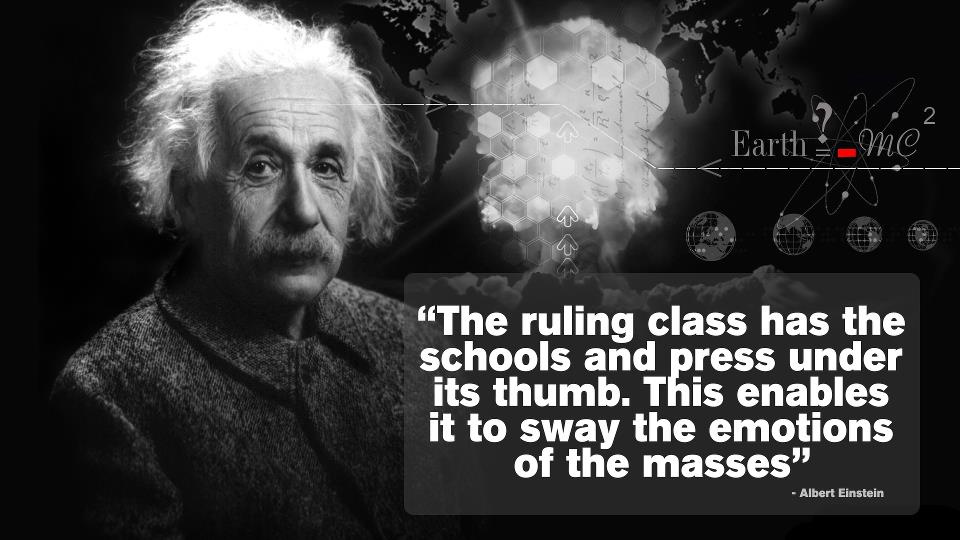
Ruling-Class Supremacy and the Free World

tn51f8143d

By Mark Weiser

Source: Dissident Voice

Soon after children start noticing differences between others and themselves, they’re old enough to believe they’re superior or entitled in some ways. These feelings come naturally, and are reinforced by adults as children learn social behaviors by comparing attributes and values so they can fit in with, or be seen apart from, certain others in society. This is all instinctual to some degree and a normal part of life. To make the case for instinct and superiority, think about what anyone would consider when choosing a partner for a serious or long-term relationship. If a potential partner does not meet the standards of another, by default one person is considering their self above the other in some way. And speaking generally for superior humans, when considering procreation, they don’t want their superior self to mix with inferior genes. Everybody has standards of age, looks, intelligence, income, occupation, social standards and more or less, it’s different for everybody.

Pro-creationist superiority is instinctual to best insure our genetic code is passed along into the future. Of course there’s pure romantic attraction, but that’s only triggered because the partner being considered hasn’t been ruled out. It could ultimately be the depth and types of emotions which compel the romantic to get deeply involved, but they still make relative comparisons the first time meeting someone and along the way. We’re not speaking hypothetical, these attitudes are accepted realities and I would guess, at minimum, 96% of all readers over age twenty can relate by direct experience, even if they’ve not been in a serious intimate relationship.

Instinct and human nature overlap when it comes to seeking society with others, and societies or social groups necessarily have a culture that sets boundaries for ideological beliefs, abilities, practices, social status etc. If a group doesn’t set boundaries, by default, that group would be all inclusive and non-judgmental concerning any specific particulars. As individuals or groups looking at others, it’s all so much instinct and human second-nature, we may not be aware we’re being judgmental. Whether superiority by comparison is instinct due to genetics and the natural workings of the mind, or is influenced by personal nature and prejudices, or results from ideological and social culture, it makes no difference at all in the real world if the end result is the same.

What does make a difference in the real world is whether or not we unjustly impose on others. If our sense of imposing or taking advantage of others is not disabled, and we do impose unjustly on others, ultimately it’s some sense of superiority or entitlement which allows us to impose. Benign superiority is basically harmless as no actions are taken which harm or impose on others; although, if a person feels superior to others and doesn’t participate in something that could benefit himself, he could be a victim of his own perceived superiority.

In the U.S. we have laws against supremacist entitlement being imposed on the unwilling, but because of social conditioning there are times we might assume we’re not being imposed on when, in fact, we are the victim(s). It’s often considered justifiable that one should feel morally or intellectually superior to racists or sexists. But what about assuming religious or ideological superiority and entitlement(s)? Why would either of those be considered fair game in certain circles or social situations? If you have moral values you may feel superior to Wall Street bankers and our enabling Washington D.C politicians – as those two groups were literally the driving forces behind the 2008 economic crash – while at the same time they enriched themselves at the expense of innocent U.S. and world citizens.

The 2008 economic collapse was brought about by the deregulation and non-enforcement of banking laws which resulted in the Federal Reserve and banks both taking excessive risks. There was the Federal Reserve policy of giving the banks too much low interest money to begin with. The banks relaxed loan qualifications which led to real estate and stock market bubbles. It was all tied to fraudulent mortgage default insurance known as credit default swaps being used to prop up bundled mortgage securities which were sold all over the world to individuals, groups and all sizes of governments. The fraudulent mortgage default insurance and grossly exaggerated security ratings made the bundled mortgages securities look much less risky than they actually were, and the bundled mortgage securities were fraudulent due to the grossly misrepresented financial risks. So great were the cumulative risks of all combined, the world economy in 2008 was lined up like dominoes and literally ready to fall as soon as the mortgage defaults started adding up. By the time this was all recognized publicly as the unsustainable confidence game it was, the banks’ corporate officers had already pocketed hundreds of million$ and intended on leaving you and your grandchildren to pay for their entitlements.

With D.C. politicians, the regulatory boards, and Department of Justice looking the other way – while they’re supposed to oversee banking practices in some manner – the bankers were able to pull off the greatest financial scheme in human history. The two main groups which lined those dominoes up, the bankers and D.C. politicians, in this instance are prime examples of interdependent criminals. Our Republican and Democratic parties essentially accepted election campaign funding (bribes) from the bankers, in exchange for legislation the bankers wanted, which finally led to the 2008 crash. And because politicians wanted those campaign funding bribes to continue after 2008, they didn’t pressure the U.S. Attorney General to prosecute the bankers and most likely instructed him not to. These types of crimes and failure to prosecute are nearly guaranteed with the existing campaign funding laws when combined with the accepted political culture among the “ruling-class” in Washington D.C. Not only was the 2008 crash painful for many at the time, but people in the U.S and around the world are, in fact, enslaved to a certain degree while the true costs of those violations are still being paid off.

Assuming they didn’t suffer from psychological disorders, the bankers necessarily had to feel superior or entitled to put their personal interests above the U.S. law and country. A complex and intertwined scheme of 2008 magnitude could only have taken place if the laws on the books prior to the crash were non-existent (deregulated), corrupt as written, corrupted as practiced, or corrupted by enforcement (or non-enforcement) thereof; and we had all of those contributing factors leading up to the crash.

In the U.S. today we have a ruling-class supremacist culture holding itself, the self-chosen few, above the law. And they demand you comply with the law as they cultivate systemic enslavement to a degree as it’s being imposed on the vast majority of citizen-victims. And by all means they invite you, as a dupe, to join their party as a Democrat or Republican, neither of which are looking out for the American people; but join them, and you too can shill for the status quo. If big money likes you enough, they might select you through a screening and grooming process, to be in the U.S. Senate or Congress representing the personal best interests of ruling-class elites to the overall detriment of the country.

As a collective in the U.S. we believe ourselves to be validly non-supremacist as decreed by law, while also believing our culture is morally grounded, and that moral citizens wouldn’t impose unjust self-entitlements by forcing citizens into a degree of slavery. So what is it in our human instinct, human nature or various cultures which allow these types of supremacist-entitlement violations to occur? If the collective sense of injustice is not disabled by some psychological disorder, then as a “moral culture”, these transgressions could only take place by having a population with sufficiently corrupted-intellects, or by having a few corrupted-intellects imposing on the vast majority through concentrated political power. Corrupted-intellect for our purposes here would include the mindset to commit any act of deceitfulness, denial, or false rationalizations by either the perpetrators or victims, which allow legal violations to be committed without eventual prosecution. And regardless of whether or not we suffer from a disabling disorder, corrupted-intellect has collectively disabled our society from attaining a reasonable amount of “liberty and justice for all”. Among those unable to maintain intellectual integrity due to the influence of religious, academic or political cultures, collective denial can take the form of institutionalized supremacist-entitlements as we’ve seen with bankers and politicians surrounding the 2008 fiasco.

Does that mean we’re stuck in a non-democracy being run by a collective of predominately corrupted-intellects of a self-entitled ruling-class supremacist culture? That may depend on Americans understanding just how openly and blatantly they’re still being taken advantage of, and whether or not enough of them are outraged enough to demand some changes. Our two-party political system is essentially a self-perpetuating power structure and would require a major mutiny among members of at least one party to change the existing campaign funding laws, or the Supreme Court would have to overrule itself; the first case is extremely unlikely specifically because getting elected requires receiving huge amounts of campaign funds from the excessively wealthy “ruling-class”, and there’s little hope for the Supreme Court considering the corrupted-intellects sitting there on the bench without a clue.

The joke may be on “we the people” for the time being, but unjust power structures historically fail as the one in question is failing now by eroding the strength and health of its own population. It’s only a matter of time as to when and how a major shift takes place. And regardless of anyone’s sentiment toward the system as is, it’s not working to represent the best interests of the country. What’s left to be said for a system that has systemic corruption guaranteed by existing laws enjoyed by unjustly self-entitled ruling-class supremacists? According to the Declaration of Independence “we the people” have final say and it’s our duty as patriotic Americans, “to throw off such Government”.

Another group which more than deserves mention in the grand scheme of supremacy-entitlements is the so called “news” media. The press has immense power to pressure both, corporate industry and the government to operate within legal and moral parameters that would be beneficial to our overall society. What’s often referred to as “corporate news” isn’t really news, but is actually manipulative propaganda. And those running the show behind the scenes perceive personal benefits by having a bias slanted strongly toward corporate or special interests – which also means not exposing the government because the government works for corporate and special interests also. With the press not using its immense power to benefit U.S citizens and country as a whole, the people running the major news networks are performing a great disservice to the country by denying citizens the absolute truth for their own considerations. Corrupted-intellects are everywhere…

And going back to speaking of dupes, we need to acknowledge the entire subservient culture of politicians around the globe that cater to the whims of Washington D.C. Those foreign office holders often see their compliance to Washington as benefitting themselves personally while it victimizes their own citizens. If those “leaders” are not plain ignorant for any reason, then by default they are willing accomplices on some level. Whatever the case, they’re arguably not fit to look out for the best interests of their own countrymen – just as they’re currently not doing. This subservience is not only applicable to economic issues at present, but also enables unjust military incursions and illegal “wars” of chosen aggression for some perceived political or monetary gain.

If a constant and stable life could be realized, the vast majority of world citizens would prefer to live without trespassing on others. But the brokers of industry, media, and politics, who seek extreme wealth and power, are a different sort – some of these people are beyond being supremely self-entitled, where sociopath or psychopath would be a fitting definition. They act without consideration for truth or the lives they abuse and destroy. Nothing is beneath them, not robbing granny’s life savings while personally benefitting, not starting and backing unnecessary wars of personal choice for monetary or political gain. Over just the last five-and-a-half decades the U.S is directly and indirectly responsible for the deaths of millions in various places around the world. The worldwide self-entitled “ruling-class” supremacists of the “free world” predominately exists in a cultural bubble of extreme criminal immorality and exceptionalism — all due to a combination of genetic instinct, human nature and social culture(s) rendering their corrupted-intellects incapable of acknowledging absolute truth and the motives behind their actions. With most of these activities being approved and orchestrated from the epicenter in Washington D.C., the destructive earthquakes travel around the globe through varying forms of imposed ideological and economic tyranny, often with a military “solution” being carelessly and recklessly forced on countless innocent victims of the current day, year, decade or century as the case may be… The “ruling-class” puts all of our lives at risk by keeping our planet in constant jeopardy.

Due to the shear waste and destruction of war along with the possibility of wanton escalation, the entire earth and the world’s population are threatened by the practices of a tiny and miniscule minority comprising the collective ruling-class supremacist culture; and with everything on earth being directly and indirectly interconnected to everything else, their victims, I’m sure you know, include all living things and every last human being.


9 Crucial Ballot Measures that Could Legalize Marijuana and Help End the Drug War this Election

war-on-drugs

There are more drug policy reform questions on the ballot this November than ever in American history.

By Stephen Gutwillig

Source: Alternet

It may be an off-year election, but it’s a big one for drug policy reform. In seven weeks, voters across the country will have a chance to accelerate the unprecedented momentum to legalize marijuana and end the wider drug war. In fact, there are more drug policy reform questions on the ballot this November than ever in American history. Voter initiatives — primarily reforming or repealing marijuana laws — appear on the ballots in seven states, at least 17 municipalities and one U.S. territory. To help you keep score at home, here’s an overview, starting with the highest-profile measures.

Oregon: Passage of Measure 91 [3] will make the Beaver State the third to legalize marijuana for adults outright. Like the historic laws adopted in Colorado and neighboring Washington two short years ago, this initiative would legalize possession of small amounts of marijuana for adults 21 and older and create a statewide system to regulate production and sales. And similar to Colorado’s law, Measure 91 would allow adults to cultivate small amounts of marijuana under controlled circumstances. In this entirely vote-by-mail election, the initiative has already been endorsed by the Pacific Northwest’s largest daily paper [4] and would likely boost efforts across its southern border to end marijuana prohibition in California two years from now.

Alaska: The other statewide marijuana legalization initiative, Measure 2 [5], is closely modeled on Colorado’s Amendment 64 and tracks many of the elements in Oregon’s prospective law. Alaska was something of a marijuana reform pioneer as possession and cultivation of small amounts for personal use in a private residence has been protected under the Alaska Constitution since the 1970s. Alongside Oregon in 1998, Alaska was among the first states to legalize medical marijuana. With a deep-rooted respect for personal freedom, Alaska would become the first red state to legalize marijuana for adult use, no doubt raising eyebrows across the political spectrum.

Florida: Amendment 2 [6] is the only statewide medical marijuana initiative on the ballot this year, and it’s one to watch. Victory would make Florida, with its huge population and bell weather status in American politics, the very first southern state to adopt a medical marijuana law. With 23 other medical marijuana states and super-majority support [7] nationally, passage of Amendment 2 would effectively settle any lingering questions on public acceptance of marijuana as medicine. It’s going to be a challenge, though, since Florida law requires 60% to pass a voter initiative. While polls indicate enormous support [8], casino mogul Sheldon Adelson contributed a few million dollars [9] to stop it as Amendment 2 is associated with Charlie Crist’s comeback gubernatorial campaign. Adelson’s intervention has created the first well-funded opposition to a statewide marijuana reform campaign ever.

California: On the heels of reforming its harshest-in-the-nation Three Strikes law in 2012, Californians are now poised to refine six low-level, nonviolent offenses, including simple drug possession, from felonies to misdemeanors. Proposition 47 [10]would then dedicate the savings — likely more than $1 billion a year — to schools, victim services, and mental health treatment. With retroactive sentencing and expungement provisions, the impact of Prop 47 in California on wasteful corrections spending and individual lives would be profound and surely resonate across the country.

District of Columbia: Earlier this year, the D.C. Council adopted the nation’s most far-reaching marijuana decriminalization law [11]. In November, voters in the nation’s capital will decide whether to go even further. Initiative 71 [12] makes it legal for adults over the age of 21 to possess and cultivate small amounts of marijuana. While District law prevents the ballot initiative from addressing the sale of marijuana, the D.C. Council is considering a bill that would tax and regulate marijuana within the District. D.C. has the highest per capita marijuana arrest rates in the U.S. with enormous racial disparities as police target African Americans for 91 percent of these arrests. Initiative 71 will be the first marijuana reform campaign fought primarily on the issue of the drug war’s ongoing toxic impact on black communities.

Other races: Voters in municipal elections from the Northeast to Micronesia will weigh in November 4th on a range of marijuana focused issues.

  • Guam: Voters could make this U.S. territory the first to adopt medical marijuana. The binding referendum [13] would allow for dispensaries regulated by the Department of Public Health and Social Services.
  • Maine: By a wide margin in 2013, Portlanders chose to eliminate criminal penalties for adult possession of up to an ounce of marijuana. In seven weeks, voters in York, South Portland, and Lewiston [14] will tackle the same question.
  •  Michigan: In the last two years, residents of seven cities have voted to remove local penalties for adult possession of small amounts of marijuana in a private residence. As of now, a whopping 11 other cities [15] (with apparently more to come) will have the chance to follow suit this year.
  • New Mexico: Last month, the City of Santa Fe became the first in the state to decriminalize possession of small amounts of marijuana. On the ballot in November, voters in Bernalillo (Albuquerque) and Santa Fe Counties will decide [16] if their county should affirm decriminalization efforts.

Public opinion has shifted dramatically over the last decade in favor of reforming marijuana laws and dismantling the egregious excesses of the drug war. And elected officials have begun to take notice. The U.S. House has voted five times in recent months to let states set their own marijuana policies while Senators Rand Paul and Cory Booker have introduced similar bi-partisan legislation in the U.S. Senate in addition to a cluster of other long-overdue criminal justice reforms. When the dust settles on November 5th, the momentum for change in this country will only have accelerated.

BOSTON UPDATE: FBI War on Marathon Bombing Witnesses Continues

fbi-foils-fbi-plot

By James Henry

Source: WhoWhatWhy

The Boston Marathon bombing is much more important than has been acknowledged, principally because it is the major domestic national security event since 9-11 and has played a major role in expanding the power of the security state. For that reason, WhoWhatWhy is continuing to investigate troubling aspects of this story and the establishment media treatment of it. So even as it slips from the headlines, we will be exploring new elements of the story regularly as the trial of Dzhokhar Tsarnaev approaches. 

***

Since the Boston Marathon bombing a year and a half ago, the FBI appears to be intimidating, harassing, and silencing friends and acquaintances of the Tsarnaev brothers. Dzhokhar Tsarnaev’s lawyers have noticed it too—they’re having trouble getting anyone to talk to them, recent court papers reveal.

In what WhoWhatWhy previously described as the FBI’s “war on witnesses”, the Bureau seems to be employing a scorched earth strategy of destroying anything that might be of use to the “enemy.”

On August 29, Tsarnaev’s lawyers filed a motion requesting a continuance for more time to prepare their defense, noting the fact that they were given only half the median preparation time that federal courts have allowed over the past decade for defendants on trial for their lives. (The judge did grant a two-month delay while refusing the defense request to move the trial out of Boston.)

The lawyers cited “outpaced requirements” in building a proper defense for their client: (1) the international nature of the investigation—including language and geographic barriers, (2) the large amount of evidence that has to be scrutinized, and most tellingly, (3) the climate of intimidation and fear created by the FBI’s investigative efforts since the bombing. They write:

Domestic defense mitigation investigation has been conducted amid a growing atmosphere of anxiety and agitation generated by highly-publicized arrests, indictments, prosecutions, deportations (and, in one instance, the FBI killing) of members of Dzhokhar and Tamerlan Tsarnaev’s peer groups.

Most news reports brush over that last part. As if shooting to death an unarmed man involved in this case—as an FBI agent did to Tamerlan’s friend Ibragim Todashev—is not relevant to the difficulties the defense team has had in getting witnesses to talk to them. But even less extreme events are enough to silence potential witnesses, such as the mysterious closing of their bank accounts.

Prosecutors resisted this and an earlier attempt to have the trial delayed. The victims have a right to see justice done—swiftly, the thinking goes.

The victims and their families certainly deserve justice for this horrible atrocity. True justice should include a full accounting—something a hurried, one-sided investigation is not likely to produce. And of course Boston and the American public deserve, and need, the truth, whatever it may be.

Yet a close read of the motion document reveals FBI activities that seem more of an effort to conceal than to illuminate.

The FBI’s March to the Sea

Tsarnaev’s defense team makes reference to the most troubling—and most anxiety-producing—action by the FBI since the bombing: the shooting to death of Tamerlan’s friend, Todashev. (See our earlier story on the head-scratching circumstances surrounding that shooting, including the questionable history of the agent who pulled the trigger.)

Some of the FBI’s aggressive tactics described in the defense document look like outright intimidation. For instance, individuals “with lawful immigration status have been detained for hours and required to surrender their electronic devices upon re-entry to the United States.”

And take a look at this excerpt:

“The investigation has been further hampered by aggressive FBI follow-up tracking and questioning of potential witnesses, as well as by the unrelenting attention of the news media.”

It is one thing to be aggressively tracking and questioning individuals suspected of committing crimes, but to be doing this to presumably innocent witnesses reeks of intimidation. Witness intimidation is a tactic ordinarily associated with mafia or drug cartel defendants.

Notably, this “tracking” must have been brought to the attention of defense lawyers by witnesses themselves, indicating overt surveillance: “We’re watching you.”

Then, farther down in the document:

“These difficult circumstances are compounded by a continuing pattern of aggressive FBI re-interviewing of potential witnesses — on occasion within hours of an attempted contact by defense investigator [emphasis added].”

Within hours of an attempted contact by defense investigator? Is the defense team being watched too? (We reached out to Tsarnaev’s defense team hoping they could expand on that, but have not yet had a response.)

It wouldn’t be the first time the FBI was caught spying on defense lawyers in a high-profile terrorism case. Lawyers for accused 9/11 mastermind Khalid Shaikh Mohammed allege that the FBI has been surveilling  them.

Whether legal counsel are being watched directly or simply getting caught up in the surveillance of Tsarnaev’s acquaintances, the effect is the same: the feds know who is talking to whom, and when.

That’s a Nice Immigration Status You Got There…

Witnesses who are not U.S. citizens—which describes the majority of Tsarnaev’s friends, family, and many in the local Muslim community—are particularly vulnerable to law enforcement manipulation. The threat of deportation is a clear and present danger to these individuals, “regardless of whether criminal charges are ever brought or proven against them,” Tsarnaev’s lawyers wrote.

Indeed, a handful of people loosely connected to the Tsarnaevs have already been deported, or had deportation proceedings initiated against them, despite having nothing to do with the Boston Marathon bombing. These include:

–   Konstantin Morozov: friend of Tamerlan, arrested and jailed pending deportation reportedly after refusing to wear a wire for the FBI as the Bureau sought information on one of Tamerlan’s Chechen friends.

–   Tatiana Gruzdeva: girlfriend of Ibragim Todashev, deported after speaking with Boston Magazine about the circumstances surrounding her boyfriend’s death.

–   Ashurmamad Miraliev: friend of Ibragim Todashev, was reportedly denied a request for an attorney while interrogated by FBI for over six hours, and transferred to an immigration detention center where deportation proceedings were initiated.

–   Khusen Taramov: friend of Ibragim Todashev, denied reentry to the United States after visiting Chechnya, despite having a Green Card.

Why hasn’t Boston’s “liberal” media made more noise about this? Arguably, the most newsworthy portion of Tsarnaev’s motion for continuance—potential witness intimidation—has been glossed over or ignored in most mainstream media accounts.

The Florida chapter of the Council on American-Islamic Relations reached out to the media and the public to expose the intimidation and harassment of Todashev’s friends and associates—and got a fair amount press coverage by their local media. The same cannot be said for the Boston area press.

Have they, albeit indirectly, been intimidated, too? The Boston media has historically had a close relationship with law enforcement, and when it ever so slightly challenged the police, found its usual (and needed) sources shut down.

However, if ever there was a moment for the local press to do the right thing, this is surely it.