After the Crash

Dispatches From a Long Recovery (Est. 10/2024)

After the Crash

Saturday Matinee: Tribulation 99

movie_259187

Synopsis from Other Cinema:

Upon its release in 1991, Tribulation 99 became an instant counter-culture classic. Craig Baldwin‘s “pseudo-pseudo-documentary” presents a factual chronicle of US intervention in Latin America in the form of the ultimate far-right conspiracy theory, combining covert action, environmental catastrophe, space aliens, cattle mutilations, killer bees, religious prophecy, doomsday diatribes, and just about every other crackpot theory broadcast through the dentures of the modern paranoiac.

A delirious vortex of hard truths, deadpan irony, and archival mash-ups—industrials, graphs, cartoons, movies from Hollywood B to Mexican Z—Tribulation 99 constructs a truly perverse vision of American imperialism.

https://vimeo.com/36739141

Saturday Matinee: Mr. Freedom

tumblr_l0uzlsUIuW1qaw1oyo1_500

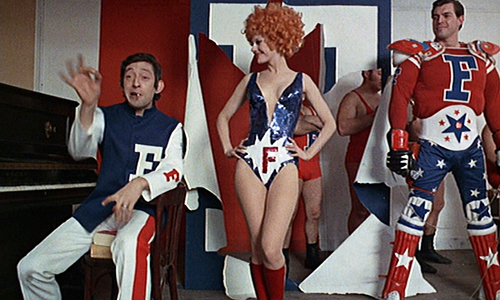
“Mr. Freedom” (1969) is a surreal polemic directed by William Klein skewering patriotism, imperialism and cold war scare-mongering by chronicling the idiotic exploits of an all-American superhero. What it lacks in plot and subtle acting it makes up for in audacious visuals and sadly still relevant yet deserving political jabs. The film is also notable for it’s soundtrack and cameo appearance by the great Serge Gainsbourg.

http://www.dailymotion.com/video/xq8l5g_mr-freedom_shortfilms

Saturday Matinee: The Day the Fish Came Out

the-day-the-fish-came-out-movie-poster-1967-1020685028

“The Day the Fish Came Out” (1967) is a Greek/British co-production written and directed by Michael Cacoyannis (who also designed the film’s bizarre costumes). The film is a satirical sci-fi take on an actual incident in which two military aircraft collided over Spain causing four hydrogen bombs to rain down amongst the debris. Two of the bombs partly detonated similarly to a dirty bomb creating radioactive contamination in the area that persists to this day. In the film version, when a deadly payload called “Container Q” is dropped over a Greek resort island Americans disguised as tourists and real estate developers race against time to recover it in a dark comedy of errors reminiscent of Dr. Strangelove.

http://www.dailymotion.com/video/xmt7hc_the-day-the-fish-came-out_shortfilms

Saturday Matinee: Kung Fury

kung-fury-poster-600x851-600x851

Source: twitch

Review: Struck By Lightning. Bitten By A Cobra. KUNG FURY Is A Giddy Blast Of B-Movie Entertainment.

By Todd Brown

Ladies and gentlemen, I could write quite a lot here about how the internet has democratized filmmaking and storytelling, and how that has had impacts both good and bad. I could cite statistics about crowd funding, viewership patterns and the generational split between the thirty and fortysomethings who continue to drive theatrical exhibition and the children growing up having never known a world without broadband, who consume their media instantly, on demand, on whatever size screen happens to be handy. But what all those numbers would boil down to is this: Kung Fury changes everything.

Yes, yes, you’re thinking hyperbole and all that. But, no. Think about it. What we have here is an online phenomenon, a kitschy video game and b-movie pastiche dreamt up by some guy in Sweden whose only previous IMDB entries were as an account manager on two episodes of television. Released online as a goofy trailer with its creator in the lead, it then became a crowd funding phenomenon that then recruited David Hasselhoff to the cause, and finally had its world premiere in selection as part of Directors Fortnight at Cannes. Let that sink in for a moment. We’ve arrived at a bizarre moment in time where some kid in Sweden can make a YouTube video presenting a concept that then goes on to premiere in fucking Cannes. And why? Because, good god, it’s bloody well brilliant. After years of online ‘sensations’ that have tended to over promise and under deliver, Kung Fury shows up and blows the fucking doors off.

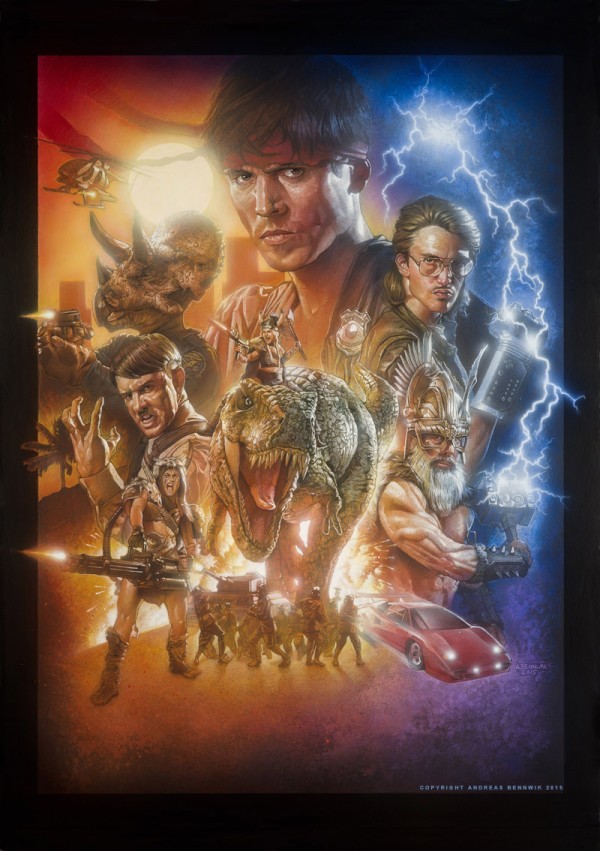
Written, directed by and starring David Sandberg in the title role, Kung Fury is the nostalgia drenched tale of a renegade Miami cop / kung fu master who realizes he must travel back in time to kill Adolf Hitler – the Kung Fuhrer – before Hitler has the chance to travel in time to ‘modern’ day Miami himself to wreak havoc in the present. Along the way we’re treated to a physical confrontation with an angry video game, reptilian partner Triceracop, Viking maidens with machine guns, more deadpan one liners than you can shake a stick at, and David Hasselhoff.

To be clear, narrative cohesion is not the greatest strength of Kung Fury. Character arcs and insight into the human condition do not abound in these parts. What we do get, however, is a thirty-minute long, nonstop assault of some of the most astounding visual gags ever assembled in one place. Kung Fury knows its audience, knows it damn well, and while it has little to offer to anyone outside of its particular niche, for people within that niche this is absolute gold.

A huge percentage of what makes Kung Fury works rests on the many talents of Sandberg himself. As a leading man he is blessed with a deliciously deadpan delivery and wicked comic timing blended with a legitimately compelling physical presence. As a writer he is an absolutely unstoppable idea machine. And as a director he is bold, ambitious, and enormously gifted on the technical side of things. Take Sandberg’s talent and then throw in SNL veteran Jorma Taccone’s utterly hysterical take on Hitler, Andreas Cahling’s Thor, and the work of his brilliant VFX team and you end up with something that feels like Dario Russo and David Ashby’s Danger 5 on speed.

The Path of the Sacred Clown: Where Trickster and Shaman Converge

1.200

By Gary Z McGee

Source: Fractal Enlightenment

“If the fool would persist in his folly, he would become wise.” –William Blake

Most of us are familiar with the prototypical clowns: red-nosed clowns, court jesters, and Tarot fools. But sacred clowns take clowning to a whole other level. The Ne’wekwe “mud-eaters” were the Zuni equivalent of a sacred clown. The Cherokee had sacred clowns known as Boogers who performed “Booger dances” around a community fire.

In Tibetan Buddhism it’s referred to as Crazy Wisdom, which the Guru adopts in order to shock their students out of fixed cultural and psychological patterns. But perhaps the most popular type of sacred clown is the Lakota equivalent of Heyoka, a contrary thunder shaman who taught through backwards humor.

Almost all types of sacred clowns combine trickster spirit with shamanic wisdom to create a kind of sacred tomfoolery that keeps the zeitgeist in check. Their methods are unconventional and typically antithetical to the status quo, but extremely effective. They indirectly re-enforce societal customs by directly enforcing their own powerful sense of humor into the social dynamic. They show by bad example how not to behave.

The main function of a sacred clown is to deflate the ego of power by reminding those in power of their own fallibility, while also reminding those who are not in power that power has the potential to corrupt if not balanced with other forces, namely with humor. But sacred clowns don’t out-rightly derive things. They’re not comedians, per se, though they can be. They are more like tricksters, poking holes in things that people take too seriously.

Through acts of satire and showy displays of blasphemy, sacred clowns create a cultural dissonance born from their Crazy Wisdom, from which anxiety is free to collapse on itself into laughter. Sacred seriousness becomes sacred anxiety which then becomes sacred laughter. But without the courageous satire of the sacred clown, there would only ever be the overly-serious, prescribed state of cultural conditioning.

Lest we write our lives off to such stagnated states, we must become something that has the power to perpetually overcome itself. The sacred clown has this power. Christ was a sacred clown, mocking the orthodoxy. Buddha was a sacred clown, mocking ego attachment. Even Gandhi was a sacred clown, mocking money and power.

Like Thomas Merton wrote, “In a world of tension and breakdown, it is necessary for there to be those who seek to integrate their inner lives not by avoiding anguish and running away from problems, but by facing them in their naked reality and in their ordinariness.” Sacred clowns are the epitome of such integration.

Heyokas, for example, remind their people that Wakan tanka, the great mystery, is beyond good and evil; that its primordial nature doesn’t correspond to human platitudes of right and wrong. Heyokas act as mirrors, reflecting the mysterious dualities of the cosmos back onto their people. They walk the Red Road, following in the bloody footprints left behind by their Heyoka fore-brothers.

They go forward, to that place where emptiness is full, and fullness empty. “As a representative of Thunderbird and Trickster,” writes Steve Mizrach, “the heyoka reminds his people that the primordial energy of nature is beyond good and evil. It doesn’t correspond to human categories of right and wrong. It doesn’t always follow our preconceptions of what is expected and proper. It doesn’t really care about our human woes and concerns. Like electricity, it can be deadly dangerous, or harnessed for great uses. If we’re too narrow or parochial in trying to understand it, it will zap us in the middle of the night.”

Sacred clowns are adept at uniting joy with pain, acting on the higher and more inscrutable imperatives of the Great Mystery. They tend to govern transition, introduce paradox, blur boundaries, and mix the sacred with the profane. They are called upon to reestablish the bridge between the physical and spiritual worlds. They dare to ask the questions that nobody wants answers to.

They are the uncontrollable avatars of the Trickster archetype, constant reminders of the contingency and arbitrariness of the social order, poking holes in anything taken too seriously, especially anything assuming the guise of power. They are a conduit to forces that defy comprehension, and by their absurd, backwards behavior, they are merely showing the ironic, mysterious dualities that exist within the universe itself.

Sacred clowns understand that humans fail, and failing means that sometimes we need to change. They remind us that the goal is not to stick to the same old path, but to embrace the vicissitudes of life and to discover new paths and the courage it takes to adapt and overcome. Taking the universe into deep consideration, letting it be, and then letting it go, is far superior to clinging to a “belief” and becoming stuck in a particular view. Sacred clowns realize that the highest wisdom lies in this type of counter-intuitive detachment, in accepting that nothing remains the same, and then being proactive about what it means to change.

Most importantly, they teach us that there is no such thing as an enlightened master. We’re all spiritually dumb. The closest we can ever get to being “enlightened” is simply to understand that we are naïve to it, and then to laugh about it together as a community. Sacred clowns have the ability to plant this seed of sacred humor. They are constantly in the throes of metanoia, disturbing the undisturbed, comforting the uncomfortable and freeing the unfree. They remind us, as Rumi did, that “the ego is merely a veil between humans and God.”

Legalizing Marijuana Now More Popular Than All Political Candidates

yes-we-cannabis-marijuana-poster

By John Vibes

Source: TheAntiMedia.org

It is no secret that Americans are losing faith in the US political system. With the potential of a choice between a Clinton and a Bush in 2016, it is likely that even more people will stop participating.

Now that there have been states where people have been allowed to vote for the legalization of marijuana, that topic has actually become more popular than the candidates themselves.

According to a Quinnipiac University poll conducted in March, in the key swing states of Ohio, Pennsylvania and Florida, marijuana is far more popular than all the major political candidates. The survey found that over 80% of people in all states supported medical marijuana, with over 50% also supporting full legalized recreational marijuana.

Meanwhile, all of the major political candidates have the approval of less than 50% of the people polled.

In some ways marijuana policy is the perfect issue for a presidential campaign. It has far reaching consequences that both parties have reason to engage,” John Hudak of the Brookings Institution told the Washington Post, in response to the poll.

Prohibition of any kind should be opposed for the reasons I have laid out in the past. However, marijuana is of specific immediate importance because of its ability to heal sick people and create environmentally friendly industrial products. It is also one of the safest drugs known to our species.

A recent Gallup poll found that major political parties in the United States are seeing their lowest popularity levels in recent memory.

Both the Democrats and the Republicans fall well below 50% in terms of approval, with 39% viewing the Democratic party favorable and 37% viewing the Republican party favorable.


John Vibes is an author, researcher and investigative journalist who takes a special interest in the counter culture and the drug war. In addition to his writing and activist work he organizes a number of large events including the Free Your Mind Conference, which features top caliber speakers and whistle-blowers from all over the world. You can contact him and stay connected to his work at his Facebook page. You can find his 65 chapter Book entitled “Alchemy of the Timeless Renaissance” at bookpatch.com.


Report: Whites More Likely To Be Named CEOs Than Equally Sociopathic Black Candidates

americanpsycho8

Editor’s Note: Good satire always has a firm basis in truth.

Source: The Onion

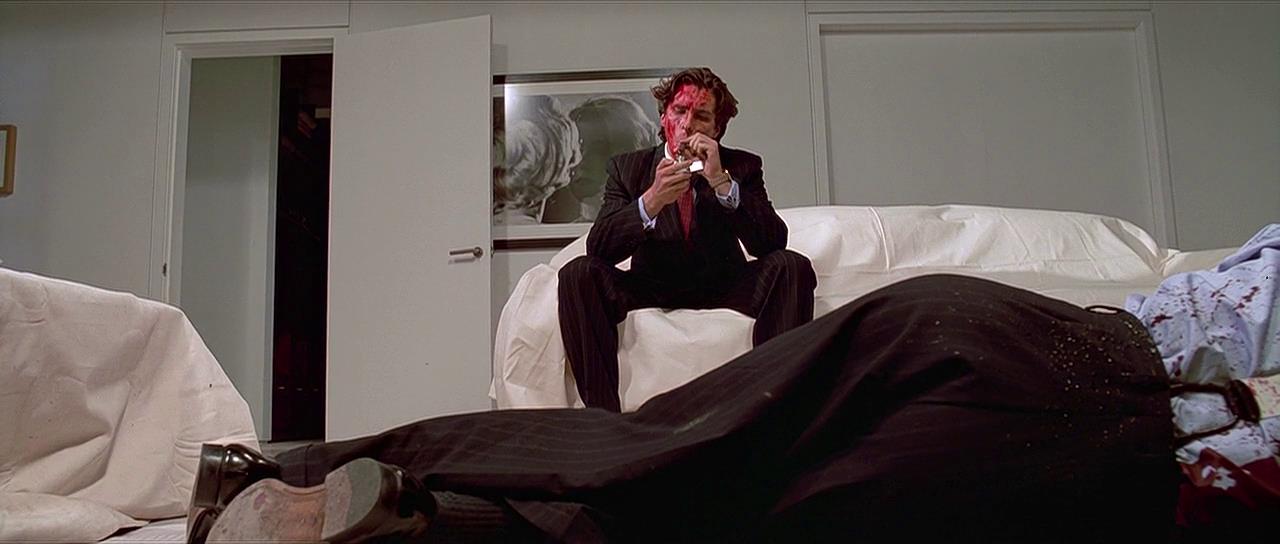
ALEXANDRIA, VA—Shedding light on the striking lack of diversity within the highest ranks of corporate America, a report from the Executive Leadership Council released Tuesday reveals that white individuals are far more likely to be named CEOs than equally sociopathic black candidates.

Despite widespread evidence that minority executives are just as misanthropic and unprincipled as their Caucasian peers, the study found that less than 1 percent of Fortune 500 companies have black chief executives, demonstrating that the upper levels of the business world frequently remain inaccessible to even the most morally bankrupt of African-Americans.

“Our data shows that when white megalomaniacs and black megalomaniacs contend for the highest corporate positions in the U.S., the latter are routinely passed over,” said the report’s lead author, Sandra Norwood, pointing to dozens of recent instances in which African-American individuals who had proven track records of undermining their colleagues’, employees’, and shareholders’ interests in order to further their own selfish ambitions were not even offered an interview for a company’s top seat. “Vindictive, unscrupulous blacks simply aren’t granted these leadership opportunities, despite possessing the same willingness to maximize short-term profit by eliminating health insurance benefits for part-time employees or commit accounting fraud in order to inflate the value of their personal stock options.”

“These are heartless sadists who have put in countless hours of backstabbing and forsaken all ethical constraints in order to bolster their own power, and yet time and time again they are denied a place at the top of the corporate ladder simply because of the color of their skin,” she continued.

According to the report, even when companies were presented with numerous highly qualified minority candidates with no moral compass and a history of increasing earnings by knowingly rushing an unsafe product to market or outsourcing thousands of manufacturing jobs to overseas sweatshops, the top-tier positions still tended to be awarded almost exclusively to deceitful, empathy-devoid whites.

In fact, the study found that, when presented with identical résumés of potential CEOs who had hid billions of dollars of revenue in offshore tax havens and poached several engineers from a rival business in order to illegally gain confidential trade secrets—one labeled with a common Caucasian name and the other with a traditionally African-American name—boards of directors were far more likely to select the applicant with the white-sounding name. Such findings suggest that many at the highest corporate level still hold inherent biases against amoral, power-hungry egotists of color.

“Even in 2015, many corporate boards will automatically discount a black candidate even if they have demonstrated that they are fully capable of using aggressive intimidation tactics to prevent their company’s workers from forming a labor union,” Norwood said. “Board members often are more comfortable working with lying, underhanded double-crossers who are similar to themselves. Therefore, the individual that they ultimately promote to CEO tends to come from the same cultural background that turned them into destructive, unrepentant monsters.”

According to sources, the dearth of black CEOs within corporate America has prompted a number of companies to institute personnel outreach programs to identify and cultivate malevolent young African-Americans who they believe have the potential to one day violate insider trading laws and initiate spurious patent lawsuits against smaller competitors in order to overwhelm them with legal fees and force them out of the industry.

However, after years of confronting the “glass ceiling” that prevents them from advancing as far as their white peers, many blindly ambitious blacks told reporters they are skeptical that these programs will have a meaningful impact on African-Americans who aspire to become CEOs so that they can immediately downsize as many low-level personnel as necessary to hit profit targets that trigger lucrative personal bonuses.

“When you’re black, you have to be twice as ruthless and deceptive just to reach the senior level, but then you can pretty much forget about ever having a shot at the corner office,” said William Coleman, the sole African-American vice president at a prominent Wall Street financial services group, who says he has yet to be recognized for allocating the risk of his firm’s portfolio of unstable derivatives investments entirely onto the municipal worker pension funds it administers. “My company just elected a white external candidate for our CEO role even after I successfully shifted the blame for a botched merger onto a fellow senior manager before personally firing him and claiming his successes as my own. It’s like they refuse to see how deeply predatory and full of hatred I am.”

“My race shouldn’t be a factor when I’ve proven that I’m a borderline psychopath who will step over anybody in my way to sate my fanatical lust for power,” he continued. “When it comes to succeeding in the business world, that’s all that should matter.”


Related Video:


Pink-haired ‘nerd’ scores win, thanks to 9/11 Truth websites

22587_001_5108_r

Video game blogger beats NASA engineer in TV physics contest

By Craig McKee

Source: Architects and Engineers for 9/11 Truth

Sometimes the truth about 9/11 shows up in the oddest places.

On a recent episode of the TBS reality show King of the Nerds, a bubbly, pink-haired video game blogger named Danielle was the unlikely winner of one phase of a science-related competition that pitted her against a NASA engineer and three other contenders. The most intriguing aspect of her upset win was that Danielle used “9/11 conspiracy” websites to outsmart her rivals.

Hosted by the stars of the Revenge of the Nerds movies, Robert Carradine and Curtis Armstrong, King of the Nerds features a group of contestants who compete in a series of challenges called “nerd wars” in a location called “Nerdvana.” The challenge on this episode involved predicting how many panes of glass — spaced apart vertically in much the same way floors in a high-rise office building are — would be broken when balls of various weights were dropped from a tower.

At the start, the hosts did a demonstration to acquaint the five competitors with the problem they would have to solve. When they dropped a twelve-pound ball suspended fourteen feet above more than two dozen sheets of glass that were one-quarter-inch thick and spaced three inches apart, the top four panes broke.

Carradine and Armstrong then issued the assignment: The contestants had to calculate how many panes would shatter in each of three different tests. In the first and third tests, the only variable that changed was the density of the dropped object — a six-pound nerd ball in the former, a fifteen-pound stuffed pig in the latter. (The audience is left to wonder what the heck the pig was stuffed with!) In the second test, besides the different density (an eight-pound nerd ball), the thickness of the glass and the space between the panes were also altered.

One by one, the young competitors revealed their academic backgrounds, familiarity with physics, and current vocations. There was Ivan, the smug-but-confused, role-playing game designer; Moogega, the cocky NASA engineering whiz; Genevieve, the stressed-out fantasy writer; Celeste, the pro-gamer; and Genevieve, the AP physics guide writer. The latter two collaborated “to improve our mutual chances of winning . . .” and “. . . to have a better chance of knocking Danielle out of this competition.” Then there was Danielle, who, having taken zero courses in physics, initially declared the challenge to be “bull&@^*” because all her adversaries were more qualified than she was. (She majored in a pre-vet program, where “we didn’t care how fast the cat moved . . . .”)

Lack of expertise, however, didn’t deter Danielle. Unlike her opponents, who got some sleep, she stayed up all night in search of answers. And while they appeared to rely only partially on the Internet (we see them referring to the available calculus books as well as scribbling lots of notes and equations — a few from memory), Danielle depended exclusively on the World Wide Web.

“I might be the only one in the house who is looking at My Little Pony to try to solve a physics problem,” she admitted at one point.

But the main sources of Danielle’s research were 9/11 Truth websites. “The only thing I’ve found that’s even similar to what we’re doing are people who are trying to disprove 9/11 being a terrorist attack,” she observed. “I have literally found probably ten websites using an example of dropping a bowling ball through panes of glass to explain why the Twin Towers is a conspiracy.”

When the three tests were over, Danielle came out on top, having bested her two closest competitors by one point. Ivan was miffed that someone with no prior knowledge of physics had beaten them all. Meanwhile, embarrassed engineer Moogega saw her worst fear come true when she finished dead last.

“I just beat a NASA scientist in physics,” a bemused Danielle beamed, then added, “What the f%^k?” She went on to thank “all the conspiracy theorists of America.”

Curiously, in one night of research, the “queen” of King of the Nerds did more to forward the truth about the Twin Towers’ destruction — albeit indirectly and unwittingly — than the mainstream media has done in thirteen years of pretending to prove the unprovable official account of 9/11.

Craig McKee is a journalist and creator of the blog Truth and Shadows.

Lara Trace Hentz

INDIAN COUNTRY NEWS

In Saner Thought

"It is the duty of every man, as far as his ability extends, to detect and expose delusion and error"..Thomas Paine

ZEDJournAI

Human in Algorithms

Rooster Crows

From the Roof Top

Aisle C

I See This

The Free

blog of the post capitalist transition.. Read or download the novel here + latest relevant posts

अध्ययन-अनुसन्धान(Essential Knowledge of the Overall Subject)

अध्ययन-अनुसन्धानको सार