
The Superpower Conundrum

The Rise and Fall of Just About Everything

By Tom Engelhardt

Source: TomDispatch.com

The rise and fall of great powers and their imperial domains has been a central fact of history for centuries.  It’s been a sensible, repeatedly validated framework for thinking about the fate of the planet.  So it’s hardly surprising, when faced with a country once regularly labeled the “sole superpower,” “the last superpower,” or even the global “hyperpower” and now, curiously, called nothing whatsoever, that the “decline” question should come up.  Is the U.S. or isn’t it?  Might it or might it not now be on the downhill side of imperial greatness?

Take a slow train — that is, any train — anywhere in America, as I did recently in the northeast, and then take a high-speed train anywhere else on Earth, as I also did recently, and it’s not hard to imagine the U.S. in decline.  The greatest power in history, the “unipolar power,” can’t build a single mile of high-speed rail?  Really?  And its Congress is now mired in an argument about whether funds can even be raised to keep America’s highways more or less pothole-free.

Sometimes, I imagine myself talking to my long-dead parents because I know how such things would have astonished two people who lived through the Great Depression, World War II, and a can-do post-war era in which the staggering wealth and power of this country were indisputable.  What if I could tell them how the crucial infrastructure of such a still-wealthy nation — bridges, pipelines, roads, and the like — is now grossly underfunded, in an increasing state of disrepair, and beginning to crumble?  That would definitely shock them.

And what would they think upon learning that, with the Soviet Union a quarter-century in the trash bin of history, the U.S., alone in triumph, has been incapable of applying its overwhelming military and economic power effectively?  I’m sure they would be dumbstruck to discover that, since the moment the Soviet Union imploded, the U.S. has been at war continuously with another country (three conflicts and endless strife); that I was talking about, of all places, Iraq; and that the mission there was never faintly accomplished.  How improbable is that?  And what would they think if I mentioned that the other great conflicts of the post-Cold-War era were with Afghanistan (two wars with a decade off in-between) and the relatively small groups of non-state actors we now call terrorists?  And how would they react on discovering that the results were: failure in Iraq, failure in Afghanistan, and the proliferation of terror groups across much of the Greater Middle East (including the establishment of an actual terror caliphate) and increasing parts of Africa?

They would, I think, conclude that the U.S. was over the hill and set on the sort of decline that, sooner or later, has been the fate of every great power. And what if I told them that, in this new century, not a single action of the military that U.S. presidents now call “the finest fighting force the world has ever known” has, in the end, been anything but a dismal failure?  Or that presidents, presidential candidates, and politicians in Washington are required to insist on something no one would have had to say in their day: that the United States is both an “exceptional” and an “indispensible” nation? Or that they would also have to endlessly thank our troops (as would the citizenry) for… well… never success, but just being there and getting maimed, physically or mentally, or dying while we went about our lives? Or that those soldiers must always be referred to as “heroes.”

In their day, when the obligation to serve in a citizens’ army was a given, none of this would have made much sense, while the endless defensive insistence on American greatness would have stood out like a sore thumb. Today, its repetitive presence marks the moment of doubt. Are we really so “exceptional”? Is this country truly “indispensible” to the rest of the planet and if so, in what way exactly? Are those troops genuinely our heroes and if so, just what was it they did that we’re so darn proud of?

Return my amazed parents to their graves, put all of this together, and you have the beginnings of a description of a uniquely great power in decline. It’s a classic vision, but one with a problem.

A God-Like Power to Destroy

Who today recalls the ads from my 1950s childhood for, if I remember correctly, drawing lessons, which always had a tagline that went something like: What’s wrong with this picture?  (You were supposed to notice the five-legged cows floating through the clouds.)  So what’s wrong with this picture of the obvious signs of decline: the greatest power in history, with hundreds of garrisons scattered across the planet, can’t seem to apply its power effectively no matter where it sends its military or bring countries like Iran or a weakened post-Soviet Russia to heel by a full range of threats, sanctions, and the like, or suppress a modestly armed terror-movement-cum-state in the Middle East?

For one thing, look around and tell me that the United States doesn’t still seem like a unipolar power.  I mean, where exactly are its rivals?  Since the fifteenth or sixteenth centuries, when the first wooden ships mounted with cannons broke out of their European backwater and began to gobble up the globe, there have always been rival great powers — three, four, five, or more.  And what of today?  The other three candidates of the moment would assumedly be the European Union (EU), Russia, and China.

Economically, the EU is indeed a powerhouse, but in any other way it’s a second-rate conglomeration of states that still slavishly follow the U.S. and an entity threatening to come apart at the seams.  Russia looms ever larger in Washington these days, but remains a rickety power in search of greatness in its former imperial borderlands.  It’s a country almost as dependent on its energy industry as Saudi Arabia and nothing like a potential future superpower.  As for China, it’s obviously the rising power of the moment and now officially has the number one economy on Planet Earth.  Still, it remains in many ways a poor country whose leaders fear any kind of future economic implosion (which could happen).  Like the Russians, like any aspiring great power, it wants to make its weight felt in its neighborhood — at the moment the East and South China Seas.  And like Vladimir Putin’s Russia, the Chinese leadership is indeed upgrading its military.  But the urge in both cases is to emerge as a regional power to contend with, not a superpower or a genuine rival of the U.S.

Whatever may be happening to American power, there really are no potential rivals to shoulder the blame.  Yet, uniquely unrivaled, the U.S. has proven curiously incapable of translating its unipolar power and a military that, on paper, trumps every other one on the planet into its desires.  This was not the normal experience of past reigning great powers.  Or put another way, whether or not the U.S. is in decline, the rise-and-fall narrative seems, half-a-millennium later, to have reached some kind of largely uncommented upon and unexamined dead end.

In looking for an explanation, consider a related narrative involving military power.  Why, in this new century, does the U.S. seem so incapable of achieving victory or transforming crucial regions into places that can at least be controlled?  Military power is by definition destructive, but in the past such force often cleared the ground for the building of local, regional, or even global structures, however grim or oppressive they might have been.  If force always was meant to break things, it sometimes achieved other ends as well.  Now, it seems as if breaking is all it can do, or how to explain the fact that, in this century, the planet’s sole superpower has specialized — see Iraq, Yemen, Libya, Afghanistan, and elsewhere — in fracturing, not building nations.

Empires may have risen and fallen in those 500 years, but weaponry only rose. Over those centuries in which so many rivals engaged each other, carved out their imperial domains, fought their wars, and sooner or later fell, the destructive power of the weaponry they were wielding only ratcheted up exponentially: from the crossbow to the musket, the cannon, the Colt revolver, the repeating rifle, the Gatling gun, the machine gun, the dreadnaught, modern artillery, the tank, poison gas, the zeppelin, the plane, the bomb, the aircraft carrier, the missile, and at the end of the line, the “victory weapon” of World War II, the nuclear bomb that would turn the rulers of the greatest powers, and later even lesser powers, into the equivalent of gods.

For the first time, representatives of humanity had in their hands the power to destroy anything on the planet in a fashion once imagined possible only by some deity or set of deities.  It was now possible to create our own end times.  And yet here was the odd thing: the weaponry that brought the power of the gods down to Earth somehow offered no practical power at all to national leaders.  In the post-Hiroshima-Nagasaki world, those nuclear weapons would prove unusable.  Once they were loosed on the planet, there would be no more rises, no more falls.  (Today, we know that even a limited nuclear exchange among lesser powers could, thanks to the nuclear-winter effect, devastate the planet.)

Weapons Development in an Era of Limited War

In a sense, World War II could be considered the ultimate moment for both the narratives of empire and the weapon.  It would be the last “great” war in which major powers could bring all the weaponry available to them to bear in search of ultimate victory and the ultimate shaping of the globe.  It resulted in unprecedented destruction across vast swathes of the planet, the killing of tens of millions, the turning of great cities into rubble and of countless people into refugees, the creation of an industrial structure for genocide, and finally the building of those weapons of ultimate destruction and of the first missiles that would someday be their crucial delivery systems.  And out of that war came the final rivals of the modern age — and then there were two — the “superpowers.”

That very word, superpower, had much of the end of the story embedded in it.  Think of it as a marker for a new age, for the fact that the world of the “great powers” had been left for something almost inexpressible.  Everyone sensed it.  We were now in the realm of “great” squared or force raised in some exponential fashion, of “super” (as in, say, “superhuman”) power.  What made those powers truly super was obvious enough: the nuclear arsenals of the United States and the Soviet Union — their potential ability, that is, to destroy in a fashion that had no precedent and from which there might be no coming back.  It wasn’t a happenstance that the scientists creating the H-bomb sometimes referred to it in awestruck terms as a “super bomb,” or simply “the super.”

The unimaginable had happened.  It turned out that there was such a thing as too much power.  What in World War II came to be called “total war,” the full application of the power of a great state to the destruction of others, was no longer conceivable.  The Cold War gained its name for a reason.  A hot war between the U.S. and the USSR could not be fought, nor could another global war, a reality driven home by the Cuban missile crisis.  Their power could only be expressed “in the shadows” or in localized conflicts on the “peripheries.”  Power now found itself unexpectedly bound hand and foot.

This would soon be reflected in the terminology of American warfare.  In the wake of the frustrating stalemate that was Korea (1950-1953), a war in which the U.S. found itself unable to use its greatest weapon, Washington took a new language into Vietnam. The conflict there was to be a “limited war.”  And that meant one thing: nuclear power would be taken off the table.

For the first time, it seemed, the world was facing some kind of power glut.  It’s at least reasonable to assume that, in the years after the Cold War standoff ended, that reality somehow seeped from the nuclear arena into the rest of warfare.  In the process, great power war would be limited in new ways, while somehow being reduced only to its destructive aspect and nothing more.  It suddenly seemed to hold no other possibilities within it — or so the evidence of the sole superpower in these years suggests.

War and conflict are hardly at an end in the twenty-first century, but something has removed war’s normal efficacy.  Weapons development has hardly ceased either, but the newest highest-tech weapons of our age are proving strangely ineffective as well.  In this context, the urge in our time to produce “precision weaponry” — no longer the carpet-bombing of the B-52, but the “surgical” strike capacity of a joint direct attack munition, or JDAM — should be thought of as the arrival of “limited war” in the world of weapons development.

The drone, one of those precision weapons, is a striking example.  Despite its penchant for producing “collateral damage,” it is not a World War II-style weapon of indiscriminate slaughter.  It has, in fact, been used relatively effectively to play whack-a-mole with the leadership of terrorist groups, killing off one leader or lieutenant after another.  And yet all of the movements it has been directed against have only proliferated, gaining strength (and brutality) in these same years.  It has, in other words, proven an effective weapon of bloodlust and revenge, but not of policy.  If war is, in fact, politics by other means (as Carl von Clausewitz claimed), revenge is not.  No one should then be surprised that the drone has produced not an effective war on terror, but a war that seems to promote terror.

One other factor should be added in here: that global power glut has grown exponentially in another fashion as well.  In these years, the destructive power of the gods has descended on humanity a second time as well — via the seemingly most peaceable of activities, the burning of fossil fuels.  Climate change now promises a slow-motion version of nuclear Armageddon, increasing both the pressure on and the fragmentation of societies, while introducing a new form of destruction to our lives.

Can I make sense of all this?  Hardly.  I’m just doing my best to report on the obvious: that military power no longer seems to act as it once did on Planet Earth.  Under distinctly apocalyptic pressures, something seems to be breaking down, something seems to be fragmenting, and with that the familiar stories, familiar frameworks, for thinking about how our world works are losing their efficacy.

Decline may be in the American future, but on a planet pushed to extremes, don’t count on it taking place within the usual tale of the rise and fall of great powers or even superpowers. Something else is happening on Planet Earth. Be prepared.

Tom Engelhardt is a co-founder of the American Empire Project and the author of The United States of Fear as well as a history of the Cold War, The End of Victory Culture. He is a fellow of the Nation Institute and runs TomDispatch.com. His latest book is Shadow Government: Surveillance, Secret Wars, and a Global Security State in a Single-Superpower World.
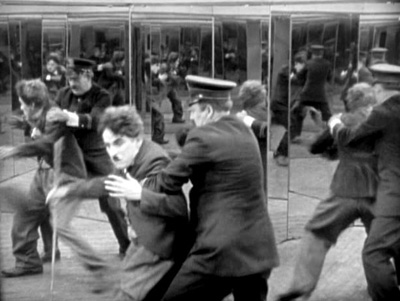
 

American Politics: A House of Mirrors

the-circus-fun-house-mirrors

By Ulson Gunnar

Source: Land Destroyer

A house of mirrors is an immersive, highly distorted and intentionally confusing version of reality. Those walking its corridors are sometimes amused and sometimes frightened by the disorienting experience, but luckily for them, it is only temporary. There is an exit, and they will walk through it, back to reality.

But what if one existed their entire lives in such a distorted reality and knew of no exits? Would they convince themselves that these distorted images reflected back at them were in fact reality no matter how unnatural they appeared? Could they convince themselves to enjoy and even embrace this distorted reality?

One ponders such questions when looking from the outside-in on American politics. It too is a house of mirrors reflecting back a reality entirely distorted. Also like a house of mirrors, American politics have been intentionally constructed this way, to confuse, disorient and even frighten the American people when necessary to exercise mass persuasion over them. The final result is perpetual impunity granted to the powers that truly be, hiding behind the powers that allegedly were “elected,” and powers whose authority only exists in this house of mirrors and no further.

New Leaders, Old Wars 

Consider US President George Bush Sr. He launched the inaugural war of what he himself called a “New World Order.” Operation Desert Storm included multiple nations comprising of nearly a million soldiers who swept from the map one of the largest conventional armies (4th largest) in the world. Bush Sr., however, paused just ahead of sweeping the Iraqi leader Saddam Hussein from power. His successor, US President William Jefferson Clinton would keep Iraq subdued with periodic bombing campaigns and the imposition of both crippling sanctions and no-fly zones in the north and south of Iraq.

Clinton would serve 8 years in office and lock horns with Russia in Serbia in a proto-Ukraine-style conflict. In 2000, we should remember that George Bush Jr. ran on a platform opposed to global interventionism. For those trapped in the house of mirrors, this distortion of reality seemed very convincing. For those who understood the hegemonic mission of America’s special interests, those that transcend elections and political parties, they knew Bush Sr.’s desires for a “New World” endured and would manifest themselves in a yet revealed, muscular foreign policy that only needed the right impetus to be justified in the eyes of the American people.

Conveniently, the events of September 11, 2001 delivered just that. So began the 8 year “War on Terror.” So sick of wars were Americans at the end of those 8 years, that anyone promising to end them would likely win the 2008 elections. And so Barack Obama did and thus became “US President.” However, not only did the wars not end, and not only were they in fact expanded, new wars were begun. In fact, these new wars were all the planned wars Bush Sr., Clinton and Bush Jr. never got around to fighting.

Yet, no matter how unnatural this distorted reflection appeared in the American politics house of mirrors, those trapped perpetually within its mirrored walls found it perfectly acceptable for a Democratic president to continue Republican wars and start new wars the Republicans could only have dreamed of starting but couldn’t because of left-wing anti-war movements now silent because “their guy” was in office.

Hillary = Obama = Bush Jr. = Clinton = Bush Sr.  

With Hillary Clinton’s announcement that she is running for office in 2016 with President Obama’s full endorsement, those infected with neo-liberalism and wandering the corridors of this house of mirrors see yet another distorted, ghoulish image staring back, but one they are yet again ready to embrace.

Here is a woman who as US Secretary of State laughed and mocked the Libyan people upon hearing their leader had been murdered by terrorists in what constituted by all accounts a war crime. Before that, she played an active role in selling the war upon Libya in 2011 to the American left (as the American right had already desired such a war for years and needed no convincing). By 2016 we may have yet another Clinton in office, and a Clinton fully dedicated to carrying on the wars of both the Democrats and Republicans that came before her.

To say this is continuity of agenda is a bit of an understatement. American foreign policy has been so singular in purpose and focus for the past several decades that it is clear that behind the distortions of this house of mirrors, something singular and very nasty has been there the entire time. Who or what could it be?

The Real President of the United States Lives on Wall Street, not Pennsylvania Avenue 

How about we look at the people who pay for the political campaigns to put these various spokesmen and women-in-chiefs into office in the first place? Or the immense interests driving lobbying efforts that target and control both sides of the political aisle in American politics? A single Fortune 100 corporation has enough money to buy out every relevant politician on Capital Hill and still finish up the fiscal year bloated with billions in profits. And what happens when these interests converge across various think-tanks they themselves have set up and created to generate the singular foreign and domestic policies we see carried forward from presidency to presidency, from congressional session to session?

We see complete control exerted over American politics as well as across the media, allegedly charged to serve as watchdogs and a check and balance, but instead turned into an echo chamber and instrument of mass persuasion by those who have clearly consolidated the summation of American politics in their pockets.

While policy might be debated over by these special interests, and groups moved in one direction or another to exert influence against competing special interests among this exclusive club, one thing is for sure, the American voter is the last voice considered in this process.

Since the American voter is incapable of seeing that they are in fact in a house of mirrors to begin with, and think they are “outside” in reality making real decisions, their decisions are completely irrelevant to those who really do live outside in reality and are actually making real decisions.

We must understand that for special interests that collectively control trillions of dollars in assets, profits and infrastructure all over the planet, the last thing they are willing to do is allow for the existence of a system that might actually put into power a form of authority above their own, that would set policy predicated upon the interests of the people, rather than their own. They have the money, the power and the ability to ensure policy is set to suit them, and them alone, and they clearly have done just that.

This is why US troops are still in Afghanistan and Iraq, wars are still being waged either directly or indirectly against Libya, Syria, Yemen, Iran and Russia and destabilization targeting China and other targets of Washington and Wall Street’s special interests continues unabated, albeit distorted within the house of mirrors, regardless of who is president.

So Americans may think they are voting for Hillary Clinton in 2016, and those infected with neo-liberalism the world over may think another enlightened champion of their progressive cause has taken the reins of the free world, but they might as well have voted for another Bush. The reality is, that as along as Americans and those who look to America from abroad for leadership dwell in this house of mirrors, the special interests that intentionally built this carnival called “democracy” will have their way back in actual reality.

Instead of fumbling through another four years trapped inside this carnival attraction, let’s find the exits. Let’s leave this house of mirrors and breathe a breath of fresh air. Are we really going to listen to another round of campaign promises, holding our breath hoping that this time they mean it? Or will we begin divesting from this system and building our own, one that might actually truly represent us this time, far from the mirrored walls that held us for so long?

Our Spoiled-Brat Economy

f418a7472f5783aa8fcf04d0d72e443140b9e2325a6cf04371d142e41c4827e0

By Charles Hugh Smith

Source: Of Two Minds

By insuring spoiled brats/vested interests never face the consequences of their actions and choices, we guarantee failure of the entire system.

Spoiled brats do not take kindly to being called out as spoiled brats. Since economies are aggregates of individuals, we can anticipate howls of outraged denial at our economy being identified as spoiled rotten.


The two essential characteristics of spoiled brats are 1) a complete disregard for the burdens of those paying the bills and 2) a childishly self-absorbed sense of overweening entitlement. Spoiled brats have no sense of fiscal discipline. Indeed, it is their defining characteristic. They want what they want, and they want it now, regardless of the cost to others or the system as a whole.

In America’s Spoiled Brat Economy, no vested interest is ever allowed to fail. Lost billions gambling with borrowed money? Just throw a K Street temper tantrum and threaten to close all the ATMs when you go broke, and voila, Mommy and Daddy (the federal government and Federal Reserve) come rushing with trillions of dollars to make all the bad things like well-deserved bankruptcy go away.

That tens of millions of savers must be robbed of hundreds of billions of dollars in lost interest to rebuild your banks’ profits and balance sheets–the sacrifices of others are of no concern to spoiled brats.

What does not allowed to fail bring to mind? How about coddled children who are crippled by helicopter parents who do their homework for them and schools that give everybody passing grades and gold stars?

A system that doesn’t allow individuals and enterprises to fail is a system that is simply taking another path to failure. Students who are given gold stars and 9th place ribbons (Meet the Fockers) cannot possibly establish a real sense of accomplishment or learn how to make a realistic assessment of their deficiencies or strengths. They are crippled by all the “help” enablers press on them.

The same is true of spoiled-brat economies. Enterprises that are never allowed to fail (for example, too big to fail banks, bankrupt cities, counties and states, defense contractors who produce failed weapons systems, healthcare organizations that cheat the government and patients, etc. etc. etc.) become deadwood that saps the vitality of the economy, dragging down the few productive sectors.

The “help” lavished on vested interests include sweetheart contracts, direct subsidies, tax credits, lines of credit, zero interest rates and a vast range of other subsidies. The entire point of the vast lobbying machine that funnels federal and Federal Reserve largesse to vested interests is about staving off the very failure that keeps economies from imploding (creative destruction).

The Yellowstone Analogy and The Crisis of Neoliberal Capitalism (May 18, 2009)

Innovation, Risk and the Forest Fire Analogy (July 2, 2010)

By insuring spoiled brats/vested interests never face the consequences of their actions, choices and self-absorbed greed, we guarantee failure of the entire system. So by all means, keep passing out subsidies to too big to fail banks and 9th-place ribbons, and give the brats whatever they want as soon as they start wailing, regardless of the cost to the system itself.


Another World is Possible

original

From the Spanish Civil War to the fall of the Berlin Wall, anarchism pushes for a new social order

By Tommaso Segantini

Source: Adbusters

The Spanish Civil War that occurred between 1936-1939 is always remembered as the fight between the Republicans and Franco’s nationalist semi-fascist forces. However, the war was marked by another, extraordinary event; in 1936, the year of the outbreak of the civil war, the world witnessed the first glimpses of an anarchist revolution. Sam Dolgoff, an American anarcho-syndicalist, stated that the Spanish Revolution “came closer to realizing the ideal of the free stateless society on a vast scale than any other revolution in history.”

The revolution was led by the CNT (Confederación Nacional del Trabajo), a confederation of anarchist and anarcho-syndicalist trade unions. A significant part of Spain’s economy was collectivized and put under direct worker’s control. In Catalonia, workers controlled more than 75% of the economy. We should not imagine Soviet-style forced collectivization, but, as Sam Dogloff said, “a genuine grass roots functional libertarian democracy, where each individual participated directly in the revolutionary reorganization of social life”. George Orwell, who has served as a combatant for the CNT, was able to document the revolution as a first-hand observer. Two short passages from his Homage to Catalonia, published in 1938, illustrate superbly the spirit of the revolution: “[T]here was a belief in the revolution and the future, a feeling of having suddenly emerged into an era of equality and freedom. Human beings were trying to behave as human beings and not as cogs in the capitalist machine,” and “many of the normal motives of civilized life—snobbishness, money-grubbing, fear of the boss, etc.—had simply ceased to exist. The ordinary class-division of society had disappeared to an extent that is almost unthinkable in the money-tainted air of England; there was no one there except the peasants and ourselves and no one owned anyone else as his master.”

Unfortunately, the Spanish anarchist utopia did not last long. The anarchists were crushed by a temporary alliance between all other political parties (including the Communists and the Socialists) and the brief—but real—experience of an anarchist society faded away.

However, an important lesson can be drawn from the anarchist utopia of 1936: another world is possible (which is also the slogan of the World Social Forum). Before discussing anarchism’s possible role in the resistance to the capitalist world order, let’s shortly retrace last century’s main stages of the capitalist system’s consolidation: elites have won the long-lasting struggle against the working class; this was achieved firstly by granting workers some benefits after World War II, notably through the implementation of welfare systems in the West, then by fragmenting them with the increase in specialization of labor and the growth of the service industry during the post-Fordist period and finally by assessing the knockout blow through neoliberal policies, which erased hard-fought social and economic rights, diminished trade unions’ bargaining power and weakened their influence.

The libertarian revolutions of 1968 have also ended up in disappointment. Hopes brought by the “New Left” political movement that emerged from the demands of students, activists and workers, came to a close when economic powers and politics colluded in the 80s, removing the last glimmers of hope that change could happen from within the current political system. The 1980s also marked the beginning of the neoliberal era (deregulation of the financial system, erosion of welfare states, privatization programs, financial crises, cuts to public spending).

Finally, the fall of the Berlin Wall represented the end of the last bastion of ideological resistance against capitalism: communism. Fukuyama’s The End of History and the Last Man main thesis was emblematic in the representation of the world we faced and still face today: the triumph of liberal democracy and capitalism marked the end point of mankind’s ideological and political evolution.

We live in a historically specific cultural paradigm, shaped during the course of the last century through mass media, popular culture and advertising, which converged together and formed our consumer culture and in an economic and political system structured to serve the interests of a small elite. In this scenario, anarchist thought has a dual function of resistance: as a challenge to the neoliberal ideology, and as a possible concrete utopia that can guide us in the construction of a valid alternative social order.

The most accessible ground for us, “the 99%,” through which a radical change can be achieved, is that of ideas. No economic or political revolution can bring genuine change without, stated Serge Latouche, an advocator of the degrowth movement, “the decolonization of our minds” from the ideological framework we find ourselves in. Anarchism challenges the ideas, the dehistoricized and naturalized assumptions, and the taken-for-granted norms of today’s society. In an anarchist society, solidarity would replace individualism; mutual aid would prevail on competition; altruism on egoism; spirituality on materialism; the local on the global. Changing the current global framework of rules first necessitates an individual ideological liberation that can only come through self-awareness. To free our body we must first free our mind.


“Good al-Qaeda’s” Air Force: The United States Is At War With Syria

nusra-front-us-weapons-tow

By Jim Kavanagh

Source: The Polemecist

“The President does not have power under the Constitution to unilaterally authorize a military attack in a situation that does not involve stopping an actual or imminent threat to the nation”
candidate Barack Obama, December, 2007

The United States has decided to allow airstrikes to defend Syrian rebels trained by the U.S. military from any attackers, even if the enemies hail from forces loyal to Syrian President Bashar al-Assad, U.S. officials said on Sunday.
—  “U.S. to defend Syrian rebels with airpower, including from Assad,” Reuters, August 3, 2105

The United States just went to war with Syria. With the confirmation today that American planes will shoot down Syrian planes attacking USDA-approved “rebels,” the United States is now overtly engaged in another criminal attack on a sovereign country that poses no conceivable, let alone actual or imminent, threat to the nation. This is an act of war.

Please don’t try any not-really-war “no-fly zone” or “safe zone” bullshit. As the Commander of NATO says, a no-fly zone is “quite frankly an act of war and it is not a trivial matter….[I]t’s basically to start a war with that country because you are going to have to go in and kinetically take out their air defense capability.” Or as Shamus Cooke puts it: “In a war zone an area is made ‘safe’ by destroying anything in it or around that appears threatening.”  Inevitably, “U.S. and Turkish fighter jets will engage with Syrian aircraft, broadening and deepening the war until the intended aim of regime change has been accomplished.”1

Does anybody doubt that this is exactly what’s intended? Perhaps Obama will soothe the discomfort of his purportedly peace-loving progressive fans with some assurance like: “broadening our military mission to include regime change would be a mistake.” He’ll be lying, as he was four years ago when he said that about Libya.

As an aggressive, unprovoked war, this is totally illegal under international law, and all the political and military authorities undertaking it are war criminals, who would be prosecuted as such, if there were an international legal regime that had not already been undermined by the United States.

As an act of war, to be constitutional, it also demands a congressional act of war, and, at the very least, congressional authorization under the War Powers Act. Will Obama ask for this? Will any Democratic or Republican congresscritter demand it? Is the Pope a Hindu?

Would it make any difference? Don’t forget that Obama completely ignored the War Powers Act, the Constitution, Congress, and his own Attorney General and legal advisers,2 and went right ahead with a war on Libya, under the theory that, if we pretend no American troops are on the ground (everybody knows there were, and must be3), it isn’t really a war or “hostilities” at all. So, I guess if the Chinese Air Force starts shooting down American planes in American airspace in defense of the Occupy Wall Street movement’s assault on the White House, China wouldn’t really be engaging in an act of war.

Please don’t complain that the last sentence makes no sense. The U.S. is now officially acting as al-Qaeda’s air force, trying to force a regime change that everybody knows will result in turning Syria into another jihadi playground, Libya 2.0. This makes sense?

Obama is, in fact, now building on the imperial executive arrogance he demonstrated in the Libyan intervention — as Bruce Ackerman said, “betraying the electoral majorities who twice voted him into office on his promise to end Bush-era abuses of executive authority…and the Constitution he swore to uphold,” and asserting the president’s unilateral authority to make war. Per Ackerman: “Nothing attempted by his predecessor, George W. Bush, remotely compares in imperial hubris.”4

It’s impossible to overstate the danger in these executive war-making prerogatives that Obama has now normalized — with the irresponsible connivance of his sometimes-progressive groupies, who pretend not to know where this leads: “I don’t believe at this stage, therefore, if I’m president that we need to have a war powers approval or special authorization for military force. The president has that capacity now,” said Mitt Romney in 2012, and every Republican thereafter.5

It’s also quite clear now, that the War on ISIS is a sham, that ISIS was always just a pretext to get the American military directly involved in attacking the Syrian army and destroying the coherence of the Syrian state. Jihadi horror-show “ISIS” replaced the WMD horror-show “chemical weapons” pretext that Putin so adroitly took off the table in 2013, removing the excuse for the war on Syria Obama was itching to launch then (and earning the lasting enmity of the deep-state neocon cabal). If the U.S. and Turkey wanted to defeat ISIS, they would, besides not sending ISIS arms and fighters, be coordinating their actions with, and not against, the forces who have been most effectively fighting it: the Syrian Arab Army, the Kurds, Iran, and Hezbollah.

Turns out that ISIS and the U.S. have the same enemies. Go figure. Must be some kind of bizarre accident. Doesn’t mean a thing. The U.S. is now even supporting Turkey’s attacks on the Kurds, who have recently won some major victories against ISIS — which is why (Can’t let those Kurds get too uppity.) the Turks are attacking the Kurds!  But really, we’re attacking all of ISIS’s worst enemies in order to defeat ISIS. That the American media pretend there is some credibility to this story reveals… well, at least their utter credulity.

By the way, did you know there’s now a “good Al-Qaeda”? The Wild Ones in the picture above. (They just look like the “bad Al-Qaeda.”) They’re the jihadis our Air Force will be fighting for defending. As Daniel Lazare points out: “After years of hemming and hawing, the Obama administration has finally come clean about its goals in Syria.  In the battle to overthrow Bashar al-Assad, it is siding with Al Qaeda.” And that’s A-OK with the Serious People in Washington: “[R]ather than protesting what is in fact a joint U.S.-Al Qaeda assault, the Beltway crowd is either maintaining a discreet silence or loudly hailing Al Nusra’s advance as ‘the best thing that could happen in a Middle East in crisis.’” Al-Nusra is the official affiliate of Al-Qaeda in Syria. As Lazare says:It is as if 9/11 never happened.” Kiss and make up. New fish to fry, don’t you know.6
The best thing that could happen. You read that right.
As anyone with one eye and half a brain can reckon, the primary goal in creating a “safe zone” is to make a safe redoubt from which al-Qaeda, al-Nusra, ISIS, the Army of Conquest, and all 60 of the U.S.-vetted “moderate” rebels – all jihadi brothers-in-arms against Syrian secular nationalism – can launch their attacks to overthrow the government of Syria.

Really. A total of 60, at $9 million per.7 I can’t make this stuff up.

Syria is now under explicit attack by the armed forces of two states – the U.S. and its NATO ally Turkey (sanctioned by NATO) – along with a panoply of jihadi proxy armies supported by at least two other states – Saudi Arabia and Israel (Oh, yes!8). The Syrian state and its allies, Iran and Russia, have the right to respond, and any military response of theirs will be legitimate self-defense. Turkish soldiers, and American pilots (and any Special Ops soldiers, who will be on the ground) have no right to be in Syria trying to impose regime change by deadly force. The Syrian Army, on the other hand, has every right to stop them with deadly force, and every right to strike back at the American military apparatus, everywhere.

So please, do not pretend to be shocked, shocked, if Syria and its allies fight back, inflicting American casualties. Don’t pose as the morally superior victim when Americans are killed by the people they are attacking. And don’t be preaching about how everyone has to support our troops in a criminal, unconstitutional, aggressive attack on a country that has not threatened ours in any way. Every casualty of this war, however big it gets, is the ethico-political responsibility of the attacking party – US. The first responsibility of every American is not to “support our troops,” but to stop this war. Right now. Before it gets worse.

Three years ago, Col. Lawrence Wilkerson, Colin Powell’s Chief of Staff and another Johnny-come-late (just after he could have made a difference) to the honesty and responsibility party, exhibited either his precognitive powers or the fact that everybody in the deep-state-know has known for a long time what plans were in motion:

I could paint you a scenario where we start a NATO no-fly zone over Syria, and wind up, in a year or two, with a general regional war, and then, within a year or two of that, possibly lots of big players fighting each other, first through surrogates, and then their own troops…I wouldn’t be surprised to see the Russians … begin to sell their most sophisticated air defense missiles to Syria. Then they’re going to start shooting down NATO airplanes; not one or two, but lots of them.9

Yup, because Iran and/or Russia may come to Syria’s defense, as they have every right to do, there is a real danger of this quickly developing into a wider regional war. And this, of course, is something that at least one of the parties targeting Syria would welcome. As I’ve said many times before, those who think all this makes no sense need to understand that there are those for whom it does.10 Israel would love to have the United States and NATO involved in conflict in the region, and would greatly prefer having ISIS/al-Nusra/Army of Conquest/good-or-bad-al-Qaeda misrule Syria, because, as the Association of Arab-American University Graduates said over thirty years ago, commenting on the Yinon plan: “the Zionist hope is that sectarian-based states become Israel’s satellites and, ironically, its source of moral legitimation.”

A plan? Yes, there is a plan, and it’s being followed. It’s getting hard not to notice. In an essay this week, Roger Van Zwanenberg, founder of Zed Press, comes around to noticing. He asks: “So why do the great powers continue with these policies?” He continues: “My question is whether the cock-up theory is really sufficient to explain the chaos that we are witnessing and whether our foreign policies really are conducted by idiots?” And he goes on the notice the Yinon plan, and “how close Israel is to the USA. There is no equal to these nations’ fraternal relations in the world. There is no doubt that American policy toward the Middle East and Israel’s policy in the region are powerfully coordinated.”11

No, the neocons driving American foreign policy are not idiots (although some of the more public frontmen may be), any more than Lawrence Wilkerson or the Arab-American University Graduates are precogs. They all just understand the plan.

Really, who wants a war with Syria? After Iraq and Libya, who wants this? Who thinks it’s a good idea, and for what reasons? Who wants years of conflict between the Caliph, al-Nusra, and the Army of Conquest over the spoils of Damascus and Aleppo? Who wants another five thousand well-trained, victorious jihadis marching off to take down Lebanon and Jordan, and another ten thousand migrants storming the Greek islands and the Chunnel? Did I miss the tens of thousands of people in the streets of America clamoring for it, and for all the benefits it will bring them? (Although I was in the streets with millions of people throughout the world trying to stop a war in 2003, and being ignored.) Or did I just not see – what was not invisible, but was never highlighted, and required some effort at peeking behind the curtain – those inside the foreign policy apparatus of the United States and its special allies arguing and preparing for this, and refusing to give up on it, tirelessly conjuring up pretext after pretext, and pack of lies after pack of lies, until they got what they wanted? These are not rhetorical questions. Because this – the United States going to war on Syria – is not happening by accident. It is only happening because somebody does want it, for some reasons. Go figure.

Really. Think about it.

Any self-identified “liberal” or “progressive” American who spent (and may still spend) their political energy attacking Bush, et. al., for that crazy war in Iraq, and who goes along with this war for a second – who does not recognize, and immediately and energetically denounce it for the criminal and dangerous adventure that it is, and its authors, from Obama on down, for the dangerous criminals they are – is a political hypocrite. Any politician or presidential candidate who does not immediately and energetically denounce it certainly has no right to pretend to be progressive.

Let’s see what Bernie does and what his followers say. A $15 minimum wage and imperialist chaos? We’ll have to go along with that, ‘cause we can’t bother raising the troublesome questions about militarism, exceptionalism, and what constellation of forces is devastating the Middle East?

Hillary? You’re kidding.

Those who wanted a war with Syria in 2013 have finally gotten what they wanted. It will be a dangerous diversion, at least, for the United States, and a certain disaster for the people of the Middle East. And nobody will stop it.

Let’s talk about Donald Trump some more.

1 Breedlove: No-fly zone over Syria would constitute ‘act of war’: Why Obama’s “Safe Zone” in Syria Will Inflame the War Zone

2 Glenn Greenwald. The illegal war in Libya – Salon.com; Charlie Savage, 2 Top Lawyers Lost to Obama in Libya War Policy Debate – The New York Times

3 “The administration promised not to send ground troops into Libya, but Obama secretly authorized covert action by CIA paramilitary officers to aid the rebels.”

Obama the Conservative | Tracking Obama’s abandoning of the progressive agenda, and the disconnect between his words and deeds.

4 Bruce Ackerman, Obama’s Betrayal of the Constitution – The New York Times

5 Conor Friedersdorf,  How Obama Ignored Congress, and Misled America, on War in Libya – The Atlantic

6 Daniel Lazare, Climbing into Bed with Al-Qaeda | Consortiumnews

7 Pentagon Recruits 60 “Moderate” Syrian Rebels, Pays $9 Million to Train Each One | Global Research – Centre for Research on Globalization; In Syria: $36 million to train 60 opposition fighters? – LA Times
8 Israel acknowledges it is helping Syrian rebel fighters | The Times of IsraelTurkey and Israel Are Directly Supporting ISIS and Al Qaeda Terrorists In Syria Washington’s Blog [update on 8/6/2015]

9 Thomas Hedges, War Power Abuse Makes Iran Conflict More Likely – Truthdig

10 America, ISIS, and Syria: We have to bomb the jihadis in order to save them, and other posts on Syria.

11 Middle East chaos: Cock-up or conspiracy? | Middle East Eye

Other Links [update on 8/6/2015]
Tony Cartalucci, US To Begin Invasion of Syria | New Eastern Outlook

Eric Draitser, The Fake War on ISIS: US and Turkey Escalate in Syria | New Eastern Outlook

Mike Whitney, The Brookings Institute Plan to Liquidate Syria

Moon of Alabama – Turkey Lauches War On Islamic State’s Worst Enemies – The Kurds

James Petras, Erodoğan and Netanyahu Declare War

State Dept. ‘frankly doesn’t know’ legal authority behind US airstrikes supporting Syrian rebels — RT USA


Weird Parallels: Helium Waste and 19th-Century Logging

macys-parade-uncle-sam-spidermanBy Kowality Jesus

Source: Disinfo.com

There is plenty of regret to go around about the wholescale waste of the immense virgin forests in pre-20th century America. These forests represented a cheap, high-quality building material to early Americans and a profitable export that only required rudimentary tools and a healthy portion of elbow grease to attain. Unfortunately, the citizens of 19th century America (a few of whom became very rich) did not exhibit the conscientiousness nor collective restraint to prevent from despoiling the vast majority of these invaluable and dignified forests. It simply did not occur to them (until Teddy Roosevelt spearheaded the conservation movement and hippies formed the environmental movement) that this timber resource is exhaustible, and once exhausted practically irreplaceable.

For example, during the early history of my home state of Michigan, it is said that a squirrel could traverse from Lake Huron to Lake Michigan without ever touching the ground.  Yet it took an incredibly small amount of time (mostly 1870-1890) for men with hand-drawn felling saws to systematically evacuate every virgin tree on the entire peninsula. The scale and speed of this relentless logging machine still baffles me to this day. In fact, the harvest was so unimaginably great that a profitable industry exists today of recovering the very small percentage of fine old-growth logs that sank during transport and have rested on the bottom of the Great Lakes for 150 years.

Imagine, if you would, that we had saved some portion of these magnificent, centuries-old trees until today. What would a good violin luthier do these days for some now-rare, quality old-growth tone wood? How impressive would Michigan’s tourism industry be if we had thought to save more than just a few monument virgin trees? We can never know.

Yet we find numerous analogs to this 19th-century state-of-mind today. One remarkable example is our prodigious waste of what is a very finite and valuable resource, helium. Helium and its fellow noble gas, argon, both naturally occur on Earth because of radioactive decay (argon as a decay product of potassium-40, helium as an alpha particle from the decay of various radioactive substances inside the earth, mostly thorium). Interestingly, argon composes about 1% of the Earth’s atmosphere whereas helium is only found in trace quantities. This is because helium is SO light that, once released, it actually floats completely out of the atmosphere, which means once it is extracted from its underground home (through a natural gas well) it must be contained or it will literally disappear into outer space during the next solar storm.

But why is helium valuable, you say? Interesting question. As well as being widely used in arc-welding, manufacture of computer chips, and fiber optics, helium finds applications in ultra-low temperature measurements and experiments (since liquid helium is the coldest liquid there is at 4 degrees Kelvin), and is 2nd to none. Liquid helium is used to cool the magnets in MRI scanning, NMR spectroscopy, and a variety of other low-temperature scientific experiments (96 metric tons of it are used in the particle accelerator at CERN, and 120 metric tons were used to launch the Saturn V rocket). In fact, universities and scientific laboratories have large and expensive apparatuses to recycle the copious amounts of helium that is regularly used in scientific experimentation.

The United States actually has a National Helium Reserve based near Amarillo, Texas which was established in 1925 as a source for airships in a time of war. It expanded during the Cold War as a resource for the Space Race and other scientific research (unfortunately we still live in an era of our nation where technological advancements are almost invariably spearheaded by military research). By 1995 the reserve had accumulated not only 450 million tons of helium but also $1.4 billion in debt, so congress decided to offset the liability through completely selling off the helium by 2015 and privatizing the helium production industry. The Strategic Helium Reserve being the only helium reserve in the world, this rather abrupt selling-off had the effect of greatly reducing the price.

As happened in the 19th century when huge forests were being felled as quickly as possible, a glut of supply and a cheap price creates the natural propensity for wanton waste of a product. Even though party balloons are the most visible and frivolous waste of helium, (at some dollar stores one can purchase a balloon WITH helium for $1) they only account for about 8% of overall consumption. The larger users in industry currently have no incentive to purchase helium recycling systems and collect the helium they use, because it is not currently necessary, or profitable, to do so. More fundamentally, with no government organization stockpiling it, natural gas producers here and around the world have no price incentive to capture helium which naturally occurs in some deposits at a concentration of 1-3% and is not difficult to refine. Most natural gas producers currently vent their helium into the atmosphere. According to Nobel laureate Robert Coleman Richardson, in order to reasonably protect the supply of helium for current and future high-tech applications, the price should be 20 times greater than it currently is.

Much like old-growth forests, we will never truly run out of helium because it is constantly being produced by alpha-decay 0f radioactive particles inside the earth, though at an incredibly slow rate. Thus, it will become progressively less and less accessible, and eventually make industrial applications and invaluable scientific research more difficult to execute without enormous funding. So in other words, the 1996 US congress via Public Law 104-273 helped America go from “hero” to “zero” yet once again.

The Poverty Machine: Student Debt, Class Society, and Securing Bonded Labor

StudentLoanDebt070313_0

By Jeremy Brunger

Source: The Hampton Institute

At the dawn of the 20th century, very few American students attended high school, as the demands of the heavy-industrial and the agricultural economies of that period were ill-suited to an extended education beyond the family sphere. In the middle of the 20th century, most Americans who either aspired to or had to work entered the full-time workforce immediately after high school, for such a postwar economy featured plenty of growth and comparably fair wage-compensation for the average worker. As the economy became more complex in its labor needs, its extending length of education complemented these requirements. The transformation of the agricultural economy into the technological economy after World War II, in turn, transformed the university, once the commune of the well-to-do, into a center for job training, an adjunct to industry, and one which continued to increase in enrollment as the technological necessities of an increasingly complex economy required further education. What was once the realm of the study of Christian religion, the Rennaissance humanists, and the Aufklärung became, for most students, the study of the technical labor necessary to produce and reproduce the new forms of capitalism and scientific production coming into existence. The growth of the American middle class became co-incident with the growth of the education industries which had hardly existed a century previous, when the middle class itself had hardly existed in any recognizable form. Where there was study, there was hope for economic success-the maxim “if a man falls in a field he is redeemed in a library” comes to mind-and the institution of the university became as integral to living well in the United States as the ownership of property and the propagation of the nuclear family.

However, in the 21st century, although attendance of university courses is at an all-time high as the millennial generation achieves the highest historical rate on record of college attendance, that same generation is forecast to experience a decline in standards of living comparative to their forebears. Not only this qualitative fact, but also the quantitative method of that attendance is worthy of critical analysis-for the funding of undergraduate and graduate educations comes largely from the borrowing of money from lenders with the Federal government playing its role as intermediary. As the declining middle class cannot pay for its children’s higher educations, it looks to the loan system to cover the ever-increasing costs of reproducing its standards of living over time. But such loans cannot be discharged in bankruptcy, and with the already saturated labor markets of the majority of the professions that could hope to pay off those loans, the economic situation comes to look much different: rather than the state intent on spreading enlightenment to the masses, the state appears to be securitizing a labor force that will simply have to perform whatever jobs are available, perhaps for decades on end, in order to pay off those loans.

That is, the students will have to do so if they want to qualify for home mortgages and otherwise live free from debt, which historically has always loomed over the subaltern and the serf alike. The parallels between the indebted student and the historical bond-laborer are strong enough to warrant comparison. One trend that especially deserves critical analysis is the outreach of the market to cover students from low-income backgrounds and whether or not such outreach is democratic-a Rawlsian lifting of the boats-or if it is merely predatory in nature and outcome. For, if the state and its lenders are merely financing higher education in order to secure a labor force that will not practice in the professions for which it trained but rather any job available by fiat of the debt-load, then a new reckoning is due of the state of affairs between the working-class young and their educations, the relationship between the state and the private sector, and the ongoing presence of class determinism in the free world.
Debt Corvee

According to The Institute for College Access and Success, statistics for the average student debt load from 2014 suggest that 71% of all students graduating from four-year colleges had student loan debt and the average level of this debt for public colleges was about $25,550, about $5000 higher than 2008. At the for-profit colleges the level was even higher, with students graduating with about $40,000 in debt. Most of this debt is mediated by government loan programs-about 80%-with the rest being covered by private lenders without mediation. The average student debt has increased, since 1993, about three-fold; given the rising cost of living and institutional funding in general, an increase in cost is not particularly surprising. What is surprising is how steep that increase in cost is. The cost of the aspirant apparatus of education increases beyond the market value of the professions on offer when viewed sociologically-the combination of public funding and private ambition allows tuition rates to soar even as student returns on investment plummet.

It appears the days when middle-class parents, a status declining in real terms since the 1970’s, directly financed their children’s college educations are largely over. While this may appear to be beneficial to the working class, in that the gatekeeping apparatus for entry into the professions-the colleges and universities-are more easily accessible than ever before, the debt that falls on the students is that much more of a burden. Students “who received Pell Grants, most of whom had family incomes under $40,000, were much more likely to borrow and to borrow more” than their more middle class peers, according to the Institute for College Access and Success. The debt load is thus geared to the children of the working class and the working poor who, no doubt seeking a better future for themselves, expend large sums of money-often more than a year’s wages, and sometimes two years’ worth-in accessing the portals of higher education. Given that student loans mediated by the government cannot be discharged in bankruptcy, students often have no choice but to live with that debt load for years and years if not forever: they have an education which cannot be repossessed, but they are also forced to work in professions for which they did not train in order to pay off that initial investment. This situation comes to resemble the historical institution of corvee labor, or other forms of debt-labor, in that the young, in being promised a better future, must nevertheless work for others as bonded servants in order to pay off their contracts. This is especially true for graduates in the non-scientific disciplines, as a Bachelor’s degree in a field other than business or the sciences becomes a mere shibboleth for entry into work that is not at the very bottom of the labor market, and even those “safe degrees” harbor little real safety for the student at the whim of capital. Having a Master’s degree in economics, the social science that ended The Great Depression, is yet no guarantee against waiting tables for tips for an indefinite period. The same can be said of the other disciplines.

The historical practice of corvee labor has much in common with the emergence of the indebted student. Corvee was a form of near-slavery, often linked to the military, that indentured laborers to a contract with an owner; nominally, the contract was entered into freely by the laborer, was guaranteed by the state, and was therefore not legally slavery, but due to the conditions of existence the laborer otherwise faced, the contract’s foundations were more reminiscent of the Hobbesian outlook than the Lockean. It was often the only viable option available for the children of the poor, and so, faced with hunger or hard labor, they chose labor on contract with the state. The structural difference between this practice and the practice of loaning to students are small, in that the state was involved in corvee as much as it is involved in student lending-for the student who may seek jobs after graduation is still in the economic red even as the student receives compensation for work. Corvee’s goals were to fill up a floating labor pool; the side effect, whether designed or accidental, of student lending winds up much the same. A student who accrued $30,000 in debt studying philosophy is likely to wind up working in the lower sectors of the labor market, unless they go back to school for a different or a higher degree-and so, in terms of base economics, their impersonal labor has been securitized by the public sector in favor of the private sector. Unless, that is, that student winds up working for the state in some other capacity than what they expected when they entered into their field of study, in which case the state has merely financed its own labor pool: and plenty of state jobs, like those in the sector of public secondary education, offer debt-manumission in reward for practicing in those fields for a period of several years. As such, the claim that only for-profit colleges are to blame for high student debt is false, for public universities contribute massively to rates of student debt and possess internal incentives for producing indebted students who might seek to dissolve their debt through public service.

The same may be said to apply to a pre-medical student who decides it is not prudent to enter into the “megaloans” required for medical school-at which point that student is already indebted for the undergraduate education and so, like the student of philosophy, winds up working for any institution that is hiring. This aleatory materialism may not have been intended by the state-the rhetoric behind opening access to higher education to as many people as possible was couched in democracy and enlightenment, to which every “Dream Big” sign on college campuses will attest-but its practical effects come to much the same result as corvee labor. The ideological state apparatus metamophoses into the financial state apparatus, yet focuses on the same people-the students, who, now indebted, represent a securitized labor force for private and public sectors alike. Most internships available to the graduate are unpaid internships-a relatively new development since the 1990s-thus leaving workng-class graduates desperate for income only non-professional career avenues. As the only broad field of economic growth under the last two presidential terms has occured in the service sector, educated working-class students can expect to enter the same service sectors in which their parents worked. Most interestingly, the etymological root of the word “service” stems from the word “serf.”
The Graeberian Insight

According to Dr. David Graeber’s 2011 book Debt: The First 5000 Years, the centralizing state has employed debt as its apparatus of growth for centuries. Debt, for Graeber, informs the very epistemology of Western people-we think in terms of credit and debit, of libertas and indebtedness, of squaring up our moral accounts. Debt is thus an all-pervasive category in how the Western world works, whether in the ancient world or in the contemporary 21st century. Graeber’s insight is useful beyond his idealist prescriptions for “everyday communism” and his moral philosophy, for the latent commodification of the ideals of democracy-education among them-is still a very real phenomenon. Education may have its necessary infrastructural costs, but it need not be a commodity traded between lenders, or traded between speculators, with unwitting students-especially students from non-professional backgrounds-used as its financial pawns. Given that the actually-existing professions cannot absorb these students, and that the state serves as mediator between lenders financing their educations, the surplus labor which the students provide can only be absorbed by sectors they did not intend on entering: the various service sectors, the only growing sectors in the economy, the only employers broadly willing to accept non-professionals.

Graeber writes that “presented with the prospect of its own eternity, capitalism-or anyway, financial capitalism-simply explodes. Because if there’s no end to it, there’s absolutely no reason not to generate credit-that is, future money-infinitely. Recent events would certainly seem to confirm this. The period leading up to [the financial crisis of] 2008 was one in which many began to believe that capitalism really was going to be around forever; at the very least, no one seemed any longer to be able to imagine an alternative. The immediate effect was a series of increasingly reckless bubbles that brought the whole apparatus crashing down” (360). Given that higher education has become an industry like any other, subject to the same laws of capital and labor, it also suffers the same proneness to instability endemic to any other capitalist endeavor. Consider the recent closure of Sweet Briar College, the glut of PhDs, or the models of infinite growth to which larger universities seem to adhere. The universities are awash in internal commentary that they are swiftly becoming corporatized, going from the internally-administed grove of academe to an organ of capital’s interest-just look at any critical article on The Chronicle of Higher Education, especially those written by educators and researchers already secure in their tenure, such as Terry Eagleton’s 2015 article “The Slow Death of the University.” With such extension of the sphere of capital and its models of development into academia, academia comes to suffer the same risks as capital, along with its students-or, according to the corporatized university, its customers.

The social form of capitalism, in synthesizing Louis Althusser’s social theory of economic reproduction and Graeber’s theory of debt, thus reproduces itself not only through relations of the commodity-form but also through relations of debt (Althusser 47). Capital has a tendency to perform its name-to capitalize, to penetrate into vulnerable markets-and what market is more vulnerable than youth? From ancient Greece to Africa it was not uncustomary for families to lend their children to the market in the form of pawnship or peonage, or in the early modern Western world with indentured servitude, according to the Historical Dictionary of Slavery and Abolition; and with corvee, the state guaranteed the trade-and within the structures of contemporary student lending these kinds of practices appear to have survived into the 21st century even in the liberal West (174, 229-30). The millennial cohort, massive as it is and funded into debt by the state, represents not a boon for the professions but a huge and exploitable labor pool for the industries.
The Re-proletarianization of Youth

In world-systems theory, as understood by the scholar Immanuel Wallerstein in his book Historical Capitalism, the spread of capitalist social relations produces two key processional phenomena: embourgeoisement and proletarianization. These historical processes act in tandem, as some become bourgeois through the labor of those who become proletarianized, and others, more unfortunate, reverse that process. Such a process, now that the university systems have co-opted the capitalist mode of financing, has been enacted in large swathes of the student population. In seeking embourgeoisement and standards of living that have been viable for only a very few for decades, many students actually become proletarianized-and perhaps moreso than had they not attended higher education with the help of the lending system in the first place. Now that higher education is a thoroughly penetrated market for historical capitalism, many of its students become proletarians as surely as if they had went to work in the nearest factory-only it is not the lonely capitalist who profits but rather the university institutions and the state. The funding models of higher education depend on a floating student body, just how labor-intensive industry depends on a floating labor pool; both groups of people come to resemble each other more and more in terms of base material economy in relation to overall American wealth.

The trappings of economic success-a diploma, the social capital of calling oneself educated-only signify the sort of well-being to which people aspire. Those trappings do not guarantee it. Indeed, even many of the teaching scholars who profess at America’s universities still have debt from their undergraduate years well into their careers that prevent them from attaining the truly middle class lifestyles their students expect to earn. The academic phenomenology of the indebted teacher becomes the capitalist yoke of the indebted student who, upon graduation, in all likelihood does not even know the definition of “liberal capitalism.” It is odd, given America’s general strain of individualism, that it has become a normative part of life to amass such large amounts of debt-that the insistence on neoliberal economics binds the citizenry that much more powerfully by debt-relations than by individualism. Such a process is bound to produce discontent not in isolated outliers but in a whole cohort of the population.

The cornerstone of proletarianization is that one expects, in resignation, to work for low wages in industry-any industry, at that. The structural similarity between the historical proletariat and the new student proletariat is profound enough to warrant its assertion; even if standards of living have increased for the working class since Karl Marx’s 19th century by vast leaps and bounds, the group of people graduating from universities with mortgage-sized loans fit into the same category of social utility as that historical proletariat. An indebted youth cohort is very good for capitalist endeavor-businesses, having already offloaded job-training responsibilities to the colleges, can expect an incoming workforce that is more desperate for employment because of the debt-burden-and it is very good for the state, since so many students attend public universities. Given that universities, once homesick spaces of learning and temporary poverty, have become profiteering enterprises of not only education but also entertainment akin to theme parks, they produce permanent poverty under the current administrative model of offering high loans to undergraduates.

Consider the critical theorist Theodor Adorno’s observations, in “The Culture Industry” section of Dialectic of Enlightenment, on “the original affinity between business and entertainment” which “reveals itself in the meaning of entertainment itself: as society’s apologia” (115). Even the studious and earnest student plays today and pays tomorrow in the contemporary university-the hardships of education are passed onto not the undergraduate of today but the graduate of tomorrow. The right to proletarian entertainment is not the “jazz-machines” of Adorno’s era, but the sites of higher education which only since the 1980s welcomes proletarians on their credit. Through a Kantian education that is supposed to free them from external determination, the young have become mere objects of financial speculation, as well as objects of exploitable and undifferentiated labor. The parallels in labor, in relation to the social totality, suggests that the average student body upon graduation becomes the reproduced proletarian body due to debt peonage, which has always been the chief exploitable force and method in industrial society.

In contrast, the medieval institution of journeymanship, by which a student learns gradually more and more from a teacher-worker, was not a relationship of bondage so much as a relationship of tutorship, but despite the modern university’s medieval roots in these practices, the emergence of student debt of such magnitude renders null those benign roots. The indebted student is, as a rule of thumb with its exceptions, rendered by the system of higher education the indebted servant to capital. Working-class 18 year olds ought not be the victims of financial speculation instruments wielded from above, nor should the narrative of enlightenment reproduce inequal relations of capitalism on their shoulders. Beyond this, it is perhaps symptomatic of general living conditions that so many working-class students are attending higher education in the first place-that being poor in a world-historically dynamic economy is that much more intolerable than in the past.

The most worrying facet of this indebting process is the public insistence that students from low-income families attend university on credit. Born into poverty, they can expect to continue enduring it even upon graduation, even if they amass the scholarships and grants that are geared to supporting them. Given the statistics on debt provided by The Institute for College Access and Success, this low-income cohort is the most vulnerable to predatory lending, and so becomes the most indebted relative to their wealthier peers. The class determinism inherent to this shifting of capital from private business to the educational sector all too often makes poor teenagers into poor students into poor working adults. The kinds of jobs these students were taught never to do, by their parents who worked those very jobs in order to keep food on the table, are the only kinds of jobs available to the majority of indebted students upon graduation. While standing debts that pose no possibility of discharge in bankrupty might be good for the speculators of the macro-economy, it represents a monumental burden for individuals and especially those individuals who compose the working class. The pedagogical theorist Henry Giroux suggests in his 2014 book Neoliberalism’s War on Higher Education that the funding mechanisms for American universities are abrasively neoliberal, in that they are extended to students only in the interest of maximum returns on investment-and not only does the funding mechanism support inequality, but also the class interests vested in university research that favors the wealthy over the interests of the poor: the aspirant young become as grist for the capitalist mill by the very institutions they were taught to trust since birth.

The sociology of student debt suggests that indebted working-class students will live in, in relation to society at large, the same socioeconomic position as their parents despite their higher educational attainments. According to findings in the economist Dr. Thomas Piketty’s Capital in the Twenty-First Century, “even with the considerable increase in the average level of education over the course of the twentieth century, earned income inequality did not increase,” and neither did “the intergenerational correlation of education and earned incomes, which measures the reproduction of the skill hierarchy over time” that “shows no trend toward greater [social] mobility over the long run” (484). The cycle of sociological immiseration thus continues unabated, no matter how loud the college yells of freedom and democracy resound, for someone-most likely not the student-profits off the exploited student body. The social utility of higher education transforms, under capitalism, into the private utility of the capitalist; the social affectation of education-as-commodity transforms into the relations between master and bondsman in the new feudalism. Cultures are changed not by the beliefs of the old but by the beliefs of the young. Where the forces of conservatism-not necessarily undesirable in themselves provided they are matched with creativity-over-reach their purview is in the debt-relations extended to the young, who alone amongst the age groups offer history an American future.

Youth is a time for creative experiment and creative destruction, for healthy questioning of the decadent status quo, for sane inquiry into our insane history; it is not a time to be enslaved to financial circumstance, the time clock, or the manager with delusions of grandeur. Such inexuscable waste now doubtless bears future repercussions. Education has always had its costs, and any prosperous society has paid them-but to what result? Creating a vast age group that, in coming to political and economic consciousness, despises the institutions that led it into servitude is not only damaging to the quality of life the students themselves experience. It is also damaging to the self-serving patriotism that conservative forces depend on, for student debt loads only foster distrust of hallowed institutions. “Mistreat the young,” the old adage goes, “and doom the old.” Not only this, but it is also destructive to middle-class capitalism itself, for a generation that pays student debt is a generation that does not buy homes-a high mark of complaint given that so many American cities are falling into infrastructural decay and personal poverty. The populist imperative to preserve a future worth living in need not clash with the profit motive, provided speculators find means other than the young to achieve their profits. The theory of higher education-its opening of access to a more democratic cross-cut of the classes-ought to inform its more predatory practices which, under the debt-relation, only reproduces poverty.

A Victorian patriarch despite himself, Marx despised the immiseration of proletarians most of all because their subordinate positions rendered them incapable of independence, as though by virtue of their servitude they became adult children permanently. Similar in his criticism was that the chief goal of the working class is self-abolition, that is, the working class’s aspiration is to no longer be working class. In seeking to escape the mire of poverty amidst splendor-for America remains the wealthiest country on the planet-working-class students all too often dig themselves deeper into the poverty trap, however adorned with diplomas its ever-heightening walls become. The only way out of the poverty trap for most of them is to become the very thing they were taught not to become by their parents and their professors: bonded servants, or, as the economist Frederic Lordon calls them,willing slaves of capital,” in his book of the same name.

It is not that state involvement in higher education is destructive to the common weal. Far from it-higher education is definitely an institution best left to public administration, for it is a valuable aspect of the commons and its democratic purview. The attendance of higher education may represent one area where the erosion of the commons, at first appearance, has not progressed. But the erosion of the commons occurs where capital privatizes public utility, whether or not it happens in land-grant universities or in private colleges. Where the danger lies is in the inter-relationships between the state and funding models that target the poor for the benefit of the wealthy, thereby fostering uneven development and the reproduction of the conditions of poverty for the working class. Were the attendance of university by the poor and the children of the poor not incumbent upon credit, and therefore upon their probable future immiseration, higher education in America would actually function in harmonious accordance with its original raison d’etre: the humane enlightenment of society no matter the class situations its members may have happened to inherit in the lottery of birth.

Works Cited

Adorno, Theodor & Horkheimer. “The Culture Industry.” Dialectic of Enlightenment. Stanford UP, 2002.

Althusser, Louis. “The Reproduction of the Conditions of Production.” On the Reproduction of Capitalism. Verso, 2014.

Eagleton, Terry. “The Slow Death of the University.The Chronicle of Higher Education. 2015.

Giroux, Henry. Neoliberalism’s War on Higher Education. Harmarket, 2014.

Graeber, David. Debt: The First 5000 Years. Melville House, 2012.

Klein, Martin. “Pawnship.” Historical Dictionary of Slavery and Abolition. Scarecrow Press, 2002.

Lordon, Frederic. Willing Slaves of Capital: Spinoza and Marx on Desire. Verso, 2014.

Piketty, Thomas. “Regulating Capital in the Twenty-First Century: Do Educational Institutions Foster Social Mobility?” Capital in the Twenty-First Century. Harvard UP, 2014.

TICAS.Quick Facts About Student Debt, March 2014. The Institute for College Access and Success. 2014.

Wallerstein, Immanuel. Historical Capitalism. Verso, 2011.

Uncle Sam’s Personal “Terror Factory”

manufactured-terror

• New book documents how FBI built vast informant network to infiltrate Muslim communities and cultivate phony terrorist plots.

By John Tiffany

Source: American Free Press

If someone believes that most, or all, “terrorists” are invented and created by government agents provocateurs, would, or should, they be considered a “conspiracy theorist”?

In fact, agencies such as the Federal Bureau of Investigation (FBI) have been busily creating terrorists out of what had been law-abiding individuals. The system features entrapment, sting operations, provocations and denial of due process, with anonymous juries, secret evidence and extensive pretrial detentions.

In the new book The Terror Factory: Inside the FBI’s Manufactured War on Terrorism, author Trevor Aaronson documents hundreds of Americans who have been hassled by the government as if they were terrorists. But how many actual terrorists have been caught by this grand effort? Aaronson was able to look at the data from 2001 to August 2011, a database of 508 defendants whom the government considered terrorists. Of the 508, 243 had been targeted due to an FBI informant. One hundred fifty-eight had been caught in sting operations, and 49 had been manipulated by an agent. The number of actual terrorists? Fewer than half a dozen.

In those scores of sting operations, almost every “terrorist” was uneducated, unsophisticated and economically strapped—hardly people likely to plan and launch terrorist operations without major help from the government. It’s called “creating crimes to solve crimes so they can claim a victory in the war on terror.”

The practice, started under President George W. Bush, has mushroomed under President Barack Hussein Obama, with more than 75 sting prosecutions in his first three years in office.

To catch a handful of dangerous hombres and a slew of patsies, the government has built the largest network of spies ever to exist in America, with 10 times as many “shoes on the street” today as during the heyday of J. Edgar Hoover. It spends $3 billion a year “fighting terrorism” and needs results to show to the media and Congress.

While the defendants may be broke, it’s not uncommon for informants to make $100,000 or more on a case—plus tens of thousands more if the case results in a conviction. Not surprisingly, the ranks of informants has grown explosively.

James J. Wedick, a retired FBI agent with 34 years of service, ventured to say that 90% of the cases seen in the last 10 years “are garbage,” and informants are unreliable sources and “the most dangerous individuals on the planet.”

He says it is not uncommon for the FBI to send well-heeled informants (with taxpayer money) into poor Muslim communities to try to trick cash-starved men into going along with their jihad-related entrapment schemes, knowing that these men are desperate for a job, a loan, free meals—anything that will help them support their families.

Writes Aaronson:

Congress allocates billions to the FBI to find terrorists and prevent the next attack. The FBI in turn focuses thousands of agents and informants on Muslim communities in sting operations that pull easily influenced fringe members of those communities into terrorist plots conceived and financed by the FBI. The Justice Department then labels those targets, who have no capacity on their own to commit terrorist acts and no connections to actual terrorists, as terrorists and includes them in data intended not only to justify how previous dollars were spent but also to justify the need for future counterterrorism funding.