Is This China & USA’s “Thelma & Louise” Moment?

thelma-and-louise

By James Howard Kunstler

Source: Zero Hedge

Why would anybody suppose that the Peoples Bank of China might want to tell the truth about anything that was within their power to lie about? Especially the soundness of any loan portfolio vested unto the grasp of its tentacles? Of course, most of what China has done in speeding toward the wall of financial crack-up, it learned from watching US bankers slime their way into Too Big To Fail nirvana — most particularly the array of swindles, dodges, and frauds constructed in the half-light of shadow banking to hedge the sudden, catastrophic appearance of reality-based price discovery.

When so many loans end up networked as collateral in some kind of bet against previous bets against other previous bets, you can be sure that cascading contagion will follow. And so that is exactly what’s happening as China’s rocket ride into Modernity falls back to earth. Like most historical fiascos, it seemed like a good idea at the time: take a nation of about a billion people living in the equivalent of the Twelfth Century, introduce the magic of money printing, spend a gazillion of it on CAT and Kubota earth-moving machines, build the biggest cement industry the world has ever seen, purchase whole factory set-ups, and flood the rest of the world with stuff. Then the trouble starts when you try to defeat the business cycles associated with over-production and saturated markets.

Poor China and poor us. Escape velocity has failed. Which raises the question: escape from what, exactly? Answer: the implacable limits of life on earth. The metaphor for all this, of course, is the old journey-into-space idea, which still persists in the salesmanship of Elon Musk, the ragged remnants of NASA, and even the nightmares of Stephen Hawking. Get off this messed-up home planet and light out of the territories, say Mars. Of course, this is a vain and stupid idea, since we already have a planet engineered to perfection for all the life systems associated with the human project. We just can’t respect its limits.

So now, that dynamic duo, Nature and Reality, the actual owners of the planet, have showed up to read the riot act to the renters throwing a wild party. The fourth and perhaps ultimate financial crisis of the last twenty years begins to express itself in terms that only the raptors and vultures can see from on high. George Soros, Kyle Bass, and the other flocking shadow banking scavengers prepare to short the living shit out of the old Middle Kingdom. The immortal words of G.W. Bush ring in their ears: This sucker is going down,” and they are sure to win big by betting on the obvious. Trouble is, this sucker could go down so much further than they imagined, that whatever fortunes they gain from its descent will be foiled by the destruction of the very economic system needed for them to enjoy their gains.

For instance, when banking systems go down, governments usually follow, and when governments go down, societies often unravel. It doesn’t take a great effort of imagination to see China’s one party politburo leadership machine lose the respect of its governed masses, and then its control of events, followed by a Great Struggle among the regions and factions to restore some kind of order. And when the smoke clears there will a whole lot of nearly worthless concrete and steel, and a vast loss of notional wealth, and China will be lucky to land back in some approximation of the Twelfth Century.

It must be interesting for China to watch the horrifying disintegration of America’s political party structure currently on view, with the mad bull called Trump rampaging across the land and the designated inevitable Mz It’s-My-Turn hijacking her collective for the greater glory of Goldman Sachs. The last time China got the vapors politically — the so-called Cultural Revolution of the 1960s — the country went batshit crazy. Surely some of the ruling party remembers that with requisite terror.

Or maybe this is China and the USA’s Thelma and Louise moment. Pedal to the metal, they drive into the abyss of history holding hands. Remember, audiences loved that!

The West Is Reduced To Looting Itself

wPGF1

By Paul Craig Roberts

Source: PaulCraigRoberts.org

I, Michael Hudson, John Perkins, and a few others have reported the multi-pronged looting of peoples by Western economic institutions, principally the big New York Banks with the aid of the International Monetary Fund (IMF).

Third World countries were and are looted by being inticed into development plans for electrification or some such purpose. The gullible and trusting governments are told that they can make their countries rich by taking out foreign loans to implement a Western-presented development plan, with the result being sufficient tax revenues from economic development to service the foreign loan.

Seldom, if ever, does this happen. What happens is that the plan results in the country becoming indebted to the limit and beyond of its foreign currency earnings. When the country is unable to service the development loan, the creditors send the IMF to tell the indebted government that the IMF will protect the government’s credit rating by lending it the money to pay its bank creditors. However, the conditions are that the government take necessary austerity measures so that the government can repay the IMF. These measures are to curtail public services and the government sector, reduce public pensions, and sell national resources to foreigners. The money saved by reduced social benefits and raised by selling off the country’s assets to foreigners serves to repay the IMF.

This is the way the West has historically looted Third World countries. If a country’s president is reluctant to enter into such a deal, he is simply paid bribes, as the Greek governments were, to go along with the looting of the country the president pretends to represent.

When this method of looting became exhausted, the West bought up agricultural lands and pushed a policy on Third World countries of abandoning food self-sufficiency and producing one or two crops for export earnings. This policy makes Third World populations dependent on food imports from the West. Typically the export earnings are drained off by corrupt governments or by foreign purchasers who pay little while the foreigners selling food charge much. Thus, self-sufficiency is transformed into indebtedness.

With the entire Third World now exploited to the limits possible, the West has turned to looting its own. Ireland has been looted, and the looting of Greece and Portugal is so severe that it has forced large numbers of young women into prostitution. But this doesn’t bother the Western conscience.

Previously, when a sovereign country found itself with more debt than could be serviced, creditors had to write down the debt to an amount that the country could service. In the 21st century, as I relate in my book, The Failure of Laissez Faire Capitalism, this traditional rule was abandoned.

The new rule is that the people of a country, even a country whose top offiials accepted bribes in order to indebt the country to foreigners, must have their pensions, employment, and social services slashed and valuable national resources such as municipal water systems, ports, the national lottery, and protected national lands, such as the protected Greek islands, sold to foreigners, who have the freedom to raise water prices, deny the Greek government the revenues from the national lottery, and sell the protected national heritage of Greece to real estate developers.

What has happened to Greece and Portugal is underway in Spain and Italy. The peoples are powerless because their governments do not represent them. Not only are their governments receiving bribes, the members of the governments are brainwashed that their countries must be in the European Union. Otherwise, they are bypassed by history. The oppressed and suffering peoples themselves are brainwashed in the same way. For example, in Greece the government elected to prevent the looting of Greece was powerless, because the Greek people are brainwashed that no matter the cost to them, they must be in the EU.

The combination of propaganda, financial power, stupidity and bribes means that there is no hope for European peoples.

The same is true in the United States, Canada, Australia, and the UK. In the US tens of millions of US citizens have quietly accepted the absence of any interest income on their savings for seven years. Instead of raising questions and protesting, Americans have accepted without thought the propaganda that their existence depends upon the success of a handful of artificially created mega-banks that are “too big to fail.” Millions of Americans are convinced that it is better for them to draw down their savings than for a corrupt bank to fail.

To keep Western peoples confused about the real threat that they face, the people are told that there are terrorists behind every tree, every passport, under every bed, and that all will be killed unless the government’s overarching power is unquestioned. So far this has worked perfectly, with one false flag after another reinforcing the faked terror attacks that serve to prevent any awareness that this a hoax for accumulating all income and wealth in a few hands.

Not content with their supremacy over “democratic peoples,” the One Percent has come forward with the Trans-Atlanta and Trans-Pacific partnerships. Allegedly these are “free trade deals” that will benefit everyone. In truth, these are carefully hidden, secret, deals that give private businesses control over the laws of sovereign governments.

For example, it has come to light that under the Trans-Atlantic partnership the National Health Service in the UK could be ruled in the private tribunals set up under the partnership as an impediment to private medical insurance and sued for damages by private firms and even forced into abolishment.

The corrupt UK government under Washington’s vassal David Cameron has blocked access to legal documents that show the impact of the Trans-Atlantic partnership on Britain’s National Health Service. http://www.globalresearch.ca/cameron-desperate-to-stop-scandal-as-secret-plans-to-sell-the-national-health-service-are-discovered/5504306

For any citizen of any Western country who is so stupid or brainwashed as not to have caught on, the entire thrust of “their” government’s policy is to turn every aspect of their lives over to grasping private interests.

In the UK the postal service was sold at a nominal price to politically connected private interests. In the US the Republicans, and perhaps the Democrats, intend to privatize Medicare and Social Security, just as they have privatized many aspects of the military and the prison system. Public functions are targets for private profit-making.

One of the reasons for the escalation in the cost of the US military budget is its privatization. The privatization of the US prison system has resulted in huge numbers of innocent people being sent to prison, where they are forced to work for Apple Computer, IT services, clothing companies that manufacture for the US military, and a large number of other private businesses. The prison laborers are paid as low as 69 cents per hour, below the Chinese wage.

This is America today. Corrupt police. Corrupt prosecutors. Corrupt judges. But maximum profits for US Capitalism from prison labor. Free market economists glorified private prisons, alleging that they would be more efficient. And indeed they are efficient in providing the profits of slave labor for capitalists.

Here is a news report on UK Prime Minister Cameron denying information about the effect of the Trans-Atlantic partnership on Britains’ National Health.
http://www.theguardian.com/business/2016/jan/26/anger-government-blocks-ttip-legal-documents-nhs-health-service

The UK Guardian, which often has to prostitute itself in order to maintain a bit of independence, describes the anger that the British people feel toward the government’s secrecy about an issue so fundamental to the well being of the British people. Yet, the British continue to vote for political parties that have betrayed the British people.

All over Europe, the corrupt Washington-contolled governments have distracted people from their sellout by “their” governments by focusing their attention on immigrants, whose presence is a consequence of the European governments representing Washington’s interests and not the interest of their own peoples.

Somthing dire has happened to the intelligence and awareness of Western peoples who seem no longer capable of comprehending the machinations of “their” governments.

Accountable government in the West is history. Nothing but failure and collapse awaits Western civilization.

Global House Price Crash Led by Major Cities And Rapid Exit Of Investors

property-market-crash-investwithalex

By Graham Vanbergen

Source: TruePublica

The global house price crash is being led by the most important cities in the world and where they are not falling yet, they soon will be.

The fault lies directly in the lap of central banks as quantitative easing caused an enormous injection of cash into economies, forcing interest rates to fall the their lowest levels in history. This knee-jerk over-reaction effectively halted price corrections that should have fully unfolded but didn’t and put rocket boosters under house price inflation the world over.

With banks and their financial services operations now seen by the public as nothing more than criminal gangs operating with impunity, both legally saved money and laundered cash needed a safe haven. Normal people know nothing about derivatives, day-trading and the like. Property is something most people know something about. Criminals just want to harbour ill gotten gains.

With institutional investors, individuals looking to boost pension incomes, criminals with global reach and an aspirational general public all combined, mountains of cash found their way into property. The international property bubble inflated as the market uncoupled from both the economy and reality.

In Britain, a blinkered Chancellor, unable to see the obvious, supported naive first time buyers in various ways all at the expense of the taxpayer in the hope of winning votes in his 2020 bid. By then the housing market in Britain will have crashed and all his first time buyer voters will be in negative equity for another decade.

It now takes an average skilled worker 14 years to buy a 600q ft one bed apartment in London, the equivalent of renting it for 30 years. What could go wrong?

Sales in London have now dropped by a quarter, prices are already deflating with some commentators blaming new stamp duty/taxation rules imposed for April this year. This is just another reason for the impending decline soon to engulf London and then ripple out to the rest of the country. The average price of a property in Britain is 300 per cent higher today than 20 years ago and that includes the biggest financial crash since the Great Depression.

Hong Kong is experiencing property price falls with most commentators expecting declines of 20 per cent, some at 30 per cent and a few at 40 per cent. The government backed builders to construct rented property to ease the ridiculous prices required to buy an apartment. It took ten years and now rental prices have fallen back just as property investment has taken a nosedive.

In Sydney there’s been a total collapse of business investment and corresponding increase in property investment as Australians got on the ‘get-rich-quick’ bandwagon. Prices are now falling at around 1.5 per cent a month. Not much you might think but by mid 2016, prices could easily be off 12 per cent with no indication of the bottom.

So over-stretched are they in Vancouver it is estimated that a normal price correction of 20 per cent would completely wipe out ten per cent of homeowners. Not surprising as house prices there are by some estimates now 30 per cent overvalued.

America’s most important housing market, San Fransico is about the feel the big house price chill after its epic over-heating. It managed an eye-watering 103 per cent increase in some plush areas in just four years. Affordability has tanked and only the top 10 per cent of earners in the city can now afford to own a home there. If prices fall back to 2008 levels, the 60 to 70 per cent average increase in prices since then could dive with catastrophic consequences.

In The Netherlands just 7 per cent of properties sell for more than the asking price – about the norm for the country. In Amsterdam that figure is about 60 per cent. Housing stock has vaporised and prices today have shot past the 2008 peak. These are the ominous signs of a price correction. Amsterdam may continue to rise for a short while but soon the party will be over.

In Geneva, Switzerland 90 per cent of all household debt is mortgaged. Since 2008, property prices have increased what some might say is a modest 24.3 per cent. Price falls are expected for several reasons; the imposition of a countercyclical capital buffer (CCB) to prevent the real estate market from further overheating, other stricter (mortgage) lending controls and a squeeze on immigration which was causing house price inflation. Switzerland’s mortgage market is 140 per cent of GDP. Expectations are that prices will deflate more slowly, but deflate they will.

The French property market had the dubious distinction of being the most overvalued in Europe in 2011. Even the OECD gave a stern warning that Paris was about to implode – it probably knew best as that is where it’s office are located. Property prices in Paris rose 278 per cent in eleven years to 2011 with two well known French economists predicting steady house price falls for the next ten years totalling 35 per cent to 2025 and a best case scenario of falls until 2020.

What all this says now is obvious. The financial crash in 2008 was caused by reckless banks deliberately overextending mortgage lending that led to the public speculating in the property market. Central banks then pumped trillions of dollars, euros and pounds into the market in order to save the banks. It saved them in part by deliberately inflating property prices.

Investors are now getting out of the game. They know the QE scam is over. As ZeroHedge reportsHow Billionaires Are Investing In 2016: “The Only Winning Move Is Not To Play The Game“. Here they report that the rich and powerful have ended their investment strategies; the only way now is to hold cash, duck and see what happens as the global markets in all asset classes unravel. It confirms what is being said here; that all this ‘funny money’ has created growing distortions in nearly all asset prices—from stocks to bonds to real estate.

The UBS global real estate bubble index for 2016 makes for sobering reading, predicting falls in 10 major cities this year. Fortune reports that the “world is headed for disaster, and will take the prices of equities down with it. How much? Edwards predicts the U.S. stock market could plunge as much as 75%. That would be worse than during the financial crisis, in which stocks from their peak to trough dropped a brutal 62%.”

Even the Oracle of Omaha, Warren Buffet has got this all wrong as his stock is heading south and about to enter ‘bear’ territory.

Bloomberg agrees: “Fed Up Investors Yank Cash From Almost Everything Just Like 2008“.

And what they mean by everything is not just stocks and bonds. The FTGlobal property bubble fears mount as prices and yields spike”. Here the FT reports that returns for rental income (globally) has collapsed when a crash in massively overleveraged property triggered the 2008 international banking crash. Time to get out.

Everyone got into property because prices were expected to beat bond prices, and they did.

When the worlds biggest, wealthiest and most powerful start losing their shirts they rapidly divest to save the proverbial bacon. Result? Asset prices fall and house prices with it. The global house price crash is on and coming to a town near you.

The Militarization of the Superhero

quitely_all_star_superman

Editor’s note: In honor of Grant Morrison’s 56th birthday, enjoy Dan Sanchez’s excellent analysis of the humanist anti-militarist messages of Morrison’s body of work.

By Dan Sanchez

Source: Voices of Liberty

Grant Morrison Vs. the Super-Soldiers

At this year’s Comic-Con (a huge event in the worlds of comics and superhero blockbusters), celebrated writer Grant Morrison:

“…told a crowd of 2,600 that he’s done all he can with traditional superheroes. He’s sick of the ‘military entertainment complex,’ in which today’s characters always seem to be working for the government…” [Rolling Stone]

The creative industry’s booming superhero sector would be wise to take this criticism to heart, as Morrison is the preeminent genius of the genre. He wrote the most commercially successful graphic novel ever, his 1989 Batman: Arkham Asylum, as well as the comic series All-Star Superman (2005–2008), widely acclaimed as one of the all-time best stories about that archetypal superhero.

The Scottish scribe is not only a master practitioner of the genre, but is even its foremost philosopher, having written the definitive book on the superhero, the national bestselling Supergods: What Masked Vigilantes, Miraculous Mutants, and a Sun God from Smallville Can Teach Us About Being Human, which the Memphis Flyer aptly described as:

“…at once a well-researched history, an entertaining memoir, intriguing cosmological analysis, and a surprising personal revelation…”

Morrison’s disdain for the militarization of his art form is in line with his upbringing. As he relates in Supergods, his father was:

“…a working-class World War II veteran who’d swapped his bayonet for a Campaign for Nuclear Disarmament badge and became a pacifist “Spy for Peace” in the Committee of 100.”

As Morrison has explained in interviews, his father did not suffer from “shell shock” so much as from a “political shock.” His dad remembered first believing that he was going to war to “fight fascism,” and then realizing that “we were just as bad as they were,” after witnessing atrocity after atrocity.

Raised by both parents according to “pacifist principles,” young Morrison once told a Boy Scouts recruiter:

“I refuse to be part of any paramilitary organization, and that includes the Boy Scouts.”

In the sixties, his father was arrested protesting the American nuclear missile bases then located in Scotland. Morrison tells of growing up in the terrifying shadow of:

“…the Bomb, always the Bomb, a grim and looming, raincoated lodger, liable to go off at any minute, killing everybody and everything. (…)

Accompanying imagery was provided by the radical antiwar samizdat zines my dad brought home from political bookstores on High Street. Typically, the passionate pacifist manifestoes within were illustrated with gruesome hand-drawn images of how the world might look after a spirited thermonuclear missile exchange.”

In his childhood home, these horrific images contested with the “shiny futurity” of the covers of his “mum’s beloved science fiction paperbacks.” This struggle played out on his TV screen as well, until victory was claimed for optimism by the dramatic arrival of superheroes into his life:

“On television, images of pioneering astronauts vied with bleak scenes from Hiroshima and Vietnam: It was an all-or-nothing choice between the A-Bomb and the Spaceship. I had already picked sides, but the Cold War tension between Apocalypse and Utopia was becoming almost unbearable. And then the superheroes rained down across the Atlantic, in a dazzling prism-light of heraldic jumpsuits, bringing new ways to see and hear and think about everything.”

Ironically, these saving superheroes entered Scotland in the duffle bags of the very same American soldiers who also delivered the Bomb. As Morrison put it in an interview, they brought with them both the disease and the cure.

The sunny, scifi superheroes of the “Silver Age” of comics flew and swung into Morrison’s psyche, saving him from the debilitating existential terror of the Bomb. For the Hulk, having a Gamma Bomb blow up in his face was only the beginning of his career. The Flash could outrun a nuclear blast wave without breaking a sweat. And Superman could stroll out of ground zero without so much as a sun tan.

“Before it was a Bomb, the Bomb was an Idea. Superman, however, was a Faster, Stronger, Better Idea. It’s not that I needed Superman to be “real,” I just needed him to be more real than the Idea of the Bomb that ravaged my dreams. I needn’t have worried; Superman is so indefatigable a product of the human imagination, such a perfectly designed emblem of our highest, kindest, wisest, toughest selves, that my Idea of the Bomb had no defense against him.”

For Morrison, the superheroes were a hopeful, defiant answer to nuclear nihilism, because they were:

“…the best current representation of something we all might become, if we allow ourselves to feel worthy of a tomorrow where our best qualities are strong enough to overcome the destructive impulses that seek to undo the human project…”

Since childhood, the superhero represented to Morrison the antithesis of the ultimate form of warfare. It is no wonder that he would now speak out against its military conscription.

Morrison later turned his love for superheroes into a career as comic book writer. Early in that career, Alan Moore, a fellow Brit, revolutionized the genre, starting in 1982 with his dark, deconstructionist Marvelman (later retitled Miracleman for fear of Marvel Comics’ lawyers). In this revised origin story, Moore recast Britain’s classic Superman-type character as having been engineered as a living weapon by the Royal Air Force.

Moore inaugurated what Morrison calls the “Dark Age” of superhero comics. Realism, political analogy, dystopia, mass carnage, graphic violence, and antiheroes characterized this new age, as well as higher literary standards.

Moore’s first American title was Watchmen (published in 1986–87 and made into a Hollywood movie in 2009). Written during the heightened nuclear tensions of the Reagan years, Moore’s Watchmen was also haunted by the Bomb. Morrison described it as a:

“…murder mystery set against a familiar backdrop of Cold War nuclear paranoia, but located in an alternate history where the appearance of one single American superhuman in 1959 had deformed and destabilized global politics, economies, and culture itself.”

That single superhuman was Doctor Manhattan, who placed his godlike powers in the service of the US government, swinging the Cold War’s balance of power in America’s favor, and making the Vietnam War a cakewalk instead of a quagmire.

Watchmen launched the comic world’s analog to pop music’s “British Invasion” of American culture, an invasion that also included writers such as Neil Gaiman and Morrison himself.

America’s answer to the British “Dark Age” Invasion was Frank Miller: especially his hardboiled 1986 Batman story The Dark Knight Returns. The story also features Superman, and in Hollywood influenced both The Dark Knight Rises and the upcoming Superman v Batman: Dawn of Justice. Morrison wrote:

“The thoroughly modern Batman of The Dark Knight Returns was an antiestablishment rebel and ruthless pragmatist, but Miller’s Superman was an idealistic government stooge in the pay of an all but mummified Ronald Reagan, president forever and ever, amen. A memorable sequence of panels introducing Superman to the story depicted a visual dissolve of the flag on the White House roof, where the rippling stripes of Old Glory morphed into an abstract close-up detail of the famous S shield.”

Morrison further characterized Miller’s Batman as:

“…no bleeding-heart liberal but a rugged libertarian.”

…and his Superman, in contrast, as a:

“…compromised champion of the powers that be, serving the letter of the law, no matter how corrupt its administration became.”

Miller’s story, like Moore’s, also featured the threat of nuclear war and such themes as superhero registration/regulation. And both Watchmen and The Dark Knight Returns are often assigned reading in university courses.

The Cold War, Reagan-era superhero could sometimes be a government stooge, like Moore’s Doctor Manhattan and Miller’s Superman. But in such instances, he was recognized as a stooge.

This has often not been the case for the post-Cold War super-stooge. Starting in the “humanitarian interventionist” Clinton era, the western superhero began celebrating what Charles Krauthammer called America’s “unipolar moment” by strutting the globe, not as government lackeys, but as government badasses.

This was especially the case in the title Stormwatch under the authorship of Warren Ellis, yet another Brit, starting in 1996. Ellis’s heroes were, as Morrison put it:

“…UN-sanctioned operatives with a mandate to monitor superhuman activity and to police violations of the various protocols and sanctions governing the use of extranormal abilities. Costumes became functional field outfits, designed for espionage and black-ops work. Ellis suggested a new take on the T.H.U.N.D.E.R. Agents–S.H.I.E.L.D. model, combining spy thrills with grimy, violent superheroics in a world of genetic manipulation, weaponized flesh, and budget restrictions.”

In 1999, Ellis went even further in this vein with The Authority. Ellis’s new superteam was an updated “Justice League,” with its own parallels of Superman and Batman. The powers and costumes were alike, but the similarities ended there. As Morrison wrote:

“The Justice League never resorted to lethal force, but Ellis’s heroes would happily cut off your head and beat you to death with it if that’s what it took to stop you from being a dictator or a “bastard.” These hombres meant business, and the bad guys could no longer rely on that handy code against killing, which had kept superheroes in check for so long.”

The “heroes” of the Authority decapitated, dismembered, and impaled with abandon. In Marvelman, Alan Moore graphically showed what would happen in the “real world” when supervillains got their hands on frail mortals. Now superheroes too were gleefully exploring the myriad ways to disrupt human anatomy.

The Authority was as ambitious as it was severe. As Morrison wrote:

“The opening page of The Authority no. 1 showed Earth as seen from space accompanied by a single caption. ‘They think there’s no one left to save the world.’”

But the classic superhero trope of “saving the world” had a distinctly imperial ring with this team of, in Morrison’s words, “strutting imperial warrior superhumans.”

“Unlike Alan Moore’s troubled heroes, the members of the Authority were comfortable with their powers, using them sensibly to fight “bastards” and improve the lot of everyone on planet Earth. It was the utopian vision of [Superman creators] Siegel and Shuster strained through British cynicism and delivered on the end of a spiked leather glove. It… suggested a new kind of superfascist, one who was on our side.”

Also unlike the superheroes of yesteryear, these “friendly” imperial superfascists did not shy away from incurring extensive “collateral damage,” if that’s what it took to terminate the superhuman dictators, terrorists, and other “bastards” plaguing the planet.

In one storyline, to defeat an enemy empire on a parallel Earth, the Authority wages total war on the planet. In the last battle, the team’s shaman, called the Doctor, floods the entire Italian peninsula with a move of two fingers, killing everyone on it, man, woman, and child.

The team leader then issues a triumphal global broadcast, announcing the regime change:

“This is Jenny Sparks for the Authority. Albion is free of the Blue. Sicily and the Italian capital infrastructure are gone. If needed, we can annihilate the Hanseatic regions within the hour. If we’re asked to, we will go into China and Japan. If we have to, we will personally expunge the royal blood and military rape culture from the face of the planet. We’re here to give you a second chance. Make a world worth living in. We are the Authority. Behave.”

Morrison liked both Stormwatch and The Authority, and was even creatively involved in the latter. But in hindsight, he now sees that their spirit presaged dark things to come, both in superhero fiction and global superpower reality.

“For a while, it was exciting. In The Authority, the no-nonsense army toughs were on our side for a change, but it was a particular kind of power fantasy: that of impotent liberals, who feared deep down that it was really only force and violence that got things done and not patient diplomacy, and that only soldiers and very rich people had the world figured out. Gifted Irish writer Garth Ennis had occupied this territory for years; his soldier-hardman heroes influenced the new generation of supermen and women. These books were a capitulation to a kind of thinking that would come to dominate the approaching first decade of the new millennium. Soon the no-compromise bomb and ‘cripple what you don’t agree with’ approach of the Authority would be put to practice in the real world with horrific results. And it wouldn’t be liberals doing the damage”

Throughout the 90s, Morrison’s own career was taking off as well, but in a decidedly non-militaristic direction. After the smash hit of his 1989 Arkham Asylum, he was a hot commodity in the comics industry. But his subsequent explorations of the superhero were worlds away from the “grim ‘n’ gritty” comics of the 80s and 90s.

In his titles Animal Man, Doom Patrol, and The Invisibles, Morrison preferred to explore the intersection of the cosmic, the quirky, and the counter-cultural. Morrison’s gonzo inventiveness and bubbling-over genius quickly made a splash. With obscure superheroes, he felt free to take the genre in radically experimental directions, infusing it with such elements as transcendentalism, surrealism, and even dadaism, making his books cult classics among more discerning and literary comic readers.

But sometimes quirkiness just isn’t called for, so in 1997, when he got a crack at the Justice League itself and its all-star roster (Superman, Batman, Wonder Woman, the Flash, etc) in the title JLA, he gave these iconic characters the iconic (yet still boldly and brilliantly inventive) treatment they deserved.

“There would be no obtrusive postmodern meta-tricks in JLA, just unadulterated, gee-whiz, unadorned sci-fi myths in comic form, giving back to the superheroes the respect and dignity a decade of ‘realism’ and harsh critique had stripped away.”

Morrison had no interest joining a paramilitary organization as a boy, and he had no interest writing one as an adult. And so Morrison’s Justice League members were not “operatives” or “imperial warrior superhumans,” but genuine superheroes.

In the first storyline, the Justice League repelled an alien invasion: and unlike the Authority, did so without harming innocents. In this story, it was the villains and not the heroes who promised to “make the world a better place” by taking it over and remaking it. Morrison ends the adventure with an exchange that cautions against interventionism:

Wonder Woman: “When does intervention become domination?”

Superman: “I can only tell you what I believe, Diana. Humankind has to be allowed to climb to its own destiny. We can’t carry them there.”

In another storyline, the League takes on the “Ultramarines,” who, like Marvelman, were bio-engineered, duped, and exploited by the military.

And in his final story, “World War III,” the great menace is not a person, but a psychic weapon on auto-pilot called Mageddon, which causes its victims to destroy each other by instilling in them “war fever.” Ages ago it destroyed its godlike creators, and now it threatens to destroy humanity by pitting it against itself.

The Justice League manages to temporarily confer superpowers to all the people of Earth, who then together vanquish Mageddon. For his finale, Morrison has an embodiment of war itself as the villain, and regular people rising up and becoming superheroes to defeat it. Thus, a decade before he wrote Supergods, Morrison had already manifested his vision of the superhero as:

“…the best current representation of something we all might become [represented by the population of Earth becoming superheroes], if we allow ourselves to feel worthy of a tomorrow where our best qualities are strong enough to overcome the destructive impulses [represented by Mageddon] that seek to undo the human project…”

Morrison returned to the Justice League in his 2000 graphic novel, JLA: Earth 2. The villains of that tale, the Crime Syndicate of America, are basically the Authority taken to its logical conclusion: a team of JLA-doppelgänger super-tyrants ruling an alternate Earth with an iron fist.

In a scene that will warm the hearts of hard money advocates and fans of George Orwell, paper money is seen raining down on the alternate-Earth city of Metropolis, causing brawls to break out as the impoverished subjects scramble for it. Next we see that the bills are being cast from an overhead satellite by Ultraman, the evil-twin version of Superman, who tells his robotic servant Brainiac:

“By the time they realize the notes are fake, the economy will be in ruins again.”

Down below, one of the citizens reaches his breaking point, a la Orwell’s Winston Smith.

“…not real! It’s crap! It’s just more crap from the sky! From Ultraman! I can’t take any more of them looking down at us as though we’re-”

A red light is seen penetrating the clouds, and “Winston” is incinerated mid-sentence. Ultraman, his eyes still glowing from his use of heat vision, says:

“They insult me within earshot. They know what to expect. Big Brother is watching you.”

He might have just as well echoed Ellis’s Jenny Sparks and said, “We are the Authority. Behave.”

Of course unlike in The Authority, the swaggering imperialists of the Crime Syndicate are obviously villains. And it is gratifying to see Morrison’s Justice League show them what real superheroes are made of. A similar feeling can also be had reading Morrison’s JLA/WildC.A.T.S. inter-series crossover, in which the League tackles (though later teams up with) another obnoxious paramilitary (C.A.T.S stands for Covert Action Teams) super-group of the “grim ‘n’ gritty” tradition.

Then 9/11 happened, and the militarization of the superhero, like the concurrent militarization of the police, went into overdrive.

What must have been particularly grating for Morrison, was that it was spearheaded by his own protege Mark Millar, a fellow Scot who had made his name after he was selected to take over writing The Authority on Morrison’s recommendation.

In his hugely influential The Ultimates, Millar gave the Avengers (Marvel Comics’ chief super-team) an Authority makeover. Captain America cut villains in half with his shield while shouting jingoistic catchphrases. The Hulk ate innocent people while rampaging, causing little more trouble for the team than a PR headache. And the whole team was a government project.

Morrison’s analysis of his friend’s title was as withering as it was perceptive and eloquent.

“The Ultimates, re-created with Mark Millar’s gleefully right-leaning heroes, gave a voice to Bush’s America’s posturing, superheroic fantasies of global law enforcement in a posttraumatic world. (…)

President George W. Bush himself turned up to welcome Captain America to the new millennium with the words “WELL, WHAT’S YOUR VERDICT ON THE 21ST CENTURY, CAPTAIN AMERICA? COOL OR UNCOOL?,” to which the Captain replied, “COOL, MISTER PRESIDENT. DEFINITELY COOL.” With photorealistic renderings of George W. Bush embracing an equally believable Captain America, there could be no mistaking the dizzying, stifling collapse of fact into fantasy. (…)

The fear of a sinister military-industrial underworld that haunted Moore’s Marvelman was inverted to become a joyous embrace of Republican America’s undeniable access to the best guns, the best soldiers, and the best superheroes in the world. For Mark Millar, it was a given that any real-world superhero would be co-opted by the powers that be and recruited as a soldier. The Moore-Miller Superman of the eighties, that helpless, unreconstructed tool of the ruling class, became the template for a new generation of reengineered characters. In The Ultimates, everyone worked for the government, but it was all cool. In the first decade of the twenty-first century, superheroes strove to preserve and embody the values of a defiant military-industrial corporate complex or they didn’t work at all. The brief era of The Authority had passed and left the “bastards” in charge as usual.”

For Morrison, all of this had a bleak upshot:

“The last pirate art form had swapped its Jolly Roger for the Stars and Stripes once again, and this time it looked as if there was no turning back.”

This is the key background to Morrison’s Comic-Con pronouncement discussed at the beginning. At that conference, he told ComicBook.com:

“…for the last fifteen years at least — certainly since 9/11 — I think America’s been processing the horror of those images through their art, through their popular art in particular.

That’s why I think superheroes became from ordinary people who went out at night to make the world a better place, they’ve become I think agents of the military-entertainment complex. The Avengers work for the government, and it’s been like that since Mark [Millar] did The Ultimates. Batman as seen by Christopher Nolan and subsequently is a soldier. He wears military gear with his ordinance and his machines. For me, it became quite reductive. It was an interesting way to look at it for a while, but it’s persisted for so long that I’m quite bored with the idea that the best superheroes can represent is some aggressive version of the military.”

Millar’s Ultimates seem to have been a major influence on the phenomenally successful Marvel Cinematic Universe films. Not all of that influence has been bad; two great characterizations — Tony Stark as a cocky billionaire playboy genius, played so perfectly by Robert Downey, Jr., and even the casting of Samuel L. Jackson as Nick Fury — both came straight from the pages of Ultimates. But the tight integration between the Avengers and the SHIELD government agency did too.

Thankfully, the Avengers of the films are not nearly as fascist as the Ultimates. In fact, to a large extent they take a marvelously anti-authoritarian and anti-militarist stance. See for example my articles on Captain America: Winter Soldier and Avengers: Age of Ultron.

Yet, the militarization of the Avengers is bleeding into its merchandise, even targeting its most impressionable audiences. For example, the title of an Avengers sticker book for children, “Top Agents & Most Wanted,” seems to recast the Avengers as some sort of super-FBI.

Fortunately, even after Ultimates, Morrison had not given up trying to remind people what a true superhero is. Superman and friends had saved Morrison’s psyche from the Bomb. Now Morrison would return the favor by saving Superman from possibly imminent militarization by writing All-Star Superman. Morrison wrote of how doing so brought his life full circle.

“I wrote my personal best story of the world’s greatest superhero, for my favorite artist to draw, overlooking a loch where Trident submarines still sailed in all their stately satanic splendor, with black bellies full of hellfire sufficient to blind and vaporize me in a fraction of a heartbeat, even as it liquefied the ancient stones of my walls, cracked Scotland in half, and turned the world into a refrigerated postnuclear litter tray. I wrote it scant miles from the former American navy base, where my parents had protested, where Dad had been arrested, and where American comics had arrived in Scotland with the sailors and submariners. It felt like ground zero, the center of a web of coincidence and personal mythology…”

All-Star Superman was Morrison’s defiant response to post-9/11 culture and what it was doing to the genre. In it, he even outdid his own work on JLA in beautifully distilling the essence of the superhero.

“As the first few years of the twenty-first century wore on, I wondered just how badly people, especially young people, were being affected by the overwhelmingly alarmist, frightening, and nihilistic mass media narratives that seemed to boil with images of death, horror, war, humiliation, and pain to the exclusion of almost everything else, on the presumed grounds that these are the kinds of stories that excite the jaded sensibilities of the mindless drones who consume mass entertainment. Cozy at our screens in the all-consuming glare of Odin’s eye, I wondered why we’ve chosen to develop in our children a taste for mediated prepackaged rape, degradation, violence, and “bad-ass” mass-murdering heroes.

And so All-Star Superman: our attempt at an antidote to all that, which dramatized some of the ideas in Supergods by positioning Superman as the Enlightenment ideal paragon of human physical, intellectual, and moral development that Siegel and Shuster had originally imagined. A Vitruvian Man in a cape, our restorative Superman would attempt to distill the pure essence of pop culture’s finest creation: baring the soul of an indestructible hero so strong, so noble, so clever and resourceful, he had no need to kill to make his point. There was no problem Superman could not solve or overcome. He could not lose. He would never let us down because we made him that way. He dressed like Clark Kent and took the world’s abuse to remind us that underneath our shirts, waiting, there is an always familiar blaze of color, a stylized lighting bolt, a burning heart.”

One scene bottles the lightning that is the superhero concept most elegantly of all. In a fleeting interlude between mega-crises, Superman’s super-hearing picks up the voice of a therapist stuck on a train, desperately trying to keep a suicidal patient on the phone until he can reach her. The troubled girl, with purple hair and facial piercings, drops her phone off the ledge of a skyscraper. She closes her tear-streaked eyes and prepares to jump. Suddenly Superman is standing behind her with his hand on her shoulder.

“Your doctor really did get held up, Regan. It’s never as bad as it seems.”

As she turns wide-eyed to face him, he says:

“You’re much stronger than you think you are. Trust me.”

Regan collapses into Superman’s arms, and he hugs her in silence as his cape billows in the wind.

These five panels and two dozen words have literally saved lives. At Comic-Con, Morrison spoke of how moved he was to meet actual kids who decided against committing suicide after reading this scene. It made him more convinced than ever that superheroes, when written as superheroes, can make a real and positive difference in people’s lives.

The Grant Morrison superhero is no souped-up super-soldier taking twisted pleasure in the hunting of men, like an American Sniper or an American Cop, using “saving people” as a mere excuse. He is not some semi-sadistic adolescent power fantasy.

The superhero according to Morrison takes what’s best in us, personifies it in a sigil-draped figure, and shows it springing into action, inspiring us to emulation.

The superhero according to Morrison takes what’s best in us, personifies it in a sigil-draped figure, and shows it springing into action, inspiring us to emulation. It imparts that not even the sky is the limit if we choose to bring out in ourselves those noble qualities which the superhero personifies.

Like Superman with the suicidal girl, the superhero reminds us that we’re stronger than we think we are. Stronger than despair. Stronger than hate. Strong enough to someday achieve scifi marvels. To even be stronger than the Bomb. Stronger than War.

Gandhi the Anarchist

5e0fc8e70e7f794d27662ed00910928f

Editor’s note: Tomorrow marks the 67th anniversary of the assassination of Mohandas Gandhi. Society often celebrates such influential rebels while forgetting what made them great. Articles such as this help us avoid that trap.

By Jason Farrell

Source: Center for a Stateless Society

A complex man with a controversial legacy, Mohandas Gandhi remains one of the pioneers of civil disobedience as a political weapon and a giant in 20th century anti-colonialism. An individualist anarchist who motivated millions to fight to liberate themselves from British rule, his success showed a potentially powerful application of libertarian ideas during a major political crisis and the ability of those values to inspire positive, peaceful outcomes.

Gandhi’s principles of radical liberation existed within a moral framework that abhorred violence but empowered ordinary people, intellectually and spiritually, to prevail against oppressors and shatter a miserable status quo. According to the research of Erica Chenoweth, Gandhi’s template of non-violent resistance has been immensely successful for later generations around the world in creating lasting improvements in civil rights.

Modern activists and political thinkers shouldn’t discount the essential libertarian qualities of Gandhi’s philosophy, as they were among its most powerful and effective attributes. A commitment to natural law, self-determination, individualism and an abhorrence of government were core to his thinking and largely responsible for his success as an activist.

Gandhi’s Philosophy

Satyagraha, Gandhi’s philosophy of non-violence, which translates to “truth force” or “love force” carries with it some distinctly libertarian ideas. It incorporates elements of both the “knowledge problem” (applied in a moral sense) and the non-aggression axiom, although taken a step further into moral obligation to others — which is more than libertarianism demands. According to Gandhi:

In the application of Satyagraha, I discovered in the earliest stages that pursuit of truth did not admit of violence being inflicted on one’s opponent but that he must be weaned from error by patience and compassion. For what appears to be truth to the one may appear to be error to the other. And patience means self-suffering. So the doctrine came to mean vindication of truth, not by infliction of suffering on the opponent, but on oneself.

Gandhi noted the purpose of Satyagraha was to “convert, not to coerce, the wrong-doer.” Success is thus defined as cooperation towards a just end, rather than a political “win.” He also spoke of means and ends as inseparable, rejecting the use of violence or the “victory, by any means necessary,” mentality of some who have practiced passive resistance in the West. Gandhi knew using violent means would embed injustice in whatever ends are attained, exacerbating the cycle of violence that plagues so many societies. In this way, the practitioner’s authority is rooted in moral force instead of violence, and has the potential to reduce antagonisms within a society without harming the antagonists.

Gandhi developed a set of very particular rules and mores for Satyagrahis to follow, including mandatory spinning, chastity and abstinence from alcohol. With these we are unconcerned, since different disobedience movements employed different particulars in their belief systems. What is interesting and relevant is the commonality among them, and the parallels to libertarian beliefs: The notion of the moral abhorrence of coercion, and the acknowledgement of coercion’s role in perpetuating injustice; the belief in natural rights that oblige disobedience to unjust laws; finally, and most pertinently, the almost mystical ability of this approach to inspire entire populations to mass action is an historical fact.

Foundations of Indian Liberty: Satyagraha in Action

The Jallianwala Bagh massacre of April 13, 1919 (also known as the Amritsar massacre) has been characterized as the turning point in the history of British India, the event that lost Britain her ‘jewel in the crown’ and eventually her empire. The event, condemned by Winston Churchill, nevertheless produced an escalation of tension and insults against Indian subjects and shattered the notion that Indians were British subjects with the same rights as the British themselves, much in the way the Easter Rising created that same clarity for the Irish.

The Tribune of India described the massacre as a

[M]ilestone in the struggle for freedom which brought Mahatma Gandhi on the scene in his capacity as a leader of the masses whose presence inspired millions of people for three decades.

In the annals of our freedom struggle the Jallianwala Bagh massacre occupies an unforgettable place. Overnight, men and women resolved to defy the British might. For Gandhiji, the incident was a turning point. He became a ‘rebel’ and realised the futility of achieving freedom through British cooperation. The seeds of his ‘do or die’ movement were thus sown then and there.

Noted the Tribune:

History bears ample testimony to the fact that the ill-conceived and unwarranted 1919 military operation proved to be a catalyst for bringing the doom of the British Raj as it created an unbridgeable gulf between the British Government and the Indian people, leaving the British with no other option but to transfer power to the Indians.

Gandhi capitalized on the anger against British rule with the first concerted civil disobedience campaigns, the non-cooperation movement that began in the 1920’s. The Salt March of 1930 was among his most famous successes. The march began with a mere 78 people, swelling to throngs of 30,000-50,000 as they marched through four provinces to protest the salt tax. Gandhi went to sea to make illegal salt, a highly symbolic and dangerous act that challenged British authority. The result was widespread support and media attention, and the building of a broad-based movement. That movement contributed to Indian independence from the British in 1947.

Gandhi’s Libertarian Ideology

Though Gandhi the monolithic figure is widely revered, his actual political philosophy is seldom discussed, perhaps because he was an anarchist who believed in a cooperative agrarian economic model that prevented stratification of classes and political power.

It is well known that Gandhi was motivated by a desire to see India gain independence from the British Empire. Beyond that, his experience with governments seemed to have led him to a deep abhorrence of the institution, and an embracing of individualism, self-reliance and spontaneous order, part of a moral system he called the Swaraj, which translates literally to “self-rule.”

According to Swaraj.org:

The call for Swaraj represents a genuine attempt to regain control of the ‘self’ — our self-respect, self-responsibility, and capacities for self-realization — from institutions of dehumanization. As Gandhi states, “It is Swaraj when we learn to rule ourselves.” The real goal of the freedom struggle was not only to secure political azadi (independence) from Britain, but rather to gain true Swaraj (liberation and self-rule).

Gandhi scorned the representative democracy due to its conflict with his deeply held reverence for the rights of the individual, noting “Swaraj will be an absurdity if individuals have to surrender their judgment to a majority.”

Gandhi recognized inequalities would persist. He was, however, deeply skeptical of government as a tool of social improvement:

I look upon an increase of the power of the State with the greatest fear, because although while apparently doing good by minimizing exploitation, it does the greatest harm to mankind by destroying individuality, which lies at the root of all progress. We know of so many cases where men have adopted trusteeship, but none where the State has really lived for the poor.

It is my firm conviction that if the State suppressed capitalism by violence, it will be caught in the coils of violence itself, and will fail to develop non-violence at any time. The State represents violence in a concentrated and organized form. The individual has a soul, but as the State is a soulless machine, it can never be weaned from violence to which it owes its very existence.

Gandhi was a believer in spontaneous order as well: “We find the general work of mankind is being carried on from day to day be the mass of people acting as if by instinct.”

Influenced by Western traditions in part due to the time he spent in Britain in his youth, Gandhi was also a believer in individualism, and the use of reason to underwrite a person’s morality. According to Professor T.N. Madan, Honorary Professor of Sociology at New Delhi University:

One of Gandhi’s outstanding contributions to social and political thought, I suggest, was the conception of altruistic individualism within a cultural setting that was generally considered group-centred … In regarding reason and moral sense as the primary sources of good conduct, Gandhi asserted the right of the individual to arrive at judgments and, if necessary, to defend them against collective opinion, whether traditional or contemporary. His excoriation of the practice of untouchability was not merely an assertion of his own individual right to make moral judgments — indeed he considered this an obligation  but more importantly the assertion of the moral worth of every single human being, irrespective of his or her ascribed social status. Such moral worth is the basic premise of good society; whether it is enhanced or eroded depends on the dialectic of social pressures and individual agency.

Gandhi not only believed in asserting individual rights against the coercion of the state, he evidently believed market processes and private property would best meet man’s needs and scorned the use of parliamentary systems in attempting to achieve social ends. He was hostile to centralized authority of any kind and believed strongly in individualism and self-rule. “If we become free,” he said, “India becomes free and in this thought you have a definition of Swaraj. It is Swaraj when we learn to rule ourselves.”

It is worthwhile to note the relevance of natural law in radical liberation. Like with most governments, the British claim that their colonies enjoyed rights as British subjects was farcical. Whenever conflict arose, those rights seemed to dissolve quickly into coercion and bloodshed as the British fought to maintain unquestioned supremacy. Gandhi, like the Sinn Fein and the American founders before him, used the notion of a higher “natural” law and an emphasis on self-rule to motivate the oppressed to seize their own freedom.

Gandhi angered some by extending his notion of power and Swaraj to the history of colonization. While acknowledging the British Empire’s cynical intentions in India, he placesthe responsibility for the disaster of colonization on the Indian people. “It is truer to say that we gave India to the English than that India was lost … to blame them for this is to perpetuate their power.” Because power resides in the people and they can only lose it by relinquishing it (often through coercion by others), petitions to the government get a new meaning with Gandhi. “A petition of an equal is a sign of courtesy; a petition from a slave is a symbol of his slavery.”

Here again is a similarity with Sinn Fein’s embrace of natural rights — rights don’t come from government, but from within. Therefore, rights continue to exist when they cannot be openly expressed due to coercion. This is a crucial intersection for libertarians. Radical ideologies succeed in part by inculcating oppressed and apathetic populations with a sense of self-worth. The concept of natural rights was important during the colonial period, when colonized people believed rights were rare morsels tossed to them on the whim of their superiors. Gandhi’s philosophy sought to rob Britain of their power to determine the law as a sort of demystification of white rule.

Anarchic India of course, was not to be. Gandhi, not being able to realize his “oceanic villages” system with Indian liberation in 1947, settled on minarchism:

Gandhi recognized that there would be a national government, and his anarchic, oceanic circle would not yet be possible. Nevertheless, he used the terms of nationalism to move towards the ideal of Anarchy. He advocated for a minimal level of State organization to fund some education programs and to promote his economic concept of trusteeship. Hence, Gandhi was a compromising Anarchist.

Gandhi had to compromise his principles in some cases. But of greater import is the fact that his individualist principles caught fire and exploded in popularity in the face of severe oppression. Indian independence was a complicated endeavor, but in the end, Gandhi proved to be on the right side of history. The radical anarchist who had been repeatedly imprisoned, classified as a terrorist by the British parliament and derided as a threat to law and order, was described by former U.S. Secretary of Defense George C. Marshall as “a spokesman for the conscience of all mankind.” With the positive impact non-violent resistance movements have had in the last seven decades, he might also be considered a true political visionary.

The Wickedness of [US] Foreign Policy

us-imperialism-nepal-south-asia-revolution

By Sheldon Richman

Source: Center for a Stateless Society

If you want to see how inhumane people can be, just watch those who make and execute foreign policy. We could spend all day discussing the cruelties that politicians and bureaucrats commit against people who live inside the United States. Think how many are caged like wild animals because they manufacture, sell, or consume disapproved substances; gamble where government has forbade it; traded sexual services for money; possessed a gun they weren’t “supposed” to possess; etc. ad infinitum. Naturally, America leads the world in locking up people.

But at least the policy of mass imprisonment gets increasing attention. Subject to far less scrutiny is how America’s (mis)leaders, (mis)representatives and public (self-)servants treat foreigners, especially those with dark skins and a still-unfamiliar religion. When we talk about foreign policy, how easy it is to get wrapped up in abstractions like empire,intervention, nonintervention, and kinetic military action. These are important concepts to understand, of course, but foreign-policy conversations often become sterile examinations of “policy,” when what we need is a full awareness of the harm to individual human beings, the destruction of their families, homes, communities, and societies. These persons are the victims of our rulers’ geopolitical stratagems, which seemly outrank all other considerations. Yet each victim has a story embodying unique relationships and aspirations, a story that is permanently changed by an American cluster bomb, drone-launched missile, or special-ops mission.

The best that can be said of the perpetrators of this carnage and social devastation is that they are guilty of gross negligence. Many of their acts, however, cross into the territory of premeditated murder and the infliction of mayhem with malice aforethought.

One need not look hard for the most egregious examples taking place right at this moment. In Yemen the Obama administration gives indispensable material support to Saudi Arabia’s barbaric war — war ought not to require a qualifier like barbaric, but it seems necessary these days — on the poorest population in the region. The U.S.-facilitated starvation blockade and cluster-bombing take an untold number of Yemeni lives while devastating the social order. Policymakers — a euphemism for the architects of devastation — can rationalize this cruelty in geopolitical terms — the Houthis, who incidentally are fighting al-Qaeda-affiliated jihadis, are (falsely) said to be instruments of Iran — but the fact remains that individual persons who did no harm to anyone are being slaughtered and starved with the help of American politicians and military bureaucrats.

Or how about Syria? U.S. conduct carries out a seemingly incoherent policy of simultaneously targeting the regime of President Bashar al-Assad and one of his chief adversaries, the Islamic State, while helping another Islamist group, al-Nusra Front, that has pledged allegiance to Ayman al-Zawahiri, Osama bin Laden’s successor as head of al-Qaeda, perpetrators of the 9/11 attacks. Estimates of the death total in Syria’s civil war reach as high as 340,000, a number that represents the toll at the hands of both government and rebel forces. (The total is sometimes invidiously attributed to Assad’s military alone.) The injured and refugees are probably uncountable.

What must be understood is that most of these deaths, injuries, and dispossessions would probably not have occurred had the Obama administration — most especially Secretary of State Hillary Clinton — not early on intensified the civil war by declaring Assad’s regime “illegitimate,” demanding that he “go” (i.e., die), and overseeing the transfer weapons and jihadi fighters from Benghazi, Libya. While doing all this, the Obama administration was thwarting promising efforts toward a negotiated settlement, which might have stopped or at least reduced the killing of innocent persons. For details see these three articles by the excellent investigate journalist Jonathan Marshall.

And then there’s Libya itself, which Clinton boasts is an example of “smart power at its best.” In 2011 she had egg on her face because she was on the wrong side of the Arab Spring, having defended Egypt’s military dictator, Hosni Mubarak, as a family friend and trusted world leader to the bitter end while throngs of aggrieved Egyptians were in the streets demanding his exit. Needing to clean up her image (perhaps in preparation for her quest for the presidency), she along with administration national-security VIPs Samantha Power and Susan Rice persuaded a reluctant Obama that the residents of Benghazi had to be saved from Col. Muammar Gaddafi’s alleged genocidal designs. The only problem was that Gaddafi had no genocidal designs. (Also see this and this.) And in a classic exhibition of mission-creep, the U.S.-led NATO air campaign went from protecting Benghazi to changing the regime in Tripoli, prompting Clinton to gloated, “We came. We saw. He died.” (Gaddafi was killed extrajudicially, reportedly in a most gruesome manner.)

Since the U.S. intervention, Libya has been wracked by sectarian civil war — even the Islamic State now holds territory there — prompting many Libyans to flee to Europe, which now has to contend with a growing refugee crisis. As noted, the Libyan power vacuum, featuring the unlocking of Gaddafi’s arsenal of heavy weapons, helped to boost the Islamist rebel militias in Syria, to the delight of U.S. allies Turkey (which fears the Kurds) and Saudi Arabia (which fears Iran and the Shi’ites). After the nightmare in Iraq, one has to wonder what Clinton was thinking. The closest thing we have to an answer is from then-Secretary of War Robert Gates, an opponent of the intervention, who said, “We were playing it by ear.” (And let’s not forget: destabilization itself can be an objective.)

Of course we could point to Iraq, George W. Bush’s invasion of which in 2003 set most of the aforementioned mayhem in motion, and Afghanistan, but the story is largely the same: innocent lives are sacrificed to the politicians’ grand agenda. Little people living small lives can’t be allowed to stand in the way.

When Collapse Is Cheaper and More Effective Than Reform

a-falling-house-of-cards

By Charles Hugh Smith

Source: Of Two Minds

Collapse begins when real reform becomes impossible.

We all know why reforms fail: everyone whose share of the power and money is being crimped by reforms fights back with everything they’ve got.

Reforms that can’t be stopped by the outright purchase of politicos are watered down in committee, and loopholes wide enough for jumbo-jets of cash to fly through are inserted.

The reform quickly becomes “reform”–a simulacrum that maintains the facade of fixing what’s broken while maintaining the Status Quo. Another layer of costly bureaucracy is added, along with hundreds or thousands of pages of additional regulations, all of which add cost and friction without actually solving what was broken.

The added friction increases the system’s operating costs at multiple levels. Practitioners must stop doing actual work to fill out forms that are filed and forgotten; lobbyists milk the system to eradicate any tiny reductions in the flow of swag; attorneys probe the new regulations for weaknesses with lawsuits, and the enforcing agencies add staff to issue fines.

None of this actually fixes what was broken; all these fake-reforms add costs and reduce whatever efficiencies kept the system afloat. Recent examples include the banking regulations passed in the wake of the 2008 meltdown and the ObamaCare Affordable Care Act (ACA).

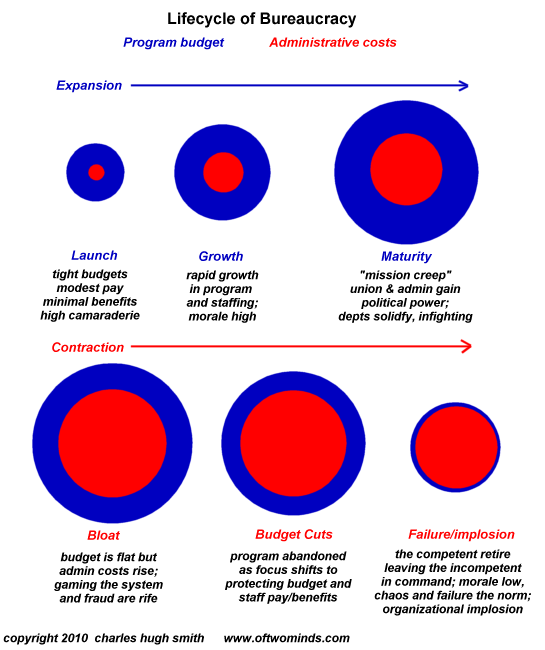
Back in 2010 I prepared this chart of The Lifecycle of Bureaucracy: as bureaucracies expand, they inevitably become less accountable, less efficient, more bloated with legacy staffing and requirements that no longer make sense, etc.

As costs soar, the bureaucracy’s budget is attacked, and the agency circles the wagons and focuses on lobbying politicos and the public to leave the budget untouched.

Since accountability has been dissipated, management becomes increasingly incompetent and larded with people who can’t be fired so they were kicked upstairs. Staff morale plummets as the competent quit/transfer out in disgust, leaving the least productive and those clinging on in order to retire with generous government benefits.

In this state of terminal decline, the agency’s original function is no longer performed adequately and the system implodes from the dead weight of its high costs, lack of accountability, gross incompetence, inability to adapt and staggering inefficiency.

lifecycle-bureaucracy

I’ve covered this dynamic a number of times:

Our Legacy Systems: Dysfunctional, Unreformable (July 1, 2013)

The Way Forward (April 25, 2013)

When Escape from a Previously Successful Model Is Impossible (November 29, 2012)

Complexity: Bureaucratic (Death Spiral) and Self-Organizing (Sustainable) (February 17, 2011)

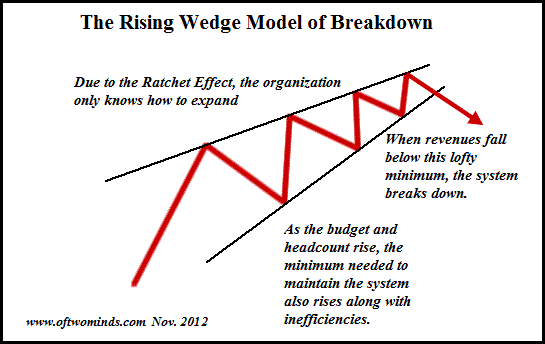
This generates a ratchet effect, where costs increase even as the bureaucracy’s output declines. The ratchet effect can also be visualized as a rising wedge, in which costs and inefficiencies continue rising until any slight decrease in funding collapses the organization.

Dislocations Ahead: The Ratchet Effect, Stick-Slip and QE3 (February 14, 2011)

The Ratchet Effect: Fiefdom Bloat and Resistance to Declining Incomes (August 23, 2010)

rising-wedge

The net result of the Ratchet Effect and the impossibility of reform is this: it’s cheaper and more effective to let the system collapse than squander time and treasure attempting reforms that are bound to fail as vested interests will fight to the death to retain every shred of power and swag.

Since the constituent parts refuse to accept any real reforms, the entire system implodes. We can look at healthcare, higher education and the National Security State as trillion-dollar examples of systems that become increasingly costly even as their performance declines or falls off the cliff.

This is the lesson of history, as described in the seminal book The Upside of Down: Catastrophe, Creativity, and the Renewal of Civilization.

Collapse does not need to be complete or sudden. Collapse tends to be a process, not an event.

Collapse begins when you can’t find any doctors willing to accept Medicaid payments, when the potholes don’t get filled even when voters approve millions of dollars in new taxes, and when kids aren’t learning anything remotely useful or practical despite the school board raising tens of millions of dollars in additional property taxes.

Collapse begins when real reform becomes impossible.

Saturday Matinee: Burn! (aka Queimada)

MPW-51451

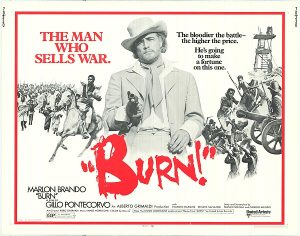
“Burn!” (aka Queimada) (1969) is a film directed by Gillo Pontecorvo loosely based on a failed uprising in Guadalupe but also serves as an amalgamation of many incidents throughout the history of western exploitation of the global south. Marlon Brando stars as William Walker, a character named after the American filibuster but is a British agent in the film. He arrives in the fictional island of Queimada to foment a slave revolt against the Portuguese regime in order to install a government controlled by British plantation owners. A decade later, when an uprising occurs against the plantation-controlled regime, Walker is sent back to install an even more corporate-beholden government but things don’t go exactly as planned. Burn! features great performances from Marlon Brando and Evaristo Márquez in his debut role as a revolutionary leader. The film is also notable for its excellent direction by Pentecorvo (who previously directed The Battle of Algiers) and soundtrack by Ennio Morricone (best known for his music for films of Sergio Leone).