
John Perkins: The New Confessions of an Economic Hitman

apologiesofaneconomichitman

Reposted below is the introduction and sample chapter from John Perkin’s “The New Confessions of an Economic Hitman” (also available in pdf form on his site here).

Introduction

The New Confessions

I’m haunted every day by what I did as an economic hit man (EHM). I’m haunted by the lies I told back then about the World Bank. I’m haunted by the ways in which that bank, its sister organizations, and I empowered US corporations to spread their cancerous tentacles across the planet. I’m haunted by the payoffs to the leaders of poor countries, the blackmail, and the threats that if they resisted, if they refused to accept loans that would enslave their countries in debt, the CIA’s jackals would overthrow or assassinate them.

I wake up sometimes to the horrifying images of heads of state, friends of mine, who died violent deaths because they refused to betray their people. Like Shakespeare’s Lady Macbeth, I try to scrub the blood from my hands.

But the blood is merely a symptom.

The treacherous cancer beneath the surface, which was revealed in the original Confessions of an Economic Hit Man, has metastasized. It has spread from the economically developing countries to the United States and the rest of the world; it attacks the very foundations of democracy and the planet’s life-support systems.

All the EHM and jackal tools—false economics, false promises, threats, bribes, extortion, debt, deception, coups, assassinations, unbridled military power—are used around the world today,even more than during the era I exposed more than a decade ago. Although this cancer has spread widely and deeply, most people still aren’t aware of it; yet all of us are impacted by the collapse it has caused. It has become the dominant system of economics, government, and society today.

Fear and debt drive this system. We are hammered with messages that terrify us into believing that we must pay any price,assume any debt, to stop the enemies who, we are told, lurk at our doorsteps. The problem comes from somewhere else. Insurgents. Terrorists. “Them.” And its solution requires spending massive amounts of money on goods and services produced by what I call the corporatocracy—vast networks of corporations, banks, colluding governments, and the rich and powerful people tied to them. We go deeply into debt; our country and its financial henchmen at the World Bank and its sister institutions coerce other countries to go deeply into debt; debt enslaves us and it enslaves those countries.

These strategies have created a “death economy”—one based on wars or the threat of war, debt, and the rape of the earth’s resources. It is an unsustainable economy that depletes at ever-increasing rates the very resources upon which it depends and at the same time poisons the air we breathe, the water we drink, and the foods we eat. Although the death economy is built on a form of capitalism, it is important to note that the word capitalism refers to an economic and political system in which trade and industry are controlled by private owners rather than the state. It includes local farmers’ markets as well as this very dangerous form of global corporate capitalism, controlled by the corporatocracy, which is predatory by nature, has created a death economy, and ultimately is self-destructive.

I decided to write The New Confessions of an Economic Hit Man because things have changed so much during this past decade. The cancer has spread throughout the United States as well as the rest of the world. The rich have gotten richer and everyone else has got-ten poorer in real terms.

A powerful propaganda machine owned or controlled by the corporatocracy has spun its stories to convince us to accept a dogma that serves its interests, not ours. These stories contrive to convince us that we must embrace a system based on fear and debt, accumulating stuff, and dividing and conquering everyone who isn’t “us.” The stories have sold us the lie that the EHM system will provide security and make us happy.

Some would blame our current problems on an organized global conspiracy. I wish it were so simple. Although, as I point out later,there are hundreds of conspiracies—not just one grand conspiracy—that affect all of us, this EHM system is fueled by something far more dangerous than a global conspiracy. It is driven by concepts that have become accepted as gospel. We believe that all economic growth benefits humankind and that the greater the growth, the more widespread the benefits. Similarly, we believe that those people who excel at stoking the fires of economic growth should be exalted and rewarded, while those born at the fringes are available for exploitation. And we believe that any means—including those used by today’s EHMs and jackals—are justified to promote economic growth; preserve our comfortable, affluent Western way of life; and wage war against anyone (such as Islamic terrorists) who might threaten our economic well-being, comfort, and security.

In response to readers’ requests, I have added many new details and accounts of how we did our work during my time as an EHM, and I have clarified some points in the previously published chapters. More importantly, I have added an entirely new part 5, which explains how the EHM game is played today—who today’s economic hit men are, who today’s jackals are, and how their deceptions and tools are more far-reaching and enslaving now than ever.

Also in response to readers’ requests, part 5 includes new chapters that reveal what it will take to overthrow the EHM system, and specific tactics for doing so.

The book ends with a section titled “Documentation of EHM Activity, 2004–2015,” which complements my personal story by offering detailed information for readers who want further proof of the issues covered in this book or who want to pursue these subjects in more depth.

Despite all the bad news and the attempts of modern-day robber barons to steal our democracy and our planet, I am filled with hope. I know that when enough of us perceive the true workings of this EHM system, we will take the individual and collective actions necessary to control the cancer and restore our health. The New Confessions of an Economic Hit Man reveals how the system works today and what you and I—all of us—can do to change it.

Tom Paine inspired American revolutionaries when he wrote,“If there must be trouble, let it be in my day, that my child may have peace.” Those words are as important today as they were in 1776. My goal in this new book is nothing less than Paine’s: to inspire and empower us all to do whatever it takes to lead the way to peace for our children.


CHAPTER 34

Conspiracy: Was I Poisoned?

The situation has gotten much worse since Confessions of an Economic Hit Man was first published. Twelve years ago, I expected that books like mine would wake people up and inspire them to turn things around. The facts were obvious. I and others like me had created an EHM system that supported the corporatocracy. Together, the EHMs, corporate magnates, Wall Street robber barons, governments and jackals, and all their networks around the world have created a global economy that fails everyone. It is based on war or the threat of war, debt, an extreme form of materialism that pillages the earth’s resources and is consuming itself into extinction. In the end, even the very rich will fall victim to this death economy.

Most of us have bought into it in a big way; we are collaborators—often unconscious ones. Now it is time to change. I had hoped that exposing these facts, making people conscious, would inspire a movement that, by 2016, would have resulted in a new vision, anew story.

People were in fact shaken awake. Activities in so many parts of the world, including localized ones such as the Occupy movements,national ones in places as diverse as Iceland, Ecuador, and Greece, and regional ones such as the Arab Spring and Latin America’s Bolivarian Alliance for the Peoples of Our America (ALBA), have demonstrated that we understand our world is collapsing.

What I had not anticipated was the flexibility in the EHM system or its absolute determination to defend and promote the death economy. I had not anticipated the rise of an entirely new class of EHMs and jackals.

I made it clear in the original book that I did not believe the EHM system was driven by some nefarious, illegal, secret plan devised by a small group of people determined to control the world; in other words, I did not believe in some unified “grand conspiracy.”

Then something strange happened.

In late March 2005, less than five months after publication of the book, I flew to New York City on a Monday. I was scheduled to speak at the United Nations the next day. I was in perfect health,as far as I knew. A man who identified himself only as a free-lance journalist had been hounding my publicist for an interview. Because his credentials were sketchy and I was receiving a lot of press at that time, she kept putting him off. But when he suggested picking me up at LaGuardia Airport, taking me to lunch, and driving me to the apartment where I was staying with a friend, she consulted with me and I acquiesced. He was waiting for me when I exited the airport. He took me to a small cafe, told me how much he admired my book, asked some of what had become rather standard questions about my life as an EHM, and then drove me to my friend’s apartment on the Upper West Side.

I never saw that man again, and meeting him would have been an unmemorable event—except that a couple hours later I suffered severe internal bleeding. I lost about half the blood in my body,went into shock, and was rushed to Lenox Hill Hospital. I ended up spending two weeks there and having more than 70 percent of my large intestine removed.

As I lay recovering in that hospital bed, I thought that perhaps my illness was a message to slow down, that my body was over-taxed and I needed to cut back on writing and the speaking tours.

The New York gastroenterologist told me that I’d suffered from complications due to a severe case of diverticulosis. I was shocked to hear this, because I’d recently had a colonoscopy. My Florida doctor had assured me that there were no signs of cancer, which had been my main concern. He mentioned that I had some diverticula, “like most people your age,” and ended by advising me to come back in five years.

Of course, my UN speech was canceled, as were numerous other media events. Word of my operation got out very quickly, and soon I was receiving lots of e-mails. Most supported me and expressed concern for my well-being. Some e-mails came from people who accused me of being a traitor to my country. Several assured me that I’d been poisoned.

When I asked my gastroenterologist, he responded that he was“quite certain” I hadn’t been poisoned, but that he’d also learned“never to say never.” In any case, all of it got me to thinking and reading more about conspiracies.

I still do not believe in the grand conspiracy theory. In my experience, there is no secret club of individuals who get together to plot illegal, world-dominating strategies. However, I do know that part of the power of the EHM system is that it foments many small conspiracies. By “small,” I mean that they are focused on specific objectives. Such conspiracies—secret actions to accomplish illegal goals—happened when I was just beginning school, such as the CIA coup that replaced the democratically elected Iranian prime minister, Mossadegh, with the shah, in 1953. They continued during my high school years; consider the CIA-supported Bay of Pigs invasion of Cuba, in 1963. But I became most aware of them when I was an EHM and the CIA arranged the assassinations of my two clients, Ecuador’s Roldós and Panama’s Torrijos, in 1981. Then, as I began writing the original of this book in 2002, there was the US-led conspiracy to overthrow Venezuela’s president, Hugo Chávez. After that came the conspiratorial lie about weapons of mass destruction in Iraq. This was followed by a flurry of conspiracies against leaders and governments in the Middle East and Africa.

While I was an EHM, the goals of most conspiracies were to further US and corporate interests in the economically developing countries—to do whatever it took, including overthrowing or killing government leaders, to enable our companies to exploit resources. After my colon operation, as I lounged around my home reading various reports, it became obvious that the tools I had used in Indonesia, Panama, Egypt, Iran, Saudi Arabia, and other countries were now being applied in Europe and the United States. Fortified by the so-called threat of global terrorism after 9/11, these conspiracies have given excessive power to the very wealthy individuals who control global corporations. Among the most striking are conspiracies to implement “free” trade agreements such as NAFTA and CAFTA, and the more recent Trans-Pacific Partnership (TPP) and the Transatlantic Trade and Investment Partnership (TTIP), which empower corporations to assume defacto sovereignty over governments in countries around the world; to convince politicians to pass laws that permit the rich to avoid paying taxes, to control the media, and to use media to influence politics; and to terrify US citizens into fighting endless wars.

These and many other conspiracies took the EHM system far beyond where it had been in the 1970s. Despite all that I had writ-ten, I had to admit that I’d missed much of what had been going on beneath the surface. The old tools had been sharpened and new ones invented. The heart of this system remained the same: an economic and political ideology based on enslavement through debt and enforced by paralyzing people with fear. In my day, it had convinced the majority of Americans and much of the rest of the world that all actions were justified if they protected us from Communist subversives; the fear had now switched to Muslim terrorists,immigrants, and anyone threatening to rein in corporations. The dogma was similar, but the impact was now much greater.

Recuperating from that operation also sent me into the dark abyss of guilt. I’d wake up in the middle of the night haunted by memories of leaders I’d bribed and threatened. I had not yet come to terms with my EHM past.

I asked myself why I’d stayed in that job for ten long years. And then I realized how difficult it had been to escape. It wasn’t just the seduction of money, flying first class, staying in the best hotels, and all the other perks. Nor was it the pressure exerted by my bosses and fellow employees at MAIN. It was also the aura of the job, my title—the very story of my culture. I was doing what I’d been schooled to do, what I’d been told was the right thing to do. I was educated as an American whose job it was to sell America and to believe and convince everyone else that Communist regimes were out to destroy us.

One day, a friend e-mailed me a photograph of a poster like one that had hung on the wall of the boys’ bathroom in my elementary school. It depicted a sinister-looking man who asked, “Is your washroom breeding Bolsheviks?” It was an ad for Scott paper towels, and the subtitle read, “Employees lose respect for a company that fails to provide decent facilities for their comfort.” It sent a strong message that not buying American was akin to treason.

That photograph got me thinking about those most formative years in my life. After the Soviet Union launched Sputnik, the first satellite, we all became convinced that nuclear warheads were on the way. The chilling scream of sirens sent us scampering under our desks in weekly drills, to hide from imagined Soviet missiles. Movies and TV shows like I Led Three Lives, a gripping drama based on the memoir of an FBI agent who infiltrated a Communist cell in the United States, warned us to be vigilant; Red provocateurs, like the evil Bolshevik in the poster, lurked among us, ready to pounce.

By the time I entered the EHM ranks, it had become apparent that we were losing in Vietnam, a nation portrayed as a Sino-Soviet puppet. We were told that there would be a “domino effect”—that Indonesia would go next, then Thailand, South Korea, the Philip-pines, and on and on. It wouldn’t be long before the Red tide would sweep Europe and then engulf the United States. Democracy and capitalism were doomed—unless we halted the onslaught. And that meant doing whatever it would take to promote companies such as Scott, which portrayed themselves as bulwarks against communism.

Delving into my feelings of guilt helped me see the ease with which I had deceived myself in those years. It opened my mind to understanding that millions of people are in positions similar to mine. They are no longer taught to fear communism, but they still fear Russia, China, and North Korea, in addition to al-Qaeda and other terrorists. They may not travel to foreign lands and confront, face-to-face, the consequences of what their companies do. They may not personally stand beside oil spills in the Amazon or see the hovels where sweatshop workers sleep. Instead, they anesthetize themselves with TV. They succumb to assurances by their schools, banks, human relations experts, and government officials that they are contributing to progress. But in their hearts they know other-wise. Deep down, they—we—realize that the stories misrepresent. And now it is time to admit to our complicity.

On a trip to Boston, not long after my operation, I reconnected with my former Boston University professor and the author of A People’s History of the United States, Howard Zinn. Now in his eighties, he was still actively campaigning to reform a system he saw as an experiment that hadn’t worked. When I shared with him the guilt that so often threatened to overwhelm me, he urged me to keep opening to it.

“Don’t be afraid of it,” he said. “You are guilty. We’re all guilty. We have to admit that although the big corporations own the propaganda machine, we allow ourselves to be duped. You can set an example. Show people that the way out, redemption, comes from changing it.”

I told him that I often thought of middle-class Americans as being like the medieval bourgeoisie—the majority of the people, who lived in the bourgs outside the castle walls. “We pay our taxes so soldiers and jackals will defend us from the knights in the neighboring castles.”

“Exactly,” he said, with that smile of his that had enchanted and inspired so many students. “We will do anything to maintain a system that has failed us.”

I came to understand, during those days following my operation and in discussions with Howard, that my most important lesson since the publication of Confessions of an Economic Hit Man was similar to the one I had learned as a Peace Corps volunteer working with Andean brick makers: the only reason the EHM system works is because the rest of us give it permission to work. At best, we look the other way; at worst, we actively support it. One of the things that most bothered me was having to admit to myself that I not only had looked the other way but also had convinced many people to actively support that system. I made a commitment to myself that I’d be more diligent; I’d watch more closely what was going on in my own community, my country, and the world.

Although I was determined to follow Howard’s advice, I also found myself envying another man, who did not struggle with his conscience—a friend who became an immense support during my physical recuperation in Florida and who seemed to have no problem justifying his own violent actions. He was a jackal, taking a short leave of absence from the Middle East.

ABOUT THE AUTHOR

As Chief Economist at a major international consulting firm, John Perkins advised the World Bank, United Nations, IMF, U.S.Treasury Department, Fortune 500 corporations, and leaders of countries in Africa, Asia, Latin America, and the Middle East.

The New Confessions of an Economic Hit Man(2016), a follow-up to John’s classic New York Times bestseller, brings the story of economic hit men and jackal assassins up to date and chillingly home to the U.S. It goes on to provide practical strategies to transform the failing global death economy into a regenerative life economy. Confessions of an Economic Hit Man(70 weeks on the New York Times bestseller list, 32 languages), The Secret History of the American Empire(New York Times bestseller) and Hoodwinked were ground-breaking exposés of the clandestine operations that created the current global crises; they set the stage for the revelations and strategies detailed in The New Confessions of an Economic Hit Man.

John is a founder and board member of Dream Change and The Pachamama Alliance, nonprofit organizations devoted to establishing a world future generations will want to inherit, has lectured at Harvard, Oxford, and more than 50 other universities around the world, and is the author of books on indigenous cultures and transformation, including Shapeshifting, The World Is As You Dream It, Psychonavigation, Spirit of the Shuar, and The Stress-Free Habit. He has been featured on ABC, NBC, CNN, CNBC, NPR, A&E, the History Channel, Time, The New York Times, The Washington Post,Cosmopolitan, Elle, Der Spiegel, and many other publications, as well as in numerous documentaries including The End of Poverty?, Zeitgeist Addendum, and Apology of an Economic Hit Man. He was awarded the Lennon Ono Grant for Peace 2012, and Rainforest Action Network Challenging Business As Usual Award, 2006.

 

Hillary’s email revelation: France and US killed Qaddafi for his gold and oil

hilary_clinton_laughs_gaddafi_

By Bob Fitrakis

Source: FreePress.org

With the recent release of Hillary Clinton’s emails by Wikileaks, the public now knows exactly how the North Atlantic Treaty Organization (NATO) went from a collective defense organization to the new Barbary Coast Pirates of imperialism.

During the 2011 Libyan uprising, the United Nations Security Council passed Resolution 1973 which called for a ceasefire and authorized military action to protect civilian lives. A coalition formed, centered around NATO with the March 17, 2011 passing of the Resolution. Its purpose — a so-called “no-fly zone” over Libya.

The irony that the U.S.-dominated NATO military organization would be concerned with “protecting” Arab civilians is all too obvious since the United States is the nation most responsible for killing Arab civilians.

The real reasons for the attack have been dealt with most directly by America’s famous reformed “economic hitman,” John Perkins.

Perkins points out that the attack on Libya, like the attack on Iraq, has to do with power and control of resources, not only oil, but gold. Libya has the highest standard of living in Africa. “According to the IMF, Libya’s Central Bank is 100% state owned. The IMF estimates that the bank has nearly 144 tons of gold in its vaults,” Perkins wrote.

NATO went there like modern Barbary Coast Pirates — to loot Libya’s gold. The Russian media, in addition to Perkins, reported that the Pan-Africanist Qaddafi, the former President of the African Union, had been advocating that Africa use the gold so plentiful in Libya and South Africa to create an African currency based on a gold dinar.

“It is significant that in the months running up to the UN resolution that allowed the U.S. and its allies to send troops into Libya, Muammar al-Qaddafi was openly advocating the creation of a new currency that would rival the dollar and the euro. In fact, he called upon African and Muslim nations to join an alliance that would make this new currency, the gold dinar, their primary form of money and foreign exchange. They would sell oil and other resources to the US and the rest of the world only for gold dinars,” Perkins explained.

Revelation in Email to Hillary Clinton

Wikileaks released an unclassified U.S. Department of State document emailed to Hillary dated April 2, 2011, key Clinton aide Sidney Blumenthal confirmed that the Perkins was right and the attack on Libya had nothing to do with Qaddafi being a threat to the United States and NATO and everything to do with looting his gold.

“Qaddafi’s government holds 143 tons of gold, and a similar amount in silver. During late March, 2011, these stocks were moved to Sabha (south west in the direction of the Libyan border with Niger and Chad); taken from the vaults of the Libyan Central Bank in Tripoli,” Blumenthal reported to Clinton.

Blumenthal pointed out the purpose of Qaddafi’s precious metal: “This gold was accumulated prior to the current rebellion and was intended to be used to establish a pan-African currency based on the Libyan golden Dinar. This plan was designed to provide the Francophone African Countries with an alternative to the French franc (CFA).”

Blumenthal spells out the reason for NATO’s attack and France’s imperial plunder, “French intelligence officers discovered this plan shortly after the current rebellion began, and this was one of the factors that influenced President Nicholas Sarkozy’s decision to commit France to the attack on Libya.”

There were five reasons for France’s illegal war with NATO against Libya. Sarkozy sought, according to Blumenthal, “a. A desire to gain a greater share of Libyan oil production, b. Increase French influence in North Africa, c. Improve his internal situation in France, d. Provide the French military with an opportunity to assert its position in the world, e. Address the concern of his advisors over Qaddafi’s long term plans to supplant France as the dominant power in Francophone Africa.”

Under the neo-colonialism favored after World War II during the period of the Cold War, we preferred to bribe various African leaders to help us loot their nation’s resources. The U.S., of course, killed any Pan-African aspirations as well as potential leaders like Patrice Lumumba.

This highjacking of Arab and African resources and slaughtering of Arab civilians is a long-standing plan put forth by neo-conservatives in the United States. The Project for a New American Century (PNAC) has had a “hit list” of Arab nations and little regard for Arab casualties.

General Wesley Clark wrote in “Winning Modern Wars” that “As I went back through the Pentagon in November 2001, one of the senior military staff officers had time for a chat. Yes, we are still on track for going against Iraq, he said. But there was more. This was being discussed as part of a five-year campaign plan, he said, and there was a total of seven countries beginning with Iraq, then Syria, Lebanon, Libya, Iran, Somalia, and Sudan.

What we witnessed in Libya was old-fashioned 19th century imperialism — the deliberate plundering of a sovereign nation-state’s resources by more powerful Western conquistadors.

Link to Wikileaks article

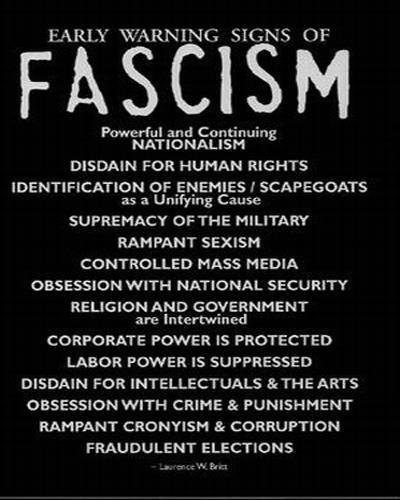
Fascism, American style

fascism1

By John W. Whitehead

Source: Intrepid Report

“If we define an American fascist as one who in case of conflict puts money and power ahead of human beings, then there are undoubtedly several million fascists in the United States.”―Henry A. Wallace, 33rd Vice President of the United States

This is an indictment of every politician who has ever sold us out for the sake of money and power, it is a condemnation of every politician who has ever lied to us in order to advance their careers, and it is a denunciation of every political shill who has sacrificed our freedoms on the altar of Corporate America.

They’re all fascists.

If Donald Trump is a fascist—as nearly half of Americans surveyed believe—then so is every other politician in office or running for office in America who has ever prioritized money and power over human beings.

Truly, apart from Trump’s virulently bombastic comments and his metaphorical willingness to spit in the wind in order to garner media coverage and notoriety, how is he any more of a fascist than Hillary Clinton and the millions she has amassed from the financial sector?

How is Trump any more of a fascist than Barack Obama, whose willingness to march in lockstep with the military industrial complex has resulted in endless wars, covert drone strikes that have killed hundreds of civilians abroad, and militarized police who have killed thousands of American citizens here at home?

How is Trump any more of a fascist than Congress, the majority of whom are millionaires and who are more inclined to do the bidding of their corporate sponsors and benefactors, all the while remaining deaf to their less affluent constituents?

For that matter, how is Trump any more of a fascist than the Supreme Court whose decisions in recent years have been characterized most often by an abject deference to government authority, military and corporate interests?

Writing for the New York Times in 1944, Vice President Henry A. Wallace noted that “American fascists are most easily recognized by their deliberate perversion of truth and fact. Their newspapers and propaganda carefully cultivate every fissure of disunity, every crack in the common front against fascism. They use every opportunity to impugn democracy. They use isolationism as a slogan to conceal their own selfish imperialism. They cultivate hate and distrust . . .”

As Wallace concluded, American fascists are not pro-Constitution:

They are patriotic in time of war because it is to their interest to be so, but in time of peace they follow power and the dollar wherever they may lead . . . They claim to be super-patriots, but they would destroy every liberty guaranteed by the Constitution. They demand free enterprise, but are the spokesmen for monopoly and vested interest. Their final objective toward which all their deceit is directed is to capture political power so that, using the power of the state and the power of the market simultaneously, they may keep the common man in eternal subjection.

We are being played for fools. Again.

The United States of America, that dream of what a democratic republic ought to be, has become the Fascist States of America. We have moved beyond the era of representative government and entered a new age. You can call it the age of authoritarianism. Or fascism. Or oligarchy. Or the American police state.

Whatever label you want to put on it, the end result is the same.

Driven by our fears, we have entered into a corporate-controlled, militaristic state where all citizens are suspects, security trumps freedom, and the U.S. government does not represent the majority of American citizens but instead is ruled by the rich and powerful.

Any semblance of constitutional government that we might still enjoy today is a mere shadow, a mockery of what the founders envisioned. Constitutional government today—much like the farcical circus that purports to be the presidential election—is a sham, a hoax, an elaborate ruse maintained by the powers-that-be to mollify us into believing that we still have a say in the workings of our government. We do not.

Shortly after World War II, historian William L. Shirer predicted that America may be the first country in which fascism comes to power through democratic elections.

Former presidential advisor Bertram Gross also warned that we would not recognize fascism when it took over:

Anyone looking for black shirts, mass parties, or men on horseback will miss the telltale clues of creeping fascism . . . In America, it would be supermodern and multi-ethnic—as American as Madison Avenue, executive luncheons, credit cards, and apple pie. It would be fascism with a smile. As a warning against its cosmetic facade, subtle manipulation, and velvet gloves, I call it friendly fascism. What scares me most is its subtle appeal.

They were both right.

However, what we failed to realize is that the fascist coup took place long ago. It was that subtle and that incremental.

We are now ruled by the velvet-gloved, technologically savvy, militarized iron fist of what Gross termed “friendly fascism” or fascism with a smile. Having studied Shirer and Gross, tracked the rise of fascism in past regimes, and assimilated the necessary ingredients for a fascist state, I can attest to the fact—as I document in my book Battlefield America: The War on the American People—that the parallels to modern America are impossible to ignore.

Under fascism, the government:

  • is managed by a powerful leader (even if he or she assumes office by way of the electoral process)
  • assumes it is not restrained in its power (this is authoritarianism, which eventually evolves into totalitarianism)
  • ostensibly operates under a capitalist system while being undergirded by an immense bureaucracy
  • emits powerful and continuing expressions of nationalism through its politicians
  • has an obsession with national security while constantly invoking terrifying internal and external enemies
  • establishes a domestic and invasive surveillance system and develops a paramilitary force that is not answerable to the citizenry
  • and its various agencies (federal, state, and local) develop an obsession with crime and punishment (this is overcriminalization)
  • becomes increasingly centralized while aligning closely with corporate powers to control all aspects of the country’s social, economic, military, and governmental structures
  • uses militarism as a center point of its economic and taxing structure
  • and is increasingly imperialistic in order to maintain the military-industrial corporate forces.

Compare that to America today where, as economist Jeffrey Tucker rightly observes, “every industry is regulated. Every profession is classified and organized. Every good or service is taxed. Endless debt accumulation is preserved. Immense doesn’t begin to describe the bureaucracy. Military preparedness never stops, and war with some evil foreign foe, remains a daily prospect.”

Fascism thrives by hiding behind the entertainment spectacle that is partisan politics. As Tucker points out, “It’s incorrect to call fascism either right wing or left wing. It is both and neither . . . fascism does not seek to overthrow institutions like commercial establishments, family, religious centers, and civic traditions. It seeks to control them . . . it preserves most of what people hold dear but promises to improve economic, social, and cultural life through unifying their operations under government control.”

In this way, American-style fascism is deceptively appealing.

It appears friendly.

The news media covers the entertainment and political trivia. The basic forms of government remain intact. The legislators remain in session. There are elections.

Consent of the governed, however, no longer applies. Actual control has finally passed to the oligarchic elite controlling the government behind the scenes.

Yet the most crucial ingredient for fascism to succeed in America is that the majority of the people would have to agree that it’s not only expedient but necessary for the government to assume greater powers in order to keep them safe and secure, whether it’s by militarizing the police, stripping them of basic constitutional rights, criminalizing virtually every form of behavior, or spying on their communications, movements and transactions.

Sound familiar?

When you really drill down to what the various presidential candidates believe about the issues that will impact the future of our freedoms long-term—war, surveillance, civil liberties—you’ll find that most of them support the government’s position, which, conveniently enough, profits the corporate sector.

This is not freedom.

It is despotism, which Gross refers to as “faceless oligarchs [who] sit at command posts of a corporate-government complex that has been slowly evolving over many decades.” Gross explains:

In efforts to enlarge their own powers and privileges, they are willing to have others suffer the intended or unintended consequences of their institutional or personal greed. For Americans, these consequences include chronic inflation, recurring recession, open and hidden unemployment, the poisoning of air, water, soil and bodies, and, more important, the subversion of our constitution. More broadly, consequences include widespread intervention in international politics through economic manipulation, covert action, or military invasion . . .

It is, in Gross’ words, “pretended patriots who desecrate the American flag by waving it while waiving the law”:

I see at present members of the Establishment or people on its fringes who, in the name of Americanism, betray the interests of most Americans by fomenting militarism, applauding rat-race individualism, protecting undeserved privilege, or stirring up nationalistic and ethnic hatreds.

It is, concludes Gross, Big Business and Big Government in bed together:

In this present, many highly intelligent people look with but one eye and see only one part of the emerging Leviathan. From the right, we are warned against the danger of state capitalism or state socialism, in which Big Business is dominated by Big Government. From the left, we hear that the future danger (or present reality) is monopoly capitalism, with finance capitalists dominating the state. I am prepared to offer a cheer and a half for each view; together, they make enough sense for a full three cheers.Big Business and Big Government have been learning how to live in bed together and despite arguments between them, enjoy the cohabitation. Who may be on top at any particular moment is a minor matter—and in any case can be determined only by those with privileged access to a well-positioned keyhole.

When the votes have all been counted, “we the people” will be the losers.

The joke will be on us. Whether we ever realize it not, the enemy is not across party lines, as they would have us believe. It has us surrounded on all sides.

Even so, we’re not yet defeated.

We could still overcome our oppressors if we cared enough to join forces and launch a militant nonviolent revolution—a people’s revolution that starts locally and trickles upwards—but that will take some doing.

It will mean turning our backs on the political jousting contests taking place on the national stage and rejecting their appointed jesters as false prophets. It will mean not allowing ourselves to be corralled like cattle and branded with political labels that have no meaning anymore. It will mean recognizing that all the evils that surround us today—endless wars, drone strikes, invasive surveillance, militarized police, poverty, asset forfeiture schemes, overcriminalization, etc.—were not of our making but came about as a way to control and profit from us.

It will mean “voting with our feet” through sustained, mass civil disobedience. As journalist Chris Hedges points out, “There were once radicals in America, people who held fast to moral imperatives. They fought for the oppressed because it was right, not because it was easy or practical. They were willing to accept the state persecution that comes with open defiance. They had the courage of their convictions. They were not afraid.”

Ultimately, it will mean refusing to be divided, one against each other, as Democrats versus Republicans, and instead uniting behind the only distinction that has ever mattered: “we the people” against tyranny.


Constitutional attorney and author John W. Whitehead is founder and president of The Rutherford Institute. His new book “The Freedom Wars” (TRI Press) is available online at www.amazon.com. Whitehead can be contacted at johnw@rutherford.org. Information about The Rutherford Institute is available at www.rutherford.org.


The Media and the Corporate State

THINK_for_yourself_Question_Everything_Anonymous_raising_awareness__113654

By Kevin Carson

Source: Center for a Stateless Society

In an interview with Cenk Uygur March 23, Bernie Sanders noted, “The media is an arm of the ruling class of this country,” going on to point out its concentrated corporate ownership (for example, Disney’s ownership of ABC, Comcast’s of NBC, etc). This corporate media has a vested interest in not covering real news in a way that examines the root causes of problems. Such coverage might lead to radical threats to the power structure. Of course he’s quite right. And it’s not a situation that came about by accident; the state played a central role in bringing it about.

The mainstream media — network news shows, cable news networks, major newspapers and wire services — is part of an interlocking set of governing institutions that also includes government agencies, large corporations, and universities, think tanks and charitable foundations. These institutions share a common organizational style — top-down hierarchies and enormous managerial bureaucracies, Weberian rules, million-dollar executives — and tend to shuffle their personnel back and forth from one such institution to the other.

This whole interlocking complex of institutions goes back to the rise of such institutions in the late 19th century as the dominant organizational form — a top-down transformation of the American economy and society that the state and the plutocratic interests controlling it imposed on the country.

From the beginning of radio, the state’s regulatory approach fostered a cartelized system of nationwide media networks. The FCC licensing system permitted a limited number of radio stations compared to what the spectrum permitted. Had the full spectrum been opened up on a first-come first-served basis, with something like the common law of riparian rights preventing new stations from broadcasting on frequencies that might disrupt broadcasts of existing stations, there would have been many more stations. And had the spectrum been open to all homesteaders, there would have been a variety of participants including amateurs and hobbyists, and community and labor groups. For that matter the FCC itself might have awarded its licenses to such a variety of groups; but instead it awarded them almost entirely to commercial interests. And given a limited number of salable licenses, they inevitably appreciated in value just like taxicab medallions, so that only plutocratic interests could afford them.

But before the mass broadcast media ever came into existence, there was already a nationwide advertising market in place fostered by the corporate centralization of the economy, and a complex of corporate and government institutions to influence the content of media.

The existence of a nationwide advertising market, coupled with “intellectual property” in content and rebroadcast rights, further reinforced the concentration of broadcast media into nationwide networks.

And the pre-existence of an interlocking system of corporate, state and civil society institutions into which the media could be assimilated, created the systemic pressures and filters behind what Noam Chomsky and Edward Herman called the media’s “Propaganda Model.” This doesn’t just mean the cruder forms of influence like direct advertiser vetoes of stories, or even editorial fear of offending advertisers — although that obviously plays a real part in filtering content. More important is the common class background and affinity, and common social ties of those in charge of the media and governing institutions, and the symbiotic organizational structures of the institutions themselves.

Network executives, talk show hosts, and newspaper publishers and editors travel in the same social circle as the powerful state and corporate figures whom they’re theoretically supposed to serve as watchdogs over. So you have “responsible” and “patriotic” news organizations refusing to report on government war crimes, and people like publisher Katherine Graham of the Washington Post telling an appreciative audience of CIA spooks that “there are some things the public doesn’t need to know.”

You have a “professional” journalistic culture, since Walter Lippmann’s time, dominated by the same managerial ethos as other governing institutions, seeing their job as simply reporting “objectively” what “both sides” say without regard to facts. And given the limited (and dwindling) resources for actual reporting, you have the majority of TV news anchor scripts and newspaper column inches taken up either by quotes from public figures or the output of public spokespersons and corporate and state PR departments. You have wire service correspondents in countries where the U.S. is backing local death squads or military coups, sitting in hotel rooms writing their copy directly from U.S. embassy handouts.

The cumulative effect of all these filters, without much central direction, is a sort of “invisible hand” mechanism with exactly the result Chomsky and Herman described:  a corporate media that reports news from the perspective of the state and the corporations in control of it almost the same as if they were officially censoring it.

So Sanders is right: the media is an arm of the ruling class — and the state is at the heart of it.

Corporate Media Guard Secrets of Western 1% in Panama Leak – Wage Info War on Russia/China

A Mossack Fonseca law firm logo is pictured in Panama City April 3, 2016. REUTERS/Carlos Jasso

A Mossack Fonseca law firm logo is pictured in Panama City April 3, 2016. REUTERS/Carlos Jasso

By

Source: The Free Thought Project

While it seems the Panama Papers are a genuine attempt at exposing rampant corruption of the world’s corporate-political uber-elite, a closer inspection reveals a likely Western geopolitical power play utilizing the latest techniques in information warfare.

The 11.5 million documents that were stolen from Mossack Fonseca were leaked to Suddeutsche Zeitung, which then turned to the International Consortium of Investigative Journalists to investigate the documents.

This process created a dynamic where control of the information resides in the hands of corporate mainstream media, thus allowing them to cherry pick stories they deem “newsworthy” – this exclusive access is troubling.

The reason this exclusive access is troubling becomes apparent when one recalls the infamous incident where The Guardian physically smashed the copies of the Snowden files in their possession upon the command of MI6 and the British government.

Had the Mossack Fonseca documents been turned over to WikiLeaks, the information would have been released en mass, as to allow for a publicly searchable database that would allow for anyone to search the documents in detail.

The immediate initial reporting on the Panama Papers has been curiously focused on Russian President Putin and Chinese President Xi Jinping, the leaders of two countries that have been recently labeled as strategic threats by Washington – with explicit implications that both of their leaders are corrupt.

Coincidentally, the U.S. has been working to actively “contain” both of these states – actively hedging against Russian influence in Syria and Ukraine, as well as actively engaging in an “Asian pivot” strategically designed to usurp a rising China and maintain U.S. hegemony.

And while there are some pro-Western interests revealed thus far, such as holdings by British Prime Minister David Cameron’s father, Ukrainian President Petro Poroshenko and Saudi Arabian King Salman, the vast amount of the reporting has focused on the usual suspects demonized by the West.

Curiously, there is no mention of any Western corporations or billionaires – the primary customers of Mossack Fonseca – in any of the articles written on the leak thus far, with The Guardian ominously stating that “much of the leaked material will remain private.”

With so much power residing in the hands of journalists, it begs the question; who or what is behind the International Consortium of Investigative Journalists?

The International Consortium of Investigative Journalists was launched by the Center for Public integrity – a group heavily funded by Putin arch-nemesis George Soros. Soros has been implicated in being a hidden hand behind numerous revolutions across the world.

Other groups that provide funding include:

Rockefeller Family Fund
Open Society Foundation (Soros)
Carnegie Endowment
Ford Foundation
W K Kellogg Foundation

The simple fact that information is being kept out of the public’s reach seems to speak clearly to the fact that this leak is most likely being perpetrated with an agenda to destabilize certain powerful states that are working to create a more multipolar world i.e. (Russia and China) at the expense of U.S. hegemony.

While there is no mistaking the corruption within every state apparatus on earth, curiously these leaks seem to focus heavily on those the U.S. political elite has established as threats. Perhaps there is more to come that will bring to light the corruption of the West as well… but until then, it looks to be a geopolitical hit job by the West — with a few sacrificial lambs thrown in to cause reasonable doubt.


American Cartel: How America’s Two Major Parties Helped Destroy Democracy

cartel

By Frank Castro

Source: The Hampton Institute

Cartel: An association of manufacturers or suppliers with the purpose of maintaining prices at a high level and restricting competition.

A little over two decades ago, on December 2, 1993, the principle engineer of Colombia’s infamous cocaine empire, Pablo Escobar, was killed while fleeing police on the barrio rooftops of his hometown, Medellin. Before he died he had amassed an organization of state-like power, challenging, in fact, the government of Columbia itself over the question of its extradition policies-and winning. Dubbed the Medellin drug cartel, his international cocaine operation grew to prominence functioning similarly to the corporations which dominate today’s global economy. Escobar knew, by controlling every possible link in the drug chain from production to retail, he could corral suppliers under a single umbrella, dictate the price of his product, and severely limit any would-be competitors from challenging his power.

Escobar was not alone in learning from the strategies of corporate giants. If anything he was late. Few organizations have pervasively and durably monopolized a market as well as America’s Republican and Democratic parties. The two dominant machines steering the U.S. electorate have consistently diminished the potential for a freer America. That’s because the reality is, rather than arch rivals, liberals and conservatives are two factions of the same team. Both are capitalist. Both are imperialist. Both are white supremacist surrogates. And both are controlled by a plutocratic elite who have discovered what Escobar learned in his early twenties, that competition is best neutralized by eliminating all possible outliers. We merely perceive the two parties as markedly different because of the degree to which the spectrum of possibilities has been narrowed.
American Cartel

Politics, at its barest, is a market characterized by power-and the struggle for how power will be distributed. As CrimethInc illustrated some time ago, in this market ideas function similar to currency. Delineated by ideas which can build capital enough for the acquisition of more power, and those which might unbind power, political parties are tethered to the same basic operating principles of any capitalist enterprise. They must solidify market share in the realm of ideas and grow, wherever and whenever possible, or go bankrupt. Incubated within this constant power play, self-preservation becomes the party’s central priority; and it does not matter if the ideas which accomplish this outcome are beneficial to the electorate or detrimental, so long as it achieves the imperative to survive.

Political organizations which maintain growth long enough to survive often do so by normalizing their ideological framework. When they have obtained a disproportionate amount of influence over their immediate surroundings, they can metastasize into monopolies and control large swaths of the idea-economy. New ideas about how society ought to function can enter the market to contest old ideas, but usually encapsulated within reforms incapable of unseating the dominant paradigm. Characteristic of any capitalist system, once market monopolies are established “power tends to flow upward to the top of a hierarchy, from which the masters, the ones qualified to employ it, decide matters for everyone else.”

Remember the age-old question, what do all those with power want? More power. As such, two monopolies have dominated American politics for over 150 years-the Democratic Party, founded in 1828, and the Republican Party, founded in 1854. Together, they form a political cartel, or an association of political parties with the purpose of maintaining concentrated power and restricting or repressing competition. Throughout the past century its loosely managed agreements, often wholly unofficial, but embedded deep within its standard operation, have been the quasi-coordinated production, distribution, and enforcement of a set of normalized choices which reflect only the range of needs of private corporate power.

Essentially, to solidify and gain greater control, the two parties staked out a set of positions within a predetermined and standardized framework which express the basic ideas of the status quo. This way any “new” solutions about what might be possible tend toward ideas which pose no serious danger to the framework itself, which produce reforms only capable of gutting radical resistance while leaving the underlying problems intact. Any outliers are assimilated or positioned to enhance the strength of current institutions. In other words, all ideas must first be filtered through the umbrella of the Democrat-Republican cartel, which dictates the pedigree of ideas both old and new, and therefore severely limiting any competition from threatening its hegemony.
American Sicarios

Central to the project of any cartel is control. And within most drug cartels there is an armed group responsible for carrying out violence in an effort to maintain it. In Colombia they were called sicarios. Though the violence is systematically different, American sicarios are most accurately found in state institutions like the Central Intelligence Agency (CIA) and the Federal Bureau of Investigation (FBI). Such an observation should not be seen as hyperbole. Even the most marginally informed American should know their government frequently has been involved in shameful acts of violence, whether it was the assassination, framing, and political neutralization of black, brown, indigenous, and left-radical movements and their leaders, or organized coups in the Middle East, Africa, and Central or South America.

Without enforcers America’s political cartel simply could not exist. As I wrote in Gangs Of The State: Police And The Hierarchy Of Violence , our society operates on a clearly defined, yet often unarticulated, hierarchy of violence; and the function of politicians and police agencies is to normalize and enforce that violence. As an institution, these agencies act as state-sanctioned gangs, or, in this instance, the sicarios of America’s political ideology, charged with the task of upholding the violent, racist hierarchy of white supremacist capitalism. Wherever and whenever possible, they are tasked with solidifying a monopoly of power where all violence from/by those higher on the hierarchy upon those lower can be normalized into business as usual. Any deviation from the status quo, any resistance whatsoever, is met with brutal repression.

For those familiar with United States history, the record of repression against anti-capitalist groups has been a source of considerable alliance between Democrats and Republicans. In A People’s History of the United States, recounting America’s anti-leftist atmosphere after Russia’s Bolshevik Revolution, Howard Zinn wrote:

“In early September 1917, Department of Justice agents made simultaneous raids on forty-eight IWW [International Workers of the World] meetings across the country, seizing correspondence and literature that would become courtroom evidence. Later that month, 165 IWW leaders were arrested for conspiracy to hinder the draft, encourage desertion, and intimidate others in connection with labor disputes. One hundred and one went on trial [en masse] in April 1918; it lasted five months, the longest criminal trial in American history up to that time… [T]he jury found them all guilty. The judge sentenced [IWW president William “Big Bill”] Haywood and fourteen others to twenty years in prison; thirty-three were given ten years, the rest shorter sentences. They were fined a total of $2,500,000. The IWW was shattered.”

Commonality between the United States’ two major political parties has been most visible when viewed through its historically imperialist and anti-communist foreign policy. Beginning with the expansion of Soviet influence, the relationship is best described by a popularized euphemism of the Cold War Era: Partisanship ends at the water’s edge, meaning, if the two factions of the cartel could ever totally agree, it must be on the dismembering of communism everywhere. As the growth of nationalist and anti-colonialist movements abroad strengthened in concert with labor movements in America, a fierce need for bipartisan crackdown to preserve the dominant regime emerged. Zinn once again lends clarity:

“The United States was trying, in the postwar decade [of World War II], to create a national consensus-excluding the radicals, who could not support a foreign policy aimed at suppressing revolution-of conservatives and liberals, Republicans and Democrats, around the policies of the Cold War and anti-Communism. Such a coalition could best be created by a liberal Democratic President, whose aggressive policy abroad would be supported by conservatives… [I]f the anti-Communist mood became strong enough, liberals could support repressive moves at home which in ordinary times would be seen as violating the tradition of liberal tolerance.”

Repressive moves were exactly what happened. Imperialist consensus not only generated cohesion on issues of foreign policy, it refined a coordinated relationship of narrowed domestic power between Democrats and Republicans, providing the groundwork to enact an increasingly clandestine police-state. Repression of previous magnitude would continue against not only anti-capitalists, but against movements for self-determination throughout the ’60s and ’70s among black people, Puerto Ricans, Chicanos, and indigenous populations, most notably through the FBI’s COINTELPRO operations. The tactics for gutting competing political currents pioneered by police agencies then became standard operating procedure, evolved into pervasive surveillance apparatuses, and have been deployed in both recent uprisings against Occupy Wall Street and Black Lives Matter protesters.
American Crime Lords

If there is a position within the cartel’s classic hierarchy embodied by most liberal and conservative politicians, it would not be the rank of crime lord, but rather that of lieutenant, the second highest position. Lieutenants are responsible for supervising the sicarios within their own territories-in our case, their respective states. They are allowed discretion to carry-out the day-to-day operations of the cartel, to ensure its smooth operation. Crucial duties include voting on legislation filtered through existing idea-monopolies, which remain firmly rooted within the sanctioned political spectrum, and policing the spectrum’s established borders by criminalizing outliers, especially ones that cannot be assimilated and must be repositioned to reinforce the existing framework. If they perform well enough, they become the focus of investigative inquiry and obscure the higher authority they serve.

The rank of real crime boss goes to richest of the rich. The multi-billionaires of America who-in recent years-have given up to 42 percent of all election contributions, and captured the state in the process. Brothers Charles and David Koch, owners of Koch Industries, the second largest privately owned company in the United States, are known for funding the Republican political machine, giving over one hundred million dollars to far-right causes. But the Kochs are no more alone in their policy purchasing than Republicans are in begging the super wealthy for campaign funds. Democrats have increasingly relied on it too. Money awarded to Democrats from corporate PACs now far outstrips what used to come from labor unions and trial lawyers. For instance, corporate PACs donated $164.3 million to Republicans during the 2010 election season and $164.3 million to Democrats also. Unions gave $59-$79 million.

Owning a cartel may not seem cheap, but it pays dividends. It accomplishes this not only through generating enormously disproportionate wealth, or even through buying elections, but by imposing upon the impoverished a set of values which ensure their continued exploitation. Karl Marx himself pointed this out, explaining that “the class which is the ruling material force of society, is at the same time its ruling intellectual force.” For the poor American voter this means individuals are made to develop in such a fashion that their development fosters the strength of the capitalist state. At their core, working class people are constantly being sold and resold their own disempowerment, until finally we sell it to ourselves-over and over again. It is a sinister, but brilliant, stroke of genius-what better way to destroy the possibility of expropriation than to make disparity gold.

Michel Foucault described this process of perpetually re-inscribing within ourselves, and each other, the relation we have to power as the effect of unspoken warfare, a war where we build within our social institutions, and our very bodies, an ultimate disequilibrium. We self-police so thoroughly that when power’s effects upon us begin self-reproducing “there is no need for arms, physical violence, [or] material constraints,” just an inspecting gaze, “which each individual under its weight will end by interiorisation to the point that he is his own overseer, each individual thus exercising this surveillance over, and against, himself.” In short, we become our own worst enemies. The rules and values of the rich become the self-inflicted rules and values of the poor. But they never benefit us. And we quit asking why.
American Plutocracy

Democracy describes today’s America by only the most facile standards. It has never really described America anyway. Plutocracy is the accurate word. And our plutocratic overlords keep us in a hamster-wheel choosing which lieutenant we will take orders from next for practical reasons. It gives them, and the political parties they own, a sort of object permanence. We understand the prescriptions of those in power even when we cannot observe them directly; because we have been inundated by their surrogates and transformed into a passive body meant only to ratify our subjugation. Imagine waking up in a prison cell with the choice to continue sleeping on an unpadded iron bench or a concrete floor. No matter what “decision” you make, neither can destroy the cage. This is the reality of our political climate, a series of non-decisions masquerading as choice.

Ultimately, the emergence of plutocracy has not been the fault of the working class. Even though we have internalized many of the mechanisms used to exploit us, we constantly have been outpaced, outgunned, and outright demoralized. And in our attempts at democracy we have fundamentally failed to understand that political freedom cannot exist in the absence of economic freedom. They are inextricably linked, like a tree to its roots. Now that many Americans are beginning to see how capitalism has been the physical incarnation of inequality, we must move forward in this moment and reconcile with another unassailable truth: That capitalism’s relation to democracy will always be characterized by adversary, not coexistence. In such an environment, America’s major political parties remain henchmen to a perverse and morally bankrupt distribution of power.

‘Corruption’ as a Propaganda Weapon

By Robert Parry

Source: Consortium News

Sadly, some important duties of journalism, such as applying evenhanded standards on human rights abuses and financial corruption, have been so corrupted by the demands of government propaganda – and the careerism of too many writers – that I now become suspicious whenever the mainstream media trumpets some sensational story aimed at some “designated villain.”

Far too often, this sort of “journalism” is just a forerunner to the next “regime change” scheme, dirtying up or delegitimizing a foreign leader before the inevitable advent of a “color revolution” organized by “democracy-promoting” NGOs often with money from the U.S. government’s National Endowment for Democracy or some neoliberal financier like George Soros.

We are now seeing what looks like a new preparatory phase for the next round of “regime changes” with corruption allegations aimed at former Brazilian President Luiz Ignacio Lula da Silva and Russian President Vladimir Putin. The new anti-Putin allegations – ballyhooed by the UK Guardian and other outlets – are particularly noteworthy because the so-called “Panama Papers” that supposedly implicate him in offshore financial dealings never mention his name.

Or as the Guardian writes:Though the president’s name does not appear in any of the records, the data reveals a pattern – his friends have earned millions from deals that seemingly could not have been secured without his patronage. The documents suggest Putin’s family has benefited from this money – his friends’ fortunes appear his to spend.”

Note, if you will, the lack of specificity and the reliance on speculation: “a pattern”; “seemingly”; “suggest”; “appear.” Indeed, if Putin were not already a demonized figure in the Western media, such phrasing would never pass an editor’s computer screen. Indeed, the only point made in declarative phrasing is that “the president’s name does not appear in any of the records.”

A British media-watch publication, the Off-Guardian, which criticizes much of the work done at The Guardian, headlined its article on the Putin piece as “the Panama Papers cause Guardian to collapse into self-parody.”

But whatever the truth about Putin’s “corruption” or Lula’s, the journalistic point is that the notion of objectivity has long since been cast aside in favor of what’s useful as propaganda for Western interests.

Some of those Western interests now are worried about the growth of the BRICS economic system – Brazil, Russia, India, China and South Africa – as a competitor to the West’s G-7 and the International Monetary Fund. After all, control of the global financial system has been central to American power in the post-World War II world – and rivals to the West’s monopoly are not welcome.

What the built-in bias against these and other “unfriendly” governments means, in practical terms, is that one standard applies to a Russia or a Brazil, while a more forgiving measure is applied to the corruption of a U.S. or European leader.

Take, for instance, former Secretary of State Hillary Clinton’s millions of dollars in payments in speaking fees from wealthy special interests that knew she was a good bet to become the next U.S. president. [See Consortiumnews.com’s “Clinton Stalls on Goldman-Sachs Speeches.”]

Or, similarly, the millions upon millions of dollars invested in super-PACS for Clinton, Sen. Ted Cruz and other presidential hopefuls. That might look like corruption from an objective standard but is treated as just a distasteful aspect of the U.S. political process.

But imagine for a minute if Putin had been paid millions of dollars for brief speeches before powerful corporations, banks and interest groups doing business with the Kremlin. That would be held up as de facto proof of his illicit greed and corruption.

Losing Perspective

Also, when it’s a demonized foreign leader, any “corruption” will do, however minor. For example, in the 1980s, President Ronald Reagan’s denounced Nicaraguan President Daniel Ortega for his choice of eyewear: “The dictator in designer glasses,” declared Reagan, even as Nancy Reagan was accepting free designer gowns and free renovations of the White House funded by oil and gas interests.

Or, the “corruption” for a demonized leader can be a modest luxury, such as Ukrainian President Viktor Yanukovych’s “sauna” in his personal residence, a topic that got front-page treatment in The New York Times and other Western publications seeking to justify the violent coup that drove Yanukovych from office in February 2014.

Incidentally, both Ortega and Yanukovych had been popularly elected but were still targeted by the U.S. government and its operatives with violent destabilization campaigns. In the 1980s, the CIA-organized Nicaraguan Contra war killed some 30,000 people, while the U.S.-orchestrated “regime change” in Ukraine sparked a civil war that has left some 10,000 people dead. Of course, in both cases, Official Washington blamed Moscow for all the trouble.

In both cases, too, the politicians and operatives who gained power as a result of the conflicts were arguably more corrupt than the Nicaraguan Sandinistas or Yanukovych’s government. The Nicaraguan Contras, whose violence helped pave the way for the 1990 election of U.S.-backed candidate Violeta Chamorro, were deeply implicated in cocaine trafficking. [See Consortiumnews.com’s “The Sordid Contra-Cocaine Saga.”]

Today, the U.S.-supported Ukrainian government is wallowing in corruption so deep that it has provoked a new political crisis.[See Consortiumnews’com’s “Reality Peeks Through in Ukraine.”]

Ironically, one of the politicians actually named in the Panama Papers for having established a shadowy offshore account is the U.S.-backed Ukrainian President Petro Poroshenko, although he got decidedly second-billing to the unnamed Putin. (Poroshenko denied there was anything improper in his offshore financial arrangements.)

Double Standards

Mainstream Western journalism no longer even tries to apply common standards to questions about corruption. If you’re a favored government, there might be lamentations about the need for more “reform” – which often means slashing pensions for the elderly and cutting social programs for the poor – but if you’re a demonized leader, then the only permissible answer is criminal indictment and/or “regime change.”

One stark example of these double standards is the see-no-evil attitude toward the corruption of Ukraine’s Finance Minister Natalie Jaresko, who is touted endlessly in the Western media as the paragon of Ukrainian good governance and reform. The documented reality, however, is that Jaresko enriched herself through her control of a U.S.-taxpayer-financed investment fund that was supposed to help the people of Ukraine build their economy.

According to the terms of the $150 million investment fund created by the U.S. Agency for International Development (USAID), Jaresko’s compensation was supposed to be capped at $150,000 a year, a pay package that many Americans would envy. But it was not enough for Jaresko, who first simply exceeded the limit by hundreds of thousands of dollars and then moved her compensation off-books as she amassed total annual pay of $2 million or more.

The documentation of this scheming is clear. I have published multiple stories citing the evidence of both her excessive compensation and her legal strategies for covering up evidence of alleged wrongdoing. [See Consortiumnews.com’s “How Ukraine’s Finance Minister Got Rich” and “Carpetbagging Crony Capitalism in Ukraine.”]

Despite the evidence, not a single mainstream Western news outlet has followed up on this information even as Jaresko is hailed as a “reform” candidate for Ukrainian prime minister.

This disinterest is similar to the blinders that The New York Times and other major Western newspapers put on when they were assessing whether Ukrainian President Yanukovych was ousted in a coup in February 2014 or just wandered off and forgot to return.

In a major “investigative” piece, the Times concluded there was no coup in Ukraine while ignoring the evidence of a coup, such as the intercepted phone call between U.S. Assistant Secretary of State for European Affairs Victoria Nuland and U.S. Ambassador to Ukraine Geoffrey Pyatt discussing who they would put into power. “Yats is the guy,” said Nuland – and surprise, surprise, Arseniy Yatsenyuk ended up as prime minister.

The Times also ignored the observation of George Friedman, president of the global intelligence firm Stratfor, who noted that the Ukraine coup was “the most blatant coup in history.” [See Consortiumnews.com’s “NYT Still Pretends No Coup in Ukraine.”]

The Propaganda Weapon

The other advantage of “corruption” as a propaganda weapon to discredit certain leaders is that we all assume that there is plenty of corruption in governments as well as in the private sector all around the world. Alleging corruption is like shooting large fish crowded into a small barrel. Granted, some barrels might be more crowded than others but the real decision is whose barrel you choose.

That’s part of the reason why the U.S. government has spread around hundreds of millions of dollars to finance “journalism” organizations, train political activists and support “non-governmental organizations” that promote U.S. policy goals inside targeted countries. For instance, before the Feb. 22, 2014 coup in Ukraine, there were scores of such operations in the country financed by the National Endowment for Democracy (NED), whose budget from Congress exceeds $100 million a year.

But NED, which has been run by neocon Carl Gershman since its founding in 1983, is only part of the picture. You have other propaganda fronts operating under the umbrella of the State Department and USAID. Last year, USAID issued a fact sheet summarizing its work financing friendly journalists around the globe, including “journalism education, media business development, capacity building for supportive institutions, and strengthening legal-regulatory environments for free media.”

USAID estimated its budget for “media strengthening programs in over 30 countries” at $40 million annually, including aiding “independent media organizations and bloggers in over a dozen countries,” In Ukraine before the coup, USAID offered training in “mobile phone and website security,” which sounds a bit like an operation to thwart the local government’s intelligence gathering, an ironic position for the U.S. with its surveillance obsession, including prosecuting whistleblowers based on evidence that they talked to journalists.

USAID, working with billionaire George Soros’s Open Society, also funds the Organized Crime and Corruption Reporting Project, which engages in “investigative journalism” that usually goes after governments that have fallen into disfavor with the United States and then are singled out for accusations of corruption. The USAID-funded OCCRP also collaborates with Bellingcat, an online investigative website founded by blogger Eliot Higgins.

Higgins has spread misinformation on the Internet, including discredited claims implicating the Syrian government in the sarin attack in 2013 and directing an Australian TV news crew to what looked to be the wrong location for a video of a BUK anti-aircraft battery as it supposedly made its getaway to Russia after the shoot-down of Malaysia Airlines Flight 17 in July 2014.

Despite his dubious record of accuracy, Higgins has gained mainstream acclaim, in part, because his “findings” always match up with the propaganda theme that the U.S. government and its Western allies are peddling. Though most genuinely independent bloggers are ignored by the mainstream media, Higgins has found his work touted by both The New York Times and The Washington Post.

In other words, the U.S. government has a robust strategy for deploying direct and indirect agents of influence. Indeed, during the first Cold War, the CIA and the old U.S. Information Agency refined the art of “information warfare,” including pioneering some of its current features like having ostensibly “independent” entities and cut-outs present U.S. propaganda to a cynical public that would reject much of what it hears from government but may trust “citizen journalists” and “bloggers.”

But the larger danger from this perversion of journalism is that it sets the stage for “regime changes” that destabilize whole countries, thwart real democracy (i.e., the will of the people), and engender civil warfare. Today’s neoconservative dream of mounting a “regime change” in Moscow is particularly dangerous to the future of both Russia and the world.

Regardless of what you think about President Putin, he is a rational political leader whose legendary sangfroid makes him someone who is not prone to emotional decisions. His leadership style also appeals to the Russian people who overwhelmingly favor him, according to public opinion polls.

While the American neocons may fantasize that they can generate enough economic pain and political dissension inside Russia to achieve Putin’s removal, their expectation that he will be followed by a pliable leader like the late President Boris Yeltsin, who will let U.S. operatives back in to resume plundering Russia’s riches, is almost certainly a fantasy.

The far more likely possibility is that – if a “regime change” could somehow be arranged – Putin would be replaced by a hard-line nationalist who might think seriously about unleashing Russia’s nuclear arsenal if the West again tries to defile Mother Russia. For me, it’s not Putin who’s the worry; it’s the guy after Putin.

So, while legitimate questions about Putin’s “corruption” – or that of any other political leader – should be pursued, the standards of evidence should not be lowered just because he or anyone else is a demonized figure in the West. There should be single not double standards.

Western media outrage about “corruption” should be expressed as loudly against political and business leaders in the U.S. or other G-7 countries as it is toward those in the BRICS.


Investigative reporter Robert Parry broke many of the Iran-Contra stories for The Associated Press and Newsweek in the 1980s. You can buy his latest book, America’s Stolen Narrative, either in print here or as an e-book (from Amazon and barnesandnoble.com).

Related Video:

The Slow, Inevitable Collapse of the Two-Party System

march_of_tyranny

By Russell A. Whitehouse

Source: Strategic Culture Foundation

In this election year, it’s clear that a seismic political shift is rumbling through America.  Widespread discontent for the status quo is surfacing from both the left and right.  A year ago, it would have been impossible to envision a card-carrying socialist and a pre-WWII style populist mounting legitimate presidential campaigns (much less without Super PACs).  Now, far-left and far-right sentiments are emerging from the underground as perfectly palatable options to Middle America.  Establishment darlings like Hillary Clinton, Jeb Bush & Marco Rubio have faced extreme pressure from the New Normal in their respective political tents.

It has become clear that the traditional 2-party system in America is starting to erode.  Sanders’ supporters view Clinton as too untrustworthy & beholden to Big Business.   Meanwhile Trump’s blue-collar base has rejected rank-and-file Republicans as being too unsympathetic to their economic concerns, while his surprising chunk of the evangelical contingent is refuting the Bush-flavored puritanism of Ted Cruz.  Conversely, Clinton’s supporters reject Sander’s bold platform as delusional and Cruz’s base is increasingly being filled by #NeverTrump neocon purists and Romey-ite country club Republicans.

One can see political parallels across the pond, in the UK’s 2015 Parliamentary elections.  The two main parties in Westminster Palace, Conservative and Labour (roughly equivalent to the GOP and Democrats), were shaken up by two popular insurgencies.  UKIP, the UK Independence Party, rose up from the rising flames of the relatively conservative British heartland’s fears of free trade in the EU and immigration, winning an eighth of the popular vote in England. To the north, SNP, the Scottish National Party, won 95% of Scotland’s seats by inspiring among other things, record youth turnout and social media support (sound familiar?), with a message of social democracy and defiance against the British status quo.

Intra-party schisms are also forming in the two Anglophone democracies.  The Tories are tearing themselves apart over the Brexit, austerity and jockeying to succeed Cameron as Party Leader, while the American neocons are assessing the fallout of Trump’s ascendance while in free fall.  Labour officials are debating whether to follow their insurgent leader Jeremy Corbyn to the far Left after 20 years of Tony Blair’s New Labour movement, which moved the party to the center to win back the support of big business and blue-collar voters.  The New Labour centrist putsch coincided with Bill Clinton (and later Obama’s) similar efforts as the face of the Democrats.   Now, Democratic voters are beginning to second-guess this political realignment, spearheaded by the presumptive Democratic nominee’s husband.  Her opponent Bernie Sanders is siphoning away the youth vote and blue-collar moderates from the Democratic establishment, two of the Party’s traditional constituencies, by railing against neoliberal policies like free trade and social welfare cuts.

Given the rise of social-democratic populism and nativist-protectionist populism to either flank of American politics, it would make sense to look at the formation of entirely new parties.  Bernie Sanders can form a Stars-and-Pinstripes version of SNP; he too has the momentum of a more secular, progressive generation reaching political maturity as the more religious, conservative Baby Boomers begin to die out.  Assuming Trump completes his takeover of the Grand Old Party at July’s convention, the neocon brain trust can form a new conservative movement; this is already being planned by members of the #NeverTrump triad. Evangelical and free market diehards can unite to mount a serious challenge to Trump’s right by fielding a Texas crusader like Ted Cruz or Rick Perry, or Mormon elder statesman Mitt Romney.

Regardless of how Trump and Sanders fare in their respective conventions, they could still operate a serious race for the White House.  Both New York loudmouths boast a gigantic wave of rabid new voters, as well as a wellspring of working-class Americans desperate to reverse Wall Street’s increasingly oligarchical dominance, mass layoffs/underemployment, stagnant wages, crumbling infrastructure & the other byproducts of the neoliberal-neoconservative economic policy alliance.  Sanders could march into November as the nominee of the new Democratic Socialist Party, with a trail of young, idealistic future leaders tweeting and live-streaming behind him.  Depending on July’s RNC, we could see a Make America Great Again Party (MAGAP, for short) trumpeting Trump’s message of putting power back in the hands of the American working class or a Romney-Cruz True Conservatives Party ticket touting Christian piety and Wall St fiscal policy.

Get used to Sanders, Clinton, Trump & Cruz.  You may see all 4 of them, come November…