The Cowardly and Despicable American Presstitutes

aa-media-monkeys

By Paul Craig Roberts

Source: Paul Craig Roberts Institute for Political Economy

There is a brouhaha underway about an American journalist who told a story about being in a helicopter in a war zone. The helicopter was hit and had to land. Which war zone and when I don’t know. The US has created so many war zones that it is difficult to keep up with them all, and as you will see, I am not interested in the story for its own sake.

It turns out that the journalist has remembered incorrectly. He was in a helicopter in a war zone, but it wasn’t hit and didn’t have to land. The journalist has been accused of lying in order to make himself seem to be “a more seasoned war correspondent than he is.”

The journalist’s presstitute colleagues are all over him with accusations. He has even had to apologize to the troops. Which troops and why is unclear. The American requirement that everyone apologize for every word reminds me of the old Soviet practice, real or alleged by anti-communists, that required Soviet citizens to self-criticize.

National Public Radio (2-5-15) thought this story of the American journalist was so important that the program played a recording of the journalist telling his story. It sounded like a good story to me. The audience enjoyed it and was laughing. The journalist telling the story did not claim any heroism on his part or any failure on the part of the helicopter crew. It is normal for helicopters to take hits in war zones.

Having established that the journalist had actually stated that the helicopter was hit when in fact it wasn’t, NPR brought on the program a psychologist at the University of California, Irvine, an expert on “false memory.” The psychologist explained various reasons a person might have false memories, making the point that it is far from uncommon and that the journalist is most likely just another example. But the NPR presstitute still wanted to know if the journalist had intentionally lied in order to make himself look good. It was never explained why it made a journalist look good to be in a helicopter forced to land. But few presstitutes get to this depth of questioning.

Now to get to the real point. I was listening to this while driving as it was less depressing to listen to NPR’s propaganda than to listen to the Christian-Zionist preachers. In the previous hour NPR had presented listeners with three reports about civilian deaths in the break-away provinces in eastern and southern Ukraine. The first time I heard the report, the NPR presstitute recounted how explosives had hit a hospital killing 5 people in the break-away Donetsk Republic. The presstitute did not report that this was done by Ukrainian forces, instead suggesting that it could have been done by the “Russian-supported rebels.” He didn’t offer any explanation why the rebels would attack their own hospital. The impression left for that small percentage of informed Americans capable of thought is that presstitutes are not allowed to say that the Washington-backed Ukrainians attacked a hospital.

In all three reports, Secretary of State John Kerry was broadcast saying that the US wanted a diplomatic, peaceful solution, but that the Russians were blocking a peaceful solution by sending tank columns and troops into Ukraine. On my return trip, I heard over NPR Kerry twice more repeating the unsupported claim that Russian tanks and troops are pouring into Ukraine. Obviously, NPR was serving as a propaganda voice that Russia was invading Ukraine.

Think about this for a minute. We have been hearing from high US government officials, including the president himself, for months and months about Russian tank columns and troops entering Ukraine. The Russian government denies this steadfastly, but, of course, we cannot trust the now-demonized Russians. We are not allowed to believe them, because they are positioned as the Enemy, and good patriotic Americans never believe the Enemy.

But how can we help but believe the Russians? If all these Russian tank columns and troops that have allegedly been pouring into Ukraine were real, Washington’s puppet government in Kiev would have fallen sometime last year, and the conflict would be over. Anyone with a brain knows this.

So, we arrive at my point. A journalist told a harmless story and has been roasted alive and forced to apologize to the troops for lying. In the middle of this brouhaha, the US Secretary of State, the President of the United States, innumerable senators, executive branch officials, and presstitutes have repeatedly reported month after month Russian tank columns and troops entering Ukraine. Yet, despite all these Russian forces, the civilians in the break-away provinces of eastern and southern Ukraine are still being slaughtered by Washington’s puppet state in Kiev.

If Russian tanks and troops are this ineffective, why are NATO commanders and neoconservative warmongers warning of the dire danger that Russia poses to the Baltics, Poland, and Eastern Europe?

It doesn’t make any sense, does it?

So the question is: Why are the presstitutes all over some hapless journalist rather than holding accountable the Great Liars, John Kerry and Barak Obama?

The answer is: It is costless to the presstitutes to try to destroy, for totally insignificant reasons–perhaps just for the pleasure of it, like “American Sniper” killing people for fun–one of their own, but they would be fired if they hold Kerry and Obama accountable, and they know it. But they have to get someone, so they eat their own.

A democracy without an honest media cannot exist. In America democracy is a facade behind which operates every evil inclination of mankind. During the past 14 years the American people have supported governments that have invaded, bombed, or droned seven countries, killing, maiming, and displacing millions of people for no reason other than profit and hegemonic power. There is scant sign that this has caused very many Americans sleepless nights or a bad conscience.

When Washington is not bombing and killing, it is plotting to overthrow reformist governments, such as the Honduran government Obama overthrew, and the Venezuelan, Bolivian, Ecuadoran, and Argentine governments that the Obama regime is current trying to overthrow. And, also, of course the democratically elected government in Ukraine that has been supplanted by Washington’s coup.

The new Greek government is in the crosshairs, and so is Putin himself.

Washington and its fawning presstitutes branded the elected Ukrainian government that was a victim of Washington’s coup, “a corrupt dictatorship.” The replacement government consists of a combination of Washington puppets and neo-nazis with their own military forces sporting Nazi insignias. The American presstitutes have been careful not to notice the Nazi insignias.

Ask yourself why a journalist’s false memory episode of an insignificant event is so important to the American presstitutes, while John Kerry’s and Barak Obama’s extraordinary, blatant, blockbuster, and dangerous lies are ignored.

In the event you have forgotten the efficiency of the Russian military, remember the fate of the American and Israeli trained and equipped Georgian Army that Washington sicced on South Ossetia. The Georgian invasion of South Ossetia resulted in the deaths of Russian peace-keeping soldiers and Russian citizens. The Russian military intervened, and the American and Israeli trained and equipped Georgian Army collapsed in five hours. All of Georgia was back in Russian hands, but the Russians withdrew and left the former province of Russia independent, despite the lies from Washington that Putin intends to restore the Soviet Empire.

The only correct conclusion that any American can make is that every statement of the US government and its presstitute media is a blatant lie designed to serve a secret agenda that the American people would not support if they knew of its existence.

Whenever Washington and its whore media speak, they lie.

Dr. Paul Craig Roberts was Assistant Secretary of the Treasury for Economic Policy and associate editor of the Wall Street Journal. He was columnist for Business Week, Scripps Howard News Service, and Creators Syndicate. He has had many university appointments. His internet columns have attracted a worldwide following. Roberts’ latest books are The Failure of Laissez Faire Capitalism and Economic Dissolution of the West and How America Was Lost.
The Man in the High Castle: When a Nazi-Run World Isn’t So Dystopian

MV5BMTUxODUxOTY5NV5BMl5BanBnXkFtZTgwMzIyMjk5MzE@._V1_SX214_AL_

(Editor’s note: I recently viewed the pilot for the new “The Man in the High Castle” series and was disappointed for the same reasons mentioned in the article. For a PKD adaptation more faithful to the source material see Radio Free Albemuth.)

By Noah Berlatsky

Source: The Atlantic

Amazon’s new television adaptation The Man In the High Castle—part of the streaming service’s 2015 pilot season—opens in a conquered New York. The Nazis won World War II, and the American flag now bears a swastika. A few freedom fighters struggle on—we see one in particular brutally tortured and beaten to death—and the police are everywhere. Life in this alternate dystopia is a thing of fear and hardship, as in 1984, or The Handmaid’s Tale, or The Hunger Games. The familiar forces of freedom struggle against the familiar totalitarian forces of dystopia, epitomized, in the usual way, by a cruel, sadistic supervillain (here portrayed by Rufus Sewell as SS officer John Smith). If the Nazis had won the war, the TV series warns us, the world would have been much, much worse.

This message, as it happens, is a complete inversion of Philip K. Dick’s 1962 novel of the same name, on which the series is based. As such, it betrays the source material’s difficult and conflicted message in the interest of the banal genre default of plucky Americans fighting for freedom against the evil invaders; as Adi Robertson of The Verge suggests, it might as well be Red Dawn.

Superficially, perhaps, the novel isn’t all that different. Dick also imagines that the Nazis have won World War II, and the world under the Nazis is certainly horrible enough: The novel mentions several times that after their victory in the war, the Germans set about murdering everyone in Africa. Slavery has been reinstituted in the southern United States (an uncomfortable detail that isn’t mentioned in the pilot episode), and American Jews in Nazi-controlled areas have been systematically gassed. One of the Jewish main characters, Frank Frink (née Fink) is arrested on the Japanese-controlled west coast and scheduled for deportation to Germany. Meanwhile, in the TV series, Frink (Rupert Evans) only has a Jewish grandparent, which seems a bizarre alteration.

But while life in the novel’s alternate reality is certainly awful in many ways, it’s not exactly a dystopia, which is precisely why it’s so chilling. Dick’s book has little of the pulp melodrama of the TV pilot; there are no torture scenes, no supervillains, and not even a single scene set in the repressive Nazi-controlled region of the former U.S. Instead, the action occurs in the independent Mountain States or on the Japanese-controlled Pacific areas, and most of the characters go about their daily lives just as most of us do now. They have small problems and worries and cares, they adapt to quotidian injustices. But they do so without great urgency about the genocidal violence being inflicted on people on the other side of the world, continent, or neighborhood. The frightening thing isn’t the dystopia. It’s that the dystopia is so familiar it doesn’t really feel dystopian at all.

This is nowhere more clear than in the novel’s treatment of race. In the TV pilot, the bad guys are racists, and the good guys are not. Frank’s wife, Juliana Frink (Alexa Davalos), makes it clear that she opposes the racial laws that threaten her husband and that she harbors no racist feelings toward the Japanese conquerors. But in the book, things are a lot murkier. Juliana and Frank are estranged, and in her internal monologue she sneers at him for liking “Japs” and for being “ugly” with “large pores” and a “big nose.” Another character who doesn’t appear in the pilot, the salesman R. Childan, vacillates between obsequious paeans to Japanese racial superiority and resentful, vicious Orientalist stereotyping. Even Mr. Tagomi, the Japanese official who is the moral center of the book in most respects, lapses occasionally into racist invective—”white barbarian. Neanderthalyank. That subhuman …”— although he regrets it almost immediately.

It makes sense that a world in which the Axis won the war would be, in just about every way, more racist. But the uncomfortable question is, just how much more racist is it? Again, the Nazis seem to have created a protectorate of sorts in the southern U.S., the implication being that whites who supported Jim Crow there would find the Nazi racial doctrines quite congenial. And when Mr. Tagomi, in a quintessential Dickian moment, stumbles out of his alternate reality into the “real” 1962, his own racist preconceptions (as he orders whites around) are met in turn with the simmering racist antipathy of the world in which America won the war. (“Watch it, Tojo,” one man says to him.) The racism in Dick’s alternate universe isn’t alien. It’s homey.

The imagined and the real fit together in a number of other ways as well. One of Dick’s characters muses, for example, that the basic insanity of the Nazis is that “They want to be the agents, not the victims, of history. They identify with God’s power and believe they are godlike … Man has not eaten God; God has eaten man.” That’s a reasonable analysis of Nazi obsessions. But it’s also a reasonable analysis of American obsessions, as Carl Freedman points out in his book Critical Theory and Science Fiction. Dick, Freedman says, is linking “the quintessential Western will to domination with the horrors of genocidal Nazism.” And that Western will to domination is shown most clearly in the book through the Nazi plan to drop a bomb on the Japanese home islands. But in the real world the Nazis didn’t drop a bomb on the home islands. America did.

In the TV pilot, Juliana finds a banned newsreel called The Grasshopper Lies Heavy, which portrays a world in which the Allies won the war. The idea that this might be true fills her with an almost religious, tearful enthusiasm. In Dick’s version, The Grasshopper Lies Heavy is a book. Juliana discovers that that book is true—but her reaction is not exactly fervor. Instead, it’s a mixture of hope, bafflement, and a kind of displaced, distant fear. “Truth, she thought. As terrible as death.” That truth, or at least one possible truth suggested by Dick, is that there is no radical disjunction between his alternate history and our own. The TV show encourages us to congratulate ourselves on our horror at the Nazis, and our distance from them. But Dick’s novel suggests, disturbingly, that the defeat of the Nazis did not, in fact, truly transform the world. Their evil was not banished; it’s still here with us, a dystopia we can choose, and that many of us do choose, every day.

Former CIA Official Lied in Boston Bombing Cover-Up

index

By Daniel Hopsicker

Source: MadCowNews

Former top CIA official Graham Fuller lied in a press interview about his former son-in-law, Ruslan Tsarni, the uncle of “The Brothers Tsarnaev,” Tamerlan, now dead, and Dzhokhar, soon to go on trial in Boston for allegedly planting a homemade pressure-cooker bomb packed with shrapnel near the finish line of the Boston Marathon. 

“A story on the Internet implying possible connections between Ruslan (Tsarni) and the Agency through me is absurd,” Fuller said in an Apr 27 2013 story headlined “Former CIA officer: ‘Absurd’ to link uncle of Boston suspects, Agency,” in Washington-D.C.-based Al-Monitor, which bills itself as the “Pulse of the Middle East.”

Fuller was responding to an exclusive report published here headlined “Was Boston Bombers ‘Uncle Ruslan’ with the CIA?”,which he and reporter Laura Rosen churlishly refused to credit, calling it merely a “story on the Internet” even as they labored to debunk it. Yet it was reported and re-published so widely in the aftermath of the Boston Marathon terror attack that Fuller felt compelled to respond.

Well,  compelled to respond may be a little strong. Still, respond he did, in an interview which marshalled arguments to indicate questioning whether Ruslan Tsarni’s connection with the CIA had been through his famous former father-in-law were not just an exercise in futility. They were absurd

Just to be clear, there is zero evidence to indicate either Uncle Ruslan Tsarni or the CIA hired the Tsarnaev Brothers to blow up Boston.  There is, however, abundant evidence that elements of the U.S. Government have been playing footsie with Chechen terrorists, presumably to divert Russia from committing the kind of rash Neo-Communist Gangster stuff they’d be doing already unless we’re very very  careful.

Here’s a troubling question: If it was blow-back from that campaign which blew up in Boston—throwing covert U.S. support at Chechen terrorists—do you think anyone in the U.S. Government is eager to let the American people in on that no-doubt classified-for-reasons-of-national-security secret?

Why, the very idea seems—to use Mr. Fuller’s word—absurd.

Uncle Ruslan meets ‘the boys’

In his interview, Graham Fuller admitted that a second bombshell disclosure in an exclusive Apr 26, 2013, report headlined Boston bombers’ uncle married daughter of top CIA official, also was true: The Tsarnaev Brothers’ uncle, Ruslan Tsarni, was his former son-in-law.

Tsarni was married to Graham Fuller’s daughter Samantha between 1994 and sometime near the dawn of the millenium, Fuller grudgingly admitted.  Still, he insisted,without explanation, that suggestions that law enforcement should be checking to see if Ruslan Tsarni had “hooked up” with the CIA through Fuller were “absurd.”

It was an odd assertion. At the very moment he was making it, investigators with the FBI—who remained convinced the Tsarnaev Brothers had outside help and support—were in an intensive manhunt to find foreign connections to the case.  Asking questions about links between Ruslan, the CIA, and the bombers would not be seen as out of bounds. Or would they?

Of course, statements by former top CIA officials should be taken with a large grain of salt. Double the salt allowance if the “former” official is still engaged in intrigue in Central Asia.

Hannibal crosses the Alps; Fuller fords his Rubicon

And that’s before discounting fstill further for being widely and infamously known as the man who convinced the Reagan Administration that it would be a neat idea to send a callow Marine Lt. Col. named Oliver North with a cake under one arm and some TOW missiles under the other to a meet-and-greet in Tehran with the Ayatollah.

But back to the body blows being thrown against the credibility of anyone with the temerity of reporting the obvious…

“Fuller retired from the agency almost a decade before the brief marriage,” sniffed Laura Rosen, the reporter  selected to give him a sympathetic hearing.

“I, of course, retired from CIA in 1987,” Fuller offered helpfully, suggesting his Agency past had receded into the far reaches of recorded history, a dimly-remembered time located somewhere just this side of Hannibal crossing the Alps.

If Fuller retired, moved to Florida, and taken up golf while decked out in the vibrant hues of lime-green and canary-yellow sweater-slack combinations favored in the Florida golfing fraternity, he might have a point.

That was not, alas, how Fuller chose to spend his dwindling years. Even today he keeps stirring the pot in Central Asia, a long-time player in what previous generations called the Great Game.

He’s a consultant at Rand Corp; and he’s written a prodigious number of books with Great-Game-y titles: “Turkey & the Arab Spring;” “The Arab Shia’a;” “The Future of Political Islam;” “Turkey’s Kurdish Question;” “The Geopolitics of Islam & the West. “

Kazakh-style crony capitalism, illustrated

Ruslan Tsarni’s former father-in-law isn’t his only link to the CIA. There’s also his decades-long work history, discovered in a press release from a dodgy oil-related company with no assets and a ridiculous name whose President had been somehow lured away from a life-long career with Halliburton.

It reveals that Tsarni had worked in Central Asia for the Agency for International Development (USAID)—a U.S. Government Agency often used for cover by the CIA, including a two-year stint in the former Soviet Republic of Kazakhstan during the “Wild West” days of the early 1990’s, when anything that wasn’t nailed down in that country was up for grabs.

At a time when vast natural resources and enormous fortunes were ‘in play’ during the economic free-for-all in the “Stans” after the collapse of the Soviet Union, 24-year old Ruslan Tsarni was already a ‘player.’

Ruslan Tsarni is once again working (since 2010) working for USAID. Oddly enough, Russia, the country competing with the US for influence in the region, unceremoniously kicked USAID out of the country just months before the Boston Bombing terror attack, for, according to a Putin spokesmen, encouraging his political opposition.

Ruslan Tsarni & the Congress of Chechen International Organizations

In his interview with Laura Rosen, Fuller uncorked a whopper. Said Fuller,“Like all Chechens, Ruslan was very concerned about his native land, but I saw no particular involvement in politics [although] he did try to contact other Chechens around.”

Perhaps Fuller felt that no one would notice. Perhaps he felt immune to fact-checking, a sentiment common among Reagan-era CIA officials. But whatever his motivation, he has been caught in a provable lie.  Ruslan Tsarni, as Fuller well knows, has been up to his neck in Central Asian political intrigue for decades. 

On August 17,1995, while Ruslan Tsarni and Graham Fuller’s daughter Samantha were still virtual newlyweds, Tsarni incorporated a company in Maryland called the “Congress of Chechen International Organizations.” 

Ruslan Tsarni was listed as the company’s resident agent. The group sent aid to Islamic terrorists in Chechnya, including thousands of pairs of combat boots, coordinating its efforts with another so-called “charity,” Benevolence International, designated “financiers of terrorism” by the Treasury Department before being shut down by US Attorney Patrick Fitzgerald.

The company’s listed address, 11114 Whisperwood Ln. Rockville MD., was the home address of former top CIA official s Graham Fuller.

Today, the home remains listed in his wife’s name.

“An impromptu press conference aired live on network television”

With worldwide attention on the upcoming trial of Boston Marathon bombing suspect Dzhokhar Tsarnaev, what facts could possibly be being deliberately de-selected and hidden from view?

In “Long Mile Home” a book about the Boston Marathon Bombing by two Boston Globe reporters,  everything they have to say about Ruslan Tsarni isn’t much:

“On the Friday morning after Tamerlan was  killed, with police still hunting for Dzhokhar, investigators and reporters found their uncle, Ruslan Tsarni, a corporate attorney living outside Washington D.C.

When he emerged after speaking to FBI agents inside his home, he walked up to television cameras and reporters gathered outside looking for the latest in what had become the biggest story in the world. In an impromptu press conference aired live on network television, Tsarni offered condolences to the bombing victims, denounced his nephews, and ordered Dzhokhar to turn himself in.

Asked to explain what provoked the brothers to attack, Tsarni said, “Being losers. Hatred for those who were able to settles themselves. These are the only reasons I can imagine. Anything else—anything to do with religion, with Islam –that’s a fraud. It’s a fake.”

Asked how he felt about the United States, Tsarni said, “I respect this country. I love this country.”

An opinion writer for the Washington Post called his words “inspiring,” and said his press conference was “a moment we all needed.”

The New Yorker said he “looked like he might hunt his nephew down himself.”

That’s it. That’s everything they wrote about Ruslan Tsarni. Nothing about his work overseas for USAID. Nothing about being the former son-in-law of a top CIA official, or about running an organization out of his house that was sending aid to Chechen terrorists. Most of all nothing about his being—at the same time he was calling his nephews “losers”— a guy involved, according to the London Telegraph, in the biggest bank fraud in history.

By anyone’s standards, that’s a lot not to report. The authors must be proud.

“Uncle” Ruslan Tsarni is the elephant in the living room

“News,” someone once wrote, “is selection.”

And selection is always  based on an ideology and an agenda. Just something to remember the next time you’re reading, or watching, the ‘news.’

As jury selection proceeds in Boston in the upcoming trial of Dzhokhar Tsarnaev, the most pressing question about the attack remains one which is so obvious even Time Magazine is asking it: Did They Really Act On Their Own? 

The logical place to start would be with Uncle Ruslan, who’s been married to the daughter of a former top CIA official who remains a”player” in Central Asia’s Great Game.  But, of course, it ain’t gonna happen.

Whether by accident or design, Ruslan Tsarni played the same role in the aftermath of the Boston terror attack played after the 9/11 terror attack by Rudi Dekkers,  manager of Mohamed Atta’s flight school in Venice. And just like Rudi Dekkers before him, his pronouncements were received uncritically.

The mainstream media fawned all over him. He was soon being called “Uncle Ruslan. He  became the primary go-to source on the suspects, peddling his brief about the perfidy and all-around loser nature of his two nephews, one of whom, who he’d helped raise and bring to America, had just been killed in a hail of gunfire with police.

There were no tears for Uncle Ruslan. He was “protected,” and no doubt glad for it.

When Graham Fuller fibbed about Ruslan’s political activities, was it out of personal loyalty, or in support of a larger operation which had Ruslan Tsarni leading every 24-hour news cycle for more than a week during the biggest story of the year? Is there anyone in America who still thinks this happens by accident?

What does this say about the CIA’s ability to mold news coverage of a major event?

Already a valuable asset, Uncle Ruslan hadn’t even executed his most valuable task yet. Tsarni would soon be single-handedly responsible for leading the entire mainstream media of the Western World on a two-week long wild goose chase. Like a Pied Piper for the electronic age, he led the world away from whoever had actually punched the Tsarnaev Brothers ticket to jihad, towards something that didn’t even exist, “a chubby red-haired Armenian Muslim exorcist named Misha.”

More on this in our next story.

Uncle Ruslan’s  network for “international corruption”

When he was pontificating daily on live network television, why had no one thought to ask him about his contemporaneous  involvement in what London newspapers had begun calling “the biggest bank fraud in history?”

That’s the other side, the well-connected oil executive-side, of Ruslan Tsarni, that remains hidden. When one reporter had the bad manners to ask him what he did, Tsarni got touchy, and would say only, “I work for a living.”

End-of-story,CIA-style.

Tsarni is implicated in an international criminal investigation that oddly enough also involves another name currently in the news: Britain’s Prince Andrew, who sold his run-down estate to a Kazakh billionaire banker-turned-fugitive looking for asylum in London who paid Andrew $10 million more than it was worth.

Before he left Almaty for a more exciting life in London, the banker, with Tsarni’s help, had made off with a cool six billion dollars. Six billion. With a “B.”

More on this in our next story too.

When Graham Fuller was caught lying, it confirmed growing suspicions that huge chunks of the truth about the Boston Marathon Bombing—the biggest act of terrorism in America since the 9/11 attack— are deliberately being hidden from view.

In truth, news that another cover-up is underway comes as no great surprise. What is surprising is how much of cover-up, both in the 9/11 and the Boston Marathon terror attacks, was first identified here, in The MadCow Morning News, whose very name points out the surrealistic absurdity of contemporary American journalism.

Novelist Thomas Pynchon put it best: “If they can get you to ask the wrong questions, they don’t have to worry about the answers.”

Who’s the “Low Life Scum:” Kissinger or CODEPINK?

kissinger-wanted

By Medea Benjamin

Source: Information Clearing House

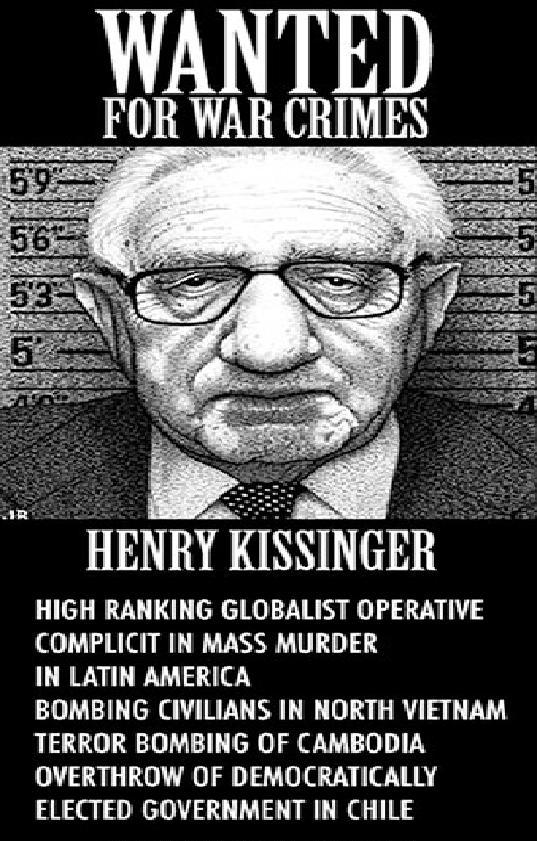
A very angry Senator John McCain denounced CodePink activists as “low-life scum” for holding up signs reading “Arrest Kissinger for War Crimes” and dangling handcuffs next to Henry Kissinger’s head during a Senate hearing on January 29. McCain called the demonstration “disgraceful, outrageous and despicable,” accused the protesters of “physically intimidating” Kissinger and apologized profusely to his friend for this “deeply troubling incident.”

But if Senator McCain was really concerned about physical intimidation, perhaps he should have conjured up the memory of the gentle Chilean singer/songwriter Victor Jara. After Kissinger facilitated the September 11, 1973 coup against Salvador Allende that brought the ruthless Augusto Pinochet to power, Victor Jara and 5,000 others were rounded up in Chile’s National Stadium. Jara’s hands were smashed and his nails torn off; the sadistic guards then ordered him to play his guitar. Jara was later found dumped on the street, his dead body riddled with gunshot wounds and signs of torture.

Despite warnings by senior US officials that thousands of Chileans were being tortured and slaughtered, then Secretary of State Kissinger told Pinochet, “You did a great service to the West in overthrowing Allende.”

Rather than calling peaceful protesters “despicable,” perhaps Senator McCain should have used that term to describe Kissinger’s role in the brutal 1975 Indonesian invasion of East Timor, which took place just hours after Kissinger and President Ford visited Indonesia. They had given the Indonesian strongman the US green light—and the weapons—for an invasion that led to a 25-year occupation in which over 100,000 soldiers and civilians were killed or starved to death. The UN’s Commission for Reception, Truth and Reconciliation in East Timor (CAVR) stated that U.S. “political and military support were fundamental to the Indonesian invasion and occupation” of East Timor.

If McCain could stomach it, he could have read the report by the UN Commission on Human Rights describing the horrific consequences of that invasion. It includes gang rape of female detainees following periods of prolonged sexual torture; placing women in tanks of water for prolonged periods, including submerging their heads, before being raped; the use of snakes to instill terror during sexual torture; and the mutilation of women’s sexual organs, including insertion of batteries into vaginas and burning nipples and genitals with cigarettes. Talk about physical intimidation, Senator McCain!

You might think that McCain, who suffered tremendously in Vietnam, might be more sensitive to Kissinger’s role in prolonging that war. From 1969 through 1973, it was Kissinger, along with President Nixon, who oversaw the slaughter in Vietnam, Cambodia and Laos—killing perhaps one million during this period. He gave the order for the secret bombing of Cambodia. Kissinger is heard on tape saying, “[Nixon] wants a massive bombing campaign in Cambodia. He doesn’t want to hear anything about it. It’s an order, to be done. Anything that flies or anything that moves.”

Senator McCain could have taken the easy route by simply reading the meticulously researched book by the late Christopher Hitchens, The Trial of Henry Kissinger. Writing as a prosecutor before an international court of law, Hitchens skewers Kissinger for ordering or sanctioning the destruction of civilian populations, the assassination of “unfriendly” politicians and the kidnapping and disappearance of soldiers, journalists and clerics who got in his way. He holds Kissinger responsible for war crimes that range from the deliberate mass killings of civilian populations in Indochina, to collusion in mass murder and assassination in Bangladesh, the overthrow of the democratically elected government in Chile, and the incitement and enabling of genocide in East Timor.

McCain could have also perused the warrant issued by French Judge Roger Le Loire to have Kissinger appear before his court. When the French served Kissinger with summons in 2001 at the Ritz Hotel in Paris, Kissinger fled the country. More indictments followed from Spain, Argentina, Uruguay—even a civil suit in Washington DC.

Hitchens was disgusted by the way Henry Kissinger was treated as a respected statesman. He would have been appalled by Senator McCain’s obsequious attitude. “Kissinger should have the door shut in his face by every decent person and should be shamed, ostracized, and excluded,” Hitchens said. “No more dinners in his honor; no more respectful audiences for his absurdly overpriced public appearances; no more smirking photographs with hostesses and celebrities; no more soliciting of his worthless opinions by sycophantic editors and producers.”

Rather than fawning on him, Hitchens suggested, “why don’t you arrest him?”

Hitchens’ words were lost on Senator McCain, who preferred fawning to accountability. That’s where CodePink comes in. If we can’t get Kissinger before a court of law, at least we can show—with words and banners—that there are Americans who remember, Americans who empathize with the man’s many victims, Americans who have a conscience.

While McCain called us disgraceful, what is really disgraceful is the Senate calling in a tired old war criminal to testify about “Global Challenges and the U.S. National Security Strategy.” After horribly tragic failed wars, not just in Vietnam but over the last decade in Iraq and Afghanistan, it’s time for the US leaders like John McCain to bring in fresh faces and fresh ideas. We owe it to the next generation that will be cleaning up the bloody legacy left behind by Kissinger for years to come.


Edward Abbey’s FBI File

ed-abbey

(Editor’s note: in honor of author/activist Edward Abbey, who was born on this day in 1927, you can learn a little more about his life through this overview of the FBI’s file on the courageous iconoclast beginning in his college days followed by a short video essay filmed in Moab.)

By David Gessner

Source: Orion Magazine

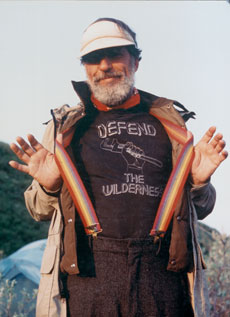
THE FILE BEGINS in 1947, when Abbey, just twenty and freshly back from serving in the army in Europe, posts a type-written notice on the bulletin board at the State Teacher’s College in Pennsylvania. The note urges young men to send their draft cards to the president in protest of peacetime conscription, exhorting them to “emancipate themselves.” It is at this point that Abbey becomes “the subject of a communist index card” at the FBI, and from then until the end of his life the Bureau will keep track of where Abbey is residing. They will note when he heads west and when, as acting editor of the University of New Mexico’s literary magazine, The Thunderbird, he decides to print an issue with a cover emblazoned with the words: “Man will not be free until the last king is strangled with the entrails of the last priest!” The quote is from Diderot, but Abbey thinks it funnier to attribute the words to Louisa May Alcott. And so he quickly loses his editorship while the FBI adds a few more pages to his file. Also quoted in full in his files is a letter to the editor of the New Mexico Daily Lobo, in which he writes: “In this day of the cold war, which every day shows signs of becoming warmer, the individual who finds himself opposed to war is apt to feel very much out of step with his fellow citizens.” He then announces the need to form a group to “discuss implications and possibilities of resistance to war.”

The files contain interviews with fellow students and teachers at the University of New Mexico, who talk of Abbey’s “instability and poor judgment,” with one interviewee saying that, as an editor, Abbey showed “a stubborn ego, a taste for shocking the reader, a lack of maturity.” Abbey, according to other colleagues, was “indiscreet in his individualism” and “demonstrated a somewhat radical rebellious quality . . .” Though the interviews are mildly damning, no one questioned the subject’s loyalty to his country.

One wonders how Abbey would have fared these days. Would the FBI, or the NSA, have simply kept tabs on him or actually called him in for questioning? So many of his views, and so much of his personality, match just the sort of profile we have come to associate with our rather broad definition of domestic terrorism. It isn’t just his gun advocacy, or his monkey wrenching. It’s his belief that wilderness is a place where the last free men can retreat when the tyrants take over. He writes:

Democracy has always been a rare and fragile institution. . . . As social conflict tends to become more severe . . . there will inevitably be a tendency on the part of the authoritarian element—always present in our history—to suppress individual freedoms, to utilize the refined techniques of police surveillance (not excluding torture of course) in order to preserve—not wilderness!—but the status quo . . .

It’s a type of sentiment that anticipates our government’s reaction to 9/11. Thoreau said that under a government that unjustly imprisons its own, “the true place for the just man is also a prison.” Prison is exactly where Abbey’s monkey wrenching and FBI record might have landed him in today’s world.

Abbey’s beliefs in freedom and resistance, and his message of aggressive nonconformity, of screw-you freedom, were perfect for the ’60s and ’70s. But it’s hard to imagine that the same message would get a similar reaction today, or to see, at least at first, how his spirit might be adapted to fit our times. For instance, isn’t monkey wrenching dead as a legitimate possibility for the environmental movement? I must admit that in my own grown-up life as a professor and father I don’t blow a lot of things up. For most of us who care about the environment, Wallace Stegner provides a much more sensible model.

But I don’t want to be so quick to toss Abbey on the scrap heap. If the times have changed, Abbey’s ideas about freedom have in some ways never been more relevant. Many of the things that he foresaw have come to pass: we currently live in an age of unprecedented surveillance, where the government regularly reads our letters (now called e-mails) and monitors our movements. Abbey offers resistance to this. Resistance to the worst of our times, the constant encroaching on freedom and wildness. He says to us: Question them, question their authority. Don’t be so quick to give up the things you know are vital no matter what others say.

David Gessner is the author of nine books, including the forthcoming All the Wild That Remains: Edward Abbey, Wallace Stegner, and the American West from which this essay is adapted. He is the founder of the journal Ecotone.


Production notes by Ned Judge:
An eight minute film essay that I co-produced and directed with Ed Abbey in 1985. At the time I was working for a network magazine show. The executive producer took me to lunch one day. He told me that he was having trouble with his son who was 18. The son thought his dad was a corporate whore. He had told his father if he had any balls at all he’d put Ed Abbey on his show. That’s why the EP was talking to me. Would I see if it was possible? I had an acquaintance who knew Ed and he passed the request along. Ed responded that he’d give it a try. He signed the contract and wrote a script. We met in Moab and went out to Arches National Park to shoot some practice sessions with a home video camera. We would review them at the motel in the evening. After a day or two, Ed was feeling pretty comfortable on camera so we scheduled the shoot. We were all happy with the way it went. But then we ran head-on into network reality. Roger Mudd, the show’s host, was extremely negative about putting an “eco-terrorist” on the show. The executive producer had no choice but to cave. So this Abbey essay was put on the shelf and never aired. Abbey died 3 years later in March 1989.

How the War on Drugs Advances Transnational Capitalism

dwc-cvr-small_72web

How US drug policy in the Americas is a pretext for extending militarization and global capitalism south of the border.

By Mark Karlin

Source: Alternet

Dawn Paley, a Canadian journalist, offers a transformative view of the US war on drugs in the Western Hemisphere (with the exclusion of Canada as a targeted nation because it is a neoliberal partner of the United States in exploitation). Her just-released book,  Drug War Capitalism, is a sweeping, exhaustively detailed analysis that reveals the insidious actual goals of the US-led and funded militarization south of the border in the name of destroying drug cartels. As Paley writes, “This war is about control over territory and society [and market share, cheap labor, mineral rights and profits], much more so than it is about cocaine or marijuana.”

The following is the Truthout interview with Dawn Paley about  Drug War Capitalism:

Mark Karlin: You state the so-called war on drugs is really a war on people. This is a key point in your exhaustively documented and cogently threaded book. Can you expand on that – and of course you are talking about a certain class and background of person: the indigenous and the poor south of the US Border?

Dawn Paley: There is excellent work being done in the US examining and resisting the impacts of the drug war, specifically when it comes to the mass incarceration of young people from communities of color on that pretext.  Drug War Capitalism looks at how the drug war is deployed south of the US border, where the key mechanism for social control is the use of terror against the people/ el pueblo/los pueblos. Some activists and writers use words like social cleansing to describe the impacts of drug war militarization and paramilitarization, and how both primarily target poor young men in urban and rural environments. The case of Ayotzinapa, with the disappearance of 43 students and the murder of three others (one of the disappeared students is now confirmed to have been murdered) by municipal police in Iguala, Guerrero, is just the latest example of how often the victims of the drug war come from marginalized – and often well organized – communities and groups.

In the US, many people have been turned into frightened puppets who support any action in the name of the war on terrorism, even when such military and police action has to do with the goal of expanding transnational business opportunities. How is this analogous to the use of the war on drugs as a cover for US military intervention in Mexico, Central America, Colombia and the rest of most of the Western Hemisphere, with the exclusion of Canada? After all, doesn’t the US benefit by having a state of violence among the poor and socially marginal people keep them from considering populist political rebellion in these nations?

I’d like to approach this question a little differently, and ask instead why it is that the hundreds of thousands of people who mobilized throughout the United States against the unjust war in Iraq were able to make the connection between US invasions and oil extraction, and why it has been so difficult for folks to mobilize and make the same connections to resource extraction and capitalism in the case of the US-backed war on drugs in Colombia, Mexico and elsewhere.

Once we can start to make the connections between US-backed war agendas in the form of Plan Colombia or the Merida Initiative and the expansion of capitalism in Mexico and Colombia, a lot of things begin to make sense. In the immediate term, the militarization and the paramilitarization stemming from these plans to sow terror and strengthen the state repressive apparatus, which, as we are well aware, works to protect transnational capital, like mining companies or oil companies.

Over the longer term, the structural reforms that go hand in hand with Plan Colombia and the Merida Initiative deepen neoliberalism. With the privatization of Petroleos Mexicanos (Pemex), Mexico’s state oil company, for example, 70 percent of Mexico’s federal budget is at stake, something I argue could lead to a previously unknown level of austerity in Mexico. Already financially starved sectors like health and public education could be impacted, as could existing subsidies for transportation, basic goods and otherwise.

As the privatization of Pemex kicks in and the effects begin to be felt over the next decade, should people rise up in protest, the fact that police and military forces as well as nominally non-state armed actors were strengthened through the Merida Initiative will certainly come in handy in order to control dissent.

You bring up how narcotrafficking money laundering has been profitable for banks and even that the cash liquidity of such funds helped some large US banks survive the 2008 implosion of the economy. In addition, drug cartels invest a lot of their money – 85 percent of which you note is generated in the US, in the cocaine market – in legitimate businesses. Aren’t narcotraffickers often the shady cousins of neoliberal capitalists, who collaborate for mutual benefit at times?

I suppose you could say that, yes. The book doesn’t focus on the role of banks, as this is one of the areas of the drug war that has been extensively covered in the mainstream media. However, There’s a tendency towards showing images of Mexican traffickers with stacks of US dollars, but their proceeds represent a fraction of the overall cash generated because of prohibition. I think it’s important to point out that when we talk about the wealth generated by the drug trade it is essential to remember that the vast majority of that cash is generated in the United States and helps prop up the US economy in various ways.

Perhaps the linchpin to your investigative reporting is that the war on drugs is a cover, in many ways, for the expropriation of land for excavation and fossil fuel companies – as well as the creation of secure manufacturing, assembly and marketing environments for other international corporations. I know that specific alliances of corruption are often difficult to ascertain when it comes to the so-called war on drugs, but how do paramilitary groups (sometimes drug cartels), the military and the police play a role in securing land and providing security for transnational corporations. As you point out, large corporations and their employees are rarely victims of violence in the nations that have been targeted for drug war capitalism.

Colombia provides us with the strongest examples of this: paramilitaries hired to kill union organizers, or companies like BP and Drummond using paramilitaries to ensure they had access to lands for mining and pipeline building. These cases are extensively documented by court cases which have led to settlements for victims.

In a place like Ciudad Juarez we see how, for example, it is workers and their families who are terrorized by the drug war, and especially by state forces, while police go to great extents to protect the US-based owners of manufacturing plants when they visit the city. In the book I document how communal landowners dedicated to protecting their land from resource extraction are threatened by Federal Police deployed in the name of fighting the war on drugs, or how they are murdered by so called cartel hitmen, who I consider to be more akin to paramilitaries. And this is just the beginning. Unfortunately these trends are likely to become more obvious in Mexico, as they did in Colombia, as time goes on.

What role did NAFTA and other trade agreements play in having laid the groundwork for killing, kidnapping and displacing people to seize land for excavation and fossil fuel development? As a further note, you are a Canadian, and Canadian mining companies appear to play a large role in land seizures, hiring of enforcers (in many cases assassins and torturers), and cooperation with corrupt governments, police and even drug cartels. Is it safe to assume that this is with the full support of the Harper government?

Well, in Colombia it was actually Plan Colombia that paved the way for the Canada-Colombia Free Trade Agreement and the US-Colombia Free Trade Agreement. They didn’t advertise it at the time, but following Plan Colombia it was made clear by officials from both the US and Colombia that though the flow of drugs wasn’t reduced, Plan Colombia was a success because it created the conditions for the implementation of these new free trade agreements.

In some ways NAFTA, which became active in January 1994, happened too soon. Let me explain: While NAFTA went a long way towards destroying local economies especially in rural areas and impoverishing small farmers, by 2008 when the Merida Initiative kicked off, it left much to be desired in terms of how open the Mexican economy actually was to transnational capital. At that time, the Mexican government continued to be the full owner of the Federal Electricity Commission and the national oil company, Pemex.

Communal landowners were refusing to enter into privatization schemes made possible when Article 27 of the Mexican Constitution was changed prior to the signing of NAFTA in 1992. Elite Mexican families took control over certain sectors of the economy that were privatized, as NAFTA era privatizations did not include regulations that meant that US bidders would be considered on equal footing with national bidders. All of these elements, among others, meant that Mexico was ripe for a new round of neoliberalism and austerity that would open new areas for investment. That’s part of what the Merida Initiative has provided a platform to do.

NAFTA was a key ingredient in opening up Mexico’s mining sector. Large scale, modern mining, especially gold mining, provides us with a bit of a preview of the kinds of conflicts that could erupt if widespread private sector oil and gas exploration and exploitation goes ahead in Mexico. Gold mining in Mexico is dominated by companies based in Canada, which gives them a litany of financial as well as diplomatic and legal supports for their activities. In the book, I document cases where these Canadian mining companies take advantage of the conditions created by the Merida Initiative in order to push their projects forward.

It appears ironic that the free trade treaties squeeze out small business people and entrepreneurs, benefiting almost exclusively the large multinational corporations. After all, the promoters of the treaties claim that they stimulate the business environment for everyone. You provide evidence, however, on why that is just a sales point for free trade agreements, but hardly the reality.

Free trade agreements decimate local economies and small businesses. They allowed the US and other nations to dump their subsidized agricultural products, like corn, into a diverse national market that included many small holders, as in Mexico, who operate with very few subsidies. There are social classes that benefit greatly from these kinds of agreements, but they are the minority, in the US as well as in target countries like Mexico. Rendering small farms and family businesses unprofitable is more than an economic issue: It is a root cause of forced migration, of displacement, and in the destruction of social and community fabric. This, in turn, is beneficial in terms of increasing state and corporate control over peoples’ lives and lands.

You provide a good deal of clarity on how Plan Colombia was the model for the Mérida Initiative in Mexico. What was the real priority of Plan Colombia in terms of creating a nation that is structured to provide an accommodating and secure environment for transnational businesses?

I believe the real priority of Plan Colombia was just that: improving the conditions for investment throughout the country. Officially this takes a couple of forms, including regulatory and judicial reforms and the extension of police forces and soldiers throughout the national territory. Off the books, it is known that paramilitary groups work closely with police and soldiers throughout the country, and that this tends towards benefiting the activities of transnational companies.

One of the implications of the US working to graft its legal model on nations south of the border is that it appears likely to increase prison populations. Given that the United States has the highest percentage of its population incarcerated, that is an ominous portent, isn’t it?

It is indeed. The Merida Initiative also included funds for building and expanding Mexico’s prison facilities and training Mexican prison guards in the ways of US jailers.

That brings us back to the first question. Who is responsible for the social cleansing that is a significant component of the violence associated with the alleged war on drugs? Who gains from killing “disposable people”?

There are cases where we can talk about individuals responsible for killings, but the approach I take in the book is to try and present what I argue are structural elements which allow this kind of killing and terror to take place. Certainly US-funded militarization is a key component. There’s the media and the government, which blame victims for their own deaths by linking them with drug trafficking. Then there is the impunity, the fact that those responsible for criminal acts not only get away with their crimes, but that various levels of government are actively involved and thus also cover their tracks. That impunity exists at a national level in Mexico and elsewhere, but it is allowed to thrive because it is backed by the US State Department, which boasts that it has had closer relations with the Mexican government since the beginning of the Merida Initiative than at any previous juncture.

One of your key points is that the US State Department basically concedes that the flow of drugs into the US will never really significantly diminish. However, as you point out, by constantly militarizing nations south of the border, the US is able to – through its Northern and Southern Commands – gain large footholds in the militaries, police, paramilitaries (who not infrequently are at the service of global corporations) and even drug cartels that can cooperate to favor US financial interests. In that sense, we are really talking about drug war capitalism, aren’t we?

We are! I hope folks will be inspired to pick up  Drug War Capitalism and explore these issues. In the conclusion, I write that I consider the book to be an early attempt to articulate and make visible connections between the war on drugs and the expansion of capital. Sadly, as recent events in Ayotzinapa, Guerrero and Tlatlaya, Mexico State, have shown, it is likely to become increasingly obvious that the drug war is in fact a war on the people, waged in large part by US-backed state forces.

The FBI is Great at Disrupting (Its Own) “Terror Plots”

index

By Kevin Carson

Source: Center for a Stateless Society

On January 14 the US Department of Justice announced that the Joint Terrorism Task Force had disrupted the latest “domestic terrorism plot” — this time by “a Cincinnati-area man … to attack the U.S. Capital and kill government officials.” House Speaker  John Boehner immediately cited the disrupted plot as evidence that Congress should think carefully before refusing to renew the NSA’s bulk data collection powers. Only it turns out the feds had at least as much to do with hatching the plot as did the alleged plotter, Christopher Cornell.

The FBI investigator became aware of Cornell’s pro-ISIS comments on Twitter thanks to a tip-off from an unnamed informant who “began cooperating with the FBI in order to obtain favorable treatment with respect to his criminal exposure on an unrelated case.” The informant, on FBI orders, arranged two meetings with Cornell where they discussed attacks on the capital, after which the FBI arrested him to “prevent” the attacks. In other words, it identified Cornell as a suspect entirely on the basis of his expression of radical political opinions, with the help of a jailhouse snitch who rolled over in response to prosecutorial blackmail. And the actual “plot” was worked out only in subsequently arranged meetings in which one party — working for the FBI — may well have been leading Cornell. It wasn’t for nothing that ecological activist Judi Bari said “the first person to mention bringing dynamite is probably a fed.”

In this the Cornell case has a lot in common with a great many other so-called “domestic terrorism plots” federal law enforcement has “disrupted,” going back to the Lackawanna Six. A good example is the so-called “plot” of the Newburgh Four, who supposedly plotted to blow up synagogues and attack a military base. The judge commented that the government “came up with the crime, provided the means, and removed all relevant obstacles,” in the process making a terrorist out of a man “whose buffoonery is positively Shakespearean in scope” (“US: Terrorism Prosecutions Often An Illusion,” Human Rights Watch, July 21, 2014).

This reminds me of a story I read — from Dilbert cartoonist Scott Adams, I think — about a software company that offered programmers a bonus for every bug they detected in code. Predictably, creating bugs to “detect” became a major source of revenue for employees. H.L. Mencken once remarked on government’s tendency “to keep the populace alarmed (and hence clamorous to be led to safety) by menacing it with an endless series of hobgoblins, all of them imaginary.”

We see this in the dismaying, Starship Troopers-like media narrative involving any and all armed government personnel in uniform. Last weekend’s highest U.S. box office receipts came not from Selma (the story of oppressed people organizing to fight for their freedom) but from American Sniper. The latter movie glorifies a vile wretch who gloated over all the “savages” (his word for any male age 16 to 60) he murdered in Iraq, on the grounds that he was saving American troops from being shot at. Never mind that the people in Iraq were shooting back at an invading army in their own country. Domestically, we see the same phenomenon with shows like COPS, and local news coverage of police in paramilitary gear (breathlessly referred to as “the authorities” by nitwit reporters) storming alleged “meth labs.”

And remember, the very concept of a “sting operation” (also known as “entrapment”) invokes the principle that some human beings are superior to the law. The first professional police forces were justified on the grounds that they were simply being paid to exercise the same posse comitatus powers of “citizen’s arrest” possessed by any other member of society. By that standard, if it’s illegal for an ordinary citizen to solicit or instigate illegal activity, it should be illegal for anyone — including uniformed state officials.

But most importantly, this is an example of how the state mostly “solves” problems of its own making — and has an incentive to keep creating more problems to justify giving it the power and resources to “solve” them.


Fascism and War: Elite Tools to Crush and Kill Dissent

facism

By Julie Lévesque

Source: GlobalResearch.ca

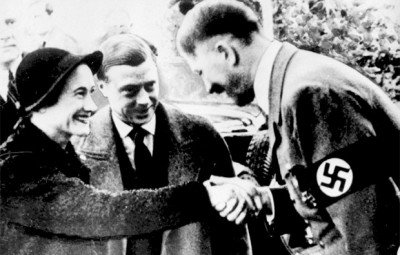
The Duke and Duchess of Windsor in 1937 with Adolf Hitler.

The Duke and Duchess of Windsor in 1937 with Adolf Hitler.

Dr. Jacques Pauwels is not the kind of historian you often hear about in the mainstream media. He’s obviously not the kind of “expert” they refer to for historical facts. Actually, one crucial propaganda method consists in excluding current events from their historical context.

Listening to Pauwels makes one realize the scope of the lies we’ve been fed about the Second World War, fascism and democracy, and how myths related to previous wars need to be upheld in the mainstream discourse to satisfy never ending war propaganda needs.

In a speech held December 15 in Montreal, he explained that World Wars I and II were all about crushing mass revolutionary movements.

The myth of the Good War

Every time Westerners’ approval for war is required, the myth of the good war surfaces: the Second World War was a good war, a necessity to quench Hitler’s blood thirst. Pauwels tears this myth apart, uncovering the vicious nature of the western elite.

The reasons for the US involvement in World War II lie in the social-economic conditions of the time, not in an outpouring of compassion destined to save humanity from fascism. The US elite was actually in favor of fascism, a very convenient tool to crush the mass revolutionary movement embodied by the Russian Revolution and the USSR.

WWII was in fact a continuity of WWI. “We are always told that WWI started with the assassination of Archduke Franz Ferdinand, but it’s not true”, Pauwels says. It is indeed a well established myth carried on by various sources, whether history is written by “thousands of eminent experts, scholars, and leaders” like in Encyclopedia Britannica, or by just about anybody, like in Wikipedia:

The outbreak of war

With Serbia already much aggrandized by the two Balkan Wars (1912–13, 1913), Serbian nationalists turned their attention back to the idea of “liberating” the South Slavs of Austria-Hungary. Colonel Dragutin Dimitrijević, head of Serbia’s military intelligence, was also, under the alias “Apis,” head of the secret society Union or Death, pledged to the pursuit of this pan-Serbian ambition. Believing that the Serbs’ cause would be served by the death of the Austrian archduke Francis Ferdinand, heir presumptive to the Austrian emperor Francis Joseph, and learning that the Archduke was about to visit Bosnia on a tour of military inspection, Apis plotted his assassination. (World War I, Encyclopedia Britannica)

The immediate trigger for war was the 28 June 1914 assassination of Archduke Franz Ferdinand of Austria, heir to the throne of Austria-Hungary, by Yugoslav nationalist Gavrilo Princip in Sarajevo. This set off a diplomatic crisis when Austria-Hungary delivered an ultimatum to the Kingdom of Serbia,[10][11] and international alliances formed over the previous decades were invoked. Within weeks, the major powers were at war and the conflict soon spread around the world. (World War I, Wikipedia)


Both WWI and WWII had two dimensions: the vertical dimension, namely the rivalry between empires, and the horizontal one, class warfare, Pauwels explains.

These wars were actually the best way for the western elite to cope with the ever growing revolutionary and democratic movements fueled by dire economic conditions and which threatened the established order.

In Nietzsche’s view for example, Pauwels says “war was the solution against revolution, since in a war, there are no discussions, like there is in a democracy. In a war, the minority, the elite, decides and the majority, the proletarians, obey.”

For members of the elite like Malthus, “the system could not be the cause of poverty since they were profiting from it. The cause of poverty was the poor: there were too many of them. Therefore the solution to poverty and threatening revolutionary movements was simply to eliminate poor people and what better solution than war to kill poor people?”

After WWI though, “revolution was no longer a simple idea but rather something concrete: the Soviet Union.” That’s when fascism came to the rescue. “Fascism was the instrument used by the elite to further the objectives of 1914, namely put an end to revolutions and communism.”

Communism and socialism were gaining worldwide momentum after WWI. “The German industrial and financial elite wished to crush the revolutionary movement and destroy the Soviet Union. Adolf Hitler was their instrument.”

According to popular belief Western leaders were defending democracy, engaged in a war against Germany to save humanity from fascism and the US involvement in the war led to the downfall of Hitler’s war machine. Nothing is further from the truth. “Hitler was supported by other European countries and the US because they wanted him to destroy the USSR, the cradle of the revolution.” The exact opposite occurred: it was the USSR that defeated Nazi Germany, losing over 20 million souls in the battle.

The US even recruited the best Nazi scientists, technicians and engineers to work for them after the war. That piece of history called Operation Paperclip (picture below) has yet to find its way in Encyclopedia Britannica.

WWII was the victory of American Imperialism, a term which is rarely used today even if it best describes the reality the world has been living in ever since.

But even more surprising is the surviving myth that we are going to war to save the world from evil dictators or terrorists and that the western world fights for freedom and democracy. Thanks to the “stenographers of power”, the tactic is still reliable and used several decades later.

Visit Jacques Pauwels’ web site at http://www.jacquespauwels.net/about/. His articles and books are available in several languages. See also Jacques Pauwels’ articles on Global Research.