North Dakota’s Governor ordered the state’s National Guard to clear the protest encampment of Lakota Sioux water protectors and their supporters during the 2016-17 protests against a pipeline through tribal lands. Click on image to play video (video courtesy RT television)
Sometimes the hypocrisy of the US government, especially when it comes to foreign affairs, it just too much to let pass.
The latest example of this is the Ukraine crisis, where the US pretty much stands all alone (unless you count Britain’s embattled and embarrassed Prime Minister Boris Johnson, who parrots US policy like a trained bird), accusing Russia not just of preparing for an “imminent invasion’ of Ukraine, but of violating international law and “rules-based international order,” as Secretary of State Antony Blinken likes to put it.
The Biden administration’s top diplomat has made repeatedly blasted both Russia for threatening Ukraine with an invasion by moving troops and equipment to its border and to the border between Ukraine and Belarus, Russia’s ally to the west, and China for its threats to Taiwan and for a rights crackdown in Hong Kong, a Chinese Special Administrative Region that had been promised 30 years or “no change” but was put under new stricter national security laws following violent student protests and university occupations in 2019-20.
But how can the US make such accusations against the Russians and the Chinese governments when the US for nearly eight years, has been bombing, launching rocket and drone attacks, and sending troops, under both CIA and Pentagon control, against both ISIS and Syrian government troops and aircraft — even attacking and killing Russian mercenary troops at one point, who, unlike the US, were in Syria at the request of the Syrian government.
US military actions in Syria are completely outside of any “rules based international order.”
International rules, when it comes to warfare, are crystal clear, enshrined in the United Nations Charter, which is an international treaty signed and ratified by the US government along with most other nations of the world and incorporating all the laws of war. The primary law, violation of which is described as the gravest war crime of all “because it contains with in it all other war crimes.” Called a Crime Against Peace, it states that no nation may attack another except if that nation faces an “imminent threat” of attack.
There are no codicils expanding on or getting around that proscription.
The US has committed that Crime Against Peace countless times, in Vietnam, in Laos, in Cambodia, in Yemen, in Iraq, in Lebanon, in Syria, in Somalia, in Sudan, in Haiti, in the Dominican Republic, in Nicaragua, in El Salvador, in Cuba, in Niger, in the Congo, in Panama, in Grenada — indeed in so many places I’m sure I’m not remembering them all. Suffice to say that my whole life (I was born in 1949), my country has been a violator of the UN Charter’s ban on launching illegal wars.
Rules-based order? What the F**k is Blinken talking about? The US makes its own rules. In fact, whenever the US launches some illegal invasion or air attack against a country, the biggest complaint we hear in the US is that the president has ordered up and launched a war “without Congressional approval”
The implication is that if Congressional approves an illegal war or act of war, that makes it legit. It doesn’t.
What makes it worse when the US makes such accusations against Russia and China is that it is accusing two countries which, as objectionable as their actions or threats might be, at least have a better argument for their legality than does the US.
Let’s start with China. The government in Beijing stands accused by Blinken and the US government under a series of presidents, with threatening Taiwan, an island that historically was a part of China, but became functionally independent in 1949 when the Chinese Communist Party won its revolution on the mainland, founding the People’s Republic of China, and the remnants of the Nationalist Party and its army fled to Taiwan, murdering tens of thousands of local Taiwanese and Hakka Chinese people, and establishing a brutal dictatorship under Nationalist leader and major domo Chiang Kai-Shek. China has never acknowledged the independence of Taiwan, which for 50 years prior to the end of World War II had been a colony of Japan, a spoil of victory in the China-Japan War won by Japan against the Ching dynasty in 1895.
The US initially recognized Taiwan, after the Chinese Communist revolutionary victory in 1949, as an independent country, but Richard Nixon, in a slick realpolitik maneuver masterminded by his National Security Advisor and later Secretary of State Henry Kissinger, in order to recognize China and drive a wedge between that country and the Soviet Union, agreed to cease recognizing Taiwan as an independent nation, removed the US embassy from the island, and set one up in Beijing. In other words, at that point, from the US point of view at least, Taiwan’s status became an internal affair of China’s, not an international affair.
The same applies to the Chinese crackdown on rights in Hong Kong. Since July 1997, Hong Kong ceased to be a British colony, and reverted to being part of China. Now it’s true there were negotiations between the Beijing government and departing British government. During those years of transition, Hong Kong’s appointed colonial Governor Chris Patten, former head of the British Conservative Party, carefully avoided allowing Hong Kongers to obtain long-sought universal suffrage to elect all members of the territory’s legislative council, Legco, before the British departure (a move which would at least have left the Beijing facing a local government that actually represented all the people of Hong Kong, instead of Legco representatives representing various business sectors like banking, the legal profession, the retail industry, property owners, etc).
China agreed during those negotiations to gradually increase the number of Legco members elected from geographic constituencies, and to leave basic freedoms of speech, press, etc. untouched “for 30 years.” But when students rose up to protest the arrests of Hong Kong residents and their deportation to face trials in China, it set in motion a confrontation between democracy advocates in Hong Kong and authoritarians in Beijing, and ultimately to a new Beijing-imposed national security law for Hong Kong that has turned the city into essentially just another bit of China. But again, while it was certainly a draconian over-reaction to legitimate local protests, that action by China is not a violation of international law — just violation of an agreement between a departing (and loathed) colonial power, a legacy of the European Opium War against China, and a new vastly more powerful China. It’s a bit like the US’s brutal crackdown on immigrants at the Mexican border or on Native defenders of water rights in North Dakota. Disgusting, and perhaps criminal under US law, but hardly a violation of some kind of “rules-based international order.”
As for Russia, even the plebiscite in Crimea, some 97% of the population there voted that they wanted to leave Ukraine and return to being part of Russia, as the peninsula had been until 1954, when new Soviet Premier Nikita Khrushchev, as a gift to the region he had grown up in, transferred Crimea from the Russian Soviet to the Ukrainian Soviet, which the US has criticized as somehow fraudulent (Crimea is about 85% ethnic Russian). With 85% of eligible people voting, that plebiscite provided Russia with the justification for reclaiming jurisdiction over Crimea. Russia’s action, criticized by the US as “aggression,” is less of a violation of democratic norms though than the massive disenfranchisement of blacks and other people of color in Republican-run “red” states of the US — a process that is now being accelerated to warp speed with the approach of the 2022 off-year Congressional elections. If the Biden administration really cared about justice and democracy it would be laser-focused on defending voter rights, not on shipping deadly weapons to Ukraine.
If the US government cared about following a “rules-based international order,” the it would pull all US military forces out of Syria, pull the US Navy out of the Persian Gulf, stop using drones to kill people in Yemen, Somalia, and elsewhere, stop sending US Special Forces wherever the president wants to send them, and rejoin the World Court and respect its adjudication of violations of international rules and laws.
Then we wouldn’t have to listen to all the hypocritical crap uttered by Biden, Blinken and their ilk.
Someday, I’m sure there will come a reckoning, when US leaders will finally be held to account for their long record of crimes against humanity. Until then, we will have to endure all this epic hypocrisy.
Once upon a time, there was a government so paranoid about its hold on power that it treated everyone and everything as a threat and a reason to expand its powers. Unfortunately, the citizens of this nation believed everything they were told by their government, and they suffered for it.
When terrorists attacked the country, and the government passed massive laws aimed at paving the way for a surveillance state, the people believed it was done merely to keep them safe. The few who disagreed were labeled traitors.
When the government waged costly preemptive wars on foreign countries, insisting it was necessary to protect the nation, the citizens believed it. And when the government brought the weapons and tactics of war home to use against the populace, claiming it was just a way to recycle old equipment, the people believed that too. The few who disagreed were labeled unpatriotic.
When the government spied on its own citizens, claiming they were looking for terrorists hiding among them, the people believed it. And when the government began tracking the citizenry’s movements, monitoring their spending, snooping on their social media, and surveying them about their habits—supposedly in an effort to make their lives more efficient—the people believed that, too. The few who disagreed were labeled paranoid.
When the government allowed private companies to take over the prison industry and agreed to keep the jails full, justifying it as a cost-saving measure, the people believed them. And when the government started arresting and jailing people for minor infractions, claiming the only way to keep communities safe was to be tough on crime, the people believed that too. The few who disagreed were labeled soft on crime.
When the government hired crisis actors to take part in disaster drills, never alerting the public to which “disasters” were staged, the people genuinely believed they were under attack. And when the government insisted it needed greater powers to prevent such attacks from happening again, the people believed that too. The few who disagreed were told to shut up or leave the country.
When the government started carrying out covert military drills around the country, insisting it was necessary to train the troops for foreign combat, most of the people believed them. The few who disagreed, fearing that perhaps all was not what it seemed, were shouted down as conspiracy theorists and quacks.
When government leaders locked down the nation, claiming it was the only way to prevent an unknown virus from sickening the populace, the people believed them and complied with the mandates and quarantines. The few who resisted or voiced skepticism about the government’s edicts were denounced as selfish and dangerous and silenced on social media.
When the government expanded its war on terrorism to include domestic terrorists, the people believed that only violent extremists would be targeted. Little did they know that anyone who criticizes the government can be considered an extremist.
By the time the government began using nationalized police and the military to routinely lockdown the nation, the citizenry had become so acclimated to such states of emergency that they barely even noticed the prison walls that had grown up around them.
Now every fable has a moral, and the moral of this story is to beware of anyone who urges you to ignore your better instincts and blindly trust that the government has your best interests at heart.
In other words, if it looks like trouble and it smells like trouble, you can bet there’s trouble afoot.
Unfortunately, the government has fully succeeded in recalibrating our general distaste for anything that smacks too overtly of tyranny.
After all, like the proverbial boiling frogs, the government has been gradually acclimating us to the specter of a police state for years now: Militarized police. Riot squads. Camouflage gear. Black uniforms. Armored vehicles. Mass arrests. Pepper spray. Tear gas. Batons. Strip searches. Surveillance cameras. Kevlar vests. Drones. Lethal weapons.Less-than-lethal weapons unleashed with deadly force. Rubber bullets. Water cannons. Stun grenades. Arrests of journalists. Crowd control tactics. Intimidation tactics. Brutality.
This is how you prepare a populace to accept a police state willingly, even gratefully.
You don’t scare them by making dramatic changes. Rather, you acclimate them slowly to their prison walls. Persuade the citizenry that their prison walls are merely intended to keep them safe and danger out. Desensitize them to violence, acclimate them to a military presence in their communities, and persuade them that only a militarized government can alter the seemingly hopeless trajectory of the nation.
It’s happening already.
The sight of police clad in body armor and gas masks, wielding semiautomatic rifles and escorting an armored vehicle through a crowded street, a scene likened to “a military patrol through a hostile city,” no longer causes alarm among the general populace.
We’ve allowed ourselves to be acclimated to the occasional lockdown of government buildings, military drills in small towns so that special operations forces can get “realistic military training” in “hostile” territory, and Live Active Shooter Drill training exercises, carried out at schools, in shopping malls, and on public transit, which can and do fool law enforcement officials, students, teachers and bystanders into thinking it’s a real crisis.
Still, you can’t say we weren’t warned.
Back in 2008, an Army War College report revealed that “widespread civil violence inside the United States would force the defense establishment to reorient priorities in extremis to defend basic domestic order and human security.” The 44-page report went on to warn that potential causes for such civil unrest could include another terrorist attack, “unforeseen economic collapse, loss of functioning political and legal order, purposeful domestic resistance or insurgency, pervasive public health emergencies, and catastrophic natural and human disasters.”
Rounding out this profit-driven campaign to turn American citizens into enemy combatants (and America into a battlefield) is a technology sector that has been colluding with the government to create a Big Brother that is all-knowing, all-seeing and inescapable. It’s not just the drones, fusion centers, license plate readers, stingray devices and the NSA that you have to worry about. You’re also being tracked by the black boxes in your cars, your cell phone, smart devices in your home, grocery loyalty cards, social media accounts, credit cards, streaming services such as Netflix, Amazon, and e-book reader accounts.
In the latest “unconventional warfare exercise,” dubbed “Robin Sage,” special forces soldiers will battle seasoned “freedom fighters” in a “realistic” guerrilla war across two dozen North Carolina counties.
Robin Sage follows on the heels of other such military drills, including Jade Helm, which involved U.S. Army Special Operations Command, the Navy Seals, Air Force Special Operations, Marine Special Operations Command, Marine Expeditionary Units, the 82nd Airborne Division, and other interagency partners.
The training, known as Realistic Military Training (RMT) because it will be conducted outside of federal property, are carried out on both public and private land, with locations marked as “hostile territory,” permissive, uncertain (leaning friendly), or uncertain (leaning hostile).
This is psychological warfare at its most sophisticated.
Add these military exercises onto the list of other troubling developments that have taken place over the past 30 years or more, and suddenly, the overall picture seems that much more sinister: the expansion of the military industrial complex and its influence in Washington DC, the rampant surveillance, the corporate-funded elections and revolving door between lobbyists and elected officials, the militarized police, the loss of our freedoms, the injustice of the courts, the privatized prisons, the school lockdowns, the roadside strip searches, the military drills on domestic soil, the fusion centers and the simultaneous fusing of every branch of law enforcement (federal, state and local), the stockpiling of ammunition by various government agencies, the active shooter drills that are indistinguishable from actual crises, the economy flirting with near collapse, the growing social unrest, the socio-psychological experiments being carried out by government agencies, etc.
And then you have the government’s Machiavellian schemes for unleashing all manner of dangers on an unsuspecting populace, then demanding additional powers in order to protect “we the people” from the threats. Almost every national security threat that the government has claimed greater powers in order to fight—all the while undermining the liberties of the American citizenry—has been manufactured in one way or another by the government.
What we’ve seen play out before us is more than mere totalitarian paranoia run amok.
What has unfolded over the past few years has been a test to see how well “we the people” have assimilated the government’s lessons in compliance, fear and police state tactics; a test to see how quickly “we the people” will march in lockstep with the government’s dictates, no questions asked; and a test to see how little resistance “we the people” will offer up to the government’s power grabs when made in the name of national security.
Most critically of all, this has been a test to see whether the Constitution—and our commitment to the principles enshrined in the Bill of Rights—could survive a national crisis and true state of emergency.
We have failed the test abysmally.
We have also made it way too easy for a government that has been working hard to destabilize to lockdown the nation.
The training video is only five minutes long, but it says a lot about the government’s mindset, the way its views the citizenry, and the so-called “problems” that the government must be prepared to address in the near future through the use of martial law.
Even more troubling, however, is what this military video doesn’t say about the Constitution, about the rights of the citizenry, and about the dangers of locking down the nation and using the military to address political and social problems.
The training video anticipates that all hell will break loose by 2030—that’s barely eight short years away—but we’re already witnessing a breakdown of society on virtually every front.
The danger signs are screaming out a message
The government is anticipating trouble (read: civil unrest), which is code for anything that challenges the government’s authority, wealth and power.
What they’re really talking about is martial law, packaged as a well-meaning and overriding concern for the nation’s security.
The chilling five-minute training video, obtained by The Intercept through a FOIA request and made available online, paints an ominous picture of the future—a future the military is preparing for—bedeviled by “criminal networks,” “substandard infrastructure,” “religious and ethnic tensions,” “impoverishment, slums,” “open landfills, over-burdened sewers,” a “growing mass of unemployed,” and an urban landscape in which the prosperous economic elite must be protected from the impoverishment of the have nots.
And then comes the kicker. Three-and-a-half minutes into the Pentagon’s dystopian vision of “a world of Robert Kaplan-esque urban hellscapes—brutal and anarchic supercities filled with gangs of youth-gone-wild, a restive underclass, criminal syndicates, and bands of malicious hackers,” the ominous voice of the narrator speaks of a need to “drain the swamps.”
The government wants to use the military to drain the swamps of futuristic urban American cities of “noncombatants and engage the remaining adversaries in high intensity conflict within.” And who are these noncombatants, a military term that refers to civilians who are not engaged in fighting? They are, according to the Pentagon, “adversaries.” They are “threats.”
They are the “enemy.”
They are people who don’t support the government, people who live in fast-growing urban communities, people who may be less well-off economically than the government and corporate elite, people who engage in protests, people who are unemployed, people who engage in crime (in keeping with the government’s fast-growing, overly broad definition of what constitutes a crime).
In other words, in the eyes of the U.S. military, noncombatants are American citizens a.k.a. domestic extremists a.k.a. enemy combatants who must be identified, targeted, detained, contained and, if necessary, eliminated.
In the future imagined by the Pentagon, any walls and prisons that are built will be used to protect the societal elite—the haves—from the have-nots.
If you haven’t figured it out already, we the people are the have-nots.
Suddenly, the events of recent years begin to make sense: the invasive surveillance, the extremism reports, the civil unrest, the protests, the shootings, the bombings, the military exercises and active shooter drills, the color-coded alerts and threat assessments, the fusion centers, the transformation of local police into extensions of the military, the distribution of military equipment and weapons to local police forces, the government databases containing the names of dissidents and potential troublemakers.
The government is systematically locking down the nation and shifting us into martial law.
This is how you prepare a populace to accept a police state willingly, even gratefully.
As Nazi Field Marshal Hermann Goering remarked during the Nuremberg trials:
It is always a simple matter to drag people along whether it is a democracy, or a fascist dictatorship, or a parliament, or a communist dictatorship. Voice or no voice, the people can always be brought to the bidding of the leaders. This is easy. All you have to do is tell them they are being attacked, and denounce the pacifists for lack of patriotism and exposing the country to danger. It works the same in every country.
It does indeed work the same in every country.
It’s time to wake up and stop being deceived by government propaganda.
Mind you, by “government,” I’m not referring to the highly partisan, two-party bureaucracy of the Republicans and Democrats.
As I make clear in my book Battlefield America: The War on the American People and in its fictional counterpart The Erik Blair Diaries, I’m referring to “government” with a capital “G,” the entrenched Deep State that is unaffected by elections, unaltered by populist movements, and has set itself beyond the reach of the law. I’m referring to the corporatized, militarized, entrenched bureaucracy that is fully operational and staffed by unelected officials who are, in essence, running the country and calling the shots in Washington DC, no matter who sits in the White House.
Be warned: in the future envisioned by the government, we will not be viewed as Republicans or Democrats. Rather, “we the people” will all be enemies of the state.
The 2014 U.S. sponsored coup against the elected government of Ukraine must be the starting point for any discussion of the current crisis. That crisis has been manufactured by Joe Biden, who was the Obama administration point person in using Ukraine as a means of destabilizing Russia.
The corporate media always carry water for the state, and they are never more dangerous than when the nation is on a war footing. Right now the United States government is sending weapons to Ukraine. One wouldn’t know that because of constant references to “lethal aid.” The euphemisms and subterfuge are necessary for a very simple reason. Everyone except the Washington war party knows that provoking war with Russia is extremely dangerous.
Joe Biden is picking up where he left off, as Barack Obama’s Ukraine viceroy. He and his incompetent foreign policy team have spun a tale about a pending Russian attack on Ukraine. In reality, it is the U.S. that is ginning up war by provoking the Ukrainians to start a fight that they can’t win. In 2014 a U.S. backed coup put a far-right clique in power. The people of the Donbass region in the east, largely ethnic Russians, wanted no part of the new anti-Russian government and sought autonomy. The resulting war has killed some 30,000 people.
Now the Biden team who publicly insulted the Chinese government and withdrew from Afghanistan without even being able to secure a major airport, have moved on to opening the proverbial can of whoopass with the world’s other major nuclear power. They are using Ukraine in an ill-advised effort to instigate what could lead to disaster.
The 2014 coup against an elected Ukrainian president took place because the Russians were asleep at the wheel. They roused themselves quickly however and annexed the Crimea, yet another region of Ukraine with close connections to Russia. The U.S./NATO regime change effort came at a steep price for Ukraine. Thanks to Atlanticist meddling it is now the poorest country in Europe that won’t get the NATO and EU membership it was promised. It remains a pawn between two powerful countries.
The U.S. is pulling all the hybrid warfare schemes out of the tool box. For months they claimed that Russian troops were massed on the border, ready to invade. They have engaged in diplomacy but only to try and get their way. Russia has held firm on a guarantee of no further NATO encroachment and the removal of missiles from their border. The French and Germans are feckless and do what Washington wants. They should be pressuring Ukraine to live up to the Minsk II Agreement which requires talks with the breakaway Donbass region.
None of this information is conveyed to the American people who live in ignorance orchestrated by republicans, democrats, and their friends in corporate media. Republican senators who want to run for president outdo one another with nonsense about stopping the Nord Stream II gas pipeline that Germany, a U.S. ally, asked the Russians to build. Winter is coming, quite literally, and Europe needs Russia’s gas. But unless they stop following Uncle Sam’s bullying they will end up with nothing.
Now Washington is pulling the same ploy they attempted in Ethiopia. They have declared that the Russians are coming and have even announced an evacuation of embassy personnel families from the capital city of Kyiv. Vassal states Australia and the United Kingdom have followed suit, but a European Union official demurred , “We are not going to do the same thing because we don’t know any specific reasons.” The Ukrainian government, a de facto U.S. colony, wasn’t happy and called the evacuations “premature.”
If the right hand doesn’t know what the left is doing, then one can only conclude that big lies are being told. The U.S. has been hoisted on its own petard and now has little more than dangerous bluster to get its own allies in line.
Biden himself is a part of this problem of his own making. In a recent press conference he declared that Russia was on the verge of invading but then said a little invasion wouldn’t be so bad after all. It isn’t clear if he was speaking from his usual state of confusion or if he really meant what he said.
The Russians certainly mean what they say. As Secretary of State Antony Blinken rushes from Moscow to Berlin to London to Moscow, seemingly making things up as he goes along, the Russians dig in their heels and make clear that their days of being pushovers are in the past. The most committed puppet states like the U.K. go along with whatever Washington wants. They can be counted on to repeat an unsourced story of a Russian plan to overthrow the Ukrainian government or something else equally nonsensical. The people most likely to use a false flag event to justify going to war, instead claim that the other side will do so. The result is a situation that could go badly over the slightest provocation or even a perceived provocation.
The American people should just say no. The Biden administration is sorely mistaken if they think the public are in a mood for war with another nuclear power. They can call ammunition “lethal aid” if they want, but when the match is lit they can expect no support. Then again, the ginned-up conflict may be taking place for that very reason. Biden has failed in almost every respect and is facing electoral defeat for his party in November. Perhaps he thinks that he would be supported by people who have no faith in his ability or willingness to do anything on their behalf.
If hostilities are averted it will be because of forces outside of the U.S. Biden’s team of blood thirsty incompetents spent most of last year predicting a Chinese invasion of Taiwan. It isn’t clear if they grew bored or saw an easier opening in Ukraine.
No one should be fooled by these people. Russia and China are very close, “better than allies ,” as Xi Jinping said. Why shouldn’t they be? Both countries want to protect themselves from American aggression. People in this country had better hope for Russian and Chinese wisdom and experience. If the U.S. is allowed to do what it wants then the whole world is at risk. That statement is not hyperbole. The U.S. has withdrawn from decades old nuclear weapons agreements and now pushes the world toward the precipice.
The New York Times and Washington Post will play the role they did in 2003 when the U.S. invaded Iraq. They will repeat what spokespeople tell them to say and be a party to warfare. If ever there was a moment to break free from media disinformation this is it. They have nothing to offer except war propaganda and possibly war itself.
This will not be a popular post, simply because of the cult of personality of mythical dimensions built around the figure of Professor Noam Chomsky, regardless, I am posting at the insistence of a friend of mine who encouraged me to publish my critiques highlighting some of the most problematic inconsistencies of Chomksy that ironically enough, have served to “manufacture consent” for the corrupt and criminal establishment that he claims to oppose.
I admit it, for years I admired Professor Chomsky’s work, in spite of his tedious monotone, he comes across as most clever and articulate, yet there is much more to this controversial character that many of his loyal followers perceive as a guru or cult figure and his critics as a faux progressive or a gatekeeper at best and a collaborator at worst.
Here are some of the inconsistencies that I have observed (and documented) during the last few years:
• In spite of the occasional criticism towards Israeli leadership, Chomsky ultimately supports the existence of the belligerent apartheid state of Israel.
• Chomsky opposes the Boycott, Divestment and Sanctions (BDS) Movement, a global non-violent campaign that uses economic and political pressure on Israel to end of Israeli occupation and colonization of Palestinian land, full equality for Arab-Palestinian citizens of Israel, respect for the right of return of Palestinian refugees and recognize the Palestinian people’s inalienable right to self-determination.
• Chomsky was a propagandist of the US/NATO aggression against the former Yugoslav Federation, enabling the criminal policy that broke the Yugoslav Federation into six unstable, impoverished micro-states after carrying out a 78-day bombing campaign in which US/NATO dropped over 3,000 bombs killing thousands of civilians.
• Chomsky said that the Western military intervention was the only way to prevent genocide in Libya, advocated for the ‘no fly zone’ and subsequent destruction of Libya. Every word he uttered turned out to be completely false. The allegations of abuses by the Libyan government were total war propaganda fabrications and look what happened to Libya, once the most prosperous nation in the African continent under Qaddafi who offered, public housing, free healthcare, free education, and many other public benefits to Libyans is now a failed state, a territory disputed by al-Qaeda, Daesh and other Wahhabi takfiri groups rival groups, where organ trafficking is prevalent, where, thousands of refugees drowning in the Mediterranean after paying human traffickers to take them to Europe in tiny, overloaded boats, where sub-Saharan Africans are openly sold as slaves for as little as $200 and where human life is worth not more than infected yeast.
What is Chomsky saying about Libya these days?
Has he assumed any responsibility for his role in manufacturing consent?
No, not at all, Professor Chomsky remains invested in openly advocating for regime change in Syria.
"The Syrian army appears to be pursuing Assad’s own objectives, fighting #ISIS being a secondary concern on the ground. Assad’s own objectives are to stay in power no matter how many Syrians he kills and how much damage he does to the country"
• Chomsky routinely parrots the corporate media lines by referring to Bashar Al Assad an autocrat who needs to be forcibly removed and seems to justify with the continuous bombing of the great Syrian nation to achieve regime change. As of today, he remains a strong advocate for the U.S. occupation forces to remain illegally occupying Syrian territory.
"The Syrian army appears to be pursuing Assad’s own objectives, fighting #ISIS being a secondary concern on the ground. Assad’s own objectives are to stay in power no matter how many Syrians he kills and how much damage he does to the country"
• Chomsky supported the U.S. led coup in Ukraine which successfully installed Europe’s first Nazi government since Adolph Hitler and his Third Reich.• Chomsky acknowledges the one-party corporate oligarchy, and then urges everyone to vote for the “lesser evil”. He did in 2008, 2012, 2016, 2020, He publicly supported the candidacy of war criminals, Barak Obama in 2008, Hillary Clinton “Butcher of Libya, Syria and Honduras” in 2016 and Crime Bill’s author, Joe Biden in 2020 just to maintain the status quo and hence a system of injustice that he claims to oppose.
• Chomsky is perfectly kosher with W Bush government’s official narrative of 9/11 – he went as far as to say, “who cares?” about who might be the real culprits of this historical event.
• Chomsky was academically formed by and works for MIT, an elitist university with close ties with the Military Industrial Complex and the CIA.
• Chomsky defines himself as an “anarcho-syndicalist” yet he defends the existence of the Federal Reserve – while Chomsky bemoans the widespread poverty in America and the Third World, he has never spoken publicly on the role of the Federal Reserve. Therefore, most leftist activists influenced by Chomsky remain unaware of the role played by this privately owned banking cartel which basically prints worthless flat currency out of thin air.
• Chomsky opposes the Right of Return of the Palestinian diaspora – which in essence is opposing international law, since the Right of Return is an inalienable and basic human right.
Noam Chomsky says the "right response" to the unvaccinated is "to insist that they be isolated" from society.
As a lifelong old school left-winger, I am really struggling with the mentality from so many on the left right now. This is another example.
• These days, Chomsky has turned full-blown fascist as he called for the isolation of the unvaccinated from society even if that means their starvation. Chomsky’s most inflammatory comment came when he was asked how this isolated class he is proposing would receive food. He remarked that this was a problem for the unvaccinated. The solution then, according to Chomsky, is to appeal to moral capacity and then claim that those who do not understand should live in an isolated existence with food uncertainty. Please keep in mind that in his authoritarian views, Chomsky is oblivious to clinical data that shows that Covid vaccines do not prevent neither infection nor transmission, in fact, early data shows that the variant, Omicron is infecting those who are “fully vaccinated” at a much higher rate than the unvaccinated and American authorities also revealed the 79% of the country’s infection cases were vaccinated.
• In addition, Chomsky belittles the importance of Medicare for All in the midst of a global pandemic and cynically refers to it as “candy” to be pursued, but never achieved.In essence, Chomsky has made a career talking from both sides of his mouth while perfecting the art of manufacturing consent.
Chomsky talks like an anarchist during off years, then tucks tail and comes slinking back to the establishment during election years – that is why many refer to him as “controlled opposition” or “left gatekeeper”, this is why I have no use for Chomsky, and why it baffles me when people speak of him in tones of reverence and awe.
As this year ends, U.S. President Joe Biden signed into law military spending of $770 billion. That’s just for the next year alone. The scale of wastefulness and bloated corruption is eye-watering. It eclipses what the United States is willing to invest for overhauling its badly neglected civilian infrastructure and for combating the coronavirus pandemic that has killed far more people in the U.S. than in any other nation.
If there is one thing that portends a historic collapse of U.S. global power it is its pathological addiction to militarism that is hemorrhaging vital resources.
What is also amazing is how this gargantuan deformity in economic planning is presented as somehow rational and normal by the Western media.
Three decades after the Cold War officially ended, the U.S. is setting a new record high for annual expenditure on its armed forces.
Biden’s budget – his first as president – exceeds the record set by the previous Trump administration for military largesse of $740 billion.
So much for wishing humanity peace and prosperity – as is the international tradition at this time of year – when the U.S. allocates such a grotesque amount of resources to the means of war and annihilation.
This obscene expenditure is not in any way conceivably a “defense budget” as it is termed in Orwellian newspeak. It is a dreadful and despicable war budget.
The United States spends more on its military than the next 11 top nations combined. Compared with China ($250bn) the U.S. budget is nearly three times bigger. The U.S. spends over 12 times more than Russia ($60bn) on its armed forces.
Those figures alone tell beyond any doubt which nation is the ultimate aggressor. Yet, farcically, the Western corporate media in Orwellian fashion portray China and Russia as the aggressors against whom the United States is “defending’ the rest of the world.
Biden’s 2022 National Defense Authorization Act (NDAA), as it is formally titled, devotes billions more to devising new nuclear weapons and to provoke China and Russia. Camouflaged with Orwellian rhetoric, there is some $7 billion for the “Pacific Deterrence Initiative” and $4 billion for the “European Defense Initiative”.
The Biden administration has committed a further $300 million in military support for Ukraine over the next year. This is on top of the $2.5 billion in arms that Washington has plowed into Ukraine since the CIA-backed coup d’état in Kiev in 2014 which brought to power a Russophobic regime.
Next week, U.S. and Russian officials are to hold negotiations in Geneva to deescalate tensions over Ukraine and Europe generally. It is blindingly obvious that the crisis over security has been created by the United States pushing a policy of militarizing Europe against Russia in the form of expanding the NATO alliance all the way to Russia’s borders.
With twisted logic, Moscow is accused of “threatening” Ukraine and European security even though its troops are on Russian soil and it is American weapons that are encroaching on Russia’s territory.
The inordinate military spending by the United States year after year is proof of the source of international tensions.
When the Cold War supposedly ended in 1991 following the demise of the Soviet Union, there was a reasonable expectation around the world for a “peace dividend” to ensue. That is, whereby Cold War militarism would at last give way to peaceful economic development and cooperation. How lamentable the disappointment!
The inescapable fact is that the U.S. economy is a war-driven system. The military-industrial complex at the heart of American capitalism is dependent on massive taxpayer-funded financial subvention. If an economy is driven for war, then it follows that conflicts and wars are inevitable. This is why, 30 years after the supposed end of the Cold War, the United States is closer to starting a war with Russia and China than ever before.
In an insightful interview this week, former United Nations diplomat Alfred Maurice de Zayas condemned what he called the “universal provocation” of the US “war budget”. De Zayas points out that the United States is preeminently guilty of undermining global peace and security. Its relentless militarism compels other nations to spend excessively on defense in order to counter the threat posed by the United States. Both China and Russia have long-proposed multilateralism and “win-win” cooperation. Neither of these nations has threatened the United States. It is always the U.S. with its mixture of paranoia and hubris that constantly portrays others as enemies and existential dangers. Again, that is due to the need for justifying the abomination of American military orgy year after year.
The truth is the United States has been at war against the rest of the world since at least the end of the Second World War. For most of that period, the Cold War, Washington cited the threat of Soviet and Chinese communism. It waged wars in dozens of countries on every continent killing tens of millions of people purportedly in the “defense of democracy and the free world”. How godawful ridiculous is that?
The Cold War was supposed to have ended, yet the U.S. continues its remorseless warmongering. It retreated from Afghanistan this year after two decades of futile war, only to now wind up tensions with Russia and China. The pretexts and excuses change over the decades, but the fundamental story remains the same: the United States is at war with the rest of the world in the vain ambition of exerting hegemonic domination. Arguably, that’s an essential definition of fascism.
But it’s not just against the rest of the world that the U.S. rulers are waging war. They are waging war against their own American citizens. The Washington elite of both parties (comprising the de facto War Party) whistle through a military budget funded by taxpayers that dwarves anything the federal government is prepared to spend on societal infrastructure and decent human development.
Far above any other nation, the U.S. has a pandemic killing nearly 850,000 people so far and there is no end in sight. U.S. rulers refuse to allocate more financial help to the population to defeat the pandemic yet they are planning to spend billions on offensive weapons systems to threaten Russia and China.
The hideously perverse priorities of the United States as demonstrated by its wanton militarism are a portent and ultimate cause of its historic failure. It is a vile disgrace that the apparent solution to its inherent contradictions is to start a catastrophic war. Fortunately, Russia and China are strong enough militarily to not let that happen. And so the outcome we will witness more of over the coming year will be the United States cratering from its own internal corruption.
It’s been a year since I’ve written anything for this blog. The reason, frankly, is that I have been at a loss for words. What has happened to human society in the last two years has been, for anyone with an understanding of history, beyond belief.
Of course, it should not be beyond belief because we know history repeats itself. And in the last two years it has been repeating with a vengeance.
I spent 18 years working to understand, and help others understand, the crimes of September 11, 2001. Those crimes were never honestly investigated apart from the work of independent researchers. The official accounts are widely known to be false and those who have taken the time to look deeper have found that there are good reasons to believe that people within government and major corporations were involved in planning and executing the attacks.
September 11th was a deception used by rich and powerful people to steal resources, consolidate power, and control the masses. It was just one example of such a mass deception. Others include the following.
The CIA’s assassination of JFK
The false Gulf of Tonkin incident that escalated the CIA’s war in Vietnam
The deceptions used to justify the 1991 Gulf War
The government-sponsored 2001 anthrax attacks
Claims of weapons of mass destruction used to justify the second invasion of Iraq
Previously hyped pandemics, including the 2005 “Bird Flu” and 2009 “Swine Flu” that were grossly exaggerated by the World Health Organization for the benefit of big pharma companies
Along with these conveniently over-looked crimes, the last 18 months have shown that the 9/11 lie was not taken seriously. Anyone who still believes that governments and media care about our health has forgotten that deep state actors murdered thousands of citizens on 9/11. The corporate media and corporate-owned governments then covered it up so that a million more could be murdered to steal resources and control people.
Historical illiteracy is largely to blame for the Covid scare although much of that illiteracy is by choice, through willful ignorance of events that cause cognitive dissonance. The examples cited above are but a few in the long history of deceptions used by governments to drive the agendas of the powerful few. People who ignore these historical facts not only turn a bind eye to history, they ignore painfully obvious features of current affairs including that “terrorism” has mysteriously disappeared.
People don’t want to acknowledge the fact that we do not live in democratic societies any longer. Yet today the world is fully run by an oligarchy and that oligarchy wants us to be diverted and outraged about superficial things while staying ignorant or silent on issues important to us like the following.
Indefinite detention without charges at Guantanamo Bay
Unwarranted mass surveillance
Voting machine hacking and election theft
Failure to prosecute the crimes of previous administrations (e.g. drone killings targeting weddings and funerals, torture at CIA black sites)
The increasing totalitarian censorship of dissenting views
Some people have accepted or ignored the poverty and famine being driven by the reckless response to Covid. And they have also ignored that the people driving the Covid scare have a history of crimes against humanity. Not the least of these are Bill Gates, who has monopolized healthcare and has tried to buy off the media, and Anthony Fauci, who is known for having killed nearly 200,000 HIV patients with the toxic drug AZT.
How has the public’s willful ignorance been established so easily? The Covid crimes were carefully practiced beforehand through a series of exercises conducted by governments and corporations since 9/11. And the operation builds upon elements utilized in all the previous government crimes against humanity. Here are three primary components.
As has been demonstrated through all of history, the most effective way to dumb down a population is through fear. Communism, terrorism, WMDs, virus… it all works the same way. This basic feature of the Covid scare is one of many features and outcomes that it shares with previous psychological operations.
Censorship is another hallmark of authoritarian tyranny and we are seeing it raised to a new level in the media today. Any doctor or scientist who has spoken out about the obvious lack of scientific scrutiny applied to the Covid scare has been blocked on social media and ignored or smeared on television, radio, and in print.
In America the most useful tool driving willful ignorance has been the narrative behind the phony 2-party system in politics. The Covid scare works in part because many Americans are easily controlled through the farcical theater of “right-left” identity politics. Today if you want “the left” to take a position, all that is needed is to frame it as opposition to Trump. Control of “the right” is just as easy. This works despite the fact that we are ruled by an oligarchy that does the same things no matter who is in office.
Added to this formula of fear, censorship, and cartoonish politics has been the complete abandonment of science. Scientific illiteracy is known to be quite high in America, but that has become the case for many nations and today anyone with a lab coat and a pointer promoted by the media is accepted as a scientific authority. What people often forget is that it was doctors, not soldiers, who committed the worst crimes in Nazi Germany. These days it is just as easy to buy a doctor or a scientist as it is to buy a politician.
Scientific literacy in America took a giant leap downward after 9/11. The absurd anti-scientific approach taken by the government for the destruction of the Word Trade Center buildings was either accepted or left unquestioned by many Americans. No doubt the death of science with respect to 9/11 was a key step in enabling the Covid scam.
Here are a few examples of how people around the world abandoned science when it came to Covid.
The PCR test for Covid infection in the U.S., which was used in many other countries as well, did not identify a unique coronavirus. In other words, the test had a high rate of false positives. Still, people accepted the narrative of “cases” that drove the fear.
The policy endorsed by the WHO and the CDC that attributed Covid as a cause of death for anyone who tested positive using the false PCR test, no matter what their actual cause of death was, dramatically inflated the number of deaths attributed to Covid.
Both the word vaccine and the word pandemic were redefined by agencies like the WHO to enable the Covid scare.
The “vaccines” are experimental gene therapies that are making people sick and killing them. Those bought into the vaccine narrative responded to this fact with the diversionary claim that the Covid drugs do not change your DNA. But most gene therapies do not change your DNA. Instead, they provide a functioning gene in addition to your DNA. More importantly, all the Covid “vaccines” provide genetic material that drives the production of toxic spike proteins that cause blood clotting, endothelial tissue damage, antibody dependent enhancement, and death.
The Emergency Use Authorizations under which these Covid drugs were granted temporary approvals were based on fraudulent attacks against long-established, effective treatments like Ivermectin and Hydroxychloroquine. The suppression of these effective drugs is responsible for the deaths of the patients who did die from Covid (instead of just with Covid).
How do we go forward realizing that many of our friends, family, and coworkers have decided to remain willfully ignorant of history and science and the facts about the Covid psychological operation?
It is a difficult question but one that has a few clear answers. First, we must stop parroting the absurd official narrative regarding Covid. It is an illness that has a 99.7% survival rate for the elderly and higher for everyone else. And it is very obviously a tool of propaganda in a psychological operation that exhibits all the features and outcomes of previous psychological operations. So, the first step is to not accept or repeat the nonsense narrative.
Secondly, since social media and other corporate media are completely compromised and engage in censorship of any facts related to Covid, we must reach people directly. This means speaking out locally, and contacting your city, county, and state government representatives to oppose the Covid agenda.
There are creative ways to resist as well. For example, if you are forced to wear a mask in public areas in order to conduct your life, put a message on the mask that lets like minded people see you. Something like “Mind Control” or “You stay safe, I’ll stay free” would work.
Finally, realizing that this will all get much worse before it gets better, plan to reduce your dependence on goods and services controlled by the oligarchy. If you can, get off the grid. In other words, find alternative sources of power, food, water, and the other necessities of life before the ultimate tool of control—the vaccine passport—limits your access.
The psychological operations of the media and political establishment are ramping up. They’re targeting every weakness of the gullible public, from its scientific and historical illiteracy to its most banal prejudices, in order to inflame superficial separations from the farcical left/right division to racial tensions. They know us better than we know ourselves.
Let’s resist these provocations and see if we can establish control groups within this corrupt system that can survive and educate future generations.
Kevin Ryan is a chemist, former laboratory director, and prominent voice in the 9/11 Truth movement. You can read more his work at his blog. You can also watch his testimony to the Toronto Hearings on 9/11 here, his video on the parallels between 9/11 and Covid here and his interview as part of our Covid19/11 series here.
A global network of stakeholder capitalist partners are collaborating to usher in what they claim to be a new model of enhanced democratic accountability that includes “civil society”. However, beneath their deceptive use of the term civil society lies an ideology which offers this network an unprecedented degree of political control that threatens to extinguish representative democracy entirely.
Representative democracy is quietly being phased out to be replaced with a “new normal.” This “new normal” is a nascent form of governance being referred to as “civil society.” It is founded upon the principles of communitarianism and it is being offered to us as an illusory replacement for representative democracy.
The Global Public-Private Partnership (G3P), who set the worldwide policy agenda, have long-seen the manipulation of the concept of civil society as a means to achieve their ambitions. This is at odds with how many emergent “civil society” groups understand their allocated roll.
Set against the background of a corporate, global state, in this article, we will explore the exploitation of communitarian civil society and consider the evidence that, despite possibly good intentions, civil society is very far from the system of increased democratic accountability that communitarians had hoped for. In the hands of the G3P, what they refer to as “civil society” is a tyranny.
Shaping the Global Public-Private Partnership
Speaking at the World Economic Forum (WEF) annual Davos meeting in 1998, then United Nations (UN) Secretary General Kofi Annan, described the transformation of the United Nations. He signalled the transition to the G3P model of global governance:
“The United Nations has been transformed since we last met here in Davos. The Organization has undergone a complete overhaul that I have described as a ‘quiet revolution’ […] A fundamental shift has occurred. The United Nations once dealt only with governments. By now we know that peace and prosperity cannot be achieved without partnerships involving governments, international organizations, the business community and civil society […] The business of the United Nations involves the businesses of the world.”
The WEF describes itself as the “International Organization for Public-Private Cooperation.” It represents the interests of more than 1000 global corporations and, in June 2019, it signed a Strategic Partnership Framework agreement with the United Nations. The WEF and the UN agreed to work together to “accelerate implementation of the 2030 Agenda for Sustainable Development.”
Agenda 2030 establishes the initial waypoints along the path to completion of the plan for the 21st century, also known as Agenda 21. The policies required to achieve these goals will be developed by the multi-stakeholder partnership. The UN explain how this is envisaged to operate:
“Cross sectorial and innovative multi-stakeholder partnerships will play a crucial role for getting us to where we need by the year 2030. Partnerships for sustainable development are multi-stakeholder initiatives voluntarily undertaken by Governments, intergovernmental organizations, major groups and others stakeholders, which efforts are contributing to the implementation of inter-governmentally agreed development goals and commitments, as included in Agenda 21.”
For its part, the UN describes itself as the “place where the world’s nations can gather together, discuss common problems and find shared solutions.” Currently 193 sovereign states are signed up to the UN Charter.
National governments commit to abide by the principles of the Charter and the ruling arbitration of the International Court of Justice. While UN General Assembly recommendations are non-binding on member states, the UN provides a mechanism by which governments can take collective action.
With the Strategic Partnership in place, the WEF and the corporations they represent are now engaged in “effective collaboration” with the 193 national governments represented at the UN. They are directly partnering with government in the development of global policy agendas.
The partnership will guide the formation of policies and regulations related to international finance and the global financial system; the transition to a new, low carbon global economy; international public health policy, disaster preparedness and global health security; the technological development deemed necessary to bring about the Fourth Industrial Revolution; policies on diversity, inclusion and equality; oversight of the global education systems and more.
In an attempt to add a veneer of democratic accountability to this Strategic Partnership Framework, as the world uniformly moves towards Agenda 2030 Sustainable Development Goals (SDGs), the UN strongly advocates collaboration with “civil society.” Indeed, SDG 17 specifically refers to this arrangement: “Goal 17 further seek to encourage and promote effective public, public-private and civil society partnerships”
Civil society will be engaged by utilising the WEF concept of the “multistakeholder platform.” This is a core element of the WEF’s definition of stakeholder capitalism.
The communitarian model of civil society is based upon a triumvirate power sharing structure between state (public sector), market (private sector) and community (social or third sector.) However, the WEF’s interpretation of stakeholder capitalism assumes that the public-private partnership stakeholders (state-market) select the civil society communities (social or third sector) they wish to engage with.
Selection bias is a concern, as it obviously excludes the communities the public-private partnership does not wish to engage with. In part, this contradicts the communitarian view of civil society.
The WEF’s multistakeholder platform appears to exploit, rather than embrace, communitarian civil society. Understandably, the WEF’s partnership with the UN drew strong criticism from many civil society groups. The Transnational Institute (TNI) encapsulated their concerns as follows:
“This public-private partnership will permanently associate the UN with transnational corporations […] This is a form of corporate capture […] The provisions of the strategic partnership effectively provide that corporate leaders will become ‘whisper advisors’ to the heads of UN system departments, using their private access to advocate market-based profit-making ‘solutions’ to global problems while undermining real solutions […] The UN’s acceptance of this partnership agreement moves the world toward WEF’s aspirations for multistakeholderism becoming the effective replacement of multilateralism […] The goal was to weaken the role of states in global decision-making and to elevate the role of a new set of ‘stakeholders’, turning our multilateral system into a multistakeholder system, in which companies are part of the governing mechanisms. This would bring transnational corporations, selected civil society representatives, states and other non-state actors together to make global decisions, discarding or ignoring critical concerns around conflicts of interest, accountability and democracy.”
Less than six months after the Strategic Partnership Framework was signed the pseudopandemic allegedly began in Wuhan, China. Resulting world events have somewhat obscured the corporate capture of global governance from public attention, but it remains in place.
The Civil Society Tradition
Representative democracies have a long tradition of civil society. Between 1835 and 1840 the French aristocrat, Alexis de Tocqueville, wrote and published two volumes of “Democracy in America.” He noted that, for the representative democracy of the “new world,” the voluntary institutions of civil society promoted active engagement in decision making and acted as a bulwark against the excesses of centralised, governmental authority:
“Americans of all ages, all conditions, and all dispositions, constantly form associations. They have not only commercial and manufacturing companies, in which all take part, but associations of a thousand other kinds -religious, moral, serious, futile, extensive, or restricted, enormous or diminutive. The Americans make associations to give entertainments, to found establishments for education, to build inns, to construct churches, to diffuse books […] and in this manner they found hospitals, prisons, and schools […] they form a society.”
While he found that American civil society empowered the citizenry, de Tocqueville also identified some of the apparent risks:
“When several members of an aristocracy agree to combine, they easily succeed in doing so; as each of them brings great strength to the partnership, the number of its members may be very limited; and when the members of an association are limited in number, they may easily become mutually acquainted, understand each other, and establish fixed regulations. The same opportunities do not occur amongst democratic nations, where the associated members must always be very numerous for their association to have any power.”
There is nothing intrinsically wrong with concept of civil society, but even in the 19th century the potential for it to be exploited by powerful interest groups was apparent.
Today, civil society is sold to us as a way to fix what many people see as the “democratic deficit”. First coined in the late 70’s by the Congress of Young European Federalists (JEF), the “deficit” was conceived to explain the observed failings in representative democracy.
The JEF held that the ponderous, centralised bureaucracy of national government was unable to adapt to rapidly changing economic and social conditions. Further, that the interdependent, international nature of modern, technologically advanced industrial societies created conditions that no single nation could address in isolation.
This left the electorate unable to affect the policy changes they needed, as government became unresponsive to social and economic realities. Civil society was suggested as a way to bridge the gap between governance, government and community. Unfortunately, the inherent credulity of the communitarian theory driving it rendered civil society vulnerable to manipulation by more Machiavellian global forces.
Communitarian Civil Society Model
In 1848, Karl Marx and Frederick Engels published the first edition of the Communist Manifesto. In it they criticised their intellectual forebears, Henri de Saint-Simon, Charles Fourier and others, for their utopian naivety. In particular they decried the “utopian socialist” rejection of the class struggle, pointing out that, in their opinion, the proletariat needed an independent political movement in order to overturn the rule of the bourgeoisie.
In 1841, John Goodwyn Barmby coined the term “communitarian.” He was among those who Marx would subsequently label as utopian socialists. Communitarianism elucidated their theory that individual identity was a product of familial, social and community interactions. Communitarianism wasn’t widely referenced until, in 1996, the Canadian philosopher Charles Taylor highlighted that a new form of political communitarianism was building in the US:
“The term has been taken up by a group under the leadership of Amitai Etzioni in the US. This group has a political agenda. One might say that they are concerned social democrats who are worried about the way that various forms of individualism are undermining the welfare state. They see the need for solidarity, and hence for ‘community’ on a number of levels, from the family to the state.”
Amitai Etzioni, an Israeli-American dual citizen, is the director of the Center for Communitarian Policy Studies at George Washington University. A former advisor to the Carter administration, he formed an association of like minded sociologists and other scholars called the Communitarian Network.
In 1991, the Network produced its manifesto in the form of the Responsive Communitarian Platform. Etzioni et al. defined civil society as the moral and political space between community and state. They suggested that global problems could only be tackled with the participation of civil society:
“A communitarian perspective must be brought to bear on the great moral, legal and social issues of our time […] Moral voices achieve their effect mainly through education and persuasion, rather than through coercion […] they exhort, admonish, and appeal to what Lincoln called the better angels of our nature […] this important moral realm, which is neither one of random individual choice nor of government control, has been much neglected […] we see an urgent need for a communitarian social movement to accord these voices their essential place […] civil society is a constant, ongoing enterprise.”
Communitarianism is opposed to authoritarian control. It specifies “community” as representative of the people. Accordingly, in order for government to be genuinely responsive to the changing needs of the electorate, it must engage with communities:
“We seek to find ways to accord citizens more information, and more say, more often. We seek to curb the role of private money, special interests, and corruption in government. Similarly, we ask how ‘private governments,’ whether corporations, labor unions, or voluntary associations, can become more responsive to their members and to the needs of the community.”
Etzioni and other communitarians, like the utopian socialists before them, believe that the community represents the individual. Therefore, the community can speak for the individual. Further, they believe that governments and “private governments” can engage with the people via consultation with the communities. In combination, these communities form civil society.
Communitarian Assumptions
In his 2000 commissioned treatise for the UK-based, privately funded think tank DEMOS, titled The Third Way To A Good Society, Etzioni argued that civil society could remedy public disillusionment in democratic institutions. He noted the dwindling public trust in government and increasing sense of disenfranchisement. The remedy he proposed for this democratic deficit has since proven disastrous:
“We aspire to a society that is not merely civil but is good […] When we bond with family, friends or community members we live up to the basic principle of the good society […] The good society is one that balances three often partially incompatible elements: the state, the market and the community. […] Communities, in my understanding, are based on two foundations […] First, communities provide bonds of affection that turn groups of people into social entities resembling extended families. Second, they transmit a shared moral culture (a set of shared social meanings and values that characterise what the community considers virtuous verses unacceptable behaviour) […] These traits differentiate communities from other social groups […] Contemporary communities evolve among members of one profession working for the same institution […] members of an ethnic or racial group even if dispersed among others; people who share a sexual orientation; or intellectuals of the same political or cultural feather […]Groups that merely share specific interests – to prevent the Internet from being taxed or to reduce the costs of postage – are solely an interest group or lobby. They lack the affective bonds and shared culture that make communities.”
For communitarians shared morality defines the “good society” which manifests in the exercise of power sharing between “the state, the market and the community.” Communities, as defined, stand apart from mere “interest groups” because they have “affective bonds” whereas interest groups don’t, in the communitarian’s view.
Community is, according to the communitarians, held together because people have affection for each other. They suggest that interest groups lack cohesion by comparison.
Community is “good” and therefore the power-sharing triangle is “good” for society. Certainly the vast majority of us want to live in a peaceful society, where families of every shape and size can thrive, where children have the opportunity to reach their full potential and conflict is resolved without resorting to violence. Nonetheless, communitarianism poses some questions.
Absent a shared “specific interest,” it is not easy to define community. Which “communities” will be chosen to form civil society, how is this decision made and who makes it? Who represents the local community? Is it the church, if so which church? Is it a local charity or an environmentalist group? Does the local cyclist community represent the interests of the local road hauliers community? What “good” values do these selected communities promote, who among us agree with them and how many of us share their aims and objectives?
Who is selected from each alleged community to represent the opinions of all of its constituent members? Do the community members share the views of their representatives? Are they happy for these community leaders to speak for them?
In the multistakeholder platform-based model of civil society it appears that these judgments fall to the public-private partnership. How confident can the rest of us be in their rationale? Even the notion of the local community is a nebulous concept. Where are the boundaries of local? Is it our street, our town, city or nation state? Does everyone who lives in whatever is prescribed as the local community agree? Do we all share the same opinions, do we even want to be part of a community?
Communitarians offer few, if any, answers to these questions. It is an implicit assumption of communitarianism that this thing they call community is capable of acting as a voice for the individual. This is not evident.
Communitarian “New Normal” Intolerance
An oft quoted sound-bite during the 2020 iteration of the pseudopandemic was the phrase the “new normal.” Many of us probably believed that the prospect of a new normal referred to little more than the introduction of stringent public health measures following an unprecedented global pandemic. However, this is not what “new normal” means.
While he was far from the first to use it, the “new normal” was a phrase offered by Amitai Etzioni in his 2011 book of the same name. He accompanied his book with an essay, titled The New Normal, also written in 2011. In both the book and the essay, Etzioni explored the communitarian view on the new, post global economic collapse world. The “new normal” was the name Etzioni gave to a society of “diminished economic condition.”
He suggested that people must accept that continual growth was unlikely and should, in any case, eschew consumerism as a measure of success. He welcomed this envisaged change to a society that valued relationships as well as emotional, intellectual and spiritual growth beyond material acquisition. He claimed that a reduction in consumption was required to save the planet. We all needed to reduce our carbon footprints, he asserted.
As people have come to question the often dispiriting pursuit of modern materialism, Etzioni’s perspective was welcome perhaps. However, it is in Etzioni’s exploration of the balance between individual rights and the “common good” where doubts arise. Etzioni, alongside most communitarians, considers that balance to be fluid. Neither individual rights nor the common good take precedent in a sociological concept Etzioni called “libertarian communitarianism.”
As new situations arise and technologies emerge, what is good for the community today may not be good for the community tomorrow. Therefore, the point at which the common good does override individual rights—as it must—is constantly shifting, according to libertarian communitarianism.
However, one value which communitarianism does not espouse is diversity of opinion. In the communitarian model, the power to define the common good is absolute. The traditional democratic values of freedom of speech and expression are distinctly unwelcome in communitarian philosophy. This is not admitted, but it is implicit to their theory. For communitarians, dissent from the community or disagreement with the stated “common good” is not tolerated.
“We should not hesitate to speak up and express our moral concerns to others when it comes to issues we care about deeply […] Those who neglect these duties, should be explicitly considered poor members of the community […] A good citizen is involved in a community or communities. We know that enduring responsive communities cannot be created through fiat or coercion, but only through genuine public conviction […] Although it may seem utopian, we believe that in the multiplication of strongly democratic communities around the world lies our best hope for the emergence of a global community that can deal concertedly with matters of general concern to our species as a whole.”
Communitarians are ambitious. They see their civil society as a global project where everyone involved has a “genuine public conviction” to communitarian principles. This ambition is shared by the G3P, but for very different reasons.
What if we are not convinced? What if we believe individual sovereignty is sacrosanct and that freedom of speech and expression, of organic public protest and freedom of choice are more important than a commitment to any prescribed community or the community’s authorised version of the common good?
According to communitarians, like Etzioni, this makes us poor members of the community. We are not “good citizens” and they suggest how we should be dealt with:
“Responsibilities are anchored in community […] communities define what is expected of people; they educate their members to accept these values; and they praise them when they do and frown upon them when they do not […] Whenever individuals or members of a group are harassed, many non-legal measures are appropriate to express disapproval of hateful expressions and to promote tolerance among the members of the polity.”
This is community as a control mechanism, not as an extension of any egalitarian meritocracy where individuals can flourish. The community will define our responsibilities and spell out what is expected of us. The community will instill its values and we must agree with them. If we don’t, we will be “educated” to accept them.
If we strongly express disagreement with community values this could constitute “hate” and “harassment” of community members. Those of us outside of the community, for any reason, will be receive its disapproval and efforts will be made to make us more tolerant of the community’s beliefs. Whatever they may be.
Therefore, uniformity of opinion within these communities is enforced. Debate will be welcome as long as it doesn’t challenge the community’s precepts. These are off limits. Members will probably have to leave independent thought at the door before entering the community and certainly before being accepted by it.
There is a significant risk that groupthink will develop. The roots of communitarianism are in the utopian socialist view that identity is formed by the community. In turn, this also suggests that community identity becomes individual identity.
An individual suffering from groupthink possesses unquestioned certainty, intolerance for any opposing views and an inability to engage in logical discourse. Their critical thinking skills are impaired, because to question the community is to question their own identity.
Those who do not share the ordained group ethos, or those who question the evidence base underpinning the group’s certainty, are not part of the community. They are “other.”
Etzioni describes anyone who doesn’t embrace vaccine passports as Individual Rights Luddites. Having thought about vaccine passports, he concluded:
“These passports could enable scores of millions of people to leave their depressing quarantines, to go to work, to attend school, and to be socially active again, all of which would help revive the economy and reduce social tensions.”
He accepts that lockdowns and the closure of the global economy was an unavoidable response to a global pandemic and not a policy choice. He believes that school closures make sense and that the economy will be revived once the vaccine passport system is established. He believes that the mRNA and viral vector injections are vaccines and that they work as described by the manufacturers.
In other words Etzioni accepts a whole raft of assumptions. Based upon them, he insists that denying access to society to those who don’t want to be injected is not “discrimination” but rather “differentiation.” Applying his communitarian principles he wrote:
“Differentiation will exert some pressure on those who refuse to be vaccinated, as they will be unable to reap the benefits of the passports unless they reconsider their position.”
Etzioni has defined the common good. Or rather, he accepts the common good as defined for him. Freedom of choice or principles such as bodily autonomy are overridden by the “common good.”
Etzioni disagrees with the philosopher Giorgio Agamben who pointed out the horrific ramifications of a biosecurity state. This is fine, disagreement and debate are welcome in any free society.
Unfortunately, unlike Agamben, Etzioni doesn’t advocate a free society. He suggests a communitarian civil society based upon the consensus view of what does or does not constitute the common good. As did Hitler’s National Socialists in 1930s Germany, a society from which Etzioni fled as a child to what is now the state of Israel.
Communitarians oppose the abuse of power and it is unfair to describe them as fascists. Nonetheless, it is entirely reasonable to point out the parallels. Both political ideologies accept authoritarian diktat. That is what enforcement of the “common good” is.
However, this is not the most worrying aspect of the communitarianism. It is communitarians’ naive grasp of the global realpolitik, which renders communitarian civil society the perfect policy vehicle for the G3P. This is what should concern us most. Unlike communitarians, the G3P definitely wants to enforce dictatorial control.
The Political Class Embraces Communitarian Civil Society
In one sense, the global political class’ apparent enthusiasm for communitarian civil society seems surprising. It is unusual for them to seek ways to increase public scrutiny of state and corporate power or public involvement in their policy development.
While public consultation is nothing new, policy is typically designed via internal party political processes, set at party conferences and so-forth. The parties then produce manifestos that the people are invited to select in elections, once every 4 or 5 years.
Civil society, as envisioned by communitarians, suggests a permanent power sharing structure that affords individual voters “more say, more often” in an effort to “curb the role of private money, special interests, and corruption in government.” It is rare that governments, and the political parties that form them, willingly diminish their own power and authority.
That this seeming diminution of party political power should be embraced both simultaneously and globally is unprecedented. Yet, that is what we have seen, as Western representative democracies have advocated, what appears to be, increasing political power for civil society groups.
The recent COP26 summit, which established the basis for action for the new global economy, invited representatives from “governments, businesses, NGOs, and civil society groups.” The US State Department brought together “leaders from government, civil society, and the private sector” for their Summit For Democracy to deliberate on US foreign policy.
The German government has appointed a National Civil Society Body to monitor the site selection for potential nuclear waste storage facilities. The UK government has created the Office for Civil Society within the Department for Digital, Culture, Media & Sport. On the surface, it seems democracy is exploding everywhere.
Communitarian Civil Society Is A G3P Project
The Communitarian Network’s ideas certainly enthralled the western political class. During the 1990s, US president Clinton and then UK Prime Minister Tony Blair, with German Chancellor Gerhard Schröder leading the mainland European charge, embraced what they called “the Third Way.”
“Elements of both stakeholding and communitarianism can be found in the Third Way […] communitarian ideas have undoubtedly influenced New Labour [..] Outputs and not ideology are driving the new agenda of governance under New Labour. This is seen to have its roots in the new ways of working the party has embraced in local governance, where public–private partnerships have become the norm and a new ethos of public service has emerged.”
This transformation in governance was not solely a political shift of the “progressive left.” Following the demise of the UK Labour government, the Conservative-led coalition, under David Cameron, advocated the “Big Society.” Today, under another Conservative government, virtually no UK policy initiative or announcement is complete unless it speaks of engagement with “civil society.”
“Public-private partnerships” became prevalent in UK local government decision-making during the 1980s & 90s. This was an aspect of the forerunner of the Third Way, named by the UK Labour party as the “stakeholder society.”
The idea of the stakeholder society owed much to the reforms introduced by former UK Conservative Prime Minster, Margaret Thatcher. Under her leadership in the 1980s the pursuit of “Reagonomics” led the introduction of compulsory competitive tendering (CCT) for all local authority contracts.
Hitherto, standard local government practice had been to allocate infrastructure projects to private contractors while the regional government provided many local services. With CCT, all contracts were opened up to the private sector. This meant that multinational corporations had access to new taxpayer-funded markets.
“The key idea behind one nation socialism is the stakeholder society, a society in which all individuals and interests have a stake through democratic representation, and through the adoption by political parties like the Labour Party of a conception of the public interest.”
However, the stakeholder society redefined who would determine the public interest? Traditionally, this had primarily been an undertaking for elected governments. They could be kicked out of office if the public disagreed with their policies. However, the stakeholder society gave a formal policymaking role to both the third (social) and the private sector. No one voted for them, nor could they be removed through any electoral process.
Nor was the Third Way simply a European project. In the US, the Third Way policy think tank was formed in Washington in 2005. Supposedly a think tank of the “progressive left”, the Third Way was heavily backed by global corporations and lobbied Congress intensively to adopt multinational trade deals, such as the Trans-Pacific Partnership (TPP).
Initially, it seems difficult to understand why global corporations and governments would be eager to promote an idea like the Third Way or civil society. For global corporations, the ability to focus their lobbying efforts on a handful of elected officials would appear preferable, and easier, than trying to influence the communities forming civil society. Centralised authority benefits them, so why would they seek to to dilute it?
The “key idea” of the stakeholder society did not originate in centre-left think tanks like the Resolution Foundation or the Third Way. It sprang from the heart of the global capitalist network forming the Global Public Private Partnership (G3P).
Stakeholder capitalism is supposedly a new model of so-called responsible capitalism which the founder and current executive chairman of the World Economic Forum (WEF), Klaus Schwab, pioneered in the 1970s. The G3P he represents claims the right to act as trustees of society. In December 2019, Schwab wrote “What Kind of Capitalism Do We Want”, where he outlined the stakeholder capitalism concept:
“Stakeholder capitalism, a model I first proposed a half-century ago, positions private corporations as trustees of society, and is clearly the best response to today’s social and environmental challenges.”
“The person appointed, or required by law, to execute a trust; one in whom an estate, interest, or power is vested, under an express or implied agreement to administer or exercise it for the benefit or to the use of another.”
The referenced “other” is us, the population. We all apparently agree that private corporations should be invested with the power to administer the global estate. Or at least that is the assumption at the heart of stakeholder capitalism.
Communitarianism and stakeholder capitalism merge to form what is now being referred to as “civil society.” This then is the proposed model of representative democracy that will ostensibly enable us to have a say in the policy formation process. If we examine this claim, however, it is resoundingly hollow.
In the hands of the global stakeholder capitalists, with the connivance of a power hungry “progressive” left, Etzioni’s dream of a communitarian civil society has metastasised into a global control mechanism for the G3P. Civil society, as the term is now being used, is a threat to every democratic principle we value.
The Tyranny of the New Normal Communitarian Civil Society
Etzioni, Michael Sandel, Charles Taylor and other proponents of communitarianism, who advocate local and national governance via civil society, offer a model ripe for exploitation. Governments across the world have enthusiastically seized the opportunity presented by this rendering of civil society, typically in the form of people’s or citizen’s assemblies.
Many assemblies have formed their consultative community through the drawing of lots. So-called sortition is a governance model that invites members of the local community to deliberate on important policy issues. For example, the UK Government commissioned the Climate Assembly to look at policy enabling the UK to achieve “net zero” carbon emissions by 2050.
Selected delegates were able to debate what the net zero policy priorities should be. They considered how fast net zero policies should be implemented and looked at how net zero policies could impact their communities, considering what mitigation measures may be required. What they could not do is question net zero policy nor the underlying assumptions it is based upon.
“Civil society actors from a wide range of fields come together to collaborate with government and business leaders on finding and advocating solutions to global challenges. They also focus on how to best leverage the transformation brought by the Fourth Industrial Revolution and partner with industry, philanthropy, government and academia to take action and engage in the development, deployment, use and governance of technology. Non-governmental organizations (NGOs), labour and religious leaders, faith-based organizations and other civil society stakeholders are key members of the World Economic Forum’s multistakeholder platform.”
There is no questioning of either government or business. No opportunity is provided for the people, the subjects of the policy agenda under debate, to explore alternatives.
The necessity for the WEF model of the Fourth Industrial Revolution is assumed, as is the partnership with industry to achieve it. The problems are predetermined and the “solutions” have already been decided before civil society has the opportunity to “collaborate with government and business.”
The civil society stakeholders are chosen. Representatives from NGOs, religious communities, unions and philanthropic foundations are the selected stakeholders whose only role is to agree with the policies placed on the table by the public-private partnership. Their consent is deemed to be public consent.
As previously stated, the communitarian civil society creates a power sharing structure between state (public sector), market (private sector) and community (social or third sector.) It assumes that all three sectors are independent of each other and therefore governance, the setting of policy agendas, is achieved through equal compromise of all three parties.
This fatal naivety effectively extinguishes, rather than enhances, democratic accountability. In truth, the public and private sector are not independent of each other. They are working as equals in partnership.
Between them, they have all the money, all the legal authority, all the resources. Via the public sector (government), they also possess a monopoly on the use of force to compel communities to comply.
On the other side of the civil society equation sits some abstract form of “community” that is invited by the public-private partnership to collaborate. The public-private partnership selects the community or communities they want to rubber stamp their policies. The community has neither power, nor access to resources. Unlike their civil society “partners”, the community can’t force anyone to do anything.
The parameters of the alleged debate are set before the community joins and it will only be allowed to select from whatever “solutions” are put in front of it. All of this fulfills the immediate objectives of the G3P.
At the same time, this allows the G3P to address an issue that has plagued it for years: the democratic deficit or the public’s loss of trust in the institutions of government.
Within the G3P, governments don’t necessarily devise policy. Instead, their primary role is to market the policy and then enforce it.
Governments also provide the enabling environment for G3P policy agendas. They provide this environment both in terms of investment, via the taxpayer, and perhaps more importantly because the population is more likely to accept the rule of an allegedly democratic government rather than a dictatorship composed of a network of global corporations, NGOs and philanthropic foundations.
Consequently, a democratic deficit that erodes that trust is a problem. If you want to convert your policy agenda into legislation and regulation that impacts people’s lives, then you need to make them believe they still have some way of holding decision makers to account. Otherwise, they might resist your undemocratic rule.
The communitarian model of civil society is a gift for the G3P. Not only can they use it to continue maintaining the illusion of democracy, they can exploit claimed engagement with the community and build trust. Building trust is a current, major goal fo the G3P. For example, a “Crucial Year to Rebuild Trust” was the central theme of the 2021 Davos summit, hosted largely virtually by the WEF, and their planned theme for 2022 is “Working Together, Restoring Trust.”
Our continued “trust” in their institutions is vital for the G3P and the stability of their rule. The constant reference to civil society is intended to convince us that we too are stakeholders in the G3P’s multistakeholder platform. In reality, we aren’t. This is a deceit.
Instead, we are the subjects of the predetermined policy agendas that civil society will be invited to approve on our behalf. If we question the selected representative civil society groups, their communitarian beliefs or their assumed right to speak for us, we will be castigated as “bad citizens.”
Being in a community of like-minded souls, with whom we feel a bond, is nice but such a community has no chance against against a committed “interest group.” Such groups have a shared goal and often the will and the resources to attain it. Throughout history, communities have been ruthlessly oppressed by such “interest groups.”
Interest groups’ big advantage is that their members don’t have to feel any affection for each other or even agree on anything other than their objective. Its constituent members simply need to settle their purpose and they do so because each recognises how it benefits them. They are committed to the cause, not to each other.
In the case of the G3P, their cause is the creation and control of new markets and, in doing so, the establishment of a new global economic model. Civil society has helped to set this process in motion.
One of the G3P objectives is the global roll-out of Central Bank Digital Currencies (CBDCs). This offers the G3P the ability to individually monitor and control every financial transaction on Earth. We have every reason to fiercely oppose its introduction. It represents nothing less than absolute economic enslavement.
Yet, the civil society deception is being used to convince us that we are somehow stakeholders in its development. This will undoubtedly be exploited to persuade us to accept its imminent introduction.
The Bank of England (BoE), who claim they have yet to make a decisions on CBDC, has committed its CBDC Taskforce to “engage widely with stakeholders on the benefits, risks and practicalities.”
To this end, they have set up the CBDC Engagement Forum (EF). The BoE states that the EF will:
“Provide a forum to engage senior stakeholders and gather strategic input on all non-technology aspects of CBDC from a diverse cross-section of expertise and perspectives […] The EF will inform the Bank’s further exploration of the challenges and opportunities of potentially implementing CBDC […] Participation in the EF is at the invitation of the Bank and HMT (Her Majesty’s Treasury.) Members will be drawn from the relevant range of CBDC stakeholders: from financial institutions, to civil society groups, to merchants, business users and consumers.”
Given that the introduction of CBDC will radically transform all our lives, it would be good to know who the civil society groups are that will supposedly be representing the public interest. The BoE explains that representatives will be invited to join, following their application, from any of the following organisations:
“Organisation active in retail or the digital economy, a university, a trade or consumer representative body, a think-tank, a registered charity or non-government organisation.”
It is not clear how any of these hand-picked delegates will actually advocate in the public’s interest. However, the BoE assures us that they will:
“On an individual level, the EF will be representative of the gender and ethnic diversity of the UK population, and seek to incorporate members of different backgrounds to support diversity of thought.”
This is what the BoE call engaging widely with stakeholders. In many respects, it is the epitome of communitarian ideology.
The community (in this case, the British public) will be represented because the EF will reflect the right gender and ethnic balance. This is appropriate, but it is missing one vital aspect of diversity: Class.
Just like the utopian socialists who inspired Etzioni and other communitarian thinkers, the BoE does not think that economic power matters when it comes to defining civil society. As long as they tick the right diversity boxes, class is not an issue. However, when they decide to introduce CBDC, it is the working and middle class who will suffer most as a result.
This may not be the model of civil society that the communitarians intended, but it is the model that the rest of us are going to get. A powerful interest group, the G3P, has seized upon the opportunity of communitarianism to construct a form of fake democratic accountability that consolidates their power and authority.
In one sense, it does fix the democratic deficit. By cutting out the electorate, the “new normal” communitarian civil society effectively ends representative democracy.
The year of sickening global psychosis ended with virologist and vaccine-uberspecialist Dr. Robert Malone truth-bombing the Internet with three hours of straight talk about the US health authorities’ campaign to destroy the lives of at least half a million US citizens (so far) and, leading by example, to harm multiples of that number of innocent people across all of Western Civilization. Podcaster Joe Rogan assisted skillfully in an interview that is finally rocking the world out of an epic consensus trance. (Listen.)
By health authorities I don’t just mean Dr. Anthony Fauci, the designated National SARS-CoV-2 Coordinator, or his accomplices in the Dept. of Health and Human Services agencies, CDC, NIH, NIAID, etc., but also the purblind US medical establishment of actual doctors in clinical practice, researchers, hospital administrators, and pharma executives who acted with a collective stupid malevolence not seen since the crematory-stuffers of the Nazi bureaucracy carried out their final solution.
We know what you did. You engineered and patented a gain-of-function virus at the same time you conspired with pharma companies to devise and patent pseudo-vaccines, and then you loosed both of them on the public. You didn’t just fail to adequately test the “vaccines” cooked up by Moderna, Pfizer, and Johnson & Johnson, but you deliberately botched the trails and lied about it. You created rich $$ incentives for hospitals to mis-treat Covid patients by failing to use known, safe, effective anti-virals. You conspired with social and news media to suppress information about those common anti-viral drugs that would have informed many patient’s decisions and saved thousands of lives. You treated late-stage patients dying of Covid-induced vascular disorder with the ineffective and toxic drug remdesivir that Dr. Fauci had developed unsuccessfully for an ebola outbreak years ago. (Nurses turned so cynical about the remdesivir protocol that they nicknamed it “run-death-is-near.”) You prompted government officials to lockdown society, force useless masking, and now to coerce “vaccination” by threatening to deprive citizens of their livelihoods.
The US Supreme Court will entertain arguments this Friday, January 7, to enjoin against “Joe Biden’s” mandates to coerce “vaccination” in companies that employ more than a hundred people and a separate mandate forcing vaxxes on staff at Medicare / Medicaid certified “providers” (meaning most hospitals and doctors’ offices). There’s a pretty good chance the court will decide against the mandates. They’re expected to rule Monday, January 10, the day that the mandates are supposed to take effect.
The government’s actions around the Covid-19 event look more and more to be deliberately and maliciously intended to harm lives and cause social and economic breakdown. In the last weeks of 2021, federal public health officers even blocked shipments of monoclonal antibodies around the country, despite their proven efficacy. The CDC scheduled the use of PCR tests for Covid-19 to end on December 31, after declaring them unreliable in August. Why the five-month lag? (To keep case numbers jacked up, that’s why.)
Every effort is being made to extend emergency use authorizations for unsafe and ineffective “vaccines” in order to sustain shields against liability for the benefit of their manufacturers. Pfizer refuses to release in the USA its FDA-approved comirnaty version of the EUA-protected BioNTech product for that reason. The Pentagon has lied and confabulated its use of the two Pfizer products in order to illegally force unapproved BioNTech vaccinations on enlisted men and women. Hospital directors, doctors, and their professional associations continue to persecute colleagues who speak publicly against the “vaccines.” The “vaccine” makers refuse to disclose the exact contents of their products, and were permitted to withhold data on safety trials until a half-century into the future. The obvious conclusion is that they don’t want the public to be informed about any of this. The net effect is that medicine in the USA has destroyed its own authority. Who can trust his doctor knowing that they’ve gone along with all this epic dishonesty?
The country is heading into an agonizing reality-test at a scale and speed never seen before in world history. You can already assume that government has lost control of the Covid-19 story. The Omicron scare is failing miserably. Lots of cases, few deaths, mild symptoms. Government’s credibility is shot. In the months ahead, we’ll learn just how harmful those “vaccines” were — especially among American children — as deaths mount from damage done to people’s organs and immune systems.
The perfidious news media is scrambling now to adjust its narratives, but they won’t escape the record of falsehood they’ve sedulously laid down. They can’t delete or rewrite every story in their archives, and many of these are printed out in hard-copy anyhow. Next, they’ll try apologizing. (“Sorry, but the pandemic drove us a little nuts.”) That’s hardly enough. They have to answer in courts of law — or else we must just declare the USA a lawless state.
The Covid-19 crimes against our fellow citizens amount to only one piece of a package of reality-tests coming our way in 2022. Do you think Special Counsel John Durham skulked off to drink pina coladas in oblivion after indicting a couple of errand boys (Danchenko and Sussman)? He is a hypersonic force orbiting over a well-known cast of political criminals who are headed for prosecution. Next up will be the train wreck of the US economy. Do you think the crimes around the 2020 national election are buried and forgotten? You’re in for some harsh surprises. Things have truly flipped. You just don’t realize it yet.




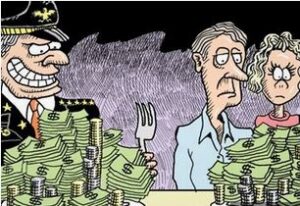



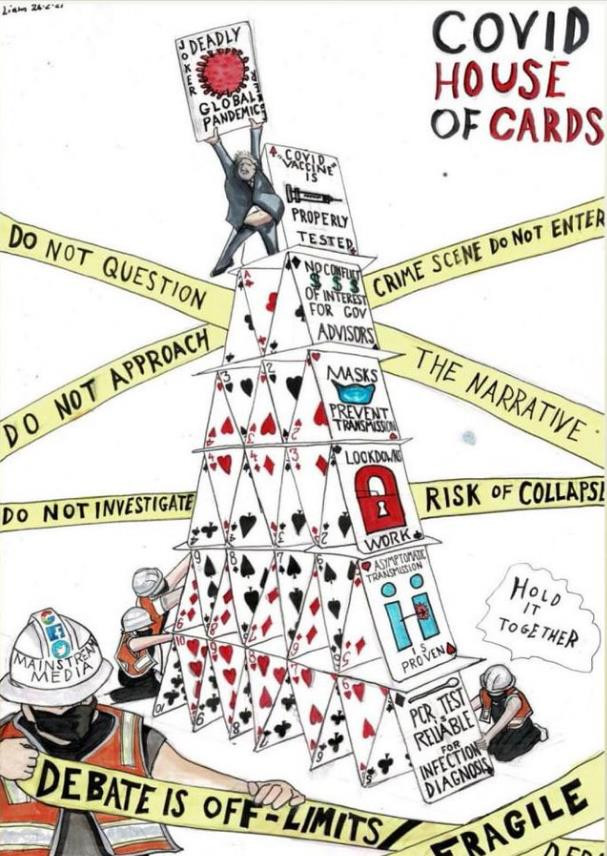
 After the Crash