Unrealistically Great Expectations

By Charles Hugh Smith

Source: Of Two Minds

Our expectations have continued ever higher even as the pie is shrinking..

Let’s see if we can tie together four social dynamics: the elite college admissions scandal, the decline in social mobility, the rising sense of entitlement and the unrealistically ‘great expectations’ of many Americans.

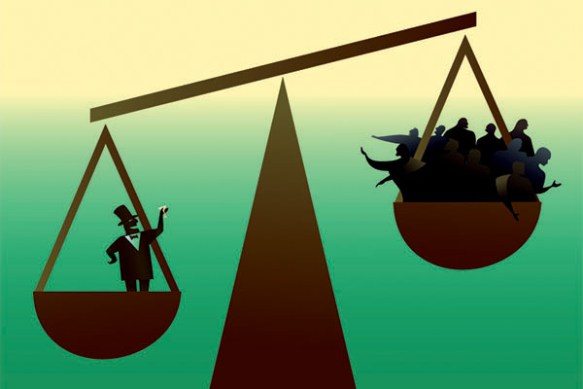
As many have noted, the nation’s financial and status rewards are increasingly flowing to the top 5%, what many call a winner-take-all or winner-take-most economy.

This is the primary source of widening wealth and income inequality: wealth and income are disproportionately accruing to the top slice of earners and owners of productive capital.

This concentration manifests in a broad-based decline in social mobility: it’s getting harder and harder to break into the narrow band (top 5%) who collects the lion’s share of the economy’s gains.

Historian Peter Turchin has identified the increasing burden of parasitic elites as one core cause of social and economic collapse. In Turchin’s reading, economies that can support a modest-sized class of parasitic elites buckle when the class of elites expecting a free pass to wealth and power expands faster than what the economy can support.

The same dynamic applies to productive elites: as I have often mentioned, graduating 1 millions STEM (science, technology, engineering, math) PhDs doesn’t magically guarantee 1 million jobs will be created for the graduates.

Such a costly and specialized education was once scarce, but now it’s relatively common, and this manifests in the tens of thousands of what I call academic ronin, i.e. PhDs without academic tenure or stable jobs in industry.

This glut is a global: I’ve known many people with PhDs from top universities in the developed world who have struggled to find a tenured professorship or a high-level research position anywhere in the world.

In other words, what was once a surefire ticket to status, security and superior pay is no longer surefire.

No wonder wealthy parents are so anxious to fast-track their non-superstar offspring by hook or by crook.

There is an even larger dynamic in play. As I explained here recently, the economic pie is shrinking, not just the pie of gains that can be distributed but the pie of opportunity.

Would parents and students be so anxious about their prospects if opportunities abounded for average students? The narrowing of opportunities to secure a stable career and livelihood is driving the frenzy to get into an elite university.

As everyone seeks an advantage, there’s a vast expansion of people with advanced diplomas: what was once relatively scarce (and thus valuable) is no longer scarce and therefore no longer very valuable.

The soaring cost of the middle-class membership basics–home ownership, healthcare and access to college–has drastically reduced the number of households who can afford these basics.

Two generations ago, just about any frugal working-class household with two wage-earners could save up a down payment for a modest home and later, save enough to put their children through the local state college.

Now, even two relatively well-paid wage earners in Left and Right Coast urban areas cannot afford to buy a house or put their kids through college. They are lucky to afford the rent, never mind buying a house.

As the number of upper-middle class slots declines, expectations have risen.This manifests in two ways: a rising sense of entitlement, which broadly speaking is the belief that the material security of middle class life should be available without great sacrifice.

The second manifestation is is higher expectations of material life in general: not only should we all have access to healthcare, college and home ownership, we also “deserve” to eat out every day, own luxury brand items, take resort vacations, and so on.

In a recent pre-recording conversation with a podcast host, we were talking about the number of average workers who think very little (apparently) of buying a $15 breakfast and/or a $20 lunch for themselves every day, plus an expensive coffee or beverage. This contrasts with the “old school” expectations which reserved lunches in restaurants for executives with expense accounts or The Boss. Everyone else filled a thermos with coffee at home and packed a brown bag lunch (or kau-kau tin in Hawaii).

From this perspective, $25 a day is $125 a week or $6,250 annually (a 50-week year). That’s $12,500 annually for a two wage-earner household. Five years of foregoing this luxury yields a nest egg of $62,500, a down payment for a $300,000 house, or the full cost of a four-year university education for two students who attend the local state university and who live at home.

(Sidebar note: a kind person gave us a $50 gift certificate to a popular casual-dining breakfast-lunch cafe. I reckoned we’d get a nice chunk of change after ordering two basic sandwiches and one beer. The $50 didn’t cover the three items, much less the tip. I nearly fell out of my chair. Over $50 for two sandwiches and a beer? And yet the place is jammed with people young and old, and I wondered: is everyone here earning $200,000+ annually, i.e. a top 5% income? If not, how can they afford such a costly luxury?)

As I noted earlier this month in the blog, the Federal Reserve’s obsession with generating a “wealth effect” by inflating bubbles in stocks and housing have enriched owners of capital at the expense of the young.

But even if we set aside the perverse and destructive impact of this disastrous policy, the economy is changing in structural ways. Scarcity value is becoming, well, scarcer. Global competition has reduced the scarcity value of education, ordinary labor and capital, and so the gains flowing to these has declined accordingly.

Yet our expectations have continued ever higher even as the pie is shrinking. Common sense suggests realigning expectations with a realistic appraisal of what’s possible and what sacrifices are necessary is a good first step.

The Great Unraveling Begins: Distraction, Lies, Infighting, Betrayal

By Charles Hugh Smith

Source: Of Two Minds

The good news is renewal becomes possible when the entire rotten status quo collapses in a putrid heap.

There are two basic pathways to systemic collapse: external shocks or internal decay. The two are not mutually exclusive, of course; it can be argued that the most common path is internal decay weakens the empire/state and an external shock pushes the rotted structure off the cliff.

As Dave of the X22 Report and I discuss in The World Is About To Change & It’s Going To Be Glorious, we are in the early stages of terminal internal decay.There are a number of dynamics shared by decaying empires/states:

1. The ruling elites lose the moral imperative to sacrifice for the good of the empire/state. Instead they use the power of the state to further their own private interests and agendas.

2. The ruling elites start “fudging” reports (i.e. lies are presented as truths) and promoting narratives to mask their self-aggrandizement and the erosion of the nation/empire under their self-interested rule.

In other words, the elites know the public would resist their leadership if the truth were widely known, so the ruling elites devote tremendous resources to massaging the news to distract the public from reality and reflect positively on their self-serving leadership.

Since the weaknesses of the empire are being hidden, they cannot be addressed, and so rot that could have been fixed early becomes widespread and fatal.

3. Flush with the state’s wealth and power, the ruling elite splinters into warring camps which squander the empire’s remaining wealth on private battles over which camp will rule what appears solid and eternal–the empire.

4. As the elites battle it out, the nation/empire falls apart as the leadership’s focus is on internecine conflicts over the spoils of the empire, rather than on preserving the foundations of the empire’s wealth and security.

5. As the truth inevitably leaks out, the public grasps the enormity of the elites’ betrayal of the nation and the public interest. Faith in the elites and the institutions they control plummets, and the Great Unraveling becomes unstoppable.

6. In a last-ditch effort to save their wealth and power, the elites distract the public with Bread and Circuses– “free money” in various guises (Universal Basic Income, Modern Monetary Theory, etc.)–and the distracting Circus of political theater and a surfeit of entertainment.

Whether the elites or the public are aware of it or not, America is well down the path to terminal internal decay: Distraction, Lies, Infighting, Betrayal.

The good news is renewal becomes possible when the entire rotten status quo collapses in a putrid heap of broken promises, dysfunctional institutions, blatant lies, unpayable debts and cascading defaults.

Why Are American Communities Dying?

By Tom Chatham

Source: Project Chesapeake

Most Americans who have been around for a while know life is nothing like it used to be. When someone wanted a job one was found with a little bit of searching. Today jobs are difficult to find, especially in small communities.

When I was growing up in the 70’s, there were several car dealers in my community. There were three tractor dealers and too many mom and pop stores to count. Today there are two used car dealers and the nearest tractor dealer is twenty miles away. So how is it that we now have more people, but fewer businesses to employ them?

A nations wealth is derived from having a product to sell. That wealth needs to circulate in towns and cities to compound the wealth effect and create jobs and businesses. When wealth is not created or it is siphoned off to other places, the wealth effect can not happen, and in many cases goes into reverse. A community needs a certain amount of service related jobs to function but it also needs some type of production jobs to bring in money from the outside. This can be mining , agriculture or manufacturing type jobs, but they must exist to insure a healthy economy.

America has two major problems today. A large amount of our production is done outside the country eliminating production jobs in local communities and many of the small local businesses that kept wealth within communities have been supplanted by large corporations that siphon wealth out of communities and send it to wall street.

In the past when a small business made profit, that profit was kept in the local community because that is where the owner lived. Now, that profit leaves the community never to be seen again. With less money to circulate within the community the businesses that depend on people spending their extra dollars, have fewer customers and eventually go out of business. With fewer jobs there is that much less money circulating and the economic situation spirals down until nothing is left.

These days corporate businesses and government jobs make up the major part of many local communities. In many cases if it were not for the government jobs, many communities would no longer exist. So what do you think would happen if the government suddenly no longer had money to pay those workers? What would happen if corporate profits dropped to the point where corporate stores decided to close and cut their losses?

To some extent we are seeing this happen now in many places. Corporate stores moved in and drove small local businesses out. Then when the profits dried up the corporate stores closed leaving the community with no jobs or products to buy. With no capital in the local communities to rebuild small businesses, the people simply drive to other areas to do their shopping.

The corporate cronies and government laggards control most of the money flowing through communities now and they want to keep it that way. Any attempt to rebuild local businesses is met with luke warm results. Any business that might make a difference is either killed outright or regulated into oblivion before it can get off the ground. The county where I live has all but abandoned local businesses. The bulk of their income comes from property taxes generated by vacation homes and retirement homes of retired government employees. As long as the government pensions and paychecks continue, they see no reason to change the status quo. The result is that the younger people leave as soon as they can and the average age of the population continues to get older. As with many places today, this area has no future.

Where I live is a microcosm of the nation. Corporate and government entities continue to siphon what little money there is out of communities and just as small communities are dying, the nation will soon follow if current trends do not change. A return to small local economics is the only way to reverse some of the damage and keep our communities livable. But, do not be deceived. There is no way to undo all of the damage that has been done and even if we survive, we will only be a shadow of what we once were as a nation.

Stick to the Plan

Illustration by Mike Faille

Reclaiming central planning from the clutches of corporations

By Brendan James

Source: The Baffler

What do you think the Russians talk about in their councils of state—Karl Marx? They get out their linear programming charts, statistical decision theories, minimax solutions, and compute the price-cost probabilities of their transactions and investments, just like we do.

–CCA Chairman Arthur Jensen, Network

WHAT DO JEFF BEZOS AND JOSEPH STALIN have in common? A certain supervillain chic. Cold-blooded austerity. Iron discipline. A penchant for back-breaking output targets. A healthy appetite for terror.

Yet perhaps their most surprising overlap is that the General Secretary and the chairman of Amazon, Inc. built two of history’s largest centrally planned economies. Then again, maybe it’s not so surprising: What embodies the trademark Bezos-ethos of “Get Big Fast” better than the Five-Year Plan? Thanks to its cutting-edge logistics and coordinated supply chains, Amazon last year clocked a GDP of $230 billion[*]. To Jared Kushner’s recent demand that “the government should be run like a great American company,” let all communists raise a fist of solidarity!

In fact, write Leigh Phillips and Michal Rozworski in The People’s Republic of Walmart, Amazon is just one of thousands of firms, big and small, that centrally plan their inputs and outputs. Of the top hundred global economies, around sixty-nine of them are businesses, not countries; most, if not all, are internally planned. (Sears, which over the last decade broke its firm into an “internal market” of competing units thanks to CEO and Ayn Rand-devotee Eddie Lampert, is conspicuously absent from this list.) Despite the collapse of the USSR and the global gospel of markets that spread in its wake, it seems planning is still working all around us.

The problem is that planning is not working for most of us. Yes, automation and “Big Data” have conjured cheaper goods for consumers—unfortunately, most consumers are also laborers who remain ruthlessly exploited. As the promise of new technology expands each day, workers sleep while standing or collapse from heat exhaustion. Planning, once a revolutionary tool meant to reduce labor time and eliminate exploitation, has become just another vulgar mechanism for maximizing the profits of unelected, authoritarian, union-busting, planet-cooking, superrich vampires. The People’s Republic of Walmart makes the case that the left should reclaim the radical demand for a democratically planned economy and repurpose this corporate apparatus for the flourishing of all. Far from a dry pamphlet on logistics theory, the book raises crucial questions about justice, technology, and our capacity to build a new world in the face of economic and climate catastrophe.

The planned economy was supposed to have gone extinct three decades ago. The Soviet Union gasped its last breath, American capitalism sprayed a bottle of Cristal, European social democracy ordered another latte, and China pressed a big button labeled “Market Socialism.” But if you really put the time in, you could probably get a wonk from the Hoover Institution to grudgingly accept that government planning still beats the market in the realm of certain public services, such as health care or fire departments. The knives come out, though, when this approach is proposed for things like housing, pharmaceuticals, energy, or, heaven forbid, consumer goods in general.

What may surprise newcomers, however, is that many self-described Marxists are wary of planning, too. Despite being thanked in Phillips and Rozworski’s acknowledgements, Bhaskar Sunkara, editor of the left-wing magazine Jacobinidentifies as a market socialist. In a 2013 essay sketching an agenda for the left, Jacobin’s executive editor Seth Ackerman conceded that markets are necessary, so perhaps we’d best just find a way to socialize them. Vivek Chibber, professor of sociology and, along with Sunkara, one of several co-authors of The ABCs of Socialismdismisses planning as a dead-end: “We can want planning to work, but we have no evidence that it can.” One of the left’s “worst legacies” has been to “identify socialism with central planning.” Market socialism, we’re told, is communism for grown-ups.

Everyone from the market socialist to the Austrian economist has taken one side of an incredibly sexy academic exchange known as the “socialist calculation debate.” The argument should be familiar: market transactions provide producers with essential information about what consumers and other producers need, and therefore how much to make. To try and calculate (that is, plan) this galaxy of interdependent inputs and outputs is impossible in a fluid economy. It’s a matter of information, you fool. And like it or not, market prices are the best way to collect the information we need to map out supply and demand.

A rich tradition of heterodox economics, mathematics, and computer science has materialized to answer this problem of calculation. But it is modern processing power, dwarfing the bandwidth available in the twentieth century, that truly rebukes the argument above. Consider computer scientist and economist Paul Cockshott who, in about two minutes, using only university equipment, claims to have run models that were able to optimize an economy “roughly the size of Sweden.” You get the feeling that the mammoth data centers at Amazon, Ford, or Foxconn might be capable of even more impressive calculations. And besides, to insist communist theory prove some perfect equation is either disingenuous or missing the point. The question is not whether planning is mathematically pristine, but whether it can allocate better than the market.

The answer, to return to the material world, is yes it can. It’s true that under capitalism firms plan internally but compete with each other, a dance that keeps companies innovating new ways to capture surplus and, sometimes, inadvertently benefit regular people. This dynamic would not occur naturally in a planned economy; one cannot just seize Amazon or Walmart, socialize it, and call it a day. Phillips and Rozworski apparently recognize this (there is an entire chapter in The People’s Republic of Walmart titled “Nationalization Is Not Enough”) and point to an interesting line of thought from economist J. W. Mason: Banks tend to operate as a privatized Gosplan, where the slush fund of finance capital flows to whichever firm a group of Brooks Brothers-clad planners decide deserves investment, regardless of profitability. Market competition, in other words, is hardly the divine engine of innovation if so many firms are, as Mason writes, “born new each day by the grace of those financing it.”

Even so, could planning replicate the market’s capacity to innovate? Ford’s former CEO Mark Fields certainly seemed to think so, declaring in 2016 that his company would soon “be able to use analytics to anticipate people’s needs, as opposed to people trying to tell us what they want.” And to the perennial taunt of the lizard-brained conservative—“I love seeing idiot millennials protest capitalism on their Apple-made IPHONES”—one may point out it was largely the market-immune Pentagon and Department of Energy, not Apple, that developed the batteries, algorithms, touch screens, and microprocessors our right-wing friend uses to tweet about the Muslim Caravan. Once again, none of this is to celebrate the actual decisions or practitioners of planning as it exists under capitalism, but to recognize its power and how else it might be put to use.

So much for feasibility. Still, the left has good reason to harbor deeper techno-skepticism. When most of us hear the phrase “data collection,” we think not so much of social justice but of Facebook selling our personal information, NSA surveillance, and racist models of “predictive” policing. In Automating Inequality, Virginia Eubanks catalogs state policies that placed welfare applications, housing allocation, and child welfare investigations under algorithmic control. The results have been catastrophic for the poor and working class, of every race and gender. Algorithms, after all, are written by humans, and prejudices operate just as easily in digital form as they do in twentieth century analog—perhaps even more so. Phillips and Rozworski acknowledge this reality and rightfully urge vigilance. If planning is to make use of such technology, we must make sure not to bake this poison into the cake.

But hope lies in the very recognition that technology is a political construct, rather than some transcendental, neutral force. If we can program the reinforcement of hierarchies, we can certainly work to program their destruction. (There’s already encouraging research as to how to account for problems such as “disparate impact.”) As Eubanks writes, “if there is to be an alternative, we must build it on purpose, brick by brick and byte by byte.”

Beyond algorithmic justice, the real specter haunting socialism is, naturally, the Union of Soviet Socialist Republics, whose record in planning was less than exemplary. While capital-C Communism brought about modern industry, literacy, and social security, Phillips and Rozworski don’t deny the ultimate failure of the Soviet experiment. The October Revolution was contorted and compromised by a world war, a civil war, imperialist invasion, economic backwardness, another world war, and a half-century of military competition with the United States. For the sake of the revolution, democracy was indefinitely postponed. Even if Soviet and East German firms were just as or more efficient than their Western counterparts, this arrangement still resulted in workers resisting work and managers lying about output, i.e., bad information. (In a particularly cruel irony, Gosplan bureaucrats even took to sabotaging new computerized approaches to planning, lest they personally lose their political clout. Their unlikely co-conspirators were “reform” minded crypto-capitalists who worried the algorithms would actually succeed, leaving planning in place forever!)

For Phillips and Rozworski, it wasn’t communist planning that led to authoritarianism and disaster, but authoritarianism and disaster that led to bad planning. “Democracy,” they write, “is not some abstract ideal tacked on to all this, but essential to the process.”

A few years ago. Francis Spufford’s novel Red Plenty cast the very idea of Soviet planning as its hero, wherein it falls from grace, as all tragic heroes do. There’s no need to understate that tragedy, but it ispossible to overstate it. Let’s not forget what happened after the victorious arrival of the market in the former USSR: production of consumer goods, industrial output, and human life expectancy all cratered. A new class of homeless citizens emerged, frozen to death in streets, alleyways, and parks. We often discuss the millions of deaths in the Stalinist 1930s. We don’t discuss the millions of deaths in the post-Communist 1990s. Unsurprisingly, recent polling revealed that a majority of those surveyed in Russia still regret the collapse of the USSR and its planned economy. (In 1996 they nearly voted in Communist presidential candidate Gennady Zyuganov until—get this—right-wing hucksters colluded with a hostile foreign government to help install a widely unpopular and corrupt buffoon through a media campaign that peddled rank propaganda.) The Soviet experience was a lesson, all right, but not quite the one many smug market fetishists would have us believe.

And if all that can happen to a superpower, imagine what faced Chile, the would-be socialist alternative to Soviet technocracy: in 1970, buoyed by the support of the working class, Marxist president Salvador Allende was elected and set about building a nation-wide, participatory planning network. This novel approach was predictably stymied by a U.S. economic blockade and finally snuffed out by a CIA-backed military coup in 1973. Still, the pioneering spirit of this moment was poignantly captured by Eden Medina in her wonderful study Cybernetic Revolutionaries. What happened next is a depressing cliché: Chileans were placed under the rule of a distinctly not-left-wing dictatorship and enrolled as fresh test subjects in the mad laboratory of the market.

How will that same market treat the workers of tomorrow who fall victim to imminent waves of automation? Is the market really compatible long-term with progressive policy goals like universal basic income, or full employment? Will the market really permit the end of mass incarceration? Then there’s the C-word: last month we learned that potentially catastrophic climate change is now beyond prevention, and that even if we swore off carbon tomorrow, by 2099 the Arctic will still be 5°C hotter. The expression “glacial pace” doesn’t quite mean what it used to. In light of this, The Atlantic, official mouthpiece for the death god Nyarlathotep, predictably suggests that “any realistic plan to decarbonize the U.S. economy will almost surely require the sort of commercial technological breakthroughs that tend to come from private entrepreneurs.” Not to be outdone, the New York Times last month published an op-ed titled—no shit—“Can Exxon Mobil Protect Mozambique From Climate Change?

It doesn’t have to be this way. Converting industries to renewable energy, Phillips and Rozworski argue, is wholly within the power of America, India, and China. But, wouldn’t you know it, the principles of commerce just aren’t incentivizing them fast enough! Carbon-free agriculture is a trickier feat, but certainly less tricky as a state-sponsored venture freed from market meddling, à la Sputnik or the Manhattan Project. Climate reporter Kate Aronoff suggests: “If you create a successful drive to nationalize [the fossil fuel industry] or rapidly scale back their power that will create a real precedent for other industries . . . then you can nationalize Monsanto. Have that be the crux of a populist demand of a climate movement.” There are different schools on the left when it comes to ecology (Phillips, science writer by day, has been criticized for consumerist, growth-happy “ecomodernism”), but one hopes we can all agree that smashing the existing energy market is a necessary step.

More than any other crisis of capitalism, ecological calamity is the most self-evident reason to abandon the dumb, short-sighted, animal logic of the market for a rational and humane plan. It has been, to quote the superior critique of capital, Gremlins 2, “a complete failure of management.” And if the history of capitalist crises is any guide, the odds are that climate change will produce a bigger, bulkier, more controlling state no matter what. Before things really start to crack up, we may want to pick whether that state runs on egalitarian principles or the fascist death drive. Does anyone who doesn’t own a yacht called Fountainhead truly want to cede that decision to the invisible hand of the market?

To their credit, Phillips and Rozworksi return throughout the book to the necessity of mass mobilization. Planning is not One Weird Trick to Achieve Socialism. Unless we simply want state-capitalist profit optimization, the real thing will require continuous and brutal class struggle. It will require experimentation, failure and, as Marv Alpert once said, tenacious defense. Any hope of success lies in a rejuvenated, robust and, yes, global people’s movement to shatter the political, legal and physical barricades put up by governments and capital. But planning must be part of the agenda.

Here the cybernetic concept of feedback is useful: the very idea of a plan, of giving everyone control of their own lives, is just the kind of revolutionary notion that can energize, inspire, and keep such a movement alive. The final line of Spufford’s Red Plenty need not be read as the end of a dream, but the real beginning of history: “Can it be, can it be, can it ever be otherwise?”

Hope for the best, of course. And plan for the worst.

Poor Folks

By Peter Van Buren

Source: We Meant Well

A guy on Facebook I don’t know wrote a version of what has become a kind of set-piece article in today’s America. Here’s a portion:

Losing The War of Attrition or How To Turn Any Normal Person Into A Broken, Angry Radical

You are one of the millions who are employed at minimum wage. Or you are one of the millions who are euphemistically called underemployed, or you are one of the millions with no job and no prospects. You are retired- how did that happen?- or disabled- why did that happen?- and trying to survive on Social Security.

You reach a point when you realize that getting ahead is no longer possible. After that you reach a point when you realize that holding on to what you have is no longer possible. Then you reach a point when you realize that replacing what has been lost or depleted is no longer possible.

I wrote a book about this five years ago called The Ghosts of Tom Joad. No one read it. Publishers in the process of turning me down mocked me for writing about “poor people” and seemed surprised there were poor people in America who weren’t black and living in ghettos. Well, hell, then Trump happened. Because people watching a way of life — a middle class existence where the rich have more but we had some — fall away are easy targets for demagogues. Always have been. Because before we dismissed things as whataboutism we used to study them as lessons from history. Other people’s’ mistakes. History shows very clearly this economic game we’re playing ends with everyone but a small handful at the top losing badly.

I concluded five years ago the game was already decided. Our society was already then like those photos of railroad tracks, where in the distance it seems like the two rails come together in a single point. That point is essentially feudalism, where a tiny minority owns almost everything and everyone else lives off whatever scraps they let us have. Like in the Middle Ages, where everyone farmed for the king as serfs. It’s worse than slavery, because slaves at least know they’re slaves and have the possibility, however small, of freedom. Maybe for their kids if not for themselves.

We are not at the singularity, but we are inexorably headed toward it. Five additional years of data has only made that clearer; five years ago we spoke of the 1%. That number no longer matters. The new figure is .1%, an even smaller group who owns even more.

And no, none of this is new Because Trump. Since 1980, the incomes of the very rich (the .1%) have grown faster than the economy, for about a 400% cumulative increase in wealth. The upper middle class (the 9.9%) has kept pace with the economy, while the other 90% of us, the middle class and the poor have fallen behind.

By the way, it is these numbers which sent Barack Obama and Hillary Clinton during the 2008 campaign to both use $250,000 as the upper limit of the middle class. They sounded misguided, but it was sort of true. They just were still lumping what we’re calling here the “Upper Middle Class” and the “Middle Class” together. Just words. At present in the U.S. we have three-and-a-half classes: The .1%%, the 9.9%, everyone else hanging on, plus some people way at the bottom with basically nothing.

But bad news for the 9.9% Since the they the most (the most the .1% does not yet have) they have the most to lose. At their peak, in the mid-1980s, people in this group held 35% of the nation’s wealth. Three decades later that had fallen 12%, exactly as much as the wealth of the 0.1% rose. And do understand the people at the top are constructing walls and throwing nails off the back of the truck to make sure no one can catch up with them. The goal of .1% is to eliminate the competition, the 9.9% below them. They’ll only effectively have it all when the ratio is down to two classes, the .1% and the 99.9%

We are kept in place via shiny objects (500 channels, more movies and Apple watches and drugs!) and curated divisions. The ever-increasingly sharp lines between say blacks and whites are a perfect tool. Keep the groups fighting left and right and they’ll never notice the real discrimination is up and down. Some groups just found down earlier and harder, but as long as a poor white man in south Kentucky thinks he has nothing in common with a poor black man in the South Bronx they will never work together, never even see the massive economic forces consuming both equally. Forces are even now hard at work to tell us the Republican party is for whites, POC head Democrat, and any third party is a Russian shill in place to hurt the candidate you favor.

Whether your housing is subsidized via a mortgage and that tax deduction or Section 8, you’re still on the spectrum of depending on the people really in charge to allow you a place to live. I do not see a way out of this, only maybe steps that can slow it down or cause it to speed up.

Very short version summary: People like you and I fell through the cracks; we weren’t supposed to end up here but the .1% hadn’t worked out the details so they got as much as they do now and we basically ended up with bigger crumbs than we should have, especially me lucking into a “career” with no real skills.

Our own kids may do OK with what we leave for them, but only if your son is a medical doctor will he have a decent shot at our lifestyle and only because of the “cartelization” of the profession by the AMA. The rest of our kids are unlikely to have any shot at what we ended up with.

Sorry, I’m not a more cheerful guy but these conclusions are based on a fair amount of honest study.

GIVE AMERICA’S ‘HELICOPTER PARENTS’ A BREAK

Hovering parents don’t need lectures. They need a more equal nation.

By Sam Pizzigati

Source: OtherWords

A good many of us aging baby boomers are having trouble relating to the “helicopter parents” of our modern age — those moms and pops constantly hovering over their kids, filling their schedules with enrichment activities of every sort, worrying nonstop about their futures.

Back in the middle of the 20th century, baby boomers didn’t grow up like that. We lived much more “free-range” childhoods. We pedaled our bikes far from hearth and home. We organized our own pick-up games. We spent — wasted! — entire summers doing little bits of nothing.

We survived. So did our parents. So why do parents today have to hover so much?

The standard explanation: Times have changed. Yes, today’s parents take a more intense approach to parenting. But they have no choice. The pressures of modernity make them do it.

Economists Matthias Doepke of Northwestern University and Fabrizio Zilibotti of Yale have followed all the debate over helicopter parenting, and they’re not jumping on this blame-modernity bandwagon. If the pace and pressures of our dangerous digital times are driving parents to hover, the pair points out, then we ought to see parents helicoptering across the developed world.

We’re not.

In fact, researchers have found significant differences in parenting styles from one modern industrial nation to another. Parents in some nations today have parenting styles as relaxed as anything aging baby boomers experienced back in the 1950s. In other nations, by contrast, parents seem as intense as today’s helicoptering norm in the United States.

How can we account for these differences?

Doepke and Zilibotti have a compelling explanation. Levels of helicopter parenting, they note, track with levels of economic inequality. The wider a society’s income gaps, the more parents hover.

The two countries most notorious for their helicopter parenting, China and the United States, just happen to sport two of the world’s deepest economic divides. And those more relaxed parenting days of mid-20th century America? They came at a time when the United States shared income and wealth much more equally than the United States does today.

What’s going on here? Why should economic inequality have any impact on parenting styles?

In severely unequal nations, the evidence suggests, childhoods have become high-stakes competitions. Only the “winners” go on to enjoy comfortable lives when they grow up. You either make it into the ranks of your nation’s elite or you risk struggling on a treadmill that never ends.

In more equal societies, you don’t have to matriculate at the “best” schools or score a high-status internship to live a dignified life. In societies with income and wealth more evenly distributed, broad swatches of people — not just elites — live comfortably. That leaves parents, as Doepke puts it, “more room to relax and let the kids just enjoy themselves.”

Parents in highly unequal nations can’t afford to relax. They have too much to do. They have to shape their kids into winners. But the competition their children face will always be rigged, because the already affluent in deeply unequal societies have more time and money to invest in that shaping.

Researchers Doepke and Zilibotti call for greater public investments in social services — like quality child care — to narrow the competitive advantage that wealth bestows upon affluent American families.

The investments they recommend would certainly help ease the pressure on working households. Would they be enough to get our parents more relaxed? Not likely, not so long as rewards keep concentrating in the pockets of the few at the expense of the many.

Our helicopter parents, in short, don’t need fixing. Our economic system does.

Survival of the Richest

All Are Equal, Except Those Who Aren’t

By Nomi Prins

Source: TomDispatch.com

Like a gilded coating that makes the dullest things glitter, today’s thin veneer of political populism covers a grotesque underbelly of growing inequality that’s hiding in plain sight. And this phenomenon of ever more concentrated wealth and power has both Newtonian and Darwinian components to it.

In terms of Newton’s first law of motion: those in power will remain in power unless acted upon by an external force. Those who are wealthy will only gain in wealth as long as nothing deflects them from their present course. As for Darwin, in the world of financial evolution, those with wealth or power will do what’s in their best interest to protect that wealth, even if it’s in no one else’s interest at all.

In George Orwell’s iconic 1945 novel, Animal Farm, the pigs who gain control in a rebellion against a human farmer eventually impose a dictatorship on the other animals on the basis of a single commandment: “All animals are equal, but some animals are more equal than others.” In terms of the American republic, the modern equivalent would be: “All citizens are equal, but the wealthy are so much more equal than anyone else (and plan to remain that way).”

Certainly, inequality is the economic great wall between those with power and those without it.

As the animals of Orwell’s farm grew ever less equal, so in the present moment in a country that still claims equal opportunity for its citizens, one in which three Americans now have as much wealth as the bottom half of society (160 million people), you could certainly say that we live in an increasingly Orwellian society. Or perhaps an increasingly Twainian one.

After all, Mark Twain and Charles Dudley Warner wrote a classic 1873 novel that put an unforgettable label on their moment and could do the same for ours. The Gilded Age: A Tale of Today depicted the greed and political corruption of post-Civil War America. Its title caught the spirit of what proved to be a long moment when the uber-rich came to dominate Washington and the rest of America. It was a period saturated with robber barons, professional grifters, and incomprehensibly wealthy banking magnates. (Anything sound familiar?) The main difference between that last century’s gilded moment and this one was that those robber barons built tangible things like railroads. Today’s equivalent crew of the mega-wealthy build remarkably intangible things like tech and electronic platforms, while a grifter of a president opts for the only new infrastructure in sight, a great wall to nowhere.

In Twain’s epoch, the U.S. was emerging from the Civil War. Opportunists were rising from the ashes of the nation’s battered soul. Land speculation, government lobbying, and shady deals soon converged to create an unequal society of the first order (at least until now). Soon after their novel came out, a series of recessions ravaged the country, followed by a 1907 financial panic in New York City caused by a speculator-led copper-market scam.

From the late 1890s on, the most powerful banker on the planet, J.P. Morgan, was called upon multiple times to bail out a country on the economic edge. In 1907, Treasury Secretary George Cortelyou provided him with $25 million in bailout money at the request of President Theodore Roosevelt to stabilize Wall Street and calm frantic citizens trying to withdraw their deposits from banks around the country. And this Morgan did — by helping his friends and their companies, while skimming money off the top himself. As for the most troubled banks holding the savings of ordinary people? Well, they folded. (Shades of the 2007-2008 meltdown and bailout anyone?)

The leading bankers who had received that bounty from the government went on to cause the Crash of 1929. Not surprisingly, much speculation and fraud preceded it. In those years, the novelist F. Scott Fitzgerald caught the era’s spirit of grotesque inequality in The Great Gatsby when one of his characters comments: “Let me tell you about the very rich. They are different from you and me.” The same could certainly be said of today when it comes to the gaping maw between the have-nots and have-a-lots.

Income vs. Wealth

To fully grasp the nature of inequality in our twenty-first-century gilded age, it’s important to understand the difference between wealth and income and what kinds of inequality stem from each. Simply put, income is how much money you make in terms of paid work or any return on investments or assets (or other things you own that have the potential to change in value). Wealth is simply the gross accumulation of those very assets and any return or appreciation on them. The more wealth you have, the easier it is to have a higher annual income.

Let’s break that down. If you earn $31,000 a year, the median salary for an individual in the United States today, your income would be that amount minus associated taxes (including federal, state, social security, and Medicare ones). On average, that means you would be left with about $26,000 before other expenses kicked in.

If your wealth is $1,000,000, however, and you put that into a savings account paying 2.25% interest, you could receive about $22,500 and, after taxes, be left with about $19,000, for doing nothing whatsoever.

To put all this in perspective, the top 1% of Americans now take home, on average, more than 40 times the incomes of the bottom 90%. And if you head for the top 0.1%, those figures only radically worsen. That tiny crew takes home more than 198 times the income of the bottom 90% percent. They also possess as much wealth as the nation’s bottom 90%. “Wealth,” as Adam Smith so classically noted almost two-and-a-half-centuries ago in The Wealth of Nations, “is power,” an adage that seldom, sadly, seems outdated.

A Case Study: Wealth, Inequality, and the Federal Reserve

Obviously, if you inherit wealth in this country, you’re instantly ahead of the game. In America, a third to nearly a half of all wealth is inherited rather than self-made. According to a New York Times investigation, for instance, President Donald Trump, from birth, received an estimated $413 million (in today’s dollars, that is) from his dear old dad and another $140 million (in today’s dollars) in loans. Not a bad way for a “businessman” to begin building the empire (of bankruptcies) that became the platform for a presidential campaign that oozed into actually running the country. Trump did it, in other words, the old-fashioned way — through inheritance.

In his megalomaniacal zeal to declare a national emergency at the southern border, that gilded millionaire-turned-billionaire-turned-president provides but one of many examples of a long record of abusing power. Unfortunately, in this country, few people consider record inequality (which is still growing) as another kind of abuse of power, another kind of great wall, in this case keeping not Central Americans but most U.S. citizens out.

The Federal Reserve, the country’s central bank that dictates the cost of money and that sustained Wall Street in the wake of the financial crisis of 2007-2008 (and since), has finally pointed out that such extreme levels of inequality are bad news for the rest of the country. As Fed Chairman Jerome Powell said at a town hall in Washington in early February, “We want prosperity to be widely shared. We need policies to make that happen.” Sadly, the Fed has largely contributed to increasing the systemic inequality now engrained in the financial and, by extension, political system. In a recent research paper, the Fed did, at least, underscore the consequences of inequality to the economy, showing that “income inequality can generate low aggregate demand, deflation pressure, excessive credit growth, and financial instability.”

In the wake of the global economic meltdown, however, the Fed took it upon itself to reduce the cost of money for big banks by chopping interest rates to zero (before eventually raising them to 2.5%) and buying $4.5 trillion in Treasury and mortgage bonds to lower it further. All this so that banks could ostensibly lend money more easily to Main Street and stimulate the economy. As Senator Bernie Sanders noted though, “The Federal Reserve provided more than $16 trillion in total financial assistance to some of the largest financial institutions and corporations in the United States and throughout the world… a clear case of socialism for the rich and rugged, you’re-on-your-own individualism for everyone else.”

The economy has been treading water ever since (especially compared to the stock market). Annual gross domestic product growth has not surpassed 3%in any year since the financial crisis, even as the level of the stock market tripled, grotesquely increasing the country’s inequality gap. None of this should have been surprising, since much of the excess money went straight to big banks, rich investors, and speculators.  They then used it to invest in the stock and bond markets, but not in things that would matter to all the Americans outside that great wall of wealth.

The question is: Why are inequality and a flawed economic system mutually reinforcing? As a starting point, those able to invest in a stock market buoyed by the Fed’s policies only increased their wealth exponentially. In contrast, those relying on the economy to sustain them via wages and other income got shafted. Most people aren’t, of course, invested in the stock market, or really in anything. They can’t afford to be. It’s important to remember that nearly 80% of the population lives paycheck to paycheck.

The net result: an acute post-financial-crisis increase in wealth inequality — on top of the income inequality that was global but especially true in the United States. The crew in the top 1% that doesn’t rely on salaries to increase their wealth prospered fabulously. They, after all, now own more than half of all national wealth invested in stocks and mutual funds, so a soaring stock market disproportionately helps them. It’s also why the Federal Reserve subsidy policies to Wall Street banks have only added to the extreme wealth of those extreme few.

The Ramifications of Inequality

The list of negatives resulting from such inequality is long indeed. As a start, the only thing the majority of Americans possess a greater proportion of than that top 1% is a mountain of debt.

The bottom 90% are the lucky owners of about three-quarters of the country’s household debt. Mortgages, auto loans, student loans, and credit-card debt are cumulatively at a record-high $13.5 trillion.

And that’s just to start down a slippery slope. As Inequality.org reports, wealth and income inequality impact “everything from life expectancy to infant mortality and obesity.” High economic inequality and poor health, for instance, go hand and hand, or put another way, inequality compromises the overall health of the country. According to academic findings, income inequality is, in the most literal sense, making Americans sick. As one study put it, “Diseased and impoverished economic infrastructures [help] lead to diseased or impoverished or unbalanced bodies or minds.”

Then there’s Social Security, established in 1935 as a federal supplement for those in need who have also paid into the system through a tax on their wages. Today, all workers contribute 6.2% of their annual earnings and employers pay the other 6.2% (up to a cap of $132,900) into the Social Security system. Those making far more than that, specifically millionaires and billionaires, don’t have to pay a dime more on a proportional basis. In practice, that means about 94% of American workers and their employers paid the full 12.4% of their annual earnings toward Social Security, while the other 6% paid an often significantly smaller fraction of their earnings.

According to his own claims about his 2016 income, for instance, President Trump “contributed a mere 0.002 percent of his income to Social Security in 2016.” That means it would take nearly 22,000 additional workers earning the median U.S. salary to make up for what he doesn’t have to pay. And the greater the income inequality in this country, the more money those who make less have to put into the Social Security system on a proportional basis. In recent years, a staggering $1.4 trillion could have gone into that system, if there were no arbitrary payroll cap favoring the wealthy.

Inequality: A Dilemma With Global Implications

America is great at minting millionaires. It has the highest concentration of them, globally speaking, at 41%. (Another 24% of that millionaires’ club can be found in Europe.) And the top 1% of U.S. citizens earn 40 times the national average and own about 38.6% of the country’s total wealth. The highest figure in any other developed country is “only” 28%.

However, while the U.S. boasts of epic levels of inequality, it’s also a global trend. Consider this: the world’s richest 1% own 45% of total wealth on this planet. In contrast, 64% of the population (with an average of $10,000 in wealth to their name) holds less than 2%. And to widen the inequality picture a bit more, the world’s richest 10%, those having at least $100,000 in assets, own 84% of total global wealth.

The billionaires’ club is where it’s really at, though. According to Oxfam, the richest 42 billionaires have a combined wealth equal to that of the poorest 50% of humanity. Rest assured, however, that in this gilded century there’s inequality even among billionaires. After all, the 10 richest among them possess $745 billion in total global wealth. The next 10 down the list possess a mere $451.5 billion, and why even bother tallying the next 10 when you get the picture?

Oxfam also recently reported that “the number of billionaires has almost doubled, with a new billionaire created every two days between 2017 and 2018. They have now more wealth than ever before while almost half of humanity have barely escaped extreme poverty, living on less than $5.50 a day.”

How Does It End?

In sum, the rich are only getting richer and it’s happening at a historic rate. Worse yet, over the past decade, there was an extra perk for the truly wealthy. They could bulk up on assets that had been devalued due to the financial crisis, while so many of their peers on the other side of that great wall of wealth were economically decimated by the 2007-2008 meltdown and have yet to fully recover.

What we’ve seen ever since is how money just keeps flowing upward through banks and massive speculation, while the economic lives of those not at the top of the financial food chain have largely remained stagnant or worse. The result is, of course, sweeping inequality of a kind that, in much of the last century, might have seemed inconceivable.

Eventually, we will all have to face the black cloud this throws over the entire economy. Real people in the real world, those not at the top, have experienced a decade of ever greater instability, while the inequality gap of this beyond-gilded age is sure to shape a truly messy world ahead. In other words, this can’t end well.


Nomi Prins, a former Wall Street executive, is a TomDispatch regular. Her latest book is Collusion: How Central Bankers Rigged the World (Nation Books). She is also the author of All the Presidents’ Bankers: The Hidden Alliances That Drive American Power and five other books. Special thanks go to researcher Craig Wilson for his superb work on this piece.

Saker interview with Michael Hudson on Venezuela, February 7, 2019

By The Saker and Michael Hudson

Source: The Saker

Introduction: There is a great deal of controversy about the true shape of the Venezuelan economy and whether Hugo Chavez’ and Nicholas Maduro’s reform and policies were crucial for the people of Venezuela or whether they were completely misguided and precipitated the current crises.  Anybody and everybody seems to have very strong held views about this.  But I don’t simply because I lack the expertise to have any such opinions.  So I decided to ask one of the most respected independent economists out there, Michael Hudson, for whom I have immense respect and whose analyses (including those he co-authored with Paul Craig Roberts) seem to be the most credible and honest ones you can find.  In fact, Paul Craig Roberts considers Hudson the “best economist in the world“!
I am deeply grateful to Michael for his replies which, I hope, will contribute to a honest and objective understanding of what really is taking place in Venezuela.
The Saker

The Saker: Could you summarize the state of Venezuela’s economy when Chavez came to power?

Michael Hudson: Venezuela was an oil monoculture. Its export revenue was spent largely on importing food and other necessities that it could have produced at home. Its trade was largely with the United States. So despite its oil wealth, it ran up foreign debt.

From the outset, U.S. oil companies have feared that Venezuela might someday use its oil revenues to benefit its overall population instead of letting the U.S. oil industry and its local comprador aristocracy siphon off its wealth. So the oil industry – backed by U.S. diplomacy – held Venezuela hostage in two ways.

First of all, oil refineries were not built in Venezuela, but in Trinidad and in the southern U.S. Gulf Coast states. This enabled U.S. oil companies – or the U.S. Government – to leave Venezuela without a means of “going it alone” and pursuing an independent policy with its oil, as it needed to have this oil refined. It doesn’t help to have oil reserves if you are unable to get this oil refined so as to be usable.

Second, Venezuela’s central bankers were persuaded to pledge their oil reserves and all assets of the state oil sector (including Citgo) as collateral for its foreign debt. This meant that if Venezuela defaulted (or was forced into default by U.S. banks refusing to make timely payment on its foreign debt), bondholders and U.S. oil majors would be in a legal position to take possession of Venezuelan oil assets.

These pro-U.S. policies made Venezuela a typically polarized Latin American oligarchy. Despite being nominally rich in oil revenue, its wealth was concentrated in the hands of a pro-U.S. oligarchy that let its domestic development be steered by the World Bank and IMF. The indigenous population, especially its rural racial minority as well as the urban underclass, was excluded from sharing in the country’s oil wealth. The oligarchy’s arrogant refusal to share the wealth, or even to make Venezuela self-sufficient in essentials, made the election of Hugo Chavez a natural outcome.

The Saker: Could you outline the various reforms and changes introduced by Hugo Chavez? What did he do right, and what did he do wrong?

Michael Hudson: Chavez sought to restore a mixed economy to Venezuela, using its government revenue – mainly from oil, of course – to develop infrastructure and domestic spending on health care, education, employment to raise living standards and productivity for his electoral constituency.

What he was unable to do was to clean up the embezzlement and built-in rake-off of income from the oil sector. And he was unable to stem the capital flight of the oligarchy, taking its wealth and moving it abroad – while running away themselves.

This was not “wrong”. It merely takes a long time to change an economy’s disruption – while the U.S. is using sanctions and “dirty tricks” to stop that process.

The Saker: What are, in your opinion, the causes of the current economic crisis in Venezuela – is it primarily due to mistakes by Chavez and Maduro or is the main cause US sabotage, subversion and sanctions?

Michael Hudson: There is no way that’s Chavez and Maduro could have pursued a pro-Venezuelan policy aimed at achieving economic independence without inciting fury, subversion and sanctions from the United States. American foreign policy remains as focused on oil as it was when it invaded Iraq under Dick Cheney’s regime. U.S. policy is to treat Venezuela as an extension of the U.S. economy, running a trade surplus in oil to spend in the United States or transfer its savings to U.S. banks.

By imposing sanctions that prevent Venezuela from gaining access to its U.S. bank deposits and the assets of its state-owned Citco, the United States is making it impossible for Venezuela to pay its foreign debt. This is forcing it into default, which U.S. diplomats hope to use as an excuse to foreclose on Venezuela’s oil resources and seize its foreign assets much as Paul Singer hedge fund sought to do with Argentina’s foreign assets.

Just as U.S. policy under Kissinger was to make Chile’s “economy scream,” so the U.S. is following the same path against Venezuela. It is using that country as a “demonstration effect” to warn other countries not to act in their self-interest in any way that prevents their economic surplus from being siphoned off by U.S. investors.

The Saker: What in your opinion should Maduro do next (assuming he stays in power and the USA does not overthrow him) to rescue the Venezuelan economy?

Michael Hudson: I cannot think of anything that President Maduro can do that he is not doing. At best, he can seek foreign support – and demonstrate to the world the need for an alternative international financial and economic system.

He already has begun to do this by trying to withdraw Venezuela’s gold from the Bank of England and Federal Reserve. This is turning into “asymmetrical warfare,” threatening what to de-sanctify the dollar standard in international finance. The refusal of England and the United States to grant an elected government control of its foreign assets demonstrates to the entire world that U.S. diplomats and courts alone can and will control foreign countries as an extension of U.S. nationalism.

The price of the U.S. economic attack on Venezuela is thus to fracture the global monetary system. Maduro’s defensive move is showing other countries the need to protect themselves from becoming “another Venezuela” by finding a new safe haven and paying agent for their gold, foreign exchange reserves and foreign debt financing, away from the dollar, sterling and euro areas.

The only way that Maduro can fight successfully is on the institutional level, upping the ante to move “outside the box.” His plan – and of course it is a longer-term plan – is to help catalyze a new international economic order independent of the U.S. dollar standard. It will work in the short run only if the United States believes that it can emerge from this fight as an honest financial broker, honest banking system and supporter of democratically elected regimes. The Trump administration is destroying illusion more thoroughly than any anti-imperialist critic or economic rival could do!

Over the longer run, Maduro also must develop Venezuelan agriculture, along much the same lines that the United States protected and developed its agriculture under the New Deal legislation of the 1930s – rural extension services, rural credit, seed advice, state marketing organizations for crop purchase and supply of mechanization, and the same kind of price supports that the United States has long used to subsidize domestic farm investment to increase productivity.

The Saker: What about the plan to introduce a oil-based crypto currency? Will that be an effective alternative to the dying Venezuelan Bolivar?

Michael Hudson: Only a national government can issue a currency. A “crypto” currency tied to the price of oil would become a hedging vehicle, prone to manipulation and price swings by forward sellers and buyers. A national currency must be based on the ability to tax, and Venezuela’s main tax source is oil revenue, which is being blocked from the United States. So Venezuela’s position is like that of the German mark coming out of its hyperinflation of the early 1920s. The only solution involves balance-of-payments support. It looks like the only such support will come from outside the dollar sphere.

The solution to any hyperinflation must be negotiated diplomatically and be supported by other governments. My history of international trade and financial theory, Trade, Development and Foreign Debt, describes the German reparations problem and how its hyperinflation was solved by the Rentenmark.

Venezuela’s economic-rent tax would fall on oil, and luxury real estate sites, as well as monopoly prices, and on high incomes (mainly financial and monopoly income). This requires a logic to frame such tax and monetary policy. I have tried to explain how to achieve monetary and hence political independence for the past half-century. China is applying such policy most effectively. It is able to do so because it is a large and self-sufficient economy in essentials, running a large enough export surplus to pay for its food imports. Venezuela is in no such position. That is why it is looking to China for support at this time.

The Saker: How much assistance do China, Russia and Iran provide and how much can they do to help? Do you think that these three countries together can help counter-act US sabotage, subversion and sanctions?

Michael Hudson: None of these countries have a current capacity to refine Venezuelan oil. This makes it difficult for them to take payment in Venezuelan oil. Only a long-term supply contract (paid for in advance) would be workable. And even in that case, what would China and Russia do if the United States simply grabbed their property in Venezuela, or refused to let Russia’s oil company take possession of Citco? In that case, the only response would be to seize U.S. investments in their own country as compensation.

At least China and Russia can provide an alternative bank clearing mechanism to SWIFT, so that Venezuela can by pass the U.S. financial system and keep its assets from being grabbed at will by U.S. authorities or bondholders. And of course, they can provide safe-keeping for however much of Venezuela’s gold it can get back from New York and London.

Looking ahead, therefore, China, Russia, Iran and other countries need to set up a new international court to adjudicate the coming diplomatic crisis and its financial and military consequences. Such a court – and its associated international bank as an alternative to the U.S.-controlled IMF and World Bank – needs a clear ideology to frame a set of principles of nationhood and international rights with power to implement and enforce its judgments.

This would confront U.S. financial strategists with a choice: if they continue to treat the IMF, World Bank, ITO and NATO as extensions of increasingly aggressive U.S. foreign policy, they will risk isolating the United States. Europe will have to choose whether to remain a U.S. economic and military satellite, or to throw in its lot with Eurasia.

However, Daniel Yergin reports in the Wall Street Journal (Feb. 7) that China is trying to hedge its bets by opening a back-door negotiation with Guaido’s group, apparently to get the same deal that it has negotiated with Maduro’s government. But any such deal seems unlikely to be honored in practice, given U.S. animosity toward China and Guaido’s total reliance on U.S. covert support.

The Saker: Venezuela kept a lot of its gold in the UK and money in the USA. How could Chavez and Maduro trust these countries or did they not have another choice? Are there viable alternatives to New York and London or are they still the “only game in town” for the world’s central banks?
Michael Hudson: There was never real trust in the Bank of England or Federal Reserve, but it seemed unthinkable that they would refuse to permit an official depositor from withdrawing its own gold. The usual motto is “Trust but verify.” But the unwillingness (or inability) of the Bank of England to verify means that the formerly unthinkable has now arrived: Have these central banks sold this gold forward in the post-London Gold Pool and its successor commodity markets in their attempt to keep down the price so as to maintain the appearance of a solvent U.S. dollar standard.

Paul Craig Roberts has described how this system works. There are forward markets for currencies, stocks and bonds. The Federal Reserve can offer to buy a stock in three months at, say, 10% over the current price. Speculators will by the stock, bidding up the price, so as to take advantage of “the market’s” promise to buy the stock. So by the time three months have passed, the price will have risen. That is largely how the U.S. “Plunge Protection Team” has supported the U.S. stock market.

The system works in reverse to hold down gold prices. The central banks holding gold can get together and offer to sell gold at a low price in three months. “The market” will realize that with low-priced gold being sold, there’s no point in buying more gold and bidding its price up. So the forward-settlement market shapes today’s market.

The question is, have gold buyers (such as the Russian and Chinese government) bought so much gold that the U.S. Fed and the Bank of England have actually had to “make good” on their forward sales, and steadily depleted their gold? In this case, they would have been “living for the moment,” keeping down gold prices for as long as they could, knowing that once the world returns to the pre-1971 gold-exchange standard for intergovernmental balance-of-payments deficits, the U.S. will run out of gold and be unable to maintain its overseas military spending (not to mention its trade deficit and foreign disinvestment in the U.S. stock and bond markets). My book on Super-Imperialism explains why running out of gold forced the Vietnam War to an end. The same logic would apply today to America’s vast network of military bases throughout the world.

Refusal of England and the U.S. to pay Venezuela means that other countries means that foreign official gold reserves can be held hostage to U.S. foreign policy, and even to judgments by U.S. courts to award this gold to foreign creditors or to whoever might bring a lawsuit under U.S. law against these countries.

This hostage-taking now makes it urgent for other countries to develop a viable alternative, especially as the world de-dedollarizes and a gold-exchange standard remains the only way of constraining the military-induced balance of payments deficit of the United States or any other country mounting a military attack. A military empire is very expensive – and gold is a “peaceful” constraint on military-induced payments deficits. (I spell out the details in my Super Imperialism: The Economic Strategy of American Empire (1972), updated in German as Finanzimperium(2017).

The U.S. has overplayed its hand in destroying the foundation of the dollar-centered global financial order. That order has enabled the United States to be “the exceptional nation” able to run balance-of-payments deficits and foreign debt that it has no intention (or ability) to pay, claiming that the dollars thrown off by its foreign military spending “supply” other countries with their central bank reserves (held in the form of loans to the U.S. Treasury – Treasury bonds and bills – to finance the U.S. budget deficit and its military spending, as well as the largely military U.S. balance-of-payments deficit.

Given the fact that the EU is acting as a branch of NATO and the U.S. banking system, that alternative would have to be associated with the Shanghai Cooperation Organization, and the gold would have to be kept in Russia and/or China.

The Saker:  What can other Latin American countries such as Bolivia, Nicaragua, Cuba and, maybe, Uruguay and Mexico do to help Venezuela?

Michael Hudson: The best thing neighboring Latin American countries can do is to join in creating a vehicle to promote de-dollarization and, with it, an international institution to oversee the writedown of debts that are beyond the ability of countries to pay without imposing austerity and thereby destroying their economies.

An alternative also is needed to the World Bank that would make loans in domestic currency, above all to subsidize investment in domestic food production so as to protect the economy against foreign food-sanctions – the equivalent of a military siege to force surrender by imposing famine conditions. This World Bank for Economic Acceleration would put the development of self-reliance for its members first, instead of promoting export competition while loading borrowers down with foreign debt that would make them prone to the kind of financial blackmail that Venezuela is experiencing.

Being a Roman Catholic country, Venezuela might ask for papal support for a debt write-down and an international institution to oversee the ability to pay by debtor countries without imposing austerity, emigration, depopulation and forced privatization of the public domain.

Two international principles are needed. First, no country should be obliged to pay foreign debt in a currency (such as the dollar or its satellites) whose banking system acts to prevents payment.

Second, no country should be obliged to pay foreign debt at the price of losing its domestic autonomy as a state: the right to determine its own foreign policy, to tax and to create its own money, and to be free of having to privatize its public assets to pay foreign creditors. Any such debt is a “bad loan” reflecting the creditor’s own irresponsibility or, even worse, pernicious asset grab in a foreclosure that was the whole point of the loan.

The Saker:  Thank you very much for taking the time to reply to my questions!