A Most Peculiar Recession

By Charles Hugh Smith

Source: Of Two Minds

So what are conventional pundits missing today? I would start with three dynamics.

Only old people experienced real recessions–those in 1973-74 and 1980-82. Recessions since then have been shorter and less systemic.

In the good old days, a recession laid waste to entire industries which never recovered their previous employment. People who were laid off couldn’t find another job. Major sectors of the economy dried up and blew away. Jobs were scarce and there was an oversupply of people looking for work.

We’re told consumer confidence is in the dumps and everyone expects the worst: recession! Oh Lordy. Interestingly, there isn’t much evidence of this near-panic behaviorally. Everyone’s tightening their belts and battening down the hatches, but it’s not the cliff-dive we see in a real recession.

There’s certainly a lot of froth to be scraped off the latte, but what I’m curious about are the armatures of the economy and what I’m seeing is the crowd ignoring key dynamics because they’re so busy pushing the Recessionary Play-Doh into the old playboard.

The entire notion that there is a hard and fast line indicating “recession” is not realistic or useful. The economy dropped 1% for two quarters in a row, quick hit the alarm, go to DefCon 1. Uh, OK, right.

The more useful approach is to look at data points as mostly signal noise that fail to reflect or illuminate the core dynamics of the economy. Here’s an example: the stagflation of the 1970s is a hot topic as the financial punditry compares then to now, seeking evidence of similarities strong enough to predict a Lost Decade ahead.

One key factor that’s rarely (if ever) mentioned was the staggering cost of cleaning up America’s industrial sector and polluted skies and waterways at the same time that the Cold War required the U.S. to strengthen its allies by allowing them unfettered access to the U.S. marketplace–exports to the U.S. that had a price advantage due to the dominance of the dollar and the relative weakness of allies’ currencies.

1972 exchange rates indicate that the Japanese yen was 302 to $1–an enormous advantage when compared to recent exchange rates of around 110 yen to the USD.

What few current pundits seem to grasp is the dominant dynamic of the entire era of 1945-1992 was the Cold War with the Soviet Union and its client states and allies. Strengthening allies’ economies was a core goal and so the costs to the domestic economy had to be absorbed: there was no choice.

The costs of cleaning up the nation and its vast industrial base was an enormous drag on the economy. The value of the trillions of dollars (in current dollars) invested was not in boosting profits, it was in restoring what had been heedlessly destroyed and damaged by rampant dumping of waste and pollutants and improving the health and well-being of the citizenry.

Check out the smog in early 1970s TV series filmed in Los Angeles for a taste of what was cleaned up.

But in a mind-boggling failure of conventional economics, our financial punditry is blind to the impact of the most consequential economic realities of the 1970s–the Cold War and the lengthy, painful, costly clean-up of the nation and its industrial base–on stagflation.

One reason for this abject failure is these dynamics were difficult to measure, so they weren’t measured.We only manage what we measure and so if we don’t measure it, it doesn’t exist. If we measure things in a no-longer-relevant manner, for example GDP, we continue to act as if this misguided measure is of supreme importance when the reality is it’s dangerously misleading.

So what are conventional pundits missing today? I would start with three dynamics:

1. For the first time in multiple generations, there is a structural scarcity of labor. For a variety of reasons, there are fewer people willing to do the work at the offered wage than there are jobs. This is not temporary, it is demographic and social, not simply economic. All the supposedly easy fixes– automate everything, etc.–are not that easy.

2. The strength of the U.S. dollar is exporting inflation, to the benefit of the domestic economy. After offshoring critical supply chains–a disaster that will take years to reverse–now the U.S. is offshoring inflation and the resulting demand destruction.

3. Global capital flows are reversing. capital flowed from the Core to the Periphery to reap the gains of globalization. Now the flow is reversing and capital is flowing from the Periphery to the Core to preserve capital and lock in lower-risk returns. What looks expensive to those earning U.S. dollars may look cheap and secure to those fleeing depreciating currencies and assets.

In my analysis, these are consequential dynamics that merit little attention in conventional financial analysis.

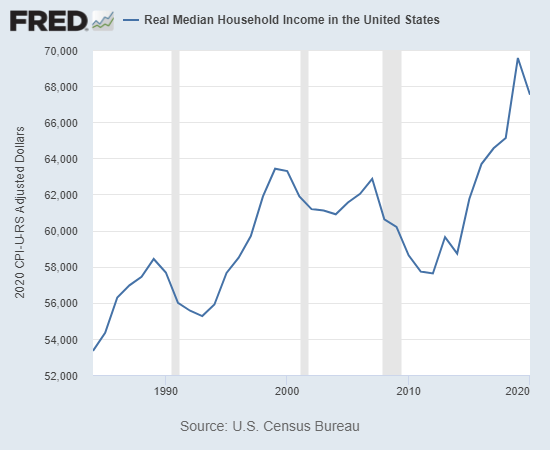
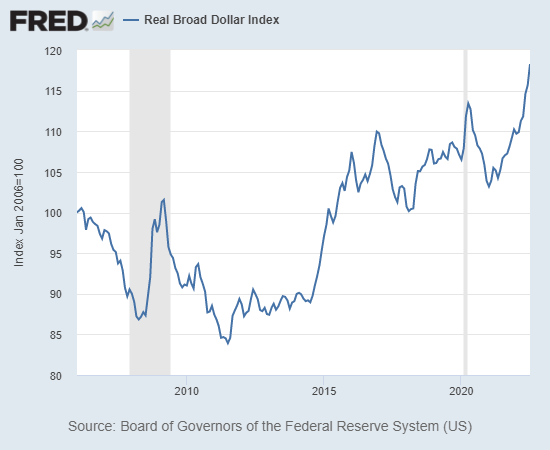
There is much more to say but glance at these two charts: real (i.e. adjusted for official inflation) median household income and real Broad U.S. Dollar Index.

If we’re not measuring or pondering the core structural dynamics of the economy, we’re not going to make sense of no-longer-relevant data. This is a most peculiar recession, and few seem to be asking if the reason is we’re missing what’s changed structurally.

Charts courtesy of St. Louis Federal Reserve Database (FRED))

A Glance Ahead

By James Howard Kunstler

Source: Kunstler.com

Satan is the father of lies and we have become Satanic, being and doing evil, most especially to ourselves….

hat’s ahead — like a few months down the road? Hysteria and chaos, if the “Joe Biden” regime can help it… and they’re helping it all they can. Twice vaxxed, twice boosted, and twice recent Covid-19 patient Dr. Anthony Fauci warned this week that the unvaxxed would “get into trouble” as the seasons turn this year. The part he left out is: the unvaxxed will be in trouble trying to keep up with helping their sick and dying vaccinated relatives whose immune systems have been damaged by their multiple vaxxes.

The boldness of Dr. Fauci’s lying is really something to behold. Who in the entire HHS-NIH-CDC bureaucracy has failed to notice that the mRNA “vaccines” have no efficacy whatever against Covid-19? The vaccinated are by far those still getting sick and increasingly disabled from the disease and even more from the vaxxes themselves. The emperor’s new clothes hang in shreds. Rumor is that many upper-level employees in these public health agencies are increasingly freaked out by their now-obvious complicity in a momentous crime. They know they will have to answer for allowing the mRNA fiasco to get this far, for going along to get along, and they’re preparing to mutiny to save their own asses. Wait for it.

The regime’s back-up plan is the comical monkeypox, transmitted to date mainly via all-male orgies. HHS Secretary Xavier Becerra declared a national monkeypox emergency this week, saying he’d “explore every option on the table” (except an official advisory against homosexual orgies). There is, of course, reasonable suspicion that monkeypox is but one device for shutting down the November mid-term election, or, more deviously, closing polling places and allowing only mail-in ballots — the easiest way to rig elections.

That will lead naturally to several state’s attorneys general seeking relief in the Supreme Court against the federal government’s unconstitutional takeover of the states’ duty to conduct their elections. The “Joe Biden” regime will lose that one, but not before royally pissing off at least half the adults in the land, leading to even greater-than-anticipated election losses for the Party of Chaos.

Meanwhile, the Party of Chaos is about to unleash its “Inflation Reduction Act,” which proposes to spend three quarters of a trillion dollars created from thin air into an economy already hyperventilating on three years of multi-trillion-dollar injections derived from no productive activity. At the same time, the act will raise taxes especially for low-end wage earners and small businesses, completing the regime’s destruction of the middle-class. The cherry-on-top is the provision to double the size of the Internal Revenue Service by hiring 87,000 new employees to harass ordinary American taxpayers. Is that what you voted for in 2020? I  thought not.

None of that is going to work as intended. More likely, passage of the act will trigger destruction of the dollar as the world’s reserve currency, and a stampede out of dollar-denominated investments, which is to say, a very severe financial crisis. Credit will freeze, the distribution and sales of goods will cease, interest will stop being paid on virtually all outstanding debt, the bond market will implode, few will have anything identifiable as money, and there will be little in the way of everyday goods like food and gasoline to buy anyway.

You realize, of course, that this is a description of economic collapse. If things roll that way, there will be absolutely no trust left in the US government. It will be either ignored or opposed. And in places like my own New York, under the tyrannical and titanically incompetent accidental Governor Kathy Hochul, there will be no trust in state government either. Meaning, we’re on our own, community-by-community. This will be a very interesting experiment in the dynamics of emergence — the self-organizing properties of systems in chaos. I doubt that it will resolve in the direction of the globalists’ dreams of transhuman technocracy. Every macro trend now runs against centralization.

But the process could conceivably invite an attempted Chinese takeover of the USA, if not militarily, then in a way similar to America’s asset-stripping operations in the collapsed Soviet Union of the 1990s, a looting spree — as seen many other times in history when empires founder. Or else, the rest of the world will just kick back and witness the spectacle of our struggle as the lights of Western Civ flicker out. (Europe will be right in it with us, by the way.) The other nations of the world are tired of us trying to push them around, with increasingly evil intentions. They will enjoy watching our tribulations. They will be convinced we deserve it.

This is what comes from a culture of immersive and pervasive dishonesty. Satan is the father of lies and we have become Satanic, being and doing evil, most especially to ourselves, whether you believe in a literal Satan or not. So, do you think now that being transgressive is… fun? You’ll be changing what’s left of your mind about that soon. Along with the threat of literal starvation will also arise a terrible hunger for truth: How did this happen? How did we come to do this?  Who was behind it? It won’t be hard to find out, once we’re motivated to look.

The United States Does Not Have an Economy

By Paul Craig Roberts

Source: PaulCraigRoberts.org

The US financial sector has long looted other countries.  A number of participants have described the process.  First a country is enticed with bribes to the leaders to take out loans that cannot be serviced or repaid.  Then in comes the IMF. Austerity is imposed on the population.  Public services and employment are cut to free resources for debt service, and public assets are sold to repay the loan.  Living standards fall, and US corporations take over the country’s economy.

As foreign governments, having experienced or witnessed the economic carnage and fearing accountability, are less willing to be bribed into indebting their countries, American finance is now applying this technique to Americans. Contrary to the narrative in the financial press, the Federal Reserve is not raising interest rates in order to fight inflation.  It is ludicrous to think that a three-quarters of one percent rise in a very low interest rate is going to have any impact on a 9.1% rate of consumer inflation or that speculation that the Federal Reserve has in mind another three-quarters of one percent possibly followed by one half of one percent comprise an anti-inflation policy.  If all these increases occur, it still leaves the interest rate below the inflation rate.

Moreover, as I have previously explained, the inflation is not monetary.  The higher prices are the result of supply disruptions caused by Washington’s Covid lockdowns and Russian sanctions.  Production was stopped and supply chains are broken.  

The Federal Reserve’s rise in interest rates is just a continuation of its policy of concentrating income and wealth in the hands of the One Percent.  Quantitative Easing was the cloak for the Federal Reserve to print $8.2 trillion in new money which was directed or found its way into the prices of stocks and bonds, thus enriching the small number who own most of these financial instruments.  Having maxed out this avenue of wealth concentration, the Federal Reserve is now raising interest rates in order to drive up mortgage costs to aspiring home owners.  The Federal Reserve is driving individuals out of the housing market in order to free up properties for “private equity” firms to purchase homes for their rental values.  That private equity firms see rental income from the existing stock of houses as the best investment opportunity tells us that the US economy has played out.  When investment goes into existing assets, not into producing new assets, the economy ceases to grow.

The Obama regimes policy of bailing out the financial fraudsters responsible for the 2008 crash while foreclosing on their victims, reduced American homeownership from 70% to 63 percent. The Urban Institute predicts further declines. Today homeowners’ equity has declined from 85% after World War II to one-third, leaving two-thirds of homeowner equity in the hands of creditors.  This makes it completely clear that a financialized economy indebts the people for the sake of rentier income to the One Percent.  Indeed, the financialized economy created by the Federal Reserve has reimposed a class system akin to the landed British aristocracy that was overthrown.  Indeed, we have an economically far worst class system.  The landed British aristocrats produced food that fed the nation.  The American class system produces interest and fees for the financial system.

As Michael Hudson has shown us, a no-growth economy is the end result of a financialized economy.  A financialized economy is one in which consumer income is diverted by debt expansion away from the purchase of new goods and services into debt service and fees–interest on mortgages, car loans, credit card debt, student loan debt.  With such a large share of household income spent on debt service, little is left for driving the economy forward.

If American economists were capable of escaping from their neoliberal junk economics, they would realize that “the world’s largest economy” they attribute to the United States is total fiction.  The fact is that the United States does not have an economy.  Corporations driven by Wall Street located American manufacturing in Asia so that the One Percent could benefit from higher profits from lower labor costs, while the deserted city and states had to sell their income streams, such as Chicago’s parking meter revenues for 75 years, to foreigners for one lump sum payment to solve one year’s budget crisis.  

The offshoring of American production, carried out under the cloak of “globalism,” destroyed the American economy and the tax bases of cities and states.  While the real economy declines, the Democrat Party, seeking permanent power, has imposed a policy of open borders for immigrant-invaders.  How are these millions of peoples to support themselves in an economy whose manufacturing has been moved abroad?  How can a population, deserted by American corporations, that is experiencing debt deflation absorb the costs of support and social infrastructure for tens of millions of third world immigrant-invaders?

You will never hear it from the whores in the financial press, but the United States is on the precipice of economic and social collapse.  And what are the fools in Washington doing?  The idiots are ginning up wars with Russia, China, and Iran.  

Calm Before the Tempest?

By Charles Hugh Smith

Source: Of Two Minds

Let’s start by stipulating the obvious: no one knows the future, and most of the guesses–oops, I mean forecasts–will be wrong. Arguing about the forecasts now won’t make any difference as to which ones are correct and which ones are wrong. Time alone will tell.

That said, here’s a scenario that fits the dynamics I see as most consequential: Core-Periphery and the demise of the waste is growth / financialization / globalization model as the reigning model of how the global economy should work.

Core-periphery dynamics are pretty simple: unraveling starts on the periphery and seeps toward the core. The core actually strengthens in the process as capital and talent seek havens where they’re treated well, and the core became the core by treating capital and talent well.

The periphery responds to the unraveling of financialization / globalization by tightening its grip on whatever capital and talent is still available, incentivizing the flight of capital and talent to the core.

A great many people think there are many core economies. In my analysis, there is only one, due to the qualifying requirements: 1) issues a reserve currency, i.e. not pegged to another currency 2) liquid global markets for securities, debt, commodities, etc., i.e. anyone anywhere can trade in size in the core markets 3) transparent market and governance mechanisms, i.e. no overnight devaluations, expropriations, capital restrictions, etc. 4) diverse economy not dependent on exports or imports for its well-being and 5) ease of flow: capital, talent, enterprises and employees all have essentially unlimited freedom of movement within the core.

We can argue about which nations qualify as core but it won’t change the outcome. Capital and talent will make their own decisions about risk, safety, exposure to devaluation and expropriation and where the odds of being treated fairly are highest. It’s a good exercise to put yourself in the shoes of a manager of a $10 billion fund and go through the decision tree of where to put this $10 billion to preserve its purchasing power first and foremost, and secondarily generate a return.

Would you really gamble $10 billion on a 15% return on the bonds of Timbukthree, whose currency has fallen 20% against the U.S. dollar this year? Or Timbukfour, which is dependent on exports of commodities in a shrinking global economy? Or Timbukfive, which is dependent on imports of commodities and exports of consumer goods in a shrinking global economy?? If you answer “yes,” you’re not actually playing like you are responsible for $10 billion.

As the periphery unravels financially, it also unravels politically and socially. Bordering states are at risk of destabilizing, and any entity with large exposure to the unraveling debt or markets starts unraveling, too. The destabilization spreads to second-tier nations whose exposure to the dynamics of unraveling are structural.

As all these dominoes fall, eventually those closest to the core also crumble, and then core itself is finally destabilized.

Humans have an interesting talent for adjusting to new circumstances, i.e. habituating to new conditions. Those households consuming 14,000 gallons of fresh water a month may well scream that they can’t possibly get by on 12,000 gallons, but then if circumstances change and all the water we have is what we can carry in buckets a kilometer over rough terrain, we find that we can live on the few gallons we can carry a kilometer.

The amount of waste in developed economies is beyond easy measure. It’s estimated 40% of all food in the U.S. is wasted. Energy, food and fresh water have been treated as if low cost and abundance were birthrights rather than brief explosions of excess. While we’re screaming about energy costs, empty buildings are brightly lit, water taps are left running and one individual per idling vehicle in a traffic jam frets about rising costs.

When the 1989 Loma Prieta earthquake closed the Bay Bridge across San Francisco Bay, the main artery between San Francisco and the East Bay, economic doom was predictably predicted. Yet people quickly managed via extra BART (subway) trains that rain beneath the Bay and carpools with four people per vehicle rather than one occupant.

Is it possible that all the predictable predictions of economic doom are somewhat exaggerated by the thrill of sensationalism and projections of past trends, as if people can’t possibly make consequential adjustments to their behaviors and consumption?

Systems have constraints, and so there are limits on what adjustments can be made without altering the structure, but in many cases, we’re far from reaching limits on basic conservation work-arounds.

Is it possible that things will prove less dire than currently expected? It seems little credence is being given to the potential to adjust to new conditions.

Is it beyond conception that the core actually strengthens for a length of time before the unraveling reaches it? In my crystal ball, it seems not just possible but likely. This will be the calm before The Tempest, when the unraveling reaches the core and structural changes are finally required.

Global Planned Financial Tsunami Has Just Begun

By F. William Engdahl

Source: Global Research

Since the creation of the US Federal Reserve over a century ago, every major financial market collapse has been deliberately triggered for political motives by the central bank. The situation is no different today, as clearly the US Fed is acting with its interest rate weapon to crash what is the greatest speculative financial bubble in human history, a bubble it created. Global crash events always begin on the periphery, such as with the 1931 Austrian Creditanstalt or the Lehman Bros. failure in September 2008. The June 15 decision by the Fed to impose the largest single rate hike in almost 30 years as financial markets are already in a meltdown, now guarantees a global depression and worse.

The extent of the “cheap credit” bubble that the Fed, the ECB and Bank of Japan have engineered with buying up of bonds and maintaining unprecedented near-zero or even negative interest rates for now 14 years, is beyond imagination. Financial media cover it over with daily nonsense reporting , while the world economy is being readied, not for so-called “stagflation” or recession. What is coming now in the coming months, barring a dramatic policy reversal, is the worst economic depression in history to date. Thank you, globalization and Davos.

Globalization

The political pressures behind globalization and the creation of the World Trade Organization out of the Bretton Woods GATT trade rules with the 1994 Marrakesh Agreement, ensured that the advanced industrial manufacturing of the West, most especially the USA, could flee offshore, “outsource” to create production in extreme low wage countries. No country offered more benefit in the late 1990s than China. China joined WHO in 2001 and from then on the capital flows into China manufacture from the West have been staggering. So too has been the buildup of China dollar debt. Now that global world financial structure based on record debt is all beginning to come apart.

When Washington deliberately allowed the September 2008 Lehman Bros financial collapse, the Chinese leadership responded with panic and commissioned unprecedented credit to local governments to build infrastructure. Some of it was partly useful, such as a network of high-speed railways. Some of it was plainly wasteful, such as construction of empty “ghost cities.” For the rest of the world, the unprecedented China demand for construction steel, coal, oil, copper and such was welcome, as fears of a global depression receded. But the actions by the US Fed and ECB after 2008, and of their respective governments, did nothing to address the systemic financial abuse of the world’s major private banks on Wall Street and Europe , as well as Hong Kong.

The August 1971 Nixon decision to decouple the US dollar, the world reserve currency, from gold, opened the floodgates to global money flows. Ever more permissive laws favoring uncontrolled financial speculation in the US and abroad were imposed at every turn, from Clinton’s repeal of Glass-Steagall at the behest of Wall Street in November 1999. That allowed creation of mega-banks so large that the government declared them “too big to fail.” That was a hoax, but the population believed it and bailed them out with hundreds of billions in taxpayer money.

Since the crisis of 2008 the Fed and other major global central banks have created unprecedented credit, so-called “helicopter money,” to bailout the major financial institutions. The health of the real economy was not a goal. In the case of the Fed, Bank of Japan, ECB and Bank of England, a combined $25 trillion was injected into the banking system via “quantitative easing” purchase of bonds, as well as dodgy assets like mortgage-backed securities over the past 14 years.

Quantitative madness

Here is where it began to go really bad. The largest Wall Street banks such as JP MorganChase, Wells Fargo, Citigroup or in London HSBC or Barclays, lent billions to their major corporate clients. The borrowers in turn used the liquidity, not to invest in new manufacturing or mining technology, but rather to inflate the value of their company stocks, so-called stock buy-backs, termed “maximizing shareholder value.”

BlackRock, Fidelity, banks and other investors loved the free ride. From the onset of Fed easing in 2008 to July 2020, some $5 trillions had been invested in such stock buybacks, creating the greatest stock market rally in history. Everything became financialized in the process. Corporations paid out $3.8 trillion in dividends in the period from 2010 to 2019. Companies like Tesla which had never earned a profit, became more valuable than Ford and GM combined. Cryptocurrencies such as Bitcoin reached market cap valuation over $1 trillion by late 2021. With Fed money flowing freely, banks and investment funds invested in high-risk, high profit areas like junk bonds or emerging market debt in places like Turkey, Indonesia or, yes, China.

The post-2008 era of Quantitative Easing and zero Fed interest rates led to absurd US Government debt expansion. Since January 2020 the Fed, Bank of England, European Central Bank and Bank of Japan have injected a combined $9 trillion in near zero rate credit into the world banking system. Since a Fed policy change in September 2019, it enabled Washington to increase public debt by a staggering $10 trillion in less than 3 years. Then the Fed again covertly bailed out Wall Street by buying $120 billion per month of US Treasury bonds and Mortgage-Backed Securities creating a huge bond bubble.

A reckless Biden Administration began doling out trillions in so-called stimulus money to combat needless lockdowns of the economy. US Federal debt went from a manageable 35% of GDP in 1980 to more than 129% of GDP today. Only the Fed Quantitative Easing, buying of trillions of US government and mortgage debt and the near zero rates made that possible. Now the Fed has begun to unwind that and withdraw liquidity from the economy with QT or tightening, plus rate hikes. This is deliberate. It is not about a stumbling Fed mis-judging inflation.

Energy drives the collapse

Sadly, the Fed and other central bankers lie. Raising interest rates is not to cure inflation. It is to force a global reset in control over the world’s assets, it’s wealth, whether real estate, farmland, commodity production, industry, even water. The Fed knows very well that Inflation is only beginning to rip across the global economy. What is unique is that now Green Energy mandates across the industrial world are driving this inflation crisis for the first time, something deliberately ignored by Washington or Brussels or Berlin.

The global shortages of fertilizers, soaring prices of natural gas, and grain supply losses from global draught or exploding costs of fertilizers and fuel or the war in Ukraine, guarantee that, at latest this September-October harvest time, we will undergo a global additional food and energy price explosion. Those shortages all are a result of deliberate policies.

Moreover, far worse inflation is certain, due to the pathological insistence of the world’s leading industrial economies led by the Biden Administration’s anti-hydrocarbon agenda. That agenda is typified by the astonishing nonsense of the US Energy Secretary stating, “buy E-autos instead” as the answer to exploding gasoline prices.

Similarly, the European Union has decided to phase out Russian oil and gas with no viable substitute as its leading economy, Germany, moves to shut its last nuclear reactor and close more coal plants. Germany and other EU economies as a result will see power blackouts this winter and natural gas prices will continue to soar. In the second week of June in Germany gas prices rose another 60% alone. Both the Green-controlled German government and the Green Agenda “Fit for 55” by the EU Commission continue to push unreliable and costly wind and solar at the expense of far cheaper and reliable hydrocarbons, insuring an unprecedented energy-led inflation.

Fed has pulled the plug

With the 0.75% Fed rate hike, largest in almost 30 years, and promise of more to come, the US central bank has now guaranteed a collapse of not merely the US debt bubble, but also much of the post-2008 global debt of $303 trillion. Rising interest rates after almost 15 years mean collapsing bond values. Bonds, not stocks, are the heart of the global financial system.

US mortgage rates have now doubled in just 5 months to above 6%and home sales were already plunging before the latest rate hike. US corporations took on record debt owing to the years of ultra-low rates. Some 70% of that debt is rated just above “junk” status. That corporate non-financial debt totaled $9 trillion in 2006. Today it exceeds $18 trillion. Now a large number of those marginal companies will not be able to rollover the old debt with new, and bankruptcies will follow in coming months. The cosmetics giant Revlon just declared bankruptcy.

The highly-speculative, unregulated Crypto market, led by Bitcoin, is collapsing as investors realize there is no bailout there. Last November the Crypto world had a $3 trillion valuation. Today it is less than half, and with more collapse underway. Even before the latest Fed rate hike the stock value of the US megabanks had lost some $300 billion. Now with stock market further panic selling guaranteed as a global economic collapse grows, those banks are pre-programmed for a new severe bank crisis over the coming months.

As US economist Doug Noland recently noted, “Today, there’s a massive “periphery” loaded with “subprime” junk bonds, leveraged loans, buy-now-pay-later, auto, credit card, housing, and solar securitizations, franchise loans, private Credit, crypto Credit, DeFi, and on and on. A massive infrastructure has evolved over this long cycle to spur consumption for tens of millions, while financing thousands of uneconomic enterprises. The “periphery” has become systemic like never before. And things have started to Break.”

The Federal Government will now find its interest cost of carrying a record $30 trillion in Federal debt far more costly. Unlike the 1930s Great Depression when Federal debt was near nothing, today the Government, especially since the Biden budget measures, is at the limits. The US is becoming a Third World economy. If the Fed no longer buys trillions of US debt, who will? China? Japan? Not likely.

Deleveraging the bubble

With the Fed now imposing a Quantitative Tightening, withdrawing tens of billions in bonds and other assets monthly, as well as raising key interest rates, financial markets have begun a deleveraging. It will likely be jerky, as key players like BlackRock and Fidelity seek to control the meltdown for their purposes. But the direction is clear.

By late last year investors had borrowed almost $1 trillion in margin debt to buy stocks. That was in a rising market. Now the opposite holds, and margin borrowers are forced to give more collateral or sell their stocks to avoid default. That feeds the coming meltdown. With collapse of both stocks and bonds in coming months, go the private retirement savings of tens of millions of Americans in programs like 401-k. Credit card auto loans and other consumer debt in the USA has ballooned in the past decade to a record $4.3 trillion at end of 2021. Now interest rates on that debt, especially credit card, will jump from an already high 16%. Defaults on those credit loans will skyrocket.

Outside the US what we will see now, as the Swiss National Bank, Bank of England and even ECB are forced to follow the Fed raising rates, is the global snowballing of defaults, bankruptcies, amid a soaring inflation which the central bank interest rates have no power to control. About 27% of global nonfinancial corporate debt is held by Chinese companies, estimated at $23 trillion. Another $32 trillion corporate debt is held by US and EU companies. Now China is in the midst of its worst economic crisis since 30 years and little sign of recovery. With the USA, China’s largest customer, going into an economic depression, China’s crisis can only worsen. That will not be good for the world economy.

Italy, with a national debt of $3.2 trillion, has a debt-to-GDP of 150%. Only ECB negative interest rates have kept that from exploding in a new banking crisis. Now that explosion is pre-programmed despite soothing words from Lagarde of the ECB. Japan, with a 260% debt level is the worst of all industrial nations, and is in a trap of zero rates with more than $7.5 trillion public debt. The yen is now falling seriously, and destabilizing all of Asia.

The heart of the world financial system, contrary to popular belief, is not stock markets. It is bond markets—government, corporate and agency bonds. This bond market has been losing value as inflation has soared and interest rates have risen since 2021 in the USA and EU. Globally this comprises some $250 trillion in asset value a sum that, with every fed interest rise , loses more value. The last time we had such a major reverse in bond values was forty years ago in the Paul Volcker era with 20% interest rates to “squeeze out inflation.”

As bond prices fall, the value of bank capital falls. The most exposed to such a loss of value are major French banks along with Deutsche Bank in the EU, along with the largest Japanese banks. US banks like JP MorganChase are believed to be only slightly less exposed to a major bond crash. Much of their risk is hidden in off-balance sheet derivatives and such. However, unlike in 2008, today central banks can’t rerun another decade of zero interest rates and QE. This time, as insiders like ex-Bank of England head Mark Carney noted three years ago, the crisis will be used to force the world to accept a new Central Bank Digital Currency, a world where all money will be centrally issued and controlled. This is also what Davos WEF people mean by their Great Reset. It will not be good. A Global Planned Financial Tsunami Has Just Begun.

What Was Covid Really About? Triggering A Multi-Trillion Dollar Global Debt Crisis. “Ramping up an Imperialist Strategy”?

Covid, Capitalism, Friedrich Engels and Boris Johnson

By Colin Todhunter

Source: Global Research

“And thus it renders more and more evident the great central fact that the cause of the miserable condition of the working class is to be sought, not in these minor grievances, but in the capitalistic system itself.” Friedrich Engels, The Condition of the Working Class in England (1845) (preface to the English Edition, p.36)  

The IMF and World Bank have for decades pushed a policy agenda based on cuts to public services, increases in taxes paid by the poorest and moves to undermine labour rights and protections.

IMF ‘structural adjustment’ policies have resulted in 52% of Africans lacking access to healthcare and 83% having no safety nets to fall back on if they lose their job or become sick. Even the IMF has shown that neoliberal policies fuel poverty and inequality.

In 2021, an Oxfam review of IMF COVID-19 loans showed that 33 African countries were encouraged to pursue austerity policies. The world’s poorest countries are due to pay $43 billion in debt repayments in 2022, which could otherwise cover the costs of their food imports.

Oxfam and Development Finance International (DFI) have also revealed that 43 out of 55 African Union member states face public expenditure cuts totalling $183 billion over the next five years.

According to Prof Michel Chossudovsky of the Centre for Research on Globalization, the closure of the world economy (March 11, 2020 Lockdown imposed on more than 190 countries) has triggered an unprecedented process of global indebtedness. Governments are now under the control of global creditors in the post-COVID era.

What we are seeing is a de facto privatisation of the state as governments capitulate to the needs of Western financial institutions.

Moreover, these debts are largely dollar-denominated, helping to strengthen the US dollar and US leverage over countries.

It raises the question: what was COVID really about?

Millions have been asking that question since lockdowns and restrictions began in early 2020. If it was indeed about public health, why close down the bulk of health services and the global economy knowing full well what the massive health, economic and debt implications would be?

Why mount a military-style propaganda campaign to censor world-renowned scientists and terrorise entire populations and use the full force and brutality of the police to ensure compliance?

These actions were wholly disproportionate to any risk posed to public health, especially when considering the way ‘COVID death’ definitions and data were often massaged and how PCR tests were misused to scare populations into submission.

Prof Fabio Vighi of Cardiff University implies we should have been suspicious from the start when the usually “unscrupulous ruling elites” froze the global economy in the face of a pathogen that targets almost exclusively the unproductive (the over 80s).

COVID was a crisis of capitalism masquerading as a public health emergency.

Capitalism  

Capitalism needs to keep expanding into or creating new markets to ensure the accumulation of capital to offset the tendency for the general rate of profit to fall. The capitalist needs to accumulate capital (wealth) to be able to reinvest it and make further profits. By placing downward pressure on workers’ wages, the capitalist extracts sufficient surplus value to be able to do this.

But when the capitalist is unable to sufficiently reinvest (due to declining demand for commodities, a lack of investment opportunities and markets, etc), wealth (capital) over accumulates, devalues and the system goes into crisis. To avoid crisis, capitalism requires constant growth, markets and sufficient demand.

According to writer Ted Reese, the capitalist rate of profit has trended downwards from an estimated 43% in the 1870s to 17% in the 2000s. Although wages and corporate taxes have been slashed, the exploitability of labour was increasingly insufficient to meet the demands of capital accumulation.

By late 2019, many companies could not generate sufficient profit. Falling turnover, limited cashflows and highly leveraged balance sheets were prevalent.

Economic growth was weakening in the run up to the massive stock market crash in February 2020, which saw trillions more pumped into the system in the guise of ‘COVID relief’.

To stave off crisis up until that point, various tactics had been employed.

Credit markets were expanded and personal debt increased to maintain consumer demand as workers’ wages were squeezed. Financial deregulation occurred and speculative capital was allowed to exploit new areas and investment opportunities. At the same time, stock buy backs, the student debt economy, quantitative easing and massive bail outs and subsidies and an expansion of militarism helped to maintain economic growth.

There was also a ramping up of an imperialist strategy that has seen indigenous systems of production abroad being displaced by global corporations and states pressurised to withdraw from areas of economic activity, leaving transnational players to occupy the space left open.

While these strategies produced speculative bubbles and led to an overevaluation of assets and increased both personal and government debt, they helped to continue to secure viable profits and returns on investment.

But come 2019, former governor of the Bank of England Mervyn King warned that the world was sleepwalking towards a fresh economic and financial crisis that would have devastating consequences. He argued that the global economy was stuck in a low growth trap and recovery from the crisis of 2008 was weaker than that after the Great Depression.

King concluded that it was time for the Federal Reserve and other central banks to begin talks behind closed doors with politicians.

That is precisely what happened as key players, including BlackRock, the world’s most powerful investment fund, got together to work out a strategy going forward. This took place in the lead up to COVID.

Aside from deepening the dependency of poorer countries on Western capital, Fabio Vighi says lockdowns and the global suspension of economic transactions allowed the US Fed to flood the ailing financial markets (under the guise of COVID) with freshly printed money while shutting down the real economy to avoid hyperinflation. Lockdowns suspended business transactions, which drained the demand for credit and stopped the contagion.

COVID provided cover for a multi-trillion-dollar bailout for the capitalist economy that was in meltdown prior to COVID. Despite a decade or more of ‘quantitative easing’, this new bailout came in the form of trillions of dollars pumped into financial markets by the US Fed (in the months prior to March 2020) and subsequent ‘COVID relief’.

The IMF, World bank and global leaders knew full well what the impact on the world’s poor would be of closing down the world economy through COVID-related lockdowns.

Yet they sanctioned it and there is now the prospect that in excess of a quarter of a billion more people worldwide will fall into extreme levels of poverty in 2022 alone.

In April 2020, the Wall Street Journal stated the IMF and World Bank faced a deluge of aid requests from scores of poorer countries seeking bailouts and loans from financial institutions with $1.2 trillion to lend.

In addition to helping to reboot the financial system, closing down the global economy deliberately deepened poorer countries’ dependency on Western global conglomerates and financial interests.

Lockdowns also helped accelerate the restructuring of capitalism that involves smaller enterprises being driven to bankruptcy or bought up by monopolies and global chains, thereby ensuring continued viable profits for Big Tech, the digital payments giants and global online corporations like Meta and Amazon and the eradication of millions of jobs.

Although the effects of the conflict in Ukraine cannot be dismissed, with the global economy now open again, inflation is rising and causing a ‘cost of living’ crisis. With a debt-ridden economy, there is limited scope for rising interest rates to control inflation.

But this crisis is not inevitable: current inflation is not only induced by the liquidity injected into the financial system but also being fuelled by speculation in food commodity markets and corporate greed as energy and food corporations continue to rake in vast profits at the expense of ordinary people.

Resistance  

However, resistance is fertile.

Aside from the many anti-restriction/pro-freedom rallies during COVID, we are now seeing a more strident trade unionism coming to the fore – in Britain at least – led by media savvy leaders like Mick Lynch, general secretary of the National Union of Rail, Maritime and Transport Workers (RMT), who know how to appeal to the public and tap into widely held resentment against soaring cost of living rises.

Teachers, health workers and others could follow the RMT into taking strike action.

Lynch says that millions of people in Britain face lower living standards and the stripping out of occupational pensions. He adds:

“COVID has been a smokescreen for the rich and powerful in this country to drive down wages as far as they can.”

Just like a decade of imposed ‘austerity’ was used to achieve similar results in the lead up to COVID.

The trade union movement should now be taking a leading role in resisting the attack on living standards and further attempts to run-down state-provided welfare and privatise what remains.

The strategy to wholly dismantle and privatise health and welfare services seems increasingly likely given the need to rein in (COVID-related) public debt and the trend towards AI, workplace automisation and worklessness.

This is a real concern because, following the logic of capitalism, work is a condition for the existence of the labouring classes. So, if a mass labour force is no longer deemed necessary, there is no need for mass education, welfare and healthcare provision and systems that have traditionally served to reproduce and maintain labour that capitalist economic activity has required.

In 2019, Philip Alston, the UN rapporteur on extreme poverty, accused British government ministers of the “systematic immiseration of a significant part of the British population” in the decade following the 2008 financial crash.

Alston stated:

“As Thomas Hobbes observed long ago, such an approach condemns the least well off to lives that are ‘solitary, poor, nasty, brutish, and short’. As the British social contract slowly evaporates, Hobbes’ prediction risks becoming the new reality.”

Post-COVID, Alston’s words carry even more weight.

As this article draws to a close, news is breaking that Boris Johnson has resigned as prime minister. A remarkable PM if only for his criminality, lack of moral foundation and double standards – also applicable to many of his cronies in government.

With this in mind, let’s finish where we began.

“I have never seen a class so deeply demoralised, so incurably debased by selfishness, so corroded within, so incapable of progress, as the English bourgeoisie…

For it nothing exists in this world, except for the sake of money, itself not excluded. It knows no bliss save that of rapid gain, no pain save that of losing gold.

In the presence of this avarice and lust of gain, it is not possible for a single human sentiment or opinion to remain untainted.” Friedrich EngelsThe Condition of the Working Class in England (1845), p.275

Controlling The Savages: COVID, Lockdowns, Shortages, and The Great Reset

By Brandon Turbeville

Source: Activist Post

Who controls the food supply controls the people. Who controls the energy can control whole continues. Who controls money can control the whole world. – Henry Kissinger

Around 1868, the Indian Wars had briefly paused and the soon to be butchered treaties remained in force. However, the US Federal government and private interests were well aware that the “Indian Question” and “problem of the savages” was still unanswered. In other words, the “problem of the savages” was that the savages still existed. Those “savages” had been beaten back for years by the US regular army but they were not completely vanquished. In fact, despite being outmanned and outgunned and with little to no competition for the advancements in weaponry of the US Army, the Native Americans routinely routed the American military, at times slaughtering whole detachments.

But now that the secessionists had been dealt with, it became apparent that it was now time to remove the gloves from the iron fist of the coming settlements and that the Native Americans had to be annihilated, subjugated, or displaced from their native lands. Railroads, telegraphs, mines, and the like were all being hampered by the very existence of Native Americans.

Enter William Sherman, the general famous for his brutal March to the Sea, the burning of Atlanta, and the destruction of civilian infrastructure in the US Civil War. Say what you want about Sherman, the man knew how to win a war. He knew that breaking the backs of the civilian population and the ability of the society as well as military to sustain itself was a successful method of warfare. He also knew that the Native Americans relied upon buffalo for food and shelter and indeed their very survival. In a letter penned in 1868, he wrote that as long as the buffalo were alive, “Indians will go there. I think it would be wise to invite all the sportsmen of England and America there this fall for a Grand Buffalo hunt, and make one grand sweep of them all.”

And so it became unofficial Federal policy that the buffalo had to be extinguished in order to solve the vexing “Indian problem.” Over the next ten years, the buffalo were hunted by privateers, highly encouraged by the US government, to the point of near extinction. Where buffalo once numbered about 30 million, by the end of the 1800s, that number had been reduced to just a few hundred.

In Andrew C. Isenberg’s book, The Destruction Of The Bison, Isenberg writes of a reporter who asks a railroad worker, “Do the Indians make a living gathering these bones?’ Yes, replied a railroad inspector, ‘but it is a mercy that they can’t eat bones. We were never able to control the savages until their supply of meat was cut off.”

Fast forward to 2022. After nearly three years of COVID hysteria, lockdowns, economic disruptions, and schizophrenic government responses, the United States as a whole, as well as the rest of the world, is facing a food shortage. Claims that once belonged only to “preppers” and “conspiracy theorists” are now mainstream news items, with corporate media outlets reporting that some items may be in short supply or simply not available at all. All that is necessary is a brief internet search to see a myriad of mainstream reports of shortages of meat, vegetables, baby formula and many other staple items. Just a cursory walk around the local grocery store will reveal a fairly obvious shortage of many items though the pain is now mostly at the point of being an inconvenience moreso than a reason for panic. For now.

But talk of a food shortage is more than scattered news reports. Even the United Nations is warning of  one, but not just in the United States. The UN is warning of a global food shortage. As ABC News reports,

The head of the United Nations warned Friday that the world faces “catastrophe” because of the growing shortage of food around the globe.

U.N. Secretary-General Antonio Guterres said the war in Ukraine has added to the disruptions caused by climate change, the coronavirus pandemic and inequality to produce an “unprecedented global hunger crisis” already affecting hundreds of millions of people.

“There is a real risk that multiple famines will be declared in 2022,” he said in a video message to officials from dozens of rich and developing countries gathered in Berlin. “And 2023 could be even worse.”

Guterres noted that harvests across Asia, Africa and the Americas will take a hit as farmers around the world struggle to cope with rising fertilizer and energy prices.

“This year’s food access issues could become next year’s global food shortage,” he said. “No country will be immune to the social and economic repercussions of such a catastrophe.”

Notice that Gueterres also mentions the rising prices of fuel and fertilizer. This is something else that is being experienced worldwide, not just in the United States. Of course, Western media and the ruling party would have the population believe that Vladmir Putin is hoarding all the world’s gas via Ukraine, imposing restrictions and taxes on the vulnerable people of the United States who were on their way to energy independence just three short years. Now, however, they somehow woke up begging other countries for fuel, licking the boots of the Saudis, and blaming Vlad for the doubling of the price at the pump. Clearly, it has nothing to do with intentionally shutting off oil pipelines and punishing businesses and working people on behalf of the climate and faulty notion that man-made CO2 is causing temperatures to rise and the planet to reach a point of irreversible calamity.

Again, however, fuel prices aren’t just rising in the United States. They are rising across the world along with fertilizer and food costs and along with the price of just about any consumer good. Inflation, too – the hidden tax that is making itself well known in the United States – is popping up in the majority of countries across the globe. Who knew printing large amounts of money would cause that money to be worth less and thus cause prices to rise to compensate?

Living standards, too, are dropping all across the world with polio now rearing its head in the UK again for the first time since the 1980s. Polio, of course, is a disease that thrives on the low living standards and poor sanitation of the third world, a world which was partially imported to the UK all the while the standards of living (healthcare, sanitation, nutrition, etc.) have been gradually eroded. It’s not just the UK either. Living standards have been falling in the US for decades but accelerating recently. That is, of course, unless one chooses to believe silly “happiness indexes” repeated out of the UN to promote globalism and Free Trade policies.

Even basic services are falling apart. Labor shortages from pilots to the service industry are causing disruptions in the economy, rising prices, and chaos at airports. All happening globally.

Food shortages are happening globally. Food prices are rising globally. Fuel and fertilizer are rising globally. Living standards are falling globally. Inflation is rising globally. Labor shortages are global. Transportation is falling apart globally. See a pattern yet?

Everything disruption happening nationally is also happening globally. Are we expected to believe that every government across the world simply made the same stupid decisions at the same time? That none of them could figure out the source of the problem? Shouldn’t at least one of them have stumbled on the right path forward and lead the others through the mist? Or should we assume that there are more factors at play here and remember that anytime we see the same thing happening across the world at the same time agendas that are global in nature and have no respect for national boundaries are marching forward? I would argue the latter.

Keep in mind, all of these “global crises” came to be out of the “global pandemic,” itself at best an opportunity that was not allowed to go to waste. At worst, a global hoax designed to usher in the Great Reset. COVID, after all, is still a virus that has yet to be fully identified in a lab, yet the entire world was locked down at the same time, a prison planet brought in to being, upon this dubious evidence and weak justifications. Regardless, COVID’s biggest casualty was freedom.

None of the current crises have arisen on the basis of a chain of befuddled reactionaries acting in ignorant unison across the globe to an emerging “pandemic.” In fact, the only ones ignorant of the pandemic and coming responses were the unsuspecting civilians who willingly gave up their most basic rights over fear of a virus that has never been isolated in a lab and still is not able to be accurately tested for.

Still think COVID just surprised everyone in power as much as it did the unsuspecting citizens? Consider briefly how, in the months before the alleged pandemic arose, a simulation exercise was held at Johns Hopkins Center for Health Security in concert with the World Economic Forum and the Bill and Melinda Gates Foundation regarding the emergence of a global coronavirus pandemic that results in mass disruption of life and culture as we know it, economic chaos, and disruption of basic services.

As Tim Hinchcliffe wrote in his article, “A Timeline Of The Great Reset Agenda: From Foundation To Event 201 And The Pandemic of 2020,

On May 15, 2018, Johns Hopkins Center for Health Security hosted the “Clade X” pandemic exercise in partnership with the WEF.

The Clade X exercise included mock video footage of actors giving scripted news reports about a fake pandemic scenario

. . . . .

The Clade X event also included discussion panels with real policymakers who assessed that governments and industry were not adequately prepared for the fictitious global pandemic.

“In the end, the outcome was tragic: the most catastrophic pandemic in history with hundreds of millions of deaths, economic collapse and societal upheaval,” according to a WEF report on Clade X.

“There are major unmet global vulnerabilities and international system challenges posed by pandemics that will require new robust forms of public-private cooperation to address” — Event 201 pandemic simulation (October, 2019)

Then on October 18, 2019, in partnership with Johns Hopkins and the Bill and Melinda Gates Foundation, the WEF ran Event 201.

During the scenario, the entire global economy was shaken, there were riots on the streets, and high-tech surveillance measures were needed to “stop the spread.”

. . . . .

Two fake pandemics were simulated in the two years leading up to the real coronavirus crisis.

“Governments will need to partner with traditional and social media companies to research and develop nimble approaches to countering misinformation” — Event 201 pandemic simulation (October, 2019)

The Johns Hopkins Center for Health Security issued a public statement on January 24, 2020, explicitly addressing that Event 201 wasn’t meant to predict the future.

“To be clear, the Center for Health Security and partners did not make a prediction during our tabletop exercise. For the scenario, we modeled a fictional coronavirus pandemic, but we explicitly stated that it was not a prediction. Instead, the exercise served to highlight preparedness and response challenges that would likely arise in a very severe pandemic.”

Intentional or not, Event 201 “highlighted” the “fictional” challenges of a pandemic, along with recommendations that go hand-in-hand with the great reset agenda that has set up camp in the nefarious “new normal.”

“The next severe pandemic will not only cause great illness and loss of life but could also trigger major cascading economic and societal consequences that could contribute greatly to global impact and suffering” — Event 201 pandemic simulation (October, 2019)

Together, the Johns Hopkins Center for Health Security, the World Economic Forum, and the Bill and Melinda Gates Foundation submitted seven recommendations for governments, international organizations, and global business to follow in the event of a pandemic.

The Event 201 recommendations call for greater collaboration between the public and private sectors while emphasizing the importance of establishing partnerships with un-elected, global institutions such as the WHO, the World Bank, the International Monetary Fund, and the International Air Transport Organization, to carry out a centralized response.

. . . . .

One of the recommendations calls for governments to partner with social media companies and news organization to censor content and control the flow of information.

“Media companies should commit to ensuring that authoritative messages are prioritized and that false messages are suppressed including though [sic] the use of technology” — Event 201 pandemic simulation (October, 2019)

According to the report, “Governments will need to partner with traditional and social media companies to research and develop nimble approaches to countering misinformation.

“National public health agencies should work in close collaboration with WHO to create the capability to rapidly develop and release consistent health messages.

“For their part, media companies should commit to ensuring that authoritative messages are prioritized and that false messages are suppressed including though [sic] the use of technology.”

Sound familiar?

Throughout 2020, Twitter, Facebook, and YouTube have been censoring, suppressing, and flagging any coronavirus-related information that goes against WHO recommendations as a matter of policy, just as Event 201 had recommended.

Big tech companies have also deployed the same content suppression tactics during the 2020 US presidential election — slapping “disputed” claims on content that question election integrity.

Take a look at the predictions made by Event 201:

  • Governments implementing lockdowns worldwide
  • The collapse of many industries
  • Growing mistrust between governments and citizens
  • A greater adoption of biometric surveillance technologies
  • Social media censorship in the name of combating misinformation
  • The desire to flood communication channels with “authoritative” sources
  • A global lack of personal protective equipment
  • The breakdown of international supply chains
  • Mass unemployment
  • Rioting in the streets (see source)

Only the last two are yet to have checkmarks beside them, though mainstream economists are pointing toward September as a possible date for the mass unemployment. Surely, unless there is some inflationary printing by governments, the riots will then follow.

At the core of the COVID scam as well as the subsequent crises mentioned above is the ushering in of an entirely new society, that depicted by UN Agenda 21 and the Great Reset, itself the beginning of a global society reminiscent of that depicted in the The Hunger Games.

So what is the Great Reset? Essentially, the term comes from both a June 3, 2020 event sponsored by the WEF entitled The Great Reset which featured statements from leaders of the IMF, World Bank, and members of the corporate and banking sectors of the United States and UK as well as book written by Klaus Schwab, founder of the WEF, entitled COVID19: The Great Reset. Both the book and the event echoed the same sentiment, i.e. that the world economy must be shut down and “reset” in order to usher in a new economy based upon the ideals of Agenda 21 and the Green New Deal.

Hinchcliffe again, in a separate article, “’The Great Reset Will Dramatically Expand The Surveillance State Via Real-Time Tracking’: Ron Paul,” writes,

The overall goal of the WEF’s so-called great reset agenda has always been to reshape the global economy and revamp every aspect of society, with or without COVID.

Trust becomes a major concern when you realize that the idea of tracking and tracing every human being on the planet was already championed by the WEF Founder Klaus Schwab years before COVID-19 arrived on the scene.

Another concern is whether to believe that the lockdowns, the limited mobility, the destruction of small businesses, the crashing of the economy, the home evictions, and the largest transfer of wealth in the history of the world are all necessary to stop an “invisible enemy,” along with the subsequent curtailing of freedom that hasn’t been seen in the free world since the beginning of the so-called War on Terror.

“This digital identity determines what products, services and information we can access – or, conversely, what is closed off to us” — WEF report

According to Schwab, the post-COVID fourth industrial revolution will lead to “a fusion of our physical, our digital, and our biological identities.”

In his books, “COVID-19: The Great Reset,” (2020) and “The Fourth Industrial Revolution” (2017), Schwab envisioned a future of tracking and tracing every individual through digital identities connected to the Internet of Bodies (IoB) ecosystem.

For example, in “The Fourth Industrial Revolution,” Schwab noted:

Any package, pallet or container can now be equipped with a sensor, transmitter or radio frequency identification (RFID) tag that allows a company to track where it is as it moves through the supply chain—how it is performing, how it is being used, and so on.

In the near future, similar monitoring systems will also be applied to the movement and tracking of people.

. . . . .

The digital identity agenda picked-up speed throughout 2020, starting with contact tracing and continuing with immunity passports to monitor and control citizen mobility for the greater good.

After attempting to justify mass surveillance in the interest of public health and safety, Schwab wrote in “COVID-19: The Great Reset” that in the post-pandemic era “the genie of tech surveillance will not be put back in the bottle,” and that “dystopian scenarios are not a fatality.”

Below are just a few quotes from “COVID19: The Great Reset:”

Now that information and communication technologies permeate almost every aspect of our lives and forms of social participation, any digital experience that we have can be turned into a “product” destined to monitor and anticipate our behavior.

. . . . .

The pandemic could open an era of active health surveillance made possible by location-detecting smartphones, facial-recognition cameras and other technologies that identify sources of infection and track the spread of a disease in quasi real time.

. . . . .

Dystopian scenarios are not a fatality. It is true that in the post-pandemic era, personal health and wellbeing will become a much greater priority for society, which is why the genie of tech surveillance will not be put back into the bottle.

. . . . .

The combination of AI, the IoT and sensors and wearable technology will produce new insights into personal well-being. They will monitor how we are and feel, and will progressively blur the boundaries between public healthcare systems and personalized health creation systems – a distinction that will eventually break down.

Hinchcliffe also writes:

Between 2014 and 2017, the WEF called to reshape, restart, reboot, and reset the global order every single year, each aimed at solving various “crises.”

2014: WEF publishes meeting agenda entitled “The Reshaping of the World: Consequences for Society, Politics and Business.”

2015: WEF publishes article in collaboration with VOX EU called “We need to press restart on the global economy.”

2016: WEF holds panel called “How to reboot the global economy.”

2017: WEF publishes article saying “Our world needs a reset in how we operate.”

In 2020, the coronavirus was the catalyst needed to enact the great reset plan that had been bubbling under the surface for years, and immunity passports are just another step in the overall plan to track and trace every citizen through their digital identity.

Without digressing too far, I would suggest reading my article, “Social Media, Universal Basic Income, and Cashless Society: How China’s Social Credit System Is Coming To America,” to see just how far characters like Klaus would like to drag the world’s population. It truly is essential reading at this stage of the game.

One of the few statements made by the WEF related to its future goals was a bizarre article published by Forbes entitled, “ Welcome To 2030: I Own Nothing, Have No Privacy And Life Has Never Been Better,” where the WEF contributor describes a futuristic society (eight years away) that resembles a feudalist communist utopia where there is no such thing as privacy or private property and AI runs society. The article is so bizarre because, while it attempts to paint a utopia, even the fictional narrator can’t seem to keep from sounding like a brainwashed cult member. It reads

My biggest concern is all the people who do not live in our city. Those we lost on the way. Those who decided that it became too much, all this technology. Those who felt obsolete and useless when robots and AI took over big parts of our jobs. Those who got upset with the political system and turned against it. They live different kind of lives outside of the city. Some have formed little self-supplying communities. Others just stayed in the empty and abandoned houses in small 19th century villages.

Once in a while I get annoyed about the fact that I have no real privacy. Nowhere I can go and not be registered. I know that, somewhere, everything I do, think and dream of is recorded. I just hope that nobody will use it against me.

All in all, it is a good life. Much better than the path we were on, where it became so clear that we could not continue with the same model of growth. We had all these terrible things happening: lifestyle diseases, climate change, the refugee crisis, environmental degradation, completely congested cities, water pollution, air pollution, social unrest and unemployment. We lost way too many people before we realized that we could do things differently.

Combined with the Social Credit System, UBI, and digital passports, UN Agenda 21, mentioned above, the next step after the world’s economic and cultural systems are “reset,” will be implemented, creating what is essentially a global version of the Soviet Union, gulags and all. For those who are unaware, UN Agenda 21 is an established and published plan developed by the United Nations Department of Economic and Social Affairs, Division for Sustainable Affairs. The plan, according to the UN website, is a “comprehensive plan of action to be taken globally, nationally and locally by organizations of the United Nations system, government, and major groups, in every area in which humans have impact on the environment.”

The plan essentially calls for government control of all land, where human and animal lifestyle and activity is strictly limited and controlled, humans rounded up into “habitat areas,” and individual rights are a thing of the past. Travel will be restricted to essential vehicles only and diet will be mandated by the dictates of the “needs” of the environment.

This is precisely why we are seeing chaos at airports for lack of pilots, why the supply chain is broken and why food is becoming scarce. This is not by accident. In fact, food-processing facilities have been burned,vandalized, and rendered inoperable all across the United States in seemingly random acts. But how random are they? Did a sudden mass psychosis take hold which prodded people into carrying out attacks against food-processing facilities? Or, again, is there an agenda afoot?

Is it any coincidence that the very goals set forth by Agenda 21 and the Great Reset have been met one by one in the last two years?

  • Economic shutdown and “reset” – COVID Lockdowns and furloughs, artificial labor shortages.
  • Food shortages – disruption of supply chain by lockdowns, labor shortage, “random” attacks on    food facilities, destruction of crops, culling of farm animals, rising fuel prices.
  • Restriction of travel – rising fuel prices, fewer cars functional due to trade disruption, harder to find parts, COVID travel restrictions, vaccine passports, digital monitoring of travel, pilot  shortages.
  • Loss of individual rights – slow burn for decades but COVID lockdowns, vaccine passports,   travel restrictions, right to gather all drastically infringed upon under “emergency measures” have eviscerated the concept of individual rights.
  • Unemployment – global economy already struggling before COVID, after the “pandemic,” however, many businesses simply disappeared.

But there is some light in all this. Where many people simply panicked at the outset of the “pandemic” and willingly gave up their rights and their critical thinking skills, the subsequent infringement upon their daily lives for such a sustained amount of time with little to no logical standards for actually preventing disease, many eventually began opening their eyes to the fact that another agenda was being put in place. In fact, more people than ever before have begun to openly question and oppose what their governments are doing in the name of keeping them safe and healthy.

So, after two years of having their most basic rights shredded and destroyed, the savages have become restless. They’ve started to realize that the treaties of the status quo between themselves and the global ruling glass were not being honored and so they began to question the legitimacy of that ruling class. They voted, they protested, they demonstrated, and refused to comply.

And what is the response of the ruling class? “We were never able to fully control the savages until their supply of meat was cut off.” It’s not very inventive but it is effective. So the question dear reader is, if you are a savage and your meat supply is being cut off, what should you do? Well, ask yourself what should the native Americans have done? I’ll leave that up to you but, I think you already know the answer.

The Cult of Globalism: The Great Reset and its ‘Final Solution’ for Useless People

By Timothy Alexander Guzman

Source: Silent Crow News

The idea of the Great Reset derives from the New World Order which is still alive in the minds of the establishment or who we can call the globalists from people like Henry Kissinger to the current US president, Joe Biden.  Of course there are many others on the top levels of the pyramid whose ideas range from establishing a police state, to implanting microchips the day we are born to track and trace us, to depopulating the planet.  I know it all sounds insane but that’s what the globalists have planned for us for a very long time.  Klaus Schwab’s protégé, Yuval Noah Harari, is an Israeli born intellectual who authored a popular bestseller titled ‘Sapiens: A Brief History of Humankind’ and is also a professor of history at the Hebrew University of Jerusalem.  Harari once asked a disturbing question, “what to do with all these useless people?”  Harari is an intelligent man, there is no doubt about that, but his intelligence has led him to the level of insanity.  Harari is an influential member of the World Economic Forum (WEF) who supports the idea of creating a dystopian society managed by a handful of globalists who will rule over every human being on earth from the day they are born.  According to Harari, planet earth is overpopulated:    

Again, I think the biggest question in maybe in economics and politics of the coming decades will be what to do with all these useless people? The problem is more boredom and how what to do with them and how will they find some sense of meaning in life, when they are basically meaningless, worthless?

My best guess, at present is a combination of drugs and computer games as a solution for [most]. It’s already happening…In under different titles, different headings you see more and more people spending more and more time or solving the inner problems with the drugs and computer games both legal drugs and illegal drugs…

They also want people to stay home connected to the Metaverse world, a virtual reality simulation and at the same time get them addicted to all sorts of drugs.  The kind of world they are trying to create for us is pure lunacy.  Wired, a monthly magazine describes the metaverses as a combination of the digital and physical worlds that creates a virtual reality as in the Hollywood film, ‘Ready Player One,’ The article ‘What is the Metaverse, Exactly?’  answers that question, “Broadly speaking, the technologies companies refer to when they talk about “the metaverse” can include virtual reality—characterized by persistent virtual worlds that continue to exist even when you’re not playing—as well as augmented reality that combines aspects of the digital and physical worlds.”                              

Many other Hollywood films that are based on virtual reality in the future includes Jumanji, Source Code, The Matrix, Total Recall, Inception, and many others.  The globalists want you to believe that a dystopic society is in the works for us, but no worries, you will be completely happy at least according to Klaus Schwab.  In my opinion, the notion that the human species will be living their lives through virtual reality is far-fetched, it’s an illusion that will take decades even centuries to accomplish and that would only happen if we allowed it to happen.  Harari is saying that under a scientific, technocratic world order, the state will be your sole provider for everything, so basically, he says that families are not needed in this new world they are creating for us, in other words, having a family will be a thing of the past:

After millions of years of evolution suddenly within 200 years the family and the intimate community break, that they collapse most of the roles filled by the family for thousands and tens of thousands of years are transferred very quickly to new networks provided by the state and the market, you don’t need children, you can have a pension fund, you don’t need somebody to take care of you, you don’t need neighbors and sisters or brothers to take care of you if you’re sick, the state takes care of you, the states provide you with police, with education, with help with everything

Listen to Harari’s own words in this video:


The World in Crisis: A Stakeholder Economy, the Green Agenda and Covid-19    

Rahm Emanuel worked for US presidents Bill Clinton and Barack Obama under various titles, but one quote he will always be remembered for was when he said “you never let a serious crisis go to waste. And what I mean by that it’s an opportunity to do things you think you could not do before.” That is exactly what happened under the Covid-19 global health emergency.  Klaus Schwab, who is the original founder, and executive chairman of the WEF published an article that outlines three basic components of the Great Reset titled Now is the Time for a ‘Great Reset, in the first component, they would help steer or “improve coordination (for example, in tax, regulatory, and fiscal policy), upgrade trade arrangements, and create the conditions for a “stakeholder economy.”  How would this work? There are more than 195 countries in the world meaning that all these countries would have to establish a “unified” tax, regulatory and fiscal policy, all in sync, all with the same laws and that would be impossible even if they tried because all countries have different tax systems, different economies and cultures and that will not change because of a handful of globalists with outlandish ideas of a unified financial system they want to control for their own benefit.  It’s a ridicules idea.  In fact, more countries today are more open to imposing less taxes and regulations to attract foreign investments to grow their economies, so the WEF ‘s recommendations will never work, in fact its dead-on arrival. 

Then there is the looming financial crisis that can ultimately force the world into a Federal Reserve Bank “Digital Currency” known as central bank digital currencies (CBDCs) that will be tracked by the government on how you spend your money.  What can go wrong with this idea?  If in any case, you are not politically aligned with a particular party or refuse an experimental injection, then the government may block your transactions.  In other words, they can literally control when and how you spend your money and that is something most people will not accept.  An article published by Stefan Gleason who is an investor, political strategist, and grassroots activist wrote an interesting analysis last year for fxstreet.com titled ‘The Great Reset is Coming for the Currency’ asks what will be the next major issue for a Global Reset? “As the Great Reset proceeds from globalist think tanks and technology billionaires to allied media elites, governments, schools, and Woke corporations, what will be “reset” next?  The next reset will most likely take place in the financial sector as “Supporters of the World Economic Forum’s all-encompassing Great Reset agenda are eyeing BIG changes for the global monetary system.”  Biden’s Treasury Secretary and former Federal Reserve Chair, Janet Yellen wants to end the use of various cryptocurrencies and have the International Monetary Fund (IMF) issue CBDC’s.  “Yellen derided Bitcoin as “an extremely inefficient way to conduct transactions” because “the amount of energy consumed in processing those transactions is staggering.”  Gleason says that Yellen and her colleagues are planning to have the public use digitized tokens issued by the central bank.  The bottom line is that “They just want to make sure those digits are issued and controlled by governments and central banks.” 

The best way to avoid the Federal Reserve bank’s control over your finances is to own gold, silver, and other safe-haven assets.  “Anyone who is concerned about the prospect of being herded into a new digital currency regime should make it a high priority to own tangible money that exists outside the financial system.”  Gleason makes the case for owning gold and silver, “No technology or government mandate can change the fact that gold and silver have universally recognized, inflation-resistant value.”  At some point, the public will reject the Federal Reserve and its ‘digital currency’ if they can avoid it.  However, the best way to bypass CBDC’s in the future is to buy gold, silver, and other metals that that can maintain value and become resistant to inflationary pressures.  An important note to consider is that all US silver coins that were produced before 1964 were minted with 90% silver and 10% copper, so keep an eye on your pocket-change just in case you come across some silver coins with value. 

The second component “would ensure that investments advance shared goals, such as equality and sustainability. Here, the large-scale spending programs that many governments are implementing represent a major opportunity for progress.”  Which means that governments will be required to print an unlimited money supply to support their agenda that will eventually lead to inflationary pressures which can devastate their respective economies.  “Here, the large-scale spending programs that many governments are implementing represent a major opportunity for progress. The European Commission, for one, has unveiled plans for a €750 billion ($826 billion) recovery fund. The US, China, and Japan also have ambitious economic-stimulus plans.”  They are pushing for an expensive Green Agenda which is part of Joe Biden’s Build Back Better plan to reduce greenhouse gas emissions that will change how the world operates when it comes to using traditional energy resources such as coal, oil, and natural gas:

Rather than using these funds, as well as investments from private entities and pension funds, to fill cracks in the old system, we should use them to create a new one that is more resilient, equitable, and sustainable in the long run. This means, for example, building “green” urban infrastructure and creating incentives for industries to improve their track record on environmental, social, and governance (ESG) metrics

Last year, Forbes magazine published Why Biden’s Climate Agenda Is Falling Apart’ which does explain how the Green Agenda is an expensive and unreliable scheme:

The vast majority of human beings want high rather than low economic growth, and so politicians ultimately choose policies that make energy cheap, not expensive.

And the limitations of weather-dependent renewables are more visible than ever. If California’s large wind energy project is built, it will provide less than half of the energy of California’s Diablo Canyon nuclear plant Newsom is planning to close in 2025, and it will be unreliable. During the heatwave-driven blackouts last summer, there was little wind in California or other Western states, meaning we can’t count on wind energy when we need it most. 

In other words, the Democrats’ climate change and renewable energy agenda is rapidly falling apart, and the reasons have far more to do with physics than with politics

Schwab proposes that the third component is basically the innovations that will lead to centralized control of the world’s health policies by the World Health Organization (WHO) However, the innovations began the moment  WHO officials declared a global Public Health Emergency more than 2 years ago.  Schwab mentioned the ‘Fourth Industrial Revolution’ which is described on the World Economic Forum’s website as a new system that “shapes new policies and strategies in areas such as artificial intelligence, blockchain and digital assets, the internet of things or autonomous vehicles, and enables agile implementation and iteration via its fast-growing network of national and sub-national centres.” Regarding Covid-19 or any other declared public health emergency in the future, the new system will be able “to support the public good, especially by addressing health and social challenges. During the COVID-19 crisis, companies, universities, and others have joined forces to develop diagnostics, therapeutics, and possible vaccines; establish testing centers; create mechanisms for tracing infections; and deliver telemedicine.”

However, there was a unified response put forward by a several nations including Brazil, India, Russia, China, Iran, South Africa, Malaysia and the practically the entire continent of Africa that rejected a pandemic treaty developed by the World Health Organization.  They all agreed that the treaty would allow authorities from the WHO to gain control of their health policies bypassing their rights as sovereign nations.  As the spirit of Tanzania’s late President, John Magufuli lives on, Reuters published the positive move on behalf of the African continent Africa objects to U.S. push to reform health rules at WHO assembly regarding Africa’s 47 nations who rejected the treaty “African countries raised an objection on Tuesday to a U.S.-led proposal to reform the International Health Regulations (IHR), a move delegates say might prevent passage at the World Health Organization’s annual assembly.”  The treaty brought forward by the WHO and the US government was technically defeated which is a positive outcome considering what’s at stake:

If Africa continues to withhold support, it could block one of the only concrete reforms expected from the meeting, fraying hopes that members will unite on reforms to strengthen the U.N. health agency’s rules as it seeks a central role for itself in global health policy.

The IHR set out WHO members’ legally binding obligations around outbreaks. The United States has proposed 13 IHR reforms which seek to authorise the deployment of expert teams to contamination sites and the creation of a new compliance committee to monitor implementation of the rules.

But the African group expressed reservations about even this narrow change, saying all reforms should be tackled together as part of a “holistic package” at a later stage

Western powers along with top level WHO officials will try to persuade or blackmail sovereign nations who originally rejected the IHR treaty to reverse their decision with a new modified version in hopes of centralized control of any future pandemic, but the current decision made by those nations who rejected the treaty is welcoming news indeed.   

Just imagine the concept of a group of mostly unelected bureaucrats with the power to oversee a centralized control grid to rule over a global pandemic is Orwellian, in fact, the Great Reset kind of reminds me of the 1973 classic Hollywood film, Soylent Green with Charlton Heston based on the 1966 science fiction novel ‘Make Room! Make Room! by Harry Harrison based on a dystopian society.  The story is about a police investigation into the murder of a wealthy businessman while the world is experiencing a slow death from “greenhouse gases” that produced a variety of problems for humanity including overpopulation, pollution, poverty, crime, and the concept of enforced euthanasia by the state. 

Soylent Green is an example of what a deranged group of globalists or in this case, government bureaucrats would do to humanity if we did nothing to stop them.  In the film, Detective Thorn (played by Charlton Heston) warned his colleague Chief Hatcher (Brock Peters) “The ocean’s dying! Plankton’s dying! It’s people – Soylent Green is made out of people! They’re making our food out of people! Next thing they’ll be breeding us like cattle for food! You’ve gotta tell them, you’ve gotta tell them!” Although Soylent Green is obviously fictional, it’s a metaphor on how far globalists will be willing to go so that their agenda of world control and depopulation can succeed.  In the film, the state strongly encouraged and even facilitated suicide which turned the people into food for the remaining population.  It sounds insane but reading about the agenda of the Great Reset of you ‘owning nothing and being happy is the start of something more sinister in our future.  I am not saying that they will try to turn people into food in the future, but they are certainly trying to push forward other outrages solutions to feed the world such as the possibility of people eating insects to survive.  I wish this was a joke, but it’s not. 

Globalists are calling for the world’s population to be completely vaccinated with their Covid-19 experimental injections, in other words, they want total control over the world’s healthcare policies to enforce the use of facemasks and endless vaccination schemes through government-imposed mandates on the population although Covid-19 experimental injections are injuring and even killing thousands of people around the world.  Globalist plotters began their plan of action to implement their vaccine mandates as soon as the Public Health Emergency was announced, but there were governments who rejected the idea from the start.  On December 3rd, 2020, Brazil’s Minister of Foreign Affairs Ernesto Araujo clearly rejected the World Economic Forum’s Great Reset agenda by addressing the United Nations (UN) special session on COVID-19 by saying that “Those who dislike freedom always try to benefit from moments of crisis to preach the curtailing of freedom. Let’s not fall for that trap” In his conclusion, Araujo clearly states what is Brazil’s position on the idea of the Great Reset:

Fundamental freedoms are not an ideology. Human dignity requires freedom as much as it requires health and economic opportunities.  Those who dislike freedom always try to benefit from moments of crisis to preach the curtailing of freedom. Let’s not fall for that trap.  Totalitarian social control is not the remedy for any crisis. Let’s not make democracy and freedom one more victim of COVID-19

Is the World Ready to Embrace the Great Reset?  

In the geopolitical spectrum, globalists are set on punishing sovereign countries who do not obey a rules-based order under the Great Reset agenda in partnership with the US-NATO alliance leading the world to some form of conflict or regime change against Russia, China, Iran, Belarus, Syria, Venezuela, Nicaragua, Cuba, and any other nation who wants to remain sovereign at all costs. There are many who are vehemently opposed to such an idea, for example, on January 27th, 2021, Russian President Vladimir Putin spoke at the World Economic Forum (WEF) and basically rejected the idea of the Great Reset and gave a reasonable idea of humanity working together to achieve a prosperous future for all with “calls for inclusive growth and for creating decent standards of living for everyone are regularly made at various international forums. This is how it should be, and this is an absolutely correct view of our joint efforts” and that “It is clear that the world cannot continue creating an economy that will only benefit a million people, or even the golden billion. This is a destructive precept. This model is unbalanced by default.” Putin’s perception of the Great Reset or a unipolar world order is correct because it is destined for failure since the world is a complex place where nations have distinct cultures and history.  Putin questions how nations would respond to a Great Reset with a rules-based order run by an elite group of psychopaths that expect a harmonious transition from all nations who are willing to comply:

We are open to the broadest international cooperation, while achieving our national goals, and we are confident that cooperation on matters of the global socioeconomic agenda would have a positive influence on the overall atmosphere in global affairs, and that interdependence in addressing acute current problems would also increase mutual trust which is particularly important and particularly topical today.

Obviously, the era linked with attempts to build a centralized and unipolar world order has ended. To be honest, this era did not even begin. A mere attempt was made in this direction, but this, too, is now history. The essence of this monopoly ran counter to our civilization’s cultural and historical diversity.

The reality is such that really different development centers with their distinctive models, political systems and public institutions have taken shape in the world. Today, it is very important to create mechanisms for harmonizing their interests to prevent the diversity and natural competition of the development poles from triggering anarchy and a series of protracted conflicts

The rejection of the Great Reset and its associated global institutions and industries such as the WHO, NATO and Big Pharma is a step in the right direction and the globalists are in panic.  Brazil, Russia, the continent of Africa and others are proving that the Great Reset or that century’s old idea of a New World Order has become a failed project.  Some people might disagree with my analysis because many are pessimistic about their future because they believe that a Great Reset is inevitable, that there is no escape from it because it seems that things are getting out of control with ongoing wars, coming food shortages and a growing danger of a global medical tyranny.  However, I do believe that we are in the early stages of a great awakening, not a rules-based order managed by a group of globalists despite the endless propaganda on how the Great Reset will make the planet a better place for all of us.   

People and certain governments are awakening to the fact that a group of globalists are working against them on every level, and they are starting to fight back.  We do not want to be ruled by a centralized power telling us what to do or how to think.  The concept of the Great Reset has failed in many ways, but there is still work to do. 

Never give up, never allow a group of influential globalists whether they are billionaires or bankers, government bureaucrats or special interest groups, resist this ideology of a unipolar world order.  We can win this war, there is still time, I believe that we will prevail if we just don’t comply with their goal of them trying to control us, the useless people.