and right now, Hollywood, as you know, is pretty obsessed with superheroic characters or, as you see, pretty archetypal characters. It’s easy to understand what Batman represents, for instance. So I was, I wanted to show that he was doing that kind of movie, that he was trying to create a hero for the 21st century, in these fraught and fretful times we live in.
So then I got to thinking about characters like Batman, and Hamlet, and that kind of high-cheekboned, Byronic, antihero character that’s kind of haunted all of our literature and so many of our movies and books and TV shows, and it was really just about going back. Because ultimately I thought that all tracks back to Milton’s Satan to be honest. So I kind of was telling a story about a devil, through the medium of science fiction. And I think the character came to me through these different angles, and then I thought about the different portrayals of that character in popular culture, so we connected them to Fantomas, you know, the early 20th-century surrealist hero who was kind of a pulp fiction character, or to characters like Diabolik from the 1970s Italian comic books, or Criminale, who was another, a character who dressed in a skull suit and went around robbing people and shooting things.
They were very dark antiheroes, and I was kind of trying to track the lineage of those guys right back to the original, and build up Nomax from basically Milton’s Satan via lots of these other portrayals of the ultimate rebel antihero poet dissident character that we’ve been haunted by.
What’s the difference to you between something like this, an archetype of something classic, and just a cliche?
Who knows? I think it just depends on how you deploy them. Perhaps it can easily shift into cliché — I mean, as long as I don’t feel it’s a cliché, then I’m fine with it. But I think if other people start to see that, then yeah, obviously it becomes embarrassing. So hopefully Nomax won’t be a cliché. We’ve tried to give him a personality that’s pretty strong and pretty direct, and again quite funny; he’s got a certain take on things. So I think the only way to do it is to be aware of its origins, and kind of the ubiquity of these figures, but at the same time give them enough personality that… Max Nomax is very different from the other iterations of the dark man I’ve mentioned, so hopefully he has his own personality as well.
The female characters that I’ve seen so far tend to be love interests and prostitutes. I’m wondering if that’s something that’s going to change?
It’s actually about that; there’s a character who comes in in Issue 3 who’s really central to the entire thing, and it’s kind of about the attitude of men to women in Hollywood. Again it’s something that you’ll see unfold, but actually part of the story is about the way men treat women. About how the screen treats women.
How do you do that without just replicating it? How do you depict that without it just being another part of Hollywood — talking about how men treat women but just treating them the same way?
By making the character strong, and by giving her things to do, which aren’t necessarily the traditional things that happen in stories like these. And that’s honestly what it’s all about, as you’ll see, I think. The female character who enters this story is very important to how it plays out.
Do you think these themes and myths are all something that are already set, and we’re just going back to a monomyth? Or are we still developing new archetypes, and new myths, and new ideas?
I honestly.. from having observed it, I think we keep going back to what are basically six human default personalities. We have these different characters: there’s the comedian, there’s the lover, there’s the stern judge, there’s the critic… I think people have always developed gods and ideas like that around these basic default states of the actual human personality. I think it’s just part of how we’re made up. It’s almost like the periodic table of being human. And I think no matter how modern these characters look, I’m not entirely convinced…
I think certain things like the atom bomb created a new archetype, and we saw how that appeared in fiction, and in pop culture. So yeah, there’s probably the potential for new technologies and new ideas to create their own archetypes, but I honestly think the human personality hasn’t changed much over our entire span of time. I know I live in the 21st century, so I have no idea what people felt like in the 1300s!
But that’s kind of my take on it, right or wrong, I kind of think we do go back to the same well often, because I think these are the characteristics we recognize in ourselves and others as being kind of universal.
Are there types that you wish you’d been able to write so far that you haven’t? Or that you’re interested in?
I guess as a writer you’re often drawn to characters like Nomax the rebel, because a lot of writers like to self-imagine themselves as rebels against society when in fact most of the time we’re just part of society. I’ve kind of tried to write about characters that I felt at least some connection with, but I think through my life I’ve always written about people who are slightly at right angles to society, and maybe that’s just… maybe I need to write more about kings and queens and dukes.
You were talking about Annihilator and darkness and this being a place that we are culturally right now. Do you think there’s something that follows that, something that we’re going to be moving into?
It’s hard to say, because we seem to be very enamored by darkness. Things just keep coming out like True Detective, which came out earlier in the year and was really talking about darkness and nihilism, and that obviously was inspired by a lot of the same books I read when I was working on Annihilator. But that was a great show and it really seemed timely and important and modern. I think whether it’s created by the media — because really as we know, most people are living better lives now than they have at any time in history, most people are safer, especially in the Western world, the child mortality rate has gone down, the chance of dying has lessened — so we actually live in a much better world, but our entertainment seems really very interested in the dark areas of experience. It goes all the way from the zombies to the obsession with war and violence that we have. I don’t know if it’s just because we’re so comfortable we can afford to play with these things, or if there is just something wrong with humanity.
Besides True Detective, what are you looking at right now in terms of contemporary artists, authors, etc.?
Not an awful lot of stuff. I tend to just lock myself away and work. But again a lot of stuff kind of relates to what I’m doing. I picked up a book quite recently called Luminarium by Alex Shakar, an author, and it just seemed to be talking about the same stuff that I’m talking about in Annihilator. It’s all about the abyss at the center of our lives that we try to forget about and we make stories about and we orbit around. So I’m just… I’ve been reading a lot of that, and then nihilism, like Raymond Brassier, the nihilist philosopher, and Thomas Ligotti, because I really wanted to get down into the dark areas of human experience.
If it doesn’t sound too grandiose, what kind of stuff do you think people are going to be mining your work for, and everybody else’s work for, in 40 years? The way that we’re looking back at things from the mid-20th century and reinterpreting them?
I don’t know. I think honestly it will just be more Batman. I think a lot of us will be forgotten in 40 years. I really don’t expect — my work is talking about the world I’m in, with the people that I live in the world with right now, so I never think about the future. I honestly think I’ll be forgotten in two generations, and what will be there is Sherlock Holmes and all the stuff that we’re kind of fascinated with, unless people break out of their nervous fear of the future and start to innovate again. Right now it seems like everybody’d kind of rather look backwards than forwards, because forwards seems a bit scary.

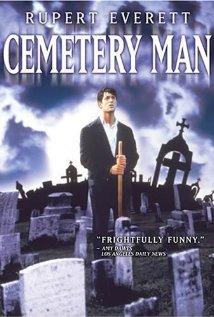 “Cemetery Man” (1994) is a film adaptation of the novel “Tiziano Sclavi” and directed by Michele Soavi. It’s an interesting hybrid of horror, comedy and art film in which Rupert Everett plays a caretaker of a cemetery whose recent arrivals come back to life a few days later. This zombie film stands out of the crowd for its visual flair and philosophical subtext. Cemetery Man should appeal to fans of early Sam Raimi, Dario Argento, and cult horror cinema in general.



 After the Crash