Every American Should Watch Abby Martin’s New Afghanistan War Documentary
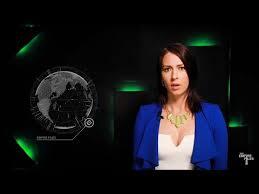
Abby Martin’s new documentary, “Afghanistan War Exposed: An Imperial Conspiracy,” is a tour de force, a must watch for every American seeking a holistic understanding of American’s longest-running war.
The perpetual occupation of Afghanistan has become so normalized that it mostly serves as background noise to most Americans. It’s even jokingly referred to as the “Forever War,” accepted as just another constant reality. A soldier dies now and again, a couple of dozen civilians get killed in another bombing. It’s never enough to stir the population to pressure Washington enough to stop it. And the endless war drags on.
From George W. Bush to Barack Obama, to Donald Trump, every U.S. president has promised to end the war. But their plans to bring the troops home inevitably require first sending more troops to the country. You can’t look at all this rhetoric and reality and not conclude that the United States wants to stay in Afghanistan forever. And there is a reason, despite an unresolvable military quagmire, that the Empire won’t let go of Afghanistan.
In this latest “Empire Files” documentary, journalist Abby Martin covers reveals the reality of America’s Wars in Afghanistan, from the CIA construct of the 1980s through today’s senseless stalemate. MintPress brings you documentary in its entirety, published with permission from filmmaker Abby Martin.
The 1970s have always occupied a grim place in the British imagination. Sandwiched between Harold Wilson’s utopian “Swinging Sixties” and Thatcher’s anti-social eighties, the decade represents a time of tremendous turbulence and change. With the empire in ruins, anti-colonial backlash came home to roost as Northern Ireland descended into civil war and the IRA began its bombing campaign in Britain. The naked enthusiasm of the post-war consensus dissipated, and the battle between labor and industry heated up. Bombs, blackouts, and shortages recalled war-like conditions during a time of supposed peace. Modern scholarship has pointed to an eerie style in British cultural output from the period. From its cinema to its television to its public information films, there pervades a gothic sensibility commonly identified with Mark Fisher’s concept of “hauntology,” the idea that the present state of cultural paralysis is a function of a collective mourning for futures that never materialized.
The dark and mystic sensibility that emerged from this disruptive and paranoid milieu, now called “folk horror,” manifests a fear of sublimation—the absorption of the individual into the mass, the human into the environment, modernity into the unknown. While the horror of Hammer Films and Roger Corman that had dominated the ‘50s and ‘60s was preoccupied with endless combinations of 19th century gothic, folk horror steps outside time as we understand it, beyond the scope of the human. In the 2010 documentary series A History of Horror, Mark Gatiss outlined a rough canon for this folk horror tradition based on the unholy trilogy of Witchfinder General (1968), The Blood on Satan’s Claw (1971), and The Wicker Man (1973). Intense ideological conflict pervades these stories: Witchfinder General is set in and around the Battle of Naseby, where Cromwell’s revolutionary New Model Army destroyed the veteran feudal forces of King Charles, and tells the story of a soldier who pursues a charlatan witch-hunter across the English countryside. And in The Blood on Satan’s Claw, set around the same time, a secular magistrate must slay a demon summoned from “the forest, from the furrows, from the fields” by the local pagan cult.
These historical tales come at us from the dawn of modern time, in the midst of feudal collapse and the emergence of capitalism. Our heroes are rational, secular agents of the state; our villains the ancient forces of paganistic superstition that batter at the door of our burgeoning technological world. It’s telling that the only film in Gatiss’s trilogy set in contemporary times, The Wicker Man, advances a very different view of the battle between the rational modern and the primordial other. Here, the heroic agent of the state, in this case a police officer, dies alone in the flames of the titular effigy, while the villagers dance in rings around him. Christopher Lee would go on to insist that The Wicker Man was not actually a horror film, an assertion that hints at the sublimation of genre itself, and how this paranoid affect had settled over the British imagination like an eerie fog.
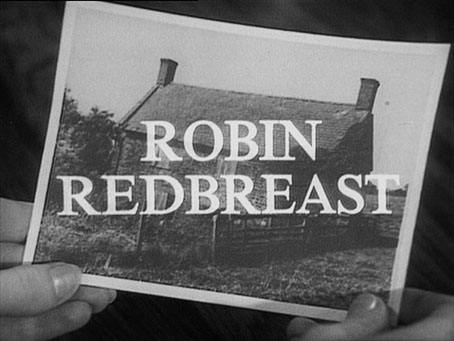
Well before The Wicker Man hit theaters, however, there was the television play Robin Redbreast (1970), which tells a similar story: middle-class metropolitan Norah Palmer (Anna Cropper) ventures into the English countryside only to find herself caught up in the fatal fertility rites of the polytheistic locals. Robin Redbreast is noteworthy for its appearance on Play for Today, a BBC anthology series typically reserved for kitchen-sink realist drama that has been described in posterity as everything from a “national theatre of the air” to an “[exercise] in viewer patronisation” (the latter quote coming from current Conservative Party MP and Boris Johnson ally, Michael Gove). Abrasive, polemical, socially conscious to a fault, its moral messaging embodied the paternalistic spirit of the ‘60s welfare state. If television was the medium of the masses, Play for Today was its conscience.
Set in the present day, Robin Redbreast inverts the conventional relationship between the modern and the un-modern, configuring our world as hopelessly encompassed by a dark architecture of the outside. From the moment Norah arrives in the village, she’s deprived of all agency. Everything she does is preempted, public and private spaces are intermeshed—the villagers always seem to know what she’s doing in advance, repeatedly wander onto her property without invitation, and even orchestrate events so that she ends up sleeping with Rob (Andy Bradford), an awkward local man who she first encounters practicing karate naked in the woods.
Norah can sense she’s being manipulated in some way but remains powerless to stop it. The menacing Mr. Fisher (Bernard Hepton), apparent leader of the community, even explains their sinister designs, albeit in elliptical language, at various junctures. Yet Norah is unable to resist literal and metaphorical seduction by the strange persuasions of the village folk. There’s a dark implication that in some respect Norah wants, or is at least allowing herself, to be trapped. The heightened emotions of country life contrast starkly against the bourgeois detachment of her conversations with city friends. To an extent, we get the impression that Norah’s volatile relationship with the villagers is a reaction to her own suppressed Dionysian impulses.
The shadowed social commentary is compounded when Fisher explains that the villagers are under no pretense of doing justice to the “old ways.” He admits the basis of the robin sacrifice could be Greek, Egyptian, even Mexican in origin. He mentions James George Frazer’s “The Golden Bough,” a largely discredited work of comparative mythology that serves as the basis for most popular representations of paganism. Historical authenticity is immaterial here. What scares us about paganism is what it tells us about ourselves, how it recalls our own innate strangeness.
After the ritual slaughter of Rob (short for Robin), a pregnant Norah flees the village, but her escape will never be complete. She knows that the same cycle will repeat itself when her baby, the new robin, comes of age. As she drives away, she looks back to find that the villagers, still watching from the cottage, have transformed into pagan deities. The fact that the villagers do nothing to stop her from returning to the city amplifies the play’s paranoid pessimism. As Fisher, having taken the form of Herne the Hunter, watches Norah disappear over the hill, the viewer is left with the horrible feeling that nothing Norah can do will have any impact on the ultimate fate of her unborn child. (The narrative is clearly inspired in part by Ira Levin’s Rosemary’s Baby).
Robin Redbreast’s horror is reactive, bird-brained—evoking the feeling of being cornered. The great fear is a lack of control, the feeling of being swept away by strange currents beyond the self. Even in her fleeing, Norah’s fate is ultimately foreclosed by forces that not only surround her but exist elementally within her. If Witchfinder General is set at the dawn of modernity, Robin Redbreast is set at modernity’s dusk, in a world that shrinks from itself as it feels the darkness loom ahead. The postponed reclamation of the robin proves a compelling metaphor for the hopeless uncertainty of a historical moment in which strange futures pounded on the door of the present, threatening to break in at any moment.
* * *
The first three years of the 1970s would see five states of emergency, each presided over by Ted Heath’s Conservative government following its surprise election in 1970, and each involving battles between Heath and what Thatcher would later refer to as “the enemy within”—the labor movement. Problems continued to pile up, each new disruption amplifying the last. The stock market crashed in January 1973, sending inflation soaring into double figures; then, in October, OPEC declared an oil embargo that set the western world reeling. Seeing an opportunity, the National Union of Mineworkers voted to go on strike in pursuit of fairer pay. Heath’s government responded by introducing the infamous Three-Day Week, in which consumption of electricity was to be limited to three non-consecutive days per week to conserve coal supplies. For two months, Britain was plunged into a cold, dark winter unlike anything it had seen since wartime.
Described by The Times as a “fight to the death between the government and the miners,” this was the second large-scale confrontation in as many years and one the government couldn’t afford to lose. Heath resolved to call an election to serve as a referendum on the issue of union power, with the Conservatives campaigning on the slogan “Who governs Britain?” The election of February 28, 1974 returned yet another dramatic development: despite the weight of the media and the state behind them, the Conservatives had in fact lost ground and handed the Labour Party a plurality in parliament. A settlement was soon reached in which the strikers secured a 35% pay-increase—the miners had won, at least for now.
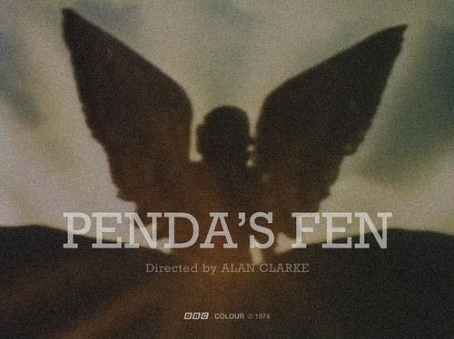
Two weeks after the lifting of restrictions, millions of Britons tuned in to BBC1 to watch the latest installment of Play for Today. That evening’s episode was Penda’s Fen, a fittingly unsettling exploration of unsettling times, the most developed folk horror film to date, and a triumph of public programming in its own right. Writer David Rudkin gives voice to the dark song of the fields with a visionary script about a devout young Christian who must confront both the unseen forces that stir beneath the village where he lives and the “unnatural” desires that emerge contrary to his pious pretensions.
Stephen Franklin (Spencer Banks) is a boy possessed by the “new gods”—he is ordered, anal, orthodox, patriotic, loyal to the structures of church and state. He’s the kind of kid that almost deserves the vicious bullying he gets from his grammar school classmates. As Stephen matures into his eighteenth year, however, things fall apart as he discovers that he’s both gay and adopted. Through the mentorship of his heretical parson father, a politically radical local playwright, and a series of disturbing apparitions, he begins to come to terms with his inner “ungovernableness.”
Director Alan Clarke, Britain’s mirror-holder-in-chief behind such brutal portraits as Elephant (1989) and Made in Britain (1982), presents an image of Britishness that’s wild, diverse, almost ethereal. Clarke, typically known for his uncompromising realism, adopts a more hallucinogenic style to portray the metaphysical turbulence of Stephen’s new understandings. The haunted, shifting landscapes of Worcestershire work as a kind of demonic mutation of Situationist psychogeography. Whereas the students of May 1968 were implored to uncover “the beach beneath the streets,” Clarke and Rudkin invite us to discover the flames beneath the fen.
Penda’s Fen stands apart from other artifacts of the “wyrd” in its overt politicization of strangeness. Almost immediately we meet the playwright Arne (Ian Hogg) as he puts up a one-man defense of the strikers at a town hall debate, while naïve Little Englander Stephen huffs and puffs in the audience. As Stephen begins to lose, or rather relinquish, control of himself, his grades suffer and his mother warns him not to fall foul of “the machine,” the inhuman conveyor belt of modernity and its cult of productivity. Later, the Reverend Franklin (John Atkinson) expounds on Moloch as the sun sets behind him, explaining to Stephen how the new gods of industry and institutions are perversions that have disfigured the message of the “revolutionary” Jesus. The Reverend speculates that the people may “revolt from the monolith and come back to the village,” noting that “pagan” means “of the village,” contrasting with what it means to be “of the city”—”bourgeois.”
The provisional nature of modernity is a key theme. Arne speaks of the urban behemoth swelling to a great city that will “[choke] the globe from pole to pole” but that will also “bear the seed of its own destruction.” We might imagine Hobbes’s Leviathan, bloated and turgid, decomposing back into the earth. Elsewhere, Stephen and his father discuss King Penda, the last pagan ruler of Britain. The Reverend reimagines the heretic as a transcendent symbol of resistance, wondering aloud what secrets he took with him when he fell. “The machine,” like the meaty bodies of its busy multitudes, is imagined as just one combination among an infinite number, an entirely temporary arrangement destined for the dirt.
Landscape is a focal point of the play but, unlike in our other examples, here serves as a vector of elemental truth rather than a source of corruption. Rudkin draws on the Gothic and Romantic traditions to conjure up an English countryside pregnant with ancient histories that lie unknown, hidden or forgotten. It was here, after all, in the 16th century, that the machine first emerged out of the fields and the fens and separated the peasantry from the land—the original trauma that encloses the margins of modern Western history. What lies beyond that temporal boundary is the vanishing realm of nightmare, of un-modernity, where yawns the black abyss of the unknown, the domain of animal and reigning wilderness. But, paradoxically, that abyss is essential to our nature—it’s where billions of lives were lived, where our minds and bodies were wrought and cultivated. Penda’s Fen considers the abyss for all its hidden potentials and reconfigures rupture as opportunity. The horror of recognizing the self in the other, or vice versa, is imagined as a route to emancipation.
In perhaps the most famous scene, Stephen awakes from a homoerotic dream to discover a demonic entity straddling him in his bed, which then takes the shape of the local milkman (Ron Smerczak). What haunts him is not his sexuality but his dedication to the authoritarian norms of middle-class Protestant England. As Arne prophecies in a later scene, the only way to purge ourselves of these demons and reach salvation is by way of “chaos” and “disobedience,” to summon our basest selves.
When we first find Stephen, he’s alone in his room, listening to his favorite composer Edward Elgar’s The Dream of Gerontius and reflecting on the moment when the protagonist meets God. Stephen is isolated from the world, only able to theorize obliquely about transcendent experiences. By contrast, the final sequence sees him meet his maker on an open hillside—not God, per se, but King Penda himself, the half-real spirit of “ungovernableness,” who tells him to go forth and “be strange.”
Much like its predecessors, the play makes no attempt at an authentic depiction of pre-Christian spirituality—we have no idea what the titular King Penda might have believed, what his traditions were, what cosmologies were lost when he was defeated all those years ago. But this is precisely the point. The last pagan king functions as an empty vector of “possibilities” and “unknown elements,” much like Stephen himself. Despite being an apparition of a long-dead historical figure, King Penda represents a haunting from the future, that dark domain of the beyond with which we are in contact every moment of our lives, full of unthinkable potential and inherent strangeness.
Penda’s Fen advances itself as the spiritual resolution to the folk horror cycle, a psychic exorcism of the demons that haunted the ‘70s. Rudkin’s play summons the future from the past, reconstituting the volatility of its day as a rite of passage into a new world. Horror in this sense denotes contact with new terrain, communion between the self and the beyond. To be comfortable is to live in fear of the strange invasions that confront us at every moment and in every thought and experience—to flee from ourselves. In a time when people want change without having to confront the proverbial milkman, the play enjoys continued relevance long after its first life.
Both Robin Redbreast and Penda’s Fen were aired only once more on British television, in 1971 and 1990 respectively, lending these tales the ephemeral quality of weird dreams dreamt long ago—and raising the question of why they’ve now returned to haunt us. The villagers never came to reclaim the robin in the end, yet still we see their shapes in the window and hear strange knocks at the door. Will we ever face up to the horrors that guard the margins of our world? Or are we, like Norah Palmer, doomed to retreat further and further into the city, to delay the inevitable day when the outside closes in? In the closing scene of Rudkin’s play, King Penda prophesies exile as the sun sets behind him: “Night is falling; your land and mine goes down into a darkness now… but the flame still flickers in the fen.” The future promised by that strange flame lies lost somewhere in that expanse of night. Only by embracing the dark might we find it again.
“Trump’s American dystopia has reached a new and ominous cliff,” warns a CNN opinion headline. “The last two and a half months in America have felt like the opening montage in a dystopian film about a nation come undone,” writesNew York Timescolumnist Michele Goldberg, in describing the images of militarized police storming U.S. cities to put down protests in the days following George Floyd’s murder, which came on the heels of two months of pandemic, panic, and widespread economic collapse. A very popular post published elsewhere on Medium was titled, bluntly, “America is a Dystopia.”
There is a lotofdystopia talk getting tossed around right now, for reasons that probably seem obvious. Those images we’ve all spent hours staring at on Twitter and cable TV — the military vehicles patrolling suburban streets, the lines of tactical vested officers cordoned around the Lincoln Memorial, the scenes of tear gas blurring flames as masked protesters clash with armed police — match up reasonably well with the aesthetics and broad strokes of a genre that we’ve spent the last 10 years staring at on Netflix and the other channels on cable TV.
But this is not “Trump’s American dystopia.” It is the continued, if inflamed, dystopian state of play as it has laid for centuries. The montage of horrors did not begin only a few months ago or when a cohort of privileged observers suddenly became aghast at the SWAT howitzers and brutal policing tactics when they were seen on suburban streets.
Years of toothless and profitable pop culture dystopias have primed consumers to ignore race, helping to obscure the fact that the real dystopia arrived long ago.
Comparing America to a dystopia has become something of a national pastime.
If we wanted to get pithy about it, we might say that the 2010s were the dystopia decade, a period that saw both the rise of dystopia as a reliably profitable and uniform entertainment format in mass culture and what appeared to be the IRL manifestation of the images and tropes the genre broadcast by decade’s end. TheHunger Games rose to dominate box offices and spawned a follow-on flotilla of similarly shaped YA dystopian fare. Black Mirror mainstreamed a visual mode of bleak cynicism about technology, and critical darlings like Ex Machina, Her, and Mad Max: Fury Road made apocalypses brought about by artificial intelligence and climate change palatable for the intelligentsia. Meanwhile, Blade Runner, RoboCop, Starship Troopers, and Children of Men became frequent touchstones. Partly because they are good films that offered prescient cultural and political commentary, and partly because their visuals provide handy fodder for comparative screen-grabbing on social media while we’re watching high-tech police forces brutalize popular uprisings, climate change-fueled wildfires spread across cityscapes, and A.I. take on alarming new dimensions, like being racist.
As a result, comparing America to a dystopia has become something of a national pastime; a recurring op-ed framework, a subgenre of Twitter commentary — especially during crisis points and moments of mass upheaval.
But what are we actually talking about when we talk about “dystopia”? Gesturing towards a vague constellation of injustices set to the color palette of a “gritty” summer blockbuster and declaring it dystopian won’t cut it — for dystopia to be useful as a cautionary tool for avoiding bad futures, we need to understand exactly what the ingredients setting a society on the road to ruin are. As it stands, much of the modern dystopian discourse seems content to position dystopia as something that is bad, with an air of futurity. To quote Daniel Mallory Ortberg’s famous mocking of Black Mirror: “What if phones, but too much.” What if high-tech cops, what if sea level rise, etc.
“The adjective dystopian implies fearful futures where chaos and ruin prevail,” writes Gregory Claeys, a historian and professor at Royal Holloway, University of London, and author of Dystopia: A Natural History. Though in a historical and literary sense, he says, dystopia most commonly describes “a regime defined by extreme coercion, inequality, imprisonment, and slavery.”
Because its most popular touchstones are science fiction, modern dystopia discourse tends to fixate on profit- or warfare-accelerating technologies — digital surveillance, facial recognition, automation software, drones, technologized weapons — and their capacity to serve the wealthy and powerful in a time of ecological collapse, health crises, and/or widening inequality. Our current moment fits the bill. The coronavirus, mass unemployment, and police brutality against a racial justice uprising are unfolding to the backdrop of SpaceX rocket launches and tech billionaires like Amazon’s Jeff Bezos rapidly expanding their wealth.
When I noted on Twitter that the SpaceX launch was sending astronauts on a for-profit trip into space as a surge of protests swept the country, it struck a chord. Many responded bycomparingthe events to Elysium, the 2013 Neill Blomkamp film about a future where the poor toil and swelter on Earth while the wealthy live in luxury in a space station that orbits above the Terran rabble.
Others pointedtothe greatGil Scott Heron song, “Whitey’s On the Moon.” The musician and poet released it in 1970, one year after the NASA moon landing, which was itself one year after Dr. Martin Luther King, Jr.’s assassination provoked a mass nationwide uprising, perhaps the last at a scale comparable to the one we’re seeing today.
Some of the lyrics:
A rat done bit my sister Nell.
(with Whitey on the moon)
Her face and arms began to swell.
(and Whitey’s on the moon)
I can’t pay no doctor bill.
(but Whitey’s on the moon)
Ten years from now I’ll be payin’ still.
(while Whitey’s on the moon)
That song was recorded a half-century ago, yet the plight remains the same. It was the same in 1993, when Octavia Butler, in her own magisterial dystopia, Parable of the Sower, set in a mostly Black community in Southern California in the apocalyptic 2020s, described the news of the death of a Mars explorer as eliciting the following reaction: “People here in the neighborhood are saying she had no business going to Mars, anyway. All that money wasted on another crazy space trip when so many people here on earth can’t afford water, food, or shelter.”
Billionaires can afford to send payloads into orbit, to explore space for science and for profit, but we cannot afford to provide health care to the poor or even basic racial equality. That’s what too many of us are missing when we talk about dystopia.
As comparatively radical as a dystopia like Elysium (or, say, Snowpiercer) is — in terms of summer blockbusters, anyway — its critique is limited to class. It glosses over race. It’s Matt Damon versus Sharlto Copley and Jodi Foster and the other white orbital techno-authoritarians. Take a scan through any of the most popular dystopian cinema products of the last decade or so, and you’ll find the same thing; matters of race are omitted almost entirely from the big screen eschatologies. Not only are the genre’s prime exports — Hunger Games, Divergent, Blade Runner, Elysium, RoboCop, the list goes on — written and directed by white people, the protagonists, actors, and even antagonists are nearly uniformly white. And despite many of these being imagined, written, and made in a nation whose founding arrangement was the most dystopian system conceivable, race is never even a component of the conversation in mainstream dystopian cinema, much less what the uprisings are predicated upon. Even the Handmaid’s Tale, which exploded in the wake of Trump’s misogyny-lined ascendency to the presidency, relegates any matter of racial politics deep into the background.
The most influential dystopia of the 21st century, I would argue, is not ‘1984,’ but ‘Atlas Shrugged,’ which alone is responsible for a generation of greed-is-good Republican policymaking.
Angelica Jade Bastién points all this out in “Why Don’t Dystopias Know How to Talk About Race?”, where she explains how this in effect allows white viewers to cosplay as the oppressed, without actually interrogating in any meaningful way what oppression might actually entail or who gets oppressed and why.
“Race is relegated to inspiration, coloring the towering cityscapes of these worlds, while the white characters toil under the hardships that Brown and Black people experience acutely in real life,” Bastién writes. “In this way, dystopias become less fascinating thought experiments or vital warnings than escapades in which white people can take on the constraints of what it means to be the other.”
And in so doing, these popular dystopias appropriate the other’s struggles while conveniently ignoring the actual roots of said struggle. I do still think there’s utility in dystopias and trying to heed their warnings, but only if we recognize what’s being warned against, and only, especially, if we manage to understand that many of the looming “dystopias” perceived by more affluent entertainment consumers have been the realities of plenty of communities who have faced deep inequalities, technologized surveillance, and state oppression for generations already.
There’s a tweet that’s gone viral a number of times over the dystopian decade, each time in slightly different variation. Its most recent iteration came just this January, before the pandemic and the uprising came to dominate dystopia discourse:
White dystopia fanboys like me, pundits, columnists, and social media users need to get this through our skulls. To invert a notorious quote attributed to William Gibson, the dystopia has always been here; it just hasn’t been evenly distributed.
The “dystopia” lens too often fixes conditions like those — heavily policed communities, invasive surveillance, state oppression — in the future, and it glosses over the realities of the present and the long histories of oppression of Black communities and bodies, plenty of which was technologically abetted. The writer Anthony Walton noted in a 1999 Atlantic piece, “Technology Versus African Americans,” that from “the caravel to the cotton gin, technological innovation has made things worse for Blacks.” Western technologies, he writes, formed the infrastructure that gave rise to Black slavery:
Arab and African slave traders exchanged their human chattels for textiles, metals, and firearms, all products of Western technological wizardry, and those same slavers used guns, vastly superior to African weapons of the time, in wars of conquest against those tribes whose members they wished to capture… The slave wars and trade were only the first of many encounters with Western technology to prove disastrous for people of African descent. In the United States, as in South America and the Caribbean, the slaves were themselves the technology that allowed Europeans to master the wilderness.
What better fits Claeys description of dystopia — “a regime defined by extreme coercion, inequality, imprisonment, and slavery” — than actual chattel slavery? America was founded as a dystopia.
Yet for white and affluent consumers, the constant generation of novel and fantastic apocalyptic scenarios serves to extend the horizon for the arrival of the hellish conditions contained in dystopia — if oppression is a nebulous but ever-approaching threat, it’s perpetually obscured, lifted away into a sub-fictional ether. It needs not be interrogated, not now, anyway. Which is how power prefers it.
That’s the other thing about dystopia: In many of its guises, it’s a plainly conservative enterprise. The most influential dystopia of the 21st century, I would argue, is not 1984, but Atlas Shrugged, which alone is responsible for a generation of greed-is-good Republican policymaking. The 600,000-page book, which I have (regrettably) read, positions a handful of great white men and women as the only thing keeping society together and inveighs against the millions of working-class “moochers” with a barely veiled racist subtext. (Its author was also openly racist.) Many dystopias are less flagrant but similarly conservative: They highlight the fear that we might all end up like the poor unwashed masses if we are not careful to uphold the social order, not the fear that the poor might never be liberated. And that, in fact, includes the ur-dystopia.
“Visions of the apocalypse are at least as old as 1000 B.C.,” according to the dystopian historian Claeys. “The triumph of chaos over order defined the Egyptian ‘Prophecies of Neferti’ foretold the complete breakdown of society.” In it, the “great no longer rule the land,’ the ‘slaves will be exalted.’” The first dystopia, in other words, was a cautionary tale for the haves against sliding into the world of the have-nots. It’s hard not to shake that vibe from a lot of the Twitter commentariat, pointing at the protests from afar, going “man it’s so dystopian” and moving on to whatever the central animating conflict is in their own personal heroic narratives.
There are still useful deployments of dystopian language — it can certainly be effective shorthand for “this is fucked in a new way, pay attention.” A good example is this series of viral tweets that chronicle a day of peaceful protest where demonstrators were in turn greeted with the creepy electrified visage of Gov. Andrew Cuomo on a towering billboard, beaming down the newly instated curfew. A couple hours later, many protesters would be beaten.
NYC Has Become A Dystopian Novel: What Happened After 8pm Curfew
I’ve been to many protests and marches during my life, but I’ve never seen anything like what we experienced last night.
I think everyone around the country and world needs to understand what’s happening here. pic.twitter.com/kWdgdLxZ6M
And dystopias can still jolt the politically uninvolved to wake up — this podcaster even pointed to Elysium as an entry point into radical politics. But the surfeit of commentary that amounts to “wow, this is like Blade Runner send tweet” needs an upgrade. White viewers like me need to rethink and reevaluate what it means to watch and read popular dystopian fiction, how those products are shaping our perspectives and critiques of the futures and what they’re missing. And many more Black voices clearly need to be added to the mainstream canon and the broader discussion — there’s tons of great Black dystopian fiction; Dhalgren by Samuel Delany, Who Fears Death by Nnedi Okorafor, Zone One by Colson Whitehead, pretty much anything by Ishmael Reed. Who Fears Death is in development for a TV series, which is a start, but these voices need to be better foregrounded and made central to modern dystopia discourse.
A lack of diversity has been a problem in science fiction since the genre’s inception, and it persists. When I went to the Nebulas, a high-profile sci-fi awards conference last year, attendees were overwhelmingly white. The fact that Octavia Butler’s magisterial Parable of the Sower — a dystopia that actually and skillfully manages to interrogate climate change, total economic collapse, privatization, andracist oppression — is somehow not a film or a limited series yet is as scathing an indictment of Hollywood’s insistence on whitewashing dystopias as anything. The book absolutely rips.
This is not to disparage anyone who feels like they’re living in a certain kind of almost-future hell. The number of people who genuinely experience the world as an impending or current dystopia is almost certainly rising in tandem with trends of still-increasing inequality. A decade of jobless recovery ended in 2019 with the highest levels of income inequality in 50 years, and record numbers of people of all backgrounds, even whites, are sliding into poverty and despair, and our encounters with climate change, technological surveillance, conservatism’s hard drift toward authoritarianism, and all of the above being increasingly mediated through digital devices. Our current socioeconomic system is now ideally structured to be a dystopian protagonist generator. It is rewarding elites with unprecedented wealth and luxury, equipping the agents of the state with increasingly advanced weapons and technology, exacerbating ecological collapse, and positioning us all to experience the devastation alone, blinking into a screen, hoping for tiny units of validation from a pithy comment or two about the state of the morass on social media. It is us versus [gestures wildly] all of that, out there.
Which makes it all the more imperative that white fans, pundits, and observers stop ignoring what it has historically meant to experience actual dystopian conditions. It means acknowledging and working to improve the material conditions for those who are surviving the current iteration, and not glibly waving off dystopia as some always-approaching, faceless Empire without zeroing in on the nation’s institutional prejudices, its targets for violence, its specific hatreds. It means we have to stop LARPing in appropriated fictions. It means understanding that this has always been a dystopia — and that those who have always resisted it are at the center of the story.
There are certain things you don’t know you’re missing in life until you’re exposed to them, right? EXP TV just might be one of those things. It’s got an aesthetic that hovers around the same territory as Everything is Terrible! and Vic Berger, it even reminds me of Mike Kelley’s stuff, but that’s only going to get you in the ballpark. Which is good enough, but you just have to click on the link and see for yourself. It’s a barrage of strange imagery and is really quite an inspired—not to say elaborate and work intensive—art project. And just in time for a pandemic. Bored with Netflix? Have enough Amazon Prime? Maxed out on HBO Max? You need to tune in, turn on and drop your jaw to the floor at what’s screening on EXP TV.
EXP TV the brainchild of Tom Fitzgerald, Marcus Herring, Taylor C. Rowley. I asked them a few questions via email.
What is EXP TV? What should someone expect to see when they get there?
EXP TV is a live TV channel broadcasting an endless stream of obscure media and video ephemera from our site at exptv.org. We stream 24/7.
The daytime programming is called “Video Breaks”—a video collage series featuring wild, rare, unpredictable, and ever-changing archival clips touching on every subject imaginable. Similar to how golden era MTV played music videos all day, daytime EXP TV streams non-stop, deep cut video clips filtered through our own distinct POV.
What treasures would reward the loyal Video Breaks viewer? Ventriloquist dummy sales demos, Filipino Pinocchios, LSD trip-induced talking hot dogs, Liberace’s recipe tips, French synth punk, primal scream therapy seminars, Deadhead parking lots, empty parking lots, Israeli sci-fi, scary animatronics, teenage girls’ homemade art films, Belgian hard techno dance instructions, Czech children’s films about UFOs, even Danzig reading from his book collection. And that’s all in just one hour!
We’ve been collecting obscure media for decades, but we’ve sorted through it all and cherry-picked the funny, the bizarre, the relevant, the irrelevant, the visually stunning, the interesting, the infamous, the good, the bad and the fugly. We’ve done all that so the viewers don’t have to. They get to kick back and experience the sweet spot without having to dig for rare stuff themselves or sit through an entire movie waiting for the cool part.
Our Nite Owl programming block features specialty themed video mixes and deep dives on everything under the sun: Bigfoot, underground 80s culture, Italo disco, cults, Halloween hijinks, pre-revolutionary Iranian pop culture, midnight movies, ‘ye ye’ promo films, Soviet sci-fi, reggae rarities, psychedelic animation and local news calamities. On any given night you could watch something like our Incredibly Strange Metal show followed by a conceptual video essay like Pixel Power—our exploration of early CGI art.
Aside from our unique tone and deep crate of video materials, one thing that really sets us apart in 2020 is our format. We are *not* on demand, we are *not* interactive—just like old TV! You can tune in anytime and something cool will be on.
That’s EXP TV in a nutshell. It’s funny, it’s art, it’s music, it’s infotainment, it’s free and it’s 24/7.
We have a little bumper on our Instagram @exp.tv that illustrates this
How much material did you have in the can, ready to go at launch?
We had been quietly working on the channel for over a year so we had quite a bit of material. When the pandemic hit, we decided to launch early as a beta so people could have an alternative to the big streaming channels – something totally different.
In this modern world of all these different streaming platforms, it feels like you spend more time deciding what to watch than you do actually watching something. We wanted to make something you could just turn on and leave on for hours—days even—and you’d be guaranteed to catch something interesting. We basically just made the channel we wanted to watch.
Right now, we have about 60 hours in rotation and we are regularly adding new material—new Video Breaks, new episodes of our ongoing series, and hatching entirely new concepts for shows. Stay tuned for Kung Fu Wizards coming soon!
Do you have themes? What are some of your more elaborate productions on the channel?
Our Nite Owl block has a roster of shows centered around specific themes. A few examples include…
Pixel Power – an homage to the early days of computer graphics.
Witches Brew – a tour through the history of witches on film.
Total News – a completely gonzo take on nightly news past and present.
Bollyweird – a huge compilation of the most “out there” Bollywood musical numbers.
Pomegranates – a survey of pre-revolutionary Iranian cinema, set to Persian psych music.
Underground USA – a continuing series archiving 80s alt culture.
Cosmonaut – our tribute to Soviet sci-fi.
Incredibly Strange Metal – exactly what it sounds like.
They Call Him Bigfoot – a search for Sasquatch in cinema.
Jamaica, No Problem – a crash course in Jamaican music culture.
The David Bowie Mixtape – The Thin White Duke’s glory years captured on film and video.
Our Star Wars Mixtape – Star Wars gone wild, gone weird, and gone wrong.
Cats – an exploration of cats in cinema and beyond.
Wow – a survey of psychedelic animation from around the world.
Mosaic – meditative compilation of short films from the world of fine art.
La Videotheque – French yeye music promo compilation.
Disco Odyssey – our series exploring the wild world of Italo disco and other dance music mutations.
And there’s so much more…
Where do you mostly find stuff? Or maybe, how do you search for it?
We have been collecting video materials for decades. Years of VHS tape-trading, pouring through mom and pop video stores (RIP), even the internet! It makes our day to stumble upon a Bulgarian sci-fi animation title we never heard of. We love our work! Like a hip hop dj/producer is looking for the perfect beat, we’re always searching for that perfect “clip”, that magic moment, that video gem.
What are some of your future plans for EXP TV?
The first priority is continuing to add more cool stuff to the site. We’re looking forward to the time when there’s hundreds of hours of free entertainment.
An unexpected but welcome side effect of our offbeat media expertise is that we’ve been getting work as creative consultants to dig up obscure clips and offer fresh takes on commercials and live events. Last year EXP TV was hired to program the Red Bull Music Film Festival in LA, and we brought in cool guests like Sun Ra Arkestra, Man Parrish, Lady Bunny, and Earth. Our mixtapes were the throughline of the fest. Some of our shows made it down to Austin Film Society and Music Box in Chicago. Having met as programmers at Cinefamily, our background is in public exhibition, but we’re interested in exploring new ways to subject the world to our perspective. We’ve been running the stream on Twitch and Periscope. Someday we want to take a bunch of old CRT TVs and use Raspberry Pi’s to make terrestrial TVs that you flip on and they only play EXP TV. We think that would be a fun gift for local galleries and bars.
We’re currently working on the EXP TV Apple TV app, but we wanna see EXP TV everywhere…we can see opportunities for our particular style of obscure video mixtapes as an HBO series or maybe even its own section on Netflix!
“The Monkey King” (2014) is a Hong Kong/Chinese fantasy film directed by Cheang Pou-soi and based on an episode of Journey to the West, a Chinese literary classic written in the Ming Dynasty by Wu Cheng’en. The film focuses on the origin of Sun Wukong (Donnie Yen), the titular protagonist who’s the only one who can prevent the Bull Demon King (Aaron Kwok) from taking over the heavenly kingdom.
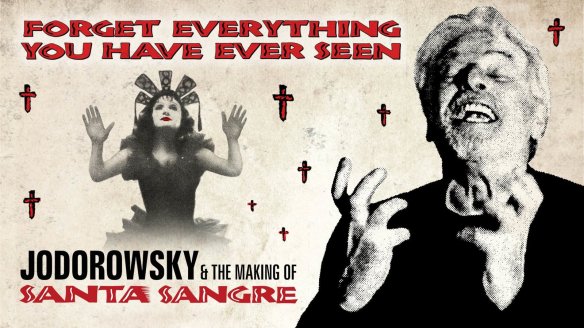
In the 1970s, his legendary films El Topo and The Holy Mountain redefined movies as both art and entertainment while changing the face of cinema forever. In 1989, after his dream project Dune fell apart and a resultant decade-long break from cinema, visionary filmmaker Alejandro Jodorowsky returned with his most triumphant work: SANTA SANGRE. Forget Everything You Have Ever Seen is a feature-length documentary on the making of Santa Sangre featuring interviews with the cast and crew.
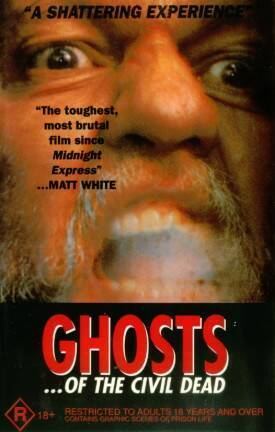
Director John Hillcoat (The Road, Lawless, The Proposition) made his 1989 feature debut with the gripping prison drama Ghosts…Of The Civil Dead, which contains a brief, but unforgettable appearance by Nick Cave. It’s a really amazing film, but one that is sadly little-known outside of Australia (and extreme Nick Cave fanboys—admittedly I saw Ghosts… almost alone, at its sole midnight screening in NYC.)
Perhaps it is a misconception, but due to the worldwide popularity of films like Chopper and the classic camp TV of the women-in-prison soap opera Prisoner: Cell Block H, I can be forgiven, I hope, for assuming that Australians, on the whole, are a bit obsessed with criminals, violent crime and incarceration. I guess it’s in their blood, so to speak. (I kid, I kid, Aussie readers! Please don’t kill me!) Loosely based on the life and writing of Jack Henry Abbott—the psychotic murderer turned literary protégé of Norman Mailer turned psychotic murderer once again—and research done with David Hale, a former guard at an Illinois maximum security prison, Ghosts… Of The Civil Dead features a cast of real-life ex-convicts, former prison guards and tough-looking motherfuckers they found in local Melbourne gyms. This film is realistic. Scary realistic. HBO’s Oz is a day spa in comparison.
Narrated by a (fictional) former prison guard, Ghosts… takes place deep in within the bowels of a maximum security prison, somewhere in the Australian outback. The place is an incessantly humming, fluorescent-lit nightmare. Due to outbreaks of violence, there has been a three-year lockdown that is still ongoing. The tension is palpable, the place is a claustrophobic, concrete Hell that no sunlight penetrates, a hatred and resentment-fueled bomb with a very short fuse just waiting to go off.
As events transpire, the viewer begins to see that the prison authorities are actively trying to provoke the prison population, and that they are pitting the guards against the inmates, preying on both to escalate the violence in order to crack down on the prisoners ever harder and to justify building a fortress even more fearsome, inescapable and “secure.”
Ghosts… has layers of unexpected meaning. Although the script (co-written by Hillcoat, Cave, one-time Bad Seeds guitarist Hugo Race, Gene Conkie and producer Evan English) tells a reasonably straightforward tale of the prisoners—captive in a high security fortress that escape from seems impossible—versus the authorities who manipulate them into chaos, there’s a wider allegorical message of the power dynamic inherent in Western capitalism: Conform. Do exactly what we tell you to do, or there will be consequences. Like this high security Hell on Earth.
Michel Foucault would have most certainly approved of Ghosts…Of The Civil Dead, I should think.
Although contrary to the way Ghosts… was marketed, Nick Cave is onscreen for just a very short appearance about an hour into the film, but having said that, it is a cinematic moment of pure genius. Cave plays Maynard, a violent psychotic who paints with his own blood. Maynard is an absolute fucking lunatic, deliberately brought in by the prison authorities to make an already bad situation much, much worse. His psychotic ranting and raving riles up the situation into complete murderous chaos. Although he is seen just briefly in Ghosts…, it is Cave’s Maynard who lights the bomb’s ever present fuse.
Ghosts… Of The Civil Dead is extraordinary film, as as bleak and as uncompromising a work of art as I have ever experienced, it might be difficult for the squeamish to sit through. Once seen, it can never be forgotten.
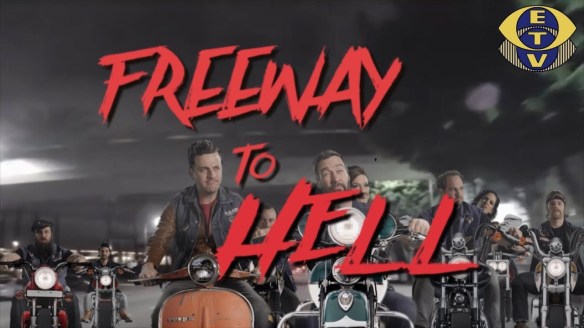
Mike Upchurch is a comedy writer who got his start working on Mr. Show and The Chris Rock Show in the late nineties. In recent years he has written, directed and edited a series of short films, the best of which are presented here. They share in common an acerbic wit skewering various genres of pop culture detritus using brilliant editing and low-tech CGI techniques to insert whimsical performances, dialogue and plotlines into found footage.


 After the Crash