Saturday Matinee: Macross: Do You Remember Love?

Remembering Macross: Do You Remember Love?

By Victor de la Cruz

Source: 3rd World Geeks

There have been so many anime movies that have come and gone. A lot of them have, deservedly so, have been called classics and must-watch animes. You’ve got your My Neighbor Totoro, Ghost in the Shell, Weathering with You, Your Name and Akira. They are undoubtedly classics in their own right and every anime fan needs to see them. But there always seems to be one anime film that’s left out of the conversation for one reason or another. I’m here to shine a spotlight on that anime that usually gets lost in the shuffle when people list down great anime movies.

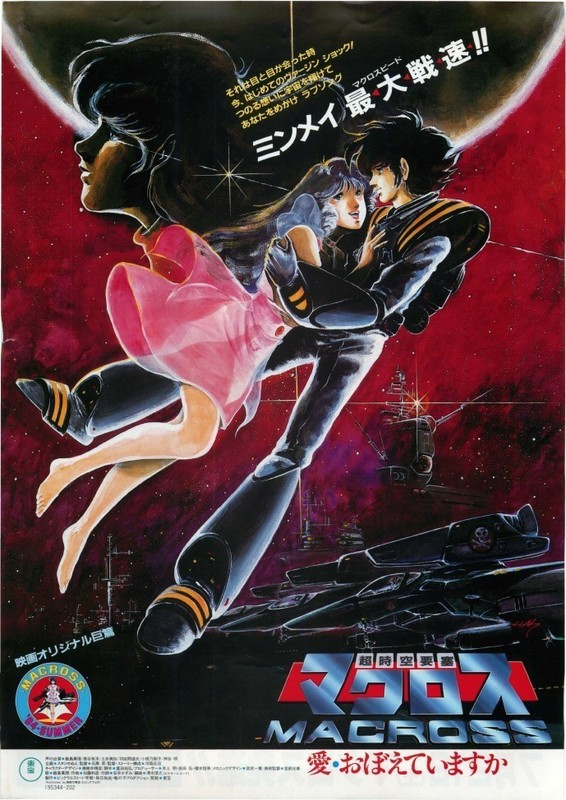
That movie is Macross: Do You Remember Love?

But before I do talk about Macross: Do You Remember Love?, I do have to talk about my very complicated relationship with the first Macross franchise. Like most anime fans, the very first contact I had with Macross wasn’t actually called Macross. It was from Robotech. Now, Robotech was this weird mishmash of three animes, namely, Super Dimension Fortress Macross, Super Dimension Cavalry Southern Cross and Genesis Climber MOSPEADA. The original Japanese animes had nothing to do with each other. However, the people over at Harmony Gold had the bright idea to attempt to link these three disparate shows. The writers did a good job with what they were given but this did greatly affect how the later chapters, more specifically the Southern Cross story, was almost totally revamped to retrofit it into the overarching story. Thankfully, as it was the first chapter in Robotech, Macross was hardly touched story-wire. Basically, if all you have is the Robotech version of Macross, you’re still getting pretty much the original story.

I also have to mention that my first experience with Do You Remember Love? isn’t by watching the movie. The first time I did see the movie was the Clash of the Bionoids dub. And, god help me, I loved it! I managed to catch this by pure accident while channel surfing when I was a kid. Seeing they actually pushed out a movie based on Robotech (because I didn’t know any better then) blew my mind and maybe that was a part of why I loved it so much. It would be an easy excuse to say I was young and foolish to like something as bad as the dubbing done in Clash of the Bionoids. But there’s just something so earnest in the performances! Oh, I also didn’t know they cut out a lot of stuff from the original film but, hey, I didn’t know there was an unedited version back then! Of course, now that I’ve seen the original cut, it’s hard to go back to Clash of the Bionoids unless it’s to kind of laugh at some of the dialogue.

Anyway, back to Do You Remember Love? and why I believe it deserves to be called a classic. For one thing, just look at it! Despite it being released way back in 1984, a good 35 years ago now, Do You Remember Love? still looks incredible. I can’t deny they touched up the film to bring everything into high resolution. But even so, you gotta admire the amount of detail the animators put into each frame of animation here! The number of little things, like lights flashing on the screen, the wires that stick out of a console, how the shadows lay on objects realistically, the tiny details of the Valkyrie stabilization thrusters looks outstanding.

The animation of how the Valkyrie also transform from mode to mode so seamlessly is also incredible. Of course, you also have to love those spiraling missiles the Valkyrie fire at the enemy Zentradi and how well animated those things are. Considering this was way before computer animation was a thing, that means you had a bunch of animators drawing up each and every frame of those missiles careening at wild directions while making it look real. They did a fantastic job on Do You Remember Love?

I also have to commend the writers of managing to streamline the entire 36 episode arc into something that would fit into roughly a couple of hours. Well, it’s not exactly streamlining as Do You Remember Love? alters the story quite a bit. But the changes they did do make sense. The movie actually starts right in the middle of the Macross’ journey back to Earth and ends after the defeat of the Zentradi leader Boddole Zer. This does leave out a good chunk of story but it also cuts out the more boring parts. We get to see the Macross transform without having the long, complicated episode explaining how they figured out to do so. We don’t have the Macross return to Earth only to be exiled to deep space. We also don’t get the aftermath of the Macross War and see the Zentradi have difficulty integrating in human society. These may be part of the entire drama of Macross. But, by cutting out these more slower parts, Do You Remember Love? gets into the meatier part of the entire story, which does makes things more satisfying.

Of course, no talk about Do You Remember Love? can be made without talking about the phenomenal final act of the film. The big battle where the loose forces of the Zentradi, Meltradi and remaining humans join forces to attack Boddole Zer while Lynn Minmay sings the titular song. There’s just something to the entire buildup to the song and the beautiful simplicity of the lyrics that makes it come off as more awesome than it should be. Of course, it certainly doesn’t hurt that Mari Iijima, who does both the normal and singing voices of Lynn Minmay, sounds really ethereal with her performance of the song. There’s also a kind of beautiful message in the scene where a simple love song can touch even the hardest of hearts to make them do the right thing.

I’m not saying Do You Remember Love? is a flawless anime film. I actually have to say I have some problems with it. The melodrama can be irritating at times as the characters would suddenly start behaving like they’re in the middle of a cheap soap opera. Lynn Minmay can definitely be grating at times because of how bratty she comes off in certain scenes. And while I did give high praise to the writers for focusing on the more important elements of the series, there are a couple of times when things just seem to happen in order to move the story forward.

However, these shortcomings should not really detract from how great Do You Remember Love? actually is. There’s just an overall epic feel to the story and the animation, despite its age, seems to have richer details than the anime movies we get today. But it’s that really memorable final act that really clinches it for me. The song, while nothing great in itself, feels much more epic in scale because of everything that accompanies it. Honestly, I would’ve watched it for those final ten minutes and still feel satisfied with how well done everything is.

I honestly think Macross: Do You Remember Love? deserves a little love as it seems to have been lost in the shuffle of all of the other anime films out there. If you’re interested in watching it, you’re in luck! The entire movie is available on YouTube on the Macross channel. It’s not in super hi-def but the high quality animation will make you forget it isn’t.

Give it a watch if you can spare a couple of hours. You can thank me later.

Have you seen Macross: Do You Remember Love? What did you think of it? What other classic anime films do you think deserves a little more attention? Let me know in the comments section below!

Saturday Matinee: Capricorn One

By Ken Zurski

Source: Unremembered

In 1976, a controversial new book was released that contended the Apollo 11 moon mission never happened. We Never Went to the Moon: America’s Thirty Million Dollar Swindle was written by Bill Kaysing, a Navy midshipman and rocket specialist, who claimed to have inside knowledge of a government conspiracy to fake the moon landing.

Kaysing believes NASA couldn’t safely put a man on the moon by the end of the 1960’s (a promise made by President Kennedy) so they staged it instead. Kaysing’s theories were technical and persuasive and soon a movement of nonbelievers, inspired by the book, was born.

Whether you believed Kaysing or not was a moot point for American screenwriter and director Peter Hyams.  A former TV news anchor, Hyams was more interested in how such a thing could actually be pulled off?

“I grew up in the generation where my parents basically believed if it was in the newspaper it was true,” Hyams said in an interview with a film trade magazine.  For him, he admits, it was the same with television. “I wondered what would happen if someone faked a whole story.”

So he wrote a story based on the concept.

That was in 1972, four years before Kaysing’s book was released. Hyams shopped the script around but got no takers.  Then something unexpected happened. Watergate broke and America was thrown into a government scandal at its highest levels. Interest in a story like a fake moon landing (in the movie’s case, the first manned mission to Mars) had appeal. In 1976, Hyams was given the green light to make his movie as part of deal with ITC Entertainment to produce films with a conspiracy bent.

“Capricorn One” was released in the Summer of 1977. “Would you be shocked to find out the greatest moment of our recent history may not have happened at all?” the movie posters read.

Reviews were mixed. Chicago Tribune film critic Gene Siskel called it “a surprisingly good thriller” while another critic Harry Themal said it was a “somewhat feeble effort at an adventure film.” Variety was even less complimentary calling it “underdeveloped” and the cast “scattershot.”

In the movie, Sam Waterston, James Brolin and O.J. Simpson play the three astronauts. Elliott Gould, Hal Holbrook, Telly Savalas, Brenda Vaccaro and Karen Black round out the cast. While Brolin was known mostly for his television role as Dr, Steven Kiley on Marcus Welby, M.D. Simpson was a celebrity athlete whose acting career was just beginning.

In hindsight the cast was impressive, but the actors weren’t as important as the story.

After the landing is staged and broadcast as real, the nation is told the three astronauts died instantly in a failed reentry.  But Gould, as journalist Robert Caulfield, is suspicious. The astronauts, who are harbored, realize they have no recourse but to escape or be killed. “If we go along with you and lie our asses off, the world of truth and ideals is, er, protected,” say’s Waterston’s Lt Col. Peter Willis. “But if we don’t want to take part in some giant rip-off of yours then somehow or other we’re managing to ruin the country.”

From there its a cat and mouse game between the good guys and bad. A dramatic helicopter chase scene ensues. In the end, Caulfield with the help from Brolin’s character exposes the conspiracy.

The movie’s tag-line accentuated the drama:

The mission was a sham. The murders were real.

“In a successful movie, the audience, almost before they see it, know they’re going to like it,” remarked Hyams. “I remember standing in the back of the theater and crying because I knew that something had changed in my life.”

The film’s final chase scenes were pure escapism. “People were clapping and cheering at the end,” Brolin relayed to a reporter shortly after the film’s release.

Today, the film’s legacy may be in the conspiracy only.  It’s impact may also have been diminished by the negative attitudes towards O.J. Simpson who in 1994 was charged and acquitted in the brutal murder of his ex-wife, Nicole Brown.

Even Hyams concedes to his own bizarre trivia: “I’ve made films with two leading men who were subsequently tried for the first degree murder of their wives,” he said referring to Simpson in Capricorn One and Robert Blake in his first film Busting (1974).  

Fifty years later, on the 2019 anniversary date of July 20, 1969, the moon landing is still celebrated as one of man’s greatest achievements. “We choose to go to the Moon in this decade and do the other things, not because they are easy, but because they are hard,” President Kennedy prophetically said in 1962.

For some, apparently, that was just too hard to believe.

Several years after it happened, a movie showed how it could be done…Hollywood style.

Saturday Matinee: District B13

By Brian Eggert

Source: Deep Focus Review

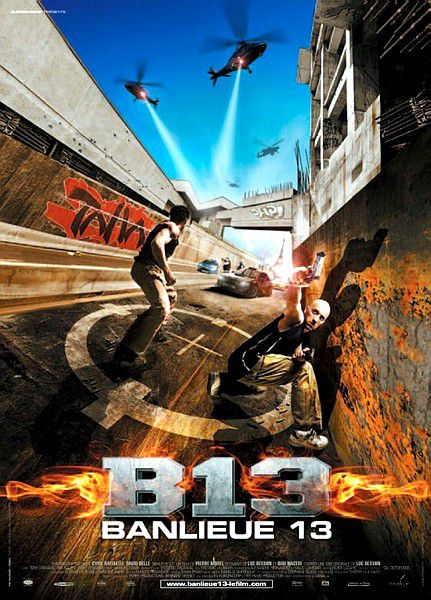
If the movies from French producer Luc Besson’s factory of B-grade actioners, District 13 (Banlieue 13, 2004) stands among the best. This is your typical martial arts-laden action extravaganza, filled with thumping techno music, a thin plot, and impressive stunts. But the increasingly prosaic clichés evident in Besson’s other films, which are also evident here, electrify with an uncommon kinetic energy. The action feels and looks real thanks to its stuntmen stars. The plot seems to have a social resonance behind it. And indeed the French soundtrack of techno and rap augments the no-holds-barred attitude of the movie.

The setting is Paris, 2010, which upon the release of this movie in 2004 was the future. Use your imagination. The city is plagued by unruly slums, and to isolate the problem areas, the government has erected a wall around a particular neighborhood known as District 13. The walls create a makeshift ghetto wherein all schools, all civil servants, and all hope has been evacuated. Inside, two million people are divided into various gangs and the police have no say, except that no one can leave through the guarded checkpoints. Drugs and crime run rampant on the streets within. Meanwhile, Elitist politicians would prefer to wipe this blotch off their maps entirely and start over.

Two heroes ban together to fight both a crime boss polluting the inside and political corruption stewing from outside the walls. One hero, Leïto (David Belle), comes from the slums. After being double-crossed by the local police, Leïto watches as his sister, Lola (Dany Verissimo), is taken hostage by the seedy gangster Taha (Bibi Naceri), and then he’s put in jail for 6 months to rot. Enter the other hero, supercop Damien (Cyril Raffaelli), who is commissioned by his superiors to go undercover, befriend Leïto, stage a prison break, and then use Leïto to sneak into District 13 to defuse a deadly bomb. The bomb was supposedly stolen from the government by the District 13 gangs, but this McGuffin proves to be slightly more complicated. And of course, Damien has only 24 hours to complete his mission.

Nevermind the plot, though. You’re not watching to find out what happens with Leïto, Damien, and the bomb. You’re watching to see the physical bravado of the two leads, as they demonstrate some of the most impressive stunts you’ve ever seen in any action movie. Belle and Raffaelli run across rooftops, leaping from building to building with ease. They scale obstacles and scuttle across walls like Spider-man. Whenever surrounded by a horde of goons, the heroes take them down without a minimum of fuss, exacting fisticuffs with a seemingly effortless precision. Through it all, they keep up a light banter that keeps the tone chummy and enjoyable.

Belle and Raffaelli are actual stuntmen and practitioners of a street-born, pseudo-martial art known as Parkour. According to the definition of those who practice it, “Parkour is the physical discipline of training to overcome any obstacle within one’s path by adapting one’s movements to the environment.” As opposed to a direct defensive strategy such as karate or jujitsu, Parkour involves running and jumping with fluidity, dodging obstructions with competence and speed through a complete awareness of one’s surroundings. But all you need to understand Parkour exists within this movie. The most amazing scenes aren’t those brimming with violence, they’re the chase scenes where Parkour skills are used to escape.

Director Pierre Morel, who would later helm Taken and From Paris with Love for the American market, exhibits clear and decisive action. The editing captures all the movements of Belle and Raffaelli with amazing clarity, whereas action movies nowadays so often rely on shaky-cam to disguise the stuntmen standing in for big-name stars. There’s nothing to hide in District 13, however, as Belle and Raffaelli complete the stunts and the fights themselves. Comparable to Jackie Chan in his heyday, these actors have the charisma, humor, and ability to advance themselves from stuntmen to stars, and they advance this movie from another dull actioner to must-see entertainment.

Watch District B13 on Tubi here: https://tubitv.com/movies/439503/district-b13

Saturday Matinee: The Secret of Roan Inish

By Roger Ebert

Source: RogerEbert.com

One day, many years ago, an ancestor of Fiona spied a beautiful creature sunning by the sea. She was both woman and seal. We would call her a mermaid, but on that western coast of Ireland such creatures were well-known as Selkies.

The ancestor trapped the creature and married her, and they had children together and lived happily, although she seemed to long for the sea. One day she learned where her husband had hidden her sealskin, up under the roof, and she put it back on, and returned to the sea.

Fiona (Jeni Courtney), who is 12 or 13 years old, is told this story by a relative. It is not told as a “fairy tale” but as an account of family history, to be taken quite seriously. And well might Fiona believe it, because ever since there have been dark-haired children in her family who were said to throw back to the Selkie, and whose eyes turned yearningly to the sea.

The year is about 1946. Fiona’s mother has died, and her father can barely be budged from his mourning in the pub. She is sent to live with her grandparents, on a sea coast across from the island of Roan Inish, where the whole family once lived. There she learns the story of her little brother Jamie, whose cradle was carried off by the waves. And there, with her grandparents and her cousin Eamon (Richard Sheridan), she first explores Roan Inish, which means, in Gaelic, “island of the seals.” The secret of John Sayles‘ “The Secret of Roan Inish” is that it tells of this young girl with perfect seriousness. This is not a children’s movie, not a fantasy, not cute, not fanciful. It is the exhilarating account of the way Fiona rediscovers her family’s history and reclaims their island. If by any chance you do not believe in Selkies, please at least keep an open mind, because in this film Selkies exist in the real world, just like you and me.

On Roan Inish, the girl sees a child’s footprint. Then she sees the child – Jamie! – running on the sand. She calls to him, but he gets back into his cradle, which is borne out to sea by friendly seals. Of course it is hard to convince grownups of what she has seen.

In the meantime, her grandparents face eviction from their cottage, which is to be sold to rich folks from the city. They may have to move inland. “To move off of Roan Inish was bad enough,” Fiona’s grandmother says, “but to move out of sight of the sea . . .” She shakes her head, making it clear that it would kill the grandfather, who thinks of the city as “nothing but noise and dirt and people that’s lost their senses!” Can Fiona and Eamon, her young cousin, restore the family’s old cottages on Roan Inish? Can she reclaim Jamie from the sea? I found myself actually caring. John Sayles and Haskell Wexler, who has photographed this movie with great beauty and precision, have ennobled the material. There is a scene where a person numbed by the cold sea is warmed between two cows, and we feel close to the earth, and protected.

One can easily guess how this legend could have been simplified and jollied up in other hands – how it could have been about cute little Selkies. But legends are, after all, told by adults, not children, and usually they record something essential to the culture that produces them. What this legend says, I think, is that the people who tell it live on the land but live from the sea, so that their loyalties are forever divided.

Of course this is a wonderful “family film,” if that term has not been corrupted to mean simpleminded and shallow. Children deserve not lesser films but greater ones, because their imaginations can take in larger truths and bigger ideas. “The Secret of Roan Inish” is a film for children and teenagers like Fiona, who can envision changing their family’s fate. It is also for adults, of course, except for those who think they do not want to see a film about anything so preposterous as a seal-woman, and who will get what they deserve.

Déjà Vu All Over Again

The Matrix, resurrected

By John Semley

Source: The Baffler

MIDWAY THROUGH 1999’S THE MATRIX, Keanu Reeves’s hacker-cum-cyberpunk-messiah Neo sees a black cat shivering in a doorway. Then, he sees it again. “Woah,” he utters, in that trademark, flat Keanu Reeves way. “Déjà vu . . . ” The phenomenon, Trinity (Carrie-Anne Moss) tells him, means big trouble. In the titular world-scale digital simulation in which the bulk of the film unfolds, déjà vu signals a computer glitch: a case of the simulation tweaking its code in real time.

One can’t help but be reminded of this idea watching The Matrix Resurrections, a long-gap sequel to the original sci-fi trilogy, which ended with Reeves’s Neo striking a détente between the machine overlords that enslaved mankind within a counterfeit reality and the fleshy human resistors who opposed them. The new film opens as the original does, following a heavily-armed SWAT team as they swarm a seedy motel room where a leather-clad hacker is plonking away at a computer terminal. The scene expands to introduce a new character, Bugs (Jessica Henwick), who notes to her compatriot that this familiar scene is a training module, designed to hone the skills of the digital heavies who patrol the parameters of the matrix. Or rather, a version of it that exists within the original matrix. It’s sixty years after the events of the last film, and nearly twenty years after its release. Things have gotten deeper—if only slightly.

The simulation now includes a popular video game trilogy—called, of course, The Matrix—that re-stages the events of the original films. Neo, too, is back, in his guise as Thomas Anderson. This time he’s not a computer programmer but a video game designer, whose “great ambition was to make a game indistinguishable from reality.” He’s the chief architect of the Matrix game trilogy, which has just seen a sequel green-lit within the fiction of both the matrix and The Matrix. (Matrix Resurrections was itself promoted with a tie-in video game demo, The Matrix Awakens.) Like William James’s image of our world resting on an infinite regress of rocks, it seems like it’s matrixes all the way down.

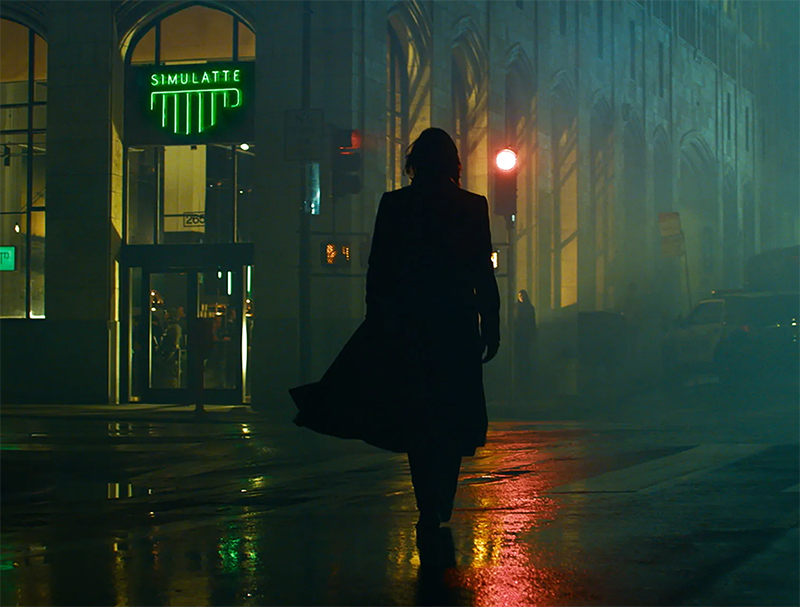
The planned game sequel prompts much hand-wringing. Characters bat ideas back and forth in an open-concept office, trying to get to the heart of what made the original Matrix work. Resurrections abounds with this sort of dorky meta-humor. There are jokes about the game design firm’s parent company being Warner Bros. (the actual film’s producer) and jokes about déjà vu. A fourth-wave coffee shop is called “Simulatte.” That kind of thing. It’s the sort of stuff that elicits barking, staccato guffaws from in-the-know audience members that quickly fade into barely bemused titters. It’s meant to be cute, but it’s mostly annoying.

Still, the film is not without its charms. Some of the early action scenes crack along reliably, playing with inversions of gravity and time, like a fleeter Christopher Nolan flick. And the notion of revisiting the world of the matrix is not without appeal. After all, the original film forecasted a world of digital disenfranchisement that is now, under the auspices of our current Silicon Valley overlords, regarded as aspirational. (In a telling touch, Resurrections moves the action from an implied Chicago to the Bay Area, explicitly marked by familiar landmarks and San Francisco PD cruisers.) And with its image of two pills representing diverging ideological bents, The Matrix provided a ready-made vocabulary that has been embraced in our real world, where everyone is redpilledblackpilledDanpilled, or Tedpilled. But Resurrections never manages to meaningfully intervene in the very conditions it seems to be diagnosing—and which the series had already diagnosed, decades ago. Like postmodernity itself, the state of digital dependency dramatized by The Matrix cannot be alleviated. It can only be mediated, with increasing levels of irony and winking self-awareness.

To wit: Resurrections is not about digitization, or the metaphysics of reality, or the broken promise of the cyberpunk genre. It is about movie reboots. Here, Neo must be liberated again, literally remaking his quest from the original film, with the obstacles re-skinned and old foes appearing in new guises (Jonathan Groff, playing the meddling computer program Smith, is a hunkier, paler imitation of the menacing Hugo Weaving). Characters snipe about how humanity is merely reframing the same handful of archetypal themes and ideas. “We’re still telling the same stories we’ve always told,” says one game designer, sounding like he’s been watching too many Jordan Peterson YouTubes. “Just with different names, different faces.” This may well be true. But it also feels like a cop-out. Especially because the original Matrix, as imagined by sororal duo Lilly and Lana Wachowski, felt genuinely inventive. It blended Terminator-styled dystopian sci-fi with Hong Kong wire-fu action and state-of-the-art special effects, all draped in the industrial liveries of a turn-of-the-millennium goth club. It may not have been wholly new. But it was thrilling remix. It spoke to the ennui of America at the “end of history.” It captured the soul-deadening, Dilbert-esque daily doldrums explored in films like Fight Club and Office Space. It also played straight to the anxiety around “Y2K” and the mounting cultural panic that home computers and toaster ovens might break down or turn against their owners. The Matrix felt like it was speaking to its time. Now, movies seem to chatter only among themselves.

There’s plenty of precedent here, of course: Ready Player Onethe recent Space Jam sequel; and the new Spider-Man movie, which draws together two decades worth of sticky narrative threads spun across three distinct franchises. Corporate wheeling-and-dealing is increasingly allegorized onscreen, to the point that many blockbusters are now about their own production. Within ten years, we’ll see Aaron Sorkin hoisting an Oscar overhead, rewarded by his peers for helming a chatty drama about the backroom legal finagling that saw a Star Wars-branded lightsaber licensed to the movie Free Guy. Hollywood is already lodged in the post-postmodern rabbit hole, with little to show for it. The culture is glitching, looping, stuck in some long, static interregnum, like a radio drifting between channels. If a new Matrix movie felt grimly inevitable in such a climate, it also had great potential.

And I suppose it’s nice that director Lana Wachowski (going solo this time) returned to wield some control over a story that would otherwise be expropriated however-which-way by the studio. But she has only a passing interest in the new convolutions of the simulation itself. Wachowski is more invested in revisiting Neo and Trinity’s wrenching, realities-spanning romance. Rather than the heady ideas at play in the premise—which have been by-and-large replaced by geeky in-jokes—she wants to explore (again) the profound power of love as some supernatural force. At its worst, the Wachowski worldview recalls that classic Simpsons joke: the secret ingredient is always capital-l Love.

This strain of touchy-feely sci-fi certainly has its admirers, and I sometimes count myself among them. But I find the Wachowskis’ sappiness (however earnest) more tolerable when enlivened by their stylistic and technical inventiveness. The rote, underdog rhythms of Speed Racer (2008) only work because they unfold within an aesthetic landscape that splits the difference between La Chinoise and Paper MarioThe Matrix’s heavy hooey about fate and choice and freeing one’s mind is leavened because, well, the movie is entertaining as hell. But now, the ideas are stale (2003’s The Matrix Reloaded already introduced the concept of its story being a remake), and the action settles into tedium: graceful bullet-time ballets are replaced by crunchy, John Wick-style fights and repetitive CGI set pieces that see Neo stopping hails of bullets with his hands, over and over and over again.

Perhaps there’s something modestly clever in the major meta-gesture of this newest Matrix—in its idea of the matrix reproducing its own destruction in the form of an interactive video game. After all, the notion that the very systems that delude us offer self-contained safe spaces for relieving those delusions is apt. Like capital, the matrix survives by evolving quicker than the forces that oppose it. If we take this message seriously, then the goodly thing to do is to ignore The Matrix Resurrections and all corporatized entertainments. To put down Twitter and TikTok and smooch our spouses; build a snowman with the kiddies; clink some beers with a gaggle of good buddies.

That we should all invest not in our virtual existences, but the fleshy, loving, contingent relationships of real life, is a perfectly decent message. That the Wachowskis have been repeating this tired line for two decades speaks despairingly to the conditions of our own, present-day dystopia. Resurrections is suspended between cyberpunk trappings that were already shopworn circa 1999 and the intellectual prison of high-concept meta-mongering. It is a movie of the interregnum, one that could have been auto-generated by it. In this way, The Matrix does manage to speak to the times. Again.

Saturday Matinee: Detective Dee: The Four Heavenly Kings

By Andrew Skeates

Source: Far East Films

Tsui Hark returns for a third go around in his fantasy blockbuster franchise, sending the titular Dee on another eye-boggling, mind-warping, wuxia-infused adventure. While the first instalment saw Andy Lau take on the title character, the first follow up, ‘Rise of the Sea Dragon’, saw a younger version of Dee (now played by Mark Chao) muddle his way through an assortment of fanatical situations. ‘The Four Heavenly Kings’ is a direct follow on from ‘Rise of the Sea Dragon’, with Chao and many of the core cast returning for another adventure which may just be the best in the series.

Due to his exploits in ‘Rise of the Sea Dragon’, Dee is rewarded the coveted Dragon Taming Mace: a near mythical and indestructible weapon. So coveted it is, that many a nefarious foe want to get their hands on it including Empress Wu (Carina Lau) who hatches a plan to steal it and discredit Dee using a band of mystical warriors. Coupled with the resurgence of a once deadly spiritual tribe, Dee soon finds all is not what it seems as sorcery weaves it evil way, and he and his fellow Bureau colleagues attempt to uncover the conspiracy and battle an ever increasing assortment of fantastical creatures and foes.

Much like the first two Dee flicks, ‘The Four Heavenly Kings’ is an often breathless fantasy blockbuster that doesn’t skimp on the wuxia action, CGI wonderment and imaginative scenarios. These days Tsui Hark is happy to play in the big budget, CGI sandbox and while his recent films have been a bit hit or miss, the ‘Detective Dee’ flicks have arguably been his most enjoyable blockbusters of late. While ‘Mystery of the Phantom Flame’ and ‘Rise of the Sea Dragon’ could be all over the place in tone and plotting ‘The Four Heavenly Kings’ finds Hark on more assured ground. Sure there is still a fair amount of convoluted plotting and subplot/secondary character development a-go-go which takes a while to digest as the narrative often rockets along, but on the whole this entry flows coherently.

Dee’s cohorts (Lin Gengxin and Feng Shaofeng) get fully fleshed character arcs and are just as integral to the plot and action as the lead, with Feng Shaofeng (as General Yuchi) all but stealing the film. This unfortunately means Dee feels somewhat like a supporting character in his own film but the team dynamic is a nice approach to this threequel and keeps the viewer guessing and often surprised as to where the narrative is going. While the film is packed with playful energy, energetic set-pieces and a good amount of silliness, ‘The Four Heavenly Kings’ also packs in a fair bit of menace, not least when the vicious Wind Warriors show up. A truly threatening foe, they add menace and bite to what is essentially a cartoon blockbuster, Hark wringing out some genuine tension every time they appear on screen.

As with the other Dee instalments (and most of Hark’s recent output), this entry is packed with CGI ingenuity which leads to some truly creative scenarios and characters. For the most part the CGI works (save for the odd wonky bit here and there) and blends into the environment and practical action well. Hark certainly can’t resist packing in as much CGI inventiveness as he can but come the finale it certainly works to deliver some truly eye frazzling action: complete with giant gorillas, squids and some sort of colossal demon made up of eyeballs!

If one isn’t a fan of this type of CGI laced, fantasy blockbuster then one is probably not going to get along with ‘The Four Heavenly Kings’ but if one is (and enjoyed the previous jaunts with Dee) then there is a lot of fun to be had here. Tsui Hark delivers a wickedly fun fantasy romp full of wondrous fight action and flights of fancy.

Watch the film on Tubi here: https://tubitv.com/movies/619638/detective-dee-the-four-heavenly-king

Saturday Matinee: A Midnight Clear

By James Berardinelli

Source: ReelViews.net

December 1944 in the Ardennes. The Battle of the Bulge is beginning. The snow is falling gently, coating everything in white. It’s here that the members of a small American Intelligence squad find themselves holed up in an abandoned house under orders from their commander, Major Griffin (John C. McGinley). Their mission: watch, listen, and report back if there are signs of enemy activity. The squad’s leader, Sgt. Will Knott (Ethan Hawke), is doubtful about things from the beginning. He is in command because he has survived thus far while six others haven’t. The oldest soldier, ‘Mother’ Wilkins (Gary Sinise), has suffered a mental breakdown following the long-distance news of the stillborn death of his child. The other four – Bud Miller (Peter Berg), Mel Avakian (Kevin Dillon), Stan Shutzer (Arye Gross), and ‘Father’ Mundy (Frank Whaley) – do their duty, although not all of them are happy about it.

There’s a group of Germans out in the forest – seven of them, as it turns out. Hitler’s war has so depleted the Germany army that they’re left with “old men and boys.” They’re tired and scared and, like many Axis soldiers in Europe, recognize that hope has fled. They don’t want to die so they seek an alternative to fighting. Surrendering to the Americans doesn’t seem like a bad one, as long as they can make it look like they were taken after a battle. The first challenge is to conquer the language barrier, something they attempt not with bullets but by stoking the Christmas spirit. After a tree, a few carols, and an exchange of gifts, the Germans and Americans are able to regard one another with something closer to trust than hostility. Until, of course, it all goes wrong. In war, it seems, that almost always happens.

A Midnight Clear is adapted from the novel of the same name by William Wharton. It is not based on a true story – there are no records of American and German soldiers fraternizing around Christmas during World War II – not in 1942, 1943, of 1944. Wharton may have been inspired in part by an incident from World War I, however. On December 25, 1914, the so-called “Christmas Truce” occurred – a series of unofficial cease-fires along the trenches of the Western Front. French, German, and British soldiers put aside their differences to talk, sing, and toast the season. (The 2005 film Joyeux Noel dramatized this.) There’s an echo of that in A Midnight Clear. Fiction, however, follows history. Once the holiday was over in 1914, many of the men who shook hands killed one another. In A Midnight Clear, the outstretched hand is ultimately cut off. Human nature is a fickle thing – the impulse to reach out to another is counterbalanced by a cold-hearted bloodthirstiness.

A Midnight Clear is a war story but it’s not like any other war story ever made. The characters (well, most of them at least) are nuanced. The situations are fluid and ambiguous. And there are no big battles. At one point, a character remarks that he doesn’t like this kind of war. He doesn’t want to meet the enemy. He wants to shoot them dead from afar, never knowing a thing about them. One of the most impactful aspects of A Midnight Clear is that when the time comes to kill, the targets are no longer faceless.

A Midnight Clear is powerful without being overbearing. It emphasizes the chaotic and nonsensical aspects of war without dragging the viewer into the trenches and burying him/her in mud. The movie is sad in a way that even a powerhouse picture like Platoon didn’t manage. The only villain here is circumstance, unless you count John C. McGinley’s Major Griffin, who is thankfully kept in the background except at the beginning and the end.

Speaking of McGinley, he represents one of two missteps on the part of Keith Gordon’s otherwise fine effort as a writer/director (this was his second film behind the camera). Griffin is written as a two-dimensional asshole and McGinley portrays him with cartoonish fluency. In a film where every other character has as many facets as a well-cut gemstone, Griffin feels like he stumbled into the wrong movie.

The other problem relates to a flashback detailing how the four youngest members of the group lost their virginity. A young woman named Janice (Rachel Griffin) opts to give herself selflessly to these soldiers rather than commit suicide (she’s despondent after learning of the death of her fiancé overseas). It’s a bit of wish-fulfillment that strikes a wrong chord no matter how hard Gordon tries to make the situation sympathetic.

The acting is uniformly strong, featuring a group of performers at the beginning of what would be long and productive careers. A little-known Ethan Hawke (with a previous role in Dead Poets Society) shows the charisma that would make him the go-to actor for many serious-minded directors. Gary Sinise, several years pre-Lt. Dan, makes the psychologically wounded Mother a suitably complex individual. Also featured are Peter Berg, Kevin Dillon, Arye Gross, and Frank Whaley. This may not be a “who’s who” of future A-list stars but it’s a strong roster of men who would become known for their ability to flesh out characters.

The typical movie set in and around Christmas embraces the mood of the season: Peace on Earth and Goodwill to All People. A Midnight Clear has a sharper and less idealistic perspective of things. Viewed through the lens of war, the absurdity of human nature is laid bare. We see the good, the bad, and the ugly – all packaged together in events spanning a few days leading up to December 25. It’s a reminder, as if any is needed, that, despite the birth being celebrated at Christmas, humankind is still very much in need of salvation.

Watch A Midnight Clear on Kanopy here: https://www.kanopy.com/product/midnight-clear

Saturday Matinee: In Time

A thought-provoking sci-fi thriller set in the future that taps into some of the most troubling inequities and problems of our era, the lack of time.

By Frederic and Mary Ann Brussat

Source: Spirituality and Practice

The best science fiction always uses some trend or policy of the present as a foundation and projects it into the future with a picture of some possible results. Through this glimpse of tomorrow, we can ponder anew the spiritual or philosophical ramifications of what we are doing today. In The Adjustment Bureau, we were given a chance to assess the idea of free will or the alternative of following a plan mapped out by God. In Gattaca the idea of genetically engineered perfection is explored. Writer and director Andrew Niccol who wrote and directed the latter thriller is also at the helm of this thought-provoking sci-fi drama that has many resonances with today’s world.

The Preeminence of Time

A search on Google for “time” yields more than 11 billion hits whereas there are fewer than 3 billion hits for “money” and 241 million hits for “sex.” Time is very much on our minds and at the hub of our concerns. We speak of “having” and “saving” and “wasting” time but we never seem to find a way of “conquering” it. We are caught up in the obsessive-compulsive need to make the most of the time we have each day. Pagers and cell phones are taken everywhere. We don’t want to miss a moment of connection.

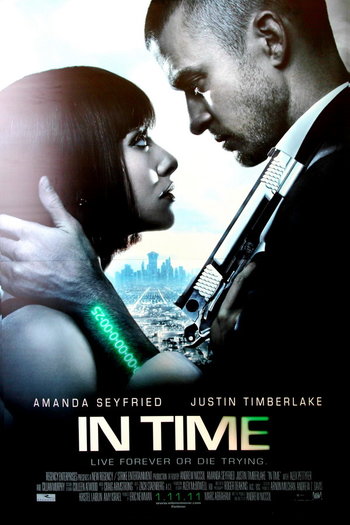
In Time is set in a future dystopia where living zones separate the rich from the poor. Will Salas (Justin Timberlake) lives in a ghetto zone with his mother Rachel (Olivia Wilde). She looks very young since all aging stops at 25.

Will works in a factory and she has a job as well, but still it is hard to make ends meet. Time in this society is literally money. Each person has a timer on his or her arm and at 25 you are given one year of free time after which you die — unless you can find a way to get more time. Wages are doled out in days of added longevity. All expenses (rent, a cup of coffee, clothes, phone calls) are paid for with time and scanners are used to deduct the time for the purchase. The biggest fear in the ghetto is that your time will run out unexpectedly. That is exactly what happens to Will’s mother.

Time Is Strange

“Time is stranger and deeper than anything else in our lives.”
— Jacob Needleman

The biggest dream in the ghetto is acquiring a surplus of years and the prospect of immortality. When Will saves a young man with a century on his clock, the fellow gives the years to him and then commits suicide. An intrepid “Timekeeper,” Raymond Leon (Cillian Murphy), is convinced that Will stole the years from the dead man. He launches a man hunt for him. Also hot on Will’s trail are some nasty time thieves.

Caught in Time

“Time is the element in which we exist. We are either borne along with it or drowned in it.”
— Joyce Carol Oates

Will begins a daring journey into the zone for the time rich called New Greenwich. After winning more than a millennium at a casino, he meets Sylvia (Amanda Seyfried), the daughter of Philippe Weis (Vincent Kartheiser), an immensely wealthy and powerful banker who has been exploiting the poor by making high interest time loans. A believer in “Darwinian capitalism,” he’s stored up enough years to be immortal. But Sylvia thinks there must be more to life than the favored existence she knows. She is intrigued by Will’s wild ideas about changing the system which favors the rich over the poor and allows many to die so a few can be immortal. After he takes her hostage when the Timekeeper is closing in on him, Sylvia doesn’t take very long to pledge her allegiance to what becomes their own mutual crusade. They begin robbing time banks and giving time to the poor and the down-and-out.

In Time is a winning sci-fi thriller that taps into some of the troubling problems of our era, such as the view of time as money, the growing gap between the rich and the poor, and all the ways that we waste time and fail to value every moment. It is also a meditation on the healing and restorative medicine of generosity and sharing. Writer and director Niccol has given us a cautionary tale about the possible future consequences of class consciousness, the high cost of trying to stay young or live forever, and the need for something more meaningful than just spending time to get ahead of the game.